Exposition of the Practical Operation of the Judicial and Revenue Systems of India
And of the General Character and Condition of Its Native Inhabitants, as Submitted in Evidence to the Authorities in England
Rammohun Roy
Originally published: 1832 · London: Smith, Elder and Co.
Akshara Digital Library · Machine Checked Edition · Public Domain (CC0 1.0)
Frontmatter
[p. i]
EXPOSITION
ON THE
JUDICIAL AND REVENUE SYSTEMS
OF INDIA.
[p. ii]
London:
Printed by Littlewood and Co.
Old Bailey.
[p. iii]
OF THE
PRACTICAL OPERATION
OF THE
JUDICIAL AND REVENUE SYSTEMS
OF
INDIA,
AND OF THE
GENERAL CHARACTER AND CONDITION OF ITS NATIVE INHABITANTS,
AS SUBMITTED IN EVIDENCE TO THE AUTHORITIES IN ENGLAND.
WITH
NOTES AND ILLUSTRATIONS.
ALSO
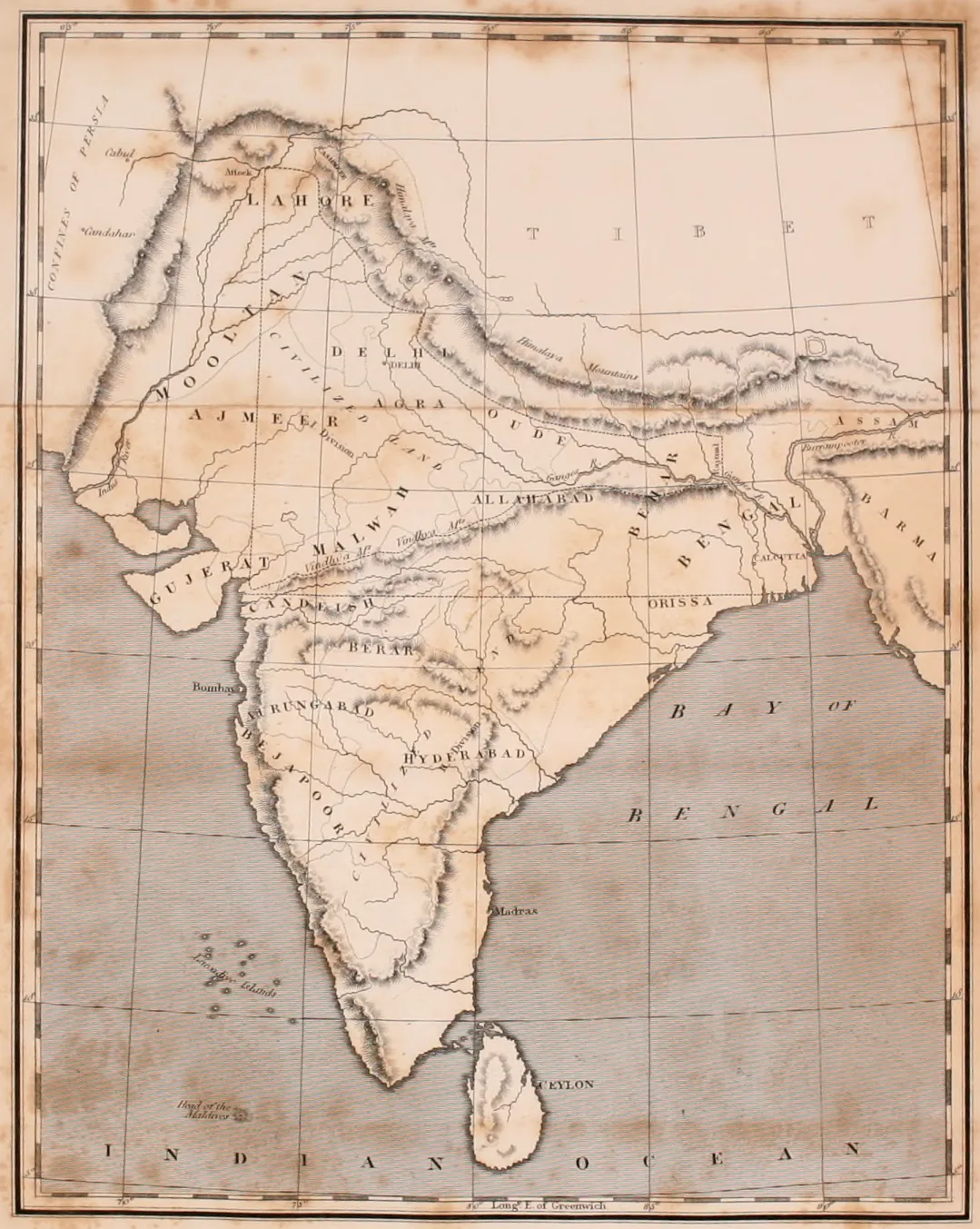
A BRIEF PRELIMINARY SKETCH OF THE ANCIENT AND MODERN BOUNDARIES, AND OF THE HISTORY OF THAT COUNTRY.
Elucidated by a Map.
BY RAJAH RAMMOHUN ROY.
LONDON:
SMITH, ELDER AND CO., CORNHILL.
1832.
Preliminary Remarks
[p. v]
Preliminary Remarks.
India, anciently called the “ Bhārat Varsha”* after the name of a monarch called “ Bharat”† is bounded on its south by the sea; on the east partly by this sea, and partly by ranges of mountains separating it from the ancient China, or rather the countries now called Assam, Cassay and Arracan; on the north by a lofty and extensive chain of mountains which divides it from Tibet; and on the west partly by ranges of mountains, separating India from the ancient Persia, and extending towards the Western Sea, above the mouth of the Indus, and partly by this sea itself. It lies between the 8th and 35th degrees of [p. vi] north latitude, and the 67th and 93d degrees of east longitude.*
Wide tracts of this empire were formerly ruled by different individual princes, who, though politically independent of, and hostile to each other, adhered to the same religious principles, and com monly observed the leading rites and ceremonies taught in the Sanscrit language, whether more or less refined. These tracts of land are separated [p. vii] from each other by rivers, or hills, or sometimes by imaginary lines of demarcation.
The part styled “ the civilized,” in the sacred writings of the Brāhmans, consists of two large divisions.*
The first is called “ the civilized and sacred land ;”† which, extending from the banks of the Indus at 34° north and 72° 25. east, in a south-easterly direction, along the foot of the Himālāyā mountains as far as 26° 30. north and 87° 30. east, lies between this line and the northern limits of the Vindhya range, which runs from 22° north and 73° east, to 25° north and 87° 30 east, through Rājmahāl, Behar, Benares, the Provinces of Allahabad, [p. viii] and of Malwa, along the north side of the Nerbudda, almost to the west coast of India. The second division is named merely “ the civilized land,” and is situated between the eastern and western coasts, terminating towards the east at the mouth of the Gānges, about 22° north, and 87° 30. east, and on the west towards the mouth of the Indus, at nearly 22° north, 72° 30. east, comprehending the large province of Guzrāt.
The countries situated beyond the limits of the civilized lands, as above described, whether mountains, valleys, or low lands, though included within the Bhārat Varsha, are declared to have been chiefly inhabited by Mlechhas, or barbarians, and were therefore called barbarous countries.*
In consequence of the multiplied divisions and subdivisions of the land into separate and independent kingdoms, under the authority of numerous princes hostile towards each other,† and owing to the successive introduction of a vast number of [p. ix] castes and sects, destroying every texture of social and political unity, the country, (or, properly speaking, such parts of it as were contiguous to foreign lands,) was at different periods invaded, and brought under temporary subjection to foreign princes, celebrated for power and ambition.
About 900 years ago, the Mahommedan princes, advancing by the north-west, began to ravage and over-run the country; and after continued efforts, during several centuries, they succeeded in conquering the best parts of India. Their rule was transferred in succession from one dynasty of conquerors to another (Ghazni, Ghor, and Afghān,) till 1525 of the Christian era, when prince Babur, a descendant of Tīmūr (or Tamerlane), in the fifth generation, established his throne in the centre of Hindūstān. His offspring (the Moghul dynasty) exercised the uncontrolled sovereignty of this empire * for nearly two centuries, (with the exception of about sixteen years) under a variety of changes, according to the rise or decrease of their power.
In the year 1712, the star of the Moghul ascendancy inclined towards descent, and has since gradually sunk below the horizon. The princes [p. x] oftener consulted their own personal comfort than the welfare of the state, and relied for success on the fame of their dynasty, rather than on sound policy and military valor. Not only their crowns, but their lives also, depended on the goodwill of the nobles, who virtually assumed independence of the sovereign power, and each sought his own individual aggrandizement.
At present, all the southern and eastern, as well as several of the western provinces of the empire, have gradually fallen into the possession of the English. The army they employed chiefly consisted of the natives of India, a country into which the notion of patriotism has never made its way. Those territories were in fact transferred to British possession from the rule of a number of the rebellious nobility. While the greatest part of the northern provinces beyond the river Sutlej has fallen into the hands of RunjeetSingh, the chief of a tribe commonly called Sikhs.
Akbar the Second, present heir and representative of the imperial house of Tīmūr, enjoys only the empty title of “ King of Delhi,” without either royal prerogative or power.
Runjeet Singh, sovereign of north-western India, (consisting of Lahore, Multan, Cashmere, and Eastern Cabul,) is considered highly gifted with prudence and moderation, and apparently inclined towards liberal principles; judicious in the discharge of public duties, and affable in private [p. xi] intercourse. The idea of constitutional government being entirely foreign to his mind, he has necessarily followed the same system of arbitrary rule which has been for ages prevailing in the country. The government he has established, although it be purely military, is nevertheless mild and conciliatory.
With regard to the circumstances under which a body of respectable English merchants (commonly known by the name of the Honorable East India Company) first obtained their Charter of Privileges in 1600, during the reign of Queen Elizabeth, to carry on trade with the East Indies ; and with respect to the particulars of their success in procuring from the Emperor of Hindoostan (Jahāngīr), and from several of his successors, permission to establish commercial factories, as well as the enjoyment of protection, and various privileges in that country; with relation further to their conquests, which commencing about the middle of the 18th century have extended over the greater part of India, — conquests principally owing to the dissensions and pusillanimous conduct of the native princes and chiefs, as well as to the ignorance existing in the East, of the modern improvements in the art of war, combined with the powerful assistance afforded to the Company by the naval and military forces of the crown of England, — I refer the reader to the modern histories [p. xii] of India,* such particnlars and details being quite foreign to the object which I have for the present in view.
The government of England, in the meantime, received frequent intimations of the questionable character of the means by which their acquisitions had been obtained and conquests achieved, and of the abuse of power committed by the Company's servants,† who were sent out to India from time to time to rule the territory thus acquired; and the impression in consequence was that the immense, or rather incalculable, distance, between India and England, impeding intercourse between the natives of the two countries, and the absence of efficient local check on the exercise of power by the Company's executive officers, as well as the hope of support from their influential employers in England, might lead many of them to neglect or violate their duties and bring reproach [p. xiii] on the national character. Under these apprehensions the British Parliament in 1773, by 13th Geo. III. commonly called the Regulating Act, declared that all territorial acquisitions by conquest or treaty belong to the state, and directed that all correspondence connected with their civil or military government should be submitted to the consideration of the Ministers; and subsequently in 1784, (by act 24th Geo. III. cap. 25.) a Board of Commissioners was established by the crown as a controul over the East India Company and the executive officers in India. The Board consists of a president, who usually has a seat in the British cabinet, and of several members, honorary and otherwise, with a secretary and other requisite subordinate officers. This institution has answered the purpose as far regards subjects of a general nature.
The system of rule introduced and acted on in India by the executive officers of the Company, previous to 1793, was of a mixed nature — European and Asiatic. The established usages of the country were for the most part adopted as the model of their conduct, in the discharge of political, revenue, and judical functions, with modifications at the discretion of the local authority. In addition to the exercise of the sovereign power, declared through policy to have been vested in them by the throne of Delhi, they continued to act in their commercial capacity with greater [p. xiv] success than previous to their sovereignty.* In consideration of the extensive territories acquired by the Company in different parts of India, they deemed it advisable to establish three governments at the three presidencies of Bengal, Madras and Bombay; the two latter being, since 1773, subordinate to the first in matters of a political nature.
The Marquis of Cornwallis, a straight-forward honest statesman, assumed the reins of government in Bengal in 1786.† He succeeded not only in consolidating the British power in its political relations in those remote regions; but also in introducing, in 1793, material changes in every department, particularly in the revenue and judicial systems. These changes approximating to the institutions existing in England, are calculated to operate beneficially, if regularly reduced to practice.
As my evidence respecting the government of India which will form the main body of this treatise gives a particular account of the practical operation of these systems, I refrain from a repetition of it in this place.
[p. xv]
From occasionally directing my studies to the subjects and events peculiarly connected with Europe, and from an attentive, though partial, practical observation in regard to some of them, I felt impressed with the idea, that in Europe literature was zealously encouraged and knowledge widely diffused; that mechanics were almost in a state of perfection, and politics in daily progress; that moral duties were, on the whole, observed with exemplary propriety, notwithstanding the temptations incident to a state of high and luxurious refinement; and that religion was spreading, even amid scepticism and false philosophy.
I was in consequence continually making efforts for a series of years, to visit the Western World, with a view to satisfy myself on those subjects by personal experience. I ultimately succeeded in surmounting the obstacles to my purpose, principally of a domestic nature; and having sailed from Calcutta on the 19th of November 1830. I arrived in England on the 8th of April following. The particulars of my voyage and travels will be found in a Journal which I intend to publish; together with whatever has appeared to me most worthy of remark and record in regard to the intelligence, riches and power, manners, customs, and especially the female virtue and excellence existing in this country.
The question of the renewal of the Honorable [p. xvi] East India Company's Charter* being then under the consideration of the government, and various individuals connected with India having been examined as witnesses on the subject, the authorities wished me also, as a native of that country, to deliver my evidence; which was, in consequence, given as in the following pages.
Although it has been printed among the other minutes of evidence taken before the select committee of the House of Commons, I deem it proper to publish it in a separate form, for the purpose of prefixing these preliminary explanations, and of accompanying it with notes and replies to remarks made thereon, by persons whose opinions are deserving of notice.
CONTENTS
[p. xvii]
CONTENTS.
I. Preliminary Remarks — Brief Sketch of the Ancient and Modern Boundaries and History of
India . . . . . . . . . . . . . . . . . . . . . . . . . . . . i—xvi
II. Questions and Answers on the Judicial System
of India . . . . . . . . . . . . . . . . . . . . . . . . . . . . 1—55
III. Do. Do. on the Revenue System of India.. 57—85
IV. A Paper on the Revenue System of India .. 87—89
V. Additional Queries, respecting the Condition of
India . . . . . . . . . . . . . . . . . . . . . . . . . . . . 101—111
London, Published by Smith, Elder & Co. 65, Cornhill.
II. Questions and Answers on the Judicial System of India
[p. 1]
QUESTIONS AND ANSWERS
ON THE
JUDICIAL SYSTEM OF INDIA.
1. Question. Have you observed the operation of the Judicial System in India?
Answer. I have long turned my attention towards the subject, and possess a general acquaintance with the operation of that system, more particularly from personal experience in the Bengal presidency, where I resided.
2. Q. Do you think that the system hitherto acted upon is calculated to secure justice?
A. The judicial system established in 1793, by Lord Cornwallis, was certainly well adapted to the situation of the country, and to the character of the people as well as of the government, had there been a sufficient number of qualified judges to discharge the judicial office, under a proper code of laws.
[p. 2]
3. Q. Explain particularly in what points you consider the practical operation of the system defective?
A. In the want of a sufficient number of judges and magistrates, in the want of adequate qualification in many of them to discharge the duty in foreign languages, and in the want of a proper code of laws, by which they might be easily guided.
4. Q. Can you explain what evils result from the want of a greater number of judges?
A. 1st, The courts being necessarily few in number in comparison to the vast territories under the British rule, many of the inhabitants are situated at so great a distance from them, that the poorer classes are in general unable to go and seek redress for any injury, particularly those who may be oppressed by their wealthier neighbours, possessing great local influence. 2ndly, The business of the courts is so heavy that causes often accumulate to such an extent, that many are necessarily pending some years before they can be decided; an evil which is aggravated by subsequent appeals from one court to another, attended with further delay and increased expence. By this state of things wrong-doers are encouraged, and the innocent and oppressed in the same proportion discouraged, and often reduced to despair. 3rdly, Such a mass of business transacted in foreign languages being too much for any one individual, [p. 3] even the ablest and best intentioned judge, may be disheartened at seeing before him a file of causes which he can hardly hope to overtake; and he may therefore be thus induced to transfer a great part of the business to his native officers, who are not responsible, and who are so meanly paid for their services, that they may be expected to consult their own interests.
5. Q. Will you inform us what evils arise from the want of due qualification in the judges?
A. It is but justice to state that many of the judicial officers of the company are men of the highest talents, as well as of strict integrity, and earnestly intent on doing justice. However, not being familiar with the laws of the people over whom they are called to administer justice by these laws, and the written proceedings of the court, answers, replies, rejoinders, evidence taken, and documents produced, being all conducted in a language which is foreign to them, they must either rely greatly on the interpretation of their native officers, or be guided by their own surmises or conjectures. In one case, the cause will be decided by those who in point of rank and pay are so meanly situated, and who are not responsible to the government or the public for the accuracy of the decision; in the other case, a decision founded on conjecture must be very liable to error. Still, I am happy to observe that there are some judicial officers, though very few in number, [p. 4] whose judgment and knowledge of the native languages are such, that in cases which do not involve much intricacy and legal subtlety, they are able to form a correct decision independent of the natives around them.
6. Q, Can you point out what obstructions to the administration of justice are produced by the want of a better code of laws?
A. The regulations published from year to year by the local government since 1793, which serve as instructions to the courts, are so voluminous, complicated, and in many instances, either too concise or too exuberant, that they are generally considered not a clear and easy guide ; and the Hindu and Mahommedan laws administered in conjunction with the above regulations, being spread over a great number of different books of various and sometimes doubtful authority, the judges, as to law points, depend entirely on the interpretations of their native lawyers, whose conflicting legal opinions have introduced great perplexity into the administration of justice.
7. Q. Is there any other impediment to the fair administration of justice besides these you have stated?
A. The first obstacle to the administration of justice is, that its administrators and the persons among whom it is administered have no common language. 2ndly, That owing partly to this cause and also in a great measure to the difference of [p. 5] manners &c., the communication between these two parties is very limited; in consequence of which the judges can with the utmost difficulty acquire an adequate knowledge of the real nature of the grievances of the persons seeking redress, or of the real character and validity of the evidence by which their claims are supported or opposed. 3dly, That there is not the same relation between the native pleaders and the judge as between the British bar and the bench. 4thly, The want of publicity owing to the absence of reporters and of a public press, to take notice of the proceedings of the courts in the interior: consequently there is no superintendence of public opinion to watch whether the judges attend their courts once a day or once a week, or whether they attend to business six hours or one hour a day, or their mode of treating the parties, the witnesses, the native pleaders or law officers, and others attending the courts—as well as the principles on which they conduct their proceedings and regulate their decisions; or whether in fact they investigate and decide the causes themselves, or leave the judicial business to their native officers and dependants. (In pointing out the importance of the fullest publicity being afforded to judicial proceedings by means of the press, I have no reference to the question of a free press, for the discussion of local politics, a point on which I do not mean to touch). 5thly, The great prevalence of perjury, [p. 6] arising partly from the frequency with which oaths are administered in the courts, having taken from them the awe with which they were formerly regarded, partly from the judges being often unable to detect impositions in a foreign language, and to discriminite nicely the value of evidence amongst a people with whom they have in general so little communication; and partly from the evidence being frequently taken, not by the judge himself but by his native officers (Omlah), whose good will is often secured before hand by both parties, so that they may not endeavour to detect their false evidence by a strict examination. Under these circumstances the practice of perjury has grown so prevalent that the facts sworn to by the different parties in a suit are generally directly opposed to each other, so that it has become almost impossible to ascertain the truth from their contradictory evidence. 6thly, That the prevalence of perjury has again introduced the practice of forgery to such an extent as to render the administration of justice still more intricate and perplexing. 7thly, The want of due publicity being given to the regulations which stand at present in place of a code of laws. From their being very voluminous and expensive, the community generally have not the means of purchasing them; nor have they a sufficient opportunity of consulting or copying them in the judicial and revenue offices where they are kept. As these are usually at a [p. 7] distance from the populous parts of the town, only professional persons or parties engaged in suits or official business are in the habit of attending these offices. 8thly, and lastly, Holding the proceedings in a language foreign to the judges, as well as to the parties and to the witnesses.
8. Q. In what language are the proceedings of the courts conducted?
A. They are generally conducted in Persian, in imitation of the former Mohammedan rulers, of which this was the court language.
9. Q. Are the judges, the parties, and the witnesses sufficiently well acquainted with that language to understand the proceedings readily?
A. I have already observed that it is foreign to all these parties. Some of the judges, and a very few among the parties, however, are conversant with that language.
10. Q. Would it be advantageous to substitute the English language in the courts, instead of the Persian?
A. The English language would have the advantage of being the vernacular language of the judges. With regard to the native inhabitants, it would no doubt, in the mean time, have the same disadvantage as the Persian; but its gradual introduction in the courts would still, notwithstanding, prove ultimately beneficial to them by promoting the study of English.
[p. 8]
11. Q. Does the native bar assist the judge, and form a check on the accuracy of the decisions?
A. It is no doubt intended to answer this most useful purpose, and does so to some extent; but, from the cause alluded to above (Ans. 7. No. 3.), not to the extent that is necessary to secure the principles of justice.
12. Q. Do the judges treat the native pleaders with the consideration and respect due to their office?
A. They are not always treated in the inferior courts with the consideration due to their office.
13. Q. To what do you attribute it, that the bar is not treated with respect?
A. The native pleaders are so unfortunately situated from there being such a great distance between them and the judges who belong to the rulers of the country, and from not being of the same profession, or of the same class as the judges, and having no prospect of promotion as English barristers have, that they are treated as an inferior caste of persons.
14. Q. Do not the native judicial officers employed under the judge assist him in his proceedings?
A. Of course they assist him, and that very materially.
15. Q. What kind of assistance do they render to the judge?[p. 9] A. They read the proceedings, viz. the bill (darkh'ast, or arzī), answers, replies, rejoinders, and other papers produced in the court; they write the proceedings and depositions of the witnesses; and very often, on account of the weight of business, the judge employs them to take the depositions of the witnesses: sometimes they make abstracts of the depositions and other long papers, and lay them before the judge for his decision.
16. Q. Are they made responsible with the judge for the proceedings held?
A. They are responsible to the judge, but not to the government or the public.
17. Q. Are not the judges assisted also by Hindu and Mohammedan lawyers, appointed to act as interpreters of the law?
A. They are: learned natives of this description being attached to the courts to give their opinion on the Hindu and Mohammedan law points which may arise in any case.
18. Q. Are natives of the country empowered to decide causes of any description?
A. Yes: there are native Munsifs, or commissioners, for the decision of small debts; and Sudder Aumeens who are authorised to try causes under five hundred rupees, whether connected with landed or moveable property.
19. Q. Are they qualified to discharge the duties entrusted to them?[p. 10] A. Many of them are fully qualified; and if proper care can be taken in the selection, all the situations might be filled with well-qualified persons.
20. Q. What is your opinion of the general character and conduct of the judges in their official capacity as such?
A. I am happy to state that in my humble opinion the judicial branch of the service is at present almost pure; and there are among the judicial servants of the Company gentlemen of such distinguished talents, that from their natural abilities, even without the regular study of the law, they commit very few, if any, errors in the administration of justice. Others are not so well gifted, and must therefore rely more on the representations of their native officers, and being free from any local check on their public conduct, their regularity, attention to business, and other judicial habits, are not equal to the wishes of their employers, nor calculated to give general satisfaction.
21. Q. Do they borrow money to any extent from the natives?
A. Formerly they borrowed to a great amount; at present this practice is discouraged.
22. Q. Why are the natives prevailed upon to lend to the judges, and other civilians, money to such an extent?
A. Natives not having any hope of attaining [p. 11] direct consideration from the Government by their merits or exertions, are sometimes induced to accommodate the civil servants with money, by the hope of securing their patronage for their friends and relatives, the judges and others having many situations directly or indirectly in their gift; sometimes by the hope of benefiting by their friendly disposition when the natives have estates under their jurisdiction; and sometimes to avoid incurring the hostility of the judge, who, by Regulation IX. of 1807, is empowered not only to imprison, but inflict corporal punishment, by his own authority under certain legal pretences on any native, whatever his respectability may be.
23. Q. What is your opinion of the judicial character and conduct of the Hindu and Mohammedan lawyers attached to the courts?
A. Amongst the Mohammedan lawyers I have met with some honest men. The Hindu lawyers are in general not well spoken of, and they do not enjoy much of the confidence of the public.
24. Q. What is your opinion of the official character and conduct of the subordinate native judicial officers?
A. Considering the trifling salaries which they enjoy, from 10, 20, 30, or 40 rupees to 100 rupees a month, (the last being the allowance of the head native officer only,) and the expenses they must [p. 12] incur, in supporting some respectability of appearance, besides maintaining their families; (the keeping of a palankeen alone must cost the head man a sum of between 20 and 30 rupees per month,) and considering also the extent of the power which they must possess, from their situations and duties as above explained (Q. 15.), and the immense sums involved in the issue of causes pending in the courts, it is not to be expected that the native officers, having such trifling salaries, at least many of them, should not avail themselves sometimes of their official influence, to promote their own interests.
25. Q. What is your opinion of the professional character and conduct of the pleaders?
A. Many pleaders of the Sudder Dewanee Adawlut are men of the highest respectability and legal knowledge, as the judges are very select in their appointment, and treat them in a way which makes them feel that they have a character to support. Those of the provincial courts of appeal are also generally respectable, and competent to the discharge of their duties. In the Zillah courts some respectable pleaders may also be met with, but proper persons for that office are not always very carefully selected; and in general, I may observe, that the pleaders are held in a state of too much dependence by the judges, particularly in the inferior courts, which must incapacitate [p. 13] them from standing up firmly in support of the rules of the court.
26. Q. Is bribery and corruption ever practised in the judicial department, and to what extent?
A. I have already intimated my opinion in the answers to Questions 20 and 24.
27 and 28. Q. Have the respectable and intelligent native inhabitants generally confidence in the purity of the Company's courts and the accuracy of their decisions; and have the native community confidence in the integrity of the subordinate judicial officers?
A. Whilst such evils exist as I have above noticed, in my reply to Queries 5, 6, and 7, as well as to Queries 20 and 24, the respectable and intelligent native inhabitants cannot be expected to have confidence in the general operation of the judicial system.
29. Q. Are the judges influenced in their decision by their native officers?
A. Those who are not well versed in the native languages, and in the Regulations of government, must necessarily be very much dependent on their native officers, as well as those who dislike to undergo the fatigue and restraint of business, which to Europeans is still more irksome in the sultry climate of India.
30. Q. Can you suggest any mode of removing[p. 14]the several defects you have pointed out in the judicial system?
A. As European judges in India are not generally expected to discharge judicial duties satisfactorily, independent of native assistance, from not possessing a thorough knowledge of the languages, manners, customs, habits, and practices of the people, and as the natives who possess this knowledge have been long accustomed to subordination and indifferent treatment, and consequently have not the power of commanding respect from others, unless joined by Europeans, the only remedy which exists is, to combine the knowledge and experience of the native with the dignity and firmness of the European. This principle has been virtually acted upon and reduced to practice since 1793, though in an imperfect manner, in the constitution of the courts of circuit, in which the Mufti (native assessor) has a voice with the judge in the decision of every cause, having a seat with him on the bench. This arrangement has tolerably well answered the purpose of government, which has not been able to devise a better system in a matter of such importance as the decision of questions of life and death, during the space of forty years, though it has been continually altering the systems in other branches. It is my humble opinion, therefore, that the appointment of such native assessors should be reduced to a regular system in the civil courts. They should be appointed [p. 15] by government for life, at the recommendation of the Sudder Dewanee Adawlut, which should select them carefully, with a view to their character and qualifications, and allow them to hold their situations during life and good behaviour, on a salary of from 300 to 400 rupees per mensem. They should be responsible to the government as well as to the public for their decisions, in the same manner as the European judges, and correspond directly with the judicial secretary. A casting voice should be allowed to the European judge, in appointing the native officers, in case of difference of opinion; the native assessor, however, having a right to record his dissent. These assessors should be selected out of those natives who have been already employed for a period of not less than five years as assessors (Mufti), lawyers (Zillah Court Maulavis), or as the head native officers in the judicial department.*
Par. 2. This measure would remove the evils pointed out in the answers to Q. 5 and to Q. 7. Nos. 1, 2 and 3, and also afford a partial remedy to the evils noticed in Nos. 5, 6 and 8 of Answer 7, as well as provide against the evils referred to in answer to Query 24.
Par. 3. In order however to render the administration [p. 16] of justice efficient and as perfect as human efforts can make it, and to remove the possibility of any undue influence which a native assessor might attempt to exercise on the bench under a European judge of insufficient capacity, as well as to do away the vexatious delays and grievous suffering attending appeals, it is necessary to have recourse to trial by jury, as being the only effectual check against corruption, which, from the force of inveterate habit, and the contagion of example, has become so notoriously prevalent in India. This measure would be an additional remedy to the evils mentioned in the reply to Query 5 and 7, Nos. 1, 2, 3, and 5, 6, 8, and also in the replies to Query 4, Nos. 2 and 3, as well as in Query 24.
Par. 4. With a view to remove the evils arising from want of publicity of the Regulations, as noticed in No. 7 of Ansr. to the Query 7, two or three copies in each of the principal native languages used in that part of the country should be kept in a building in the populous quarter of the town, under the charge of a keeper on a small salary, and all persons should be freely admitted to read and copy them at leisure from sunrise to sunset. The expence of this would not amount to two pounds a month for each station, and the benefits of it would be incalculable.
Par. 5. In order to remedy the evils arising from the distance of the courts as noticed at Question [p. 17] 4th Ansr. No. 1, I beg to suggest as follows : The Sudder Aumeens, or superior commissioners for the decision of causes under 500 rupees, afaffecting moveable or immoveable property, are at present stationed at the same place where the zillah judge holds his court, and plaints are at first laid before the judge, who turns them over to one of these commissioners at his own discretion ; consequently they afford no remedy for the great distance of the courts from many under their jurisdiction, as this often embraces a circle of 60 or 80 miles. I therefore propose that these Sudder Aumeens should be stationed at proportionate distances in different parts of the district, so that suitors may not have to travel far from their homes to file their bills and afterwards to seek and obtain justice ; and that one of the assistants of the judge should be stationed in a central position which might enable him (without any additional charge to government as I shall hereafter show) to visit and personally superintend these Aumeens, when the judge's station is on or near the border of his district. If it is otherwise situated, one of the assistants of the judge may remain at the head station with the judge and superintend the commissioners nearest to him, while another assistant being stationed at an appropriate distance, may superintend those who are more remotely situated from the first assistant. There will thus be as complete a check over them as under the present [p. 18] system, and justice will be brought home to the doors of a great majority of the inhabitants of each district, since causes under 500 rupees are exceedingly numerous in every Zillah or City Court.
Par. 6. These assistants may, at the same time, be very usefully employed in checking the dreadfully increasing crime of forgery, by which the course of justice is now so very much impeded in the judicial courts. Written documents of a diametrically opposite nature are, as is well known, constantly laid before these courts, and serve to confound justice and perplex a conscientious bench. Therefore under the proposed system of assistant judges' courts in two different quarters of a district, I would recommend, as highly necessary and expedient to check materially the practice of forgery, that parties to any deed should be required, in order to render the same valid, to produce it in open court before the nearest assistant judge, within a certain number of days from the time of its execution. This rule should apply* to all sorts of deeds, contracts and agreements regarding property above 100 rupees in value, such as wills and bills of sale, &c. and money bonds for debts payable at a certain period beyond six months, and upon receiving a fee of from one to two rupees, according to its importance, the assistant judge, [p. 19] after ascertaining the identity of the parties in open court, should immediately affix his signature as witness to the deed, and retain a copy of the same in a book of record kept on purpose, duly authenticated and marked to prevent the possibility of interpolation, or any other species of fraud. The sum above allowed as a fee on registering, with a small fixed charge per page for retaining a copy, would be more than sufficient to remunerate any extra trouble attending the duty and the labour of transcribing. To induce the proprietors of land and other respectable persons to appear without reluctance in open court on such occasions, they should be invariably treated with the respect due to their rank. Further to encourage the public to have papers registered, and to satisfy the government that no improper delay takes place in registering them, as well as to prevent the copyists from extorting perquisites, a book should be kept in which the party presenting a paper should in open court enter a memorandum of the day and hour on which he presented it for registration, and of the day and hour when it was produced and returned to him. This system would materially remedy the evil referred to in answer to Q. 7. No. 6.
Par. 7. The assistant judges should also receive appeals from the Sudder Aumeens, and try them in conjunction with a native assessor appointed by the Sudder Dewanee Adawlut, on a [p. 20] salary smaller than that of the judges' assessor, that is, perhaps not exceeding 200 rupees a month. In the event of difference of opinion between the assessor and the assistant judge on any case, it should be appealable to the Zillah judge, whose decision should be final; and as the Sudder Aumeens are now paid from the duties on the stamps used and the fees received on the papers filed, so the assistant judges' assessor may be paid in the same manner from the fees and stamps imposed on the appeal causes.
Par. 8. The assistant judge, though not empowered to interfere with the police officers of the interior in the discharge of their duties, should notwithstanding be authorised to receive written complaints of any abuse of their power from persons who feel themselves oppressed by the police, and to forward the same to the head magistrate of the district for his investigation; as very often the poor villagers or peasants are oppressed by the local police officers, but despair of any relief, from being unable to leave their homes and travel to a distance to the station to seek redress.
31. Q. Is trial by jury (or any thing resembling it) resorted to at present in any case?
A. The principle of juries under certain modifications has from the most remote periods been well understood in this country under the name of Punchayet.
[p. 21]
32. Q. What is the difference between the Jury system and the Punchayet?
A. The Punchayet exists on a very defective plan at present, because the jurors (members of the Punchayet) are not regular in their meetings, have no power to compel the attendance of witnesses, unless by appealing to the court; they have no judge to preside at their meetings and direct their proceedings, and are not guarded in any manner from partiality or private influence. They are in fact at present only arbitrators appointed by the court with consent of the parties in a cause, each party nominating one arbitrator and the judge a third; and sometimes both parties agree to refer the decision of the case to one arbitrator.
33. Q. Why and when was the Punchayet system discouraged?
A. It has not been totally discouraged, but rather placed on a different footing. In former days it was much more important in its functions. It was resorted to by parties at their own option, or by the heads of tribes, who assumed the right of investigation and decision of differences; or by the government, which handed over causes to a Punchayet.
34. Q. Do you really think the introduction of any system of jury trial or Punchayet would be beneficial?
A. Undoubtedly, as shewn by the 3d Par. of my answer to Question 30. Since a Punchayet [p. 22] composed of the intelligent and respectable inhabitants, under the direction of a European judge to preserve order, and a native judge to guard against any private influence, is the only tribunal which can estimate properly the whole bearings of a case, with the validity of the documentary evidence, and the character of the witnesses, who could have little chance of imposing false testimony upon such a tribunal.
35. Q. Do you think it would be acceptable to the inhabitants?
A. As the Punchayet even in its present very imperfect form is still practised by the inhabitants, it would without doubt be much more so, were it reduced to a regular system, guarded by proper checks, and dignified by judicial forms, which would inspire the whole community with higher respect and confidence for this ancient institution. But whatever length its popularity may go, it is the only system by which the present abuses consisting of perjury, forgery, and corruption can be removed.
36. Q. Will you explain, in detail, the modification of the Punchayet-jury system which you think best suited to the circumstances of the country?
A. I am of opinion that the Punchayet system should be adopted in conjunction with the plan above stated. (Q. 30.) It would be easy to adapt it to the object in view, without imposing any heavy [p. 23] duty on the respectable portion of the native community. Three jurymen, or at most five, would, I conceive, answer the purpose as well as a greater number, and any zillah (district) could easily supply a list from which these might be taken without inconvenience. Three times the number required for sitting on a trial should be summoned, and the persons actually to serve should be taken by lot, so that neither the judges nor the parties may be able to know beforehand what persons will sit on the trial of a cause. The general list of jurymen should be as numerous as the circumstances of the city or zillah (district) will admit. It should be prepared by the European judge at the station, and altered and amended by him from time to time as may seem proper and requisite. He may easily select well qualified juries from respectable and intelligent natives known to be versed in judicial subjects, who reside in considerable numbers at every station. A necessary concomitant to the introduction of jurymen will be the sole use of the vernacular dialect of the place to the exclusion of the Persian language in proceedings. Publicity should be as much fostered as possible, and the jury should be kept apart and required to decide without separating, as in the English courts of law. In a trial thus conducted the resort to appeal will cease to be useful, and for the purposes of justice, need only be allowed where there is a difference of [p. 24] opinion betwixt the bench and the jury. For, where judge and jury are unanimous, an appeal would be more likely to produce injustice by vexatious expense and delay, than to rectify error on the part of the inferior court, and ought therefore to be prohibited.
37. Q. Do you think the natives of the country qualified to discharge judicial functions of this nature, and from what class would you select the jurors?
A. They are assuredly qualified, as I observed before, in answer to Query 19, and the jurors at present may be judiciously selected from retired pleaders (wakīls) and retired judicial officers, from agents employed by private individuals to attend the court (mukhtars) who are generally well qualified, and from the other intelligent and respectable inhabitants as above observed (Answer to Q. 30 and 36.) To avoid any undue bias or partiality, both parties in a suit should have a right of objecting to any juryman, who can be shewn to have an interest in the cause, or particular connection with either party.
38. Q. Do you think the natives competent and eligible to all judicial situations, or only subordinate ones?
A. As many of them, even under the present manifold disadvantages, already discharge all the judicial functions, even the most arduous (see Q. 15.), it will not be very difficult, I think, with [p. 25] proper management, to find qualified persons amongst the natives for any duty that may be assigned to them. Many, however, as in other countries, are only fit for subordinate situations.
39. Q. What advantage do you conceive this Punchayet-jury system would possess over the judicial system now established?
A. First, from the thorough knowledge of the native character possessed by such a tribunal, and of the language of the parties and witnesses, it would not be so liable to error in its decisions. Secondly, the jury would be guarded from undue influence by the judge and his assessors. Thirdly, it would guard the assessor from the use of undue influence. Fourthly, it would secure the dispatch of business, and the prevention of delay, and of the need of appeals. The checking of perjury and forgery may also reasonably be hoped from it, besides many other advantages already pointed out.
40. Q. Are the provincial courts of appeal conducted on the same principles as the district courts to which you have referred?
A. As they are presided over by gentlemen of more experience and longer residence in the country, these courts are generally conducted with greater regularity.
41. Q. What is the nature of the difference existing between them?
A. Under the Bengal Presidency, in causes [p. 26] above 10,000 rupees, the action must be laid in the provincial court of appeal, and may be decided by one judge. This court takes cognizance also of any case of inferior amount below 10,000 rupees, which may be carried to it by appeal from the decision of, or proceedings held by, the judge of the city or district court, and from these provincial appeal courts, appeals can only be made to the Sudder Dewanee Adawlut, the highest civil tribunal.
42. Q. Can you point out any defects in the Sudder Dewanee Adawlut, and their remedies?
A. Government has always been very careful in its selection of judges for the Sudder Dewanee Adawlut, both as regards their ability and integrity; and they are fully competent to remove any defects which may exist in the court over which they preside. It is, however, highly desirable that judges of the Sudder Dewanee Adawlut should have the power of issuing the writ of habeas corpus, on seeing sufficient grounds for the exercise of this peculiar power, according to the practice of the English courts. But when the person imprisoned is situated at a greater distance from the Sudder courts than fifty miles, the judges of this court, to save useless expense, might direct one of the circuit judges, on whom they could best rely, to investigate the case, and report to them.
[p. 27]
43. Q. What other duties are assigned to the judges of the provincial courts?
A. They are a medium of communication between the Sudder Dewanee Adawlut and the inferior courts, and were also judges of circuit.
44. Q. How many provincial courts are there?
A. There are six provincial courts in the provinces attached to the Bengal Presidency, viz. that of Calcutta, Dhacca, Moorshedabad, Patna, Benares, and Bareilly.
45. Q. Are not the judges of the provincial courts still judges of circuit?
A. No: they were so formerly; but about two years ago the local government transferred the duties of judges of circuit from them to the revenue commissioners.
46. Q. Does any inconvenience arise from making the revenue commissioners also judges of circuit?
A. Such an union of offices is quite incompatible and injurious. The judge of circuit discharges duties of the highest importance, being invested with the power of life and death, and imprisonment during life in chains, the infliction of corporal punishment, and the confiscation of property. He is, besides, charged with the preservation of peace and good order in several extensive districts; and it is morally impossible, therefore, that he can fulfil the expectation of Government and the public, if his attention be at the same time engrossed [p. 28] and distracted by political, commercial, or revenue transactions. In criminal suits, moreover, he labours under a peculiar disadvantage, not being assisted by a bar composed of persons of liberal education, or by a body of honest, intelligent, and independent jurors. The former often proves of essential service to the bench in the king's courts, by able expositions of the law as applicable to every case, by great acuteness in cross-examining witnesses, and in the detection of false evidence; while the importance of the jury is universally acknowledged.
Par. 2. Formerly, when the judges of the provincial courts of appeal did the duties of the circuit, one or two of them used to remain at the station, to attend to the necessary current business, while the others (one, or sometimes two,) were on circuit. But on the present system, the commissioner of revenue being also judge of circuit, when he goes on circuit, all references to him, by the collectors under his jurisdiction, often remain unanswered, and the most important matters in the revenue business are entirely suspended for months together. Although the former Mohammedan governments were subject to the charge of indifference about the administration of justice, they yet perceived the evils liable to arise from an union of revenue and judicial duties. No judge or judicial officer empowered to try capital crimes, (as Cazees [p. 29] or Muftis) was ever suffered to become a collector of revenue.
Par. 3. The separation of these two offices has also been established by long practice under the British government, being one of the leading principles of the system introduced by Lord Cornwallis. Accordingly those young civilians who attached themselves to the revenue line of the service, have advanced by successive steps in that line; while those again who preferred the judicial, have been in like manner continued and promoted through the different grades in that department of public duty. Therefore, by overturning this system, a gentleman may now be appointed to discharge the highest judicial duties, who never before tried the most trivial cause; and another to superintend the collectors of revenue, to whose duties he has been all his life a stranger. Mr. E. R. Barwell, Revenue Commissioner and Judge of Circuit of the 24 Purgunnahs, Baraset, Jessore and Burrisal, is an example of the former case; and Mr. H. Braddon, Revenue Commissioner and Judge of Circuit of Burdwan, Jungul Muhal, and Hooghley is an instance of the latter.*
Par. 4. The remedy I beg to propose, without further expence attending the establishment, is to separate the duties between two distinct sets of [p. 30] officers, and double the jurisdiction of each. By this arrangement each gentleman discharging one class of duties would find them more easy and simple, though the field embraced was more extensive, and the expence would be the same as under the present system.
Par. 5. The duties of judges and magistrates are not so incompatible as those of the judges of circuit and the commissioners of revenue; but still separation of these duties is advisable on account of the great weight of the business in the Zillah and city courts. Therefore these two offices (the office of judge and that of magistrate) should be exercised by different individuals. However, the magistrates should assist the judges in the execution of their decrees or orders as they have hitherto done in those districts where the offices of judge and magistrate are separate.
47. Q. What delay generally takes place in the decision of causes?
A. In the Zillah courts a cause may be pending on an average about two or three years; in the courts of appeal four or five years; and in the Sudder Dewanee Adawlut the same period. But if the property in dispute amount to the value of about 50,000 rupees, so as to admit of an appeal to the king in council, the probable period of delay in the decision of such an appeal is better known to the authorities here than to myself.
48. Q. What is the cause of such delay?
[p. 31]
A. It must be acknowledged that irregularity in attending to the discharge of the judicial duties, and the want of proper discipline or controul over the judicial officers, are the main causes of obstruction in the dispatch of the judicial business; and these daily growing evils in every branch of the judicial establishment, have in a great measure defeated the object which the government had in view in establishing it. For example, a bill of complaint written on stamp, the first paper in a suit, cannot easily be got on the file unless it be accompanied with some perquisite to the native recorder, whose duty it is to ascertain, first, whether the sum in dispute correspond with the value of the stamp, an act which may be accomplished in a minute or a week, just as it suits the inclination of the examiner. The case is the same with respect to the issuing of the summonses prepared by another native officer, to command the attendance of the person sued, either in person or by a pleader to put in his answer. Summonses, subpœnas, and the processes of the provincial courts are issued against individuals through the judge of the district in which they reside, and a certain period is always allowed for the serving these processes; but neither are the Zillah judges, whose time is otherwise fully occupied, punctual in observing those subordinate duties, nor does the higher court, which is occupied by other important business, take any early notice of the expiration [p. 32] of the time allowed for making the return. The parties are therefore obliged to cultivate a friendly understanding not only with the officers of the provincial court, but also with those of the Zillah or city court. Whether the defendant attends immediately or long after the time allowed him, or whether he files his answer within the regular prescribed period, or a year afterwards, is treated as if practically immaterial. But delay unintentionally allowed to the parties in filing the requisite papers and in producing their documents and witnesses, is the too frequent source of great abuses; as the opportunity thus afforded by delay is embraced to invent stories and forge documents in support of them, to procure false witnesses and to instruct them in the manner that appears best calculated to serve the purposes in view.
Par. 2. Moreover, some of the judges are very irregular in calling on causes, choosing any day and any time that suits their convenience to occupy the bench singly. The pleaders being natives of the country have little or no influence over the conduct of the judges to prevent such irregularities, and dare not hint dissatisfaction.
Par. 3. I would suggest, with a view to remove irregularities originating in a want of official controul, without disregard to economy, that the head writer in each court be required to discharge this duty with some extra remuneration for the same, [p. 33] and be made strictly responsible under an adequate penalty, with proper sureties for his conduct, liable, jointly with him, for any fine he may incur, by want of punctuality proved against him by either party, on complaint to the judge of the court, or of a superior court, or to the judicial secretary.
Par. 4. This superintendant or clerk of the papers, should be required to place on the file in open court, bills of complaint as well as answers and replies, &c. within the period prescribed in Regulation IV. of 1793. These should not be admitted to the records after the time allowed, unless the judge, on motion publicly made, find sufficient reason for prolonging the period, say a week or two in particular cases.
Par. 5. The clerk of the papers should vigilantly watch that no delay takes place in issuing summonses, subpœnas, and other process of the court; and that the day on which these are ordered to be issued, and the day on which their return is expected should be correctly registered in a separate book kept on purpose.
Par. 6. In case of neglect or wilful disobedience, the superintendant of the papers should immediately submit the circumstance to the notice of the judge. Should the neglect be on the part of the prosecutor, the judge ought immediately to pronounce nonsuit, and if on the part of the defendant, proceed ex parte without allowing the [p. 34] neglect to be remedied. Or if the judge do not attend to these rules, the clerk of the papers should be bound to report the circumstance to the superior court, or the judicial secretary on pain of forfeiting his situation. A separate register of the returns should also be kept, as well as a register shewing the time when the defendant's answer must be filed — say one month from the day when the summonses are served, as is the case with equity suits in Calcutta; also shewing the hours during which the judge may attend on public duty, and likewise his occasional absence from court with the alleged cause thereof. The superintendant should transmit monthly a copy of each register, with his own remarks, to government through the secretary in the judicial department, for its particular attention to every breach of regularity therein mentioned.
Par. 7. With a view to the same end, every person who chooses should have a right to be present during the trial of causes in any court: the courts, as is generally the case at present, should be so constructed as to afford facilities for a considerable number of persons hearing and witnessing the whole proceedings: any one who chose should be entitled to make notes of the same and publish them, or cause them to be published, in any manner he may think proper for general information, subject to prosecution for any intentional error or misrepresentation that might be judicially proved [p. 35] against him before a competent tribunal, and to incur such penalty as it might award. This measure would tend to remove the evil pointed out in answer to Query 7, No. 4.
49. Q. What number of causes may be pending at one time, and undisposed of in the district courts and courts of appeal?
A. This depends partly on the comparative degree of industry and attention to business bestowed by the judicial officers, partly on the extent of the district, and amount of business within the jurisdiction of the respective courts. However the average number of causes pending may be ascertained by a reference to the registers kept, which are not at present accessible to me. My impression is that in some districts they are very numerous. But to shew how much the vigilance and activity of a public officer may accomplish, even in so extensive a district as Hoogley, I may mention that there, under Mr. D. C. Smith, every case is decided in the course of four, five or six months. In the courts of appeal the causes pending are very numerous. Conscientious and active as Mr. Smith is, he is often obliged, from the pressure of business, judicial and magisterial, to authorise his native judicial officers to take the depositions of witnesses in the civil suits.
50. Q. Could the number of appeal cases be reduced without any disadvantage?
A. Yes, certainly, not only without disadvantage [p. 36] but with great positive advantage. 1st, By introducing a more regular system of filing papers and bringing on causes, as above suggested, in answer to Q. 48. 2nd, By the aid of a jury and joint native judge, as proposed in reply to Q. 30. 3d, By allowing of no appeal unless when there is a difference of opinion in the zillah or city court in giving sentence, as noticed in reply to the Query 36. By these means the business would be at once conducted with more dispatch, and with more accuracy; so many litigious suits would not occur; and there would be very little need of appeals to revise the decisions.
51. Q. Has the right of appeal to the King in Council proved beneficial or otherwise?
A. Owing to the vast distance, the heavy expence, and the very great delay which an appeal to England necessarily involves, owing also to the inaccuracies in the translations of the papers prepared after decision and sent to this country, and to other causes, I think the right of appeal to the king in council is a great source of evil and must continue to be so, unless a specific court of appeal be created here expressly for Indian appeal causes above 10,000l. At the same time to remove the inaccuracies above noticed, three qualified persons (a European, a Mussulman, and a Hindu) should be nominated joint translators, and the translations should be furnished within one year from the conclusion of the proceedings in India, and both [p. 37] parties should be allowed to examine the accuracy of the translations thus prepared.* But if the appellant neglect to pay the fees of translation within two months after the decision, the appeal should be quashed.
52. Q. What is the nature of the duties assigned to the revenue commissioners?
A. They exercise a general superintendence and controul over the revenue collectors, with powers similar to those vested in the board at Calcutta, formerly called the board of revenue, and in the board of commissioners for the upper provinces. That board at Calcutta is now the superior authority to which an appeal may be made from the decisions of the present commissioners, (it is in consequence now generally termed the Sudder or supreme board), and thence to the government itself. In other words the office of commissioner is a substitute for the board of revenue, but an appeal being allowed from the one to the other, of course there is abundance of appeals and [p. 38] a great part of the business is thus transacted twice or thrice over.
53. Q. What is the nature of the duties assigned to them as judges of the circuit?
A. As judges of circuit they exercise control over the magistrates, and try the higher classes of criminal causes, which involve a question of life or death, or severe punishment; and an appeal lies from them to the Sudder Nizamut Adawlat, the highest criminal tribunal.
54. Q. Does not the discharge of one class of duties interfere with the discharge of another class, which seems to be of a very different nature?
A. As above noticed (Ans. to Q. 46.), while they are engaged in the duties of their circuit court, the reports and references from the revenue collectors must remain for several months unanswered; and not only do the people suffer in consequence, but the public business stagnates, as already observed.
55 and 56. Q. What is the nature of the functions of the judge of circuit, and his native law assessor? Do they afford each other reciprocal assistance in the discharge of their duties?
A. Both take cognizance of the charges brought before the magistrates and sent to their court; both hear the evidence and examine the witnesses, and both give their voice in passing the [p. 39] decision, as I observed in Par. 1st, of my Ans. to Q. 30. In a vague sense the Mohammedan law assessor may be considered as analagous to the jury in English courts, while the European judicial officer is the judge.
57. Q. Are the judges generally competent to the discharge of their duties?
A. Some of them are highly qualified; but it is not expected that European judges should be generally competent to determine difficult questions of evidence among a people whose language, feelings, and habits of thinking and acting are so totally different from their own.
58. Q. Are the native law assessors generally competent?
A. They are generally so: some of the Muftis (Mussulman law assessors) are men of such high honour and integrity, that they may be entrusted with the power of a jury with perfect safety; and they are all of the most essential utility, and indeed the main instrument for expediting the business of the criminal courts. However highly or moderately qualified the European judges may have been, the business has been advantageously conducted through the assistance and co-operation of these Mohammedan assessors for a period of 40 years past.
59. Q. If they should differ in opinion, what course is adopted?[p. 40] A. The case is then referred to the Nizamut Adawlat (the highest criminal tribunal).
60. Q. What course do the judges of the Nizamut Adawlat adopt?
A. If the judge of the supreme criminal court, before whom the referred case comes, should, after consulting with the Muftis of that court, concur in the opinion of the circuit judge, his decision is confirmed and carried into execution. But should the Sudder Nizamut (supreme criminal) judge differ from the opinion of the circuit judge, the case is then submitted to a second, or if necessary, to a third Sudder Nizamut judge, and the opinion given by two Sudder judges against one, is final.
61. Q. Are the judges of the supreme criminal court also judges of the highest civil court?
A. Yes; and very deservedly.
62. Q. Are they generally competent to the discharge of their duties?
A. I have already observed (Q. 42.) that they are highly competent.
63. Q. As it is of the highest importance that the courts of circuit should be above all corruption; can you suggest any means of improving them?
A. Courts which have the disposal of life and death are undoubtedly of very high importance; [p. 41] and I would therefore propose instead of only one law assessor (who stands in place of a jury) that three or five (at least three) law assessors should be attached to each court, while trials are going on.
64. Q. From what class of men would you select the juries in the criminal courts?
A. The criminal law now established in India has been very judiciously founded on the Mohammedan criminal law. It has however been so greatly modified by the acts of government from time to time since 1793, that it, in fact, constitutes a new system of law, consisting partly of its original basis, and partly of the government regulations. But it has been made a regular study only by the respectable Mohammedans, who when they attain a certain proficiency are styled Maulavies, a term equivalent to Doctors of Law. Formerly two of these were attached to each court of circuit, and one to each district court. Of late the office of Maulavi of circuit having been abolished, the Maulavi or Mufti of the Zillah (district) court has been ordered by government to officiate as Mufti of circuit, while the judge of circuit is engaged in the trial of the criminal causes of that district. Thus he alone, as assessor of the judge of circuit, is entrusted with the powers usually assigned to a jury in a British court; having the power of delivering his opinion on every case at the close of the trial.
Par. 2. With a view to lessen the abuse of the [p. 42] great power thus given, it is highly desirable that government should adopt the following precaution : The judge of circuit previous to his departure for any Zillah (district) or city to try criminal causes, should summon, through the magistrate, one or two additional Maulavis attached to the adjacent courts, with a few other learned, intelligent and respectable inhabitants of that district or city, to join him on his arrival with a moderate extra allowance for their services, and every morning before he takes his seat on the bench, the judge should, without previous intimation, direct three of them to sit with him during the whole trials that may come on for that day as his law assessors ; and they should be required to deliver their opinions in each case in open court, immediately after the close of the proceedings, without previous opportunity of communicating with any one whatever, on the same principle as an English jury : and the judge should immediately inform the parties of the verdict, to put an end to all intrigues. The judge of circuit should also be required to keep a vigilant watch over the proceedings of the magistrates within his jurisdiction, and to institute an investigation personally and on the spot, into any complaint preferred against them, whenever he sees sufficient ground for adopting this prompt measure ; and the judge of circuit only should have the power of inflicting corporal punishment; not any [p. 43] magistrate as injudiciously authorised by Regulation IX. of 1807, Sec. 19th.
65. Q. What would be their duty? precisely like that of a jury, or like that of the law assessors as hitherto employed?
A. More resembling that of the law assessors as hitherto employed. The difference between them is not important, and the result would be the same.
66. Q. Should not the jury be selected from persons of all religious sects and divisions?
A. Since the criminal law has hitherto been administered by the Mohammedans; to conciliate this class, the assessors should still be selected from among them, until the other classes may have acquired the same qualifications, and the Mohammedans may become reconciled to co-operate with them.
67. Q. Do you think any alteration necessary in the system of criminal law now established?
A. As the criminal laws now established are already in general very familiar to the natives, I think they may better remain in their present state, until the government may be able to introduce a regular code.
68. Q. In what manner do you think a code of criminal law could be framed suitable to the wants of the country?
A. A code of criminal law for India should be [p. 44] founded as far as possible on those principles which are common to, and acknowledged by all the different sects and tribes inhabiting the country. It ought to be simple in its principles, clear in its arrangement, and precise in its definitions ; so that it may be established as a standard of criminal justice in itself, and not stand in need of explanation by a reference to any other books of authority, either Mohammedan or Christian. It is a subject of general complaint that persons of a certain high rank, however profligate some of them may be, are, from political considerations, exempted from the jurisdiction or controul of the courts of law. To remedy this inconvenience, in the proposed code, so as to give general satisfaction, without disregarding the political distinctions hitherto observed, it may perhaps be expedient for government to order such persons to be tried by a special commission, composed of three or more persons of the same rank. This very regulation, when once known to them, would, in all probability, deter them from committing any very gross act of tyranny or outrage upon their dependents or others.
69. Q. What period of time would it take to frame such a code, and by whom could it be done satisfactorily?
A. It must require at least a couple of years to do it justice ; and it ought to be drawn up by persons, thoroughly acquainted with Mohammedan [p. 45] and Hindu law, as well as the general principles of British law.
70. Q. Are the judges capable of regulating their proceedings by such a code of laws?
A. At present they are not generally capable of performing their judicial duties independent of the aid of the assessors; but with a proper code, as above supposed, they might most of them, in no great period, by making it a regular study, become much more capable of administering justice by it than they are by the present system.
71, 72. Q. Would not the detention of the young civilians in England to obtain a regular legal education be injurious by delaying their proceeding to India for several years, at that period of life, when they are best capable to acquire the native languages? Do you conceive that any disadvantages arise from civilians going out at an early age?
A. This is a subject which merits the deepest consideration of the legislature. Young men sent out at an early age, before their principles are fixed, or their education fully matured, with the prospect of the highest power, authority, and influence before them, occupying already the first rank in society immediately on their arrival, and often without the presence of any parent, or near relative to advise, guide or check them, and surrounded by persons ready, in the hope of future [p. 46] favours and patronage, to flatter their vanity and supply money to almost any extent to their too easily excitable passions — are evidently placed in a situation calculated to plunge them into many errors, make them overstep the bounds of duty to their fellow creatures and fellow subjects, and to relax whatever principles of virtue may have been implanted in their yet inexperienced minds. The excuse made for so injudicious an arrangement, that it is favourable to the acquisition of the native languages, is of no weight; for it may be observed that the missionaries, who are usually sent out at the age of from 25 to 35 years, acquire generally in two or three years so thorough a knowledge of these languages as to be able to converse freely in them and even to address a native audience with fluency in their own tongue. In fact the languages are easily acquired at a mature as well as at an immature age by free communication with the people. Moreover, by the system of native assessors, juries and other helps to the judges and magistrates, and by the gradual substitution of English for Persian, as above proposed, so extensive and minute a knowledge of the native languages would not be requisite, In short from the present system of sending out youths at so early an age very serious evils arise to themselves, as well as to the Government, and to the public. 1st, With respect to themselves, they are too often seduced into habits which [p. 47] prove ruinous to their health and to their fortunes, becoming thereby involved in debts from which many of them are never afterwards able to extricate themselves without having recourse to improper means. 2dly, These embarrassments interfere very seriously with their duty to Government and the public, as the persons to whom they are indebted generally surround them, and seize every opportunity of enriching themselves which their situation and influence put in their way. 3dly, Their indiscreet choice of native officers from youthful partialities, and the thoughtless habits acquired in early days, amid power and influence, prove very injurious to the community. Therefore no civil servant should be sent to India under 24 or at least 22 years of age, and no candidate among them should be admitted into the judicial line of the service, unless he can produce a certificate from a professor of English law to prove that he possesses a competent knowledge of it. Because, though he is not to administer English law, his proficiency therein will be a proof of his capacity for legal studies and judicial duties, and a knowledge of the principles of jurisprudence as developed in one system of law will enable him to acquire more readily any other system; just as the study of the ancient and dead languages improves our knowledge of the modern tongues. This is so important, that no public authority should have the power of violating the [p. 48] rule, by admitting to the exercise of judicial functions any one who has not been brought up a lawyer.
73. Q. How are the laws of inheritance regulated?
A. The property of Mohammedans descends and is divided according to their own law of inheritance ; and the property of Hindus according to theirs ; and of other sects also agreeably to their respective laws of inheritance.
74. Q. What books do the Hindu lawyers officially attached to the courts follow as law authorities?
A. There are various books, but in Bengal they chiefly follow the Dāyabhāga, with occasional reference to other authorities ; and in the western province, and a great part of the Dakhan they follow the Mitaksharā principally.
75. Q. What books do the Mahommedan lawyers follow as authorities?
A. The majority of the Mussulmans of Hindustan follow the doctrines of Abū Hanīfah and his disciples ; consequently the Hidāya is their chief law authority ; but they also refer to some other books of decision or cases, such as the Fatāwae Ālamgīrī and others.
76. Q. Is there any mode by which the law authorities, now so voluminous and perplexing, might be simplified in such a manner as to prevent the native lawyers[p. 49]from misleading the courts, and confounding the rights of property?
A. To effect this great and pre-eminently important object, a code of civil law should be formed on similar principles to these already suggested for the criminal code, and this, as well as the former, should be accurately translated, and published under the authority of government. By printing off large impressions, and distributing them, at prime cost, in the current languages of the people, they might render the rights of property secure; since, these being clear and well known to the whole community, it would be impossible for any designing man to induce an intelligent person to enter upon litigious suits. The law of inheritance should, of course, remain as at present with modifications peculiar to the different sects, until by the diffusion of intelligence the whole community may be prepared to adopt one uniform system. At present when a new regulation, drawn up by any officer of government and submitted to it, is approved of, it immediately becomes law when promulgated, the same as an act of parliament in this country, when approved of, discussed, and sanctioned by king, lords and commons. From the want of sufficient local knowledge and experience on the part of the framers of such regulations, they are often found not to answer in practice, and the local government is thus frequently obliged to [p. 50] rescind the whole or part of them. I would therefore suggest that if any new regulation be thought necessary before the completion of the civil and criminal codes above proposed, great care and precaution should be observed in its enactment. With this view every such project of law before it is finally adopted by the government, should be printed and a copy sent directly from government, not only to the Judges of the Sudder Dewanee Adawlat, and the members of the Board of Revenue &c., but also to the advocate-general on the part of the Honourable Company, to the principal Zamindars, such as the Rajahs of Burdwan, Behar, Benares, &c., and to the highly respectable merchants such as Jaggat Set at Murshedabad, Baboo Bajnath at Patna, and the representatives of Baboo Manōhar Dass at Benares, also to the Muftis of the Sudder Dewannee Adawlat, and the head native officers of the Boards of Revenue, for their opinion on each clause of the Regulation to be sent in writing within a certain period. Because these being the persons who are affected by the Regulations, they will be cautious of recommending any that is injurious.* It should still be optional, however, with government to be guided or not by their suggestions. [p. 51] But a copy of the minutes made by the different parties above named should accompany the Regulations, when these are to be transmitted to England for the consideration of the court of directors, and parliament; and there should be a standing committee of the House of Commons, to take the whole regulations and minutes into consideration, and report to the House from time to time on the subject, for their confirmation or amendment.
In such matters as those of war and peace, it may be necessary that the local government should act on its own discretion and responsibility according to existing circumstances, notwithstanding the opinion of the government in England. But as the affairs of India have been known to the authorities in Europe, for such a series of years, in matters of legislation, the local government should be bound to carry into effect any regulations or orders in judicial and revenue matters sent out, formally enacted by the British government, or the Court of Directors under the express sanction of the Board of Commissioners for the controul of the affairs of India, although the local Government might still remonstrate against them to the home authorities.
The attention thus shewn by the government at home and abroad, to the feelings and interests of the Zamindars, and merchants, as principal members of the community, though it would not [p. 52] confer upon them any political power, would give them an interest in the government, and inspire them with greater attachment to it, and also the whole community, as being under their influence, and in general receiving its opinions from them.
77. Q. Should the civil servants, in the judicial and revenue departments, be educated expressly for the particular line of the service in which they are engaged, or is it advantageous to transfer them from one branch of it to another?
A. It is found by experience that persons, by long habit in the performance of any particular duties, become not only more dexterous in but more reconciled and even attached to them, and find them less irksome than others to which they have not been accustomed. In my humble opinion, the duties of a judge are not inferior in difficulty to those of any other profession whatever, nor is the qualification requisite for them to be acquired with less experience. It has been alleged that the revenue officers, when converted into judicial officers, must be better judges of revenue causes; But on this principle, commercial officers ought to become judges for the sake of commercial causes, agriculturists for agricultural causes, and mechanists for mechanical disputes. However, as matters of revenue, commerce, agriculture, &c. are decided on the general principles of law and justice, any such special preparation has never [p. 53] been found necessary: therefore these two classes of duties should be kept quite distinct, if it is wished that either of them be performed well.
78. Q. Can you offer any other suggestions for the improvement of the Judicial Establishment?
A. 1st. In order to keep the judicial officers above temptation, their salaries should not be reduced. 2dly. With the additional aids and checks of joint native judges, assessors, and juries above proposed, (Ans. to Q. 30.) all civil courts of appeal may be dispensed with, except the supreme civil court (Sudder Dewanee Adawlat,) and thus a very considerable saving may be effected by the government. One tenth of this saving will suffice to support all the native assessors, juries &c. above recommended (Q. 30.) 3dly, By gradually introducing the natives into the revenue departments under the superintendance of European officers, (as I proposed in my Appendix A, on the revenue system,) and in the judicial department in co-operation with them, the natives may become attached to the present system of government, so that it may become consolidated, and maintain itself by the influence of the intelligent and respectable classes of the inhabitants, and by the general good will of the people, and not any longer stand isolated in the midst of its subjects, supporting itself merely by the exertion of superior force.
[p. 54]
Par. 2. Should the gradual introduction of the natives into places of authority and trust as proposed, be found not to answer the expectations of Government, it would then have the power of stopping their farther advancement, or even of reversing what might have been already done in their favour. On the contrary, should the proposed plan of combining Native with European officers have the effect of improving the condition of the inhabitants and of stimulating them with an ambition to deserve the confidence of the government, it will then be enabled to form a judgment, of the practicability and expedience of advancing natives of respectability and talent to still higher situations of trust and dignity in the state, either in conjunction with or separately from their British fellow subjects.
Par. 3. In conclusion, I deem it proper to state, that in preparing my replies to these queries, I have not been biassed by the opinions of any individual whatsoever; nor have I consulted with any person or even referred to any work which treats on the subject of India. I have for the facts consulted only my own recollections; and in regard to the opinions expressed, I have been guided only by my conscience, and by the impressions left on my mind by long experience and reflection. In the improvements which I have ventured to suggest, I have kept in view equally the interests of the governors and the governed; [p. 55] and without losing sight of a just regard to economy, I have been actuated by a desire to see the administration of justice in India placed on a solid and permanent foundation.
(Signed,) rammohun roy.
london, Sep. 19th, 1831.
III. Do. Do. on the Revenue System of India
[p. 57]
QUESTIONS AND ANSWERS
ON THE
REVENUE SYSTEM OF INDIA.
1. Question. By what tenure is land held in the provinces with which you are acquainted?
Answer. In the provinces of Bengal, Behar, and part of Orissa (Midnapoor), land is now held by a class of persons called Zamindars (i. e. landholders), who are entitled to perpetual hereditary possession, on condition of paying to government a certain revenue, fixed on their respective lands. This is termed the Zamindary system. But in the ceded and conquered provinces belonging to the Presidency of Fort William, no fixed agreement has yet been made with the Zamindars as to the amount of assessment. Consequently their estates are not in their own hands, but under the immediate management of government, and subject to fresh assessments from time to time at its discretion.
[p. 58]
In the Madras Presidency, the revenue is, for the greater part, collected directly from the cultivators, (called Ryots), by the government revenue officers, according to the rate fixed on the different descriptions of land in various situations. These cultivators may retain possession as long as they pay the revenue demanded from them.
2. Q. By what tenure was land held under the former government?
A. Under the Mohammedan government, lands were held by hereditary right on the Zamindary system (though the revenue was sometimes arbitrarily encreased); and the Zamindars were considered as having a right to their respective estates, so long as they paid the public revenue. They were at the same time responsible for any breach of the peace committed within the limits of their estates. In this manner many estates, some of which can yet be referred to, such as Vishnupoor, Nuddea, &c., continued in the same family for several centuries.
3. Q. Do persons of all religious sects hold by the same tenure?
A. No religious or other distinctions were observed under the former government in regard to the holding of land; at present, Europeans are interdicted by law from becoming proprietors of land, except within the jurisdiction of the British courts of law at the three presidencies, Calcutta, Madras and Bombay.
[p. 59]
4. Q. Are the estates most usually large or small?
A. In the Bengal presidency the estates are many of them considerable, and there are many others of various smaller dimensions; but in the Madras presidency, where the revenue is collected directly from the cultivators, the district is generally divided into small farms.
5. Q. Do the proprietors cultivate their own estates, or let them to tenants?
A. To the best of my knowledge, almost all the land in the Bengal presidency is let out by the proprietors in farms, on a larger or smaller scale.
6. Q. On what terms are the farms rented?
A. The farms are frequently rented by the Zamindar himself to cultivators, often on lease, for payment of a certain fixed rent, and frequently the Zamindar lets the whole, or a great part of his Zamindary to respectable individuals, who realize the rents from the cultivators according to the contracts previously made with them by the Zamindars, or subsequently by these middlemen.
7. Q. Does the ordinary rate of rent seem to press severely on the tenants?
A. It is considered in theory that the cultivator pays half the produce to the landholder, out of which half, 10-11ths or 9-10ths constitute the revenue paid to government, and 1-10th or 1-11th the net rent of the landholder. This half of the produce is a very heavy demand upon the cultivator, after he has borne the whole expense of [p. 60] seed and labour; but in practice, under the permanent settlement since 1793, the landholders have adopted every measure to raise the rents by means of the power put into their hands.
8. Q. Under the former government had the cultivator any right in the soil to cultivate in perpetuity on paying a fixed rent not subject to be increased?
A. In former times Khud-Kasht Ryots (i. e. cultivators of the lands of their own village) were considered as having an absolute right to continue the possession of their lands in perpetuity on payment of a certain fixed rent, not liable to be encreased. But under an arbitrary government, without any regular administration of justice, their acknowledged rights were often trampled upon. From a reference to the laws and the histories of the country, I believe that lands in India were individual property in ancient times. The right of property seems, however, to have been violated by the Mohammedan conquerors in practice; and when the British power succeeded that of the Mohammedans, the former naturally adopted and followed up the system which was found to be in force, and they established it both in theory and practice.
9. Q. Are the tenants now subjected to frequent increases of rent?
A. At the time when the permanent settlement was fixed in Bengal (1793), government recognized [p. 61] the Zamindars (landholders) as having alone an unqualified proprietary right in the soil, but no such right as belonging to the cultivators (Ryots). (Vide Reg. I. & VIII. of 1793, the foundation of the perpetual settlement.) But by Art. 2. S. 60. of Reg. VIII. of 1793, government declared, that no one should cancel the Pattāhs (i. e. the title deeds), fixing the rates of payment for the lands of the Khud-Kasht Ryots (peasants cultivating the lands of their own village), "except upon proof that they had been obtained by collusion," or "that the rents paid by them within the last three years had been below the Nirkh-bundee (general rate) of the Purgunnah," (particular part of the district where the land is situated) or "that they had obtained collusive deductions," or "upon a general measurement of the Purgunnah for the purpose of equalizing and correcting the assessment." In practice, however, under one or other of the preceding four conditions, the landholders (Zamīndārs), through their local influence and intrigues, easily succeeded in completely setting aside the rights, even of the Khud-Kasht cultivators, and encreased their rents.
10. Q. In what manner was the revenue assessed by Government upon each estate, and upon what principle at the time of the permanent settlement?
A. In the province of Bengal at the time of the permanent settlement, (in 1793) the amount of [p. 62] the revenue which had been paid on each estate, (Zamindary) in the preceding year, was taken as a standard of assessment, subject to certain modifications. Estates (Taaluks) which had paid a revenue directly to Government for the twelve years previous without fluctuation, were to be assessed at that rate, and the principle of that assessment was considered to be nearly one half of the gross produce. In Behar and other places the gross amount of the rents arising from an estate was fixed upon as the rate of government assessment, allowing however a deduction of ten per cent. to the landholder (Zamindar), in the name of proprietors dues (Malikanah), and also something for the expense of collecting the rents, &c. In the upper provinces attached to the Bengal presidency, as before observed, no settlement has yet been concluded with the Zamindars (landholders.) The estates (Zamindarys) are sometimes let out by government to the highest bidder, to farmers of revenue on leases of a few years, and in other cases the rents are collected from the cultivators by the government officers.
11. Q.On what principle do the proprietors of land regulate the rate of rent paid by the tenants?
A. The different fields or plots of ground on an estate are classed into 1st, 2d, 3d, and 4th quality, and certain rates per bigah (a well known land measure in India) are affixed to them respectively, [p. 63] agreeable to the established rates in the district. These rates are considered as a standard in settling the rent to be paid by the cultivators. But as the precise quantity of land is always liable to dispute, and fields may be classed in the first, second, third, or fourth quality according to the discretion of the Zamindars or government surveyors, and the measurement is also liable to variation through the ignorance, ill will, or intentional errors of the measurers—there is in practice no fixed standard to afford security to the cultivators for the rate or amount of rent demandable from them, although such a standard is laid down in theory.
12. Q. Is the rent any specific proportion of the gross produce of the land?
A. In theory the rent is estimated, as I before observed, at half the gross produce of the land; it is often encreased however much beyond that amount by various means; but in places peculiarly subject to have the crops destroyed by sudden inundation, or any other casualty, villagers cultivate generally on condition of receiving half the gross produce and delivering the other half to the landlord (Zamindar).
13. Q. Is the rent paid in money, in agricultural produce, or in labour?
A. The rent is generally paid in money, except under peculiar circumstances, when the agreement is to pay half the gross produce as rent. And it is sometimes paid by labour, when some of the [p. 64] villagers enter the service of the landlord (Zamindar) on condition of holding certain lands in lieu of their services.
14. Q. If in money or produce, at what period of the year, and in what proportion?
A. The money rent is usually paid by monthly instalments, the heaviest payments being made when the harvest is realized: and the payment in produce is of course exclusively at that season.
15. Q. Is the revenue in many instances collected by government directly from the cultivators, and not from the proprietors, or any set of middlemen?
A. Yes; very commonly in the Madras presidency, and sometimes in the ceded and conquered upper provinces, as above observed (Question 10.) Also when lands advertized for sale, in order to realize arrears of revenue, do not find purchasers, they may remain temporarily in the hands of government.
16. Q. In the event of a proprietor or cultivator falling into arrear in his instalments of revenue, what means are adopted by the government for realizing it?
A. Various modes have been adopted, but the usual mode now followed, with respect to landholders (Zamindars) is, that at the expiration of every third month of the revenue year, should any balance of revenue remain unpaid, the estate in arrear may be advertized for sale.
[p. 65]
17. Q. Is the person of the proprietor liable to be arrested for the revenue?
A. Should the arrear of revenue due not be realized by the sale of the estate, the person of the proprietor may be seized.
18. Q. What proportion of the revenue may fall into arrear in one year, or what proportion of the land may be subject to legal process by the public authorities for its recovery?
A. Perhaps two fifths, or one half of the whole revenue are usually in arrear, on an average, taking the whole year round, and more than one half of the estates are advertized for sale every year, but comparatively few are actually sold, as many of the proprietors contrive, when pressed by necessity, to raise the money by loan or otherwise.
19. Q. In the event of the tenants falling into arrear with their rent, what means do the proprietors adopt for realizing it?
A. They distrain their moveable property with some exceptions by the assistance of the police officers, and get it sold by means of the judicial authorities.
20. Q. Do the courts afford the same facilities to the proprietors for recovering their rents, as to the government for realizing its revenue?
A. When the revenue of an estate falls into arrear, the government by its own authority sells the property. But the proprietor cannot sell the [p. 66] property of a cultivator, except by the means of the judicial authority, which however generally expedites the recovery of such balances.
21 Q. In the event of a sale of land for revenue, what mode does the collector adopt in bringing it to sale?
A. When, at the end of the revenue quarter or year as before explained, a balance remains due, a notice is put up in the collector's office (Cutcherry) announcing that the lands are to be sold, unless the balance of revenue be paid up within a certain period. On the expiration of this period the lands may be sold to the highest bidder at public auction by the collector, under the sanction of the Board of Revenue.
22. Q. What period of indulgence is given to the defaulter before the sale takes place;
A. A space of from one month to six weeks, and not less than the former period from the time of advertising, is allowed for paying up the arrears before the sale can actually take place.
23. Q. What previous warning is given to him to pay up his arrears, what length of notice of the intended sale is given to the public, and in what mode is the notice published.
A. First the collector sends a written order to the defaulting landholder, demanding payment of the arrears due. Failing this, a catalogue of the various estates for sale is inserted in the government gazette, and the particulars of each are advertised [p. 67] in the office of the collector, and of the judicial court and the Board of Revenue.
24. Q. What class of persons become the principal purchasers?
A. Frequently other landlords become purchasers, and sometimes the proprietors themselves in the name of a trusty agent. Sometimes persons engaged in trade, and sometimes the native revenue officers in the name of their confidential friends.
25. Q. What proportion of the land is purchased by the revenue officers?
A. The proportion purchased by the revenue officers is now, comparatively very small.
26. Q. Do they conduct the sales fairly or turn their official influence to their own private advantage?
A. As such publicity is not given to the notices of sales as the local circumstances require, native revenue officers have sometimes an opportunity, if they choose, of effecting purchases at a reduced price; since the respectable natives in general, living in the country, are not in the habit of reading the government gazette, or of attending the public offices; and in respect to estates of which the business is transacted by agents, by a collusion with them, the estates are sometimes sold at a very low price.
27. Q. Can you suggest any plan for obviating abuses of this kind?
[p. 68]
A. 1st, The advertisements or notices of sale should first be regularly sent to the parties inter-rested at their own residences, not merely delivered to their agents. 2dly, They should be fixed up not only in the government offices, but at the chief market places and ferries (ghats) of the district ; also in those of the principal towns, such as Calcutta, Patna, Murshedabad, Benares, Cawnpore, 3dly. The police officers should be required to take care that the notices remain fixed up in all these situations from the first announcement till the period of sale. 4thly, The day and hour of sale being precisely fixed, the biddings for an estate should be allowed to go on for a specific period—not less than five minutes—that all intending purchasers may have an opportunity of making an offer ; and the lapse of that period should be determined by a proper measure of time, as a sand-glass placed on the public table for general satisfaction.
28. Q. When a cultivator fails to pay his rent, does the proprietor distrain or take possession of the tenant's moveables by his own power, or by applying to any legal authority?
A. Already answered. (See Ques. 19.)
29. Q. Does the legal authority seize upon both the moveable and immoveable property, and the person of the tenant for his rent?
A. 1st, On a summary application to the police, the moveable property of the tenant, with some exceptions, is distrained by the help of the [p. 69] police officers; 2ndly, by the ordinary judicial process, the immoveable property of the tenant may be attached, and his person arrested for the recovery of the rest.
30. Q. What is the condition of the cultivator under the present Zamindary system of Bengal, and Ryotwary system of the Madras Presidency?
A. Under both systems the condition of the cultivators is very miserable; in the one, they are placed at the mercy of the Zamindars' avarice and ambition; in the other, they are subjected to the extortions and intrigues of the surveyors and other government revenue officers. I deeply compassionate both; with this difference in regard to the agricultural peasantry of Bengal, that there the landlords have met with indulgence from government in the assessment of their revenue, while no part of this indulgence is extended towards the poor cultivators. In an abundant season when the price of corn is low, the sale of their whole crops is required to meet the demands of the landholder, leaving little or nothing for seed or subsistence to the labourer or his family.
31. Q. Can you propose any plan of improving the state of the cultivators and inhabitants at large?
A. The new system acted upon during the last forty years, having enabled the landholders to ascertain the full measurement of the lands to their [p. 70] own satisfaction, and by successive exactions to raise the rents of the cultivators to the utmost possible extent, the very least I can propose, and the least which government can do for bettering the condition of the peasantry, is absolutely to interdict any further increase of rent on any pretence whatsoever; particularly on no consideration to allow the present settled and recognized extent of the land to be disturbed by pretended remeasurements; as in forming the Permanent Settlement (Reg. I. of 1793. Sec. 8. Art. 1.), the government declared it to be its right and its duty to protect the cultivators as being from their situation most helpless," and "that the landlord should not be entitled to make any objection on this account." Even in the Regulation (VIII. of 1793. Sec. 60. Art. 2.), the government plainly acknowledged the principle of the Khud-Kasht cultivators having a perpetual right in the lands which they cultivated, and accordingly enacted, that they should not be dispossessed, or have their title deeds cancelled, except in certain specified cases applicable, of course, to that period of general settlement (1793), and not extending to a period of forty years afterwards. If government can succeed in raising a sufficient revenue otherwise by means of duties, &c., or by reducing their establishments, particularly in the revenue department, they may then, in the districts where the rents are very [p. 71] high, reduce the rents payable by the cultivators to the landholders, by allowing to the latter a proportionate reduction. On this subject I beg to refer to a paper (Appendix A.) which I drew up some time before leaving Bengal, which, with some additional hints and quotations, is subjoined.
32. Q. Are the Zamindars in the habit of farming out their estates to middlemen in order to receive their rents in an aggregate sum, authorizing the middlemen to collect the rent from under-tenants; and if so, how do the middlemen treat the cultivators?
A. Such middlemen are frequently employed, and are much less merciful than the Zamindars.
33. Q. When the cultivators are oppressed by the Zamindars or middlemen, are the present legal authorities competent to afford redress?
A. The judicial authorities being few in number, and often situated at a great distance, and the landholders and middlemen being in general possessed of great local influence and pecuniary means, while the cultivators are too poor and too timid to undertake the hazardous and expensive enterprize of seeking redress, I regret to say that the legal protection of the cultivators is not at all such as could be desired.
34. Q. Can you suggest any change in the revenue or judicial system which might secure justice and protection to the cultivators against[p. 72]the oppression of the Zamindars, middlemen, or officers of government.
A. I have already suggested (see Q. 31.) that no further measurement or encrease of rent on any pretence whatever should be allowed; 2ndly, Public notices in the current languages of the people, stating these two points, should be stuck up in every village, and the police officers should be required to take care that these notices remain fixed up at least twelve months; and to prevent any infringement thereof, on receiving information of any attempt at remeasurement on the part of any landholder (Zamindar), &c. 3rdly, Any native judicial commissioner for small debts (Munsif) who is authorized to sell distrained property for the recovery of rent, should be required not to proceed to sale unless fully satisfied that the demand of the Zamindar had not exceeded the rate paid in the preceding year; and if not satisfied of this, he should immediately release the property by application to the police. 4thly, That the judge or magistrate be required to hold a court one day in the week for cases of this kind, and, on finding any Zamindar guilty of demanding more than the rent of the preceding years, should subject such offender to a severe fine; and on discovering any police officer or native commissioner guilty of connivance or neglect, he should subject them to fine and dismissal from the service. 5thly, The judge or magistrate in each district [p. 73] should be directed to make a tour of the district once a year, in the cold season, in order to see that the above laws and regulations for the protection of the poor peasantry are properly carried into effect. 6th, and lastly, The collector should be required to prepare a general register of all the cultivators, containing their names, their respective portions of land, and respective rents as permanently fixed according to the system proposed.
35. Q. Is the condition of the cultivators improved within your recollection of the country?
A. According to the best of my recollection and belief, their condition has not been improving in any degree.
36. Q. Has the condition of the proprietors of land improved under the present system of assessment?
A. Undoubtedly: their condition has been much improved; because, being secured by the permanent settlement against further demands of revenue, in proportion to the improvement of their estates, they have in consequence brought the waste lands into cultivation, and raised the rents of their tenantry, and thus encreased their own incomes, as well as the resources of the country.
37. Q. Has the government sustained any loss by concluding the permanent settlement of 1793 in Bengal, Behar, and part of Orissa, without [p. 74] taking more time to ascertain the net produce of the land, or waiting for further encrease of revenue.
A. The amount of assessment fixed on the lands of these provinces at the time of the permanent settlement (1793), was as high as had ever been assessed, and in many instances higher than had ever before been realized by the exertions of any government, Mohammedan or British. Therefore the government sacrificed nothing in concluding that settlement. If it had not been formed, the landholders (Zamindars) would always have taken care to prevent the revenue from encreasing by not bringing the waste lands into cultivation, and by collusive arrangements to elude further demands; while the state of the cultivators would not have been at all better than it is now. However, if the government had taken the whole estates of the country into its own hands, as in the ceded and conquered provinces, and the Madras Presidency, then, by allowing the landholders only ten per cent. on the rents (Mālikānah), and securing all the rest to the government, it might no doubt have encreased the revenue for a short time. But the whole of the landlords in the country would then have been reduced to the same wretched condition as they are at present in the ceded and conquered provinces of the Bengal Presidency, or rather annihilated, as in many parts of the Madras territory; and the whole population [p. 75] reduced to the same level of poverty. At the same time, the temporary encrease of revenue to government under its own immediate management would also have soon fallen off, through the misconduct and negligence of the revenue officers, as shewn by innumerable instances in which the estates were kept khās; i. e. under the immediate management of government.
38. Q. Why are lands so frequently sold for arrears of revenue, and transferred from one set of hands to another?
A. For ten or twelve years after the introduction of the permanent settlement, the old Zamindars, from adhering to their ancient habits of managing their estates by agents, and neglecting their own affairs, very soon lost a great part of their lands, and some the whole; the purchasers, by their active exertions and outlay of capital, improved many of their estates, and encreased their own fortune: but many of their heirs and successors again becoming less active and more extravagant, by rivalry with each other in nuptial entertainments, funeral rites, and other religious ceremonies, frequently run into debt, and brought their estates again into the market.
39 and 40 Q. Do the lands sold for arrears usually realize the revenue claimed by government, and fetch their full value? If not, what is the cause of the depreciation?
[p. 76]
A. They generally realize the revenue due from them; not always, however, as they are sold sometimes even below the amount of arrears due by the proprietors, owing to the want of due publicity and consequent absence of competitors; or to collusive sales of the estates as before observed (see Ans. to Quest. 26).
41. Q. After the sale of the lands, should the arrears not be realized, does the government seize upon the person of the proprietor?
A. Yes: the government seizes his person, and any other property government may discover him to be possessed of, is sold.
42. Q. If so, is there any limit to his confinement, except payment of the debt?
A. There is no specified limit to the best of my recollection; but after government is satisfied that he has given up all his property, he may obtain his release from its humanity.
43. Q. Have the cultivators any means of accumulating capital under the present system?
A. Certainly not: very often when grain is abundant, and therefore cheap, they are obliged, as already observed, to sell their whole produce to satisfy the demands of their landlords, and to subsist themselves by their own labour. In scarce and dear years they may be able to retain some portion of the crop to form a part of their subsistence, but by no means enough for the whole. In short, such is the melancholy condition of the [p. 77] agricultural labourers, that it always gives me the greatest pain to allude to it.
44. Q. When the government makes an assessment on the fields of the cultivators by means of numerous subordinate officers, is there any effectual mode of preventing collusion, embezzlement or oppression in the valuing and measuring of the lands?
I think it is almost impossible under that system, carried on, as it must be, by means of a vast number of individuals who are generally poor, and have no character to support. From their mismanagement not only the cultivators suffer, but ultimately the government itself, from the falling off in the revenue, under a system that at once presses down the people and exhausts the resources of the country. However, if the government would take the survey and assessment of one of the preceding years as a standard, and prevent any future measurement and assessment, it would relieve the cultivators, from the apprehension of further exactions,* and the collector or the register of the district should be authorized to grant reduction to any cultivator subjected to overmeasurement [p. 78] on being petitioned, and on personally ascertaining such to have occurred.
45. Q. Are collectors generally competent to superintend personally the revenue affairs of the district ?
A. From the heat of the climate, and from the difficulty of transacting business in a language which is foreign to them, the collectors in general for the above reasons, must stand in need of aid from others, whom they employ as instruments in conducting the details. At the same time they have so little intercourse or acquaintance with the native inhabitants, that they must naturally depend chiefly on two or three persons who are around them, in whom they generally place confidence, and consequently these few who have no chance of bettering their condition from the trifling salaries allowed them, sometimes consult their own interests, rather than those of the government or the people.
46. Q. Are the collectors vested with sufficient power to perform effectually the duties attached to their office, or do they enjoy authority of an extent to be injurious to the public ?
A. Their powers are amply sufficient. The judicial authorities also are always required by the regulations of government to afford them promptly every necessary assistance in the discharge of their duties ; and many collectors are even invested with the additional office and powers of magistrates; [p. 79] contrary to the judicious system established by Lord Cornwallis, and to the common principles of justice, as they thus become at once parties and judges in their own case; consequently such powers very often prove injurious to those who attempt to maintain their own right against the claims of government, whose agents the collectors are. I much regret such a wide deviation in principle from the system of Lord Cornwallis; as I think that system, with such modifications and improvements as time may suggest, should be maintained as the basis of the revenue and judicial system of India.
47. Q. Can you suggest any improvement which might secure the revenue to government and protection to the people?
A. The regulations already in force are fully adequate to secure the government revenue. But to secure the people against any unjust exactions on the part of the revenue officers, I would propose, first, that the collectors should not by any means be armed with magisterial powers. Secondly, that any charge against the revenue officers should be at once investigated by the judicial courts to which they are subject, without reference to the number of cases on the file of the court, as has been the practice with regard to causes in which the collectors are prosecutors; so that both parties may have an equal chance of legal redress. This, under existing circumstances, seems to be the best [p. 80] remedy that presents itself; but with the present system, I must repeat my fears that redress will not always be attainable.
48. Q. Would it be injurious or beneficial to allow Europeans of capital to purchase estates and settle on them?
A. If Europeans of character and capital were allowed to settle in the country, with the permission of the India board, or the Court of Directors, or the local government, it would greatly improve the resources of the country, and also the condition of the native inhabitants, by shewing them superior methods of cultivation, and the proper mode of treating their labourers and dependants.
49. Q. Would it be advantageous, or the reverse, to admit Europeans of all descriptions to become settlers?
A. Such a measure could only be regarded as adopted for the purpose of entirely supplanting the native inhabitants, and expelling them from the country. Because it is obvious that there is no resemblance between the higher and educated classes of Europeans and the lower and uneducated classes. The difference in character, opinions and sentiments between Europeans and the Indian race, particularly in social and religious matters, is so great, that the two races could not peaceably exist together, as one community, in a country conquered by the former, unless they were gradually assimilated by constant intercourse, [p. 81] continued and encreased for a long period of years, under a strong and vigorous system of police, in every village, large or small; an establishment so expensive however, that the present revenues of India could not support it. Such assimilation has in some measure taken place at Calcutta, from the daily communication of many of the respectable members of both communities. Yet even in that capital, though the seat of government, and numerous police officers are placed at almost every hundred yards, the common Europeans are often disposed to annoy the native inhabitants. By the above statement I do not mean to convey that there are not any honest and industrious persons among the European labourers. On the contrary I believe that amongst the very humblest class of society such characters are numerous. But even in justice to them, I deem it right to state that without capital, they could not, in a hot country, compete with 'the native labourers, who are accustomed to the climate, and from their very different habits of life with regard to food, clothes and lodging, can subsist on at least one sixth, if not one tenth of what is required by an European labourer. Consequently the latter would not find his situation at all improved, but the very reverse by emigrating to India.
50. Q. Would the judicial system as at present established, be sufficient to controul the European settlers in the interior of the country?
[p. 82]
A. At present British-born subjects are not amenable to the Company's courts, except as regards small debts under 500 rupees (about £50) and for petty cases of assault. Consequently under the present regulations, the courts as now established, are by no means competent to exercise any adequate control over British-born subjects in the interior.
51. Q. Would it be advisable to extend the jurisdiction of the king's courts already established at the presidencies, or to augment their number; or to give greater power to the Company's judges over the European settlers?
A. If the expenses attending the king's courts could be reduced to a level with the costs of the Company's courts, it would be useful and desirable to encrease the number of such courts to the same extent as that of the Company's courts of appeal at present; if Europeans of respectability are permitted freely to settle in the interior. But should such reduction of expense be impracticable, it seems necessary in that event to extend the power of the Company's courts under the judicial servants of the Company. In the latter case these judicial servants should be regularly educated as barristers in the principle of British law; or the British settlers must consent to be subject to the present description of judicial officers, under such rules and regulations as the local government of India has established for the rest of the inhabitants [p. 83] of the country. With regard to the extension of the jurisdiction of the king's courts already established at the presidencies, although in these courts, justice is, I think, ably administered, yet it is at an expense so enormous to the parties, and to the community, that even so wealthy a city as Calcutta is unable to support its exorbitant costs, to which two successive grand juries have called the attention of the judges without any effect.
52. Q. How would the settlement on a large scale of Europeans of capital in the country improve its resources?
A. As a large sum of money is now annually drawn from India by Europeans retiring from it with the fortunes realized there, a system which would encourage Europeans of capital to become permanent settlers with their families, would necessarily greatly improve the resources of the country.
53. Q. Is there any portion of land in the provinces with which you are acquainted free from public assessments?
A. There is land of this description, and in some districts to considerable extent.
54. Q. Have any measures been adopted by government to ascertain the validity of the title by which such lands are held free from assessment, or have any of them been resumed, and under what circumstances?
A. In Reg. XIX. of 1793, Lord Cornwallis, [p. 84] the Governor-General in Council, directed the revenue collectors to enquire into the validity of the titles of such lands : and in case of there being any doubt as to their validity, to institute prosecutions so as to have them judicially investigated ; and in the event of the parties in possession of the land failing to establish a valid title in the court, the lands might, by a decree of the court, be resumed by the collectors on behalf of government. But the government declared, in the preamble of that regulation, that no holder of such tax-free (lakiraj) lands should be deprived of them, or subjected to revenue, until his title should be judicially investigated and “adjudged invalid by a final judicial decree.” However, I feel bound to add, that in 1828, by Reg. III. of that year, the revenue collector in each district was authorized to dispossess the holders of such tax-free lands by his own authority, without reference to any judicial courts, if the collector should be of opinion, after such enquiry as might satisfy himself that the title of the proprietor was not valid. It is therein enacted (Sec. 4. Art. 1.) that “such decision of the collector shall have the force and effect of a decree.” Also (Art. 2.), that “it shall not be necessary for him to transmit his proceedings to the Board of Revenue,” but “the party dispossessed might appeal ;” and by Art. 3., whether an appeal be filed or not, “that it shall and may be lawful for the collector immediately [p. 85] to carry into effect his decision by attaching and assessing the lands." This regulation produced great alarm and distrust amongst the natives of Bengal, Behar, and Orissa, many of whom petitioned against the principle of one party, who lays claim to the land, dispossessing an actual possessor at his own discretion; and Lord William Bentinck, though he has not rescinded the regulation, has suspended the immediate execution of it for the present.
(Signed) RAMMOHUN ROY.
London, August 19, 1831.
IV. A Paper on the Revenue System of India
[p. 87]
PAPER
on the
REVENUE SYSTEM OF INDIA.
Various opinions are entertained by individuals with regard to the perpetual settlement of public revenue, concluded according to Regulation I. of 1793 with proprietors of land in the provinces of Bengal, Behar, and Orissa, and arguments resting on different principles have been adduced for and against this system; no room is therefore left for throwing any new light on the subject. We may, however, safely advance so far as to admit the settlement to be advantageous to both the contracting parties, though not perhaps in equal proportion.
2. To convince ourselves, in the first instance, of the accuracy of the opinion that the perpetual settlement has proved advantageous to government, a reference to the revenue records of the former and present rulers will I think suffice. No [p. 88] instance can be shewn in those records, in which the sum assessed and annually expected from these provinces was ever collected with equal advantage prior to the year 1793. To avoid the demand of an encrease of revenue on the part of government, proprietors in general used then wilfully to neglect the cultivation, which very often proved utterly ruinous to themselves, and excessively inconvenient to government, in managing, farming, or selling such estates for the purpose of realizing their revenues.
3. Such persons as have directed their attention to the revenue records of government, must have been struck with the extreme difference existing between the rate of value at which estates usually sold prior to the year 1793, or even several years subsequent to that period, and the common price which the disposal of those estates now obtains to government or individuals at public or private sales; and it will not, I believe, be alleged that I am far wrong, when I say that this encrease may in general be reckoned tenfold, and in some instances twenty. This enormous augmentation of the price of land is principally to be attributed to the extensive cultivation of waste lands, which has taken place in every part of the country, and to the rise of rents payable by the cultivators, and not to any other cause that I can trace.
4. It is true the common encrease of wealth has [p. 89] an irresistible tendency to augment the price, without any improving change in the property; but when we reflect on the extent of overwhelming poverty throughout the country (towns and their vicinity excepted), we cannot admit that encrease of wealth in general has been the cause of the actual rise in the value of landed estates. To those who have ever made a tour of the provinces, either on public duty or from motives of curiosity, it is well known that within a circle of a hundred miles in any part of the country there are to be found very few, if any (besides proprietors of land), that have the least pretension to wealth or independence, or even the common comforts of life.
5. It has been asserted, and perhaps justly, that much of the encreased wealth of Bengal in late years is to be ascribed to the opening of the trade in 1814, thereby occasioning a greatly encreased demand for the produce of lands. In as far, however, as this cause may have operated to encrease of wealth, it is confined to landlords and dealers in commodities.
6. Besides government appropriates to itself an enormous duty on the transit and exportation of the produce of the soil, which has, since the period of the perpetual settlement, encreased to a great amount, from the exertions of the proprietors in extending and improving cultivation, under the assurance that no demand of an encrease of revenue [p. 90] would be made upon them on account of the progressive productiveness of their estates.
7. In the second place, that the perpetual settlement has been conducive to the interest of the proprietors of land is, in fact, acknowledged by all parties, and is fully evident on reference to the present and former revenue registers. The benefit which the proprietors enjoy is principally owing to two circumstances : First, The extended cultivation of waste lands which formerly yielded no rent : Secondly, Subsequent encrease of rents, much beyond those rates paid by cultivators at the time of the perpetual settlement, in defiance of the rights of Khud-kasht Ryots — that is, such villagers as cultivate on lease the land that belongs to the village.
8. None will, I think, hesitate to rejoice in the augmentation of the incomes of proprietors derived from the extension of cultivation, as every man is entitled by law and reason to enjoy the fruits of his honest labour and good management. But as to the policy of vesting in the proprietors themselves, exempted from any encrease of tax, the power of augmenting rents due from their Khudkasht tenants, I must confess it to be a subject that requires examination.
9. It is too true to be denied that there was no regular system of administering justice, even in theory, under the government of the former rulers, and that there were few instances in which such [p. 91] humble individuals as Khud-kasht Ryots succeeded in bringing complaints against proprietors to the notice of higher authorities; nevertheless their claims to the cultivation of particular soils at fixed rates, according to their respective qualities, were always admitted as their means of livelihood, and inducement to continue to reside in their native village, although proprietors very often oppressively extorted from them sums of money, in addition to their rents, under the name of abwābs, or subscriptions; while, on the other hand, the Ryots frequently obtained deductions through collusion with the managers acting in behalf of the proprietors.
10. The measure adopted for the protection of Khud-kasht tenants in Article 2nd, Sec. LX. Reg. VIII. of 1793, was conditional, and has been consequently subject to violation. Hence they have benefited very little, if at all, by its provisions.
11. The power of imposing new leases and rents, given to the proprietors by Reg. I. and VIII. of 1793, and subsequent Regulations, has considerably enriched comparatively a few individuals—the proprietors of land—to the extreme disadvantage, or rather ruin, of millions of their tenants; and it is productive of no advantage to the government.
12. During the former system of government, proprietors in these and other provinces, contrary [p. 92] to the tenure by which lands are held in England, were required to pay a considerable proportion of their rents to the ruler of the country, whose arbitrary will was alone sufficient to augment or reduce the rates of the revenue demandable from them, and who, by despotic power, might deprive them of their rights as proprietors when they failed to pay the revenue unjustly alleged to be due from them. Under these circumstances, the situation of the proprietors was not in any respect on a more favourable footing than that of the Khud-kasht tenant, and consequently their right was not in any way analagous to that of a landlord in England.
13. In short, there were three parties acknowledged to have had a fixed right in the soil :— 1st, The Ryots to cultivate the land, and receive one half of the produce in return for the seed and labour. 2ndly, The government, in return for its general protection, to receive the other half, with the exception of one-tenth or eleventh. 3dly, The Zamindars, or landholders, to receive the tenth or eleventh for their local protection, and for their intervention between the government and the peasantry.
14. With a view to facilitate the collection of revenue, and to encourage proprietors to improve their estates, government liberally relieved them in the year 1793 from the distress and difficulties originating in the uncertainty of assessment, by [p. 93] concluding a perpetual settlement with them. But I am at a loss to conceive why this indulgence was not extended to their tenants, by requiring proprietors to follow the example of government, in fixing a definite rent to be received from each cultivator, according to the average sum actually collected from him during a given term of years; or why the feeling of compassion excited by the miserable condition of the cultivators does not now induce the government to fix a maximum standard, corresponding with the sum of rent now paid by each cultivator in one year, and positively interdict any further encrease.
15. Some, however, doubt whether government can now assume the power of bettering the condition of this immense portion of its subjects, without violating the long-standing practice of the country, and the principles laid down in their existing regulations, at least for the last forty years. But I am satisfied that an unjust precedent and practice, even of longer standing, cannot be considered as the standard of justice by an enlightened government.
16. With respect to the Regulations, however, there would be no real violation of them; as in Reg. I. of 1793, which is the basis of the permanent settlement, the government thus expressly declares, that “It being the duty of the ruling power to protect all classes of people, and more particularly those who from their situation are [p. 94] most helpless, the Governor-general in council will, whenever he may deem it proper, enact such regulations as he may think necessary, for the protection and welfare of the dependant Talookdars, Ryots, and other cultivators of the soil; and no Zamindar, independent Talookdar, or other actual proprietor of land, shall be entitled on this account to make any objection to the discharge of the fixed assessment which they have respectively agreed to pay."
17. And again in Reg. viii. of 1793 (Sec. 60. Art. 2.), the government recognized the principle of the cultivators of the lands attached to their own village (Khud-kasht Ryots) having a permanent right to retain possession thereof at a fixed rent, and enacted that their title-deeds (Pattāhs) should not be set aside, except in certain specified cases, applicable to that period of general settlement, and not extending to forty years afterwards.
18. I regret to say that in some parts of these provinces the rent is already raised so high, that even an interdict against further encrease cannot afford the Ryots (cultivators) any relief or comfort; consequently, the government might endeavour to raise part of its revenue by taxes on luxuries, and such articles of use and consumption as are not necessaries of life, and make a proportionate deduction in the rents of the cultivators, and in the revenues of the Zamindars to whom their lands belong.
[p. 95]
19. Failing this, the same desirable object may be accomplished by reducing the revenue establishment in the following manner :— Under the former government, the natives of the country, particularly Hindoos, were exclusively employed in the revenue department in all situations, and they are still so almost exclusively under the present system. The collectors being covenanted European servants of the Company, are employed as superintendants, at a salary of a thousand or fifteen hundred rupees (100 to 150l.) per mensem. The duties, however, are chiefly performed by the native officers, as they are not of such importance or difficulty as the duties attached to the judicial department, in which one slip might at once destroy the life of the innocent, or alter the just destination of property for a hundred generations.
20. The principal duties attached to the situation of Collector are as follows : 1st. The receipt of the revenue by instalments according to the assessment, and remitting the amount thus collected to the General Treasury; or to one of the commanding officers; or to the Commercial Resident, or Salt Agent, as directed by the Accountant General. 2nd. Advertising and selling the estates of defaulters to realize arrears. 3rd. Taking care of his own treasury (to prevent any mismanagement of it,) and the revenue records. 4th. Making partitions of estates, when joint sharers thereof apply to him for such division.
[p. 96]
5th. Preparing a quinquennial register of the estates paying revenue within his collectorship. 6th. Ascertaining what tax-free land has been in the possession of individuals without a valid title. 7th. Furnishing the judicial authorities with official papers required by them, and executing their decrees concerning lands &c. 8th. Deciding cases which the judicial officer has it in his option to refer to the collector. 9th. Officiating as local postmaster under the authority of the post-master-general. 10th. Assessing duties on the venders of liquors and drugs with the concurrence of the magistrate, and collecting the duties payable thereon (receiving five per cent. on the amount of collection for his trouble). 11th. Giving out stampt papers to native venders, and he being responsible for the same, ten per cent., I think, on the sum realized is allowed him for his trouble and responsibility. (The two latter articles produce to the collector an additional monthly income of from not less than 200 to 1000 rupees a month, according to the greater or smaller sale in different districts.) 12th. Regulating the conduct of the native sub-collectors, assessors and surveyors, employed on the estates under the immediate management of government. 13th. Transmitting monthly and annually reports and accounts to the accountant-general and the civil auditor, and corresponding with the Board of [p. 97] of Revenue on the various affairs of his collectorship as well as obeying their instructions.
21. A native of respectability at a salary of about 300 or 400 rupees per month may be appointed in lieu of the European collector, and he should give sureties for his character and responsibility to such amount as government may deem adequate. The large sum that may thus be saved by dispensing with the collectors would not only enable government to give some relief to the unfortunate Ryots above referred to by reducing their rents, but also raise the character of the natives and render them attached to the existing government and active in the discharge of their public duties, knowing that under such a system the faithful and industrious native servant would receive the merit, and ultimately the full reward of his services; whereas under the present system the credit or discredit is attributed to the European head of the department; while the natives who are the real managers of the business are entirely overlooked and neglected, and consequently they seem most of them to be rendered quite indifferent to any thing but their own temporary interest.
22. With respect to the expediency and advantage of appointing native revenue officers to the higher situations in the revenue department, I am strongly supported by the opinions of persons whose sentiments have great weight with [p. 98] the governing party as well as with the party governed. I can safely quote the remarks of many distinguished servants of the Honourable East India Company, such as Sir Thomas Munro, Mr. Robert Rickards, Mr. H. Ellis, and others.
23. The native collectors should be under the immediate and strict controul of the Board of Revenue as the European collectors at present are, and should be made strictly responsible for every act performed in their official capacity. No one should be removed from his situation unless on proof of misconduct regularly established to the satisfaction of government on the report of the Board of Revenue.
24. For the present, perhaps, it would be proper to transfer the duty of selling the property of defaulting landholders to the registers; and the judges, instead of referring causes to the revenue officers, should submit them to the Sudder Ameens (or native commissioners already appointed to decide causes under a certain amount.)
25. In order to prevent the exercise of any undue influence or bribery in obtaining the situation of native collectors of revenue, it is requisite that all the present Serishtadars or head native officers attached to the different collectorships, should each be confirmed, at once, in the situation of collector, and in case of his death or removal, the next in rank should succeed him. In the same manner those under them should be each promoted [p. 99] regularly in succession according to his rank in the revenue department, unless incapacitated from being unable to produce the requisit esecurity, or from other evident disqualification. And no one should be allowed to hold the situation of collector unless he had been at least ten years in the revenue service.
26. The present collectors may be transferred, if found qualified, to the judicial or some other department, or allowed to retire on suitable pensions. Besides, the Board of Revenue, who should exercise a constant superintendance over the revenue branch, there should be six or eight European civil servants of the company, who stand high in the estimation of government, appointed under the denomination of circuit collectors, to examine personally, from time to time, the records kept, and the proceedings held by the native collectors.
27. At all events I must conclude with beseeching any and every authority to devise some mode of alleviating the present miseries of the agricultural peasantry of India, and thus discharge their duty to their fellow-creatures and fellow-subjects
London, August 19, 1831.
V. Additional Queries, respecting the Condition of India
[p. 101]
ADDITIONAL QUERIES
respecting
THE CONDITION OF INDIA.
1. Question. What is your opinion of the physical condition of the Indian peasantry?
Answer. India is so extensive a country that no general statement on this subject will apply correctly to the people of the various parts of it. The Natives of the Southern and Eastern Provinces for example, are by no means equal in physical qualities to those of the Northern and Western Provinces. But as regards physical strength, they are upon the whole inferior to the Northern nations, an inferiority which may be traced, I think, to three principal causes: 1st, The heat of the climate of India, which relaxes and debilitates the constitution: 2dly, The simplicity of the food which they use, chiefly from religious prejudices: 3dly, The [p. 102] want of bodily exertion and industry to strengthen the corporeal frame, owing principally to the fertility of the soil, which does not render much exertion necessary for gaining a livelihood. Hence the Natives of Africa, and some parts of Arabia, though subject to the influence of the same, or perhaps a greater intensity of heat, yet from the necessity imposed upon them of toiling hard for sustenance, and from using animal food, they are able to cope with any Northern race in physical strength; therefore, if the people of India were to be induced to abandon their religious prejudices, and thereby become accustomed to the frequent and common use of a moderate proportion of animal food, (a greater proportion of the land being gradually converted to the pasture of cattle,) the physical qualities of the people might be very much improved. For I have observed with respect to distant cousins, sprung from the same family, and living in the same district, when one branch of the family had been converted to Mussulmanism, that those of the Mohammedan branch living in a freer manner, were distinguished by greater bodily activity and capacity for exertion, than those of the other branch which had adhered to the Hindoo simple mode of life.
Q. What is the moral condition of the people?
A. A great variety of opinions on this subject has already been afloat in Europe for some centuries past, particularly in recent times, some [p. 103] favourable to the people of India and some against them. Those Europeans who, on their arrival in the country, happened to meet with persons whose conduct afforded them satisfaction, felt prepossessed in favour of the whole Native population, and respected them accordingly; others again who happened to meet with ill treatment and misfortunes, occasioned by the misconduct or opposition, social or religious, of the persons with whom they chanced to have dealings or communication, represented the whole Indian race in a corresponding light; while some, even without being in the country at all, or seeing or conversing with any Natives of India, have formed an opinion of them at second hand founded on theory and conjecture. There is, however, a fourth class of persons, few indeed in number, who though they seem unprejudiced, yet have differed widely from each other, in many of their inferences from facts, equally within the sphere of their observation, as generally happens with respect to matters not capable of rigid demonstration. I therefore feel great reluctance in offering an opinion on a subject on which I may unfortunately differ from a considerable number of those gentlemen. However, being called upon for an opinion, I feel bound to state my impression, although I may perhaps be mistaken.
From a careful survey and observation of the people and inhabitants of various parts of the [p. 104] country, and in every condition of life, I am of opinion that the peasants or villagers who reside at a distance from large towns and head stations and courts of law, are as innocent, temperate and moral in their conduct as the people of any country whatsoever; and the farther I proceed towards the North and West, the greater the honesty, simplicity and independence of character I meet with. The virtues of this class however rest at present chiefly on their primitive simplicity, and a strong religious feeling which leads them to expect reward or punishment for their good or bad conduct, not only in the next world, but like the ancient Jews, also in this: 2dly, The inhabitants of the cities, towns or stations who have much intercourse with persons employed about the courts of law, by Zamindars &c. and with foreigners and others in a different state of civilization, generally imbibe their habits and opinions. Hence their religious opinions are shaken without any other principles being implanted to supply their place. Consequently a great proportion of these are far inferior in point of character to the former class, and are very often even made tools of in the nefarious work of perjury and forgery: 3dly, A third class consists of persons who are in the employ of landholders (Zamindars) or dependent for subsistence on the courts of law, as attorney's clerks, and who must rely for a livelihood on their shrewdness; not having generally [p. 105] sufficient means to enter into commerce or business. These are for the most part still worse than the second class ; more especially when they have no prospect of bettering their condition by the savings of honest industry, and no hope is held out to them of rising to honor or affluence by superior merit. But I must confess that I have met a great number of the second class engaged in a respectable line of trade, who were men of real merit, worth and character. Even among the third class I have known many who had every disposition to act uprightly and some actually honest in their conduct. And if they saw by experience that their merits were appreciated, that they might hope to gain an independence by honest means, and that just and honourable conduct afforded the best prospect of their being ultimately rewarded by situations of trust and respectability, they would gradually begin to feel a high regard for character and rectitude of conduct ; and from cherishing such feelings become more and more worthy of public confidence, while their example would powerfully operate on the second class above noticed, which is generally dependent on them and under their influence.
3. Q. What is the rate of wages generally allowed to the peasantry and labourers?
A. In Calcutta, artizans, such as blacksmiths and carpenters, if good workmen, get (if my memory be correct) from ten to twelve rupees a [p. 106] month (that is, about 20 to 24 shillings; common workmen who do inferior plain work 5 or 6 rupees (that is, about 10 or 12 shillings sterling money); masons from 5 to 7 (10 to 14 shillings) a month; common labourers about 3½ and some 4 rupees; gardeners or cultivators of land about 4 rupees a month, and palanquin bearers the same. In small towns the rates are something below this, in the country places still lower.
4. Q. On what kind of provisions do they subsist?
A. In Bengal they live most commonly on rice with a few vegetables, salt, hot spices and fish. I have however often observed the poorer classes living on rice and salt only. In the upper provinces they use wheaten flower instead of rice, and the poorer classes frequently use bajra (millet) &c.; the Mohamedans in all parts who can afford it add fowl and other animal food. A full grown person in Bengal consumes about 1lb to 1½lb of rice a day; in the upper provinces a larger quantity of wheaten flower, even though so much more nourishing. The Vaishya (persons of the third class) and the Brahmans of the Dakhan never eat flesh under any circumstances)
5. Q. What sort of houses do they inhabit?
A. In higher Bengal and the upper and Western Provinces they occupy mud huts; in the lower and Eastern parts of Bengal generally hovels composed of straw, mats and sticks; the higher classes only having houses built of brick and lime.
[p. 107]
6. Q. How are they clothed?
A. The Hindus of the Upper Province wear a turban on the head, a piece of cotton cloth (called a Chadar) wrapped round the chest, and another piece girt closely about the loins and falling down towards the knee; besides, they have frequently under the Chadar a vest or waistcoat cut and fitted to the person. In the lower provinces they generally go bare-headed; the lower garment is worn more open but falling down towards the ancle; and the poorer classes of labourers have merely a small strip of cloth girt round their loins for the sake of decency and are in other respects quite naked. The Mohammedans every where use the turban and are better clad. The respectable and wealthy classes of people, both Mussulmans and Hindus, are of course dressed in a more respectable and becoming manner.
7. Q. Does the population encrease rapidly?
A. It does encrease considerably, from the early marriages of the people and from the males so seldom leaving their families, and almost never going abroad. But there are occasional strong natural checks to this superabundance. The vast number carried off of late years by cholera morbus having greatly reduced the surplus population, the condition of the labourers has since been much mproved, in comparison withwhat it was before the people were thinned by that melancholy scourge.
[p. 108]
8 Q. What is the state of industry among them?
A. The Mohammedans are more active and capable of exertion than the Hindus, but the latter are also generally patient of labour, and diligent in their employments, and those of the Upper Province not inferior to the Mohammedans themselves in industry.
9. Q. What capability of improvement do they possess?
A. They have the same capability of improvement as any other civilized people.
10. Q. What degree of intelligence exists among the native inhabitants?
A. The country having been so long under subjection to the arbitrary military government of the Mohammedan rulers, which shewed little respect for Hindu learning, it has very much decayed and indeed almost disappeared, except among the Brahmans in some parts of the Dakhan (Deccan), and of the Eastern side of India, more distant from the chief seat of the Mohammedan government. The Mussulmans, as well as the more respectable classes of Hindus chiefly, cultivated Persian literature, a great number of the former and a few of the latter also extending their studies likewise to Arabic. This practice has partially continued to the present time, and among those who enjoy this species of learning, as well as among those who cultivate Sanscrit literature, many well informed and enlightened persons may be found, [p. 109] though from their ignorance of European literature, they are not naturally much esteemed by such Europeans as are not well versed in Arabic or Sanscrit.
11. Q. How are the people in regard to education? A. Those about the courts of the native princes are not inferior in point of education and accomplishments to the respectable and well bred classes in any other country. Indeed they rather carry their politeness and attention to courtesy to an inconvenient extent. Some seminaries of education (as at Benares &c. &c.) are still supported by the princes and other reapectable and opulent native inhabitants, but often in a very irregular manner. With respect to the Hindu College in Calcutta, established under the auspices of government on a highly respectable and firm footing, many learned christians object to the system therein followed of teaching literature and science without religion being united with them; because they consider this as having a tendency to destroy the religious principles of the students (in which they were first brought up and which consequently were a check on their conduct), without substituting any thing religious in their stead.
12. Q. What influence has superstition over the conduct of the people? A. I have already noticed this in reply to query 2nd.
[p. 110]
13. Q. What is the prevailing opinion of the Native inhabitants regarding the existing form of government and its administrators, Native and European?
A. The peasantry and villagers in the interior are quite ignorant of, and indifferent about either the former or present government, and attribute the protection they may enjoy or oppression they may suffer to the conduct of the public officers immediately presiding over them. But men of aspiring character and members of such ancient families as are very much reduced by the present system, consider it derogatory to accept of the trifling public situations which natives are allowed to hold under the British Government, and are decidedly disaffected to it. Many of those, however, who engage prosperously in commerce, and of those who are secured in the peaceful possession of their estates by the permanent settlement, and such as have sufficient intelligence to foresee the probability of future improvement which presents itself under the British rulers, are not only reconciled to it, but really view it as a blessing to the country.
But I have no hesitation in stating, with reference to the general feeling of the more intelligent part of the Native community, that the only course of policy which can ensure their attachment to any form of government, would be that [p. 111] of making them eligible to gradual promotion, according to their respective abilities and merits, to situations of trust and respectability in the state.
(Signed) RAMMOHUN ROY.
London, September 28, 1831.
NOTE.
In replying to Queries 2nd, 9th and 10th, I have felt great delicacy in offering to the British public, situated at the distance of so many thousand miles, my opinion of the character of my own countrymen, and of their intelligence and capability of improvement; lest I should be accused of partiality, or supposed to be prejudiced in their favor. I have, therefore, endeavoured to convey my sentiments in very moderate language.
In replying to Query 11, I wish to be distinctly understood as referring to those Natives of India who have been brought up under the mixed system of Hindoo and Mahommedan education, which has hitherto existed in the country among the respectable classes. The present generation of youth, particularly at the Presidency, bred up in communication and intercourse more or less with Europeans, [p. 112] are progressively becoming imbued with their habits, manners, and ideas, and will in the course of time, most probably approximate very nearly to them. My remarks are, therefore, not applicable to these, and may in a few years appear strange to those who do not consider and make allowance for these changes.
VI. Appendix
[p. 113]
APPENDIX.
I.
Since the foregoing evidence has been circulated, a gentleman of high literary repute, connected with India, has expressed doubts regarding the policy or expediency of the suggestions, I made in reply to Queries 71, 72, on the Judicial System, in the following words :
“ No civil servant should be sent to India under twenty-four or at least twenty-two years of age, and no candidate among them should be admitted into the judicial line of the service, unless he can produce a certificate from a professor of English law to prove that he possesses a competent knowledge of it.” (vide p. 47 supra.)
In addition to the reasons there advanced in support of this position, and also in reply to Query 77, (vide p. 52) I beg here to quote (with deference to that gentleman's extensive oriental acquirements), the authority of Sir William Blackstone, given in his introduction to the celebrated “ Commentaries on the Laws of England,” an authority which stands very high in the estimation of the British public.
“ Should a judge in the most subordinate jurisdiction [p. 114] be deficient in the knowledge of the law, it will reflect infinite contempt on himself and disgrace upon those who employ him. And yet the consequences of his ignorance is comparatively very trifling and small: his judgment may be examined and his errors rectified by other courts. But how much more serious and affecting is the case of a superior judge, if without any skill in the laws he will boldly venture to decide a question upon which the welfare and subsistence of whole families may depend, where the chance of his judging right or wrong is barely equal, and where if he chances to judge wrong, he does an injury of the most alarming nature, and injury without possibility of redress." Sec. 1. No. 12.
It should not be overlooked that the Company's district Judges and young Registrars who have the decision of minor causes, are afterwards made judges of the provincial courts of appeal, and also of the Sudder Dewanee and Nizamut Adawlut (the highest civil and criminal tribunals), whose decision is final in all criminal causes, as well as in civil causes under 50,000 rupees; and that even in regard to causes above that sum, very few have the means of appealing to the king and council in England. The peculiar difficulties and discouragements attending such appeals have been already pointed out in my evidence, (Judicial System, Q. 51. page 36.)
No. II.
In my paper on the Revenue System I expressed an opinion that the permanent settlement has been beneficial to both the contracting parties, i. e. the government and [p. 115] the landholders. This position, which, as regards the former, was long much controverted, does not now rest upon theory; but can be proved by the results of about forty years’ practice. To illustrate this, I subjoin the annexed statements, Nos. I. & II., shewing the failure of the whole amount of the public revenue at Madras under the Ryotwary system as contrasted with the general increase of the revenues of Bengal under Zumeendary permanent settlement; the latter diffusing prosperity into the other branches of revenue, whereas the former (or Ryotwary system), without affecting any material increase in that particular branch, has, by its impoverishing influence, tended to dry up the other sources of Revenue: a fact which must stand valid and incontrovertible as a proof of the superiority of the latter, until a contrary fact of greater or at least equal weight can be adduced.
Statement 1st.—Bengal, Behar and Orissa.
By a comparative view of the Revenues of Bengal, Behar and Orissa, from the period of the Perpetual Settlement, it appears that, in the thirty-five years, from 1792-3 to 1827-8, there was a total increase on the whole amount of the Revenue of above 100 per cent. (101·71), and that this increase has been steady and progressive up to the present time; in the first seventeen years (from 1792-3 to 1839-10), it was about 42½ per cent.; in the next eighteen years (from 1809-10 to 1827-8) 43 8⁄10 per cent., and in the last ten years of that period (from 1817-18 to 1827-8) it was nearly 30 per cent.
These results are extracted from The Second Report of the Select Committee on the Affairs of the East India Company in 1810, p. 80; The Second Report of 1830, p. 98.
[p. 116]
In 1815-16, the revenue of Cuttack was incorporated with that of Bengal, but in 1822 the revenue of this Province did not exceed 185,000l.
Statement 2nd.—Madras.
By a comparative view of the revenue of the old British territory in Madras, it appears that during the same period of thirty-five years (i. e. from 1793 to 1828, there was an increase of only about 40 per cent. (40·15.) on the total amount of the whole revenue. That the increase during the first seventeen years (from 1793 to 1810) was 43 23⁄100 per cent.; that in the next eight years the increase was only about 3½ per cent.; and that in the last eighteen years, (i. e. from 1810 to 1828) there has been a decrease of 2 15⁄100 per cent.
These results are extracted from the Second Report of the Select Committee on the Affairs of the East India Company in 1810. (p. 88.); Second Report of 1830, (p. 98) and Minutes of Evidence, 1830-31.
No. III.
A doubt has been expressed with regard to the policy and advantage of acting on the principle suggested in my paper on the Revenue System (paragraph 14 to 17), in which I expressed my opinion as to the propriety (on grounds of justice and humanity) of fixing a maximum rent to be paid by each of the cultivators, that their rents, already raised to a ruinous extent, might not be subject to further encrease. I shall therefore here offer a few additional remarks on that point, shewing the policy of such a measure.
[p. 117]
Since the establishment of the permanent settlement in the lower provinces of the Bengal Presidency, the landholders (whose rents have been secured by it) are well known to have been firmly attached to the existing government (as I noticed in reply to No. 13 of the Additional Queries). This cannot be said of the same class in the ceded and conquered provinces, whose estates have not been secured by a similar arrangement; and it is not the case with regard to the people of a large proportion of the Madras presidency, where no similar attachment can be reasonably expected. Hence we may be justified in inferring that if the benefit of a permanent settlement were also extended to the cultivators, the farmers and labourers in every part of the country, both in the upper and lower provinces (who form the largest portion of the population of India) would be equally attached to government, and ready to rise in defence of it, as a militia or in any other shape that might be required; so as to secure the British rule in a foreign and remote empire, alike from internal intrigue and from external aggression, without the necessity of keeping on foot an immense standing army at an enormous cost. This consideration is of great importance in respect to the natives of the upper and western provinces, who are distinguished by their superior bravery, and form the greater part of the British Indian army. If this race of men, who are by no means deficient in feelings of personal honor and regard for family respectability, were assured that their rights in the soil were indefeasible so long as the British power should endure, they would from gratitude and self-interest at all times be ready to devote their lives and property in its defence. The saving that might be effected by this liberal and generous policy, [p. 118] through the substituting of a militia force for a great part of the present standing army, would be much greater than any gain that could be realized by any system of increasing land revenue that human ingenuity could devise. How applicable to this case is the following line of the Persian sage (Sadi). “ Be on friendly terms with thy “ subjects, and rest easy about the warfare of thine ene- “ mies; for to an upright prince his people is an army.”
Bā rayat sulh kun wa’z jang i khasm aiman nishīn Z’ānki shāhinshāh i ādil rā rayat lashkar ast.
On the other hand, the same confidence could not be produced by any periodical settlement (be it quinquennial, decennial or even centennial) formed on the narrow policy of securing a temporary advantage or remote problematical gain to the government; since the love of offspring and the desire of continuing name and lineage in connection with the place of nativity and of residence, and with hereditary property, are the same in a peasant as in a prince.
No. IV.
An idea has gone abroad that the permanent, or Zamindary system, though undeniably beneficial to Government, has proved too advantageous to the landholders; and the vast wealth which they are supposed to have derived from it has excited an anxiety in the minds of some to devise a plea for overturning it. The fact, however, is, that even the greatest landholder in the country, such as the Rajah of Burdwan, who pays a landtax [p. 119] of between 30 and 40 lakhs of rupees to Government, does not receive more than six or eight lakhs, about 20 per cent. on the amount collected, for his own share as proprietor. For this sum they incur an immense responsibility to the Government; they are punishable for thefts and robberies committed within their estates, when suspected even of negligence in preventing or detecting such offences, and subject to loss by inundations and failure of crops. Some may have about an equal sum with that payable to government, and a very few double; these almost exclusively in the eastern parts of Bengal. But the generality are by no means so favourably situated as is generally supposed; a fact clearly proved by the estates which come into the immediate management of Government in the Court of Wards, and which may be easily inferred from the frequent sales of estates for arrears of revenue.
Supposing these landholders of Bengal to stand in the place of the farmers in England, who are considered to pay about one-third of the produce of their farms as rent; is there any thing so unreasonable, if the Zamindars receive 15 or 20 per cent.; a very few 30 per cent. of the produce of their estates? If the persons above alluded to, who suppose the Zamindars too well off, will only wait a little, as the law of primogeniture is not established or observed, the effect of hereditary succession will soon so subdivide the estates, and reduce the incomes of the landholders, that very few, if any, rich Zamindars can be found in the country.
[p. 120]
No. V.
In illustration of the statement made in my reply to Query 52, on the Revenue System, that as a sum of money is drawn from India by Europeans retiring from it with fortunes realized there, a different system, calculated to encourage Europeans of capital to become permanent settlers with their families, would necessarily greatly improve the resources of the country; I here subjoin some tables showing the amount paid to the principal European Civil Officers of the Government in the General, Judicial and Revenue Departments in India in 1826-7. The Military Establishment, of course, is not included. Besides, such Europeans as are barristers, solicitors and law officers paid by fees, merchants, agents, and planters also, not being permitted to settle in the country, retire from it with their fortunes; and these, likewise, are not included in the Statement. Moreover, many miscellaneous and minor officers are not enumerated in the subjoined List; I also annex a note shewing the amount of the Revenues of India expended in England.
BENGAL CIVIL OFFICES.
I. GENERAL BRANCH.
Per Annum. Indian Money.
Per Annum. Sterling.
Governor General's Salary .. Rupees.
2,44,181
£24,418
3 Members of Council, in all
2,93,017
29,301
6 Secretaries to Government
2,74,000
27,400
3 Judges of the King's Supreme Court
1,95,344
19,534
Lord Bishop of Calcutta
50,303
5,030
[p. 121] Archdeacon and 31 Chaplains
3,00,222
30,022
Advocate-General, Company's Attorney, and Standing Counsel
9 Local (Political) Agents, with 6 Assistants and 6 Surgeons
2,37,573
23,757
5 Do. Do. (at Joypore, Harowtee, for Sikh and Hill Affairs—Serowhee, Mhairwarra)
95,241
9,524
18 Assistants
1,29,000
12,900
11 Surgeons and Assistant Do.
86,640
8,664
Postmaster-General
60,635
6,063
Accountant-General
44,400
4,440
Sub Treasurer
36,000
3,600
4 Mint Masters
60,993
6,099
4 Assay Masters
60,600
6,060
II. Judicial Branch.
II. Judicial Branch.
Supreme Civil and Criminal Courts (Sudder Dewanee and Nizamut Adawluts.)
5 Judges
Rs. 2,80,000
£28,000
1 Registrar and Deputy
39,600
3,960
4 Assistants
27,683
2,768
2 Translators
9,600
960
Four Provincial Courts of Appeal and Circuit, viz. Calcutta, Dacca, Moorshedabad, and Patna.
17 Judges
Rs. 6,55,000
£65,500
6 Surgeons at 4,800
28,800
2,880
[p. 122] Two additional Provincial Courts of Appeal and Circuit of Benares and Bareilly, 9 Judges; also Benares City Adawlut, Gazeepoore, Juanpore, and Mirzapoor, 4 Judges and Magistrates.
13 Judges
Rs. 4,71,196
£47,119
5 Registrars, and Registrars and Joint Magistrates
51,082
5,108
8 Surgeons and Assistant Surgeons
38,400
3,840
Three City Adawluts—Dacca, Moorshedabad, Patna.
3 Judges with Magisterial power
S. Rs. 84,000
£8,400
5 Registrars
37,200
3,720
Forty Zillah Adawluts.
49 Judges, Magistrates and Assistant Do.
12,13,762
121,376
57 Registrars (or Registrars and Joint Magistrates)
S. Rs. 4,39,893
£43,989
49 Surgeons and Assistant Surgeons
2,26,393
22,639
Superintendents and Assistant Do...
138,120
13,812
5 Commissioners and Assistant Do..
118,510
11,851
III. Revenue Branch.
Lower Provinces.
Board of Revenue, 3 Members
1,40,000
14,000
Secretary
26,784
2,678
Sub-Secretary and 2 Assistants
20,400
2,040
3 Commercial (or Opium) Agents in Behar, Benares, Malwa
1,56,091
15,609
[p. 123] Board of Customs, Salt and Opium,
2 Members
1,05,000
10,500
Secretary
29,449
2,944
8 Salt Agents
2,89,354
28,935
20 Collectors of Customs and Duties
4,30,695
43,069
5 Superintendents of Stamps and of Salt
1,22,099
12,209
28 Collectors in the Lower Provinces
6,06,288
60,628
Commissioner in the Sunderbunds..
22,800
2,280
10 Revenue Officers for Calcutta, Hooghley, Jungal Mehals, N. E. of Rungpore, Kumaoon, Cuttack, Balasore, Kherdah
1,99,424
19,942
Secretary of Presidency Committee of Records and Registrar
10,800
1,080
Western Provinces.
Board of Commissioners, 3 Members
1,44,487
14,448
Secretary, Sub ditto, and Assistant..
42,744
4,274
12 Collectors, 2 Deputy-Collectors, and 1 Sub-Collector
4,14,792
41,479
Central Provinces.
Board of Revenue, 3 Members ....
1,45,000
14,500
Secretary and 5 Assistants ........
58,179
5,817
16 Collectors and Sub-Collectors....
3,53,129
35,312
Agent to Gov. General in Saugor and Nerbuddah
50,000
5,000
9 Assistants in charge of Districts ..
1,23,765
12,376
[p. 124]
The allowances of the Civil Officers on the Presidencies of Madras and Bombay, are similar to those of Bengal; the chief difference exists between the salaries of the Governors and Members of Council in these Presidencies, and those of the Governor-General in Bengal and the Members of his Council. I shall therefore only subjoin an Abstract of the Total Amount of the Civil Service of the Three Presidencies.
[p. 125]
Abstract of the Total Number of Covenanted Assistants, and Military and Medical Officers employed in the Civil Department of Bengal, Madras and Bombay, distinguishing the different Branches and total Expence of the same in the year 1827. (Extracted from Official Returns, ordered to be printed, 25th Feb. 1830.)
1827. BRANCHES.
BENGAL
MADRAS
BOMBAY
TOTAL
NOS.
ALLOWANCES. Rs.
NOS.
ALLOWANCES. Rs.
NOS.
ALLOWANCES. Rs.
NOS.
ALLOWANCES. Rs.
General
302
42,47,914
124
14,25,735
81
13,34,391
507
70,08,040
Judicial
236
40,48,268
101
16,53,975
66
9,68,733
403
66,70,976
Revenue
177
37,11,209
85
13,95,052
65
7,82,370
327
58,88,631
Marine
16
1,42,740
22
78,078
20
1,60,596
58
3,81,414
Commercial
.........
6
1,25,978
5
1,04,981
11
2,30,959
Totals
731
1,21,50,131
338
46,78,818
237
33,51,071
1306
2,01,80,020
Total number of persons, One thousand, three hundred and six. Total amount of money, Two crores, one lakh, eighty thousand and twenty Rupees; nearly two millions English money.
[p. 126]
N. B.—By the evidence of Messrs. Lloyd and Melville, (the former the Accountant-general, and the latter the Auditor-general of the East India Company,) recorded in the Minutes of Evidence taken before the Select Committee of the House of Lords, 23d February 1830, it appears that the proportion of the Indian revenues expended in England on the territorial account amounts, on an average, to 3,000,000l. sterling annually. It includes the expences at the Board of Controul and India House; pay, absentee allowances, and pensions to Civil and Military Officers in Europe for services in India, with interest of money realized there, &c. &c. besides 453,588l. for territorial stores consigned to India.
In a letter of the Court of Directors to the Government of Bengal, dated the 20th of June 1810, and quoted in the work “ On Colonial Policy as applicable to the Government of India,” by a very able servant of the Company, holding a responsible situation in Bengal, the Directors state that “ it is no extravagant assertion to advance, that the annual remittances to London on account of individuals, have been at the rate of nearly 2,000,000l. per annum for a series of years past.” (p. 70.) From these and other authentic documents the author calculates the amount of capital, or “ the aggregate of tribute, public and private, so withdrawn from India from 1765 to 1820, at 110,000,000l.” (p. 65.)
INDEX.
[p. 127]
INDEX.
[The following Abbreviations are used in this Index: p. for page; j. q. Judicial Queries; r. q. Revenue Queries; r. p. Revenue Paper; a. q. Additional Queries; Appx. Appendix.]
Appeals, Courts for, j. q. 41; delays in, j. q. 47; mode of reducing, j. q. 50; to King in Council, j. q. 51.
Arrears of Revenue, land sold for, r. q. 18; of rent, r. q. 19, 20.
Aumeens Sudder, j. q. 18; new arrangement of suggested, j. q. 30,
(par. 5.)
Bar, Native, depressed state of, j. q. 12, 13; bad effects of this, j. q. 47,
No. 2.
Capital drawn from India, Appx. V. p. 120. 126.
Circuit Courts, proposed improvements in, j. q. 63, 64; Judges, j. q.
45, 46; evils of their union with Commissioners of Revenue, j. q. 46;
duties of, j. q. 53, 54.
Civil Servants, age of when sent to India, j. q. 71, 72; education of, j. q. 77. Appx. I. p. 113—114.
Code of Laws, want of, j. q. 6. 67; principle of suggested, j. q. 68,
69, 70.
Collectors, qualifications of, r. q. 45; powers of, r. q. 46; duties of, r. p. 20.
Commissioners of Revenue, j. q. 46. (2.); duties of, 52.
Company, East India, rise of, p. xi.
Controul, Board of, origin of, p. xiii.
Courts of Appeal (Provincial), powers of, 40. 41. 43.; number of, j. q.
44, 45.
[p. 128]
Courts (King's), on the extension of their jurisdiction, j. q. 51 : great expenses of,
Courts (Company's), defects of, j. q. 2, 3. 7. ; language of their proceedings, j. q. 8, 9, 10 ; general opinion regarding, j. q. 27, 28 ; delays in, j. q. 47 ; causes of, and remedy for proposed, j. q. 48 ; causes pending in, j. q. 49.
Cultivators, r. q. 5, 6; rights of, r. q. 8. (see Ryots).
Forgery and Perjury in the Courts, cause of, j. q. 7. (No. 5.) ; remedy
for, j. q. 30. (Par. 6.)
India, its ancient name, p. v. ; boundaries of, p. vi. ; “Civilized” and
“Sacred Land,” p. vii. ; political divisions of, p. viii. ; conquest of by
the Mahommedans, p. ix. ; decline of their power, p. ix. x. ; acquisition of by the English, p. x. ; government of by the E. I. Company, p. xi. xii. ; creation of Board of Controul for, p. xiii. ; nature of
the Company's rule, p. xiv.
Inheritance, Laws of, j. q. 73, 74, 75.
Judges, fewness of, 4 ; qualifications of, j. q. 5. 70 ; character of, j. q.
20. 57 ; borrowing money, j. q. 21. 22.
Judicial System, defects of, j. q. 2, 3. 7; want of judges, j. q. 4; of
qualification, j. q. 5; of code of laws, j. q. 6 ; of a proper judicial
language, j. q. 8, 9, 10 ; remedies suggested, j. q. 30. 78.
Jury, trial by recommended, and why, j. q. 30. (par. 3.), j. q. 31. 32.
34. 36. 39. 63. 64. ; from whom to be selected, j. q. 64. 66. ; duties
of, j. q. 65. (See “Punchayet.”)
Land, Tenures of, r. q. 1, 2, 3 ; transfers of, r. q. 18. 24. 25. 38. ; sales
of, r. q. 26 ; increased value of, r. p. 3 ; from opening of trade, r. p. 5.
Lakheraj land, r. q. 53 ; measures for resuming adopted, r. q. 54.
Law Authorities, Hindu, j. q. 74 ; Mussulman, j. q. 75 ; simplification
of proposed, j. q. 76.
Lawyers, Native, j. q. 17 ; character of, j. q. 23.
Maulavis, character of, j. q. 30. 64.
Muftis, j. q. 30. 55. 56. ; qualifications of, j. q. 58.
Munsifs, j. q. 18, 19.
Natives of India, condition of, r. p. 4; formerly employed in the revenue
department, r. p. 19 ; advantages of so employing them, r. p. 21, 22 ;
suggestions respecting, r. p. 23, 24, 25, 26 ; physical condition of, a. q. 1 ; moral and religious, do. a. q. 2 ; rate of wages, a. q. 3 ; food [p. 129] of, a. q. 4; houses, a. q. 5; clothing, a. q. 6; increase, a. q. 7; industry, a.q. 8; capability of improvement, a. q. 9; intelligence, a. q. 10;
education, a. q. 11; their opinion regarding the Government, a. q. 13.
Officers, Native Judicial, use of, j. q. 14, 15; irresponsibility of, j. q. 16;
character and allowances of, j. q. 24; influence of, j. q. 29. 38.
Pleaders, Native, relations between them and the Judges, j. q. 7. 11, 12,
13; their character, j. q. 25; their want of influence, j. q. 48. (2)
Press, public, want of as a check on judicial proceedings, j. q. 7.
Publicity of the Courts of Justice, j. q. 48. (7); do. of the Law Regulations recommended, j. q. 30. (par. 4.)
Punchayet System, j. q. 31, 32, 33, 34; Absolute necessity of resorting
to it, j. q. 35; mode of forming it, j. q. 36, 37; great advantages of
introducing it, j. q. 39. (See ‘‘Jury.’’)
Registry of Deeds, &c., plan of recommended, j. q. 30. (par. 6.); do. of
causes and papers filed, j. q. 48. (4.)
Regulations, greater publicity of necessary, j. q. 30. (par. 4.); improvement in the mode of framing them proposed, j. q. 76.
Rent, rates of. r. q. 6, 7; increase of, r. q. 9; regulation of, r. q. 11, 12,
13; periods when paid, r. q. 14; recovery of. r. q. 19; maximum
should be fixed, r. p. 14. Appx. III. p. 116.
Reporters, public, want of, j. q. 7.
Revenue, from whom collected, r. q. 15; Arrears of, how realized, r. q.
16, 17, 18, 19, 20, 21, 22, 23, 24; abuses in conducting the sales, r. q. 26; remedy for, r. q. 27; cause of sales of land for, r. q. 38; results of the revenue systems of Bengal and Madras contrasted, r. q. 39,
40, 41, 42, Appx. II. p. 213; reduction of revenue establishment proposed, r. q. 31. r. p. 19, 20, 21.
Revenue system, see Zamindary and Ryotwary Systems, comparative
results of, Appx. II. p. 114.
Ryots, rights of, r. q. 8, 9, and r. p. 13; condition of, r. q. 30, r. p. 27, a. q. 1; mode of improving suggested, r. q. 31; protection of, imperfect, r. q. 33; remedies, r. q. 34; no means of accumulating capital, r. q. 43; excessive rents of, r. p. 18; limitation of proposed, r. p. 14, Appx. No. III. p. 116.
Ryotwary System, evils of, r. q. 44, Appx. II. p. 116, 117, 118.
Settlement, Permanent, r. q. 10; benefits to Government, r. q. 37, r. p.
2; to proprietors, r. p. 7, Appx.; transit duties raised by, r. p. 6. p. 89.
[p. 130]
Settlers, European, limited controul of Courts over, r. q. 50 ; remedy, r. q. 51 ; benefits to the country from Europeans of respectability and
capital becoming settlers, r. q. 48, 52 ; objections to their indiscriminate
admission, r. q. 49.
Sudder Dewanee Adawlut (Company's Supreme Civil Court), high
qualifications of judges of, j. q. 42 ; duties of, j. q. 61, 62.
Tribute drawn from India and expended in Europe, amount of, Appx. p. 120, 125.
Union of European and Native Judges recommended, and on what
ground, j. q. 30 ; union of revenue with judicial officers, evils of, j. q. 46. (3) ; remedy for, j. q. 46 (4) ; union of judges and magistrates, inconvenience of, j. q. 46. (5)
Zamindary System, introduction of, r. q. 10, r. p. 14 ; condition of
Ryots under, r. q. 30 ; middlemen, r. q. 33 ; improved condition of
Zamindars, r. q. 36, r. p. 3, Appx. IV. p. 118 ; rights of, r. p. 13 ;
advantages of to Government, Appx. II. p. 114.