The Imperial Gazetteer of India: The Indian Empire, Vol. II — Historical
New Edition, Published under the Authority of His Majesty's Secretary of State for India in Council
Great Britain. India Office
Originally published: 1908 · Oxford: Clarendon Press
Akshara Digital Library · Community Edition · Public Domain (CC0 1.0)
Frontmatter
[p. 6]
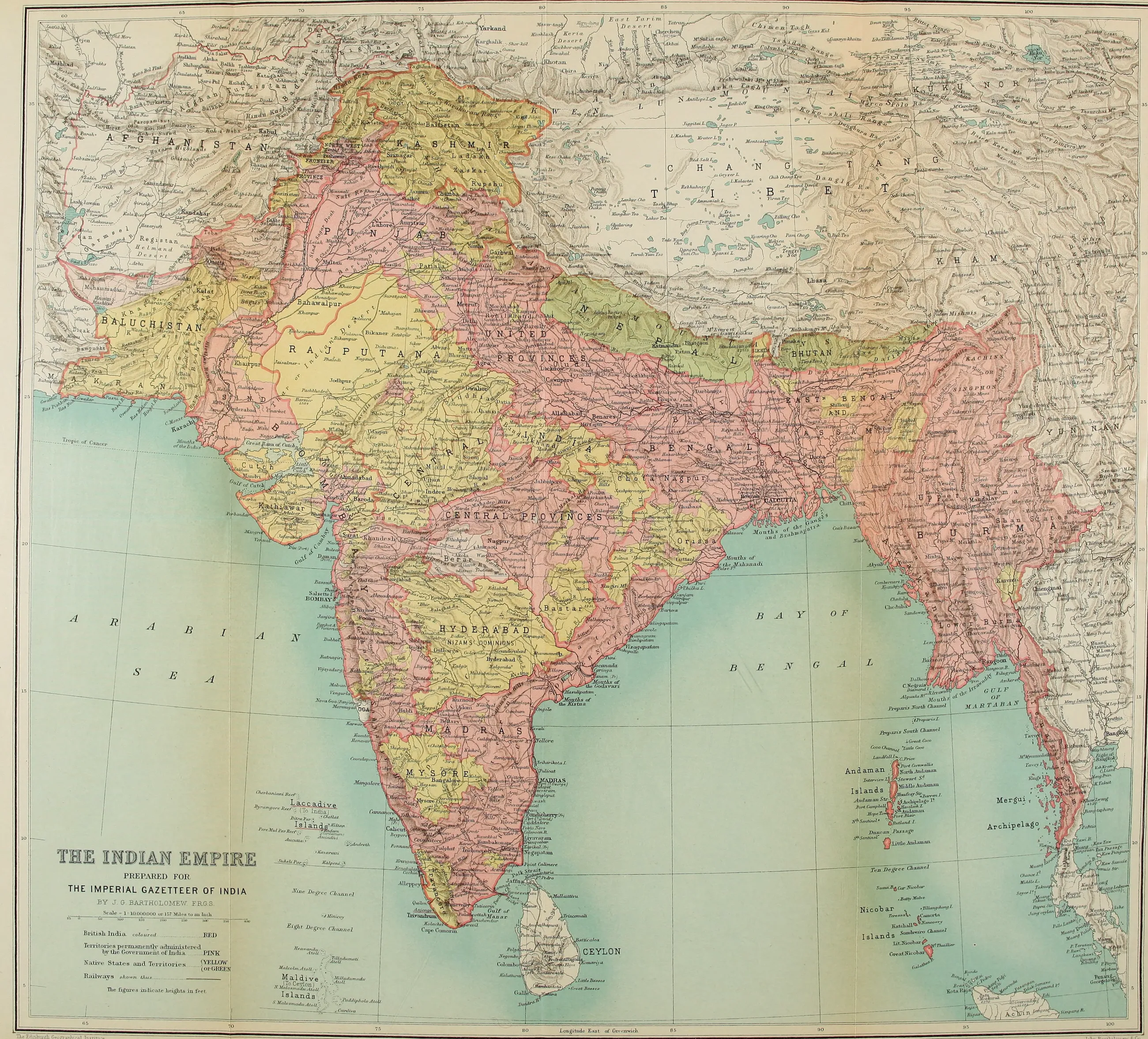
The Edinburgh Geographical Institute
John Bartholomew & Co.
[p. i]
THE INDIAN EMPIRE
VOL. II
HISTORICAL
NEW EDITION
PUBLISHED UNDER THE AUTHORITY OF HIS MAJESTY'S SECRETARY OF STATE FOR INDIA IN COUNCIL
OXFORD
AT THE CLARENDON PRESS
1908
[p. ii]
HENRY FROWDE, M.A.
PUBLISHER TO THE UNIVERSITY OF OXFORD
LONDON, EDINBURGH
NEW YORK AND TORONTO
PREFACE
[p. iii]
PREFACE
The present volume differs from the three other volumes of ‘The Indian Empire,’ in that for the most part it has been planned and written in England, and therefore does not bear the same official sanction of the Government of India.
When dealing with so vast a subject as the history of India, it has been held necessary to divide it into chapters which relate not so much to separate periods of time as to the separate sources from which the materials are derived, and to entrust these chapters to different authors with special qualifications. Such important branches of historical investigation as epigraphy, numismatics, archaeology, and architecture are thus introduced into their proper place as preliminary to the chapters based upon written records, while the available evidence from both Sanskrit and vernacular literature has likewise been included. It must, however, be admitted that this method of treating the subject possesses certain inherent disadvantages. The matter of the several chapters cannot be marked off by rigid lines. For example, inscriptions comprise those on coins, and the origin of both building and sculpture is to be sought in prehistoric times. So again when the days of history proper have been reached. Periods that may conveniently be distinguished overlap one another in fact, while Northern and Southern India can hardly be brought within the same focus. It must also be borne in mind that large portions of the early history of India are still the field of conjecture and controversy, where scholars of equal eminence hold divergent views. Consequently, there may be found in the present volume some lack of logic in [p. iv] arrangement, a certain amount of repetition, and possibly a few inconsistencies of statement. It has been thought better to admit such apparent defects than to attempt a strict uniformity, which would only produce results inadequate and misleading. In particular, the editor has not felt it his duty to demand that the contributors should all follow a conventional spelling of Indian names and words.
The names of the authors are appended to their several chapters, but it may be desirable to enumerate them here :—
Chapter I, ‘ Epigraphy,’ has been written by Dr. J. F. Fleet, C.I.E., late I.C.S., and sometime Epigraphist to the Government of India ; Chapters II, III, IV, and VII, ‘ Prehistoric Antiquities,’ ‘ Archaeology of Historical Period,’ ‘ Numismatics,’ and ‘ Early History of Northern India,’ by Mr. Vincent A. Smith, late I.C.S., author of The Early History of India ; Chapter V, ‘ Architecture,’ by Dr. James Burgess, C.I.E., formerly Director-General of the Archaeological Survey of India ; Chapter VI, ‘ Sanskrit Literature,’ by Dr. A. A. Macdonell, Boden Professor of Sanskrit at Oxford ; Chapter VIII, ‘ Mediaeval History of Northern India,’ by Mr. James Kennedy, late I.C.S. ; Chapter IX, ‘ Hindu Period of Southern India,’ by Mr. Robert Sewell, late I.C.S. ; Chapter X, ‘ Muhammadan India,’ by Mr. William Irvine, late I.C.S. ; and Chapter XI, ‘ Vernacular Literature,’ by Dr. G. A. Grierson, C.I.E., late I.C.S., Superintendent of the Linguistic Survey of India.
The sketch of the Marāthās in Chapter XII is due to the editor ; while Sir W. W. Hunter’s story of the early European Settlements and of British rule, forming the basis of Chapters XIII and XIV, has been revised and brought up to date, without altering the personal impress of the original, by Mr. P. E. Roberts, who acted as assistant to Sir W. W. Hunter during the closing years of his life.
INTRODUCTORY NOTES
[p. v]
INTRODUCTORY NOTES
Notes on Transliteration
Vowel-Sounds
a has the sound of a in ‘woman.’ ā has the sound of a in ‘father.’ e has the vowel-sound in ‘grey.’ i has the sound of i in ‘pin.’ ī has the sound of i in ‘police.’ o has the sound of o in ‘bone.’ u has the sound of u in ‘bull.’ ū has the sound of u in ‘flute.’ ai has the vowel-sound in ‘mine.’ au has the vowel-sound in ‘house.’
It should be stated that no attempt has been made to distinguish between the long and short sounds of e and o in the Dravidian languages, which possess the vowel-sounds in ‘bet’ and ‘hot’ in addition to those given above. Nor has it been thought necessary to mark vowels as long in cases where mistakes in pronunciation were not likely to be made.
Consonants
Most Indian languages have different forms for a number of consonants, such as d, t, r, &c., marked in scientific works by the use of dots or italics. As the European ear distinguishes these with difficulty in ordinary pronunciation, it has been considered undesirable to embarrass the reader with them ; and only two notes are required. In the first place, the Arabic k, a strong guttural, has been represented by k instead of q, which is often used. Secondly, it should be remarked that aspirated consonants are common ; and, in particular, dh and th (except in Burma) never have the sound of th in ‘this’ or ‘thin,’ but should be pronounced as in ‘woodhouse’ and ‘boathook.’
[p. vi]
Burmese Words
Burmese and some of the languages on the frontier of China have the following special sounds :—
aw has the vowel-sound in ‘law.’
ö and ü are pronounced as in German.
gy is pronounced almost like j in ‘jewel.’
ky is pronounced almost like ch in ‘church.’
th is pronounced in some cases as in ‘this,’ in some cases as in ‘thin.’
w after a consonant has the force of uw. Thus, ywa and pwe are disyllables, pronounced as if written yuwa and puwe.
It should also be noted that, whereas in Indian words the accent or stress is distributed almost equally on each syllable, in Burmese there is a tendency to throw special stress on the last syllable.
General
The names of some places—e. g. Calcutta, Bombay, Lucknow, Cawnpore—have obtained a popular fixity of spelling, while special forms have been officially prescribed for others. Names of persons are often spelt and pronounced differently in different parts of India ; but the variations have been made as few as possible by assimilating forms almost alike, especially where a particular spelling has been generally adopted in English books.
Notes on Money, Prices, Weights and Measures
As the currency of India is based upon the rupee, all statements with regard to money throughout the Gazetteer have necessarily been expressed in rupees, nor has it been found possible to add generally a conversion into sterling. Down to about 1873 the gold value of the rupee (containing 165 grains of pure silver) was approximately equal to 2s., or one-tenth of a £ ; and for that period it is easy to convert rupees into sterling by striking off the final cipher (Rs. 1,000 = £100). But after 1873, owing to the depreciation of silver as compared with gold throughout the world, there came a serious and progressive fall in the exchange, until at one time the gold value of the rupee dropped as low as 1s. In order to provide a remedy for the heavy loss caused to the Government of India in respect of its gold payments to be made in England, and also to relieve foreign trade and finance from the inconvenience due to constant and unforeseen fluctuations in exchange, it was resolved in 1893 to close the mints to the free coinage of silver, and thus force up the value of the rupee by restricting the circulation. The intention was to raise [p. vii] the exchange value of the rupee to 1s. 4d., and then introduce a gold standard (though not necessarily a gold currency) at the rate of Rs. 15 = £1. This policy has been completely successful. From 1899 onwards the value of the rupee has been maintained, with insignificant fluctuations, at the proposed rate of 1s. 4d. ; and consequently since that date three rupees have been equivalent to two rupees before 1873. For the intermediate period, between 1873 and 1899, it is manifestly impossible to adopt any fixed sterling value for a constantly changing rupee. But since 1899, if it is desired to convert rupees into sterling, not only must the final cipher be struck off (as before 1873), but also one-third must be subtracted from the result. Thus Rs. 1,000 = £100 − ⅓ = (about) £67.
Another matter in connexion with the expression of money statements in terms of rupees requires to be explained. The method of numerical notation in India differs from that which prevails throughout Europe. Large numbers are not punctuated in hundreds of thousands and millions, but in lakhs and crores. A lakh is one hundred thousand (written out as 1,00,000), and a crore is one hundred lakhs or ten millions (written out as 1,00,00,000). Consequently, according to the exchange value of the rupee, a lakh of rupees (Rs. 1,00,000) may be read as the equivalent of £10,000 before 1873, and as the equivalent of (about) £6,667 after 1899 ; while a crore of rupees (Rs. 1,00,00,000) may similarly be read as the equivalent of £1,000,000 before 1873, and as the equivalent of (about) £666,667 after 1899.
Finally, it should be mentioned that the rupee is divided into 16 annas, a fraction commonly used for many purposes by both natives and Europeans. The anna was formerly reckoned as 1½d. ; it may now be considered as exactly corresponding to 1d. The anna is again subdivided into 12 pies.
The various systems of weights used in India combine uniformity of scale with immense variations in the weight of units. The scale used generally throughout Northern India, and less commonly in Madras and Bombay, may be thus expressed : one maund = 40 seers ; one seer = 16 chittaks or 80 tolas. The actual weight of a seer varies greatly from District to District, and even from village to village ; but in the standard system the tola is 180 grains Troy (the exact weight of the rupee), and the seer thus weighs 2·057 lb., and the maund 82·28 lb. This standard is used in official reports and throughout the Gazetteer.
For calculating retail prices, the universal custom in India is to express them in terms of seers to the rupee. Thus, when prices change, what varies is not the amount of money to be paid for the [p. viii] same quantity, but the quantity to be obtained for the same amount of money. In other words, prices in India are quantity prices, not money prices. When the figure of quantity goes up, this of course means that the price has gone down, which is at first sight perplexing to an English reader. It may, however, be mentioned that quantity prices are not altogether unknown in England, especially at small shops, where pennyworths of many groceries can be bought. Eggs, likewise, are commonly sold at a varying number for the shilling. If it be desired to convert quantity prices from Indian into English denominations without having recourse to money prices (which would often be misleading), the following scale may be adopted—based upon the assumptions that a seer is exactly 2 lb., and that the value of the rupee remains constant at 1s. 4d. : 1 seer per rupee = (about) 3 lb. for 2s. ; 2 seers per rupee = (about) 6 lb. for 2s. ; and so on.
The name of the unit for square measurement in India generally is the bīgha, which varies greatly in different parts of the country. But areas have always been expressed throughout the Gazetteer either in square miles or in acres.
TABLE OF CONTENTS
[p. ix]
TABLE OF CONTENTS
GENERAL PLAN
Epigraphy . . . . . . . . 1–88
Prehistoric Antiquities . . . . . . . 89–100
Archaeology of Historical Period . . . . . 101–134
Numismatics . . . . . . . . 135–154
Architecture . . . . . . . . 155–205
Sanskrit Literature . . . . . . . 206–269
Early History of Northern India . . . . . 270–302
Mediaeval History of Northern India: the Hindu
Period . . . . . . . . . 303–320
Hindu Period of Southern India . . . . . . 321–349
Muhammadan India . . . . . . . 350–413
Vernacular Literature . . . . . . . 414–438
The Marāthās . . . . . . . . 439–445
The Early European Settlements . . . . . 446–469
History of British Rule . . . . . . 470–530
Index . . . . . . . . . 531–573
CHAPTER I
EPIGRAPHY
I. Introductory note . . . . . . . 1
II. The value of the inscriptions . . . . . 3
A. The absence of ancient historical compilations in India 5
B. Pedigrees and successions . . . . . . 7
C. Official records . . . . . . . . 11
D. Dynastic archives and chronicles . . . . . 12
E. The Purāṇas . . . . . . . . 14
F. The Rājataraṁgiṇī . . . . . . . 15
G. General literature and historical romances . . . 17
H. Introductions and colophons of literary works . . 19
I. The inscriptions . . . . . . . . 21
III. The materials on which the inscriptions have been
recorded . . . . . . . . . 24
A. Metals . . . . . . . . . 25
1. Iron . . . . . . . . . 25
2. Gold and silver . . . . . . . 25
[p. x]
3. Brass . . . . . . . . 25
4. Bronze . . . . . . . . 26
5. Copper . . . . . . . . 26
6. Seals of copperplate records . . . . 29
B. Other substances than metal . . . . . 34
1. Crystal . . . . . . . . 36
2. Clay, terra-cotta, and brick . . . . 37
3. Earthenware . . . . . . . 40
4. Stone . . . . . . . . 41
(a) Rocks . . . . . . . 41
(b) Columns and pillars . . . . . 42
(c) Relic-receptacles . . . . . . 43
(d) External parts of stūpas . . . . 45
(e) Caves . . . . . . . 47
(f) Images and statues . . . . . 47
(g) Moulds for making seals . . . . 48
IV. The topics of the inscriptions, and the reasons for which
they are historically useful . . . . . 49
A. Plain statements of events . . . . . 50
B. Records due to religious motives . . . . 52
C. Records of religious endowments . . . . 57
D. Records of secular donations . . . . 58
E. The essential nature of the inscriptions . . . 60
F. The great number of the inscriptions . . . 62
G. The precise dating of the inscriptions . . . 64
V. General observations and indications of lines of future
research . . . . . . . 65
A. The inscriptions . . . . . . . 67
B. Tradition . . . . . . . . 70
C. Palaeography, coins, and art . . . . 73
D. Geography . . . . . . . . 76
E. Other fields of work . . . . . 83
F. Concluding remarks . . . . . . 85
List of abbreviations . . . . . . 87
CHAPTER II
PREHISTORIC ANTIQUITIES
Introductory . . . . . . . . 89
The Stone Age in India . . . . . . 90
Palaeolithic implements . . . . . . 90
Neolithic implements . . . . . . 92
‘Pygmy flints’ . . . . . . . 92
[p. xi]
Implement factories . . . . . . . . 93
‘Cinder-mounds’ . . . . . . . . 94
‘Cup-marks’ . . . . . . . . 94
Ruddle drawings . . . . . . . . 94
Tombs . . . . . . . . . 95
Adichanallūr . . . . . . . . 97
Copper implements . . . . . . . 97
Iron . . . . . . . . . 98
Selected references . . . . . . . . 99
CHAPTER III
ARCHAEOLOGY OF HISTORICAL PERIOD
Scope of the chapter . . . . . . . 101
Transition from prehistoric times . . . . . 101
The earliest Indian building . . . . . . 102
State of civilization 450 B. C. . . . . . . 102
Wooden architecture . . . . . . . 103
Early period of Indian art, 250 B. C. to A. D. 50 . . 103
Distribution of remains of early period . . . 104
Evolution of the stūpa . . . . . . 104
Stone railings . . . . . . . 104
Hellenistic and Persian influence . . . . 105
Bharhut . . . . . . . . 106
Sānchī . . . . . . . . 108
Monolithic pillars of Asoka . . . . . 109
Sculpture in the round . . . . . . 109
Mathurā . . . . . . . . 110
Jain stūpas . . . . . . . . 110
Decoration of stūpas . . . . . . 111
Sculpture in the early caves . . . . . 111
The second or Kushān period . . . . . . 112
History . . . . . . . . 112
Influence of Roman taste . . . . . . 112
Two principal schools of sculpture . . . . 113
Abundance of Gandhāra sculptures . . . . 113
General description of Gandhāra sculptures . . . 114
The sculptures illustrate the Newer Buddhism . . 114
Chronology of the Gandhāra school . . . . 115
Amarāvati . . . . . . . . 115
The Ajantā paintings . . . . . . . 117
Technical execution . . . . . . . 117
Age of the paintings . . . . . . . 118
[p. xii]
Subjects of the paintings . . . . . 118
Aesthetic merits . . . . . . 119
Origin and artistic affinities of the paintings . . . 119
Decline of the art of sculpture . . . . . 121
Religion and sculpture . . . . . . 121
Art of the Gupta period (A.D. 320–480). . . . 122
Māmallapuram sculptures . . . . . 123
Chālukya sculpture . . . . . . 123
The towers of Chitor . . . . . . 123
Bhuvanesvar, Khajurāho, and Mount Abu . . . 124
Temples of the South . . . . . . 124
Vijayanagar . . . . . . . 125
Hindu decoration on early Muhammadan buildings . . 125
Foreign modes of decoration . . . . . 126
Mother-of-pearl inlay . . . . . . 126
Geometric marble inlay . . . . . . 127
Pietra dura . . . . . . . 127
Tomb of Jahāngīr at Lahore . . . . . 128
Early examples of enamelled tiles . . . . 128
The Chīnī-kā-Rauza near Agra . . . . 128
Glass mosaics . . . . . . . 129
Paintings of the early Mughal period . . . 129
Paintings in Chinese style . . . . . 130
The so-called ‘Annunciation’ . . . . 130
Akbar’s patronage of painting . . . . . 130
Failure to found a national school of painting . . 131
Mughal sculpture ; the elephants at Delhi . . . 131
Bas-reliefs at Nūrmahal . . . . . . 132
Pictured tiles at Lahore . . . . . 132
Rarity of specimens of minor arts . . . . 132
Jewelled jade . . . . . . . 133
Rock crystal . . . . . . . 133
Jewellery . . . . . . . . 133
Authorities . . . . . . . 134
CHAPTER IV
NUMISMATICS
I. The Ancient Coinage of Northern India
Introductory . . . . . . . 135
‘Punch-marked’ coins . . . . . . 135
Cast coins . . . . . . . 137
Bactrian coins . . . . . . . 137
[p. xiii]
PAGE
Kushān coins . . . . . . . . . 138
Kanishka . . . . . . . . . 139
Huvishka . . . . . . . . . 140
Vāsudeva . . . . . . . . . 140
Gupta coins . . . . . . . . . 141
Satrap coins . . . . . . . . . 142
Degraded coins . . . . . . . . . 142
II. Muhammadan and Indo-European
Muhammadan coins . . . . . . . . . 143
Ghaznī coins . . . . . . . . . 143
Ghorī coins . . . . . . . . . 144
The Slave dynasty . . . . . . . . . 144
Alā-ud-dīn . . . . . . . . . 144
Kutb-ud-dīn . . . . . . . . . 145
Tughlak coins . . . . . . . . . 145
Sūri coins . . . . . . . . . 145
Akbar’s coins . . . . . . . . . 146
Jahāngīr’s coins . . . . . . . . . 146
Shāh Jahān’s coins . . . . . . . . . 147
Aurangzeb’s coins . . . . . . . . . 147
The Company’s coinage . . . . . . . . . 148
Modern Native States . . . . . . . . . 149
European coins . . . . . . . . . 149
III. Southern India
‘Punch-marked’ coins of the South . . . . . . . . . 150
Dutch and English jealousy of the Embden Company . . 466
The Nawāb’s orders against the Prussians . . . . 467
English agents privately trade with Embden Company . . 467
Frederick sacrifices the Company . . . . . . 467
Causes of failure : of the Portuguese . . . . . 467
Of the Dutch . . . . . . . . 467
Of the French . . . . . . . . 467
Of the Germans . . . . . . . . 468
Causes of England’s success in India . . . . . 468
Bibliography . . . . . . . . . 469
CHAPTER XIV
HISTORY OF BRITISH RULE
Southern India after 1707 . . . . . . . 470
The French in India . . . . . . . . 470
Dumas, 1735–41 . . . . . . . . . 470
Dupleix, 1741 . . . . . . . . . 471
English and French in the Carnatic : First French War, 1744–8 . . . . . . . . . 471
Madras taken, 1746 . . . . . . . . 471
Second French War, 1750–4 . . . . . . . 472
Clive’s defence of Arcot, 1751 . . . . . . 472
Third French War, 1756–63 . . . . . . . 473
Lally, 1758 . . . . . . . . . . 473
Battle of Wandiwāsh, 1760 . . . . . . . 473
Native rulers of Bengal, 1707–56 . . . . . . 474
European head-quarters in Bengal . . . . . . 474
The Black Hole of Calcutta, 1756 . . . . . . 474
Clive and Watson . . . . . . . . . 475
Calcutta recovered, 1757 . . . . . . . . 475
Battle of Plassey, 1757 . . . . . . . . 476
Mīr Jafar, 1757 . . . . . . . . . 476
Pecuniary compensations to the English . . . . . 476
Grant of Twenty-four Parganas . . . . . . 477
Clive’s jāgīr . . . . . . . . . 477
Clive Governor of Bengal, 1758–60 ; scatters Oudh army ; overcomes French in Madras ; defeats Dutch . . 478
Mismanagement, 1760–5 . . . . . . . . 478
[p. xxxi]
Mīr Kāsim set up, 1761 . . . . . . 478
Mīr Kāsim breaks with the English . . . . 478
Patna massacre, 1763 . . . . . . 479
First sepoy mutiny, 1764 . . . . . . 479
Battle of Buxar, 1764 . . . . . . 479
Clive’s second governorship, 1765–7 . . . . 479
Clive’s partition of Gangetic valley, 1765 . . . 480
Grant of Dīwānī of Bengal, 1765 . . . . 480
Clive’s reorganization of the Company’s service . . 480
Dual system of administration, 1765–72 . . . 481
First Mysore War . . . . . . 481
Dual system abolished, 1772 . . . . . 481
Warren Hastings, 1772–85 . . . . . 481
His administrative reforms . . . . . 481
Hastings first Governor-General, 1774 . . . 482
His struggle with his Council . . . . 482
Execution of Nuncomar . . . . . 482
Hastings’s twofold aims . . . . . 482
His theory and practice . . . . . 482
Hastings makes Bengal pay; sells Allahābād and
Korā; withholds the emperor’s tribute . . 483
The Rohilla War . . . . . . 483
Fines on Chet Singh and the Oudh Begam . . . 484
Impeachment of Hastings . . . . . 484
Hastings’s policy in Western and Southern India . . 484
First and second Marāthā Wars, 1775–82 . . . 485
Goddard’s march . . . . . . 485
Treaty of Sālbai, 1782 . . . . . 485
Second Mysore War, 1780–4 . . . . 485
Death of Haidar Alī, 1782 . . . . . 486
Lord Cornwallis, 1786–93 . . . . . 486
His revenue reforms . . . . . . 486
Period of experiment . . . . . . 486
The Permanent Settlement of Bengal, 1793 . . . 487
Third Mysore War, 1790–2 . . . . . 487
Sir John Shore, 1793–8 . . . . . 487
Marquess Wellesley, 1798–1805 . . . . 488
French influence in India . . . . . 488
Causes of the weakness of France . . . . 488
Lord Wellesley’s scheme in Oudh; in the South . . 489
Treaty with the Nizām, 1798 . . . . 489
Fourth Mysore War . . . . . . 490
Fall of Seringapatam, 1799 . . . . . 490
The Marāthās . . . . . . . 490
[p. xxxii]
Treaty of Bassein, 1802 . . . . . . 491
Third Marāthā War, 1802–4 . . . . . 491
Additions to British territory . . . . . 491
Later disasters, 1804–5 . . . . . . 491
India after Lord Wellesley; in the North; in the South 492
Lord Cornwallis again, 1805 . . . . . 492
Sir George Barlow, 1805–7 . . . . . . 492
Lord Minto, 1807–13 . . . . . . . 492
Lord Moira (Marquess of Hastings), 1814–23 . . . 493
The Gurkhas of Nepāl . . . . . . 493
Nepāl War, 1814–5 . . . . . . . 493
Treaty of Sagauli . . . . . . . 494
The Pindāris . . . . . . . 494
Last Marāthā War, 1817–8 . . . . . . 495
Lord Amherst, 1823–8 . . . . . . 496
Burma . . . . . . . . . 496
First Burmese War, 1824–6 . . . . . . 496
Assam, Arakan, and Tenasserim annexed . . . 497
Bharatpur taken, 1826 . . . . . . 497
Lord William Bentinck, 1828–35 . . . . . 497
His financial reforms . . . . . . 497
Abolition of satī, 1829 . . . . . . 498
Suppression of thagī . . . . . . 498
Mysore administered, 1831 . . . . . . 498
Coorg annexed . . . . . . . 498
Sir C. Metcalfe, 1835–6 . . . . . . 499
Lord Auckland, 1836–42 . . . . . . 499
Afghānistān under the Durrānis, 1747–1826 . . 499
Dost Muhammad, 1837 . . . . . . 500
Russian influence . . . . . . . 500
Shāh Shujā installed, 1839 . . . . . 500
Kābul occupied, 1839–41 . . . . . . 500
The garrison annihilated, 1842 . . . . . 501
Lord Ellenborough, 1842–4 . . . . . 501
The army of retribution, 1842 . . . . . 501
The ‘Gates of Somnāth’ . . . . . . 501
Conquest of Sind, 1843 . . . . . . 502
Gwalior outbreak, 1843 . . . . . . 502
Lord Hardinge, 1844–8 . . . . . . 502
The Sikhs . . . . . . . . 502
Nānak . . . . . . . . . 502
Sikh confederacies . . . . . . . 502
Ranjīt Singh, 1780–1839 . . . . . . 503
First Sikh War, 1845 . . . . . . 503
[p. xxxiii]
Lord Dalhousie, 1848–56 ... 504
His administrative reforms ... 504
His public works ... 504
Second Sikh War, 1848–9 ... 504
The Punjab annexed, 1849 ... 505
Its pacification ... 505
Second Burmese War, 1852 ... 505
Lower Burma annexed ... 505
The Feudatory States ... 505
Lord Dalhousie’s ‘doctrine of lapse’. ... 506
Hindu theory of adoption ... 506
Lapsed States : Sātāra, 1849 ; Jhānsi, 1853 ; Nāgpur,
1853 ... 506
Berār assigned, 1853 ... 507
Annexation of Oudh, 1856 ... 507
Lord Dalhousie’s view of the measure ... 507
Grounds of annexation ... 508
Lord Dalhousie’s death, 1860 ... 508
His work in India ... 508
Lord Canning, 1856–62 ... 508
The Sepoy Mutiny, 1857 . ... 509
Causes of the Mutiny ... 509
The ‘greased cartridges’ . ... 510
The army drained of its officers ... 510
Outbreak of the Mutiny, May, 1857 . ... 511
At Meerut ... 511
At Delhi . ... 511
Spread of the Mutiny, summer of 1857 ... 511
Loyalty of the Sikhs ... 511
Cawnpore ... 512
Nāna Sāhib ... 512
Massacre of Cawnpore ... 512
Lucknow. Sir Henry Lawrence ... 512
Siege of Delhi, June to September, 1857 . ... 513
Oudh reduced by Sir Colin Campbell ... 513
Sir Hugh Rose in Central India ... 513
Downfall of the Company, 1858 ... 513
Its history epitomized, 1773–1858 ... 514
Act of 1773 ... 514
Act of 1784 ... 514
Act of 1833 ... 514
Act of 1853 ... 514
India transferred to the Crown, 1858 ... 515
‘The Viceroy’. ... 515
[p. xxxiv]
India under the Crown . . . . . . 515
Queen’s Proclamation, November 1, 1858 . . . 515
Cost of the Mutiny . . . . . . . 515
Financial reforms . . . . . . . 516
Legal reforms . . . . . . . . 516
Lord Elgin, 1862–3 . . . . . . . 516
Lord Lawrence, 1864–9 . . . . . . 516
Lord Mayo, 1869–72 . . . . . . 516
Lord Mayo’s reforms . . . . . . . 517
Lord Northbrook, 1872–6 . . . . . . 517
Prince of Wales’s tour, 1875–6 . . . . 517
Lord Lytton, 1876–80 . . . . . . 517
The ‘Empress of India’ . . . . . . 517
Famine of 1877–8 . . . . . . . 518
Afghān affairs, 1878–80 . . . . . . 518
Lord Ripon, 1880–4 . . . . . . . 518
Afghān affairs . . . . . . . . 519
Rendition of Mysore . . . . . . . 519
Lord Ripon’s internal administration . . . . 519
Local government Acts . . . . . . 519
Amendment of criminal procedure . . . . 519
Department of Agriculture . . . . . . 520
Education Commission . . . . . . 520
Abolition of customs duties . . . . . 520
Lord Dufferin, 1884–8 . . . . . . 521
Third Burmese War, 1885 . . . . . 521
Russian attack on the Afghāns at Panjdeh, 1885 . . 521
Queen Victoria’s Jubilee, 1887. . . . . 522
Lord Lansdowne, 1888–94 . . . . . 522
Lord Cross’s Act, 1892 . . . . . . 523
Manipur, 1891 . . . . . . . . 523
Russian aggressions on the Pāmirs . . . . 524
Burmese progress . . . . . . . 524
The fall in the rupee . . . . . . . 524
Lord Elgin, 1894–9 . . . . . . . 525
Presidency Army system abolished . . . . 525
Pāmir agreement with Russia, 1895 . . . . 525
Chitrāl, 1895 . . . . . . . . 525
The Tīrāh campaign, 1897–8 . . . . . 525
Famine, 1896–7 . . . . . . . 526
Bubonic plague, 1896 . . . . . . 526
Plague precautions . . . . . . . 526
Lord Curzon, 1899–1905 . . . . . . 526
North-west frontier policy . . . . . . 526
[p. xxxv]
New North-West Frontier Province, 1901. . . . 527
Foreign policy . . . . . . . . 527
Tibet mission, 1904 . . . . . . . 527
Plague and famine . . . . . . . 527
Finance . . . . . . . . . 528
Punjab Land Alienation Act . . . . . . 528
Agricultural banks . . . . . . . 528
Education . . . . . . . . 528
Army reform . . . . . . . . 528
Reform of police . . . . . . . 529
The Feudatory States . . . . . . . 529
Death of Queen Victoria, 1901 . . . . . . 529
Coronation darbār, 1903 . . . . . . 529
Partition of Bengal, 1905 . . . . . . 529
Lord Minto, 1905 . . . . . . . 530
Bibliography . . . . . . . . 530
INDEX . . . . . . . . . 531
CHAPTER I — Epigraphy
[p. 1]
THE INDIAN EMPIRE
VOLUME II
HISTORICAL
CHAPTER I
EPIGRAPHY
I. Introductory Note
The subject of this contribution to the Imperial Gazetteer is the explanation of the nature and value of the epigraphic or inscriptional bases of Indian research for the pre-Musalmān period. And the topic is an important one; for, not only is India particularly rich in inscriptional remains, but also those remains are the only sure grounds of historical results in every line of research connected with its ancient past. We have, however, to exclude from our treatment of this subject one branch which has always been found more generally attractive than any of the others. The inscriptions on coins and gems, better termed, by way of avoiding confusion, ‘legends’ on coins and gems, are epigraphic materials. But they are a special class of such materials; and the treatment of them falls, most properly, under the subdivision of numismatology. We have to confine our attention here to those epigraphic remains which have come to be best known as ‘inscriptions’ by way of distinction from the numismatic materials. Nevertheless, we hope to be able to show that our topic is no dry and dull one, but is full of interest as well as importance.
The inscriptions, thus indicated as our topic, are notifications, very frequently of an official character, and generally more or less of a public nature, which recite facts, simple or complex, with or without dates, and were intended to be lasting records of the matters to which they refer. They are in almost all cases found engraved, not written. They were occasionally engraved [p. 2] upon monuments in the shape of great monolithic columns ; as, for instance, in the case of some of the moral and religious edicts of Aśōka, and the panegyric on the two columns of victory at Mandasōr, in Mālwā, which recites the conquests of king Yaśōdharman. Mostly, however, they are found engraved on metal plates, on stone tablets, on rocks, on walls and pillars and other parts of caves or of temples and other buildings, on pedestals of images and statues, and on relic-caskets. But they are occasionally found painted, and in a few instances written with ink. And some are found stamped on clay and bricks.
For the purposes that we have in view, the inscriptions include, with the exception of the legends on coins and gems, everything inscriptive, written, painted, stamped or engraved, public or private, lengthy or brief, that can be turned to account in connexion with the ancient past of India, in respect of the political history, the religious development, or any other line of research. Even the mere records of pilgrims’ visits are of value, in establishing the antiquity of the sacred places visited by them, and of the towns from which they came. Even descriptive labels, incised as accompaniments to statues and sculptures, are valuable, in marking the ancient times to which traditions and legends and mythological notions may be carried back. Even a name stamped on a brick has been found of use, in determining the period to which a building may be referred. And even masons’ marks, in the form of alphabetical characters, have played an important part in the inquiry into the history of writing in India.
Such are the remains with which we are to deal, and of which we shall speak either as ‘inscriptions,’ or as ‘epigraphic records,’ or simply as ‘records,’ according to the convenience of the moment. But we are to handle them to only a certain extent.
There are technical details connected with the inscriptions into the treatment of which we cannot, for various reasons, enter here. For the palaeographic branch of Indian epigraphic research, which explains the alphabets in which the inscriptions were written, and deals with the origin and development of those alphabets, we can here only refer to Professor Bühler’s Indische Palaeographie, published in 1896. In respect of the languages used in the inscriptions, we can only say here that they include Sanskṛit, Pāli, some of the Prākṛits, the mixed dialect or dialects, and the older dialects of Kanarese, Marāṭhī, Malayāḷam, Tamiḻ, and Telugu ; adding that, though in this detail some of the records offer problems which have still to be solved, they present no substantial initial difficulties to explorers [p. 3] who will use, along with grammars and dictionaries, the more recently and critically edited treatments of the texts and translations. In respect of the diction, we can only observe that the inscriptions were composed sometimes entirely in prose, sometimes entirely in verse, and sometimes in prose and verse mixed. And, in respect of the eras in which so many of the inscriptions were dated, and of the methods according to which the precise dates were stated, we can only refer to certain special works and tables which will be mentioned farther on. Those are technical topics which cannot be handled here. Also, while a sufficient indication must be given of the various purposes to which the inscriptions can be applied, we shall not present here even a summary of the historical and other results obtained from them; those results form the topics of other contributions to this volume.
We have to deal here with the inscriptions from other points of view. We have to explain the nature of them. We have to illustrate the value of them, and show in a general way the ends to which they may be utilized, and establish the necessity for an exhaustive examination of them. And we have to indicate the nature of the work which still remains to be done on them, and to point out certain subsidiary lines of research which ought to be systematically followed up in connexion with them. In leading, as we hope to do, new workers into a field of exploration in which there is a vast amount of important work still to be done, especially in connexion with the more ancient periods, we have to make the way easy for them, by showing them how to avoid the mistakes of previous explorers, and how to direct their own inquiries to the greatest advantage.
II. The Value of the Inscriptions
Rich as have been their bequests to us in other lines, the Hindūs have not transmitted to us any historical works which can be accepted as reliable for any early times. And it is almost entirely from a patient examination of the inscriptions, the start in which was made more than a century ago, that our knowledge of the ancient political history of India has been derived. But we are also ultimately dependent on the inscriptions in every other line of Indian research. Hardly any definite dates and identifications can be established except from them. And they regulate everything that we can learn from tradition, literature, coins, art, architecture, or any other source.
[p. 4]
While, however, the inscriptions contain the historical and other information which we seek, they were written, engraved, and published, not with the object of presenting that information, but for other purposes which will be made apparent further on; and as a rule it is only incidentally, and as a purely secondary consideration, that they record the details which are so valuable to us. The collection of those details, therefore, is a matter that requires time and patience. The general value of the inscriptions lies mostly in the way in which they all work in, one with another. It follows that our results are, for the most part, obtained only by an examination and combination of large numbers of the epigraphic records; as, for instance, in the process which enabled Professor Kielhorn (see IA, 20. 404 ff.1) to dispel the influence of a myth, the Vikrama-legend, which had long dominated certain theories about the history of Sanskṛit literature and other matters, by showing that the so-called Vikrama era, beginning in 58 B.C., was neither established by, nor designedly invented in memory of, any king Vikramāditya who actually flourished at that time 2. It is not always [p. 5] that a single inscription, taken by itself, will establish anything of special importance; and we must, at any rate, not make a start in epigraphy with the expectation of achieving a great discovery in the first new record that we examine. It is not every day that we are able to obtain a Rummindēī inscription (EI, 5. 4) which locates at once the birthplace of a Buddha; or a Mandasōr inscription (F.GI, 79, and see introd., 65 ff.) which settles at once the long-disputed question of the epoch of an Indian era, that of the great Gupta kings; or a Takht-i-Bahaī inscription which (see JRAS, 1905. 223 ff.; 1906. 706 ff.) furnishes corroborative evidence of a Christian tradition about an apostle and an Indian king, St. Thomas and Gondophernēs1.
A. The Absence of Ancient Historical Compilations in India
It has been said above, that the Hindūs have not bequeathed to us any historical work which can be accepted as reliable for any early times. It is, indeed, very questionable whether the ancient Hindūs ever possessed the true historical sense, in the shape of the faculty of putting together genuine history on broad and critical lines. As we shall see, they could write [p. 6] short historical compositions, concise and to the point, but limited in extent. But no evidence of the possession by them of the faculty of dealing with history on general lines has survived to us in the shape of any genuine historical work, deliberately written by them as such, and also accurate and reliable.
The experience of the Arabian writer Albērūnī, in the eleventh century, was, that ‘the Hindūs do not pay much attention to the historical order of things, they are very careless in relating the chronological succession of their kings, and when they are pressed for information and are at a loss, not knowing what to say, they invariably take to tale-telling.’1 And certainly, such attempts as have been made by the Hindūs of more recent times do not display any capabilities from which we might infer that their early ancestors possessed the faculty, even if they did not exercise it.
Early in the last century, there was put together—apparently quite spontaneously, and not in consequence of any lead given by western inquiries—a Kanarese compilation entitled Rājāvalikathe, or ‘the story of the succession of kings,’ which purports to trace the history of Jainism, especially in connexion with the province of Mysore, on the political history of which, also, it pretends to throw light, from the earliest possible times : the published extracts from this work2, however, show that it is simply an imaginative production, of the most fanciful kind, based on the wildest legends, to which no value of any sort can be attached for early historical purposes3. At apparently some earlier time, as yet not fixed, there was drawn up, in the same part of the country, a Tamiḷ chronicle entitled Koṅgudēśarājākkaḷ4, or ‘the kings of the Koṅgu country,’ which purports to give a connected historical account of Mysore from the first century A.D. : but in this case, again, the fanciful nature of the work, and its utter want of reliability for any purposes of early [p. 7] history, are disclosed at once by the very slightest thoughtful examination in the light of present knowledge : for instance, at the outset, not only does it give, as real facts, the fictitious pedigree and history with which we are familiar from the spurious copperplate records of the Western Gaṅga series, but also (see EI, 3. 170), before the first of the fictitious Gaṅga kings, it places in the period A.D. 82 to 178, and before that time, some of the Rāshṭrakūṭa kings whose dates really lay between A.D. 675 and 956. Notices of other chronicles, relating, for instance, to the Chōḷa, Pallava, and Pāṇḍya territories and to the Teliṅgāna country, are to be found in Professor H. H. Wilson’s Descriptive Catalogue of the Mackenzie Collection. These have, perhaps, not yet been criticized in detail. But a perusal of the notices discloses features very similar to those of the Rājāvalikathe and the Koṅgudēśarājākkaḷ. And, though they may be of some use in the geographical line of inquiry, we have no prima-facie reason to expect to find in these works, also, anything of the slightest historical value for early days.
B. Pedigrees and Successions
Yet there were once, undoubtedly, genuine materials in abundance, from which histories of the most valuable kind might have been compiled in ancient times.
In the first place, we, who have lived in India, know how, in that country, pedigrees are always forthcoming, even in the present day, to an extent that is unknown in western lands. Among families connected in any way hereditarily with the administration, even the Gauḍas or Pāṭīls (the village headmen) and the Kuḷkarṇīs (the accountants) can always bring forward, whenever there is any inquiry into their watans or rights and privileges, or any dispute among themselves, genealogical tables, unquestionably not altogether unauthentic, which exhibit the most complicated ramifications of their houses, and often go back for two or three centuries ; and even the death of an ordinary cultivator usually results in the production of a similar table, though of more limited scope, in the inquiry that is held to determine his heirs. Every maṭha or religious college of any importance preserves the succession of its heads. And among the Jains we have the Paṭṭāvalis or successions of pontiffs, for a full and lucid notice of some of which we are indebted to Dr. Hoernle (IA, 20. 341 ; 21. 57)1. They purport to run [p. 8] back to even the death of the last Tīrthaṁkara Vardhamāna-Mahāvīra in (let us say) 527 B.C.; and, though the earlier portions of them were probably put together in their present form not before the ninth century A.D. (because they exhibit the Vikrama-legend; see page 4 above, and note 2) and with results that are capable of considerable adjustment, they are, no doubt, based upon more ancient and correct lists that were then extant.
The preservation of pedigrees and successions has evidently been a national characteristic for many centuries. And we cannot doubt that considerable attention was paid to the matter in connexion with the royal families, and that Vaṁśāvalis or Rājāvalis, lists of the lineal successions of kings, were compiled and kept from very early times. In fact, the matter is not one of speculation, but is capable of proof. We distinctly recognize the use of such Vaṁśāvalis, giving the relationships and successions of kings, but no chronological details beyond the record of the total duration of each reign, with occasionally a coronation-date recorded in an era, in the copperplate records. We trace them, for instance, in the introductory passages of the grants of the Eastern Chalukya series (see, e.g., IA, 14. 55; H.SII, 1. 36; EI, 5. 131; 7. 177), which, from the period A.D. 918 to 925 onwards, name the successive kings, beginning with the founder of the line who reigned three centuries before that time, but do not put forward more than the length of the reign of each of them; and, from certain differences in the figures for some of the reigns, we recognize that there were varying recensions of those Vaṁśāvalis. And we trace the use of Vaṁśāvalis again in the similar records of the Eastern Gaṅgas of Kaliṅga, which, from A.D. 1058 onwards (see EI, 4. 183), give the same details about the kings of that line with effect from about A.D. 890, and one of which, issued in A.D. 1296 (JASB, 65, 1896. 229), includes a coronation-date of A.D. 1141 or 1142.
There is other proof also1. There has been brought to light from Nēpāl a long Vaṁśāvali (IA, 13. 411), which purports to give an unbroken list of the rulers of that country, with [p. 9] the lengths of their reigns and an occasional landmark in the shape of the date of an accession stated in an era, back from A.D. 1768 to even so fabulous an antiquity as six or seven centuries before the commencement of the Kali age in 3102 B.C. It contains gross mistakes in chronology : for instance, it places in 101 to 34 B.C. Aṁśuvarman, of the Ṭhākurī dynasty, who, we know, was ruling in A.D. 635 and 649 or 650 (F.GI, introd., 189) ; and, partly through committing one of the usual leading faults of Hindū compilations, namely, of treating contemporaneous dynasties as successive dynasties, it places about the end of the seventh century B.C. a certain Vṛishadēva, of the Sūryavaṁśi or Lichchhavi dynasty, who, we know, was a contemporary of Aṁśuvarman. And, as was pointed out by Pandit Bhagwanlal Indraji, who brought the full Vaṁśāvali to notice critically, ‘it possesses no value whatever as a whole,’ and ‘no single one of its several portions is free from the most serious errors,’ and it is useless for reconstructing the earlier history of Nēpāl, even by adjustment with respect to any names and dates that are known from other sources. But, in connexion with the above-mentioned Vṛishadēva, and in spite of the error in respect of his date, it teaches one thing which is of use. From him, whom it places No. 18 in the Sūryavaṁśi dynasty, to Vasantadēva, No. 23, it gives correctly a list of six successive names, which we have verified from epigraphic records. It allots to each of these rulers, it is true, a length of reign which not only is impossible in itself, but also is disproved in one case at least by the inscriptions. But the fact remains, that the names are given correctly and in the right order. This short list was certainly not based on some ancient charter read by the original compiler of this portion of the Vaṁśāvali. What would have happened, if that had been the case, is suggested plainly enough by the Konnūr inscription from the Dhārwār District (EI, 6. 25), which purports to be the reproduction of a charter, dated A.D. 860, of the time of the Rāshṭrakūṭa king Amōghavarsha I. Here, we have a record on stone, which says that it was embodied in that shape in accordance with a copperplate charter that was read and explained by a certain Jain teacher named Vīranandin, son of Mēghachandra. Partly from the characters of the record, and partly from the established fact that Mēghachandra died A.D. 1115, we know that this record was not put on the stone before the twelfth century A.D. We do not dispute the alleged fact that Vīranandin drafted the stone record from some ancient charter on copper. But we find either that he could not read that charter [p. 10] correctly, or that he did not take the trouble to interpret it aright; for, not only has he misstated the relationships of some of the Rāshṭrakūṭa kings whom the stone version does mention, and omitted others whom it ought to have included, but also— probably from a wrong interpretation of some verse which we have not as yet found in a genuine record—he has placed at the head of the Rāshṭrakūṭa genealogy a purely fictitious person, whom he has called Prichchhakarāja. If the list from Vṛishadēva to Vasantadēva in the Nēpāl Vaṁśāvali had been put together in the same way from some ancient deed, the compiler of that part of the document would undoubtedly have committed some similar mistakes. We have no hesitation in saying that he took these six names from some genuine early Vaṁśāvali, accessible to him, which had survived from the time of the rulers to whom it referred; and probably the duration of the reigns was given correctly by him, and was falsified subsequently by some later compiler to suit his own scheme of the whole chronology.
The Bower Manuscript has proved to us that, under favourable conditions, a document written on even so frail a material as birch-bark can survive for fourteen centuries. This manuscript was obtained in Kashgaria, on the north of Kashmīr, through excavations at ‘the foot of one of the curious old erections, of which several are to be found in the Kuchar district.’ It was secured and brought to notice by Lieutenant Bower (see JASB, 59, 1890. proceedings, 221), from whom it derives its name. And Dr. Hoernle has shown (IA, 21. 37), by a comparison of its characters with those of epigraphic records, that in it we have a veritable original document, which is a relic that has come down to us from the period A.D. 400 to 450. With this instance before us, we may not unreasonably hope that an exploration of some buried city, or even of one or other of the numerous private collections of ancient manuscripts that still remain to be examined, may some day result in the discovery of some of the early and authentic Vaṁśāvalis.
Meanwhile, we have to be very cautious in accepting what we do obtain in this line. We have before us the example, not only of the Nēpāl Vaṁśāvali, but also of some Vaṁśāvalis from Orissa, which do not indeed pretend to quite such fabulous antiquity, but which nevertheless purport to present an unbroken list of the kings of that province back from A.D. 1871 to the commencement of the Kali age in 3102 B.C., with the length of the reign of each, and with certain specified dates as epochs. [p. 11] And the results put forward by them, and by the palm-leaf archives of the temple of Jagannātha at Purī, have been supposed to give at any rate certain definite and reliable landmarks in the early history. But an examination of them and of the archives (see EI, 3. 334 ff.) has shown that, for at least the period anterior to about A.D. 1100, they are utterly fanciful and misleading, and that they were devised, chiefly from imagination, simply to magnify the antiquity and importance of the temple of Jagannātha and of all its surroundings and connexions. These local annals are not correct even in respect of so radical a point as the building of that temple. They attribute it to a king Anaṅgabhīma, whom they would place A.D. 1175 to 1202; whereas we know from the epigraphic records that it was built by a predecessor of his, Anantavarma-Chōḍagaṅga-Gaṅgēśvara, in the period A.D. 1075 to 1141 or 1142. Further, they actually divide this latter king into two persons, Chōḍagaṅga and Gaṅgēśvara, to whom they would allot the periods A.D. 1132 to 1152 and 1152 to 1166. For the period anterior to him, they do not incorporate any ancient and authentic lists of rulers, but simply bring forward, amongst a host of fabulous names, a few historic kings, some of them not even connected with Orissa at all, whose dates they grossly misplace. Thus these records, again, are absolutely worthless for any purposes of ancient history.
C. Official Records
In the genuine early Vaṁśāvalis, materials must long have been extant, which could have been turned to most valuable account, if only for the bare outlines of political history. But there were plainly more ample materials than these. Of course, the elaborate routine of modern times had not been devised. Still, with the great advance towards civilization which the Hindūs had made even in the fourth century B.C., and with the careful and detailed system of administration which is disclosed by the inscriptional remains, there must have been, from early times, a fairly extensive system of official records. In any such state of advancement there are certain precautions and arrangements, indicated by common sense, which would inevitably be adopted. Copies of important orders issued must be kept on record in the issuing office, as a reminder to make sure that instructions given are duly and fully carried out; and orders received must be filed in the receiving office, to be produced in justification of any particular measures taken in giving effect to them. The specific terms of treaties and alliances must be reduced to writing; and copies must be kept [p. 12] for reference by each of the contracting parties. Diaries of some kind must be kept by local governors, from which to prepare from time to time the periodical reports on their administration. A record must be kept, on both sides, of tribute paid by the great feudatory nobles and received by the paramount sovereign. And, even under a system of farming the revenues, accounts of some kind must be framed, of the proceeds of provincial customs and taxes and of village revenues, and of the expenditure incurred on the collection of them.
Notes of all such matters must have been preserved in some form or another, in all the various offices. But it is probable that they were kept in the shape of general day-books, something like the Diaries of the Pēshwās of the eighteenth century1, dealing with all matters mixed, rather than according to any system of separate ledgers and files for each branch of business. Except on the hypothesis of such a system of day-books, it is difficult to account for the manner in which, for instance, the date of a record of A.D. 1008 at Tanjore (H.SII, 3. 14) cites the 124th and 143rd days of the twenty-fourth year of the Chōḷa king Rājarāja I, and the date of a record of A.D. 1113 at Tiruvārūr in the Tanjore district (EI, 4. 73) cites the 340th day of the fifth year of the reign of his descendant Vikrama-Chōḷadēva; for such details to be cited conveniently there must have been available some such books, in which the days were entered and numbered, and the events of them were posted up, as they ran2.
D. Dynastic Archives and Chronicles
In such day-books and other records, valuable items of historical information would abound. The compilation, however, of any general history from them would, no doubt, be [p. 13] a somewhat complicated and laborious matter. But there were, plainly, other materials of a more concise kind, that might have been used with great facility, in the shape of dynastic archives and chronicles, which, in some cases at least, survived for a considerable time after the disappearance of the dynasties to which they belonged, and from which comprehensive and very valuable accounts might easily have been put together.
It can only have been from ancient archives, of considerable fullness of detail, which had fallen into their own hands, that the Western Chālukya kings of Kalyāṇi (A.D. 973 to 1189) derived the knowledge that they possessed, and exhibited in some of their records, of the earlier Chalukya dynasty of Bādāmi (about A.D. 550 to 757)—separated from themselves by an interval of more than two centuries, during which an extraneous dynasty possessed the sovereignty—from which they claimed to be descended. This is pointedly illustrated by the mention, in the Kauṭhēṁ plates of A.D. 1009 (IA, 16. 15), of Maṅgalēśa, who was not in the direct line of descent, and therefore might easily have been lost sight of in a mere Vaṁśāvali, and by the preservation, in the same record, among certain other details for which tradition alone, or a mere list of kings, would not account, of the memory of the conquest by him of the territory of Rēvatidvīpa, and by the way in which the record seeks to obliterate his attempt to break the direct and rightful senior line of succession in favour of transmitting the crown to his own son, by representing him as simply a regent during the minority of his nephew Pulakēśin II, to whom, it says, he eventually restored the throne in pious accordance with the custom and laws of the Chalukya kings. And the Śilāhāra princes of the Southern Koṅkaṇ must have kept a careful record of their paramount sovereigns, the Rāshṭrakūṭas (A.D. 754 to 973), as well as of themselves, to account for the statement about the rise of their own family under Kṛishṇa I. in the period between A.D. 878 and 912, and for the full account of the Rāshṭrakūṭa genealogy, as well as of their own pedigree, that is given in the Khārēpāṭaṇ plates of A.D. 1008 (EI, 3. 293), issued by the Śilāhāra Raṭṭarāja in the time of the Western Chālukya king Iṛiva-beḍaṅga-Satyāśraya.
These cases indicate distinctly the compilation and survival of dynastic chronicles, which were doubtless carried on chapter by chapter after the death of each successive king or prince. And we can actually recognize the copy of a chapter, or of [p. 14] the draft of the beginning of a chapter, of such a chronicle, compiled most probably from day-books or other such sources, in the Hāthigumphā cave-inscription, of 156–55 B.C. if it is really dated in the 165th year of the time of the Maurya kings (C.IA, plate 17 ; Sixth Oriental Congress, 3. 135), which gives a succinct account of the career of king Khāravēla of Kaliṅga from his birth to the thirteenth year of his reign : it tells us that he spent fifteen years in princely sports ; that for nine years he enjoyed power as Yuvarāja or heir-apparent and appointed successor ; and that he was crowned to the succession at the end of his twenty-fourth year ; and then it briefly enumerates, year by year, the principal events of his reign, and certain large items of expenditure on public works and charity, as far as the thirteenth year. In this department, again, we may hope that future explorations will result in discoveries of a particularly interesting kind.
E. The Purāṇas
Those materials did not remain altogether unutilized. We can trace a use of at least Vaṁśāvalis in the historical chapters given in some of the Purāṇas, which do certainly indicate a desire on the part of the ancient Hindūs not to ignore general history altogether, and are clearly based upon ancient archives which had survived in a more or less complete shape and were somehow or other accessible to the composers of those works, or upon some prototype which had been so based.
At the same time it is not very much, in the way of reliable history, that we gather from these chapters in the Purāṇas. In the first place, some of the necessary materials were apparently not available to the authors, and some of the dynasties are omitted altogether. For instance, the Purāṇas do not include (at any rate with any clearness) any references to the line established in Northern India by Kanishka, who, in doing that, founded the so-called Vikrama era commencing in 58 B.C. (see page 4 above, and note 2), or to the line established in Western India by that king of Kāṭhiāwār and Ujjain, apparently of Pahlava, Parthian, extraction, who thereby founded the so-called Śaka era of A.D. 78. They mention the great dynasty of the Guptas (A.D. 320 to about 530) in merely a vague manner, without individual names, as kings reigning over Sākēta and the Magadha country and along the Ganges as far as Prayāga (Allahābād)—a description which can only apply to the actual rise of the Gupta power under Chandragupta I. (A.D. 320 to about 335). And with this statement [p. 15] about the Guptas—whom (by the way) they would place more than three centuries ahead of the present day—they close their treatment of the dynasties : no later history is found in them. In the second place, the authors did not think it worth their while to give us any fixed points, in the shape of dates recorded in any of the Hindū eras, to which we might refer their statements. Thirdly, they are by no means in exact agreement with each other in respect of the details which they give regarding the lengths of individual reigns or even the duration of each dynasty. In the fourth place, even allowing for corruption by successive copyists, it seems plain that—be the cause what it may ; sometimes, perhaps, inability to decipher ancient characters—they have not always given us even the names of their kings with accuracy : compare, for instance, the Purāṇic lists of the Andhrabhṛityas with each other, and still more with such information about those kings as we have obtained from the epigraphic records. Finally, the chronological results of these chapters show that here, again, the authors committed the fault of treating contemporaneous dynasties as successive : thus (to take only a part of the whole list), from the beginning of the Mauryas to the end of the Kailakila-Yavanas the Purāṇas give us a total period of more than 2,500 years ; apply this to 320 B.C. as the initial year of the first Maurya king Chandragupta (see JRAS, 1906. 984 f.), and we have the end of the Kailakila-Yavanas about A.D. 2200, some three centuries in the future from even the present time ; and we have to place after that a variety of other rulers, including the Guptas (A.D. 320 to about 530), who, the same works say, followed the Kailakila-Yavanas.
In short, in the historical chapters of the Purāṇas the treatment of their subject is sketchy and meagre, and the details are discrepant. We may utilize these chapters to a certain extent for general purposes, if we discriminate so as to place synchronously in different territories some of the dynasties which they exhibit as ruling successively over the same dominions. But we cannot apply them more precisely without appreciably more corroboration than has as yet been obtained from epigraphic and numismatic sources.
F. The Rājataraṁgiṇī
The only other indication, that has survived from any antiquity, of an attempt on the part of the Hindūs to put together anything in the shape of a general history, is the Rājataraṁgiṇī, [p. 16] on the first eight cantos of which Kalhaṇa was engaged in A.D. 1148–49.
Kalhaṇa mentions certain previous writers : Suvrata, whose work (he says) was made difficult by misplaced learning ; Kshēmēndra, who drew up a list of kings, of which, however (he says) no part is free from mistakes ; Nīlamuni, who wrote the Nīlamata-Purāṇa ; Hēlārāja, who composed a list of kings in 12,000 verses ; Padmamihira ; and Chhavillākara. His own work, he tells us, was based on eleven collections of Rājakathās or ‘stories about kings,’1 and on the work of Nīlamuni. He says he sought to remove all errors by consulting charters issued by ancient kings, and laudatory inscriptions on stones, and manuscripts. And he has presented us with a detailed account of Kashmīr, including occasional items of external history, which purports to go back to 2448 B.C., and has given us the alleged exact details of the length of the reign of each successive king from 1182 B.C. onwards.
We may expect to find Kalhaṇa fairly correct for his own time, and for the preceding century or so. But an examination of the details of his work quickly exposes its imaginative character, and its unreliability for any earlier period. It places towards the close of the period 2448 to 1182 B.C. the great Maurya king Aśōka, whose real initial date, as determined by his abhishēka or anointment to the sovereignty, was 264 B.C. (see JRAS, 1906. 985 f.). It places in 704 to 634 B.C. Mihirakula, the great foreign invader of India, whose real period was closely about A.D. 530 (F.GI, introd. 11). It places about seven centuries after Mihirakula a Tōramāṇa, the original of whom can hardly be any other than Tōramāṇa the father of Mihirakula. And, though Kalhaṇa could put forward such exact details as four years, nine months, and one day for the duration of the reign of Māṭrigupta (A.D. 106 to 111, as placed by him), he was obliged to allot to Raṇāditya I. a reign of three centuries (A.D. 222 to 522), simply in order to save his own chronology.
[p. 17]
G. General Literature and Historical Romances
With those exceptions, namely, the historical chapters of the Purāṇas and the Rājataraṁgiṇī, the ancient Hindūs seem to have never made any real attempt to deal with history on general lines. They have left us to gather what we can from their ordinary literary works, into which they have occasionally introduced historical matter, but, as can clearly be seen, only as an incidental detail of quite secondary and subordinate importance.
In the body of their literature, the Hindūs do not help us much. The plots of some of the plays, the classical poems, and the collections of imaginative stories, were woven round historic names, both of persons and of places. But it is seldom, except in the geographical line, that such allusions can be put to any practical use. They help us to locate places, and to fix the limits of countries. For instance, we know, from other sources, that the ancient Tāmaliptī is the modern Tamlūk in the Midnapūr District; and thus an incidental statement of the Daśakumāracharita, that Tāmaliptī was in the Suhma country1, gives us a more precise indication than is obtainable elsewhere as to the exact part of Bengal that was known by the name of Suhma. So, also, for another part of Bengal, the statement in the Dīgha-Nikāya, 1. 111; 2. 235, that Champā, which is known to be represented by a village which forms the western part of the town of Bhāgalpūr, was in Aṅga, gives us a similar indication as to the exact position of the Aṅga country. And they help us to establish the antiquity of places: thus, we know, from the Aihoḷe inscription of the time of Pulakēśin II, that the celebrated poet Kālidāsa flourished before a.d. 634; and so the mention by him, in the Raghuvaṁśa, 8. 33, of Gōkarṇa, in the North Kanara District, carries back the existence of that place, as a famous Śaiva site, to at least the beginning of the seventh century a.d. In the historical line, however, the allusions teach us little, if anything. The works do not give dates for what is told in them: and naturally enough: the similar productions of other countries, also, do not aim at being historical records, and at including chronological details. The works in question are of use, historically, only when the [p. 18] date of an author happens to be known, and we are enabled thereby to fix a latest possible limit for an historic name, mentioned by him, for which we have otherwise no specific date at all.
There are, indeed, a few compositions which put forward certain distinct historical pretensions, but which cannot, in truth, be taken as anything more serious than historical romances.
In Sanskṛit, we have in prose the Harshacharita of Bāṇa, and in verse the Vikramāṅkadēvacharita of Bilhaṇa. The first deals with the achievements or career of the great northern king Harsha, Harshadēva, or Harshavardhana, of Ṭhāṇēsar and Kanauj (A.D. 605–6 to about 648); and the second deals, in the same way, with an equally great southern king of later times, the Western Chālukya Vikramāditya VI, of Kalyāṇi (A.D. 1076 to 1126). Thus they both aim at being historical chronicles of those two periods. But they do not present the plain straightforward language of sober common sense. They imitate the classical poems, with all their elaboration of diction, metaphor, and imagery. They weave into their stories mythical and supernatural matter of the most fanciful kind. And they give us some charming reading in the poetical line. But they offer us not much beyond that. The historical information contained in the Harshacharita might be summed up very briefly. That in the Vikramāṅkadēvacharita is more extensive; mixed up, on the other hand, with more imaginative matter than is found in Bāṇa’s work. But neither author has given us a date for anything that is mentioned by him. We do not blame them for this: the authors of the modern European historical novels rarely give dates; and, when they do, we should hardly accept their statements for quotation without verification. We only remark that no dates are given. Bāṇa, for instance, tells us that Harshavardhana was born ‘in the month Jyaishṭha, on the twelfth day of the dark fortnight, when the moon was standing in the Pleiades, just after the twilight time, when the young night had begun to climb;’1 but he has not given us any statement as to the year. And Bilhaṇa tells us that, when Vikramāditya was born, ‘flowers fell from the sky, Indra’s drum resounded, and the gods rejoiced in heaven’ (IA, 5. 318); but he does not even name the month and day. Neither [p. 19] author has given us even his own date. And so, if Harshavardhana and Vikramāditya were not known from more exact sources of a different kind, we should not even know to what period to refer the poets and their patrons.
In the same category we must place the Tamiḻ historical poems, the Kaḷavaḻi, the Kaliṅgattu-Paraṇi, and the Vikrama-Chōḻan-Ulā, for our introduction to which we are indebted to Mr. V. Kanakasabhai Pillai (IA, 18. 259 ; 19. 329 ; 22. 141). In these, again, there is a great deal of charming reading, and much of interest, and a good deal of importance. But here, also, there are no dates, and therefore no means in the works themselves for determining the periods to which they belong.
These works, the dramas, the classical poems, the imaginative stories, and the historical romances, and so also the Buddhist writings both Sanskṛit and Pāli, are invaluable for the study of manners and customs, trade and commerce, methods and routes of communication, geographical hints, and the details of domestic, social, public, and religious life. They would furnish excellent materials for articles such as those which the Rev. T. Foulkes has given us, from the Buddhist works, on the Deccan in the time of Gautama-Buddha (IA, 16. 1 ff., 49 ff.). And they supplement the epigraphic records admirably. But that is all they do. And, even in respect of the results which we do obtain from such sources, we must always remember that the ancient Hindū writers were not archaeologists, and that, consequently, the results are liable to be for the times in which the writers wrote, rather than for the times to which their works refer.
H. Introductions and Colophons of Literary Works
It is only in the introductions and colophons of their literary works, for a knowledge of which we are indebted largely to the detailed reports of Professor Peterson and of Dr. Bhandarkar on Sanskṛit manuscripts, that the Hindūs have thought it worth their while to give us any dates to accompany such historical details as they put forward. Here, the dates are useful enough. But we find that the historical matter is introduced only incidentally, to magnify the importance of the authors themselves rather than of their patrons, and is not handled with any particular care and fullness. As typical illustrations, we take the following cases.
Sōmadēva tells us, in the colophon of his Yaśastilaka1, that he finished that work in the month Chaitra, the Śaka year 881 [p. 20] expired, falling in A.D. 959, during the rule of a Chālukya prince who was the eldest son of Arikēsarin and was a feudatory of a king Kṛishṇarājadēva. But he does not take the trouble to tell us the name of the prince, presumably his immediate patron, or to state the family or even the parentage of the king, or to indicate the territory of either the sovereign or his vassal. In this case, as it happens, we learn more about the family of the prince from the Vikramārjunavijaya or Pampa-Bhārata of Pampa, who, writing A.D. 941–42, mentions as his patron the aforesaid Arikēsarin, and gives his pedigree for seven preceding generations, with apparently a tolerably definite hint as to the part of the country to which he belonged1. As regards the king Kṛishṇarājadēva, we knew, from the epigraphic records, the Rāshṭrakūṭa king Kṛishṇa III, for whom we had dates in A.D. 940 and 956. And, there being no extraneous objections, we did not hesitate to identify Sōmadēva’s Kṛishṇarājadēva with this Kṛishṇa III, and to extend the reign of the latter to A.D. 959, even before obtaining for him a later epigraphic date in A.D. 961 (see EI, 6. 180). In this way, Sōmadēva’s literary reference usefully supplemented the inscriptions. But it teaches us, in itself, little enough. And, by the way, he might plainly have told us even a good deal more than he has. The preamble of the letter issued by his hero king Yaśōdhara2, particularly in its introduction of the titles ‘supreme lord of the town Padmāvatīpura, lord of the mountain Kanakagiri, and owner of the Kailāsa-crest,’ as well as in other details, is no mere ordinary epistle, but is an imitation of the formal preamble of a grant; from which we gather that Sōmadēva had access to official papers, and used one of the drafts kept on hand for preparing charters of grants.
Take, again, the case of Jahlaṇa. In the introduction to his Subhāshitamuktāvali, written in the period A.D. 1247 to 12603, he states carefully the relationships in his own pedigree, but omits to state them in the case of the Dēvagiri-Yādava kings Bhillama, Siṅghaṇa, and Kṛishṇa, and their ancestor Mallugi, whom he mentions.
Take, finally, the case of Hēmādri. Writing in the period A.D. 1260 to 1271, in the time of the Dēvagiri-Yādava king Mahādēva, under whom, as also under his successor Rāmachandra, he held the post of Śrīkaraṇādhipa or superintendent [p. 21] of the business connected with the drawing up of documents, he aimed, in the introduction to his Vratakhaṇḍa1, at giving the full pedigree, with incidental historical items, of that branch of the Yādavas from even Purāṇic times. In spite, however, of the free access that he must have had to the chronicles and official records of the family within the historical period, he has omitted, several times, to state the exact relationships of the successive members of the family; he has apparently passed over altogether one of them, Sēuṇadēva, whose existence is established by an epigraphic record; and, as tested by an inscription of A.D. 1191 at Gadag (EI, 3. 216; and see F.DKD, 516), he has suggested an altogether wrong inference regarding the parentage of Bhillama, the first paramount king in the family, within only a century before the time at which he was writing.
I. The Inscriptions
The dates which are given in the introductions and colophons of the literary works, in connexion with the composition of those works, may of course be accepted as reliable; and any genealogical and historical items put forward in the same places ought to be correct for a few preceding generations. But it would be a very extraordinary and imperfect history of India that we should put together from such references, and from the Purāṇas, the Rājataraṁgiṇī, the historical romances, the general body of the literature, such Vaṁśāvalis as have been obtained from Orissa and Nēpāl, and the few items of alleged history that are incidentally given in the Paṭṭāvalis.
We should doubtless recognize that the successions of kings given for India itself by the Purāṇas, for Kashmīr by the Rājataraṁgiṇī, and for Nēpāl by the Vaṁśāvali, should be taken as separate successions, in territories the histories of which must be treated separately. We should not know exactly what conclusion to arrive at in respect of the annals of Orissa, which is a province of India itself. But, having regard to the preposterous duration allotted to each of the reigns from 3102 to 58 B.C., we should doubtless decide that all memory of the true history of that period had been lost in Orissa, and that from the next fixed point, A.D. 78, Orissa was an independent province with a history and a line of kings of its own. We could scarcely fail to detect the occurrence, in the Purāṇas, the Rājataraṁgiṇī, and the Nēpāl [p. 22] Vaṁśāvali, of one particular name, that of Aśōka, which ought to establish a definite synchronous point in the histories of the three countries. We should not be able to deduce the date of Aśōka from the Purāṇas. But we should find that the Rājataraṁgiṇī would place him somewhere about 1260 B.C. We should find, indeed, that the Nēpāl Vaṁśāvali would place him, roughly, about 2600 B.C. As, however, that list does not mention him as a ruler of Nēpāl, but only as a visitor to the country, we should probably infer a mistake in that account, and prefer to select the date of 1260 B.C. And then we should set about arranging the succession of the kings of India itself, from the Purāṇas, with 1260 B.C. for the approximate date of the accession of Aśōka as our starting-point1.
We should then examine the other available sources of information. And probably we should first note, from the Jain Paṭṭāvalis, the king Vanarāja, who is said to have founded Aṇhilwāḍ, in Gujarāt, in A.D. 746 (IA, 11. 253); and we should obtain the alleged succession at Aṇhilwāḍ after him, with an initial date for each king, to A.D. 1304, from the Pravachanaparīkshā of Dharmasāgara2. From the literary works we should obtain a few names, with fixed dates, such as the following. Jinasēna tells us (see EI, 6. 195), in the Jain Harivaṁśa, in connexion with the date of that work, that in A.D. 783–84 there were reigning—in various directions determined with reference to a town named Vardhamānapura, which is to be identified with the modern Waḍhwāṇ in the Jhālāwāḍ division of Kāṭhiāwār—in the north, Indrāyudha; in the south, Śrīvallabha; in the east, Vatsarāja, king of Avanti (Ujjain); in the west, Varāha or Jayavarāha, in the territory of the Sauryas. And from the Channabasavapurāṇa we should have (but, in this case, falsely; because his real date was A.D. 1156 to 1167) a king Bijjala reigning at Kalyāṇi, in the Nizam’s Dominions, contemporaneously with them. Guṇabhadra gives us, in recording the completion of his Uttarapurāṇa (see IA, 12. 217), a king Akālavarsha, with the date of A.D. 897. Pampa gives us (see page 20 above) a Chālukya prince Arikēsarin, with the date of A.D. 941, with his pedigree for seven generations, and with, apparently, a hint that he was ruling the territory round the modern Lakshmēshwar in the Dhārwār District. Sōmadēva gives us [p. 23] (see page 20 above) a king Kṛishṇa, with the date of A.D. 959. Ranna gives us1 a king Āhavamalla, reigning in A.D. 983. A later Sōmadēva gives us (IA, 10. 75) a Bhōja, ruling in the Kōlhāpūr territory in A.D. 1205. And Jñānēśvara gives us2 a Rāmachandra, reigning in A.D. 1290; while another work (see IA, 21. 51) gives a date for the same king in A.D. 1297, and shows that the Koṅkaṇ was a part of his dominions.
In the way of definite names with uncertain dates, we should have from Jahlaṇa (see page 20 above) another king Kṛishṇa, with his predecessors Mallugi, Bhillama, and Siṅghaṇa, whom we could not place in any particular period from his information alone. And we should have from Hēmādri (see page 20 f. above) a much longer list, in which we should recognize the same names, without, however, here again the means of referring them to any particular period. We should probably obtain the right clue here from the fact that Hēmādri elsewhere mentions, as the successor of his king Mahādēva, a Rāmachandra who, we should guess, ought to be identified with the Rāmachandra of A.D. 1290 and 1297. But in the case of Bāṇa’s Harsha (Harshavardhana) and Bilhaṇa’s Vikramāditya, we should in all probability go completely wrong: the temptation would be almost irresistible to identify Vikramāditya either with a Vikramāditya who is mentioned in the Rājataraṁgiṇī, 2. 5, 6, as a contemporary of Pratāpāditya of Kashmīr in the asserted period 180 to 148 B.C., or else with the Vikramāditya of Ujjain of the Vikrama-legend (see page 4 above, and note 2), who is supposed according to one version to have died, according to another to have begun to reign, in 58 B.C., and to identify Harsha with a certain Harsha-Vikramāditya, king of Ujjain, who is mentioned in the Rājataraṁgiṇī, 3. 125 ff., as a contemporary of Hiraṇya and Mātṛigupta of Kashmīr in the asserted period A.D. 76 to 111.
We should look in vain in the Purāṇas for any of the names obtained from the literature and the Paṭṭāvalis. But we should, to the best of our ability, work those names, and the dates connected with them, into the list obtained from the Purāṇas and in continuation of it. And we should possibly be working into it also some quite modern inventions, such as those of the bards of Kāṭhiāwār (see F.GI, introd., 49), which were at one time supposed to be ‘old-world tales,’ but which really sprang into existence some quarter of a century ago, and owe their [p. 24] origin only to certain modern speculations which had found their way to the bards through an educational treatise.
In this way we should build up a chronological list of the rulers of India, and of some of its provinces, with 1260 b. c. as a starting-point. Then, sooner or later, we should be met by the discovery that Chandragupta, the grandfather of Aśōka, was known to the Greeks as Sandrokottos, and that his initial date is fixed very closely about 320 b. c. by the Greek writers. We should thus learn that Aśōka could not be placed before about 265 b. c.1. All the early part of our arrangements would be upset by a thousand years. And the subject would become a maze of bewilderment, confusion, and speculation, to be approached afresh from an entirely new point of view.
Fortunately, the discovery about Chandragupta was made and announced in 1793 by Sir William Jones2, before speculation into the ancient history of India had gone very far; and, fortunately, a few of the inscriptions had already begun to come to notice. From that time, more and more attention was paid to them; particularly from the time when they were taken in hand by Mr. James Prinsep, who first succeeded in deciphering the records of Aśōka, and, in that and other ways, laid the real foundations of the whole superstructure that has been subsequently reared up. And it is with relief that we turn to the inscriptions, and lay aside any further consideration of the position in which we should have found ourselves without them.
III. The Materials on which the Inscriptions have been recorded
We have explained and illustrated the value of the Indian inscriptions. We come now to the consideration of the nature of them, from two points of view; as regards the materials on which they have been recorded, and as regards the topics of them.
It will be convenient to take first the materials on which the inscriptions have been recorded. These divide themselves into two leading categories; of metals, and of other substances than metal.
[p. 25]
A. Metals
1. Iron
Amongst the incriptions on metal, there is one that stands out by itself, in respect of the peculiarity of having been incised on iron. It is the short poem, constituting the epitaph of the Gupta king Chandragupta II. (F.GI, 139), which was composed in or about A. D. 415, and was placed on record on the iron column, measuring 23 ft. 8 inches in height, and estimated to weigh more than six tons, which stands at Meharaulī near Delhi.
The iron pillar itself is not unique. There is another, in fragments, which was apparently nearly twice the height of the Meharaulī column, at Dhār in Central India. But, while the Dhār column bears a Persian inscription of Akbar, incised in A. D. 1591–92, and a few names and letters in Nāgarī as well as Persian characters, there is no original record on it, placed there when it was set up.
2. Gold and Silver
On gold, we have a short Buddhist votive inscription from one of the Stūpas or relic-mounds at Gangu near Sir-Sukh in the Punjab1 (ASI, 2. 130).
On silver, we have a short record, not yet deciphered, from the Stūpa at Bhaṭṭiprōlu in the Kistna District of Madras (ASSI, 6. 13); and another, apparently dedicatory, on a small disc which was found in a Stūpa at Māṇikiāla in the Rāwalpiṇḍī District of the Punjab (ASI. 2. 160).
3. Brass
Records on brass are more numerous. Amongst them we may mention prominently the following :—
From a Stūpa at Wardak in Afghānistān, we have a brass relic-vase with an inscription the date of which falls in 6 b.c. (Ariana Antiqua, 118; JRAS, 1863. 255).
From Kōsam near Allahābād, we have an inscribed brass seal-ring, apparently of the Gupta period (ASI, 10. plate 2, No. 4).
From somewhere near Gayā, we have a brass image of Buddha, bearing on its pedestal an inscription which, marking [p. 26] the image as a votive gift, is also of special interest in presenting a specimen of the nail-headed alphabet (IA, 19. 77).
And from the Chambā State there have been obtained some brass images, bearing inscriptions which give the names both of the king who caused them to be made and of the workmen who made them1.
4. Bronze
On bronze, we have some interesting stamps for making seals (JRAS, 1901. 98, plate, Nos. 8, 9, 11, 12, 14; 1905. 814, plate, Nos. 17 to 20); and one of them (No. 20) is of particular interest in presenting its legend in three classes of characters, Brāhmī, Kharōshṭhī or Kharōshṭrī2, and Greek.
We also have a bronze head, obtained at Peshāwar, bearing round the base of it an inscription, which cannot be deciphered fully from the illustration of it, but seems to mark it as a votive offering (JASB, 5, 1836. 484, and plate 26).
The majority of the seals attached to the copperplate records mentioned farther on—at any rate, the more elaborate ones, of later date—must probably be held to be in reality of bronze: casting in copper would hardly have brought out the details of the devices and legends so completely.
And skilled examination would perhaps stamp as being of bronze, rather than copper, the signet-ring of the Mahārāja Mahēśvaranāga which is noticed on page 31 below.
5. Copper
For the most part, however, the known inscriptions on metal were placed on sheets of copper, ranging in size from about 2½ inches by 1⅞ inches in the case of a small and very early record obtained at Sōhgaurā in the Gōrakhpūr District, United Provinces of Agra and Oudh (JRAS, 1907. 509), to as much as about 2 ft. 6 inches square in the case of a record of 46 b.c. obtained at Suē-Vihār in the neighbourhood of Bahāwalpur in the Punjab (IA, 10. 324; 11. 128).
Some of these records on copper were commemorative and dedicatory, and were deposited inside the erections—relic-mounds, and, in the case of the Suē-Vihār plate, a tower— to which they belonged.
[p. 27]
The usual copper record, however, was a donative charter, in fact a title-deed, and passed, as soon as it was issued, into private personal custody. And many of the known records of this class have come to notice through being produced by the modern possessors of them before official authorities, in the expectation of establishing privileges which (it is hardly necessary to say) have long since ceased to exist through the lapse of time, the dying out of families of original holders, rights of conquest, and the many changes of government that have taken place. It is, therefore, in private hands that we must still look to find the majority of those that remain extant but unknown. But others have been found buried in fields, and hidden in the walls and foundations of buildings. And the decay of old erections, and the excavation of ancient sites, may at any time yield a rich harvest in this direction.
A point that must always be borne in mind in connexion with these donative records on copper is that many of them have, in the course of time, passed from hand to hand and place to place, so as to have been discovered, like coins, inscribed gems, seals, seal-stamps, images, and other portable articles, in localities far distant from those to which they really belong. We have a pointed instance of this in the so-called Vakkalēri plates (EI, 5. 200). They contain a charter issued by the Western Chalukya king Kīrtivarman II. in A.D. 757. The grant was made when the king was encamped at a place specified in the record itself as Bhaṇḍāragaviṭṭage, on the north bank of the river Bhīmarathī ; that is (see EI, 6. additions and corrections, A), at the modern Bhaṇḍār-Kauthēṁ, on the north bank of the Bhīmā, about twenty miles south-west from Shōlāpūr in the Bombay Presidency. And probably the plates were prepared and issued at that place, and were sent thence to the donee by a special officer, frequently mentioned in other similar records as the Dūtaka, ‘the messenger.’ But, whatever may have been the case in that respect, the charter conveyed a village named Suḷḷiyūr, situated in the immediate vicinity of Hāngal in the Dhārwār District. And the grantee must have resided somewhere there, on or close to the property that was given to him ; and he must have had the record there in his possession, for production in case his title to the property should ever be questioned. The plates, however, eventually found their way to, and came to light from, the village of Vakkalēri in a distant part of Mysore.
The result of this peculiarity is as follows. A stone record [p. 28] almost invariably establishes the sovereignty or other jurisdiction, at the place itself where it stands, of any king, etc., by whose orders or in whose time it was drawn up. But, in the case of a copper charter, any such question usually depends entirely upon a successful identification of any places mentioned in it; and the find-places of such records frequently do not help us at all in this matter, except in indicating localities in which we may look first in the process of identification. To emphasize the point, and to prevent constantly occurring misconceptions, we shall have, some day, to rename all the copper records more precisely. The so-called Vakkalēri plates would be more correctly described as the Suḷḷiyūr grant: as regards its historical bearing, it is the country round Hāngal in the Dhārwār District, Bombay, not the Kōlār District in Mysore, which this record places in the territory of Kīrtivarman II. Another pointed case is that of the seal of the Maukhari king Śarvavarman (F.GI, 219), which was found at Asīrgaṛh in the Nimāṛ District, Central Provinces, some fifty miles to the south of the Narbadā: it is unmistakably a record of Northern India; and it had no original connexion with the locality in which it was found.
It may be added that, in view of the nature of the purport of nearly all the records on copper, epigraphists are in the habit of speaking of them as ‘grants,’ using the term ‘inscriptions’ more particularly in connexion with the records on stone. But, as will be made clear in the next section, there is no radical difference in nature, such as might be inferred from this difference in nomenclature, between the records of the two classes. The inscriptions on stone are for the most part donative charters, just as is the case with the large majority of the inscriptions on metal. On the other hand, some of the copper records are, like some of the stone records, simply commemorative or dedicatory.
The copper records call themselves sometimes paṭṭikā, ‘a tablet, a plate’ (e.g., EI. 1. 7, line 51), and sometimes tāmra-paṭṭikā, ‘a copper tablet’ (e.g., IA, 5. 52, line 34). But the expression more usually met with is either śāsana, ‘a charter’ (e.g., F.GI, 240, line 61), or tāmra-śāsana, ‘a copper charter’ (e.g., F.GI, 108, line 10). The term triphalī-tāmra-śāsana, ‘a triplicate copper charter,’ is found (EI, 3. 345) in the case of three separate records which are copies of each other, except only in respect of the specification of the different villages conveyed by them. And two instances are known (IA, 13. 121, line 21; H.SII, 1. 151, line 89) of the use of the [p. 29] term praśasti, ‘a eulogy,’ which is elsewhere found only in connexion with records on stone.
The plates on which these inscriptions were incised vary greatly in the number of the leaves, in the size and shape of them, and in the arrangement of the records on them ; partly, of course, according to the lengths of individual records, but also according to particular customs and fashions prevalent in different parts of the country and in different periods time. In some cases a single plate was used ; and it was inscribed sometimes on only one side of it, sometimes on both. More often, however, more plates than one were used ; and the number ranges up to as many as eleven in the case of the Kaśākūḍi record of the Pallava king Pallavamalla-Nandivarman, of some time about a.d. 733 to 747 (H.SII, 2. 342). When more plates than two were used, they were sometimes numbered (e.g., IA, 5. 50, 154, 176 ; 7. 191 ; EI, 1. 2 ; 5. 106 ; 6. 84, 315 ; 8. 143, 159). In a few records on stone, the lines were numbered (e.g., PSOCI, Nos. 116, 124, 141, 192) ; but no instance can be cited of that having been done in the case of a record on metal.
In the case of records on copper covering more plates than one, it was customary to string the plates together by one or two copper rings, passing through round holes in them ; much after the fashion in which the leaves of Indian manuscripts are strung together by threads.
6. Seals of Copperplate Records
It was also customary that such of the records on copper as were donative charters should be authenticated. And the most usual method of giving the authentication was by attaching a copper or bronze reproduction of the royal seal.
This emblem of sovereignty and power, whether in the shape of an actual seal made from a stamp, or in the shape of a stamp or a signet-ring for making a seal, no doubt played in India quite as important a part, in many ways, as it has always played in other eastern lands and in the west. And, in support of our belief, we may appropriately quote the following instances. In one direction, in the line of romance, a dexterous use of the royal signet was made by Kālidāsa, in his well-known play, the plot of which hinges upon the recognition of his wife Śakuntalā by king Dushyanta being evoked by the sight of the ring which he had given her, incised with the letters of his name. So also, the signet-ring of the fugitive minister, with his name engraved upon it, plays a part [p. 30] in the Mudrārākshasa. In another direction, in the line of practical affairs, we learn from the Life of the Chinese pilgrim Hiuen-tsiang (Julien, 260; Beal, 190) that, when he finally took leave of king Harshavardhana of Ṭhāṇēsar and Kanauj, the king furnished him with letters, written on fine white cotton stuff and certified by impressions of his seal made in red wax, which the officers of his escort were to present in all the countries through which they conducted the Master, to the end that the princes of those countries should provide carriages or other means of conveyance for the Master even to the borders of China.
And to the seal of Harshavardhana there is another allusion, in the Harshacharita of Bāṇa, which is worth citing, not only because it is a happy one, but also because it is instructive in mentioning another manner in which it was customary to make the seal; namely, by stamping it on a ball or disc of clay. The Hebrews seem to have made seals in the same way: ‘it is turned as clay to the seal,’ or ‘it is changed as clay under the seal’ (Job xxxviii. 14). And the backs and other parts of some extant specimens of Indian clay seals show distinctly the lines and the graining of the palms of the hands in which the clay was held in making the impressions1.
The passage in question in the Harshacharita (Kashmīr edition, 430; and see the translation by Cowell and Thomas, 198) sets out that, when king Harshavardhana was about to make his expedition against the king of Gauḍa, a starting-point was selected, and a temporary encampment was made, at a suitable place, not far from his capital, on the bank of the river Sarasvatī. There the Grāmākshapaṭalika, or keeper of the village-records, came before the king, and asked him to issue the orders for the day, and presented a newly made golden stamp (mudrā), bearing the device of a bull, wherewith he was to make a seal authenticating the orders. As soon, however, as a ball or disc of clay was produced for that purpose, the stamp slipped from the king’s hand, and fell face downwards upon some almost dry black mire which served as an inking-pad, and then rolled onto a spot of soft clay. And so the lines of letters of the legend on the stamp were distinctly marked on the bank of the river. The bystanders saw in that a bad omen. But the king deduced from it the auspicious augury, that the whole earth should be stamped with the single seal of his sole command.
[p. 31]
Here, plainly, Harshavardhana was to have used, not a signet-ring, but a stamp of the same kind with some which have been mentioned on page 26 above, under the heading of inscriptions on bronze.
Indian kings, princes, and high ministers, however, used also signet-rings, with which they could make their seals as occasion might require, or, of course, which they might themselves exhibit when necessary, or might entrust to others to be used as a voucher or token. Not only do we gather that from the Abhijñānaśakuntala and the Mudrārākshasa, but also we have an actual specimen of such a ring, referable to the fourth century a.d., which was obtained at Lahore (F.GI, 282). That specimen is an exaggerated signet-ring, made of copper or bronze, closely resembling the ordinary English pattern, and of the kind which may still be seen worn loosely on the thumbs of ministers of Native States. From the flat surface of the signet to the bottom of the ring, it is about 1¼ inches high. The surface of the signet is about 1/16 inch thick, and is slightly oval in shape, about 1⅞ by 1⅝ inches. On it there is a legend, in two lines, of which the purport is : ‘The Mahārāja Mahēśvaranāga, son of Nāgabhaṭṭa ;’ above the legend, and separated from it by a line serving the same purpose with the bar which usually stands below the heraldic device on an English signet-ring, there is a bull couchant, with a crescent moon ; and below the legend there is a snake. The legend is in reverse in the original ; and both it and the devices are sunk in the surface of the signet. Accordingly, if pressed, uninked, on some soft substance, this signet-ring would bring out the legend and devices in relief on a plain flat ground. If inked and then pressed on such a substance, it would bring them out in white relief on a black ground ; as, we are to understand, was done by Harshavardhana’s stamp according to Bāṇa. If inked and pressed on some hard substance, or on cloth stretched tight1, it would bring them out in white on a black field.
This custom of thus attaching the royal authentication to charters has given us a large and highly interesting series of ancient Indian seals, some of them presenting devices only, others only legends, and others both legends and devices, and some of them being of an extremely elaborate kind. And [p. 32] from various statements in the records we know that the sole or the principal device, as the case may be, was almost always the lāñchhana or crest, which was usually different from the device emblazoned on the dhvaja or banner (see F.DKD, 299, note 4). The same device, the crest, was used on coins also, and sometimes with inscriptions on stone. And it usually took the form of some animal ; a bull, a boar, a lion, a tiger, a fish, the bird-man Garuḍa, the monkey-god Hanumat, and so on. It was probably used on shields also, though at present there can be cited to that effect only one indication, which is found in an inscription on stone at Baḷagāmi in Mysore (PSOCI, No. 205) ; in the sculptures, showing a battle-scene, in the bottom compartment of that stone, the shields on the right side distinctly bear animals, which are apparently in one case a lion and in the other a boar.
In the case of records on single plates, it was customary to weld or otherwise fasten the seals on to the plates themselves ; sometimes at the left side, before the lines of the inscription (e.g., F.GI, 256 ; IA, 15. 112, 140 ; EI, 6. 133, 140), and sometimes at the top (e.g., JASB, 47, 1878. 384 ; 63, 1894. 58). For some instances of seals which were once attached in this way, but have become separated from the plates to which they belonged, reference may be made to the fine Bhitarī seal of Kumāragupta II. (JASB, 58, 1889. 85), and to the still more elaborate Aśīrgaṛh seal of the Maukhari king Śarvavarman (F.GI, 220). We have also a seal of Harshavardhana, from Sōnpat (F.GI, 230) ; but it is not in the same excellent state of preservation.
In the case of charters consisting of more plates than one, the seal was treated in another manner, and was made to serve as a safeguard in addition to being a mark of authentication. This was effected by attaching it to the single ring when there was only one, and to one of the two rings when there were two. And the usual process seems to have been, first to rivet or otherwise join the ends of the ring, and then to cast the seal over the joint, so that the component parts of the record could not be separated without intentionally severing the rings. The result is that most of the seals attached to the charters in this way imitate the shape of exaggerated signet-rings, of varying sizes. But, together with the seals fixed on to the plates themselves, they represent real seals, not reversed stamps for making seals. As has been mentioned on page 26 above, probably they are for the most part of bronze, rather than of copper.
[p. 33]
In this class of seals, for some which bear devices only, reference may be made to the plates at IA, 5. 50; 6. 23; 7. 39, 161, 252; 8. 27, 44; 9. 35, 103, 124; 11. 112, 126, 161; 12. 160; EI, 2. 352; 3. 104, 276; 4. 244; JBBRAS, 15. 386; B.ESIP, 106. For some seals with legends only, see the plates at F.GI, 108, 234; EI, 3. 261; 4. 244. And, for some seals with both legends and devices, see the plates at F.GI, 128, 169, 194, 198, 296; IA, 1. 16; 6. 25, 33; 7. 17, 190, 253; 8. 47, 320; 12. 93, 267; 13. 137, 249; 18. 234; 19. 310; EI, 2. 364; 3. 104; 4. 244; 6. 294; JRAS, 1865. 247; JASB. 86, 1897. 124; B.ESIP, 106. Some of the references given above illustrate clearly also the various shapes of rings and diverse methods of attaching the seals to them.
Sometimes an additional authentication was given by what purported to be more or less an autograph signature of the king or prince from whom a charter emanated, usually introduced by words meaning either ‘this is the own hand of me’ or ‘this is the pleasure of me.’ The signature is sometimes in characters of the same class with those used in the body of the record (e.g., IA, 6. 19, 193; 16. 202, 206; EI, 1. 317; 4. 210; 6. 294), and sometimes in different characters (e.g., IA, 13. 79; 14. 210; PSOCI, No. 282). Occasionally it is accompanied by marks evidently intended to represent some kind of a signmanual (e.g., IA, 6. 19; 14. 201; EI, 6. 294).
There are a few cases in which an image was employed instead of a seal. The ends of the ring on which were strung the Khārēpāṭaṇ plates, bearing the record of the Śilāhāra prince Raṭṭarāja of a.d. 1008, were welded into the base of a small image of Garuḍa (EI, 3. 301). In the case of the Paiṭhaṇ record of a.d. 1272 of the Dēvagiri-Yādava king Rāmachandra (IA, 14. 314), on a plain ring which holds the plates together there slides another ring which is let into the back of an image of Garuḍa about 8½ inches high. In the case of the Kamauli plates of king Vaidyadēva of Prāgjyōtisha, an image of Gaṇapati is ensconced in a spoonshaped receptacle which secured the ring on which the plates were strung (EI, 2. 352).
The Paiṭhaṇ record of a.d. 1272, mentioned in the preceding paragraph, is an epigraphic curiosity in respect of its weight. It is on three plates, each measuring about 1 ft. 3 inches in width by 1 ft. 8½ inches in height, which are so massive as to weigh 59 lb. 2 oz.; and the weight of the ring on which they were strung, and of the image of Garuḍa which was secured to it by the other ring, is 11 lb. 12 oz. Thus, the total weight [p. 34] of this title-deed, which conveyed a village to fifty-seven Brāhmaṇs, is no less than 70 lb. 14 oz. ; appreciably more than half a hundredweight.
B. Other Substances than Metal
The inscriptions on other substances than metal are found on crystal ; on clay, sometimes left to harden naturally, sometimes apparently hardened by some artificial means, and sometimes baked into terra-cotta or burnt into brick ; on earthenware ; and on stone in various forms. Inscribed wooden tablets and strips of leather secured by clay seals have been obtained in Central Asia ; but it is not known that any such have been as yet found in India.
For the most part, whatever happened to be the material used, the records of this class were executed by engraving.
We have, however, a few written with ink on earthenware ; from Bhōjpur, Sāñchi, and Andhēr in Central India (pages 40, 44, 45, below) ; from Chārsada in the North-West Frontier Province (page 40) ; and from Hidda in Afghānistān (Ariana Antiqua, 111, and 262, plate). Of these, the instances from Central India are the earliest, and are probably to be referred to the second or third century b. c.
And from the Ginja hill, in either the Allahābād District or the Rewah State, we have an inscription recorded by paint on a rock (ASI, 21. 119, and plate 30; EI, 3. 306, plate) : it mentions a Mahārāja named Bhīmasēna ; and it presents a date which places it either in a. d. 371 or in 5 b. c.1 Other painted inscriptions, executed in that manner as an accompaniment to frescoes, have been found in the Buddhist caves at Ajaṇṭā in the Nizam's Dominions (ASWI, 4. 136, and plate 59).
In the case of votive tablets made of clay, the custom was to use incised stamps, prepared of course in reverse ; with the result that, on the tablets on which the stamps were impressed, the inscriptions, as well as any devices accompanying them, stand out in relief. And the results are the same in the case of clay seals, made from reversed metal dies or from anything in the shape of a stone matrix.
The inscriptions on brick were either incised with a stilus, or stamped with a die, before the clay was burnt into brick.
[p. 35]
In the case of inscriptions on stone, the devices and symbols, dynastic, religious, and of other kinds, which accompany some of them in Northern India and a large number of them in Southern India, were in the earliest instances incised in outline ; but they were nearly always sculptured in relief from the time, the seventh century, when the use of them began to be frequent, and the nature of them became more or less elaborate. The records themselves, however, of the period covered by this account, were but rarely treated so. The Musalmān inscriptions were, it is believed, nearly always carved in relief. And various Hindū inscriptions were done in the same way in the Musalmān period. But only one instance of a record prepared in that way, otherwise than on metal, can as yet be cited for the earlier period ; it is an inscription on the pedestal of an image of Buddha, of the Gupta period, found in excavations recently made at Sārnāth1.
We have noted, on page 28 above, certain names by which some of the copperplate records designate themselves. Amongst the records on stone, some of the edicts of Aśōka style themselves dhamma-lipi, ‘a writing of religion.’ Various other records mention themselves by such names as śilā-śāsana, ‘a stone charter ;’ śilā-lēkha, ‘a stone writing ;’ and praśasti, ‘a eulogy.’ And other terms which occur are śāsana, ‘a charter’ (EI, 3. 5, line 19) ; kallu-śāsana, ‘a stone charter’ (EC, 3. Nj, 139, line 29) ; and vīra-śāsana, ‘a charter or record of heroism’ (PSOCI, No. 191 ; EC, 7. Sk, 144, last line).
We have also, on page 27 above, mentioned, and indicated the necessity of bearing in mind, the liability to travel, which has led to some of the copper charters being found in localities far distant from those to which they really belong. Records on stone were necessarily not so much liable to leave their original sites. But it is known (see ASI, 1. 161 ; 5. 143 ; 14. 78 ; JRAS, 1906. 407) that the two columns, bearing edicts of Aśōka, which now stand at Delhi, were brought there in the latter half of the fourteenth century under the orders of Fīrōz Shāh Tughlak ; one from Meerut, and the other from Baṛā Topra, in the Ambālā District, some fifty miles from the Siwālik Hills. And it is supposed that the similar column which stands at Allahābād was originally set up at Kauśāmbī ; because it bears, in addition to other records, an order of Aśōka addressed to the officials of Kauśāmbī. Also, it may be added, the opinion has been expressed that the inscribed iron pillar [p. 36] which stands at Meharaulī, near Delhi (see page 25 above) may have been taken to that place from Muttra.
1. Crystal
Only one record on crystal, which may be classed as an inscription, can be cited; evidently, the material was found too hard for any general use to be made of it in the inscriptional line. The record in question is scratched, rather than engraved, on the six faces, each about ⅜ inch in breadth, of an hexagonal piece of crystal, measuring about 2¼ inches in breadth, and probably, as it is pierced by a hole through its axis, originally used for suspending round the neck as an amulet, which was found in the remains of a Buddhist Stūpa or relic-mound at Bhaṭṭiprōlu in the Kistna District of Madras (EI, 2. 324, plate; ASSI, 6. 11, and plates 1, 4, 5). The purport of the inscription (EI, 2. 329) is not at all certain; it may perhaps register a votive offering, made by a woman from a town named Nadapura, Nandapura, in recognition of recovery from a serious illness.
Along with many other articles, two crystal phials and one crystal casket were found in the Bhaṭṭiprōlu deposit; but there are no inscriptions on them, or on crystal articles found in similar deposits elsewhere. In connexion, however, with some of those articles, other expedients were adopted, to mark the nature of them, or to record the dedication of them.
A crystal relic-casket was found in the Stūpa No. 2 at Sōnārī, in the neighbourhood of the well-known Sāñchi in the Bhōpāl State, Central India. The casket itself was not inscribed. But inside it there was deposited a piece of stone, about ¾ inch long by ½ inch broad, bearing an inscription on the front and back (C.BT, 121, 316, and plate 24, ‘box’ No. 1). The purport of the inscription (JRAS, 1905. 687) is : ‘(Relics) of the sainted (literally, the good man) Gotiputa-Dudubhisara (or Duṁdubhisara), of the Himavat region, an heir of the faith.’ This record gives us an historic name, of one of the four companions of Kotīputta-Kassapagotta, the missionary who (see page 44 below) was sent to the Himālayas by Moggaliputta-Tissa, in the time of Aśōka; and it helps to furnish valuable corroboration of the account of that mission given in the Dīpavaṁsa, 8. 10.
A crystal casket, obtained from the remains of a Stūpa at Kōlhāpūr in the Bombay Presidency, was found inside a stone box. Here, again, the crystal casket was not inscribed; but on the lid of the stone box there was engraved an inscription [p. 37] (ASWI, No. 10, Cave-Temple Inscriptions, 39, and plate No. 1) to the purport: ‘The gift of Bamha; caused to be made by Dhamaguta.’
2. Clay, Terra-cotta, and Brick
In various parts of India there are found, in large numbers, small inscribed tablets of clay, sometimes baked into terra-cotta, sometimes left to harden naturally. These tablets are called, as a matter of convenience, sometimes seals, sometimes discs; but neither term is exactly appropriate. The latter because these tablets are not uniformly round in shape: some of them are oval; others, rectangular. The former, because, for the most part, the nature of them is not such as to answer to any ordinary meaning of the word seal: they were mostly votive offerings.
The best-known instances of these tablets are Buddhist, and bear the verse, the so-called formula or creed, which (see the Vinayapiṭaka, ed. Oldenberg, 1. 40) was pronounced by Assaji, one of the earliest followers of Buddha, and led to the conversion of those two persons, Sāriputta-Upatissa and Moggallāna-Kōlita, who became the chief disciples of Buddha. Sāriputta had asked Assaji who his teacher was, and what might be the essence of his doctrine. And Assaji replied: ‘Of those conditions which spring from a cause, Tathāgata (Buddha) has declared the cause and the suppression of them; it is of such matters that he, the great Samaṇa, discourses.’
Of these votive tablets, some present the verse only (see, for instance, ASI, 11. plate 12, No. 13). Others exhibit with the verse a representation of a Stūpa (ibid., No. 12). Others exhibit, as an accompaniment, one or more Stūpas and perhaps a number of bells (ibid., plate 28, Nos. 2, 3). Others show, above the verse, and with an accompaniment of Stūpas, sometimes a Buddha seated on a throne, in the act of teaching (C.MG, plate 24, C), but more usually a Buddha squatting in the posture of meditation (ibid., D, E, F).
Others of these objects present, instead of the verse, other inscriptions, varying in length, some of which may be worth studying (C.MG, plate 24, Nos. 5, 6; ASI, 11. plate 28, No. 1); but the characters are so small that they are very difficult to read.
In short, the varieties of these Buddhist votive tablets are numerous; and it may be remarked here that in some cases the substance from which they were made was, not clay, but lac or wax (ASI, 3. 158, and plate 46, Nos. 2, 3). In some [p. 38] of the deposits, along with the usual Buddhist tablets there are found others, of the same make, but more of the nature of ordinary seals, which present sometimes devices only, sometimes only legends, and sometimes both legends and devices (ASI, 11. plate 12, Nos. 1 to 10). In one case we have, not a tablet prepared for presentation, but a stamp or mould, technically a matrix, for making such tablets (ASI, 16. plate 13, bottom).
Such are the usual Buddhist votive tablets. Others of a different class come from Sunet or Sunit in the Ludhiāna District, Punjab, mixed with similar tablets which are not Buddhist: these have been as yet only partially examined; but some good specimens have been figured in JRAS, 1901. 98, plate.
Of these Sunet seals, some bear simply the dedication : ‘To Śaṁkara and Nārāyaṇa ;’ that is, to the gods Śiva and Vishṇu. Others, bearing that dedication on the reverse, present the name of the dedicator on the obverse ; for instance : ‘(An offering) of the illustrious Vishṇudāsa’ (loc. cit., No. 1). Others bear no dedication, but present simply the name of the offerer. These seem, from the devices on them, to be impressions from ordinary matrices of seals, made in order to be presented as votive offerings. And they are likely, therefore, to present names which may be historic. We have one (No. 3) which exhibits a horse, standing towards a sacrificial post, with the legend parākrama ; this reminds us at once of the legend aśvamēdha-parākrama, ‘he whose prowess, or whose title Parākrama, (was established) by performing the horse-sacrifice,’ which stands on some of the coins of the Gupta king Samudragupta. Another (No. 7) exhibits a lion, seated, with a staff, resembling a combination of a spear and a trident, bound with ribbons, and the legend : ‘Of the illustrious Sūryamitra.’ A third (No. 10) exhibits a horse, prancing, and the legend : ‘Of Dharmasēna.’
A large and highly interesting collection of clay seals, of the fourth and fifth centuries, has recently been found in the course of excavations made at Basār, Basāṛh, in the Muzaffarpūr District, Bengal1 : the total number of specimens is about 720, with somewhat more than 1,100 seal-impressions, exhibiting approximately 120 varieties. Here the bulk consists of seals of officials, guilds, corporations, etc. ; of seals of private individuals ; of seals of temples ; and of seals with religious [p. 39] legends on them. One, however, bears the legend : ‘Of the illustrious Ghaṭōtkachagupta,’ in which we can hardly avoid recognizing a mention of the father, called simply Ghaṭōtkacha in the inscriptions, of the Early Gupta king Chandragupta I. Three others bear legends which mention Dhruvasvāminī, called in the inscriptions Dhruvadēvī, wife of Chandragupta II, and give us Gōvindagupta as another son of that king. Others bear legends which mark them as having been issued at Vaiśālī. Others bear legends which include the territorial appellation Tīrabhukti, whence came the modern name Tirhūt. The legends on others present Tīra, evidently as the locality from which the territory derived its designation.
Quite recently, a smaller but highly interesting find of clay seals has been made near Kasiā in the Gōrakhpūr District. Amongst these we have some, referred to about A.D. 400 (JRAS, 1907. 365), which mention the Makuṭabandhana, the coronation-temple of the Mallas of Kusinārā at which (see ibid., 1906. 661) the corpse of Buddha was cremated, and others which speak of ‘the community of friars, from the four quarters, at the Mahāparinirvāṇa,’ i.e., at the scene of the Great Decease, which was at Kusinārā. And more lately still there has been found, at the same place, a seal-stamp, the legend on which mentions ‘the community of friars at the Vishṇudvīpa (Veṭhadīpa) monastery.’ These will be of considerable importance towards determining the identity of the remains in that neighbourhood.
A distinctly historical clay seal-stamp has come from Kāṭhiāwār, in the Bombay Presidency, but, of course, though it is a southern record, does not necessarily belong to that territory. The face of it is slightly oval, measuring about 2½ inches by 3 inches (IA, 12. 274); and it exhibits the sun and moon, and an inscription, incised in reverse in four lines, of which the purport is : ‘(Seal) of the prince and commander-in-chief Pushyēṇa, son of the illustrious prince Ahivarman, whose royal pedigree extends back unbroken to Jayaskandha.’
And we probably have another, but simpler, historical specimen, in a terra-cotta seal found at Bulandshahr, United Provinces, which presents (IA, 18. 289) the devices of a conch-shell and something which may be a nautilus or an ear shown in section, or a wing, or a conventional representation of a wheel, with the name Mattila, perhaps of a king who is mentioned as Matila in the Allahābād inscription of Samudragupta.
[p. 40]
An inscribed terra-cotta image of Buddha, referred to the fifth century A. D., has been found near Kasiā, in the Gōrakhpūr District1.
There are no indications that the use of brick for inscriptional purposes was ever at all general in India, as it was in some other eastern lands.
But at Bhitarī in the Ghāzīpūr District, United Provinces, there have been found numerous bricks, bearing the inscription ‘the glorious Kumāragupta’ (ASI, 1. 94, plate 30), with reference to either the first or the second Gupta king of that name, of the fifth century. And other inscribed bricks, of later date, have been found at Shōrkōṭ in the Jhang District, Punjab (ASI, 5. plate 30), stamped with apparently directions for the placing of them by the builders.
At Gōpālpūr in the Gōrakhpūr District, there have been found some brick tablets bearing Buddhist Sūtras (JASB, 65, 1896. proceedings, 99), one of which is a version in Sanskṛit of a short sermon preached by Buddha at Śrāvastī.
And a brick tablet, found in a field in the Jaunpūr District, United Provinces, bears an inscription (JASB, 19, 1850. 454), dated in A.D. 1217, which registers a mortgage of some lands as security for a loan.
3. Earthenware
Inscribed earthenware relic-receptacles have been found at Bhōjpūr near the well-known Sāñchi in the Bhōpāl State, Central India (C.BT, 331, 333, and plate 26 ; 335, 336, and plate 27, Nos. 4, 5), and at Andhēr in the same neighbourhood (ibid., 346, and plate 29, No. 5). And the first of these (331) is of some interest, because the inscription, recorded on its lid, which was coated with whitewash, was written with ink. Only traces of the letters, however, remain ; no part of the record is decipherable.
Three earthenware jars, bearing inscriptions in Kharōshṭhī characters written in ink, have been obtained at the Pālāṭu-Ḍherī hillock in the neighbourhood of Chārsada, North-West Frontier Province2 : the inscriptions record the gift of the jars to the local community of Buddhist monks.
And from Kāṭhiāwār we have a piece of earthenware, apparently a fragment of a huge pot, bearing an incised inscription [p. 41] (IA, 14. 75) which presents a date equivalent to a.d. 566–67, and the name of ‘the glorious Guhasēna,’ who was one of the Maitraka princes of Valabhī.
4. Stone
We come now to the great bulk of the inscriptions, those which were recorded on stone in some form or another. They are found on rocks ; on isolated monolith columns and pillars, of which some were erected simply to bear the records that were published on them, others were placed in front of temples as flagstaffs of the gods, and others were set up as pillars of victory in battle ; on relic-receptacles, hidden away in the interiors of Buddhist Stūpas ; on external structural parts of Stūpas ; on façades, walls, and other parts of caves ; on pedestals and other parts of images and statues, sometimes of colossal size ; on moulds for making seals ; on walls, beams, pillars, pilasters, and other parts of temples ; and on specially prepared slabs and tablets, sometimes built into the walls of temples and other erections, sometimes set up inside temples or in the courtyards of them, or in conspicuous places in village-sites and fields, where they have occasionally in the course of time become buried.
(a) Rocks
Amongst the inscriptions on rocks, the most famous ones are those at Shāhbāzgaṛhī in the Yūsufzai country, at Mansehra in the Hazāra District, North-West Frontier Province, at Kālsī in the Dehra Dūn District of the United Provinces, at Girnār (Junāgaḍh) in Kāṭhiāwār, at Dhauli in the Cuttack District of Orissa, and at Jaugada in the Gañjām District of the Madras Presidency (see, for instance, C.IA, plates 1 to 7, 9 to 12 ; Senart, Inscriptions de Piyadasi, 1 ; and IA, 9. 282 ; 10. 83, 180, 209, 269 ; EI, 1. 16 ; 2. 447 ; ASSI, 1. 114), which present, more or less completely, and in different recensions, one series of the edicts of Aśōka (264 to 227 b.c.), the fourteen ‘rock-edicts,’ as distinguished from the ‘pillar-edicts.’ In these inscriptions of both series we have proclamations on the subject of religion and morality, issued by Aśōka for the guidance of his subjects, and placed on record in conspicuous positions in or near towns, or close to highways frequented by travellers and traders, or in the neighbourhood of sacred places visited by pilgrims. The idea of publishing some of them on rocks was certainly suggested by a reminiscence of the proclamations issued in the same way by the great Persian king Darius. And it can hardly be doubted that other traces [p. 42] of the influence of the Persian occupation of the valley of the Indus in the time of Darius are to be recognized in the style of address adopted both in the rock-edicts and in the pillar-edicts :—‘Thus saith the king, the Beloved of the Gods, He of gracious mien,’ and in the characters, Kharōshṭhī or Kharōshṭrī, in which the Shāhbāzgaṛhī and Mansehra versions were drawn up and incised.
The most notable inscribed rock is probably that at Girnār, which contains, in addition to the edicts of Aśōka, a record, with a date in A.D. 150, of the Mahākshatrapa Rudradāman (EI, 8. 36), and a record, with dates in A.D. 455 to 457–58, of the Gupta king Skandagupta (F.GI, 56).
Amongst other noteworthy inscriptions on rocks, we have the record of Aśōka at Sahasrām, Rūpnāth, and Bairāt in Northern India (C.IA, plate 14 ; IA, 6. 149 ; 7. 141 ; 20. 154), and at Brahmagiri, Siddāpura, and Jaṭiṅga-Rāmēśvara in Mysore (JA, 1892, 1. 472 ; EI, 3. 134), which is dated (see JRAS, 1904. 26) 256 years after the death of Buddha in 482 B.C.1, and (see ibid., 355) somewhat more than thirty-eight years after the anointment of Aśōka to the sovereignty in 264 B.C., and was framed when, having abdicated, he was living in religious retirement, as a fully admitted member of the Buddhist order, at Suvarṇagiri, Sōngīr, one of the hills surrounding the ancient city Girivraja, in Magadha. Others are the duplicate inscriptions in Brāhmī and Kharōshṭhī characters at Kanhiāra and Paṭhyār in the Kāṅgṛa District, Punjab (ASI, 5. 175 ; EI, 7. 116) ; the record of the Western Chalukya king Pulakēśin II. at Yekkeri in the Beḷgaum District, Bombay (EI. 5. 6) ; and various inscriptions on the Chandragiri hill in Mysore (EC, 2. Inscriptions at Śravaṇa-Beḷgoḷa, Nos. 1 to 35), including the epitaph of the Jain teacher Prabhāchandra (EI, 4. 22), which commemorates also the migration of the Digambaras to Southern India, and their settlement at Śravaṇa-Beḷgoḷa.
(b)Columns and pillars
On columns we have the famous seven ‘pillar-edicts’ of Aśōka, at Allahābād (C.IA, plate 22 ; IA, 13. 306 ; EI, 2. 245), [p. 43] at Delhi (C.IA, plates 18 to 21, Senart, Inscriptions de Piyadasi, 2; and IA, 17. 303; 18. 1, 73, 105, 300; IA, 13. 306; 19. 122; EI, 2. 245), and at Radhia, Mathia, and Rāmpūrwa in the Champāran District, Bengal (EI, 2. 245). And amongst the records of that king, published in this way, a very interesting one is the inscription on the column at Rummindēī, in the Nepalese Tarai (EI, 5. 4), which locates the Lumbinīvana garden in which Buddha was born.
The most notable inscribed column is probably that at Allahābād, which bears, in addition to Nos. 1 to 6 of the ‘pillar-edicts,’ two short Aśōka records which are known as the Queen’s edict and the Kōsambī edict (C.IA, plate 22; IA, 19. 123, 124), and also the record of Samudragupta incised at some time about A.D. 375 (F.GI, 1).
A few other specially noteworthy inscriptions on columns and pillars are the following. At Ēraṇ in the Sāgar District, Central Provinces, we have the record of Budhagupta of A.D. 484 (F.GI, 88), invaluable because the full details of the date presented in it helped to enable us to determine the exact commencement of the Gupta era. At Mandasōr in Mālwā, we have on two battle-columns or columns of victory the record of Yaśōdharman (F.GI, 142, 149), who conquered the great foreign invader Mihirakula, and swept away the last remnant of the Gupta sovereignty. At Tāḷgund in Mysore, we have the record that recites the rise of the Kadamba dynasty of Western India (EI, 8. 24). From Mahākūṭa in the Bijāpur District, Bombay, we have the record, dated in A.D. 602, of the Western Chalukya king Maṅgalēśa1 (IA, 19. 7; and see 32. 213). At Paṭṭadakal, in the same District, we have the duplicate record, in Nāgarī and Old-Kanarese characters, incised in A.D. 754, of the Western Chalukya king Kīrtivarman (EI, II. 3. 1). And at Śravaṇa-Beḷgoḷa, in Mysore, we have the epitaphs of the great Western Gaṅga prince Noḷambāntaka-Mārasiṁha, incised about A.D. 975 (EI, 5. 151), and of the Jain teacher Mallishēṇa, incised about A.D. 1129 (EI, 3. 184).
(c) Relic-receptacles
Amongst the inscriptions on relic-receptacles from the interiors of Buddhist Stūpas, we have most notably the record on the steatite or soapstone vase from Piprahwa (JRAS, 1906. 149; 1907. 105),—the oldest known Indian record, deposited perhaps within a century after the death of [p. 44] Buddha,—which locates Kapilavastu, the paternal home of the great Teacher.
From the Stūpa No. 3 at the well-known Sāñchi in the Bhōpāl State, Central India, we have two steatite caskets which bear in ink, on the inner surfaces of the lids, in one case the letter Sa, and in the other case the letter Ma (C.BT, 299, and plate 22). They were found inside two boxes, apparently of ordinary stone, each bearing on its lid an incised inscription (C.BT, 297, and plate 22) to the following purport, explaining the initials: in one case: ‘(Relics) of Sāriputa;’ in the other case: ‘(Relics) of Mahā-Mogalāna.’ Here we have memorials of Sāriputta-Upatissa, and of Moggallāna-Kōlita, otherwise known as Mahā-Moggallāna, the two chief disciples of Buddha. Other relics of the same persons were deposited in inscribed steatite caskets in the Stūpa No. 2 at Satdhāra in the same neighbourhood (C.BT, 324, and plate 25, Nos. 4, 5).
From the Stūpa No. 2 at Sōnāri in the same neighbourhood, we have steatite vases bearing inscriptions (C.BT, 121, 317, and plate 24; and see JRAS, 1905. 681), of which the purport is as follows: in one case: ‘(Relics) of the sainted Kotīputa-Kāsapagota, the teacher of all the Himavat region;’ and in another case: ‘(Relics) of the sainted Koḍiniputa-Majhima.’ And from the Stūpa No. 2 at Sāñchi, we have an inscribed steatite casket containing relics of the same two persons, and of a third named Hāritīputa; and here, again, the record marks Kāsapagota as the teacher of all the Himavat region. The records are of extreme value in corroborating the account, given in the Buddhist books, of missions which were sent by the great priest Moggaliputta-Tissa, in the time of Aśōka, to establish the Buddhist faith in border-countries. And they are of particular interest in supporting, against the assertions of Buddhaghōsha in his Samantapāsādikā and of Mahānāma in the Mahāvaṁsa, the earlier statement of the Dīpavaṁsa, 8. 10, that the leader of the mission to the Himālayas was the Thēra Kassapagotta, and that Majjhima was only one of the companions sent with him.
Another steatite casket from the same deposit in the Sāñchi Stūpa No. 2 bears three inscriptions (C.BT, 289, and plate 20, No. 4), of one of which the purport is: ‘(Relics) of the sainted Mogaliputa.’ Here, it can hardly be doubted, we have a memorial of the great Moggaliputta-Tissa himself, who has been mentioned just above. And we find another memorial of him in the inscription on a steatite vase from the Stūpa [p. 45] No. 2 at Andhēr in the same neighbourhood (C.BT, 347, and plate 29, Nos. 8, 9), of which the purport is : ‘(Relics) of the sainted Mogaliputa, pupil of Gotiputa.’ We have a memorial of Gotiputa on the same steatite casket from the Sāñchi Stūpa No. 2, mentioned just above, which bears the record of the relics of Moggaliputta.
From Andhēr we have, from the Stūpa No. 3, a steatite casket which bears two inscriptions (C.BT, 349, and plate 30, No. 6). One, incised on the outside, is to the purport : ‘(Relics) of the sainted Hāritīputa.’ The other, of special interest because it was written in ink on the inside of the lid, is to the purport : ‘The gift of Asadēva.’
The Bhaṭṭiprōlu Stūpa yielded also three inscribed stone relic-receptacles (ASSI, 6. plate 3), bearing nine short records (VOJ, 6. 148 ; EI, 2. 323). Two of the inscriptions mention a king whose name appears both as Kubiraka and as Khubiraka ; and two of the others speak of relics of Buddha. A special interest attaches to these nine records, in that they exhibit some very exceptional palaeographic peculiarities, in a variety of the alphabet, referred to approximately the period 225 to 200 b.c., which is not met with elsewhere.
(d) External parts of Stūpas
Amongst the inscriptions recorded conspicuously on external parts of Stūpas, we may mention, in the first place, the record on a pillar of the eastern gateway of the Stūpa at Bharaut in the Nāgōd State, Central India (C.SB, plate 12 ; IA, 14. 138 ; 21. 227), which registers the fact that the tōraṇa or ornamental arched part of the gateway was caused to be made, and the completion of the masonry work was effected, by Vāchhiputa-Dhanabhūti, son of Gotiputa-Agaraju, son of the king Gāgīputa-Visadēva. This record is of special interest because it further refers itself to the time of the sovereignty of the Śuṅgas ; it gives us the only known inscriptional record of that dynasty, which the Purāṇas place next after the great Maurya dynasty of Chandragupta and Aśōka.
From the upper architrave of the southern gateway of the Sāñchi Stūpa No. 1, we have an inscription (C.BT, plate 19, No. 190) which mentions Siri-Sātakaṇi, one of the early kings of the Deccan and Central India.
From other external parts of the same Stūpa and the second one at the same place, we have a number of short records, registering gifts of various parts of the buildings (EI, 2. 87, 366), which, mentioning the places of abode of the donors, [p. 46] carry back to very early times various cities and towns which still exist, and still play their part in current events.
In the inscriptions on the pillars, rails, and copings of the Bharaut Stūpa (IA, 21. 225), we have a larger variety of records.
Some of them, donative records of the same nature with those at Sāñchi, are similarly useful in the geographical line. And three of them (loc. cit., Nos. 95, 134, 144) are of importance in showing that the Buddhist canon had already, in the second or first century B.C., divisions known by the names of the Piṭaka, the Sūtrānta, and the Five Nikāyas.
Others, not of that class, but descriptive of the sculptures to which they are attached, are valuable in other directions. Some (C.SB, plates 25 to 27) carry back to the same period some of the Jātakas, the stories of the previous existences of Buddha in various forms. Three of them mention ancient kings (IA, 21. 227, Nos. 20, 58, 77): Janaka, with queen Sivaladēvī (C.SB, plate 44, top); Pasēnaji, of Kōsala (plate 13, right); and Ajātasatu, represented in the act of performing worship to Buddha (plate 16, right). One of them marks an illustration (C.SB, plate 13, left) of the bōdhi-tree of the last Buddha, Sakamuni ; i.e., of the tree under which he was sitting when he attained perfect knowledge, enlightenment as to good and evil. Others mark sculptures (C.SB, plate 29, and 30, No. 1) of the bōdhi-trees of some of the previous Buddhas, whose names they present as Vesabhu, Konāgamena, Kasapa, Vipasin, and Kakusadha.
Amongst miscellaneous records, a notable inscription stamps a medallion (C.SB, plate 34, No. 2) as representing Mahadēva rescuing Vasuguta from the belly of a sea-monster ; the scene shows Mahadēva seated with two companions in a boat over the sea-monster, an enormous fish, which is disgorging another boat containing Vasuguta and two attendants. Another stamps a panel (C.SB, plate 16, centre) as exhibiting the angel Arahaguta announcing to the great assembly the future conception of Buddha. Another marks a medallion (C.SB, plate 28, top, right) as showing the dream of Māyā, the mother of Buddha, in which she saw her future son about to enter into her womb in the form of a white elephant. Another marks a medallion (C.SB, plate 57) as illustrating the gift of the Jētavana park to the Buddhist community by Anādhapeḍika ; the scene shows his servants putting down the layer of a crore of coins with which he purchased the site (see Vinayapiṭaka, 2. 159 ; Jātaka, 1. 92). Others record the names [p. 47] of statues of gods and goddesses, nymphs of heaven, celestial attendants, and other beings, and help much in the department of Buddhist mythology.
From the remains of a Stūpa at Muttra we have the lion-capital, covered with records, in intrusive Kharōshṭhī characters (JRAS, 1894. 525; 1904. 703; 1905. 154), which establish a temporary occupation of that part of India, just after the time of Huvishka, by a power from the north-west which was represented at Muttra by the governors Rajula-Rājuvūla and his son Śuḍasa-Śoḍāsa. And, from a rail outside the eastern gate of the Sāñchi Stūpa No. 1, we have an inscription (F.GI, 29) which gives us a date in a.d. 412 for the Gupta king Chandragupta II.
(e) Caves
Amongst the inscriptions on façades, walls, and other parts of caves, we have at the Bārābar and Nāgārjunī Hills in the Gayā District, Bengal (ASI, 1. 47, plate 20; C.IA, plate 16; IA, 20. 361), other records of Aśōka, and some of a king Daśaratha who according to the Vishṇu-Purāṇa was a grandson of Aśōka.
From the Hāthigumphā cave near Cuttack in Orissa, we have the record of king Khāravēla of Kaliṅga (see page 14 above), which belongs to 156–55 b.c. if it is really dated, as has been held, in the year 165 of the time of the Maurya kings.
From a cave at the Nānāghāṭ Pass in the Poona District, Bombay, we have the record of queen Nāyanikā, wife of one of the Sātavāhana-Sātakaṇi kings (PSOCI, No. 265; ASWI, 5. 6).
And from caves at Nāsik, Junnar, and Kārlē, we have the valuable records (ASWI, 4. 98 to 114; EI, 7. 56, 57, 61, 71; 8. 59 ff.) of the Kshaharāta king Nahapāṇa and his son-in-law Ushavadāta, and of Gōtamīputa-Sātakaṇi and his son Vāsiṭhī-puta-Puḷumāyi, which throw so much light on the history of Western India in the first and second centuries a.d.
(f) Images and Statues
Amongst inscriptions on pedestals and other parts of statues and images, we may mention, as being either typical instances or otherwise of special interest, the record of a king or prince named Turāmala, dated in a.d. 7 or 8, on the base of a colossal statue of Buddha at Bōdh-Gayā (C.MG, plate 25); the record, dated in a.d. 22, on the base of a statue of the Jain Tīrthaṁkara Ara at Muttra (EI, 2. 321); the record, dated in a.d. 328, on the pedestal of a statue of Buddha at Hashtnagar in the [p. 48] Peshāwar District (JASB, 58, 1889. 144 ; IA, 18. 257 ; 20. 394) ; the record of the time of Kumāragupta I, dated in A.D. 448, on the pedestal of an image of Buddha at Mankuwār in the Allahābād District (F.GI, 45) ; the record of the Mahārāja Bhīmavarman, dated in A.D. 458–59, on the base of a sculptured group of Śiva and Pārvatī at Kōsam near Allahābād (F.GI, 266) ; the record of the time of the foreign invader Tōramāṇa, the father of Mihirakula, on the colossal boar at Ēraṇ in the Sāgar District (F.GI, 158) ; the record of the Sthavira Mahānāma, on the pedestal of an image of Buddha at Bōdh-Gayā (F.GI, 278) ; and the record of the time of Ādityasēna, dated in A.D. 672, on the pedestal of an image of the sun at Shāhpūr in the Patna District (F.GI, 208).
There are some notable inscribed colossal statues of the Jain saint or god Bāhubalin or Bhujabalin, otherwise called Gummaṭa or Gommaṭēśvara, at Śravaṇa-Beḷgoḷa in Mysore, and at Kārkaḷa and Vēṇūr in the South Kanara District, Madras (EI, 7. 108 ff., and plates). But, while the statue at Śravaṇa-Beḷgoḷa dates from the period A.D. 977 to 984, the other two date only from A.D. 1432 and 1604 respectively.
Another noteworthy object in this class is the colossal statue found near Kasiā in the Gōrakhpūr District, United Provinces (ASI, 18. 57, and plate 5 ; 22. 17), which represents Buddha dying, and bears on a part of its pedestal an inscription (F.GI, 272) which is referable to about the end of the fifth century A.D.
(g)Moulds for making Seals
In the way of moulds or stamps for making seals, we must mention first some objects from Harappa in the Montgomery District, Punjab, of which two have been figured (ASI, 5. plate 33, No. 1 ; C.IA, plate 28 ; IA, 15. 1). They present legends in some characters the clue to the decipherment of which has not yet been obtained.
From a place which has come to be known as Sankīsā, or more fully Sankīsā-Basantpur, in the Farrukhābād District, United Provinces, we have a steatite or soapstone seal-stamp (ASI, 11. plate 9, No. 1), which presents the name Utarasēna, incised in reverse, with some emblem above it the nature of which is not apparent, and, below it, a svastika or square cross with four arms. And it may be added that from the same place we have a goldsmith’s mould, also made of steatite (ibid., No. 6), bearing three Kharōshṭhī characters which seem to give a word in the genitive case : here the letters are not reversed, and they stand on the flat surface surrounding the hollow [p. 49] containing the pattern which was to be reproduced from the mould ; they seem, therefore, to give the name of the owner of the mould.
In this line, however, the chief curiosity is the rock-cut seal-matrix, of about the commencement of the seventh century, at Rōhtāsgaṛh in the Shāhābād District, Bengal (F.GI, 283 ; and see C.MG, plate 27, G, for an illustration of the original as it actually stands, in reverse). This matrix exhibits a bull couchant, and below it a legend, of which the purport is : ‘(Seal) of the illustrious Mahāsāmanta Śaśāṅkadēva.’ The device and the legend are surrounded by a circle, about 4¼ inches in diameter, marking the size of any impressions to be produced from it. And in the original the legend is in reverse, and, with the device, it is carved in the rock, not carved in relief. We plainly have here a matrix or mould for making seals. It is, however, difficult to imagine that so friable a substance as rock would stand having molten metal poured into it, and would remain unhurt. It would seem, either that some very soft metal must have been used, which could be forced into the mould in almost a cold state, or else that the mould was made for the purpose of producing a clay, lac, or wax seal.
Limitation of space precludes us from illustrating any more the various positions and circumstances in which the inscriptions on stone are found. And, for the same reason, we cannot enter here into a description of the sculptured devices, religious, dynastic, and of other kinds, which accompany a few of them in Northern India, and a large number of them in the South : these sculptures are of considerable interest in their own line ; but they have not the particular importance which attaches to the seals of the copperplate records. We must pass on to our next division of the general subject.
IV. The Topics of the Inscriptions, and the Reasons for which they are Historically so Useful
We have considered the inscriptions according to the substances on which they were recorded. We have now to examine the nature of them according to the purport of their contents ; especially with the object of showing precisely why they are of such importance from the historical and chronological point of view.
[p. 50]
A. Plain Statements of Events
In classifying the inscriptions for this purpose1, we may take first those of them which are plain statements of events, sometimes perhaps containing allusions to religion and to donations, but not specially directed to any such ends. In this class one of the best instances of purely historical narrative is the Hāthigumphā cave-inscription, already referred to (page 14 above), which summarizes the career of Khāravēla of Kaliṅga as far as the thirteenth year of his reign, and presents to us a chapter, or the beginning of a chapter, of a dynastic chronicle. Another is the eulogy of Samudragupta on the Aśōka column at Allahābād (F.GI, 1), which recites his pedigree, describes his conquests in Northern India, mentions some of the foreign tribes with which he had relations, and gives us a considerable insight into the political divisions of Southern India. A third is the short poem, in grand diction, given in duplicate on the two columns of victory at Mandasōr (F.GI, 142, 149), which describes the triumphs of Yaśōdharman, including the humbling of the great foreign invader Mihirakula ‘who had never before that bowed his head in obeisance to any save the god Śiva.’2
To the same class we may refer some of the records of the carrying out of public works. Here we have the two fine rock-inscriptions at Junāgaḍh (EI, 8. 36 ; F.GI, 56), which record the repairing of the embankment of the great lake Sudarśana [p. 51] in the time of Rudradāman, and again in the time of Skandagupta ; the former of them reciting, also, how the lake was originally made by a governor of the great Maurya king Chandragupta, and had been embellished by a governor of Aśōka. And here we have also the Tāḷgund inscription (EI, 8. 24), which, directed primarily to recording the construction of a great tank, recites, by way of introduction, the origin and rise to power of the early Kadamba dynasty of Banawāsi.
To the same class belong some of the epitaphs : for instance, the charming short poem on the iron pillar at Meharaulī (F.GI, 139), which preserves the memory of the great Gupta king Chandragupta II ; the panegyric of the great Western Gaṅga prince Noḷambāntaka-Mārasiṁha at Śravaṇa-Beḷgoḷa (EI, 5. 151) ; and the epitaphs of the Jain teachers Prabhāchandra and Mallishēṇa at the same place (EI, 4. 22 ; 3. 184).
In the same class we have some of the monumental pillars and tablets commemorating the death of heroes in battle. Here we may cite the small pillar at Ēraṇ (F.GI, 91), which gives us the name of king Bhānugupta, as a preliminary to recording how his follower Gōparāja died in fight, and how Gōparāja’s wife accompanied his corpse onto the funeral pyre. And other instances are found in the vīrgals or ‘ hero-stones ’ of Central India, Bombay, and Madras, as illustrated by the Tērahi stones (IA, 17. 201), which recite how Chāṇḍiyana, the governor of a fortress under Guṇarāja, was killed in a fight between Guṇarāja and Undabhaṭa ; by the Ablūr stone (EI, 5. 261), which commemorates the death of the brothers Mācha and Gōma, fighting valiantly on the occasion of a cattle-raid against their village ; and by the Kīḻ-Muṭṭugūr, Āmbūr, Naregal, and Baṅgavādi tablets (EI, 4. 178, 182, 183 ; 6. 162 ; 7. 22), which preserve the memory of other heroes killed on occasions of the same kind.
In the way of more miscellaneous records referable to this same class, we have the Sōhgaurā plate (JRAS, 1907. 509), containing a public notification of the establishment of two storehouses, at the junction of three great highways of vehicular traffic, to meet any emergent needs of persons using those roads ; the Mandār Hill rock-inscriptions (F.GI, 211), which record the construction of a tank by the order of Kōṇadēvī, the wife of king Ādityasēna ; and the Bhumarā pillar (F.GI, 110), which was set up as a boundary-mark between the territories of the Mahārāja Hastin and the Mahārāja Śarvanātha, and the record on which enables us to synchronize the families to which those two princes belonged. [p. 52] And here we may mention also another stone at Kīḷ-Muṭṭugūr (EI, 4. 179), which marks the spot on an embankment at which a local hero killed a tiger ; the Kōṭūr inscription (IA, 20. 69), which narrates how a Śaiva ascetic immolated himself in the fire ; and the Beḷatūru inscription (EI, 6. 213), which tells the pathetic tale of how, in spite of the remonstrances of her parents and her relatives, the wife of a local governor entered the flames, to accompany her dead husband to the world of the gods.
In the same class we may notice two inscriptions at Śīyamaṅgalam and Tiruvottūr1, which give an interesting insight into the administration of criminal law in the twelfth century. One of them recites how a certain individual by mistake shot a man belonging to his own village ; whereupon, the governor and the people of the district assembled together, and decided that the culprit should not die for the offence committed by him through inadvertence, but should burn a lamp in the Tūnāṇḍār temple at Śīyamaṅgalam ; and accordingly he provided sixteen cows, from the milk of which ghee was to be prepared, to be used in burning the lamp. The other records that a man went hunting, and missed his aim, and shot another man ; whereupon, the people of the district assembled, and decided that the culprit should make over sixteen cows to, apparently, the Tiruvottūr temple.
We may further include here two inscriptions at Cheṅgama 2, which embody political compacts of alliance for purposes of offence and defence. And, though it does not contain any narrative, we may conveniently note here the seal-matrix of Śaśāṅka, cut in the rock at the hill-fort of Rōhtāsgaṛh (see page 49 above),—a mould for casting seals to be issued by him,—which, by its existence there, locates in that direction the kingdom of Kie-lo-na-su-fa-la-na mentioned by the Chinese pilgrim Hiuen-tsiang.
B. Records due to Religious Motives
For practically all such records as those mentioned in the preceding paragraphs, we are indebted to an historical instinct which found expression more or less fully in them. And some of them illustrate how well the ancient Hindūs could put together brief historical narratives, concise and to the point, [p. 53] but limited in scope. But the records of that class, though fairly numerous in themselves, are but few in number in comparison with the others that we have yet to deal with. For the great bulk of the epigraphic materials that have come down to us, we are indebted, not to any historical instinct of the Hindūs, but to the religious side of their character, and to their desire for making endowments on every possible occasion.
In the class of inscriptions to which we have now come, we may take first those for which we are indebted to religious motives alone. And, amongst them, we may notice first those which were directed to the propagation of religion and morality. Here, however, we can bring forward prominently only some of the records of Aśōka.
We have, in the first place, his well-known rock and pillar edicts (see pages 41, 42, above), scattered about at various places of importance in his dominions and in other territories that were more or less subject to his influence, from Shāhbāzgarhī in the Yūsufzai subdivision of the Peshāwar District on the north to Śiddāpura in Mysore on the south, and from Dhauli in the Cuttack District and Jaugada in the Gañjām District on the east to Girnār (Junāgaḍh) in Kāṭhiāwār on the west. The object of them was to proclaim the firm determination of Aśōka to govern his realm righteously and kindly in accordance with the duty of pious kings, and with considerateness for even religious beliefs other than the Brāhmaṇical faith which he himself at first professed, and to acquaint his subjects with certain measures that he had taken to that end, and to explain to them how they might co-operate with him in his objects. But, in addition to mentioning the contemporaneous foreign kings Antiochus I. or II. of Syria, Ptolemy Philadelphus of Egypt, Antigonus Gonatas of Macedonia, and Magas of Cyrene, they yield items of internal history, in detailing some of Aśōka’s administrative arrangements; in locating the capital of his empire at Pāṭaliputra (Patna), and seats of viceroys at Ujjēni (Ujjain) and Takhasilā (Taxila); in giving the names of some of the leading peoples of India, particularly the Chōḷas, the Pāṇḍyas, and the Andhras; and in recording the memorable conquest of the Kaliṅga country, the attendant miseries of which first directed the thoughts of the king to religion and to solicitude for the welfare of all his subjects.
To these we must add that record of Aśōka, extant in various versions in Northern India and in Mysore (see page 42 [p. 54] above), which was framed and issued when he had been converted to Buddhism and had been led to formally join the Buddhist order, and when, having taken the vows of a monk, he had abdicated, and was spending his remaining days in religious retirement in a cave-dwelling on Suvarṇagiri (Sōngīr), one of the hills surrounding the ancient city of Girivraja in Magadha (Bihār). This record was issued to proclaim Buddhism as the true religion, and Buddha, ‘the Wanderer,’ the ascetic teacher exiled by his own choice from the house-life into the houseless state, as the great exponent of it. And it has its historical value in the fact that it was framed (see JRAS, 1904. 26, 355) when 256 years had elapsed after the death of Buddha, and 38 years after the anointment of Aśōka to the sovereignty, and, it may be added, on the first anniversary of his abdication. It thus confirms exactly, and carries back to the time of Aśōka himself, the statement of the Ceylonese chronicle, the Dīpavaṁsa, that 218 years intervened between the death of Buddha and the anointment of Aśōka. Corroborating the Dīpavaṁsa in that important matter, it enables us to accept with considerable confidence the historical details given for the intervening period by the same chronicle. And it enables us to determine (see JRAS, 1906. 984 ff.), with due regard to all the considerations that have to be harmonized, and to put forward as the closest approximations that we are likely to attain, 482 B.C. for the death of Buddha, along-side of 320 B.C. for the foundation of the Maurya sovereignty by Chandragupta, and 264 B.C. for the anointment of Aśōka.
To religious motives alone, in the form of the desire to honour the memory of saints and teachers by enshrining relics of them, we owe the records on relic-caskets of Koṭīputta-Kassapagotta and Koḍinīputta-Majjhima and Gotīputta-Dundu-bhissara, from Sāñchi and Sōnārī (see JRAS, 1905.681,685,687), which confirm in so important a manner the account given in the Dīpavaṁsa of the missions that were sent out by the great priest Moggaliputta-Tissa, in the time of Aśōka, to establish the Buddhist faith in the border-lands.
Similarly, to the desire to honour in another way the memory of a dead teacher we owe the Rummindēī pillar-inscription of Aśōka (EI, 5. 4), which is of such interest because it localizes the Lumbinīvana garden, the place of Buddha’s birth. The record, framed when Aśōka was twenty-years-anointed, and before his conversion to Buddhism, tells us that he did the place the great honour of visiting it in person, evidently in the course of some tour of inspection or [p. 55] state-progress through the north-eastern parts of his dominions ; and it proceeds to recite that, because Buddha, ‘the Sakya saint,’ was born there, the king built a stone enclosing and screening wall round the place, and set up a stone column (the one which bears the record), and made the village Lumminigāma free of certain taxes.
So, again, to the installation of relics of Buddha we are indebted for the inscriptions of about A.D. 15 on the Muttra lion-capital (JRAS, 1894. 525; 1904. 703; 1905. 154), which, amongst other items of information, mention the Satraps Rajula-Rājuvūla and Śuḍasa-Śoḍāsa ; and for the record on the Sir-Sukh or Taxila plate (EI, 4. 54), which gives us a date in A.D. 22 for the Satrap Patika.
And to another development of the same desire we are indebted for the oldest known Indian record, the inscription on the Piprahwa relic-vase (see page 43 above), which was directed to preserving the memory of the kinsmen of Buddha, the Sakyas of tradition, who were ruthlessly massacred, men, women, and children, by Viḍūḍabha, king of Kōsala, and which locates for us the city Kapilavastu, the home of Buddha in his childhood, youth, and early manhood.
We owe the record (IA, 14. 138; 21. 227) which proves the historical existence of the dynasty of the Śuṅgas, to the building of a gateway of the Stūpa at Bharaut. And we owe the Kura inscription of Tōramāṇa (EI, 1. 238) to the erection of a Buddhist monastery.
We owe the Nānāghāṭ inscription, of the Sātavāhana-Sātakaṇi series (ASWI, 5. 60), to the desire to commemorate the great sacrifices that had been celebrated, and the costly sacrificial fees that had been given, by queen Nāyanikā.
For the inscription of Tōramāṇa on the breast of the stone boar at Ēraṇ (F.GI, 158), which establishes his conquest of Central India, we are indebted to the building of the temple, in the portico of which the boar stands. And to the same motive we are indebted for the Gwālior inscription of his son Mihirakula (F.GI, 161), and for the Aihoḷe inscription of Pulakēśin II. (EI, 6. 1), which contains a great deal of important historical and geographical matter, and for the Vaḷḷimalai inscription (EI, 4. 140), which settles the first four generations of the family of the Western Gaṅga princes of Taḷakāḍ.
It is to the restoration of a temple that we are indebted for the important Mandasōr inscription (F.GI, 79), which gave us what had so long been wanted, namely, a date for one of the Early Gupta kings, recorded in an era, capable of identification, [p. 56] other than that which was specially used by them in their own records. And we owe another important record of the Early Guptas, the Ēraṇ pillar-inscription (F.GI, 88), which gives us the name of Budhagupta and one of the dates which helped to fix the exact initial point of the Gupta era, to the erection of the column as the ‘flagstaff’ of the god of the temple in front of which it stands.
To the installation of an image of the Jain saint Vardhamāna, we owe the Muttra inscription (EI, 1. 381; IA, 1904. 34, No. 4), which gives us a date in the year 5, falling in 53 B.C., for Kanishka. To the installation of an image of a Bōdhisattva we owe another record from the same place (IA, 1904. 39, No. 9), which gives us a date in the year 33, in 24 B.C., for Huvishka; and for another record (JBBRAS, 20. 269), which gives us a date for the same king in the year 45, in 12 B.C., we are indebted to the installation of an image of Buddha. To the installation of another image of a Bōdhisattva we owe the record from the place known as Sēt-Mahēt (EI, 8. 180), which seems to give conclusive evidence as to the position of the ancient city Śrāvastī. And we owe the Shāhpur inscription (F.GI, 208), which gives us a date for king Ādityasēna, recorded in the Harsha era and falling in A.D. 672–73, to the installation of an image of the Sun.
The Takht-i-Bahaī inscription of Gondophernēs, of A.D. 47 (see page 5 above), so interesting in view of the corroboration which it gives to the Christian tradition of the mission of St. Thomas the Apostle to the east, was recorded to register some pious act performed, in memory of his parents, by the person for whom the record was drawn up.
To the building of a temple of the Sun, under the name Chaṇḍasvāmin, we are indebted for the Dhōlpūr inscription of A.D. 842 (ZDMG, 40, 1886. 39), which, in specifying its date in the era of 58 B.C. as the year 898 of ‘the time called vikrama,’ in the sense of a reckoning of years commencing in the autumn, which was the ‘war-time,’ the season for undertaking campaigns, gives us the earliest known instance of the use of the precise term from which there was evolved the legend (see page 4 above, and note 2) that the era was founded by a king named Vikrama.
A dispute between two priests, each of whom claimed the ownership of a particular plot of land for his god, has given us an interesting record of a trial by ordeal in an inscription at Kittūr (JBBRAS, 9. 307).
The settlement of a sectarian dispute has given us a [p. 57] record (EC, 2. Inscriptions at Śravaṇa-Beḷgoḷa, No. 136) which narrates how king Bukkarāya of Vijayanagara brought about a reconciliation between the Jains and the Vaishṇavas of Śravaṇa-Beḷgoḷa, and embodies a compact under which the Jains were to enjoy equal freedom and protection with the Vaishṇavas in respect of their rites and processions.
The necessity for reforming the sacred law on a certain point has given us an inscription at Viriñchipuram (H.SII, 1. 82), embodying an agreement fixing the law of marriage among the Brāhmaṇs of the Paḍaivīḍu country, by which they bound themselves that marriages among their families should only be concluded by kanyādāna, that is to say, by the father giving his daughter gratuitously, and that any father accepting money, and any bridegroom paying money for his bride, should be subject to punishment by the king and excommunication from caste.
The desire of pilgrims to commemorate their visits to sacred sites has given us a number of records at Sāñchi (EI, 2. 87, 366) and at Bharaut (IA, 21. 225), which are of considerable value in the geographical line of inquiry.
And the presentation of caskets to hold relics of Buddha has disclosed to us, in the inscriptions found at the Bhaṭṭiprōlu Stūpa (see page 45 above), a peculiar variety of the Brāhmī alphabet, which has not been met with elsewhere, and which has an important bearing on the development of the art of writing in India.
C. Records of Religious Endowments
We come next to those inscriptions of which the object was to register donations and endowments made to gods, to priests on behalf of temples and charitable institutions, and to religious communities.
The inscriptions of Aśōka, and of a king Daśaratha who according to the Purāṇas was his grandson, which are found in the caves on the Barābar and Nāgārjunī Hills (IA, 20. 361), were engraved to record the presentation of the caves to a community of Ājīvika ascetics.
The Nāsik inscription of Ushavadāta, son-in-law of the Kshaharāta king Nahapāna, dated in the year 42, in a.d. 120 (ASWI, 4. 102, No. 9 ; EI, 8. 82), was engraved to register the presentation of the cave, with endowments in money and with the gift of a coco-nut tree plantation, to a community of Buddhist monks.
The object of the Bhitarī pillar-inscription of Skandagupta (F.GI, 52), and of the Kūram grant of Paramēśvaravarman I. [p. 58] (H.SII, 1. 144), was to register grants of villages to gods ; in the first case to Vishṇu, and in the second case to Śiva.
The Indōr record of the time of Skandagupta, dated in A.D. 466 (F.GI, 68), was issued to record an endowment to provide oil for the lamp of a temple of the Sun.
Some of the charters of the early Kadamba kings of Banawāsi (IA, 6. 24 ff. ; 7. 33 ff.) were issued to convey lands and villages to the god Jinēndra, and to members of various Jain sects for the maintenance of the worship of that god.
The object of the Kaluchuṁbarru grant of the Eastern Chalukya king Amma II. (EI, 7. 177) was to convey that village to a Jain teacher for the purposes of a charitable dining-hall of a Jain temple.
The principal record on the Ātakūr stone of A.D. 949–50 (EI, 6. 50) registers a grant of some land to a temple of Śiva, made in celebration of a fight between a hound named Kāḷi and a great wild boar, in which, while the hound slew the boar, the hound itself was killed.
The Cochin grant of Bhāskara-Ravivarman (EI, 3. 66), which establishes the existence of a colony of Jews in that part of India, was issued to record the bestowal of a village on the Jews, with the right to use certain religious paraphernalia.
But for the fact that the ultimate object of it was to register the names of the villages that were granted to Ēkāntada-Rāmayya for the purposes of a temple that he built, we should not have had the Ablūr inscription (EI, 5. 237 ; and see IA, 1901. 2), which discloses the real originator of the movement, in the twelfth century, that led to a local development of Śaivism, with renewed vigour, which resulted in the establishment of the sect of the Liṅgāyats or Vīra-Śaivas which occupies so prominent a position in the Beḷgaum, Bijāpūr, and Dhārwār Districts and in the northern parts of Mysore.
And so on with innumerable other instances, in which history has been recorded only as an incidental matter, in connexion with the primary topic of religious benefactions.
D. Records of Secular Donations
Finally, we have the inscriptions which register secular grants, not in any way connected with religion, to private individuals. As a few instances here, we may cite the following.
The Halsī record of the Kadamba king Kākusthavarman (IA, 6. 23) registers the grant of a field, as a reward for saving his life, to a Sēnāpati or general named Śrutakīrti.
On the other hand, in recognition of an equally useful but [p. 59] less laudable service, the supplementary inscription on the Ātakūr stone of a.d. 949–50 (see page 58 above) records that the Rāshṭrakūṭa king Kṛishṇa III. gave to the Western Gaṅga prince Būtuga II. the Banavase twelve-thousand province, and the districts known as the Beḷgoḷa three-hundred, the Purigeṛe three-hundred, the Kisukāḍ seventy, and the Bāgenāḍ seventy, as a reward for (so the record itself says) treacherously slaying the Chōḷa king Rājāditya in the act of embracing him in pretended friendship.
The Maḷavaḷḷi pillar-inscription of king Hāritīputta, of the Viṇhukaḍḍachuṭu line of the Sātakaṇi kings (EC, 7. SK, 263), was published to register the grant of a group of villages to a Brāhmaṇ. And the record of the Kadamba king Śiva-Skandavarman, on the same pillar (ibid., SK, 264), was published to renew that grant, and to confirm the enjoyment of it by a descendant of the original grantee.
The Mayidavōlu record of the Pallava king Śiva-Skandavarman, and the Koṇḍamudi record of Jayavarman (EI, 6. 84, 315), which have introduced to us a new archaic variety of the southern alphabet, were issued to register grants of villages to Brāhmaṇs.
The Paṭṭadakal pillar-inscription of a.d. 754 (EI, 3. 1), of special interest because it is a duplicate record in Nāgarī as well as in the local Kanarese characters, registers the grant of half a village to a Brāhmaṇ, with a subsidiary allotment of some land for religious purposes.
The Madhuban record of a.d. 630–31, of Harshavardhana of Ṭhāṇēsar and Kanauj (EI, 6. 155), was issued to cancel the tenure of a certain village under a forged charter, and to authoritatively assign the same village to two other Brāhmaṇs.
The Chammak record of the Vākāṭaka king Pravarasēna II. (F.GI, 235) was issued to grant that village to one thousand Brāhmaṇs, forty-nine of whom are named in it as the recipients appointed for the occasion.
The record on the Vakkalēri plates or Suḷḷiyūr grant of a.d. 757 (EI, 5. 200; and see page 27 above), which gives the full direct lineal succession of the Western Chalukyas of Bādāmi, from the first paramount king, Pulakēśin I, to the last of the line, was framed in order to register the grant of a village to a Brāhmaṇ.
The Doḍḍahuṇḍi inscription of about a.d. 840 (EI, 6. 41), which records the death of the Western Gaṅga prince Nītimārga-Raṇavikrama, was incised in order to register the grant of some land to one of his followers.
[p. 60]
The Nīlgund inscription of A.D. 866 (EI, 6. 98) registers the fact that, under a royal decree of the Rāshṭrakūṭa king Amōghavarsha I, the tax on clarified butter or ghee was assigned to the Mahājanas or elders of the village; evidently in order to make the proceeds of the tax available for expenditure by them on communal purposes, instead of being credited to the royal revenues.
And the Paiṭhaṇ plates of A.D. 1272, an epigraphic curiosity in respect of their great weight (see page 33 above), were issued to convey certain villages to fifty-seven Brāhmaṇs.
Finally, in this class we have, amongst numerous other records, the majority of the vīrgals of Mysore, which, differing in this respect from the similar records elsewhere, mostly record grants of land in addition to commemorating the deaths of heroes. For instance, the inscription on the Bēgūr stone of the period A.D. 908–38 (EI, 6. 45) not only records the death of the commander of the Nāgattara troop in a battle that was fought between the forces of Ayyapadēva and those of Vīramahēndra, but also records the appointment of his successor, and registers the grant of various villages to him.
A second clause in the supplementary inscription on the Ātakūr stone of A.D. 949–50 (see pages 58, 59, above) gives another instance of a grant of villages in recognition of bravery in the battle-field, to a hero who fought and survived.
And we learn from this last record that grants of this kind were sometimes accompanied by the ceremony of washing the warrior’s sword, just as religious grants were usually accompanied by the ceremony of laving the feet of the priest into whose hands the donation was actually given.
E. The Essential Nature of the Inscriptions
We have thus shown the general nature of the epigraphic records, by a rough classification of them according to the objects to which they were directed.
Now, the donative records are by far the most numerous of all. And, as the result of this, we arrive at the point that in the vast majority of the epigraphic records we have a mass of title-deeds of real property, and of certificates of the right to duties, taxes, fees, perquisites, and other privileges. The copperplate grants are the actual title-deeds and certificates themselves. The stone inscriptions are usually of the same nature, but they sometimes mention the concurrent bestowal of a copperplate charter. And in such cases they are, rather, a public intimation that the transaction had been made [p. 61] complete and valid by the private assignment of the necessary title-deeds and certificates.
The essential part of the records was, of course, the specification of the details of the donor, of the donee, and of the donation. And we have to bear in mind that, not only are the donative records by far the most abundant of all, but also, among them, by far the most numerous are those which we may call the records of royal donations ; by which we mean grants that were made either by the kings themselves, or by the great feudatory nobles, or by provincial governors and other high officials who had the royal authority to alienate state lands and to assign allotments from the state revenues. The reason for this, no doubt, is that which was suggested by Dr. Burnell (B.ESIP, 94) ; namely, the tendency for gifts to take the place of the sacrifices which, according to the epic poems, and in fact according to some of the earlier records, the kings of India used to have performed in order to acquire religious merit, or to attain other objects. But, be the reason what it may, the fact remains, that the records of royal donations, whether for religious purposes or for other purposes, are the most numerous of all. And many of them register, not simply the gift of small holdings, but grants of entire villages, and large and permanent assignments from the public revenues.
It is to these facts that we are indebted for the great value of the records from the historical point of view. The donor of state lands, or of an assignment from the public revenues, must show his authority for his acts. A provincial governor or other high official must specify his own rank and territorial jurisdiction, and name the king under whom he holds office. A great feudatory noble will often give a similar reference to his paramount sovereign, in addition to making his own position clear. And it is neither inconsistent with the dignity of a king, nor unusual, for something to be stated about his pedigree in charters and patents issued by him or in his name. The precepts of the law-books, quoted by Dr. Burnell from the chapters relating to the making of grants, prescribe in fact that a king should state the names of his father, his grandfather, and his great-grandfather, as well as his own (B.ESIP, 97). That, no doubt, was a rule deduced from custom, rather than a rule on which custom was based. But we find that, from very early times, the records do give a certain amount of genealogical information. More and more information of that kind was added as time went on. And the recital of [p. 62] events was introduced, to magnify the glory and importance of the donors, and sometimes to commemorate the achievements of recipients.
Thus, not with the express object of preserving history, but in order to intensify the importance of everything connected with religion, and to secure grantees in the possession of properties conveyed to them, there was gradually accumulated almost the whole of the great mass of epigraphic records from which, chiefly, the ancient history of India is now being put together.
F. The great Number of the Inscriptions
It must be added that neither are the epigraphic records at all few in number, nor are they confined to any limited divisions of the country.
The inscriptions of India itself come from all parts : from Shāhbāzgaṛhī in the north, in the Yūsufzai subdivision of the Peshāwar District, to the ancient Pāṇḍya territory in the extreme south of the Peninsula ; and from Assam in the east to Kāṭhiāwār in the west.
And there are also others, from beyond the confines of India, of which we must take account in our Indian researches. We have important records in the Indian mixed dialect, neither exactly Sanskṛit nor exactly Prākṛit, from Afghānistān, and others, in Sanskṛit, from Nēpāl ; these are so intimately connected with India that they are always classed and treated amongst the Indian records. We have records as well as manuscripts from Central Asia, in some dialect of the mixed class, and not only in the Kharōshṭhī characters, which, though used in the north-west of India, were not, we have now learnt, confined to that territory, but also in the Indian Brāhmī characters1 ; the exploitation of this source of information has recently begun. From over the sea, we have Sanskṛit, Pāli, and Singhalese records from Ceylon, useful to us in the historical line as well as in the palaeographic and linguistic departments ; the systematic examination and publication of these has now commenced in the Epigraphia Zeylanica. From Further India, we have Sanskṛit records from Cambodia in Indo-China, ranging onwards from A.D. 6042. Records in [p. 63] Sanskṛit come even from Java; six such, ranging from A.D. 732 to 1373, are already known (see IA, 4. 356; 24. 184 ff., Nos. 35, 42, 53, 57, 290). And we are beginning to obtain valuable records in Burma.
Further, the numbers of the records in India itself are very great. For India as a whole, a detailed list of the earlier inscriptions, anterior to about A.D. 400, is, it is understood, in course of preparation for the Epigraphia Indica: the already known inscriptions of that period number altogether, large and small, between 1,100 and 1,200; and, when once that list has been published, we shall be in a position to appreciate them far better than has ever yet been done. For Northern India, that is to say, chiefly for the territory lying to the north of the Narbadā and Mahānadī rivers, and for the period from about A.D. 400 onwards, Professor Kielhorn has given us a list (EI, 5. appendix), with dates, names, and some other leading details, of more than 700 inscriptions already known. And for Southern India, the same scholar has given us a similar list (EI, 7. appendix) of no fewer than 1,090 inscriptions, ranging onwards from about A.D. 500, the contents of which have already been sufficiently made known to be available for treatment in that way.
And, whereas new records are every year being freely obtained in Northern India, it is known that in Southern India there is a wealth of materials the extent of which can hardly yet be gauged. Sir Walter Elliott, who first systematically explored the southern records, with the result of the compilation of a manuscript collection of which copies exist in the Libraries of the Royal Asiatic Society and of the University of Edinburgh, collected transcriptions of 595 inscriptions from the Kanarese country, and a large number of others from the Telugu districts. Professor Hultzsch has given us, in his first two volumes of South-Indian Inscriptions, and in the first two parts of the third volume, critical texts and translations of some 300 records, chiefly from the Tamiḷ country. From the State of Mysore, Mr. Rice has brought to our notice some 9,000 records, in the volumes of his series entitled Epigraphia Carnatica. From the Beḷgaum and Dhārwār Districts, in the Bombay Presidency, ink-impressions of nearly 1,000 inscriptions were collected under the direction of the writer of this account; and the southernmost parts of Dhārwār, which abound with such materials, and some parts of the Beḷgaum and Bijāpūr Districts and of the Nizām’s Dominions, still remain to be explored. And a great mass of materials from [p. 64] the eastern parts of Southern India lies ready to hand in the office of the Government Epigraphist.
G. The precise Dating of the Inscriptions
Further, we are not in any way left to grope our way blindly in the arrangement of this vast mass of materials. We have a definite guide in the fact that, from the first century B.C., the epigraphic records are for the most part specifically dated : some in the regnal years of well-known kings ; others in the astronomical Kaliyuga reckoning, the initial point of which was placed in 3102 B.C. ; and the large majority in the various historical eras, commencing with the so-called Vikrama era founded (see page 4 above, note 2) by Kanishka in 58 B.C. And with the specification of the year there are usually given details of the month, the day, etc., which sometimes enable us to state even to an hour the exact occasion of the framing of any particular record.
The initial points of all the eras are now well known. And we are now fully provided with tables which enable us to determine with accuracy, and without much trouble, the European equivalents, not only of the years, but also of all the other details of the Indian dates. Each worker, of course, will select for use, from amongst the various guides that are available, those tables with which he can work most quickly. But the following hints may be given to those who have still to take up this line of research.
For special expositions of most of the various eras, we have Professor Kielhorn’s articles on the examination of questions connected with the Vikrama era of 58 B.C. (IA, 19. 20, 166, 354 ; 20. 124, 397) ; on dates of the Śaka era of A.D. 78 met with in inscriptions (IA, 23. 113 ; 24. 1, 181 ; 25. 266, 289 ; 26. 146) ; on the epoch of the Kalachuri or Chēdi era of A.D. 249 (IA, 17. 215) ; on the Harsha era of A.D. 605 or 606 (IA, 26. 29) ; on the Kollam era of A.D. 825 (IA, 25. 53, 174) ; on the epoch of the Nēwār era of A.D. 879 (IA, 17. 246) ; on the epoch of the Lakshmaṇasēna era of A.D. 1119 (IA, 19. 1) ; and on the Saptarshi era of Kashmīr, which has its initial point in 3076 B.C. (IA, 20. 149). And in the same line we have Mr. Shankar Balkrishna Dikshit’s account of the twelve-years’ cycle of the planet Jupiter (IA, 17. 1, 312 ; F.GI, appendix 3). For the Gupta-Valabhī era of A.D. 320, see F.GI, introd., 124.
For exactly accurate calculations, we have Professor Jacobi’s tables for the computation of Hindū dates (EI, 1. 403 ; 2. 487 ; recast and simplified from an original article in IA, 17. 145), [p. 65] and Professor Kielhorn's tables for the sixty-years' cycle of Jupiter (IA, 18. 193, 380; 25. 233).
And for closely approximate calculations, sufficiently accurate in all ordinary circumstances, we have Dr. Schram's tables for the conversion of Hindū dates (IA, 18. 290), and the work of Mr. Sewell and Mr. Sh. B. Dikshit, entitled The Indian Calendar, with an appendix on eclipses of the sun in India by Dr. Schram, and with a supplement on eclipses of the moon in India by Mr. Sewell. This last-mentioned work, we may add, contains also tables for the computation of dates of the Muhammadan calendar ; and, along with a general account of all the Hindū eras, it presents much useful information on the subject of the connected topic of Hindū astronomy.
We may finally mention, for light on various considerations that must be borne in mind in connexion with the details given in Hindū dates, Professor Kielhorn's article on festal days of the Hindū lunar calendar (IA, 26. 177).
V. General Observations and Indications of Lines of Future Research
We have thus explained and illustrated the value of the inscriptions of India. We have given an account of the substances on which they were recorded. And we have explained the essential nature of them, and have shown the precise reasons for which they are historically and chronologically so important.
For the most part the exploration of the inscriptions, and the collation of results from them, require nothing but intelligence and patience, coupled with a certain amount of experience. But there is one class of them which must be used with only the greatest caution, if at all.
Just as there are in India numismatic forgeries and (see IA, 30, 1901. 201, note 2) even literary forgeries, so also there are spurious, counterfeit, or forged records, as well as genuine ones. Some of these spurious records have imposed on us in the past. From accepting them, as well as from giving too ready a credence to the pseudo-historical legends which exist in abundance in so many parts of the country, and to the fantastic archives and Vaṁśāvalis, or successions of kings, of Orissa, and to similar documents obtained elsewhere (see page 8 above), and to imaginative chronicles such as the Koṅgudēśarājākkaḷ and the Rājāvalikathe (see page 6), much erroneous matter has been introduced into the history of India. And, in [p. 66] trying to prevent the introduction of any more such matter into it hereafter, as well as in eliminating the fables that have already been imported into it, we have to be specially on our guard against such materials as falsely purport to be ancient official records or vouchers issued by official authority.
While, however, we must thus indicate the existence of these spurious records, space does not permit of our entering into any details about them, and of accounting for the existence of them and showing how they may be detected. On these points reference can only be made to a full exposition of this matter given elsewhere (IA, 30, 1901. 201 ff.), with a list, which however is now not quite up to date, of the known records of this class. And in the same place there will be found a brief mention of certain other records, which also must only be used with discrimination. Some of these are, by their own admission, reproductions of original records; and we have to consider how far the originals may have been reproduced correctly, or may have been unintentionally perverted. Others of them, while not admitting that they are reproductions, plainly are such, or are reasonably suspected to be such. And there are also genuine records which have been tampered with (see ibid., 123, and note), in order to make them serve purposes other than those originally intended by them.
That matter we cannot enter into here. Nor is this the place for presenting any detailed exposition of the results that we have obtained from the genuine records.
The political history forms the subject of other contributions to this volume, and has also been treated in other ways elsewhere. For detailed accounts of different parts of India from this point of view, reference may be made to the present writer’s Dynasties of the Kanarese Districts of the Bombay Presidency, in the Gazetteer of the Bombay Presidency, vol. i, part 2 (1896), pp. 277–584; to Dr. Bhandarkar’s Early History of the Dekkan, in the same volume and part, pp. 133–275; and to Pandit Bhagwanlal Indraji’s Early History of Gujarāt, in the same volume, part 1 (1896), pp. 1–206. We have, further, Mr. V. A. Smith’s Early History of India (1904), wider in its title, but dealing chiefly with Northern India and requiring to be read with a knowledge of the views of other writers even for that part of the country. And for a general résumé of bases, with full references, arranged in such a way that the work will long remain indispensable to all students of Indian history, reference may be made to Miss Duff’s Chronology of India (1899).
[p. 67]
Thus, a great deal has already been done in the department of political history. Of course, many details still remain to be filled in from future exploration and research. But we have now a very fair knowledge of the ancient past of India from 58 b.c. to a.d. 320, and a comparatively copious knowledge of it from the latter time onwards. And we are indebted for this almost entirely to the inscriptions.
But, though so much has been achieved, a great deal still remains to be done even in the line of political history. And there are other departments of research, which must go hand in hand with the study of the inscriptions, in which hardly a beginning has been made, beyond a preliminary treatment, in detached writings, of details which will have to be hereafter brought together and handled on broader lines in connected and more easily accessible works.
A. The Inscriptions
In the first place, only a small part of the mine of epigraphic information has been as yet explored. For the earlier period, before a.d. 320, when the great Gupta dynasty of Northern India rose to power, we are looking forward to the results of excavations, still to be made, which should, and undoubtedly will, enable us to get at many an important record now hidden from sight. For the period onwards from that date, we have still to trace many additional copperplate records, not yet brought to notice, which unquestionably exist in private hands : and from the enormous number of stone records we have to select those which will best repay the trouble of editing them in full ; dealing with the others by means of abstracts that shall bring forward every point in them that can be turned to practical account.
As regards the earlier period, reaching back to the time of Buddha, we have one record, the inscription on the Piprahwa vase (see page 43 above), the oldest known Indian record, which may possibly date from within a century after the death of Buddha. We have a certain amount of epigraphic material of the time of Aśōka. We have some such material for the interval from his time to 58 b.c. We have a very appreciable amount of such material for the interval from that date to a.d. 320. And indications are not wanting that systematic exploration of judiciously selected sites, as well as chance discoveries, will greatly and quickly increase the number of instructive inscriptional records available for the whole period ; we may [p. 68] point, for instance, to the results of the excavations recently made under the supervision of the Director-General of Archaeology at Sārnāth, Kasiā, and Basāṛh, which have well illustrated what important epigraphic remains may be found lying even close at hand within quite easy reach. Still, for the present, we are greatly dependent for our knowledge of that period upon coins, and upon tradition as preserved in literary works ; both of these being sources of information which must be used with extreme care and discrimination. The explorations and the chance discoveries have still to be made, and the results of them have to be examined and weighed as they may come to light.
In the second place, we must before long make a start towards bringing the records together, in chronological order, in volumes according to the dynasties and periods to which they belong, on lines such as those adopted in the volume of Gupta Inscriptions, prepared by the writer of the present account as the third volume of the intended Corpus Inscriptionum Indicarum, which, however, has not as yet gone beyond that volume and vol. i, by General Sir Alexander Cunningham, which gave the first collective treatment of the records of the Aśōka period.
It is very difficult to exhaust any particular line of research from texts which are scattered about in the volumes of different journals, amongst extraneous matter of all sorts and without any attempt at, or possibility of, general arrangement according to dates, and many of which are printed in native characters which do not lend themselves to the use of capitals, thick type, and other devices for marking points that are to be specially attended to. To a great extent, of course, this scattered and unsystematic disposal of our results has been unavoidable. As an inevitable consequence, however, not even the department of political history has been dealt with as fully as might be the case even from such materials as we already have for reference. And, though much has been accomplished by the official journal, the Epigraphia Indica, towards minimizing the difficulties entailed by having to search the volumes of so many different publications, more still requires to be done.
We must set about bringing together, in the manner indicated above, such records as have already been published ; inserting at the same time any others of each series that can concurrently be prepared for publication. We want, for instance, one volume devoted to the records of the Western Chalukyas of Bādāmi, with those of the early Kadambas of Banawāsi and the Pallavas [p. 69] of Conjeeveram, and with some others of the same period which are not numerous enough to make up a volume by themselves. We want another volume for the records of the Eastern Chalukyas; another for those of the Rāshṭrakūṭas; others for those of the Kalachuris and the Gāhaḍavālas; and so on; each with the miscellaneous records of the period brought in. When such compilations have been made, we shall have the basis of a systematic arrangement, by means of which the materials can be examined far more conveniently and exhaustively than at present. And it will then be an easy and simple matter to insert in such volumes, in the proper places, references to further records, which, of course, must continue to be published in the present detached manner until sufficient materials for supplementary volumes accumulate.
In thus rearranging the records already edited, we have to revise the published texts, and bring them up to date on a uniform system according to our latest knowledge and experience. Even among the most recently issued versions, there are but few that could be finally reprinted just as they stand. We require to have both the texts and the translations dealt with critically, according to a thoroughly consistent method of treatment. The same passages in different records have to be translated in identically the same words. And technical titles and expressions require to be recognized, and to be used as they stand without attempting to render them by English words which may, indeed, be literal translations, but the meanings of which do not suffice to convey the ideas intended by the originals. There are many points in the records which will not be recognized until we begin to deal with the records on the lines indicated above. There are also many allusions in the records which we are only now beginning to understand. And, as a very suitable instance of what an up-to-date revision can effect, we may point to the case of the Aihole inscription of A.D. 634-35, of the time of the Western Chalukya king Pulakēśin II. It was first handled fully by the present writer some thirty years ago (IA, 5. 67; 8. 237). It seemed, then, that at any rate all the historical matter in it had been brought out fully and correctly. But it remained for Professor Kielhorn, in lately examining the record anew and re-editing it with the advantages of experience and wider knowledge (EI, 6. 1), to remove some mistakes then made, and to discover yet two more historical items in it, in the mention of the Kollēru lake and of the territory on the north of the Bhīmā, and, further, to detect and explain two recondite allusions, one to a grammatical [p. 70] rule of Pāṇini and the other to the traditional precepts for the behaviour of kings in exile, and to bring out various interesting points in which the writings of the poet Kālidāsa were used and imitated in this record and in some other early ones.
B. Tradition
We have mentioned tradition, as preserved in literary works, as one of our sources of information ; but with the reservation that, along with what we gather from coins, it must be applied with extreme care and discrimination.
We may fairly use tradition to help us to interpret obscure expressions in the inscriptions, and in a general way to explain the meaning and the bearing of those records. We may even use it to fill up gaps in the history deduced from the inscriptions, when nothing incongruous or improbable is suggested by it ; especially when it receives, in respect of immediate surroundings, any specific corroboration from the inscriptions, as in the case of the interval from the death of Buddha to the anointment of Aśōka to the sovereignty, and in the case of the missions that were sent out by Moggaliputta-Tissa to establish the Buddhist faith in the border-lands (see pages 44, 54, above).
But, when we can gather plain facts from the epigraphic records and arrange them on the bases of those records, we are independent of tradition, and can then recognize it only with a view to gauging its value in the light of what we learn from the only definite source of information. And we must not, in any circumstances, twist the assertions of tradition. We must not start by conjecturally correcting its statements, just as fancy may dictate, in order to make them support that which we seek to prove. We must not, as a basis for our application of it, make it say what it does not say. We may correct it only when we have undeniable evidence that it is open to correction, and an unmistakable guide as to the direction in which it may be corrected.
The Buddhist tradition of the seventh century A.D., of India, Gandhāra, and Kashmīr, as reported by Hiuen-tsiang1, placed the initial dates of Aśōka and Kanishka respectively 100 and 400 years after the death of Buddha. Applied to 264 B.C. as the initial date of Aśōka the Maurya2, this gives us 364 B.C. as one amongst various more or less substantial traditional dates for the death of Buddha. With that, however, we are not here concerned. Our point is this. A combination of those statements [p. 71] places the initial date of Kanishka 300 years after the initial date of Aśōka; with the effect, on the same application, of setting up A. D. 37 for the initial date of Kanishka. But that did not suit the views of certain writers who wished to make the initial date of Kanishka fall in or about A. D. 78: and, accordingly, they increased the traditional 400 years for Kanishka into 437 years, by applying the statements as if they gave for him an interval of 300 years from, not the initial date of Aśōka, but the end of his reign; so that, Aśōka the Maurya having reigned for thirty-seven years, from 264 to 227 B. C., they of course obtained A. D. 73 (a result quite close enough for their purposes) for the initial date of Kanishka. The key to the matter here is found in the Buddhist tradition of Ceylon, confirmed for India by a record of Aśōka himself. From those sources we know that the said tradition of India, Gandhāra, and Kashmīr, confused Aśōka-Dharmāśōka the Maurya, in respect of his date, with a predecessor, Aśōka-Kālāśōka the Śaiśunāga, who began to reign 90 years after the death of Buddha, and in whose eleventh year, 100 years after the death of Buddha, there was held the second Buddhist Council. From those sources we know, also, that the death of Buddha occurred 218 years before the initial date of Aśōka the Maurya; that is, in 482 B. C. And, applied to 482 B. C., the statement of 400 years for Kanishka places his initial date in 82 B. C. That is, we can now see, it is a statement in round numbers of 400 for 424 years; and the tradition is in perfect accordance with the fact that Kanishka founded the so-called Mālava or Vikrama era commencing in 58 B. C.1.
Again, tradition, as recorded by Hiuen-tsiang, tells us as follows :—In the midst of the 1000 years after the death of Buddha2, or within the 1000 years after the death of Buddha3, there reigned at Śrāvastī a powerful and ostentatiously lavish king Vikramāditya, who ultimately lost his kingdom in consequence of behaving uncivilly to a Buddhist teacher named Manōratha, and was followed4 by a successor who showed respect to men of eminence. Further, tradition, as recorded by the same writer, tells us5 that in quite a different part of India, namely in Mālava, and about sixty years before the time (A. D. 641–42) [p. 72] when Hiuen-tsiang was writing, there was a king Śīlāditya, who reigned for fifty years1, and who, in addition to being a man of great wisdom and one who was attached to and beloved by his subjects, was full of respect for the three precious things of the Buddhist faith. These two accounts refer to very different parts of India. They were recorded on different occasions, and without any reciprocal connexion. And even the date of Vikramāditya of Śrāvastī still remains to be determined. Nevertheless, and because the result is supposed to fit in with a very liberal adjustment of some mythical statements, distinctly referred to the period about a.d. 78, made in the twelfth century by Kalhaṇa in the Rājataraṁgiṇī, 3. 125-331, about a king Harsha-Vikramāditya and his son Pratāpaśīla-Śīlāditya of still a third kingdom, Ujjain, we have been told (JRAS, 1903. 565 ff.) that, while Hiuen-tsiang has reported the facts themselves correctly, he has confounded the two names, and what he relates about Vikramāditya of Śrāvastī really applies to Śīlāditya of Mālava, but also, while we transfer Vikramāditya from Śrāvastī to Mālava, we are to leave Śīlāditya in that same locality.
Results can be strung together from treatments of tradition such as the two cited above. But such results are not history.
We may use tradition. But we must weigh it, and must not distort it. We must see that we understand it aright. We must not take one line of it, say the Buddhist tradition of the Dīpavaṁsa of Ceylon, and modify it according to another line, say the Brāhmaṇical tradition of the Indian Purāṇas. And we must take care that whatever tradition we do use shall be ancient. We cannot base history upon fanciful collections of legendary matter, dignified by the name of tradition, presented to us in modern compilations such as the Koṅgudēśarājākkaḷ and the Rājāvalikathe (see page 6 above). And, in these days of dissemination of knowledge, we must be on our guard against admitting so-called traditions which are really the results of our own conjectures dressed up in other forms. In this direction, we have before us the notorious case of the bards of Kāṭhiāwār (see F.GI, introd., 49 f.). They have a story about the rise of Valabhī, which was at one time brought forward and accepted as ‘an old-world tale’ which had an historical basis, though it might not be altogether accurate. But it was subsequently made known that the story only sprang into existence some quarter of a century ago [p. 73] and owed its origin entirely to modern speculations which had found their way to the bards through an educational treatise.
In short, it cannot be too steadily borne in mind that, while we may most suitably take tradition as a subsidiary source of history, we must weigh it carefully before we use it. It can in no way take the place of the epigraphic records. It is of no value against any plain and unmistakable assertions made by them.
C. Palaeography, Coins, and Art
The palaeographic inquiry has been brought to a climax for the present by Professor Bühler’s Indische Palaeographie. The German original of this invaluable work, with its plates, was published in 1896 as part xi. of the first volume of the Grundriss der Indo-Arischen Philologie und Altertumskunde, or Encyclopaedia of Indo-Aryan Research. And the English version of the letter-press of it has been issued as an appendix to the Indian Antiquary, vol. xxxiii, 1904.
But in this line, as also in the historical line, on which it is largely dependent, and, in fact, in every line of Indian research, we are steadily accumulating more facts and better materials, and making substantial progress every year. Already, some of the details exhibited in Professor Bühler’s work might now be treated, or at least considered, from other points of view. Already the Mayidavōlu record of Śiva-Skandavarman and the Koṇḍamudi record of Jayavarman (see page 59 above) have given us a new archaic variety of the southern alphabet, which was not known when Professor Bühler was writing.
Even the palaeographic inquiry, therefore, has sooner or later to be taken a step farther than the high point to which it has been brought by the labours of Professor Bühler.
As one way of helping to this end, the occasions of publishing more advanced texts and translations of records already handled, must be utilized to substitute real facsimiles of at least the more representative originals, in the place of the manipulated and sometimes misleading lithographs that have occasionally been issued in times gone by. Then, attention was directed to publishing clear and easily legible lithographs, rather than to giving facsimiles which an unpractised eye might find it difficult to deal with because of their including all the imperfections of the originals due to damage and decay. Now, with greatly improved methods of preparing our materials for reproduction, we take a wiser course.
[p. 74]
We require for critical work, in any line, purely mechanical reproductions, which shall be actual facsimiles of the originals as they stand, prepared without, at any stage, any touching up by hand of the materials, ink-impressions or uninked estampages, which are the bases of them, or of proofs from those materials. Any such touching up by hand of such materials, and any issuing of lithographs from eye-copies, gives us, not what really stands in an original but that which the operator thinks he sees there, which is often quite a different thing ; and, for two pointed illustrations of this, reference may be made to some remarks by the present writer on another occasion (EI, 6. 80). Any such process deprives of all value the results that are laid before us. And it must be sedulously avoided, in the first treatment of any new materials, as much as in the revision of any old ones.
In connexion with this branch of the general inquiry, it must also be borne in mind that it is not easy to fix within a century or so, or even more, on simply palaeographic grounds, the time of an undated record which does not present the name of a well-known king, or some other specific guide. And of this there is on record a case in point that may be appositely cited. It has been said, and not unjustifiably (JRAS. 1903. 393), that the characters of the legend on a certain coin may be, perhaps, of the ninth or tenth century ; leaving us to infer that the coin itself might be allotted to that time. But from the words of the legend, ‘the glorious Rāyamurāri,’ we know that the coin is one of the Kaḷachurya king Rāyamurāri-Sōvidēva-Sōmēśvara of Kalyāṇi (see F.DKD, 471), who reigned A.D. 1167–77.
There should further be borne in mind certain considerations which apply also to numismatic theories and views about art, as other bases for the construction of history.
In the case of royal proceedings and the records of them, we may expect that both the artistic standard of any statues or other sculptures chosen as objects of presentation, and of any shrines or other buildings ordered to be erected, and also the characters, drafting, etc., of the records of such acts, should ordinarily be the best procurable of their kind and time, and should be more or less uniformly progressive in one direction or another ; in point of fact, it would seem, towards deterioration rather than improvement. But, even so, there must have been incidental times of throwing-back, and occasions when actually the best synchronous work in either line could not be obtained, even on royal demands. And [p. 75] the position must always have been very different in respect of private proceedings and the records of them ; and we must remember that many of the records of the first century B.C. and the following two centuries, and particularly those which come from Northern India, are private non-official records of private non-official donations and foundations. There are, and there must always have been, everywhere, and in every line, of writing, sculpture, or any other branch of work, good and bad workmen, synchronously and in the same localities. The terms of workmen vary, and must always have varied, according to their skill and reputation. Not every ordinary individual can have afforded to employ, even if he knew, the most deft sculptor, to give him the highest art, or the best writer, to give him the most approved official or even non-official script of his time. And considerations of that kind, and of locality, and of the materials used, metal, stone, etc., as the case may be, quite as much as differences of time, may account for many of the difficulties experienced in some quarters, sometimes on palaeographic grounds, sometimes from other points of view, of construing, as belonging really to one and the same series, certain dates from Northern India which run harmoniously from the year 3 to the year 399 without any actual specification of the name of the era,—the so-called Vikrama or Mālava era, founded by Kanishka in 58 B.C.,—to which they belong.
So, too, as regards coins. The sinking of dies must always have been a somewhat close profession, transmitted hereditarily, and probably confined to but a few families, in but a few localities, the members of which would be summoned far and wide for the exercise of their skill. In this line, too, not always could the best work have been obtainable, even by a king. A new design, shape, or weight from Greece or Italy, or a new development of the Greek alphabet, may easily have reached Broach by sea, and may thence have travelled overland via Ujjain to Muttra, much more quickly than it could penetrate into India by way of Persia and the north-west frontier. Or, again, a new design, shape, or weight, originating in Persia, may have reached India long before it could reach Italy or Greece. And such conditions as these, coupled with a natural tendency to follow, if not exactly to copy, previous models, may account for many of the difficulties that attend the arrangement of numismatic facts.
In short, not only palaeographic views, but also numismatic theories and deductions based on art, must always be subordinate [p. 76] to, and must be regulated by, what we can learn in the way of clear facts from the inscriptional records.
D. Geography
As has been said, even the political history has not been yet worked out from the published records as fully as might be done. And there are other lines of inquiry, of general historical interest, particularly in the geographical, administrative, and fiscal departments, which have hardly been touched upon at all to any purpose.
The geography, indeed, an attractive branch of inquiry which has been popular in many quarters, has received a certain amount of attention. But the researches in this line have been made chiefly with the object of trying to identify places, countries, and tribes mentioned by foreign writers, namely, the Greek historians and geographers, the Chinese pilgrims, and the Arab travellers, and of constructing maps of ancient India from their writings. And in that connexion much has been put forward in vain, in consequence of an idea that we can and must still find an existing representative of every ancient name recorded by the foreign writers. But tribes die out and disappear; towns decay and are deserted; seaside emporia sometimes shift: and, in addition to the gradual transition from classical to vernacular forms, the names of cities are liable to change entirely in the course of time, even though the places themselves survive.
Some of the records of the Indian campaign of Alexander, in 327 to 324 B.C., were plainly based on accounts written by persons who actually went to India with him1. Yet but few of the places mentioned in them have been identified with any real approach to certainty.
The author of the Periplus of the Erythraean Sea2, who wrote at some time about A.D. 85, evidently sailed in person round the coast of India. But we cannot expect to find now every place on the coast mentioned by him. And, as regards his [p. 77] inland details, his statement that Paiṭhaṇ, which is really about 200 miles almost due south-east from Broach, lay south of the latter place, at a distance of a twenty days’ journey, quite suffices to show that, for places away from the coast, he was at least sometimes dependent on information which was liable to be of a very vague kind ; and it left us free to exercise considerable latitude of choice, fully justified when at length the identification came to be made (see page 82 below), in applying his immediately following assertion that Tagara, a famous inland emporium, situated at a distance of a ten days’ journey from Paiṭhaṇ, was on the east of Paiṭhaṇ : the correct bearing is, in reality, as closely as possible south-east by south.
Ptolemy, who wrote approximately1 at some time about A.D. 150, had not even the opportunities of personal observation which the author of the Periplus enjoyed, but only compiled from the reports of travellers and navigators, and from the works of previous writers, of whom some may have enjoyed such advantages, but others had simply put together information obtained similarly at second-hand. Consequently, it is only in a very general way, at any rate with merely our present means of applying the information given in his work2, that we can use his statements towards reconstructing the early geography.
The writer of the geographical part of the article on Ptolemy in the Encyclopaedia Britannica, vol. xx, has told us that Ptolemy’s geographical knowledge is strikingly imperfect even in regard to the Mediterranean and its surroundings, and that it is especially faulty in respect of the southern shores of Asia, in connexion with which he had obtained (as we can readily detect) only a vague acquaintance with extensive regions, based on information which was indeed to a certain extent authentic, but which had been much exaggerated and misunderstood. Ptolemy (we are told) recognized the importance of utilizing, to check and adjust results, any positions of places that had been determined by actual observations of latitude and longitude. But there was not any appreciable number of such places. And thus ‘the positions laid down by him were really, with very few exceptions, the result of computations of distances from itineraries and the statements of travellers, [p. 78] estimates which were liable to much greater error in ancient times than at the present day.’ Moreover, in addition to placing the equator at a considerable distance from its true geographical position, and accepting a prime meridian which made all his eastern longitudes about seven degrees less than they should have been, he made a still more serious mistake, which ‘had the effect of vitiating all his subsequent conclusions,’ in taking every degree of latitude, and of longitude measured at the equator, as equal to only 500 stadia or fifty geographical miles, instead of its true equivalent of 600 stadia or sixty miles. And, as the result of the last-mentioned error, ‘if he had arrived at the conclusion from itineraries that two places were 5,000 stadia from one another, he would place them at a distance of ten degrees apart, and thus in fact separate them by an interval of 6,000 stadia.’
The curious and utterly erroneous conception of the shape of India formed by Ptolemy, is well shown by the map (IA, 13. between pp. 322, 323) which accompanies Mr. McCrindle’s extracts from his work. And the general distortions that resulted from his data and method of work are admirably exhibited in an ingenious form in the Encyclopaedia Britannica, vol. xv, in plate 7, between pp. 516, 517, which shows Ptolemy’s idea of the world superimposed upon an actual map of the corresponding portions of the world. His results, exposed in this way, place Paiṭhaṇ (on the Gōdāvarī) well out to sea in the Bay of Bengal. They make Ceylon an enormous island, stretching from below the equator to about the twelfth degree of north latitude, and covering the position of the northern half of Sumatra and of part of the Malay Peninsula, with a large area of the Bay of Bengal, including the Nicobar Islands. They make the Mahānadī river run over Siam and Cambodia. They make the Ganges run over the very heart of China, flowing towards the sea somewhere near Canton. They carry Palibothra, which is Patna (on the Ganges), to the east of a line from Tonquin to Pekin. And they make the Himālayan range, as represented by the Imaos and Emodos mountains, run north of Tibet, through the north of China, across the Yellow Sea and Korea, and into Japan.
It is obvious that, before we can do anything substantial with Ptolemy’s work, in the direction of utilizing it for even the outlines of the early political geography of India, we need something more in the way of an exposition of it than even that which Mr. McCrindle has given us ; and we require an adjustment of Ptolemy’s results for India similar to that [p. 79] which Colonel Gerini has made (JRAS, 1897. 551) in respect of his results for the countries beyond the eastern confines of India. But it is also certain that, though we may gather from Ptolemy a fair quantity of general information about tribes and territorial divisions, no amount of adjustment will ever enable us to frame from his work a map of India that would be even approximately accurate in its details.
Passing on to a still more definite source of information, we find that much even now remains to be done in connexion with the writings of Hiuen-tsiang1, who travelled through practically the whole of India between A.D. 629 and 645, and kept a very close record of his peregrinations.
The territorial divisions mentioned by Hiuen-tsiang are fairly easy to locate, more or less approximately, with the help of the epigraphic records. But his cities, or such of them as survive, are more difficult. Before his writings can be fully utilized, we want better readings and explanations than have even yet been offered of his place-names. We have to re-examine his movements from the point of view that 100 li denoted the time occupied in making a day’s journey2; the said day’s journey averaging very closely about twelve miles, but being actually determined in each case by such considerations as the nature of the country traversed and the distances between villages, sarais, and other convenient halting-places, so that it might easily in ordinary circumstances be anything from ten to fourteen miles, and in exceptional cases might have even a wider range in either direction. In connexion with the point that the distances and directions given by him as from country to country are almost always the distances and directions from each capital to the next capital, we have to bear in mind, in the first place, that even a slight difference in bearings will lead to a wide divergence in position when the bearings are set out on a long line; and, in the second place, that, whereas it is impossible that every capital can have been due north, east, south, or west, or due north-east, north-west, south-east, or south-west, from the preceding capital, he [p. 80] recognized no points of the compass beyond those eight, and very seldom, if ever, gave the bearings except as if they were due north, etc., or due north-east, etc. And, not only some cases of discrepancy between the Records and the Life, but also certain various readings which exist, are quite enough to show that both his bearings and his directions have not always been correctly transmitted to us.
We have by no means yet found (if we ever can find) every city and other place mentioned even by Hiuen-tsiang ; and some of the most confidently asserted identifications of places spoken of by him are unquestionably wrong.
Take, for instance, the case of the capital of Kaliṅga, which he visited and mentioned without, apparently, recording its name. M. Vivien de Saint-Martin felt satisfied (Mémoires, 2. 395) that it is represented by Kaliṅgapaṭam on the coast, in the Gañjām District ; an identification which was practically, if not absolutely, endorsed by Mr. Ferguson (JRAS, 1873. 252) : while General Sir Alexander Cunningham arrived at the conclusion (AGI, 516) that it must be Rājamahēndri on the Gōdāvarī, the head-quarters of a subdivision of the Gōdāvarī District. But the information furnished by the epigraphic records makes it certain that it was neither of those two places. It was the city Kaliṅganagara, which dates back to at any rate the time of king Khāravēla in the second century b.c., and was from about a.d. 645 onwards the capital of the Gaṅga dynasty of Kaliṅga. And the place is now represented (see EI, 4. 187 ff.) by the villages Mukhaliṅgam and Nagarakaṭakam and the ruins between them, on the Vaṁśadhārā river, in the Parla-Kimeḍi Zamīndārī or estate, in the Gañjām District.
Take, again, the case of an ancient city in the Punjab, regarding the identity of which there has been almost as much speculation, with announcements of confident results in various directions, as in the case of the famous Tagara (see page 82 below.) Hiuen-tsiang visited the city in question, and has mentioned it as She-ka-lo, the old capital of the Cheh-ka, Ṭakka, country, and the seat of government of the great foreign invader Mihirakula about the commencement of the sixth century a.d. It is otherwise of interest as being the Śākala of the Mahābhārata, and the Sāgala of the Milindapañha, which latter work specifies it as the capital of king Milinda, whom it is customary to identify with the Graeco-Bactrian or Indo-Grecian king Menander, and to place in the second century b.c. And there would have been no difficulty in finding its modern representative long ago, if only the attempt had been made [p. 81] without starting by correcting the indication given by Hiuen-tsiang as to its position. Starting by making such a correction, Sir A. Cunningham felt satisfied (C.AGI, 179 ff.) that the site of this city is marked by the Sangla Hill in the Gujrānwāla District. And proceeding on the same lines, and taking us at least as far from the locality indicated by the Chinese pilgrim, Mr. Rodgers and Mr. Vincent Smith pronounced1 that this city is apparently either Chiniōṭ or Shāhkōṭ in the Jhang District. In reality, however, as has now been proved by the present writer2, Śākala, Sāgala, She-ka-lo, is Siālkōṭ, the chief town of the Siālkōṭ District.
That the writings of Hiuen-tsiang, as transmitted to us, are sometimes open to correction is, indeed, certain. For example, they tell us that, going above 200 li south-east from P‘i-lo-shan-na, he arrived at a country (capital) named Kah-pi-t‘a; and that then, going north-west for nearly 200 li, he reached a country (capital) named Ka-no-kü-she (Watters, 1. 333, 340). Here there is undeniably some mistake: the text represents him as exactly retracing his steps, and yet arriving at a totally different place. But, even with a various reading which gives the bearing from Kah-pi-t‘a to Ka-no-kü-she as south-east instead of north-west, we must not jump too readily to the conclusion that that is the detail in which the mistake lies. Before we can approach that point, we must determine, more definitely than has yet been done, the exact position of Kah-pi-t‘a, and make sure that the mistake does not lie in the specification of the direction of that place from P‘i-lo-shan-na.
With the writings of Hiuen-tsiang we shall be able to do much more than has hitherto been done, if we refrain from the prima-facie assumption that his statements are open to correction freely, and if, when we find cases like the above in which there is certainly some mistake, we weigh all the surroundings more fully, instead of forming a preconceived notion and then making the correction in accordance with it.
And there are other writings which are likely to be of considerable use, if we are given the means of looking behind certain restorations which have been made in the treatment of them. For instance, a fair amount of geographical information is to be found in Albērūnī’s work on India, written in A. D. 1031–32. But, in order that the work may be fully utilized, not only in this direction but in others also, by those who do [p. 82] not read Arabic, we need something more than what has been given to us even by Professor Sachau’s admirable translation, and by the index of words of Indian origin which accompanies his edition of the text. It is not enough for us to have the Indian place-names and other words restored into Sanskṛit forms, actual or conjectural ; we require an index which shall give us exact transliterations of the names, etc., as presented by Albērūnī in Arabic characters. He has cited, to a large extent, Prākṛit rather than Sanskṛit forms ; and it is the Prākṛit forms which are so useful to us in tracing transitions from the Sanskṛit to the modern forms.
For the ancient geography, in short, as for everything else connected with the past of India, we are really dependent primarily and almost entirely on the epigraphic records. It is from that source that it must be mostly worked out. And we can only fill in additional details from extraneous sources, such as those discussed above, when we have arrived at some more definite idea of at least the general features from the indigenous materials.
The first desideratum now, in this line, is to index the published epigraphic records for all geographical details, and to prepare from them, and from such other native sources as can be conveniently worked in at the same time, an atlas of ancient India, a series of maps illustrating successive periods, which shall take the place of the long-since obsolete maps that are now available. Only in such a collection of maps shall we find the first reliable means of proceeding to apply properly any information that may be derivable from foreign sources. Many a result, advanced in the earlier inquiries indicated above, will be corrected in the course of compiling such a collection of maps ; partly on the basis of better information already available, partly as the natural consequence of the care and thought that must attend the preparation of the compilation, if it is properly taken in hand. And many an interesting identification will be made at the same time, by the same means. It was only recently that the writer of the present account was able to show (JRAS, 1901. 537 ff.) that the ancient and famous Tagara exists to this day, known by the natural modern form of its former name, as Tēr, in the Nizam’s Dominions (the misspelt Thair, Ther, Tair, of maps, etc.), though for more than a century of search and speculation its identity had escaped recognition. It is only still more lately that he has been able (see EI. 7. 223 ff.) to mark Lātūr in the same territory as the ancient Lattalūr, Lattanūr, the original home [p. 83] of the Rāshtrakūṭa kings of Mālkheḍ, and to prove (see page 80 f. above) that Siālkōṭ in the Punjab is the ancient city Śākala, Sāgala, mentioned as She-ka-lo by Hiuen-tsiang.
There are, however, also other urgent desiderata in connexion with our geographical inquiries1. A great obstacle to making identifications—in some cases a factor which directly leads to erroneous results—is the difficulty of ascertaining the real forms of the modern place-names. Official spellings are of little, if any, value ; there is no system, in ordinary official use, which gives us the critical details that we require. We need a series of compilations for the various Presidencies and other territorial divisions of India, framed on the lines followed in the official manual entitled Bombay Places and Common Official Words (1878), but prepared in a thoroughly critical manner and as the result of skilled inquiry, which shall give us, in the native characters as well as in transliteration, the actually correct forms of the modern names of all the principal towns, villages, rivers, and mountains. And, to supplement those compilations, we need others similar to, and arranged like, the Postal Directory of the Bombay Circle (1879), which shall show, in alphabetical order and in transliteration only, the name of every town and village in each postal circle, with its district, subdivision, and post-town.
E. Other Fields of Work
There is, thus, plenty of both original research and revisional work still to be done in connexion with, and by the help of, the epigraphic records. And the leading desideratum is, certainly, to get those records explored more fully and published in larger numbers.
But systematic co-operation in other lines of study would help very greatly, even towards a more accurate understanding of the records. And there are various ways in which much valuable assistance towards the ends that we have in view might be given by scholars who are not inclined to undertake the editing of the records, or even the detailed study of them.
In connexion with the general literature, there is still a great deal to be done in discovering, and bringing to notice by texts and translations, the historical introductions and colophons, the value of which has been indicated above (see page 19 ff.). Such materials are found freely in Southern India at any rate, [p. 84] and particularly in the Kanarese country. And results already published promise well for the future in this field of work.
We want a compilation of all the historical and geographical hints, and any other practical matter, that can be derived from the epics, the plays, the classical poems, and the collections of imaginative stories. And we want succinct abstracts of all the similar matter contained in the historical romances.
Life is too short for either the epigraphist or the historian to examine all these sources of information in the original texts, or even, in every case, to go thoroughly through translations of them. An editor of a text, on the other hand, could do all that is wanted in a day or two of extra work, the results of which would be embodied in an introduction and an index. And a student of any particular book might, on finishing his perusal of it, easily put together an instructive and valuable note which would be welcomed as an article in, for instance, the Indian Antiquary, in the pages of which it would at once attract the attention of those who could use it for general purposes.
The Paṭṭāvalis, the lists of the succession of the Jain pontiffs (see page 7 f. above), require to be examined more fully, especially with a view towards determining how far back we can carry the verses on which the earlier portions of them were based, and to what extent those portions of them are imperfect or erroneous and open to adjustment.
The geographical lists of some of the Purāṇas still remain to be exhibited, on lines similar to those adopted by the present writer in respect of the topographical list of the Bṛihat-Saṁhitā (IA, 22. 169). As yet we have, beyond that, only the list of the Bhāgavata-Purāṇa (IA, 28. 1). And, though it may be difficult to find many such lists the value of which is enhanced and made specific by our knowing the exact periods during which they were composed, as is the case with the list of the Bṛihat-Saṁhitā, still they will all come in usefully in some way or another. And there is, no doubt, many a Māhātmya or Sthalapurāṇa which will be useful for local geography and the identification of places, in the manner in which the Mahākūṭa-Māhātmya helped the writer of this account to establish the identity of the Vātāpi of the records, the capital of the great Chalukya dynasty of Western India, with the modern Bādāmi (IA, 5. 68 ; 8. 238).
We want a thorough exploration of all these subsidiary sources of information. And we want eventually a series of indexes to them similar to that prepared by Dr. Sörensen, and [p. 85] now in course of publication, of the names in the Mahābhārata ; but bringing together also all the information that can be gathered from them in respect of social customs, trade and commerce, administration, arts and industries, and all the other lines of inquiry which present themselves to different workers in various fields of research.
The Mahābhārata—a vast repository, not simply of theories about cosmogony and time and space, of lectures on the duties of the castes, and of philosophical disquisitions, but also of ancient tales and legends to which there are constant references in the inscriptions, of geographical details, and of many other practical matters—will, in some respects, be exhausted by Dr. Sörensen's work.
But the Rāmāyaṇa remains. We want an index for that. We want another for the Vēdas. We want others for the Kāvyas, the dramas, the prose romances whether historical or fictitious, the Rājataraṁgiṇī, and any other works of that class. In the Buddhist division, we want indexes for the Dīpavaṁsa and the Mahāvaṁsa, for the writings of Buddhaghōsha, for the Jātaka, the Lalitavistara, and the Divyāvadāna, and for many another work which cannot be indicated here. So, also, we want indexes of the Jain and other Prākṛit works. And in the vernacular division we want indexes of, for instance, the Pampa-Bhārata, the Pampa-Rāmāyaṇa, and any other Kanarese works which, issued in print, are available for treatment.
But the field is a vast one, and can be properly worked only on the principle of co-operation of labour, by breaking it up into manageable areas.
F. Concluding Remarks
There is, in short, a vast amount of work still to be done, and by no means only in connexion with the inscriptions, but in all the various lines of research connected with the past of India.
We hope indeed, in particular, that the present exposition of the inscriptional bases of Indian research, and the accompanying sketch of the position at which we have arrived, may do something towards attracting more attention to the principal materials, the epigraphic records, and towards inducing more scholars to join us in exploiting them.
The means for carrying on this, the most essential, branch of the inquiry are ample. There is a special official journal, maintained expressly for the critical editing of the texts of the [p. 86] inscriptions, with translations of them, and with such explanatory comments as can be appropriately given with the texts, instead of being worked up into special articles of greater length in the Indian Antiquary and in the journals of the various learned societies. That journal is the Epigraphia Indica, started in 1888 or 1889, and now in its eighth volume. It is in the charge of an editor whose duty and pleasure it is to welcome all contributions to it, to advise and encourage novices, and generally to co-operate in the satisfactory publication of all communications sent in to him for it. And by the size of its pages, and the freedom with which facsimiles are issued to accompany articles in it, it is better suited than any other journal to the preliminary exploration of the inscriptions, as a necessary precursor of an ultimate grouping of them in the volumes of the Corpus Inscriptionum Indicarum.
The pages of that journal have been filled to good purpose by those who have already been engaged in this line of work. But we want more workers to join us. And we look for recruits specially to the class of scholars who have a certain knowledge of Sanskṛit to start with; because, though most of the records are not in Sanskṛit, that tongue is more or less the key to the languages in which they were written, and a general knowledge of Sanskṛit literature and mythology is essential to a proper understanding of many of the allusions in the records.
At the same time, anyone who has made himself conversant with one of the vernaculars in its archaic form and ancient literature, has necessarily acquired, by that process, a considerable acquaintance with the Sanskṛit vocabulary, and can easily master, by general reading, what else is wanted. A preliminary knowledge of Sanskṛit itself, therefore, is by no means absolutely indispensable. As regards other leading languages, in Kanarese at any rate we have, in the Rev. F. Kittel's Kannaḍa-English Dictionary (1894) and Grammar of the Kannaḍa Language (1903), two most scholarly and admirable compilations, which have now placed it in the power of all western students to understand fully, and do justice to, the beauties of that highly polished and powerful tongue; and in the three volumes of Dr. Hultzsch's South-Indian Inscriptions we have a number of carefully edited versions, a study of which would go far towards removing any difficulties in the way of grappling with the epigraphic peculiarities of Tamiḻ.
It is no specially difficult matter now to approach the epigraphic records. And a very brief study of some of the [p. 87] versions that have been most recently edited, and of the results brought forward from them, would quickly teach the lines on which it is desirable to deal with the records so as to produce the uniformity of treatment that is requisite, and would inevitably awake an interest that would induce a steady desire to join in the work that we have in hand. But we hope, also, that others may be induced to co-operate, by examining more methodically and critically the subsidiary sources of information, and by bringing forward their results in such a way as to make them available for being easily worked in with the more special results derivable from the epigraphic records.
The principal materials are the epigraphic records, the inscriptions. And a very brief study of some of them will suffice to show the specific importance of them, and to excite a desire to join in exploring them. But the subsidiary materials, also, are numerous and interesting. And anyone who will take any of them in hand systematically, with just enough knowledge of the results derived from the inscriptions to show the objects that require to be kept in view and the general lines of work that should be followed, can render assistance the value of which will be made clear enough when his results are put forward in an accessible form, even if it may not be fully realizable by him while he is actually at work.
J. F. FLEET
List of Abbreviations
AR . . = Asiatic Researches; vol. i (1788) to vol. xx (1836-39).
ASI . . = Reports of the Archaeological Survey of India; Cunningham's Series, vol. i (1871) to vol. xxiii (1887); general index by V. Smith (1887).
ASSI . = Reports of the Archaeological Survey of Southern India; vol. i (1887), The Buddhist Stupas of Amaravati and Jaggayyapeta, by Burgess; vol. vi (1894), South-Indian Buddhist Antiquities, by Rea.
ASWI. = Reports of the Archaeological Survey of Western India; Burgess's Series, vol. i (1874) to vol. v (1883).
B.ESIP = Burnell, Elements of South-Indian Palaeography; 2nd edition (1878).
C.AGI = Cunningham, Ancient Geography of India, the Buddhist Period (1871).
C.BT . = Cunningham, The Bhilsa Topes (1854).
[p. 88]
C.IA . = Cunningham, Inscriptions of Asoka; Corpus Inscriptionum Indicarum, vol. i (1877).
C.MG. = Cunningham, Mahabodhi-Gaya, i.e. Mahabodhi, or the Great Buddhist Temple under the Bodhi Tree at Buddha-Gaya (1892).
C.SB . = Cunningham, The Stupa of Bharhut (1879).
EC .. = Epigraphia Carnatica, Rice's Series; vol. i (1886) to vol. viii (1904), vols. ix, x (1905), vol. xi (1903), vol. xii (1904).
EI .. = Epigraphia Indica; vols. i (1892) and ii (1894), edited by Burgess; vol. iii (1894–95) and following ones, biennially, up to date, edited by Hultzsch.
F.DKD = Fleet, The Dynasties of the Kanarese Districts of the Bombay Presidency (1896), in The Gazetteer of the Bombay Presidency, vol. i, pt. 2, pp. 277–584.
F.GI . = Fleet, Gupta Inscriptions, i.e. Inscriptions of the Early Gupta Kings and their Successors; Corpus Inscriptionum Indicarum, vol. iii (1888).
H.SII . = Hultzsch, South-Indian Inscriptions; vol. i (1890), vol. ii (1891–95), vol. iii, pt. 1 (1899), pt. 2 (1903).
IA .. = Indian Antiquary; vol. i (1872) to vol. xiii (1884), edited by Burgess; vol. xiv (1885) to vol. xx (1891), by Fleet and Temple; vol. xxi (1892) and following ones, up to date, by Temple.
JA .. = Journal Asiatique; vol. i (1822), and following ones up to date.
JAOS . = Journal of the American Oriental Society; vol. i (1849), and following ones up to date.
JASB . = Journal of the Asiatic Society of Bengal; vol. i (1832), and following ones up to date.
JBBRAS = Journal of the Bombay Branch of the Royal Asiatic Society; vol. i (1841–44; reprinted 1870), and following ones up to date.
JRAS . = Journal of the Royal Asiatic Society; first series, vol. i (1834) to vol. xx (1863); new series, vol. i (1865) to vol. xxi (1889); subsequent volumes, no series or numbers, annually, from 1890 up to date.
PSOCI = Pali, Sanskrit, and Old-Canarese Inscriptions from the Bombay Presidency and parts of the Madras Presidency and Maisur; a collection of 286 photographic and lithographic reproductions of inscriptions, compiled by Fleet and Burgess, with an explanatory analysis by Fleet, and largely based upon a collection of photographs of inscriptions in Mysore made by Dixon and published in 1865, and upon similar photographs in Hope'sInscriptions in Dharwar and Mysore (1866), and Architecture in Dharwar and Mysore (1866).
VOJ . = Vienna Oriental Journal, sometimes cited as WZKM, i.e. Wiener Zeitschrift für die Kunde des Morgenlandes; vol. i (1887), and following ones up to date.
ZDMG = Journal of the German Oriental Society, Zeitschrift der Deutschen Morgenländischen Gesellschaft; vol. i (1847), and following ones up to date.
CHAPTER II — Prehistoric Antiquities
[p. 89]
CHAPTER II
PREHISTORIC ANTIQUITIES
KNOWLEDGE of the condition of mankind in the dim ages of the past which lie beyond the ken of history or tradition is attainable only by scientific interpretation of the scanty material relics of human workmanship—the tools, weapons, tombs, and pottery—which survive from those remote times. Archaeologists are agreed that the successive stages of nascent civilization in the prehistoric world are best distinguished by noting the degrees of progress in the metallurgic arts.
The period during which iron was, as it now is, in familiar use is known as the Iron Age. The next preceding period, when implements now commonly made of iron were made of bronze, is called the Bronze Age. The still earlier period, when men knew not the use of metals, but were compelled to rely for all purposes of war, the chase, and domestic industry upon rude instruments of wood, bone, or stone, is designated the Stone Age.
In many countries two subdivisions of the Stone Age are clearly to be distinguished. The earlier, termed the Palaeolithic or Old Stone Age, is characterized by chipped stone implements, rude in form, and frequently associated with the remains of extinct animals. The later, termed the Neolithic or New Stone Age, is characterized by the prevalence of a higher type of implements, commonly ground or polished, and associated with remains of the fauna now existing. The palaeolithic men were ignorant of the potter’s art and built no sepulchres. During the neolithic period, pottery, at first hand-made, and afterwards turned on the wheel, was in constant use, and the dead were honoured by elaborate tombs, frequently built of massive stones.
By imperceptible gradations the Neolithic passes into the Bronze, and the Bronze into the Iron Age, but between the Palaeolithic and the Neolithic Ages a great gulf seems to be fixed. Most parts of Europe, Western Asia, and Egypt certainly [p. 90] passed in prehistoric times through all these four ages, or stages of civilization ; but the course of evolution has often been less regular, and many examples of abrupt transition from the Stone Age to the Iron Age might be cited. Numerous savage tribes were recently, and some, perhaps, still are, ignorant of the use of metal, and have remained in the stage attained by the ancestors of the civilized races many thousands of years ago. In India generally the Bronze Age is missing, and the transition from polished stone to iron was effected directly, but in some parts of the country tools and weapons were made of pure copper before iron came into ordinary use.
The first clearly recognized discovery in India of an implement belonging to the Stone Age was made by Mr. Le Mesurier in 1861. Since that date numerous writers have accumulated observations, and a considerable mass of material for a systematic account of Indian prehistoric antiquities is now in existence, but the task of writing such an account has not yet been undertaken. The officers of the Archaeological Survey, with the notable exceptions of Mr. Alexander Rea and the late Mr. A. C. Carlleyle, have been too much occupied with the study of historic monuments to devote attention to the obscure relics of a more remote past, and the observations on which a treatise descriptive of prehistoric India might be based remain buried in the pages of technical periodicals.
The following sketch, which must necessarily be brief, may perhaps be of service by stimulating interest in the subject, and indicating the lines of future research.
The geological evidence in India, as in Europe, indicates the existence of a wide gap of untold centuries between the remains of palaeolithic and those of neolithic men. Between the Neolithic and the Iron Ages no such gap exists. In the prehistoric settlements of the Deccan Mr. Bruce Foote has observed that these two stages of civilization overlap, and has thus obtained direct evidence that the people of the ancient Iron Age were direct descendants of their stone-using predecessors. Many of the existing tribes and castes are no doubt descended from the neolithic peoples, but there is no evidence of continuity between the palaeolithic men whose remains are found in the river gravels and any subsequent element of the population.
Only two cases in India seem to be known where stone implements have been found in fossiliferous beds associated [p. 91] with the remains of extinct animals. Mr. Hacket was fortunate enough to discover a well-made ovate instrument of chipped quartzite at Bhutra in the Narbadā Valley (about N. lat. 23°), lying in undisturbed post-tertiary gravels containing the bones of Hippopotamus namadicus and other extinct mammals. Mr. Wynne obtained an agate flake from similar gravels in the Godāvari Valley (G. I., p. 386; pl. xxi, 1, 2). Most of the implements which must, for geological reasons, be classed as palaeolithic, have been found in laterite deposits, which are, unfortunately, destitute of fossils. Mr. Bruce Foote has been very successful in detecting rude implements, usually of quartzite, in beds of detrital laterite—a ferruginous rock overlying gneiss—in Southern India, and has traced their distribution over an area comprising eight degrees of latitude (N. lat. 10° to 18°). They are especially numerous near Madras city, and in the neighbourhood of Ongole in Guntūr District. More systematic search will probably reveal them in many other localities. Implements similar in form and material, but apparently of neolithic age, have been obtained by several observers in large numbers among the Kōn ravines of South Mirzāpur (N. lat. 24° 25′).
The distinction between palaeolithic and neolithic antiquities should be based rather on the nature of the situations in which they are respectively found than on the style of workmanship, which is a very unsafe guide. The implements from the Kōn ravines and those with which the great monoliths of Stonehenge were dressed, although both of neolithic age, are quite as rude as those found in the Madras laterite, which must undoubtedly be classed as palaeolithic, and are far inferior to many of the finely chipped implements from the river gravels of France and England, to which a very remote antiquity is assigned.
Ossiferous caves, like those which in Western Europe have yielded innumerable relics of palaeolithic times, seem to be unknown in India.
Bone implements, so common in Europe, are in India very rare. Mr. Carlleyle excavated a serrated fish-bone, perhaps an arrow-head, from Gangetic alluvium in Ghāzīpur District, lying below a stratum which contained polished neolithic tools (A. S. R., xxii, 102).
All that is known at present about palaeolithic man in India may be summed up in the brief statement that rude stone implements found in laterite beds and ossiferous gravels south of parallel 25° of north latitude reveal the existence of a race of men contemporary with animals now extinct. Even the [p. 92] skulls and skeletons of these men, who made no pottery and built no tombs, have disappeared. The geological problems connected with the implement-bearing beds of India require investigation much fuller than that which they have yet received.
Implements of the neolithic period abound in India. They have been observed in the Peninsula from the extreme south to parallel 18° of N. latitude ; and all along the southern border of the Gangetic Valley in the Vindhyan and other ranges which separate the plains of Northern India from the Deccan the soil ‘teems’ with them. Mr. Cockburn notes that he picked up fifty chert knives and two broken celts in a field near his house at Bāndā in Bundelkhand, and that he does ‘not remember ever having gone out on a search for implements to return unrewarded.’ In Bengal and the Punjab stone implements seem to be rare. Only two finds of celts from the latter Province are recorded, but when carefully searched for others will doubtless be found. The antiquities of the Punjab, historic and prehistoric, have received scant attention. The hills at Rohrī on the Indus in Sind yield copious supplies of singularly large and perfect flakes of nummulitic flint, as well as of the cores from which the flakes were struck. The Rohri implements, of which many specimens may be seen in English museums, are probably of neolithic age. Examples of neolithic implements have been found at a few sites in the Gangetic alluvium, as well as among the hills and deserts of Rājputāna, and probably exist in every Indian Province.
The various forms of the Indian implements on the whole are identical with those familiar to European antiquaries ; but a shouldered celt with an edge like that of a carpenter's plane, which is common in the Irrawaddy Valley of Burma, and occasionally occurs in the hilly regions of Western Bengal, seems to be unknown in Europe.
The so-called ‘pygmy flints,’ believed to be of neolithic age, which are now known to occur in England and other countries, were first discovered by the late Mr. A. C. Carlleyle in 1867–8 at a pass in the Vindhya Hills about thirty miles south-south-west of Allahābād. Subsequently the same explorer obtained thousands of these tiny implements in Baghelkhand, Rewah, and the southern parts of Mirzāpur District. The richest treasures of this class were found under shallow deposits [p. 93] of earth or sandy gravel on the floors of caves or rock-shelters, associated with the ashes and charcoal of hearths and lumps of ruddle or haematite. Rude paintings made with ruddle on the walls and roofs of the caves seem to be coeval with the implements. A few specimens were found in tumuli containing entire skeletons and coarse pottery. Mr. Carlleyle does not state whether the pottery was hand-made or turned on the wheel. The little implements, which vary in length from half an inch to an inch and a half, comprise delicately made arrow-heads, crescents, and sundry pointed and rhomboidal forms. The material is frequently chalcedony. Exactly similar miniature implements occur at several stations in England, and in the valley of the Meuse in Belgium. The numerous specimens excavated by the Rev. R. A. Gatty from sand-drifts at Scunthorpe in Lincolnshire are remarkable for their extremely minute size, the smallest being no more than three-sixteenths of an inch in length. The Scunthorpe sites appear to be, like the Vindhyan ones, the floors of dwellings. The occurrence of these miniature implements in immense numbers on the sites of huts indicates that they must have served purposes of ordinary life; but what those purposes were it is difficult to determine. Most probably they were used by being fitted into wooden holders and handles of various kinds, and so made to serve a great variety of functions. In some parts of Australia the natives still employ, or recently employed, minute flakes of flint as arrow-heads, knives, &c., by fitting them to wooden holders with the aid of strongly adhesive resin. The manufacture of the ‘pygmy flints’ evidently extended over a long period, and there is reason to believe that the earlier examples go back to the beginnings of the Neolithic Age. It is possible that they are the memorials of the survivors of palaeolithic men, working as the slaves or dependents of the more advanced neolithic races1. If this view should find support, the common belief that a great gap divides the palaeolithic from the neolithic period will require modification.
Mr. Bruce Foote has recorded interesting brief descriptions of [p. 94] the sites of several neolithic settlements and implement factories in Southern India. The implements were polished on gneiss rocks, which exhibit grooves 10–14 inches long, and nearly 2 inches deep. The pottery found in abundance at these settlements is described as being all wheel-made, and ‘of very high class for Indian pottery,’ although not to be compared with Etruscan or Greek ware. Stone beads also occur, as well as pieces of haematite, used apparently for the manufacture of pigment. A systematic account of the neolithic settlements in the South is much to be desired.
The ‘cinder-mounds’ of Southern India, of which about a dozen are known, for the most part in the Bellary District of Madras, present a puzzling problem. Mr. Sewell gives plausible reasons for believing the great mound at Nimbāpur near the ruined city of Vijayanagar to have been the scene of the awful sacrifices of women, up to the number of five hundred at a time, which used to be offered at royal funerals as late as the sixteenth century. Mr. Bruce Foote, on the other hand, maintains that all the ‘cinder-mounds’ are of neolithic age, and is supported in his opinion by the fact that the Būdigunta mound, which is certainly the result of wholesale holocausts of animals, actually yields neolithic implements. Possibly the ‘cinder-mounds’ may extend over a very wide range of time. The problem of their origin cannot be solved until they have been systematically surveyed and explored.
The class of prehistoric objects known as ‘cup-marks’ and ‘ring-marks,’ described by Sir J. Y. Simpson, with special reference to Great Britain, in his work on Archaic Sculpturings upon Stones and Rocks, is well represented in India. This branch of archaeology has been chiefly studied by Mr. H. Rivett-Carnac, C.I.E., whose publications give full details, and discuss the various theories propounded in explanation of the markings, which are probably to be referred, for the most part, to neolithic times.
The ruddle, or haematite, drawings discovered by Carlleyle in the caves of the Vindhyan Hills have been referred to as being probably in part coeval with the neolithic ‘pygmy flints.’ Similar drawings, which depict hunting scenes, occur in the Kaimur Hills. Carlleyle, unfortunately, never published any detailed account of his discoveries. The primitive form of the weapons delineated on the walls of the Kaimur caves supports the hypothesis that the drawings are of neolithic age (J. R. A. S., 1899, p. 89). On sheltered surfaces the stain produced by ruddle may last for an indefinite number of centuries, [p. 95] and it is quite possible that the drawings in the Kaimur caves may be 3,000 years old, or even more.
In prehistoric, as in modern India, various methods for the disposal of the dead were adopted. The men of palaeolithic times probably abandoned their dead in the forests, as the Oritae of Gedrosia (Makrān) continued to do in the days of Alexander the Great. In the Neolithic Age burial was perhaps the rule, and it seems certain that the practice of burial is older than that of cremation.
Examples of sepulchres which can be referred with confidence to the neolithic period are rare in India, where most of the megalithic tombs belong to the Iron Age. The stone implements from the Kōn ravines in South Mirzāpur, already mentioned, are associated with neolithic interments. Another certainly neolithic cemetery near the town of Mirzāpur was visited by Mr. Cockburn, who was present at the excavation of two graves. The grave fully excavated was 6 or 8 ft. deep, enclosed in a stone circle about 12 ft. in diameter, and contained the skeleton of an adult male of large size, lying north and south on a thick stone slab. A flat dish of ‘glazed’ pottery was placed at the head of the skeleton, and a similar vessel lay at each corner of the tomb, which also contained ‘a long narrow lachrymal vase of green glass about 7 inches long1.’ In the second grave opened two stone hammers and sundry flint flakes were found.
Captain Cole found two fragments of stone implements associated with piles of pottery, evidently wheel-made, in a cemetery comprising fifty-four tombs at Māshalli in the Kolār District of Mysore. No metal object was discovered in this cemetery, which must be referred to a late period of the Neolithic Age (I. A., ii, 86). At Daosa, in the Jaipur State of Rājputāna, Mr. Carlleyle observed rude stone implements in cairn tombs (A. S. R., vi, 107, pl. ii).
The tombs at Pallāvaram near Madras city are earthen mounds covering terra-cotta coffins, which are of two kinds, oblong and pyriform. The former, about 6 ft. in length, were used for females, who were buried in the extended position. The latter, about 2¼ ft. in height, were used for males, who were buried in the contracted position. Large quantities of pottery, apparently [p. 96] wheel-made, were found in these tombs, but no objects of either stone or metal1.
Oblong terra-cotta sarcophagi, standing on short legs, similar to those used for the interment of females at Pallāvaram, have been discovered at various places in the Madras Districts of Chingleput, Nellore, South and North Arcot, sometimes associated with iron implements. The Pallāvaram examples may be of neolithic age. The Indian oblong sarcophagi are practically identical in form with similar objects found at Gehrāreh near Baghdād (I. A., v, 255). This fact is one of many indications connecting archaic Indian civilization with that of Babylonia and Assyria, which suggest tempting ethnological speculations.
Megalithic tombs in great variety of form abound throughout Madras, Bombay, Mysore, and the Nizām’s Dominions. They generally contain iron implements, and are evidently of very various ages, some being truly prehistoric and of remote antiquity, while others may be described as modern. The examples in the Nīlgiri Hills, explored by Mr. Breeks, extend over many centuries down to 1596, which is the date (Saka 1518) of a Tamil inscription on one.
The fine bronze vases and other ornamental objects found in the more ancient tombs on the Nīlgiri Hills evidently date from the early centuries of the Christian era, when the Kurumba, or Pallava, power commanded an extensive sea-borne trade. The bronze used is a malleable alloy, composed of copper (70·11) and tin (29·89 per cent.)
The human remains found in the megalithic tombs have been sometimes buried, but, perhaps, more frequently cremated. Occasionally, a single sepulchre contains traces of cremation as well as of burial.
Examples of urn-burial, not of cremated ashes, but of the whole body, occur at places as wide apart as Brahmanābād in Sind and Tinnevelly District at the extremity of the Peninsula. Large jars, narrow at the neck and pointed at the bottom, were used, and the body must have been reduced in bulk either by dissection or by pounding before it could be passed through the narrow neck. Similar jars occur in Babylonia, where they were coated with bitumen on the inside. The Indian examples substitute for the bitumen a black smear, or false glaze, prepared from the juice of the Abutilon indicum.
[p. 97]
The great cemetery at Adichanallūr, in Tinnevelly District, partially explored by Mr. Rea, covers an area of 114 acres, and it is estimated that about 1,000 urns are buried in each acre. The presence of a few stone implements indicates that parts of this necropolis may be very ancient, but most of the tombs contain iron implements and bronze ornaments of comparatively recent date. Mr. Rea’s collection made at this site includes seven gold ornaments, which very rarely occur in Indian tombs. The artistic and ethnological problems suggested by the discoveries in Tinnevelly District still await discussion.
India, as already observed, had no Bronze Age ; that is to say, weapons and tools now made of iron or steel were very rarely made of bronze. That material was ordinarily employed only for vases, lamps, and other ornamental purposes, and did not come into common use until long after iron was familiar. But there are clear indications that in a considerable portion of Northern India tools and weapons made of practically pure copper were in use for a time, and the facts fully warrant the assumption that a Copper Age intervened between the Neolithic and Iron Ages.
‘The most important discovery,’ observes Sir John Evans, ‘of instruments of copper as yet recorded in the Old World is that which was made at Gungeria in Central India’ in 1870. The treasure, which was found carefully packed in a pit near Gungeria, a village in the Bālāghāt District of the Central Provinces (about N. lat. 22°), consisted of 424 copper implements, weighing 829 lb., and 102 thin silver plates, weighing 6 lb. The copper articles include ‘bar-celts’ more than 2 ft. long, and ‘flat celts’ of very primitive forms. Twenty-one of these implements are in the British Museum, and no two of them are identical in shape. The specimen with the most widely splayed edge closely resembles an Irish bronze celt in the Franks collection, and a copper one in the National Museum of Ireland ; while other examples recall Babylonian, Egyptian, and even Peruvian patterns. On the whole, they resemble Irish specimens more closely than those of any other country.
The silver plates comprise circular discs and figures of a bull’s head with horns (or ? ears) turned down, probably intended for attachment to sacred objects. Notwithstanding the presence of silver in this unique hoard, the probability is that a remote date must be assigned to both the copper [p. 98] tools and the silver ornaments. The Irish copper celts, many of which are almost identical with Gungeria specimens, are assigned to the period between 2,000 and 1,500 b.c., and it is quite possible that the Indian copper implements and weapons may be as old as the Irish. Silver, although perhaps unknown in the South before 600 or 700 b.c., may have been introduced into the North by land routes at a much earlier period. So far as is known, the metal was never produced in considerable quantity from Indian mines; it has always been an important item in the list of imports. Copper, on the other hand, is widely diffused in India, and the sites of ancient mines are known. The reddish ayas of the Veda cannot have been either iron or bronze, and must have been copper. The copper implements of the Gungeria hoard, and the fine celts, swords, and spear-heads of the same material, found from time to time in the Cawnpore, Fatehgarh, Mainpuri, and Muttra Districts in the Gangetic Valley, were probably made of Indian copper.
The approximate date of the introduction of a knowledge of iron into India cannot at present be determined. This metal, which was in common use in Egypt in the seventh century b.c., does not appear there much before 800 b.c. This latter date may be the anterior limit for the appearance of iron in Southern India, which was in communication with Egypt from very early times, while still severed from Northern India by an almost impassable barrier of mountain and forest. But in Babylonia iron was known from remote antiquity, and it is possible that the people of Northern India may have been familiar with the metal long before it became common in the isolated South. At the time of Alexander’s invasion (326 b.c.) the armed nations of Northern India were far superior in the art of war to the other nations of Asia, and were as well versed in the use of iron and steel as the Greeks themselves. Quintus Curtius mentions that the chiefs of the Punjab presented Alexander with 100 talents of steel (ferrum candidum). The Greek accounts of Indian civilization as a whole imply that the nations of the Punjab and Sind in the fourth century b.c. had long emerged from the conditions involved in the use of stone or copper tools and weapons. The Iron Age in Northern India may well go back to 1500 or even 2000 b.c.
VINCENT A. SMITH.
[p. 99]
SELECTED REFERENCES
Indian Antiquary (I.A.).Walhouse, iv, 12, ‘Archaeological Notes, Miniature and Prehistoric Pottery’; ibid., 302, ‘Bronze Antiquities in India.’ Vanstavern, ibid., 305, ‘Notes on the Antiquities found in parts of the Upper Godāvari and Krishnā Districts.’ Garstin and Walhouse, v, 159, 255, ‘Dolmens in the Coromandel Coast.’ Caldwell, vi, 80, 279, ‘Explorations at Korkeï and Kāyal,’ ‘Sepulchral Urns in Southern India.’ Branfill, x, 1, ‘On the Sāvandurga Rude Stone Cemetery, Central Maisūr.’ V. A. Smith, xxxiv, 229, ‘The Copper Age and Prehistoric Bronze Implements of India.’
Journal of Asiatic Society of Bengal (J. A. S. B.).Rivett-Carnac, 1877, pt. i, ‘Rough Notes on some Ancient Sculpturings on Rocks in Kumaon’; 1879, pt. i, 1, ‘Prehistoric Remains in Central India’; ibid., 17, ‘The Snake Symbol in India’; 1883, pt. i, 221, ‘On Stone Implements from the N.W.P.’ King, 1877, pt. i, 179, ‘Notice of a Prehistoric Burial-place with Cruciform Monoliths, near Mungapet in the Nizam's Dominions.’ Branfill, 1880, pt. i, 8, ‘Rude Megalithic Monuments in North Arcot.’ Foote, 1887, pt. ii, 259, ‘Notes on some recent Neolithic and Palaeolithic Finds in Southern India.’ Cockburn, 1894, pt. iii, 21, ‘Flint Implements from the Kon Ravines of South Mirzapore.’ Bodding, 1901, pt. iii, 17, ‘Stone Implements in the Santāl Parganas.’
Proceedings of Asiatic Society of Bengal (Proc. A. S. B.).Le Mesurier, 1861, 81, ‘Note on Twelve Stone Hatchets or Celts from Jabalpur’ (the earliest distinct notice of prehistoric implements in India). V. Ball, 1867, 136, ‘Stone Implements found in India’ (list of localities known to date, with references). Bloomfield, 1870, 131, ‘Silver and Copper Objects found near the village of Gungeria.’ Mockler, 1876, 172, ‘Ancient Dwellings and Tombs in Beluchistan.’ V. Ball and Foote, 1888, 192, ‘Ancient Stone Implements in India.’
Journal of Royal Asiatic Society (J. R. A. S.).Walhouse, 1875, 17, ‘Megalithic Monuments of the Coimbatore District.’ Bidie, 1887, 693, ‘On Prehistoric Cemeteries in Southern India.’ Sewell, 1899, 1 (see 1900, 402), ‘The Cinder-Mounds of Bellary’; 1902, 165, ‘Prehistoric Burial Sites in Southern India.’ Cockburn and V. A. Smith, 1899, 89, ‘Cave Drawings in the Kaimūr Range, N.W.P.’
Journal of Bombay Branch of Royal Asiatic Society (J. Bo. R. A. S.).Meadows Taylor, iii, 179; iv, 380, ‘Megalithic Monuments in the Shorapur District.’ (See also Trans. Royal Irish Academy (Tr. R. I. A.), vol. xxiv, for 1865, and Journal of Ethnological Society (J. E. S.), i, 157.)
Journal of the Anthropological Institute (J. A. I.), xxix (N. S. ii), 271. Crooke, ‘Primitive Rites of Disposal of the Dead, with Special Reference to India.’
V. Ball, ‘On the Forms and Geographical Distribution of Stone Implements in India’ (App. B of Jungle Life in India, 1880, condensed from Proc. R. I. A., second series, vol. i, 1879).
Carlleyle, notes in Cunningham's Archaeological Survey Reports (A. S. R.), vi, 107; xxii, 97–117; and MS. communicated by Rev. R. A. Gatty. A. Rea, ‘Prehistoric Antiquities in Tinnevelly’ (A. S. R., Annual Report for 1902–3 and 1903–4).
[p. 100]
Anderson, Catalogue and Handbook of the Archaeological Collections in the Indian Museum, Calcutta (Cat. I. M.), Pt. II.
Bruce Foote and Sir W. Elliot in Intern. Congress of Prehistoric Archaeology, Norwich, 1868 (Longmans, 1869).
Memoirs of Geological Survey of India (Mem. G. S. I.), x, 44. B. Foote, ‘Stone Implements in Laterite.’
Markham, Memoir of the Indian Surveys, 1878, second ed., p. 248 (summary of results to date).
Medlicott and Blanford, Geology of India (G. I.), pt. i, 440, pl. xxi (numerous references).
Breeks, An Account of the Primitive Tribes and Monuments of the Nīlagiris, London, 1873. B. Foote, Catalogue of the Prehistoric Antiquities in the Government Museum, Madras (Cat. M. M.).
Evans, The Ancient Stone Implements, &c., of Great Britain, second ed., 1897 (Evans, Stone). Ancient Bronze Implements, &c., of Great Britain and Ireland, 1881 (Evans, Bronze).
CHAPTER III — Archaeology of Historical Period
[p. 101]
CHAPTER III
ARCHAEOLOGY OF THE HISTORICAL PERIOD
The subjects of Architecture, Numismatics, and Epigraphy, being treated separately elsewhere, are excluded from consideration in this chapter, which will be chiefly devoted to an outline of the history of sculpture and painting in India. The minor decorative arts will also be noticed briefly. Inasmuch as a line, more or less arbitrary, must be drawn somewhere, the termination of the reign of Aurangzeb, the last Great Mogul, in a.d. 1707, has been chosen as the boundary between the old and the new. The existence of the buildings referred to is assumed, and attention is confined to the subsidiary arts employed in their decoration. The limitations of space forbid any attempt at detailed description, and readers who desire to study the subject in detail are referred to the numerous descriptive works indicated in the note on authorities at the end of the chapter. For the same reason, want of space, it is impossible to discuss the history and prospects of archaeological inquiry in India, or to explain the measures taken by the Government of India, especially during the Viceroyalty of Lord Curzon, for the survey, conservation, and partial restoration of ancient monuments1.
The historical age begins in Northern India about 600 b.c., and in Southern India at a much later date, which can hardly be defined with precision. If it is permissible to judge by the known state of Indian civilization in 500 b.c. and the help of European analogies, some of the neolithic remains briefly noticed in the preceding pages may be assumed to go back as far as 2000 b.c. In the present state of knowledge it is impossible to trace the connexion between the relics of prehistoric [p. 102] and those of historical ages, and we must be content in practice to treat the remains left by the peoples who fall within the purview of history as if they were separated by a wide gap from those of unrecorded prehistoric times. Of course, as a matter of fact, no such gap really existed. The civilization of historical India is undoubtedly based on that of the neolithic and copper ages, as modified by the new arts introduced from time to time by foreign invaders ; but the connexion has not been clearly worked out, and the story of the origins of Indian civilization has yet to be written.
The earliest Indian building to which an approximate date can be assigned is the stūpa at Piprahwa on the Nepāl frontier, explored by Mr. W. C. Peppé in 1898. Very strong reasons exist for assigning this building to 450 B.C. in round numbers, shortly after the decease of Gautama Sākyamuni, commonly known as Buddha. The edifice, which was almost perfect when opened, is a solid cupola, or domed mass, of brickwork, 116 feet in diameter at the base, and about 22 feet high, built round and on a massive stone coffer in which relics of the body of Buddha were enshrined by his tribesmen, the Sākyas1. The bricks are huge slabs set in mud mortar, of which the largest measure 16 × 11 × 3 inches. Such a structure is obviously a development of the earthen tumulus, kiln-baked brick slabs being substituted for earth in order to ensure permanency.
Buildings of similar construction, but probably two or three hundred years later in date, situated at Bhattiprolu and Gudivāda in the Kistna District of Madras, have been described by Mr. Rea.
The construction and contents of the Piprahwa stūpa offer valuable testimony concerning the state of civilization in Northern India about 450 B.C., which is quite in accordance with that elicited from early literary sources. Even in the much more ancient Vedic age the civilization of the North-Western Indians was so far advanced that Professor Wilson could describe it as ‘differing little, if at all, from that in which they were found by the Greeks at Alexander’s invasion’ (326 B.C.). We need not therefore feel surprised when the Piprahwa stūpa gives us definite information that the Indians on the frontier of Nepāl in 450 B.C. included skilled masons, accomplished stonecutters, and dainty jewellers. The masonry of the stūpa is excellent of its kind, well and truly laid ; the great sandstone coffer could not be better made ; and the [p. 103] ornaments of gold, silver, coral, crystal, and precious stones which were deposited in honour of the holy relics, display a high degree of skill in the arts of the lapidary and goldsmith. The brief inscription on one of the vases in the coffer is of inestimable value as fixing an approximate date in the history of the development of Indian writing, and as a tangible refutation of the theories once fashionable which would not allow a knowledge of writing even to the Indians of the fourth century B. C.
Although the art of constructing substantial edifices of brick masonry was well understood in Northern India four or five centuries before Christ, and must have been introduced, perhaps from Babylonia, at a much earlier date, there is good reason for believing that the ornamental buildings of ancient India were mainly constructed of timber. Brick foundations and substructures were probably common ; but the whole history of Indian architecture proves that the superstructures of the early buildings possessing architectural features must have been, as a rule, executed in wood, like the modern Burmese palaces. The Piprahwa stūpa is a monument of engineering rather than of architectural skill.
It is possible that when the really ancient sites of India, such as Taxila and Vaisāli, shall be explored, remains of buildings assignable to the fourth, fifth, and sixth centuries B. C. may be discovered. Such remains, if ever found, are likely to consist chiefly of stūpas and the plinths or substructures of wooden superstructures which have long since disappeared. But the results of exploration of these ancient sites, so far, have been disappointing ; and in our present state of ignorance a great gap, to which no material remains can be assigned, exists between the date of the Piprahwa stūpa and that of Asoka Maurya, two centuries and a half later. In fact, the history of Indian art may be said to begin in the reign of Asoka (272–231 B. C.), and all the known remains assignable to his period are probably later than 260 B. C. These are sufficiently numerous and well preserved to give a good notion of the state of the arts during the reign of the great Maurya emperor. The Maurya style, subject, of course, to considerable modification owing to the lapse of ages and the variety of local fashions, lasted for several centuries, and the early period of Indian plastic art may be described with a close approximation to accuracy as extending from 250 B. C. to A. D. 50. Most of the remains date from the second and third centuries B. C.
[p. 104]
The ruins of the buildings of this period are almost without exception associated with the Buddhist religion. The best preserved are the numerous stūpas and connected buildings at Sānchī in the State of Bhopāl, Central India. The buildings at Bharhut (more accurately, Barhut) in the State of Nāgod, Central India, have been destroyed, but the sculptures rescued from that locality are of great value and interest. The ruins at the ancient imperial capital, Pātaliputra (Patna), and at the Mahābodhi temple, commonly called Buddha Gayā, although fragmentary, are important. The ancient city of Mathurā (Muttra) on the Jumna, and some of the oldest cave-temples in Western India, contribute examples of sculpture, while the numerous monolithic pillars erected by Asoka in the home provinces of his empire afford valuable evidence of the state of the arts in his time.
The brick stūpa, originally an exact copy of a low earthen sepulchral tumulus, naturally showed a tendency to increase in height and grandeur as builders gained confidence and skill in the manipulation of extensive works in brick and stone. The Piprahwa stūpa, with a basal diameter of 116 feet, stands only about 22 feet high, and even if it once possessed ornamental appendages at the top, was probably never more than 30 feet in height. The great tope or stūpa at Sānchī, which may have been built in the reign of Asoka, is much higher in proportion, the height being about 54 feet, and the basal diameter of the dome on the top of the plinth 106 feet. As time went on the height of stūpas was gradually increased until the original cupola form was lost, and that of a tower substituted. Simultaneously with the change in form, great progress was made in the decoration of the originally plain brick tumulus.
A very important addition took the form of a stone railing, which enclosed a perambulation path and sacred precinct around the monument. The mode of construction of these stone railings permits no doubt that they were copied from wooden models, of which naturally no remains exist. The most ancient railings discovered are perfectly plain post and rail low fences about 3½ feet in height, made of stone instead of wood. The railing of the great stūpa at Sānchī, though higher, is of this kind, and similar plain fencing has been discovered at Pātaliputra. Some of the examples may be earlier than the age of Asoka. But even in his time ornament was applied to the railing at Mahābodhi, which was adorned with friezes, panels, and bosses exhibiting a considerable [p. 105] amount of artistic skill. The approximate date of the Mahābodhi railing is fixed by the dedicatory inscriptions, which are incised in characters closely resembling those of the Asoka edicts. The bosses are usually in the form of an expanded lotus flower, treated with much variety in detail, and sometimes exhibiting figure subjects in the centre. The friezes on the coping show processions of animals, many of which are weird mythical creatures, often winged. Interesting domestic scenes are depicted on some of the pillars.
Although the details of real life in the sculptures of the early period are invariably purely Indian, the compositions as a whole, and the representations of mythical monsters, are certainly Hellenistic, and exhibit the distinctive characteristics of Hellenistic art. The practice of decorating buildings with ‘pictures in relief’ might well have been borrowed from Persia ; but the composition and style of the Indian work are so remote from the Persian, and so akin to the Alexandrian, that it is impossible to doubt that the Indian artists imitated European rather than Iranian models. The Alexandrian school loved reliefs essentially similar to those of Sānchī and Bharhut, and the words in which Professor Ernest Gardner describes the bas-reliefs of Alexandria apply to many Indian compositions.
‘There is usually,’ he observes, ‘a group of figures in the foreground . . . often the scene is from actual country life. . . . The background, which is the most characteristic portion of these reliefs, varies so as to be appropriate to the subject. Sometimes it is purely architectural, sometimes it represents nothing but rocks and trees, treated with a strange combination of naturalism and conventionalism. More often it consists of a mixture of the two—a country scene, with peasants’ huts and rustic shrines scattered over the landscape, or a group of buildings with trees and bushes lending variety to their stiffer outlines. . . . The flowers on the rocks, the leaves of the trees, are often carved not only with the utmost care, but with botanical accuracy. The country is seldom left untenanted by man or by his imaginings : small shrines or altars, thyrsi, and masks or other symbols, are scattered freely over the scene. . . . They [the reliefs] are interesting . . . because they show us an undoubted example of the influence of painting on sculpture1.’
Any reader who will take the trouble to compare Professor Gardner’s description with the published plates illustrating the Sānchī and Bharhut reliefs cannot fail to perceive that, with the substitution of Indian for Greek details, the description strictly applies. The drawing and execution of the Indian [p. 106] ‘pictures in relief ’ are, of course, much inferior to the Greek, but the general principles of the composition in both are identical. The obviously pictorial character of the Indian sculptures is probably due to direct imitation of the Hellenistic sculptures based on painted models, rather than to the existence of a lost school of Indian painting.
The intimate commercial and diplomatic intercourse which undoubtedly existed between the Maurya empire of India and the Hellenistic kingdoms of Asia, Africa, and Europe permits of no difficulty in understanding how the artistic conceptions of the West reached India. During the Maurya period (321– 180 B. C.), and for some centuries later, active intercourse by both sea and land was maintained between East and West, and endless opportunities existed for the importation of European art motives. The Hellenistic is not the only foreign element in ancient Indian art. The influence of Persia is apparent, and the columnar architecture of the Achaemenian monarchy supplied the models for Asoka’s monolithic pillars and many architectural and sculptural details. The capitals of Asoka’s pillars present a curious combination of Hellenistic and Persian elements. The style of the most ancient Indian works of art in stone being a compound of Hellenistic, Persian, and Indian elements, any descriptive name would be inconveniently cumbrous ; and it is better to designate the first school of Indian sculpture, extending from about 250 B. C. to A. D. 50, by a simple chronological appellation and to call it the Early School.
The infinite capacity of the stone railing for decoration having been recognized, the ancient plain fence was quickly transformed into an elaborate screen of considerable height, giving ample space for a picture gallery. The railing of the stūpa at Bharhut (Barhut), nearly a hundred miles south-west from Allahābād, erected between 200 and 150 B. C., stood seven feet high, and every part of it, posts, rails, and coping, was covered inside and outside with elaborate pictures in bas-relief. The Bharhut sculptures, like the slightly later frieze of the great altar at Pergamum, possess special interest because many of them are provided with contemporary labels, and thus, so far as they go, are equivalent to an illustrated treatise on Buddhist mythology. About fifty of the subjects are taken from the collection of 510 Jātakas, or Birth Stories, and twenty-six of them have been definitely identified with stories in the Pāli books. These stories, which form the basis [p. 107] of much of the current European beast-fable and folk-lore literature, assume the form of narratives of the adventures which befell Buddha in previous states of existence.
The Bharhut reliefs are invaluable and interesting, not only as a commentary on and illustrations of old-world literature, but as vivid representations of the daily life of India more than 2,000 years ago. The houses of the people, the shrines of the gods, the hermitages of the saints, as well as the carts, chariots, boats, dress, arms, and ornaments in ordinary use, are all displayed with the utmost realism and distinctness. The purpose of the artists, like that of the mediaeval designers of stained glass, was the edification of the faithful by a lively presentation of the sacred stories in such a fashion that man, woman, or child, literate or illiterate, could understand it. Aesthetic beauty was not aimed at as an end by itself ; whenever it is attained, it must be regarded as a by-product subsidiary to the faithful rendering of the legend. Considered with reference to their purpose, the Bharhut reliefs must be pronounced a success. They tell their story well ; and as against this achievement of their main purpose, faults of composition, drawing, and perspective are of small account.
The sculptures, discovered by Sir Alexander Cunningham, were rightly removed to Calcutta, where they now adorn the Imperial Museum. If they had been left on the spot, they would have shared the fate of so many of the Amarāvati marbles, and would have been ruthlessly destroyed by the villagers.
Although detailed description of the Bharhut reliefs is not within the scope of this chapter, a few of the specially interesting subjects may be alluded to. A nearly life-size figure of an infantry soldier, armed with an extraordinarily broad sword, is a most apposite commentary upon the description of Chandragupta Maurya’s infantry as given by Megasthenes, and may be compared with the figure of the similarly armed but differently dressed soldier at Sānchī. The carefully labelled reliefs which tell the story of the visits paid to Buddha by the kings Prasenajit and Ajātasatru deserve attention for many reasons.
In the delineation of some of the animals, especially elephants and monkeys, a high standard of artistic excellence has been attained, and the scenes in which the capture of an elephant by a troop of impish monkeys is portrayed display much humour as well as executive skill. The series of reliefs on the coping (Cunningham, plates xl–xlviii) manifests the Alexandrian influence with special distinctness, the long garland [p. 108] being very cleverly used to divide the subject into compartments by its sinuosities. This garland was long a favourite motive in Hellenistic and Graeco-Roman sculpture, continuing in use up to Byzantine times, and even later. In the second period of Indian art it was largely employed by the artists of Gandhāra.
The upper moulding of the coping is a variation on the ‘knop and flower’ pattern, the knop or cone being replaced by miniature battlements or crenelations of Persian form.
When the unique group of ruins near Sānchī in the State of Bhopāl became known to Europeans, in A.D. 1818, seventeen stūpas were standing undisturbed; but in subsequent years amateur excavations, conducted without adequate care and knowledge, wrought much damage, and destroyed some of the buildings. Since 1880 the monuments have received expert attention, and effective measures have been taken for survey, conservation, and publication. Mr. Cousens, Archaeological Surveyor of the Bombay Circle, took 236 large-scale photographs in the years 1900 and 1901, which will facilitate detailed study of the sculptures and form a valuable supplement to the works of Cunningham, Maisey, Fergusson, and Cole.
The buildings are of different ages. The great stūpa or tope is very ancient, and may be a monument of early Buddhism older than the time of Asoka. The stone railing of perfectly plain design which surrounds this building may also possibly be anterior to the age of Asoka. Certain isolated monolithic pillars and other accessories certainly date from the reign of the great Maurya emperor (272–231 B.C.). The highly decorated gateways, technically called toranas, which give access to the sacred precinct, are of later date, and were probably completed about 140 B.C., in the time of the Śunga dynasty, which succeeded the Maurya. The minor buildings are of different dates, but all are early.
Each of the four great gateways, which are the glory of the principal stūpa, is composed of two massive pillars and three successive architraves or beams, separated by small balusters. The entire surface of every member on all sides is covered with sculpture in relief, and a large volume might be devoted to the detailed description of each gateway. The subjects, which are generally similar to those at Bharhut, include Jātakas and all sorts of incidents connected with Buddhist legend. The criticism on the aesthetic merits of the Bharhut reliefs is on the whole applicable to those of Sānchī, but the earlier work is the better of the two. A relief on the eastern [p. 109] gateway, representing boys riding on horned lions, one of whom holds in his hand a vine branch and bunch of grapes, is clearly Hellenistic in conception. The oxen with human faces, long pointed beards, and finely twisted manes, which appear in another relief on the same gateway1, recall, as Herr Grünwedel points out, the ancient Greek river-gods even more than the Assyrian cherubs. Assyrian elements undoubtedly exist in early Indian art; but they came through Persia, and the style of the early period in India may be correctly described as compounded of Persian, Hellenistic, and Indian elements.
The numerous detached monolithic pillars erected by Asoka, of which nine are inscribed, bear testimony, like the stone coffer at Piprahwa, to the perfection attained by the early stonecutters of India in the exercise of their craft2. The shaft of the Lauriyā-Nandangarh pillar in Tirhut is a polished block of fine sandstone nearly 33 feet in length. The height of the capital, including the abacus and crowning lion, is 6¾ feet, so that the whole monument stands almost 40 feet high; and some of the other monoliths are even more massive. No small skill was required to manipulate such enormous masses. The principal member of the Asoka capital is reeded and bell-shaped in the Persepolitan style. The edge of the abacus is in some cases adorned by a row of wild geese pecking their food, a decoration probably suggested by the frequent introduction of the goose in Alexandrian sculpture. The abacus of the pillar at Allahābād is decorated with a graceful scroll of alternate lotus and honeysuckle, resting on a beaded astragalus of Hellenistic style. A fine capital found at Pātaliputra exhibits the acanthus leaf ornament delicately carved in low relief. In general terms the Asoka pillars may be described as imitations of the Persian columns of the Achaemenian period with Hellenistic ornament.
The few examples of sculpture in the round which are assignable to the age of Asoka cannot be said to attain a high standard of excellence. The lions which still crown some of the monolithic pillars are stiff and conventional, although the paws are rendered with some regard to nature. Indian sculptors have always succeeded better with the elephant than with any other animal; and the figure of the fore part of an elephant [p. 110] carved in the rock, which watches over the inscription at Dhauli in Orissa, is imposing and dignified, if it cannot be called beautiful.
A colossal statue of a woman, 6 ft. 7 inches in height, found at Besnagar in the State of Gwalior, is of interest as being the only early detached statue of a female yet found in India, and probably dates from the time of Asoka. This work is free from the monstrous exaggeration of the bust and hips which deforms the later attempts of Indian sculptors to represent the female figure, and is a creditable performance, although it cannot claim to rank as high art. The arrangement of the drapery is rigid and formal. Both arms have unfortunately been lost.
The mounds of the ancient and sacred city of Mathurā (Muttra) on the Jumna have yielded a rich treasure of sculptures of various dates. Most of them belong to the time of the great Kushān or Indo-Scythian kings of the second century A. D., but many interesting specimens are of earlier date. The oldest may probably be referred to the latter part of the second century B. C., when foreign princes with the Persian title of Satrap governed Mathurā. A very curious sculpture of Hercules strangling the Nemean lion is of uncertain age. The superior execution of the figure of Hercules as compared with most Indian statuary suggests an early date, whereas the feebleness with which the lion is treated points to a period of decadence1. The four groups of bacchanalian figures found at Mathurā have given rise to much discussion. They are undoubtedly among the best of Indian sculptures, and may belong to the Early Period, but the probability perhaps is that both they and the Hercules should be referred to the second century A. D. during the Kushān Period2.
Most writers on Indian antiquities assume that the stūpa and its concomitant railing are Buddhist only ; and, in consequence of this assumption, stone railings such as those above mentioned are commonly spoken of as ‘Buddhist railings.’ But, as a matter of fact, the art and architecture of early India were not sectarian. All religions, Buddhist, Jain, and Brāhmanical, used the art of their age and country, and all alike drew on a common storehouse of symbolic and conventional devices. The Jains, especially, erected stūpas surrounded by stone railings which are indistinguishable from those of the Buddhists, and honoured the bones of their saints in exactly [p. 111] the same way as did their rivals. The prejudice that all stūpas and stone railings must necessarily be Buddhist has probably prevented the recognition of Jain structures as such, and up to the present only two undoubted Jain stūpas have been recorded. The foundations of the larger example, nearly 70 ft. in diameter, were excavated by Dr. Führer on the Kankāli mound at Mathurā, and numerous Jain sculptures belonging to it, dating from both the Satrap and the Kushān periods, were exhumed, and are now in the Lucknow Museum. The reliefs give several pictures of Jain stūpas surrounded by all the accessories commonly associated exclusively with Buddhist monuments. A miniature votive stūpa, with an inscription in honour of a Jain saint, dating probably from the third or fourth century a. d., was also found at Mathurā. The smaller structural building was excavated at Rāmnagar (Ahīchhatra) in Bareilly District.
In addition to the stone railings and decorated gateways, stūpas, whether Jain or Buddhist, were adorned with numerous other accessories, including stone umbrellas, elaborately carved pillars and pilasters, and abundant statuary, usually in the form of reliefs, but occasionally detached. No existing stūpa is in a sufficiently perfect condition to display these accessories in position, but the reliefs supply numerous pictures of stūpas in all their glory. The permanent architectural and sculptured decoration was supplemented by huge tinsel garlands suspended from pegs fastened in the masonry, and by lamps inserted in little niches and distributed over the surface of the monument. The Chinese pilgrim, Hiuen Tsiang, mentions two stūpas ascribed by tradition to Asoka which were each 300 ft. high. One of these was faced with stone, curiously carved, the other was of brick. Many others are described which stood from 100 to 200 ft. in height. Monuments of this magnitude, when decorated with the lavish ornament dear to the heart of the Indian architect, must have presented a spectacle of extraordinary magnificence.
The artificial caves of India devoted to religious purposes exceed a thousand in number, and range in date over more than a thousand years. The most ancient are the polished chambers hewn out of the gneiss of the Barābar hill near Gayā, by order of Asoka, in 257 b. c., as hermitages for certain Hindu ascetics. These chambers, destitute of sculpture and almost devoid of ornament, do not concern the history of Indian art ; but some of the numerous caves in the hills of the Western Ghāts are nearly as ancient, and are adorned with a certain amount of sculpture. [p. 112] Among the oldest of the western caves are those at Bhājā and Pitalkhorā, which may be as early as 200 B. C. The sculptures are far inferior in interest to those of the same period in Northern India, but some winged sphinx-like figures may be mentioned as being curious and related to the Mahābodhi reliefs. Four of the Ajantā caves, Nos. IX, X, XII, and XIII, are also early. But the chief interest of the Ajantā caves centres in the celebrated paintings, and it will be convenient to treat the ancient Indian schools of painting together. The sculptures in the Udayagiri caves of Orissa date from the second century B. C.
The Second (and best) Period of Indian plastic art may be regarded as extending over a space of about three centuries, from A. D. 50 to 350. With reference to the principal dynasty of the time in Northern India, it may also be designated as the Kushān Period.
According to the most probable system of chronology1, the Kābul Valley was conquered by the Kushān or Indo-Scythian king, Kadphises I, about the middle of the first century A. D., and all Northern India was annexed by his successor, Kadphises II, forty or fifty years later. The subsequent kings of the dynasty, Kanishka, Huvishka, and Vāsudeva, continued to rule India north of the Narbadā river up to the date of the rise of the Sassanian dynasty of Persia in A. D. 226. The relaxation of the Kushān hold on India may have been due to unrecorded conflicts with the new Persian dynasty. After the date named the Kushān power in India was restricted to the Punjab, where it seems to have lasted until the Hun invasions in the fifth century. Meantime, the Sakas, another race of invaders from Central Asia, had occupied the peninsula of Kāthiāwār and the neighbouring province of Mālwā about the end of the first century A. D. The table-land of the Deccan was governed by a native dynasty, the Āndhras, who disappear about the same date as the Kushān kings of India below the Punjab.
During the three centuries referred to, and especially up to the date of the destruction of Palmyra in A. D. 272, the Indian kingdoms were in active commercial, and occasional diplomatic, relations with the Roman empire, which, in the time of Hadrian (A. D. 117–38), perhaps touched the boundary of the Kushān dominion. Hellenistic art at this period assumed a cosmopolitan [p. 113] aspect under the uniform pressure of the Roman rule and taste. We find consequently that Indian Buddhist sculptures in the Punjab are often hardly distinguishable from contemporary pagan works at Palmyra and Christian works in the catacombs. The Corinthian capital, which in various florid forms was so fashionable in the Roman empire, was freely imitated as a decoration by the masons and the sculptors of the Punjab, who did not hesitate to mix up Graeco-Roman with Persian forms. The artists simply followed the taste of the day, whether they were working on commissions given by Buddhists, Pagans, or Christians. The way in which Indian sculptors of the Kushān period adopted Graeco-Roman fashions and mixed them up with the familiar Persian forms may be compared with the modern practice of mingling European and Asiatic designs without much regard to congruity. India has always been eclectic in art matters, and most of the designs now known as Indian are really of foreign origin.
The principal examples of the sculpture of the Kushān period fall into two local schools, those of Gandhāra and Amarāvati. The Yūsufzai country north of Peshāwar, with some neighbouring territories, constituted the ancient province of Gandhāra. The Indo-Graeco-Roman sculptures, often designated as Graeco-Buddhist, are found chiefly in that province, and are best designated by its name. The Amarāvati school is practically confined to a single locality, on the Kistna river, south of the Vindhya mountains. Some interesting sculptures of the period also occur at Mathurā on the Jumna, and Dr. Stein has recently discovered the traces of a branch of the Gandhāra school in distant Khotan in Chinese Turkistān.
No Indian sculptures have excited interest in Europe at all comparable with that aroused by the extremely numerous works of the Gandhāra school, found at Buddhist sites in the Yūsufzai country north of Peshāwar, and in the neighbouring valleys of the Kābul and Swāt rivers. The multitude of these works is astonishing. Hundreds are deposited in the galleries at Calcutta, Lahore, Woking, Lucknow, the British Museum, and South Kensington. Many more are to be found in minor collections, and thousands must still remain on the numerous sites of Buddhist establishments. The Calcutta collection, as it stood twenty years ago, was catalogued by Dr. Anderson ; but of the other collections named, with the exception of Woking, no catalogue is available. The literature of the subject is considerable, and much progress has been made in determining [p. 114] the date and artistic affinities of the school, but many problems concerning it still await solution.
The Gandhāra sculptures consist for the most part of works in high relief executed in clay slate, for the decoration of Buddhist monasteries and their appurtenant buildings. Statues in the round also occur, and plaster heads are numerous. All the better specimens, which range in date between A. D. 100 and 300, are obviously ‘classical’ in style, and very closely related to the art of the Roman empire in the Antonine period. The drapery is treated in the Greek fashion, and with considerable ease and grace in the best examples. Figures in the pose of Atlas are commonly used as supporters, the muscles being treated in a way that recalls the teaching of the masterly Pergamene school. The composition of groups is arranged on the lines usual in Graeco-Roman reliefs, and the conventional representation of the dying Buddha is clearly imitated from contemporary Graeco-Roman sarcophagi. Many of the figures of the Buddhist mythology are certainly adaptations of Greek gods, among whom Apollo, Zeus, Gē, Nikē, and others may be recognized. The expressions of the different actors in the scenes represented are carefully discriminated, and often finely rendered, but the drawing of the body frequently fails in proportion. Taken as a whole, the work of the school is probably equal in merit to much of the contemporary sculpture in the provinces of the Roman empire, and infinitely superior to any truly Indian production.
The sculptures are illustrations of the creed of the Newer Buddhism, technically called Mahāyāna, which practically deified Buddha and surrounded him with a numerous hierarchy of saints and angels. The primitive Indian Buddhists clearly realized the fact that their teacher was dead and gone, only his word abiding with them. But this dry doctrine did not suit the foreign nations to whom Buddhism was preached by Asoka’s missionaries and their successors, and the times in which the various forms of Christianity and Gnosticism took shape witnessed a profound transformation of Buddhism. The new Buddhists entertained ideas which may be called Messianic, and transferred their homage from a dead Teacher to a living Saviour. Buddha was deified in practice if not in theory, and his images were multiplied exceedingly. Primitive Buddhism had no images of the Teacher. When the Sānchī and Bharhut artists wish to suggest his presence in a scene, they do so by a symbol, usually the imprint of his footsteps. But in the Gandhāra sculptures his image is everywhere, and [p. 115] many attempts were made before the artists succeeded in evolving an approved conventional likeness. The story of these efforts, and of the diffusion of the type finally evolved over the Buddhist world, has been ably worked out by Herr Grünwedel and M. Foucher. The introduction of the image of Buddha supplied a centre for each group, and thus enabled the artists of Gandhāra to produce well-balanced, symmetrical compositions, in which Buddha plays the same part as Christ in Christian and the Imperator in Pagan works. Jain sculpture of this period is arranged on the same principle, a Jain saint taking the place of Buddha.
The art of the Gandhāra school undoubtedly attained its highest development during the reign of the powerful Kushān monarchs Kanishka and Huvishka, from about A.D. 120 to 185, while Hadrian, Antoninus Pius, Marcus Aurelius, and Commodus occupied in succession the imperial throne of Rome. The very best specimens probably all belong to the second century, but good work was done in the third century also, and very fair work in the fourth. How long the style lingered in the remote valleys of Swāt and Buner is not known.
In India proper few traces of the Gandhāra school are to be found except at Mathurā, where images dating from the time of Kanishka and Huvishka, and clad in the characteristic Greek drapery, have been found. Mr. Growse has figured a specimen which is remarkable for the skill with which the outline of the body is shown through the drapery. The Bacchanalian and Hercules groups, of uncertain date, found near Mathurā have been already mentioned. They differ in style from the Gandhāra work, and may possibly represent a distinct early Indo-Hellenic school.
The establishment belonging to the Mahāyāna sect, or Newer Buddhism, at Amarāvati in the Kistna District of Madras, was famous in olden days, but was already deserted in the seventh century A.D. when the Chinese pilgrim Hiuen Tsiang travelled through India. The ancient stūpa existed up to the beginning of the nineteenth century, when it was destroyed by a local landholder for the sake of the materials. The precinct around it was enclosed by two great railings or screens, an inner and an outer one, of white marble, profusely covered with elaborate sculptures in low relief.
The outer and principal railing, the most elaborate and artistic monument of the kind in India, was formed of upright slabs standing about 10 feet in height above the level of the inner paved path, and connected by three cross-bars running [p. 116] between each pair of uprights, with ends lenticular in section and let into mortices cut in the edges of the upright slabs or pillars. These supported a coping or frieze about 2 ft. 9 inches high ; and a brick support about a foot high ran along the line of their bases, so that the whole monument stood about 14 ft. in height. The outside of the plinth was ornamented by a frieze of animals and boys, generally in comic attitudes. On the cross-bars were full discs, all different and all carved with the utmost care. The outside of the coping was decorated with the favourite device of a long flower-roll carried by men, on or over which sundry symbols were inserted. The inside of the rail was even more elaborately carved, the coping or frieze being one continuous bas-relief ; while the central discs of both the rails and the pillars were filled with sculptures of great elaboration and beauty of detail, representing scenes of sacred legend or of everyday life. The inner rail was similar in character but of smaller dimensions. It is calculated that the separate figures carved on the outer rail alone amount to about 12,000. No general description can convey any idea of the richness of the ornament ; and readers who desire to appreciate the merits of these splendid works must consult the illustrated publications of Messrs. Fergusson and Burgess, or better still, examine the marbles themselves on the grand staircase of the British Museum. Very many of the priceless sculptures were ruthlessly consigned to the lime-kiln by local barbarians. Most of those rescued have found a resting-place, after many adventures, in the national collection or in the Madras Museum.
The characteristic features of the decoration alluded to above —the discs, wavy roll, and boys and animals in comic attitudes— help to determine the age and affinities of the monument. The general style may be defined as an Indianized adaptation of an Antonine development of Alexandrian art. This proposition, which might be deduced from consideration of the style alone, is confirmed by a few inscriptions and other items of external evidence. The work, of course, took many years to execute, and no single date can express the chronology with accuracy. It is, however, safe to say that the outer railing should be referred to the second half of the second century A.D., and must be contemporary with Huvishka, the Kushān king of Northern India, and with the best examples of the Gandhār sculptures. At that time Amarāvati was included in the dominions of the Āndhra kings of the Deccan. The inner rail may be slightly later in date.
[p. 117]
Although the resemblances between the works of the Gandhāra school and the Amarāvati marbles are to some extent obscured by differences of material and treatment, the close relationship of the two schools cannot be denied. Both are essentially Indianized adaptations of Graeco-Roman art; but the sculptors of Amarāvati seem to have drawn their inspirations chiefly from Alexandrian models, whereas the artists of Gandhāra were more indebted to the Hellenistic schools of Asia. The image of Buddha is as frequently seen at Amarāvati as in Gandhāra, and is clad in drapery arranged in Greek style. A few sculptures, more or less closely resembling the Amarāvati marbles, have been found at other sites in the neighbourhood.
Before proceeding farther with the history of sculpture, it will be convenient to consider the subject of painting. Although there is reason to believe that schools of pictorial art may have existed at various places in ancient India, the actual remains of early paintings are confined to two western localities, the caves near Ajantā in the Aurangābād District of the Nizām’s Dominions, and those at Bāgh in the south of Mālwā. The remnants of pictures at the latter place have not been copied or minutely described, and our knowledge of ancient Indian painting is practically limited to what is left of the Ajantā paintings. Since these works first became known to Europeans in 1819 they have suffered many things, and most of the copies made by Major Gill in the course of thirty years’ labour perished by fire at the Crystal Palace in 1866. The diminished residue of the originals has since been copied again by Mr. John Griffiths, whose work, half destroyed by a fire at South Kensington, has been published (so far as it escaped destruction) by command of the Secretary of State for India. But no adequate monograph on the paintings, dealing with them from all points of view, technical, aesthetic, and historical, has yet been written, and many problems concerning them await solution. Traces of painting, some on the ceilings, some on the walls, and some on pillars, survive in thirteen caves, but the important remains are confined to five or six.
Technically, as Mr. Griffiths observes (I. A., ii, 153), ‘They are not frescoes in the true acceptation of the term, nor do they appear to correspond to the Italian fresco secco, where the entire surface of the wall was first prepared for painting on, and then thoroughly saturated with lime-water before the painting was commenced—as the groundwork upon which the paintings at Ajantā were executed would, I think, hardly admit of this treatment. [p. 118] ‘The groundwork, which appears to be composed of cow-dung with an immixture of pulverized trap, was laid on the roughish surface of the rock to a thickness varying from a quarter to half an inch. To increase the binding properties of this ground rice-husks were introduced in some instances, especially in the ceilings. Over this ground was laid the intonaco of thin, smooth plaster, about the thickness of an egg-shell, upon which the painting was executed. This thin coating of plaster overlaid everything—the mouldings, the columns, the ornamental carving, and the sculptures—and enough remains to show that the whole has been closed.’
The paintings unquestionably extend over a period of several centuries. The earliest, which comprise a fragment on the inside front wall of Cave IX and works on the side walls of Cave X, are referred to the second century A.D., when the most powerful kings of the Āndhra Dynasty ruled the Deccan, and Kanishka and Huvishka were lords of the North. These pictures are therefore approximately contemporary with the marbles of the great railing at Amarāvati and the best sculptures of Gandhāra. The second period of the paintings is represented by pictures of Buddha, with drapery and nimbus after the style of the Gandhāra school on the pillars of Cave X, which may be dated between A.D. 350 and 550. The third and most important series, of which large remains exist in Caves I and XVII, was executed in the sixth and seventh centuries, and may be dated between A.D. 550 and 650. Contrary to what might be expected, these later paintings are the best and most interesting. They present an astonishing contrast when compared with the inartistic figure sculpture or the barbarous coins of the period.
The pictures were painted primarily for the edification of pious Buddhists, like the modern decorations of the Ceylon monasteries, not as mere adornments, and the subjects are confined (with perhaps one exception) to those drawn from Buddhist mythology or legend. Among them representations of twelve Jātakas, or stories of Buddha’s previous births, have been identified. Others deal with the well-known traditional incidents of his last life on earth, among which the picture of the Temptation in Cave XXVI may be specially mentioned. A very interesting painting in Cave XVII, crowded with figures, is believed to represent the landing and coronation of king Vijaya in Ceylon, as recorded by the chroniclers of the island. Lt.-Col. Waddell, I.M.S., has proved that the so-called ‘zodiac’ in Cave XVII is really a representation of the Buddhist doctrine [p. 119] of the ‘wheel of life,’ and that it can be interpreted by the help of modern Tibetan paintings1. Special interest attaches to the picture in Cave I, depicting the reception of a Persian embassy by an Indian king. Good reasons exist for believing that the embassy referred to was dispatched by Khusrū II, king of Persia, to Pulakesin II, king of the Deccan, in or about A.D. 625. The connexion of this composition with Buddhism is not obvious.
The aesthetic merits of the paintings have been appraised by the late Mr. Fergusson and Mr. Griffiths, both of whom compare the later pictures at Ajantā with the work of Italian artists in the fourteenth century. In Mr. Fergusson’s judgement they are better than anything in Europe before Orcagna or Fiesole. Mr. Griffiths considers the picture of the dying princess (size 4 ft. 11 inches by 4 ft. 3 inches) in Cave XVI to be the best piece of painting now remaining at Ajantā, and criticizes it in the following terms :—
‘For pathos of sentiment and the unmistakable way of telling its story, this picture, I consider, cannot be surpassed in the history of art. The Florentine could have put better drawing, and the Venetian better colour, but neither could have thrown greater expression into it. The dying woman, with drooping head, half-closed eyes, and languid limbs, reclines on a bed the like of which may be found in any native house of the present day. She is tenderly supported by a female attendant, while another with eager gaze is looking into her face and holding the sick woman’s arm as if in the act of feeling her pulse. The expression on her face is one of deep anxiety, as she seems to realize how soon life will be extinct in one she loves. Another female behind is in attendance with a panka (fan), whilst two men on the left are looking on with the expression of profound grief depicted in their faces. Below are seated on the floor other relations, who appear to have given up all hope, and to have begun their days of mourning—for one woman has buried her face in her hands and apparently is weeping bitterly.’ (I. A. iii, 27.)
This is high praise, but not without justification. The Ajantā paintings undoubtedly deserve attention on their merits as works of art, and not merely as curiosities or pictures of manners.
The problem of the origin and artistic affinities of the Ajantā paintings is extremely obscure, and at present is not susceptible of a definite solution. They stand practically alone in India, and nothing contemporary seems to exist anywhere [p. 120] with which they can be compared, except perhaps some of the frescoes discovered by Dr. Stein in Khotan. Their foreign origin is apparent, but nobody knows where the artists came from, or what their models were. The most ancient paintings in Cave X (Burgess, Notes, pl. vii–x) exhibit admirably drawn groups of men, women, and elephants. Inasmuch as the caves are situated near the western coast, and these early paintings are approximately contemporary with the pictorial bas-reliefs of the Amarāvati marbles, in which Alexandrian influence may be traced, the probability seems to be that the inspiration of the Ajantā paintings was drawn from the same source. The Buddhas on the pillars of Cave X, executed in the Gandhāra style during the fourth and fifth centuries, are merely illustrations of the general proposition demonstrated by Herr Grünwedel, that the standard pattern for images of Buddha was evolved in Gandhāra and copied subsequently, even to the present day, in all Buddhist countries. The most attractive pictures, which seem to belong to the century between A. D. 550 and 650, exhibit powers of composition and bold freehand drawing quite at variance with the character of the contemporary Indian art. The very latest Indian coins with the slightest pretensions to artistic merit are earlier than A. D. 400. During the fifth and sixth centuries, the period of the Hun invasions and consequent anarchy, the coinage of India presents an aspect of chaotic barbarism, and the figure sculpture of the age, as distinguished from decorative patterns, is contemptible. The best literature of the time is the tawdry and insincere rhetoric of Bāna, overladen, like the pillars of the temples, with redundant and incongruous ornament. With the exceptions of the inherited skill of the stonemasons’ guilds in working out intricate patterns with astounding exuberance, and of some successes in architectural design, art was then dead in India. The Ajantā paintings could not have originated in such an environment. Those of late date seem to have been produced by foreign artists, working under the patronage of the powerful Chālukya kings of the Deccan, especially Pulakesin II (611–42), the rival and successful opponent of Harsha, ruler of the North. But to determine the place from which those foreign artists came, a little before and after A. D. 600, is not easy. The conjecture may be hazarded that the later Ajantā paintings are an Indianized development of the Sassanian art of Persia, which produced the Takht-i-Bostān reliefs described by Sir R. K. Porter, and was itself derived from the schools of Greece. The Sassanian monarchy was destroyed by the Arabs in A. D. 641 ; but [p. 121] even after the Muhammadan conquest the art of painting continued to be patronized by the Persian kings of the Shiah sect, and in the sixteenth century, when Akbar resolved to decorate his palaces with paintings on plaster, he was obliged to import artists from Persia. It is, therefore, not unreasonable to suppose that Akbar was anticipated by the Chālukya monarch, and that the artists who painted the later and best Ajantā frescoes came from Persia.
After a.d. 300 Indian sculpture properly so called hardly deserves to be reckoned as art. The figures both of men and animals become stiff and formal, perception of the facts of nature almost disappears, and the idea of power is clumsily expressed by the multiplication of members. The many-headed, many-armed gods and goddesses whose images crowd the walls and roofs of mediaeval temples have no pretensions to beauty, and are frequently hideous and grotesque. The dignity of the architectural design is, on the contrary, often imposing beyond dispute; and the sculpture is so varied, laborious, and multitudinous that the spectator, however much he may criticize its obvious deficiencies, is impressed with a feeling of wonder, and even of admiration. Throughout the ages the Hindu masons have retained the faculty of producing in extraordinary variety decorative patterns of infinite complexity, executed with consummate mechanical skill. The great mediaeval buildings, indeed, seem to have been designed mainly for the exhibition of unrestrained ornament, lavished on every available surface in such inordinate quantity that it often wearies the eye and partially defeats its purpose. Many of the wreath-forms and other motives of the early semi-classical art continue to be used, although in highly conventionalized forms. Every mediaeval temple of importance throughout India might be cited as illustrating these remarks, but the limitations of space preclude us from noticing individual works, except a few which may be noted as marking stages in the decadence of Indian art.
The artistic remains of ancient India up to the beginning of the fourth century are mainly Buddhist. Under the Gupta dynasty (a.d. 320–480), a great revival of Brāhmanical Hinduism took place and Buddhist worship slowly decayed. But Buddhism was not as a rule violently extirpated; it continued to flourish in Bihār, the ancient Magadha, under the rule of the sympathetic Pāl kings, until the Muhammadan conquest at the end of the twelfth century, and traces of its survival are found in many other parts of the country up [p. 122] to as late a time. The mercantile and trading classes, who formed the great stronghold of Buddhism, seem to have turned to the allied Jain system, especially in Central and Southern India. Bundelkhand is full of Jain images of the eleventh and twelfth centuries, whereas Buddhist remains of that period are rare. The colossal monolithic nude Jain statues of the South are among the wonders of the world. That at Sravana Belgola in Mysore, which stands clear on the top of a hill, is 57 ft. in height, cut from a single block of gneiss. There are similar colossi at Yenūr and Kārkala in South Kanara. The last named was erected in A. D. 1432. As works of art their merits are not great1. The colossal reliefs carved in the rock face at Gwalior are also Jain, and belong to the same period, having been executed between A. D. 1440–73. The later Buddhists used images as freely as the Jains and Brāhmanical Hindus; and the adherents of all three religions drew on a common stock of symbolism and convention in the same way as in early times. The mediaeval Buddhist statuary of Bihār, consequently, is almost identical with that of Hindu temples, and the two classes of objects are frequently confounded, even by skilled archaeologists. The Jain statues are ordinarily, although not always, distinguishable from the Buddhist by their nudity, but the accessories of both do not differ widely.
The sculpture on the flat-roofed temples of the Gupta period in Northern India is of the usual kind—conventional and misshapen figures accompanied by pretty and well-executed decorative patterns. Emblematic statues of the Jumna and Ganges rivers, the former standing on a tortoise and the latter on a crocodile, characterize the style. The Gupta emperors imitated Asoka in the matter of monolithic pillars, which again became fashionable in the fourth and fifth centuries. Samudra Gupta (A. D. 326–75) was content to make use of an old Asoka pillar at Allahābād to record his deeds; but in the reigns of his successors several notable new monoliths were erected—for example, at Eran in the Central Provinces and Kahaon in Gorakhpur. The famous Iron Pillar, now standing in the courtyard of the Kutb mosque near Delhi, probably was originally erected on a hill at Mathurā. The inscription, recorded about A. D. 415, commemorates the military achievements of Chandra Gupta II, emperor of Northern India (A. D. 375–413). The pillar is a welded mass of pure malleable iron, 23 ft. 8 inches in length, and is a triumph of the blacksmith’s [p. 123] art which few modern foundries could emulate. The capital retains the outline of the old Persian form1.
Two of the most remarkable examples of early mediaeval sculpture are to be seen on rocks near the celebrated Raths, or rock-cut shrines, near Māmallapuram (Mahābalipur, or ‘Seven Pagodas’), on the coast thirty-five miles south of Madras. One of these works, a tableau representing the goddess Durgā in conflict with the buffalo demon, was considered by Mr. Babington to be the most animated piece of Hindu sculpture which he had seen, and is praised by Fergusson for its spirited character. The other, a huge bas-relief, executed on two masses of rock, extends to a length of 90 feet, with an average height of 30 feet. The principal figure is a four-armed god, apparently Siva, but the other figures are very numerous, and include ‘a whole menagerie of animals.’ The colossal images of a Nāga Rājā and his queen—imposing and dignified, if not very artistic works—lie close by. All these sculptures are believed to date from the sixth or seventh century A.D.
In the time of the powerful kings of the later Chālukya dynasty of the Deccan (A.D. 973–1189), numerous temples in a peculiar style of architecture, and covered with the most elaborate ornament, were erected. The finest edifice in this style is the incomplete temple erected early in the twelfth century by the Hoysala king Vishnu at Halebīd in Mysore. It is specially remarkable for the rich friezes of elephants, lions, &c., crowded with thousands of figures.
The Chālukyan temples of Bellary District, in Madras, have been described by Mr. Alexander Rea in a special monograph. The carving, so deeply undercut that the ornament is sometimes attached to the masonry by the slenderest of stalks, is characterized by ‘marvellous intricacy and artistic finish in even the minutest details.’ The foliage, purely conventional, is arranged as a massive incrustation resting in high relief against the background. The work, which dates apparently from the twelfth century, is remarkable for its exuberance of varied forms, boldly designed and finely executed; but the figure sculpture is feeble in the extreme.
The two grand towers at Chitor in Rājputāna deserve a passing notice. The Jain tower, 80 feet high, of uncertain date, is covered with sculpture; and the somewhat [p. 124] similar structure built between A.D. 1442 and 1449, to preserve the name and fame of the local chieftain, is equally ornate. This building is constructed in nine storeys, more than 120 feet in height. ‘Statues and ornaments decorate it inside and out, and every Hindu deity, with the name inscribed below, is there represented.’ These sculptures, which have not been published, thus constitute an illustrated dictionary of Hindu mythology1. No adequate account of the magnificent buildings at Chitor has yet been prepared.
The largest group of mediaeval temples in Northern India probably is that at Bhuvanesvar (Bhubaneswar) in Orissa, said to comprise five or six hundred separate edifices, ranging in date from the seventh to the twelfth century. The architecture and sculptures form the subject of a large but unsatisfactory work by the late Rājendrāla Mitra. Another important group of temples, erected under the patronage of the Chandel dynasty at Khajurāho (Khajrāho) in Bundelkhand between A.D. 900 and 1200, presents the usual indiscriminate profusion of bad sculpture, some figures of which are grossly obscene. The architectural design of many of the temples, both at Bhuvanesvar and Khajurāho, is very fine, and the ornamentation, as distinguished from the sculpture properly so called, exhibits the usual variety and delicacy. The cusped ceilings are particularly beautiful. The marble temples dedicated to Jain worship at Mount Abu in Rājputāna, of which the two finest date from A.D. 1032 and 1231, carry to its highest perfection the Indian genius for the invention of graceful patterns and their application to the decoration of masonry. The ancient cities of Rājputāna abound in magnificent buildings which have never been surveyed or described in detail.
The temples of the extreme South are characterized by the vastness of the scale on which they are designed. The central shrine is the least important part of the composition, and is surrounded by successive enclosures, each approached by huge gateways, which increase in size towards the outer circumference. The extent of wall surface thus provided affords infinite space for the application of sculpture. But it is all of very little merit, although imposing by virtue of its enormous quantity. The great Siva temple at Madura, on which twenty lakhs of rupees have been recently expended in repairs, is the [p. 125] best preserved. The greater part of the buildings dates from the seventeenth century. ‘The glory of the place,’ as Fergusson observes, is the hall of a thousand columns, decorated with sculpture of marvellous elaboration. The walls of some of the buildings are adorned with mythological frescoes. Trichinopoly possesses two celebrated and magnificent temples. The colossal rampant horses, standing about 12 ft. high, placed on pedestals in front of the pillars of the Seshagiri Rao Mantapam, are very striking works. Although the artist shows the usual Indian disregard for correct representation of the muscles, the general design of both the horses and the attendant grooms is spirited, and superior to that of most Indian sculpture. The date of these compositions is uncertain1. Other famous temples exist at Tanjore and many places in the South.
The ruins of the splendid city of Vijayanagar, now Hampi, in the Bellary District of Madras, the capital of the ‘forgotten empire’ destroyed at the battle of Tālikotā in A.D. 1565, which cover many square miles, are now being surveyed by the Archaeological department. The numerous palaces and temples are adorned with a profusion of sculpture and architectural ornament. The outer and inner walls of one temple are ‘covered with spirited basso-rilievos representing hunting scenes and incidents in the Rāmāyana,’ and ‘in the centre of the Vitthala temple is the stone car of the god, supported by stone elephants, and about 30 ft. high’ (I. A. ii, 177). The detailed survey of this great site may be expected to result in many interesting discoveries.
As the Muhammadan invaders gradually established themselves in India and extended their conquests from the Punjab to the east and south, they naturally introduced new forms of architecture adapted to the needs of their religious worship and the taste of foreigners from Central Asia. These new forms of architecture, described in another chapter of this volume, are modifications of the Arab style, especially as developed in Persia on the basis of the Sassanian style, now represented by the remains at Sarvistān and other places in the province of Fars. But the conquering armies of Islām did not carry with them a crowd of masons and artificers, and the new rulers of India were compelled to build their mosques and palaces by the aid of Hindu workmen. Hence all the earlier Muhammadan buildings, even as late as the reign of Akbar, show unmistakable [p. 126] traces of Hindu influence, and many are almost as much Hindu as Muhammadan in style. The marks of Hindu workmanship are, indeed, so apparent that several writers long contended even for the Hindu origin of the famous Kutb Minār near Delhi. But Sir Alexander Cunningham has demonstrated that this noble tower ‘is entirely a Muhammadan one both as to origin and design ; although, no doubt, many, perhaps all, of the beautiful details of the richly decorated balconies may be Hindu.’ It was undoubtedly built as the māzinah, or minaret, for the proclamation of the call to prayers at the great mosque close by, which was itself constructed from the spoils of twenty-seven Hindu and Jain temples. The Minār, erected by Altamsh (not by Kutb-ud-dīn Aibak), was probably completed about a.d. 1230, which is the date of an inscription on the adjoining mosque. Repairs were effected by Fīroz Shāh Tughlak in the fourteenth century. The pillars of the mosque were taken bodily out of the idol temples and roughly adapted to serve their new purpose. They naturally retain most of their old ornamentation, which contrasts strangely with the great Saracenic arches. The same procedure was adopted in many other places, and numerous mosques display an odd combination of Perso-Saracenic arches and cupolas with Hindu architrave construction and mediaeval ornament. The specially Indian ornaments of the earlier Muhammadan buildings need not detain us. They comprise geometrical patterns and floral devices in great variety, exactly the same as those found in innumerable temples at Khajurāho, Mount Abu, and in fact all over India.
But Indian ornament was supplemented, and ultimately displaced, by foreign forms of decoration, the history of which is worth tracing in some detail. One of the most characteristic ornaments of Muhammadan buildings in India is mosaic or inlay in various forms. In the earliest examples, of which Alā-ud-dīn’s gateway on the south side of the Kutb mosque, erected in the year a.d. 1310, is the most notable, the inlay is confined to broad bands of white marble set in the red sandstone, and has a very pretty effect. The exterior of the tomb of Tughlak Shāh at Delhi, built in 1321, is decorated in the same severe style, which is seen in a more developed form in the Kila Kohna mosque built at Delhi by Sher Shāh (a.d. 1541–2).
Mother-of-pearl is combined with marble on the tomb of Ahmad Shāh’s queen at Ahmadābād (a.d. 1430), and is also used on the wooden canopy of the tomb of the saint Salīm Chishti at Fatehpur Sīkri, applied as a tesselated incrustation of [p. 127] delicate design (A.D. 1571). Akbar’s great mosque at Fatehpur Sīkri, erected in the same year, in imitation of a mosque at Mecca, is freely decorated with white marble mosaics of Arabian and Persian geometric patterns, occasionally varied by the insertion of blue and green enamel. A fine mosaic pavement is to be seen at the Rayan Angan palace at Udaipur, of the same date. All these early mosaics of different kinds were immediately derived from Asiatic models.
But, during the reign of Jahāngīr, the European artists and craftsmen then in the service of the Great Mogul introduced the Florentine, or pietra dura, style of mosaic, which during the reign of Shāh Jahān (A.D. 1627–58) almost superseded the older styles.
The Florentine mosaic, a revival of the ancient opus sectile, first appears in the Fabbrica Ducale built by Ferdinand I, Grand Duke of Tuscany, in 1558. It is composed of thin sections of hard stones (pietra dura), such as jasper, carnelian, and agate, cut to the shapes required, and neatly bedded in the masonry with cement. This style of mosaic, when executed by capable workmen, can be applied in the most various patterns, and is of an extremely decorative character.
The earliest imitation in India of the Florentine work is to be seen in the bold floral mosaics on Akbar’s mausoleum at Sikandra near Agra, executed about A.D. 1613. But the first closely accurate copy of Italian pietra dura mosaic is ten years later in date and occurs in the Gol Mahāl, a domed pavilion in the Jagmandir palace at Udaipur. Shāh Jahān, while still known as Prince Khurram and in rebellion against his father, resided as a fugitive in this very building a year or two after the execution of the mosaics, and thus probably acquired his strong liking for the Italian mode of decoration. All travellers who have visited Agra and Delhi are familiar with the exquisite pietra dura decorations of the Tāj, of the tomb of Itimād-ud-daula, and of the royal palaces erected during Shāh Jahān’s reign. Practitioners of the art settled in Agra, where it flourished for a considerable time as long as it was supported by court patronage. But when the imperial court dwindled to a shadow, the arts which depended upon it dwindled also, and at the beginning of the nineteenth century the Agra craftsmen had almost forgotten their ancient skill in pietra dura. The exertions of Dr. Murray, Inspector-General of Hospitals about 1830, revived the art, and the now numerous cold-season visitors to Agra buy enough to keep a moderate number of workmen engaged in producing commonplace articles. Highclass [p. 128] is necessarily so expensive that the demand for it is very small. The localization of this pretty handicraft in Agra is a good example of the benefits which the Indian arts have so often gained by intercourse with outside nations and the importation of foreign ideas and designs.
The fine sepulchre of Jahāngīr near Lahore (A.D. 1627–8), which is much less familiar to tourists than the buildings at Agra and Delhi, is remarkable for its display of ‘all the resources of inlaying in marble, stone, and pottery, lavished on the central tomb. There is no structure in India which presents so many classes of mosaic work as this’ (Cole). These classes comprise black and white panels filled with outlines of flagons and other objects, executed in a style possessing dignity without excessive severity ; zigzag bands of variegated marbles and coloured stones ; mosaics in geometrical patterns ; pietra dura work in the Florentine fashion ; and mosaics in enamelled tiles.
The art of embellishing buildings by the application of enamelled tiles was derived, through Persia, from the old-world craftsmen of Assyria and Babylonia. It was introduced into India by the Muhammadan invaders during the twelfth century, and from that time was frequently employed with great effect. Good early examples of this form of decoration are to be seen at Multān on the tombs of Bahā-ul-hakk and Rukn-ud-dīn, dating from the thirteenth and fourteenth centuries. The colours employed are dark blue, azure, and white. Tiles of green, yellow, and blue colour were used extensively to adorn the palace of the Hindu Rāja, Mān Singh, at Gwalior, which was built at the beginning of the sixteenth century. The floral patterns executed in green, yellow, and blue tile mosaics on the walls of Jahāngīr’s tomb (A.D. 1627–8) are extremely effective.
The most striking example in India of the use of encaustic tiles is the Chīnī-kā-Rauza near Agra, the tomb of a poet who died in A.D. 1639, which has been described and illustrated in a special study by the late Mr. E. W. Smith. The exterior of the tomb was covered from top to bottom with mosaic of tiling in a variety of colours, arranged so as to form an unbroken flat surface. This uniformity of surface led Mr. Carlleyle to believe that the glazed decoration was applied, not in the form of tiles, but either in one continuous sheet or in a few very large sheets. The more searching examination of the building by Mr. E. W. Smith has, however, proved that the glazed patterns are made up of thousands of small pieces of tiles carefully embedded like mosaic into the face of the plaster. The brickwork was first [p. 129] overlaid with a coat of plaster 2 inches in depth, which in its turn was covered by a finer layer 1 inch thick, and upon this the tiles, ⅝ths of an inch thick, were bedded. The range of colours is much greater than that of the earlier examples, and includes chocolates, vermilions, and lakes, which were quite unknown in more ancient times. The art of making enamelled tiles is now nearly extinct, but is said to linger at Peshāwar and in Sind.
A rather meretricious, though pretty, form of decoration is the inlay of pieces of looking-glass, which became fashionable in the seventeenth century, and was adopted in later times by the Sikhs. The finest glass mosaics are in the palaces at Udaipur and Amber. The mirror throne in the centre of the western wall of the Udaipur palace is very brilliant, and overlooks a court to the east, the walls of which are adorned with peacocks standing in niches and executed in glass mosaic. The mirror mosaics of Shāh Jahān’s ‘Shīsh Mahal’ in the Agra Fort are well known.
Painting was first used extensively as an architectural decoration by Akbar, who imported artists from Tabrīz and Shīrāz in Persia ; but, according to Major Cole, earlier examples are to be seen on the interior of the dome of Shāh Ālam’s tomb at Ahmadābād (A.D. 1475) ; on the walls of Mān Singh’s palace at Gwalior (about A.D. 1507) ; and on the ceilings of the Kila Kohna mosque at Delhi (A.D. 1540).
Akbar and his successors, Jahāngīr and Shah Jahān, freely invoked the aid of the painter’s art, and had no hesitation in permitting the delineation of the human figure, notwithstanding the prohibition of the Korān. The paintings of the Mughal period are commonly called frescoes ; but the published accounts do not give detailed information concerning the technique, and they may or may not be true frescoes in the strict sense. The most interesting specimens of the time of Akbar are to be seen, unfortunately much damaged, in the small chamber used by the emperor as his bedroom in the Fatehpur Sīkri palace, and have been admirably reproduced in Mr. E. W. Smith’s book. One of the best-preserved fragments represents a sailing boat, carrying Muhammadan passengers of the upper classes, running before the wind on a river passing an Indian city. Although the perspective might be better, it is not bad, while the drawing of the figures is distinctly good, and the different expressions of the various actors in the scene are vividly rendered. The style of the figures closely resembles that of the best of the miniature paintings which are still produced at Agra, but probably it would be difficult now to find [p. 130] an artist there capable of designing a group equal to that in this ancient work.
Another painting in the same room is unmistakably Chinese in style, and the subject is apparently Buddhist. It is not improbable that the foreigners in attendance at the Mughal court may have included Buddhist artists from China, but, even if none such were present, the court painters would have found no difficulty in copying an imported Chinese picture. Sir Thomas Roe, the ambassador of James I at Jahāngīr’s court in 1615, was much struck by the facility with which foreign pictures and manufactures were copied by the craftsmen of the imperial household; and some years later, the French physician Bernier repeats the observation. As Sir George Birdwood remarks, the Hindus have ‘a natural capacity for assimilating foreign forms.’
The frescoes in ‘Miriam’s House’ at Fatehpur Sīkri are as curious as those of Akbar’s bedroom. One, painted on a panel over the doorway in the north-western angle of the building, has been dubbed ‘the Annunciation’ by the guides. The picture represents two winged angels, seemingly engaged in the delivery of a message to some person under a canopy. It is possible that the current name of the composition may be correct, but the work is so seriously damaged that the interpretation must remain doubtful. The popular notion that the queen who bore the title of ‘Miriam of the Age’ was a Christian is absolutely baseless. But there is no doubt that Akbar took the liveliest interest in foreign religions, and was much pleased with Christian and Buddhist pictures.
The liberality of Akbar’s patronage of painters is recorded by his minister, Abul Fazl, who writes:—
‘His Majesty from his earliest youth has shown a great predilection for the art, and gives it every encouragement, as he looks upon it as a means both of study and amusement. Hence the art flourishes, and many painters have obtained great reputation. The works of all painters are weekly laid before his Majesty by the dârôghas and the clerks; he then confers rewards according to the excellence of workmanship, or increases the monthly salaries. Much progress was made in the commodities required by painters, and the correct prices of such articles were carefully ascertained. The mixture of colours has especially been improved. The pictures thus received a hitherto unknown finish. Many excellent painters are now to be found, and masterpieces, worthy of a Bihzâd [a Persian painter, who lived about A.D. 1500], may be placed by the side of the wonderful works of the European painters who have [p. 131] obtained world-wide fame. The minuteness in detail, the general finish, the boldness of execution, &c., now observed in pictures are incomparable; even inanimate objects look as if they had life. More than a hundred painters have become famous masters of the art, whilst the number of those who approach perfection or of those who are middling is very large. This is especially true of Hindus; their pictures surpass our conception of things. Few indeed in the whole world are equal to them’ (Ain-i-Akbarī, sec. 34).
This interesting passage proves that the Mughal school of painting was inspired by European as well as Persian models. The comprehensiveness of the scheme of colour in the Fatehpur Sīkri frescoes is clearly a result of the study of European art. Although the imitative Hindus attained conspicuous skill in the assimilation of foreign artistic methods, no genuine school of Indian painting was founded by Akbar’s well-meant efforts. India has never produced an artist of original genius in either painting or sculpture; and to this day the inhabitants of Hindustān, even the most highly cultivated, are singularly indifferent to aesthetic merit, and little qualified to distinguish between good and bad art. The same defect in the Indian mind existed in the days of Akbar, and nullified his attempt to found and establish a national school of art. The pictorial decorations of the Mughal palaces, so far as they are Indian work, are merely commissions executed by clever copyists to gratify the caprices of a royal master. The art of miniature painting still lingers at Agra and Delhi, and the few craftsmen who practise it produce pretty, but feeble and lifeless works, of more interest to the curio-hunter than to the historian of art. The encouragement of artists by the Mughal emperors resulted in the production of numerous exquisitely illuminated manuscripts for the royal libraries, but of these sumptuous productions comparatively few survive. An exceptionally fine collection of works of this class has been presented by a Muhammadan gentleman to the city of Patna.
The Mughal sovereigns, following the practice of the Persian Shiah Muhammadans, who little regarded the Korānic prohibition of images, not only made free use, as we have seen, of pictures delineating human and animal forms, but occasionally summoned the aid of the sculptor’s art for the decoration of their palaces. The two life-size statues of elephants with riders, originally set up at Agra, probably by Jahāngīr, of which portions are preserved in the public gardens at Delhi, were the most notable efforts of the sculptors of the Mughal [p. 132] period. The French traveller, Bernier, who saw them in A.D. 1663, was much impressed by their merit, and observed :—
‘These two large elephants, mounted by the two heroes, have an air of grandeur, and inspire me with an awe and respect which I cannot describe1.’
The Sarai, or travellers’ rest-house, at Nūrmahal in the Punjab, built in the reign of Jahāngīr, is remarkable for its sculptured front.
‘The whole front is divided into panels ornamented with sculpture ; but the relief is low and the workmanship coarse. There are angels and fairies, elephants and rhinoceros, camels and horses, monkeys and peacocks, with men on horseback, and archers on elephants. The sides of the gateway are in much better taste, the ornament being limited to foliated scroll-work with birds sitting on the branches. But even in this the design is much better than the execution, as there is little relief2.’
In this connexion mention may be made of the unique tile work on the north and west sides of the inner wall of the Lahore Fort, believed to have been executed in the reign of Jahāngīr. An enormous space, more than a quarter of a mile in length and 17 yards high, was decorated with enamelled tiles, exhibiting not only geometrical and foliated designs, but figures of living beings.
‘Many of the scenes represented possess also considerable historical interest, illustrating the life of the Mughal emperors. Several specimens represent elephant fights, which were one of the chief recreations of the Mughal court, and one of the finest panels shows four horsemen playing Chaugān or Persian polo.’
Dr. Vogel has succeeded in securing tracings of 116 panels3.
When the antiquity and high standard of Indian civilization are considered, the almost absolute non-existence of examples of the minor arts dating from past ages is astonishing. The only ancient pottery discoverable is that found in prehistoric cemeteries and megalithic tombs. With the exception of the enamelled tiles already mentioned, no examples of old Indian ceramic work with any pretension to artistic merit seem to exist, and the tiles, even if actually made in India, are essentially foreign. India never had indigenous art pottery. For ceremonial reasons Hindūs always have been in the habit of using the cheapest unglazed earthenware pots, which could be used once and then thrown away without appreciable loss. [p. 133] People with such a habit had no inducement to design art ware intended for permanent preservation. But side by side with the coarse earthenware pots, Hindus, from time immemorial, have been accustomed to use vessels of metal—gold, silver, copper, brass, and other alloys. We might expect to find numerous ancient examples of metal vessels employed in domestic service or the worship of the gods, but as a matter of fact such examples are of the utmost rarity. The only really ancient domestic utensil known seems to be the engraved lota, or waterpot, found in 1857 in Kulū in the Punjab, and now in the Indian Museum at South Kensington. The shape of this unique vessel is exactly the same as that of the common pots now in use. Its approximate date is determined by the engraving, which consists of a processional scene treated after the manner of the Sānchī and Bharhut bas-reliefs, and indicates that the work may be attributed with some confidence to the second century B.C.
Very little of the sumptuous metal ware which served the needs of the luxurious princes and nobles of the imperial court seems to have escaped the melting-pot. Sir George Birdwood has figured a beautiful silver hukka bowl, decorated with transparent enamel, belonging to the Royal Collection, and dating from ‘the best Mughal period,’ but examples of work of that age are very rare.
The art of decorating jade vessels with gems is an invention of the Mughal period, which may have been due to either the European or the Indian jewellers in the service of the court. Two priceless specimens of this costly art—a bowl and a plume—are in the Indian Museum at South Kensington, and have been figured in Sir George Birdwood’s book.
Several examples of small caskets and receptacles made of rock crystal have been found in ancient Buddhist stūpas. By far the most ancient, as well as the largest and most important of these, is the covered bowl which accompanied the relics of Buddha in the Piprahwa stūpa mentioned above. This bowl is 3¼ in. in diameter, and, including the cover, stands 3½ in. high. The cover, which fits with perfect accuracy, has a handle in the shape of a fish, hollowed out, and stuffed with stars of gold-leaf. The crystal bowl and the steatite vases accompanying it are all turned on the lathe, and we thus learn that the Indian lapidaries were familiar with the use of the lathe in or about 450 B.C.
The skill of the ancient craftsmen in shaping, polishing, and piercing gems of extreme hardness, is attested for the same [p. 134] remote date by the treasure accompanying the Piprahwa relics, as well as by other similar finds of later date. The combined testimony of ancient literature and archaeology proves that jewellery of an elaborate kind was used freely in India from very early times, but our knowledge of the actual forms of ancient jewellery is chiefly derived from bas-reliefs and the Ajantā paintings. The discovery a few years ago in Peshāwar District of some fine specimens of complete necklaces and pendants of complex design stands alone. These ornaments, which have been described and illustrated by Mr. Marshall, were associated with Kushān coins, and may be assigned to the third century a.d. Seals and engraved gems of varying degrees of merit have been found at many ancient Indian sites, and Dr. Stein’s researches have disclosed the existence of similar objects in the ruins of the sand-buried cities of Chinese Turkistan. In that region, as in India, the best examples are Hellenistic in design.
VINCENT A. SMITH.
Authorities
The literature of Indian Archaeology is of such enormous bulk that a complete enumeration of the items would fill a volume. The official publications of the Archaeological Survey alone comprise Cunningham’s Reports, twenty-three volumes; Vincent Smith’s General Index to the same, one volume; and the Imperial Series, about thirty volumes large quarto, by various authors; besides other series and numerous minor and miscellaneous works issued by Local Governments. Since the reorganization of the Archaeological Survey by Lord Curzon, two Annual Reports, for 1902–3 and 1903–4, have appeared, edited by Mr. Marshall.
The voluminous Journals and Proceedings of the Asiatic and Oriental Societies of England, India, and Europe, as well as the thirty-four volumes quarto of the Indian Antiquary, are full of innumerable articles on the subject.
The following works, not included in the regular series of Reports, will be found specially useful :—
Cunningham, Bhilsa Topes; Stūpa of Bharhut; Mahābodhi. Fergusson, Tree and Serpent Worship, 2nd ed., 1873 (for Sānchī and Amarāvati). Fergusson and Burgess, Cave Temples of India. Burgess, Notes on the Bauddha Rock Temples of Ajantā (Bombay, 1879). Griffiths, The Paintings in the Buddhist Cave Temples of Ajantā (two vols., atlas folio, London, 1896). Grünwedel, Buddhist Art in India, ed. Burgess, transl. Gibson (London, 1901; with a copious bibliography). Foucher, L’Art Gréco-Bouddhique du Gandhâra (only vol. i yet published). Cole, Reports on the Preservation of National Monuments, India, ten parts (ancient and Muhammadan), and Griggs’sPreservation of Indian Monuments, 100 plates. Vincent Smith, The Jain Stūpa and other Antiquities of Mathurā (Allahābād, 1901). E. W. Smith, Fathpur-Sikri, four vols. quarto; and Moghal Colour Decoration of Agra, one vol. quarto. Le Bon, Les Monuments de l’Inde (Paris, 1893). Maindron, L’Art Indien (Paris, 1898).
CHAPTER IV — Numismatics
[p. 135]
CHAPTER IV
NUMISMATICS
I. The Ancient Coinage of Northern India
For more than seventy years the varied coinages of India, which extend over a period of about 2,500 years, have been diligently studied by a multitude of collectors and scholars, whose labours have had a great share in the gradual recovery of the long-lost history of ancient India. For some obscure periods, indeed, our knowledge is derived almost exclusively from coins, the only contemporary documents now surviving. But, although much has been done, the numismatic field is so vast, and the difficulties of its thorough exploration are so great, that ample scope remains for further researches. In the following sketch an attempt is made, so far as the prescribed limits of space permit, to give a general view of the evolution of Indian coinage. The historical results of numismatic investigations are embodied in the chapter devoted to the early history of the country.
The introduction into India of the use of coins, that is to say, metallic pieces of definite weight authenticated as currency by marks recognized as a guarantee of value, may be ascribed with much probability to the seventh century b.c., when foreign maritime trade seems to have begun. There is reason to believe that the necessities of commerce with foreign merchants were the immediate occasion for the adoption by the Indian peoples of a metallic currency as well as of alphabetical writing.
Coinage, as Mr. James Kennedy justly observes, is, according to Oriental ideas, ‘the business, not of the state, but of the banker and merchant1.’ In accordance with this principle, the earliest Indian currency was struck by private persons, not by governments. This consists of bits of metal more or less rectangular in shape, and trimmed when necessary at the corners so as to scale the required weight. Sometimes the coins [p. 136] are altogether blank, more frequently they are blank on the reverse only, and, more frequently still, the reverse is impressed with one or two small marks, struck by a punch. The obverse commonly exhibits many such marks, impressed by separate punches at different times. This ancient coinage is therefore generally described by numismatists as ‘punch-marked.’ The Laws of Manu denote coins of this kind as purānas, or ‘eldlings,’ and Southern writers call them salākās, or ‘dominoes.’
The metal is usually impure silver, containing about 20 per cent. of alloy. The silver was evidently prepared as a plate, which was then cut up into strips from which the bits were divided. Silver was never produced to any considerable extent in India, but has always been, as it still is, one of the chief items in the list of imports. Silver coins, consequently, cannot have come into use until silver was freely imported, and if that metal was not available before 700 B.C. no silver coins can be of earlier date. Mr. Kennedy’s suggestion that the punch-marked coins were copied from Babylonian originals after the opening of maritime trade in the seventh century B.C. has much to recommend it, although it cannot be regarded as proved.
The most archaic-looking coins known are punch-marked copper pieces, found at extremely ancient sites near Benares. They are much more elongated in form than the silver pieces, and seem to have been cut from a bar and struck to a different scale of weights. These rare copper pieces are possibly older than any silver coin, and may be a memento of Babylonian trade by overland routes1.
The marks on the punch-marked coins, whether silver or copper, are extremely numerous and varied. They comprise rude outlines of men, animals, trees, the sun, and a variety of miscellaneous objects. Mr. Theobald has catalogued about 300 of these devices2. Legends are always absent. Punch-marked coins of roughly circular shape occasionally occur, and are probably a later development of the rectangular bits.
The silver coins, of which the best specimens weigh about 55 grains or 3½ grammes, are so adjusted in weight as to be the approximate equivalent of thirty-two ratī seeds (Abrus precatorius). The ratī may be rated as averaging about [p. 137] 1·80 grains. The entire system of the ancient Hindū coinage of Northern India was based on the weight of the ratī. In the South other seeds served as a metric basis.
Cast coins, usually of copper or bronze, were largely used in Northern India along with the punch-marked currency. A few specimens are inscribed with characters dating from about 300 b.c. Sometimes the metal, while in a half-fused state, was struck with a small die, which produced a square or circular incuse hollow. Coins of this kind, which were frequently struck in the second century b.c., may be designated as ‘hot-stamped.’ An interesting series, belonging to the great city of Taxila in the Punjab, enables us to trace the development of regular double-die coins through the ‘hot-stamped’ and ‘single-die’ stages. The final adoption of the ‘double-die’ system was undoubtedly due to Greek and Roman example.
Alexander’s victorious progress through the Punjab and Sind from March, 326, to September, 325 b.c., produced little direct effect on the Indian coinage. A chieftain in the Salt Range, named Sophytes (Saubhūti), issued a few silver pieces in Greek style, suggested probably by the well-known ‘owls’ of Athens; but, on the whole, the indigenous currency, like the other institutions of India, was unaffected by the great Macedonian’s feat of arms. Immediately after his death (323 b.c.), the territories east of the Indus, which he had intended to annex permanently, were reconquered by the Indian Chandragupta, who became the first emperor of India, and administered his dominions on native principles. Not a trace remained of Alexander’s governors, garrisons, or institutions.
In the middle of the third century b.c. the independent Bactrian kingdom was separated from the Seleucid empire of Syria, and in the following century several Bactrian monarchs, notably Eucratides and Menander, made incursions into India, where their coins are now found. Scions and connexions of the Bactrian royal family established themselves as rulers of principalities in the countries now known as Afghānistān, Baluchistān, and the Punjab, which became Hellenized to a considerable extent.
These princes issued an abundant currency, chiefly in silver and copper, modelled on Greek lines, and up to about 150 b.c. exhibiting a high degree of artistic merit. Some of the foreign kings on the border adopted the characteristic Indian square form for their coins, which in other respects also indicate the influence of Indian ideas. Bilingual legends were adopted to meet the convenience of a mixed population, and the devices [p. 138] reproduced familiar Indian objects. The later Indo-Greek issues are semi-barbarous in style.
The Punjab excepted, India was little affected by the ideas of the West, and the vast populations of the interior continued their purchases and sales through the medium of the indigenous private currency. For this reason no coins are known bearing the name of Asoka (272–232 B.C.), or of any other member of the Maurya dynasty founded by his grandfather Chandragupta.
The working of Greek influence may perhaps be traced in the fact that the coins erroneously attributed by some authors to the Sunga dynasty (circa 188–76 B.C.) bear the names of kings, Agni-mitra and others. The coins of the later Andhrabhritya (or Āndhra) dynasty (circa A.D. 90–220), which are Northern in type although geographically belonging to the South, also frequently record the name of the reigning sovereign. But the old system of private coinage continued in many localities, and was still in full force in Central India at the time of the English conquest1. To this day the people of Bihār and Gorakhpur prefer the unauthorized ‘dumpy pice’ made at private mints in Nepāl to the lawful copper coinage of the British Government.
The conquest of the countries now known as Afghānistān and the Punjab by the chiefs of the Kushān clan of the Yueh-chi horde, about the middle and close of the first century A.D., brought India into relation with the Roman empire as extended eastward by Augustus and his successors. The prince, whom European scholars conveniently designate as Kadphises I (circa A.D. 45–85), annexed the Kābul valley and surrounding regions to the Kushān empire, and issued copper coins bearing on the obverse a king’s head palpably imitated from that of Augustus, and on the reverse a figure of the king seated on a Roman curule chair.
His son, successor, and namesake, Kadphises II (circa A.D. 85–125), the conqueror of Northern India, carried much farther the imitation of the imperial Roman coinage, and struck a large number of gold pieces, both aurei and double aurei, exactly agreeing with their Roman prototypes in weight, though considerably inferior in purity.
The testimony of Pliny that in his time (A.D. 77) a copious stream of Roman gold flowed eastward is abundantly confirmed by the numerous hoards of Roman coins which have been discovered both in Northern and Southern India. In the [p. 139] South, the imperial coins probably circulated at the ports as English sovereigns now circulate on the continent of Europe. In the North, large quantities of the Roman gold were probably melted down and reissued. The Kushān coins, although Roman aurei in weight, are mainly Oriental in style, and not merely slavish copies of Roman models. The constant reverse device on the pieces issued by Kadphises II is the figure of the Indian god Siva, attended by his sacred humped bull. The legends, which record the royal name and titles, are bilingual, in accordance with Bactrian practice. The obverse legend is inscribed in the Greek language and character, but the language of the reverse legend is a form of Prākrit, or vernacular Sanskrit, and the character is a form of the Kharoshthī alphabet, read like Hebrew from right to left. Kadphises II also struck an extensive copper currency, similar in general style to his gold coinage. The copper coins, which commonly show signs of long use, are found in large quantities as far east as Benares.
The Indo-Roman coinage of the Kushān dynasty, commonly called Indo-Scythian, marks an epoch in the numismatic history of India. The Kushān kings, while retaining in their coin devices many features peculiarly Oriental, definitely abandoned the native Indian tradition and adopted in essentials the European form of coin. From this time forward the principal coinages of Northern India are double-die pieces, issued by the authority of the sovereign, and usually bearing either his effigy or his name, or both.
Kadphises II was succeeded (circa A. D. 125) by Kanishka, the conqueror of Kashmīr, renowned in Buddhist tradition as the convener of the last Church Council, and the zealous patron of the newer form of Buddhism1. This famous monarch regarded Kābul and Peshāwar as his capital cities, and issued, probably chiefly from those mints, vast quantities of gold and copper coin. His aurei agree with those of his predecessor in weight and purity, but differ widely in design and legend. The obverse device of the king standing sacrificing at a fire-altar was retained as inherited from Kadphises II. The novel reverse devices, which display astonishing variety, are devoted to the representation of an eclectic assemblage of gods and goddesses, beginning with the Greek Ηλιος and Σελήνη, the Sun and Moon, and ending with Buddha, the Sākya sage. Many of the deities represented in [p. 140] this strange company, such as Nanaia, Oesho, and others, are plainly Zoroastrian. Kanishka was apparently a fire-worshipper at first, and was converted to Buddhism in his later years. The legends on both sides of Kanishka’s coins are in Greek characters only, and the title βασιλεὺς βασιλέων, ‘king of kings,’ although occasionally expressed in the Greek language, is usually translated into a tongue which may be described as a form of Old Persian. The abundant copper, or bronze, coinage of Kanishka resembles the gold.
The coinage, in both metals, of his successor Huvishka (acc. A.D. 153) is similar in general style. It agrees exactly in weight and purity with that of Kanishka, but is perhaps slightly inferior in execution. On the gold coins the king’s bust is substituted for the standing figure ; and on the bronze coins the monarch is depicted riding an elephant, or sitting cross-legged, or perched on the edge of a throne with one foot hanging down and the other tucked up. The reverses, like those of Kanishka’s coins, exhibit an eclectic assemblage of deities, Greek, Persian, and Indian. The legends are in the Greek character.
With the accession of Huvishka’s successor, Vāsudeva (circa A.D. 185), marked decadence sets in. The aurei retain their old weight, but each contains nearly ten grains less of pure gold. Vāsudeva reverted to the obverse device of the standing king sacrificing at an altar, as favoured by Kanishka, and to the reverse type of Siva with his bull, as used by Kadphises II. The eclectic pantheon of the two immediately preceding reigns has disappeared. The execution of Vāsudeva’s coins is semi-barbarous, and his authentic issues are succeeded by a crowd of wholly barbarous imitations, many of which are copied from Sassanian models. The Hellenic tradition is maintained only by the use of corrupted Greek characters in the legends. The reign of Vāsudeva terminated about A.D. 225.
Nearly a century later (A.D. 320) a new imperial dynasty arose. The founder of the line assumed the name, Chandra Gupta, of the first Indian emperor, and fixed his capital at Pātaliputra, the ancient seat of empire. His son, Samudra Gupta, carried his victorious arms to the extremity of the Peninsula (circa A.D. 330), and the next emperor annexed Gujarāt and Kāthiāwār, to the shore of the Arabian Sea. In the reign of the fifth monarch the imperial power was shattered (circa A.D. 480) by the White Huns, whose fierce hordes had broken through the north-western passes, deluging the land with barbarism. India then reverted to her normal condition, [p. 141] and again became a geographical expression for a seething mass of ill-defined and loosely organized petty states, engaged in unceasing internecine war, uncontrolled by any paramount authority.
The historical events thus briefly outlined are reflected in the coinage. Gupta gold coins, which Sir A. Cunningham considered to be the most interesting series in India, are in the main a continuation of the Kushān coinage; and those struck during the time of the great emperors of the dynasty continued to be Indo-Roman aurei in weight, although, with one exception1, appreciably inferior in purity to the Kushān issues. The devices display a surprising variety on both the obverse and the reverse, and are in some cases more artistic than anything that had been seen in India since the days of the Bactrian monarchy.
Recent researches indicate that a marked revival of Sanskrit, as distinguished from the Prākrit or vernacular, took place between a.d. 350 and 450 under the patronage of the Gupta emperors, who felt a personal interest in literary and artistic movements. The artistic merit of the best Gupta coins seems to be closely related to the literary revival which found its highest expression in the poems of Kālidāsa2. The favour in which classical Sanskrit was held in those days is clearly indicated by the coin-legends, which are expressed in neither Greek nor Prākrit, but in formal Sanskrit written in accordance with the grammarians’ rules. But the glory of this literary and artistic revival did not last long. The coinage shows signs of decadence early in the fifth century, and the final victory of the Huns about a. d. 480 swept away nearly all manifestations of intellectual and imaginative effort.
The rich variety of the earlier Gupta gold coin devices gradually settled down into one pattern, with the standing king for the obverse, and a goddess seated on a lotus flower for the reverse type. These two designs dominate the coinage of Northern India for centuries. The standing king is seen in a corrupt form on innumerable nameless coins, and may be traced in the provincial coinage of Kashmīr as late as 1339 (C. M. I., p. 37). The seated goddess became the fashionable reverse device for the mediaeval Hindu dynasties, and even appears on coins struck at Kanauj by the Muhammadan king Muhammad bin Sām in 1194 (Thomas, p. 20).
[p. 142]
The rare copper coins of the Gupta dynasty, though curious and not without interest, are devoid of artistic merit.
The Gupta silver coinage is imitated from that of the foreign Saka Satraps of Surāshtra or Kāthiāwār, whose dynasty, after enduring for three centuries, was overthrown by the third Gupta emperor about A.D. 390.
The Satrap coins are hemidrachmae, weighing from 30 to 36 grains. Their pedigree may be traced back to the Indo-Greek issues of Hyrcodes and Apollodotus Philopator. A vestige of the Hellenic tradition, kept alive by commerce with Alexandria, is preserved in corrupt Greek legends. The last trace of the use of the Greek alphabet in India had disappeared by A.D. 400; but the name drachma (dramma), as the designation of a coin, and the Greek weight-standard survived in certain regions at least until the eleventh or twelfth century.
After the fall of the Gupta empire the coinages of the countless native rulers and of the rude Hun invaders vie with each other in barbarous degradation. The partial restoration of the paramount power by Harshavardhana (A.D. 606) had no beneficial effect on the coinage. Certain moneys inscribed with the letter H, which have been ascribed to him, but without sufficient reason, could not be much worse executed1.
The prevalent style in the seventh, eighth, and ninth centuries was a barbarous imitation of the Sassanian coins of Persia, which are characterized by a representation of a fire-altar with supporters. This device, introduced into India by the Huns, was so corrupted by ignorant imitators as to be often unrecognizable by eyes not trained by study of the gradual degradation of the original type.
About the end of the ninth century several Hindu dynasties of note begin to emerge. These dynasties, the Chandels of Mahoba, the Tomars of Delhi, the Rāthors of Kanauj, and the Haihayas of Chedi or Central India, introduced a new style of coin, which was first struck by Gāngeyadeva of Chedi early in the eleventh century. In consequence, apparently, of Muhammadan example, the king's name and title in three lines occupied the obverse in lieu of his effigy, the reverse device being the seated goddess of the Gupta series. As has been already mentioned, coins of this pattern were struck by Muhammad bin Sām in 1194. The latest specimen is a Chandel coin issued about 1250.
Another new type was invented by the mint-masters of the Brāhman kings of Ohind, commonly, but erroneously, called [p. 143] ‘the Hindu kings of Kābul’ (circa A.D. 860–950), which is known to numismatists as the ‘Bull and Horseman,’ because the device on the obverse is a horseman, and that on the reverse a bull. This type was copied by the Chauhān kings of Delhi and Ajmer, by the early Muhammadan Sultāns of Delhi up to the reign of Balban (1265; C. C. N. I., p. 69), and by the Rājās of the petty sub-Himālayan State of Kāngra. In this little kingdom it survived until the beginning of the seventeenth century (C. M. I., p. 108).
II. Muhammadan and Indo-European
In the year A.D. 696–7 (A.H. 77), sixty-four years after the death of the Prophet, the first distinctive Muhammadan coins were struck by the Khalīfa (Caliph) of Damascus. These pieces were strictly orthodox, being inscribed on both sides with pious phrases, and free from all taint of imagery. A few years later, in A.D. 712, Muhammad the son of Kāsim conquered Sind1, and the governors set up by him or his successors issued a considerable series of coins, chiefly silver, but including some copper, which have the distinction of being the first Muhammadan coins struck in India (C. C. N. I., pp. 45, 55). They are modelled on the mintage of the Khalīfas of Damascus and Baghdād, and are of some interest as giving information concerning the names of the governors and of the mint cities.
The first wave of Muslim conquest expended its force in the provinces of Sind and Multān in the Indus Valley, and made no impression on the vast mass of India. The native dynasties, Rāthors, Chandels, and the rest, went on coining rude money in their accustomed fashion, and neither knew nor cared anything about the numismatic innovations of the foreign zealots on the Indus.
The first serious Muslim attack on the interior Indian kingdoms was made towards the close of the tenth century by Sabuktagīn, king of Ghazni, who defeated a formidable confederacy of princes, and established his authority at Peshāwar. His more famous son, Mahmūd of Ghazni, devoted the greater part of his reign of thirty-two years (A.D. 998–1030) to making plundering raids into India, and has thus some claim to be regarded as an Indian sovereign. He struck coins which are remarkable for possessing a marginal legend in Sanskrit, explanatory of the Arabic inscription (Thomas, p. 48). His son Masaud, and his grandson Maudūd, also struck coins [p. 144] at the same mint, copied from the ‘Bull and Horseman’ type of the kings of Ohind, and did not hesitate to violate the strict rule of the Korān by placing the images of creatures on their coins. So far as is known, these are the earliest Muhammadan coins struck in India which bear images (C. C. N. I., p. 60). Notwithstanding its defiance of a fundamental rule of religion, the innovation maintained its ground, and the Muhammadan kings of Ghazni and North-western India continued to use the ‘Bull and Horseman’ device up to the time of Balban (A.D. 1265).
The real founder of the Musalmān dominion in India was Muizz-ud-dīn Muhammad bin Sām, otherwise known with embarrassing Oriental redundancy as Shahāb-ud-dīn, or Muhammad Ghorī (A.D. 1193–1205). His Ghazni coins follow the old style of the Khalīfas of Baghdād; but his Indian coins, which are extremely numerous, usually exhibit the Ohind device of the ‘Bull and Horseman,’ and are mostly composed of billon, an alloy of copper and silver, mingled in irregular and widely varying proportions. This exceedingly inconvenient currency, the value of which could only be determined by assay or touch, was borrowed from the contemporary Hindu princes, and the prejudices of the conquered Indians were further humoured by the use of bilingual legends and the native scale of weights. Certain gold coins struck by Muhammad bin Sām in the Gangetic valley actually bear the image of the Hindu goddess Lakshmī. Images then disappear from the Muhammadan coinage of India, and are not again seen until the unorthodox Akbar and his son Jahāngīr ventured to reintroduce them on some limited issues.
Altamsh (Iltitmish), the most notable of the Turkish Slave kings of Delhi, who erected the Kutb Minār, kept his mint busy during his reign (A.D. 1210–35), and emitted a copious currency, chiefly in billon, comprising many varieties. His daughter Razīa (1236–9), the only queen who ever ruled at Delhi, perpetuated her name by the issue of a few rare coins. Balban (A.D. 1265–87), as has been mentioned, was the last sovereign of Delhi to use the ‘Bull and Horseman’ device. He struck a large number of silver coins of orthodox type, and a few gold pieces in the same style, besides small change in copper and billon.
The next notable reign from the numismatic point of view is that of Alā-ud-dīn Muhammad Shāh (A.D. 1295–1315), the conqueror of the South. His silver, copper, and billon coins are extremely abundant, and his gold pieces are not very rare. [p. 145] Some of his gold coins, inferior in purity to the standard coinage, seem to have been manufactured out of the treasure plundered from the Hindu kings of the South.
This able monarch’s worthless son, Kutb-ud-dīn Mubārak Shāh (A.D. 1316–20), introduced an innovation in the Muhammadan series by reverting to the old Hindu square form of coin, which continued to be used from time to time until the reign of Shāh Jahān.
Muhammad, son of Tughlak (1324–51 A.D.), one of the strangest figures in history, who was ‘learned, merciless, religious, and mad,’ has been called by Mr. Thomas the ‘prince of moneyers.’ The title was justly earned by the variety and beauty of his coins, which surpass those of all other Indian sovereigns in the elegance of their Arabic legends. This mad king tried to replenish his treasury by the simple expedient of coining brass in vast quantities and ordaining that it should be accepted as silver. In order to induce his subjects to accept this arrangement, the legends on the coins informed holders that ‘truly he who obeys the Sultān, Muhammad bin Tughlak, obeys God,’ and enjoined upon them the Korānic command to ‘Obey God, and the Prophet, and those in authority.’ But pious maxims affirming the divine right of kings, even when backed by the power of a cruel despot, failed to compel the acceptance of brass as silver; and a century after the tyrant’s death, ‘mountains’ of the rejected coins piled up in his fort of Tughlakābād testified to the failure of his crude finance (Thomas, p. 247, note).
Muhammad bin Tughlak, having gained the throne by parricide, laid great stress upon the recognition of his title by the acknowledged head of the Musalmān world—the Khalīfa of Egypt, who had succeeded to the honours formerly enjoyed by the rulers of Damascus and Baghdād. When this desired recognition was secured in about the middle of his reign, the Indian monarch discontinued the use of his own name on the coinage, and substituted that of the Egyptian Khalīfa. Coins of this class are common.
The coinage of the succeeding kings of the Tughlak and Lodī dynasties offers little of interest. Ibrāhīm, the last Lodī king, was decisively defeated at Pānīpat in 1526 by Bābar, the founder of the dynasty of the ‘Great Moguls.’ The coins of Bābar followed foreign models.
Sher Shāh, the Afghān rival of Bābar’s son Humāyūn, is entitled to the honour of establishing the reformed system of currency, which lasted throughout the Mughal period, was [p. 146] maintained by the East India Company down to 1835, and is the basis of the existing British currency. He finally abolished the inconvenient billon coinage of mixed metal, and struck well-executed pieces in gold, silver, and copper, to a fixed standard of both weight and fineness. His silver rupees, which weigh 180 grains, and contain 175 grains of pure silver, being thus practically equal in value to the modern rupee, often have the king’s name in Nāgari characters in addition to the usual Arabic inscriptions. The coins of the other kings of the struggling Sūri dynasty are similar, but much less numerous.
The early issues of the great Akbar (1555–1605), the contemporary of Queen Elizabeth, closely follow Sher Shāh’s models, the gold and silver coins being broad pieces with elaborately interlaced Arabic legends. His later coins are smaller in diameter.
In the thirtieth year of his reign (A.D. 1584) Akbar utilized the coinage to express his attachment to the ‘Divine Religion’ which he had invented. His coins were henceforward dated in the years of the Divine Era beginning with February, 1556, the first year of the reign; and Persian names of the month were substituted for the customary Arabic. Many of the coins bear the ambiguous words Allāhu Akbar, which may be interpreted as meaning either ‘God is most great,’ or ‘Akbar is God,’ and were probably intended to convey a double sense to the select few who had been initiated into the mysteries of the imperial creed.
Akbar, like his son Jahāngīr and his grandson Shāh Jahān, disregarded the Mosaic and Korānic prohibitions against making the likeness of anything that is in heaven or earth, and freely used the aid of pictorial art for the decoration of his palaces; but on the coinage he employed image devices very sparingly, and only on three very rare types in gold. The square coins of Akbar in gold and silver, which bear on the corners the names of ‘the four companions’ of Muhammad, being much prized as amulets, are frequently imitated. The long list of his mints, at least seventy in number, testifies to the extent of his empire.
Jahāngīr maintained on the whole his father’s mint system, but rarely struck copper coins, which had been abundantly provided by the copious issues of Sher Shāh and Akbar. He abandoned the use of Akbar’s ‘Divine Year,’ and expressed the date according to the ordinary Muhammadan epoch, although still continuing to employ the Persian solar year and [p. 147] months for the record of the regnal years. He habitually inserted in the legends of his coins doggerel Persian couplets, which had been tentatively employed by Akbar, and was followed in this practice by many of his successors.
The issues of Jahāngīr are remarkable for their beauty and also for the introduction of a number of curiosities—the delight of the collector. His deep and abiding affection for his able consort Nūr Jahān is commemorated by the pieces struck in his later years, which bear her name in conjunction with his own. His contempt for the prohibitions of orthodoxy and his love of the bottle are recorded by the gold coins which represent the monarch sitting cross-legged on his throne, goblet in hand. Other portrait coins depict him with different accessories. He was the only Muhammadan ruler of India who ventured to place his portrait on his coins.
The much-prized zodiacal series in gold and silver was the result of a freak, which is thus described in his autobiography :—
‘ Formerly,’ he writes, ‘ it was customary to strike my name on one side of the coin, and that of the place, and the month, and the year of the reign, on the obverse. It now occurred to my mind that, instead of the name of the month, the figure of the sign of the zodiac corresponding to the particular month should be stamped. For instance, in the month of Farwardīn, the figure of a ram ; in Ardībihisht that of a bull, and so on ; that is, in every month in which a coin might be struck, the figure of the constellation in which the sun might be at the time should be impressed on one side of it. This was my own invention : it had never been done before.’
Nor was it ever done again. The most nearly complete genuine series of these curiosities, which have been extensively forged, is that in the British Museum.
The next emperor, Shāh Jahān (A. D. 1627–58), abstained from his father’s numismatic eccentricities, and issued an abundant coinage in silver and gold. Some of the gold pieces are of enormous size. His copper coins are rare. A small issue of square coins in white base metal, bearing his name, struck at Sopāra near Bombay, were probably intended to supersede similar Portuguese coins current in that part of the country1.
The coinage of the fanatical Aurangzeb (1659–1707) is, of course, strictly orthodox. Motives of reverence induced him to abstain from placing the Kalima, or Muhammadan confession of faith, on objects which must necessarily be handled [p. 148] alike by the unbelievers and the faithful. His coinage is monotonous in character, and chiefly interesting for the mints, seventy or more in number, of which it records the names.
The numismatic history of the feeble successors of Aurangzeb need not be recounted in detail. It is remarkable for the fact that, notwithstanding the disintegration and disorder of the empire, the weight and fineness of the imperial coinage continued to be maintained. By gradual steps it passed into an Anglo-Indian coinage. The East India Company, which had for a long time surreptitiously copied the imperial issues, obtained in January, 1717, a formal grant of the right to coin at Bombay. Permission to copy the rupees of Arcot, near Madras, was granted in 1742, and in 1757 the Company’s mint at Calcutta was legally established. Additional mints were subsequently set up in the interior at Benares, Farrukhābād, and other places. All the coins struck at these mints were copies of various Mughal issues, distinguished only by the insertion of emblems, such as the cinquefoil and lion.
Ultimately the necessity for an authoritative currency became pressing, and the temporary expedient was adopted of selecting for mechanical imitation the Mughal coins of certain mints and years. For example, the Calcutta mint, from the year 1793, struck copies of the rupees issued in the name of the titular emperor Shāh Ālam at Murshidābād in the nineteenth year of his reign, which became known as sikka rupees ; while the Farrukhābād mint copied the rupees of the forty-fifth year of the same monarch.
This unsatisfactory system was swept away by the legislation of 1835–6, when ‘the Company established an English coinage with the head of William IV in place of the name of the Mughal emperor, and all the older issues were ordered to be suppressed.’ The standard rupee thus established weighs 180 grains, or one tola, and contains 175 grains of pure silver. It is reckoned as equivalent to 16 annas, and the anna is subdivided into 12 pies. The legal tender is silver ; but recent legislation, by restricting the volume of the coinage, has given the rupee an artificial value, and made it equivalent to the fifteenth part of a sovereign, which may now be tendered in payment of debts at the rate of 15 rupees. From 1835 the evolution of Indian coinage may be considered as closed ; the currency of India from that date is a branch of that of the British empire.
The coinages of the independent Muhammadan States— Bengal, Mālwā, Jaunpur, Gujarāt, and others—which from time [p. 149] to time came into being as the imperial power of Delhi was obscured, do not call for detailed notice. They are closely related to the imperial series. The octagonal silver coinage of the Hinduized Ahom dynasty in Assam is peculiar and well executed.
The coinages of the modern Native States, which were formed for the most part during the decay of the Mughal empire in the eighteenth century, are, almost without exception, crude in design, coarse in execution, and wanting in interest. In recent years many of the States have agreed to use the imperial coinage.
The Indo-European currencies, of which a good summary account will be found in Captain Tufnell’s Hints, may likewise be dismissed with only a passing notice. The complicated history of the East India Company’s coinage may be pursued by the curious reader in Mr. Thurston’s works. The Indo-Portuguese coins, struck at seven mints, of which Goa was the principal, have been described by the same painstaking author. The Indo-Danish mint at Tranquebar produced a considerable variety of coins, many of which are now either very rare or no longer extant. The lead coins (a.d. 1640–87) are among the rarest. Coins of the same metal were also issued by the English and Dutch factories. During the seventeenth and eighteenth centuries the Dutch had mints at Pulicat, Tuticorin, and several other places in Southern India, where they struck coins in gold, silver, and copper. The Indo-French coinage minted at Pondicherry is small in volume and poor in variety. Its characteristic devices are the cock and the fleur-de-lis.
III. Southern India
The term Southern India is to be understood as a general name for the Peninsula to the south of the Narbadā river and the Vindhyan mountains, the home of the Dravidian races. This vast region, except in prehistoric times, was far less affected by foreign influence than were the plains of the North. The isolation of the South is reflected in its coinage, which was developed by the Dravidians on independent lines, and presents a general aspect differing widely from that of the North. But the isolation of the Peninsula was not absolute ; and some classes of coins which, from a geographical point of view, must be included in the southern division, are, in respect of their type, to be regarded as outliers of the northern system, which followed foreign models.
[p. 150]
The coinage of Southern India presents greater difficulties to the student and offers less reward for his labours than that of the North. The political history of the Dravidian countries is obscure, examples of really ancient coins are rare, and the comparatively modern issues which fill collectors’ cabinets are ill adapted to serve as aids to the historian striving to recover the outlines of the story of a long-forgotten past. The coins are frequently extremely minute, sometimes weighing less than 2 grains ; the devices are crude and indistinct ; legends are commonly either absent, or too brief and enigmatical to be of use ; and dates, except on certain late Muhammadan coins, are invariably lacking.
The extraordinary scarcity of really ancient southern coins may be partially explained by the destructive raids of plundering invaders from the North, who swept the country bare, and brought home untold treasure. The earliest recorded raid of this kind is that of Samudra Gupta, about A.D. 330, who penetrated nearly to the extremity of the Peninsula, and enriched his treasury with vast spoil. Nearly a thousand years later his exploit was repeated by Malik Kāfūr, who carried off to Delhi gold valued at about £3,000,000 sterling. The later Muhammadan invaders were not slow to imitate the example of their forerunners ; and in 1565 the sack of Vijayanagar, one of the most magnificent cities of the world, scattered or destroyed the hoarded wealth of many generations.
The domino-shaped punch-marked coinage, the purānas or ‘eldlings’ of the law-books, as described at the beginning of this chapter, was common to both Northern and Southern India. The ancient cast coins which circulated along with the punch-marked coins in the North do not seem to occur in the South. The date when the silver and copper punch-marked coins ceased to be current is not known, but it is probably to be placed not earlier than A.D. 200. In Coimbatore silver punch-marked coins have been found associated with denarii of Augustus, who died in A.D. 14 ; and similar pieces have been obtained from a megalithic tomb, which may be as late in date. In the Pāndyan kingdom of the extreme south the ‘punch-marked’ coins pass into very similar die-struck coins in copper, and Mr. Loventhal suggests with considerable probability that the use of the die was introduced from the North along with Buddhism. But, taking Southern India as a whole, the punch-marked currency may be said to have had no progeny. Die-struck silver coins of at all ancient date are very few and unimportant. In historical times the principal coinage of the [p. 151] South was in gold not silver. At the time of Malik Kāfūr’s raid (A.D. 1310) it is recorded that the southern treasure consisted exclusively of gold.
When or how this gold coinage originated is not known. The modern miners in the Wynaad and Kolār districts find everywhere the traces of ancient workings, and the conjecture seems probable that the discovery of the gold-mines was the immediate cause of the substitution of gold for silver in the main currency. The earliest known gold coins, which Dr. Bidie believed to date from the first two centuries of the Christian era, are slightly flattened pellets or globules of metal, bearing no device save a minute and indistinct punch mark. These curious pieces, which are extremely rare, weigh about 52 grains (3·368 grammes) each.
The southern system of coinage, like the northern, is based on the weights of indigenous seeds. The northern scale rested on the ratī seed (Abrus precatorius), which may conveniently be taken as equivalent to about 1·80 grains. According to this system the purāna, or silver punch-marked coin, was equal in weight to thirty-two ratī seeds. The southerners used as the basis of their scale the kalanju seed, or ‘Molucca bean’ (Guilandina or Caesalpinia Bonduc), weighing about 50 grains, and the manjādi seed (Adenanthera pavonina), weighing about a tenth of the kalanju. According to this scale, the purāna was roughly equal in weight to a kalanju seed. The standard coins, subsequently known as pon, hon, varāha, or ‘pagoda,’ usually weighed approximately 52 grains, and the small coins, the fanams of later times, were each a tenth of the ‘pagoda’ of 52 grains. This system lasted substantially unchanged up to 1833. In comparatively modern times Dutch ducats and Venetian sequins also circulated as roughly equivalent in weight to the pagoda or golden kalanju. Some of the more ancient gold coins are considerably heavier, ranging up to 70 grains, and it is not clear how their weight was calculated.
Among the more ancient issues, the most intelligible and interesting series is that attributable to the Chālukya dynasty, which separated into two branches—the Western, first at Vātāpi (Bādāmi), subsequently at Kalyān ; and the Eastern, first at Vengi, subsequently at Rājahmundry, about A.D. 620. The coins of this series are so rare that all the specimens which Sir Walter Elliot could collect in the course of twenty-five years’ search suffice only to fill one small plate1. The boar device characteristic of the Chālukya coinage is the origin of the [p. 152] vernacular designation varāha or varāgan (‘boar’) universally applied to the peculiar gold coin of Southern India, to which the European settlers subsequently gave the name ‘pagoda,’ supposed to be a corruption of the word ‘bhagavati,’ or ‘goddess.’
Some of the earliest Chālukya pieces, dating perhaps from the sixth century, are cup-shaped, with plain reverse. The obverse is the concave side, the central figure being a boar, around which four or five other symbols have been subsequently stamped by means of smaller dies or punches. These curious coins thus exhibit a transition from the use of punches to that of a regular die. Apparently the practice of punchmarking lingered on the gold coinage long after its disuse on the silver and copper.
A few specimens of the later Chālukya issues, assigned vaguely to the period between A.D. 600 and 1000, approach the dumpy form of the modern pagoda, but are heavier in weight than the heaviest of the recent pagodas. The Chālukya boar, as well as the fish emblem of the Pāndya dynasty of the extreme south, continues to appear on Chola coins of the eleventh century, by which period the Chola dynasty of Tanjore had absorbed the Chālukya and Pāndya kingdoms.
Many of the Chola coins exhibit on the obverse an exceedingly crude standing figure, borrowed from the Pāndyas, who in their turn had imitated it from the familiar ‘standing king’ type of the Gupta kings of Northern India. The famous monarch Rājārājā (acc. A.D. 985) was the first Chola king to adopt this device, which was again imitated on the abundant coinage of the Ceylonese Napoleon, Parākrama Bāhu (acc. A.D. 1153). Another example of the intrusion of a northern type of coinage into the South is afforded, as already noticed, by the much more ancient Andhrabhritya, or Āndhra, coins (circa A.D. 90–220).
The coins of the powerful dynasty of Vijayanagar (circa A.D. 1340–1565), beginning with those of Bukka, the first king, constitute a long series, chiefly in gold. The coins agree in general aspect with the modern dumpy pagoda, and weigh, approximately, either 52 grains or half that amount1. After the destruction of Vijayanagar, in A.D. 1565, this series was extensively imitated by innumerable native chieftains, as well as by the European factories.
[p. 153]
The coinage of Haidar Alī and Tipū Sultān, as well as that of Krishna Rājā of Mysore, is also based on the Vijayanagar model. The imperial currency is now used in the Mysore State, but the Travancore mint still issues coinage in the southern style. Tipū’s coinage is of special interest, owing to the fanciful changes introduced by him, including a new set of names for the mint towns, a special era dating from the birth of the Prophet, and a whimsical method of expressing the dates. The numismatist is thankful to find the dates given in any fashion.
The coins of the Bahmani and other Muhammadan States of the South are executed in substantially the same style as the ordinary Delhi coinage, and have no connexion with the peculiar southern system.
During the eighteenth century the currency of the Peninsula fell into a state of such utter confusion that in 1806 the English officials administering the Ceded Districts of Cuddapah and Bellary found thirty-two kinds of gold pagodas and fifteen kinds of silver rupees in circulation. Legislation passed in 1833 swept away this chaos, and made the rupees of Madras, Bombay, and Upper India equal in value and equivalent to fifteen-sixteenths of the sikka rupee of Murshidābād, which still continued current in Lower Bengal, Bihār, and Orissa. Acts of the Legislature, passed in 1835 and subsequent years, established the modern Anglo-Indian currency system throughout India.
VINCENT A. SMITH.
PRINCIPAL REFERENCES
General.MARSDEN, Numismata Orientalia (1825). WILSON, Ariana Antiqua (1841). PRINSEP, Essays, ed. THOMAS (1858). THOMAS, ‘Ancient Indian Weights’ (Intern. Num. Or.). CUNNINGHAM, Coins of Ancient India, 1891 (C. A. I.); Coins of Mediaeval India, 1894 (C. M. I.). RODGERS, Coin-Collecting in Northern India (Allahabad, 1894) (C. C. N. I.); Catalogue of Coins in Indian Museum; Catalogue of Coins in Lahore Museum.RAPSON, Indian Coins (1898). V. A. SMITH, Catalogue of Coins in the Indian Museum, Calcutta, including the cabinet of the Asiatic Society of Bengal, vol. i (Oxford, 1906).
Bactrian, Indo-Parthian, Indo-Scythian, or Kushān.VON SALLET, Die Nachfolger Alexanders des Grossen in Baktrien und Indien (1883). GARDNER, Greek and Scythic Coins of Bactria and India (1886) (B. M. Cat.). CUNNINGHAM, ‘Coins of the Indo-Scythians’ (Num. Chron., 1888–92, republ. 1892); ‘Coins of the Later Indo-Scythians’ (ibid., 1893–4, republ. 1894).
[p. 154]
Gupta Period.V. A. Smith, ‘Gupta Gold Coins,’ (J. A. S. B., 1884, pt. i); ‘Coinage of the Gupta Dynasty’ (J. R. A. S., 1889; ibid., 1893; J. A. S. B., 1894, pt. i). Rapson and Indraji, ‘The Western Kshatrapas’ (J. R. A. S., 1890 and 1899).
Muhammadan.Thomas, Chronicles of the Pathan Kings of Delhi, and Supplement (1871). Rodgers, ‘Six Supplements’ to above (J. A. S. B., pt. i, 1880, 1883, 1886, 1894, 1896). Lane-Poole, Coins of the Sultans of Delhi; Coins of the Muhammadan States of India; Coins of the Moghul Emperors of Hindustan (B. M. Catalogues, 1884–92). The Historical Introduction to the last-named work was separately reprinted (Constable, 1892). H. Nelson Wright, Catalogue of Coins in the Indian Museum, Calcutta; vol. ii, Muhammadan Coins (Oxford, 1907). Dr. Codrington’sManual of Musulman Numismatics (1904) is of considerable value. King, L. W., ‘History and Coinage of Malwa’ (Num. Chron., 1904); Burn, R., and other writers on Mughal mints and various topics in the Numismatic Supplement to J. A. S. B., 1904.
Modern Native States.Webb, Currencies of the Hindu States of Rājputāna (1893). Temple, ‘Coins of the Modern Native Chiefs of the Panjāb’ (I. A., 1889); ‘Currency and Coinage among the Burmese’ (ibid., 1897–8). Rodgers, ‘The Coins of the Sikhs’ (J. A. S. B., pt. i, 1881). Hoernle, ‘Notes on Coins of Native States’ (ibid., pt. i, 1897).
Indo-European.Thurston, ‘History of the Coinage of the E. I. Company’; ‘Portuguese Coins’ (Cat. Madras Museum); ‘Note on the History of the E. I. Company’s Coinage’ (J. A. S. B., pt. i, 1893). Rea, ‘Dutch Coinage’ (in Monumental Remains of the Dutch E. I. Company, vol. xxv Arch. S. Rep. New Imp. S.). Hultzsch, ‘Indo-Danish Coins’ (I. A., 1893). Ranga Chari and Desika Chari, ‘Danish Coins from Tranquebar’ (ibid., 1893, 1895; Mad. J. Lit. and Sc., 1888–9). Da Cunha, ‘Contributions to the Study of Indo-Portuguese Numismatics’ (J. Bom. B. R. A. S., vols. xiv, xv).
Southern India.Elliot, Coins of Southern India (1877) (C. S. I.). Rhys Davids, ‘Ancient Coins and Measures of Ceylon’ (1877) (Int. Num. Or.); largely corrected by Lowsley, ‘Coins and Tokens of Ceylon’ (Num. Chron., 1895). Loventhal, The Coins of Tinnevelly (Madras, 1888). Bidie, ‘The Pagoda or Varāha Coins of Southern India’ (J. A. S. B., pt. i, 1883; republ. by Higginbotham, Madras). Thurston, ‘Coins of Mysore’; ‘Coins of Ceylon’ (Mad. Museum Cat.). Tufnell, ‘Hints to Coin-Collectors in Southern India’ (Madras, 1888). Hawkes, Coinage of Mysore (1856).
CHAPTER V — Architecture
[p. 155]
CHAPTER V
INDIAN ARCHITECTURE
To present, even in the merest outline, any satisfactory account of Indian architecture in the space allotted in the following pages may seem almost impossible. In no other country, perhaps, have so many various styles been employed, nor have developments and changes of the styles been so marked. To separate these various forms into well-defined groups with distinctly recognized characteristics, and to trace their modifications in the course of history, is the task presented to the student. To give any comprehensive outline of the development of these varieties and of their complex relations to one another would necessitate entering into details and the employment of illustrations that would be incompatible with the extent and aims of this chapter : the most that can be attempted is a sketch of the main features of architectural advancement with reference to outstanding examples, to which may be added some notices of less-known groups. For a fuller account the reader may be referred to Fergusson's History of Indian and Eastern Architecture.
The careful study of this art as developed in India is of extreme interest for the general history of architecture ; and, whatever may be his estimate of its aesthetic qualities, the student cannot fail to realize that the designers of Indian structures attained as successfully as their Western contemporaries the aims they had before them, though they used arrangements and adopted forms and details very different from those of Occidental builders in ancient or mediaeval times. These forms and their adaptations of course require study for their proper appreciation ; but once this is understood they become really interesting—for the perception of the suitability of the design to its purpose creates an interest, if not an admiration, for the whole. But besides the scientific advantages of the study, which need not be here enumerated, it has been remarked by the late Mr. Fergusson—to whose genius the science of the history of architecture owes so much—that ‘it will undoubtedly be conceded by those who [p. 156] are familiar with the subject that, for certain qualities, the Indian buildings are unrivalled. They display an exuberance of fancy, a lavishness of labour, and an elaboration of detail to be found nowhere else.’
Without any properly historical chronicle, our knowledge of Indian history and antiquities is hampered by difficulties not perhaps found in the case of any other country. We possess scarcely a landmark in history previous to the invasion of India by Alexander the Great in the fourth century B.C., nor do we know of an architectural monument of earlier date. For later periods there are fortunately a few examples dated by inscriptions, and for others—by applying the scientific principles developed by Thomas Rickman for the discrimination of other styles and relative ages of architectural works—we are now enabled to arrange the monuments of India with considerable certainty in chronological sequence or order of succession.
Architecture, it must be understood, is something more than the mere art of building in any form ; and, if a definition is required, it must be that it is the fine art of designing and constructing ornamental buildings in wood, stone, or other material. It is thus distinct from common building or civil engineering.
Early Architecture—Wooden
It is generally conceded that in the early architecture of India, as in that of Burma, China, and Japan, wood was solely or chiefly employed ; and, if brick or stone were in use, it was only as a building material for foundations and for engineering purposes. Even as late as the end of the fourth century B.C. we find Megasthenes stating that Pātaliputra, the capital of Chandragupta, was ‘surrounded by a wooden wall pierced with loopholes for the discharge of arrows’ ; and if the capital were defended by such palisading, we may fairly infer that the architecture of the time was wholly wooden. And, for all religious or private structures in a tropical climate, wood has marked advantages over stone. On the Sānchī gateways, brick walls are represented, apparently, however, as fences or limits with serrated copings, but not in architectural structures. And at whatever date stone came to be introduced, the Hindus continued and repeated the forms they had employed in the earlier material, and preserved their own style, so that it bore witness to the antecedent general use of wood. Hence we are able to trace its conversion into lithic forms until finally its origin disappears in its absorption in later styles.
[p. 157]
The perishable nature of this material readily accounts for the disappearance of all Indian buildings of early date. Memorial stūpas, it is true, have been assigned by some archaeologists to a date previous to the fourth century B.C. ; but they have been excavated with so little conception of scientific method that the main result has been the destruction of such evidences of their real age as might have existed. We have thus no monument of an architectural character that we can cite as certainly belonging to a date before the third century B.C. : one to be noted presently is hardly architectural and shows but little experience in the use of stone. The transition from wood to stone was naturally, as in other countries, made gradually, and at first by the use of brick, to fill in the wooden framing of the structures.
The spread of Buddhism to the westward and, at latest, the invasion of Alexander brought India into contact with Persia, where, in the sixth and fifth centuries B.C., Cyrus and the succeeding Achaemenian kings had hewn out mausoleums in the rocks and constructed palaces with stone basements, pillars, and doorways, filling in the walls with brick, as in the earlier Assyrian buildings. These works would naturally attract the attention of Indian visitors—whether missionaries, ambassadors, or merchants ; and the report of such magnificent structures would tempt Indian princes to copy them. The embassies of Megasthenes to Chandragupta, and of Deimachus to his son, were probably not the only visits of the kind during the interval between the time of Alexander and the accession of Asoka ; and such visitors from the West were specially suited to convey a knowledge of Persian arts to the contemporary Indian potentates. The daughter of Seleucus Nikator, too, who was given in marriage to Chandragupta, may have helped in this.
By the middle of the third century B.C. we find the great Asoka in communication with the contemporary kings of Syria, Egypt, Macedonia, Epirus, and Cyrene ; and to his reign belong the great stone pillars, with capitals of Persian type, that are engraved with his religious edicts. A convert to Buddhism, Asoka is credited with the construction, all over the country, of vast numbers of stūpas—monumental structures enshrining relics of Sākyamuni Buddha or other Buddhist saints ; and with them were erected monasteries and chapels for the monks. We cannot positively identify any of the few still existing stūpas as having been actually built by him ; but there can scarcely be a doubt that the sculptured rails at Buddh [p. 158] Gayā and Bharhut, the caves at Barābar, and the oldest of the cave monasteries in Western India, were excavated during the existence of the Maurya dynasty, or at least within the two centuries following Asoka’s accession.
It was thus partly, at least, to Buddhism, under the impulse of this powerful sovereign, that we owe the inception of all the monuments that have come down to us from that age. Buddhism had not then developed the cult of a personal Buddha farther than to reverence his relics, the representation of his footmarks, the sacred bodhi tree and other symbols, combined perhaps with aboriginal snake-worship. But we must keep in mind that the Jains and other sects, contemporary with the Buddhists, were also protected by this beneficent monarch, and that they raised shrines and constructed cave temples and monastic abodes for their devotees, and further, that these are now recognized by distinctive symbols, by inscriptions, or other evidences of the sects for whom they were prepared.
Stone Architecture—Stūpas
One structural building, close to Rājagriha or Buddh Gayā, is claimed as probably of earlier date than the age of Asoka. This is the great basement known as Jarāsandha-kī baithak. It is about 85 ft. square at the base, and slopes upwards from 20 to 28 ft. to a platform 74 ft. by 78 ft., built entirely of large unhewn stones, neatly fitted together without mortar, and contains fifteen small cells, mostly on the north side, each 6 or 7 ft. in length, and half that width. This is apparently the ‘stone house’ mentioned by Hiuen Tsiang, and the rude cavern behind it would correspond to the traditional Asura’s dwelling. So far, then, as we at present know, this structure may represent the earliest vihāra or monastic dwelling found in India, and its resemblance to the Birs Nimrud has been pointed out by Mr. Fergusson.
On the inscribed pillars or lāts set up by Asoka, besides the Persian form of capital, we find the honeysuckle with the bead and reel and the cable ornaments employed in earlier Assyrian and Persian sculpture; and, though not noticed afterwards in India proper, these continued in use in Gandhāra on the north-west frontier for about four centuries, which seems to indicate that it was from Persia that these forms first came, along with the suggestion that led to the conversion in India of wooden architecture into stone. Many of these lāts, as they [p. 159] are called, have been destroyed ; but it seems probable that they stood originally beside stūpas or other sacred structures. Beside the great stūpa at Sānchī-Kānākhedā, near Bhilsa, there was found a portion of one of Asoka’s pillars, with a fragment of one of his edicts upon it ; but in all other cases the buildings have now disappeared.
The stūpas were more or less conventional or architectural representations of funeral tumuli, and were constructed for the relics of the Buddha and of his disciples. How this relic-worship originated and came to hold so large a place in the Buddhist cult we can hardly conjecture ; the sentiment could not have arisen for the first time on the death of Gautama, when, we are told, eight stūpas were built over the corporeal relics, a ninth over the vessel (drona) by which they were divided, and a tenth over the charcoal of the funeral pile—the erection of such monuments must have been an established custom long before. Asoka, we are told, pulled down the first stūpas over Buddha’s remains, and erected others, which were doubtless different and more architectural. But whether or not we shall yet discover, from actual examination, their real construction, we can hardly doubt that they formed the general model for such objects for the following centuries, and their outward appearance is often represented on later monuments.
The Sānchī-Kānākhedā stūpas, of which two or three were quite entire at the beginning of the nineteenth century, and the second largest of which almost certainly dates from about 200 B.C., may be accepted as examples of the Asoka pattern. On a low circular drum, a hemispherical dome was constructed, with a procession path round the latter, and over the dome a box-like structure surmounted by an umbrella and surrounded by a stone railing. Round the drum was an open passage for circumambulation, and the whole was enclosed by a massive rail with gates on four sides. The dome, surrounded by its drum or berm, was in no sense architectural, and, having but one special purpose, could convey no information as to the art of the age. The railings, however, are most interesting : they are constructed as closely as possible after wooden patterns, and are the only examples of this type that survive here or elsewhere. On the second stūpa, which has been badly ruined by bungling excavators, the sculptures are chiefly on discs upon the uprights of the rails ; and from the difference of character, as compared with those of the toranas of the first and third stūpas, they seem to indicate an earlier stage. But these have not secured the attention they deserve, nor have they been [p. 160] adequately depicted. The uprights are square, and there are as usual three rails between each, and a heavy coping or headrail is placed over the uprights and holds them together by tenons on their upper ends.
To about the same age must belong the remains of the rail round the Buddh Gayā temple, and probably only a little later comes the Bharhut stūpa enclosure. The remains of a rail found at Muttra is of early Jain work, and may perhaps be placed slightly later than the last. The uprights are carved with full-length basso-rilievo figures or with discs ; but the remains found there belong to a lengthened period, and the want of information as to the relative positions in which the various subjects were found deprives us of the basis of any safe induction as to the development of the art.
In the great stūpa at Sānchī we have something more complete : the uprights are still square, and the three cross-bars between each pair are lenticular in section ; but, like the stūpa itself, they are of unusually large dimensions, the rail being 11 ft. in height. This, as well as the smaller rails that were formerly on the berm and round the platform over the dome, were all carved after wooden patterns. But here the erections of lofty toranas at the entrances formed a better field for sculpture than the rail, and it was to them that it was exclusively applied.
These ornamental gateways must have belonged to most if not to all of the larger and more notable stūpas ; though at first they were evidently of wood, and the earliest Buddhist missionaries seem to have carried the idea of such adjuncts with them, for even in Japan they are well known at all temples as tori-i, and in China as p'ai-lus or p'ai-fangs, while wooden toranas are to be met with in villages in Rājputāna and elsewhere down to the present day—an example of what archaeology teaches, that the present is linked to the past in one chain.
The whole of the superstructure of these Sānchī examples is so essentially wooden in character that, as Mr. Fergusson remarked, ‘we rather feel inclined to wonder how men dared to attempt its erection in stone, and are equally astonished that it should have stood’ for twenty centuries ‘nearly uninjured.’
The remains at Sānchī, however, evidently belong to a very extended period, and there are scarcely any reliable data by which to fix the dates of the earliest structures, while much has disappeared, even during the nineteenth century, that might [p. 161] have aided our knowledge. The former presence of one, if not two, Asoka pillars at the great stūpa would point to the stūpa itself being in existence in his time at the latest ; the rail round it may have been added subsequently, and the gateways still later ; but the inscriptions on Stūpa No. II are in the same characters as those of the Asoka inscriptions, and the sculptures appear to be more archaic than those on the great stūpa, so that this rail may be the older of the two. Yet the difference may be small, for several of the inscriptions on the large stūpa seem to be also of the same age.
The gateways would naturally be erected last ; and on the south one we find an inscription on one of the beams stating that it was the gift of an officer under Śrī Śātakarṇi, an Āndhra king who ruled about 160 b.c. The others were probably erected not long before or after this date. Of the buildings that once covered the surrounding area, the ruins of which still remain, our information is defective ; but a small temple to the south-east of the great stūpa is probably the oldest remaining, and may go back even to the third century b.c.
The remains of the Amarāvati stūpa on the lower Kistna river present a still more complicated problem, for of the original work only a few archaic sculptures have survived. Its rail, at least, must have been entirely reconstructed before our era or shortly after,—the sculptures representing the veneration of relics, &c., but no representation of the Buddha ; and then about the middle or end of the second century a.d. a great ‘restoration’ had been effected, when what has been called the inner rail—probably a wainscoting of the stūpa itself—was added, consisting of marble panels sculptured with those figures of Buddha, &c., that were so much favoured by the Mahāyāna school of later Buddhism.
Cave Temples
The earlier rock temples must be of about the same age as these stūpas. Indeed in the Barābar hills, about sixteen miles north from Gayā, we find a group of caves in three of which are short inscriptions of Asoka, dated in his twelfth and nineteenth year, and dedicating them to the Ājīvikas, who seem to have been a naked sect, founded by Makkhali Gosāla, and similar to the Jains. Close by are three more caves, dedicated to the same sect by Asoka’s grandson Dasaratha about 215 b.c. The architectural features of these caves are few : they have vaulted roofs, the walls of some of them are carefully polished, and in the ends of three of the earliest are [p. 162] circular chambers or shrines, the fronts of two of which are carved with overhanging eaves. In the case of the Lomas Rishi cave, the outer apartment of which is 32½ ft. in length, the doorway is surrounded by carving which represents in stone the form of the structural chaityas of the age. They were apparently constructed with strong wooden posts sloping slightly inwards, supporting longitudinal rafters mortised into their heads, while small blocks at the sides were employed to keep the roof in form. Between the main posts was a framework that served to support the smaller rafters, on which lay the roof formed of three thicknesses of plank. The form of this roof was therefore a slightly pointed arch, having a ridge along the centre. The door, like the others in this group, has sloping jambs.
Now when we compare this with the façades of other early caves, we note the identity of construction. Among these the chaitya caves at Kondānā, Bhājā, Pitalkhorā, and No. X at Ajantā are the oldest. The excavators had not yet learnt to carve out these halls leaving a screen wall in front, or they still preferred to retain the wooden fronts. In two of them at least —that at Bhājā and the one at Ajantā—the mortises in the floor indicate clearly where the supports of the wooden screen once stood ; and in the case of the Kondānā chaitya the remains of the wooden framework occupying the upper portion of the façade were still in existence not very many years ago, and were supported by posts rising from the floor, the heads of which were still left. In Bhājā, Kārle, Beḍsā, Kānheri, and other chaityas, the vault of the nave was ornamented by wooden ribs, as if for its support, which proves beyond doubt that these roofs were not copies of any masonry arch, but of a timber construction ; and as time wore on we find these wooden ribs copied in stone in the cave temples of a subsequent date, as in some of the Junnar caves, which were possibly of Jain origin, and in the later Ajantā chaityas.
The next step was to make the pillars of the nave vertical— for they had sloped inwards in the earlier examples—and to carve the front in stone ; and when we look at the instances of this in the chaityas at Kārle, Ajantā No. IX, and Nāsik, we trace the close imitation of previous forms. The arch represented on the front of the Lomas Rishi cave in Bihār continues to be sculptured in all its details in the vihāras and chaityas of Western India till a late date ; and the few buildings pictured on the Sānchī gateways represent it as of the same form. Whence we perceive that every feature and [p. 163] detail of the early caves is copied from a wooden original, and conclude that the early Hindus did not construct their architectural works—whether temples, monasteries, or palaces—in stone or brick, though for foundations and mere walls such materials may have been employed.
The façades of chaitya shrines were, from an early date, covered with sculpture—some of them very richly; and to protect them from the weather a screen was contrived and cut in the rock in front of the façade, with large windows in the upper half for the entrance of light; but, judging from what remains at Kārle and Kānheri, it seems to have been further faced by wainscoting or ornamentation of wood, or a wooden porch was added. In other cases a porch or veranda was only attached below, while a frieze projecting well forward above saved the front from the weather, as in the case of caves XIX and XXVI at Ajantā and the Buddhist chaitya cave at Ellora. The lighting of these chapel caves by a great arch over the entrance has attracted considerable attention, as being admirably adapted to its purpose. As Mr. Fergusson truly remarked : ‘ nothing invented before or since is lighted so perfectly, and the disposition of the parts or interior for an assembly of the faithful . . . is what the Christians nearly reached in after times but never quite equalled.’
The original outward form of the chaitya or chapel when constructed in wood was once a matter of some uncertainty, though the Raths at Māmallapuram (Seven Pagodas), south of Madras, supplied a key—particularly those known as Sahadeva’s and the Ganeśa Rath. Each of these, however, is represented as of several storeys, and has no proper interior, so that certain of the details were somewhat conjectural; but the discovery by Mr. Cousens of an ancient structural chaitya at Tēr in Hyderābād territory, and of others by Mr. Rea at Chezarlā and Vidyādharapuram in Guntūr District and at Guntupalle, have fully confirmed the inferences deduced from the rock-cut examples; and that at Tēr, at least, and the Vishnu Deyyanne Dewale at Polonnaruwa in Ceylon, bear ample evidence of a wooden prototype.
Besides shrines for worship excavated in the rock, such as the Buddhist and Jain chaitya caves, others usually known as vihāras were devoted to the residence of monks and ascetics. These dwellings consisted as a rule of a hall (śālā) surrounded by a number of cells (Bhikshu-gṛihas) or sleeping cubicles. The earliest of these is perhaps that discovered at Bhājā about [p. 164] twenty-five years ago ; it consists of a small hall about 17 ft. each way, with a veranda in front and eight cells irregularly arranged.
The Bhājā group of caves has very little figure sculpture—no other has less—and, but for the form of the chaitya cave and of the groups of dāgabas, it would be hard to ascribe it to any sect. But in this little vihāra cave, except the small rilievo dāgabas, alternating with Caryatids that support a cornice in the veranda, the sculptures are quite different from anything Buddhist. Over the pillar and pilaster capitals in the end of the veranda are sphinxes of Indian form—though derived from Persian prototypes; on the walls are five full-length armed figures, peculiarly dressed; and in the right end of the veranda are two large sculptures, one representing Sūrya the Sun-god in his chariot with attendants, and below a number of monsters; the other probably Indra on his elephant with a group of small figures. These seem to indicate a connexion with the Sauras or Sun-worshippers, who certainly formed an important religious sect in early times.
It can now no longer be assumed that all the earliest caves are of Buddhist origin; the discovery of this early excavation, together with the Ājīvika cave-shrines, suggests that other groups may have to be reconsidered. Certain of the excavations at Junāgarh are almost certainly Jain, and the Lonad cave may not be Brāhmanical. A fuller study of these, and of the sculptures in the excavations at Junnar and elsewhere, may yet lead to some changes in our classification.
Among those of Orissa we find no cave of the properly chaitya pattern ; and as an inscription on the Hāthi Gumphā cave, near the east end of the Udayagiri hill, is of the reign of a king Khāravela of Kalinga (circ. 160 B.C.), a contemporary of Śātakarṇi the Āndhra king, thus bringing it to about the date of the south gateway at Sānchī, this is one of the most important data yet found for the chronology of Indian archaeology. It upsets the whole of the theories advanced in the Antiquities of Orissa, both as to the age and sect to which these caves belonged; for the Hāthi Gumphā and most of the others are not Buddhist but Jain caves—even the figure mentioned by Rājendrāla Mitra in the Ananta-gumphā as ‘of Buddha’ is certainly not Buddhist, nor is it integral, but probably Jain of a late date; while the sculptures in the veranda show no sign of either of these sects, and over one doorway is a representation of the Sun-god Sūrya in his chariot. These Orissa caves are of early date—some or [p. 165] perhaps most of them Jain, and the rest of other Hindu sects ; but an intelligent survey of them has still to be made, and would be of very great importance to the history of Indian art.
Gandhāra Monuments
We come next to a class of remains found on the north-west frontier of India, and generally known as belonging to the ancient province of Gandhāra. Most probably they date from the commencement of the Christian era till about the fourth century, and belong to the Mahāyāna school of Buddhism—a form of religion differing entirely from that early Buddhist cult which had no images of gods or saints, but paid reverence to relics and sacred symbols. Indeed, we have no very clear proof that any of the early Hindu religions had iconographic representations of their divinities.
Be this as it may, we find the first representations of Buddha and the Buddhist pantheon among the sculptures of the Gandhāra monasteries ; and the influence of classical art manifested in many of these images leaves little doubt that they were modelled after foreign and Western patterns. The Graeco-Bactrian kingdom had passed away before the appearance of these sculptures ; but Ionians and other Greeks went far and wide with their merchandise and their art-productions, and Buddhist emissaries had for long travelled westwards as far as into the Levant. But the ethical precepts of Gautama Buddha failed to satisfy the followers of the various sects that acknowledged his tenets, or those who afterwards expounded and developed them ; and the Mahāyāna schools, coming in contact with Western iconography, seem to have embraced the idea of representations for their rapidly multiplying divinities— drawn from aboriginal superstitions as well as from their own legends and imaginations. The development of this pantheon is apart, however, from that of architecture.
The structures in connexion with which these sculptures are found have unfortunately been little regarded by the excavators, whose idea was mainly, if not solely, to secure as many of the sculptures as possible, irrespective of their relations to one another or to the plans, nature, use, and construction of the buildings themselves. Besides their iconographic teaching, however, the sculptures have considerable interest ; for the scenes depicted have frequently an architectural setting or background in which we find pillars, cornices, façades, &c., represented ; while from the débris, capitals, bases, and mouldings have been saved that belonged to the structures themselves, [p. 166] and these must have borne a close resemblance to the style of the buildings of the time.
The separate capitals are distinctly Corinthian, and evidently fashioned on western models, or by western artists. They are not pure Greek, nor yet of very early Roman type, as the little figures of Buddha among the foliage indicate : similar additions were made to capitals in Asia Minor at least as early as the time of Augustus, and were prevalent in other parts of the empire for two centuries afterwards ; and to this period we may on other grounds refer the monasteries at Jamālgarhi and elsewhere on the north-west frontier.
Again, in the sculptures we constantly find representations of architecture, in many of which the bell-shaped Persepolitan capital is represented, and this seems to have been introduced into India at an early date, and to have spread pretty widely in modified forms ; but the Corinthian form does not appear to have extended into India proper. The Persian form of capital, and such as naturally sprang from the necessities of their own wooden construction, therefore gave rise to all the capitals employed in India. The first was the earliest form used in stone architecture in India, and it continued largely in use in Northern India till after the Christian era, and among the Gandhāra monasteries so long as they existed, while in Southern India even till now modifications of wooden forms have been almost exclusively prevalent.
The façades appearing as conventional frames for sculptured scenes represent the fronts of monastic cells, and the form of the wooden framework that filled the great arched windows of the chaitya temples is that represented in these Gandhāra sculptures.
One other type of column, found at Shāhdheri, in the Punjab, is of the Ionic order—the base of the pure Attic type, and the capital with volutes. This is, perhaps, as old as any of the Gandhāra remains, and is a further indication of Western influences. But the remarkably classical character and interest of the Gandhāra sculptures generally makes their age a question of the utmost importance, and this has of late been approaching solution. The era in Western history when Greek art in its minor examples became an object of export ; the introduction of a pantheon into Buddhism ; and the dates found on, or in connexion with, several of the sculptures, if reckoned from the Saṁvat epoch of 57 B.C., all seem to converge on the period of about three centuries between A.D. 50 and 350. The monastic establishments of the Buddhists [p. 167] about Peshāwar and to the west and north must have been very flourishing, and their artistic ornamentation very rich— everywhere covered with carving and gilding. The sudden appearance of representations of Buddha and numerous Bodhisattvas in these establishments, and the Hellenic impress in the sculptures, may raise the question whether iconography in its wider extent, Brāhmanic as well as Buddhist, was not imported from the West.
Probably to about the same age as the Gandhāra remains belong the stūpas at Mānikyāla, between the Indus and Jhelam rivers, excavated by General Ventura and M. Court about 1830. Some of them contained coins of Kanishka, and the inference is that they date from the second century ; but only the great Mānikyāla stūpa had any portion of the outer covering left, and that seems to have been added as the facing of an envelope, 25 ft. in thickness, placed over a smaller stūpa at a much later date, possibly in the eighth century.
Gupta Architecture
By about the fifth century the architectural forms had developed in richness of decoration and variety. For convenience the prevalent style of this later age is sometimes called Gupta, for from about A.D. 319 to 520 the principal ruling dynasty in Hindustān was that of the Guptas, but the style continued long after their extinction. The columns have higher square bases than before, and sometimes a sur-base ; the capitals, which previously had a vase as the chief member, were developed by a foliaged ornament, springing from the mouth of the vase and falling down upon it from the four corners, and so lending strength to the neck whilst converting the round capital into a square support for the abacus. Often, too, a similar arrangement of foliage was applied to the vase so frequently used in early bases, and this form quite superseded the Persepolitan pillar, with its bell-shaped capital, which now disappeared from Indian art. The shafts were round, or of sixteen or more sides ; pilasters were ornamented on the shafts, and the śikharas or spires of the temples were simple in outline, and rose almost vertically at first and curved inwards towards the summit, which was always capped by a large circular fluted disc supporting a vase, whilst the surface of the tower was covered with a peculiar sort of horseshoe diaper, which was usual in early times. This style prevailed all over Hindustān, and was continued with modifications varying with age and locality down almost to the Muhammadan conquest, being [p. 168] often best marked in Jain structures. How far south it extended is uncertain ; for but few examples have survived of the many that must have existed previous to the fourteenth century, when the Muslim armies desolated the Deccan and ruined the Hindu shrines.
Whether the Buddhist chaitya temple, with its nave and side aisles, its sacred dāgaba in the apse, and circumambulatory passage, was derived from an early Hindu form, or vice versa, we can trace the connexion in plan between the early Buddhist shrines and the later Jain and Hindu temples. This is, perhaps, most distinctly brought out in the old Vaishnava temple at Aihole in Dhārwār, belonging to about the year A.D. 700. There the nave has side aisles lighted through the walls of the temple, which was impossible in the rock-cut chapels ; the dāgaba, or chaitya proper, is superseded by a cella for the image with a semicircular back, also separated from the outer wall by the continuation of the aisles in the passage for pradakshiṇā or circumambulation ; this passage also is lighted from without. In front is a porch, and round the whole is a raised veranda on square pillars and plain bracket capitals. How the śikhara or spire and roof of this early temple were finished, we have, unfortunately, no means of knowing, as it was long since ruined to convert it into a place of defence in the troublous times of a century ago : careful removal of the débris that covers it might, perhaps, reveal part of the structure of the spire.
If we turn next to the temple of Pāpanātha or Sangamesvara, at Pattadkal, which is also of early date—leaving out of consideration the large square outer mandapa that has been joined to it as a great portico—we find the plan almost repeated, except that the shrine or cella is now square, and the passage behind it narrower than the side aisles, but still lighted as at Aihole. The next step was to widen the temple by double side aisles, as in the temple of Virūpāksha at the same place, belonging to the Dravidian style, and built in the latter half of the eighth century ; and from this plan we see how readily the later temples all over the country—both Hindu and Jain—were evolved.
Kashmīr Architecture
From the eighth century, if not earlier, till about the Muhammadan conquest, we find in Kashmīr and the vicinity a style of architecture having in it a certain classical element, which at once reminds us of more western forms and has little if any connexion with the art of the rest of India. No sufficiently [p. 169] complete examination has yet been made of the examples of this style, and the hypotheses of unscientific surveyors are of doubtful value. A full knowledge of the details and peculiarities of such a quasi-classical style would afford valuable data for the history of architecture in this region.
The most notable type of this Kashmīr style is the temple of Mārtand, about three miles east of Islāmābād or Anantnāg, the old capital. It stands in a court about 220 ft. by 142 ft., surrounded by the ruins of some eighty small cells, with a large entrance porch at the east end. The temple itself was 60 ft. long by 38 ft. wide, with two wings, and consisted of two apartments— a naos and a cella. The trefoiled or cusped arch on the doors of the temple and cells is a striking peculiarity of the style, and may perhaps have been derived from the section of the Buddhist chaitya. It is used decoratively, however, rather than constructively. The pillars and pilasters of the portico and temple bear a close resemblance to some of the later forms of the Roman Doric, and have usually sixteen shallow flutes on the shafts, with numerous members in the base and capital. A triangular pediment surmounts the doorways, and on gableends or projecting faces are representations of double sloping roofs, much in the style of modern Kashmīr wooden roofs, and of which many of the temple-roofs in Nepāl are also exaggerated examples. The Mārtand temple has long been roofless ; but the probability is that when built in the eighth century (A.D. 725–60) it had a sloping wooden roof, while the cells surrounding the court were small enough to be covered by flat stone roofs. The name given it implies that it was a temple of the Sun, and we know that, till the eleventh century at least, the worship of the sun was very prevalent in the north-west of India.
It was contended by General Cunningham that this and other Kashmīrian temples of the class, at Avantipur, Bhanyur, Vāngath, Pāndrethan, &c., were Nāga or snake shrines, because he supposed they had originally been surrounded by shallow basins of water, kept at a uniform level, and approached by raised pavements across the courts. But there is no proof of this ; nor does their situation render it at all probable that the traces adduced in support of his theory were other than necessary drainage arrangements. Snake-worship, indeed, appears as early as the Yajurveda, and probably was prevalent among the original inhabitants of Kashmīr ; but surrounding water was not an indication of a Nāga shrine. The sculptures here are much decayed, and have not been represented in such detail as to indicate the divinities worshipped. [p. 170] We do know, however, from history that all the older examples must have been erected between A.D. 720 and 1000.
Jain Temples in Kanara
Another departure from the style of Hindu architecture has been remarked in certain Jain temples and tombs at Mūdbidri in South Kanara. These works have double and triple sloping roofs; indeed the tombs consist of a basis with quite a series of converging roofs, and remind us at once of Nepāl chaityas or Chinese towers. The whole style, in the form of the pillars of the temples, the blinds between them, and the reverse slope of the eaves above the veranda roof, is closely in imitation of wooden originals, and must have been copied either from a foreign source or from local wooden models; and one has only to notice the style of the native thatched dwellings to see whence these forms were directly derived. The interiors of the Kanara temples are often very rich in carving, the massive pillars being sculptured like ivory or the precious metals.
Associated with these temples are elegant monolithic pillars placed on square bases, the shafts richly carved and the capitals wide-spreading, and supporting, on four or five very small colonnettes, a square roof elaborately modelled. These stambhas or pillars are the representations of the early Buddhist lāts and other columns raised at their temples. We had an example of a Jain stambha in the Indra Sabha court at Ellora, and of a Brahmanical stambha in the court of the great Kailāsa temple there. The Jain example at Ellora was of the Svetāmbara sect, while the Kanara Jains are Digambaras, and the Kanarese columns belong chiefly to the fourteenth and fifteenth centuries.
Dravidian Architecture
It would be difficult to follow a strictly chronological order in noting the development of the Hindu styles, since, though they may have reacted on one another, they developed naturally among the various races and more or less independently. We might at this point, then, take up first either the Northern or the Southern developments.
Dravidian is a term applied to the people in Southern India who speak the Tamil, Malayālam, Telugu, and Kanarese languages, and is conveniently applied to the style of art practised over the larger portion at least of the area inhabited by this race. We may trace approximately the northern boundary of the style along the course of the Kistna river, to Dhārwar District, and thence south-east, past Vijayanagar [p. 171] and to the east of Sravana Belgola and north of Mysore city westwards to the coast. Much of the Kanarese country lies to the west of this, and part of the Telugu area to the north of it. Of course examples of the style are to be found beyond this line, and of other styles within it. In this area flourished the early dynasties of Pāndyas, Cheras, and Cholas—the first in the south, the Cholas on the east, and the Cheras in the west. These families were often at war, and by the tenth century the Cholas had overcome the Cheras and, somewhat later, the Pāndyas.
The architecture of this area, however, was essentially different from that of other regions of India, and of one type, gradually changing, but becoming worse rather than better. So far as yet known, we cannot point to any building within the Dravidian area of very early date, or before the sixth or seventh century, if indeed quite so early. Yet there may be still unnoticed structures that careful survey may bring to light, and for the present the materials are not available to enable us to trace the evolution of the style.
One of the best-known groups of monuments in the southern part of the Peninsula is that of the Māmallapuram Raths, or ‘Seven Pagodas,’ on the seashore to the south of Madras. They have often been figured, by Chambers, Goldingham, Babington, Braddock, &c., but the Government survey still remains unpublished. The raths are each hewn out of a block of granite, but none of them has ever been quite finished, nor have any of the numerous excavated caves at the same place. How this is to be accounted for we cannot explain. They have been ascribed to various dates, some too early, others very late ; the most probable view, to judge from their style and the character of the alphabets in which the inscriptions on them are carved, being that they belong to the seventh century A.D. Though evidently of Brāhmanical origin, they are certainly very like Buddhist temples as we know them from the early caves and such structural examples as have been found. But their special interest lies in their being the earliest forms of Dravidian architecture. If we compare the whole arrangement of parts in the great rath with some of the typical Dravidian temples, we at once see how the latter have been derived from the earlier type. The square raths were evidently models of Buddhist vihāras, and became the designs from which the temples proper or vimānas of Southern India were for long copied ; and further, the oblong raths, like Arjuna’s, appear to have given the first form to the great gateways or gopurams[p. 172] which are so notable a feature in the enclosures surrounding the larger Dravidian temples.
The next landmarks in Dravidian art are the temple of Virūpāksha at Pattadkal and the rock-cut example of the Kailāsa at Ellora. The latter is well-known as a great monolithic temple hewn out of the rock, and perhaps a century older than the first. Why we find a purely Dravidian style of temple so far to the north of the Tamil country is not readily accounted for. The site was in the Rāshtrakūta kingdom, but the style of work is that of the Cholas; and we ask, was this temple the sequence of a conquest, or of an alliance, or was the architect brought from the South?
Buildings of the Dravidian style are very numerous in proportion to the extent of the area in which they are found. The temples generally consist of a square base, ornamented externally by thin tall pilasters, and containing the cell in which the image is kept. In front of this may be added a mantapam or hall, or even two such, but they are not characteristic of the style. Over the shrine rises the śikhara, of pyramidal form, but always divided into storeys and crowned by a small dome, either circular or polygonal in shape. Another special feature of these temples is the gopurams, or great gateways, placed in front of them at the entrances to the surrounding courts, and often on all four sides. In general design they are like the vimānas or shrines, but about twice as wide as deep, and very frequently far more important than the temples themselves. Another feature is the cornices of double curve; in other Indian styles the cornices are mostly straight and sloping downwards.
The style is distinctly of wooden origin, and of this the very attenuated pilasters on the outer walls and the square pillars—often of small section—are evidences. But as the contemporary Northern styles are characterized by the prevalence of vertical lines, the Dravidian is marked by the prevalence of horizontal mouldings and shadows, and the towers and gopurams are storeyed. Then the more important temples are surrounded by courts enclosing great corridors, or prakāras, and pillared halls. In the early Kashmīr temples, in many of the Jain temples of Western India, at Brindāban, at the great temple of Jagannāth in Orissa, and others—probably in early times very many more—there are courts surrounded by cells; but in the great Dravidian temples, such as those at Madura, Rāmeswaram, Tinnevelly, Srīrangam, Tiruvallūr, Chidambaram, Kānchipuram (Conjeeveram), &c., the courts are very extensive, [p. 173] and are one within another. This system of enclosure within enclosure, with pillared corridors, was also carried across to Siam and Kāmboja, where the largest and most magnificently sculptured temples perhaps ever raised were executed in this Dravidian style, developed and more fully adapted to lithic materials, with complete symmetry of arrangement, a consideration disregarded in South India, where they are too often a fortuitous aggregation of parts, arranged as accident required during the long course of their erection.
The later examples of the style were overloaded with carving: every part of the building was covered with ornamentation in the most elaborate and intricate designs the artist could invent; but while the imagination may be impressed with the evidence of power and labour so lavished on ornament—much of it truly elegant—the better judgement is offended by want of architectural design in the arrangement of the constituent parts of the whole.
One of the best examples of this order is the great temple at Tanjore. It would appear to have been begun on a definite plan, and not as a series of extensions of some small temple which, by accident, had grown famous and acquired wealth by which successively to enlarge its courts, as that in Tiruvallūr seems to have grown—by a series of accretions. The body of the Tanjore temple is of two storeys and fully 80 ft. high, whilst the śikhara or pyramidal tower rises in eleven storeys to a total height of 190 ft. This dominates the gopurams over the entrances to the court in which it stands, and to an outer court, added in front of the first, but which does not, as in other cases, surround it. On the left of the principal shrine stands a smaller one of Śubrahmanya, the war-god, which is an admirable illustration of the style in its later and decorative stage, in which aspect it is as exquisite an example as exists in Southern India. The central shrine, so far as we know, was erected in A.D. 1025, and this separate one may be placed at least as late as A.D. 1150.
The Śrīrangam temple, the largest in India, is architecturally the converse of this; it is one of the latest in date, the fifth court having been left unfinished in the middle of the eighteenth century. The shrine is quite insignificant and distinguished only by a gilt dome, while, proceeding outwards, the gopurams to each court are each larger and more decorative than the preceding. The circumstances of successive independent additions and the ambitions of successive donors proved incompatible with any considered design or arrangement of parts.
[p. 174]
The earlier Dravidian structures had lions or yālis and elephants placed as supports for pillars ; and these were gradually enlarged, made affixes to pilasters or pillars, and the animal forms multiplied and conventionalized with riders and human and other figures introduced as supporters or attendants, until about the fourteenth century or earlier they had obtained a permanent place in the architecture : at a later date figures of gods, demons, and patrons or donors sometimes took their place. Well-known examples of these occur in the temples of Vellore, Madura, Vijayanagar, and Rāmeswaram.
But though we can trace the beginnings of Dravidian art back to a pretty early date, we have as yet little help in following its development up to the thirteenth or fourteenth century ; and most of the temples, of which published plans and details are as yet available, belong to dates subsequent to the great Muhammadan invasions in the first quarter of the fourteenth century.
Chālukyan Architecture
Leaving the Dravidian, we come to the next great architectural area—that which Mr. Fergusson has called the Chālukyan style—prevailing over the whole of the basin of the Godāvari, the northern boundary being drawn roughly from the south end of the Chilka Lake in Orissa to the north-west, following for a considerable distance the course of the Mahānadī river, along the Sātpurā Hills to the Tāpti, and then south-west to the coast, eighty miles south of Surat.
The Chālukyan dynasty, whose name is applied to this style, begins to figure in the history of the Deccan early in the fifth century. About 615, a brother of Pulikesin II, who ruled at Bādāmi, set up an eastern kingdom at Vengi, on the lower Godāvari, and about the same time another branch of the family became established in the south of Gujarāt. The area of the Chālukyan style, then, includes the Hyderābād territory, the Central Provinces, Berār, and the Marāthī and part of the Kanarese-speaking Districts of the Bombay Presidency.
In the middle of the eighth century the Rāshtrakūtas dispossessed the Chālukyas of their territories and made them feudatory ; but late in the tenth century they reasserted their power, which continued for about two centuries, and was finally overthrown in A.D. 1184 by the Hoysalas, who next ruled the south-west of the earlier Chālukya domain, while the Kākatīyas had established themselves a little earlier at Warangal [p. 175] to the east. Both these kingdoms were conquered about 1320 by the Muhammadans.
The earliest temples within this area, however, are not very clearly marked off from the Dravidian and the more northern styles—some of them have distinctly northern spires, and others are closely allied to the southern style ; and it was perhaps only gradually that the type acquired its distinctive characteristics. Till a late date we find temples with towers differing so little in form from Dravidian vimānas, that, other details apart, they might readily be ascribed to that order. Unfortunately many of the finer examples must have perished during the Musalmān invasions and during the rule of the Muhammadan dynasties of Bijāpur, Gulbarga, Bīdar, Hyderābād, and Burhānpur, and, as we might expect, round these cities most of the earlier works have disappeared. Still in Mysore, Dhārwār, and Belgaum, as well as in Berār and the Marāthā districts, sufficient remains still exist to illustrate the various developments of the style.
The old temple of Pāpanātha at Pattadkal presents a curious combination of styles. The body of the temple is Dravidian, and must have been a fine specimen, of as early a date as the early part of the eighth century ; but the śikhara is a curious approximation to the form of the early Northern Hindu or Indo-Aryan order, while in details the temple shows a strong leaning to the Dravidian. One is almost tempted to suppose that the architect of the temple had died and left the spire to another who, having a preference for the northern form, had tried to adapt it to a Dravidian substructure. The temple of Virūpāksha at the same place is an excellent example of the pure Dravidian, built about A.D. 740, while close by is another that might have been transferred from Orissa.
On the temple of Kuchchimalligudi at Aihole is a somewhat similar śikhara. This temple is small and plain, with a sloping roof over the side aisles, and belongs to about the seventh century. The Meguti temple also at Aihole must have been a fine work, but unfortunately it has lost all above the wall heads.
Among Chālukyan temples a prevalent form is that of three shrines round one central mandapa or hall. The arrangement for supporting the roofs of the halls almost always follows the Dravidian mode of four pillars, or multiples of four, in squares ; the device of twelve columns so disposed in a square that, omitting the corners, the remaining eight could be connected by lintels to form the octagonal base of a dome, is almost unknown. It is employed, however, in the outer hall of the great temple at Hāngal. In the Dravidian and northern temples the [p. 176] projections on the walls are generally formed by increments of slight thickness added flatly to their faces, and, however thick, they are so placed as to leave the true corners of the shrines, &c., more or less recessed.
In the Chālukyan temples the corners are often made prominent by increments placed over them, or the whole plan is star-shaped, the projecting angles having equal adjacent faces lying in a circle, as in the temple of Belūr in Mysore, built about A.D. 1120; in that at Somnāthpur on the Cauvery, thirteen miles east from Mysore city, finished in A.D. 1270; in that of Kaitabheśvara at Halebīd—lately the gem of Chālukyan art, now, alas ! a shapeless ruin ; and in a modified form in that of Galteśvara in Gujarāt. The great temple of Hoysaleśvara at Halebīd, begun about A.D. 1250, was left unfinished at the Muhammadan conquest. It is a double temple, measuring 160 ft. by 122 ft., and is covered with an amazing amount of the richest sculpture. But the spires were never raised over the shrines. The Kedāreśvara temple at Balagāmi is perhaps one of the oldest of the style in Mysore, and there are other good examples at Kubattur, Harnhalli, Arsikere, Kōravangala, and elsewhere—surveys of none of which have been published. But the plans vary greatly. The śikhara did not preserve the southern storeyed form but was rather stepped, forming a square pyramid with breaks corresponding to the angles in the walls, and with a broad band answering to the larger face in the middle of each exposed side of the shrine.
Some of the details of this style are very elaborate : in fact, most of the finer temples were completely overlaid with sculptural ornament. The pillars are markedly different from the earlier Dravidian forms ; they are massive, richly carved, often circular and highly polished. Their capitals are usually spread out, with a number of circular mouldings immediately below ; and under these is a square block, while the middle section of the shaft is richly carved with mouldings in the round. In many cases the capitals and circular mouldings have been actually turned in a sort of lathe, the shaft being held in a vertical position. They are almost always in pairs of the same design, the whole effect being singularly varied and elegant.
As we see at Ajantā and elsewhere, doorways were, from a very early period, objects on which much artistic skill was lavished ; and this taste was maintained in the utmost elaboration bestowed on the sculptures surrounding the doors of Dravidian and Chālukyan shrines. Pierced stone windows were employed in Dravidian temples at Pattadkal, Ellora, and other [p. 177] places ; but the richly carved and highly ornamented pierced windows belong specially to this style. Generally the temples stand on a terrace from 10 to 15 ft. wide, quite surrounding them, and from 3 to 6 ft. in height—a feature which adds considerably to the architectural effect. The buildings were erected without mortar, and, in the earlier examples at least, the joints were carefully fitted. The whole was covered with sculpture, often of geometric and floral patterns, intermixed with numerous mythological figures ; and, in the later examples, the courses of the base were carved with the succession of animal patterns prescribed for them in the Śilpa Śāstras. This is very fully exemplified in the great temple of Hoysaleśvara at Halebīd. This temple, though unfinished, is one of the most remarkable in India, and, in an artistic sense, is unmatched in the variety of its details and the wild exuberance of fancy displayed in its ornamentation ; while the combination of horizontal with strongly-marked vertical lines and the play of outline and of light and shade are hardly surpassed in any style.
Owing to our still imperfect knowledge of the antiquities in the Hyderābād territory, we can as yet refer only to a few, such as the Hanamkonda temple near Warangal, one at Buchanapalli to the west of Hyderābād, and others at Ittagi in the south-west, at Nilanga, Nārāyanpur, &c., though we know there are many other ruins all over the area that belong to this style. In the south of the Bombay Presidency we may instance those at Dambal, Rattihalli, Tiliwalli, and the large temple at Hāngal ; in the Bellary District of Madras, at Magala, Kuruvatti, Nīlagunda, &c. ; and in Mysore those at Belūr, Somnāthpur, Halebīd, Balagāmi, Kōravangala, Harihar, and others.
Indo-Aryan Style of Architecture
Of Northern India, or that area which is usually designated as Hindustān, lying to the north of the Tāpti and the Mahānadī rivers, the Hindu architectural style or styles, besides being more widely spread than either of the preceding, is also more varied and wanting in marked and characteristic individuality. Mr. Fergusson, whose nomenclature has necessarily become impressed upon Indian archaeology, has applied the term Indo-Aryan to the Hindu style prevailing over this area ; and it would be difficult to find a better, since this type of architecture was ‘invented and used in a country which Aryans once occupied, and in which they have left a strong impress of their superior mental power and civilization.’
[p. 178]
Within this large area there are, of course, many examples of other styles, whilst south of it there are also buildings belonging to this more northern type. At Pattadkal, for example, the temple of Pāpanātha, as already noticed, has a śikhara belonging to this Indo-Aryan style ; whilst at the same place is another temple of the early northern class, as are also the temples of Kuchchimalligudi at Aihole, the smaller temple at Hāngal, and others in the northern Kanarese districts. This sporadic appearance of temples of a style removed from their proper area may be accounted for in various ways : great temples were constantly being visited by pilgrims on their way from one shrine to another, and the repute of any new fane was soon spread over all India ; and thus, when a prince undertook to build a new temple, an architect (sthapati) of acknowledged ability might occasionally be sent for from the most distant province, and engaged to design the work, which, of course, would be in his own style. This, too, may possibly account for the mixture of styles we find in some temples.
But under this Indo-Aryan style are classified monuments of very various orders, and we might, if necessary, separate them into two or more distinct types. The characteristic that first appeals to our notice is the curvilinear spires of the temples, and next to this the absence of that exuberance of sculpture seen in the great Chālukyan temples of the South ; while in many cases, as in the Jain temples, a greater central area has been obtained by arranging twelve columns so as to support a dome on an octagonal disposition of lintels. The shrines and mandapas are square, and only slightly modified by additions to the walls of parallel projections, which, in the earlier examples, were thin ; the walls were raised on a moulded plinth (pīṭha) of some height, over which was a deep base, the two together rising, roughly, to about half the height of the walls. Over this is the panelled face of the wall, usually of less proportionate height than in the Chālukyan style, and though devoted to figure sculptures in compartments, the tall, thin pilasters of the southern style have disappeared. Over this is the many-membered architrave and cornice, above which rise the spire and roof. The spires follow the vertical lines of the wall, and present no trace of division into storeys, but vary in details with the age. In the earlier, we have a broad band in the centre of each face, running up and curved inwards towards the summit, which was crowned by a large, fluted, circular block called amalaśilā— probably mistaken for āmalaka (Phyllanthus Emblica),—the [p. 179] word amala meaning ‘pure,’ ‘shining.’ The finial over this is the shape of a vase, known as the kalaśa or karaka. The central band on the śikhara was carved, usually with a reticulated pattern composed of minute arches, but occasionally interrupted by bands of larger ornament, as at Kanārak in Orissa, and on some of the Bhubaneswar temples. The corners of these spires were generally in courses, also carved in successive patterns, each third or fourth course being alike, and one of these was usually fluted if not also circular like the āmalaka.
What is known as the Jain style of architecture in Western India is a development or variety of this Indo-Aryan order, and was used by Hindus and Jains alike all over Rājputāna, Mālwā, and Gujarāt. It was employed in its most ornate form by the Jains in their famous marble temples on Mount Abu, and by both Jains and Hindus at Nāgdā near Udaipur, where is a group of little-known but remarkably fine deserted temples. At Girnār also and Śatrunjaya in Gujarāt are clusters of temples of this order; but as they are mostly restorations of earlier shrines destroyed by the Muhammadans, they are much less lavishly ornamented with sculpture. One of the most striking features of the style is the richly carved domes over their mandapas or porches. Nothing can exceed the elaboration and delicacy of details in the sculptured vaults of the temples at Abu and Nāgdā. These, with the diversified arrangement of variously spaced and highly ornamented pillars supporting them, produce a most pleasing impression of symmetry and beauty.
The plain of north Gujarāt was so often devastated by war from the eleventh to the fifteenth century that its more notable temples have perished, though the once magnificent Sun temple at Mudherā still witnesses in its ruins to the architectural style and grandeur of the period when it was erected. What fragments still survive there have been illustrated in the volume of the Archaeological Survey of that district.
Another considerable group of from thirty to forty temples in this style is found also at Khajurāho in Bundelkhand. In the early part of the last century they were much more numerous than now—many having been removed for building material. They belong to both the sects of Hinduism as well as to the Jains, and date mostly from the tenth and eleventh centuries. The older temples are covered outside and inside with the most elaborate sculptures, and architecturally they may justly be regarded as ‘the most beautiful in form as well [p. 180] as the most elegant in detail' of the temples of Northern India ; indeed, the only others that can well be compared with them is the earlier group at Bhubaneswar in Orissa.
The temples at Bhubaneswar exhibit the Indo-Aryan style perhaps in its greatest purity, and they differ very markedly from those in the West in being almost entirely astylar—pillars having been introduced in later additions. They have the early form of śikhara—nearly perpendicular below, but curving in near the summit ; and the crowning member has no resemblance to anything like the small domes on Chālukyan spires. The surface of the sides is entirely covered with carving in the most elaborate style, every single stone having a pattern engraved upon it ; and much of the sculpture on the earlier temples is of considerable merit and much beauty of design. The older and finer ones were erected probably in the seventh and eighth centuries, and the series was continued, by additions, down to the eleventh. From the light they seem calculated to throw on the history of art, no temples in India probably would better repay a complete scientific survey, and an attempt was made in 1869 to supply this want, but the result was an unfortunate failure. The drawings made were mostly of mere details, chosen without sequence or meaning ; and no plans of any of them were prepared until a second effort was made three years later, when some ground-plans on a small scale and of doubtful accuracy of detail were drawn and printed together, on two plates in the second volume of the Antiquities of Orissa.
The temple of Kanārak, known as the Black Pagoda, on the coast of Orissa, appears to belong architecturally to the ninth century, though it has been by some attributed to the reign of Narasimha in the thirteenth—possibly because he repaired it or made some addition. A detached mandapa that stood in front of it, occupying a corresponding place to that at Mudherā, was removed to Purī, in the eighteenth century, by the Marāthās. A corner of the śikhara was still standing in 1839, but within the next thirty years had disappeared ; and the great lintel over the entrance to the principal hall, carved with the Navagraha or nine planetary divinities, with other parts about the doorway, had fallen or were removed, and an abortive attempt was made to carry the lintel to Calcutta. Now this famous monument, which for its size is 'the most richly ornamented building—externally at least—in the whole world,' has lately been treated in a way that has very seriously injured it. The historical and artistic interest of it and of the [p. 181] two groups previously noticed cannot be fully estimated until complete surveys have been published with detailed plans and sections.
In later examples the spire is still a square curvilinear pyramid, to the faces of which are added smaller copies of the same form, carrying up the offsets of the walls ; and in some examples these are multiplied to an extraordinary extent. The earlier temples were apparently astylar, then—like the southern forms—with columns arranged in the mandapas in groups of four, and later, especially in Western India, the larger domes on twelve pillars formed the central area of the halls. These mandapas in early examples were roofed with long, sloping slabs ; but, to provide for carved conical roofs inside, their outer forms represented courses of masonry, which were carved, —as we find in the older temples of Kanārak and Bhubaneswar, in the mediaeval shrines at Ambarnāth, Baroli, Khajurāho, Abu, and Chitor, and in the more recent forms at Nāsik, Benares, Udaipur, Śatrunjaya, &c.
Muhammadan Architecture
What is popularly known as Saracenic architecture is the style which was adopted by the Muhammadans when they became the ruling race in India, from about the end of the twelfth century. But while largely applied to mosques and tombs, it varied much at different periods and under the various local Muslim dynasties in different parts of the country. The Delhi emperors, for the first three centuries of their domination, were of Turkī or Pathān stock, and were succeeded in the early part of the sixteenth century by the Mughal dynasty founded by Bābar, when the latter materially influenced the architectural style of the previous dynasty.
Then there were local kingdoms which had styles more or less their own : Bengal became a separate kingdom at the beginning of the thirteenth century ; the Bahmani dynasty at Gulbarga and Bīdar dates from the middle of the fourteenth century ; the kingdoms of Jaunpur, Gujarāt, and Mālwā from about A.D. 1400 ; Bijāpur and Ahmadnagar from about 1490, and Golconda from some twenty-two years later. Exclusive of other varieties of less extent and individually not so distinctly marked off, we have thus some ten more or less fairly different styles of Saracenic structures.
In all the varieties, the distinctive features of each may be traced at once to the employment of local native Hindu [p. 182] workmen, and the use of their own materials and methods. The conquerors were of Turkish descent, and apparently had strong architectural instincts ; accordingly they began at once to found mosques for the glory of Islām and to mark their triumph over the idolaters.
Their first mosques were accordingly constructed of the materials of Hindu and Jain temples, and sometimes with comparatively slight alterations. The colonnade of a temple court required little more than a wall on the west side fitted with mihrābs or kiblas, and the removal of the idol shrine, to adapt it for a mosque. In other instances they demolished the temples, and, by adding to the height of the columns, obtained the greater elevation and airiness they required. Thus in the great mosque at Ajmer, erected between 1200 and 1230, three tiers of pillars are piled above one another, and the roof is largely formed of slabs from the temples to which the columns originally belonged : in plan it is an adaptation of that of a Jain temple. And in the still larger mosque at the Kutb Minār near Delhi, built about the same time—so far as it remains—we have the same features ; while in both a richly carved screen of pointed arches was added in front, and the whole enclosed by massive walls. The arches, which the Muhammadans seem to have insisted on, are built after the system of the Hindu domes, of horizontal courses as far as practicable, and then closed by long slabs meeting at the apex—an evidence that the workmen, being Hindus, were unused to building arches and modified their own methods to meet the new form of construction. The arches are circular segments up to about two-thirds of their height, and constructed in horizontal courses. Above come one or two half voussoirs, and the head is closed in by sloping slabs.
The Kutb Minār itself is one of the finest pillars in the world. Erected by order of Altamsh (not by Kutb-ud-dīn Aibak), it was probably completed about a.d. 1231, which is the date of an inscription on the adjoining mosque. It is still about 240 ft. in height and ornamented by four projecting balconies with richly sculptured and engraved belts between, and the whole of the lower three storeys are cut up by twenty-four projecting ribs that add greatly to its beauty. Behind the north-west extremity of the Kutb mosque is the tomb of Altamsh, who died in 1236 ; it is thus perhaps the earliest Musalmān tomb to be found in India, and is profusely ornamented with carving, and altogether of extreme beauty [p. 183] in its details. A still finer example of the Pathān style is to be seen in the eastern annex of the mosque—the splendid southern gateway or Alai Darwāza, built in 1310 : this and the now ruined tomb of ‘Alā-ud-dīn Khilji, erected soon after, mark the style at the period of its greatest perfection : indeed during his reign (1296–1316), and that of Fīroz Shāh Tughlak (1351–88), palaces, forts, mosques, mausoleums, baths, universities, and all sorts of public and private buildings multiplied in an extraordinary manner. But after the death of the former, for fully a century, the Pathān buildings are marked by a stern simplicity of design and a solemn gloom and nakedness, in marked contrast to the elaborate richness of ornamentation of the preceding period. In 1321 New Delhi or Tughlakābād was founded by Ghiyās-ud-dīn Tughlak I, all the buildings of which are characterized by a severe simplicity, as contrasted with those of the preceding century. The sloping walls and massive solidity of the founder’s tomb, together with the heavy towers of the fortified citadel surrounding it, form an unrivalled model of a warrior’s tomb.
But by this time the builders had got rid of the imitation arch of the Hindus, and had learnt to construct true arches, and their architecture had now developed into a new and complete style of its own. To this style belong many of the finest mausoleums of Northern India. Like that of Sher Shāh Sūri (1540–1545), built in a spacious tank at Sasarām, which is one of the best examples, they are very often octagonal, with an outer veranda and crowned by a dome over the inner walls, and the whole surrounded by a square terrace ornamented by small pavilions at the corners. Round the drum of the domes, also, are placed octagonal kiosks that accentuate the beauty of the outline. Other examples are numerous, among which that of ‘Alā-ud-dīn Ālam Shāh at Tijāra in Alwar territory, and of Mubārak Shāh (1540-45) at Kotila near Old Delhi, may be instanced.
The Pathān mosques of the fourteenth century were as severe in the simplicity of their style as their tombs, as we may see in the Kalān mosque at Delhi, finished in the time of Fīroz Shāh in 1386. In the first quarter of the fifteenth century, however, a reaction had set in, and the later style was hardly less rich and much more appropriate for its purposes than the earlier in the end of the twelfth and early thirteenth century. The façades of the mosques became more ornamental, were often encrusted with marble, and usually adorned with rich and beautiful sculpture. Minarets had [p. 184] not become a feature of the mosques, and the corners of the structure were relieved by little kiosks instead. At Ahmadābād, minarets came into use for the mu‘azzin in the fifteenth century. The body of the mosque became generally an oblong hall, with a central dome flanked by two or four others of the same span, but not so lofty, and separated from it by an arch whose mouldings formed a principal feature of the building. The pendentives are remarkable for their variety of design and elaborateness of detail. The style in the later Pathān period, as Mr. Fergusson has remarked, was marked by a return to the elaborateness of the past, but with every detail fitted to its place and its purpose, ‘and we recognize in this last development one of the completest architectural styles of the world.’
The Sharkī Style
In 1397 Khwāja Jahān, who governed Jaunpur, assumed independence, and founded the Sharkī or Eastern dynasty, which ruled there for about eighty years. Of the palaces or public buildings of the Sharkī dynasty no trace is left; for Sikandar Lodī ibn Bahlol razed them all to the ground, his courtiers using the materials for building their own mansions, and what has come down to us is little more than three great masjids—the Jāmi, Atala, and Lāl Darwāza —besides a fort and bridge with a number of tombs. Of these mosques the cloisters that surround the open courts and the galleries within are almost purely Hindu in style, with short square pillars and bracket capitals supporting horizontal lintels, and roofs formed of flat slabs; but the gateways and principal features of the masjids are in a completely arched style. There is sufficient evidence that, for the earlier of these at least, the materials of Hindu temples were largely used, and the workmen were probably mostly Hindus by birth and inclined to the old trabeate forms. The fusion of the two styles was thus incomplete. The masjid proper consists of a central square hall covered by a lofty dome of the whole width of it, in front of which stands the great propylon, of massive outline and rising to the full height of the central dome. This propylon had a large recessed arch between the two piers at the sides, in the lower portion of which was the entrance to the mosque, whilst the upper formed a pierced screen. On each side of the dome is a compartment divided into two storeys by a stone floor supported on pillars, and beyond this, on each side, is a larger apartment covered [p. 185] by a pointed ribbed vault. The gateways into the courts on the three sides were only copies on a smaller scale of the propylons of the mosques.
The whole of the ornamental work on these mosques has a character of its own, bold and striking rather than minute and delicate, though in some of the roof-panels there are designs that may bear comparison with similar patterns in Hindu and Jain shrines. The mihrābs are marked by their severe simplicity; they are simply patterns of the entrances and of the niches on the outer walls, with flat backs and structural arches over them. They form a link, however, in the evolution of the favourite form under the Mughal rule.
The Sharkī buildings have been pretty fully illustrated in the volume of the Archæological Reports on the subject, and need not be further described here. They afford a marked expression of strength combined with a degree of refinement that is rare in other styles. Examples of this style are met with also at Benares, Kanauj, and other places within the Jaunpur kingdom.
Mālwā
Dilāwar Khān Ghorī, the governor of Mālwā, assumed independence in 1401, and the state continued under its own rulers till 1531, when it was conquered by Gujarāt, and was finally re-annexed to imperial rule under Akbar in 1570. The capital of the province had been first at Dhār; but Dilāwar Shāh resided a good deal at Māndu or Māndogarh, about 22 miles south from Dhār, placed on an elevated plateau detached from the mainland by deep ravines and surrounded by walls on the brink of the cliffs; and under the second king, Hoshang Shāh, Māndu became the permanent capital. During his reign (1405–34) the most important of the buildings were erected. Among these, which are in a modified form of the Pathān style, the finest is the great Jāmi Masjid, which was only finished by Mahmūd Shāh I in 1454. It covers a nearly square area, measuring 290 ft. from east to west by 275 ft. from north to south, exclusive of the porch on the east, which projects about 56 ft. Inside, the court is an almost exact square, about 163 ft. each way, surrounded by arches on each side of about 12½ ft. in span, standing on plain square piers 10 ft. high, each of a single block of red sandstone; behind these are triple arcades on the north and south, a double one on the east, and on the west the masjid—five arcades in depth, and having three great domes [p. 186] on the west side. This court, in its simple grandeur and expression of power, may be taken, as Mr. Fergusson has well remarked, as one of the very best specimens of this style now to be found in India.
The tomb of Hoshang Shāh, adjoining the west side of the Jāmi Masjid, is a fine bold specimen of a Pathān mausoleum. It was revetted both outside and inside with white marble, which, however, has much peeled off, and is now being restored. Near the mosque, on the west, is a splendid hall, 230 ft. in length by 28 ft. wide, supported by eighty-four pillars, in three rows, of which the pattern must have been suggested by the usual forms in Hindu and Jain shrines ; only on the capitals the kīrttimukh or horned face of the Hindus has been hewn into a group of leaves of the same outline. The porch on the north side of it is purely Hindu in style.
The Delhi gate on the north of the fortifications, by which they are entered, has been a fine lofty structure, though now much ruined : it also is purely Pathān in style, but unusually elegant in proportions and decoration. Close by this gateway are the remains of an enclosure, within which are the ruins of the royal palaces—the Jahāz Mahal, the Hindola Mahal, the Tawilī Mahal, and the Nahār Jharokhā, with the Champā well or baoli, &c. The palaces are specially interesting as remaining examples of Pathān secular architecture, though, unfortunately, no proper survey of them has as yet been published, and it is hardly possible from such sketches as have from time to time appeared to form a just estimate of them or their arrangements.
The Jahāz Mahal, the ‘ship’ or ‘water-palace,’ built between two great tanks, is the chief of these. It is a massive structure, the eastern façade being about 40 feet in height, in the centre of which is the arched entrance, faced with marble, and still in fair preservation ; over it is a projecting cornice supported on brackets, above which is a bracketed balcony under an oblong pavilion. In the front of the lower storey on each side are five arches under a deep overhanging cornice, and over each end of the façade is a domed pavilion. On one side is a ruined wing of the palace branching off from it ; and on the opposite side were other apartments and a stair leading up to the roof. Seen from the west, where it overhangs the lake, this is altogether a striking building, one of the most remarkable of the period, and well worthy to be the residence of an independent Pathān chief.
North of this, about a quarter of a mile, stands the Hindola [p. 187] Palace, which, with its massive masonry, is in rather better preservation than the others. The sloping buttressed walls, projecting balconies, and deep-set windows of this fine building present an appearance of great strength ; and the great hall within, 108 ft. in length by 22 ft. wide, its roof supported on arches, was a splendid apartment. To the north of this were the zanāna apartments : and at some distance to the west are the large underground cisterns and tah-khānas, or hot-season retreats, of the Champā well or baoli. These indicate the care and taste bestowed on such appendages of a Muhammadan palace 500 years ago.
The Nahār Jharokhā Palace is to the north of the Hindola Mahal, and also within the walled enclosure ; and outside is Dilāwar Khān Ghori’s mosque, the oldest in Māndu (1405), constructed of materials taken from Hindu or Jain shrines. It has, however, a simplicity of structure about it characterizing it as a typical Pathān work.
About eighty yards to the south of the Jahāz Mahal is the Tawilī Mahal, a three-storeyed building, with its rows of lofty Saracenic arches below deep stone eaves and heavy windowless upper storeys. It lies across a beautiful foreground of water and ruins.
About a mile and a quarter south of the Jāmi Masjid, on the east of a great talāv or lake, is a group of buildings among which is the so-called Dhāī-ka Mahal, a substantial square tomb, and the Chhotā Jāmi Masjid of Malik Mughīs-ud-dīn, built in 1432 largely with materials taken from Hindu or Jain shrines, as the pillars in the porch and colonnade bear witness. This mosque must have been one of great beauty and interest, its entrance porch, though in ruins, being still an elegant structure. Opposite to it is the ruin of Malik Mughīs-ud-dīn’s palace, and also, a little farther off, his tomb, the dome still enlivened by a belt of blue enamel.
Still more to the south are the remains of the palace of Bāz Bahādur, the last king of Mālwā,—which was built apparently by Sultān Nāsir-ud-dīn Khiljī in 1509, and of which some portions of the courtyards remain intact, as well as the cupolas over the colonnades. On the hill above is what is now known as Rūpmatī’s chhatri, still in fair preservation.
Here, as elsewhere, the available materials have exercised a marked influence upon the architecture ; the prevalence of a red sandstone is emphasized in the piers of the Jāmi Masjid —more than 300 of them being each of a single block of this material ; and for more decorative purposes marble, both [p. 188] white and coloured, was freely used to revet the walls and piers. An adequate survey of the remains at Māndu, and of a few others of the same age in Mālwā, would form an interesting monograph on this style of architecture, together with its constructional methods, which deserve attention and study. We have here a strictly arcuate style, without admixture of the general trabeate structural methods followed by the native Hindus ; and while at Jaunpur and Ahmadābād, at the same period, we find the strong influence of native methods copied in the Muhammadan architecture, at Māndu the borrowing or imitating of such forms seems to have been suppressed, and the builders clung steadily to the pointed arch style, without any attempt, however, at groining—so successfully employed at a later period by the Mughal architects.
Bengal
The Bengal province was placed under governors appointed from Delhi as early as A.D. 1194, the first of these being Muhammad-i-Bakhtyār, under the emperor Kutb-ud-dīn Aibak. In 1282 Nāsir-ud-dīn Bughra Khān, the son of the emperor Ghiyās-ud-dīn Balban, was appointed governor and the office became hereditary in his family. In 1338 Fakhr-ud-dīn Mubārak slew the governor Kādir Khān and assumed sovereignty, but was successfully opposed by ‘Alī Mubārak, who reigned from 1340 to 1346. He was assassinated by Shams-ud-dīn Ilyās Shāh, who then defeated Ikhtiyār-ud-dīn Ghāzī Shāh in 1352, and may be regarded as the founder of the Purbīya dynasty, which ruled Bengal for about a century and a half, or till 1487, when the throne was usurped by Habshīs and subsequently by ‘Alā-ud-dīn Husain Shāh III. But in the reign of his son, Mahmūd Shāh III, Sher Khān, the Afghān ruler of Bihār, invaded Bengal in 1537 and laid siege to Gaur, which was then completely sacked, and this once great and wealthy city, thus plundered, began to decay and its buildings were neglected. The kingdom was annexed by the great Akbar in 1573, and the city was depopulated by plague in 1575.
But long before the advent of the Muhammadans, Gaur, or Lakhnautī, had been the capital of the Pāl dynasty in the ninth and tenth centuries and of the Sens of Bengal in the twelfth century; it was then of great extent, and doubtless contained many temples and palaces that were destroyed by the Muslims. As the country is practically without stone, they would be mostly of brick and would afford material for the conquerors ; [p. 189] but probably pillars, images, and details were of that hornblende, basalt, or hard potstone, which takes a high polish and is employed in the later structures. In the Eklākhi mosque or tomb (A.D. 1414) at Pandua, and in the Chhoti Sonā Masjid at Gaur (circ. 1500), the stones used have largely been taken from earlier Hindu buildings. The use of brick forced the builders to elaborate a local arched style of their own, and further, as Mr. Fergusson pointed out, to introduce a new mode of roofing, which, though but little agreeable to our tastes, came to be regarded by the natives, whether Hindu or Muhammadan, as a most elegant form, and spread, in the seventeenth century, as far up the Gangetic valley as Delhi, and a little later, even to Amritsar. The curvilinear form given to the eaves, descending at the corners of the structure, was almost certainly suggested by the form of the huts, constantly roofed with bamboo and thatch, in which the Bengalis always use a curvilinear form of roof.
The erection of large buildings of brick required heavy piers for the arches and thicker walls than those constructed entirely of stone. Such piers and walls, when enriched by a casing of moulded tiles, would appear still heavier ; and for tiles, when opportunity offered, a facing of carved stone might be substituted. This was doubtless the kind of buildings before the Muhammadan conquest, and the style was only modified by that event ; hence this Bengal style is not like any other, but a purely local one, with heavy short pillars faced, at least, with stone, supporting pointed arches and vaults of brick.
Ilyās Shāh (1345) made Pandua, to the north of Gaur in Mālda District, his capital, and there his son and successor, Sikandar Shāh (1358–89) built the great Adīna Masjid within the first ten years of his reign. It measures nearly 500 ft. in length by 285 ft. from east to west, containing in the centre a court measuring nearly 400 ft. by 154 ft., surrounded by a thick curtain wall of brick, pierced by eighty-nine arched openings, with one on the west side much wider and more dignified than the others. The roof was supported by 266 stone pillars—the cloisters on three sides had a double row of pillars in each— that on the west, or the mosque proper, having four rows of pillars and thirty-five mihrābs on the west wall. The pillars are about 2 ft. square at the base and 10 ft. 5 in. high, some consisting of one block of hornblende, but wanting in variety of pattern. North of the central mihrāb is a platform known as the Bādshāh-ka takht, that is, the mulūk khāna, or [p. 190] royal gallery. This is supported by twenty-one short pillars of a much heavier form, and has others of a better type above. The roof consisted of 378 domes, all of the same form and construction. Such a design has little architectural merit, though its size and the elegant richness of its details make it an interesting study; and the same character runs through most of the works of these Purbīya rulers.
Next to the Adīna Masjid comes the Eklākhi mosque or tomb, at a distance of about two miles to the south-west. It is said to be the tomb of Ghiyās-ud-dīn Azim Shāh (1390–7), but there is no inscription to show this, and it may have been the work of Jalāl-ud-dīn Muhammad Shāh (1414– 43), who was a great builder. It is 80 ft. square and covered by one dome. Much of the materials have been taken from Hindu temples, the structure being built of hornblende slabs and brick, with much embossed brick used in the decoration. It has richly carved buttresses at the corners, reminding one of the bases of minarets, but they had only a capstone above the level of the roof, the corners of which curve downwards on each face. Though much smaller, this was altogether a bolder and architecturally finer structure than the Adīna Masjid.
To the south-west of the preceding is the Sōnā Masjid, a small but once elegant mosque, built of hornblende or, perhaps, basalt. It has five arched doorways, and was roofed by fifteen brick domes, but the trees that were allowed to take root in them have wrought its destruction.
Five miles south of Pandua is Mālda, where also are remains of mosques, tombs, and gateways belonging to the times of the Purbīya rulers.
Among the ruins of the once great city of Gaur, six miles south-east of Mālda, are more interesting remains, of the same style and period. Of these may be instanced the Dākhil or Salāmī gateway, the north entrance into the fort, supposed to have been built by Rukn-ud-dīn Bārbak Shāh (1460–74)—as grand a structure of the kind as is to be found anywhere. It is built of small bricks, decorated with embossed terra-cotta facings, is 70 ft. across the façade, with a depth of 110 ft., having rooms for the guard on each side the passage and lofty towers at the corners, whilst a recessed arch 34 ft. high encloses the entrance on each face.
Just outside the fort to the east is a minār, about 85 ft. in height and 21 ft. in diameter, which, for two-thirds of its height, is a polygon of twelve sides, and above that contracts and is [p. 191] circular. Probably a platform some 15 ft. in height once surrounded the base, but it has entirely disappeared, and the door is now at a considerable height from the ground. Inside, a spiral stair leads to the small chamber on the summit, once roofed by a dome. At one time this tower was encompassed by a revetting of stone, and the cupola was covered with blue and white tiling, but now these are entirely gone. Indeed, most of the tiles with which the mosques and tombs at Gaur and Pandua were originally ornamented have long since disappeared, for (as mentioned in Grant's Fifth Report, p. 285) the Nizāmat daftar contained an entry of 8,000 rupees under the head of kīmat khishtkār, annually levied from a few land holders who had the exclusive right of 'dismantling the venerable remains of the ancient city of Gaur or Lakhnautī, and conveying from thence a particular species of enamelled bricks, surpassing in composition the imitative skill of the present race of native inhabitants.'
This minār Mr. Fergusson regarded as a Jayastambha or pillar of victory, comparing it with the Kutb Minār at Delhi, that raised by Ghiyās-ud-dīn Balban at Koil in 1253, and one at Daulatābād with a high marble platform round it. This was erected by Saif-ud-dīn Fīroz Shāh II (1488–90); and it may be remembered that about 1443 Mahmūd Khiljī, after his victory over the Rājputs at Kumbhalmīr, erected a tower of victory at Māndu faced with marble; and again on Rānā Kūmbha gaining a victory over Mahmūd he erected the fine Kīrtti-stambha at Chitor, 1448–58.
Among the mosques at Gaur the Kadam Rasūl Masjid at the south-east gate of the fort is the only one at all cared for, because it contains a stone bearing the supposed impression of Muhammad's footprint, brought from Madīna by Husain Shāh (1493–1519). The mosque was built by his son Nusrat Shāh, A.D. 1530. It has three arched entrances in the front, separated by massive piers, and is about 35 ft. in length inside; the central portion of the roof is covered by a single dome, and it had four minarets at the corners, the upper portions of stone, of which only one survived into the last century. The façade is relieved by horizontal mouldings and panels of moulded brick, and string-courses of the same extend its whole length.
South from this is the half-fallen Tāntipāra mosque, which must have been a building of considerable architectural merit. The mihrābs are elegantly carved, the roof was supported by massive stone pillars, and the façade richly [p. 192] decorated with ornamental terra-cotta facing. It is ascribed with probability to Yūsuf Shāh, about A.D. 1480.
Southwards from this again is the Lattan or ‘painted mosque,’ so called from its walls being cased inside and out with glazed tiles of different colours—dark blue, green, yellow, and white, admirably arranged for effect in varied patterns. The exterior has been much defaced, but inside, if still in fair preservation, it is fast going to decay. It has four entrances in each end as well as in front ; and eight double buttresses relieve the exterior by their mouldings and encrusted tile decoration. It is also ascribed to the reign of Yūsuf Shāh in 1475.
The Kotwālī Darwāza is a handsome and imposing gateway of brick, leading from the south side of the old city, and, except above, is in pretty good preservation. To the apex of the arch is 31 ft., the depth is 51 ft., and on the south it was provided with semicircular abutments on each side for the military guard.
About two miles farther south is the Khwāja-kī Masjid, known as the Chhoti Sonā Masjid, built by Walī Muhammad during the reign of Husain Shāh, that is, in the beginning of the sixteenth century. Constructed entirely of hornblende, which has been largely taken from earlier Hindu temples, it is in fairly good preservation—better than any other in Gaur. Inside it is divided lengthwise into three aisles, and five across, the arches over which rise on somewhat massive stone pillars to a height of 20 ft., and above this are the fifteen domes. The five mihrābs are of black hornblende, and were once gilt ; while in the north-west corner is a carved takht or throne. It is ornamented outside by carving in low relief, of most elaborate and artistic designs, and inside it is beautifully finished. In this mosque and the next we have the style probably at its best.
The Sonā Masjid, outside the fort to the north-east, is perhaps the finest memorial left at Gaur. Built by Nusrat Shāh in 1526, it was 170 ft. in length by 76 ft. deep, with walls 8 ft. thick, faced inside and out with hornblende. In front it has eleven arched entrances, 8½ ft. wide and 14 ft. high. These lead into a corridor, the arches of which support the twelve domes of its roof. Within this is the masjid, of which the whole roof has now fallen : it had three aisles in length, supported by twenty pillars, and had eleven mihrābs in the west wall. At both sides of the end doorways to the corridor and at the back corners were [p. 193] polygonal minārs of brown basalt, but how far they rose above the walls is uncertain. The front had carved panels between the doorways and mouldings above them. From its massive solidity and size this must have been an imposing building. Indeed, this characteristic of the Gaur buildings stands out in striking contrast to the somewhat slight architectural arcades of much of the Saracenic architecture.
Perhaps nowhere else, even in India, is the effect of unchecked luxuriant vegetation upon the most substantial structures to be seen in a more striking and withal melancholy scale than in the vast mass of ruins that run almost continuously for more than twenty miles from Pandua to Madhāpur. But besides these remains, there are other examples of this style scattered over the area of what was the Bengal kingdom of the fourteenth and fifteenth centuries. And the style was continued by the natives, whether Hindu or Muhammadan, and employed with excellent effect in temples of later date, as in that of Kānta at Kāntanagar near Dinājpur, erected 1704–22, or in the now-ruined one of Rās Mohan at Gopālganj near the same place, built in 1754; the latter has twelve sides, but is cramped in plan, which is sacrificed to excessive ornament.
Gulbarga and Bīdar
The Bahmani dynasty, founded by Hasan Gangū Bahmani in 1347, had Gulbarga for its capital till about 1428, when it was transferred to Bīdar, a little over sixty miles to the north-east. This kingdom stretched from Berār to the Kistna river and from the Telingāna or Warangal territories on the east to the Arabian Sea on the west, and in the latter half of the fifteenth century it included all the Western Deccan from Mysore to Gujarāt.
During the eighty years (1347–1428) that Gulbarga was the capital, it was adorned with important buildings, of which the most notable now remaining is the great mosque, one of the most striking in India. It measures over all 216 ft. from east to west by 176 ft. from north to south, 45 ft. on the west being occupied by the masjid proper. It differs from all the great mosques in India in having the whole central area covered over—as in the great mosque at Cordova—what in others would be an open court of about 126 ft. by 100 ft., being roofed by sixty-three small domes. The light is admitted through the side-walls, which are pierced by great arches on all sides except the west. This plan protects the worshippers [p. 194] from the heat and glare of the Indian sun. The central area of the masjid is covered by a dome about 40 ft. in diameter, raised on a clerestory, and the side sections by six small domes each, whilst at each end of the corridors are domes of the width of 25 ft. The style is plain and substantial, with but little ornament, and it is built wholly of original materials.
In the east of the town are the tombs of the Bahmani kings—massive square-domed structures with handsome stone tracery on their outer walls, and elaborately finished inside ; they are now used as State offices. Farther out is the shrine of Banda Nawāz, built about 1640, and other dargāhs are close by.
On the removal of the capital to Bīdar, mosques, palaces, and dargāhs were erected there also, of which most have perished. In the citadel the most entire, perhaps, is the mosque, which is 295 ft. in length by 77 ft. deep, with nineteen arched entrances in front, and inside eighty round piers, each 4¼ ft. in diameter, which support the groins of the roof. In the middle, enclosing the mihrābs and a pulpit of three steps, is an apartment 38 ft. square, which is carried up as an octagon a storey above the roof of the mosque, and covered by a large dome. Parts of the roof—which was covered by some eighty-four small domes—have fallen in.
During the reign of Muhammad Shāh II, Khwāja Mahmūd Gilanī (or Gāwān), an old noble, in 1478–9 built a madrasa about 180 ft. by 205 ft., with lofty minārs at the corners of the east face. This must have been a striking building, three storeys in height, with the towers, if not the whole façade, covered with enamelled tiles. In 1656 the city was taken by Aurangzeb, and the madrasa was appropriated as a cavalry barrack, and part of it as a powder magazine, which exploded and wrecked the building.
In 1492 the rule was seized by Kāsim Barīd, who really founded a new dynasty, his son, Amīr Barīd Shāh, assuming the title of king. The dargāh of the latter, about half a mile to the west of the city, stands on a large solid platform, and is nearly 57 ft. square, with walls 9 ft. 8 inches thick, rising to a height of 57 ft. from the platform, crowned with a sort of honeysuckle border, and the dome is about 37 ft. in height. The dome is ornamented inside with belts of coloured tiles, and further decorated with interlaced Arabic sentences.
The ten tombs of Bahmani kings, about five miles north-east from the city, are of the like pattern and of considerable [p. 195] splendour, the largest being that of Ahmad Shāh I, who died in 1435. They are not much ornamented, but are structurally good, and impressive by their massive proportions.
Gujarāt
Of the style of Gujarāt Mr. Fergusson has truly remarked, that ‘of the various forms which the Saracenic architecture assumed, that of Ahmadābād may probably be considered as the most elegant, as it certainly is the most characteristic of all. No other form is so essentially Indian, and no one tells its tale with the same unmistakable distinctness.’ It is the less necessary to enter into detail regarding this style of architecture, since it is one of the very few that have as yet been treated with anything approaching to fullness, in three volumes of the Archaeological Survey of Western India.
The Hindu kingdom of Gujarāt had been in a high state of civilization before its subjugation by the Muhammadans, and the remains of their temples at Sidhpur, Pātan, Modherā, and elsewhere testify to the building capacity of the race. Under Muhammadan rule they introduced forms and ornaments into the works they constructed for their rulers, superior in elegance to any the latter knew or could have invented. Hence there arose a style combining all the beauty and finish of the previous native art with a certain magnificence of conception which is deficient in their own works. The elevations of the mosques have usually been studiously arranged with a view to express at once the structural arrangements, and to avoid monotony of outline by the varied elevation of each division. Instead of the propylon of the Sharkī style, the central portion of the façade was raised by a storey over the roof of the wings, and to this was attached two richly carved minarets, rising in the very earliest mosques only as small turrets above the façade, but soon after to towers of considerable height. The central dome was raised over a gallery above the central part of the hall by two rows of dwarf pillars, of which the outer row was connected by open stone trellis-work, admitting a subdued light and providing perfect ventilation. This second storey rose to about the height of the central façade, and upon it was the principal dome.
By and by the style changed much : the arched entrances in front were often omitted, and only a screen of columns formed the façade, the minarets being removed to the corners, and were no longer for the mu’azzin but only architectural ornaments. This was partly a return to the Indian trabeate [p. 196] construction, and it was carried out in its best form in the Sarkhej group of buildings belonging to the second half of the fifteenth century.
The Muhammadan architecture of Gujarāt is notable for its carved stonework ; and in the perforated stone windows in Sīdī Saiyid’s mosque, the carved niches in the minārs of many other mosques, and the sculptured mihrābs and domed and panelled roofs, we have ornamental work that will stand comparison with, and much of it will rival, anything of the kind employed elsewhere in any age.
Their tombs were a natural product of the style. There were many brick mausoleums, like that of Daryā Khān and of Āzam and Muazzam Khān, just as there were brick mosques like ‘Alif Khān Bhūkāī’s at Dholkā ; but all the stone tombs were pillared pavilions of varying dimensions, the central area over the grave covered by a dome standing on twelve pillars. These pillars were connected by screens of stone trellis-work carved in ever varying patterns, and round this there might be a veranda with twenty pillars in the periphery, or a double aisle with thirty-two in the outer square. And as these were irregularly spaced in order to allow the inner twelve to support the lintels of a regular octagon for the dome, the monotony of equal spacing was avoided. In larger tombs, as in Saiyid Usmān’s, the dome was supported on a dodecagon, and coupled pillars introduced for structural purposes also increased the variety of aspect. The finest example that has come down to us of this class is the tomb of Mubārak Saiyid, erected at Mahmudābād in 1484, which is wholly in the earlier arched style and one of the most splendid sepulchres in India, simple in plan, with a solidity and balance of parts about the whole that has rarely been equalled.
The step-well or wāv of Bāī Harīr, though a Muhammadan work, is strictly Hindu in design, and almost a copy of another at Adālaj ; but it is ornamented with pillars and galleries having carved wall panels in every way as the mosques are. The sluices, too, of the great artificial tanks are really works of art—designed in suitable forms, and highly ornamental.
Bijāpur
The Musalmān dynasties of the Deccan were short-lived, and about the same time that the Barīd Shāhis supplanted the Bahmanis at Bīdar, the Nizām Shāhis set up as rulers at Ahmadnagar ; and in 1492 Yūsuf ‘Ādil Shāh, a Turk—said to have been a son of the Ottoman Sultān Murād II—who had [p. 197] found service under Amīr Barīd, founded the kingdom of Bijāpur. The Berār and Golconda kingdoms arose respectively before and after this; but of their architecture we have as yet no really satisfactory survey. Of Bijāpur we have the excellent accounts by Fergusson, Capt. Hart, and Meadows Taylor (1859 and 1866). It is, therefore, the less necessary to enlarge upon it.
The foreign origin of the ‘Ādil Shāhī dynasty, and their partiality for the Shiah form of Islām prevailing in Persia rather than the Sunni, together with their ready employment of Persian officers, probably influenced their architecture, and led to that largeness and grandeur which characterized the Bijāpur style.
About twenty years ago the Bombay Government adapted a number of these old buildings to modern requirements: the Bukhāra Masjid has been used as a post office, and the mosque belonging to Muhammad’s great tomb was turned into a travellers’ resthouse, but has recently been restored; then the ‘Adālat Mahal was converted into the Collector’s residence; the Chīni Mahal into public offices; Yāqūt Dabalī’s mosque into a residence for the Assistant Collector; Khawāss Khān’s dargāh and mosque into house and office for the Executive Engineer; the Chhotā Chīnī Mahal into a house for the Police Superintendent; and the ‘Arash Mahal into the Civil Surgeon’s residence.
The more notable buildings now left at Bijāpur are the Jāmi Masjid, begun by ‘Alī ‘Ādil Shāh (1557–79), and his unfinished tomb; the Gagan Mahal (1561); the Mihtar Mahal; the Ibrāhīm rauza and mosque (1580–1627); the ‘Asar Mahal; and the Gol Gumbaz or great tomb of Muhammad ‘Ādil Shāh (1626–56).
The style of the buildings differs markedly from those of Agra and Delhi, but is scarcely, if at all, inferior in originality of design and boldness of execution. There is no trace of Hindu forms or details; the style was their own, and was worked out with striking boldness and marked success. The mode in which the thrusts are provided for in the giant dome of Muhammad’s tomb, by the use of massive pendentives, hanging the weight inside, has drawn the admiration of European architects. And this dome, rising to about 175 ft. from the floor, roofs an area 130 ft. square, covering 2,500 sq. ft., larger than the Pantheon at Rome, where stability is secured only by throwing a great mass of masonry on the haunches, and so hiding the external outline.
The plan of the Jāmi Masjid is of the usual form, except [p. 198] that the east wall and corridor was never built ; but, notwithstanding, it is one of the finest mosques in India. It was commenced early in the reign of ‘Ālī ‘Ādil Shāh I (1557-79). The masjid proper is about 240 ft. in length by 130 ft. deep, divided longitudinally into five aisles, by nine across ; but the centre, occupying a square space of three bays each way, is covered by the great dome, supported in the same way as that over Muhammad ‘Ādil Shāh’s, rising to a height of about 96 ft. inside, and is the earliest example of this style of dome—being nearly a century earlier than that on the great tomb. The court is about 187 ft. from east to west, and has a corridor on the north and south sides. At the east corners two minārs were to be erected, but only that on the north was properly begun. At a later date the court was extended eastwards, and a large gateway constructed about 115 ft. in advance of the original court, with part of a corridor on the south of it.
In the Gagan Mahal, again, the central arch has a span of 61 ft., but the whole structure is ruined, and the wooden roof, &c., were carried off by the Marāthās. The Asar Mubārak, too, is largely of wood, the façade being open, with two wooden pillars supporting the roof, while inside the decoration was of the same material and richly painted. Again, in the Mihtar Mahal—really a splendid gateway to a mosque— and in the Ibrāhīm rauza group, we have every detail of the structure in stone covered with the most delicate and exquisitely elaborate carving, the windows filled with tracery, and cornices supported by wonderfully rich brackets. In the dargāh, too—as if in defiance of constructional demands—the room, 40 ft. square, is covered by a perfectly level stone roof, supported only by a cove-bracketing from the walls on each side.
Mughal Saracenic Style
The Mughal phase of Indian Saracenic architecture began under Bābar (1526–31), but we have no important work of his left, nor of his son Humāyūn. The first examples of the style belong to the time of Sher Shāh (1539–45), one of the most characteristic of which is the Kila-kohna or Sher Shāh Masjid (1541) at Purāna-Kila, near Delhi, and there are a few other fragments there and at Rohtās. But though the later developments of the style in the rich remains at Delhi, Agra, Fatehpur Sīkri, and some other places have been largely surveyed and illustrated, these earlier structures, though so interesting as the initial forms of the style, have hitherto been neglected for the [p. 199] more ornamental examples of later date. The first, too, seems to have suffered most under our own rule. During the whole period of the Mughal dynasty, as Mr. Fergusson has well remarked, there is a ‘unity in the works and a completeness in their history which makes the study of their art peculiarly fascinating ; and some of their buildings will bear comparison, in some respects, with any architectural productions in the world.’
With the emperor Akbar (1556–1605) the Mughal styles made a great advance ; he built very largely, and art was living and developing so vigorously during his long reign that it would be difficult to enumerate all the peculiarities of his numerous buildings. As in the Gujarāt and other styles, there is a combination of Hindu and Muhammadan features in his works which were never perfectly blended. Like their predecessors, the Pathāns, the Mughals were a tomb-building race, and those of the latter are even more splendid than those of the former, more artistic in design, and more elaborately decorated. The most splendid of these, and the most renowned building in India, is the far-famed mausoleum, the Tāj Mahal at Agra—the tomb of Mumtāz Mahal, the wife of Shāh Jahān ; it is surrounded by a garden, as were almost all Muslim tombs.
In the fine tomb of his father Humāyūn, and at Fatehpur Sīkri, Akbar’s buildings are best seen ; and as the latter have been well illustrated by Mr. Ed. W. Smith, in four volumes of his Survey Reports, it is unnecessary here to enter upon details. Three small pavilions, said to have been built for three of his wives, are gems of picturesque structures, carved and ornamented to the greatest extent without being in the least overdone, and are unsurpassed by anything of the kind elsewhere. Then the great mosque is scarcely matched in elegance and architectural effect ; the south gateway is well-known, and from its size and structure excels any similar entrance in India. Akbar’s pavilion, the Chālīs Sitūn at Allahābād, was destroyed for materials to repair the fortifications ; but his tomb at Sikandra near Agra is a unique structure of the kind and of great merit, the plan probably suggested by some native design.
With Akbar’s death the style underwent a change : the Hindu features disappeared entirely, as if outgrown. Jahāngīr made Lahore his principal residence, and Agra and Delhi have little to show belonging to his rule. His great mosque at Lahore is in the Persian style, covered with enamelled tiles ; his tomb near by (1630–40) was made a quarry of by the Sikhs from which to build their temple at Amritsar ; and the [p. 200] capital he built at Dacca in Bengal, being mostly of brickwork, in so moist a climate, has gone to utter decay. At Agra, the tomb of I‘timād-ud-daula belongs to this reign, and being built entirely of white marble and covered wholly by pietra dura mosaic, it is one of the most splendid examples of that class of ornamentation anywhere to be found.
Under Shāh Jahān (1628–58) a remarkable change came over the style : its force and originality gave way to a delicate elegance and refinement of detail. This is well illustrated in the magnificent palaces he built at Agra and Delhi—the latter once the most exquisitely beautiful in the East. Unfortunately, no adequate survey of what remains of these buildings has yet been published. Of the Tāj Mahal (1632–54), fortunately so well preserved, nothing need be added ; its extreme delicacy, the richness of its material, and the complexity of its magnificent design have been dwelt on by writers of all countries. So also of the surpassingly pure and elegant Motī Masjid in the Agra Fort, all of white marble : it is among the gems of the style. The Jāmi Masjid at Delhi (1650–66) is a really imposing building, and its position and architecture have been carefully considered so as to produce a pleasing effect and feeling of spacious elegance and well-balanced proportion of parts. In his works Shāh Jahān presents himself as the most magnificent builder of Indian sovereigns.
With the reign of Aurangzeb (1658–1707) the decline of taste set in at once. He was more disposed to insult the religion of the Hindūs than to glorify his reign by splendid monuments ; and with all his fanaticism on behalf of Islām, it is said he lowered the mimbars of the mosques that the khatībs might not stand in a commanding position in his presence. With little true reverence, it was hardly to be expected he should delight in architectural magnificence. Spending much of his time in camps, he built no palace of importance ; the tomb of his favourite wife at Aurangābād—vulgarly believed to be like the Tāj at Agra—is commonplace to a degree, and he erected no tomb for himself, though he lived to a great age. The works of his reign seem mostly to have shared in the same decline of style : squared stone and marble gave way to brick or rubble with stucco ornament.
The buildings at Seringapatam and Lucknow are of still later date and are in certain respects imposing, but in detail are often tawdry. Yet architecture is not dead in India. Even in recent years there have been erected tombs and temples of purely native origin and of much elegance in detail, [p. 201] while retaining the essential elements of structural design ; in others again, these elements have parted company, and no amount of elegant ornament can compensate the want of propriety in such structures. Otherwise the imitation of a foreign style is rapidly proving fatal to indigenous art.
Much remains to be done to make us fully acquainted with Indian architecture in its many and interesting phases, more especially in Hindustān or India north of the Vindhya range, and in the extreme South as well as in Hyderābād territory. In the North there has been too little system in the surveys ; we want a few monographs on entire styles and districts to enable us to grasp their real merits and characteristics. Surveys of buildings here and there without any links of architectural or historical connexion may serve to illustrate the traveller's route, but contribute little to a full or scientific delineation, the publication of which is a serious desideratum.
JAS. BURGESS.
BIBLIOGRAPHY
Capt. Ernest Barnes.—‘ Dhar and Mandu,’ in Jour. Bombay B. R. As. Soc., vol. xxi, pp. 339–391.
Capt. Blake.—History of Mandu, the ancient Capital of Malwa. Bombay, 1844 ; reprint. 1879.
J. W. Breeks.—An Account of the Primitive Tribes and Monuments of the Nilagiris. 4to. London, 1873.
J. Burgess.—The Rock-cut Temples of Ajanta. Pamphlet, 1868.—The Temples of Satruñjaya, photographed by Sykes and Dwyer, with historical and descriptive introduction (one plate and forty-six photographs). Atlas fol. Bombay, 1869. Reprint of Text. 8vo. Ahmadabad, 1878.—Notes of a Visit to Somanâth, Girnâr, &c., in Kâṭhiâwâḍ. 18mo. Bombay, 1869. —Notes of a Visit to Gujarât. 12mo. Bombay, 1870.—Photographs from Somanâth, Girnâr, Junâgadh, &c., in Kâṭhiâwâḍ, with descriptive Text. Bombay, 1870.—The Rock-cut Temples of Elephanta or Ghârâpurî. Illustrated (with drawings and photographs) 8vo and oblong fol. Bombay, 1871. —Photographs of Architecture and Scenery in Gujarât and Rājputāna (by Bourne and Shepherd), with historical and descriptive letterpress. Fol. Calcutta, 1874.—Report of the Archaeological Survey in Belgaum and Kaladgi Districts. Roy. 4to. London, 1874.—Report of the Archaeological Survey : Kâṭhiâwâḍ and Kachh. Roy. 4to. London, 1876.—The Rock-cut Temples of Elura or Verul, with twelve photographs. Cr. 8vo. Bombay, 1877.—Report of the Archaeological Survey : Bidar and Aurangâbâd. Roy. 4to. London, 1878.—Notes on the Rock-temples of Ajanta and their Wall-paintings. Demy 4to. Bombay, 1879.—Inscriptions, &c., from the Cave-temples of Western India. Demy 4to. Bombay, 1881. —Notes on the Amarâvati Stûpa. 4to. Madras, 1882.—Buddhist Cave-temples and Brahmanical and Jaina Caves in Western India. 2 vols. Roy. 4to. London, 1883.—List of Antiquarian Remains in the[p. 202]Bombay Presidency. Demy 4to. Bombay, 1885 : 2nd ed., revised by H. Cousens. 1897.—Buddhist Stûpas of Amarâvati and Jaggayyapeta, Roy. 4to. London, 1887.—‘Archæological Research in India,’ Actes du Congrès Int. des Orientalistes, 1889.—Epigraphia Indica, vols. i and ii. 4to. Calcutta, 1891–4.—Muhammadan Architecture of Bharoch, Cambay, Dholka, &c., in Gujarât. Roy. 4to. London, 1896.—The Ancient Monuments, Temples, Sculptures, &c., of India. Pt. i, 170 plates. Fol. London, 1897.—Muhammadan Architecture of Ahmadabad. 2 vols. Roy. 4to. 1900–5.—Buddhist Art in India, translated from A. Grünwedel’s Handbuch, revised and enlarged : 154 illustrations. 8vo. London, 1901.—‘Indian Architectural Details.’ Jour. of Indian Art, vol. iii, No. 32, fifteen plates. Fol. London, 1890.—The Gandhâra Sculptures, twenty-five plates and thirty-eight text-blocks. Ibid., vol. viii, pp. 23–40 and 73–92.—‘The Great Stūpa at Sânchi-Kânâkheda.’ Jour. R. As. Soc. 1902, pp. 29–45.—‘Sketch of Archæological Research in India during half a century.’ Jour. Bom. B. R. As. Soc. Centenary vol., 1905, pp. 131–148.
J. Burgess and H. Cousens.—The Antiquities of Dabhoi. Fol. Edinburgh, 1888.—The Architectural Antiquities of Northern Gujarât. Roy. 4to. London, 1903.
J. Burgess, E. W. Smith, and A. Führer.—Sharqi Architecture of Jaunpur. 4to. 1889.
Capt. T. S. Burt.—‘Description, with drawings, of the ancient Stone Pillar at Allahabad.’ Jour. As. Soc. Beng., vol. iii, pp. 105–123.
A. C. Campbell.—Glimpses of the Nizam’s Dominions. Fol. Bombay, 1898.
Sir J. Campbell.—‘Mandû,’ in Jour. Bom. B. R. As. Soc., vol. xix, pp. 154–201.
A. M. Cantrell.—Account of the Ruins at Bijâpur. Bombay, 1872.
Major H. H. Cole.—Illustrations of Ancient Buildings in Kashmir. Roy. 4to. London, 1869.—Architecture of Ancient Delhi. 28 plates. 4to. London, 1872.—Illustrations of Buildings near Muttra and Agra. Roy. 4to. London, 1873.—Preservation of Ancient Monuments, India. Ten parts, 104 plates. Fol. Calcutta, 1884–5.—Eighty-six plates from the preceding, and fourteen others. Fol. London, 1896.—Three Reports on Preservation of Ancient Monuments in India. 8vo. Simla, 1882–4.
H. Cousens.—Bijâpur, the Old Capital of the ‘Adil Shahî Kings. 8vo. Poona, 1889.—Lists of Antiquarian Remains in the Central Provinces, Berar, and Haidarabad. 4to. Calcutta, 1897–1900.—‘Chālukyan Temples.’ Jour. Ind. Art., vol. ii (1888), No. 17, and vol. iii (1890), No. 28.—‘Conservation of Ancient Monuments in the Bombay Presidency.’ Jour. Bom. B. R. As. Soc., Centenary vol., pp. 149–162. Sind Tiles, coloured plates. Fol. London, 1906.
W. G. Cowie.—‘Notes on Some of the Temples in Kashmir.’ Jour. As. Soc. Beng., vol. xxxv, pt. i, pp. 91 ff.
J. Crawfurd.—Journal of an Embassy to the Court of Ava. 4to. London, 1829.
H. Creighton.—The Ruins of Gour, Described and Represented in eighteen Views. 4to. London, 1817.
Sir A. Cunningham.—The Bhilsa Topes, or Buddhist Monuments of Central India, &c. 8vo. London, 1854.—The Stûpa of Bharhut, a Buddhist Monument illustrative of Buddhist Legend and History. 4to. Simla, 1877.—Mahabodhi ; or, the Great Buddhist Temple at Buddhagayā.[p. 203] 4to. London, 1892.—Archæological Survey of India Reports. 1862–84. 23 vols. 8vo. Calcutta, 1871–1887.—‘Essay on the Arian Order of Architecture, as exhibited in the Temples of Kashmir.’ Jour. As. Soc. Beng., vol. xvii, pt. ii, Sept., 1848.
Capt. J. D. Cunningham.—‘Notes of the Antiquities of the Districts within the Bhopal Agency.’ Jour. As. Soc. Beng., vol. xvi, pt. ii, pp. 739–63.
T. and W. Daniell.—Antiquities and Views in India. 143 plates. Folio. London, 1799.
H. C. Fanshawe.—Delhi Past and Present. 8vo. 1902.
J. Fergusson.—Illustrations of the Rock-cut Temples of India. Folio. London, 1845.—Picturesque Illustrations of Ancient Architecture in Hindustan. Folio. London, 1847.—The Rock-cut Temples of India, &c., illustrated by photographs by Major R. Gill. 8vo. London, 1864.—On the Study of Indian Architecture. 8vo. London, 1867.—Tree and Serpent-Worship : Illustrations of Mythological Art in India. 2nd edition. Roy. 4to. London, 1873.—History of Indian and Eastern Architecture. 8vo. London, 1876.—Archæology in India. 8vo. London, 1884.
J. Fergusson and J. Burgess.—The Cave-Temples of India. 8vo. London, 1880.
J. Fergusson and P. Meadows Taylor.—Architecture at Beejapoor. Folio. London, 1866.—Architecture in Dharwar and Mysore. Folio. London, 1866.
A. Kinloch Forbes.—Râs Mâlâ : Hindu Annals of the Province of Goozerat. 1st ed. 2 vols. 8vo. London, 1856.
J. Forbes.—Oriental Memoirs. 4 vols. 4to. London, 1813.
L. de Forest.—Indian Architecture and Ornament (50 photographs). 4to. Boston, 1887.—Indian Domestic Architecture. n.d.
Lieut.-Col. Forrest.—Picturesque Tour along the Rivers Ganges and Jumna. Twenty-four views, &c. London, 1824.
G. W. Forrest.—Cities of India. 8vo. Westminster, 1903.
A. Foucher.—Les Bas-reliefs du Stûpa de Sikri. 8vo. Paris, 1903.— L’Art Grêco-Bouddhique du Gandhâra. 1905.
A. Führer.—Monumental Antiquities and Inscriptions in the North-West Provinces and Oudh. 4to. Allahabad, 1891.—Monograph on Buddha Sakyamuni’s Birthplace. 1897.
Sir Lepel Griffin.—Famous Monuments of Central India. Obl. fol. London, 1886.
E. M. Grindlay.—Scenery, Costumes, and Architecture, chiefly in Western India. Thirty-six plates. Fol. London, 1826.
F. S. Growse.—Mathurâ, a District Manual. 2nd ed. 4to. Allahabad, 1880.
B. R. Harrington.—Portfolio Studies from Ancient Hindu Architecture. Fol. London, 1888.
Capt. C. Harris.—Ruins of Mandoo. Fol. London, 1860.
Capt. C. Hart and J. Fergusson.—Architectural Illustrations of the principal Buildings of Bijapur. Fol. London, 1859.
T. H. Hendley.—‘Decorative Art in Rajputana.’ Jour. Ind. Art, vol. ii (1888), No. 21.
William Hodges.—Select Views in India. Forty-eight plates. Imp. fol. London, 1786.
Sir T. C. Hope.—Surat, Bharoch, and other Cities of Gujarât. 4to. Bombay, 1868.
[p. 204]
Sir T. C. Hope and J. Fergusson.—Architecture of Ahmedabad, photographed by Col. Biggs, R.A. 4to. London, 1866.
Sir S. Swinton Jacob.—Jaypore Portfolios of Architectural Details (10 parts). Atl. fol. London, 1890, &c.
J. L. Kipling.—‘Indian Architecture of To-day.’ Jour. Ind. Art, vol. i (1886), No. 3.—‘Mosque of Wazir Khân at Lahor.’ Ibid., vol. ii (1888), No. 19.
E. Impey.—Views in Delhi, Agra, and Rajputana. London, 1865.
Sir S. Swinton Jacob.—Jeypore Portfolios of Architectural Details. Ten parts. Folio. 1898.
Dubois de Jancigny and Xavier Raymond.—Inde (in L’Univers); with eighty-four plates. 8vo. Paris, 1845.
H. G. Keene.—Handbook for Visitors to Delhi. Calcutta, 1874.— Handbook for Visitors to Agra. Calcutta, 1874.
Major Markham Kittoe.—Illustrations of Indian Architecture from the Muhammadan Conquest. Fol. Calcutta, 1838.—‘Ruins and Pillar at Jajipur,’ Jour. As. Soc. Beng., vol. vii, pp. 53–60 and 200–5.— ‘Notes on the Caves at Barâbar.’ Jour. As. Soc. Beng., vol. xvi, pt. i, pp. 401–16.
L. M. Langles.—Monuments Anciens et Modernes de l’Hindustan. 144 plates. 2 vols. Fol. Paris, 1821.
Gust. Le Bon.—Les Monuments de l’Inde. 4to. Paris, 1893.
List of Ancient Monuments of Bengal. Fol. Calcutta, 1896.
Capt. Lyon.—Notes to accompany photographs to illustrate The Ancient Architecture of Southern India. Edited by J. Fergusson. 8vo. London, 1870.—Notes to accompany photographs to illustrate The Architecture of Gujarat. 8vo. London, 1870.
Capt. T. S. F. Mackenzie.—Description of the Halabid Temple. 12mo. Bangalore, 1873.
Genl. F. C. Maisey.—Sānchi and its Remains. 4to. 1892.
Sir C. Malet.—‘Description of the Caves or Excavations of Ellore.’ Asiat. Res., vol. ii, pp. 389–420.
J. H. Marshall.—Archaeological Survey of India: Annual Report for 1902–3. 4to. Calcutta, 1904.—Annual Report for 1903–4. Calcutta, 1906.
R. Montgomery Martin.—History, Antiquities, and Statistics of Eastern India. 3 vols. 8vo. London, 1837.
Sayyid Muhammad Latif.—Lahore, its History, Architectural Remains, and Antiquities. 8vo. Lahore, 1892.
John Muir, LL.D.—Account of a Journey from Agra to Bombay. 8vo. Edinburgh, 1854.
H. A. Oldfield.—Sketches from Nipal, Historical and Descriptive. 2 vols. 8vo. London, 1880.
Oriental Annual. 7 vols. 8vo. London, 1834–40.
Prof. F. Orlebar.—The Monolithic Temples of India, with some Account of the Mural Paintings at Ajunteh. 12mo. London.
Major-General Sir A. P. Phayre.—History of Burma. London, 1883.
Jas. Prinsep.—Benares, Illustrated in a Series of Drawings. Sm. folio. Calcutta, 1830–31.
Rajendrala Mitra.—Antiquities of Orissa. 2 vols. Fol. Calcutta, 1875–80.—Buddha Gaya, the Hermitage of Śakya Muni. 4to. Calcutta, 1878.
Ram Raz.—Architecture of the Hindus. 4to. London, 1834.
[p. 205]
J. H. Ravenshaw.—Gaur, its Ruins and Inscriptions. 4to. London, 1878.
A. Rea.—South Indian Buddhist Antiquities. 4to. Madras, 1894.—Chalukyan Architecture of Southern India. 4to. Madras, 1896.—‘Dravidian Architectural Details,’ in Jour. Ind. Art and Industry, vol. v, No. 44, six plates. Fol. 1893.
Lewis Rice.—Mysore, a Gazetteer compiled for Government. Revised ed. 2 vols. 8vo. 1897.
E. Roberts.—Views in India, China, and the Shores of the Red Sea, with Descriptions. 2 vols. 4to. London, 1835.
L. Rousselet.—L'Inde des Rajahs. 317 gravures, &c. 4to. Paris, 1875.
R. Sewell.—Lists of Antiquarian Remains in the Madras Presidency. Madras, 1882.
Rev. M. A. Sherring.—The Sacred City of the Hindus. 8vo. London, 1868.
Wm. Simpson.—‘Indian Architecture.’ Trans. R. Inst. Brit. Architects, 1861–62, pp. 165–78.—‘Classical Influence in the Architecture of the Indus Region and Afghanistan.’ Ibid., 1894, pp. 93–115 and 191–3.—‘Buddhist Architecture in the Jellalabad Valley.’ Ibid., 1879–80, pp. 37–64.
E. W. Smith.—Mughal Architecture of Fathpur Sikri. 4 parts. Ar. Sur. 4to. Allahabad, 1894–98.—Portfolio of Indian Architectural Drawings. Fol. London, 1897.—Mughal Colour Decoration of Agra. Pt. i. 4to. 1901.—‘Chaurâsi Gumbâz, Kalpi.’ Eight plates. Jour. Ind. Art and Industry, vol. v (1893), No. 42.—‘Wall-paintings from Fathpur Sikri.’ Eleven plates. Ibid., vol. vi (1895), pp. 65–8.
V. A. Smith.—The Jain Stupa and other Antiquities of Mathura. 1901.
R. Phenè Spiers.—Architecture East and West. 1905.
Carr Stephen.—The Archaeology of Delhi. 8vo. Ludhiana, 1876.
Major W. H. Sykes.—‘An Account of the Caves of Ellora.’ Trans. Lit. Soc. Bombay, vol. iii, p. 265, 1st ed.
Major M. Symes.—Account of an Embassy to the Court of Ava in 1795. 4to. London, 1800.
Lieut.-Col. Jas. Tod.—Annals and Antiquities of Rajast’han. 2 vols. 4to. London, 1829–32.—Travels in Western India. 4to. 1839.
Views of Beejapore and the Deccan. 1845.
G. T. Vigné.—Travels in Kashmir, Ladak, Iskard, &c. 2 vols. London, 1842.
H. H. Wilson.—Ariana Antiqua; A descriptive Account of the Antiquities and Coins of Afghanistan. 4to. London, 1841.—The Oriental Portfolio. Eleven litho. plates. Fol. London, 1841.
John Wilson, D.D.—Lecture on the Religious Excavations of Western India. Bombay, 1875.—‘Memoirs on Cave-Temples and Monasteries, &c.’ Jour. Bom. B. R. As. Soc., vol. iii, pt. ii, p. 36 ff., and vol. iv, p. 340 ff.
Dr. W. H. Workman and Mrs. F. B. Workman.—Through Town and Jungle, among the Temples and People of the Indian Plains. Illustrated. 8vo. London, 1904.
Col. H. Yule.—Mission to the Court of Ava in 1855. 4to. London, 1858.
CHAPTER VI — Sanskrit Literature
[p. 206]
CHAPTER VI
SANSKRIT LITERATURE
For a full comprehension of modern India a knowledge of Sanskrit literature is indispensable. The language in which it is written was, in its earliest form, the parent of nearly all the vernaculars of Northern India, while even the Dravidian tongues of the South are saturated with Sanskrit words. The literature itself furnishes the key to the civilization of the Hindus, the vast majority of the population of the Indian Empire. While ranking very high among the literatures of ancient peoples in aesthetic merit, it is superior to all as a source for the study of human evolution. An indication of its importance in this respect is the fact that, while the discovery of the Sanskrit language gave rise to the science of Comparative Philology, acquaintance with the Vedas resulted in the sciences of Comparative Mythology and Comparative Religion. One of the two departments in which the main strength of Sanskrit literature lies is religion. This in part explains how the Indians are the only division of the Indo-European family which has created not only a great national religion, Brāhmanism, but also a great world-religion, Buddhism. In philosophy, too, the Indian mind has produced independently several systems which bear evidence of high powers of speculation. The great interest, however, which these two branches of Sanskrit literature have for us lies not so much in the results arrived at, as in the fact that they reveal every step in the evolution of religious and philosophical thought.
Owing chiefly to the gigantic mountain barrier which isolates the Peninsula from the rest of the world, the civilization of India, as well as the literature which reflects it, displays not only an originality, but also a continuity, which has scarcely a parallel elsewhere. Thus no other country (with the possible exception of China) can trace its language, literature, and institutions through an uninterrupted development of more than three thousand years.
[p. 207]
The history of ancient Indian literature naturally falls into the two main periods of the Vedic and the Sanskrit. The former, extending from perhaps as early as 1500 B. C. to about 200 B. C., embraces in its earlier phase a religious poetical literature which arose in the plain of the Indus, while the products of its latter half, theological treatises in prose, were composed in the plain of the Ganges. During the Vedic age Aryan civilization overspread the whole of Hindustān, the vast tract bounded by the Himālaya and the Vindhya ranges on the north and south, and by the mouths of the Ganges and Indus on the east and west. The Sanskrit period, during which Brāhman culture was diffused over the Deccan, or the ‘South,’ reaches from near the end (c. 300 B. C.) of the Vedic period down to the beginning of the Muhammadan conquest, or about A. D. 1000. Generally secular in its subjects, it has notable achievements to show in nearly every department of literature, as well as in various branches of science. Historical works in the true sense are, however, entirely wanting. Hence we usually know nothing at all about the lives of Sanskrit authors, and definite dates do not begin to appear in connexion with them till about A. D. 500.
The chronology of the Vedic period is purely conjectural, resting on internal evidence alone. Three main literary strata can here be distinguished. The lower limit of the second cannot be placed below 500 B. C., since its latest doctrines are presupposed by Buddhism, and the year of Buddha’s death has been calculated, with a high degree of probability, from the recorded dates of the various Buddhist Councils, to be about 480 B. C. The earliest stratum, that of the Vedic hymns, may be assumed roughly to extend from 1500 to 1000 B. C.
For the Sanskrit period we have, in addition to internal evidence, a few chronological landmarks furnished by the visits of foreigners. The earliest actual date of this kind is Alexander’s invasion of India in 326 B. C. Then came the Greek Megasthenes, who, about 300 B. C., resided for some years at the court of Pāṭaliputra (the modern Patna), and has left a valuable though fragmentary account of India in his time. Many centuries later several Chinese pilgrims paid prolonged visits to India. The most important of them were Fa-hian (A.D. 399– 414), Hiuen Tsang (630–45), and I Tsing (671–95). The records of these three travellers are extant and have all been translated into English. Besides shedding light on the social conditions, the religious thought, and the Buddhist antiquities of India in their day, they supply some general and specific facts about [p. 208] Indian literature. About the close of the Sanskrit period we have the very valuable account of India, at the time of the Muhammadan invasion, by the Arabic author Albērūnī, written in A.D. 1030.
The language in which the Vedas were composed is an older form of classical Sanskrit, differing from the latter on the whole about as much as Homeric differs from classical Greek, or the Latin of the Salian hymns from that of Varro. In the Vedic language several stages can, however, be distinguished. The Sanskrit period may be regarded as commencing from the time when the language was stereotyped by the great grammarian Pāṇini, at the end of the fourth century B.C. Classical Sanskrit is phonetically almost exactly the same as the earliest Vedic; grammatically it differs from the latter chiefly by the disappearance of many forms; linguistic changes are otherwise chiefly to be found in the vocabulary. This later phase of the language is called Sanskrit (sam-skṛita, ‘put together’), the ‘refined’ or ‘elaborate,’ as opposed to Prākrit (prākṛita), the name of the old popular dialects which are descended from the earliest form of Sanskrit, and which in turn are the sources of the modern Indian vernaculars. These ancient Prākrits occupy an important position by the side of the parent language. In the first place, the oldest Indian inscriptions, from the third century B.C. onwards, are written in Prākrit, not Sanskrit. Again, in the ancient Indian dramas Prākrit is to some extent employed beside Sanskrit. But the chief importance of the Prākrits lies in the fact that they are the main literary vehicle of the two great non-Brāhmanical religions of India, Jainism and Buddhism. Prākrit already existed in the sixth century B.C., for it was in the vernacular that Buddha preached his gospel in order that all might understand him. The oldest form of literary Prākrit is Pāli, the sacred language of the type of Buddhism preserved in Ceylon. It is related to Sanskrit in much the same way as Italian to Latin, characteristically avoiding conjunct consonants and preferring final vowels. Thus the Sanskrit sūtra, ‘thread,’ and dharma, ‘duty,’ become sutta and dhamma respectively, while vidyut, ‘lightning,’ assumes the form of vijju.
From beginning to end Vedic literature bears an exclusively religious stamp; even its latest productions were composed at least to subserve religious purposes. This is, indeed, implied by the term ‘Vedic.’ For veda, primarily signifying ‘knowledge,’ regularly either designates ‘sacred lore’ as a branch of literature, or has the restricted sense of ‘sacred book.’
[p. 209]
In Vedic literature three stages can be clearly distinguished. The first, creative and poetical, embraces the four Vedas, which were composed chiefly to accompany the oblation of the Soma juice or of melted butter (ghṛita) offered to the gods. These Vedas are ‘collections’ of hymns and prayers, called Saṃhitās, which were arranged for various ritual purposes. The creative epoch was followed by one in which the priesthood devoted their energies to the elaboration of the sacrificial ceremonial. The main object of the Vedic hymns and formulas, by this time deemed ancient and sacred revelations, was now their application to the innumerable details of the sacrifice. Thus there grew up in sacerdotal tradition a new body of doctrine which assumed definite shape in the form of a number of theological treatises, entitled Brāhmaṇas, ‘books dealing with devotion’ (brahman). Written throughout in prose, they are notable as the oldest representatives, among the Aryan nations, of that type of composition. The Brāhmaṇas themselves gradually acquired a sacred character, being classed, in the next period, along with the hymns, as śruti (‘hearing’), or ‘revelation,’ that which was directly heard by or, as we should say, revealed to the seers of old. Later works on religious and civil usage, being regarded as less authoritative, were called smṛiti, or ‘memory,’ as handing down only the tradition derived from ancient sages. Such is the character of the Sūtras (‘thread’ or ‘clue’), which constitute the third and last stage of Vedic literature. These are compendia, composed in an extremely concise style of prose, which deal with Vedic ritual and customary law. Their main object is to supply a brief survey of the mass of details preserved in the Brāhmaṇas and in floating tradition.
The Rigveda, the ‘Veda of verses,’ is by far the most important as well as the oldest of the Vedas. Consisting entirely of lyrics, mainly in praise of various gods, it may be described as a book of psalms. The Rigveda contains 1,017 hymns, which, it has been calculated, equal in bulk the surviving poems of Homer. The hymns are grouped in ten books, called maṇḍalas or ‘cycles.’ Six of these books (ii–vii) are homogeneous in arrangement, while each of them is the work of a different family of seers. The first, eighth, and tenth books, on the other hand, agree in being made up of a number of groups based on identity of authorship ; while the unity of the ninth book is due to all its hymns being addressed to the single deity Soma. There can be little doubt that the ‘family books’ formed the nucleus of the collection, while the tenth, [p. 210] as an aggregate of supplementary hymns, was added last. There are many criteria showing the recent origin of this book ; it contains, moreover, a number of hymns dealing with subjects foreign to the earlier books, such as cosmogony and philosophical speculation, wedding and burial rites, spells and incantations. Linguistically, too, it forms in many respects a transition to the other Vedas. The canonical form of the Rigveda is called the Saṃhitā text, or that in which the words are combined (saṃ-hita, ‘put together’) according to the rules of euphony (sandhi). There is sufficient evidence to show that this text came into existence after the completion of the Brāhmaṇas, and dates from about 600 B.C. Extraordinary precautions very soon began to be taken to safeguard the canonical text thus fixed. The first step was the constitution of the Pada or ‘word’ text, which, being an analysis of the Saṃhitā, gives each word in its independent and unmodified form. Its author, Śākalya, was known to Yāska (c. 500 B.C.). A number of other and more elaborate texts were devised for the same purpose, as well as several very detailed supplementary indexes. As a result, the text of the Rigveda has been, with a faithfulness unique in literary history, preserved unchanged for 2,500 years. The evidence of the other Vedas, which largely borrowed from the oldest one long before the constitution of the Saṃhitā text, further shows that the fixity of the Rigvedic text dates from a period which can hardly be less remote than 1000 B.C.
The text of the four Vedas and of two Brāhmaṇas has been preserved in an accented form. The Vedic accent was a musical one, depending on the pitch of the voice, like that in ancient Greek. This remained the character of the Indian accent till after the time of Pāṇini ; but, like the old Greek musical accent, it later gave place to a stress accent. The modern pronunciation of Sanskrit has become dependent on the quantity of the last two or three syllables, much as in Latin. Thus a long penultimate is accented, as in Kālidā́sa ; or a long antepenultimate, if followed by a short syllable, as in brā́hmaṇa or himā́laya (‘abode of snow’).
The hymns of the Rigveda consist of stanzas ranging in number from three to fifty-eight, but usually not exceeding ten or twelve. A Vedic stanza is normally formed of three or four lines (verses) of eight, eleven, or twelve syllables. The two commonest stanzas are the gāyatrī of three octosyllabic lines ending in two iambics (◡–◡–), and the trishṭubh of four hendecasyllabic lines ending in two trochees (–◡–◡). The former [p. 211] embraces nearly one-fourth, the latter two-fifths of all the stanzas of the Rigveda. Another not uncommon metre is the anushṭubh, which consists of four octosyllabic lines. In later Sanskrit the gāyatrī has disappeared altogether, while the anushṭubh, now generally called śloka, has become the predominant measure of poetry. The Vedic metres, which are the foundation of the entire prosody of the later literature, are peculiar in requiring the rhythm of only the last four or five syllables of the line to be fixed. In the Sanskrit period, on the other hand, the quantity of every syllable in the line was determined in all metres, with the sole exception of the loose śloka measure of epic poetry. The literary as well as metrical skill with which the hymns of the Rigveda are composed is considerable.
As nearly all those hymns are addressed to various gods, their matter is largely mythological. This mythology is specially interesting from the point of view of religious evolution ; for it represents an earlier stage of thought than is to be met with in any other literature. It is still sufficiently primitive to show clearly the process of personification by which natural phenomena developed into gods. Always observing action or movement in everyday life to proceed from some living being, the Vedic Indian, like man in a much less civilized state, still refers analogous occurrences in nature to personal agents whom he deems inherent in the phenomena. On the other hand, the unvarying regularity of sun and moon, as well as the unfailing recurrence of the dawn, suggested to these early poets the idea of a general law of uniformity in nature, which they recognized under the name of ṛita (the ‘course’ of things), and which they further extended to the fixed rules of the sacrifice (‘rite’), and then to those of morality (‘right’). In spite of its comparative primitiveness, the mythology of the Rigveda contains many conceptions clearly derived from still earlier ages. Thus several of the Vedic deities go back to the time when the ancestors of Persians and Indians were as yet one people. Such are Yama, god of the dead, who corresponds to Yima, the ruler of Paradise in the Avestā ; and especially the sun-god Mitra, the counterpart of the Persian Mithra, whose cult, from A.D. 200–400, became so widely diffused through the Roman Empire. From the still more remote Indo-European age had been handed down the general conception of ‘god’ (deva-s, Lat. deus) and that of Heaven as a divine father (Dyauṣ pitā ; Greek, Zeus patēr ; Lat. Jūpiter).
The Vedic poets regarded the universe as divided into the [p. 212] three domains of earth, air, and heaven, a triad on which they love to dwell. In all of these the actions of the gods take place, though their home is in the third and highest world, the abode of light. Nearly all the higher gods of the Rigveda are personifications of natural phenomena, such as Sun, Dawn, Fire, Wind. Save a few deities derived from an older period, these gods are more or less clearly connected with their physical basis. The personification is therefore rudimentary, lacking definiteness and individuality of character. Hence the gods are frequently identified with one another, and in some of the latest hymns the idea is even expressed that the various deities are but different manifestations of a single divine being. Thus one poet remarks : ‘The one being priests speak of in many ways ; they call it Agni, Yama, Mātariśvan.’ Another says : ‘Priests and poets with words make into many the bird [the sun] which is but one.’ Such incipient monotheism in a few late passages assumes the form of identifying a deity not only with all the gods but with nature as well. This germ of pantheism developed through the later Vedic literature till it finally appears in the shape of the Vedānta philosophy, still the most popular system of the Hindus. The poets even of the older hymns frequently invoke different gods as if each were paramount in turn. This practice hardly requires the special designation of ‘Henotheism’ which it has received ; for it amounts to little more than the exaggeration with which a singer would naturally magnify the particular god he is invoking.
The Vedic gods are almost exclusively beneficent beings who grant long life and prosperity, Rudra being the only one with harmful traits. The lesser ills connected with human life, such as disease, proceed from minor demons ; while the greater calamities manifested in nature, such as drought, are the work of powerful demons like Vṛitra. The relation between the worshipper and the gods is conceived as essentially based on mutual benefit. Thus the key-note of many a hymn is simply, ‘I give to thee that thou mayst give to me.’ The notion is also often expressed that the might and valour of the gods are the effect of hymns, sacrifices, and, in particular, offerings of soma. The Brāhmaṇas, going still further, represent the sacrifice as all-powerful, controlling not only the gods but the very processes of nature.
The gods are often stated in the Rigveda to be thirty-three in number. There are, however, hardly twenty sufficiently important to be invoked in at least three entire hymns. The most prominent are Indra, the thunder-god, with some 250 hymns ; Agni, the god of fire, with about 200 ; and Soma with [p. 213] over 100 ; while Parjanya, god of rain, and Yama, god of the dead, are addressed in only three each. It is remarkable that the two great deities of modern Hinduism, Vishṇu and Śiva, equal in rank at the present day, should also have been on the same level, though far below the leading gods, three thousand years ago. Even then they had the same characteristics as now, Vishṇu being specially benevolent, and Rudra (the earliest form of Śiva) terrible.
The oldest among the gods of heaven is Dyaus (Gk. Zeus). The personification, however, hardly went beyond the idea of paternity. Dyaus is generally coupled with Pṛithivī, Earth, the Mother, the pair being celebrated in six hymns as universal parents.
A much more important deity of the sky is Varuṇa. Though invoked in far fewer hymns than Indra, Agni, or Soma, he is undoubtedly the highest of the Vedic gods by the side of Indra. While Indra is the mighty warrior, Varuṇa is the great upholder of physical and moral order (ṛita). The hymns addressed to him are more ethical and devout in tone than any others. They form the most exalted portion of the Veda, often resembling in sublimity of thought and diction the Hebrew Psalms. From the end of the Rigvedic period onwards, the sovereign characteristics of Varuṇa gradually faded away, and the dominion of waters, only a part of his original sphere, alone remained. Hence in post-Vedic mythology he is merely an Indian Neptune, god of the sea.
We find in the Rigveda five solar deities, derived from the various manifestations of the sun’s power. The oldest, perhaps, of these is Mitra, the ‘Friend,’ the personification of the sun’s beneficent agency. Surviving from an earlier period, his individuality is almost merged in that of Varuṇa, with whom he is nearly always invoked.
The most concrete of the solar group is Sūrya, whose name is the ordinary designation of the luminary. He is spoken of as the eye of the gods, beholding the good and bad deeds of mortals, and as riding in a car drawn by seven steeds.
Savitṛi, the ‘Stimulator,’ represents the quickening activity of the sun. To him is addressed the most famous stanza of the Rigveda, with which he was in ancient times invoked at the beginning of Vedic study, and which is still repeated by every orthodox Brāhman in his morning prayers :—
May we attain that excellent
Glory of Savitṛi the god,
That he may stimulate our thoughts.
[p. 214]
Pūshan, the ‘Prosperer,’ exhibits the genial aspect of the sun, manifested chiefly as a pastoral deity.
Vishṇu, though less frequently invoked than any of the other solar deities, is historically by far the most important. The essential feature of his individuality is that he takes three strides, which doubtless typify the course of the sun through the three divisions of the universe. His highest step is heaven, where the gods and the fathers dwell. In several passages he is said to have taken his three steps for the benefit of mankind. According to a myth of the Brāhmaṇas, Vishṇu rescued the earth for man from the demons by taking his three strides, after assuming the form of a dwarf. Here we have a transition to the later mythology, where Vishṇu’s benevolence is further developed in the doctrine of Avatārs or incarnations for the good of humanity.
Among the deities of celestial light, the most often invoked are the twin gods of morning, named Aśvins or ‘Horsemen,’ the Dioscuri of Greek mythology. They are the sons of Heaven, eternally young and handsome, riding on a car with Sūryā, daughter of the sun. Many myths are told of their deeds in succouring the distressed.
In the realm of air the dominant deity is Indra, the favourite and national god of the Vedic Indian. Primarily the thunder-god, he is chiefly engaged in the conquest of Vṛitra, the ‘Obstructor,’ the demon of drought. He enters upon the fray armed with his bolt, exhilarated by copious draughts of soma, and generally escorted by the storm-gods.
Another deity of the air is Parjanya, whose activity in connexion with the phenomena of the rainstorm is very graphically described.
The god of wind, Vāyu or Vāta, is often associated with Indra and Parjanya in the drama of the storm.
Rudra occupies a unique position among the Vedic gods ; for fear of his terrible lightning shafts, or deprecation of his wrath, is the burden of the invocations addressed to him. The euphemistic epithet Śiva, ‘The Auspicious,’ applied to him a few times in the Rigveda, but with increasing frequency in the later Vedas, became his regular name in the post-Vedic period. Thus Rudra is not only besought to preserve from calamity, but also to bestow welfare on man and beast ; he is even occasionally lauded as a great healer.
The most important of the terrestrial deities is Agni (Lat. igni-s). It is only natural that the personification of the sacrificial fire, the centre around which the ritual poetry [p. 215] of the Veda moves, should engross so much of the attention of the seers, who love to dwell on his various births, forms, and abodes. They often refer to the daily generation of Agni by friction from the two fire-sticks, a method still surviving in India. His triple character as sun in heaven, lightning in the air, and fire on earth, is frequently alluded to, especially in a mystical manner.
Since the soma sacrifice is a main part of the Vedic ritual, the personification of the soma plant and juice is naturally one of its leading deities. The hymns to Soma are chiefly concerned with the processes by which the juice is pressed, strained, and flows into the wooden vats in which it is finally offered as a beverage to the gods on a litter of grass. The exhilarating and invigorating action of soma led to its being regarded as a divine drink bestowing eternal life. Hence it is called amṛita, the ‘immortal’ draught. A comparison of the Avestā with the Rigveda shows clearly that soma was already an important feature in the mythology and cult of the Indo-Iranian age.
It is chiefly in the later hymns of the Rigveda that a few abstract deities begin to appear. These are either deifications of abstract nouns, such as Śraddhā, ‘Faith,’ and Manyu, ‘Wrath,’ or generalized attributes, such as Prajāpati, ‘Lord of Creatures.’ The latter, originally an epithet of such gods as Savitṛi and Soma, finally appears as a distinct deity with the character of a Creator. By the time of the Brāhmaṇas, Prajāpati is recognized as the chief deity, the father of the gods. In the Sūtras we find him identified with Brahmā, his successor in the post-Vedic age.
Goddesses occupy, on the whole, a very subordinate position in Vedic belief. The only one of any consequence is Ushas, the ‘Shining One,’ goddess of dawn. The most charming and graceful creation of the Ṛishis, she is celebrated in some twenty hymns, which are the most poetical in the Rigveda.
The next in importance is Sarasvatī, to whom three hymns are addressed. Though only a river goddess in the Rigveda, she is in the Brāhmaṇas identified with Vāch, goddess of speech, and has in post-Vedic mythology become the goddess of eloquence and wisdom, invoked as a muse and regarded as the wife of Brahmā.
A peculiar feature is the invocation in couples of deities whose names are combined in the form of dual compounds. There are nearly twenty such pairs, as Mitra and Varuṇa (Mitrā-varuṇā), or Heaven and Earth (Dyāvā-pṛithivī).
[p. 216]
There are also some more or less definite groups of divine beings, generally associated with some particular god. The largest and most important of these (thrice seven or thrice sixty in number) are the Maruts or storm-gods, sons of Rudra, who constantly attend Indra in his warlike exploits. The smaller group of the Ādityas is regularly mentioned in company with their mother Aditi, or their chief Varuṇa. Their number in the Rigveda is seven or eight, but in the Brāhmaṇas and later, twelve.
Besides the higher gods, several semi-divine beings appear in the Rigveda. Such are the Ṛibhus, a triad of defthanded elves, who by their marvellous skill acquired immortality. Then there is the celestial water-nymph called Apsaras, the spouse of a corresponding male genius, Gandharva. Sometimes an indefinite number of Apsarases are mentioned in the Rigveda. This is regularly the case in the later Vedas, where their abode is extended to the earth. In the Brāhmaṇas they are described as very beautiful, and devoted to dance, song, and play. In the post-Vedic period they have become the courtesans of Indra's heaven. One of the hymns of the Rigveda, consisting of a dialogue between an Apsaras named Urvaśī and an earthly lover named Purūravas, has a special interest as containing the oldest Aryan love-story. This myth, told with more coherence and detail in one of the Brāhmaṇas, furnished, upwards of a thousand years later, the theme of one of Kālidāsa's plays.
The Gandharvas, too, in the later Vedas, form a class which is associated with the Apsarases. In the post-Vedic age they appear as celestial singers and musicians.
Among the numerous ancient priests and heroes of the Rigveda, the most important is Manu, the first sacrificer and the ancestor of mankind. In one of the Brāhmaṇas he plays the part of Noah in the history of human descent.
Animals frequently figure in the mythology and religion of the Veda. The horse is conspicuous as drawing the cars of the gods, and, in particular, as representing the sun under various names. But it is the cow which, owing to her great utility, is most prominent. Thus the beams of dawn and the rain-clouds constantly appear as cows ; and the earth itself is often called a cow. It is clear that the animal already possessed a sacred character ; the evidence of the Avestā, indeed, shows that her sanctity goes back to the Indo-Iranian period. In the Atharvaveda the worship [p. 217] of the cow is fully recognized. Her sacredness has not only survived in India, but has even been intensified by the lapse of time.
Among the noxious animals of the Rigveda, the serpent is the most notable. This is the form in which the powerful demon Vṛitra is represented. In the later Vedas the serpents are mentioned as a class of semi-divine beings, and in the Sūtras offerings to them are prescribed. In the Sūtras we first meet with the Nāgas, which, while serpents in reality, are human in form. In post-Vedic times snake-worship is found all over India. Since there is no trace of it in the Rigveda, while it prevails widely among the non-Aryan Indians, it seems reasonable to conclude that when the Aryans spread over India, the land of serpents, they found the cult diffused among the aborigines, and borrowed it from them.
References to death and the future life are scanty in the Rigveda. It is, however, clear that fire or the grave was thought to destroy the body alone, the real personality being imperishable. The soul is regarded as separable from the body, not only after death, but even during unconsciousness. There is, however, no indication here, or even in the later Vedas, of the doctrine of the transmigration of souls, though it was already firmly established in the sixth century B.C., when it was accepted without question by Buddha. The spirit of the dead is described in the Rigveda as proceeding, on the path trodden by the fathers, to the highest heaven, where Yama, in the shade of a spreading tree and to the sound of the flute and of song, drinks soma with the gods. We may infer from the slender evidence of the Rigveda that unbelievers were supposed to be consigned to an underground darkness after death. This indefinite notion of future punishment gradually developed till, in the post-Vedic age, a complicated system of hells had been elaborated.
About a dozen hymns of the Rigveda contain dialogues which, in a vague and fragmentary way, indicate the course of the action and refer to past events. These foreshadow the dramatic and epic poetry of later times.
Hardly more than thirty hymns of the Rigveda are not addressed to gods or deified objects. About a dozen of these are magical, consisting of spells directed against disease, vermin, enemies, or other injurious agencies.
Only about twenty poems of the Rigveda have a more or less secular character. They deal with social customs, the liberality of patrons, ethical questions, riddles, and cosmogonic [p. 218] speculations. One of the most noteworthy is the long wedding hymn (x. 85).
From the five hymns concerned with funeral rites it appears that, though burial was occasionally practised in Vedic times, cremation was the usual manner of disposing of the dead. The later Vedic ritual practically recognized this method alone. In accordance with a custom of remotest antiquity still surviving in India, the dead man was provided with ornaments and clothing for use in the future life. The fact that the widow lies down beside the corpse of her deceased husband and that his bow is removed from the dead man's hand, indicates that both were in earlier times burnt with his body in order to accompany him to the next world. Though not recognized by the Rigveda, widow-burning probably survived, among military chiefs, from Indo-European times, to which the practice can be proved to go back. In mediaeval India this cruel custom spread to all classes, and continued till it was suppressed by the British Government in 1829.
There is a remarkable poem of much beauty, which shows the great antiquity of gambling. It is the lament of one who deplores his inability to throw off the spell of the dice, though he sees the ruin they are bringing on him and his household.
Three of the secular poems are of a didactic character, and may be regarded as the forerunners of the sententious poetry which flourished so luxuriantly in classical Sanskrit literature.
Six or seven hymns treat the question of the origin of the world. Though displaying much confusion of ideas, these early speculations are very interesting as the sources of divergent streams of later thought. In one of these cosmogonic poems (x. 90), the gods are represented as fashioning the world out of the body of a primaeval giant—a very ancient notion. He is named Purusha (‘ Man ’), and his various parts become portions of the universe. With its statement that Purusha is all this world, what has been and shall be, this hymn represents the oldest product of the pantheistic literature of India. It is, however, one of the very latest poems of the Rigvedic age ; for it presupposes a knowledge of the three oldest Vedas, to all of which it refers by name, besides mentioning the four castes for the first and only time in the Rigveda. Two of these cosmogonic hymns advance the theory that the waters produced the first germ of things ; two others, again, explain the origin of the world philosophically as the evolution of the existent (sat) from the non-existent (asat). [p. 219] One of the latter (x. 129), a poem of great literary merit, is noteworthy for the daring speculations to which it gives utterance at so remote an age. The only piece of sustained speculation in the Rigveda, it is the starting-point of the natural philosophy which assumed shape in later times as the evolutionary Sāṅkhya system. It will always retain a general interest as the earliest specimen of Aryan philosophic thought. With the theory of this Song of Creation that, after the non-existent had developed into the existent, first came water, whence intelligence was evolved by heat, the cosmogonic accounts of the Brāhmaṇas are in substantial agreement. Always requiring the agency of the Creator Prajāpati, these treatises sometimes place him first, sometimes the waters. This fundamental contradiction, due to mixing up the theory of creation with that of evolution, is removed later in the Sāṅkhya system. The cosmogonic hymns of the Rigveda are the precursors not only of Indian philosophy, but also of the Purāṇas, one of the main objects of which is to describe the origin of the world.
In spite of the very small number of its purely secular poems, the Rigveda, as a whole, contains incidental references enough to furnish material for a tolerably detailed description of the life and surroundings of the earliest Aryans in India. The geographical data supplied by the hymns show that the Aryan invaders had already occupied the north-western corner of India, which is now called by the Persian name of Punjab, or ‘Land of the Five Rivers.’ Mention is made of some twenty-five streams, all but two or three of which belong to the Indus system. Some of the Vedic tribes, however, still remained on the farther side of the Indus, occupying the valleys of its western tributaries, from the Kubhā (Kābul), with its main affluent to the north, the Suvāstu (Swāt), or river ‘of fair dwellings,’ to the Krumu (Kurram) and Gomatī (Gomal), ‘abounding in cows,’ farther south. The only names, however, of frequent occurrence are the Sindhu (=Indus) and the Sarasvatī (Sarsuti). From the former, which simply means ‘the river,’ are derived our two names for the whole country, India, through Greek, and Hindustān (‘Land of the Indians’) through Persian.
The Sarasvatī is the sacred river of the Rigveda, more frequently lauded than any other stream. The poets’ descriptions are often applicable to a large river only ; but the Sarasvatī which, in later times, with the Dṛishadvatī to the south, enclosed the sacred region called Brahmāvarta (with Thānesar [p. 220] for its centre), is now a small stream losing itself in the sands of the desert. The explanation, supported by the evidence of ancient river-beds, is that the Sarasvatī originally reached the sea as a tributary of the Śutudrī (Sutlej), and was much larger than it is now. By the end of the Rigvedic period the Aryan settlements already extended to the Yamunā (Jumna), and the Gaṅgā (Ganges) was at least known, being mentioned in two passages. The southward migration does not appear to have yet extended much beyond the point where the united waters of the Punjab flow into the Indus.
The ocean was probably as yet known only from hearsay. The Atharvaveda, on the other hand, contains some passages showing that its authors were acquainted with the sea.
Mountains are constantly mentioned in the Rigveda, and rivers are described as flowing from them. The Himālaya range is evidently meant by the ‘snowy’ (himavat) mountains. But the Rigveda knows nothing of the Vindhya range, nor of the Narmadā (Nerbudda) river which flows immediately to the south of and parallel with it. From these data it may safely be concluded that the Aryans, when the hymns of the Rigveda were composed, had occupied that portion of the North-West which lies between the Indus, the Sutlej, and the Himālaya, with a fringe of settlements extending beyond those limits to the east and the west.
This conclusion is further borne out by the flora and fauna mentioned in the hymns. Thus soma, the most important plant of the Rigveda, is described as growing on the mountains, and must have been easily obtainable, being used in large quantities for the daily ritual. In the period of the Brāhmaṇas it was brought from long distances, or substitutes had to be used on account of its rarity. Again, rice, which is familiar to the later Vedas, and regarded in them as one of the necessaries of life, is not mentioned in the Rigveda at all; for its natural habitat is in the east, where the rainfall is more abundant.
Among wild animals, one of the most familiar to the Rigveda is the lion (siṁha), described as living in wooded mountains; but the tiger (whose natural habitat is the swampy jungles of Bengal) is never referred to. In the other Vedas the tiger has taken the place of the lion, which is, however, still known. This relation of the tiger to the lion furnishes peculiarly interesting evidence of the eastward migration of the Aryans during the Vedic period. The case of the elephant is somewhat similar. In the two passages of the Rigveda in which it is explicitly mentioned, the form of the name, ‘the beast [p. 221] (mṛiga) with a hand (hastin),’ shows that it was still regarded as a strange creature ; in the other Vedas it is not only often mentioned, but the adjective (hastin) is used by itself as the regular name of the animal. The natural habitat of the elephant in Northern India is the tarai, where it begins to be found from about the longitude of Delhi eastwards.
Of domestic animals, cattle are the most prominent as the main form of wealth. The Rigveda does not absolutely prohibit the killing of cows, for the wedding hymn shows that these animals were slaughtered on specially solemn occasions ; but in the Yajurveda the cow-killer is already punishable with death.
Horses came next in value ; for wealth in steeds, as well as in cows, is constantly prayed for. The horse was indispensable in drawing the war-car and in the chariot-race to which the Vedic Indians were devoted ; he appears, however, not yet to have been used for riding. The horse-sacrifice, moreover, was regarded as the most important and efficacious of animal sacrifices.
As regards metals, gold is the one oftenest referred to in the Rigveda ; it was probably obtained for the most part from the rivers of the north-west. Next in frequency of mention is the metal called ayas (Lat. aes), which, being sometimes described as ‘ reddish,’ must have meant copper, since India has had no bronze age. Iron was possibly not known in the Rigveda ; for the distinction drawn in the Atharvaveda between iron and copper, as ‘ dark ’ and ‘ red ’ ayas, looks like a recent one. Silver was, perhaps, also unknown to the Aryans of the Rigveda, as its name is not mentioned, and neither silver nor iron is found in any quantity in North-Western India.
Though the Aryans had occupied the territory between the Kābul and the Jumna, they were still engaged in fighting the aborigines, as is shown by frequent references to victories over them. That they aimed at conquering more territory, appears from the rivers being often mentioned as barring farther advance. Split up into many tribes, they were yet conscious of a unity of race and religion. They called themselves Aryas or ‘ kinsmen,’ in contrast to the aborigines, whom they named Dasyus or Dāsas, ‘ fiends,’ and described as ‘ black ’ (kṛishṇa), or ‘ black-skins,’ and as the ‘ Dāsa colour ’ in opposition to the ‘ Aryan colour.’ This contrast of colour (varṇa) undoubtedly formed the original basis of caste, the regular name for which in Sanskrit is ‘ colour.’ Those of the conquered race who were captured became slaves, and ultimately formed the fourth caste under the later name of Śūdras.
[p. 222]
Among the many Aryan tribes mentioned in the Rigveda the most north-westerly are the Gandhāris, later known as Gandhāras or Gāndhāras (a name still preserved in the form of Kandahār). The ‘five tribes,’ a term often used as synonymous with ‘Aryans,’ not improbably meant, strictly speaking, the five tribes which are twice enumerated together, the Pūrus, Turvaśas, Yadus, Anus, and Druhyus, and which often appear in conflict with one another. Four of them, along with some other clans, are named as allied under ten kings against Sudās, chief of the Tṛitsus, who seem to have been settled somewhere to the east of the Parushṇī (Rāvi). In their attempt to cross that river from the west, they were severely defeated by the Tṛitsus in the ‘great battle of the ten kings.’ The Pūrus are described as living on both banks of the Sarasvatī; their king Purukutsa is often mentioned, and his descendant Tṛikshi is referred to as a powerful prince. One of the most frequently named of the tribes are the Turvaśas, generally in association with the Yadus. The Anus seem to have been settled on the Parushṇī, and to have been closely allied with the Druhyus. Of more historical interest is the name of the Bharatas, who were also among the enemies of Sudās. They are described as coming to the rivers Vipās (Beās) and Śutudrī (Sutlej) accompanied by Viśvāmitra, who, formerly chief priest of Sudās, now made the waters fordable for his enemies, the Bharatas, by his prayers. These Bharatas were defeated by Sudās and his Tṛitsus, aided by the invocations of Vasishṭha, the successor of Viśvāmitra as domestic priest (purohita). The Bharatas are mentioned as sacrificing on the banks of the Dṛishadvatī and Sarasvatī. By the time the Atharvaveda was completed, the Aryans must have spread almost to the Delta of the Ganges, since that Veda mentions as remote tribes not only the Gandhāris, but also the Magadhas (Bihār) and the Aṅgas (Bengal).
The two leading peoples of the Brāhmaṇa period were the Pañchālas and the Kurus. The former are not mentioned in either the Rigveda or the Atharvaveda, and the latter only indirectly in two or three passages; while the names of many of the chief Rigvedic tribes, such as the Pūrus, Turvaśas, Yadus, Tṛitsus, are almost entirely unknown to the Brāhmaṇas. Even the Bharatas, though referred to in those works as models of correct conduct, are no longer a political entity either there or in the later literature. Hence it is likely that the numerous Vedic tribes had by this time coalesced into nations with new names. Thus the Bharatas, to whom belonged the royal race of the Kurus in the epic, and from whom the very name of the [p. 223]Mahābhārata is derived, were doubtless merged in what came to be called the Kuru nation, of which the Pūrus and Tṛitsus probably also formed part.
The name of the Pañchālas, who lived to the north of the modern Delhi, indicates that they formed an aggregate of five. As they represent, according to a Brāhmaṇa, the old Rigvedic tribe of the Krivis, the latter must have combined with several others, including probably the Turvaśas and the Yadus, to form the later nation. Some of the tribes of the Rigveda, however, the Uśīnaras, Sṛiñjayas, Matsyas (on the Jumna), and the Chedis (in Southern Bihār), preserved their old names and their separate identity down to the epic period. It is noteworthy that the Rigveda mentions a rich and powerful prince called Ikshvāku. This is the name in the epic of a mighty king who ruled to the east of the Ganges, in the city of Ayodhyā (Ajodhyā or Oudh), and was the ancestor of Rāma.
In the absence of political cohesion, the tribe appears in the Rigveda as the political unit, organized much as the Afghāns of to-day, or the Germans of the time of Tacitus. The tribe (jana) consisted of a group of settlements (viś), which were again formed of aggregates of villages (grāma). The houses of the village seem to have been built entirely of wood, as they still were in the time of Megasthenes. Each house had its domestic fire. As a refuge from foes or floods, fortified enclosures were constructed on rising ground. These strongholds were called pur, a term there is no reason for believing meant a town or city, as it did in later times. Vedic society being founded on the patriarchal family, the government of the tribe was naturally monarchical. The king (rāja) was often hereditary, but sometimes he was elected by the districts (viś) of the tribe. In return for his protection he received from the people obedience and voluntary gifts—not regular taxes—and his power was limited by the popular will expressed in the tribal assembly (samiti). In war, he was of course the leader; and on important occasions, such as the eve of a battle, he also offered sacrifice on behalf of his people, either personally or represented by a priest.
Every tribe doubtless had its family of singers, who attended the king, praised his deeds, and composed ritual hymns in honour of the gods. The priest who officiated for the king went by the name of purohita, or domestic chaplain. The employment of such sacrificial substitutes was the beginning and the earliest form of priesthood in India, laying the foundation of that historically unique order of society in which [p. 224] the sacerdotal caste occupied the supreme position. During the older Rigvedic period, however, represented by Sudās and Vasishṭha, the priesthood was not yet hereditary, still less had the warrior and sacerdotal classes become transformed into castes among the Aryans of the Punjab. Here every man was a soldier, as well as a husbandman, much as among the Afghāns of to-day. As the Aryans moved farther eastwards, society grew more complex, with a tendency to hereditary vocations. Owing to the extension of the population over wide territories, something like a standing army, composed of the families of chiefs, would arise, leaving the agricultural and industrial part of the people to follow their pursuits uninterruptedly. With the increasing complexity of the religious ceremonial, all the time and energies of the priests would be absorbed in the performance of their sacrificial duties. The transformation of these three main classes into castes or social strata, separated by the impassable barriers interposed by heredity and the prohibition of intermarriage and eating together, doubtless originated in the attitude of the Aryan conquerors towards the aborigines, who formed an isolated servile class in their polity. Having acquired a monopoly of the complex and all-powerful sacrifice, as well as of sacred learning, the sacerdotal class succeeded in raising themselves to a position of sanctity and inviolability as far above the rest of the Aryans as the latter were above the Dāsas. They then proceeded to organize the remaining classes on a similar method of exclusiveness. To the time when the system of the three Aryan castes, with the Śūdras added as a fourth, already existed in its main outlines, belong only a few of the latest hymns of the Rigveda, but much of the Atharvaveda, and most of the independent portions of the Yajurveda.
The Rigveda also furnishes a good deal of indirect evidence as to the social customs of the day. The family, with the father at its head as master of the house (gṛiha-pati), was the basis of society. A daughter’s hand was asked for by the suitor through an intimate friend. The wedding was celebrated in the house of the bride’s parents, to which the bridegroom came in procession with his relations and friends. Here they were entertained with the flesh of cows slain in honour of the occasion. Here, too, the future husband, taking the bride’s hand, led her round the nuptial fire. Then the bride, anointed and in festal attire, mounted with her husband a car, which was adorned with red flowers and drawn by two white bulls, being thus conducted in procession to her new home. The [p. 225] main features of this nuptial ceremony of three thousand years ago still survive in India.
Though the wife, like the children, was subject to the will of her husband, her position was one of greater honour in the Rigvedic age than later, for she shared with her husband the performance of sacrifice. She was mistress of the house (gṛiha-patnī), with control not only over servants and slaves, but also over the unmarried brothers and sisters of her husband. As the family could only be continued in the male line, prayers for abundance of sons are very frequent. But the birth of daughters is never desired in the Rigveda; it is deprecated in the Atharvaveda; the Yajurveda refers to girls being exposed when born; and one of the Brāhmaṇas observes that ‘to have a daughter is a misery.’ This prejudice survives in India to the present day with unabated force.
Of crimes, the commonest appears to have been robbery, generally in the form of cattle-lifting. Thieves and robbers, when caught, were punished by being bound to stakes with cords. Debts were often incurred, chiefly, it would seem, at play, and, as we read in the Rigveda, were sometimes paid off by instalments.
As to dress, a lower garment and a cloak were worn. Clothes were woven of sheep’s wool, often being variegated and sometimes adorned with gold. Necklets, bracelets, anklets, and ear-rings are mentioned in the way of ornaments. The hair was worn long, anointed, and combed. The Atharvaveda even mentions a comb with a hundred teeth, besides referring to remedies which strengthened or restored the growth of the hair. Beards were commonly worn, though shaving was occasionally practised.
The chief article of food was milk, being either drunk or used for cooking grain, as well as for mixing with soma. Next in importance came clarified butter. Grain was either parched or else ground to flour between millstones, and made into cakes with milk or butter. Various kinds of vegetables and fruit formed part of the daily fare. Flesh, however, was eaten only on ceremonial occasions, when animals were sacrificed. Two kinds of spirituous liquor were known. The use of one of them, soma, was restricted to religious rites and festivals. The liquor of ordinary life, called surā, was doubtless prepared from some kind of grain, like the ‘beer’ made from rice by wild tribes at the present day in India. Its use must have been common, for by the time of the Yajurveda the occupation of a ‘maker of surā,’ or distiller, had become a profession.
[p. 226]
One of the chief occupations of the Vedic Indians was, of course, warfare. They fought either on foot or from chariots. Cavalry, which is never mentioned, probably came into use much later ; but at the time of Alexander's invasion it already formed one of the regular four divisions of the Indian army. The Vedic warriors, who wore coats of mail and metal helmets, were armed with bows and arrows, spears and axes.
Though cattle-breeding was the principal means of livelihood, agriculture was also largely practised. The plough (which, we are told in the Atharvaveda, had a metal share) was drawn by bulls. When ripe, the corn (yava) was cut with a sickle, threshed out, and finally winnowed.
Hunting with bows and arrows, traps and snares, was a favourite pursuit ; but of fishing there is no mention. Navigation, in Rigvedic times, was limited to the crossing of rivers in boats, doubtless of the most primitive type, propelled by paddles.
Trade was still carried on in the form of barter, the cow being the standard unit of value. The transition to coinage was made by the use of gold ornaments and jewellery for reward or payment, as was the case among the ancient Germans. Thus nishka, which in the Rigveda means a necklet, in later times came to designate a coin.
The beginnings of various trades and industries can be clearly traced. The worker in wood, still carpenter, joiner, and wheelwright in one, is often mentioned ; but the construction of carts and chariots was already becoming a special art. There are also occasional references to the smith, who smelted the ore in a forge and made kettles as well as other domestic vessels of metal. Tanning was known, and women practised sewing, weaving, and the plaiting of mats from grass and reeds. The division of labour had been greatly developed by the time of the Yajurveda, in which a large number of trades and vocations are enumerated. These include the ropemaker, the jeweller, the elephant-keeper, and the actor.
The chariot-race was a favourite amusement in the Vedic age, and skilful driving was still a highly esteemed art in the epic period. Yet the use of the chariot, both for warfare and racing, gradually died out in India. The chief social recreation of men was gambling with dice ; cheating at play being mentioned in the Rigveda as one of the most frequent of crimes. Dancing was another amusement, chiefly, however, indulged in by women.
Various kinds of music were practised with the drum, the [p. 227] flute, and the lute (vīṇā). The latter has remained the favourite instrument of the Indians down to the present day. The Sūtras state that instrumental music was performed at certain religious rites, and that the vīṇā was played at the sacrifice to the Manes. By the time of the Yajurveda several kinds of professional musicians existed; and that vocal music had already advanced beyond the most primitive stage appears from the somewhat complicated method in which the Sāmaveda was chanted.
Historically the Sāmaveda is unimportant, as all of its 1,549 stanzas, except seventy-five, are derived from the Rigveda. As it was compiled exclusively for application to the soma sacrifice, its verses, removed from their original context, are significant only in connexion with particular rites. The text of the Sāmaveda is only the book of words employed by a certain class of priests at the soma ritual; and its stanzas assume their proper character of musical chants only in the various songbooks called Gānas, which indicate those prolongations, repetitions, and interpolations of syllables which are necessary in singing. There is some reason to believe that the Sāmaveda as a collection is older than at least two of the recensions of the Yajurveda.
The Yajurveda introduces us not only to a geographical area different from that of the Rigveda, but also to a new epoch of religious and social life. The centre of Vedic civilization now lies farther eastward. We hear no more of the Indus and its tributaries, for we are now in the territory of the Kurus and Pañchālas, situated in the middle of Northern India. The country of the former, called Kurukshetra, is specifically the holy land of the Yajurvedas and of the Brāhmaṇas attached to them. It lay in the tract bounded by the two small rivers, Sarasvatī (Sarsuti) on the north, and the Dṛishadvatī (Chautang) on the south. To the south-east of this region lay the land of the Pañchālas, the territory between the Jumna and the Ganges called the Doāb (‘two waters’). In Kurukshetra the Brāhmanical religious and social system grew up, and from there it spread to the rest of India. This region has an additional historical interest as the scene, in later times, of the war, described in the Mahābhārata, between the Pañchālas and Matsyas on the one hand, and the Kurus, including the ancient Bharatas, on the other. In the famous law-book of Manu (c. A.D. 200) the land of the Kurus is still regarded with veneration; and, as the peculiar home of Brāhmanism, is designated Brahmāvarta. Here the adherents of the Yajurveda[p. 228] split up into several schools, which gradually extended over other parts of India.
The four main schools of the Yajurveda have preserved altogether six recensions of the text of this Veda. One of these schools, the Vājasaneyins, represents the White (śukla) Yajurveda, which, preserved in two very closely allied recensions, contains sacrificial verses and formulas only, its explanatory matter being collected in a Brāhmaṇa. The other three schools belong to the Black (kṛishṇa) Yajurveda, in which the verses and formulas are to some extent mixed up with explanatory matter. The four recensions of the Black Yajurveda form a closely connected group, whose text often agrees verbally. The Maitrāyaṇī Saṃhitā is the recension of the Maitrāyaṇīyas, and the Kāṭhaka-Saṃhitā is that of the Kaṭhas. A subdivision of the latter school is formed by the Kapishṭhalas, whose text, known as yet only in a fragmentary form, is the sole Vedic Saṃhitā which has remained unedited. The Taittirīya-Saṃhitā is the recension which has been known longest.
Several chronological strata may be distinguished in the White Yajurveda ; but even the original portion must have assumed shape somewhat later than any of the recensions of the Black, owing to the more systematic separation and distribution of the matter.
The Yajurveda was not, like the Sāmaveda, compiled for one part of the ritual only, but for the whole sacrificial ceremonial. Like the Sāmaveda, it has borrowed from the Rigveda, but to a much smaller extent, amounting to only about one-fourth of its text. Approximately, one-half of its matter consists of prose formulas ; this and about one-half of the metrical portion are original. The language of the sacrificial formulas of the Yajurveda, though representing a later stage, on the whole agrees with that of the Rigveda. The mythology, too, is still much the same ; but Prajāpati has become more prominent as the chief of the gods ; Rudra has begun to assume the form of Śiva, and Vishṇu has grown somewhat in importance. The difference lies mainly in the cult. Snake-worship now first appears as an element in Indian religion. But what gives the Yajurveda the stamp of a new epoch is the position occupied by the sacrifice. In the Rigveda the sacrifice was merely a means of influencing the will of the gods in favour of the offerer ; in the Yajurveda it has not only become the centre of thought and desire, but its power is now so great that it compels the gods to do the will of the priest. Religion is now a kind of mechanical sacerdotalism, in which a crowd of priests [p. 229] conduct a vast and complicated system of external ceremonies, to the smallest details of which the greatest weight is attached. Simultaneously with the elaboration of the ritual went on the growth and consolidation of the caste system, which, securing to the Brāhmans social as well as religious supremacy, has held India enthralled for more than 2,500 years. Not only do we find the four chief castes firmly established in the Yajurveda, but most of the mixed castes known in later times already in existence.
Only the Rig-, Sāma-, and Yajur-vedas were originally recognized as canonical ; for they alone were connected with the great sacrificial ceremonial. The ceremonial to which the hymns of the Atharvaveda were practically applied is of a different order, being domestic rites, such as those of birth, marriage, and death, or the political rites relating to the inauguration of kings. Taken as a whole, it is a heterogeneous collection of spells, and its most salient teaching is sorcery, which, though mainly directed against various hostile agencies, is to a certain extent also of an auspicious character. Its spirit is more superstitious than that of the Rigveda, as it represents not the comparatively advanced religious beliefs of the priestly class, but the backward notions of the masses. Its witchcraft is more primitive than that of the Rigveda, some of its spells being doubtless of prehistoric antiquity; but its higher religious ideas relating to the gods belong to a more recent stage. In amount of theosophic matter it exceeds all the other Saṁhitās. As a source for the history of civilization, the Atharvaveda is thus quite as important and interesting as the Rigveda itself.
The Atharvaveda is divided into twenty books, containing about 6,000 stanzas. Some 1,200 of the latter, in particular nearly the whole of the last book, are derived from the Rigveda. About one-sixth of the collection consists of prose. Though some of them must be very old, the hymns of this Veda were probably not collected and edited till after the Brāhmaṇas of the Rigveda were composed. Judged by a grammatical standard, the Atharvaveda is decidedly later in language than the Rigveda, but earlier than the Brāhmaṇas. It must have been in existence as a collection by 600 B.C., but was a long time in attaining to canonical rank. It was, however, recognized as the fourth Veda by the second century B.C.
The period of the Vedas was followed by one of a totally different type—that of the theological treatises called Brāhmaṇas, which discuss the sacrificial ceremonial. They are [p. 230] ritual text-books which, however, do not furnish a complete survey of the subject to those not familiar with it already. Their contents may be classified under the three heads of practical sacrificial directions (vidhi), explanations (arthavāda), and exegetical, mythological, or polemical, and theosophical speculations (upanishad) on the nature of things. They reflect the spirit of an age in which all intellectual activity is concentrated on the sacrifice, describing its rites, discussing its value, speculating on its origin and significance. These Brāhmaṇas are connected with the Saṃhitās of the various Vedas. As four chronological strata can be distinguished in this class of works, their composition must have extended over a prolonged period, probably from about 800 to 500 B.C.
Connected with the Rigveda is the Aitareya Brāhmaṇa, which must have been composed in the country of the Kuru-Pañchālas. It contains several interesting myths and legends. The Śatapatha Brāhmaṇa, the ‘Brāhmaṇa of the hundred paths’ (i. e. ‘lectures’), attached to the White Yajurveda, is, next to the Rigveda, the most important work in the whole range of Vedic literature. Its geographical data point to the land of the Kuru-Pañchālas still being the centre of culture ; but it is clear that the Brāhmanical system had by this time spread eastwards of Madhya-deśa (‘mid-land’) to Kosala and Videha, with their respective capitals Ayodhyā and Mithilā. The court of king Janaka of Videha is here described as thronged with Brāhmans from the Kuru-Pañchāla country, and the dialectic contests held there are a prominent feature in the Brāhmaṇa. From the evidence of this work the inference may be drawn that Videha was the region in which the White Yajurveda was edited. Yet the book contains reminiscences of the days when the country of Videha was not as yet Brāhmanized, for it relates a legend in which three stages in the eastward migration of the Aryans can be clearly distinguished. There are indications in the Śatapatha Brāhmaṇa that it was composed before the rise of Buddhism, though only a short time before. Its internal evidence in general shows that it belongs to a late period of the Brāhmaṇa age. It is here, too, that for the first time one or two names famous in the epics are met with. Taken as a whole, this Brāhmaṇa is a mine of important data and noteworthy narratives.
Though generally forming a part of the Brāhmaṇas, the Upanishads really constitute a distinct class of works. For while they are a continuation of the speculative side of the former, they represent a new religion which is virtually opposed [p. 231] to their ritual or practical side. Their aim is no longer to obtain earthly happiness and subsequent bliss in the abode of Yama by sacrificing correctly to the gods, but to secure through correct knowledge release from mundane existence by absorption in the world-soul. They are mainly concerned with the nature of the world-soul, which is designated by the synonymous terms ātman and brahman (neuter). The former term, having in the Rigveda meant no more than ‘breath,’ and in the Brāhmaṇas ‘soul’ or ‘self,’ has now come to mean ‘soul of the universe.’ Similarly, brahman, which simply means ‘devotion’ in the Rigveda, then ‘universal holiness’ in the Brāhmaṇas, now designates the holy principle animating nature. Having a long subsequent history in religion and philosophy, the word brahman is a very epitome of the evolution of religious thought in India. The notion is inherent in the Upanishads that the material world is an illusion produced by Brahma, though it is expressly stated only in one of the later works of this class, the Śvetāśvatara Upanishad. The great fundamental doctrine of all the Upanishads is the identity of the individual ātman with the world ātman, being summed up in the famous formula tat tvam asi, ‘thou art that.’ With this doctrine is closely associated the theory of the transmigration of souls, which appears even in the oldest Upanishads, and which Buddha received into his system without question. The earliest form of this theory is found in the Śatapatha Brāhmaṇa, where the notion of being born again after death and dying repeatedly is coupled with that of retribution. We also find in one of the Upanishads the beginnings of the doctrine of karma, or ‘action,’ which makes the character of each subsequent birth depend on a man’s own deeds in the previous one.
The Upanishads do not offer a complete and consistent conception of the world logically developed. They are rather a mixture of half-poetical, half-philosophical fancies, of dialogues and disputations dealing tentatively with metaphysical questions. Their speculations were only later reduced to a system in the Vedānta philosophy. The oldest of them can hardly be dated later than about 600 B. C., since some important doctrines first met with in them are presupposed by Buddhism.
On the strength of internal evidence, four chronological groups may be distinguished. To the oldest group, composed in prose of much the same type as the Brāhmaṇas, belong the two longest and most important, the Bṛihadāraṇyaka Upanishad, [p. 232] which forms the concluding portion of the Śatapatha Brāhmaṇa, and the Chāndogya Upanishad, which is attached to the Sāmaveda. The Upanishads of the second group and some of those in the fourth are composed in verse.
The last phase of Vedic literature, which may roughly be taken to embrace the period from 500 to 200 B.C., is that of the Sūtras. Of the three classes into which these writings are divided, the first, called Śrauta Sūtras, as based on Śruti or revelation (which here means the Brāhmaṇas), forms a continuation of the ritual side of the Brāhmaṇas; but they were not themselves regarded, like the Upanishads, as a part of revelation. This was probably because they were felt to be treatises compiled with the help of oral priestly tradition from the contents of the Brāhmaṇas, solely with a view to practical needs. The oldest of them seem to be contemporaneous with the rise of Buddhism. Altogether, thirteen such ritual Sūtras belonging to the four Vedas have been preserved. They are the manuals of different Sūtra schools, each being connected with a particular Brāhmaṇa. Thus two Śrauta manuals belong to the Rigveda, that of the Āśvalāyanas being closely connected with the Aitareya Brāhmaṇa, and that of the Śāṅkhāyanas with the Kaushītaki Brāhmaṇa. These treatises deal with the ceremonial relating to the three sacred fires and the oblations offered in them, as well as to the various forms of the soma sacrifice. Such rites were conducted by a varying number of Brāhman priests on behalf of a single individual, who paid for their services. It is noteworthy that worship was in no case congregational, and has never become so in later Hinduism.
The other two groups of Sūtras are based on popular tradition (smṛiti). The Gṛihya, or ‘House’ Sūtras, give the rules for the numerous ceremonies connected with the domestic life of a man and his family from birth to the grave. They include the most important ceremony of boyhood, that of apprenticeship to a teacher, or initiation (upanyana), when the youth is invested with a sacred cord, a rite still practised. Another very interesting subject dealt with by the Gṛihya Sūtras are the funeral rites and the worship of the Manes, which still play an important part in India. The Gṛihya Sūtras thus supply abundant material for the history of civilization.
The subject-matter of the third branch of the aphoristic literature, the Dharma Sūtras, is custom. The earliest Indian works on law, they treat fully of its religious, but only partially and briefly of its secular aspect. The distinction between [p. 233] these two aspects of law has, indeed, hardly ever been clearly drawn, even in later Sanskrit writings. Many Dharma Sūtras have been lost, but five works at least of this type have been preserved. They are concerned chiefly with the duties of the Vedic student and the householder, with purifications, penances, and forbidden food ; while on the secular side they touch upon the law of marriage, inheritance, and crime.
There are also some important works of this period which do not belong to any of the above three groups of Sūtras. Vedic phonetics form the subject of the Prātiśākhya Sūtras, which are directly connected each with the text of their respective Veda, furnishing a systematic account of the euphonic combination applied in it, besides adding phonetic discussions to secure its correct recitation.
Yāska's Nirukta is a very important work, which mainly consists of a commentary interpreting, on an etymological basis, a large number of Vedic verses. Remarkable from the point of view of exegesis and grammar, it is highly interesting as the earliest specimen of Sanskrit prose of the classical type. Yāska, though using essentially the same terminology as Pāṇini, must have lived long before, since a large number of grammarians' names intervene between the two.
Grammar is represented by the epoch-making work of Pāṇini. While his Sūtra contains hundreds of rules dealing with Vedic forms, the main body of the work is meant to describe the Sanskrit language. Grammatically, it dominates the subsequent literature ; and though belonging to the middle of the Sūtra period, it may be regarded as the definite starting-point of the post-Vedic age.
The literary character of this later age differs from that of the earlier in matter, spirit, and form. Vedic literature is religious ; Sanskrit literature is secular. The religion itself which now prevails has undergone modification. The leading gods of the Veda having sunk to a subordinate position, the three great gods, Brahmā, Vishṇu, Śiva, are the chief objects of worship. New gods, such as Kubera (god of wealth), Gaṇeśa (god of learning), Kārttikeya (god of war), Śrī or Lakshmī (goddess of prosperity), Durgā or Pārvatī (wife of Śiva), have also arisen, besides the serpent deities and several classes of demi-gods and demons.
In contrast with the cheerful view of life apparent in the Vedas the later literature is tinged with pessimism, due, no doubt, to the now universally accepted doctrine of transmigration, and is pervaded by a moralizing spirit. There is [p. 234] also a strong romantic element in Sanskrit poetry, accompanied by a tendency to exaggeration and excessive diffuseness in description.
The use of prose, predominant in the Brāhmaṇa and Sūtra period, is now almost entirely restricted, in an extremely crabbed form, to grammatical and philosophical works. Literary prose is found only in a few collections of fables and fairy-tales, in a small number of romances, and partially in the drama ; but owing chiefly to the constant use of long compounds, the style even here is nearly always clumsy. Outside the literature of the Brāhmans, Sanskrit prose of an inaccurate type was to a considerable extent employed by the Northern Buddhists, and in some degree also by the Jains when they did not use Prākrit. Sanskrit literature thus reverted, on the whole, to the use of verse prevalent in the earlier Vedic age. But the Sanskrit metres, though nearly all derived from those of the Veda, differ considerably from them, the predominant one being the śloka. The poetical style, too, except in the two old epics, has become far more artificial, owing to the frequent use of long compounds as well as to the application of elaborate rules of poetics.
Sanskrit literature is not a continuation and development of the later Vedic stage. There is abundant evidence to show that during the Sūtra period (500–200 B.C.), when the rich Pāli literature of Buddhism and probably also the Prākrit literature of the Jain canon grew up, there also came into being the earliest form of Sanskrit secular poetry in the shape of epic tales. This epic poetry falls into two main classes. That which embraces old stories goes by the name of Itihāsa, ‘legend,’ Ākhyāna, ‘narrative,’ or Purāṇa, ‘ancient tale’; while the other is called Kāvya, or ‘artificial epic.’ The Mahābhārata is the chief and oldest representative of the former group, the Rāmāyaṇa of the latter. Both are composed in the śloka metre ; the Mahābhārata, however, has a small admixture of archaic verses in other metres, besides some old stories in prose. The Rāmāyaṇa is, in the main, the work of a single poet, homogeneous in plan and execution. The Mahābhārata, on the other hand, is a congeries of parts, the only connexion of which is the unity of the epic cycle with which they deal ; its nucleus, moreover, has become so overgrown with didactic matter, that the whole work wears the aspect of an encyclopaedia of moral teaching. It contains over 100,000 ślokas, equalling in length about eight times the Iliad and Odyssey combined. It is divided into eighteen [p. 235] books, called parvans, with a nineteenth, the Harivaṁśa, added as a supplement. The epic kernel of the Mahābhārata, or the ‘Great Battle of the Descendants of Bharata,’ describes the eighteen days’ fight between Duryodhana, leader of the Kurus, and Yudhishṭhira, chief of the Pāṇḍus, who were cousins, both descended from king Bharata, son of Śakuntalā. Within this narrative framework has come to be included a vast number of myths, cosmogonic legends, and disquisitions on duty. Entire works, such as the Bhagavadgītā, a philosophical poem in eighteen cantos, are occasionally inserted in illustration of some particular assertion.
It is highly probable that the Mahābhārata underwent two transformations in attaining its present shape. The epic itself states that, before the episodes were added, it comprised no more than 24,000 ślokas, and that its original form contained only 8,000. This statement is confirmed by internal evidence. There can be little doubt that the nucleus of the epic described an ancient historical conflict between the two neighbouring tribes of the Kurus and Pañchālas, who eventually became a single people. In the Yajurveda we already find these two tribes united, and king Dhṛitarāshṭra, one of the chief figures of the Mahābhārata, mentioned as a well-known person. The historical germ of the poem, therefore, probably goes as far back as the tenth century b. c., the disconnected battle-songs which describe this ancient feud having been handed down by many generations of rhapsodists till they were finally worked up into a single comparatively short epic. To the latter doubtless belong the traces of the heroic spirit and the customs of ancient times, which are so different from the state of things reflected by the Mahābhārata as a whole. This old form of the epic probably came into being about the fifth century b. c. Its first expansion—in which Śiva and Vishṇu appear on a level with Brahmā, the Greeks are mentioned, and Hindu temples, as well as Buddhist stūpas, are referred to—probably assumed shape between 300 b. c. and the beginning of our era. The final stage, in which the Brāhman editors introduced a large amount of didactic matter intended to impress on the people the divine origin and immutability of Brāhman institutions, and which thus became a vast treatise on duty (dharma), was doubtless reached in the early centuries of our era. The evidence of inscriptions proves that before a. d. 500 both the length and the character of the Mahābhārata were the same as they are now.
The main story of the Mahābhārata describes the internecine [p. 236] conflict between the hundred Kuru princes, sons of Dhṛitarāshṭra, and the five sons of his brother Pāṇḍu. The former are all killed ; while the latter retire to the forest and finally die, leaving the young prince Parikshit, the grandson of Arjuna, one of themselves, as their successor.
About four-fifths of the whole work consist of episodes. The most noteworthy of these are the story of Śakuntalā, later dramatized by Kālidāsa ; the Matsyopākhyāna, or ‘Episode of the Fish,’ the Indian form of the Flood legend ; the story of Rāma, the hero of the sister epic ; the legend of the sage Ṛiśyaśṛiṅga, connected with Daśaratha, Rāma’s father ; the tale of king Uśīnara, who sacrificed his life to save a pigeon from a hawk ; the myth of Sāvitrī, describing a wife’s devotion ; and one of the oldest and most beautiful, the story of Nala, which tells of the heroic devotion and fidelity of Damayantī, his wife.
Closely connected with the Mahābhārata is a distinct class of epic works, didactic in character and sectarian in purpose, which is designated by the general term Purāṇa. They are, on the whole, later than the great epic, since it is the main source of their legends of ancient days. Yet they contain much that is old, representing probably a later form of earlier works of the same class. In that part of their matter which is peculiar to them, the Purāṇas agree so closely that they must be derived from some single compilation as a common source. The aim of most of these legendary works is to recommend the sectarian cult of Vishṇu, though some of them inculcate the worship of Śiva.
In addition to cosmogony, the Purāṇas deal with mythical descriptions of the earth, the doctrine of the cosmic ages, the exploits of gods, saints, and heroes, accounts of the Avatārs of Vishṇu, and the genealogies of the solar and the lunar race of kings. They also contain rules about the worship of the gods by means of prayers, fastings, votive offerings, festivals, and pilgrimages. Here, as in the Mahābhārata, the world is represented as consisting of seven concentric islands, separated by different oceans. The central island, with Mount Meru in the middle, is Jambu-dvīpa, of which Bhārata-varsha, the ‘Kingdom of the Bharatas,’ or India, is the main division. Some of the Purāṇas expressly state the doctrine (already to be found in the Harivaṁśa) of the Trimūrti or Trinity, which holds that Brahmā, Vishṇu, and Śiva are only one being.
Probably the oldest of these works is the Vāyu Purāṇa, dating from about a.d. 320, and intimately related to the [p. 237]Harivaṁśa. Several, such as the Matsya (‘Fish’) and Kūrma (‘Tortoise’) Purāṇa, are connected with incarnations of Vishṇu. One of the best known is the Vishṇu Purāṇa, which, as treating of five main topics, corresponds most closely to the Indian definition of a Purāṇa. The Bhāgavata Purāṇa, consisting of about 18,000 ślokas, derives its name from being dedicated to the glorification of Bhāgavata or Vishṇu. It exercises a more powerful influence in India than any other Purāṇa.
The Rāmāyaṇa in its present form extends to about 24,000 ślokas and is divided into seven books. It has, however, been shown to have originally consisted of five books (ii–vi) only, and to contain some interpolated cantos even in these.
The internal evidence of the poem indicates that it arose in Ayodhyā (Oudh), the capital of the country ruled by the race of Ikshvāku. There is ground for believing that the original part of the Rāmāyaṇa was completed before the Mahābhārata assumed coherent shape. The balance of the evidence, including the political conditions revealed by the epic, further indicates that the original Rāmāyaṇa is pre-Buddhistic. A review of the whole evidence available appears to warrant the conclusion that the original part was composed before 500 b. c., and that the more recent portions were not added till the second century b. c. and later.
In style the Rāmāyaṇa is by no means a simple popular epic in which the story, and not the form, is the main thing. On the contrary, both in the use of poetical figures and in the style of its descriptions, it approximates to the later artificial epics (Kāvya), of which it is the forerunner.
The main story of the Rāmāyaṇa, as related in the five original books, tells how, through the machinations of one of the wives of king Daśaratha of Ayodhyā, his eldest son Rāma goes into exile, accompanied by his wife Sītā and his brother Lakshmaṇa, in the Daṇḍaka forest. Subsequently his younger brother Bharata comes to offer him the succession, but failing in his object returns to the capital. Rāma then sets about the task of clearing the forest of the gigantic demons infesting it, and slays many thousands. Their chief, Rāvaṇa, determined on revenge, succeeds, during Rāma’s absence, in carrying Sītā off by force to the island of Laṅkā. Discovering through the chiefs of the monkeys, Hanumat and Sugrīva, the locality where she is confined, Rāma with their help leads his army across from the mainland to Laṅkā, slays Rāvaṇa and recovers Sītā. Accompanied by her he returns to Ayodhyā, where he reigns gloriously in association with his faithful brother Bharata.
[p. 238]
The plot of the Rāmāyaṇa thus consists of two distinct parts. The first, ending with the return of Bharata to Ayodhyā, has every appearance of being based on historical tradition ; for Ikshvāku, Daśaratha, and Rāma are the names of mighty kings mentioned even in the Rigveda, though not connected there Nor is there a mythological background or anything fabulous in the course of the narrative. The second part is entirely different in character ; for its basis is mythological, and the story is full of marvellous and fantastic incidents. It has commonly been regarded as an allegory representing the first attempt of the Aryans to conquer the South or to spread their civilization over the Deccan and Ceylon. In no part of the epic, however, is Rāma described as establishing Aryan dominion in the South or even as intending to do so. Nor is Rāma's expedition ever represented as in any way affecting the civilization of the South. The poet knows nothing about the Deccan except that Brāhman hermitages are to be found there. Otherwise it is a region haunted by the monsters and fabulous beings with which an Indian imagination would people an unknown land. The second part of the epic is thus probably an outcome of Indian mythology. Sītā appears in Vedic literature as the Furrow personified, and is accounted the wife of Indra, the god of rain. Rāma, her husband, is probably no other than Indra, his conflict with Rāvaṇa corresponding to the Vṛitra-myth of the Rigveda.
By the addition of the first and last books the original epic, as composed by Vālmīki, was transformed into a poem intended to glorify Vishṇu, of whom Rāma is represented as an incarnation. This identification has secured to the hero of the epic the lasting worship of the Hindus. Nor has any other product of Sanskrit literature enjoyed a greater popularity in India down to the present day. It still delights many thousands of Hindus when recited at festivals. Its story has furnished the subject of many other Sanskrit poems as well as plays. It has also been translated into many Indian vernaculars. The most important adaptation is the Hindī version of Tulsī Dās (1532– 1623), the greatest poet of mediaeval Hindustān ; for with its ideal standard of virtue and purity it is a kind of Bible to nearly a hundred millions of the people of Northern India.
The verifiable history of the artificial or court epic called Kāvya (‘ work of a kavi or poet ’), which as has already been stated is historically connected with the Rāmāyaṇa, does not begin till the reign of king Harshavardhana, of Thānesar and Kanauj, who ruled over the whole of Northern India from [p. 239] A. D. 606 to 648. All that we know of previous authors, from the direct evidence of a dated inscription and of the poet Bāṇa, who lived under Harshavardhana’s patronage, is that Kālidāsa and some others among the most famous classical poets flourished before A. D. 600. As the political and social history of India during the first five centuries of our era is still obscure, the scanty materials supplied by the poets themselves, which might help to determine their individual dates, are hard to utilize. But with regard to the age of the court poetry in general, we possess some valuable literary and epigraphical evidence, which proves that this type originated not later than about 200 B. C. and continued to be cultivated during the succeeding centuries. This evidence has rendered untenable the theory, first put forward by Max Müller in 1883, that the Indians, in consequence of the incursions of the Śakas, or Scythians, and other foreigners, ceased from literary activity during the first two centuries A. D., and that there was a revival of Sanskrit literature in the sixth century under a great king named Vikramāditya of Ujjain. As to the Scythians, we now know that they permanently subjugated only one-fifth of India, and that here they were not only rapidly Hinduized, but themselves became patrons of the national Indian religion and culture. They could not therefore have interfered with the development of Sanskrit literature. Epigraphical evidence has, moreover, taken away all ground for believing in a ‘renaissance’ under Vikramāditya. For it has proved, in the first place, that court poetry flourished in the fourth century, and in the second place, that no king entitled Vikramāditya founded an era in the sixth century.
With Vikramāditya an often-quoted verse occurring in a work of the sixteenth century associates a number of distinguished authors, including Kālidāsa, as the ‘nine gems’ of his court. Sufficiently dubious owing to its lateness, this verse loses all chronological validity, as we do not know with certainty who was meant by Vikramāditya. The date of each of the literary men named in it must therefore of course be ascertained on separate and independent evidence.
As to Kālidāsa, the most famous of the nine gems, we have now good reason to believe that he flourished not later than A. D. 450. On the other hand, his knowledge of the scientific astronomy borrowed from the Greeks shows that he can hardly have lived earlier than A. D. 300.
As the popular epic poetry of the Mahābhārata was the chief source of the Purāṇas, so the Rāmāyaṇa, the earliest artificial [p. 240] epic, became the prototype of a number of Kāvyas, nearly all of which, as far as they have been preserved, belong to the period between A.D. 400 and 1100. Form, in this court poetry, is the chief thing, the matter becoming more and more a mere means for displaying tricks of style. The language in these works is dominated by the grammatical rules of Pāṇini, while the diction is regulated by the elaborate standard laws of poetics.
The two most important Kāvyas are Kālidāsa’s Raghu-vaṁśa, or ‘Race of Raghu,’ and Kumāra-sambhava, or ‘Birth of the War-god,’ both distinguished by originality of treatment and beauty of thought and style. The former describes the life of Rāma, together with an account of his forefathers and successors. The narrative moves with some rapidity, not being too much impeded, as in other works of this type, by long descriptions. Abounding in apt and striking similes, it contains much genuine poetry. The style, too, is comparatively simple, though many passages are undoubtedly too artificial for the European taste. The Kumāra-sambhava consists of seventeen cantos. The first seven are entirely devoted to the courtship and wedding of Śiva and Pārvatī, the parents of the youthful god. This fact sufficiently indicates that description is the prevailing characteristic of the poem. It is consequently distinguished by wealth of illustration, and abounds in poetical miniature painting.
The subject-matter of the later Kāvyas, which is derived from the two great epics, becomes more and more mixed up with lyric, erotic, and didactic elements.
The Kirātārjunīya describes the combat, first narrated in the Mahābhārata, between Śiva in the guise of a Kirāta, or mountaineer, and Arjuna. It cannot have been composed later than the sixth century, as its author Bhāravi is mentioned in an inscription of A.D. 634. One of its cantos contains a number of stanzas illustrating all kinds of verbal tricks. In one of these stanzas no consonant but n occurs (except a single t at the end), while each half-line of another, if its syllables are read backwards, is identical with the other half.
The Bhaṭṭikāvya, ascribed to the poet and grammarian Bhartṛihari, who died in A.D. 651, relates the story of Rāma, with the sole object of illustrating the forms of Sanskrit grammar.
The Śiśupāla-vadha, or ‘Death of Śiśupāla,’ describes how that prince, a cousin of Kṛishṇa, was finally slain in combat by the latter. As the work of the poet Māgha, it is also often called Māgha-kāvya. The nineteenth canto is full of metrical [p. 241] puzzles, some of a highly complex character. One stanza, for instance, if read backwards, is identical with the preceding one read in the ordinary way. At the same time the poem, as a whole, is by no means lacking in poetical beauties and striking thoughts. It dates from about the second half of the seventh century.
The Naishadhīya, or Naishadha-charita, deals with the well-known episode of the Mahābhārata, the story of Nala, king of Nishadha.
A veritable masterpiece of artificial ingenuity is the Rāghavapāṇḍavīya, an epic composed about A.D. 800 by Kavirāja. By the use of ambiguous words and phrases the story of the Rāmāyaṇa and of the Mahābhārata is here narrated at one and the same time.
The Nalodaya, or ‘Rise of Nala,’ describes the restoration to power of king Nala after he had lost his all. The author’s chief aim is to display his skill in manipulating artificial metres and elaborate tricks of style. What little narrative is to be found in the poem is interrupted by long descriptions and lyrical effusions. The introduction of rime, which is employed not only at the end of but within metrical lines, is an innovation in Sanskrit poetry which this work shares with the Gītagovinda and the Mohamudgara, and which is probably due to Prākrit influence. Rime is already an essential element of versification in the poetry of Prākrit, as it is in that of the modern Indian vernaculars.
To the sixth and seventh centuries belong a few prose romances which are classed as Kāvyas by the Sanskrit writers on poetics. Their style, owing to the frequent use of immense compounds, makes them difficult reading. Narrative here occupies a very subordinate place, being chiefly employed as the thread that connects a series of lengthy descriptions full of long strings of comparisons and often teeming with puns. The earliest of these, the Daśakumāracharita, or ‘Adventures of the Ten Princes,’ written by Daṇḍin, dates from the sixth century. Vāsavadattā, which recounts the popular story of a princess of Ujjayinī bearing that name, was composed by Subandhu about A.D. 600. Kādambarī, relating the fortunes of a princess of that name, was written by Bāṇa in the beginning of the seventh century. The Harsha-charita is an historical romance in which the same author gives some account of the life of his patron, king Harshavardhana of Kanauj (A.D. 606–48). This work contains a number of data which are important for literary and political chronology.
[p. 242]
Much of the lyrical poetry in Sanskrit literature is contained in the dramas, and few separate productions of this type attain any considerable length. These include two of the most perfect works of Kālidāsa, the Meghadūta, or ‘Cloud Messenger,’ and the Ṛitu-saṃhāra, or ‘Cycle of the Seasons.’ The former consists of 115 stanzas in a metre of seventeen syllables to the line. The theme is a message which an exile in Central India sends by a cloud to his wife in the Himālayas. The sight of a dark cloud moving northward at the approach of the rainy season fills him with yearning, and suggests the thought of entrusting to the aerial envoy a message of hope to his wife in his mountain home. In the first half of the poem the exile describes with much power and charm the various scenes to be traversed by the cloud on its northward course. In the second half he describes the beauties of his home on Mount Kailāsa, the loveliness, the occupations, and the grief of his wife. The great merits of this poem, in which, besides the expression of emotion, the description of nature is very prominent, won the admiration of so competent a judge as Goethe.
The ‘Cycle of the Seasons’ consists of 153 stanzas in six cantos composed in various metres. It is a highly poetical description of the six seasons into which classical Sanskrit poets usually divide the Indian year. By the introduction of love scenes the poet adroitly interweaves the expression of human emotions with glowing accounts of the beauties of nature. Perhaps no other work of Kālidāsa’s manifests so strikingly the poet’s deep sympathy with nature, his keen powers of observation, and his skill in depicting an Indian landscape in vivid colours.
A lyric of much beauty is the Chaurapañchāśikā, or ‘Fifty Stanzas of the Thief,’ by the Kashmīrian poet Bilhaṇa, who flourished in the latter half of the eleventh century. The poet, as tradition relates, was condemned to death for secretly enjoying the love of a princess. He then composed his poem, in which he describes with ardour the joys he had experienced. The king was so powerfully affected by it that he pardoned its author and bestowed on him the hand of his daughter.
A very artificial lyric, of unknown date, consisting of only twenty-two stanzas, is the Ghaṭakarpara, or ‘Potsherd,’ called after its author’s name, which is introduced into the last verse.
The greater part of Sanskrit lyrical poetry usually takes the form of single stanzas, in which an amatory situation or sentiment is depicted with a few strokes, and often drawn by a master hand. Several poets composed collections of these miniature lyrics which frequently display great wealth of illustration and [p. 243] depth of feeling. The most distinguished writer of this type is Bhartṛihari, who, having long fluctuated between worldly and monastic life, died in a.d. 651. Of his three ‘centuries’ of detached stanzas, two are of a sententious character. The other, entitled Śriṅgāra-śataka, or ‘Century of Love,’ deals with erotic sentiment. Here Bhartṛihari, in graceful and meditative verse, shows himself to be well acquainted with the charms of women and with the arts by which they captivate the hearts of men.
A short but choice collection of twenty-three love stanzas is the Śriṅgāra-tilaka, or ‘Ornament of Love,’ attributed by tradition to Kālidāsa. It contains some highly imaginative analogies, elaborated with much originality.
The most important lyric collection is, however, the Amaru-śataka or ‘Hundred Stanzas of Amaru.’ The author is a master in the art of painting lovers in all their moods, bliss and dejection, anger and devotion. His main strength perhaps lies in depicting the various stages of estrangement and reconciliation. The love which Amaru, as well as other Indian lyrists, delineates, is undoubtedly of the sensuous type, not the romantic and ideal. Delicacy of feeling and refinement of thought may, nevertheless, often be met with in this poetry. Here, too, the plant and animal worlds play an important part, being treated with much charm. Among flowers the lotus occupies the most conspicuous place.
The transition from pure lyric to pure drama is represented by the Gītagovinda, or ‘Cowherd in Song,’ a poem which, though dating from the twelfth century a.d., is the earliest literary specimen of a primitive type of play that still survives in Bengal and must have preceded the regular dramas. There is no dialogue in the proper sense, each of the three characters merely engaging in a kind of lyrical monologue, of which one of the other two is generally supposed to be an auditor. The subject is the love of Kṛishṇa and the beautiful Rādhā, their estrangement and final reconciliation. It is a highly artificial poem, but its author, Jayadeva, has attained great perfection of form by combining grace of diction with ease in handling the most intricate metres. Making abundant use of alliteration and very complex rimes, the poet has adapted the most varied and melodious measures to the expression of exuberant and erotic emotions with a skill which could not be surpassed.
We now come to the regular Sanskrit play, which is a combination of lyric stanzas and prose dialogue. The origin of the [p. 244] acted drama is wrapped in obscurity. Between such early beginnings as the dialogue hymns of the Rigveda and the actual Sanskrit plays that have come down to us, there is an enormous gap, as A. D. 400 is the earliest date assignable to any of the latter. Nor have we any direct evidence as to the history of the acted drama in this long interval. Its source is, however, indicated with some probability by the indirect testimony of language. The Sanskrit words for actor (naṭa) and play (nāṭaka) are derived from the verb naṭ, the Prākrit or vernacular form of the Sanskrit nṛit, ‘to dance,’ and familiar to English ears in the form of ‘nautch,’ a kind of ballet-dance performed by women. A rude form of pantomime was thus, in all likelihood, the starting-point. Singing was, doubtless, early added. The next step was the introduction of dialogue. This primitive form is represented by the Gītagovinda and a rudimentary type of play called yātrā still surviving in Bengal. The last step was the blending of lyric and dialogue.
We must admit the historical possibility that the performance of Greek plays during the rule of Greek dynasties in North-Western India in the three centuries preceding our era may have suggested the idea of acted drama to the Indians. We have, however, no evidence that Greek plays were actually performed in India ; and the earliest Sanskrit plays extant are separated from the Greek period by at least 400 years. The Sanskrit name of the curtain, yavanikā, may be a reminiscence of Greek plays seen in India. It is, however, uncertain whether the Greek theatre had a curtain at all ; it did not, even if it existed, form the background of the stage, as in India. Hence we can hardly doubt that the drama in India was developed independently and on national lines.
The earliest references to the drama date from about the second century B. C., being found in the Mahābhāshya, or ‘Great Commentary’ on Pāṇini, which speaks of representations of the Kaṁsa-vadha, or ‘Death of Kaṁsa,’ and the Bali-bandha, or ‘Capture of Bali,’ episodes in the history of Kṛishṇa. The Gītagovinda and the modern yātrās also represent scenes from the life of Kṛishṇa. The Indian drama was thus probably developed in connexion with the Vishṇu-Kṛishṇa cult, assuming the form of a religious play which enacted scenes from the life of the god mainly by means of song and dance, supplemented by improvised prose dialogue.
The lyrical stanzas, which characteristically interchange with prose dialogue, are composed in a variety of metres, and in Śakuntalā, for instance, comprise about one-half of the whole piece. [p. 245] They describe scenes or persons presented to view, or contain reflections suggested by the incidents that occur. The prose of the dialogue is often very commonplace, serving only as an introduction to the lofty sentiment of the poetry that follows. As a result of such conditions many Sanskrit plays appear deficient in action when compared with European dramas.
The employment of different dialects according to the social position of the dramatis personae is also characteristic. Sanskrit is spoken only by heroes, kings, Brāhmans, and men of rank; Prākrit by women and by men of the lower orders. There is, further, a gradation in the use of some half-dozen dialects of Prākrit itself. It should be borne in mind that tragedy is unknown to the Sanskrit drama. Sorrow is, indeed, often mingled with joy, the hero and heroine being sometimes reduced to the depths of despair; but neither may any deeply tragic incident, such as death, take place, nor is there ever a sad ending. Hence the emotions of terror, grief, and pity are always tranquillized by the happy termination of the story. The course of the play is, on the other hand, enlivened by the proceedings of the court-jester (vidūshaka), who usually plays a prominent part as the constant companion of the hero. It may be added that nothing considered indecorous, whether serious or comic, including biting, scratching, kissing, eating, or sleeping, is allowed to be enacted on the stage.
The plot is usually borrowed from history or epic legend. The playwrights, however, show much skill in the weaving of incidents and in the portrayal of individual character. The main theme of most Indian plays is love. The hero, usually a king, already the husband of one or more wives, is smitten at first sight with the charms of some beautiful girl. The heroine at once returns his love, but, concealing her passion, keeps her lover in agonies of suspense. Harassed by doubts, obstacles, and delays, both are reduced to a melancholy and emaciated condition. The doleful effect produced by their plight is relieved by the animated doings of the heroine’s confidantes, and especially by the hero’s friend, the jester. All at length ends happily.
A Sanskrit play is divided into acts, which vary in number chiefly according to the character of the piece. The act is divided into scenes, which are marked by the entrance of one character and the exit of another; but the stage is never left vacant till the end of the act, nor does any change of locality take place till then. The play is generally introduced [p. 246] by a prologue on the stage, where the manager and one or two of the actors converse regarding the piece to be performed. This feature was adopted in his Faust by Goethe from Kālidāsa’s Śakuntalā.
Theatres being unknown in the Indian Middle Ages, plays seem to have been performed in the concert-room of royal palaces. A curtain divided in the middle was a necessary part of the stage arrangement ; it did not, however, separate the audience from the stage, as in the Roman theatre, but formed its background. Behind the curtain was the tiringroom, whence the actors came upon the stage. The scenery and decorations were very simple, much being left to the imagination of the spectator, as in the Shakespearian drama. Weapons, seats, thrones, and chariots appeared on the stage. Owing to the very frequent intercourse between the inhabitants of heaven and earth, there may also have been some kind of aerial contrivance to represent celestial cars, the impression of motion and speed being produced on the audience simply by the gestures of the actors.
The best specimens of the Indian drama, numbering nearly a dozen, were written between about A.D. 400 and 800. They were composed by the great dramatists Kālidāsa and Bhavabhūti, or were attributed by their real authors to their royal patrons Śūdraka and Śrīharsha. The most eminent among these writers is Kālidāsa, famous also as an epic and a lyric poet. Śakuntalā, Vikramorvaśī, and Mālavikāgnimitra are his three dramas. The two former are the best specimens of the romantic drama of India, describing the love-adventures of two celebrated kings of ancient legend, and thus representing scenes far removed from the reality of everyday life. The third does not deal with the heroic or divine, but is a palace and harem drama of contemporary love and intrigue.
Śakuntalā describes the romance of king Dushyanta and the daughter of a celestial nymph. While engaged in the chase he catches sight of Śakuntalā watering her favourite trees in the sacred grove of the sage Kaṇva, her guardian. Falling in love with and marrying her, he in a short time returns home. Kaṇva then sends the bride to her husband, who, however, fails to recognize her in consequence of a curse pronounced by an angry sage. Only after passing through many vicissitudes are the lovers reunited by the agency of a ring which Dushyanta had given his wife.
Deficient as a stage-play through want of action, Śakuntalā contains many beauties. Especially striking is the delicacy of [p. 247] feeling with which the poet describes the constant communion of the lovers with nature. The richness of creative fancy and the skill in expressing tender sentiment which Kālidāsa exhibits in this play assign to him a high place among the dramatists of the world. Here, too, is apparent that moderation and sense of proportion which is elsewhere so rare in Indian literature. Śakuntalā thus greatly attracted Goethe, who at the same time was strongly repelled by the extravagances of Hindu mythological art.
Vikramorvaśī, or ‘Urvaśī won by Valour,’ deals with the story, foreshadowed in the Rigveda, of king Purūravas and the nymph Urvaśī. The hero first makes the acquaintance of his future wife when rescuing her from the demons, and is enraptured with her beauty ; but on her being summoned before the throne of Indra, he is soon obliged to part from her. The lovers, after undergoing many trials of separation, are finally reunited by Indra’s favour on account of Purūravas’s services against the demons.
Inferior to the previous two plays in poetic merit, Mālavikāgnimitra is yet distinguished by many beauties. The plot being based on the ordinary palace life of Indian princes, the play furnishes a peculiarly good picture of the social conditions of the times. It describes the loves of king Agnimitra, who reigned at Vidiśa (Bhilsa) in the second century B. C., and of Mālavikā, one of the attendants of the queen. The endeavours of the king to see and talk with Mālavikā give rise to many little intrigues. As the heroine finally turns out to be a princess by birth, and there is thus no obstacle to her union with the king, all ends happily.
The Mṛicchakaṭikā, or ‘The Little Clay Cart,’ is pre-eminent among Indian plays for the distinctively dramatic qualities of vigour, life, and action, as well as skill in portraying individual character. Attributed to a king named Śūdraka, it is probably the work of a poet patronized by him, perhaps Daṇḍin, and in any case appears to belong to the sixth century. The scene is laid in Ujjain or neighbourhood, and is crowded with characters. The hero is Chārudatta, a Brāhman merchant beggared by excessive liberality, and Vasantasenā, a rich courtesan, who loves and ultimately marries Chārudatta. Abounding in comic situations, the play also contains many serious scenes, some of which even border on the tragic.
King Śrīharsha, whom we already know as Harshavardhana of Kanauj, is the reputed author of two plays. One of these is Ratnāvalī, or ‘The Pearl Necklace,’ which reflects the court life [p. 248] of the age, and in many points resembles Kālidāsa's Mālavikāgnimitra. It represents the story of the loves of Udayana, king of Vatsa, and of Sāgarikā, an attendant of his queen Vāsavadattā. The heroine ultimately turns out to be Ratnāvalī, princess of Ceylon, who had found her way to Udayana's court after suffering shipwreck. As concerned with the second marriage of the king, it forms a sequel to the popular love-story of Vāsavadattā. It is an agreeable play, with well-drawn characters and many poetical beauties. The real author may have been Bāṇa, to whom another extant drama, the Pārvatīpariṇaya, or 'Wedding of Pārvatī,' has been attributed.
The other play, also of considerable merit, ascribed to Śrīharsha, is the Nāgānanda, a sensational piece with a Buddhist colouring. The real author was perhaps the poet Dhāvaka, who is known to have lived at the court of Śrīharsha.
To the first half of the eighth century belongs the eminent dramatist Bhavabhūti, a Brāhman who was a native of Vidarbha (Berār), and thus well acquainted with the city of Ujjain, but who spent part of his life under the patronage of king Yaśovarman of Kanauj. Three of his plays, all abounding in poetical beauties, have come down to us. They differ characteristically in various points from the productions of the earlier dramatists. The jester is absent, and the comic element is almost entirely lacking. Bhavabhūti, moreover, prefers to depict the grand and sublime, rather than the delicate and mild, aspects of nature. Lastly, he displays skill in expressing depth and force of passion, as well as tender and noble sentiment.
The most popular of Bhavabhūti's plays is Mālatī-mādhava. The scene is laid in Ujjain, and the subject is the love-story of Mālatī, daughter of a minister of the country, and Mādhava, a young scholar studying in the city. They meet and fall in love. The king, however, has determined that the heroine shall marry his favourite, whom she detests. The piece is a sort of Indian Romeo and Juliet with a happy ending.
The other two dramas of Bhavabhūti both describe the fortunes of Rāma. The Mahāvīra-charita, or the 'Adventures of the Great Hero,' diverging but slightly from the story told in the Rāmāyaṇa, concludes with the coronation of Rāma. The Uttara-rāma-charita, or 'Later Adventures of Rāma,' is a romantic piece containing many fine passages, but, owing to lack of action, resembling a dramatic poem rather than a play. It includes some passages of more genuine pathos than perhaps any other Indian drama. The plot begins with the banishment [p. 249] of Sītā and ends with her restoration, after twelve years of grievous solitude, to the throne of Ayodhyā.
A drama, composed probably not later than a.d. 800, which deserves special mention because of its unique character, is Viśākhadatta’s Mudrā-rākshasa, or ‘Rākshasa and the Seal.’ It is a play of political intrigue, full of life, action, and sustained interest, in which love plays no part. The plot turns on the efforts of the Brāhman Chāṇakya, the minister of Chandragupta, to win over to his master’s cause the noble Rākshasa, formerly minister of the last king of the Nanda line, deposed by Chandragupta in 315 b.c.
Some eight plays have survived from the period a.d. 800–1100. The Veṇīsaṃhāra, or ‘Binding of the Braid of Hair,’ by Bhaṭṭa Nārāyaṇa, derives its plot from the Mahābhārata, the main point being the incident of Draupadī being dragged, by the hair of the head, into the assembly by one of the brothers of Duryodhana. Its long popularity in India has been due to its partiality for the cult of Kṛishṇa rather than to conspicuous literary merit. It dates from the earlier half of the ninth century.
Grace and fluency of diction, as well as metrical dexterity, are the distinguishing features of the plays of Rājaśekhara, who flourished about a.d. 900. Owing to his deficiency in dramatic power and wit, his plays are dull, though occasionally relieved by passages of great lyrical beauty. Lacking in originality, his three Sanskrit plays show unmistakable traces of imitating Kālidāsa, Bhavabhūti, and Śrīharsha. His Viddhaśālabhañjikā, or ‘The Statue,’ has several points of resemblance with Ratnāvalī. The Bāla-rāmāyaṇa, or ‘Little Rāmāyaṇa,’ probably the longest Indian drama in existence and correspondingly tedious, tells the story of Rāma from his betrothal to Sītā down to her return to Ayodhyā. The Bālabhārata, or ‘Little Bhārata,’ relates the events narrated in the Mahābhārata from the wedding of Draupadī down to the departure of the Pāṇḍavas to the forest.
A play entitled Chaṇḍa-kauśika, or ‘The angry Kauśika,’ was composed by the poet Kshemīśvara, who probably lived in the tenth century at Kanauj under king Mahīpāla.
The Hanuman-nāṭaka, or ‘Play of Hanumat,’ by Dāmodara-Miśra, is a disconnected piece, of little merit, dealing with the adventures of Rāma in connexion with his ally, the monkey chief. The author, according to tradition, lived at the court of Bhoja, king of Mālava, who resided at Dhārā (now Dhār) and Ujjayinī (Ujjain) in the early part of the eleventh century.
Kṛishṇa Miśra’s Prabodha-chandrodaya, or ‘Rise of the Moon [p. 250] of Knowledge,’ dating from about A.D. 1100, is one of the most remarkable products of Indian literature. Though an allegorical play, of theologico-philosophical purport, in which practically only abstract notions and symbolical figures act as persons, it is full of dramatic power and vigour. It aims at glorifying orthodox Brāhmanism in the Vaishṇava sense, just as the allegorical plays of the Spanish poet Calderon were intended to exalt the Catholic faith.
The moralizing tone prevalent in classical Sanskrit works is specially prominent in the fairy-tales and fables, into which verses containing ethical reflections and proverbial philosophy are characteristically introduced. A distinguishing feature of this branch of literature is the insertion of a number of different stories within the framework of a single narrative, the process being often repeated by interposing other tales in a secondary story. The Persians and Arabs borrowed this type of narration from the Indians, the best-known instance being, of course, the Arabian Nights.
The Pañchatantra, so called because divided into five books, is the most important and interesting of this class. It consists mainly of fables, which are written in prose with an admixture of illustrative aphoristic verse. It is impossible to say when this collection first assumed definite shape. But we know that in the sixth century it was translated into Pehlevi, the then literary language of Persia, by order of king Khosru Ānūshīrvān (A.D. 531–579), at the same time that the game of chess (chatur-aṅga, or ‘the four-membered army’) was borrowed from India. Though the Pehlevi translation has been lost, two versions of it, the Syriac, entitled ‘Kalīlag and Damnag’ (A.D. 570), and the Arabic, ‘Kalīlah and Dimnah’ (before A.D. 760), have survived. The evidence of these versions shows that the original Sanskrit text has been best preserved by the Tantrākhyāyika, a work only edited recently (1904) for the first time. The latter represents the only authentic text of the Pañchatantra, which appears to have been written in Kashmīr by a Vishṇuite Brāhman in the second century B.C. The Pañchatantra has otherwise been preserved in two main recensions, the Southern and the Northern, the latter in both a shorter and a longer form. The Southern recension has diverged less from the original text, as it is found to agree better with the Syriac translation. A number of the fables contained in the Pañchatantra are also to be found in ancient Buddhistic writings. Apologues and fables were, indeed, current among the Buddhists from the earliest times, hundreds of such being told about Buddha in previous existences, and hence [p. 251] called Jātakas or ‘Birth-stories.’ A collection of these Jātakas appears to have existed as early as the fourth century B.C., though it did not assume the shape it now has in the Sutta-piṭaka (a part of the Pāli canon) till the fifth century A.D. Many of the Pañchatantra stories can be traced in this collection, one or two of them even being represented in Buddhist sculptures of 200 B.C. In its present form, however, the Pañchatantra is a Brāhman work, and there is sufficient evidence to show that it was not Buddhistic in its original form. The two forms of the Northern recension of the Pañchatantra show secondary Jain influence, which was probably brought to bear on it during the period A.D. 950 to 1300. The original Pañchatantra appears to have been divided into five books as now, but it may have had a different name. The titles of the old Syriac and Arabic versions suggest that in the sixth century it may have been called after the two jackals, Karaṭaka and Damanaka, who play a prominent part in the first book.
The work is pervaded by a quaint humour attributing all sorts of human action to the brute creation. Thus animals devote themselves to the study of the Vedas and to the practice of religious rites ; they engage in disquisitions about gods, saints, and heroes, or exchange views regarding subtle rules of ethics : suddenly their natural characters break out. With abundant irony and satire various human vices are exposed, such as the hypocrisy and avarice of Brāhmans, the intriguing character of courtiers, and the faithlessness of women. Altogether a sound and healthy view of life prevails, in refreshing contrast to the exaggeration so common in other branches of Indian literature.
The Pañchatantra has exercised a very far-reaching literary influence. For through the numerous versions derived from the Arabic translation, it became known all over Europe in the Middle Ages as the Fables of Bidpai or Pilpay (from the Sanskrit vidyā-pati, or ‘chief scholar’). A number of these found their way into the well-known Fables of La Fontaine.
A similar collection is the Hitopadeśa, or ‘Salutary Advice,’ which is one of the most popular works in India, and is read by nearly all beginners of Sanskrit in England. It is based chiefly on the Pañchatantra, in which twenty-five of its forty-three fables occur. It is divided into four books, the framework and titles of the first two agreeing with the first two of the Pañchatantra in inverted order. The sententious element is here much more prominent than in the older work, the number of verses introduced being often so great as to impede [p. 252] the progress of the prose narrative. These verses, however, abound in wise maxims and fine thoughts. The name of the author of the Hitopadeśa is uncertain, and nothing more definite can be said about its date than that it is more than five centuries old. Both this and the Pañchatantra belong to the class of works called Nītiśāstras, or ‘handbooks of practical ethics.’
A collection of pretty and ingenious fairy-tales is the Vetālapañchaviṁśati, or ‘Twenty-five Tales of the Goblin,’ stories supposed to be told to king Vikrama of Ujjayinī by a demon inhabiting a corpse. They are known to English readers from Sir Richard Burton’s Vikram and the Vampire. Another collection of fairy-tales is the Siṁhāsana-dvātriṁśikā, or ‘Thirty-two Stories of the Lion-seat,’ supposed to be told to king Vikrama by his throne. Both these works are of Buddhistic origin. To the same class belongs the Śuka-saptati, or ‘Seventy Stories of a Parrot,’ represented as narrated to a wife whose husband is away on his travels.
The preceding three works are all written in prose, and are comparatively short. There is, however, another of special importance, which is composed in verse, and extends to the great length of 22,000 ślokas. This is the Kathā-sarit-sāgara, or ‘Ocean of Rivers of Stories,’ written by a Kashmīrian poet named Somadeva about A.D. 1070. A similar work, but only about one-third as long, was composed somewhat earlier (A.D. 1037) by a contemporary of Somadeva, named Kshemendra Vyāsadāsa, under the title of Bṛihat-kathā-mañjarī. Both authors worked independently of each other, and both state that the Bṛihat-kathā, the source from which they derived their materials, was written in a Prākrit dialect.
The versified maxims introduced from other books into works like the Pañchatantra and Hitopadeśa are scattered throughout various departments of Sanskrit literature. They are abundant in the law-books, the drama, the Kāvyas, and the epics, especially the Mahābhārata, which is a veritable encyclopaedia of proverbial philosophy to the pious Hindu.
Owing perhaps to the universality of this aphoristic mode of expression, few Sanskrit poets composed works consisting exclusively of maxims in verse. The most important are the two collections of such stanzas by the gifted Bhartṛihari, entitled respectively Nīti-śataka, or ‘Century of Conduct,’ and Vairā-gya-śataka, or ‘Century of Renunciation.’ Several anthologies of such verses have been compiled in India since about A.D. 1200. All that is best in this branch of poetry has been collected [p. 253] in Böhtlingk’s Indische Sprüche, a treasury of some 8,000 stanzas (Sanskrit text with German translation), culled from the whole field of classical Sanskrit literature. The key-note of all this poetry is the doctrine of the vanity of human life, true happiness being obtainable only by renunciation.
Ethics, though entering so largely into the poetical literature, are excluded from the domain of systematic philosophy, which, as far as Sanskrit writings on the subject are concerned, deals mainly with metaphysics, psychology, and logic. Six orthodox systems may here be distinguished, and three which, from the Brāhmanist point of view, are heterodox. The former, however, may be grouped in three pairs, representing respectively ideal monism, evolutionary dualism, and logical classification. That one of these systems, in spite of being atheistic, should have been considered orthodox, is explained by the fact that the only conditions of orthodoxy in India were the recognition of the class privileges of the Brāhman caste, and a nominal acknowledgement of the infallibility of the Veda. Otherwise, the utmost freedom of thought prevailed in Brāhmanism, the boldest philosophical speculation and conformity with the popular religion going hand in hand to a degree never equalled in any other country. Common not only to all the Brāhman systems, but even to the two heterodox systems of the Buddhists and Jains, are the belief in transmigration dependent on retribution, and the belief in salvation, or release from transmigration. These two doctrines have dominated Indian thought for 2,500 years, denied only by the comparatively unimportant school of the Materialists. It is probable that the Aryans in India derived from the aborigines the primitive idea of the continuance of human existence in animals and trees, but that they themselves built up on this foundation the theory of an unbroken chain of existences, intimately connected with the moral principle of requital. The immovable hold this belief acquired on Indian thought is doubtless due to the satisfactory explanation it offered of the misfortune or prosperity which is often clearly caused by no action done in this life. The main object of the doctrine of salvation is to put an end to the evil of transmigration which is brought about by action (karma). The ultimate cause of transmigration is held to be ‘ignorance’ (a-vidyā), which arouses the desire (tṛishṇā, ‘thirst’) resulting in action. This ignorance is dispelled, in the view of every philosophical school, by some form of saving knowledge, not by faith.
The leading philosophical system is the Vedānta (‘end or [p. 254] goal of the Veda’), which has been the dominant philosophy of Brāhmanism since the end of the Vedic period. It is, as its name implies, connected with the Vedas, being traceable, in its beginnings, from the latest hymns of the Rigveda, while further developed in the Upanishads. The doctrines of the latter were, about the commencement of our era, reduced to a systematic form in the Vedānta, which bears much the same relation to those works as Christian dogmatics bear to the New Testament. Its fundamental tenet, expressed in the famous formula tat tvam asi, ‘thou art that,’ is the identity of the individual soul with God (brahma). The eternal, infinite, and unchangeable Brahma being one and indivisible, the individual soul is here regarded not as a part or emanation from, but as identical with, Brahma. The multiplicity of phenomena is produced by māyā, ‘illusion,’ the ultimate cause of which is innate ignorance (avidyā). This ignorance is dispelled on the attainment of true knowledge, which is to be found in the theoretical part of the Vedas, that is to say, the Upanishads. Then the semblance of any distinction between the soul and God disappears, and salvation (moksha), the chief end of man, is gained. Two forms of knowledge (vidyā) are, however, distinguished in the Vedānta, a higher (parā) and a lower (aparā). The former is concerned with the supreme and impersonal Brahma (neuter), which is without form or attributes, the latter with the inferior and personal Brahmā (masculine), who is the Lord (īśvara), the Creator of the world. The apparent contradiction is solved by the explanation that the lower Brahmā is merely an illusory form of the higher Brahma, produced by ‘ignorance.’
The doctrines of the Vedānta are laid down in the Brahma-sūtra of Bādarāyaṇa. The most important commentary on that textbook is that of the famous philosopher Śaṅkara (born in A.D. 788). His name is intimately associated with the revival of Brāhmanism, which ended in driving Buddhism out of India. To him is due the full elaboration of the doctrine of māyā, or cosmic illusion.
Among the later commentaries on the Brahma Sūtras, the most noteworthy is that of Rāmānuja, who probably lived in the eleventh century. He deviates considerably from the tenets of the textbook which he expounds, his doctrine being closely allied to Christian ideas. For, according to him, individual souls are not identical with God; they suffer, moreover, from unbelief, not ignorance, while faith (bhakti), or the love of God, not knowledge, is the means of salvation (moksha), [p. 255] or union with God. A good epitome of the Vedānta system as a whole is the Vedānta-sāra, or ‘Essence of Vedānta,’ by Sadānanda Yogīndra, who departs from the views of Śaṅkara only in a few particulars. His date is unknown.
In contrast with the speculative Vedānta, the Mīmāṃsā is concerned with the practical side of Vedic religion, as found in the Brāhmaṇas and the ritual literature. It.chiefly discusses the sacred ceremonies and the rewards resulting from their performance. Regarding the Veda as existent from all time, it lays stress on the doctrine that articulate sounds are eternal, and that, consequently, the connexion of a word with its sense cannot be due to convention, but must by nature be inherent in the word itself. The Mīmāṃsā is thus in reality not a system of philosophy at all. Its doctrines were formulated by Jaimini in the Karma-mīmāṃsā-sūtra. The oldest commentary on this textbook is that of Śabara Svāmin, which in its turn was commented upon, about a. d. 700, by the great Mīmāṃsist Kumārila in his Tantra-vārttika. The chief of the later commentaries on the Mīmāṃsā Sūtras is the Jaiminīya-nyāya-mālā-vistara of Mādhava, dating from the fourteenth century.
Another closely connected pair of orthodox systems is represented by the Vaiśeshika and the Nyāya schools of philosophy. The main content of both is a strict classification of ideas, and the explanation of the origin of the world from atoms. The Vaiśeshika, much the older of the two, derives its name from the category of ‘particularity’ (viśesha), which is specially emphasized in its theory of atoms. The memory of its founder is only preserved in the nickname Kaṇāda (‘eater of atoms’), which alludes to that theory. The chief importance of the Vaiśeshika lies in the logical categories under which it classifies all phenomena. To the original six—substance, quality, motion, generality, particularity, and inherence—a seventh, non-existence (a-bhāva), was added later. On this foundation the system aims at attaining a comprehensive philosophic view. Thus from the consideration of ‘substance’ it develops the atomic theory of the origin of the universe. Similarly, the investigation of ‘quality’ leads to its theory of psychology. Soul (ātman) is here regarded as without beginning or end, and as all-per-vading ; while mind (manas) is the internal organ which alone enables the soul to know not only external objects, but its own qualities. The Vaiśeshika Sūtras probably date from before the beginning of our era, as their tenets are already attacked in the Vedānta Sūtras of Bādarāyaṇa.
The Nyāya is, strictly speaking, only a complementary [p. 256] development of Kaṇāda's system. A very detailed and acute exposition of formal logic constitutes its specific character. As such it has remained the foundation of philosophical studies in India down to the present day. Besides dealing with the means of knowledge, which it states to be perception, inference, analogy, and trustworthy authority, the system treats exhaustively of inferences and fallacies. It is interesting to note that the Indian mind here, independently of the Greeks, enunciated the syllogism as the form of deductive reasoning. The textbook in which the tenets of the system are set forth is the Nyāya-sūtra of Gotama.
Neither of these two allied schools of thought originally accepted the existence of God, and they never went so far as to assume a creator of matter. Their theological views were first developed by Udayanāchārya in his Kusumāñjali, which was written about A.D. 1200.
The monistic theory of the early Upanishads aroused the opposition of Kapila, the rationalist founder of the Sāṅkhya system, who, according to Buddhist legends, lived before Buddha. His teaching is entirely dualistic. For it admits only two entities, both without beginning and end, but essentially different: matter on the one hand, and an infinite plurality of individual souls on the other. The main content of the system is an account of the nature and the mutual relation of these two entities. Saving knowledge is here regarded as consisting in the recognition of the absolute distinction between soul and matter. Primordial matter (prakṛiti), though unconscious, contains the inherent power of evolution. It is developed in the interest of souls (purusha), which are, however, entirely passive during the process, karma alone determining the course of the evolution. The existence of a supreme soul is consequently denied; much stress is, indeed, laid on the absence of any cogent proof for the existence of God.
From the original substance the world is described as developing through certain evolutionary stages. The diversity of material products is explained by the combination, in varying proportions, of the three inherent guṇas, or ‘constituents,’ of that substance. At the end of a cosmic period all things are dissolved into primordial matter. The alternations of evolution, existence, and dissolution form a series of cycles which has neither beginning nor end.
The psychology of this system is also original and interesting. All mental operations are here regarded as [p. 257] performed not by the soul, but as mechanical processes of the internal organs; in other words, of matter. As the soul possesses no attributes, there can be no qualitative difference between individual souls. The principle of personality is supplied by the 'subtile body.' This internal body accompanies the soul on its migrations, but is finally dissolved into its material elements on the attainment of salvation. The soul thenceforth continues to exist individually, but in absolute unconsciousness.
No sufficient reason can be adduced for rejecting the unanimous tradition that a man named Kapila was the founder of this school of thought. No work of his has, however, been preserved. As pre-Buddhistic, he cannot have flourished later than 550 B.C. The second leading authority on the Sāṅkhya was Pañchaśikha, who perhaps lived about the beginning of our era. The oldest surviving manual of the system is, however, the Sāṅkhya-kārikā of Īśvara-kṛishṇa, who at the latest belongs to the fifth century A.D., but may be older. There is a very good commentary on it by Gauḍapāda, composed about A.D. 700. The Sāṅkhya Sūtras, long regarded as the oldest textbook of the system, and attributed to Kapila, were probably not composed till A.D. 1400.
From the beginning of our era the Sāṅkhya doctrine exercised considerable influence on the religious and philosophical life of India, though to a much less extent than the Vedānta. The literary works on which it has specially left its mark are the Code of Manu, the Mahābhārata, and the Purāṇas. Some of its teachings, such as that of the three guṇas, have become the common property of the whole of Sanskrit literature.
The Sāṅkhya philosophy, with the addition of a peculiar form of mental asceticism as the best means to saving knowledge, is the Yoga system. The founder, Patañjali, is most probably identical with the grammarian of that name, and would therefore belong to the second century B.C. In order to make his system more acceptable, he introduced into his Yoga-sūtra the doctrine of a personal God. Far, however, from being essential to the work, this tenet actually conflicts with its principles. For here, as in the pure Sāṅkhya, the soul is not represented as derived from God, nor is the aim of salvation absorption in God, but absolute isolation from matter. That the really distinctive part of the system is the methodical inculcation of mental asceticism, [p. 258] is indicated by its name yoga, which means ‘yoking’ or concentrating the mind on a particular object. The condition of ecstatic abstraction, which had long been held in India to confer supernatural powers, was here turned into the chief means of salvation. The influence of the Yoga system is prominent in the later Upanishads, the Code of Manu, the Mahābhārata, and particularly the Bhagavadgītā, which is even called a yogaśāstra or ‘manual of Yoga.’ Belief in the efficacy of Yoga still prevails in India and its practice survives. But most of its adherents (Yogīs) are little more than conjurers and jugglers at the present day.
The earliest representative of the eclectic movement which combined Sāṅkhya, Yoga, and Vedānta doctrines, is the Śvetāśvatara Upanishad. More famous is the Bhagavadgītā, a philosophical episode of the Mahābhārata, in which the Supreme Being, incarnate as Kṛishṇa, expounds to Arjuna his doctrines in this sense. The beauty and the power of the language in this treatise are unsurpassed in any other work of Indian literature.
Besides the six orthodox systems described above, there are three others which, to the Brāhman, are heterodox. Two of these are the philosophical religions of Buddhism and Jainism, which in their main outlines are based on the Sāṅkhya system. The fundamental doctrine of both is that life is nothing but suffering; and the chief aim of both is to redeem mankind from the misery of mundane existence by the annihilation of desire, with the aid of renunciation of the world and the practice of unbounded kindness to all creatures. Both also deny the existence of an eternal and supreme deity. But while Jainism retained the belief in the existence of the human soul, Buddhism went one step farther than the Sāṅkhya in denying the existence of that also, and consequently affirming that salvation is an annihilation of self.
The metaphysical speculations of these two systems, however, occupy only a subordinate position in them. Their chief importance lies in their high development of the principles of morality, which hardly find a place in the orthodox systems of Indian philosophy.
These two pessimistic religions are altogether so similar that the Jains or adherents of Jina, the founder of the system, were long looked upon as a Buddhist sect. Research has, however, led to the discovery that the founders of both religions were contemporaries, the most eminent of the many [p. 259] teachers who in the sixth century b.c. opposed the Brāhman ceremonial and caste pretensions in Northern India.
Indian Buddhist literature has been preserved partly in Pāli, partly in Sanskrit. As Buddha taught in the vernacular so as to be understood by the people, it is natural that the oldest writings embodying his doctrines should have been preserved in an ancient Prākrit dialect. The supposition that Pāli is identical with Māgadhī, the old vernacular of Magadha (Bihār), the original home of Buddhism, has been shown to be erroneous ; and the view which localizes literary Pāli in the North-Western Deccan seems, on the whole, the most probable. Pāli, as the sacred language of Ceylon and of the countries (Burma and Siam) which derived Buddha’s doctrine thence, is the literary vehicle of the canon preserved in Ceylon. This Pāli canon, equal in bulk to about twice the English Bible, is called the Tripiṭaka, or ‘The Three Baskets.’ The first collection deals with Vinaya, or Canon Law, containing all that relates to the origin and discipline of the Buddhist order of monks and nuns. The Sutta-piṭaka, or ‘Collection of Sūtras,’ consists of discourses for the laity on various subjects connected with Dhamma (Saṅskrit, Dharma), the ‘Doctrine’ or ‘Moral Law,’ including the psychological system on which it is based. The third and last ‘Basket,’ the Abhidhamma-piṭaka, contains an exposition in detail of the Moral Law. To the canon also belongs an appendix of miscellaneous works, including the 550 Jātakas, or stories of the previous births of Buddha, which constitute the oldest, most authentic and complete collection of folk-lore in the world. Connected with the sacred canon is a vast subsidiary literature in Pāli, consisting of commentaries, manuals, treatises, works on legendary and semi-historical subjects, and religious poetry.
The Indian literature of the Northern Buddhists, preserved in Nepāl, was, as far as it has come down to us, written in Sanskrit. Of the canonical works of the older Buddhist doctrine in Sanskrit, corresponding to the Pāli canon, hardly anything has been preserved. The Sūtra-piṭaka (excepting a few fragments of the Sanskrit original) and the Abhidharmapiṭaka of the North are known only in Chinese translations, while owing to the early cessation of monasticism in Nepāl, scarcely any text of the Vinaya collection has survived.
The old Buddhist doctrine laid most stress on the attainment of Arahatship or Nirvāṇa in this life. But about the beginning of the second century of our era there arose a new sect, mainly promoted by Nāgārjuna, who flourished in the [p. 260] latter half of that century. This later school made the chief goal of the Buddhist the attainment of Bodhisatship, or the condition of a future Buddha, with a view to save all living creatures in ages to come. This doctrine was called the Mahāyāna, or ‘Greater Vehicle,’ in opposition to which the older view, as aiming at benefiting the individual only, was termed the Hīnayāna, or ‘Lesser Vehicle.’ The new canon of the Mahāyānists consists of the Vaipulya-sūtras, which derive their matter from the old Sūtras of the Northern Buddhists. They are regularly composed in verse, alternating with prose, and repeating the subject-matter of the latter. The language is a kind of debased Sanskrit, resulting from the translation of Prākrit originals. This change from the use of a vernacular is doubtless due to the revival of Sanskrit from about A.D. 100 onwards. One of the earliest Sūtras of this school was the Sukhāvatī-vyūha, or ‘Description of the Land of Bliss,’ translated into Chinese about the middle of the second century A.D. Another Mahāyānist Sūtra is the Lalita-vistara, a life of Buddha ; while the Saddharma-puṇḍarīka, ‘The Lotus of the Good Law,’ translated into Chinese in A.D. 286, represents the doctrine in its full development. To the same school belongs the Buddha-charita, or ‘Life of Buddha,’ composed by Aśvaghosha according to the rules of the classical Sanskrit epic. It probably dates from the second century A.D.
Other Sanskrit works of an edifying type produced by the Mahāyānists are the Jātaka-mālā of Ārya-śūra, a collection of stories of former births of Buddha, and the Divyāvadāna, an attractive collection of legendary and semi-historical lore. The only complete canonical work of the Hīnayāna which has come down to us in Sanskrit is the Mahāvastu, a Vinaya text dating perhaps from the second century B.C. Along with the Sanskrit originals of these texts, there have been preserved in Nepāl the Tibetan translations made between A.D. 700 and 900 and contained in the encyclopaedic collection entitled Tanjur. A large number of Sanskrit Buddhist books were also translated into Chinese from the first century A.D. onwards, and made their way to Japan after A.D. 600, when Buddhism was introduced into that country by way of Korea.
Buddhism vanished from the land of its birth nearly a thousand years ago, but has become a world-religion beyond its frontiers. Jainism, on the other hand, remained confined to India, but has survived only as an insignificant sect. The founder of this religion was Mahāvīra, a Kshattriya of Kuṇḍagrāma in Videha (Tirhut) near Vaiśālī. There are two sects, which not [p. 261] improbably divided about 300 B.C., the Śvetāmbaras, ‘wearing white garments,’ and the Digambaras (‘clad in the sky’), wearing (formerly) none at all. The sacred canon of the Jains was probably composed not long before the beginning of our era, but it was not reduced to writing till the fifth century A.D. It is composed in Ardha-Māgadhī, the most important, the best preserved, and the most copious of all the Prākrit dialects. The language employed in their non-canonical writings differs considerably from this, being a form of Mahārāshṭrī, the dialect which was generally used by the Brāhman Prākrit poets. With the revival of Sanskrit, the Jains also learnt the use of that language for literary purposes. Thus the Sanskrit grammarian Hemachandra was a Jain, and the two northern recensions of the Pañchatantra underwent, as we have seen, a considerable Jain influence. The period when this religion flourished most in India was from about A.D. 950 to 1300. The principle on which the Jains have laid more stress than any other Indian sect is that of tenderness for life (ahiṃsā), leading naturally to the practice of strict vegetarianism, but also to much exaggeration in the endeavour to avoid injuring even the smallest insect.
Still more heterodox than the two atheistic systems of Buddhism and Jainism were the tenets of the Lokāyatas (‘directed to the world’) or Materialists, whose teachings are known to have existed before the rise of Buddhism. They denied even the doctrines of transmigration and salvation, otherwise universally accepted in India. The materialistic school of the Chārvākas embodied their teaching in a textbook, the Sūtras of Bṛihaspati. Our knowledge of their system is derived chiefly from the Sarvadarśana-saṃgraha, or ‘Compendium of all Speculations,’ a work composed by Mādhava in the fourteenth century. Their antagonism to tradition went so far as to reject all the means of knowledge (even ‘inference’) accepted by the other schools, with the sole exception of the evidence of the senses. To them matter was the only reality, soul being nothing but intelligence as an attribute of the body. The existence of anything transcending the senses they, of course, denied. Their polemics against the religion of the Brāhmans were very scathing. The Vedas, they said, were only the incoherent rhapsodies of knaves, being tainted with the three blemishes of falsehood, self-contradiction, and tautology ; Vedic teachers were impostors, whose doctrines were mutually destructive ; and the ritual of the Brāhmans was useful only as a means of livelihood.
[p. 262]
Several legal treatises of the type of the Dharma Sūtras were composed in the post-Vedic period, the most important being the Vishṇu-smṛiti, which, in its final form at least, cannot be earlier than about A.D. 200. The regular Sanskrit law-books are, however, distinguished from their predecessors by two characteristics. They are metrical in form, and are much wider in the scope of their subject-matter. The chief and oldest of them is the Mānava-dharma-śāstra, or ‘Code of Manu,’ which probably assumed its present shape soon after A.D. 200. It contains 2,684 ślokas, a large proportion of which it has in common with the Mahābhārata. Next comes the Yājñavalkya-dharma-śāstra, which seems to have been composed about A.D. 350. It is much more concise than Manu, containing only 1,009 ślokas. Its author probably belonged to Mithilā, the capital of Videha (Tirhut). The third great law-book, the Nārada-smṛiti, was the first to limit the subject of dharma to law in the strict sense. It is much more voluminous than the two earlier codes, as it extends to 12,000 ślokas in length. Founded apparently on Manu for the most part, it dates probably from about A.D. 500.
The commentaries form the second stage of Sanskrit legal literature. The oldest surviving one is that of Medhātithi on Manu (c. A.D. 900). The best known commentary on Manu is, however, that of Kullūka-bhaṭṭa, composed at Benares in the fifteenth century. The most famous commentary on Yājñavalkya is Vijñāneśvara’s Mitāksharā (c. A.D. 1100). It early attained to the position of a standard work nearly all over India. In the nineteenth century it acquired great importance in the practice of the Anglo-Indian law courts through Colebrooke’s translation of the section on the law of inheritance.
A third stage is represented by the legal compendia called Dharma-nibandhas, a multitude of which were composed after A.D. 1100. The most imposing of them is Hemādri’s voluminous Chaturvarga-chintāmaṇi (c. A.D. 1300). Another, Jīmūtavāhana’s Dharma-ratna, dating probably from the fifteenth century, deserves mention because it contains the famous treatise on the law of inheritance entitled Dāyabhāga, which, as the chief work of the Bengal school on the subject, was translated by Colebrooke. It is to be noted that the Indian law-books occupy a different position from those of other nations, because they are the work of private individuals. They were, moreover, written by Brāhmans for Brāhmans, whose caste pretensions they consequently exaggerate. Hence it is important to check their statements by outside evidence.
[p. 263]
The only Sanskrit work claiming a directly historical character was composed after the Muhammadan conquest. It is the Rājatarangiṇī, or ‘River of Kings,’ a chronicle of the kings of Kashmīr, written by Kalhaṇa in a.d. 1148. Even here the narrative is legendary till the author approaches his own times. The book is of considerable value for the archaeology and chronology of Kashmīr. It is metrical, containing nearly 8,000 ślokas.
The author of the oldest extant Sanskrit grammar was Pāṇini, a native of the extreme north-west of India, who probably flourished about 300 b.c. His work consists of nearly 4,000 aphorisms, each of which, owing to the extreme conciseness of the style, generally consists of not more than two or three words. Hence the whole grammar could be printed within the compass of about thirty-five small octavo pages. Yet it describes the entire Sanskrit language with a completeness which has never been equalled elsewhere. Thus it is at once the shortest and the fullest grammar in the world. Three works closely connected with Pāṇini’s grammar, and often referred to by him, are the Uṇādisūtra, a list of irregularly formed words; the Dhātupāṭha, a list of nearly 2,000 verbal roots; and the Gaṇapāṭha, a ‘list of word-groups’ to which certain rules apply. Probably in the third century b.c., Kātyāyana made notes called Vārttikas on 1,245 of Pāṇini’s rules. These were incorporated, about the middle of the second century b.c., by Patañjali in his Mahābhāshya, or ‘Great Commentary,’ where he adds supplementary notes of his own in dealing with 1,713 rules of Pāṇini. About a.d. 650 was written the first complete commentary on Pāṇini, the Kāśikā Vṛitti, or ‘Benares Commentary.’ In the seventeenth century the Siddhānta-kaumudī, or ‘Moonlight of Settled Conclusions,’ was compiled with a view to making Pāṇini easier by a more practical arrangement of the subject-matter. The Laghu-kaumudī, an abridgement of this work by Varadarāja, is commonly used as an introduction to the native system of grammar. Several Sanskrit grammars do not belong to the Pāṇinean system. The earliest of these was the work (c.a.d. 480) of Chandragomin, who composed it as a textbook for grammatical studies among the Northern Buddhists. The subject-matter is for the most part borrowed from Pāṇini, but differently arranged and formulated. The Kātantra seems to have been the most influential of these later grammars, having served as a model for the standard Pāli grammar of Kachchāyana and for the native grammars of the Tibetans and Dravidians. [p. 264] Vopadeva’s Mugdha-bodha, or ‘Enlightenment of the Ignorant,’ dating from the thirteenth century, has been down to the present day the Sanskrit grammar chiefly used in Bengal.
The earliest form of Sanskrit lexicography is represented by the Vedic Nighaṇṭus, or lists of old and difficult words. The most ancient extant example of this type is the collection partly commented on by Yāska in his Nirukta ; it must go back to the sixth century B.C. These old lists contain not only nouns and indeclinable words, but also verbs. On the other hand, the regular Sanskrit dictionaries, called Kośas, or ‘ treasuries,’ comprise only nouns and indeclinable words. They are, moreover, not, like the Nighaṇṭus, intended for exegetical purposes ; and they cannot be shown to be related to the older classical Sanskrit texts, or to be general dictionaries based on special glossaries. They are for the most part simply collections of important and rare words and significations for the use of poets. They were meant to be learnt by heart, and, owing to the absence of any practical arrangement, could be of little use unless so learnt. They are therefore not really dictionaries in the European sense. Two classes of Kośas are to be distinguished : the synonymous class, containing groups of words with the same meaning ; and the homonymous class, containing lists of words each of which has several meanings. These Sanskrit dictionaries have two striking peculiarities : they are all versified, and alphabetical order is entirely absent in the synonymous, and only incipient in the homonymous class.
The Amara-kośa, or ‘ Dictionary of Amara Siṁha,’ occupies the same dominant position in lexicography as Pāṇini’s work does in grammar. It seems to have been composed not earlier than the seventh century A.D. Śāśvata’s Anekārtha-samuchchaya, or ‘ Collection of Homonyms,’ is possibly older. Halāyudha’s Abhidhāna-ratnamālā, or ‘ Necklace of Names,’ dates from about A.D. 950. A century later was composed the Vaijayantī of Yādavaprakāśa. The Jain scholar Hemachandra (A.D. 1088–1172) compiled three Sanskrit dictionaries, besides a Prākrit one and a Prākrit grammar.
The oldest and most important work treating of poetics is Bharata’s Nāṭya-śāstra, or ‘ Treatise on Dramatic Art,’ which probably goes back to the sixth century A.D. Daṇḍin’s Kāvyādarśa, or ‘ Mirror of Poetry ’ (c.A.D. 600), deals with styles of composition, poetic ornament, metrical tricks and puzzles, besides the ten kinds of blemishes to be avoided by poets. Some half-dozen other works on this subject belong to subsequent centuries ; much the latest of them is the well-known [p. 265]Sāhitya-darpaṇa, or ‘Mirror of the Art of Poetry,’ composed in Eastern Bengal in a.d. 1450.
In the mathematical sciences the achievements of the Indians have been very considerable. As the inventors of the numerical figures with which the whole world reckons, and of the decimal system connected with the use of those figures, they naturally became the greatest calculators of antiquity, just as the Greeks were the greatest geometricians. The oldest extant mathematical writings of the Indians are the Vedic Śulva Sūtras, which, as representing a kind of ritual geometry, are altogether of a practical character. They nevertheless display a large amount of geometrical knowledge. Thus the Pythagorean theorem, that the square of the hypotenuse equals the squares of the other two sides of a triangle, is well-known to them. The later mathematicians made more progress in trigonometry, especially by the invention of the sine table. The greatness of the Indian mathematical writers, who belong to the fifth century and later, lies in their arithmetical and algebraical investigations. These, as their authors were at the same time astronomers, form auxiliary chapters in astronomical works. The raising of numbers to various powers and the extraction of the square or cube root were but elementary operations to these mathematicians. They also calculated mathematical progressions, perhaps first suggested by the chessboard of sixty-four squares, which was known in India long before the beginning of our era. They attained the greatest eminence in algebra, which they developed to a degree beyond anything ever achieved by the Greeks. Strange though it may appear to the European mind, the mathematical chapters of the astronomers are composed in verse, like the rest of their works.
In astronomy the Indians do not seem to have made much progress till they became acquainted with the science of the Greeks. Thenceforward, however, their astronomical literature is extensive. The earliest works of scientific Indian astronomy, beginning about a.d. 300, were four treatises called Siddhāntas, or canonical textbooks, of which only one, the Sūrya-siddhānta, has survived. The doctrines of these early works were reduced to a more concise and practical form by the real founder of Indian astronomy, Āryabhaṭa, who was born at Pāṭaliputra (Patna) in a.d. 476. His work is entitled Āryabhaṭīya, the third section treating of mathematical problems only. He will ever be memorable as having maintained the rotation of the earth round its axis, and having explained [p. 266] the cause of the eclipses of the sun and moon. The next great Indian astronomer was Varāha-mihira, a native of a place near Ujjain, who died in A.D. 587. He was the author of four works. His Pañcha-siddhāntika is a practical astronomical treatise. One of the other three, which are astrological, is the Bṛihat-saṃhitā, a treatise composed quite in the style of the court epics. Another great astronomer was Brahmagupta, who, born in A.D. 598, wrote his Brahma-sphuṭa-siddhānta when he was thirty years old. The last eminent Indian astronomer was Bhāskarāchārya, born in A.D. 1114. He was the author of the Siddhānta-śiromaṇi, or ‘Diadem of Systems,’ which has enjoyed more authority in India than any other astronomical work except the Sūrya-siddhānta.
Medicine, or the healing art, is designated in Sanskrit Āyurveda, the ‘Veda of Life.’ Its beginnings go back to the Atharvaveda, in which many diseases are mentioned and connected with healing plants. The earliest and most notable medical authorities are Charaka and Suśruta. The former probably lived at the close of the first century A.D. His work, which is in verse, and is entitled Charaka-saṃhitā, is still regarded as authoritative in India. The great surgeon Suśruta probably belongs to the second century. The extant form of his work, the Suśruta-saṃhitā, seems to be considerably expanded as compared with the form of it known to the Arabs. The most noteworthy medical writer subsequent to these two leading authorities is Vāgbhaṭa the Elder, the author of the Ashṭāṅga-hṛidaya, who probably lived about A.D. 600. During the eighth century a number of Sanskrit medical treatises were translated into Arabic by order of the Caliphs of Baghdad. With regard to the intrinsic value of the works of the old Indian writers on medicine, the opinion of competent judges who have hitherto examined them is not favourable. Nor is it likely that the Indian mind, since it never showed any aptitude for natural science, should have accomplished anything great in this direction. Probably the only valuable contribution to surgery to which India can lay claim is the art of forming artificial noses. This operation has been borrowed in modern times from India, where Englishmen became acquainted with it in the eighteenth century.
It remains to add the briefest possible sketch of secular Prākrit literature, owing to its close connexion with Sanskrit. There is good reason to believe that the earliest Prākrit writings were composed in actually spoken vernaculars, but no such work has been preserved. The Prākrits known to us were not real vernaculars, but rather literary fictions founded on [p. 267] spoken dialects. The native writers clearly distinguish the former by the name of Prākrit from the latter, which they designate by the term Apabhraṁśa, ‘decadent speech,’ or Deśībhāshā, ‘local dialect.’ The earliest Prākrit work of the existence of which we have evidence was, however, composed in a dialect called Paiśāchī, which seems to have come nearer the character of a spoken vernacular than any other literary Prākrit. This work was the Bṛihat-kathā, a collection of stories current at the time in India. It was compiled by the poet Guṇāḍhya, who appears to have lived in the first or second century of our era. Though no longer extant, it is known from the Sanskrit translations of Kshemendra and Somadeva, made in the eleventh century. Thus Prākrit was the language first used for committing to writing the earliest collection (excepting the Jātakas) of folk-tales of which we have certain knowledge (cp. p. 251).
Since the Jains employed Prākrit as the language of their sacred canon, this sect exercised a predominant influence on the development of Prākrit literature in general. Mahārāshṭrī, being the particular dialect they used in their non-canonical writings, naturally attained a special development for literary purposes. Hence it is the language in which the lyric literature of Prākrit is for the most part composed. In it is written the Sattasaī (Skt. sapta-śatī), or ‘Seven Centuries,’ of Hāla, an anthology of lyric stanzas, mostly of an erotic type. Hāla, in all likelihood only the patron of the real compiler of the collection, most probably lived in one of the early centuries of our era. The fact that many of the verses here have the names of their respective authors appended, indicates that the history of Prākrit lyric poetry goes still farther back than Hāla’s time.
It has been shown above (p. 245) that Prākrit is used to a considerable extent in the Sanskrit drama ; here also Mahārāshṭrī is employed in lyrical passages. One play has been preserved which is written entirely in Prākrit. This is the Karpūra-mañjarī (‘Camphor-cluster’) of Rājaśekhara (about 900 a.d.), whose three Sanskrit plays have already been mentioned. Only two Prākrit dialects are employed in this play, Mahārāshṭrī and Śaurasenī. It describes, in four acts, how king Chaṇḍapāla marries Karpūra-mañjarī, the daughter of the king of Kuntala. The jealousy of the queen, and the intrigues by which the king and the heroine are brought together, furnish the plot of the play.
The Kāvya type is represented by two extant Prākrit poems. The older of the two is entitled Rāvaṇa-vaha (Skt. Rāvaṇavadha), [p. 268] ‘Death of Rāvaṇa,’ or Dahamuha-vaha (Skt. Daśa-mukha-vadha), ‘Death of the Ten-headed (Rāvaṇa),’ which relates the story of Rāma from the point when the monkey army set out for Laṅkā (p. 237) down to the slaughter of Rāvaṇa. The poem is also known under the Sanskrit title of Setu-bandha, ‘The Building of the Bridge.’ The Pravarasena to whom it is ascribed was probably a king of Kashmīr of the sixth century, the patron of the real author, who composed the poem to commemorate the construction of a bridge over the Vitastā (Jhelum) by his royal master. The other Prākrit Kāvya is the Gauḍa-vaha, which was composed by Bappairāo (Skt. Vākpati-rāja) about A.D. 750, to signalize the victory of his patron, Yaśovarman of Kanauj, over a Gauḍa king.
A. A. MACDONELL.
BIBLIOGRAPHY
The chief works dealing with the subject of Sanskrit literature are :—
Albrecht Weber.—The History of Indian Literature. Engl. trans., 2nd ed. (1882.)
F. Max Müller.—A History of Ancient Sanskrit Literature (the Vedic period only). 2nd ed. (1860.) Also: India, what can it Teach us? 1st ed. (1883.)
L. von Schroeder.—Indiens Literatur und Cultur. (Leipzig, 1887.)
Sir M. Monier-Williams.—Indian Wisdom. 4th ed. (1894.)
A. A. Macdonell.—A History of Sanskrit Literature, 1900 (full bibliography down to that year).
Since then have appeared the following works connected with the subject:—
R. Pischel and K. Geldner.—Vedische Studien. Vol. iii. (Stuttgart, 1901.)
A. Hillebrandt.—Vedische Mythologie. Vol. iii. (Breslau, 1902.)
E. Sieg.—Die Sagenstoffe des Rigveda und die indische Itihāsatradition. Vol. i. (Stuttgart, 1902.)
H. Oldenberg.—Die Literatur des alten Indien. (Berlin, 1903.) Also: Rigvedaforschung. (Berlin, 1905.)
M. Winternitz.—Geschichte der indischen Litteratur. Pt. i (Vedic Literature). (Leipzig, 1904.)
A. A. Macdonell.—The Bṛhad-devatā (text and translation). 2 vols. (Cambridge, Mass., U.S.A., 1904.)
W. D. Whitney.—Atharva-veda Saṁhitā (translated into English, with commentary), ed. by C. R. Lanman. 2 vols. (Cambridge, Mass., U.S.A., 1905.)
E. V. Arnold.—Vedic Metre. (Cambridge, 1905.)
M. Bloomfield.—A Vedic Concordance. (Cambridge, Mass., U.S.A., 1906.)
J. Scheftelowitz.—Die Apokryphen des Ṛigveda (critical edition of the Khilas, with introduction). (Breslau, 1906.)
[p. 269]
E. W. Hopkins.—India Old and New. (New York, 1901.) Also : The Great Epic of India. (New York, 1901.)
H. Jacobi.—Mahābhārata (abstract). (Bonn, 1903.)
V. Fausböll.—Indian Mythology according to the Mahābhārata. (London, 1903.)
S. Sörensen.—An Index to the Names in the Mahābhārata (first three parts). (London, 1904, 1905, 1906.)
A. W. Ryder.—The Little Clay Cart (Mṛicchakaṭikā), translated into English. (Cambridge, Mass., U.S.A., 1905.)
M. Schuyler.—A Bibliography of the Sanskrit Drama. (New York, 1906.)
R. Schmidt.—Das Pañcatantram (translated into German). (Leipzig, no date.)
J. Hertel.—Ueber das Tantrākhyāyika, die Kaśmīrische Recension des Pañcatantra (containing an edition of the text from one MS.). (Leipzig, 1904.)
J. Hertel.—Das südliche Pañcatantra (the Sanskrit Text). (Leipzig, 1906.)
G. Thibaut.—The Vedānta Sūtras, with the Commentary of Rāmānuga (translated into English). Sacred Books of the East, vol. xlviii. (Oxford, 1904.)
R. Garbe.—Die Bhagavadgītā (translated into German, with Introduction). (Leipzig, 1905.)
P. Deussen and O. Strauss.—Vier philosophische Texte des Mahābhārata. (Leipzig, 1906.)
On Prākrit literature see especially :—
A. Weber.—Indische Studien. Vol. xvi, pp. 211–479; vol. xvii, pp. 1–90. Also his Catalogue of Sanskrit and Prākrit MSS. of the Royal Library, Berlin. Vol. ii, pp. 355–823.
H. Jacobi, ‘Gaina Sūtras’ (translated into English). Sacred Books of the East, vols. xxii (1884) and xlv (1895) : Introductions.
R. Pischel.—Grammatik der Prakrit-Sprachen. (Strassburg, 1900.) (See especially Introduction, pp. 1–47.)
Sten Konow and C. R. Lanman.—Rāja-çekhara’s Karpūra-mañjarī (edited and translated). (Cambridge, Mass., U.S.A., 1901.) (See pt. iii : ‘Essay on Rāja-çekhara’s Life and Writings.’)
On Buddhist literature see especially :—
T. W. Rhys Davids.—Buddhism. 16th ed. (1901.) Also : American Lectures on Buddhism. 2nd ed. (1901.)
H. Oldenberg.—Buddha. 4th ed. (Berlin, 1903.)
R. Pischel.—Leben und Lehre des Buddha. (Leipzig, 1906.)
CHAPTER VII — Early History of Northern India, from 600 B.C. to A.D. 650
[p. 270]
CHAPTER VII
THE EARLY HISTORY OF NORTHERN INDIA, FROM 600 B.C. TO A.D. 650
The history of India begins, for an orthodox Hindu, more than three thousand years before Christ, with the war between the sons of Pandu and the sons of Kuru, as described in the Mahābhārata, a vast epic about eight times the bulk of the Iliad and Odyssey combined, and in parts of great antiquity. Another huge epic, the Rāmāyana, which probably is less ancient, relates the story of Rāma, prince of Kosala (Oudh), and is also regarded by Hindus as a storehouse of historical facts. Many attempts, all alike unsuccessful, have been made to distil history from the Indian epic poems, but modern criticism now generally acknowledges the fact that bardic lays cannot be made the basis of sober history.
The epics being rejected, the historian must look elsewhere for his material. Although the ancient kings used to maintain official chronicles, not a fragment of those documents has survived, and Sanskrit literature does not contain a single work which deserves the name of a history, except, perhaps, the Kashmīr chronicle composed by Kalhana. The materials available may be defined as consisting of monuments, inscriptions, coins, literary tradition, the annals of foreign countries, especially of China, and the observations of foreign travellers.
For the earliest period, literary tradition being almost the only source, the results obtainable are necessarily meagre and wanting in precision, until the fourth century b.c., when the other sources begin to flow, and the stream of events becomes more copious. But it varies much in volume, and when facts fail, as they do at times, the historian must stay his pen.
The most ancient literary tradition dealing with historical matter which is to be found in the sacred books of the Brāhmans, Buddhists, or Jains cannot be assumed to have taken shape earlier than 500 b.c., although it may record a [p. 271] few facts a century or a century and a half older ; and we cannot be far wrong if we place the commencement of authentic Indian history about 600 B.C., or a little earlier. The tribal movements which introduced civilization and laid the foundations of the existing nations are, of course, very much more ancient. But the story of those movements is necessarily obscure and uncertain, and refuses to be bound in chronological fetters.
The writer of this chapter holds that history cannot be divorced from chronology, and that the investigation of facts incapable of chronological arrangement lies outside the historian’s province. No approximately accurate date earlier than 650 B.C. can be assigned to any Indian event, and that year may be regarded as the extreme anterior limit by which the inquiries of an Indian historian are bounded.
A great difficulty is placed in his way by the indifference to chronology displayed by Indian writers, and by their carelessness in distinguishing fact from fiction. During the last hundred years generations of European scholars have been engaged in the task of determining the cardinal facts of Indian chronology, and thus preparing the indispensable framework for historical narrative. But for the discovery of certain clear instances of synchronism between events in India and those in countries of which the history is known, the accomplishment of this task would have been impossible, and the ancient history of India would still be a chaos of unverified conjecture. But within the last twenty or thirty years most of the leading problems in Indian chronology have been successfully attacked and solved with the aid of these synchronisms ; and it is now possible to give an outline of the main facts in chronological order from 600 B.C. to A.D. 650. Such an outline is attempted in the following sketch, which is necessarily imperfect, owing to the limitations of space, forbidding minute detail or the justification of categorical statements on disputed points. A more adequate presentation of the story of Ancient India will be found in the writer’s Early History of India, published in 1904.
The oldest historical traditions seem to be those embodied in the Jain and Buddhist scriptures, parts of which may have been composed as early as the fifth century B.C. The Purānas of the Brāhmans, although containing much material of high antiquity, were rearranged in their existing form at much later dates. The earliest of them, the Vāyu Purāna, may be assigned to the fourth century A.D., and the [p. 272] other principal compositions of the class may be dated between that time and A. D. 700. All the eighteen Purānas were certainly regarded as works of venerable age when Albirūnī wrote his account of India in A. D. 1031, and the Vāyu Purāna is known to have ranked as a sacred scripture prior to A. D. 600.
The early traditions give us glimpses of India in the sixth and seventh centuries B. C. The country, as far as it was occupied by the more advanced tribes, especially those commonly called Aryan, was even then a civilized land, in a condition far removed from barbarism. We hear of sixteen great powers or principal states in Northern India, besides smaller kingdoms and tribal republics. Cities and towns were numerous, and well equipped with the necessaries and luxuries of life. Some of the places mentioned in the most ancient stories, such as Benares and Broach (Bharōch), are important cities to this day. Others, famous in the olden time, are now ruinous heaps, and of some the very name and site have been forgotten. Taxila, for instance, which was celebrated as one of the greatest cities of the East in the time of Alexander, was not only the capital of a kingdom two centuries earlier, but a seat of learning, to which scholars of all classes flocked for instruction in every branch of knowledge then within the reach of a student. Its site is now marked by lines of shapeless mounds, scattered among the villages near Rāwalpindi. Srāvastī, the splendid city where Buddha lived and taught for many years, lies buried in jungle on the borders of Nepāl.
Herodotus, who wrote towards the close of the fifth century B. C., gives the first important notice of India by a foreign observer. He did not visit the country personally, and doubtless derived his information from Persian sources. Darius, the son of Hystaspes (521–485 B. C.), having consolidated his power as master of the Persian empire, sought to extend it over part of India. He obtained the necessary information by dispatching Scylax of Karyanda on a voyage of exploration down the rivers of the Punjab and Sind. The explorer, starting from a town named Kaspatyros, somewhere near Attock, in due course reached the sea, and, crossing it westward, ‘arrived in the thirtieth month at that place [on the coast of the Red Sea] where the King of Egypt dispatched the Phoenicians to sail round Libya.’ Unfortunately no more detailed account has been preserved of this adventurous voyage, which anticipated the achievement of Alexander and Nearchus. Darius then attacked India and annexed to his empire the provinces west of the Indus, and possibly part of [p. 273] the Punjab. At the time of Alexander’s invasion the Indus was the boundary between the Persian dominions and independent India. The Indian conquests were organized as the Twentieth Satrapy, the richest and most populous province of the empire. It paid as tribute 360 Euboic talents of gold dust, equivalent to nearly £1,000,000 sterling. (Book iii, c. 88–106; iv, c. 44.) The travellers’ tales which were told to Herodotus concerning the customs of the inhabitants and the products of the country contain no information of value.
The meagreness of the information obtainable by Herodotus is good evidence of the extraordinary isolation of India from the Western world, which continued to a much later age. Strabo, writing in the time of Augustus, complains of the difficulties which he experienced in ascertaining facts about India, owing to the remoteness of the country, the rarity of European visitors, and the irreconcilable contradictions in the few reports received. India was never really thrown open to European knowledge until the sixteenth century. Up to that time the world was dependent on the descriptions of the Punjab and Sind by the companions of Alexander, and the account of the interior by Megasthenes, which will be noticed presently. No detailed record of the commercial and diplomatic intercourse between India and the early Roman empire has been preserved, although such intercourse is known to have been considerable.
All traditions agree in assigning a prominent position from very early times to the kingdom of Magadha, or Bihār, on the Ganges. Both the Jain and Buddhist religions arose either in that kingdom or on its borders, and Brāhmanical Hinduism from time immemorial has always possessed a stronghold in the neighbouring city of Benares. The followers of all the leading Indian sects were thus equally interested in Magadha and the surrounding states. But the prominence assigned to Magadha is not due solely to the position it occupied in the history of religion. It was undoubtedly a powerful kingdom from a very early date.
The most ancient dynasty in the Purānic lists which can lay claim to historic reality is that said to have been founded by Sisunāga, about the end of the seventh century. Bimbisāra, the fifth monarch of this line of Magadhan kings, is famous in Buddhist story as the friend and patron of Gautama Buddha, the Sākya sage, the founder of the system which we call Buddhism. This unfortunate prince was deposed, imprisoned, and ultimately starved to death by his son and successor, [p. 274] Ajātasatru, early in whose reign Buddha died, probably in the year 487 B.C.
The dynasty of Sisunāga lasted three or four generations longer, and was followed at some time before the middle of the fourth century by the Nanda dynasty. But hardly anything definite is known about this early period; and detailed historical narrative does not become possible until the accession of Chandragupta Maurya, the first paramount sovereign or emperor of India, in 321 B.C.
Before, however, we can enter upon the history of the Maurya dynasty, we must briefly describe the memorable campaign of Alexander the Great, of which Chandragupta was an eyewitness in his youth.
Alexander crossed the Hindu Kush in May, 327 B.C., and spent the remainder of that year in an arduous campaign among the mountains to the north of the Kābul river. The great natural fortress of Aornos, on the Upper Indus, having been stormed in November or December, the invader’s rear was secured by the installation of garrisons at all the important places in the hills, and his way to India was at last clear. In February, 326 B.C., Alexander arrived at the bridge over the Indus at Ohind or Und, which had been constructed by his generals; and after his wearied troops had enjoyed thirty days’ much-needed rest, he crossed the river, and entered independent India at the beginning of spring, in the month of February or March.
Āmbhi (Omphis), king of Taxila, the great city three days’ march to the east of the river, whose lately deceased father had already given welcome assistance to the invading army, now sent an embassy with valuable presents to meet Alexander, and contributed a contingent of 700 men to swell his force. The ready submission of the rulers of Taxila is explained by the fact that they sought Alexander’s help against their enemies in the neighbouring states. India was then parcelled into a multitude of states, owning no allegiance to any paramount power, and continually at war among themselves. At the time of Alexander’s approach Āmbhi was engaged in hostilities both with Porus, his powerful neighbour to the east, and with the small hill kingdom of Abhisāra (Abisares) to the north.
The Taxilan monarch did homage to Alexander as his suzerain, and received investiture at his hands. Gifts of great value were exchanged, and the contingent supplied by the Indian king was increased to 5,000 men. The hill chieftain of Abhisāra, who had meditated resistance, prudently [p. 275] tendered his submission, and Alexander cherished hopes that Porus would prove equally complaisant. But that potentate, who ruled the populous and fertile territory containing 300 towns which lay between the rivers Hydaspes (Jhelum) and Akesines (Chenāb), corresponding to the modern Districts of Jhelum, Gujrāt, and Shāhpur, felt confidence in his power of resistance, and refused to yield.
In May, 326 b.c., Alexander arrived at the Jhelum river, which was already in flood by reason of the melting of the mountain snows. He soon perceived that it was impossible to carry his army openly across in the face of the powerful force assembled by Porus on the opposite bank, which was especially formidable on account of its host of war-elephants, which the Macedonian horse could not be induced to meet. Alexander, therefore, resolved to ‘steal a passage.’ By means of a masterly night march, prepared for with elaborate precautions, he effected his purpose, taking with him a picked force numbering about 12,000 men, of whom half were mounted. Porus, after a belated and ineffectual attempt to oppose the landing, drew up his host in order of battle.
The battle-field was a plain, now called Karri, about five miles in width, and situated about ten miles in a direct line north-east from Alexander’s camp near the town of Jhelum1. The Indian king placed his chief reliance upon 200 huge elephants which protected in front his central body of 30,000 infantry. Three hundred chariots, each drawn by four horses, and carrying six men, supported by 4,000 cavalry, guarded the flanks. Each foot-soldier carried a broad and heavy two-handed sword, a long buckler of undressed ox-hide, and either javelins or a bow. The bow was a formidable weapon; for ‘nothing,’ say the Greek writers, ‘can resist an Indian archer’s shot—neither shield nor breastplate, nor any stronger defence, if such there be.’ Alexander clearly perceived that his small force could have no chance of success in a frontal attack upon the enemy’s centre, and resolved to rely upon the effect of a vigorous cavalry charge against the Indian left wing. A thousand mounted archers led the way, and were followed by the horse-guards under the personal command of the king. The fight, which lasted till evening, ended in the annihilation of the Indian army, and the capture of Porus, who had fought like a lion, and was severely wounded. Alexander treated his captive with politic generosity, and [p. 276] even added to his territories, thus securing a faithful ally during the subsequent operations of the campaign.
The conqueror, having performed the obsequies of the slain with fitting splendour, offered the customary sacrifice, and celebrated games. He then left Craterus behind with a sufficient force to guard his communications, and himself pressed on eastwards with a body of picked troops, comprising as usual a large proportion of cavalry. A nation named Glausai or Glaukanikoi by the Greeks, whose territory included thirty-seven considerable towns and a multitude of villages, readily submitted; and Abisares, king of the lower hills, now known as Rājauri and Bhimbar, again tendered his allegiance. Another Porus, nephew of the king defeated at the Hydaspes, also bowed to the inevitable; and sundry independent tribes followed the example of the princes.
About the middle or end of the month of July, at the height of the rainy season, Alexander reached the bank of the river Akesines (Chenāb), which was, of course, in full flood. The passage was rendered extremely difficult by the width, about 3,000 yards, of the swollen stream and the number of large and jagged rocks with which the channel was obstructed. Many of the boats were wrecked on these and their occupants were drowned. The men who swam across supported on inflated skins got over in safety. The exact spot where the passage was effected has not been determined, but the mention of numerous rocks proves that it must have been near the foot of the hills, twenty-five or thirty miles above Wazīrābād.
In the following month the river Hydraotes (Rāvi) was reached, and crossed without difficulty. Hephaistion was detached to reduce the younger Porus, who had revolted, while Alexander in person proceeded to attack a strong confederacy of independent tribes or clans. This confederacy was headed by the Kathaioi, who dwelt between the Hydraotes (Rāvi) and the Hyphasis (Beās), and enjoyed the highest reputation for courage and skill in the art of war. The other allies were the Oxydrakai (Kshudrakas), who occupied the upper valley of the Hyphasis, and the powerful nation of the Malloi (Mālavas), who held the central districts of the Punjab on the banks of the Hydraotes. These allied tribes had successfully repelled attacks made by Porus and Abisares a short time before Alexander’s invasion, and hoped to resist the Macedonian army with equal success.
The confederates selected as their stronghold a walled town named Sangala, three days’ march beyond the Hydraotes, and [p. 277] awaited attack in a laager formed by a triple line of wagons outside the walls. Neither laager nor walls could withstand Alexander, who quickly captured the city. The loss of the allies was enormous, that of Alexander trifling. The town was razed to the ground, and the surrounding territory was bestowed on certain independent tribes who had hastened to make submission.
Yet another great river, the Hyphasis (Beās or Biāh) lay athwart the path of Alexander, who longed to cross this obstacle and subdue the rich territories beyond. He was informed that the region on the farther bank was exceptionally prosperous, being inhabited by a nation skilled equally in agriculture and war, and in the enjoyment of an excellent aristocratic government. But when he reached the river Alexander noticed that his weary troops no longer followed him with their wonted alacrity, and that the camp was filled with murmurs. He sought to rouse their enthusiasm by a speech, in which he recited the glories of their wondrous conquests from the Hellespont to the Hyphasis, and promised them the dominion and riches of all Asia. But his words fell on unwilling ears ; and, after a pause, the growing discontent of his soldiers and their fixed determination to go no farther found expression in the voice of Koinos, a trusted general. Alexander, deeply mortified, retired into his tent, and would see nobody ; but on the third day he was forced to admit the impossibility of further advance, and reluctantly gave the order for retreat. The site of the twelve great altars of cut stone which he erected on the bank of the old bed of the Hyphasis, not far from the hills, to mark the limit of his advance, has not yet been identified.
The month of September was spent in retracing the line of advance. About the beginning of October the army was again encamped on the bank of the Hydaspes, and Alexander busied himself in completing the preparations for his long-planned voyage down the rivers to the sea, which had been far advanced by his officers. The forests of the neighbouring hills supplied timber in abundance, and by the end of October a fleet numbering some two thousand vessels of all kinds was ready to start. Before the voyage began Alexander held a great assembly or Darbār of his officers and the representatives of the Indian powers, and appointed Porus king of the seven nations already subjugated. Two generals were dispatched to secure the flank of the army by obtaining the submission of Saubhūti (Sophytes), king of the Salt Range hills, which extend westward from Jhelum to the Indus.
[p. 278]
When all preliminary arrangements had been completed, a force of 8,000 men, including a large proportion of mounted troops, on which Alexander always placed his chief reliance, embarked on the fleet. The rest of the army, which numbered in all about 120,000 men, marched in two corps along the banks. The rear guard was commanded by Philippus, who had been appointed Satrap of the provinces west of the Indus.
The fleet sailed down the stream in stately array, with many delays caused by the opposition of the nations encountered. The Malloi, the allies of the Kathaioi, who occupied the central Punjab, were the most formidable opponents encountered during the earlier part of the voyage. At the siege of a small nameless town1 in their territory Alexander was dangerously wounded, and his troops were so maddened that when they stormed the place they ‘spared none, neither man, woman, nor child.’ By the beginning of 325 B.C. the power of the Malloi was shattered, and the nation nearly exterminated.
When the fleet had reached the third confluence, where the combined waters of the Punjab rivers then united with the Indus, this point was fixed as the boundary of the jurisdiction of Philippus, who was now appointed Satrap of the conquered territories. All the Thracian light horse, and a sufficient force of infantry, were left behind for garrison duty.
At the capital of a tribe named Sogdoi Alexander fortified a town, constructed dockyards, as he had done in other places, and repaired his damaged vessels. Peithon was appointed Satrap of the country extending from the limits of the jurisdiction of Philippus to the sea. During the progress through Sind certain Brāhmans who had instigated resistance were ruthlessly hanged. ‘The other cities in the same country surrendered without attempting resistance wherever he advanced; so much were the minds of all the Indians paralysed with abject terror by Alexander and the success of his arms.’
From the head of the delta, Craterus was dispatched direct to Persia through Seistān with the elephants and a large portion of the army. Early in September, 325 B.C., after a voyage of ten months, Alexander reached the sea with the corps under his command. As soon as possible he started to march by land through Gedrosia (Makrān) to Persia and Babylon; while [p. 279] Nearchus was dispatched with the fleet to sail round the coast into the Persian Gulf. The thrilling story of the adventures and sufferings of both forces is so slightly connected with the history of India that it cannot be told here. It is sufficient to note that Nearchus accomplished his perilous task with conspicuous success and slight loss ; while Alexander, although likewise successful in his main purpose, incurred frightful losses, especially among the camp followers, and arrived in Karmania with only a shattered remnant of his army. During the summer of 324 B.C. he reached Babylon, where he died a year later, in June, 323 B.C.
Alexander's stay in India, from March, 326 B.C., when he crossed the Indus, until September, 325 B.C., when he began his homeward march, lasted barely nineteen months. During that brief period he had inflicted upon the hapless land the miseries so vividly described in the words of Diodorus :—
‘The fury of war was at once let loose over the whole land ; conflagration, pillage, and massacre ran riot in every place ; the soldiers appropriated vast booty, and the number of inhabitants slain by the sword amounted to many myriads.’
His expedition, regarded as a series of masterly military operations, had been an unqualified success from beginning to end, without a single failure. Each stage of the campaign—the subjugation of the highlands, the advance to the Hyphasis, the retreat to the Hydaspes, and the descent of the rivers—had been a triumph of organization, strategy, and tactics. But the world gained nothing to compensate for the awful suffering which accompanied the display of unrivalled powers by the greatest general known to history. Even the booty, for which his soldiers had risked so much, was lost in the deserts of Gedrosia. If Alexander had lived, his well-conceived plans probably would have resulted in the Hellenization of at least the basin of the Indus, and the course of Indian history might have been changed. But his death prevented his victories from bearing fruit in India as they did in other parts of Asia. The ancient Indian polity was far too strong to be swept away by a passing storm ; and within two years of Alexander's death his successors were obliged to abandon the Indian provinces, and to leave them to work out their destiny in their own fashion.
Even before his return to Persia, Alexander had received news of the murder of his Satrap Philippus, the officer in charge of the conquered territories above the delta, and had been obliged to content himself with making temporary arrangements [p. 280] on paper for their administration. When fate overtook him at Babylon, his generals had no leisure to think of distant India, where the natives promptly rose, and in the course of a year or two swept away all traces of Macedonian rule.
The leader of this revolt was a young Hindu, named Chandragupta Maurya, an illegitimate member of the royal family of Magadha. That kingdom had already attained to a position of great power. Bimbisāra, the contemporary of Buddha, had annexed the kingdom of Anga, the modern Bhāgalpur and Monghyr, and his successors had further extended the limits of their sway. Inquiries made by Alexander elicited the information that the Magadhan monarch commanded an army reputed to number 200,000 infantry, 20,000 cavalry, 2,000 four-horsed chariots, and 3,000 war-elephants. The king then ruling, one of the Nanda dynasty, was alleged to be the son of a barber, who had become the paramour of the late queen, and with her aid had exterminated the princes of the Sisunāga dynasty, and usurped the throne. The barber’s son was considered to betray by his conduct traces of his humble origin, and was so unpopular that Alexander was assured that he would have no difficulty in defeating him. Chandragupta, having incurred the displeasure of this king, was compelled to go into exile, and flee to the north-west, where he is said to have met Alexander.
When the great Macedonian passed away, the exile saw his opportunity, and placing himself at the head of a force recruited from the predatory tribes of the frontier, descended upon Magadha. In the struggle which ensued Chandragupta was victorious. He dethroned the Nanda king, and in accordance with the Oriental practice in such cases destroyed every member of the royal family. At first he was obliged to associate with himself on the throne the principal chieftain from the north who had aided his enterprise, but this unwelcome colleague was soon disposed of, and Chandragupta reigned alone. His accession may be dated with practical certainty in the year 321 B.C., two years after the death of Alexander.
Although the Indians, under the guidance of Chandragupta and an able Brāhman minister who shared his counsels, had shaken from their necks the yoke of Macedonian servitude, they gained nothing in the way of personal freedom by the change of masters. The government was characterized by great severity—evasion of the tax-gatherer, for instance, was a capital offence, and intrusion on the royal hunting enclosure was likewise punishable with death. It is not surprising to learn that the sovereign who was constrained to maintain his [p. 281] authority by such cruel punishments lived in daily fear of assassination, and changed his bedroom every night to baffle plots against his life.
After the death of Alexander his empire was divided by his officers. Babylon fell to the share of Seleucus, surnamed Nikator or the Conqueror, who finally established himself there in the year 312 b.c., from which he began to date the era called after his name. He then turned his attention to India and sought to recover the provinces conquered by Alexander. But the vast forces controlled by Chandragupta, who is said to have been able to place 600,000 troops in the field, were too strong for the invader. Seleucus was compelled to relinquish his claim to Ariana, and to surrender a large part of that extensive region to his opponent in exchange for the inadequate compensation of 500 elephants. The territory thus annexed by the Indian monarch seems to have included the provinces of Aria, Gedrosia, Arachosia, and the Paropanisadae, corresponding roughly to the present North-West Frontier Province of India, with Baluchistān, both British and Native, and the greater part of Afghānistān. The authority of Chandragupta thus extended far beyond the Indus up to the foot of the Hindu Kush mountains. His capital was at Pātaliputra, the modern Patna and Bankipore, on the northern bank of the old course of the Son, near the confluence of that river with the Ganges.
The peace between the Syrian and Indian monarchs was cemented by a matrimonial alliance and the establishment of diplomatic relations. In 306 b.c. Seleucus had assumed the title of king of Syria, and it was probably soon after that date that he sent Megasthenes as ambassador to the court of Chandragupta. The envoy amused his leisure by preparing a careful account of the country to which he was accredited, which continued up to the sixteenth century to be the principal authority on India for European writers.
Although the book composed by Megasthenes is no longer extant, it was so largely quoted by subsequent authors that much of its substance has been preserved in fragments ; and the statements recorded are so precise that more is known in detail about the court and administration of Chandragupta in the fourth century b.c. than about any other Indian monarch prior to Abkar in the sixteenth century a.d., with, perhaps, the exception of king Harsha in the seventh century.
The capital, Pātaliputra, being built in the tongue of land between the Ganges and the Son, was necessarily long and [p. 282] narrow in shape. Its length was about nine miles, and its breadth a mile and a half. It was protected by a timber palisade, some remains of which have been found in recent excavations, and a deep moat. The fortifications were pierced by sixty-four gates and crowned with five hundred and seventy towers. The administration of this great city was elaborately organized and entrusted to a commission of thirty members, which was divided into six departmental boards with five members each. It is interesting to note that the duty of one board was to maintain an accurate register of births and deaths, which was prepared both for revenue purposes and for the information of the government.
The war office was similarly administered by a commission of thirty members, divided into six boards of five members each, charged severally with the care of the admiralty, transport and commissariat, infantry, cavalry, war-chariots, and elephants. An irrigation department controlled the distribution of water for agricultural purposes, and the land revenue was collected by proper officers.
The palace, of which the remains may still be traced to the south of the road between Bankipore and Patna, was an extensive collection of buildings, standing in a pleasant park well furnished with ponds and trees. In the time of Chandragupta the royal buildings were probably constructed to a large extent of wood, like the Burmese palace at Mandalay ; but from the reign of his grandson, Asoka, brick and stone were generally substituted for timber.
The sovereign, in accordance with Oriental custom, attended personally to the administration of justice in public, and would continue to hear cases even while his toilet was in progress. The royal sport of hunting was organized on a magnificent scale, very much after the manner practised by the Mughal court many centuries later.
The imperial dominion extended across India from the Arabian Sea to the Bay of Bengal, and beyond the Indus as far as the Hindu Kush mountains. This vast territory was governed from the capital at Pātaliputra ; and so tightly were the reins of government held in the grasp of the emperor that the sceptre was transmitted to his son and grandson without difficulty or disturbance, so far as is known. The man who could win, administer, and maintain an empire of such magnitude must have been a person of no common ability.
When Chandragupta died in 297 B.C., after a brilliant reign of twenty-four years, he was succeeded by his son Bindusāra, [p. 283] who wielded the sceptre for twenty-five years. The only recorded event of his reign is the dispatch of an ambassador named Deimachus to his court by Seleucus Nikator, which proves that the Indian empire continued to maintain diplomatic relations on a footing of equality with the Syrian power. Dionysius, the envoy sent by Ptolemy Philadelphus, king of Egypt (285–247 B.C.), may have reached the court of Magadha either in the reign of Bindusāra or in that of Asoka.
Bindusāra was succeeded by his son Asoka-vardhana, or Asoka, in the year 272 B.C. ; but the young monarch was not crowned till three years later, 269 B.C., from which date he reckons his regnal years in the numerous inscriptions which are the principal authority for the events of his memorable reign. During the first eight years which followed his coronation Asoka lived after the manner of his predecessors, enjoying the pleasures of the chase and the table. The royal kitchen was maintained on a scale so lavish that many thousands of living creatures were sometimes slaughtered to supply it for a single day on the occasion of a banquet.
In his ninth year (261 B.C. ; being the twelfth year from the true date of his accession) Asoka undertook the single military operation of his long reign, the conquest of the kingdom of Kalinga, the Northern Circārs of modern history, on the coast of the Bay of Bengal. Although Bengal seems to have been included in the empire of Chandragupta, the strip of country extending southwards along the coast from the river Mahānadī as far as the Godāvari had remained independent, and was known as Kalinga or the Kalingas. Asoka resolved to round off his dominions by the annexation of this kingdom, and succeeded, but at a terrible cost to the vanquished ; 150,000 prisoners were taken, 100,000 persons slain by the sword, and many times that number destroyed by the calamities which follow in the wake of armies.
The sight of these horrors excited profound feelings of sorrow and remorse in the heart of Asoka, who turned for consolation to the Law of Piety as taught by Buddha, which enjoined ‘many good deeds, compassion, truthfulness, beneficence, purity, and the doing no ill.’ The emperor felt that this law was inconsistent with the practice of war, and formed a fixed resolve to abstain henceforth from conquest by force of arms, and devote himself to ‘the chiefest conquest’—that of men’s hearts. He therefore attached himself to the Buddhist church as a lay disciple, and ultimately, late in his reign, assumed the monastic robe, and was ordained. [p. 284] Buddhist orders not being irrevocable, the emperor’s submission to the precepts obligatory on monks may have been only temporary ; as the first emperor of the Liang dynasty of China (a.d. 502), who lived in the style of a saintly ascetic, similarly donned the clerical vestments on two occasions. Whatever may have been the exact limits of Asoka’s monastic vows, he certainly became an ardent devotee of the philosophical and ethical system taught by Buddha, and a liberal patron of Buddhist monks.
On the completion of his conversion he abolished the royal hunt, forbade animal sacrifices, and in general the destruction of animal life, except under very stringent regulations, and appointed special censors to see that his orders were obeyed. He further took measures, which proved very effective, to diffuse and propagate Buddhist doctrine throughout his dominions and those of his friendly neighbours.. Within his own territories he required his viceroys and other great officers, when on tour, to assemble the people from time to time, and to instruct them in the teaching which their royal master regarded as essential.
He also set forth the main principles of the doctrine in pithy documents composed in the vernacular dialects, which were inscribed on rocks in the frontier, and on monolith pillars in the home provinces. An active proselytizing propaganda by means of special agents was organized, in addition to the system of instruction by officials. Missionaries were dispatched to Ceylon, to the independent Chola and Pāndya kingdoms in the extreme South, and to all tributary states on the frontiers, as well as to the Hellenistic kingdoms of Syria, Macedonia, Epirus, Egypt, and Cyrene, then governed respectively by the Greek kings Antiochus (Theos), Antigonus (Gonatas), Alexander, Ptolemy (Philadelphus), and Magas. Although the inscriptions do not mention any member of the royal family as concerned in this missionary propaganda, there is good reason to believe that the emperor’s younger brother Mahendra took an active part in the introduction of Buddhism into Ceylon. According to one version of the story, Mahendra was an illegitimate son of Asoka, but it is more probable that he was the emperor’s brother. As Professor Jacobi remarks, the spiritual career often offered a field for the ambition of younger sons in ancient India as in mediaeval Europe.
The propaganda carried on by official and special missionary agency was stimulated by the emperor’s personal example, and by the multiplication of monasteries throughout the empire, [p. 285] and even in the territories of friendly powers. Each monastery thus founded became a new centre for the diffusion of the Buddhist gospel. Popular interest in the royal teaching was further secured by the provision at government expense of material comforts for man and beast. The high roads were marked with milestones, and shaded by avenues of trees. Camping grounds were furnished with wells, mango-groves, and resthouses for travellers. Hospitals were founded, and medicinal herbs, wherever they were lacking, were freely imported and planted. The severity of the penal code was mitigated, and on each anniversary of the coronation prisoners were liberated. In these ways, and by a watchful supervision over public morals, Asoka demonstrated the sincerity of his faith, and secured an astonishing amount of success in his efforts to propagate the system of Buddha.
The form of Buddhism which he introduced into Ceylon has remained almost unchanged to this day in the island, and has thence spread over Burma and Siam. In India conversion proceeded at a very rapid rate, and good progress was made among the mountaineers and nomads to the north and north-west. But the emperor did not force his creed upon his ‘children,’ as he calls his subjects. He fully recognized the right of all sects and creeds to live and let live, and did not hesitate to adopt a policy of concurrent endowment. In respect of this active toleration his conduct was in accordance with that of most monarchs of ancient India.
By his efforts Buddhism, which had hitherto been a merely local sect in the valley of the Ganges, was transformed into one of the great religions of the world—the greatest, probably, if measured merely by the number of adherents. This is Asoka’s claim to be remembered; this it is which makes his reign an epoch, not only in the history of India, but in that of the world.
The reign of Asoka, which lasted for some forty years, ended in 231 b.c. After his death, the Maurya empire, which had endured for ninety years and three generations of kings, crumbled to pieces. The valleys of the Kistna and Godāvari were formed, about 220 b.c., into an independent kingdom, known by the name of Āndhra, which waxed great with remarkable rapidity, and soon spread across the central table-land of India from the Bay of Bengal to the Western Ghāts. The home provinces seem to have passed at once under the sway of Dasaratha, Asoka’s grandson, whose descendants continued to claim the imperial titles and rule [p. 286] Magadha, with perhaps some neighbouring districts, until 184 B.C. The last of them was then assassinated by his commander-in-chief, Pushyamitra, who seized the vacant throne, and founded the dynasty of the Sungas, to which tradition assigns a duration of one hundred and twelve years. The son and successor of this usurping soldier was Agnimitra, who had ruled Central India from Bidisā, the modern Besnagar, near Bhīlsa, during his father’s lifetime.
The Sunga dynasty came to an unhonoured end in 72 B.C., when the last king, a worthless debauchee, was murdered by his Brāhman minister, who placed himself in the seat of his master. The Brāhman line, known by the name of Kānva, which numbered only four kings, and lasted for no more than forty-five years, was extinguished in 27 B.C., when one of the Āndhra monarchs slew the last Kānva, and annexed his dominions. About this time the Āndhra kingdom was one of the most powerful states in India. The ruling dynasty survived until about A.D. 230, when it disappeared in the course of an unrecorded revolution.
We have seen that the Hellenization of India, or any part of it, was not effected by the campaign of Alexander, and that his death was immediately followed by the establishment of a powerful and highly organized native government which destroyed his garrisons and overthrew his institutions. But about seventy years after his death, and during the reign of Asoka, events occurred in Central Asia which led to the partial Hellenization of the Indian borderlands and produced some effect in the interior of the country on the fine arts, if not on anything else. About the middle of the third century B.C., the exact dates being matter of dispute, both Bactria and Parthia separated themselves from the Syrian kingdom of Antiochus Theos, grandson of Seleucus Nikator, and assumed the rank of independent states.
Euthydemus, the third king of the new Bactrian monarchy, obtained formal recognition of his independence in or about 208 B.C. from Antiochus the Great, king of Syria, who, two or three years later, made a raid into the Indian territories west of the Indus and obtained a supply of elephants from the king of Kābul, who was named Subhāgasena (Sophagasenas).
About 200 B.C. the example set by Antiochus was followed by the Bactrian king, Demetrius, son of Euthydemus, who invaded India with still greater success. He seems to have annexed the Kābul valley, Sind, and part of the Punjab, and became known as ‘king of the Indians.’ His successors in these [p. 287] territories appear to have been Agathocles and Pantaleon. The Indian campaigns of Demetrius loosened his hold on Bactria beyond the Hindu Kush mountains, and gave an opportunity to a leader named Eucratides, who seized the Bactrian throne. But the triumph of that usurper was of short duration. When returning from his contest with Demetrius on the Indian frontier he was murdered by one of his own sons, probably Apollodotus, who retained possession of the Indian provinces. Heliocles, another son of Eucratides, ascended the throne of Bactria. After the time of Apollodotus, the Indian provinces were governed by sundry Greek kings, known only from their coins, and whose history is in consequence extremely obscure. Apparently several local dynasties of Hellenic origin reigned simultaneously along the border.
One of these Greek kings, Menander by name, who ruled over the Kābul valley, distinguished himself, about 155 b.c., by an invasion of India, in the course of which he penetrated farther into the interior of the country than any of his predecessors. He crossed the Hyphasis (Beās), on the bank of which mutiny had stayed the advance of Alexander; and, according to credible Hindu tradition, carried his arms into Oudh, and even as far east as Pātaliputra, where he was encountered and forced to retire by Pushyamitra, the founder of the Sunga dynasty.
But raids, however brilliantly executed, were not sufficient to establish the Greek power in the land of the Brāhmans ; and that power, in both Bactria and India, was now on the verge of dissolution in consequence of the obscure movements of nomad hordes in the steppes of Asia. The westward migration of the Yueh-chi horde, which, according to most authorities, began about 165 b.c., but is dated some twenty-five years later by M. Chavannes, displaced the Sakas and cognate tribes dwelling in the basin of the upper waters of the Jaxartes, who were driven southwards, and forced to seek for subsistence in Bactria and India. At some date not far from 130 b.c. they overwhelmed Heliocles, the last Greek king of Bactria, whose power had been already weakened by Parthian aggression, and so destroyed Hellenic rule to the north of the Hindu Kush.
About the time referred to, or possibly at an earlier date, a large section of the Sakas poured into the valley of the Helmand, and occupied the region now called Seistān, which became known as the ‘Saka country.’ Other branches of the horde probably entered Kashmīr and the Northern Punjab, [p. 288] but there is little clear evidence of their presence. There is good reason to believe that Mithradates I, the Parthian king, actually annexed the Western Punjab about 138 b.c., and that Parthian influence was predominant on the north-western frontier of India for a long time.
The reality of Parthian domination in the Indian borderland is proved by the existence of a long line of local kings with unmistakably Parthian names—Vonones, and so forth—who governed various parts of the country during the period between 100 b.c. and a.d. 50. In Kābul a Greek dynasty seems to have maintained its possession during the same period. Exceptional interest attaches to Gondophares, a Parthian king of the Lower Kābul Valley and Western Punjab, who came to the throne in or about a.d. 21, and is mentioned in ancient Christian legends which can be traced back to the third century. All versions of the tale, which assumes various forms, agree in associating an alleged mission of the apostle Thomas for the conversion of India with king Gondophares. The story probably embodies a genuine tradition of a Christian mission sent to India during that king's reign, but it is not safe to give any credence to the details.
Hermaeus, the last Indo-Greek king of Kābul, and the later Indo-Parthian chiefs of the borderland were all swept away about the same time by the advancing Yueh-chi horde, which had gradually worked its way down through Bactria and across the Hindu Kush, after clearing away the Sakas from its path. About a.d. 45, the chieftain of the Kushān clan of the Yueh-chi, who is conveniently designated Kadphises I, made himself sole king of all sections of the Yueh-chi nation, and lord of the countries both north and south of the Oxus. During the years following he annexed the countries now known as Afghānistān, and thus became the immediate neighbour of India. For a time Kadphises I was content to share the government of Kābul with the Greek prince Hermaeus; but the latter was gradually eliminated from all participation in the administration, and the Yueh-chi chief became the sole depositary of power.
When Kadphises I died at the age of eighty, in or about a.d. 85, he was succeeded by his son, Kadphises II, who crossed the Indus and annexed North-Western India to his empire. The conquered Indian provinces, which extended towards the east and south at least as far as Benares, were entrusted to the care of military viceroys. This conquest involved the final suppression of the Indo-Parthian dynasties [p. 289] of the borderland, except in the delta of the Indus, where Parthian chiefs, engaged in incessant domestic wars, survived for a few years longer.
Kadphises II, in or about A.D. 90, was so puffed up with pride that he presumed to demand the hand of a Chinese princess in marriage, and when the proposal was indignantly rejected, sought to enforce compliance by arms. But his strength was not equal to his ambition, and an army of 70,000 men which he sent across the Tsung-ling or Karakoram passes was decisively defeated; and the Yueh-chi king was compelled to pay tribute to China. His conquest of Northern India was probably subsequent to this disaster, and the Indian embassy which reached the court of Trajan about A.D. 107 may be assumed to have been dispatched by Kadphises II after he had consolidated his power to the east of the Indus.
Like the other kings of his dynasty, Kadphises II enjoyed a long reign, which did not terminate until A.D. 125, when he was succeeded by Kanishka, famous in Buddhist legend as a second Asoka. Undoubtedly the development of the newer Buddhism, which practically deifies the founder of the religion, received a great impulse under the patronage of Kanishka, who emulated his prototype in the erection of magnificent monasteries and stūpas. He is said to have convened a council of Buddhist monks either at Jullundur or in Kashmīr, which latter country was annexed during his reign. He also made a great and apparently successful effort to retrieve the disaster suffered by his predecessor in the war with China, by dispatching an army across the passes, which penetrated as far east as Khotan. Under Kanishka the Kushān power was at its height. His dominions included the plains north and south of the Oxus, most of the territories now known as Afghānistān, as well as Kashmīr, Kashgar, Khotan, and a large part of Northern India. His capital was Peshāwar, which became the centre of a remarkable school of Indo-Roman Buddhist art, the characteristics of which are discussed in the chapter devoted to archaeology1.
Although the events of the reign of Huvishka, who succeeded Kanishka in about A.D. 150, are not known in detail, the evidence of archaeology and literary tradition is sufficient to [p. 290] prove that he was able to conserve unimpaired the vast empire which he had inherited. Buddhism, especially in its newer form, continued to enjoy popular favour and royal patronage, and to furnish the motive for many notable works of architecture and sculpture. The intercourse with the Roman empire which had begun under Kadphises I, and is manifestly reflected in Indian art of the Kushān period, was maintained throughout Huvishka's reign, and must have been stimulated by the eastern campaigns of Marcus Aurelius.
After the accession of Huvishka's successor, Vāsudeva, in or about A. D. 185, the Kushān power in India decayed, and gradually became restricted to the Punjab, where it continued to exist until the time of the White Hun invasion in the fifth century. In the interior the native powers seem to have reasserted themselves ; but the third century is one of the darkest periods of Indian history, and we are not in a position to give a narrative of events. Vāsudeva must have died about A. D. 225. His death coincides with the establishment of the Sassanian monarchy in Persia (A. D. 226), and there are indications that the Sassanian kings exercised considerable influence on Indian affairs ; but the available evidence hardly permits of any more positive statement on the subject.
A new historical epoch is marked by the rise of the Gupta dynasty in A. D. 320. During the decay of the Kushān power the Lichchhavis of Northern Bihār, who had been conquered in the olden days by Ajātasatru of Magadha, seem to have extended their power to the south across the Ganges, and to have occupied the ancient imperial capital, Pātaliputra. A local Hindu chief, who bore the honoured name of Chandragupta, married a Lichchhavi princess, and on the strength of this alliance became king of Pātaliputra, and laid claim to a paramount position over the neighbouring powers. His success was sufficiently great to warrant him in establishing an era dating from A. D. 320, known as the Gupta era, which continued in use for several centuries1. His dominions embraced Northern and Southern Bihār, Oudh, and the valley of the Ganges as far west as Prayāg (Allahābād).
After a brief reign he transmitted the sceptre to his son Samudragupta, who proved himself one of the most accomplished and energetic monarchs who ever graced an Indian throne. Soon after his accession (A. D. 326), he conceived the bold design of subduing all India. By operations of extraordinary [p. 291] daring he carried his arms across the jungles of the Vindhyan range, and penetrated almost to the extremity of the Peninsula. Eleven kingdoms of the South were compelled to make submission to the conqueror, who carried off vast treasures.
The fame of the Indian monarch induced Meghavarman, the reigning king of Ceylon (about A. D. 330), to send an embassy with valuable gifts to Samudragupta. But the remoteness of the southern kingdoms rendered their permanent annexation impossible, and the invader was obliged to content himself with the momentary submission of the kings and with the plunder of their treasures. The inability of Samudragupta to retain his conquests beyond the Narbadā river proves that the imperial organization must have been far less perfect than it had been in the days of the Maurya emperors, whose frontier extended to, approximately, the latitude of Madras.
In Northern India the campaigns of Samudragupta had more permanent effects. Nine kings were overthrown, and their dominions were annexed to the empire. Samudragupta by the success of his campaigns had made himself the paramount power in India; and, as a visible token that he had attained this position, he revived the long-obsolete ‘horse-sacrifice,’ which could only be celebrated by a monarch with undisputed claims to universal dominion. The antique rite was celebrated with great pomp and lavish distribution of largess, and commemorated by the issue of gold medals, of which specimens are extant.
The wild tribes in the forests of the Vindhya mountains were brought under control, and the limits of the empire were extended on the east to the Brahmaputra, on the north to the Himālaya, on the west to the Sutlej, Jumna, and Betwā rivers, and on the south to the Narbadā. Beyond the limits of the dominion directly under his government Samudragupta held in subordinate alliance the frontier kingdoms of the Gangetic delta, and of the southern slopes of the Himālaya, as well as the free tribes of Mālwā and Rājputāna. On his north-western frontier he maintained close diplomatic relations with the Kushān monarch, while embassies and complimentary presents from many strange and distant lands came to his court.
The king himself was a poet, musician, and liberal patron of Sanskrit literature. One of the court poets on whom he bestowed his favours has recorded the monarch’s deeds in an inscription composed in elaborate Sanskrit verse and prose, [p. 292] which is not only of the highest historical value as a record of the events of the reign, but of great interest as a landmark in the history of the language.
Although the exact date of Samudragupta’s death is not known, it is certain that his reign lasted for approximately half a century. He was succeeded in or about A. D. 375 by the son whom he had specially selected as the fittest to govern. This prince was named Chandragupta like his grandfather, and assumed among other titles that of Vikramāditya. He justified by his actions his father’s choice, and continued to maintain the reputation of his family for extraordinary ability. The western conquests of Samudragupta had not extended into Central India, and had left untouched the powerful kingdom of the Saka Satraps of Surāshtra. Chandragupta II, about A. D. 390, passed the limits of his father’s ambition, and annexed the whole of Mālwā and the peninsula of Surāshtra (Kāthiāwār) to the empire, which was thus extended on the west as far as the Arabian Sea. The Satrap dynasty extinguished by this conquest had endured for three centuries and had long counted as one of the chief powers in India.
A posthumous inscription recorded on the Iron Pillar at Delhi, which probably had been erected originally at Mathurā, celebrates the military glory of Chandragupta II with some poetic feeling in elegant Sanskrit verse. ‘By him,’ according to the poet, ‘with his own arm sole wide-world dominion was acquired and long held. Although, as if wearied, he has in bodily form quitted this earth and passed to the other-world country won by his merit, yet, like the embers of a quenched fire in a great forest, the glory of his foe-destroying energy quits not the earth.’
Welcome light is thrown upon the character of his internal administration and the condition of the people under his rule by the observations of Fa-hien, the Chinese Buddhist pilgrim, who spent six years (A. D. 406–11) travelling and sojourning in his dominions. The ancient capital, Pātaliputra, was still a populous and flourishing city, surrounded by other great towns, inhabited by people who seemed to the pious pilgrim to ‘vie with one another in the practice of benevolence and virtue.’ Two monasteries at the capital, one devoted to the older, and the other to the newer form of Buddhism, accommodated six or seven hundred learned monks, to whom inquirers from all parts flocked for instruction ; and the festivals of the Buddhist church were celebrated with much magnificence and splendid ceremony.
[p. 293]
The administration of the country was, in the traveller’s judgement, mild and equitable. The people were not worried by police regulations, direct taxes, or restrictions on the freedom of travelling. The government depended for its income on the land revenue, or crown rent, which was in fixed proportion to the produce. Punishments were lenient, and ordinarily restricted to fines, but an offender guilty of ‘repeated rebellion,’ an expression which probably includes robbery with violence, was liable to lose his right hand. Neither capital punishment nor torture was inflicted. The government officials (‘the king’s bodyguard and attendants’) were paid fixed salaries. No respectable person engaged in hunting or the sale of flesh, these occupations being restricted to the lowest outcasts; and all decent people refrained from eating meat, onions, or garlic, and from drinking intoxicating liquors, so that neither butchers’ shops nor taverns were to be seen in the towns. The pilgrim says that cowries were commonly used as the medium of exchange; but the numerous extant coins of various types in gold, silver, and copper, prove that a considerable metallic currency was also in use.
This pleasing description seems to apply to all the densely populated regions of the empire, and especially to the territories now known as Bihār, Mālwā, and the United Provinces of Agra and Oudh. But certain tracts of country were less fortunate; and the traveller notes that desolation reigned in the strip of country under the hills, now called the Nepālese tarai, in which were situated the ruins of the famous city of Srāvastī, and the minor towns Kapilavastu and Kusinagara, celebrated in Buddhist story.
Fa-hien, whose main business was the quest for sacred books and images, was so devoted to his special work and so little concerned with secular affairs that he never mentions even the name of the reigning sovereign; but the date of his travels being known with accuracy, there is no doubt that his account of the state of Northern India refers to the reign of Chandragupta II. Order was so well maintained that the pilgrim was able to make many journeys in all directions without hindrance, and to spend years of undisturbed study in peaceful monasteries. Endowments held by all sects were scrupulously respected by the sovereign, and the great wealth of the religious communities was efficiently protected. Learning was fostered and encouraged.
There is indeed some reason to believe that the golden age of classical Sanskrit literature, erroneously connected by popular [p. 294] tradition with a mythical king Vikramāditya of Ujjain, in 57 B.C., was in reality coincident with the reigns of Samudragupta and his son Chandragupta II, Vikramāditya, in the fourth century A.D. Kālidāsa, the celebrated poet and dramatist, probably flourished during the reign of Chandragupta II, who conquered Ujjain in or about A.D. 390. The revival of Sanskrit, as distinguished from Prākrit, or vernacular, literature began under the patronage of the foreign Satraps of Surāshtra, and was continued by their Gupta conqueror.
In A.D. 413 or 414 Kumāragupta (I), surnamed Mahendra, succeeded his father Chandragupta II, and reigned until A.D. 455. Although the events of his reign are not known in detail, it is clear that he maintained the integrity of the empire which he had inherited without serious diminution, though the latter years of his reign were much troubled by the incursions of foreign barbarians.
The White Huns of Khwārizm, recruited by fresh swarms from the steppes of Central Asia, had effected an alarming raid into the eastern provinces of the Roman empire during the reign of Theodosius between A.D. 430 and 440, but had been obliged to retire before the Persian army. Soon after this check they burst through the north-western passes, overran the Indian plains, and, aided by a tribe known as the Pushyamitras, contested the sovereignty of Hindustān with the Gupta emperor.
In this contest Kumāragupta was worsted, and the task of restoring the fallen fortunes of the family and the ‘ruined state’ of the Gupta heritage fell upon his son Skandagupta, who succeeded to the throne in April, A.D. 455. In this task Skandagupta was at first successful, and he established his authority in both the western and eastern provinces. But towards the close of his reign, which ended about A.D. 480, the troubles were renewed, and with his death the Gupta empire disappeared. His brother Puragupta, and at least two descendants of Puragupta, continued the dynasty in the eastern provinces, where a local line of Rājas, boasting some connexion with the imperial Guptas, retained a limited authority until the eighth century.
Nara Sinhagupta Bālāditya, the son and successor of Puragupta, in association with other princes, had the honour of defeating the formidable White Hun chief Mihiragula, or Mihirakula, about A.D. 528, and of driving him into Kashmīr, where he succeeded in ousting the lawful ruler, and setting up a cruel tyranny, of which the memory long survived.
The sixth century was, like the third, a period of confusion. The shock of barbaric invasion had dislocated the ancient [p. 295] polity, and all historical unity disappears. A few obscure indications of the existence of sundry petty kingdoms may be traced by means of inscriptions and coins, but a connected history of the time is impossible at present.
With the accession of the emperor Harsha, or Harshavardhana, also known as Silādītya, Indian history regains some degree of unity. This accomplished monarch was the younger son of the king of Thānasar, the Hindu holy land near Ambāla, who had effected considerable conquests over his northern and western neighbours. When this king died (circa A.D. 604), he was succeeded by his elder son, whose reign was cut short by the treachery of Sasānka, king of Eastern Bengal, who invited him to a conference and assassinated him. Harsha then (A.D. 606) ascended the throne, and devoted himself, first to the punishment of his brother’s murderer, and afterwards to the subjugation of India. At the beginning of his ambitious career his military force was comparatively small ; but at the height of his power he is said to have commanded the services of 60,000 war-elephants and 100,000 cavalry, besides infantry.
For nearly six years Harsha waged incessant warfare, during which time ‘the elephants did not put off their housings, nor the soldiers their cuirasses.’ The victories gained during this period of strife established Harsha as the undisputed master of Northern India, and justified him in founding an era called after his name, which dates from his accession in A.D. 606.
His ambition, not sated by the subjugation of Northern India, prompted him to follow in the steps of Samudragupta and essay the conquest of the South, about A.D. 620. But the line of the Narbadā was so strongly guarded by Pulakesin II, the powerful king of Nāsik, and lord paramount of the Deccan, that the progress of the invader from the north was effectually barred. This unsuccessful attempt upon the independence of the Southern States was not the last military effort made by Harsha, who was engaged in conflict with the sturdy inhabitants of Ganjām on the eastern coast as late as the year 643. But after that date he devoted the few remaining years of his life to piety and the arts of peace, and ordered his conduct in conformity with Buddhist teaching.
Harsha’s family history and education necessarily inclined him to latitudinarian ideas and practice in religious matters ; and, like a Chinaman, he found no difficulty in accepting several religions at the same time. His remote ancestor is recorded to have entertained a profound, almost innate, [p. 296] devotion to Siva ; his father was an ardent worshipper of the Sun ; while his sister and murdered brother were devout Buddhists of the Hīnayāna sect. The religious tastes of the family being so varied, Harsha felt no embarrassment in paying adoration in turn to Siva, the Sun, and Buddha at a great public ceremonial ; and he was eager to exchange the oldfashioned Hīnayāna Buddhism for the Mahāyāna system as taught by Hiuen Tsiang when that distinguished scholar visited his court in 643. In the closing years of his life Harsha evinced a decided preference for Buddhism, but it is not recorded that he was ever formally admitted as a member of the Buddhist church.
After he had made his submission to Buddhist influences, Harsha obviously chose Asoka as his model, imitating him in the erection of hospitals, resthouses for travellers, and sacred edifices of various kinds. He enforced the regulations protecting animal life with ruthless severity, decreeing that any person found guilty of causing the death of a living creature should be capitally punished, without hope of pardon.
Like Akbar, he loved to hear religious disputations, although he did not hesitate to throw the weight of the royal authority upon the side which he favoured. On one occasion, when the Chinese Master of the Law was preaching, the king published a decree to the effect that ‘if any one should hurt or touch the Master he shall be forthwith beheaded ; and whosoever speaks against him, his tongue shall be cut out ; but all those who desire to profit by his instruction, relying on my goodwill, need not fear this proclamation.’ The chronicler naïvely adds that ‘from this time the followers of error withdrew and disappeared, so that when eighteen days had passed there had been no one to enter on the discussion.’
The Chinese ‘Master of the Law’ alluded to was the learned pilgrim, Hiuen Tsiang, who was invited to Harsha’s court in 643, and treated with royal honours. He had started from his native country in 629, and, after braving innumerable perils on the way, had reached India by the route passing Lake Issykkul, Balkh, Bāmiān, and Kābul. The years of his sojourn in India had been devoted to the acquisition of a thorough knowledge of the Sanskrit language, and a systematic pilgrimage to all the Buddhist holy places, in the course of which he collected manuscripts and sacred images. Having now completed his self-imposed task, he was preparing to return home with his priceless collections when he was stayed by an imperious invitation from king Harsha, which admitted of no [p. 297] refusal. In due course Hiuen Tsiang returned home by the Khotan route, and devoted the rest of his blameless life to the translation of the scriptures which he had brought from India.
At Kanauj, on the Ganges, the pilgrim witnessed a magnificent assembly specially designed by the king for the exaltation of the Mahāyāna, or ‘Greater Vehicle,’ form of Buddhism, as taught by Hiuen Tsiang himself. The adherents of the older, or ‘Little Vehicle,’ Buddhism were so disgusted at the exceptional favour shown to the Chinese scholar that they made an attempt upon his life ; and certain Brāhmans, actuated by similar motives, organized a conspiracy against the king’s person, which was detected. The chief conspirators were executed, and 500 Brāhmans were banished to the frontiers.
At Prayāg, the modern Allahābād, a still more splendid spectacle awaited the pilgrim. Here, on the sandy plain at the confluence of the Ganges and Jumna, where to this day vast multitudes of Hindus hold annual festival in January, king Harsha was wont to convoke, at about the same time of year, a quinquennial assembly, known as that of mōksha, or ‘salvation,’ for the performance of deeds of piety and the distribution of alms on a colossal scale. Five such assemblies had been already held during the king’s reign. Hiuen Tsiang was invited to the sixth. In January, A.D. 644, half a million of people were assembled upon the plain, when the emperor, attended by twenty tributary kings, including the king of Vallabhī from the extreme west, and the king of Kāmarūpa (Assam) from the extreme east, arrived upon the scene. On the first day an image of Buddha was installed, and honoured with rich offerings. On the second day honours similar in kind, but less in amount, were offered to the Sun, the tutelary deity of the king’s father ; and on the third day the image of Siva, the patron god of his remoter ancestor, was set up and venerated in like fashion. For the space of seventy-five days the royal officers were busy in distributing to the holy men of all sects—Buddhist, Jain, and Brāhman—the rich accumulations of five years, piled up in ‘several hundred store-houses. Except the horses, elephants, and military accoutrements which were necessary for maintaining order, and protecting the royal estate, nothing remained. Besides these, the king freely gave away his gems and pearls, his clothing and necklaces, ear-rings, bracelets, chaplets, neckjewel, and bright head-jewel—all these he freely gave away without stint.’
[p. 298]
Notwithstanding the savage threat directed against unwelcome controversialists at Kanauj, the conduct of Harsha as a whole proves that, like most of the sovereigns of ancient India, he was ordinarily tolerant of all the forms of indigenous religion, and willing that all should share in his bounty. The royal family, as has been seen, included devotees of the Sun, Siva, and Buddha ; and Harsha himself in his later years, while still honouring the orthodox gods, felt himself at liberty to give the first place to Buddha, and to pay the highest honours to Buddhist teachers.
Although the imperial patronage and missionary zeal of Asoka had given an immense impetus to the propagation of Buddhist doctrine, the older Brāhmanical and Jain religions continued through all the ages to claim multitudes of adherents. The sovereign, whatever his personal preferences might be, rarely attempted forcible interference with the creed of his subjects ; and, as a rule, the various sects lived in peace side by side. The creed adopted by the ruler of any country for the time being naturally enjoyed a local and temporary advantage, but the advantage was not enough to enable it to suppress its rivals. There was no guarantee that the creed of the king of to-day would be that of his successor on the morrow. Each religion, therefore, had its ups and downs ; and the epochs of Indian history are marked, not by the fluctuations in the statistics of the sects, but by dynastic revolutions. It thus appears that the term ‘ Buddhist period,’ applied to the earlier ages of Indian history in many popular books, implies a misunderstanding of the facts. Although during six centuries, from 250 B.C. to A.D. 350, Buddhism enjoyed a larger measure of popular favour than it has ever obtained since, those centuries cannot be described accurately as a ‘ Buddhist period ’ ; for many parts of India never received Buddhism to any considerable extent, and at all times numerous princes and communities held aloof from it.
The gradual decay of Indian Buddhism was due to the fact that other religious systems suited the people better on the whole. Persecution, although it had some effect, was only a minor factor in the change. The fact of the persecution by Sasānka, king of Eastern Bengal, which is vouched for by credible and almost contemporary evidence, must be accepted without question ; and the earlier proceedings of the same kind attributed to Mihiragula are nearly as well attested. But proved cases of real persecution of religion are too rare to have seriously affected the slow change in the popular [p. 299] creed. Buddhism declined, for the most part, because people no longer cared for it, and not because it was suppressed by force. A similar process of gradual decay may now be observed in the case of Sikhism, which would become extinct in a short time if it were not kept alive by the esprit de corps of the Sikh regiments.
The observations of Hiuen Tsiang present a picture of India in the seventh century which may be compared with the earlier accounts of Megasthenes and Fa-hien. The Greek ambassador was informed that India comprised a hundred and eighteen nations or countries. In Hiuen Tsiang’s time only about seventy such divisions were recognized, most of which he visited. For him India began with Lamghan, to the east of the Siāh Koh, or ‘black ridge,’ north of the Kābul river. The territories west of the Indus, including Gandhāra, had become subject to the king of Kapisa, or Northern Afghānistān, and part of the Punjab was under the dominion of Kashmīr. North of the Narbadā river all, or nearly all the states, while still governed, of course, by their own Rājās, seem to have recognized the suzerainty of Harsha, and even the king of distant Assam obeyed his orders and attended in his train. The king of Valabhī in the far west was his son-in-law, and also helped to swell the crowd of twenty tributary princes. For the efficient control of his extensive dominions Harsha seems to have relied more upon his personal supervision than upon a highly organized bureaucracy like that of Chandragupta Maurya. He was continually on the move, except during the rainy season, so that his camp was his capital. Pātaliputra, the ancient imperial capital, was then in ruins.
The judicial system, however defective it may seem to modern eyes, pleased the learned Chinese pilgrim. Criminals or rebels, he observes, were few in number, and only occasionally troublesome. The ordinary punishment was imprisonment, which meant, as now in Tibet, that the prisoners ‘are simply left to live or die, and are not counted among men.’
But certain crimes regarded as heinous, including breaches of filial piety, were liable to punishment by amputation of the nose, ears, hands, or feet, or by banishment to the wilds. Minor offences were expiated by fine, which in Fa-hien’s time had been considered an adequate penalty for more serious crimes. It would seem that the disorders produced by the barbarian invasions of the fifth and sixth centuries had necessitated greater severity in the penal laws. Torture was not employed to extract evidence, but an absurd system of [p. 300] ordeals by water, fire, poison, or weighment was much favoured as an infallible method of ascertaining the truth.
Hiuen Tsiang agreed with his predecessor Fa-hien in judging the taxation to be light and the revenue administration lenient. He noted with satisfaction that every man could keep his worldly goods in peace, and till the ground for his own subsistence. The normal rent of the crown lands was one-sixth of the gross produce. Officials were paid by assignments of land (jāgīr); and the ‘fixed salaries’ mentioned by Fa-hien probably meant the same. Labour on public works was duly paid for, compulsory service not being exacted.
The army seems to have been organized in most parts of the country after the ancient fashion in four arms—infantry, cavalry, elephants, and chariots; but Harsha dispensed with the chariots, and relied largely on an imposing force of cavalry and fighting elephants. The foot-soldiers were ordinarily armed with shields and long spears, but some wore swords; and battle-axes, javelins, slings, and bows and arrows also formed part of the equipment.
Hiuen Tsiang repeats the statement made by Fa-hien that gold and silver coins were not known, and adds that commerce was conducted by barter. It is not easy to understand how the pilgrims came to make such statements about a matter the truth of which was so easily ascertainable. In reality, both silver and copper coins were commonly used in Northern India from 500 or 600 B.C.; and during the centuries of the Kushān and Gupta domination large issues of gold coin were struck, specimens of which still exist in hundreds. In the time of Harsha the coinage of gold had ceased, or become very rare, but silver pieces resembling those of the Guptas were minted in quantity.
The most advanced and highly civilized regions, according to the judgement of Hiuen Tsiang, were Magadha or Bihār, and Western Mālwā with parts of Northern Gujarāt, in the basin of the river Mahī. The tarai, or tract lying below the outer ranges of the Himālayas, continued to lie waste and desolate, as in the days of the earlier pilgrim; and Kalinga, which had been exceptionally populous in ancient times, was thinly inhabited, and supposed to lie under a curse. Buddhism generally exhibited signs of decay, but was still strong in the Punjab, Kashmīr, and the neighbouring states on the north-western frontier. In the Gangetic valley the adherents of orthodox Hinduism formed a decided majority, while Jains were numerous in Eastern Bengal and at Vaisāli.
[p. 301]
An epoch is marked by the death in a. d. 648 of Harsha, the last native paramount sovereign of Northern India. He seems to have left no son to succeed him, for the throne was usurped by his minister Arjuna. It so happened that an embassy from China, which had been dispatched in 646, arrived in India about the time of Harsha’s death, and met with an unexpected reception. The usurper attacked and cut to pieces the ambassador’s escort, and pillaged the property of the mission. The envoy himself managed to escape by night and fled to Tibet, where he was received as a friend. He returned to the plains with 1,000 Tibetans and 7,000 Nepālese cavalry, and with this small force advanced against the usurper, stormed his capital, which was apparently to the north of the Ganges, and inflicted on him a loss of 13,000 men. In a second battle Arjuna was captured with all his family, and was then sent to China as a prisoner.
After these strange events the land became a prey to famine and anarchy, and India relapsed into its normal condition as a congeries of petty states engaged in unceasing internecine war. About the beginning of the ninth century a new system of Hindu states came into being, the development of which will be traced in another chapter by another hand.
VINCENT A. SMITH.
AUTHORITIES
The foregoing sketch being based upon the examination of all the historical material accessible to the writer, it is impossible to give a full list of authorities.
Graeco-Roman.—The Greek and Roman accounts of India and Alexander’s campaign are collected and translated in Mr. McCrindle’s six works :—Ancient India as described by Megasthenes and Arrian ; The Invasion of India by Alexander the Great, 2nd ed. ; Ancient India as described in Classical Literature ; The Commerce and Navigation of the Erythraean Sea ; Ancient India as described by Ptolemy ; and Ancient India as described by Ktêsias the Knidian. The notes on Alexander’s campaign in Major Raverty’s paper, ‘The Mihrán of Sind and its Tributaries’ (J. A. S. B., 1892, pt. i), are extremely valuable.
Pāli.—Prof. Rhys Davids in ‘Some Notes on Political Divisions of India when Buddhism arose’ (J. Pāli T. Soc., 1897–1901), and Buddhist India (1903), has summarized the historical information in the Pāli texts.
[p. 302]
Maurya.—The history of Asoka has been discussed in the writer's Asoka, the Buddhist Emperor of India (Oxford, Clarendon Press, 1901), which book gives numerous references. For Chandragupta's reign the historical tradition in the Mudrārākshasa play has been utilized.
Āndhra, &c.—The Āndhra, Sunga, and Kānva dynasties are discussed in Prof. Bhandarkar's Early History of the Dekkan, and the writer's paper entitled ‘Āndhra History and Coinage’ (Z. D. M. G., 1902–3).
Indo-Greek and Indo-Parthian.—Numismatic works (see references at end of chapter on Numismatics) are the principal authorities for the Indo-Greek and Indo-Parthian history.
Purānas.—The Purānas are cited from Hall's edition of Wilson's Vishnu Purāna, and from Duff's Indian Chronology.
Kushān.—The Indo-Scythian or Kushān period has been the subject of much controversy. The view taken in the text is that advocated by the writer in his article entitled ‘The Kushān or Indo-Scythian Period of Indian History, B. C. 165 to A. D. 320’ (J. R. A. S., 1903).
Gupta.—The authorities for the Gupta period are chiefly Fleet's Gupta Inscriptions, and various numismatic treatises (see chapter on Numismatics). Dr. Stein's monumental work, the translation of Kalhana's Rājataranginī, has been consulted. The best translation of Fa-hien's Travels is Dr. Legge's, but the other versions by Beal, Giles, and Rémusat (Laidlay in English) have been compared. The chronology is in accordance with the writer's essay entitled ‘Revised Chronology of the Early or Imperial Gupta Dynasty’ (Ind. Ant., June, 1902).
Harsha.—In addition to inscriptions, the principal materials for the reign of Harsha are Bāna, Harṣa-Carita, transl. Thomas and Cowell; Hiuen Tsiang, Records of Western Countries, and Life, transl. Beal, Watters, and Julien; Tāranāth, Geschichte des Buddhismus in Indien, transl. Schiefner; and Sylvain Lévi, Les Missions de Wang Hiuen-Tse dans l’Inde, Paris, 1900 (and in J. A.). See also Ettinghausen, Harsa Vardhana, Empereur et Poète (Londres, Paris, Louvain, 1906).
The author's separate work, The Early History of India, from B. C. 600 to the Muhammadan Conquest (Oxford, 1904), deals more fully with all the topics treated in this chapter.
Two important works on local history have lately appeared, namely, Gait, A History of Assam (Calcutta, 1906), and Sylvain Lévi, Le Népal (Paris, 3 volumes, of which two have been published).
CHAPTER VIII — Mediaeval History of Northern India: The Hindu Period, A.D. 650–1200
[p. 303]
CHAPTER VIII
THE MEDIAEVAL HISTORY OF NORTHERN INDIA: THE HINDU PERIOD, A.D. 650–1200
The early history of India is a history of the fusion of two alien races, the aboriginal (which was mostly Dravidian) and the Aryan. In the Vedic age they were strongly antagonistic. In the second stage a partial fusion took place, and as this fusion was most apparent in Buddhism, this is sometimes called the Buddhist period. The third stage marks the complete fusion of the two, when the aboriginal element, moulded by the Aryan genius, becomes predominant. It is the age of Neo-Hinduism, dating from the seventh century a.d. The Guptas prepared the way, and the White Huns precipitated the transition. When Harshavardhana died the subject kings were left masterless, and Northern India lapsed into a state of feebleness or anarchy which lasted for three centuries (a.d. 650–950). By the middle of the tenth century a number of stable states emerged, which were most flourishing when the Muhammadan invasion overwhelmed them (a.d. 1192).
The history of Northern India at this period presents a close analogy to the contemporary history of Europe. In both countries barbarian invasions ushered in the dark ages; both were occupied with the same problem, the fusion of discordant elements; and in both the foundations of a new society first appear in the tenth century. Moreover, both had the same enemies. The Saracens made themselves masters of Sicily and Spain at the time that the Arabs took possession of Sind and Multān (a.d. 712); and Mahmūd annexed the Western Punjab to the kingdom of Ghazni (a.d. 1021) not very many years before the Seljūks established themselves at Iconium on the frontiers of the Byzantine empire. But despite these resemblances the difference between the two countries was profound. Europe was concerned with Feudalism and the Papacy, India with Neo-Hinduism and the Rājputs. Again, the comparative freedom from external enemies, while normal in Europe, was [p. 304] unique in India. From the sixth century B.C. to the sixth century A.D. Persians, Macedonians, Indo-Scythians, Parthians, and White Huns had poured into Northern India. But from the seventh to the twelfth century A.D. the country was comparatively free from foreign invasions, and was left—a unique occurrence—to work out its own destiny.
The materials for the first three centuries of the mediaeval period are extremely scanty, and we are forced to rely largely on tradition. From the tenth century, coins and inscriptions, the chief sources of accurate knowledge, become more abundant. The coins are very capriciously distributed, and east of Allahābād they are practically non-extant. The inscriptions are taken for the most part from temples or from copperplate grants of land. The ancient temples were destroyed wherever the Muhammadans permanently settled, and are rarely met with outside Rājputāna. Copperplate grants are more widely scattered; some 250 are known, and they are commonest in Gujarāt, Rājputāna, Rewah, Magadha, and the neighbourhood of Benares. Besides these sources of information we have an admirable metrical chronicle of Kashmīr, the Rājataranginī, written in A.D. 1150 by the Brāhman Kalhana, and also a history of Gujarāt, the work of a contemporary, the Jain monk Hemachandra. The Prithirāj Rāsau, in sixty-nine books, ascribed to the poet Chand, which narrates the history of the last and greatest of the Chauhān kings, is a composition of later date, though embodying many valuable traditions.
I. Anarchy,A.D. 650–950
In the days of the Mauryas Oudh and Bihār were occupied by Aryanized tribes, and Magadha was the centre of Indian civilization. But the power and wealth of Magadha had declined before the third century A.D.; and when the Guptas shifted the centre of their kingdom westwards to the Doāb and Mālwā, the greater part of Eastern India passed into the hands of the aborigines. And with this recrudescence of the aborigines there came an extension of the primaeval forest. The ancient capitals lay in ruins, and the jungle extended from the Himālayas to the neighbourhood of Benares, the north of Oudh was a forest country, another great forest south of the Ganges extended from Bihār to Rewah, and there were famous forests in the Upper Doāb and in the neighbourhood of Thānesar.
The Aryan element was also overthrown in the West. The Indo-Scythians had established their dominion from Peshāwar [p. 305] to Muttra, and Parthians ruled in Gujarāt and on the lower Indus. When these foreigners were becoming assimilated to the indigenous populations, the White Huns came and threw everything into confusion. Yasodharman had defeated them, and his successors for a time maintained a doubtful supremacy ; but the conquests of Harshavardhana were the last efforts of the ancient régime. Thus the Aryan element, submerged in the East and overthrown on the West, was chiefly confined to the Doāb and the Eastern Punjab, the only parts of Northern India which still retained stability and a dense population.
The tribes now dominant, whether aboriginal or foreign, were often very large, and their settlements were scattered over a wide extent of country. Nor were they without a certain amount of civilization. Ruins of their numerous forts are still extant. But they were split up into innumerable small communities, which were continually warring with each other, and their ways were abhorrent to the true Aryan. They were a valiant, jovial, witless, and drunken people. On the rare occasions when they did unite they could be very formidable. They were at once the allies, the saviours, and the victims of the Rājputs ; they repeatedly defeated Muhammadan armies ; and they were neither completely absorbed nor subdued until the sixteenth century. But they were unable to establish any political cohesion. The Gūjars alone, a pastoral tribe of Scythic origin, founded several petty states in the Punjab, Central Rājputāna, and Gujarāt ; but, with a single exception, none of these survived the tenth century.
The absorption and assimilation of these aboriginal or foreign masses within the Hindu fold was the task of Neo-Hinduism, a task mainly accomplished between the seventh and eleventh centuries a.d. ; and it was so thoroughly done that we now find throughout Northern India a Hindu population fairly homogeneous in blood, culture, and religion, and differing markedly from the degraded tribes that still haunt the outskirts of civilization. The transition was effected by a threefold movement : religious, social, and political.
The religious movement consisted in the substitution of the popular and non-Aryan cults for the Vedic or Aryan.
(a) The Vedic religion had always been the exclusive possession of the Aryan tribes, and to communicate a knowledge of the Vedas to outsiders was a sin. On the other hand, from immemorial times Siva and Krishna had been the popular deities of the Dravidians. By a process which we cannot now fully trace, Siva (whom the Greeks, although not always quite [p. 306] consistently, identified with Herakles) absorbed into himself all the chief aboriginal deities as well as the Vedic Rudra and the demons of the storm ; Krishna, the dusky god of the setting sun, was identified with Dionysos or Pan, and like Dionysos he was not only a god of the underworld, but a god of procreation and love, of song and dance. Under Brāhmanical guidance he became associated with the Aryan Vishnu, an obscure solar deity, who absorbed all the vast nature-myths connected with Krishna, leaving Krishna the rôle of a popular hero and a god of love. Under the wing of these great deities, by means of numberless counterfeited avatārs of Vishnu or forms of Siva, all the aboriginal gods found shelter. Thus Neo-Hinduism attempted to combine the monotheisms of Siva and Vishnu with a vast polytheism, and these personal deities took the place of the esoteric pantheism of the Vedas.
(b) The Vedic religion had ended in an elaborate sacrificial system and a gnosis, both the property of the Brāhmans. For these the popular religions substituted worship and devotion, and from the seventh century the Brāhmanical sacrifices fell into desuetude. But this involved a change in the position of the Brāhmans. They had hitherto been venerated for their theosophy and thaumaturgy. Disdaining to be priests of the plebeian gods, they were themselves venerated as divine. Lastly, Neo-Hinduism created a vast popular literature, the work of men of every class, and not confined to a circle of savants or concealed in the obscurity of a learned language. The great cyclic poems, the Mahābhārata and the Rāmāyana, together with the encyclopaedic Purānas, popularized in oral translations by reciters and dramatists, were the textbooks of the new religion. The efficacy of pilgrimages and the cult of the great rivers, especially the Ganges and the Jumna, were equally potent in attracting the multitude.
The evolution of Neo-Hinduism as a religion was mainly the work of the Gupta period, but it was the uprush of aboriginal and foreign elements which put a sudden end to the Vedic mythology and the ancient sacrificial system. On the other hand, the change which affected the nature of caste was the work of the mediaeval period. The history of caste is very obscure and much still remains in dispute, but the main outlines may be sketched as follows. The original constitution of both Aryan and Dravidian society was tribal ; but while the Aryans were exogamous and readily married the women they captured even from the aborigines, the Dravidians were endogamous, and although they married outside their village, yet they [p. 307] married within their tribe. Now caste is the solvent of the tribe, and it is a creation of the Aryans. Proud of their ancestry, their fair complexion, their superior civilization and their possession of the Vedas, they styled themselves the twice-born. Those aborigines whom they permitted to associate with themselves were the Sūdras. Outside these were the unspeakable barbarians. The same pride which dictated the privileges of the twice-born created an aristocracy of priests and warriors. This fourfold division of Brāhmans, Kshattriyas, Vaisyas, and Sūdras remained not altogether intact, but still in force, until the seventh century A.D. After that we find a new division. Instead of twice-born Aryan and the Sūdra Dravidian, we have only the pure and the impure. Purity of blood, of food, of occupation form the new standard of society. And the standard by which this new society is judged is the standard of the kingdom of Kanauj. From Kanauj kings invited Brāhmans to Gujarāt, to Bengal, to Orissa, to reform the barbarous customs of their people. The farther we depart eastwards or westwards from Kanauj and the Doāb, the famous ‘middle country,’ the lower is the caste, by whatsoever name it may be called.
The process by which the tribal divisions were split up may be seen at work in the present day. Under the attractions of the superior Hindu civilization, and the teaching of vagrant Brāhmans or ascetics, the upper classes separated themselves from the lower, imitated Hindu modes of life, assumed the status of a caste, were supplied with a mythical genealogy by the Brāhmans, and were recognized as an integral part of some Hindu community. The process was repeated until the lowest alone were left, and they were reduced to the condition of serfs. The transition was effected under the supervision of the Rājā, who, guided by the Brāhmans, became the source not only of precedence but of caste. But this change does not imply an immediate abandonment of the ancient Dravidian endogamy. That depended upon time and circumstance. The ancient Aryan exogamy had always allowed men to marry women of a lower class under certain conditions, and as the Aryan influence prevailed among the upper classes of the new society, so the tendency to exogamy spread. Throughout the Middle Ages we find a certain freedom of exogamy in full force, as it is in some places at the present day. The new society thus formed rested mainly upon a classification of occupations. The higher the caste the more numerous and more honourable were the occupations open to it. So completely [p. 308] did this classification by occupations supersede the old racial divisions that even among the Brāhmans we find septs which have no claim to the rank except their priestly avocations. The lower castes, on the other hand, remained endogamous trade-guilds with inherited rights and a corporate government.
Thus between the seventh and tenth centuries A. D. the old racial divisions passed away, and a new division came in, founded upon status and function. But of the older divisions two remained, at least in theory : the Brāhman and the Kshattriya. The Aryan Kshattriya had long ceased to be a warrior ; he was often a distinguished metaphysician ; and according to a popular legend the whole race was exterminated for disputing with the Brāhmans. But the theory still held good that to rule was the business of a Kshattriya, and Kshattriya kings were common down to the seventh century A. D., although many of them were probably Sūdra-Kshattriyas, or, like the Turkī kings of Ohind, not Hindus at all. The place of these Kshattriyas was taken in the Middle Ages by the clans of the Rājputs, or ‘sons of kings,’ whom the people called Thākurs or ‘lords.’ The rise of the Rājputs determined the whole political history of the time. Every tribe which exercised sovereign power or local rule for a considerable period joined itself to them. They recognized no title-deeds except their swords, and were constantly seeking for new settlements. They are found everywhere, from the Indus to Bihār, but their original homes were two, Rājputāna and the south of Oudh. They made their first appearance in the eighth and ninth centuries ; most of the greater clans took possession of their future seats between A. D. 800 and 850. From Rājputāna they entered the Punjab, and made their way to Kashmīr in the tenth century. About the same time they spread north and east from Southern Oudh, and during the twelfth and thirteenth centuries they made themselves masters of the Central Himālayas. Their origin is a subject of much dispute. None of the Rājput clans are indigenous to the Doāb. Now the kingdom of Kanauj was the most potent of all the kingdoms of Hindustān, and the Doāb was the centre of all Aryan population and culture throughout the Middle Ages. The Rājputs cannot therefore be pure Aryans, and if we examine the actual origins of the most ancient clans we shall find that they are very mixed. In the Punjab we have reigning Brāhman families which became Rājput. In Oudh, Brāhmans, Bhars, and Ahīrs have all contributed to the Rājput clans, but the majority appear to have been Aryanized Sūdras. Of the clans of Rājputāna some—like the Chauhāns, Solankis, and [p. 309] Gahlots—have a foreign origin ; others are allied to the Indo-Scythic Jāts and Gūjars ; others again represent ancient ruling families with more or less probability. But whatsoever might be their origin, all these clans acquired a certain homogeneity by constant intermarriage and the adoption of common customs. They were all distinguished by their clan feeling, their implicit obedience to their chief while claiming the equality of blood relations, their sense of communal property. They married their daughters into a higher clan, and took their wives from a lower one. They had the same feeling regarding the honour of their women, the same customs of widow-burning and of the johar, the holocaust of females in a beleaguered fort. They all refused to perform the manual work of an agriculturist. It is this code of honour, these common customs, which made them homogeneous and unique.
In later days the bards of the Rājputs invented for them many a myth, and invested them with the glory of a descent from Rāma or Krishna. The most poetical of these myths is the one which relates the origin of the four famous Agnikula tribes, a story which in its earliest form goes back to the eleventh century. When the Brāhman Parasu Rāma, ‘Rāma with the axe,’ had destroyed the race of the ancient Kshattriyas, men were masterless, and impiety spread over the land. The gods repented them of the evil they had wrought, and repaired to Mount Abu, the abode of the holy Rishis, to create a new race of warriors who should rule the earth. Out of the cauldron of fire on Mount Abu they brought forth the Parihārs, the Ponwārs, the Solankis, and the Chauhāns—most famous of the Rājput clans. Whether or not the legend is meant to disguise the substitution of a foreign for a native race of rulers, it is based upon one genuine fact. Sacred mountains are common in Rājputāna, and Mount Abu was the holiest of them all. It was also the meeting-place of the Agnikula tribes, three of which possessed territory in its immediate neighbourhood. The legend may serve to show how the true history of India is hidden under a thick veil of Brāhmanical or bardic fiction.
Amid the migrations and settlements of clans, the encroachments of the aborigines, the universal anarchy, two states, Kashmīr and Kanauj, retained something of their former power. The valley of Kashmīr probably never had more than one million and a half of inhabitants ; and there can be no more striking proof of the general anarchy than the influence so small a state was able to exercise not only over the [p. 310] Western Punjab, which was partially subject to it, but also on the civilization of countries so far distant as Gujarāt and the Deccan. The Nāgā dynasty, the first purely native rulers of Kashmīr, lasted from circa A.D. 627 to 855. Its most famous kings were the founder, Durlabha ; Lalitāditya (circa A.D. 725–52), the builder of the temple of Mārtand and a famous warrior, who fought against the Tibetans and the Turks, sent an embassy to China, and brought a considerable part of the Punjab into subjection ; and, lastly, Jayāpīda (circa A.D. 780), a knight-errant, whose history is for the most part fabulous. The Utpala dynasty, which succeeded the Nāgās, was short-lived (A.D. 835–939), but it produced two famous kings : Avantivarman (A.D. 855–83), who built the two great temples at Avantipura, and constructed a series of irrigation works which still excite our admiration ; and his son, Sankaravarman (A.D. 883–902), who was renowned as a warrior and builder, and laid the foundations of the revenue system which lasted to the nineteenth century.
The kingdom of Kanauj was of far greater importance, and its fame extended to the Arabs and Chinese. Although confined to the Doāb and Southern Oudh as far as Benares, it still retained something of its former power, and much of its former renown. During the eighth and ninth centuries the vassal kings of the Eastern Punjab and of the Tarai recognized its suzerainty. Bhoja I (circa A.D. 840–85), the conqueror of Kanauj and the greatest of its kings, was master of the whole country from Gwalior to the Himālayas ; and his son Mahendrapāla (A.D. 885–910) maintained the integrity of his father’s kingdom. The soil was fertile, and the population dense. The capital was the centre of a great trade, the richest city in Hindustān ; and we find large bands, not only of Brāhmans, but of Kāyasths, Sonārs, Kurmīs, and other castes migrating from Kanauj as far as Gujarāt on the western coast, and Bengal in the east. But throughout these three centuries Kanauj was troubled with domestic revolutions ; with the exception of the last or Tomar line founded by Bhoja, the dynasties were short-lived ; they had no chronicler, and their history must be painfully reconstructed from inscriptions, composed very often by their enemies.
II. Reconstruction, A.D. 950–1200
By the middle of the tenth century all the bases of Neo-Hinduism, political, social, and religious, had been firmly laid ; and, untrammelled from without, it developed its most striking [p. 311] characteristics during the next two hundred and fifty years. The centre of the political movement is to be found in Gujarāt, Rājputāna, the Doāb, and Oudh. Outside this area, in Kashmīr, the Punjab, Bihār, and Bengal, the old anarchy and feebleness, even the old kingdoms, still exist, although the dynasties are new. During the tenth century the Western Punjab had come under the rule of the Brāhman ‘Shāhī’ kings of Ohind, whose valiant resistance to the Muhammadans a century later evoked the admiration of their contemporary, Alberūni (A.D. 1031). But they died on the pyre or on the battle-field, their new capital of Lahore was taken, and in A.D. 1021 Mahmūd annexed the Western Punjab to the kingdom of Ghazni. The Kashmīris remained secure in their inaccessible valley ; but they were given up to internal weakness and discord, their political importance was gone, and a Muhammadan adventurer put the last Hindu queen to death in A.D. 1334. The Khas of the Central Himālayas, after whom part of Kumaun is still called Khasmandal, and who form a considerable part of the population of Nepāl, have no history until Rājput adventurers from the tenth to the thirteenth century, retreating before their compatriots, or fleeing from the Muhammadans, founded petty states among them which have survived to our own day. Bihār and Bengal require a separate notice. The political history of the time does not rest with any of these. It revolves around the Rājput clans which stretched from the Rann of Cutch to Rohilkhand.
Excluding the Bhātis of Bīkaner and Jaisalmer, and the other tribes which held the country west of the Arāvallis, and whose history has little more than local interest, we shall enumerate these clans from west to east as follows :—
1. The Solankis held Gujarāt and Kāthiāwār. Their capital was Anhilvāda or Pātan, and their kings, called Chaulukyas by the learned, must be distinguished from the Chālukyas of the Deccan. The kingdom of Gujarāt was founded by Mūlarājā (A.D. 941–93), and was conquered by Alā-ud-dīn in A.D. 1298.
2. The Ponwārs held Mālwā. They were a loosely confederated clan, claiming descent from the ancient Moris, a branch of the Mauryas, and their chief towns were Chandravati in the vicinity of Mount Abu, Ujjain, and Dhār. About A.D. 83 Ugarsen Ponwār, coming from Mount Abu, established himself as their king. But the most famous of their monarchs was Bhoja (circa A.D. 1010–50), whose fame as warrior, author, and patron of letters is second only to that of the mythical Vikramāditya. The Ponwār kingdom was overthrown by the [p. 312] Solankis in the twelfth century, and it split up into a number of small chieftainships. The Baghels (Vāghelās), a branch of the Solanki family, established themselves in the east of the Ponwār country in the latter part of the twelfth century, and founded the modern State of Rewah.
3. The Gahlots derive their origin from a princess who escaped from the sack of Vallabhi in Kāthiāwār (circa A.D. 770). Their first leader, Bāpā, with the friendly help of the Bhīls, settled in Mewār, and his son Guhila captured Chitor, which remained the Gahlot capital for 800 years. The Gahlots (or Sesodias) became the most famous of all the Rājput tribes after the thirteenth century, but they play a subordinate part in the period under review.
4. The Chauhāns, a very large and powerful clan, occupied the whole country from Mount Abu to Hissār, and from the Arāvallis to the neighbourhood of Hamīrpur. They were divided into numerous semi-independent communities, but their power centred around the Sāmbhar Lake, and the Sāmbhar kings in the eleventh and twelfth centuries extended their rule over the whole clan, and made Ajmer their capital. Their last and greatest king was Prithwī Rāj (A.D. 1172–92).
5. The Kachwāhas and the Chandels were allies, and had a fame disproportionate to their numbers. The Kachwāhas built the fort of Gwalior in the ninth century, and held Gwalior and Narwar till A.D. 1129, when Tej Karon, the ‘bridegroom prince,’ for love of the fair Maroni, devoted a whole year to his honeymoon, and his nephew, a Parihār, usurped the throne in his absence.
6. The Chandels laid the foundations of their fortune by the capture of Mahobā in Hamīrpur (circa A.D. 831), and of the strong fort of Kālinjar in A.D. 925. They were famous not only for their exploits, but for the great group of temples which they erected at Khajrāho, one of the finest examples of Rājput architecture in existence. They were overthrown by Prithwī Rāj in A.D. 1182, and Kālinjar was captured by the Muhammadans in A.D. 1193.
7. The Tomars occupied Hissār and the country around Delhi. Tradition assigns the foundation of Delhi to their first king, Anangpāl I (circa A.D. 736), but Delhi was a place of little importance until Anangpāl II turned it into a strong fortress (circa A.D. 1052). The Tomars were at constant feud with the Chauhāns, a feud which ended with the Chauhān conquest of Delhi in A.D. 1153.
8. A small clan of Dor Rājputs, flying from Mewār before [p. 313] the Gahlots, occupied Baran (Bulandshahr) about A.D. 800. They defended themselves against Mahmūd of Ghazni (A.D. 1018), and contended on equal terms with the neighbouring Tomars ; but they were subsequently hard pressed by their allies, the Bargūjars, and were utterly overthrown by Kutb-ub-dīn (A.D. 1193).
Between the Rājputs of Rājputāna and the Rājputs of Oudh lay the great kingdom of Kanauj. It embraced the Southern Doāb and the south of Oudh, and extended from the Kālīnadī to Benares. Although Rājput dynasties ruled in Kanauj, and Rājput adventurers swarmed at its court, no Rājput tribes of note formed settlements in the Southern Doāb, and the Oudh clans make their appearance only in local history. Rohilkhand and Northern Oudh were held by a multitude of petty chiefs, Bhars and Ahīrs. Rājput adventurers from Oudh pushed their way into Rohilkhand and across the Sarjū, and by the end of the tenth century we find the Bāchhals, an independent Rājput clan, ruling in Pīlībhīt, and somewhat later the Katehriyā Rājputs in Katehr (Rohilkhand).
Of all these states Kanauj and Gujarāt were the most compact, the richest, and the most powerful. Gujarāt owed its greatness partly to the wealth which flowed in through the seaports of Broach and Cambay, and partly to the long reigns of four sovereigns. Mūlarājā (A.D. 941–93), the founder of the kingdom, spent his life in wars which were generally successful, and died an old man on the battle-field. Bhima I (A.D. 1022– 63) in his youth saw Mahmūd’s sack of the famous temple of Somnāth and the capture of his capital by the Ponwārs, but he left the kingdom stronger than he found it. Siddharājā (A.D. 1093–1143) was the most celebrated of his race, and a great magician. He waged a twelve years’ war against the Ponwārs, and carried about their king in a cage. His successor Kumārapāla (A.D. 1143–72), whom he had persecuted and tried to kill, completed the conquest of Mālwā, and is said to have raided even Sāmbhar. After his death the kingdom remained strong enough to repel the attacks of the Musulmāns (A.D. 1178 and 1196), but it steadily declined until it was conquered by Alā-ud-dīn’s lieutenants (A.D. 1298).
Kanauj was the most powerful of all the kingdoms of Hindustān, and its capital on the Ganges was unrivalled for its greatness and its wealth. But its power had waned since the middle of the tenth century ; its king, Jaipāl, a descendant of Bhoja I, purchased an ignominious peace from Mahmūd (A.D. 1019) ; and the Chandels and Kachwāhas, emboldened [p. 314] by his weakness or indignant at his cowardice, stormed the capital. Jaipāl was killed (a.d. 1021), his successor fled to Oudh, and the city of Kanauj remained almost in ruins until the Rāthor Jaichand took possession of it (circa a.d. 1040). The Rāthors, who now appear for the first time in history, were a branch of the Gaharwārs of Benares, and their chief towns were Kanauj and Jaunpur. The dynasty founded by Jaichand became one of the most illustrious in India. Its fame was great, its buildings were magnificent, and it aspired to be first without a rival. The closing years of its kings are closely connected with the history of Delhi and the final overthrow of the Hindus.
The three chief events of the period under consideration are the downfall of the Ponwārs of Mālwā, the capture of Kanauj by the Rāthors, and the short-lived glory of the kingdom of the Chauhāns. The first two have been already noticed. The Chauhāns were rich, for Sāmbhar, Ajmer, and others of their towns were the centres of a great caravan trade. But their septs were disunited. Towards the end of the eleventh century Arnorājā and his successors consolidated their power, and in a.d. 1163 Visala Deva (Bisaldeo) could boast that he had conquered all the country from the Vindhyas to the Himālayas. His most important conquest was Delhi (circa a.d. 1153), which had become a place of importance since it had been fortified by Anangpāl II (circa a.d. 1052). Visala Deva allowed the Tomar king to reign as his tributary, and married his son Someswara to the Tomar’s daughter. From this union sprang Prithwī Rāj, the champion of the Hindus against the Muhammadans, and the hero of popular legend.
His earliest exploit was the abduction of the princess of Kanauj (circa a.d. 1175). Her father, the Rāthor Jaichand, claimed the title of Universal Sovereign, and resolved in the pride of his heart to celebrate the Aswamedha or horse-sacrifice, which none but a Universal Sovereign could perform. For this it was necessary that even the most menial offices should be performed by tributary kings. Prithwī Rāj alone dared to be absent, and Jaichand, that nothing might be wanting, set up a golden statue of the prince and made it his doorkeeper. But Prithwī Rāj had visited the Kanauj court in disguise and become enamoured of the princess, whose hand was to be the prize of valour. Accordingly he carried her off, nothing loath it is said, from the palace, with a small band of valiant companions hewing his way through the masses of his enemies. His second great exploit was the overthrow of [p. 315] Parmāl, the Chandel king of Mahobā and Kālinjar (A.D. 1182). But the interest of this war rests not so much with Prithwī Rāj as with his opponents, the Banāphar Rājputs, Alha and Udal. Their unjust exile, their return at the bidding of their mother, an Amazonian Ahīrin, and their feats of arms, are the poets’ theme. Prithwī Rāj’s last and greatest work was the war against the Muhammadan invaders. Brilliantly successful at first, he was completely defeated near Thānesar (A.D. 1192). Both he and his son were slain in the battle ; Ajmer was sacked, and Delhi, Budaun, and Baran (Bulandshahr) were taken (A.D. 1193). Prithwī Rāj’s rival, Jaichand of Kanauj, did not long escape. Kanauj was stormed, Jaichand slain or drowned, and within ten years all Northern India, except Rājputāna and Gujarāt, had been overrun by the Muhammadans. The mediaeval period of Neo-Hinduism was at an end.
The eleventh and twelfth centuries were the golden age of the new civilization. That civilization was founded partly on a theocracy, partly on a military despotism. The Brāhmans were divine by birth. They sometimes deigned to hold the highest offices of state, but their special business was the pursuit of literature, science, and philosophy ; and the Rājput courts vied with each other in their patronage of learning. Brāhmans of a lower rank were the spiritual guides (purohits) of the people, and they even condescended to act as priests of the more respectable popular deities. But while Brāhmans of the highest rank were above politics, the lower classes were keen politicians, enforcing their interests by the threat of their curse and of religious penalties. The kings assumed a kind of semi-divinity, and surrounded themselves with a host of mercenaries or slaves. The nobles followed the example of the kings, built strong forts for themselves in inaccessible places, and supported their power by companies of bravoes. The town guilds were strong enough to hold their own, but the rural population was reduced to serfdom. Public and private wars were the universal fashion. But despite these wars, and the jealousy with which foreigners were regarded, there was considerable communication between the different parts of the country. Commerce flourished, poets and pandits went from court to court, flowers from Kashmīr and water from the Ganges are said to have been daily offered at the shrine of Somnāth. Kings and temples were immensely rich. Pilgrimages were in fashion, and the greatest sovereigns proclaimed themselves protectors of the holy places.
Two points deserve especial notice. (1) The earliest stone [p. 316] temples of Northern India date, two or three from the sixth and seventh, but mostly from the eighth and ninth centuries A.D. Prior to this all buildings, even the most sacred, had been of brick and wood. But between the tenth and twelfth centuries magnificent stone temples, of delicate although fantastic workmanship, sprang up in all the Rājput states. The temples of Delhi, Ajmer, Kanauj, Budaun, and Jaunpur, and indeed of every place where the Muhammadans held permanent dominion, were utilized for mosques ; but the existing temples or ruins at Mount Abu, Chandravati, Barolli, and Khajrāho give us some idea of their former splendour. Even earlier than these temples are the massive fortifications with which the Rājputs crowned the tops of hills. All the great forts of Rājputāna date from this period. It was the palmy age of Rājput architecture. (2) The impulse to the new civilization came largely from the Deccan. From the Deccan issued the two great philosophies which divide the Hindu world, the philosophy of Sankarāchārya in the ninth century, and of Rāmānuja in the twelfth ; and both these teachers spent a large part of their lives in Northern India. The impulse to the new stone architecture also came probably from the South, where stone temples had been for some time in fashion ; and the manners and costumes of the Deccan found imitators even in Kashmīr. North and South exercised a reciprocal influence on each other.
Bengal, Bihār, and Nepāl lay outside the direct influence of the Rājput states. Assamese kings, converts to Hinduism, held the north and east of Bengal. The rest of the country was divided into four kingdoms. Pundra, the country of the Pods, the modern Pābna, lay to the north, and Vanga, or Bengal proper, to the south of the main stream of the Ganges, which is here known as the Padmā or Padda. To the west of Vanga was Karna Suvarna, now divided into the Districts of Burdwān, Murshidābād, &c. ; while Tāmralipta (Midnapore) with its famous port of the same name on the Rūpnarāyan, lay along the lower reaches of the Hooghly. In the west we have Anga (Bhāgalpur) with its capital Kampa, and South Bihār or Magadha. Mithilā or Tirhut, which included the present Districts of Champāran and Darbhangā, was closely connected with Nepāl. The history of these states is exceedingly obscure ; but we know that about A.D. 900 Gopāla made himself master of Magadha and Anga, and within a century the Pāl dynasty, which he founded, established its supremacy over all Bengal. A division then appears to have taken place about A.D. 1000. Mahipāla (circa A.D. 1000–35) was a powerful monarch, and [p. 317] made himself temporarily master even of Benares; while Nārāyanapāla, who represented the other branch of the family, became sovereign of Bengal. The Magadha branch of the Pāls continued to reign until Muhammad, son of Bakhtyār Khiljī, overthrew them and Buddhism with them (circa A.D. 1196). The Pāls of Bengal came sooner to an end. About A.D. 1095 Vijaya Sen of Pundra destroyed them utterly, and established the Sen dynasty, which ended with the bloodless capture of the capital, Nadiya, by the Muhammadans about A.D. 1198.
Although Brāhmans had penetrated into Bengal in very early times, Aryan settlers there were few. Aboriginal tribes like the Koch, Kaibarttas, Pods, and Chandāls were the ruling races. The mediaeval history of Bengal is chiefly remarkable for the efforts of the Sen dynasty to obtain high-caste immigrants from Hindustān, and for the elaborate code of casterules laid down by Ballāl Sen in the twelfth century.
At the time of the Muhammadan conquest Magadha was the only Buddhist kingdom in Northern India, and with its overthrow Buddhism became practically extinct. Next to the rise of the two great monotheistic cults of Vishnu and Siva, the decay of Buddhism is the most striking feature in the religious history of mediaeval India. Whether Buddhism was ever the popular religion of any part of the country outside its native home is a moot question. Asoka propagated it with the zeal of a convert and a king, and the Indo-Scythians received it gladly. In Gujarāt and Mālwā it was widely spread among the merchants and upper classes ; but in other places it was probably the creed only of a sect, and in the region where the Brāhmans were the strongest in the centuries immediately before and after the Christian era—the Eastern Punjab, the Northern Doāb, and Rohilkhand—it took no root. Throughout the Middle Ages it rapidly decayed. Between A.D. 750 and 900 it became extinct in Gandhāra and the North-Western Punjab. In the Doāb and Oudh scarcely any traces are found after A.D. 1000. The Dhamnār and Kholvi caves (A.D. 700–900) were the last expiring efforts of Buddhism in Southern Rājputāna, and if Buddhism was ever popular in Bengal it expired under the Sens. Its decay is in striking contrast with the prosperity of Jainism, its twin. The kings of Gujarāt were the protectors and perhaps the converts of the Jains ; Jain authors flourished at their courts ; Jain generals and ministers of state were their chief officials ; and Jain temples on Mount Abu, at Girnār and Pālitāna, and throughout Southern Rājputāna as [p. 318] far as Khajrāho, attest the prevalence of the creed and the wealth of its devotees.
With the Muhammadan invasion the mediaeval history of the Hindus comes to an end. During the thirteenth and fourteenth centuries the Muhammadans captured, although they failed to keep, every stronghold in Rājputāna, and they established themselves permanently through the rest of Northern India. The ‘land was sunk deep in the Turushka sea,’ and the face of Rājputāna suffered a change. The Gahlots (or Sesodias) of Mewār alone maintained themselves against the Muhammadan invaders, and the repeated capture of their capital, Chitor, served only to increase their fame. The Kachwāhas, when deprived of Gwalior by the Parihārs (a.d. 1129), had found a refuge among the savage Mīnās, and founded the kingdom of Dhundār with its capital Amber, which ultimately blossomed under the sheltering aegis of the Mughals into the modern states of Jaipur and Alwar. The Baghels had settled at Rewah in the twelfth century ; and in the thirteenth century the Bundelās, a degenerate branch of the Gaharwārs and therefore distant kinsmen of the Rāthors, established a principality at Orchhā and gave their name to Bundelkhand. The Rāthors, driven out of Kanauj, founded a new kingdom in Mārwār (Jodhpur), which absorbed the neighbouring Bhātis and Chauhans, and presently rivalled the power of the Gahlots. In the succeeding centuries Mārwār and Mewār, friends at first and afterwards bitter enemies, were the two leading states of Rājputanā. With the fall of Delhi, Ajmer, and Mahobā, the Chauhāns and Chandels had been scattered over the face of Northern India. They established petty principalities in the Himālayas from Jammu to Almorā ; and in the fourteenth century the Hāras, a sept of the Chauhāns, founded the small states of Bundi and Kotah in Southern Rājputāna. The rivalries and wars of the Muhammadan kingdoms of Delhi, Jaunpur, and Gujarāt in the fifteenth centuries gave the Rājputs a breathing space and formed the turning-point of their fortunes. It was the golden prime of the Tomars of Gwalior under the famous Mān Singh (a.d. 1486–1518). The great buildings of Chitor and Gwalior date from the fifteenth century, and they are the first Hindu buildings of note erected after the Muhammadan capture of Delhi. With the advent of the Mughals a better age began, and under the wise rule of Akbar the Rājputs once again rose to power, and became leaders and supporters of the empire.
J. KENNEDY.
[p. 319]
Bibliography
Cunningham’s Archaeological Survey Reports are a mine of confused and not always very accurate information. V. A. Smith’s Index to the series gives the necessary references. The most important volumes for Mediaeval History are vols. i, ii, iii, vi, vii, ix, x, xi, xvii, and xxi. The centenary volume of the Bengal Asiatic Society’s Journal gives a résumé of numerous inscriptions ; and Duff’s Chronology of India supplies references to the most important special articles in the Epigraphia Indica, the Indian Antiquary, and the Journals of the Asiatic Societies in Bengal, Bombay, London, Vienna, &c. It also gives useful dynastic tables. For Numismatics see Cunningham’s Coins of Mediaeval India, and the references in Rapson’s Indian Coins (Grundriss der Indo-Arischen Philologie). There are special works on the following countries : Gujarāt : Forbes’s Rās Mālā and the Bombay Gazetteer ‘ History of Gujarāt,’ vol. i, pt. i. Also Bühler, Ueber das Leben des Jaina-Mönches Hemachandra. Kashmir and the Surrounding States : Stein’s admirable edition and translation of the Rājatarangini, and his Zur Geschichte der Śahi von Kabul. Kumaun : Atkinson in the NW. P. Gazetteer, vol. xi, pt. ii. Nepāl : Wright’s History of Nepāl. Bhagwan Lāl Indraji’s and Bühler’s ‘ Inscriptions from Nepāl,’ and Bendall’s ‘ History of Nepāl ’ in the Journal of the Asiatic Society of Bengal, 1903. Also S. Lévi, Nepāl. Oudh : Benett’s Introduction to the Oudh Gazetteer. Prof. Kielhorn has given a list of some 700 inscriptions from Northern India (but they are not all of this period) in Epigraphica Indica, vol. v, Appendix. The chief works on the history of caste are : Nesfield, Caste System of the North-Western Provinces and Oudh ; Ibbetson, Outlines of Punjāb Ethnography ; and Gait’s Bengal Census Report, 1901 (pt. i, vol. vi). For the origins of the Rājputs, besides the Gujarāt Gazetteer and Ibbetson’s work quoted above, see Elliott’s Races of the North-Western Provinces, Crooke’s Tribes and Castes of the NW. P., and the Rājputāna Gazetteer. Also Dr. Hoernle’s articles on ‘ Some Problems of Ancient Indian History ’ in J. R. A. S. for 1903, p. 545 ; for 1904, p. 639 ; and 1905, p. 1—a most valuable and suggestive, but not final, contribution to the subject. Tod’s classic work on Rajasthan is based on late authorities, and contains little of value for the period preceding A. D. 1200. Barth’s Religions of India is an excellent manual of Neo-Hinduism. Hopkins’s Religions of India, admirable for the Vedic period and the Epics, is wanting in actuality when the author deals with Hinduism. For traces of Buddhism after A. D. 1200, see J. A. S. B., vol. lxiv, 1895, pp. 55–68. The chief Muhammadan authorities which bear on the period are Alberūni’s India (translated by Sachau), Elliott’s History of India, vols. i and ii, Briggs’ Ferishta, and Dow’s History of Hindustān, vol. i. A few facts may be picked up from Reinaud’s Relation des voyages, &c., and his Fragments arabes et persans relatifs à l’Inde. Lassen’s Encyclopaedia, Indische Altertumskunde, vol. iii, contains all that was known of the subject in the middle of the nineteenth century, and a chapter in Mr. V. A. Smith’s recent work, The Early History of India, gives a summary of our present knowledge. I would also draw attention to Dr. Hoernle’s articles in the J. R. A. S. for 1903, [p. 320] 1904, 1905 (mentioned above) for his speculative reconstruction of the earlier history, enriched by great knowledge of the facts. The present paper was unfortunately written before the appearance of Dr. Hoernle’s articles. But whatever our theories regarding the infusion of Gūjar blood among the Rājputs, there was certainly no Gurjara (Gūjar) empire in Northern India in the eighth and ninth centuries A.D. The assumption of imperial titles does not connote the exercise of imperial power ; and Dr. Hoernle’s Gurjara emperors are merely the kings of Kanauj from Bhoja I downwards, whose power was often very limited, and to whom Dr. Hoernle adds Bhoja’s obscure ancestors in Rājputāna.
CHAPTER IX — The Hindu Period of Southern India
[p. 321]
CHAPTER IX
THE HINDU PERIOD OF SOUTHERN INDIA
Introductory
Southern India is geographically divided from Northern India by the Vindhya mountains and the Narbadā river. To the south of these, stretching almost across the whole peninsula, is the upland plateau known as the Deccan, separated from the sea on the east by the lower tracts watered by the Godāvari and Krishna (Kistna) rivers, and on the west by the long strip under the Ghāts known as the Konkan. The Tungabhadra and Krishna rivers form the dividing line of the Deccan, to the south of which lies the country now generally distinguished as Southern India; but for the present historical summary the latter term is held to include the Deccan and all tracts below the Vindhyas and the Narbadā, thus embracing the entire area known of old as the ‘South’ to the Hindus of the north (Deccan = dakshiṇa = ‘southern’).
The people of Southern India speak one or other of the family of languages classed as Dravidian, the principal of which are Telugu (north and east), Kanarese (north and west), Tamil (south), and Malayālam (the western seaboard), with two others, Tulu and Kodagu (or Coorg), confined to small tracts. There are, however, forms of speech used by the hill tribes—Todas, Kotas, and others—which probably contain a large admixture of aboriginal words, dating from centuries earlier than even the first Dravidian inroads. In the Malayālam and Telugu countries there appears to be no great variety of dialects; but amongst the Tamil-speaking peoples there are differences, arising from the fact that for at least two thousand years, if not for longer, the Tamils were divided into distinct nationalities, ruled over by Pāndya and Chōla sovereigns. The subjects of the Chēra kings spoke Kanarese for the most part, while those of the Pallava dynasties probably used the Tamil and Telugu of the Chōla tracts. The only non-Dravidian language in the area under consideration is Marāthī, spoken by [p. 322] the inhabitants of the Western Deccan and the Konkan. Hindustāni remains, like English, a foreign tongue in common use; it is not, as in Northern India, the language of the people.
At some very remote period the aborigines of Southern India were overcome by hordes of Dravidian invaders and driven to the mountains and desert tracts, where their descendants are still to be found. At a much later period the Aryans from the north subdued the Dravidians, and established civilized communities governed by powerful kings. These communities probably represented the ancient Dravidian divisions. The earliest known kingdoms of the South were those ruled over by the Pāndyas, Chōlas, and Chēras. They are enumerated in the edicts of Asoka (250 b. c.) and in the ancient Purānas. That these were flourishing nationalities is evident from old writings. Thus the Rāmāyana credits Madura, the Pāndyan capital, with the possession of gates adorned with gold and set with jewels. That the Aryans succeeded to distinct Dravidian kingdoms may be shown by the traditionary history of the country, which relates that the first Aryan Pāndya king married a daughter of the Aryan Chōla king, thus recognizing that from the earliest days of the Aryan conquest there were at least two Tamil kingdoms. The date of this Aryan conquest is very uncertain; but Dr. R. G. Bhandarkar shows reason for supposing that it took place between the seventh and the fourth century b. c.1 Probably the earlier period is the more correct. Dr. Bühler has pointed out in his Indian Palaeography (§§ 5 and 8) that the date of the introduction into India of the Semitic alphabet was about 800 b. c., perhaps earlier; and the date of the elaboration of the Kharosthī alphabet about the fifth century b. c. If the Aryan conquest of South India had taken place after the latter date, in all probability the Dravidian Tamils would have adopted the Kharosthī script. The meagre character and simple forms of the Tamil alphabet, almost certainly derived from a Semitic source, perhaps Aramaic or Himyaritic, point to its having been adopted and having become fixed before the Kharosthī was known.
In the matter of religion the mass of the people of Southern India may be said to have been always Dravidian, Aryan Hinduism being a mere veneer. The great temples are of course dedicated to Aryan gods, but the people seldom visit them except on festival days. The religion of their daily life has always been, as it is at the present day, that of their forefathers : namely, worship of local deities and of patron gods and goddesses, [p. 323] with propitiation of demons; praying to the former for temporal blessings, and averting the anger of the latter by sacrifices and offerings. Trees are supposed to be inhabited by demons, and serpent-worship is prevalent. The worship of Siva and Vishnu is practically confined to the upper classes. This has probably always been the case. There was a period, however, when Buddhism exercised a strong influence, and this lasted for about ten centuries, namely from the second century B.C. to the eighth or ninth century A.D. During the earlier portion of this period a large number of stūpas and monasteries were constructed, some of the latter being cut in the solid rock; while some of the structural stūpas (e.g. that at Amarāvati on the Krishna) were of extraordinary magnificence. Jainism also at one time largely prevailed, and a few Jain communities still exist, while Buddhism has completely died out.
In such strongholds of religious thought as Conjeeveram and Madura the Vaishnava Brāhmans are divided into two bitterly opposed sects: Vadagalais, or northerners, who cling to the Sanskrit version of the Vedas; and Tengalais, or southerners, who use a Tamil translation. The Lingāyat form of Siva worship is largely prevalent in the Kanarese country.
Turning to the question of caste, the Brāhmans are, as they have always been since the Aryan conquest, the dominant race; but the educated Sūdras are now pressing them hard. The warrior caste of Kshattriyas is conspicuous by its absence. Among merchants a few leading families claim to be Vaisyas, but on very slender grounds. The population therefore is either Brahman, Sūdra, or Pariah (Paraiyan). The Pariahs represent the old Dravidian stock. There is a sprinkling of Muhammadans everywhere, and in some parts they are numerous; but they never established themselves in the Peninsula with such authority as in the Deccan, their wave of conquest having been checked on the line of the Tungabhadra and Krishna rivers by the Vijayanagar kings in the fourteenth century. When at last these were crushed in the sixteenth century the Muhammadans were disunited, and they were again checked by the Marāthās a little later; so that at the present day the country south of the Tungabhadra remains the most purely Hindu portion of all India. The Dravidian temple, with its elaborate sculpture, heavy roofing, and towering gopuram, is the result of indigenous growth; and its development can be traced in all its stages, more especially from the seventh century A.D. Numismatic study leads to the same result. The standard in Southern India from an early time was gold, [p. 324] and the external influences which affected the coinage of the Northern kingdoms are scarcely to be traced in the South.
The Dravidian race appears to have been a fighting one in former days. Great honour was done to brave men, as is shown by the number of carved memorial stones still to be seen in the villages, erected to commemorate heroic deaths. In Malabar, society is based upon the organization of the Nāyars as a military caste. The armies appear to have been very large. In the sixteenth century a Portuguese chronicler1 describes the Vijayanagar king as leading over 700,000 men into the field, and his government as based on military service. Haidar Alī’s army mostly consisted of Dravidians, and in later years Telingāna gave its name to the first Europeantrained sepoys, a name which has survived to our own day.
In earlier times the inhabitants of the coast must also have been bold mariners. The Buddhist Jātakas bear witness to extensive sea-borne trade between the west coast ports and Western Asia, including Babylon, as far back as the fifth century B.C., while Vedic hymns testify to its existence in days of still greater antiquity2. When the Romans came in contact with the Indian Peninsula in the first half-century after Christ, they found a well-established trade carried on with the Persian Gulf and Ceylon. Pliny (Bk. VI) states that the Indian vessels trading with Ceylon were so large as to be able to carry 3,000 amphorae. On the east coast the coins of the Andhra dynasty (roughly 200 B.C. to A.D. 250) confirm this, many of them bearing the device of a two-masted ship, evidently of large size.
History
As already stated, the aborigines of South India were, at a very early date, crushed by the Dravidians; and these, in their turn, were afterwards subdued by Aryans from the north, who seized on the old kingdoms and established dynasties which lasted down to the fifteenth century A.D. The Rāmāyana mentions the Andhras of the Godāvari and the Krishna, the Pāndyas of Madura, the Chōlas of Tanjore, and the Kēralas or Chēras of the west coast; and these were also known to the Greek geographers. Asoka (250 B.C.) sent his missionaries to teach the Buddhist philosophy to the people. He also sent emissaries for the same purpose to the Pulindas [p. 325] (near the Narbadā), the Rāstikas (predecessors of the Rāshtrakūtas and Rattas of the Marāthā country), the Pētēnikas (of Paithan in the Deccan), and the Bhōjas and Aparāntas of the Northern Konkan. This list probably sums up the nationalities then known, the rest of the Deccan being an almost uninhabited waste, known as the Dandakāranya, or desert of Dandaka. The Pallavas of Kāñchī or Conjeeveram, who in later years became very powerful in the Deccan and on the east coast, do not appear to have sprung into existence so early. The Pallavas, if they are to be identified with the ‘Pahlavas,’ who were probably of Persian origin (Fleet, Bomb. Gaz., vol. i, part ii, p. 317, &c.), are mentioned in an inscription of about A.D. 150 at Nāsik ; and again in the inscription on the Allahābād pillar of about the middle of the fourth century, which states that they were defeated by the Guptas (ibid., p. 280). The other Southern chiefs similarly mentioned as defeated at that time are the kings of Kērala, Pishtāpura, Kottūr, Vengi, and others. The Pallavas were firmly established at the period of the latter inscription.
The powerful Andhra dynasty of the Sātavāhanas dates from about 180 B.C. They fixed their residence at Dhānyakataka, on the Krishna ; and, being ardent Buddhists, they constructed there the Amarāvati stūpa, one of the most elaborate and precious monuments of piety ever raised by man. Their kingdom comprised all Middle India, and they ruled from sea to sea, having on their south the great Tamil kingdoms. After a time the Scythians from the north raided southwards, and there was war. In an inscription at Nāsik the Andhra Gotamīputra is stated to have defeated the ‘Sakas, Yavanas, and Pahlavas,’ the Saka chief being the Kshatrapa Nahapāna. This was about A.D. 125. Twenty-five years later Rudradāman, one of the Saka Satraps, fought the Andhra king, and, according to an inscription at Junāgarh, twice conquered him ; but success appears really to have lain with the Hindu, for the Saka conquests south of the Vindhyas were very limited in extent.
The Andhra period seems to have been one of considerable prosperity. There was trade, both overland and by sea, with Western Asia, Greece, Rome, and Egypt, as well as with China and the East. Embassies are said to have been sent from South India to Rome. Indian elephants were used for Syrian warfare. Pliny mentions the vast quantity of specie that found its way every year from Rome to India, and in this he is confirmed by the author of the Periplus. Roman coins have been found in profusion in the Peninsula, and especially [p. 326] in the South. In A.D. 68 a number of Jews, fleeing from Roman persecution, seem to have taken refuge amongst the friendly coast-people of South India, and to have settled in Malabar.
There appear to have been two great branches of the Andhras, the sovereign ruling the eastern territories, with his capital at Dhānyakataka, while the heir apparent governed the western dominions, and resided at Paithan.
It is not known how or why the Andhra domination came to an end, but at the beginning of the fifth century A. D. we find a different state of things. The old southern kingdoms remained much as before; but the Pallavas had overspread large tracts of country formerly under the Andhras1, and the names of new dynasties make their appearance in history. The Jain Kadambas of Halsi, apparently in the sixth century, defeated the Pallavas and the Ganga king of Mysore, and established themselves in what is now known as the Southern Marāthā country bordering on Mysore. North of them were the Rāshtrakūtas, holding the other Marāthā districts, a dynasty probably at one time feudatory to the Andhras, but now independent and in considerable power both north and south of the Vindhyas. Pressing down upon them from the north were the Guptas, and from the north-east (according to tradition) the early Chalukyas. But the Pallavas appear to have been the most powerful nation of the South at this period, holding, besides their ancestral tract about Kāñchī, the territories of Vengi on the east and part at least of the Marāthā country on the west. Here they were checked by the Kadambas, as already related.
We know little more of the history of this tract till about2 the close of the fifth century A. D., when the Pallavas under Chandadanda were decisively defeated. The Kadamba king, Ravivarman, drove them out of the Marāthā country and established Halsi as his capital. A century later the ascendancy [p. 327] of the Chalukyas at Bādāmi, under Pulakēsin I, still further reduced Pallava power. Bādāmi now became the Chalukya capital, and the Pallavas retired to their eastern and southern possessions 1. We hear so little of the Halsi Kadambas after this that it must be assumed that they soon succumbed to the growing power of the Chalukyas, since the latter became the most important Deccan dynasty at this time. This position they held against all comers for two centuries.
The Chalukya king Kīrttivarma I, who came to the throne in A.D. 566–7, was a great fighter. In one of his inscriptions it is claimed for him that he conquered all the nations and tribes of the Peninsula, seventeen of these being mentioned by name. Among others are named the Kadambas of Banavāsi and Hāngal, who ruled as great lords but not as having sovereign power. These he subdued. The Buddhist monk Dharmagupta lived during this and the next reign, translating several religious works into Chinese between 590 and 616. Kīrttivarman himself was an ardent devotee of Vishnu, and began the construction of one of the celebrated cave-temples at Bādāmi. He was succeeded in A.D. 597 or 598 by his brother Mangalēsa, who increased the power of the Chalukyas by destroying the Mātangas, a barbarous, possibly Dravidian, tribe, by defeating the Katachchuri king Buddha Rāja, a Jain, and by crushing a rising led by Svāmi Rāja, chief of a branch of the Chalukyas settled in the Konkan. This chief was slain and his territory annexed. The Katachchuris belonged to an early family of Chēdī in Central India, and their descendants the Kalachuris became, as will be seen, very powerful for a short time in the twelfth century.
In 609 or 610 Kīrttivarman's son Pulikēsin II succeeded Mangalēsa, the latter apparently losing his life in an endeavour to secure the throne for his own son. Pulikēsin II's reign was very eventful. He claims to have subdued all the nations of the South ; and, without accepting everything that is said of him in inscriptions, it is certain that he very greatly extended the power of the Chalukyas. He drove the Mauryas from the Konkan, crushed for a time the influence of the Rāshtrakūtas and the Kadambas of Banavāsi, fought his way across the Peninsula to the east coast, captured the fortress of Pithāpuram, and attacked and reduced the kingdom of Kalinga with its capital at Purī. Then followed his greatest triumph in the repulse of Harshavardhana Silāditya, sovereign [p. 328] of Kanauj. After this he marched southwards against the Pallava king Mahēndravarman, but, being checked when close to Kāñchī, he crossed the Cauvery and invaded the territory of the Chōlas, Pāndyas, and Kēralas. While his southern operations ought probably to be considered as raids rather than as conquests, the case was different as regards the east. About the year A.D. 615, finding himself unable to combine governing with conquest, Pulikēsin appointed his brother ‘Kubja’ Vishnuvardhana as his representative at Bādāmi, and on his return he sent him to take possession of his new eastern acquisitions. Vishnuvardhana accordingly went to Vengi, between the deltas of the Kistna and Godāvari, and there, after an interval, established himself as independent monarch, the first of a long line of powerful sovereigns. From this period therefore we have two distinct dynasties of Chalukyas : the Western with its capital at Bādāmi, and the Eastern with its capital at Vengi. The Pallavas were for a time ousted from the territories they had conquered, and were driven back into their own country.
During this reign the Chinese pilgrim Hiuen Tsiang visited India, and he mentions Pulikēsin II and Harsha of Kanauj. We learn from him that Buddhism and Brāhmanism held about equal sway over men’s minds in those days. Pulikēsin II was recognized as a great monarch by Khusrū II of Persia, and gifts and letters passed between them.
At the close of his reign the Pallavas, aided by the other states of the South, seem to have recovered themselves. Under Narasimhavarman they successfully attacked Bādāmi ; and it is asserted not only that that city was captured and burnt, but that for thirteen years Bādāmi was left without a sovereign. That the Chalukyas actually suffered a severe reverse may be gathered from admissions made in their own inscriptions. The date of this event is probably A.D. 642.
Vikramāditya I, who reigned from A.D. 655 to 680, was a warrior like his father. Re-consolidating the kingdom and firmly establishing his authority, he made such fierce war on his southern enemies that the Pallavas were completely defeated. Kāñchī was captured, and the power of the Chōlas and Pāndyas was so humbled that in his time at least they gave no further trouble.
Vikramāditya was aided in his wars by his stalwart son, Vinayāditya, who succeeded him, reigning from A.D. 680 to 696. He, too, proclaims himself to have been victorious over all kings of the South, but in doing so expressly refers to [p. 329] successes gained by him during his father’s reign as commander of his armies; for it seems that in his own reign he merely held his position without further aggression.
His successor Vijayāditya reigned from 696 to 733. He appears to have been on friendly terms with the Rāshtrakūtas, whose king Indra Rāja married a Chalukyan princess, and by her had a son named Dantidurga.
Succeeding in a.d. 733, Vijayāditya’s son Vikramāditya II reigned till 746 or 747. During his reign the Pallavas rose, and so successfully that the king records three victories over them, a fact which amounts to an admission that his enemies were in considerable power. He is said to have slain their king Nandipotavarman, and to have entered Kāñchī in triumph ; and this event seems actually to have taken place. The Vakkalēri1 grant records that he was struck with its beauty and richness. It was a large town and contained many fine temples, and the conqueror not only spared the place but honoured it by granting to some of the temples gifts of gold. Vikramāditya, like his predecessors, claims to have defeated all the Southern kings, but the truth seems to be that, though he may have fought many battles, his power became seriously weakened by the active opposition of so many states ; and this paved the way for the collapse that soon afterwards took place. For Kīrttivarmā II, who succeeded to the throne in a.d. 746–7, was attacked, shortly before a.d. 754, by Dantidurga, completely defeated, and ousted from his northern and western dominions. He was finally overthrown about a.d. 760, Krishna I being then king of the Rāshtrakūtas. Thus ended the sway of the Western Chalukyas, not to revive for more than two centuries. The Eastern branch continued to flourish.
The Rāshtrakūtas now succeeded to the sovereignty over most of the Kanarese-speaking districts, and Dantidurga was hailed as supreme lord. His immediate successors had some desultory fighting with the Eastern Chalukyas and the Pallavas, but nothing of much importance occurred before the end of the century to change the political condition of the Peninsula. Incidentally it may be noted that the great Sankarāchārya, the strenuous foe of Buddhism, flourished about this time. His date is not ascertained, but has been placed between a.d. 788 and 820. Another writer of the period was Akalanka, who was a protégé of the Rāshtrakūta king, Krishna I, about a.d. 770. [p. 330] Mysore now fell under the rule of the semi-independent families of the Western Gangas, Ganga-Bānas, and Ganga-Pallavas.
At the end of the eighth century the political condition of South India was as follows. Kalinga and the Eastern Deccan were governed by the Eastern Chalukyas, and the centre and west by the Rāshtrakūtas, while the southern kingdoms retained their ancient possessions.
As regards the kingdoms of the extreme South there has as yet been little to say, and throughout this sketch it will be observed that our information regarding them is meagre; the reason being that their inscriptions hitherto published differ considerably from those of the dynasties farther north, and often contain no more than the name of the sovereign and his regnal year, which renders it most difficult to compile any connected history. Their trade was certainly flourishing in the sixth century, for Chinese records prove that at that time embassies to and from South India were frequent; and Hiuen Tsiang, who visited Kāñchī in the seventh century, describes it as a rich and handsome city of six miles circumference (Julien's Translation, ii, 118). Several Tamil poets of this age, i. e. about A. D. 600–50, are greatly renowned, among whom may be mentioned the Saiva devotees Tirunāvukkaraiyar, Tirunānasambandar, and Sundaramūrti Nāyanār. Mānikya Vāsagar also belongs to this period.
Leaving for a time the extreme South, we turn to the Eastern Chalukyas, ruling at Vengi. Dr. Fleet has shown that the independent reign of the first king, ‘Kubja’ Vishnuvardhana I, brother of the Western Chalukya Pulikēsin II, probably began in A. D. 6151; but, beyond the fact that these early princes had to consolidate their kingdom by fighting at times the Gangas of Kalinga to their north and the Pallavas on the south, we know very little about them except their names, relationship, and the length of their reigns. We do, however, hear something about king Narēndra Mrigarāja (A. D. 799–843), who reigned not long after the period to which we have brought down the history of the Deccan. He claims to have fought ‘108 battles’ in twelve years with the Gangas and ‘Rattas.’ The former ruled in Mysore2; the latter were the Rāshtrakūtas, now firmly settled in the old Chalukya capital. Narēndra was an ardent worshipper of Siva and built many temples.
[p. 331]
After the fall of the Bādāmi, or Western, Chalukyas, the Pallavas—whose throne a Western Ganga prince seems to have acquired about a. d. 760–701—again tried to force their way northwards; and about a. d. 805 the Rāshtrakūta sovereign Govinda III, who reigned from about a. d. 784 to 814, defeated the Ganga-Pallava king Dantiga, and pushed down into the territory of his other troublesome neighbours, the Gangas of Mysore. Govinda’s successor was his son Amoghavarsha I, who had a long reign of sixty-three years, dying in a. d. 877. He was a follower of the Jain religion, and had for his adviser Jinasena, part author of the Adipurāna. In the middle of the century he removed his capital to Mānyakhēta, the modern Mālkhed. There was war with the Eastern Chalukyas in his reign, as above mentioned, and later on these contests between the two nations became more virulent. The next Rāshtrakūta king, Krishna II (a. d. 877–915), fought against Kalinga and the Eastern Chālukyas, but apparently without success. The Rāshtrakūtas claim to have overrun Vengi, while the Eastern Chālukya2 Vijayāditya III (844–88) boasts that he captured the Rāshtrakūta capital and burned it, and the assertion seems to be borne out by other inscriptions3. Whatever may have taken place, there appears to have been no permanent alteration of frontiers at this time. Govinda IV (c. 918–34) was at war also with the Eastern Chālukyas, but the Chālukya Bhīma II completely defeated him. That this was no empty boast seems to be established by the fact that at this time, according to inscriptions in Mysore, we find the Eastern Chālukyas in that country, which could hardly have been the case if they had been defeated by the Rāshtrakūtas.
In the second half of the ninth century the Pāndyas attacked Ceylon, and, after the defeat and flight of the Singhalese monarch Sēna I (a. d. 846–66)4, sacked the city of Anuradhapura. But a few years later king Sēna II (a. d. 866–901) turned the tables, invaded the Pāndya country, captured and plundered Madura, the capital, and placed on the throne, in succession to the reigning sovereign, a prince of the royal house. A later king of Ceylon, Kassapa V (929–39), sent an expedition to the mainland to assist a Pāndya king, probably [p. 332] Rājasimha, after his defeat at the hands of the Chōla sovereign, Parāntaka I1. Chōla inscriptions assert that king Parāntaka took Madura and entered Ceylon; but the Singhalese story runs that the army of the islanders was decimated by sickness, and that when the Pāndyas were defeated the Singhalese forces withdrew. An invasion of the island by the Chōlas is not admitted. The Pāndya king fled to Ceylon in terror; but, finding that he could expect no aid owing to internal political dissensions, he hastily withdrew to Kērala, leaving behind him his crown and royal insignia.
An inscription at Bēgūr in Mysore (Epig. Ind., vi, 45) mentions that, at a time which must have been between A.D. 934 and 938, the Eastern Chālukyas under a king called Vīramahendra, whom Dr. Fleet identifies with the Chālukya Bhīma II (ibid., p. 47), invaded Mysore, and were successfully opposed by the Pallavas of Nolamba and by the forces of the Ganga prince, Ereyappa. The Rāshtrakūta Krishna III (940– 71) had great successes in the Chōla country, and inscriptions in that tract show that he exercised sovereign rights over parts of it. North Arcot, Tanjore, and Trichinopoly seem to have passed from the Chōlas into the possession of the Rāshtrakūtas (Epig. Ind., iv, 181, 280). An inscription at Atakūr, also in Mysore, of date 949–50, relates that, at a time when the Rāshtrakūta king Krishna III was warring against the Chōla Rājāditya, son of Parāntaka I, the former’s ally, Būtuga II, of the Western Gangas of Talakād (who had married Krishna’s sister), murdered the Chōla sovereign at a place called Takkola, not far west of modern Madras, treacherously—an action so pleasing to the Rāshtrakūta that he conferred on Būtuga large tracts of land in the country north of Mysore, including Banavāsi and several other districts (Epig. Ind., vi, 50). Other epigraphical records confirm this story. A celebrated Kanarese poet, Pampa or Hampa, lived at this time at Lakshmēsvar, in the Dhārwār country, and about the year 941 wrote his Ādipurāna and Pampabhārata.
Between the years 962 and 970, during the reign, probably, of the Chōla king Parāntaka II, grandson of Parāntaka I and nephew of that Rājāditya who was killed at Takkola, an expedition was sent by the Chōla sovereign to demand from king Udaya III the Pāndya crown and insignia which were in his possession. The Tamils invaded Ceylon, completely defeated the islanders, captured the insignia, and returned in [p. 333] triumph. According to the Mahāvansa, Udaya subsequently sent an army and recovered the treasure.
By the end of the tenth century the Rāshtrakūta dynasty was at an end for ever. Its fall seems to have been accelerated by the serious attacks made on the Deccan by king Harshadēva, of Mālwā1, who penetrated as far as the Ganga territories in Mysore, which he held for a short time ; but the immediate cause was the triumph of the arms of Taila II, a descendant of the former family of Western Chalukyas, which had been ejected by the Rāshtrakūtas two centuries earlier. This prince regained for the Chālukyas all the Kanarese districts, and established a new dynasty, that of the Western Chālukyas, which was destined to become very powerful. He strengthened his position by marrying a Rāshtrakūta princess. His reign began in a.d. 973–4, and he lived till 996–7. Shortly after his accession an attempt was made by the Western Ganga, Permānadi Mārasimha, to restore the fortunes of the Rāshtrakūtas by raising to the throne a grandson of king Krishna III, but it altogether failed. Taila’s possessions included parts of Bellary and Mysore.
The result of this Chālukyan success was to strengthen greatly the power of the Chōlas, so that their energetic sovereign Rājarāja I (a.d. 985–1012) was enabled to carry out extensive schemes of conquest. Between a.d. 985 and 999 he overran some Eastern Chālukyan territory, defeated the Ganga king of Mysore, who had been weakened by the fall of the Rāshtrakūtas, and overcame the Pāndyans of Madura. By a.d. 1001 he had subdued the Kalinga country on the east coast, and about a.d. 1002 he claims to have conquered Ceylon. The truth of this is apparent from the Mahāvansa, which states that at this period the Tamils greatly oppressed the islanders, that Anuradhapura was sacked and the holy places destroyed, and that king Mihindu V and his queen were captured by the Chōlas. A few years later the Chōlas sent over an army of 100,000 men to capture prince Kāsyapa, alias Vikrama Bāhu, of Ceylon, but were unsuccessful. There was constant war between the Tamils and Singhalese after this for a century and a half, till the reign of the great Parākrama Bāhu, who consolidated the kingdom of Ceylon (a.d. 1164–97). Rājarāja about the year 1007 overran and pillaged the southern portion of the Western Chālukya country, but was driven back.
In the first half of the tenth century there was much confusion at the Eastern Chālukya capital. After the death [p. 334] of Bhīma I in A.D. 918, there appears to have been a series of revolts and massacres, for in the ensuing sixteen years no less than seven kings sat on the throne, five of whom ruled for less than a year. During the ensuing forty years three kings ruled, and then (A.D. 973) began a period of twenty-seven years, during which there was no king at all. This was the year of the restoration of the Western Chālukyas under Taila II. In the year 998–9, the anarchy in the Eastern Chālukyan dominions was apparently put an end to by the Chōla king, Rājarāja, who first conquered the Vengi country and then retired, after placing on the Chālukyan throne a prince of the royal house called Saktivarman, who reigned for twelve years1.
Crushed down originally by the two branches of the Chālukyas in the seventh century, and still further humbled by the Rāshtrakūtas, the Pallavas, who at one time seemed in a fair way to become the paramount rulers of Southern India, were now confined to a small territory with no possibility of expansion, and the Chōlas had it all their own way. We hear little of the Pallavas after the end of the tenth century2; and when the Eastern Chālukyan king Vimalāditya (A.D. 1011–22) married Rājarāja’s daughter, and his successors occupied the joint throne of the Chōlas and Eastern Chālukyas, these kings swayed the destinies of all the South.
It may be as well to finish the story of the Eastern Chālukyas before going back to the general history at the end of the tenth century. Vimalāditya3, as already mentioned, married Rājarāja Chōla’s daughter; his son4 married another Chōla princess, and so did his grandson, each lady being the daughter of the sovereign. This resulted in the children of the marriages growing up Chōlas at heart. Whether the final coalition was effected by actual invasion on the part of the Chālukyas or by failure of heirs to the Chōla male line is not certain, but in A.D. 1070 the Eastern Chālukyan king Rājēndra ascended the Chōla throne and assumed the name of Kulottunga Chōladēva I; and after this event history regards him as a Chōla. A Tamil poem, referred to by Dr. Fleet, says [p. 335] that his capital was in the Chōla country, but that he held his court at Kāñchī, the former capital of the Pallavas, whose sovereignty was now at an end. Bilhana’s Vikramānkadēvacharitra declares that Rājēndra, whom he calls ‘Rājigā,’ seized the Chōla throne and dispossessed its rightful occupant, the Chōla Adhirāja. This may well be the case. What is certain is that after A.D. 1070 the joint country was called Chōla, and that Vengi became the capital of a province administered by a member of the now Chōla royal family. Here, therefore, ends the story of the Eastern Chālukyas. (For the date see Epig. Ind., vi, 335.)
Seeing that the eleventh century was a very important one in Southern India, it will be well to observe the position of affairs at the close of the tenth century. At that time the Eastern Chālukyas were weakened by internal dissensions. The Western Chālukyas were once more triumphant, and ruled the whole of the Deccan from the western sea to the Eastern Chālukyan frontier; having as vassals many powerful hereditary families, among others the Rattas of Kundi, the Kadambas of Banavāsi and Hāngal, the Silāhāras of Kolhāpur, who ruled at Tagara (a very ancient city recently shown by Dr. Fleet to be identical with Tēr in the Osmanābād District of the Nizam’s Dominions)1, and the Sindas of Erambarage, or Yelburga. These had been mostly feudatory to the early Chalukyas, and to the Rāshtrakūtas; and they now again submitted to Western Chālukyan domination. North of the Eastern Chālukyas on the east coast were the Gangas of Kalinga. The Mysore country was as usual much divided, its principal ruling dynasty, that of the Western Gangas of Talakād, being now weakened and shorn of at least part of its territory by the Chōlas2. The Pallavas were by this time crushed; the Chōlas were rising rapidly to great power; the Pāndyas were ruling their own country, but of little account. The Rāshtrakūtas have disappeared from history.
From this point we will first map out the history of the Deccan for a couple of centuries, and then sketch the course of events in the extreme South during the same period, making a fresh start from about the end of the twelfth century.
Taila II, then, the re-establisher of the fortunes of the Western Chālukyas, died in A.D. 996–7. Passing over two or three kings about whom little is known, we come to Jaya-simha II (A.D. 1018), who fought with king Bhōja of Mālwā, and with the Chōla sovereign Rājēndra. He was succeeded [p. 336] about 1044 by Sōmēsvara (Ahavamalla) I, who fixed his residence at Kalyāni. An inscription states that in his reign, in a year that must have been before 1060, the Chōlas invaded his territories, but were driven back, the leader losing his life on the bank of the Tungabhadra; and the story is confirmed by Bilhana, who adds that Sōmēsvara penetrated as far as Kāñchī and stormed the Chōla capital, driving its ruler into the jungles. This event, if it occurred, would naturally not be alluded to in Chōla inscriptions, but we have proof even on that side that the Chōlas were at this time fighting with the West Chālukyas; for some Chōla inscriptions state that their king defeated Sōmēsvara at Koppam (?) on the upper Tunga1, while we have an inscription at Belatūr in Mysore which states that Rājēndra Chōla I conquered the Ganga country prior to A.D. 10332, and another of Rājādhirāja Chōla, engraved about 10483, stating that that king ‘took the palace of the Chēra king.’ He also captured the fortress of Kampili on the Tungabhadra, and burnt the Chālukyan king’s palace there4.
It seems that, on his return northwards from Kāñchī, Sōmēsvara passed Siddhavattam (Sidhout) and Srīsailam, where records of his charities are still to be seen engraved on stone. King Sōmēsvara was also at war with Bhoja of Mālwā and Karna of the Kalachuris, the latter of whom appears to have conquered Kalinga at this period. One of Sōmēsvara’s sons governed the Nōlambavādi province, having Kampli on the Tungabhadra as his capital. The king’s death, which occurred in A.D. 1069, is described by Bilhana, and the story is thus summarized by Dr. Bhandarkar:—
‘When he observed his end approaching, he caused himself to be taken to the banks of the Tungabhadra. He bathed in the waters of the river, and gave away a great deal of gold in charity. Then entering the river again, he proceeded until the water reached his neck, and, in the din caused by the waves and a number of musical instruments, drowned himself5.’
His son, Sōmēsvara II, reigned for a short time, and then [p. 337] was deposed by a brother, Vikramāditya VI, in circumstances that must be recorded. Vikramāditya had been the leader of his father’s forces in their victorious campaigns. At his brother’s accession Vikramāditya submitted to him, but quarrels soon arose, and increased to such a pitch as to lead to civil war, in the course of which Vikramāditya defeated the army of his brother. Afterwards he seems to have gone about fighting on his own account. Jayakēsi I, chief of the Goa Kādambas, submitted to him, and so did the Kēralas of Malabar, while he arranged a truce with the Chōlas after suffering a defeat at their hands at Kudal-Sangama. A Chōla revolution followed, and in the end the Eastern Chālukyan king Rājēndra seized the Chōla throne in the manner already stated. This was in a.d. 1070. Vikramāditya, who had married a Chōla princess, had attempted to forestall Rājēndra by placing on the Chōla throne his own wife’s brother, but as soon as his back was turned Rājēndra had seized upon the throne. Vikramāditya therefore marched on Kāñchī, but was attacked in rear, at Rājēndra’s suggestion, by king Sōmēsvara. In the battle which ensued Vikramāditya was completely victorious, and he deposed Sōmēsvara and seized for himself the throne of the Chālukyas. He seems to have been actually crowned in a.d. 1076.
Vikramāditya had a long and comparatively peaceful reign. He was liberal, tolerant, and a patron of learning. Bilhana flourished in his reign, and was made chief Pandit at his court. Vijñānēsvara, author of the celebrated legal work, the Mitāksharā, was patronized by him. In 1095 he gave a grant to a Buddhist vihāra, one of the last acts of royal favour accorded to Buddhism, then in its decay. Bilhana states that the king’s brother, Jaya-simha, viceroy of Banavāsi, rebelled, and was defeated in a pitched battle. But the most important political event of his reign was the rise of the Hoysalas. The Ganga dynasty of Talakād, perpetually attacked by the Chōlas, Pāndyas, and others, had by this time been failing in strength for some years; and about the middle of the eleventh century the Hoysalas, a feudatory family residing at Dorasamudra, the modern Halebīd in Mysore, sprang into power. They seem to have been constantly at feud with the Kādambas of Banavāsi and Hāngal, whom after a time they dispossessed. The Hoysala chief Vinayāditya was a noted warrior, and his son fought in the north (probably under the Chālukyas) against Bhōja of Mālwā. In the reign of Vikramāditya the Hoysalas suddenly attacked the southwestern [p. 338] territories of the Chālukyas, ruled by a certain Acha, or Achugi, of the Sinda family of Yelburga, by whom they were defeated. Acha also defeated a rising of the Kādambas of Goa, whose capital he seized and burned, and further crushed an attack by Bhōja, one of the Silāhāra feudatories of Karād, about the year 1117. We have no means of knowing what it was that gave rise to these attempts on the part of the great vassal families, but they must have caused the king considerable trouble. Ballāla I, son of Vinayāditya, was possessed of the headship of the Hoysalas in 1103, and he made war on and overcame the Sāntara king of Humcha in Mysore. His successor, Vishnuvardhana, alias Bittiga, seized Talakād, the Ganga capital, and put an end for ever to the Ganga dynasty, which thereupon disappears from history. The Chōlas, now in great power, being amalgamated with the Eastern Chālukyas, held for a time at least the Kurnool provinces of the Western Chālukyas during this reign, for there are inscriptions extant which prove Chōla sovereignty over that tract in A.D. 1108 and 1123 (Kurnool District Manual, p. 21). The occupation, however, does not seem to have been prolonged.
Sōmēsvara III succeeded Vikramāditya in 1126 on the Chālukyan throne. His reign was peaceful, and so was that of his successor, Jagadēkamalla II (1138–49), except for attacks by the Hoysalas and Kadambas, which were successfully met by the feudatory Sinda chief, Permādi I, who pursued the invading Hoysalas even as far as their capital, Dorasamudra. But the power of the Chālukyas now began to decline in spite of these successes. Rāmānuja, the great Vaishnava reformer, belongs to this period, though his exact date is doubtful. One Hindu author gives it as A.D. 1127–8.
Jagadēkamalla was succeeded by Taila III (1150–6), with whom the Chālukya sovereignty practically came to an end ; for a feudatory, Bijjala the Kalachuri, who was Taila’s commander-in-chief, revolted, and with the aid of the Kolhāpur chief and others drove Taila III from his throne in 1156. The unfortunate monarch also suffered another defeat at the hands of Prōda Rāja, of the Kākatīya dynasty of Warangal, and died, an outcast from his realm, in 1162.
Bijjala proclaimed himself independent, and ruled till 1167, when he either abdicated in favour of his son Sovideva (whose latest known date is 1177), or, as one romantic account goes, was murdered by his minister Basava, the leader of the religious sect of Siva-worshippers called Lingāyats. Dr. Fleet [p. 339] shows good reason for believing that the former story is correct. Three other princes of the house followed in quick succession, and in 1183 the dynasty of the Western Chālukyas was re established for a short time in the person of Sōmēsvara IV, son of Taila III. We hear of him for only six years longer, the latest date being 1189; and by 1192 both Western Chālukya and Kalachuri sovereignties were swept out of existence by the Yādavas of Deogiri from the north, and by the Hoysalas from the south. It was during this disturbed period that the great astronomer, Bhāskarāchārya, author of the Siddhānta Siromani, flourished, having been born in 1114.
In 1191-2 the Hoysala king, Ballāla II, assumed royal titles. He had previously frustrated an attempt on the part of the Chālukyas to regain their power in the Deccan, and completely defeated the Deogiri Yādava king Bhillama at Lakkundi, near Gadag, the Yādava apparently losing his life in the battle. Then he established himself as ruler over a large portion of the Deccan, which he held till his death in a.d. 1211-12. In the course of his campaign against Bhillama, Ballāla II crossed the Krishna river and reduced the country about Bellary, Gooty, and Kurugōd.
The history of this tract being now brought down to the end of the twelfth century, we return to the southern kingdoms.
It has been seen that the Eastern Chālukyas united with the Chōlas, and that Rājēndra, the Chālukya, acquired, in a.d. 1070, the Chōla crown. Henceforth he was called Kulōttunga Chōla I, and the whole united kingdom became Chōla. The Pallavas were completely crushed, and their capital, Kāñchī, became the Chōla capital. The Pāndyas seem to have also succumbed, for they never again rose to their former height, and Chōla inscriptions expressly record their complete defeat (e.g. Epig. Ind., v, 104). We know of Pāndya princes holding sway at various places, e.g. in the Nolambavādi country of North Mysore and the neighbourhood, from a.d. 1112 to about 1170, and at Gooty in 1253, but they were feudatory to the ruling families; in 1251 we hear of a Sundara Pāndya who fought the Hoysalas1, and we have a number of names and dates between 1252 and 1567 (Epig. Ind., vii, 17, &c.); but it seems safe to assume that after a.d. 1070 the Chōlas [p. 340] were the paramount power in Southern India. They were much concerned with Ceylon.
In A.D. 1065 (?) the throne of Ceylon had been seized by Vijaya Bāhu I, a usurper, and a few years later he defeated the Tamil invaders. Under Parākrama Bāhu I (1164–97) the Singhalese attacked both the Pāndya and Chōla territories, and claim to have captured Madura ; but as they soon afterwards retired, it is clear that they gained little from the invasion. From this time forward the Tamil power in Ceylon increased.
It is advisable, as before, to distinguish the position of affairs at the end of the twelfth century before proceeding. The Chōlas were then practically supreme over all the South, though the Pāndyas still ruled in Madura, and the Chōlas were confined to their own and the Pallava dominions. To their north, the Warangal Ganapatis had seized on the Telugu country ruled by the Eastern Chālukyas. North of the Ganapatis was the kingdom of Orissa. In the Deccan, the Deogiri Yādavas from the north and the Hoysalas from the south were struggling for supremacy, while the Rattas and the Kādambas of Goa were disputing possession of the Lower Konkan and parts of the country above the Ghāts. These last were soon afterwards crushed by the Yādavas.
As for the Kākatīyas of Warangal, they were a family which, so far as can be judged from the meagre records available, had for many generations ruled large portions of what are now the Nizām's Dominions, but always as feudatories to the supreme dynasties. The recent changes of sovereignty had made them independent, like so many others of the great vassal states ; and they had begun to spread. Their conquest of the Eastern Chālukya (now Chōla) territory about the Godāvari and Krishna rivers as far as the coast seems to have taken place before the year A.D. 1175.
The chief interest in the Deccan at the beginning of the thirteenth century centres in the Deogiri Yādavas and the Hoysalas. This family of Yādavas is generally known as belonging to Deogiri, though that place was not their capital till early in the thirteenth century. They belonged to one of the ruling feudatory families ; but after the fall of the Chālukyas they became independent, and pressed southwards to contend for the sovereignty of the Deccan with the Hoysalas and Kalachuris. The Kalachuris being overthrown, the Yādavas were left face to face with the Hoysalas. Bhillama had assumed royal titles in A.D. 1187. He seems to have lost his life at [p. 341] Lakkundi, as above stated. His son, Jaitugi (1191–1210), is said to have overcome Rudra, ‘Lord of the Tailangas,’ i.e. the Kākatīya king of Warangal, and to have liberated from prison a prince of that dynasty called Ganapati, whom he raised to be ‘Lord of the Andhra country.’ Whether this was so or not the Kākatīyas appear to have successfully held their ground against the Yādavas. The next king, Singhana (1210–47), was constantly at war. He fought successfully in Gujarāt and Mālwā ; but so far as Southern India is concerned his principal achievements were the complete defeat by his viceroy, Vīchana, of the Hoysalas, who lost most of their possessions in the Deccan, and of the Silāhāras, Rattas, and Kādambas of Goa. Singhana encouraged the study of astronomy ; and two descendants of Bhāskarāchārya, namely, his grandson Chāngadēva and his grand-nephew Anantadēva, were chief court astrologers under him. Vīchana claims to have penetrated so far south as to have set up a pillar of victory in the neighbourhood of the Cauvery. Singhana’s successor was Krishna II (1247–60) ; and he was followed by Mahādēva (1260–71), who also warred against the Rattas, and this time so successfully that he accomplished their complete subjugation. He effectually kept down the Hoysalas also. Both Krishna and Mahādēva appear to have been on friendly terms with the Ganapatis of Warangal. It is recorded of Mahādēva, in an inscription, that the people of Warangal were so afraid of his power that they placed a woman on the throne, knowing she would be safe at his hands. This refers to the Ganapati queen, Rudramma, widow1 of Ganapatidēva, who ruled from 1257 to 1295. It was in her reign that Marco Polo, the Venetian, visited the east coast of India. He records (Yule’s edit., ii, 295) not only that a woman had been reigning over that country for forty years, but that ‘she had administered her realm as well as ever her husband did, or better ; and as she was a lover of justice, of equity, and of peace, she was more beloved by those of her kingdom than ever was lady or lord of theirs before.’ Mahādēva’s chief adviser was the well-known author Hēmādri. In the Tamil country, the well-known poems called the Nannul belong to the early thirteenth century.
The Hoysalas, in great power at the beginning of the thirteenth century, but hard pressed by the Yādavas in the north, now used all their endeavours to crush their southern enemies. Their king, Narasimha II, began his reign by making an expedition into the Chōla country in 1222. Succeeding in this, [p. 342] he afterwards, in 1231–2, organized a second expedition to rescue the Chōla king from the clutches of the Pallava chief Peruñjingadēva. Inscriptions at Srīrangam prove this1. Narasimha II lost, owing to Yādava aggressions, most of his northern territories; and his son and successor, Vīra Sōmēsvara (1234–54), fixed his capital at Vikramapura (modern Kannanūr), close to Srīrangam, in a year which must have been previous to 12422. Hoysala influence was strong in the South after this date. The Chōla Rājarāja III died in 1243, and it is probable that his territories were dismembered, part being seized by Peruñjingadēva. This was the beginning of the end of the old kingdom.
Mahādēva's nephew, the Yādava Rāmachandra, succeeded him, and lived till 1309. He succeeded in repressing the Hoysalas, and seized their old capital. He governed all the territory formerly held by the Western Chālukyas, and in addition the whole of the Konkan and part of Mysore. Warangal marched with his lands on the east, and in the south he was at peace with the Chōlas. The Warangal Ganapatis seem to have been his most formidable opponents. But now all this was to be changed. The Muhammadans were pushing down from the north, and so far as the Deccan was concerned the Hindu period was drawing rapidly to a close.
In a.d. 1294 Alā-ud-dīn Khiljī, nephew of the Delhi emperor Jalāl-ud-dīn, invaded the Deccan with a small body of horse, and appeared so suddenly before Deogiri that Rāmachandra, panic-stricken and in the belief that the invaders represented the advanced guard of an immense host, made poor show of resistance and took refuge in the upper citadel of his capital. He parleyed with the leader of the strangers, and agreed to pay a large sum of money on his retirement. Before the amount was settled, however, Alā-ud-dīn was attacked by the king's son, Samkara, and after he had beaten the Hindus he raised his demands. Provisions were very scarce in the citadel, which had been totally unprovided for a siege; and the investment being very close Rāmachandra finally submitted, paid an immense ransom, promised to send annual tribute to Delhi, and ceded Ellichpur and its dependencies.
In 1307 Alā-ud-dīn, now emperor, sent Malik Kāfūr against Deogiri with an army, alleging as excuse non-payment of the tribute. Rāmachandra was seized and sent to Delhi, where [p. 343] he was for a short time detained. In 1309, being sent to the Deccan to reduce the Ganapati king of Warangal, Malik Kāfūr halted on his way at Deogiri and was hospitably entertained by the king. Passing on he attacked and reduced Warangal. In 1310 he again visited the Deccan, his mission this time being the reduction of the Hoysalas ; and on arrival at Deogiri he found that Rāmachandra had died, and that his son Samkara was now king. He pushed on southwards, entered Mysore, advanced against Dorasamudra, captured it, sacked the beautifully sculptured temple there, expelled the Hoysalas, and penetrated as far as the Malabar coast. He seems to have also effected the complete reduction of the Pāndyas, for there is no reasonable doubt that Madura was, from 1310 to 1358, governed by Muhammadan rulers. On Samkara's refusing tribute, he was attacked in 1312, captured, and slain. The whole of the Deccan was overrun and wasted, the temples plundered, and enormous booty sent to Delhi. A recently published inscription seems to prove that in the year 1316 the Ganapati king Pratāpa Rudra II had conquered the Chōla country, Kāñchi being tributary to him1. In 1318 Kutb-ud-dīn Mubārak, emperor of Delhi, led an army to the Deccan in order to punish Haripāladēva, son-in-law of king Rāmachandra, who had attempted to regain the kingdom for his family. Haripāladēva was seized, flayed alive, and his head set up over the gate of Deogiri. Thus the Yādava dynasty came to an end.
In 1327 Muhammad Tughlak of Delhi completed the destruction of the Hoysalas and declared their territories annexed to his empire. From this period the whole of the Deccan lay under the foot of the Muhammadan conquerors, and we enter on an entirely new chapter of history. The southern kingdoms continued to exist in name for a few years ; but in reality the whole peninsula south of the Tungabhadra and Krishna rivers, terror-stricken at the Muhammadan advance, coalesced under the leadership of two brothers, whose birth and origin is unknown but whose brave attitude in the face of danger rallied all the Hindus round them. In a very few years these new leaders established an empire to which all the old kingdoms of the South submitted, and founded a great city called Vijayanagar, destined to become its capital, and probably the largest and wealthiest city ever occupied by Hindus. Its kings kept the Muhammadans at bay for over two centuries. The brothers were called Harihara [p. 344] and Bukka, and they were assisted, it is said, by the celebrated Mādhavāchārya, who became their minister1. The kings of Vijayanagara called themselves by the Kanarese title of Rāya, instead of Rājā, they being themselves Kanarese by birth, and their capital being in the Kanarese country.
In 1344 a Muhammadan army received such a severe defeat at the hands of this mushroom power that the historian Firishta declares that for a short time the emperor of Delhi was shorn of all his possessions in the Deccan except Deogiri. He states that the stand made by the Hindus was caused by a combination of the Warangal Telugus with the Hoysalas of Mysore, headed by a prince of each dynasty ; that Warangal was recaptured from the Muhammadans, and that it was a Hoysala prince who founded Vijayanagar.
The new state was greatly aided by dissensions among the enemy, for the Muhammadans of the Deccan at this period revolted against Delhi, and established their own kingdom of the Bahmanis at Gulbarga in 1347, which lasted nearly a century and a half. It was to this new kingdom and its successors that Vijayanagar, now representing the united South, was continually opposed. Warangal lasted for some time longer, but more as a name than a reality. Its prince was attacked by the Bahmani Sultān in 1371 and put to death, but the country was not definitely annexed to Gulbarga till 1424. Inscriptions at Kāñchī seem to prove conclusively that the Chōlas were, as early as 1365, completely merged in Vijayanagar; and Hindu government was restored at Madura, the old Pāndya capital, by Bukka Rāya’s nephew Kampana II (Epig. Ind., vi, 324 ff.). Henceforth Madura also was a province of Vijayanagar.
The first of the great wars between the Hindus and their invaders broke out in 1366. Sultān Muhammad Shāh Bahmani was the aggressor. Checked at the outset at Mudkal in the Raichūr Doāb, he eventually defeated Bukka of Vijayanagar, and the latter fled to Adoni, which the Sultān attacked. A pitched battle ensued in which the Hindus were defeated, and Vijayanagar was besieged. The siege failed, but before Muhammad retired northwards he slaughtered without mercy the inhabitants of the country, which he ruthlessly laid waste. Muhammad’s successor Mujāhid again declared war in 1375. Adoni was taken and Vijayanagar again besieged. The capital was stoutly defended, and the Sultān had a very narrow escape of losing his life from his [p. 345] own recklessness. Failing to effect an entrance, the invaders retired to Adoni, and, failing there also, marched homewards. In 1378 Mujāhid was murdered and there was peace for some years. In the next year Bukka died and was succeeded by his son Harihara II. According to an inscription this king drove the Muhammadans out of Goa, but beyond this little is known of his reign. He was succeeded in 1399 by his son Bukka II, who, shortly before his father’s death, had suffered a disastrous defeat at the hands of the then Sultān Fīroz Shāh, and had fled to Vijayanagar for refuge. Bukka withheld tribute, but otherwise ruled in peace. In 1406 Dēva Rāya I came to the throne, and almost immediately caused another war with the Bahmanis by a foolish escapade—raiding into Muhammadan territory in the endeavour to seize a beautiful girl, daughter of a farmer at Mudkal, for his harem. Fīroz Shāh was again successful, and Vijayanagar had once more to submit to an investment. The Rāya was driven on this occasion to such straits that, in order to shake off the enemy, he gave his daughter in marriage to the Muhammadan sovereign. Firishta states that Fīroz Shāh behaved with great gallantry to his father-in-law, and describes the magnificence of his reception in the Hindu city.
There was again war in 1419, Dēva Rāya II being king. Fīroz Shāh had made an attempt to reduce the fortress of Pāngal, which belonged to Warangal, and the Rāya, advancing to the help of his co-religionists, gained a complete victory over the Muhammadans. Fīroz Shāh died in 1422, and was succeeded by Ahmad Shāh I, who at once attacked Dēva Rāya with great boldness, and with such success that the Hindus once more fled to the capital. Peace was patched up by the payment of many years’ arrears of tribute, and the Sultān retired to Gulbarga. The final destruction of the Kākatīya dynasty of Warangal took place in 14241, when the Bahmani power was triumphantly carried to the eastern sea. A graphic description of Vijayanagar as it was in A.D. 1443 has been left us by Abdur Razzāk, ambassador to Dēva Rāya II from Persia, who also describes the horrors which accompanied an attempt on the part of the king’s brother to murder the monarch and seize the throne.
In 1443 the debatable land of the Raichūr Doāb once more passed into the hands of the Hindus, but only for a time. During the next half-century there was much internal dissension and confusion at Vijayanagar, which ceased only when [p. 346] Narasimha, the minister, usurped the throne, about 1490. Before this took place the Muhammadans had captured Goa and the Konkan from Vijayanagar, as well as the territories of Rājahmundry and Kondapalli from the king of Orissa, who had seized them on the downfall of Warangal. Sultān Muhammad Shāh is even alleged to have penetrated northwards as far as Purī, and southwards to Kāñchī. While at Kondapalli in 1481 he put to death his aged and blameless minister Mahmūd Gāwān, an act of ferocity so abhorrent to his nobles that they revolted, and the Bahmani dynasty came to an end. On its ruins arose five separate kingdoms, created by the most powerful chiefs of the Deccan, and it was with them henceforth that the Rāyas of Vijayanagar had to deal. These were the Adil Shāhis of Bijāpur, the Barīd Shāhis of Bīdar, the Imād Shāhis of Berār, the Nizām Shāhis of Ahmadnagar, and the Kutb Shāhis of Golconda. Adil Shāh proclaimed his independence in 1489, and soon afterwards fresh war broke out with Vijayanagar in consequence of Rāya Narasimha having seized the Raichūr Doāb, which had once more passed into Muhammadan hands. In the campaign of 1493 the Hindus were driven out of the Doāb. The Portuguese made their appearance on the coast under Vasco da Gama in 1498, and before long established themselves at Goa and other places.
In 1509 the greatest of the Vijayanagar Rāyas, Krishnadēva, succeeded to the throne. He was kindly disposed towards the Portuguese, desiring to secure for himself through them, to the exclusion of his enemies, the supply of horses from Persia and Arabia, brought thence in Portuguese ships. In 1513 Krishnadēva, having completed all his preparations, which were on an enormous scale, set out on a career of conquest. His first care, after crushing a rebellion in Mysore, was to strengthen himself by the reduction of many places towards the east coast, which had been seized, some by the king of Orissa, some by the Golconda Sultān. In this he seems to have been completely successful. He certainly was so as regards the fortresses captured from Orissa; and, in spite of differences in the accounts given by Muhammadan historians, the balance of evidence is in his favour as regards his fights with Golconda. In 1520 Krishnadēva organized a grand attack on the forces of the Adil Shāh, advancing into the Raichūr Doāb with an army, which, according to the Portuguese chronicler Nuniz, who seems to have been an eyewitness, aggregated over 700,000 fighting men. He defeated the Adil Shāh in a pitched battle, and seized Raichūr.
[p. 347]
Dying in 1529 or 1530, Krishnadēva was succeeded by a weak and tyrannical prince called Achyutadēva, under whom the Hindu kingdom began to fall to pieces. The beginning of his reign saw the loss to the Hindus of the Raichūr Doāb, and a few years later he was besieged in his capital by the Adil Shāh, and purchased peace only by enormous payments. He died in 1542, when the government passed into the hands of three powerful brothers, Rāma, Tirumala, and Venkatādri, who held prisoner the rightful king Sadāsiva, while at the same time ruling in his name. After a confused period of a few years, during which the several Muhammadan Sultāns of the Deccan were continually at one another's throats, and each in turn was trying to gain the aid of Vijayanagar against his rival, the fate of the Hindu empire was decided by the overbearing arrogance of Rāma Rāya, who so incensed his neighbours that the five Sultāns of the Deccan agreed to sink their differences and combine in a grand attack on their common foe. In January, 1565, the joint forces joined battle with the Hindu army at a place north of the Tungabhadra and not very far from the capital. It is generally known as Tālikot, though that village was at least 25 miles distant. The allies were victorious at all points ; Rāma Rāya was captured and slain, and according to some authorities Venkatādri also lost his life in the battle, though this is doubtful ; Tirumala fled to Vijayanagar with the enemy hard on his heels. Gathering together all the wealth on which they could lay hands, the royal family fled southwards to Penukonda and deserted the capital. The Muhammadan armies entered the undefended city within three days from the battle ; and they halted there for six months, razing to the ground all the royal palaces and sacking the city so effectually that it has ever since remained a ruin1. Thus was destroyed the last important Hindu line of defence.
Conclusion
After the seizure and destruction of Vijayanagar, disunion and jealousies among the Muhammadan states again prevented common action, and little attempt was made for many years to carry out their conquest of the South. During this period representatives of the Vijayanagar rulers, taking refuge first at Penukonda and lastly at Chandragiri farther south, continued to exercise supremacy over the Hindus for about a century, and it was from a governor of one of their provinces that the [p. 348] English Company received the grant of a piece of land at Madras in 1639. But this supremacy was only nominal, and their deputy-governors (sometimes dignified by the title of ‘viceroys’) and other local chieftains rapidly asserted independence. The most powerful among these were the Naiks (Nāyaka) of Madura and the Wodeyars (Uḍaiyār) of Mysore ; but there were also innumerable petty chiefs called Poligārs.
Meanwhile the Muhammadan kings of Bijāpur and Golconda began to extend their power into the ‘Carnatic’ proper (or Bālāghāt) and the region below the Ghāts, but before they had consolidated their conquests they were themselves subjugated by the Mughal emperor Aurangzeb in 1687. The acquisitions of Golconda were placed under a ‘Nawāb of the Carnatic,’ with his capital at Arcot, subordinate to the Nizām of the Deccan at Hyderābād. The acquisitions of Bijāpur were less firmly held. Having been gained largely by Marāthā generals, they were ultimately reduced to little more than the Marāthā principality of Tanjore, and gave excuse for many later Marāthā inroads. The Hindu government of Madura lasted till 1736 ; that of Mysore till 1761. Tanjore remained under its Naik till about 1674, when it was conquered by Ekoji the Marāthā, brother of the great Sivajī, who himself captured Gooty and Vellore with other territory in 1677. The descendants of Ekoji ruled at Tanjore till 1799. Mysore was seized by Haidar Alī in 1761, and remained under Muhammadan rule till the death of Tipū in 1799. After that date the British were practically supreme over all Southern India.
R. SEWELL.
[p. 349]
Bibliography
The foregoing sketch has been compiled partly from Dr. Fleet’s ‘Dynasties of the Kanarese Districts’ in the Bombay Gazetteer, partly from inscriptions published in the Indian Antiquary, Epigraphia Indica, &c.; and, as regards the latter portion, from the chronicles of Firishta and Nuniz. It is impossible to give all references. Those who desire to test the accuracy of the statements made are recommended to do so with the aid of Miss Duff’s Chronology of India, where all references are given. The collections of inscriptions are mainly to be found in the following publications :—
The Indian Antiquary.
Epigraphia Indica.
Epigraphia Carnatica (Rice).
Mysore Inscriptions (Rice).
Journals of the Royal Asiatic Society.
Journals of the Bombay Branch of the Royal Asiatic Society.
Journals of the Asiatic Society of Bengal.
Pali, Sanskrit, and Old Kanarese Inscriptions (Fleet).
South Indian Inscriptions (Hultzsch).
I may also call attention to my own work on the Vijayanagar period, A Forgotten Empire (1900).
CHAPTER X — Muhammadan India (A.D. 637–1803)
[p. 350]
CHAPTER X
MUHAMMADAN INDIA (A.D. 637–1803)
THE history of Muhammadan India falls naturally into three periods : (I) a time of incursions, ending in final conquest (637–1206) ; (II) the story of the kingdoms founded as a consequence of this first conquest (1206–1526) ; and (III) the empire of the Mughals, commencing with the latest western conquest under Bābar (1526–1803).
I. Incursions and Final Conquest (A.D. 637–1206)
From preceding chapters it will have been seen that in the seventh century of our era India was, and had been for many generations, a country of which the open plains and river valleys were occupied by a settled population devoted to agriculture and the arts, with a copious literature, a refined philosophy, and fully developed religions ; and living under a singular social system, which had gradually developed within the country itself. No doubt, many successive invaders—Greeks, Parthians, Scythians, and Huns—had entered India through the north-western passes ; but all of them either returned whence they came or were rapidly absorbed in the general population, and they have left few definite traces of their presence. With Islām it was different ; its pressure from the West was more continuous, and the marked disparity in religious belief between the ancient inhabitants and these invaders produced far deeper and more lasting results.
Muhammad died in 632, having launched on the world a religion which to this day has not altogether lost its missionary energy. Islām had become a militant faith even before its founder died ; and under his immediate successors its strength as an engine of political conquest was as great as, if not greater than, its success in converting the nations. In a few years Syria, Egypt, and Persia had succumbed to the new rulers and been forced to embrace the new religion.
From the first India must have seemed a tempting prey to [p. 351] the aggressive Arabs ; and one or two not very successful attempts (A.D. 636–7) were made on it by way of the sea. The second Khalīfah, Umar (634–43), had a horror of naval expeditions ; and under the severe prohibition issued by him all further attempts against India in this direction came to an end. During the Khalīfat of Walīd (705–15, January), Hajāj (d. July, 714) was governor of Persia. Under his orders his son-in-law Muhammad, son of Qāsim, advanced through Makrān and Baluchistān, and entered India. His success was immediate ; on the 21st of June, 712, the ruler of Lower Sind was slain and the country taken. Muhammad, son of Qāsim, finally penetrated as far as Multān, about 500 miles from the sea, and even reached the foot of the Himālayas. At this time Muhammadan armies were engaged in the subjugation of Spain to the west, and Khwārizm (Khiva) in the north. After 715, having spent three and a half years in Sind, Muhammad was recalled by Sulaimān, brother and successor to Walīd, put into prison, and tortured until he died. The hold of the Khalīfahs on Sind and Multān was maintained with varying success until 870–1, when those provinces were handed over with Seistān and Kermān to a local potentate, an adherent of the Muhammadan faith. There were Muhammadan courts at Multān and Mansūra (in Sind) in 915–16, when Mas‘ūdī visited the country ; and the governments were still strong and the land prosperous at the time of Ibn Haukal’s journey in A.D. 976. By A.D. 1051 a local dynasty, the Sūmras, had seized power. They are spoken of by Elphinstone as Hindu Rājputs, though from some of their names it is more than probable that they were Muhammadans. In any case, the power of the Muhammadans in this small corner of India was on the wane, even if it had not wholly ceased.
It is obvious, from this résumé, that before the first flood of Muhammadan conquest had touched India it had almost exhausted its strength, and its eastward advance was entirely spent as soon as the valley of the Indus had been reached. The Arabs ceased to hold exclusive control over the movement of Islām, and took no further part in its expansion into India. Another race, advancing from another direction, was the appointed instrument for the effective conquest of India for the new faith. In the tenth century a Turkish slave of the fifth Samānī ruler of Northern Persia founded a kingdom of his own, fixing his capital at Ghaznī, between Kābul and Kandahār. His fourth successor, Sabuktigīn, consolidated this kingdom and extended its eastern frontier to Peshāwar. This king’s son [p. 352] and successor, Mahmūd (born December 15, 967; succeeded 998; died April 30, 1030), the greatest Muhammadan ruler of his time, began early in his reign a long series of incursions into India, the first in 999, the last in 1025–7, entering India no less than fifteen times in those twenty-eight years.
He began (999) with attacking some frontier towns, next (1000–1) he defeated Jaipāl, ruler of Lahore, near Peshāwar, and took Wahind (Ohind) on the west of the Indus. Bhera on the left bank of the Jhelum river was attacked in 1004–5; in the following year, Multān on the Indus submitted and paid a contribution. In 1007–8 Sukhpāl, who had revolted after being left in charge of the Indian conquests, was brought under subjection once more. Again Wahind was attacked (1008–9), and Mahmūd penetrated as far as Nagarkot (Kāngra) in the outer hills. After a year (1009–10) the Sutlej was crossed and Tarāīn (now Tarāwari), near Thānesar, was reached. Multān was once more the objective in 1010–11. The plundering of Nandana in the Sind-Sāgar Doāb (1013–14), and of Thānesar, east of the Sutlej (1014–15), followed in close succession. Up to this date, during sixteen years of constant activity, the farthest point reached had been, in one direction, Multān, and in the other, Thānesar and Tarāīn. During the remaining ten years of his active career, Mahmūd began to extend his raids much farther into the heart of India. He crossed the Indus in October, 1018, and taking Baran (the modern Bulandshahr), Mahāban, and Muttra on his way, reduced Kanauj (January, 1019); and, after plundering towns as far east as Fatehpur Hanswa, or even farther, ended his campaign with a flying expedition across the Jumna into Bundelkhand. It was next the turn of Katehr (the modern Rohilkhand), the region to the east and north of the Ganges; and in 1021 or 1022 a battle was successfully fought on the river Rāhab (either the Rāmgangā or the Sai). The years 1022–3 were devoted to fighting in the country west of Peshāwar; but India proper enjoyed no long respite, for in 1023–4 the fortresses of Gwalior in Central India and of Kālinjar in Eastern Bundelkhand were attacked, and their rulers forced to make terms. Mahmūd’s last expedition (1025–7), the most fruitful in plunder and the most memorable of them all, included the taking of Somnāth, the Hindu holy place on the shores of the Indian Ocean, in the peninsula of Kāthiāwār, where immense booty was acquired. Mahmūd died at Ghaznī on April 30, 1030.
Permanent absorption of conquered Indian territory does not seem to have presented itself to Mahmūd’s mind. Hence his [p. 353] unceasing activity and marvellous success in war did not result in imposing Muhammadan dominion on any part of India, beyond the confines of the comparatively small north-western corner adjoining his own territory. The Punjab seems to have felt his influence most, and it was held henceforth by the Ghaznavī kings as the frontier province of their realm. In the ruin which soon overtook that dynasty, Mahmūd’s feeble successors, on the loss of their ancestral capital, moved to Lahore (1160), where they continued to reign obscurely until finally set aside there also (1186) by the Ghorī kings, their supplanters at Ghaznī.
A petty kingdom had for many years existed in Ghor, the country between Ghaznī and Herāt, having its capital at Fīrūzkoh. Ghiyās-ud-dīn Muhammad, son of Sām, succeeded to this throne in 1162 ; and eleven years afterwards (1173) he annexed Ghaznī, leaving his younger brother, Mu‘izz-ud-dīn Muhammad, in command of the conquered territory. The latter turned his face almost at once towards India (1176) ; and before his death thirty years afterwards he had established, by his own efforts and those of his lieutenants, an enduring Muhammadan kingdom in India, extending from Peshāwar to the Bay of Bengal.
Muhammad Ghorī’s earlier campaigns were in the nature of rapid incursions, after the fashion of Mahmūd Ghaznavī. In 1175–6 he ejected the local rulers of Multān ; in 1178–9 he returned to India, and, passing by Multān and Uchh, reached Nahrwāla in Gujarāt, where he was defeated by Rāe Bhīm Deo and forced to beat a retreat. In 1181–2 the last Ghaznavī ruler bought off a threatened attack on Lahore ; the country of Sind, with its chief city, Debal, was next acquired (1182–3) ; three years afterwards (1185–6) the Lahore territory was plundered, and in the next year reunited to the kingdom of Ghaznī. In this first phase the invader had made somewhat slow progress ; he was now to move more rapidly towards his goal.
For several years India obtained a respite, while Mu‘izz-ud-dīn was occupied elsewhere in defending his brother’s kingdom from attack. At length, in 1191, he gathered together a great army for the conquest of India. Prithwī Rāj (otherwise called Rāe Pithora), the Chauhān ruler of Delhi and Ajmer, in order to repel this advance took up a position near Tarāīn (now Tarāwari), about a hundred miles north of Delhi. A pitched battle took place, Mu‘izz-ud-dīn was wounded, his defeated army retired on Lahore, and finally he returned to Ghaznī.
[p. 354]
A garrison left in Tabarhinda defended the place against Prithwī Rāj for thirteen months. The interval had been well employed by Mu‘izz-ud-dīn in restoring order to his army. When all was once more ready, he returned to avenge the disasters of the previous year. The armies met again (1192) in the neighbourhood of Tarāīn, when the victory remained with the invaders. Prithwī Rāj was taken prisoner and then slain ; the whole of his territory, as far as Ajmer (excepting the city of Delhi itself), was subjugated. Qutb-ud-dīn, Ībak (of the Powerless Finger), a Khalj slave, was placed in command, and posted at Kuhrām (now in the Patiāla State).
Qutb-ud-dīn soon captured Meerut, and in the following year (circa January, 1193) he took possession of Delhi city, and of the fort of Koil (modern Aligarh) in the Doāb. The capital was now established at Delhi. In 1194 Mu‘izz-ud-dīn Ghorī returned to India and led his forces eastwards, until near Chandwār on the Jumna river (a place now in the Etāwah District) they met and overthrew Rāja Jai Chand, Rāthor, ruler of Kanauj. After this success, he pushed on to Benares and sacked it. Muhammad Ghorī returned to Ghaznī, where his attention was taken up for some years with the succession to his deceased brother’s throne, involving many arrangements and a campaign in Trans-Oxiana.
Meanwhile Qutb-ud-dīn, the king’s generalissimo in India, had not been idle. A rising at Ajmer under Hemrāj, brother of Prithwī Rāj, was suppressed (1194) ; an advance followed into Gujarāt, where Rāe Bhīm Deo was defeated and forced to seek refuge in the hills. Further trouble was given by the Hindus of that region, and on one occasion Qutb-ud-dīn was wounded and retired to Ajmer, where he was for a time invested (July–August, 1196). In December, 1196, and January, 1197, the advance on Gujarāt was resumed ; and on February 4, 1197, a complete victory was obtained over Rāe Karan of Chitor (now in the Udaipur State). But a permanent hold on Gujarāt could not be retained. In 1202–3 Qutb-ud-dīn undertook an expedition against the hill fort of Kālinjar (in Eastern Bundelkhand), and by its reduction vast booty and many captives were acquired. On the return march, Mahobā (in Bundelkhand) was taken ; and thence, by a circuitous route, Delhi was reached, Budaun, north of the Ganges, having been overcome on the way.
In 1205–6, provoked by the turbulence of the Khokhar (Gakhar) tribesmen in the hills north and north-west of Lahore, Mu‘izz-ud-dīn returned to India. After suppressing this rising, [p. 355] the king reached Lahore (February 22, 1206). Taking but a short rest, he soon started on his way back to Ghaznī. While he was encamped at a place called Daniya, a little to the west of the Jhelum river, some Muhammadan heretics rushed upon and slew him (March 15, 1206). At that date supreme power had passed to the Muhammadans in all Northern India from Peshāwar to the Bay of Bengal. These Indian conquests had been governed through Satraps, mostly Turkish slaves, of whom the four principal at the time of Mu‘izz-ud-dīn’s death were (1) Qutb-ud-dīn, Ībak, holding Delhi and Lahore; (2) Tāj-ud-dīn Īyaldūz, in the Kurram valley; (3) Nāsir-ud-dīn, Qabājah, in Multān and Sind; (4) Muhammad, son of Bakhtyār, a free Khalj Turk, at Laknautī in Bengal. All of these governors now became practically independent sovereigns.
II. Muhammadan Kingdoms, 1206–1526
§ A. Northern India—Kings of Delhi
From the outset the kings of Delhi asserted, and from time to time were able to enforce, suzerainty over the other Muhammadan states of Northern India. This pre-eminence may be attributed to several causes: the ability of Qutb-ud-dīn and his long connexion with India; the central position of Delhi, with its comparative nearness to the border lands, whence the best fighters came; and partly to the prestige of Hindu times, which still clung to the place.
The thirty years of conquest which began in 1176 must have been attended with much loss of life and destruction of property. Political supremacy had been easily secured; some pitched battles and a victory or two usually sufficed, and the Hindu ruler at once succumbed. But the conqueror’s hold on the country could not, at this stage, have amounted to much more than a military occupation. Apart from the violence connected with the suppression of armed resistance, we do not find that the victors displayed any excessive zeal in imposing their religion, which seems, for the most part, to have sat somewhat lightly upon themselves. Such matters were allowed to take their course, and Islām filtered gradually into the population through intermarriage and immigration, coupled with the thousand inducements which, in those earlier ages, led to the adoption of the ruler’s faith. Muhammadans prefer town life, and thus congregated in the towns. Their principal [p. 356] occupation was that of soldiers or armed messengers, but many of the handicrafts, such as weaving, dyeing, painting, and so forth, were followed by them. A considerable accession to their numbers was obtained by conversion from the humbler classes of the Hindu community, who had much to gain in a worldly sense by such a change. The priestly, the superior trading, and the land-holding classes of Hindus have from the first shown themselves more obdurate to the appeal of the Prophet’s faith. The course of Muhammadan conquest can be traced, and the effect of nearness to or remoteness from the centre of Islām may be seen, by the existing distribution of the Muhammadan population, and the proportion between Muhammadans and Hindus in the different provinces. In the North-West Frontier Province and in Sind, the population is essentially Muhammadan, as also in the State of Kashmīr. In the Punjab proper, the proportion of the two religions is about equal. But as one proceeds either eastward or southward from the Punjab, the number of Muhammadans steadily diminishes, with one or two notable exceptions. Throughout Eastern Bengal, no less than two-thirds of the inhabitants have adopted the faith of Islām, probably because Hinduism was never firmly established there ; and on the Malabar coast a numerous colony of Muhammadans has long been settled, under the name of Moplahs, whose origin is due to sea-borne trade with Arabia and the Persian Gulf.
The political divisions of the Muhammadan period, or the demarcation of the country into kingdoms, provinces, and still smaller jurisdictions, down to and including the village townships, appear to have been a continuation of those existing under the Hindu kings. Even to this very day, the villages, districts, divisions, and provinces of the empire, could (if necessary) be traced back in outline to those of the Hindu states which existed when Mu‘izz-ud-dīn Ghorī first set up his standards, and began to conquer and govern India. In their early days, the Muhammadan kingdoms of Northern India may be said to have comprised the Punjab from Peshāwar to Ambāla, the valleys of the Indus, the Jumna, and the Ganges as far down as Lakhnautī (Gaur) ; with some outlying posts and strongholds to the south, such as Ajmer, Biāna, Ranthambhor, Gwalior, and Kālinjar. The Himālayas formed an impenetrable refuge for Hindu princelings, while a wide strip of the country lying at their foot, from the Jumna across the north of the Doāb, Rohilkhand, Oudh, and Bihār as far as Bengal, was only partially explored and little inhabited. To the south of [p. 357] Ajmer, the Rājput clans maintained their position undisturbed; and beyond their country, to the south and west, Gujarāt, though often invaded, could never be held, until many years had elapsed.
Thirty-four kings reigned at Delhi from 1206 to 1526; they are divided into five houses: (1) the Mu‘izzī Slave kings, 1206– 90; (2) the Khaljīs, 1290–1320; (3) the Tughlaq Shāhīs, 1320–1413; (4) the Saiyids, 1414–51; and (5) the Lodīs, 1451–1526. But though thus divided, the transfer from one line to another was made either by some pretext of inheritance, or by the election of some leading general. In no case was the succession to power due to the external influence of a new conqueror from the west. The troubled nature of the times is shown by the low average length of nine and a half years for each reign, as compared with the fifteen reigns which cover the years from 1526–1803, and yield an average length of eighteen years, about double that of the earlier epoch. Almost every succession was vigorously contested, and the country thrown each time into confusion. Of the thirty-four kings of Delhi, twelve were deposed, assassinated, or killed in battle; whereas during the vigorous period of the Mughal rule (1526– 1712), if we disregard Humāyūn’s expulsion, no emperor was deposed, assassinated, or killed in battle, while seven successions from father to son happened, with only two contests of short duration.
Of this long line of thirty-four kings, only eleven stand out with any distinctness: Qutb-ud-dīn, Ībak (1206–10); Shams-ud-dīn, Iyaltimish, his son-in-law and successor (1214–36); Nāsir-ud-dīn Mahmūd Shāh, son of Iyaltimish (1246–66); Ghiyās-ud-dīn, Balban, slave and son-in-law of Iyaltimish (1266–86); Alā-ud-dīn Muhammad Shāh, Khaljī (1296– 1316); Ghiyās-ud-dīn Tughlaq Shāh (1320–5); Muhammad, son of Tughlaq (1325–51); Fīroz Shāh, nephew of Muhammad (1351–88); Bahlol Lodī (1451–89); Sikandar Lodī (1489– 1517); and Ibrāhīm Lodī (1517–26).
Qutb-ud-dīn’s reputation was made during the fourteen years that he acted in India as deputy to his master, Mu‘izz-ud-dīn. In addition to his prowess as a warrior, he is famous as the builder of the great Qutbī mosque which stands near Mihraulī, some miles to the south-west of modern Delhi. From the date of his assuming the insignia of sovereignty at Lahore (June 25, 1206), his reign lasted only a little more than four years, the king losing his life about November 4, 1210, by a fall from his horse while playing polo at Lahore. The only notable event [p. 358] of these few years was a contest with Īyaldūz, another Turkī slave, who tried to wrest Lahore from Qutb-ud-dīn. Īyaldūz was defeated, and retreated to Kurram, whereupon Qutb-ud-dīn, following up this advantage, took possession of Ghaznī itself (1208–9), but could only retain it for forty days, beating a precipitate retreat upon the reappearance of Īyaldūz. On Qutb-ud-dīn’s sudden death, his adopted son was placed on the throne by the nobles, only to be set aside and murdered (1214–5) to make way for Shams-ud-dīn, Iyaltimish, one of Qutb-ud-dīn’s slaves and his son-in-law. The early part of the new reign was taken up with a triangular duel between Qabājah, ruler of Multān (also a son-in-law of Qutb-ud-dīn), Īyaldūz, another slave who had succeeded to Ghaznī and Kurram, and Iyaltimish, for the possession of Lahore. On Feb. 15, 1216, a decisive battle was fought near Tarāīn (now Tarāwari), in the Cis-Sutlej Doāb, between Iyaltimish and Īyaldūz, when the latter was defeated and sent a prisoner to Budaun, where his life was taken.
Although Chingīz Khān (born 1162, died 1227) never crossed the Indus himself, the pressure of his conquests was severely felt in India. Jalāl-ud-dīn, Mangbarnī (1220–31), the last Khwārizmī Shāh of Khwārizm (now Khiva), when ejected by the Mongols, migrated into India, in the hope of founding a new kingdom. He had recently suffered defeat at the hands of Chingīz Khān not far from the west bank of the Indus (Sept., 1221). He retreated into the Punjab, and when followed by a Mongol general, retired eastwards to Nandana in the Sind-Sāgar Doāb. Iyaltimish, roused by the approaching danger, advanced to protect Lahore. Jalāl-ud-dīn turned off towards Multān, followed by the Mongols, who, after investing that place for forty-two days (1223) and failing to reduce it, withdrew to Ghaznī. Jalāl-ud-dīn was soon recalled to Irāq and Kermān by his former supporters, and India knew him no more. In 1226 a body of Khalj Turks from Jalāl-ud-dīn’s army made an inroad on Mansūra, in Sind, but were speedily ejected by Qabājah. Jalāl-ud-dīn was killed soon after in Northern Persia (1231); and with this episode ended the influence exercised on India by Chingīz Khān’s own conquests, though Mongol hordes continued from time to time to make passing raids.
Iyaltimish and Qabājah had meanwhile continued their disputes; they fought in Sind in 1217, when the latter was defeated, but still retained a hold on his province. In 1228 Iyaltimish once more attacked Uchh and Multān. Hostilities [p. 359] continued for three months, Uchh finally submitting on May 6, 1228 ; shortly afterwards, Qabājah drowned himself at Bhakkar on the Indus (May 30, 1228). Iyaltimish had also resolved to recover Bengal, where for nearly twenty years (1206–25) the successors of Muhammad, son of Bakhtyār, Khaljī, had remained independent. In the last-named year Bengal submitted, and Iyaltimish placed his second son, Mahmūd, in charge as governor. In the more central parts of India the strong hill-fortress of Ranthambhor was reduced in 1226, Gwalior was taken on Dec. 13, 1232, and Mālwā invaded in 1234. The king died at Delhi on May 1, 1236, and was buried close to the Qutbī mosque. In addition to his extension of the Delhi boundaries so as to include Sind and Bengal, he is famous as the continuer of his predecessor’s great works, the Qutbī mosque near Delhi and its beautiful tower (minār).
The reign of Iyaltimish’s eldest son, Rukn-ud-dīn, was short and inglorious (May 1 to November 20, 1236) ; he was replaced by his sister, Razīyah, the only female sovereign in Indian annals until our own day. Her father had pronounced her fitter to rule than any of his sons ; and the truth of his prophecy was borne out by her vigorous reign of three and a half years. But the jealousies of rival commanders and their repugnance to seeing a woman in authority over them were too strong for her, and she was finally defeated on October 14, 1240. A brother and a nephew followed her : the first, Bahrām, being killed on May 15, 1242, less than two years afterwards ; and the second, Mas‘ūd, imprisoned on June 10, 1246. The alleged irruption of the Mongols at this period into Bengal, by way of Tibet (1244), is founded on a mistaken rendering of the authority. A third son of Iyaltimish was now raised to power. Nāsir-ud-dīn Mahmūd Shāh (born 1229 ; died February 19, 1266) reigned twenty and a quarter years. This long reign secures him a place of note among the Delhi kings ; but, in truth, he was never more than a cipher, the real ruler being an Ilbarz Turk, one of his father’s slaves and Mahmūd’s brother-in-law, who had married one of Iyaltimish’s daughters. This remarkable man, Ghiyās-ud-dīn, Balban, who was known throughout this reign by his title of Ulugh Khān, became his brother-in-law’s Wazīr, and strengthened his position by marrying his own daughter to his master (August 2, 1249). He succeeded in capturing all power, Nāsir-ud-dīn Mahmūd being of a quiet and studious disposition. For eight years Ulugh Khān, Balban, was supreme ; three or four years of disgrace and exclusion from power followed, but in the twelfth year he recovered his [p. 360] position. The first half of the reign was a confused struggle between rival generals, during which the outlying provinces of the kingdom fell into disorder. In spite of all such hindrances, the work of extending and consolidating Muhammadan rule went on apace. The army proceeded first to Lahore (March, 1247); next year Kanauj and Karra were visited, and an incursion made into Bundelkhand (March to April, 1248). The Mewāt country between Delhi and Agra was reduced to order, and Ranthambhor secured (November, 1248, to April, 1249). In 1250–1 a general was sent to occupy Multān, where he captured some predatory Mongols. The following year, a general’s revolt at Nāgor was suppressed and Uchh in Sind was taken. Then came the great campaign against Gwalior, Chanderī, Narwar, and Mālwā. Narwar was taken after a stiff resistance. The court returned to Delhi on June 4, 1252, and after seven months’ rest, left it again for Lahore. Now occurred the disgrace of Ulugh Khān and his retirement, first to Hānsī and then to Nāgor; while the king moved against Ulugh Khān’s relation, Sher Khān, governor of Multān and Uchh. Sher Khān fled to the Mongols in Turkistān. The ninth year (1254) was occupied by a campaign at the foot of the hills, north of Bijnor, the Ganges being crossed at Māyāpur, near Hardwār. Five months later an army advanced towards Samāna, in the Punjab (November, 1254), to deal with the party that had formed round the king’s brother, Mas‘ūd; but before there was any fighting a reconciliation was effected, and Mas‘ūd was given the government of Lahore (December 29, 1254). The king’s mother having married again, she and her husband, Kutlugh Khān, were considered dangerous and sent away to Oudh. In 1256–7 Kutlugh Khān took unauthorized possession of Karra and Mānikpur in the lower Doāb. On expulsion from these places, he fled to the hills of Sirmūr; and in consequence that country was raided by Ulugh Khān, who by this time had returned to power. Kutlugh Khān and a dissatisfied general, Kashlū Khān, who held Multān, tried to join hands (1257–8). While Ulugh Khān was marching against them, they managed to evade him, and, invited by their secret adherents, made for Delhi, which they reached on June 21, 1257. Their attack upon the city failed, and Ulugh Khān was now approaching. Kashlū Khān retired on Multān, thence going to Hulāgu Khān, the Mongol chief, from whom he obtained an army of Mongols, and with their aid the Delhi frontiers were ravaged. A feeble attempt was made to restore order, but the king’s forces did little or nothing, and in a few [p. 361] months they returned to the capital. Again, in 1258–9, a similar ineffective campaign took place. In 1259–60 Ulugh Khān was obliged to deal with renewed trouble from the Meos in Mewāt, south of Delhi. We know little of what happened in the remaining five or six years of this reign. Nāsir-ud-dīn died on February 19, 1266, and was at once succeeded by Ulugh Khān under the title of Ghiyās-ud-dīn, Balban.
Unfavourable opinions have been expressed about Balban; he has been called a narrow-minded and selfish tyrant. But there can be no question that he was a strong, if severe, ruler. Although his army was kept in excellent order, his reign was not marked by any extensive campaigns; his own explanation of his inactivity being that he dreaded the Mongols and must remain on the defensive. During his time India was the refuge of many exiled rulers and men of letters, the most celebrated among the latter being the poet Amīr Khusrū. In the first year there had been a fresh expedition against the Mewātīs; followed shortly afterwards by another to the Ganges, near to Patiālī (Etah District), Kampil, and Bhojpur (Farrukhābād District). Katehr, across the Ganges, next engaged the king’s attention; Lahore was also visited. All these matters had been of little importance, but in the fifteenth or sixteenth year (1281–2) there was serious trouble in Bengal, caused by a rebel governor. At length, after his generals had twice suffered defeat, the king took the field in person, and with his usual energy soon quelled the outbreak. Balban now had the misfortune to lose his eldest son, who was killed in the moment of victory over a Mongol army which had invaded the Punjab. Balban died in 1286, and was succeeded by a grandson, Kaiqubād, son of Bughrā Khān. The young man left all affairs in the hand of a minister, and after an inglorious reign of two or three years was assassinated (October, 1290).
An informal election secured the throne to the most powerful of the generals, Jalāl-ud-dīn, Khaljī, a man seventy years of age. Two inconclusive campaigns in Mālwā began the reign (1292–3), and a Mongol invasion of Lahore was repelled (1291). In the second year an attempt to obtain the throne made by Chhaju, a nephew of Balban, was suppressed. Jalāl-ud-dīn was himself old and averse to the shedding of blood; but his place in the field was soon taken by his nephew, Alā-ud-dīn, a man of great vigour and few scruples. After an excursion into Bundelkhand and Mālwā, Alā-ud-dīn resolved to attempt a longer flight. In 1294 he led the first Muhammadan army into the Deccan, or India south of the Narbadā [p. 362] Starting from Karra on the Ganges, he proceeded through forest country till he reached Berār, then turning westward, he was soon at Deogiri (now Daulatābād) in Khāndesh. A victory having been gained by the Muhammadans, the Rājā submitted. Ellichpur was next sacked, and with immense booty Alā-ud-dīn returned through Khāndesh across the Narbadā, into Mālwā. In 1295–6 Jalāl-ud-dīn, Khaljī, had gone himself to Gwalior, but instead of advancing to meet Alā-ud-dīn, he returned to Delhi. At the earnest entreaties of Alā-ud-dīn he agreed to meet him, and for this purpose went down the Ganges to Karra. When Jalāl-ud-dīn landed, he was received by Alā-ud-dīn ; then, at a signal given by his nephew, the king was attacked and wounded. He ran back towards the river, was pursued, and his head was cut off (July 21, 1296).
If Alā-ud-dīn obtained power by evil means, he used it with vigour and effect, in spite of being totally illiterate. He began by sending an army to Multān to subdue the late king’s sons, and in his second year expelled the Mongols from Sind. In 1297–8 his forces traversed Gujarāt as far as Cambay, perpetrating fearful cruelties as they went. It was here that Malik Kāfūr, Hazār Dīnārī, afterwards the king’s most celebrated general, was captured and sent as a slave to Delhi. About the same time another army went against Siwistān (Seistān), to the west of the Indus. Soon after this, a fresh invasion of Mongols threatened the kingdom with destruction ; they arrived quite close to Delhi before they were overcome in a pitched battle. Alā-ud-dīn was so elated by this success, that he seriously contemplated founding a new religion, and attempting universal conquest. However, some sound advice was tendered to him, which he was wise enough to accept. Religion was the business of prophets, not kings ; as for conquests, India was not yet subdued, nor the route into it by way of Multān closed to the Mongols. He turned his attention to internal affairs. Ranthambor, which had reverted to the Hindus, was the first conquest attempted, and after a long siege it was reduced. An attempt at the king’s assassination failed, and four insurrections were suppressed. Chitor was captured in 1303. Measures were then taken to resume all grants of land, an elaborate system of espionage was instituted, and there was much oppression of the Hindus. The Mongols appeared once more before Delhi, but were forced to retreat ; they made a few more attempts, but the king’s unremitting attention to his army and its discipline enabled him to prevail, and at length the Mongols came no more. [p. 363] Freed from danger on that side, Alā-ud-dīn resumed the project of conquering the whole of India. In 1307 Deogiri (now Daulatābād), the scene of Alā-ud-dīn’s earlier exploit, was taken. In 1309–10 Kāfūr was sent to the south to conquer Warangal (now in the Nizām’s territory), marching by way of Chanderī (in Bundelkhand). The army returned to Delhi in 1310 ; a few months afterwards (early in 1311) Kāfūr took the field again, and making Deogiri his base, marched far to the south against Ballāla Rāya, took the Rāya’s capital of Dwarasamudra, 100 miles north-west of Seringapatam, and built a mosque at Rāmeswaram, almost the most southerly point of the Indian mainland. About the middle of 1311, Kāfūr returned to Delhi with immense booty of every kind. These campaigns in the South established no permanent Muhammadan kingdoms there, but served to weaken the Hindu kings, and opened the way to Muhammadan soldiers and adventurers, by whom such kingdoms were soon afterwards founded. Alā-ud-dīn, with Fīroz Shāh, Sher Shāh Sūr, and Akbar, must be counted among the great administrators who have ruled in India. One of his chief concerns was the regulation of prices, and though the object was, as we think, a wrong one, the means taken were well enough conceived. He also had a well-developed system of letter-post. At Delhi he built the arched gateway at the Qutb, considered one of the most elegant and appropriate buildings in India. He also erected and repaired many mosques and forts. Towards the end of the reign prosperity declined, and the king’s measures were less wise : he chose weak ministers, allowed his sons too great licence, and placed himself too much in the hands of Malik Kāfūr. Alā-ud-dīn died on Jan. 3, 1316.
An infant son was placed on the throne by Kāfūr, but thirty-five days afterwards the minister was assassinated (Feb. 7, 1316), and the infant replaced by Mubārak Khān, a grown-up son of the late king, under the title of Qutb-ud-dīn. He was a man of licentious habits, quite incapable of maintaining the stern rule of his father : his reign was short and inglorious, full of plots, treasons, and revolts. His only energetic actions were to march to Deogiri, and to send an army to the south-west. Finally his favourite minister, after assassinating him in June, 1320, ascended the throne ; only to be himself defeated and slain a few months afterwards (Oct., 1320) by a rival general, who, finding that no descendants of the Khalj line survived, decided to ascend the throne himself, under the titles of Ghiyās-ud-dīn Tughlaq Shāh.
[p. 364]
During the sixty-eight years (1320–88) covered by the first three kings of the Tughlaq house, the kingdom was in a flourishing condition. Ghiyās-ud-dīn (1320–5) was an excellent ruler; he also continued the scheme of conquest to the south, at first without success, but in the end both Bīdar and Warangal (renamed Sultānpur) were reduced. Bengal submitted to the king in person. On his return to Upper India, his eldest son met him some miles from Delhi, and, as has happened before and since, in some mysterious way the roof of the pavilion erected in his honour fell and crushed him. The son, Muhammad, succeeded (1325–51). He was a most accomplished man, well versed in letters, eloquent, liberal of disposition, gallant, moral, and devout. But as a ruler his judgement was so unbalanced that his condition approached mental derangement, and in his actions he was most unjust and oppressive. He increased the taxes, tried to transfer the capital with its population from Delhi to Deogiri, introduced a token currency, and indulged in lavish expenditure as a preparation to the conquest of Khurāsān and part of China. Yet he saw himself forced to buy off a Mongol invasion, and for many years was troubled with revolts, all of which, however, he succeeded in suppressing. He died on March 20, 1351, upon the bank of the Indus, 14 miles from Tatta, where he had gone to punish the Sūmra ruler for sheltering a refugee.
Fīroz Shāh (born in 1309), brother’s son to Ghiyās-ud-dīn Tughlaq, was placed on the throne on March 22, 1351; and the reign commenced with a difficult retreat from Tatta to Delhi. After the throne had been secured, Fīroz Shāh devoted himself to recovering Bengal, which had once more repudiated the authority of Delhi; and he was successful in two expeditions to that country. On his return, as soon as he had reached Jaunpur (which he had founded on his march eastwards), he moved off through Bihār to Jājnagar in Orissa. After reducing that place, he returned to Delhi, only to set out again on an expedition against Nagarkot (Kāngra). Four years afterwards he made a campaign against Tatta with doubtful success, and was forced to retire on Gujarāt, suffering greatly in crossing the Rann of Cutch. After recovering from these hardships, the army was led once more against Tatta, the ruler of which now surrendered, and peace was made. Fīroz Shāh is worthy of remembrance as the maker of the canal from the Jumna to the dry country west of Delhi, on which he founded the town known as Hisār Fīrozah. He also built a great [p. 365] deal at the capital, and repaired the works of former kings. On the whole, he was an excellent ruler, though not devoid of bigotry, acting occasionally with great harshness and intolerance. Up to 1385 Fīroz retained the government in his own hands ; but having now reached the age of seventy-six, he invested his son with full power. In one year’s time a sudden rising caused the son to take to flight ; it was then announced that Fīroz Shāh had abdicated in favour of a grandson. Almost immediately after this event Fīroz died (Sept. 20, 1388). Six short and troubled reigns followed, and in 1398 Taimūr’s invasion threw the country into confusion. The Tughlaq dynasty ended ingloriously in 1413.
Fīroz Shāh is famous for his many excellent rules of administration, and in the histories of his reign we find the first connected account of the Muhammadan system of government in India. It was, no doubt, the same from the earliest times, and, subject to slight modification and improvement, remained the same to the last. The king held all power in the last resort, and was his own commander-in-chief ; the outlying provinces were governed by princes of the royal house or leading generals. Under the king there was a chief minister, whose power varied according to the energy and ability of the sovereign. Fīroz Shāh was the first to remunerate officials by assigning to them the land revenue from villages, a mode which Alā-ud-dīn, also a notable administrator, had condemned, preferring to pay everybody in cash from the treasury. In Fīroz Shāh’s time the modern jāgīr does not seem to have been known ; the assignments then made appear to have been mere orders to receive a particular sum, and involved no right to manage the villages or otherwise interfere. Fīroz Shāh seems also to have favoured hereditary succession in office, a practice to which Muhammadans are less inclined than Hindus, and accordingly the rule was not long observed. The army consisted almost entirely of cavalry. Men brought their own horses, and there was a system of musters, which does not seem, however, to have been very effective. The daily wants of the court were supplied by a staff of its own, divided into thirty-six departments, for the elephants, the stables, the kitchen, water-cooling, and so forth. An audit department existed, and when any provincial governor came to court his accounts were examined. There was a gold and silver coinage, of which the purity was carefully maintained.
The chief source of revenue was a share of the produce of land, supplemented by a poll-tax on non-Muhammadans. [p. 366] There were also a number of petty cesses, which Fīroz Shāh thought unjust and attempted to abolish; probably without much success, as we find Akbar and Aurangzeb, centuries afterwards, issuing similar lists of prohibited demands. There was constant interference with prices, a habit consonant with the opinions of that age, in fact still approved by the general public in India. There seems to have been an efficient postal system for the carrying of government orders. We hear little about courts and judges; probably disputes were then, as in later ages, decided by local officers, such as qāzīs, or by reference to private arbitration.
In the days of Mahmūd, the last of the Tughlaqs (1398–1413), the Delhi kingdom began to fall to pieces; Gujarāt, Mālwā, Khāndesh, and Jaunpur became separate states. Ruin was completed by the arrival in India of the Turkish conqueror, Taimūr the Lame (born April 9, 1336; succeeded April 9, 1370; died February 18, 1405), who, though himself a Muhammadan, made no distinction between men of his own and of other religions. In his campaign in India, crowded into seven months, he dealt out death and destruction wherever he went.
Taimūr crossed the Indus on September 20, 1398, and when he reached the Jhelum river he detached a force against Multān. After capturing a fort and a town on his way, he arrived there in person; and Multān was taken in October, 1398. He then retraced his steps to Bhatner, visiting on his way the shrine of Farīd-ud-dīn Shakkarganj, at Ajodhan (now in the Montgomery district). On November 9, 1398, Bhatner succumbed. After attacking the Jāts, Taimūr passed the Ghaggar stream and reached Kaithal; thence, he marched down past Pānīpat to Delhi. On December 15 the forces of Delhi were defeated in the field, 100,000 prisoners having previously been massacred to free his army from the trouble of guarding them. Sultan Mahmūd fled, and Delhi was occupied (December 18, 1398); eight days afterwards it was given up to pillage and a general massacre. After a halt of fifteen days at Delhi, the campaign was resumed by crossing the Jumna and proceeding northwards to Hardwār, which was reached on January 13, 1399. Part of the army went a little distance across the Ganges to the east, while Taimūr himself advanced some way into the hills. But he soon turned his face westwards; on January 29, 1399, he was at Sirsāwa (in Sahāranpur District), and two days afterwards crossed the Jumna. For over a month there was constant fighting in the outer hills, from the Jumna westwards as far [p. 367] as Jammu. On March 4, 1399, Jammu surrendered. But no long halts were allowed, and on March 11 Taimūr recrossed the Indus, made for Bannu, and India knew him no more.
Mahmūd regained little or none of his power, though he was successful after a time in recovering the capital. When he died in February, 1413, a Lodī chief succeeded for fifteen months ; he in turn was expelled from Delhi (May 28, 1414) by a Saiyid governor, formerly of Multān, then Lahore, who had submitted to Taimūr and been received into his favour. From December, 1407, this man had begun to struggle with the other generals in a general contest for supremacy. The victor, Saiyid Khizr Khān, soon lost Lahore, but retained Delhi. Three descendants followed until, in 1451, the last of them retired to Budaun, and left Delhi to be claimed by the son of a horse-dealer, Bahlol Khān, Lodī, a former general of Fīroz Shāh and governor of Sihrind, who now proclaimed himself king.
At his death (July, 1489), Bahlol left a considerable kingdom, extending from Delhi to Benares, including the formerly independent state of Jaunpur, which he had reannexed (November, 1488). He was a man of simple habits, pious, brave, and generous. Sikandar, his son, had a prosperous reign of over twenty-eight years, during which he extended his kingdom considerably. He ejected his brother from Jaunpur, annexed Bihār, and even advanced into Bengal ; reoccupied Dholpur, Gwalior, and some other provinces farther to the south and east. It is recorded that in his time harvests were plentiful, food cheap, and the populace contented. The king was handsome in person, an encourager of learning, a good man of business, liberal, honourable, and polite. The throne passed (November 21, 1517) to his eldest son Ibrāhīm, who was at once involved in a contest with his brother Jalāl, to whom Jaunpur had been given. In the end Jalāl was captured and murdered. Ibrāhīm made some additions to his territories, and also attacked the powerful Rānā Sanga, Sesodia, of Chitor. But he was soon involved in a dispute with Bābar, king of Kābul, who claimed all the lands in India ever held by the Turks. After several incursions had been made by Bābar into the Punjab, at length he resolved in 1526 upon a campaign of conquest. On April 21, 1526, the contending armies met near Pānīpat, about fifty-five miles to the north of Delhi, where the Delhi force was utterly defeated and Ibrāhīm himself slain. The conqueror advanced on Delhi and Agra, and the kingdom of Delhi was replaced by what is known to us [p. 368] as the Mogul (Mughal), but called by the rulers themselves the Gurgānī Chaghatāe, dynasty. For the present we suspend our narrative, and turn to consider the smaller states which rose and fell in Northern India during this second period (1206–1526).
TABLES OF DELHI KINGS, 1206–1526
[p. 369]
§ B. Minor Dynasties in Northern India (1206–1591)
Lahore hardly deserves a place in this category, since it was seldom held for long by any ruler independent of the king of Delhi. In 1206, upon the death of Mu‘izz-ud-dīn Ghorī, a contest for its possession arose between Īyaldūz of Kurram and Ghaznī, Qabājah of Multān, and Qutb-ud-dīn, Ībak, of Delhi. The last finally annexed it. For the rest of [p. 370] the period it was sometimes half independent, sometimes the apanage of a Delhi prince.
Sind, on the other hand, was seldom under the authority of Delhi; most of the time it was held by local rulers, whose origin and even names are involved in considerable obscurity. About 1050, after the Arabs had been expelled, the Sūmras, a local Rājput clan, rose to power, and continued with more or less independence to rule the country for 300 years (1050–1351), in the course of time becoming converts to Islām. Their capital was at Muhammad Tur, towards the edge of the sandy desert, or Thar.
Nāsir-ud-dīn, Qabājah, the Turkī slave and lieutenant of Mu‘izz-ud-dīn Ghorī, occupied Multān and Uchh near the end of the twelfth century, subsequently extending his power over Sind and the Sūmras, who continued to be the local rulers of seven small subordinate states. In 1206, upon his master’s death, Qabājah became independent, and remained in power till his own death in 1228. Iyaltimish of Delhi was for a time overlord of Sind; Muhammad son of Tughlaq also tried to establish the authority of Delhi. About 1351 the Sūmras were replaced by another local clan, the Sammahs, whose chief bore the title of Jām, and made his capital at Tatta. Sind was invaded in 1361 by Fīroz Shāh of Delhi and held by him for a time; but the Sammah power survived this occupation, and was not finally extinguished until the rise of the Arghūns (1520). Shāh Beg, the first of them to occupy Sind, was descended in the nineteenth generation from Chingīz Khān. His father, after serving for a time as governor for Sultān Husain of Khurāsān, declared himself independent at Kandahār. Shāh Beg, in December, 1514, descended into Sind, returned again in 1518, and finally took Tatta, the capital, in December, 1520. He died on July 18, 1522, and was succeeded by his son, Shāh Husain, who continued to govern until his death on February 14, 1544. Shāh Husain was succeeded by one of his officers, Īsā Khān, who had the hereditary title of Tarkhān, and belonged to another branch of the same family. This Tarkhān house continued in power until 1592, when the last of them, Jānī Beg, ceded the country to the Mughal emperor, Akbar.
As part of the dismemberment which followed upon the invasion of Taimūr, Multān, finding itself without a ruler, set up one of its own in the person of a Qureshi Shaikh (1443). A few years afterwards this man was supplanted by the Sehra chief of Sīwī (or Sibi), who proclaimed himself under the title of Qutb-ud-dīn Muhammad, Langah, and reigned for fifteen [p. 371] years (1454–69). His son Husain succeeded, and, after a long and fairly prosperous reign, abdicated in favour of his son Fīroz. On the murder of Fīroz, Husain resumed power, but died soon afterwards (1502). Mahmūd, son of Fīroz, was placed on the throne ; and after twenty-two years, Husain, an adopted son, followed (1524), only to be set aside a year afterwards by Shāh Husain, Arghūn, of Sind (1525).
Almost from the day of its conquest Bengal formed a separate kingdom, and its acknowledgement of the Delhi sovereignty was rarely more than nominal. Muhammad, Khalj (son of Bakhtyār), an officer of Mu‘izz-ud-dīn Ghorī, who was the first Muhammadan to invade Bengal (1198 or 1199), had, before the time of his death seven years afterwards, advanced as far east as Nadiā, and had even attempted to enter Tibet by way of Cooch Behār. He established his rule at the old Hindu capital of Lakhnautī (or Gaur) on the left bank of the Ganges (now in Mālda District). Two of his generals followed him ; then the government passed to another Khaljī, Hisām-ud-dīn, Iwaz. He was successful in increasing his territorial holding, annexing the country as far as Kanauj in one direction and Jagannāth (Orissa) in the other. In 1225 Iyaltimish of Delhi invaded Bihār and took it, only to lose it again the next year. Nāsir-ud-dīn, that king’s second son, who was now sent to Bengal, took Lakhnautī, and overcame Iwaz, who was killed.
After holding Bengal for four years, Nāsir-ud-dīn died there. Iyaltimish then came to Lakhnautī himself, and took measures to secure his authority. Three governors subject to Delhi followed one another. The last of these Delhi nominees was supplanted by a governor of Oudh, who had been sent to aid him against the Hindus. The supplanter survived only two years ; his successor, another Turk, a slave, held the country for seven years. At his death another man, who had been a slave of Iyaltimish, king of Delhi, was appointed ; and he in 1253, declaring himself independent, marched to conquer Oudh. He soon beat an ignominious retreat, without waiting to encounter the Delhi king. Next he invaded Kāmrūp (Assam), where he was made prisoner and died of his wounds (1258).
The next ruler was a man sent from Delhi (1258) ; but a rival governor, who held Karra on the Ganges (now in Allahābād District), invaded Bengal, and the governor from Delhi was slain in battle. The victor ruled for two years, and was succeeded by his son, who died seventeen years afterwards. His successor, Tughril (1277), was a slave whom Balban of Delhi had sent from that capital. Having declared himself [p. 372] independent (1279), this ruler twice defeated the Delhi generals ; whereupon Balban took the field in person, and in a vigorous campaign pushed his way as far east as Jājnagar, in Eastern Bengal, and Sonārgaon. Tughril was pursued relentlessly, until finally he was shot down, and his head cut off.
The next five rulers (1282–1331) were scions of the house of Balban, commencing with his son, Nāsir-ud-dīn, Bughrā Khān, who preferred obscure independence in Bengal to a laborious struggle for the Delhi throne, his right by inheritance. One of Bughrā Khān’s sons, of whom little is known, ruled for about eleven years ; and his second son ended in 1318 a prosperous reign of sixteen years. This last king’s sons fought together for supremacy in Bengal, and the defeated competitor appealed to Muhammad son of Tughlaq, at Delhi, who was quite ready to seize the pretext. The end of the struggle was the reannexation of Bengal to Delhi (1331). The province had been divided about 1297 into two parts, the eastern portion having its capital at Sonārgaon, the western, as before, at Lakhnautī. This division continued to exist up to 1352. In the interval, the governor of Sonārgaon had declared himself independent, under the title of Fakhr-ud-dīn, Mubārak Shāh (1338). An officer of the Lakhnautī government, who claimed to be king with the title of Alī Shāh, defeated the Sonārgaon ruler, put him to death, and annexed his territory, only to be himself assassinated a few months afterwards by Ilyās, his foster-brother. His son was placed on the throne, but two years afterwards was supplanted by Ilyās.
Ilyās Shāh and his descendants ruled Bengal up to the year 1406, the divided province having been reunited in 1352. Bengal was at this period entirely independent of Delhi ; a new capital was founded at Panduā, a little to the north of Lakhnautī, where the second king, Sikandar, erected some fine buildings. During thirty-nine years (1407–46) the house of Ilyās was set aside ; a local Hindu Rājā called Kāns, succeeded by his son and grandson, taking its place. The son of Kāns became a Muhammadan. This line of Rājās ended with a slave, who, after a usurpation of eight days, was replaced by a descendant of Ilyās Shāh. A son, a grandson, and a greatgrandson of this king ruled in succession. The last of them occupied the throne for only two and a half days, when he was superseded by his uncle, who reigned for seven years. On the murder of the latter, an Abyssinian (Habshī) eunuch ascended the throne for eight months, being followed by another Abyssinian, also a slave, for three years, when he was assassinated. [p. 373] His successor, also an Abyssinian, made himself detested, and finally was murdered after a reign of three years and five months.
The throne now passed to a family of Arab Saiyids, the first of whom, Husain Shāh, was selected by his fellow-generals to rule over them. He made a campaign in Assam, but soon had to defend himself against Sikandar, Lodī, of Delhi (1499). Terms of peace were arranged, and Husain Shāh died in 1523, after a reign of twenty-nine years. Two sons and a grandson followed him, until in 1538 Humāyūn, the second Mughal emperor, conquered the country, only to lose it again almost immediately.
Sher Shāh, Sūr, took Bengal, and in 1539 proclaimed himself king of Bengāl and Bihār, preparatory to his successful attempt to oust Humāyūn from the throne of Delhi. In the reign of Salīm Shāh, Sher Shāh’s son and successor (1545–54), a relation of the king was placed in charge of Bengal. This ruler was killed in 1554; his two sons succeeded one another, and then the line ended in a youth who was assassinated shortly after his father’s death. Sulaimān Khān, the governor of Bihār on behalf of the Sūr emperor of Delhi, intervened with success, and held the country through his brother. In 1563 Sulaimān Khān himself went to Bengal, and set up his capital at Tāndah near Gaur (Lakhnautī). He conquered Orissa, and died after a reign of nine years (1572). His eldest son was set aside after a few months in favour of his second son, Dāūd Shāh. In 1575 the emperor Abkar sent an army against Patna; Dāūd was driven from point to point, until he sought refuge in Orissa, but finding no safety even there, submitted to the conqueror. On a favourable opportunity, the local generals rose and again placed Dāūd Shāh at their head. A second campaign followed, ending in 1576 in Dāūd’s capture and execution. Independent sovereignty in Bengal was thus extinguished.
As it does not stand in the direct line of advance from Ghaznī to Lahore, Kashmīr did not fall under Muhammadan domination so quickly as the plains of the Punjab. Early in the fourteenth century Shāh Mīr, a Persian, found his way into the valley, and in time gained great influence at the Rājā’s court. In 1334 this man revolted and proclaimed himself king under the title of Shams-ud-dīn. Twelve of his descendants held the kingdom (1334–1541); the most celebrated were Sagga, otherwise Sikandar, the Idol-Breaker (1386–1410), and Zain-ul-ābidīn (1417). In the reign of Sikandar the population became almost entirely Muhammadan, as they remain to this day. Sikandar submitted himself to Taimūr when he approached [p. 374] Kashmīr, and thus saved the country from invasion. Zain-ul-ābidīn, during his long and prosperous reign, constructed canals and built many mosques ; he was just and tolerant.
In 1541 some fugitive chiefs of the two local factions of the Mākrī and the Chakk invited Mirzā Haidar Dughlāt, a relation of the Mughal emperor Bābar, to invade Kashmīr. The country was conquered and the Mirzā held it (nominally in the name of the emperor Humāyūn) till 1552, when he was killed in a skirmish. The line of Shams-ud-dīn, the first Muhammadan king, was restored for a few years, until in 1559 a Chakk leader, Ghāzī Shāh, usurped the throne ; and in the possession of his descendants it remained for nearly thirty years. But constant dissensions had weakened their power, and Akbar, then at Attock on the Indus (1586), sent an army into Kashmīr and without much difficulty added the valley to his empire.
Jaunpur on the Gumti, an affluent of the Ganges, was founded by Fīroz Shāh, Tughlaq, about the year 1351. In 1394, during the reign of that monarch's grandson, a eunuch named Khwāja Jahān was appointed governor of the eastern provinces, with his head-quarters at Jaunpur. The Delhi kingdom was then at its weakest, and Khwāja Jahān soon declared himself independent, under the title of Sultān-ush-Sharq, or King of the East. At his death in 1399 he had included Bahraich and Gorakhpur, with parts of the Doāb and Bihār, in his kingdom. An adopted son succeeded under the title of Mubārak Shāh ; and an attack from Delhi was successfully repulsed in 1400. A younger brother succeeded in 1401 ; whereupon further hostilities with Delhi occurred, in which Kanauj on the Ganges was taken and retaken. The Jaunpur king ventured for a time even so far westward as Sambhal in Rohilkhand. Ibrāhīm of Jaunpur once threatened Delhi itself, and another time marched to Biāna, south-west of Agra (1427). Five years afterwards, he fought with Hoshang Shāh of Mālwā for possession of Kālpī on the Jumna. Ibrāhīm died in 1440, and was succeeded by his son, Mahmūd. This king continued the contest with the Mālwā ruler, without either side obtaining any decisive advantage. Elsewhere the Jaunpur ruler succeeded better. Chunār fort on the Ganges was captured, and an expedition was led into Orissa. In 1452 Mahmūd besieged Delhi, but was compelled to retire ; again in 1456, the two kings fought for possession of the district of Etāwah, between Agra and Allahābād. The next king, Muhammad, succeeded in 1458. Owing to his cruelties a revolt took place ; the king was killed, and his brother, Husain, ascended the throne. A [p. 375] truce was made with Delhi and an exchange of prisoners took place. Husain Shāh began his reign by a campaign in Orissa, and next (1465) forced the Hindu ruler of Gwalior to pay him tribute. In 1473 he laid claim to the throne of Delhi and actually occupied the suburbs of the city. But Bahlol, Lodī, inflicted a defeat on the Jaunpur troops, who fled in disorder, leaving their king’s family in the enemy’s hands. After a year the attempt was renewed ; but the Jaunpur troops were again defeated in two battles. The Delhi troops under Bahlol then advanced and took Jaunpur. A son of Bahlol was left in possession of Jaunpur, and a small fief was made over to Husain ; but on the death of his father (1488), the Lodī prince, supported by Husain, endeavoured to wrest the sceptre of Delhi from the hands of his brother, Sikandar. The king of Delhi overcame the allies, and thus (1493) the Sharqī or Eastern kingdom was extinguished. Husain ended his days a fugitive in Bengal, although coinage, by some strange freak, continued to be issued in his name up to the year 1500.
The perturbed state of the rest of India gave to this short-lived dynasty a greater prominence than its power would otherwise have conferred upon it. The Sharqī capital was the resort of many learned men, and the fine buildings there erected survive, an object for our admiration, to the present day. The extraordinary activity in war of these Sharqī kings has been sufficiently indicated in the above brief narrative of their doings. Sikandar Lodī of Delhi endeavoured (1517) to revive the kingdom as an apanage for his second son, Jalāl Khān, but this attempt was soon ended by Ibrāhīm, king of Delhi, who expelled his brother and reannexed the territory.
Table VI The Sharqī Kings of Jaunpur, 1394–1493
[p. 376]
Gujarāt, one of the richest and most productive provinces of India, was first invaded by Mahmūd of Ghaznī in 1025–7, and there were several subsequent Muhammadan incursions into it; but not until the time of Mu‘izz-ud-dīn Ghorī (1196), was it annexed to the Delhi kingdom. It continued more or less in subjection to Delhi until the end of the fourteenth century. That kingdom was during that period at its weakest; and the governor of Gujarāt, Zafar Khān, the son of a converted Rājput, following the example of so many others, declared himself independent under the title of Muzaffar Shāh and enlarged his bounds considerably. In his time began the struggle with the kings of Mālwā. In 1411 the sceptre passed to his grandson, Ahmad Shāh, the founder of the capital, Ahmadābād. This king had a prosperous reign of nearly thirty-three years, during which he erected many of the fine buildings for which Ahmadābād is still celebrated. Ahmad Shāh continued the aggressive acts of his grandfather; thrice he invaded Mālwā, penetrating once as far east as Sārangpur, while the Mālwā king appeared twice under the walls of Ahmadābād. Expeditions were also made into the small surrounding states of Idar and Jhālor, and into Kāthiāwār to the south. There were two wars with Khāndesh and one with the Bahmanī king of Gulbarga. In spite of this warlike activity abroad, the king’s own territory was well governed and at peace. Ahmad Shāh was succeeded by his eldest son (1443–51), eldest grandson (1451–9), youngest son (1459), and youngest grandson, Mahmūd Shāh, Begara (1459 to November, 1511). The sixteen years from 1443–59 were occupied with a war against Gujarāt’s neighbour to the north-east, the Rānā of Mewār, in the course of which two victories were gained, Chitor, the Mewār capital, was besieged, and Abu, the country of Mewār’s ally, annexed. Mahmūd was under fourteen years of age when he succeeded, and he reigned for fifty-two years. During this long period his exploits were many, and he showed himself the greatest ruler of his house. He overran Cutch, and marched to the Indus, where he defeated the Baloch; he also reduced the two hill fortresses of Girnār (in 1471) and Chāmpāner (in 1484). Insurrection at home was severely dealt with; while abroad he invaded Khāndesh and penetrated as far as Asīrgarh; another time he forced the king of Ahmadnagar (in the Deccan) to raise the siege of Daulatābād. But the most unusual part of his career is his activity by sea. He suppressed piracy on the coast, and allied himself with the Mamlūk rulers of Egypt in a naval expedition against the Portuguese. After a first success [p. 377] at Chaul, south of Bombay, the Musalmān fleet was annihilated in a great battle off Diu in Kāthiāwār (February 3, 1509). Mahmūd Shāh, Begara, who died on November 23, 1511, is said to be the original of Samuel Butler’s prince whose
daily food
Is asp, and basilisk, and toad.
The reign (1511–26) of his son and successor was chiefly remarkable for an attempt to protect Mālwā against the Rānā of Mewār. The Rānā retaliated by an invasion of Gujarāt ; the king of Gujarāt replied by besieging the Rānā in Mandasor. The short and inglorious reigns of two sons followed (1526), when the throne passed to the third son, Bahādur. This king fully maintained the warlike traditions of his line ; he joined a confederacy against the king of Ahmadnagar in the Deccan, of which the command was given to Bahādur, and his supremacy thereby acknowledged by Khāndesh and Berār. This campaign was successful. Mālwā was the scene of his next exploit ; the king of that country having intrigued against Gujarāt and also attacked Mewār, Bahādur and the Rānā allied themselves to crush him. The king of Mālwā was captured at Māndū, his capital, and in the end was put to death. Mālwā was annexed (February, 1531) to Gujarāt. While Bahādur was absent, Diu had undergone an attack from the Portuguese, which the garrison had succeeded in repulsing (February 16, 1531). Next came the quarrel with the emperor Humāyūn. Bahādur had espoused the cause of the dispossessed Lodī princes, and furnished them with means to attack the Mughals. Humāyūn marched against Bahādur, then engaged on a siege of Chitor ; but before the armies could meet, Bahādur had retired to an entrenched camp at Mandasor in Mālwā. Finding this position untenable, he then fled to Māndū, thence to Chāmpāner and Cambay. The day before Humāyūn reached Cambay, Bahādur had continued his flight to Diu in Kāthiāwār. Humāyūn being recalled to Hindustān by trouble then brewing there, his hold of Gujarāt was so weakened that his officers evacuated it, and Bahādur recovered his kingdom. Shortly afterwards, he quarrelled with the Portuguese about their encroachments at Diu. In the course of the negotiations, Bahādur went on board the admiral’s ship, and in a scuffle which ensued as he was leaving, he was killed (February 14, 1537). For nearly forty years the kingdom survived, and four more kings reigned over it, amid a scene of continuous war, confusion, and tumult. It finally came to an end in September, 1572, when Akbar [p. 378] marched from Delhi to Ahmadābād, and the last king formally resigned his crown to that Mughal emperor. He escaped in 1583 and recovered his country, only to be expelled again in the following year. Eight years of guerrilla warfare followed, until his final capture in 1592–3, when he committed suicide on his way to the Mughal general’s camp.
[p. 379]
The central plateau north of the Narbadā, known as Mālwā, is one of the most fertile parts of India, and in popular belief is always verdant and free from famine. It was not until the reign of Alā-ud-dīn, Khaljī (1296–1316), that the Muhammadans conquered the country. The local Rāe or Rājā was slain in November, 1305. At some time shortly before 1389, one Dilāwar Khān, a Ghorī by race, was sent from Delhi as governor of the province. At length in 1401, when the ruin caused by Taimūr’s invasion had reduced the power of the Delhi kings to its lowest point, Dilāwar Khān declared his independence, establishing his capital at Dhār. Dying four years afterwards (1405), he was succeeded by his more celebrated son, Alp Khān, under the title of Hoshang Shāh, the founder of Hoshangābād on the Narbadā, who transferred the capital to Māndū. Almost at once trouble arose with the king of Gujarāt, who invaded Mālwā, reduced Dhār, and installed there his own governor. Hoshang was removed to Gujarāt, but reinstated in 1408. Instead of being grateful for this clemency, Hoshang invaded Gujarāt more than once, provoking reprisals, and in the end being forced to come to terms. In 1420 Hoshang invaded Berār, south of the Narbadā, and imposed a tribute on that country. In the next year he carried out a most romantic expedition to Jājnagar in Orissa. During his absence, Ahmad Shāh of Gujarāt had entered Mālwā. Hoshang returned in time to throw himself into Māndū, which he had strongly fortified in his father’s reign. After a time Ahmad Shāh retreated, vigorously pursued by Hoshang, until the fugitive defeated his pursuer in a pitched battle (March 16, 1423). A few years afterwards (1428), a quarrel broke out with the Bahmanī king of the Deccan over the occupation of Berār. Hoshang met the invader bravely, but was defeated ; all his heavy baggage, his family, and his followers fell into his enemy’s hands. Hoshang himself escaped to his own country in safety. In 1432 he determined to move northwards against Kālpī on the Jumna, whither the Jaunpur king was also leading an army. The Jaunpur forces retired under fear of an attack by the Delhi troops, and Kālpī was taken by Hoshang. On his death (July 8, 1435), he was followed by his son, Ghaznī Khān, under the title of Muhammad, Ghorī. During his short reign of one year, Muhammad behaved cruelly to his family and officers, gave himself up entirely to his own pleasures, and disgusted his people. He suspected his cousin and minister, Mahmūd, Khaljī, of an intention to dethrone him. Finding himself thus suspected, Mahmūd caused Muhammad Shāh to be [p. 380] poisoned. Mahmūd, Khaljī, himself then reigned for thirty-three years, and earned the character of a brave soldier and a just ruler. At first he had to contend against the heirs of the last Ghorī king, who, aided by Gujarāt, endeavoured to recover the throne. Of the claimants two were poisoned and one beheaded. This king made Kālpī, Mandalgarh, Kotah, and Būndī tributary, and fought with Jaunpur, Chitor, and Gujarāt. Once he invaded the Deccan, defeating the Bahmanī king and taking his capital. But the final victory in this contest did not rest with Mālwā, and a compromise was arrived at, by which a boundary was fixed on between the two kingdoms. Mahmūd’s successor reigned peacefully for thirty-two years. Nāsir-ud-dīn, this king’s son, was suspected of having poisoned his father ; for this reason three governors of provinces united their forces and marched against him. They were defeated, and two of them killed in battle. Nāsir-ud-dīn’s conduct was, however, so scandalous that his eldest son was induced to head a revolt, but not succeeding in his attempt, was forced to escape to Delhi. The succession passed to the third son, Mahmūd, although the other sons contested his right. With the assistance of a Hindu officer, Mednī Rāo, Mahmūd was able to defeat his rivals and establish himself, even though Delhi and Gujarāt had intervened. After a time Mahmūd, resenting the insolence of an all-powerful minister, fled to Gujarāt. A restoration followed, then another dethronement, and a second restoration. Gujarāt now became the scene of a disputed succession, and Mahmūd having sheltered one of the claimants, the successful aspirant, Bahādur, declared war. Māndū was taken, Mahmūd and his family being made prisoners and deported to Chāmpāner. On the way Mahmūd was put to death (March 28, 1531). The Khaljī line became extinct and Mālwā was annexed by Gujarāt.
Humāyūn in the year 1535 made a temporary conquest of the province. The next year the governor, one Mallū Khān, proclaimed himself king under the title of Qādir Shāh, only to be expelled by Sher Shāh, Sūr (1545). Subsequently Shujā or Shujā‘at (popularly, Shujāwal) Khān, Sūr, ruled for nine years until his death in 1554, during the later years being practically independent. His son Bāyazīd (Bāz Bahādur) succeeded him, and held the country for ten years, finally surrendering it in 1564 into the hands of the emperor Akbar. Bāz Bahādur is more famed in fable than in history, his love for Rūpmatī forming the theme of many poems.
[p. 381]
§ C. Southern India to 1526, with names of kings to 1687
We have seen that the first incursion of the Muhammadans into the country south of the Narbadā took place in 1294, when Alā-ud-dīn, Khaljī, marched from Karra on the Ganges, and passing through Bundelkhand reached Deogiri in Khāndesh, returning by a more western route to Delhi. A pause of some ten years followed, when the southward movement was resumed [p. 382] (1305) under Malik Kāfūr, Alā-ud-dīn’s general, who carried the standards of Islām to the very southernmost headland of India opposite Ceylon. Southern India, for some centuries before that time, had been divided between six principal Hindu dynasties : (1) the Yādavas in Eastern Telingāna (900–1000), who were absorbed by the Eastern Chālukyas ; (2) the Eastern Chālukyas (1000–1300), who were conquered by the Ganpatīs of Āndhra ; (3) the Western Chālukyas, capital Kaliyān (1000–1300), absorbed by the Deogiri kings ; (4) the Yādavas of Deogiri, conquered first by Alā-ud-dīn in 1294 ; (5) the Ganpatīs of Āndhra (953–1322), with a capital at Warangal to the north-east—they were finally overcome by a Muhammadan invader from Delhi ; (6) the Hoysala line of Ballāla (1050–1311), whose capital was at Dwārasamudra, about 100 miles north-west of Seringapatam. Thus, as will be seen from the dates above given, there were at the commencement of the fourteenth century three Hindu kingdoms in the South or Deccan : (1) Deogiri in the north-west ; (2) Warangal in the north-east ; and (3) Dwārasamudra, from which the Ballālas held the remaining southern territory. The power of Deogiri had been already broken by Alā-ud-dīn, and it never recovered its former position. The Ballāla realm was conquered and that of Warangal attacked in 1310–11 by Malik Kāfūr ; the latter kingdom succumbing finally to Ulugh Khān in 1322. A new Hindu kingdom arose, however, in the south, of which the capital was at Vijayanagar (the site is in the modern Bellary District). This line endured from 1336 to 1565.
Control over the southern conquests could not be long maintained by the Delhi kings. In a short time some revolted generals fixed on an Afghān officer born in Delhi, one Hasan, then bearing the title of Zafar Khān, to be the first king of the Deccan. He was enthroned on August 3, 1347, under the title of Alā-ud-dīn Hasan. Either from his having once been in the service of a Brāhman, or because he claimed descent from the Sāsānid ruler, Bahman, son of Isfandyār, he bore the appellation of Bahman Shāh ; and by the epithet Bahmanī, derived therefrom, the kings of his house are known. Their capital was at Gulbarga, in the south-west of the modern State of Hyderābād. From similar causes, the rule of Delhi was thrown off by Khāndesh, the country just south of the Narbadā, and the Fārūqī line of kings, who ruled that country from Burhānpur, endured from 1399 to 1599. The Bahmanī power at Gulbarga fell into decay in 1482, but was not finally extinguished till 1526, nearly 180 years after the first king’s [p. 383] elevation to the throne. During the last forty years or so of this period the kings had no real power, and their dominions had already been divided between five of their officers, who established kingdoms known by the titles of their founders. These kingdoms are: (1) the Ādil Shāhī of Bijāpur (1490– 1686); (2) the Nizām Shāhī of Ahmadnagar (1490–1637); (3) the Qutb Shāhī of Golconda (1512–1687); (4) the Imād Shāhī of Ellichpur in Berār (1484–1574–5); and (5) the Barīd Shāhī of Bīdar (1492–1609). In 1510 the Portuguese established themselves at Goa on the western coast.
The kingdom of the Bahmanīs reached its fullest extent almost at once, in the eleven years during which the first king, Alā-ud-dīn Hasan, reigned. It stretched from sea to sea, including the Deccan Districts of the Bombay Presidency, the modern Hyderābād State, and those Districts of the Madras Presidency which used to be called the Northern Circārs. The adjoining states were: on the north, Gujarāt, Khāndesh, and Orissa; on the south, Vijayanagar. Orissa and Vijayanagar were Hindu states. For nearly 110 years (1374–1482) the kingdom endured unimpaired; in the remaining forty-four years (1482– 1526) power was in the hands of revolted generals, who had founded new states, thereby reducing the Bahmanī power to a mere shadow of its former greatness. The last holder of the title of king became a fugitive, and ended his days in obscurity at Ahmadnagar. Altogether there were eighteen Bahmanī kings, the first eight ruling from Ahsanābād-Gulbarga, the rest from Muhammadābād-Bīdar. The second and third kings were at almost constant war with Vijayanagar, their southern Hindu neighbour. Dāūd, the fourth ruler, poisoned his nephew and predecessor, and shortly afterwards was himself murdered at the instance of the late king’s sister. Muhammad, nephew of Dāūd, had a fairly quiet reign of over nineteen years; he was enlightened and liberal. On his invitation the celebrated poet Hāfiz, Shīrāzī, embarked for India; but being driven back by a storm accepted the omen, and sent an ode to the king declining to leave his beloved Shīrāz. The eyes of Ghiyās-ud-dīn, son of Muhammad, were put out by a slave; and he was deposed after a short and inglorious reign. His successor, a youth of fifteen, fared no better; two princes of the house revolted, and after defeating the king’s army, blinded and deposed him. Fīroz, one of the successful princes, followed with a long reign of nearly twenty-five years (1397–1422). Early in his reign he was assailed almost simultaneously by the Rājā of Kherla in Berār from the north, and by the Rāe [p. 384] of Vijayanagar from the south. Fearing invasion by the Bahmanī king, Mālwā and Gujarāt entered into an agreement with Vijayanagar. War ensued, Vijayanagar was invested, and the country ravaged. For a time peace was patched up ; but war soon broke out afresh, and the Muhammadan kingdom was threatened with extinction. Luckily the king’s brother, Ahmad, won a signal victory over the Hindus, and the dynasty was saved. On the whole it was in these years that the state attained its highest prosperity. Fīroz was succeeded by his brother, whose thirteen years on the throne were passed chiefly in warfare against the Hindu confederacy of Vijayanagar and Warangal. The fortune of war varied ; but at length the Warangal Rājā was slain and his capital taken. Hostilities next broke out with Mālwā, in defence of the northern boundary of the Bahmanī kingdom. No definite success was gained by either side, and peace was at length arranged through the good offices of the ruler of Khāndesh. Under Ahmad’s son, Alā-ud-dīn, the war with Vijayanagar was continued, complicated by the revolt of another son, whose cause was espoused by that Hindu state. In the end, the pretender was defeated, and forced to content himself with the apanage of Raichūr. When the Bahmanī king had partially reduced the Konkan and suppressed a revolt in Berār, he was called on to meet a fresh attack from Vijayanagar. After three severe actions peace was made. Another unsuccessful invasion of the Konkan followed. The death of the king having been falsely reported, fresh insurrection broke out in Berār and Telingāna, supported by the allied kings of Mālwā and Khāndesh. These troubles were met vigorously by Alā-ud-dīn, although now in failing health. He did not survive more than two years, when, after a disputed succession, the throne passed to his eldest son. This king, Humāyūn, acted so cruelly that he has earned the epithet of Zālim, or ‘the oppressor’ : he was succeeded first by one, then by another minor son. Power fell into the hands of a vigorous minister, Khwāja Mahmūd Gāwan, and a victorious reign of twenty years followed. At the king’s death (March 26, 1482), the kingdom, with the exception of a small area round the capital, was split up among various revolted governors. Of the remaining five kings of the dynasty, one was in the power of his minister and for four years was actually a prisoner, while the other four were mere puppets set up by this minister for his own purposes.
[p. 385]
[Names not in the line of succession are omitted. The table is founded on Major W. Haig’s ‘Notes,’ J. A. S. B., pt. i, vol. lxxiii (1904), Extra No. p. 15.]
The founder of the Ādil Shāhī dynasty, Yūsuf, entitled Ādil Khān, was a Turk who had found his way through Persia to the Deccan. Entering the service of the Bahmanīs, he had risen to be governor of Bījāpur. After some years he renounced his allegiance to the waning power at Bīdar, and assumed the [p. 386] attributes of sovereignty (1490). He carried war into the territory of Vijayanagar (1493), and was able to defeat a combination against him, due to his encouragement of the Shiah form of Islām. His minor son succeeded (1510), under charge of a protector, who re-established the Sunni religion. Palace intrigues disturbed the country, but in the end the king’s party prevailed. Some territory to the east was recovered, which provoked an attack from Bīdar, but Bijāpur repulsed the invader. Next the king made a campaign against the Hindus on the south, but was unsuccessful. War was declared by the Nizām Shāhī king of Ahmadnagar, in which Bijāpur gained the day. An attack was also made by Bijāpur on Bīdar. The third king, a debauchee, was removed after a reign of six months, his younger brother succeeding and reigning for more than twenty-three years. In this reign Goa was finally conquered by the Portuguese. Natives of the Deccan were in special favour with this king ; the army was entirely recruited from them, and their language encouraged. Warfare was continuous throughout his reign : a campaign (1535) against Vijayanagar was not successful ; a few years afterwards Ahmadnagar and Bīdar (1542) combined against Bijāpur. A short-lived peace was ended by a confederacy (1551) between Ahmadnagar, Golconda, and Vijayanagar to destroy Bijāpur ; but the allies failed in effecting their purpose. Ali (1558–80) returned to the Shiah faith, and continued the wars with his neighbours more or less successfully. In 1564 the Ādil Shāhī king joined with the kings of Golconda and Ahmadnagar to destroy the Hindu state of Vijayanagar. A great battle was fought near Tālikot in January, 1565 ; the Hindus were entirely crushed, Vijayanagar taken, and the dynasty extinguished. Ali, Ādil Shāh, built at Bijāpur the principal mosque, a large masonry reservoir, some aqueducts, and the city wall. A minor succeeded, with the queen dowager, Chānd Bībī, as regent, between whom and the more ambitious of the generals there was constant dissension. Meanwhile the state was at continual war with the other kingdoms ; and after the king had assumed power he fought with Ahmadnagar, and then with the Hindus to the south. In 1595 the king of Ahmadnagar was killed in battle. A new king succeeded at Bijāpur in 1626, and soon after that date the Mughal emperor Shāhjahān began a war of conquest against Ahmadnagar. Bijāpur came to the latter’s aid ; but the Nizām Shāhī king preferred to submit, and left his ally to bear the whole brunt of the emperor’s attack. A long investment of Bijāpur began in 1633 ; two years afterwards [p. 387] the siege was raised, and in 1636 a peace concluded. During the years 1648–59 the kingdom was troubled by the new power of the Marāthās, then rising into notice under the celebrated Sivajī. In 1662 Sivajī was forced to conclude a peace. Already in 1657 Aurangzeb, then only governor for his father, had made an unprovoked attack on Bijāpur ; but before he had effected his purpose, the Mughal war of succession called him away to the north. In 1665–6 Jai Singh, the Mughal general, and Sivajī made a fresh attack on Bijāpur. These allies were not able to conquer it ; but in 1667 Sivajī by himself forced it to pay him tribute, and in 1673–4 he was able to annex some of its territory. In 1679 the Mughal emperor's eldest son attempted to take the capital, but failed ; and in 1685 he was similarly unsuccessful. At length Aurangzeb moved against the place himself ; and on October 15, 1686, Bijāpur was taken and the monarchy destroyed. All the territory was occupied by the Mughals in the year 1688.
TABLE X ĀDIL SHĀHĪ KINGS OF BIJĀPUR, 1490–1686
[p. 388]
The history of the Nizām Shāhīs is much like that of the Ādil Shāhīs—consisting chiefly of wars and rumours of wars, intrigues of generals and courtiers, and disputed successions. The founder had been governor of Junnar under the Bahmanīs. When his father, a converted Brāhman who had risen to be minister, was murdered by the king’s order, the son proclaimed himself independent. He founded the city of Ahmadnagar, built a fort there, and made the place his capital. On his northern frontier he captured the fortress of Daulatābād, and along with it a part of Khāndesh. The next king was involved for some time in a war of succession ; as soon as he had freed himself from this entanglement, he inflicted defeats on Berār and Khāndesh. Bahādur, king of Gujarāt, intervened, and in the end, having been proclaimed at Ahmadnagar, forced its king to admit his supremacy. In the remaining years of the reign there were further wars with Bijāpur. On the second king’s death the succession was again disputed. Fresh war with Bijāpur broke out, in the course of which the Nizām Shāhī king was besieged in his capital. Peace was made only to be broken. Golconda then offered itself as an ally against Bijāpur and Vijayanagar. The campaign was disastrous, Ahmadnagar was besieged a second time, and the king forced to sue for peace. Tired of fighting with each other, the Muhammadan rulers now entered into a confederacy against the Hindu power of Vijayanagar, which was successfully attacked and crushed. In the next reign, during the regency of the queen-mother, the state was once more involved in war with Bijāpur. Next, these two states united against their northern neighbour of Berār. By this time the king had set aside the queen-mother and had assumed control himself. He invaded and conquered Berār, but, yielding to a protest from the Mughal emperor, relinquished his conquest. In 1588 the king, whose epithet was ‘the Madman,’ was murdered by his son ; confusion reigned, and assassination was rife. In the end, a rival prince, the parricide’s cousin, replaced him, only to be superseded two years afterwards by his own father, Burhān. This king endeavoured to recover the territory which the Portuguese had occupied, and also engaged in other wars. His son and successor was killed (1595) in a battle fought against the Bijāpur army. The minister set up a usurper, who was soon deposed in favour of his predecessor’s son. The new king had only reigned about a year when Akbar sent an army against Ahmadnagar, but it was repulsed by the vigorous defence of the celebrated queen, Chānd Bībī (1596). The capital fell, however, [p. 389] upon a second attempt (July, 1600), the king being made captive and sent to the fortress of Gwalior. In 1610 the chief minister, an Abyssinian called Malik ‘Ambar, freed the territory from the Mughals and set up the last king’s son. In 1612 the emperor Jahāngīr failed in an attempt to oust Malik ‘Ambar. This great minister died about 1626, and his son, who succeeded to power, having quarrelled with the king, strangled him (about 1631). Meanwhile, early in the reign of Shāhjahān (1627– 58), one of his generals, Khān Jahān, rose in revolt, and obtained an ally in the king of Ahmadnagar ; but the attempt to throw off the Mughal yoke did not succeed. Husain, a child of ten, had been made king by the son of Malik ‘Ambar ; but in 1635 this noble was divested of all power by the Mughal emperor, and the boy-king sent to prison at Gwalior. Shāhjī, Bhonsla, the father of Sivajī, attempted to revive the kingdom under another boy-king. This youth, too, was taken and sent to Gwalior ; and in 1637 the Nizām Shāhī kingdom was finally absorbed into the Mughal empire.
[p. 390]
The Qutb Shāhī kingdom was founded by a Turk in the Bahmanī service, who had become governor of their eastern province of Golconda. In 1512, after having long held that province, he declared himself independent and ruled the country as king for thirty-one years. His son succeeded him, and, during a reign of seven years, carried on war against Bijāpur with varying success. Ibrāhīm, another son, followed, and during his long reign of over thirty years the usual warfare continued. This king was one of the allies who destroyed Vijayanagar, the last Hindu kingdom of the south. Another long reign carries us on to 1612; it was during this period that the city of Hyderābād, the present capital of the Nizām, was founded a few miles from Golconda. A nephew succeeded in 1612. In his reign (1635) the Mughal emperor, Shāhjahān, forced the Qutb Shāhīs to pay tribute. Twenty years afterwards, Aurangzeb, then governor of the Mughal provinces, won over by his intrigues Mīr Jumla, the Qutb Shāhī minister, and began to undermine the dynasty. Events in Hindustān called the prince away (1657) before he could carry out his project. But the Golconda state was already in decay; Sivajī, the Marāthā, levied tribute from it in 1667; Diler Khān, the Mughal general, invaded it in 1678; and at length, during 1685 to 1687, the emperor Aurangzeb accomplished his life-long purpose of extinguishing all the independent states of India. Hyderābād-Golconda was taken in September, 1687, and the Qutb Shāhī kingdom came to an end.
[p. 391]
When the other generals and governors threw off the Bahmanī yoke, the governor of Berār, Imād-ul-mulk, a converted Hindu from the Kanara coast, followed their example (1484); when he died, he was succeeded by his eldest son, who maintained his position and reigned for about twenty-three years. His son, Daryā Shāh, had a more peaceable reign than usual, and after about thirty-four years was succeeded by an infant son. The regent set aside this boy after a few years, and assumed power in his own name. At length the Nizām Shāhī king of Ahmadnagar defeated the usurper about 1574–5, and, setting both him and the legitimate king aside, annexed the territory to his own dominions.
Qāsim, Barīd, a Turkish officer of the Bahmanī dynasty, had risen to high office at the capital during the time when that kingdom was slowly decaying. Following the example of the governors of the outlying provinces, he appropriated the last strip of territory adjoining the capital (1492), and limited the Bahmanī king’s power to the citadel of Bīdar. The country passed from father to son for four generations. The last of these rulers was expelled by a distant relation, who continued to rule for some time after 1609, but it is not known exactly when or how his reign ended.
[p. 392]
The Khāndesh kings were the second Muhammadan dynasty to establish independent rule south of the Narbadā. In the reign of Fīroz Shāh of Delhi (1351–88), there lived one Malik Rājī, who claimed descent in the twenty-second generation from the Khalīfah Umar (634–44), surnamed Fārūq (the Discriminator). This man entered the Delhi service as a simple trooper, and rose to be governor of the district of Thālner, on the northern edge of Khāndesh. After the death of Fīroz (1388), Rājī maintained his hold on the country, and on his death (1399) it passed to his son Nasīr. The territory was enlarged to the south, the hill fort of Asīrgarh was captured from the Hindus, and Burhānpur was founded and made the capital. Towards the end of his thirty-eight years’ reign, Nasīr was discomfited by a Bahmanī army, and owed his rescue to aid from Gujarāt and Mālwā. Two peaceful reigns followed ; but in that of the second Ādil Khān (1457–1503) an ineffectual attempt was made to throw off the supremacy of Gujarāt, which had been acknowledged for several years. The next ruler declared war against his neighbour on the south, the Nizām Shāhī king at Ahmadnagar ; but, Mālwā combining against him, he was forced to desist. Protected by and allied to the Gujarāt kings, the Fārūqī house continued to take its full share in all the wars and disputes of the surrounding states. The ninth king was actually for a time placed on the Gujarāt throne, his mother having been a princess of that dynasty. In 1572 the Mughal generals made a raid into Khāndesh ; and subsequently, in 1595, the Khāndesh ruler served on their side under Akbar’s son, Murād. The last king, however, Bahādur, who succeeded in 1597, declared war against the Mughals ; and when Akbar came to Mālwā on his way to the Deccan, the king shut himself up in Asīrgarh and prepared to stand a siege. When Akbar’s men had stormed and taken the lower fort (1599), Bahādur and his garrison surrendered.
[p. 393]
Table XV Fārūqī Kings of Khāndesh at Burhānpur, 1388–1599
III. The Mughal Empire, 1526–1803, including the Sūr Line of Afghāns (1540–1555), with Appendix to 1862
The conquest of India by Bābar at the end of the first quarter of the sixteenth century introduced into the government of the country a succession of strong and vigorous rulers, who by persistent effort gradually brought the whole of India under subjection. These Mughal rulers were, for nearly two hundred years, men of exceptional bodily activity and great force of character, being usually blessed, in addition, with length of days. Up to 1712, all authority remained exclusively in the emperor’s hands, and no successful general or palace favourite ever succeeded in pushing them on one side, or seizing the reins of power, as had been so frequent under other dynasties. There were comparatively few disputed successions ; those that did arise were soon concluded without having thrown the government into disorder ; and, in addition, most of the [p. 394] reigns were of more than usual length. Thus, we have now to describe two hundred years of strong government and continuous conquest, of increasing order and tranquillity within the realm. At length, Aurangzeb (1658–1707) had, as it seemed, placed the crowning stone on the edifice of universal empire in India. But already, unnoticed, the seeds of decay had been sown. Natural conditions forbad the rule of one man over such a vast territory, and almost as soon as the empire had stretched itself out nearly to Cape Comorin it began to fall to pieces again. Then commenced a period of rapid decay ; weak ruler followed weak ruler, ministers and governors usurped the royal power, the Hindus from the south pressed ever onwards towards Delhi, the Sikh sectaries in the north-west were restless and aggressive, foreign invasion supervened, and the empire of the Mughals, for nearly fifty years before the British army occupied Delhi (1759–1803), had become nothing more than the shadow of a name.
Zahīr-ud-dīn, Bābar (b. February 14, 1483), a Barlās Turk, descended in the fifth generation from Taimūr the Lame, succeeded in his twelfth year (1494) to the small mountain principality of Farghānah, east of Samarqand. After ten years of stirring adventure, in which he was sometimes king of Samarqand, sometimes a fugitive for his life, he was finally turned out of the region north of the Oxus river. Driven southwards, he captured Kābul almost without opposition, and there established himself. During twenty-two years (1504–26) he extended his rule over Kandahār, fought the Uzbegs in Khurāsān and Transoxiana with little or no success, and made several raids into India. At length he determined on a permanent conquest of that country. He advanced without much difficulty to within a hundred miles of Delhi. The king, Ibrāhīm, Lodī, drew up his army on the plain of Pānīpat, about fifty-five miles north of Delhi ; and on April 21, 1526, a decisive battle was fought, in which Ibrāhīm, Lodī, was killed and his army defeated with prodigious loss. Delhi surrendered at once, and Agra was occupied on May 10, 1526. In four months, all of the Delhi kingdom then in possession of the Lodīs and the former kingdom of Jaunpur had been reduced to submission. Then the Hindu Rājās, who had tardily espoused the Lodī cause, advanced to contest the day with Bābar, having at their head Rānā Sanga Singh, the Sesodia ruler of Mewār (Chitor). A decisive battle was fought near Kanwa, three marches from Biāna, on March 16, 1527, in which the Hindus were routed. The rest of 1527 and the whole of 1528 were spent in consolidating [p. 395] Bābar’s hold on the country. But ill-health began to diminish his energy, and he died at Agra on December 27, 1530.
Humāyūn (b. March 6, 1508) was the eldest of the four sons left by Bābar. His first act was to conciliate his next brother, Kāmrān, by ceding to him Kābul, Kandahār, and the Punjab. The other brothers were given governments in India. Humāyūn began by pushing his armies eastward to Kālinjar in Eastern Bundelkhand, and to Chunār on the Ganges between Allahābād and Benares. Trouble then arose with Gujarāt, which was invaded and conquered (November, 1534). On this occasion, Humāyūn himself reached as far south as Cambay on the ocean ; but he was recalled to the northern provinces by the threatening acts of Sher Khān, an Afghān officer of the late Jaunpur kingdom, who held a fief in the south of Bihār.
Since the defeat of the Lodīs by Bābar in 1526, Sher Khān had become conspicuous in his own part of the country. At length, after mastering the whole of Bihār and gaining possession of the strong hill fort of Rohtās, Sher Khān laid siege to Chunār. In 1532 Humāyūn reduced Sher Khān to nominal submission ; but during the emperor’s absence in Gujarāt his rival had recovered Bihār, and was busily besieging Gaur, the capital of Bengal.
Humāyūn hastened back from Gujarāt, and in 1538 and 1539 recovered first Chunār, and then the Bengal capital of Gaur. After this many of his troops began to desert and return to their homes in the west. Sher Khān resumed his activity, and barred Humāyūn’s line of retreat from Bengal to the capital at Agra. On his way back, Humāyūn’s camp was surprised one night at Chausa, near the mouth of the Karamnāsa river (June 26, 1539), and he barely escaped with his own life, leaving his women and baggage in the hands of the enemy. A further attempt to retrieve the day again ended in disaster near Kanauj on the Ganges (May 16, 1540.) For several years Humāyūn became a homeless wanderer, was refused shelter in Sind and Mārwār, and forced finally to betake himself to Kandahār (1543), Persia, and Kābul.
Sher Shāh, Sūr, was one of the greatest rulers that India has known, though his fame has been obscured by the fact that writers like Abu’l Fazl, in the interests of the Mughals, have done their utmost to decry or obscure his merits. In his short reign, to the territories taken from Humāyūn he added those of Mālwā. He also invaded Mewār and took Chitor. He was killed by an explosion on May 22, 1545, when supervising operations at the siege of Kālinjar in Bundelkhand.
[p. 396]
Islām (or Salīm) Shāh, the second son of Sher Shāh, succeeded his father after a contest with his eldest brother. In his time India was troubled by no foreign invasion, unless it were Humāyūn’s advance in 1552 as far as the Indus. But there was civil war at first, and afterwards repeated conspiracies, the latter provoked by the king’s hatred and suspicion of his Afghān chiefs. Salīm Shāh conducted two successful campaigns in the Punjab, which he recovered from the hands of a powerful governor. He also strengthened his hold on Mālwā. At his death (October 21, 1554), his son was proclaimed, only to be murdered a few days afterwards by his maternal uncle, Mubāriz Khān, who was also a Sūr, and a nephew of Sher Shāh.
The murderer ascended the throne under the title of Muhammad Shāh, Ādil (the Just), which was corrupted by the common people into Adilī (the Confuser), or Andhlī (the Blind). He was as illiterate and as incompetent as his two predecessors, Sher Shāh and Salīm Shāh, had been the reverse. But he had the good fortune to be served by a man of genius, a great warrior and a great administrator, Hīmū, a native of Mewāt, belonging to the small Hindu trading class known as Dhūsar. Hīmū is said to have defeated his master’s opponents in twenty-two pitched battles. Ādil Shāh can hardly be said to have reigned, for he was not able to hold Delhi for longer than eleven months. The last two years of the Sūr rule (1554–5) were, in truth, nothing more than a confused fight between Ādil and his two relatives, Ibrāhīm and Ahmad Khān (Sikandar). Ibrāhīm Khān rose in Biāna, west of Agra, took Delhi and Agra, and assumed the sovereignty. Ahmad Khān (Sikandar) did the same in the Punjab. These two claimants met at Farrah near Agra, where Sikandar was victorious, and seizing Agra and Delhi was soon in possession of the whole country from the Indus to the Ganges. Humāyūn now advanced from the west and defeated Sikandar’s troops; whereupon Ibrāhīm seized the opportunity to recover his position, but was himself defeated near Biāna by Hīmū, the general of Ādil. Ibrāhīm, Sūr, who suffered sixteen or seventeen defeats in three years, finally forced his way to Bengal, where he was treacherously put to death (1567 or 1568). Ādil and his general were next obliged to turn eastwards to resist an invasion from Bengal. Hīmū now resolved to return to Delhi in order to attack the emperor Humāyūn, whose accidental death before Hīmū’s force reached that place enabled him to occupy Agra and Delhi without difficulty.
[p. 397]
On his flight from Agra and Delhi in 1540, Humāyūn had passed first into Sind (1541–2). There he was unable to establish himself, and next tried Mārwār with equally unfavourable results. He returned to Sind, where his son Akbar was born. In 1543 he was forced to retire westwards to Kandahār, where his brothers did not welcome him. At length, in 1544 he entered Persia, and after undergoing many humiliations, obtained from the Safawi king, Tahmāsp, aid to recover Kandahār. After it had been taken (1545), Humāyūn set out for Kābul, which he occupied, ousting another of his brothers. Two years afterwards (1547) this brother recovered Kābul, only to be again ejected (1548). The succeeding years were occupied by this struggle for Kābul and the country to the north, in which Humāyūn finally prevailed. In 1554 the state of his affairs had become so favourable that a reconquest of India was determined upon.
Humāyūn, with Bairām Khān, his best general, crossed the Indus early in January, 1555, and occupied the Northern Punjab and Sihrind (Sirhind). The first battle was decided in their favour, and again near Sihrind a victory was obtained over Sikandar, Sūr. These successes cleared the way to Delhi, which was reoccupied on July 23, 1555. Matters were at this stage when, on January 20, 1556, Humāyūn died from the results of an accidental fall as he was descending from the roof of a house.
At Humāyūn's death his eldest son Akbar (born October 15, 1542) had entered on his fourteenth year. Under the tutelage of Bairām Khān he had been sent to restore order in the Punjab. Altogether the position of affairs was most unfavourable. The reconquest of India was only just begun, and there were formidable rivals in the field. Hīmū was advancing from the east, and a council of war proposed the abandonment of India and a retreat upon Kābul. But thanks to Bairām Khān's determined attitude, this advice was rejected; and thereby the Mughal empire was established firmly, perhaps more firmly than could have been hoped for if Humāyūn had survived. The first danger, an advance by Hīmū, the general of Ādil Shāh, Sūr, was boldly met; and in a well-contested battle at Pānīpat, the Hindu general was wounded, taken prisoner, and executed. After Delhi and Agra had been rapidly reoccupied, a return to the Punjab was necessary, to meet the renewed attempts of Sikandar Shāh, Sūr; but he was soon forced to desist and take to flight. In the first three years of the reign Ajmer, Gwalior, and Jaunpur were recovered, in the last instance a son of Ādil Shah, Sūr, being put to flight.
[p. 398]
As was natural for a young prince of ability, Akbar was dissatisfied with his position of subordination to Bairām Khān; and in March, 1560, he proclaimed his assumption of the government in person. Bairām Khān fled to the Punjab and tried to resist, but soon submitted, was pardoned, and permitted to depart for Mecca. At the port of embarkation he was assassinated by a man who had a private grudge against him.
For several years Akbar was hindered by rebellion among his generals and relations. These difficulties having been surmounted, in 1564 Mālwā, and in 1566 Kābul, were added to his realm. By the time he was twenty-five (1567), Akbar had crushed all his adversaries. His career of conquest was now uninterrupted. The Rājputs were attacked and Chitor taken (1568), the fortresses of Ranthambor and Kālinjar reduced (1569–70), and Gujarāt conquered (1572). Bengal, Bihār, and Orissa were first acquired in 1575, but not reduced to complete subjection until 1592. A brother, having caused trouble in Kābul (1581), was soon recalled to obedience; in 1581–4 an insurrection in Gujarāt was effectually dealt with; in 1587 Kashmīr was acquired without much exertion. From 1586 the Afghāns north and south of the Khyber were greatly agitated by a religious leader called Jalāla, who proclaimed war against the empire. For fourteen years a campaign was waged against them, without any very satisfactory results. During these years (1586–1600) Akbar remained near the Punjab frontier; but his armies were not idle elsewhere: Sind was taken in 1592, and Kandahār in 1594. By this last date, the whole of India north of the Narbadā had fallen under the sway of the Mughal emperor. Akbar now endeavoured to extend his dominions into the Deccan. The Fārūqī king of Khāndesh was the first to acknowledge Akbar as his suzerain; and after a repulse in 1596, due to a spirited defence by the celebrated queen, Chānd Bībī, the citadel of Ahmadnagar was taken (July, 1600). The last few years of Akbar’s life were embittered by the conduct of his eldest son, Salīm (afterwards Jahāngīr), who procured the murder of Abu’l Fazl, his celebrated minister. Akbar died on October 5, 1605, leaving behind him one of the greatest names in history.
From 1579 Akbar endeavoured to establish a new eclectic religion, the Divine Faith, but without permanent results. His constant aim was to conciliate the Hindus, and to repress Muhammadan bigotry. This far-sighted policy is no doubt one of the chief reasons for the unusual duration of his dynasty. We have in the Āīn-i-Akbarī, written by Abu’l Fazl, exceptional [p. 399] means of understanding Akbar’s system of government in all departments. At the end of his reign there were fourteen Sūbahs or provinces, each under a governor, or Nāzim, with a Revenue Controller, or Dīwān, at his side. With the assistance of a Hindu financier, Todar Mall, the system of land revenue had been reduced to some sort of order. But the assessments then made must be looked on rather as ideal standards than as the actual income for any particular year. Far into the eighteenth century, the measurements of the lands were incomplete ; and there is every indication that annual revenue-rolls had never ceased to be drawn up. The object of Todar Mall’s registers appears to have been rather to prevent the state being imposed on than to protect the ryot. His tables enabled the central controlling offices to check the local officials, and, secondly, to prevent the grant of larger or more profitable assignments (jāgīrs) than the rules justified. The army consisted almost entirely of cavalry, and it was recruited through its own chiefs, and not directly by the state. Civil justice was very much in the hands of private bodies, such as trade guilds or caste juries ; petty crime was dealt with by the village headmen. There was a great deal of private fighting between clans and villages ; and the land revenue was frequently refused until an armed force had been sent. The degree in which order and subjection were ensured varied with the conditions at court and the efficiency of the local governors ; but even at the best of times there was little approach to the regularity and punctuality of revenue payment expected in modern days.
Although far from being the equal of his father Akbar, Jahāngīr (born August 10, 1569) was by no means an inefficient ruler. After suppressing an attempt by his eldest son to seize the throne, he began his reign by going himself to Kābul, and sending armies against the Rānā of Mewār and the kings of the Deccan. The campaign in the South met with little success, for in 1610 Malik ‘Ambar, the able minister of Ahmadnagar, recovered that territory and expelled the Mughals. In 1611 Jahāngīr married the celebrated Persian lady, Nūr Jahān, who from this time until the end of the reign played a conspicuous part. Disturbances which had arisen in Bengal were finally put an end to in 1612 ; but in the Deccan an attack on Ahmadnagar was defeated. Soon after this mishap, war broke out with Mewār, where prince Khurram (Shāhjahān) succeeded (1614) in forcing the Rānā to make his submission. In the same year an insurrection in distant Kābul was quelled.
[p. 400]
The English ambassador, Sir Thomas Roe, visited Jahāngīr’s court about this time (he landed near Surat, September 26, 1615 ; re-embarked February 7, 1619) ; and he has left us an interesting account of the king’s character and the condition of the country. Prince Khurram was now given the command in the Deccan, but returned to court in September, 1617. Jahāngīr in that year was at Māndū in Mālwā ; the next year he passed in Gujarāt. A renewal of disturbances in the Deccan involved the return of prince Khurram to that country. Not long afterwards a dangerous illness of the emperor gave rise to much intrigue as to the succession, in the course of which Khurram was forced into rebellion. He fled first to Telingāna and then to Bengal ; and it was not till 1625 that he made his peace with his father. Jahāngīr now set out for Kābul, where the followers of the fanatic Jalāla were once more giving trouble ; and on the march occurred the curious episode of the emperor’s seizure by his chief general, Mahābat Khān, and his release by the courage and cleverness of Nūr Jahān. Jahāngīr had gone to Kashmīr as usual in 1627, but, falling ill, his removal to Lahore was determined on. Before the journey was completed, he died on October 18, 1627. The chief buildings in his reign were the tomb of his father at Sikandra near Agra, part of the palace within the Agra fort, and the palace, fortress, and city wall of Lahore.
A slight contest for the succession was soon decided in favour of Jahāngīr’s eldest son, Khurram (born December 27, 1591), who succeeded under the title of Shāhjahān. Some troubles in Kābul and in Bundelkhand were suppressed ; then occurred the revolt of Khān Jahān, Lodī, who had been a favourite general in the late reign. In consequence, Shāhjahān was forced in October, 1629, to proceed to the Deccan, where he passed two and a half years. Khān Jahān was driven out of Ahmadnagar, where he had sympathizers. He sought refuge at Bijāpur, but was soon forced to move away and abandon that part of India. Becoming a mere fugitive, he was finally killed in Bundelkhand (1630). The war against Ahmadnagar and Bijāpur had meanwhile been vigorously prosecuted. The Nizām Shāhī king was murdered by his minister, whose submission was accepted by Shāhjahān. A siege of Bijāpur was then begun, but without success. After being absent three years (1632–5), during which Deccan affairs did not prosper, Shāhjahān returned there. A second attempt to take Bijāpur failed, but in 1635 terms were made under which that state became tributary to the Mughals. Golconda-Hyderābād [p. 401] was also forced to agree to the payment of tribute.
The emperor returned to Delhi in 1637. It was in this year that Ali Mardān Khān, the Persian king’s governor, ceded Kandahār to the Mughal emperor. It was held for eleven years (1637–48), when the Persians retook it. Three successive attempts, in 1649, 1652, and 1653, failed to eject them, and Kandahār ceased thenceforth to form part of the empire.
In 1645 Shāhjahān took the field in person and proceeded to Kābul, while Balkh was reduced by his fourth son, prince Murād, only to be overrun again soon after by the Uzbegs. Prince Aurangzeb’s campaign against these invaders was a failure ; he was besieged in Balkh, forced to abandon it, and only avoided capture by a disastrous retreat (1647). Earnest but ineffectual efforts to recover Kandahār filled the years 1649–53. The Deccan wars then recommenced, on this occasion prince Aurangzeb being in command. Attacks were made on Golconda-Hyderābād (January, 1656) with some measure of success ; and an unprovoked war with Bijāpur was commenced in March, 1657. At this point Shāhjahān’s illness absorbed the attention of his four sons, each of whom hoped to acquire the throne ; and for the time being further action in the Deccan was suspended.
Dārā Shukoh, the eldest son, was with his father at court, and was the declared heir apparent. Shujā, the second son, advanced against his eldest brother from his own government of Bengal, only to be defeated and forced to retire. Soon afterwards (April, 1658) Aurangzeb and Murād, the third and fourth sons, defeated Dārā Shukoh’s partisan Rājā Jaswant Singh, Rāthor, near Ujjain in Mālwā. At length Dārā Shukoh met his brothers in the field at Samūgarh near Agra (May 30, 1658), where he sustained a crushing defeat, followed by his flight to the west. Shāhjahān was deposed by Aurangzeb, and left a prisoner in his palace within the fort of Agra, where he survived until February 1, 1666. Shāhjahān’s court was the most magnificent that India has ever seen, and in his reign the Mughal empire, if not quite at its greatest extent, was without doubt at its greatest glory. This emperor was a most extensive builder : we owe to him the lovely tomb known as the Tāj Mahal ; the fort and palace at New Delhi (Shāhjahānābād), the wall of that city, and the imposing Jāmi Masjid there ; also at Lahore the tomb of his father Jahāngīr.
It was three years (1658–61) before all the rival claimants were finally disposed of. Pursued by Aurangzeb, Dārā fled [p. 402] first to Lahore and then to Sind; but an advance by prince Shujā from Bengal recalled Aurangzeb to the east before Dārā had been dealt with. At Khajwa (now in Fatehpur District) the two armies met; Shujā was defeated and fled. Jaswant Singh, Rāthor, who had passed first to one side and then to the other, now threatened Agra, but retreated on Aurangzeb’s approach. Meanwhile Dārā had found his way to Gujarāt, whence he tried to effect a junction with Jaswant Singh. The Rājā once more played the traitor; and Dārā Shukoh, left alone to face Aurangzeb, suffered a defeat near Ajmer, and being refused entry into Ahmadābād fled onwards to Sind. There his host betrayed him, he was brought to Delhi, and four days afterwards murdered. Further trouble arose with prince Shujā, who won over Aurangzeb’s eldest son for a time. But Shujā’s fortunes declined, and soon he fled from Bengal into Arakan, and was never heard of again. The remaining brother, Murād, was murdered in prison.
In 1661 Bīkaner was entered and the Rājā reduced to submission. At the other extremity of the realm Mīr Jumla, an officer who had come over to Aurangzeb from the Golconda king’s service, led an expedition into Assam with disastrous results (1662–3). About this time the emperor had a dangerous illness, during which intrigue was rife. Happily he soon recovered, and to restore his health he departed for Kashmīr.
The Marāthās of the Deccan, whose doings occupy from this time so large a space in Indian history, now began to be conspicuous under the leadership of a remarkable man, Sivajī (1627–80), son of Shāhjī. In his sixteenth year Sivajī began his career as a robber chief; in 1648 he revolted against his sovereign, the king of Bijāpur, and soon began to plunder the adjoining Mughal territories. In 1662 Shāista Khān, the Mughal governor, took the field against him without much success, but three years afterwards Rājā Jai Singh (of Amber), who had superseded Shāista Khān, induced Sivajī to submit (1665) and proceed to Delhi. There he found himself practically a prisoner, but in 1666 he managed to escape. Jai Singh had been ordered to attack Bijāpur, but failed in the attempt; no greater success attended the emperor’s son, Mu‘azzam, and Jaswant Singh, Rāthor. During all this time Sivajī continued his raids and incursions. Finally, about 1671, danger elsewhere prevented any continuance of active measures in the Deccan, and the Marāthās gained considerable strength in the interval.
The Afghān clans beyond the Indus had broken out into [p. 403] open hostility, and in 1673 Aurangzeb marched in person to Hassan Abdāl. For over two years (Jan., 1673, to Oct., 1675) he remained in that quarter, and after his return to the capital his generals carried on the strife. During the emperor's absence, an obscure Hindu sect, called by Manucci the mundīyas, or ‘shaven-heads,’ had raised a rebellion to the south of Delhi, which was suppressed with some difficulty. Aurangzeb's rule now became more openly bigoted. The poll-tax on Hindus was imposed, and other oppressive acts against them were enforced.
On the death of Jaswant Singh, Rāthor (Dec. 8, 1678), Aurangzeb attempted to seize his infant sons. This outrage led to an alliance between Mewār and Mārwār. Aurangzeb marched to Ajmer for an invasion of Mārwār, while terms were made with Mewār. Hardly had Aurangzeb returned to Delhi when the Rānā of Mewār was found to have broken the treaty. Active measures were adopted to meet the new difficulty, and Aurangzeb went back to Ajmer. In a little time, prince Akbar, the emperor's third surviving son, was won over by the Rājputs (Jan., 1681), and, openly joining them, was proclaimed emperor. Akbar's own troops, however, soon deserted him, and the Rājputs alone not being able to sustain his cause, he fled for refuge to the Marāthās (1681).
In the Deccan from 1672 to 1680 Sivajī had continued his activity, becoming more and more powerful every day. He even ventured occasionally north of the Narbadā, and far to the south recovered his father's fief of Tanjore. During these years the Mughal governor forced the king of Golconda to come to a temporary settlement (1678), and then turned his arms against Bijāpur, but without success, being forced in the end to raise the siege. In 1680 Sivajī died, and was succeeded by his son, Sambhājī.
In 1682 Aurangzeb arrived in the Deccan, where he was destined to remain constantly engaged in warfare until his death twenty-five years afterwards. He began by reducing a number of small hill forts. His son, Mu‘azzam, was sent against Bijāpur, but found himself too weak to reduce it. Golconda was the next object of attack, and terms of peace were wrested from the Qutb Shāhī king. Aurangzeb then marched in person against Bijāpur; the capital was taken and the monarchy destroyed (1686). The peace with Golconda was now perfidiously broken, the capital taken (Sept., 1687), and the monarchy subverted. As the result of suspicions arising during these operations, Mu‘azzam, the eldest surviving son of [p. 404] Aurangzeb, was made a prisoner, and remained in confinement for seven years (1687–94) in his father’s camp. By the above conquests the whole of India as far south as Tanjore was for the first time incorporated in the Mughal empire, which was now at its greatest extent.
Eight years (1690–98) were spent in a dilatory siege of Jinjī (Gingee), then held by the Marāthās. During these years and those that followed Aurangzeb was at perpetual warfare against various Hindu chiefs, taking one petty fort after another only to abandon them again. The Mughal power was beginning to bleed to death ; no one was completely trusted, and the fighting power of the army was gradually wearing down. One of the last movements of the army was a retreat northwards to Ahmadnagar, and there Aurangzeb died on Feb. 21, 1707.
In spite of his many virtues, enormous industry, unwearying persistence, and fair talent for war, Aurangzeb cannot be pronounced a successful ruler. Apparently he had raised the empire to a pinnacle of glory never before attained ; but the germs of decay were already at work. He had educated the Marāthās by twenty-four years of fighting into being his equals, if not his superiors, in war. The huge area of the empire, under then conditions, was quite beyond one man’s control, as probably Aurangzeb himself perceived, since he attempted to effect a partition of it between his three sons. While the emperor was absent in the Deccan, government in Hindustān had suffered. The empire, as Aurangzeb left it, did not endure much beyond the five years of his son’s reign ; and from 1712 the governors sent to the Deccan began to be practically independent. Aurangzeb has been blamed for the suppression of the Muhammadan kingdoms of the Deccan ; but this charge should not be laid entirely at his door, for the same policy had been pursued by Akbar, who seized Khāndesh and did his best to acquire Ahmadnagar, while Jahāngīr and Shāhjahān continued to follow the same course.
Aurangzeb left three sons, of whom the eldest was away in Kābul, while the youngest had been sent south to govern Bijāpur. The middle son, being on the spot, took possession of the camp, claimed the throne, and set out to seize the capitals of Agra and Delhi. The eldest son made still greater haste, and arrived at Agra first. Their armies met to the south of that city ; the eldest son, Shāh Ālam (Mu‘azzam), gained the day, and his brother, Āzam Shāh, was defeated and slain (June 7, 1707). In a few months the new emperor, who had taken the title of Bahādur Shāh, proceeded to [p. 405] Rājputāna, in the hope of reasserting the Mughal authority ; but before he had done much in that direction, he decided to advance into the Deccan against his youngest brother, who had usurped Hyderābād. This brother, Kām Bakhsh, was defeated near that place on Jan. 2, 1709, and died of his wounds. Bahādur Shāh retraced his steps, in order to resume his efforts against the Rājputs. He had barely reached Ajmer when a rising of the Sikhs to the north of Delhi forced him to make what terms he could with the Rājputs, and hurry on to face this new danger. Banda, the Sikh leader, escaped, though his fort was taken. Content perforce with this imperfect measure of success, Bahādur Shāh moved on to Lahore. He died there on Feb. 17, 1712.
At the time of his death, Bahādur Shāh’s four sons were in his camp. The second son, Azīm-ush-shān, who had been governor of Bengal, was the wealthiest and best equipped. But he was slow in action ; and while he stood on the defensive the remaining brothers combined, and under persistent attack Azīm-ush-shān’s force melted away. During the battle, which he was at length forced to fight with a much diminished army, his elephant took fright and in its terror rushed into the Rāvi, where both elephant and rider were drowned. The three victors began at once to quarrel over the terms of their compact, the two younger were killed in battle, one after the other, and the eldest, Mu‘izz-ud-dīn, Jahāndār Shāh, remained for the moment undisputed master of the throne. He moved to Delhi, and there plunged into dissipation in the company of a dancing-woman, of whom he had become violently enamoured.
But Azīm-ush-shān had left behind in Bengal as his representative his second son, Farrukhsīyar. This prince, as soon as he heard of his father’s defeat and death, proclaimed himself emperor. With the aid of two Saiyid brothers, who were then governors of Patna-Azīmābād and Allahābād respectively, he was able to gather together an army. He advanced from Patna to Allahābād, and thence onwards to Agra. Jahāndār Shāh’s attempt to eject one of the two Saiyids from Allahābād had already failed ; and soon afterwards Jahāndār Shāh’s eldest son was shamefully beaten in the neighbourhood of Khajwa (Fatehpur District). Jahāndār Shāh, after these disasters, moved out in person from Delhi and pitched his camp to the east of Agra. Farrukhsīyar found a ford to the west of it, by which he crossed the river Jumna, whereupon Jahāndār Shāh shifted his position. A battle [p. 406] ensued not far from Akbar’s tomb at Sikandra. On Jahāndār Shāh’s side the Turānīs were disaffected, and his Wazīr, Zulfiqār Khān, was dilatory and over-cautious. The vigorous onslaughts led by the Saiyids broke Jahāndār Shāh’s division to pieces; finding that he ran great danger of falling into their hands, he abandoned the field and fled to Delhi. There the fugitive monarch was surrendered by his Wazīr, who earned nothing by his treachery, as he was strangled on the same day that his master was beheaded.
Although Farrukhsīyar had arrived at the throne through the exertions of the two Saiyids, his reign was passed in efforts to get rid of them. Owing to the emperor’s own vacillation, these efforts were entirely fruitless. Early in the reign the second Saiyid brother led a force against the Rāthors of Jodhpur, compelling the Rājā to make terms and give a daughter as a bride to the emperor. In the Punjab, another general besieged the Sikh leader in Gurdāspur, and Banda and some hundreds of his followers, yielding to starvation, gave themselves up. The captives were brought to Delhi, paraded in triumph, and publicly executed. An expedition was sent against the Jāts, who had lately become powerful in the region between Delhi and Agra. These latter operations were not very successful, but diplomacy secured what arms had failed to effect. In the Deccan the governors, first Nizām-ul-mulk, and then the second Saiyid brother, Husain Alī Khān, found the Marāthās too strong for attack, and temporized with them instead of fighting. Certain concessions of a share in the revenue were made, on condition that the Marāthās ceased their raids. The underhand hostility to the Saiyids reached in the end to such a pitch that the elder Saiyid urged his brother to return to Delhi from the Deccan. When they were once more together, they deposed Farrukhsīyar (Feb. 17, 1719) in favour of another member of the family. After a short time Farrukhsīyar’s life was taken in prison (April 17, 1719).
The two emperors who succeeded were mere puppets in the hands of the Saiyids. They were brothers, young men of about twenty, both sickly and consumptive. The first died on May 31, and the second on Sept. 6, 1719. During these seven months the two most important events were the grant to the Marāthās of written assignments on the Deccan revenues, in return for their aid in the deposition of Farrukhsīyar; and a rising by the garrison of Agra fort, the nominal head of which was a grandson of Aurangzeb, who had been long a prisoner there. This rising the Saiyids suppressed with sufficient vigour.
[p. 407]
For the third time the Saiyids had recourse to the prison-house of Taimūr's descendants at Delhi. Muhammad Shāh, then a youth of eighteen, ascended the throne under their tutelage, in the same way as his predecessors. Soon the governor of Allahābād, a partisan of Farrukhsīyar, showed his discontent, and an army was sent against him; but the fort could not be taken and the siege lingered on until terms were arranged. Nizām-ul-mulk, head of the Turānī party, was equally dissatisfied, and abandoning his government of Mālwā, made for the Deccan and possessed himself of the fortress of Asīrgarh. An army sent by the Saiyids in pursuit was defeated on June 7, and on July 31, 1720, the Saiyids' nephew, who was their representative at Aurangābād, was also defeated and killed. Evidently active measures were necessary. The elder brother returned to Delhi to take charge of Hindustān, the younger, with Muhammad Shāh in his train, moved towards the Deccan. The emperor's camp had not travelled farther than the borders of Jaipur territory, when the younger Saiyid was assassinated (September 27, 1720), by a Mughal, instigated by some of the chief generals among the Turānīs and Persians. The whole of the Saiyid's army immediately dispersed. Unavailing efforts were made by the elder brother to save the situation; he brought out another prince, Muhammad Ibrāhīm, and gathered together a host of men to oppose Muhammad Shāh's return to Delhi. In a well-contested battle of two days (November 1 and 2, 1720), fought between Muttra and Delhi, the Saiyid was defeated and captured.
The new Turānī Wazīr lived only a few months, when Nizām-ul-mulk, also a Turānī, was recalled to take his place. He endeavoured to deal with disorder in Rājputāna and Gujarāt, but he was disliked at court and his position soon became untenable. Finding some pretext, he returned to the Deccan. The court party tried to supersede him in that government, but he defeated the newly named governor in a pitched battle at Shakar Kherā on September 30, 1724. Other semi-independent states began to arise. In Rohilkhand a petty trooper had gradually accumulated most of the province into his hands, and barely yielded a nominal allegiance to Delhi. Another campaign against the Jāts did little more than change the line of their succession; and the Jāt power continued to grow in strength. As for the Marāthās, they began to appear everywhere—in Gujarāt, in Mālwā, in Bengal, in Bundelkhand. They established themselves firmly in the first named, and in [p. 408] the second they acquired office as deputies of the Mughal governor. The Rājā of Eastern Bundelkhand was glad to cede to them one-third of his territory, as payment for their aid against the Mughal governor.
Internal disorder and Marāthā encroachment were not the only dangers that threatened. A warrior of genius, Nādir Shāh, had arisen in the north of Persia, had first recovered that kingdom for the Safawis and ejected the Ghilzai usurpers, then setting the Safawis aside altogether, had lately stood forth as sovereign in his own right (January, 1733). He opened communications with Muhammad Shāh, but met with scant courtesy, and his letters remained for years unanswered. Nādir Shāh had taken Kandahār (March 12), and moving northwards occupied Kābul (June 18, 1738). His next project was the invasion of India. The governor of Kābul was defeated near Peshāwar on November 14, 1738, and Lahore yielded on January 11, 1739, after a nominal defence. Nizām-ul-mulk had been recalled to court the year before, and was then acting with little success against the Marāthās in Mālwā. In the face of the new danger, he was made vicegerent (December 1, 1738), the governor of Oudh was summoned with his troops, and the imperial forces at Delhi were set in order. The army of Hindustān entrenched itself in front of Pānīpat. Nādir Shāh camped some miles to the north of this position. On the day that Sa‘ādat Khān, governor of Oudh, reached the imperial camp (February 12, 1739), his baggage train was captured by the Persians. Sa‘ādat Khān insisted on immediate retaliation ; and ambitious to share the honours of the day, the noble next in rank to the Wazīr, Khān Daurān, followed him into the field. The Indians were disastrously defeated, Sa‘ādat Khān was taken prisoner, and Khān Daurān mortally wounded. During the succeeding night and day the Indian army began to melt away. Further resistance could not be hoped for from such a disheartened crowd, and negotiations were opened. Nizām-ul-mulk went to visit Nādir Shāh, when fair terms were arranged ; and as a reward Muhammad Shāh conferred on Nizām-ul-mulk the offices of the late Khān Daurān. On learning of this appointment, Sa‘ādat Khān, who had long intrigued for the position, made common cause with a discontented Persian courtier. They persuaded Nādir Shāh that the terms granted were ridiculously easy. The first offers were withdrawn, Muhammad Shāh was forced to visit Nādir Shāh, and the two monarchs proceeded to Delhi. On the second night after their arrival, a rumour [p. 409] spread that Nādir Shāh had been assassinated. A relation of the Wazīr headed a street émeute, and the Persians were slain wherever they were seen. Next morning early, Nādir Shāh left the palace for the roof of a mosque in the nain street, and, laying his bare sword down before him, g ve orders for a general slaughter. Many hours afterwards, when thousands had been slain, he was persuaded to put up his sword, and the slaughter was stayed. Some weeks were passed in collecting a huge ransom and emptying the imperial storehouses of their treasures. A formal treaty was drawn up by which Muhammad Shāh ceded the Punjab, Multān, Sind, and Kābul; and a princess was given in marriage to Nādir Shāh’s son. Coin was stamped and the Friday prayer made in Nādir Shāh’s name. At length, after restoring Muhammad Shāh to the throne, the conqueror departed from Delhi, and recrossed the Indus on September 13, 1739.
In regard to the remaining years of the reign (1739–48) there is little to say. New favourites intrigued and supplanted each other at court; the Marāthās invaded Bengal in 1742 and were repulsed with difficulty; and in 1745, at the instigation of the Oudh governor, a futile attempt was made to recover Rohilkhand, Muhammad Shāh in person accompanying the army. At length, in the end of 1747, the news came that Nādir Shāh had been assassinated, coupled with the report that one of his Afghān officers, Ahmad Khān, Abdālī, had proclaimed himself king at Kandahār under the title of Ahmad Shāh, Durr-i-durrān, and was already on his way to India. An army was prepared and sent out under the orders of the emperor’s young son, also named Ahmad Shāh, with the Wazīr as real commander. By the time they reached the Sutlej, Ahmad Shāh, Abdālī, had taken Sihrind. The Wazīr was killed by a gunshot while at prayers in his tent (March 11, 1748). But his son, Mu‘īn-ul-mulk, at once gave battle to the Afghāns, who were defeated and retired to their own country.
During the return march to Delhi it became known that on April 14 Muhammad Shāh had died. The governor of Oudh, Safdar Jang, a Persian, the nephew and successor of Sa‘ādat Khān, seized his opportunity and proclaimed prince Ahmad Shāh as emperor, obtaining for himself the coveted office of Wazīr. The remainder of this reign was taken up by a contest between the Turānī party, represented by the family of the late Wazīr, and the Irānī or Persian faction, to which Safdar Jang belonged. The latter began his term of office by inducing an Afghān, the chief of the semi-independent [p. 410] state of Farrukhābād, to attack his fellow-tribesmen in Rohilkhand. The chief was slain in the attempt, and the Wazīr at once annexed the Farrukhābād country. A few months elapsed, and the Farrukhābād Afghāns rose and ejected the Wazīr’s officers. First the Wazīr’s chief general, then the Wazīr himself was defeated in the field. Recourse was had to the Marāthās, always ready to hire themselves out to the highest bidder. With their aid the Afghāns were reduced to subjection ; but the Marāthās and their claims remained as an incubus, which could never afterwards be shaken off. The emperor was in the hands of his mother, an ex-dancing-girl, and she again under the control of a eunuch. The eunuch was assassinated by the Wazīr, whereupon the Turānīs took advantage of the emperor’s anger to detach him from the Wazīr. For six months the conflict raged round Delhi, till at length the Wazīr drew off to his government in Oudh. The Marāthās, who were allies of the winning side, became all-powerful. Confusion increased, and the country round Delhi was raided in every direction. The grandson of Nizām-ul-mulk, a youth of eighteen, emerged as dictator, and by him the emperor, who had shown a preference for this boy’s uncle, was deposed, blinded, and sent into the prison-house of the princes.
The successor was an older man, the only surviving son of Jahāndār Shāh ; personally he was amiable and devout, but feebler, if possible, than his predecessors. Such troops and officials as were left passed their time in demonstrations for arrears of pay. Money ceased to come in, even from the few districts still unabsorbed by hostile Marāthās or revolted generals. The Wazīr made many unsuccessful efforts to recover territory, and to assure his position placed all the emperor’s sons and relations in a more or less honourable captivity. The heir apparent, Mirza Abdullah (known as Alā Gohar, afterwards Shāh Ālam), was the only one who evaded capture. On May 19, 1758, he was besieged in his house but effected his escape and fled to the districts west of Delhi, and then made his way, via Bareilly, Fyzābād, and Allahābād, to Bihār. Ahmad Shāh, Abdālī, had previously returned to India ; he occupied Delhi and was there proclaimed king (January 28, 1757) ; he then advanced on Muttra and Agra. Cholera breaking out in his camp, he beat a hasty retreat from India. Dissatisfied with Ālamgīr II’s conduct during this invasion of Ahmad Shāh, Abdālī, the young Wazīr procured his assassination on November 28, 1759, and raised [p. 411] up another phantom ruler to the throne under the title of Shāhjahān Sānī.
After his flight from Delhi, Alā Gohar travelled round by Sahāranpur and sought the protection of the Afghāns of Rohilkhand ; failing with them, he next addressed himself to Shujā-ud-daulah, the son of Safdar Jang, governor of Oudh. This noble’s only anxiety was how easiest to rid himself of such an undesirable visitor. He suggested the recovery of the rich provinces of Bihār and Bengal. Alā Gohar, with such aid as he had been able to obtain, took the hint, and marching eastwards endeavoured to occupy Patna. On December 22, 1759, having heard of his father’s death, he claimed the throne under the title of Shāh Ālam. Several years were spent in ineffectual attempts to conquer Bihār. At the battle of Buxar (October 23, 1764), fought by the British against Shujā-ud-daulah, the emperor was present on the side of the latter. After the defeat of Shujā-ud-daulah, Shāh Ālam made terms with the British, and accepted a tribute from the revenues of Bengal ; and in addition the greater part of the Allahābād province was made over to him. He resided at Allahābād under the protection of the British from 1765 to 1771.
At Delhi, after the death of Ālamgīr II, the Marāthās were supreme. The Muhammadan nobles entered into a combination against them, and called on Ahmad Shāh, Abdālī, to help them to strike a blow for their faith. The Marāthās collected all their strength, and, abandoning their old guerrilla tactics, entrenched themselves in a position near Pānīpat. Their adversaries gradually reduced them to a state of starvation, and at length on January 13, 1761, inflicted on them a crushing defeat. For six or seven years, the Marāthās were not seen any more in Northern India ; and a newly risen Afghān, Najīb Khān, was all-powerful at Delhi, while Shujā-ud-daulah occupied the country as far as Alīgarh, and Sūraj Mall, Jāt, of Bharatpur, became master of Agra city and fortress. The Marāthās appeared again in force in 1769–70, when Najīb Khān, now entitled Najīb-ud-daulah, made terms with them, but died soon after (October 30, 1770). An invitation to return to Delhi was sent to Shāh Ālam, which he accepted, and he re-entered Delhi in 1771.
Although there was an emperor at Delhi, the Marāthās were the real rulers. For a few years after 1774, domestic quarrels recalled them to their own capital at Poona in the Deccan. It was at this time that Shūjā-ud-daulah, aided by the British, conquered and annexed Rohilkhand, thus at length terminating [p. 412] in his favour a quarrel that had lasted over thirty years. At Delhi itself, Najaf Khān, a Persian related by marriage to the Oudh governor, came to the front ; and before his death in 1782 he had recovered some portion of the country between Delhi and Agra, and the fortress of Agra itself. But the Marāthās now acquired even more than their old position, through the energy of Mahādjī Sindhia, aided by the military talents and vigour of the Savoyard soldier of fortune, Benoît de Boigne. During an interval of Marāthā absence from Delhi the grandson of Najīb Khān made an attack on that city (1788), seized and blinded the emperor Shāh Ālam, only to be himself driven out to perish miserably. Sindhia and the European officers commanding his trained infantry and artillery continued to rule undisputed for fifteen years longer. The causes of the hostility between the British and Marāthās, which led to the war of 1803, will be spoken of elsewhere. Suffice it to say here that on September 11, 1803, Lord Lake fought the Marāthā army within sight of Delhi and thoroughly defeated it, taking sixty-eight pieces of cannon of different kinds and sixty-one tumbrils of ammunition. The city of Delhi was occupied and the Mughal empire ceased to exist.
The blind Shāh Ālam (born June 4, 1728) died on November 18, 1806, and was succeeded in his barren title, under the terms of the treaty with the British, by his son Akbar Shāh II (born April 24, 1760, died September 30, 1837) ; and he in turn by his son, Bahādur Shāh (born 1775), who was deported after the Mutiny to Rangoon, and died there on November 7, 1862.
The Hindu doctrine of Faith (bhakti) was originally propounded in the famous Sanskrit work entitled the Bhagavadgītā. It was subsequently developed in the Purāṇas, and especially in the Bhāgavata. The date and history of its origin in India are unknown, nor does it concern us at present to consider the question whether it is due to the influence of Christianity, as has been maintained by some eminent scholars. Its essence consists in the acceptance of the necessity of faith in a personal deity, a faith which closely corresponds to what Christians understand by the term. St. Augustine’s commentary on faith, as quoted by the late Professor Cowell in the preface to his translation of the Aphorisms of Śāṇḍilya—quid est credere in Deum? credendo amare, credendo diligere, credendo in eum ire, et eius membris incorporari—is almost word for word what a modern Hindu would say about bhakti.
If we exclude from consideration the religion of some learned Hindus, whose textbooks are written in Sanskrit, the foundation of modern Hinduism is not the esoteric Vēdāntism about which much has been written in Europe, but consists in a belief in a Trinity—the Supreme Deity, His Incarnation, and His Energic Power2,—consecrated by a passionate bhakti directed either to the Incarnation or to the Energic Power conceived as a person.
More than half the literature of modern India is directly based on this view of religion. Whether in the form of epic poem, or lyrics, or parenetic treatises, it deals with some aspect of the Deity, either with one of his two great incarnations, Rāma and Kṛishṇa, or with Śiva and his energic power under the [p. 415] form of Durgā1. Four-fifths of the rest consists either of commentaries or of treatises on the art of poetry, all of which are ancillary to the purely religious literature. Only the small remainder is definitely secular.
It is noteworthy that many of the vernacular writers, including those who have exercised the greatest influence on the development of the Hindu character, were men in the humblest ranks of life, as contrasted with Sanskrit writers like Kālidāsa, Bhavabhūti, or Śankara, who were Brāhmans and lived at the courts of kings. The greatest of all the moderns, Tulsī Dās, although a Brāhman by caste, was abandoned by his parents at birth, and was picked up and educated by a wandering ascetic. Kabīr was a weaver, and Dādū a humble cotton-carder. Nāmdēv, the founder of Marāṭhā poetry, was a tailor, and his most famous successor, Tukārām, a struggling Śūdra shopkeeper. Tiruvaḷḷuvar, the brightest star in the South-Indian firmament, was a Pariah, the lowest of the low ; and Vēmana, the most admired of Telugu writers, was an untaught peasant.
Indian vernacular literature is divided as to periods by a sharp line coinciding roughly with the commencement of the nineteenth century. The earlier period was the age of poetry, and the later that in which prose first found general employment. In the age of poetry prose was almost unknown, except as a vehicle for commentaries and the like. Even these were often in metre, for every author wrote most naturally in verse. While this verse was always elegant and musical, prose, for want of practice, was awkward and involved. To us it seems curious that writers found prose, like Saul’s armour to David, only an incumbrance, and were ever ready to throw it off for the freedom of action granted to them by rules of prosody ; yet such was undoubtedly the case. As explained in the chapter on Languages (Vol. I, ch. vii), the general employment of prose in the vernacular was due to English influence and to the need for elementary reading-books for the younger servants of the Company. The first writers advanced with hesitating steps, but a century of practice has given facility and a confident sense of progress. The vernacular prose of the present day is very different from that of a century ago, though, strange to say, few Europeans are aware of the fact, and we find textbooks still in use for Government examinations which were written in the days of the Marquis Wellesley.
[p. 416]
Considerations of space prohibit any attempt to give a complete account of the enormous mass of Indian vernacular literature. In the following pages the literature directly or indirectly connected with the three great forms of bhakti will be considered first. Here the classification will be, primarily, according to the objects of worship, and only secondarily according to language. Thus the literature, as a whole, dealing with Rāma will be described, followed by brief notices of its most important examples in each language. Then the literatures connected with Kṛishṇa, and with Śiva (or Durgā), will be discussed in the same manner. After these have been disposed of, the remaining space will be allotted to other features of the various literatures. Here each language will be considered separately. Three or four will be handled at some length. The rest must necessarily be dismissed in a few lines for each.
The literature dealing with Rāma had its origin in the twelfth century in Southern India. Rāmānuja, its founder, came from Conjeeveram. He wrote only in Sanskrit, and addressed himself only to Brāhmans. A Vēdāntist by religion, the cardinal point of his teaching was the personal existence of a Supreme Deity, endowed with every gracious attribute, full of love and pity for the sinful beings who adore him, and granting the released soul a home of eternal bliss near him—a home where each soul never loses its identity, and whose state is one of perfect peace. In the Deity's infinite love and pity he has on occasions become incarnate in various forms for the salvation of mankind, and his fullest and most noble incarnation was that of the Great Example, Rāma-chandra. The sect which Rāmānuja founded did not gain much popularity in Northern India, and was bound by the strictest rules regarding eating, bathing, and dressing. Early in the fifteenth century one of its prominent members, Rāmānanda, was outcasted for suspected infringement of these rules, and, in dudgeon, he migrated to the Ganges valley, and formed a new sect—teaching in the vernacular, and admitting all castes, even the lowest, to his fold. In other respects his doctrine was identical with that of Rāmānuja. He had twelve apostles, amongst whom were numbered a Rājput, a currier, a barber, and a Musalmān weaver. The last mentioned was the celebrated Kabīr, the founder of the Kabīr-panthī sect. With amazing boldness Kabīr assailed the whole system of idolatrous worship practised by the Hindus as well as the sophistications of Muhammadan doctors. Much of his doctrine, and even some of his language, were borrowed from the Nestorian [p. 417] Christianity of Southern India. To him Rāma, the Creator, ‘The Word,’ was a spirit, and they that worshipped him must worship him in spirit and in truth. He was a voluminous writer, his best-known works being the collection of Sākhīs (5,000 sayings, each consisting of one stanza) and Ramainīs (short doctrinal poems). The mingled wit and wisdom of Kabīr’s teaching, together with the purity of his theism, have deservedly given his writings a great reputation, and his compositions are eagerly read and admired at the present day over the whole of Hindustān. The two virtues on which he laid most stress were humanity and truth. At least twenty authoritative works are attributed to him or to his immediate disciples. These are all written in Western Hindī.
In the seventeenth century one Dādū, a cotton-cleaner of Ahmadābād in Gujarāt, founded a sect in Rājputāna which was an offshoot from Kabīr’s teaching. He protested against all temples and images, and restricted worship to the mere repetition of the name of Rāma. His doctrine closely resembles that of the older prophet, the main difference being the exclusion of all reference to the Musalmān ideas of the Deity, which we often meet in the writings of Kabīr. He and his successors have left behind them an enormous body of literature, which is still current in Eastern Rājputāna. It has not as yet been much studied by Europeans, and is, so far as the present writer has examined it, couched in Western Hindī.
Another offshoot of the religion taught by Kabīr was the Sikh faith preached by Guru Nānak (d. 1538). The Ādi-Granth, the holy book of this sect, is a collection of hymns by various authors, formed by degrees in the course of the sixteenth century, being completed by Guru Arjun in 1601. It is more interesting for the mark which it has made on history than for its somewhat heterogeneous contents. A few of the hymns are in Panjābī, some are in Marāṭhī, but most of them are in old Western Hindī.
The three bodies of literature which have just been described, though derived from Rāmānuja’s teaching, have little in common with it. Rāma was considered as identical with, not as an incarnation of, the Supreme Deity. The religions on which they were founded wanted that touch of personal love, directed to a gracious individual, for which human nature craves. It followed that, though attracting a few choice souls, they could be but somewhat barren systems of morality to the masses of their respective adherents. Far different was it with the literature which we now proceed to discuss. Seventh in [p. 418] descent from Rāmānanda, in succession of master and pupil, came Tulsī Dās (1532-1623). The first thing to be noted about him is his success. India has had many reformers, but none, except perhaps the Buddha, has been adopted as a religious teacher by so many professed followers. Kabīr’s and Dādū’s adherents may be numbered by hundreds of thousands, but to-day at least ninety millions of the people of Upper India acknowledge Tulsī Dās as their guide. One of the greatest reformers and one of the greatest poets that India has produced—to the present writer he is, in both characters, the greatest—he disdained to found a church, and contented himself with telling his fellow countrymen how to work out each his own salvation amongst his own kith and kin. All forms of religion, all beliefs and all forms of non-belief in the ordinary polytheism of the many Hindu cults, were to him but so many accidents beside the great truths on which he was never weary of laying stress: namely, that there is one Supreme Being; that sin is hateful, not because it defiles the sinner, but because it is incompatible with that Supreme Being; that man is by nature infinitely sinful and unworthy of salvation; that, nevertheless, the Supreme Being, in his infinite mercy, became incarnate in the person of Rāma to relieve the world of sin; that this Rāma has returned to heaven, and is there, as Rāma, now; that mankind has therefore a God who is not only infinitely merciful but who knows by actual experience how great are man’s infirmities and temptations, and who, though himself incapable of sin, is ever ready to extend his help to the sinful being that calls upon him. On all this follows, not independently but as a corollary, the duty which is owed to one’s neighbour, and the doctrine of the universal brotherhood of man. Most of his teaching was learned by Tulsī Dās from his predecessors; but, so far as the present writer’s knowledge goes, two things were first enunciated by him—the idea of the nature of sin, and that of the celestial humanity of Rāma; and these, as in the case of Kabīr, he almost certainly adopted from the Nestorians. He was the first Hindu to teach that God was δυνάμενος συμπαθῆσαι ταῖς ἀσθενείαις ἡμῶν, a belief which is usually considered to be peculiar to Christianity.
These lessons Tulsī Dās conveyed through the medium of some of the most beautiful poetry which has found birth in Asia. In Eastern Hindī he had at his disposal a language flexible in its form, copious in its vocabulary, and musical in its tones, which he wielded with a master’s hand. His best known work, the religious epic known as the Rāma-charitamānasa, [p. 419] the ‘Lake of the Gestes of Rāma,’ is no mere translation of Vālmīki’s Sanskrit Rāmāyaṇa dealing with the same course of events, but is quite independent in its treatment. As a work of art, it has for European readers its prolixities and episodes which grate against Occidental tastes, but no one can read it in the original without being impressed by it as the work of a great genius. Its style varies with each subject. There is the deep pathos of the scene in which is described Rāma’s farewell to his mother ; the rugged language describing the horrors of the battle-field—a torrent of harsh sounds, clashing against each other, and reverberating from phrase to phrase ; and, as occasion requires, a sententious, aphoristic method of narrative, teeming with similes drawn from nature herself and not from the traditions of the schools. His characters, too, live and move with all the dignity of an heroic age. Each is a real being, with a well-defined personality. Rāma, perhaps too perfect to enlist all our sympathies ; his impetuous and loving brother Lakshmaṇa ; the tender, constant Bharata ; Sītā, the ideal of an Indian wife and mother ; Rāvaṇa, destined to failure, and fighting with all his demon force against his destiny—the Satan of the epic—all these are characters as life-like and distinct as any in Occidental literature. Tulsī Dās was not a mere ascetic. He was a man that had lived. He had been a householder (a word of much meaning in India), and had experienced the pleasures of a wedded life, the joy of clasping an infant son to his bosom, and the sorrow of losing that son ere he had attained his prime. He appealed, not to scholars, but to the voiceless millions of his native country—the people that he knew. He had lived with them, begged from them, prayed with them, taught them, shared their yearnings, proved their happiness. He had wandered far and wide, and had contracted intimate friendships with the great men of his time and his country. No wonder that such a man, who was also a rare poet and an enthusiastic reformer, at once sane and clean, was taken for its own by the multitude which lived under the sway of nature and in daily contact with her secrets. ‘Here,’ cried they, ‘is a great soul that knows us. Let us choose him for our guide.’
Besides his epic, eleven other works can, with some certainty, be attributed to Tulsī Dās. Most of them cover either the same ground or a portion of it. Such are the Gītāvalī (a sort of Gospel of the Infant Rāma), and the Kavittāvalī. Of a purely religious description is the Vinayapattrikā, ‘The Petition,’ a volume of prayers addressed to [p. 420] Rāma when the poet was in great mental distress. As he put it :—
‘My soul is plunged in spiritual woe ; my body is distracted by a sore disease ; my very words are foul and false ; and yet, O Lord, with thee doth Tulsī hold the close kinship of a perfect love.’
Some of his thoughts bear a striking resemblance to those expressed in Christian liturgies. For instance, the following, taken almost at random from his pages :—
‘Lord, look thou upon me—nought can I do of myself. Whither can I go ? To whom but thee can I tell my sorrows ? Oft have I turned my face from thee, and grasped the things of this world ; but thou art the fount of mercy ; turn not thou thy face from me. When I looked away from thee, I had no eye of faith to see thee as thou art ; but thou art all-seeing. . . . First look upon thyself and remember thy mercy and thy might, and then cast thine eyes upon me and claim me as thy slave, thy very own. For the name of the Lord is a sure refuge, and he who taketh it is saved. Lord, thy ways ever give joy unto the heart. Tulsī is thine alone, and, O God of mercy, do unto him as seemeth good unto thee.’
On account of its historical interest, as well as for the striking coincidence with Sir Henry Wotton’s ‘Lord of himself, though not of lands,’ one more extract from Tulsī’s poetry is given. It was written on the death of his friend Tōdar Mal, who is traditionally, but incorrectly, said to have been identical with Akbar’s great finance minister.
‘Lord of but four small villages, yet a mighty monarch whose kingdom was himself ; in this age of evil hath the sun of Tōdar set.
‘The burden of Rāma’s love, great though it was, he bare unto the end ; but too heavy was the burden of this world, and so he laid it down.
‘Tulsī’s heart is like a pure fountain in the garden of Tōdar’s virtues ; and when he thinketh of them, it overfloweth, and tears well forth from his eyes.
‘Tōdar hath gone to the dwelling-place of his Lord, and therefore doth Tulsī refrain himself ; but hard it is for him to live without his pure friend.’
Tulsī Dās has had hundreds of followers. The literature of Eastern Hindī is the largest and most valuable of any which has existed in India since his time. His doctrines have been preached with enthusiasm and have been almost universally accepted in Hindustān. But he has had no imitators. Looking back along the vista of centuries we see his noble figure, unapproached and solitary in its niche in the Temple [p. 421] of Fame, shining in its own pure radiance as the guide and saviour of Hindustān. When we compare the religious and moral atmosphere of his country with that of other regions of India in which Rāma-worship has no hold, and not till then, can we justly estimate his importance. His influence on literature has been equally great. Since his time all the epic poetry of Upper India has been written in Eastern Hindī.
Although the Rāma-legend has been mainly a subject of literature in Northern India, we also find occasional instances of its treatment in other parts of the country. Kīrttibās Ōjhā wrote a Bengali recension of the Rāmāyaṇa in the sixteenth century. He had no important successor, as, after his time, nearly all Bengali poetry was dedicated, not to Rāma, but to Śiva and his queen. His work is, however, still recited at village festivals. In Western Hindī we have the elegant Rāma-chandrikā of the celebrated Kēśav Dās, who will be referred to again in the following pages, and many other works of less importance. The present writer has seen no less than thirteen different versions of the Rāmāyaṇa in various dialects of this language. In Marāṭhī, the learned Mōrōpant wrote several poems dealing with the history of Rāma, and other authors also handled the subject, although the favourite deity of Marāṭhī literature may be said to be Viṭhōbā, a form of Kṛishṇa.
We have already seen that Rāmānuja belonged to the south of India. We need not, therefore, wonder at finding a Tamiḷ Rāmāyaṇa written by Kamban in the eleventh century, which is described by Bishop Caldwell as a highly finished and very popular work. Malayāḷam literature is said to commence with a Rāma-charita, written in the thirteenth or fourteenth century ; and one of the oldest works in Kanarese is the Rāmāyaṇa of Kumāra Vālmīki, a Brāhman of Shōlāpur District.
The range of literature dealing less directly with Rāma is immense. Commentaries, works on poetics, and even special vocabularies in most of the great Indian languages, have seen the light in profusion. To give any account of them in the present pages would be impossible.
The acceptance of Kṛishṇa as a deity is as old as the Sanskrit Mahābhārata. It is strongly inculcated in the tenth book of the Bhāgavata Purāṇa, and has been wedded to immortal verse in the Indian Song of Songs, the Gīta-gōvinda of Jayadēva ; but it did not become a systematized form of popular religion till it was preached by a Telinga Brāhman, settled near Mathurā (Muttra), named Vallabhāchārya, in the early part of the sixteenth [p. 422] century. His son-in-law was Chaitanya, the founder of the allied sect in Bengal.
In one important point Kṛishṇa-worship is sharply differentiated from the Rāma-cult. In the latter, save in a few later developments, the worshipper’s adoration is directed to Rāma alone, and the love exhibited by him is that of a father for his child. In the former the love is sexual. The object of worship is twofold, Kṛishṇa and, conjointly with him, his divine queen, Rādhā1. The relation of the individual soul to the Deity is the passionate adoration of a woman for her lover. The soul identifies itself with Rādhā, and is thus led by its religion to offer not of its own, but its whole self to God. Hence its devotion to the Deity is pictured by Rādhā’s self-abandonment to Kṛishṇa; and all the hot blood of Oriental passion is encouraged to pour forth one mighty torrent of praise and prayer to the Infinite Creator, who waits with loving outstretched arms to receive the worshipper into his bosom, and to convey him safely across the seemingly shoreless Ocean of Existence. Like the sexual idea on which it is founded, the whole parable is a mystery, and is only to be understood by a child of nature. We find writers describing the most intimate relations of man and wife with an openness which absolutely prohibits translation; yet no indecent thought entered their minds as they wrote these burning words, and those who would protest, and who often have protested, against employing the images of the lupanar in dealing with the most sacred longings of the soul, may be reminded that :—
‘Wer den Dichter will verstehen,
Muss in Dichters Lande gehen.’
Such was Kṛishṇa-worship as it was taught by its founders, and as it appealed to its great writers. But these esoteric thoughts were little suited to the common herd; and as the cult has spread among the uneducated, it has too often degenerated into infamous licence, and scenes sometimes take place under the hallowed name of religion which were little contemplated by its founders.
While the literature of Rāma is mostly epic, that of Kṛishṇa, as its subject demands, is nearly entirely lyric—a species of composition in which the Indian genius easily exhibits a high degree of excellence. In Upper India the most famous of Vallabhāchārya’s successors was Sūr Dās, the blind bard of Agra. He wrote in the Braj Bhāshā dialect of Western Hindī, [p. 423] and his language is considered to be the purest specimen of that form of speech. Any doubtful point of idiom or grammar is immediately settled by a reference to his great work. According to native tradition, he and Tulsī Dās have between them exhausted every possibility of poetic form, and all subsequent writers can be but copyists or imitators. Without expressing so extreme an opinion, it may be admitted that his Sūr-sāgar (said to extend to 60,000 lines) contains hundreds of fine passages. It is written in the form of songs strung together on the legend of Kṛishṇa, and ever since it was composed Braj Bhāshā has been the dialect in which most of the literature dealing with this aspect of Hinduism has been written. Although Sūr Dās deserves a high place among Indian poets, the European student will prefer the nobility of character inherent in all that Tulsī Dās wrote to the pleasing but gentler muse of his great contemporary. Sūr Dās had many successors, the most famous of whom was Bihārī Lāl of Jaipur, whose Satsaiyā, or collection of seven hundred detached verses, is one of the daintiest pieces of art in any Indian language. Bound by the rules of metre, each verse had a limit of forty-six syllables, and generally contained less. Nevertheless each was a complete picture in itself, a miniature description of a mood or a phase of nature, in which every touch of the brush is exactly the needed one, and not one is superfluous. The excessive compression necessitated renders the poems extremely difficult, and he has been aptly named ‘the Mine of Commentators’; but no one who reads them can resist admiring the appropriateness and elegance alike of his diction and his thoughts. He is particularly happy in his description of natural phenomena, such as the heavy, scent-laden breeze of an Indian gloaming—the wayworn pilgrim from the sandal-south, adust, not from the weary road, but from his pollen quest ; brow-beaded with rosedew for sweat, and lingering ’neath the trees, resting himself, and inviting others to repose. Or, in more playful mood, he sets a riddle :—
‘“At even came the rogue, and with my tresses
Toyed with a sweet audace—with ne’er a ‘please’
Snatched a rude kiss—then wooed me with caresses.
Who was it, dear ?” “Thy love ?” “No, dear, the breeze.”’
Some pictures, too, of Kṛishṇa’s wooing, and of the timid bride, are charmingly graceful, though not so capable of translation.
Eastern Hindī, the language of Tulsī Dās, can hardly be said to possess a Kṛishṇa literature ; but in Bihārī there was [p. 424] Vidyāpati, one of the oldest of its poets, who achieved great success in the art of writing short lyrics on the subject. He flourished in the latter half of the fifteenth century. Chaitanya was ever quoting them, and they thus fixed the shape of all the poetry on this subject in Bengal. Chaṇḍī Dās was a contemporary and friend of Vidyāpati, and wrote similar verses in Bengali. After his time Bengali Kṛishṇa-literature was confined to imitations of these two authors, but was quickly overshadowed by the poems of the Śaiva revival of the sixteenth century. In Orissa it retained its predominance owing to the prestige of the worship of Jagannāth, a form of Kṛishṇa ; and there are numerous works of the school, the most admired of which is the Rasa-kallōla, or ‘Billows of Passion,’ written in the sixteenth century by Dīna-kṛishṇa Dās. This work leans more to the sensual side of the religion than do those which we have hitherto noticed. In Rājputāna the most prominent figure is Mīrā Bāī, a princess of Mewāṛ, who was a contemporary of Vidyāpati. She more properly belongs to Western Hindī, as she wrote her songs, which are extremely popular, in Braj Bhāshā. The following is one of them which is current all over Northern India. ‘Kānh’ is one of the many forms which the name of Kṛishṇa takes.
‘Kānh have I bought. The price he asked I gave.
Some cry “‘Tis great,” and others jeer “‘Tis small.”’
I gave in full, weighed to the utmost grain,
My love, my life, my self, my soul, my all.’
In Marāṭhī Kṛishṇa-literature, the most celebrated author is Tukārām or Tukōbā, a man of the Śūdra caste, who was born in 1608. He began life as a petty shopkeeper, and being unsuccessful both in his business and in his family relations he abandoned the world and became a wandering devotee. His Abhangas or ‘unbroken’ hymns, probably so called from their indefinite length and loose, flowing metre, are famous in the country of his birth, but do not greatly appeal to European taste. They are fervent, but, though abounding in excellent morality, do not rise to any great height as poetry. The particular form of Kṛishṇa which he addressed was the much worshipped Viṭṭhala, or Viṭhōbā, of Paṇḍharpur. The following translation by Dr. Wilson1 of the favourite ‘Confession’ is a good example of Tukārām’s somewhat pedestrian muse :—
‘I am thy helpless sinful one ; without works, of blind understanding.
[p. 425]
‘I have never remembered thee with my mouth, O ocean of favour, O parent. ‘I have not listened to the song of praise ; through shame I have lost my interests. ‘I have not relished the Purāṇas ; the assembled Saints I have blasphemed. ‘I have not practised or caused to be practised liberality, nor have I been compassionate to the sufferer. ‘I have done the business which I ought not to have done ; I have borne the anxiety of my family. ‘I have not visited holy places ; I have kept back (from labour) my body, hands, and feet. ‘I have not given service or charity to the Saints ; (nor) contemplated images. ‘With those with whom I ought not to have associated I have been guilty of sin. ‘I have been ignorant of what is advantageous ; nor have I remembered what should have been said. ‘I am my own destroyer ; I am an enemy (to all), I am a spiteful one. ‘Do thou, then, O ocean of mercy, grant salvation. Thus saith Tukā.’
How different is all this from the burning words of Tulsī Dās quoted above on p. 420 !
Other Marāṭhī poets who may be mentioned in this connexion are Śrīdhar (1678–1728), the most copious of all, who translated the Bhāgavata Purāṇa ; and the learned Mayūra or Mōrōpant, whose works smell too much of the lamp to satisfy European standards of criticism.
After merely mentioning the fact that there are several poems dealing with Kṛishṇa in Assamese and Kāshmīrī, we turn to the Dravidian languages. The most important work of the kind in Tamiḷ is the great hymnology, the Nālāyira-prabandham, some of the contents of which are said to date from the twelfth century ; but in this language Kṛishṇa-literature does not take the same important position as elsewhere. On the other hand, in Kanarese there are numerous works connected with this form of worship. We have, for instance, a translation of the Bhāgavata Purāṇa by Chāṭu Viṭṭhala-nātha ; a Jagannātha-vijaya by Rudra ; a Kṛishṇa-līlābhyudaya of Hari-dāsa ; and the so-called Dāsa-padas, or hymns sung by Kṛishṇa’s servants in honour of their master. In Telugu, a translation of the Bhāgavata by Bammera Pōtarāja is a classic. The tenth canto, dealing with the early adventures of Kṛishṇa, is especially popular.
The bhakti-literature inspired by the worship of Śiva and his queen Durgā has received its highest cultivation in Southern India and Bengal. The worship of Śiva in the Tamiḷ country [p. 426] found its earliest literary expression in the Tiru-vāśagam, or ‘Holy Word’ of Māṇikka Vāśagar, who lived in the eleventh century. His verses are said to have been transcribed by the god himself. They are still extremely popular ; and, according to Dr. Pope, their translator, few poems in any language can surpass them in profundity of thought and earnestness of feeling, or in that simple, childlike trust in which the struggling human soul, with its burden of intellectual and moral puzzles, finally finds shelter. A later and larger collection of hymns addressed to Śiva is the Tīvāram of Sambandha, Sundara, and Appa. In all these the adoration is directed to Śiva himself, and this is also the case with the Kanarese Śaiva-literature, which is of some extent, but possesses no work of importance.
In Bengal, on the other hand, it is Śiva’s bride, Durgā, looked upon as his Śakti, or Energic Principle, who is directly worshipped. In its earliest literature we meet this form of religion (which the prominence given to sexual ideas has sometimes dragged down to the lowest depths) in the Sanskrit Tantras. In the fifteenth and sixteenth centuries the vernacular literature of Bengal was devoted to Kṛishṇa, but for the next 250 years its chief theme was Durgā, usually under the name of Kālī or Chaṇḍī. The earliest and greatest of these writers was Mukunda Rām Chakravartī (seventeenth century), commonly known as Kabi Kankan, or the Jewel of Bards. His two great works are original tales designed to illustrate the power and graciousness of his favourite goddess. Of these the most popular is the story of the hunter Kālakētu and his wife Phullarā, raised to affluence and protected in misfortune by their divine guardian. The second poem, the Śrīmanta Saudāgar, tells us how the merchant Dhanapati marries Khullanā as a second wife ; how, in her husband’s absence, she is ill-treated by Lahanā, the elder wife ; and how, through Chaṇḍī’s favour, all ultimately comes right. In the second part of the poem we are told how Dhanapati journeys to Ceylon and is there imprisoned, and how he is rescued by his and Khullanā’s son Śrīmanta. Extracts from these two works have been put into admirable English verse by the late Professor Cowell, who calls Mukunda Rām ‘the Crabbe among Indian poets,’ and lays stress on the fact that in his works we may find a picture of Bengali village life as it actually existed in the seventeenth century, before any European influences had begun to affect the national character or widen its intellectual and moral horizon. It is this vivid realism which gives such permanence [p. 427] to the descriptions. The poem forms in itself a storehouse of materials for the social history of the people as apart from their rulers.
There were many other Bengali writers the theme of whose verses was, directly or indirectly, the goddess Durgā. The two most important are Rām Prasād of Nadiā, who is best known for his hymns ; and Bharat Chandra Rāi, famous for his Bidyā Sundar, a love poem, in which the frail heroine's life is saved by the goddess. The subject of this work was a favourite one, and had already attracted the pen of Rām Prasād, but Bharat Chandra's version is the one which has seized the popular fancy. To a European its passion often seems artificial enough, though this is counterbalanced by the sensuous realism of some of the love scenes.
Turning now to the literatures not founded on the idea of bhakti, and dealing with them language by language, we commence with Western Hindī. The earliest work, and one of the most important, is the Prithīrāj Rāsau of Chand Bardāī. Chand was a native of Lahore, but lived at the court of Prithīrāj, the last Hindu sovereign of Delhi, at the close of the twelfth century. He wrote in an old form of the Braj Bhāshā dialect, when the modern vernacular had not yet completely emancipated itself from the inflexional type of Śaurasēnī Prākrit. His huge poem, said to contain 100,000 stanzas, is, if it be genuine, a bardic chronicle of his master's deeds and a contemporary history of this part of India. The authenticity of the work, as we have it now, has of late years been seriously doubted ; and the truth probably is that, like the Sanskrit Mahābhārata, the text is so encumbered by spurious additions that it is impossible to separate the original from its accretions. The whole is in ballad form, and portions of it are still sung by wandering bards throughout North-Western India and Rājputāna. Readers of Tod's Rajasthan will be familiar with his many spirited translations from Chand, and the poem, even as we have it, is a not unworthy monument of Rājput chivalry. It is noteworthy as the first of the long series of bardic chronicles which are the glory of Rājputāna. These are known only by repute to European scholars, and, with few exceptions, have never been printed. Such chronicles are not confined to Rājputāna. Gujarāt, which was for many centuries politically connected with that country, has them too, and an enormous body of historical literature, hitherto little studied, is awaiting the fortunate explorer. All that we now know about it has [p. 428] been gathered from the pages of Tod’s fascinating volume, or (for Gujarāt) from those of Forbes’s Rās Mālā.
Nearly all the literature of Western Hindī, as elsewhere in India, is in verse ; and, in addition to poetry proper, it includes a great number of technical works on poetics and kindred subjects. The most famous writer in this department of literature was Kēsav Dās of Bundēlkhaṇḍ (flourished 1580), whose poems, especially the Kavi-priyā and the Rasik-priyā, are universally accepted as authoritative. Worthy successors were Chintāmaṇi Tripāṭhī of Cawnpore District (flourished 1650), and Padmākar Bhaṭṭ of Bāndā (flourished 1815) ; but there were many other excellent writers. All of them illustrated their somewhat dry rules with original illustrations, so that every work on the art of poetry is really a cento of verses, often highly poetical and fanciful. Sub-branches of this form of literature were the nāyaka-nāyikā-bhēds and the nakh-sikhs. The former of these were devoted to classifying and describing all possible kinds of heroes and heroines, with a traditional and absurdly pedantic minuteness ; while the latter were devoted to the portrayal of every member of the body of a hero or heroine from the toe-nail (nakh) to the top-knot of the hair (sikh), in both cases with illustrative verses. Such a work was intended to be used as a kind of Gradus ad Parnassum by poets in want of ideas ; but, unlike that handbook of our school-days, it affords very pleasant, if somewhat disconnected, reading.
A descendant of the old Rājput bards was Lāl Kavi, whose Chhatra-prakāś is a poetical history of Bundēlkhaṇḍ at the time of Chhatra-śāl of Pannā (1649–1731). It has been printed more than once, and was utilized by Pogson in his History of the Boondelas. Another author who deserves mention is Girdhar Das, who flourished in the first half of the eighteenth century. His Braj Bhāshā verses in the Kuṇḍaliyā metre are universal favourites. One of them, in praise of the cudgel, is so popular among the Bhojpurīs (a well-known fighting race) that it might almost be called their national anthem. It has been paraphrased by Mr. W. S. Meyer, who has admirably caught the spirit of the original :—
‘ Great the virtues of the stick !
Keep a stick with you alway—
Night and day, well or sick.
‘ When a river you must cross,
If you’d save your life from loss,
Have a stout stick in your hand :
It will guide you safe to land.
[p. 429]
‘ When the angry dogs assail,
Sturdy stick will never fail :
Stick will stretch each yelping hound
On the ground.
‘ If an enemy you see,
Stick will your protector be :
Sturdy stick will fall like lead
On your foeman’s wicked head.
‘ Well doth poet Girdhar say
(Keep it carefully in mind),
“ Other weapons leave behind,
Have a stick with you alway.” ’
The preceding works were written by Hindus, and were based on Sanskrit rules of composition and prosody. Another group of works drew its inspiration from Persian, and, being also poetical, followed the altogether different rules of Persian prosody. This is the Urdū literature, which began in the Deccan at the end of the sixteenth century, and received a definite standard of form a hundred years later at the hands of Walī of Aurangābād, commonly called ‘ the Father of Rēkhta.’ His example was quickly followed at Delhi, where a school of poets took its rise, of which the most brilliant members were Saudā (died 1780), the author of the famous satires, and Mīr Taqī (died 1810). Another school arose in Lucknow during the troubles at Delhi in the middle of the eighteenth century. Among the later Urdū authors belonging to the Delhi school, though he lived at Agra, we may mention Walī Muḥammad (Naẓīr) (died 1832), whose works have great popularity among both Muhammadans and Hindus, and are free from the extreme Persianization that disfigures the writings of the authors who belonged to Lucknow.
As has been explained in the chapter on Language, both Urdū and Hindī prose took their rise under English influence at the beginning of the nineteenth century. The Bāg͟h o Bahār of Mīr Amman and the K͟hirad Afrōz of Ḥafīẓu’d-dīn are familiar examples of the earlier of these works in Urdū, and the Prēm Sāgar of Lallū Lāl is a type of those in Hindī. Since then prose in both these forms of Hindōstānī has had a prosperous course, and it is unnecessary to dwell upon the copious literature which has poured from the press during the past century. Muḥammad Ḥusain (Āzād) and Pandit Ratan Nāth (Sarshār) are probably the most eminent among living writers of Urdū, while in Hindī the late Hariśchandra of Benares by universal consent holds the first place. Hindī has no poetical literature, [p. 430] but Urdū poetry continues to flourish. Ḥālī is perhaps the best known of the Urdū poets of the present day.
Rājasthānī literature is mainly composed of bardic chronicles, which have already been dealt with. Mīrā Bāī of Chitor wrote in Braj Bhāshā. In Mārwār both that dialect and Mārwāṛī have for centuries been employed for poetry, the former being locally known as Pingal and the latter as Ḍingal. The most admired Ḍingal work is the Raghunāth-rūpak of Manśā-rām, written at the commencement of the nineteenth century. It is a prosody with copious original examples, so arranged that they give a continuous history of the life of Rāma.
Gujarātī has an old literature, dating from the fourteenth century, which has been little explored. The oldest writers dealt with philology. The first poet was Narsingh Mētā or Mēhētā (1413–79). He does not seem to have written any long work, and his fame rests upon his short religious songs, many of which exhibit considerable grace. Among his followers we may mention Prēmānand Bhaṭṭ (flourished 1681), author of the Narsingh Mēhētānũ Māmērũ), Rēwā-Śankar (translator of the Mahābhārata), and Sāmal Bhaṭṭ. Gujarāt has not yet produced a great poet approaching in excellence the mediaeval masters of Hindōstān. Of more importance are its bardic chronicles already mentioned. Under English influence a number of works have issued from the press of late years, but these possess little originality, and are mostly translations.
Panjābī has no formal literature—as already said, even most of the Sikh Granth is in Western Hindī—but is specially rich in ballad-poetry which is much admired by those who have studied it, and has been more than once translated for the benefit of English readers. Some of these ballads are almost epic poems, and one, the Hīr and Rānjhā of Wāriṣ Shāh, is worthy of particular notice on account of the purity of its language. Kashmīrī has an old literature which has not yet been explored. It is mainly religious. Under Musalmān domination it also produced some imitations of Persian poetry, such as a version of the tale of Yūsuf and Zulaikha.
Nearly all the Eastern Hindī literature has followed its great master, and is devoted to the cult of Rāma. There are, however, some important works which do not fall within this class. In the year 1540 (more than thirty years before Tulsī Dās commenced his epic) Malik Muḥammad wrote the Padumāwati, and dedicated it to Shēr Shāh. It is remarkable both for the originality of its subject and for its poetical beauty, and was the first important work written in Eastern Hindī. It is a tale [p. 431] founded on the historical siege and capture of the virgin city of Chitor by Alāu-’d-dīn Khiljī in A.D. 1303. Ratan Sēn, its king, having heard from a parrot of the charms of Padmāvatī, princess of Ceylon, journeys thither, and after many perils succeeds in winning her. Returning with her to Chitor, he lives there happily till Alāu-’d-dīn hears of her beauty and demands her for his seraglio. Ratan refuses, and war is declared. He is treacherously taken prisoner, and held as a hostage for her surrender. During her husband’s imprisonment proposals of an insulting nature are made to Padmāvatī by the Rājā of the neighbouring state of Kambhalnēr, which she rejects with scorn. Ratan is subsequently released from his dungeon by his friends Gōrā and Bādal ; and as soon as he is again seated on his throne he attacks Kambhalnēr, and kills its king, but is himself sorely wounded, and only reaches home to die. His two wives, Padmāvatī and Nāgmatī, become satī for him, and while their ashes are still warm Alāu-’d-dīn’s army appears before the city. It is nobly defended by Bādal, who falls fighting at the gate, but in the end is taken and sacked, ‘and Chitor becomes Islām.’ In the final verses of his work the poet explains that it is all an allegory. By Chitor he means the body of man ; by Ratan Sēn, the soul ; by the parrot, the guru or spiritual preceptor ; by Padmāvatī, wisdom ; by Alāu-’d-dīn, delusion, and so on. The Padumāwati is a noble poem ; its author’s ideal is high, and throughout the work of the Musalmān ascetic there run veins of the broadest charity and of sympathy with those higher spirits among his fellow countrymen who were searching in God’s twilight for that truth of which some of them achieved a clearer vision.
One other important work in Eastern Hindī is the translation of the Mahābhārata (published in 1829) by the Benares poet Gōkulnāth and others. It has a great reputation, which it well deserves. Some of its verses are household words throughout Northern India.
The main figure in Marāṭhī literature is Tukārām, who has already been disposed of. Nāmdēv, the tailor (thirteenth century), was the earliest Marāṭhā writer of importance. He is known to us by hymns enshrined in the Sikh Granth, as well as by those current in his own country. Contemporaries of his were Dnyānōbā (author of an esteemed paraphrase of the Bhagavad-gītā) and Mukunda-rāy, a Vēdāntic writer. Ēknāth, who wrote also in Hindōstānī, was a contemporary of Shāhjī, the father of Śivajī, and composed several Vaishṇava works. Rām-dās, a devotee of Rāma, was the spiritual teacher of [p. 432] Śivajī, over whom he exercised great influence. His principal work was the Dāsbōdh, dealing with religious duties. Śrīdhar, already mentioned under the head of Kṛishṇa-worship, wrote a number of poems based on the Sanskrit epics and Purāṇas. Mōrōpant has also been dealt with. Mahīpati (1715–90) was an imitator of Tukārām, but his chief importance rests on the fact that he collected the popular traditions about national saints. His various works, such as the Bhakta-vijaya, the Bhakta-līlāmṛita, the Santa-vijaya, and the Santa-līlāmṛita, are commonly described as the Acta Sanctorum of the Marāṭhās. Lāvaṇīs, or erotic lyrics, especially those of Anantaphaṇḍī (1744– 1819) and Rāmjōśī (1762–1812), are very popular, but often more fervent than decent. Another branch of Marāṭhī literature is composed of the Pañwāḍās or war-ballads, mostly by nameless poets, which are sung everywhere through the country. There is a small prose literature. It embraces narratives of historical events (the so-called Bakhars), moral maxims, such as the Vidur-nīti, and popular tales.
Bihārī literature is small, and, with the exception of the songs of Vidyāpati (see p. 424), unimportant. All the works which have come down to us are in the Maithilī dialect. Lyrics in the style of Vidyāpati are popular, and there are more than a dozen of his imitators. Manbōdh Jhā (d. 1788) wrote a Haribans, or poetical life of Kṛishṇa, of which ten cantos have survived. The dramatic art is still cultivated. The body of a play is written in Sanskrit and Prākrit, but the songs are in Maithilī.
The earliest Oṛiyā works are lyrical verses dealing with episodes in the life of Kṛishṇa. In the first part of the sixteenth century Jagannātha Dāsa wrote a version of the Bhāgavata, Balarāma one of the Rāmāyaṇa, Sāraḷā Dāsa a Bhārata, and Achyutānanda a Harivaṁśa. None of these is of much merit. They were followed by Dīna-kṛishṇa Dāsa (who lived about three hundred years ago), mentioned on p. 424 as the author of the graceful, but wanton, Rasa-kallōḷa ; and shortly after him came Upēndra Bhanja of Goomsur in Ganjām, whose fame rests upon two romantic poems entitled respectively, after the names of their heroines, Lāvaṇyavatī and Kōṭibrahmāṇḍa-sundarī, and on a Vaidēhī-vilāsa. They are spoilt by the excessive employment of a Sanskritized vocabulary.
Most of the great Bengali works have been described under the head of Kṛishṇa- or Śiva-worship. We may also mention the Bengali version of the Mahābhārata by Kāśī-rām Dās (fifteenth [p. 433] century). It is nowadays reckoned as a classic, and is still chanted by professional bards. With the commencement of the nineteenth century came a revival of Bengali literature under English influence. Bengali prose was created—at first a deformed pasticcio of Sanskrit words, held together here and there by a vernacular pronoun or inflexion. The language thus fabricated has developed into the literary Bengali of the present day, regarding which see the chapter on Languages. Its immediate parent was the theistic reform headed by Rājā Rām Mohan Rāi, who is recognized as the father of Bengali prose. He was followed by Akshay Kumār Datta, while Īśwar Chandra (Vidyāsāgar) (born 1820) devoted himself to social reform upon orthodox Hindu lines. The enforced celibacy of widows and the abuses of polygamy were his special objects of attack. He was also the author of several early school-books, which were once very popular; and his Charitābalī (a sort of Indian Self-Help) was for many decades the first book in the language read by officials appointed to Eastern India. The best product of Bengali prose is its fiction. The founder of the school was Bankim Chandra Chatterji (1838–94), whose first novel, the Durgēśanandinī, took the Indian literary world by storm in the year 1864. In 1872 he started a high-class literary magazine, the Banga-darśan, which rapidly achieved popularity, and in which many of his later novels first saw the light. From the appearance of this magazine modern Bengali prose takes its rise. It quite superseded the original pedantic literary language, with its ‘frigid conceits, traditional epithets, and time-honoured phraseology,’ and became an instrument of considerable flexibility and polish, although still encumbered with an unwieldy Sanskrit vocabulary. Bankim Chandra has had numerous successors, the most versatile of whom was Pyārī Chand Mittra (Tēkchand Ṭhākur), whose Allālēr Gharēr Dulāl is (to European tastes) the best novel in the language.
In Bengali poetry of the nineteenth century, Īśwar Chandra Gupta (b. 1809) was the forerunner of the modern school, more catholic in its spirit than the products of earlier generations. His fame was overshadowed by that of Madhu Sūdan Datt (1824–73), who now ranks higher in the estimation of his countrymen than any Bengali poet of this or any previous age.
The Nīl-darpaṇ of Dīna-bandhu-Mittra (1829–73) was the most important dramatic work of this period. It was a picture of the abuses of indigo-planting in the middle of the last century, and appeared in 1860. Few plays have created a [p. 434] greater sensation than this did in Calcutta. It was translated into English, and its translator was fined and imprisoned for libel.
In literary history, Bengali has the Banga-bhāshā ō Sāhitya of Dīnēś Chandra Sēn—one of the few works of serious research on European lines which has issued from a modern Indian press.
The Āhoms, who conquered Assam in the thirteenth century, were great historians, and to their influence and example is due the pride of Assamese literature—its histories. These works are numerous and lengthy. According to the custom of the country, a knowledge of them has for centuries been an indispensable qualification for anybody pretending to education ; and every family of distinction, as well as government and the public officers, kept the most minute records of contemporary events. But Assamese literature is by no means confined to history. Some seventy poetical works, mainly religious, have been catalogued. The most celebrated poet was Śrī Śankar, a Vaishṇava religious reformer and translator of the Bhāgavata. Other authors were Rāma-Sarasvatī, the translator of both the Mahābhārata and the Rāmāyaṇa, and Mādhab, the author of the Bhakti-ratnāvali and other poems. Dramatic works were also popular ; while, owing to the fact that a knowledge of the science was necessary to a well-bred gentleman, there is a large body of medical works, principally translations or adaptations from the Sanskrit.
Tradition refers the commencement of literature in the Tamiḷ country to the Brāhman saint Agastya, the mythical apostle of the Deccan. The oldest Tamiḷ grammar, the Tolkāppiyam, is ascribed to one of his pupils. Whenever it was really written, the quotations contained in it show that Tamiḷ had at the time a literary history of its own. The beginning of Tamiḷ literature proper was due to the labours of the Jains, whose activity as authors in this language extended from the eighth or ninth to the thirteenth century. The earliest important work is believed to be the Nālaḍiyār, said to have consisted originally of 8,000 verses, written, one each, by as many Jains. They were cast into a river by a monarch who quarrelled with the authors, and of the whole number 400 floated upstream, while the rest disappeared. These 400 constitute the Nālaḍiyār of the present day. Each verse is a detached moral saying, unconnected with the others. The collection is much esteemed, and it is still taught in every Tamiḷ vernacular school. To the same period belongs the famous [p. 435]Kurral of Tiruvaḷḷuvar, a Pariah by caste. This consists of 2,660 short couplets dealing, like the Nālaḍiyār, with the three subjects of virtue, wealth, and pleasure. It is the acknowledged masterpiece of Tamiḷ composition. Every sect, Śaiva, Vaishṇava, or Jain, claims the author as its member ; but Bishop Caldwell considers that its tone is more Jain than anything else. The author’s reputed sister, called Auveiyār, ‘The Venerable Matron,’ is one of the most highly admired Tamiḷ poets. To the same period belong the romantic epic, the Chintāmaṇi, by an unknown poet ; the Rāmāyaṇam of Kamban (see p. 421) ; the old dictionary, the Divākaram ; the classical Tamiḷ grammar, the Nannūl, of Pavaṇanti ; and other works.
After the Jain period we have the great Śaiva movement of the thirteenth and fourteenth centuries, to which we owe the hymnologies already described. Then came two centuries of literary inactivity, followed at the end of the sixteenth century by a revival headed by the poet-king Vallabha-dēva. This was a period of translations and imitations of Sanskrit works, none of much value. In the seventeenth century there arose an anti-Brāhmanical Tamiḷ literature known as the school of the Śittar (or Siddhas). The Śittar were a Tamiḷ sect, who, while retaining Śiva as the name of the one God, rejected everything in Śiva-worship inconsistent with pure theism. They were quietists in religion and alchemists in science. Their mystical poems, especially the Śiva-vākyam, are said to be of singular beauty, and some scholars have detected in them traces of Christian influence1.
THE SHEPHERD OF THE WORLDS
How many various flowers
Did I, in bygone hours,
Cull for the gods, and in their honour strew ;
In vain how many a prayer
I breathed into the air,
And made, with many forms, obeisance due.
Beating my breast, aloud
How oft I called the crowd
To drag the village car ; how oft I stray’d,
In manhood’s prime, to lave
Sunwards the flowing wave,
And, circling Śaiva fanes, my homage paid.
[p. 436]
The Tamiḻ writers of the eighteenth and nineteenth centuries are classified as modern. The most important are Tāyumānavan, the author of 1,453 pantheistic stanzas which have a high reputation, and the Italian Jesuit Beschi (d. 1742). Beschi’s Tamiḻ style is considered irreproachable. His principal work in that language is the Tēmbāvaṇi, or ‘Unfading Garland.’ It is a mixture of old Tamiḻ legends with Italian reminiscences, the leading one being an episode from Tasso’s Gerusalemme Liberata, in which St. Joseph is made the hero 1.
The oldest Malayāḷam literature imitated Tamiḻ poetry, but it soon fell under the spell of Sanskrit. The classical epoch commences with Tuñjattu Eḻuttachchhan (seventeenth century), who translated the Mahābhārata and some of the Purāṇas. At the end of the eighteenth century we find Kuñjan Nambiār, the author of several comedies and songs, and perhaps also of translations from Sanskrit. The language also possesses a history (the Kēralōtpatti), some books on medicine, collections of folk-tales, and other works.
Kanarese literature originated, like Tamiḻ literature, in the labours of the Jains. It is of considerable extent, and has existed for at least a thousand years. Nearly all the works which have been described seem to be either translations from or imitations
But they, the truly wise,
Who know and realize
Where dwells the Shepherd of the Worlds, will ne’er
To any visible shrine,
As if it were divine,
Deign to raise hands of worship or of prayer.
The Unity of God and of Truth
God is one, and the Veda is one;
The disinterested, true Guru is one, and his initiatory rite one;
When this is obtained his heaven is one;
There is but one birth of men upon the earth,
And only one way for all men to walk in :
But as for those who hold four Vedas and six shastras,
And different customs for different people,
And believe in a plurality of gods,
Down they will go to the fire of hell !
God is Love
The ignorant think that God and love are different.
None knows that God and love are the same.
Did all men know that God and love are the same,
They would dwell together in peace, considering love as God.
[p. 437]
of Sanskrit. Besides treatises on poetics, rhetoric, and grammar, it includes sectarian works of Jains, Lingāyats, Śaivas, and Vaishṇavas. Those of the Lingāyats appear to possess most originality. Their list includes several episodes of a Basava Purāṇa, in glorification of a certain Basava who is said to have been an incarnation of Śiva's bull Nandi. There is also an admired Śataka of Sōmēśvara. Modern Kanarese has a large number of particularly racy folk-ballads, some of which have been translated into English by Mr. Fleet. One of the most amusing echoes the cry of the long-suffering income-tax payer, and tells with considerable humour how the ‘virtuous’ merchants carefully understate their incomes.
The earliest surviving writings of Telugu authors date from the twelfth century, and include a Mahābhārata by Nannappa ; but the most important works belong to the fourteenth and subsequent centuries. In the beginning of the sixteenth century the court of Kṛishṇa Rāya of Vijayanagar was famous for its learning, and several branches of literature were enthusiastically cultivated. Allasāni Peddana, his laureate, is called ‘the Grandsire of Telugu poetry,’ and was the pioneer of original poetical composition in the language, other writers having contented themselves with translating from Sanskrit. His best-known work is the Svarōchisha-Manucharitra, which is based on an episode in the Mārkaṇḍēya Purāṇa. Kṛishṇa Rāya himself is said to have written the Āmuktamālyada. Another member of his court was Nandi Timmana, the author of the Pārijātāpaharaṇa. Sūrana (flourished 1560) was the author of the Kalāpūrṇōdaya, which is an admired original tale of the loves of Nalakūbara and Kalabhāshiṇī, and of many other works. The most important writer was, however, Vēmana (sixteenth century), the poet of the people. He wrote in the colloquial dialect, and directed his satires chiefly against caste distinctions and the fair sex. He is to-day the most popular of all Telugu authors, and there is hardly a proverb or a pithy saying which is not attributed to him.
Only a few lines can be devoted to the Indian Tibeto-Chinese languages. The huge literature of Tibetan is excluded from consideration as not being directly concerned with British India, and there remain those of Burmese and of the Tai languages. In both cases the poetic diction differs so widely from the speech of common life as to be unintelligible without special study. Burmese literature is almost wholly secular, religious works being written in Pāli, the sacred language of the Buddhists. The main forms which this secular [p. 438] literature has taken are history and the drama. The histories (called Maha-Radza-Weng) are national chronicles and go back for some eighteen hundred years, but are said to be of doubtful value. The dramas are extremely popular. They are of every kind—opera, tragedy, comedy, and broad farce—and are often of portentous length and fescennine in their humour. Of the Tai races, the Shan literature is said to be very extensive, but little is known about it. The Āhoms, the Tai race which conquered Assam, and whose language is now extinct, had also a large literature. The most valuable portion of both these literatures appears to be their histories. It was the Āhoms who introduced the cult of history into Assam, and the Assamese name for ‘history,’ bu-ran-ji, is an Āhom word meaning ‘store of instruction for the ignorant.’
G. A. GRIERSON.
CHAPTER XII — The Marāthās
[p. 439]
CHAPTER XII
THE MARĀTHĀS
The eighteenth century is the formative period in the history of modern India. It witnessed the break-up of the Mughal empire, and the firm establishment of British supremacy. It also witnessed the one successful attempt on the part of the Hindus to drive back the tide of Muhammadan invasion. This result was accomplished, not by the Rājputs or any other military caste in the North, but by the peasant population of the Deccan, who had been stimulated into a race of soldiers by the example of their national hero, Sivājī.
The word ‘Marāthā’ is scarcely an ethnical or even a caste name. In modern usage, it is confined to the superior class from whom Sivājī’s generals and warriors were mostly drawn, and who sometimes claim a Kshattriya origin. In a wider sense, it may be extended to include all who speak Marāthī as their mother tongue and inhabit Mahārāshtra. The central home of the Marāthās is the neighbourhood of the Western Ghāts, eastward from Bombay. Here are thickly scattered the hill-fortresses which determined Sivājī’s original strategy. Here are the mountains that bred his hardy footmen; here are the river valleys that provided the no less hardy horses for his distant forays. Here is Poona, the home of his boyhood and afterwards the capital of the Peshwās. Here also is Sātāra, the royal residence and prison of his descendants.
This region has little history of its own. It includes Deogiri, or Daulatābād, the capital of the Yādavas, the Hindu dynasty destroyed by the Muhammadans in 1312, from whom the mother of Sivājī traced descent. In later times it was divided between the two Muhammadan kingdoms of Ahmadnagar and Bijāpur, whose rulers seem to have been very tolerant towards their Hindu subjects, utilizing their services alike in warfare and in civil administration. Sivājī’s father had distinguished himself as an army-leader for both these kingdoms. But the Mughal emperors were now pressing southwards to abolish their independence, and it was in this circumstance that Sivājī found his opportunity.
[p. 440]
Sivājī Bhonsla was born in 1627, at Shivner, the hill-fort of Junnar, within the dominions of Ahmadnagar, and was brought up at Poona, in his paternal jāgīr, while his father was conquering new territory for Bijāpur in the Carnatic. From a boy he cherished the ambition of founding a Hindu kingdom upon the ruins of the local Muhammadan dynasties that were manifestly decaying. Gathering round him a party of hill-men from the Ghāts, known as Māwalis, he seized fort after fort, and was soon able to measure his strength against a Bijāpur army, whose general, Afzal Khān, he stabbed at a friendly conference (1659). A few years later he raided as far north as Gujarāt, and sacked the imperial city of Surat (1664). This brought down upon him the wrath of Aurangzeb, who sent an army to crush him. After more than one brilliant feat of arms, Sivājī surrendered on terms, and went to Delhi to pay homage to the Mughal emperor (1666). Being coldly received and placed under restraint, he managed to escape and return to the Deccan, where he quickly re-established his power. In 1674 he found himself strong enough to assume the title of Rājā and the insignia of royalty, being enthroned with great pomp at his hill-fort of Raigarh. So secure was he that he now proceeded with a large force into the Carnatic, to establish his claim to the jāgīrs which his father had acquired in Mysore, though Tanjore was resigned to a younger brother. He died at Raigarh in 1680.
Sivājī not only founded a kingdom ; he also created a nation, as is shown by the course of events in the Deccan after his death. Aurangzeb came in person to give the final blow to the two moribund kingdoms of Bijāpur and Golconda, and to suppress the Marāthā revolt. The former object he accomplished with ease ; to the latter he devoted twenty years in vain. Sambhājī, the eldest son and successor of Sivājī, was unworthy of his father. He fell into the hands of Aurangzeb, who put him cruelly to death, though he saved alive Shāhu, his infant son. The Marāthās now placed at their head Rājā Rām, the younger son of Sivājī, whom they withdrew to Gingee in the Carnatic, while they exhausted the unwieldy Mughal army by a guerrilla warfare. On Aurangzeb’s death (1707) Shāhu was set free and recognized as the heir of Sivājī, with Sātāra as his capital, while the principality of Kolhāpur was guaranteed to a son of Rājā Rām.
Shāhu’s reign lasted for more than forty years (1707–48) ; but he was a roi fainéant, and resigned the government to his minister. As has happened elsewhere in India, the minister [p. 441] founded a dynasty of his own, confining the pageant king in a palace that became a prison. The first of the Peshwā dynasty was Bālājī Vishvanāth, a Brāhman from the Konkan, who established the power of Shāhu, and organized the confederacy of the Marāthā chiefs. Before he died in 1720, he had led a Marāthā army to Delhi, in alliance with the Saiyid ‘king-makers,’ and had extorted an imperial grant of the chauth or one-fourth of the revenues of the Deccan, together with a recognition of the swarāj or ‘kingdom’ that had been won by Sivājī. His two successors, Bājī Rao I (1720–40) and Bālājī Rao (1740–61), inherited his talents and his policy. In their time the Marāthās conquered Gujarāt, Mālwā, Berār, Gondwāna, and Orissa; they drove the Portuguese out of Salsette and Bassein; they raided as far south as the Carnatic, and as far north as Bengal and the Punjab. It was as generals of the Peshwā that the representatives of the two great houses of Sindhia and Holkar first came into notice. But at the very moment when the Marāthās appeared to have bled to death the effete Mughal empire, they brought down upon their heads a more virile Muhammadan race from the north-western frontier. Ahmad Shāh Durrāni, now paramount in the Punjab, rallied round his own Afghāns the Rohillas and the forces of the Nawāb of Oudh, and inflicted upon the confederate Marāthās the decisive defeat of Pānīpat (1761). The Peshwā himself, who had lost a son in the battle, sank under the blow; and from this epoch may be dated the disruption of the Marāthā confederacy, for henceforth each chief fought mainly for his own hand.
The fourth Peshwā, Mādhu Rao (1761–72), was not unworthy of his ancestors. He was an able administrator, and waged war successfully against Haidar Alī. His death, however, was followed by minorities and disputed successions, and by intrigues among ministers at Poona and rival chiefs who had now become independent. It was in these circumstances that the British first came into contact with the Marāthās.
Up to this time the Government of Bombay had always maintained fairly amicable relations with the Marāthās. When Sivājī sacked Surat, the English factory was stoutly defended, and compensation was paid by him for English losses on other occasions. When Sivājī was crowned at Raigarh, an English embassy attended the ceremony. Later on English ships were constantly fighting against Angriā, the admiral of the Marāthā fleet; but it was in alliance with the Peshwā that Angriā’s two strongholds of Suvarndrug and Gheria were ultimately stormed, [p. 442] and it was by treaty with the Peshwā that the English obtained Bānkot (Fort Victoria), their first possession on the mainland of the western coast.
Two motives conspired to induce the British to intervene in Marāthā affairs. On the one hand, the Bombay Government was naturally desirous to imitate the example of Madras and Bengal by acquiring influence at a Native court, and, in particular, to gain possession of the island of Salsette, which they had always maintained to be appurtenant to Bombay. On the other hand, as the British were now becoming the paramount power in India, though by no means yet supreme, it was necessary that they should enter into relations of some sort with the Marāthās, who might at any moment throw their weight into the opposite scale, or even open a door to the French on the sea-board.
As early as 1761 the Bombay Government had sent an envoy to Poona, to treat for the transfer of Salsette, without success. The disputed succession to the Peshwāship afforded another opportunity. Raghuba (or Raghunāth Rao), one of the claimants, had fled to Gujarāt; and there, in 1775, the Bombay authorities, without the knowledge of the Supreme Government, concluded with him the Treaty of Surat, by which they undertook to reinstate him at Poona, on condition of receiving Salsette and Bassein. This led to what is sometimes called the first Marāthā War. The Bombay army was uniformly successful in fighting against the confederate Marāthās in the plains of Gujarāt; but the Supreme Government at Calcutta intervened by sending its own envoy to Poona, who negotiated the Treaty of Purandhar (1776), restoring the status quo. Two years later, when the French were believed to be intriguing at Poona, a second attempt was made to restore Raghuba. The Bombay army advanced up the Bor ghāt to within a short distance of Poona, but was there surrounded by the Marāthās, and compelled to sign the ignominious convention of Wargaon. Meanwhile, Warren Hastings had dispatched a Bengal army, under Colonel Goddard, across the width of the Peninsula, which made conquests in Gujarāt, captured Bassein, and restored the honour of the British name. Other blows were struck in Central India, within the dominions of Sindhia, the most powerful of the Marāthā chiefs. The rock-fortress of Gwalior was escaladed by Popham, and Camac beat up Sindhia's camp. At this time, however, the British in Southern India were engaged in a death struggle with Haidar Alī; and Warren [p. 443] Hastings was glad to conclude with Sindhia the Treaty of Sālbai (1782), by which all conquests were restored, except Salsette Island, and Raghuba received a handsome pension.
Raghuba’s son, Bājī Rao II, succeeded as the seventh and last Peshwā in 1796; but the Peshwā was no longer the head of the Marāthā confederacy, except in name. The Bhonsla family at Nāgpur had never fully accepted his supremacy. Mahādjī Sindhia, with the help of sepoys trained by De Boigne, had extended his dominions into Hindustān proper, and had taken the Mughal emperor, Shāh Alam, under his protection. The Holkar family were usually fighting on their own account. The Gaikwār of Baroda had become, from the period of the first Marāthā War, a subsidiary ally of the British. Poona itself was during this period twice plundered by the armies of rival chiefs. While the Marāthā confederacy was thus breaking up, the British were growing in strength, and Lord Mornington (afterwards Marquess Wellesley) came out to India to make their power supreme.
In 1802 the Peshwā, Bājī Rao II, fled from his capital and threw himself upon the Bombay Government. By the Treaty of Bassein he accepted the position, which it was Lord Wellesley’s policy to extend, of subsidiary alliance with the British. He was escorted back to Poona, which was occupied without fighting by General Arthur Wellesley (afterwards Duke of Wellington) by a forced march from the south. Sindhia and the Bhonsla of Nāgpur forthwith took up arms, and Holkar after some delay followed their example. This third Marāthā War was the most decisive in which the British had yet been engaged. While General Wellesley in the Deccan won the victories of Assaye and Argaum, General Lake in Hindustān shattered the French-trained battalions of Sindhia at Laswāri, and occupied Delhi. By the peace that followed, the Bhonsla was deprived of Orissa and Berār, and Sindhia ceded his conquests in the Doāb and the custody of the blind old emperor, Shāh Alam. The later operations against Holkar were not so uniformly successful, but he too ultimately submitted.
This peace, however, did not effect a final settlement. The Marāthā chiefs still maintained a qualified independence within their circumscribed dominions. Central India and Rājputāna were left exposed to their ravages, and the Pindāris or licensed plunderers whom they encouraged became a universal terror and a danger to British territory. At last, in 1817, the Marquess of Hastings resolved to put an end to this state [p. 444] of anarchy. While he was moving British forces from all quarters towards Central India, three of the Marāthā chiefs broke out, revealing a coalition that had long been suspected. The Peshwā had always chafed under the subordination to which the Treaty of Bassein reduced him. With the support of British protection, he had accumulated large resources, which he used in levying troops and intriguing with the other chiefs. In the same month (November, 1817) the Peshwā at Poona and the Bhonsla at Nāgpur each suddenly attacked with overwhelming numbers the British Residents at their courts, but were decisively repulsed alike on the plain of Kirkee and on the hill of Sītābaldī. Next month the mutinous army of Holkar, himself a child, was destroyed at Mehidpur. Sindhia alone remained quiet, being overawed by the large British force in his neighbourhood. Favourable terms were offered to some of the Pindāri leaders ; the remainder were hunted down and exterminated.
The pacification that followed changed the map of Western and Central India. The dominions of the Peshwā—in the Deccan, the Konkan, and Gujarāt—were held to be forfeited, and were presently annexed to the Bombay Presidency, with the exception of an apanage reserved for the titular Rājā of Sātāra, the representative of Sivājī. The Bhonsla—or, rather, his infant son—retained the greater part of his possessions, though a portion became British under the style of the Saugor and Nerbudda Territories. Holkar's State of Indore, and the State of Tonk assigned to his Pindāri general Amīr Khān, form part of the settlement then effected for Central India. Sātāra lapsed, through default of issue, in 1848 ; and Nāgpur, for the same reason, in 1853. The dethroned Peshwā lived on till 1853, in the receipt of a large pension ; his adopted son was the infamous Nāna Sāhib of the Mutiny.
There still exist three great Marāthā States, but it is significant that none of the three lies within Mahārāshtra. The Gaikwār of Baroda—who never drew sword against the British—preserves the territory which his ancestors conquered in Gujarāt, and also the tribute which they exacted from numerous surrounding chiefs. Sindhia, with his capital at Gwalior on the border of Hindustān and a second capital at the ancient Ujjain, maintains the traditions of his race as premier chief in Central India and Honorary Colonel in the British Army. Holkar of Indore rules over a choice portion of the fertile valley of the Narbadā, in Mālwā. In the Deccan, the line of Sivājī is represented, through successive adoptions, by the Mahārājā of Kolhāpur ; [p. 445] and many a Sardār and Jagīrdār boasts a title that is famous in Marāthā history. Farther south, the principality of Tanjore, founded by a younger brother of Sivājī, was extinguished in 1799 ; but the petty Madras State of Sandūr still belongs to a descendant of the Ghorpade family, whose ancestor first acquired it in the service of the Bijāpur Sultāns.
At the Census of 1901 the speakers of Marāthī in all India numbered nearly 18¼ millions, of whom no less than 13¼ millions, or 73 per cent. of the total, were enumerated in British territory, and nearly 3 millions, or 16 per cent. more, in the Muhammadan State of Hyderābād.
Bibliography
J. Grant Duff.—History of the Mahrattas, 3 vols. (1826).
Gazetteer of the Bombay Presidency. Vol. i, pt. ii, ‘History of the Konkan, Dakhan, and Southern Marāthā Country’ (Bombay, 1896).
G. W. Forrest.—Selections from the State Papers preserved in the Bombay Secretariat. Marāthā Series (Bombay, 1885).
M. G. Ranade.—Rise of the Maratha Power (Bombay, 1900).
Sir T. E. Colebrooke.—Life of Mountstuart Elphinstone. 2 vols. (1884).
T. D. Broughton.—Letters written in a Mahratta Camp during the Year 1809 (1813).
H. G. Keene.—Mādhava Rao Sindhia (Oxford, 1891).
CHAPTER XIII — The Early European Settlements
[p. 446]
CHAPTER XIII
THE EARLY EUROPEAN SETTLEMENTS
The Muhammadan invaders of India had entered across the north-west mountains. Her Christian conquerors approached by sea from the western coast. From the time of Alexander the Great (327 b.c.) to that of Vasco da Gama (a.d. 1498), Europe had held little direct intercourse with the East. An occasional traveller brought back stories of powerful kingdoms and of untold wealth ; but the passage by sea was scarcely dreamed of, and, by land, wide deserts and warlike tribes lay between. Commerce, indeed, struggled overland and by way of the Red Sea. It was carried on chiefly through Egypt, although partly also across Syria, under the Roman Empire ; and in later mediaeval times by the Italian cities on the Mediterranean, which traded to the ports of the Levant. But to the Europeans of the fifteenth century India was an unknown land, which powerfully attracted the imagination of spirits stimulated by the Renaissance and ardent for discovery.
In 1492 Christopher Columbus sailed westward under the Spanish flag to seek India beyond the Atlantic, bearing with him a letter to the great Khān of Tartary. He found America instead. An expedition consisting of three ships, under Vasco da Gama, started from Lisbon five years later, in the southern direction. It doubled the Cape of Good Hope, and cast anchor off the coast of Malabar near Calicut on May 20, 1498, after a protracted voyage of nearly eleven months. An earlier Portuguese emissary, Covilham, had reached Calicut overland about 1487. From the first, Da Gama encountered hostility from the Moors, or rather Arabs, who monopolized the sea-borne trade ; but he seems to have found favour with the Zamorin, or Hindu Rājā, of Calicut. After staying three months on the Malabar coast, Da Gama returned to Europe, bearing with him a letter from the Zamorin to the King of Portugal : ‘ Vasco da Gama, a nobleman of your household, has visited my kingdom and has given me great pleasure. In my kingdom there is abundance of cinnamon, [p. 447] cloves, ginger, pepper, and precious stones. What I seek from thy country is gold, silver, coral, and scarlet.' The safe arrival of Da Gama at Lisbon was celebrated with national rejoicings as enthusiastic as those which had greeted the return of Columbus. If the West Indies belonged to Spain by priority of discovery, Portugal might claim the East Indies by the same right. The Portuguese mind became intoxicated with dreams of a mighty Oriental empire.
The early Portuguese navigators were not traders or private adventurers, but admirals with a royal commission to open up a direct commerce with Asia, and to purchase Eastern commodities on behalf of the King of Portugal. A second expedition, consisting of thirteen ships and twelve hundred soldiers, under the command of Pedro Alvares Cabral, was dispatched in 1500. On his outward voyage, Cabral was driven westward by stress of weather, and discovered Brazil ; but ultimately he reached Calicut. He seriously embroiled himself with the Zamorin, and the factors there were murdered by the Muhammadan merchants. In spite of this disaster, he left a factor behind him at Cochin when he returned to Portugal.
In 1502 the King of Portugal obtained from Pope Alexander VI a Bull constituting him ‘Lord of the Navigation, Conquest, and Trade of Ethiopia, Arabia, Persia, and India.’ In that year Vasco da Gama sailed again to the East, with a fleet numbering twenty vessels. He formed alliances with the Rājās of Cochin and Cannanore, and bombarded the Zamorin of Calicut in his palace. In 1503 the great Affonso de Albuquerque sailed to the East in command of one of three expeditions from Portugal. The Portuguese arrived only just in time to succour the Rājā of Cochin, who was being besieged by the Zamorin of Calicut. They built a fort at Cochin, and, to guard against any future disaster, left ninety Portuguese soldiers under Duarte Pacheco to defend their ally. When they departed, the Zamorin of Calicut again attacked Cochin ; but he was defeated by Pacheco on both land and sea, and the prestige of the Portuguese was by these victories raised to its height.
In 1505 a large fleet of twenty sail and fifteen hundred men was sent under Francisco de Almeida, the first Portuguese Viceroy of India. Almeida was also the first Portuguese statesman to develop a distinct policy in India. He saw that, in the face of the opposition of the Muhammadan merchants, whose monopoly was infringed, it was necessary to fortify [p. 448] factories on land, in which to carry on trade. But he wished these forts to be as few as possible, and that the chief power of Portugal should be on the sea. Almeida had also a new danger to meet. The Sultān of Egypt perceived that the discovery of the sea-route from Europe to India round the Cape of Good Hope was ruining the transit trade through his country. He therefore dispatched a fleet to exterminate the Portuguese forces in Asia. The Sultān’s admiral won a victory off Chaul, in 1508, in which Almeida’s son was killed ; but on February 2, 1509, the Egyptians were utterly defeated off the island of Diu. The danger of a general union of the Musalmāns against the Portuguese was thus averted for the moment, and the quarrels between the Turks and Egyptians that ensued gave time for the Christians to consolidate their power firmly in India.
In 1509 Albuquerque succeeded as Viceroy, and widely extended the area of Portuguese influence. He abandoned the system of Almeida, and resolved to establish a Portuguese empire in India, based on the possession of important points along the coast, and on playing off the native princes against one another. Having failed in an attack upon Calicut, he in 1510 seized Goa, which, from 1530, became the capital of Portuguese India. Then, sailing round Ceylon, he captured Malacca, the key to the navigation of the Indian Archipelago, and opened a trade with Siam and the Spice Islands. Lastly, he sailed back westward, and, after penetrating into the Red Sea and building a fortress at Ormuz in the Persian Gulf, returned to Goa only to die in 1515. In 1524 Vasco da Gama came out to the East for the third time, and he too died at Cochin, after a rule of only three months.
For exactly a century, from 1500 to 1600, the Portuguese enjoyed a monopoly of Oriental trade. But they had neither the political strength nor the personal character necessary to maintain such an empire. Their national temper had been formed in their contest with the Moors at home. They were not traders, but knights-errant and crusaders, who looked on every pagan as an enemy of Portugal and of Christ. Only those who have read the contemporary narratives of their conquests can realize the superstition and the cruelty with which their history in the Indies is stained.
Albuquerque alone endeavoured to conciliate the goodwill of the natives, and to live in friendship with the Hindu princes, who were better pleased to have the Portuguese, as firmly governed by him, for their neighbours and allies, [p. 449] than the Muhammadans whom he had expelled or subdued. The justice and magnanimity of his rule did as much to extend and confirm the power of the Portuguese in the East, as his courage and the success of his military achievements. In such veneration was his memory held, that the Hindus of Goa, and even the Muhammadans, were wont to repair to his tomb, and there utter their complaints, as if in the presence of his shade, and call upon God to deliver them from the tyranny of his successors.
Yet these successors were not all tyrants. Some of them were great statesmen; many were gallant soldiers. The names of four of them stand out brightly in the history of the Portuguese in India. Nuno da Cunha, Viceroy from 1529 to 1538, first opened up direct and regular trade with Bengal. After 1518 one ship had annually visited Chittagong to purchase merchandise for Portugal; but Da Cunha, hearing of the wealth of the province, and the peaceful, industrious character of its inhabitants, resolved to make a settlement there. He sent 400 Portuguese soldiers to assist the Muhammadan king of Bengal against Sher Shāh in 1534, and was intending to follow in person, when important events on the other side of India detained him. His intervention had the effect of causing many Portuguese to settle in Bengal. They were never formed into a regular governorship, but remained in loose dependence on the Captain of Ceylon. Yet they became very prosperous, and their head-quarters, Hooghly, grew into a wealthy city. After the capture of Hooghly by Shāh Jahān in 1632, the bravest of the Portuguese in Bengal became outlaws and pirates, and in conjunction with the Arakanese and the Maghs preyed upon the sea-borne commerce of the Bengal coast. The event which prevented Nuno da Cunha from establishing the Portuguese power in Bengal was the approach of a great Turkish and Egyptian fleet. Sulaimān the Magnificent, having consolidated the Turkish power by his conquest of Egypt, prepared to accomplish the task which the Sultān of Egypt had attempted thirty years before. But the Portuguese were now in a better position to resist than they had been in the days of Almeida. Nuno da Cunha had obtained possession of the island of Diu, a place much coveted by Albuquerque from the Sultān of Gujarāt in 1535, and it was there that the storm broke. Encompassed by the armies of Gujarāt on land and by the vast Turkish and Egyptian fleet, Diu stood a terrible siege in 1538; and the defenders at last beat off the assailants. Nuno da Cunha did not live to see this glorious result, for he [p. 450] was maligned by enemies and sent home in custody, and it was reserved for his successor to relieve Diu.
João de Castro, who ruled from 1545 to 1548, was no unworthy countryman of Albuquerque and Da Cunha. He relieved Diu, which again had to stand a siege by the Sultān of Gujarāt, whom he defeated in one of the greatest victories ever won by the Portuguese in India. But it was not only as a warrior, but also as a statesman, that João de Castro won his fame. In the three short years of his government he tried to reform the errors of the Portuguese colonial system. The trade with India was a royal monopoly, and crowds of officials resorted to peculation and corruption in order to enhance their salaries from the Crown. João de Castro endeavoured to cleanse the Augean stable, and by his own upright character set an example to his compatriots. It was during his rule that the Portuguese, in addition to being a trading and a governing power, became a proselytizing power. Hitherto Catholic priests had come to India to tend the souls of the Portuguese. But now began the era of missions to the heathen. This development of missionary effort was largely due to the inspiring exertions of St. Francis Xavier, who was Castro’s intimate friend. The Jesuits followed the missionary pioneer of their Order, and the whole authority of the Portuguese Government was practically placed at the disposal of the Christian missionaries after this epoch.
Constantino de Braganza, a prince of the royal house of Portugal, attempted, and not without success, to take up the task which had proved too hard for De Castro, during his rule from 1558 to 1561. But he is better remembered as the conqueror of Damān, one of the places still belonging to Portugal. Luis de Athaide, Viceroy from 1568 to 1571, and again from 1578 to 1581, had during his first term to meet a formidable league of opponents. The defeat of the Hindu Rājā of Vijayanagar at Tālikotā in 1565 left the Muhammadan Sultāns of the Deccan at liberty to act against the Portuguese. A great league was formed by them, which included even the half-savage king of Achīn. All the Portuguese settlements on the Malabar coast, as well as Malacca, were besieged by overwhelming forces. But the Portuguese commanders rose to the occasion. Everywhere they were triumphant. The Viceroy, in 1570, defended Goa for ten months against the Sultān of Bijāpur, and eventually repulsed him. The undisciplined native troops were unable to stand against the veteran soldiers of Portugal, 200 of whom, at Malacca, routed 15,000 men with [p. 451] artillery. When, in 1578, Malacca was again besieged by the king of Achīn, the small Portuguese garrison destroyed 10,000 of his men, and all his cannon and junks. Twice again, in 1615 and for the last time in 1628, Malacca was besieged, and on each occasion the Achīnese were repulsed with equal bravery. But the increased military forces sent out to resist these attacks proved an insupportable drain on the revenues and population of Portugal.
In 1580 the Portuguese Crown was united with that of Spain, under Philip II. This hastened the ruin of the maritime and commercial supremacy of Portugal in the East. The interests of Portugal in Asia were henceforth subordinated to the European interests of Spain; and the enemies of Spain, the Dutch and the English, preyed on the Portuguese as well as on the Spanish commerce. In 1640 Portugal again became a separate kingdom. But in the meanwhile the Dutch and English had appeared in the Eastern Seas; and before their indomitable competition the Portuguese empire of the Indies withered away as rapidly as it had sprung up. Between 1641 and 1664 the Dutch captured almost all their stations in Ceylon and on the coast of Malabar. In 1683 the Marāthās plundered to the gates of Goa, and in 1739 they captured Bassein, the northern capital. The further history of the Portuguese in India is a distressing chronicle of pride, poverty, and misfortune. The native princes pressed upon them from the land. On the sea they gave way to more vigorous European nations.
The Dutch were the first European nation who broke through the Portuguese monopoly. During the sixteenth century Bruges, Antwerp, and Amsterdam became the great emporia whence Eastern produce, imported by the Portuguese, was distributed to Germany, and even to England. At first the Dutch, following in the track of the English, attempted to find their way to India by sailing round the northern coast of Europe and Asia. William Barents is honourably known as the leader of three of these Arctic expeditions, in the last of which he perished.
The first Dutchman to double the Cape of Good Hope was Cornelius Houtman, who reached Sumatra and Bantam in 1596. Within the next five years no less than sixty-five vessels sailed to the Indies. Private companies for trade with the East were formed in many parts of Holland; but in 1602 they were all amalgamated by the States-General into ‘The United East India Company of the Netherlands,’ which was granted [p. 452] a monopoly of the trade for twenty-one years and possessed a capital of £540,000. This great corporation had especially close relations with the Government, for in Holland ‘merchandise was accounted a matter of state.’ The Dutch soon came to blows with the Portuguese in the Moluccas, and captured Amboyna in 1605. Their conflicts with the English will be described later. In 1619 their great Governor-General Coen laid the foundation of the city of Batavia as the seat of the Supreme Government. In 1641 they took Malacca, a blow from which the Portuguese never recovered. In 1652 they founded a colony at the Cape of Good Hope, as a half-way station to the East ; and six years later they captured Jaffnapatam, the last stronghold of the Portuguese in Ceylon.
In India itself they obtained a factory at Pulicat in 1609, and from 1616 were established at Surat. Between 1661 and 1664 they wrested from the Portuguese all their settlements on the pepper-bearing coast of Malabar. By 1664 they possessed factories at Masulipatam and other places on the Coromandel coast ; at Hooghly, Cossimbazar, Patna, and Dacca in Bengal ; at Surat, Ahmadābād, and Agra in Northern India, besides seven stations in Malabar. But while they retained and consolidated their power in the East Indian Archipelago, they were gradually forced to relax their hold upon the coast of India. Three fiercely contested naval wars with England, 1652–4, 1665–7, and 1672–4, and the almost continuous fighting with France from 1672 till 1713, put a heavy strain upon their resources and impaired the strength of their marine. During this period they dealt some severe blows at the early French settlements in India, and thus unwittingly smoothed the path of the English. After 1674 they were usually allied with the latter in Europe, and were forced to moderate their old ruthless attitude. Further, their somewhat short-sighted commercial policy, which was based upon a monopoly of the trade in spices, though effective in the Malayan Archipelago, hardly fitted them to play a great part on the continent of India.
Like the Phoenicians of old, the Dutch stopped short of no acts of cruelty towards their rivals in commerce ; but, unlike the Phoenicians, they failed to introduce their civilization among the natives with whom they came in contact. The knell of Dutch supremacy was sounded by Clive, when in 1759 he attacked the Dutch at Chinsura by both land and water, and forced them to an ignominious capitulation. During the great French Wars between 1795 and 1811, England wrested [p. 453] from Holland every one of her colonies, although Java was restored in 1816, and Sumatra exchanged for Malacca in 1824. At present, the Dutch flag flies nowhere on the mainland of India. But quaint houses, Dutch tiles and carvings, at Chinsura, Negapatam, Jaffnapatam, and at petty ports on the Coromandel and Malabar coasts, with the formal canals in some of these old settlements, remind the traveller of scenes in the Netherlands.
The earliest English attempts to reach India were made by the North-west passage. In 1496 Henry VII granted letters patent to John Cabot and his three sons (one of whom was the famous Sebastian) to fit out two ships for the exploration of this route. They failed, but discovered the island of Newfoundland, and sailed along the coast of America from Labrador to Virginia. In 1553 the ill-fated Sir Hugh Willoughby attempted to force a passage along the north of Europe and Asia, the successful accomplishment of which has been reserved for a Swedish explorer of our own day. Sir Hugh perished miserably; but his second in command, Chancelor, reached a harbour on the White Sea, now Archangel. Thence he penetrated by land to the court of the Grand Duke of Moscow, and laid the foundation of the Russia Company for carrying on the overland trade with India through Persia, Bokhāra, and Moscow.
Many English attempts were made to find a North-west passage to the East Indies, from 1576 to 1616. They have left on our modern maps the imperishable names of Frobisher, Davis, Hudson, and Baffin. Meanwhile, in 1577, Sir Francis Drake had circumnavigated the globe, and on his way home had touched at Ternate, one of the Moluccas, the king of which island agreed to supply the English nation with all the cloves which it produced.
The first modern Englishman known to have reached the Indian peninsula was Thomas Stephens, in 1579. He had been educated at Winchester, and became Rector of the Jesuit College in Goa. His letters to his father are said to have roused great enthusiasm in England to trade directly with India. In 1583 four English merchants—Ralph Fitch, John Newbery, William Leedes, and James Story—went out to India overland as mercantile adventurers. The jealous Portuguese threw them into prison at Ormuz, and again at Goa. At length Story settled down as a shopkeeper at Goa; Leedes entered the service of the Mughal emperor; Newbery died on his way home overland; and Fitch, after a lengthened peregrination [p. 454] in Bengal, Pegu, Siam, and other parts of the East Indies, returned to England.
The defeat of the ‘Invincible Armada’ in 1588, at which time the Crowns of Spain and Portugal were united, gave a fresh stimulus to maritime enterprise in England. In the following year a number of merchants presented a memorial to Elizabeth, praying for permission to send a squadron direct to the East. The Queen granted their petition, and in 1591 three vessels made the first English voyage round the Cape of Good Hope to the Indian Ocean. The commander, George Raymond, went down with his ship in a storm, but James Lancaster in the Edward Bonaventure penetrated to Cape Comorin and the Malay Peninsula, returning to England in 1594. Another expedition of three ships was sent out two years later under Benjamin Wood at the cost of Sir Robert Dudley, but not one of them was ever seen again. The first Englishman to reach northern India in the seventeenth century was a London merchant, John Midnall or Mildenhall. Armed with a passport from Queen Elizabeth he travelled overland, and spent seven years in the East (1599–1606). He visited the emperor Akbar at Agra, and obtained from him some farmāns of doubtful value which he afterwards vainly endeavoured to sell to the East India Company.
By the time Midnall returned that Company was already in being, for it had long been inevitable that England, refusing to hold herself bound by the Papal Bull, should make a serious attempt to win a share in the trade with India. On September 24, 1599, some merchants of London held a meeting, and having subscribed capital to the amount of £30,133 resolved to seek incorporation from the Crown. The movement owed much to certain members of the Levant Company, and Thomas Smythe, one of the leaders of that body, was eventually the first Governor of the East India Company. The original proposals of the adventurers were not accepted by the Privy Council, but they reassembled in Founders’ Hall exactly a year after their first meeting, and having now the Queen’s approval purchased ships and raised their capital to £68,373. On the last day of the year 1600 Elizabeth incorporated the subscribers, 217 in number, by Royal Charter, under the title of ‘The Governor and Company of Merchants of London trading into the East Indies.’
The first epoch in the Company’s history is that of the ‘Separate Voyages,’ from 1601 to 1612, each of which was organized by a particular body of subscribers and was wound [p. 455] up on the return of the ships by a realization of the profits. The early expeditions were directed to the islands of the Spice Archipelago rather than to the mainland of India. Captain James Lancaster of the First Voyage (1601) entered into commercial relations with the king of Achīn and visited Bantam, where he established a factory. The fleet of the Second Voyage sailed to Bantam, Ternate, Tidore, and Amboyna. It was not till the Third Voyage that a landing was made on the coast of India (1608), and for the next few years most of the trade was done with Bantam, Achīn, Aden, Mocha, and Socotra.
As soon as the trade to the Indies was definitely established, the Company proceeded to get from the Crown a renewal of their charter. This was the more necessary as King James had shown a disquieting tendency to infringe their monopoly. In 1604 he granted a licence to Sir Edward Michelborne, to trade ‘to Cathay, China, Japan, Corea, and Cambaya.’ But Michelborne, on arriving in the East, instead of exploring new sources of revenue like the East India Company, followed the pernicious example of the Portuguese and plundered the native traders among the islands of the Indian Archipelago. In this way he secured a considerable booty, but brought disgrace upon the English name, and seriously hindered the Company’s business at Bantam. The second charter, granted in 1609, extended the period of the Company’s privileges from fifteen years to perpetuity, unless they proved unprofitable to the realm, when they might be terminated on three years’ notice. After 1612 a change was made in the financial organization of the Company, and the period of ‘Separate Voyages’ was followed by that of ‘Joint Stocks.’ These, however, must be distinguished from the great permanent Joint Stock of 1657. The change simply meant that groups of adventurers for single voyages were replaced by somewhat less ephemeral groups for three or four voyages.
Early English efforts to found factories in the East were made in the teeth of determined opposition from Portugal and Holland. The Portuguese turned back the fleet of Sir Henry Middleton from landing at Surat in 1611, but in 1612 Thomas Best defeated them in several stubborn naval engagements off Swally (Suvāli). In 1615 Nicholas Downton in the same waters won a still more decisive victory; while in 1622, in concert with a Persian land force, the English captured Ormuz in the Persian Gulf. Henceforward the Company had little to fear from the Portuguese. The Treaty of Madrid in 1630 proclaimed peace in the Indies, though that desirable consummation [p. 456] was not reached till Methwold, the English President of Surat, and the Viceroy of Goa signed in 1635 a convention of their own—a convention which was afterwards ratified in the international treaty of 1642. Cromwell, by his treaty of 1654, finally wrested from Portugal a formal acknowledgement of England’s right to trade in the East.
The conflict with the Dutch was of deadlier intensity and more profoundly affected the Company’s history. The twelve years’ truce in 1609 between Spain and the United Netherlands allowed Holland to concentrate her energies against the English. The interests of the two Protestant powers had already clashed in the East, and continuous conferences in London or at the Hague had proved unavailing to bring about a settlement. On the Indian seas neither side was in the mood to pay a punctilious respect to the decencies of European diplomacy. The sea-captains of two nations that were nominally at peace fought openly and savagely whenever opportunity arose. The Dutch pressed hard upon our factories in the Spice Archipelago, and Courthope’s gallant defence of Pulo Run for four years (1616–20) was an episode that remained long in the memory of his countrymen. In 1619 a Treaty of Defence was signed in Europe which aimed at a partial union of the two national Companies. An amnesty for all past hostile acts was proclaimed, the trade of the Eastern islands was to be shared in common, and both nations were to contribute in a certain fixed proportion to the expenses of the fleet and garrisons and the duty of patrolling the seas. When the terms were proclaimed in the East (1620) the Dutch and English fleets, dressed out in all their flags, and with yards manned, saluted each other. But the treaty ended in the smoke of that stately salutation, and the perpetual strife between the Dutch and English Companies went on as bitterly as ever. The English were expelled from Lantor and Pulo Run in 1621 and 1622.
The massacre of Amboyna, which made so deep an impression on the English mind, marked the climax of the Dutch hatred to us in the Eastern seas. After long and bitter recriminations, the Dutch seized Captain Towerson at Amboyna, with nine Englishmen, nine Japanese, and one Portuguese sailor, in February, 1623. They tortured the prisoners at their trial, and found them guilty of a conspiracy to surprise the garrison. The victims were executed in the heat of passion, and their torture and judicial murder led to an outburst of indignation in England; but James could not [p. 457] afford to quarrel with Holland, and though he used brave words nothing effective was ever done. Under the reign of his successor wearisome negotiations ended in a paralysis of all action ; and it was not till the Treaty of Breda in 1654 closed Cromwell’s victorious war with Holland, that a belated indemnity of £85,000 was paid to the Company, with £3,615 to the heirs of the sufferers. Though the English did not formally renounce their shadowy claim to Pulo Run till the second Treaty of Breda in 1667, the Dutch were supreme in the Malayan Archipelago after 1624, and the fall of the English factory at Bantam in 1682 left their position unchallenged.
East of the Bay of Bengal the struggle had gone against the English, but in the meantime the factors of the Company had been slowly and painfully establishing themselves on the mainland of India. In 1608 Captain Hawkins of the Third Separate Voyage landed at Surat and proceeded to the court of Jahāngīr at Agra. He was graciously received and obtained permission to settle at Surat ; but the grant was afterwards revoked through the influence of the Portuguese, and after two and a half years of fruitless waiting at Agra Hawkins left in disgust. Although the English had obtained a precarious foothold in Surat in 1608, the credit of establishing a permanent factory there belongs to Thomas Aldworthe, who cleverly used the prestige won by Best’s victory over the Portuguese to procure an imperial grant. Subordinate agencies were set up at Ahmadābād, Burhānpur, Ajmer, and Agra. In 1615 Sir Thomas Roe was sent as ambassador from the court of St. James to Jahāngīr. A man of great ability and tact, he held his anomalous position with credit to himself and advantage to the Company for more than three years ; and, though he never succeeded in getting his famous treaty ratified, he did much to place the English trade in the Mughal dominions on a more favourable footing. Surat became the most important English factory in the East, and in 1630 even Bantam was made subordinate to it. Meanwhile the English had also made their presence felt on the coast of Coromandel. After many abortive attempts, factories were established at Masulipatam and Pettapoli about 1616. In 1628 the former settlement was abandoned for Armagon, but two years later a return was made to Masulipatam. In 1639 Francis Day procured a grant of land from a Hindu Rājā at Chennapatam or Madras, and built there (1640) Fort St. George, with the exception of Armagon the first fortified position held by the East India [p. 458] Company. In 1653 Fort St. George was raised to the rank of a Presidency and made independent of Bantam, to which it had hitherto been subordinate. In 1633 Ralph Cartwright founded our first factories in Bengal at Hariharpur and Balasore; and in 1651 the English established themselves at the more important position of Hooghly, largely through the good offices of Gabriel Boughton, who was surgeon in the household of the Mughal viceroy of Bengal. In 1658 the factories in Bengal were made subordinate to Madras, which was itself dependent on the chief Presidency of Surat.
But while Englishmen in the East tenaciously maintained their hold upon the Indian sea-board, the East India Company at home had fallen upon evil days. Since 1628, in which year the Commons disregarded their Petition and Remonstrance, opposition to their claims had been growing up, based partly on jealousy of the monopoly, partly on a mediaeval theory of foreign trade. In 1635 Charles I granted to Sir William Courten or Courteen and others a licence for trade in the East. Courten died the next year, but his son and his associates continued the trade, and became known as the Assada Merchants from their plantation in the island of Madagascar. Their captains committed depredations in the East, for which the servants of the London Company were called to account by Indian rulers. The Company’s petitions to the king passed unheeded in the constitutional struggle with the Parliament and in the turmoil of the Civil War. It became increasingly difficult to raise the Joint Stocks necessary for the continuation of the trade, and the commercial operations of the Company were practically suspended. In 1649 they were driven to some form of union with Courten’s Association. But both bodies had been nearly ruined in the long duel; other forces of opposition had come to a head, and the popular cry was raised that the trade should be thrown open to the nation. The Company, driven to despair, threatened in 1657 to withdraw their factories from India, till the Protector, who had long hesitated as to his course, granted them a new charter. Under its provisions the first permanent Joint Stock of £739,782 was raised, and the settlements in India were restaffed with factors. At the Restoration Cromwell’s charter was conveniently ignored, but the Company obtained a similar one from Charles II, which granted them the right to coin money and exercise jurisdiction over English subjects in the East. Under the Restoration Government the Company enjoyed a period of great prosperity, and the value of their stock [p. 459] rose steadily till in 1683 it stood at £360 per cent. In India, despite some checks, such as Sir Edward Winter’s royalist rebellion at Madras (1665–8), their star was in the ascendant. In 1661 Bombay was ceded to the British Crown as part of the dower of Catharine of Braganza, but was not delivered up until 1665. The King transferred it to the Company for an annual payment of ten pounds in 1668. The seat of the Western Presidency was removed to it from Surat in 1687. The direct effect of the Restoration Wars with Holland (1665–7 and 1672–4) upon our position in India was curiously small. In the former a Dutch fleet threatened Surat, but dared not land troops for fear of violating the neutrality of the Mughal empire. By the treaty which ended it England finally renounced her claim to Pulo Run. In the second War the fighting fell mainly to the lot of France, who was England’s ally. The Dutch did indeed capture St. Helena, which the English had occupied since 1658, but it was speedily retaken (1673) and henceforward remained an English possession. Under the rule of able men, such as Sir George Oxenden (1662–69), Gerald Aungier (1669–77), and Sir John Child (1682–90), all Presidents of Surat and also Governors of Bombay, the trade and influence of the Company was prosperously maintained.
Towards the end of the reign of Charles II, the position of affairs in India became much less favourable. Keigwin’s rebellion at Bombay (1683–4), and a mutiny at St. Helena during the same time, injured the reputation of the Company both at home and in India. More serious were the premonitory signs that heralded the break-up of the Mughal empire. In 1664 and 1670 Sivājī was repulsed with difficulty from the factory at Surat, and he threatened Madras in 1677. From 1683 to 1687 Aurangzeb was waging in the Deccan a desultory but destructive war with the Sultāns of Bijāpur and Golconda. All over India the forces of rebellion and disruption were manifest. The trade of Surat and Madras suffered, while in Bengal the viceroy Shaistā Khān actively oppressed the English factories. In 1686 the Court of Committees, dominated by Sir Josia Child, brother of the President of Surat, deliberately abandoned their traditional policy of a peaceful commerce, which dated from Roe’s time, for one of active reprisals. In the following year they proclaimed in memorable and prophetic words that they intended to ‘establish such a polity of civil and military power, and create and secure such a large revenue . . . as may be the foundation of a large, well-grounded, sure English [p. 460] dominion in India for all time to come.’ The Company began to covet revenues, rents, and fortified positions, and determined to consolidate their position in India on the basis of territorial sovereignty, to enable them to resist the oppression of the Mughals and Marāthās. With that view they laid down the policy which was destined to turn their clerks and factors throughout India into conquerors and proconsuls :—
‘The increase of our revenue is the subject of our care, . . . as much as our trade ; ’tis that must maintain our force when twenty accidents may interrupt our trade ; ’tis that must make us a nation in India. Without that we are but as a great number of interlopers, united by His Majesty’s Royal Charter, fit only to trade where nobody of power thinks it their interest to prevent us. And upon this account it is that the wise Dutch, in all their general advices which we have seen, write ten paragraphs concerning their government, their civil and military policy, warfare, and the increase of their revenue, for one paragraph they write concerning trade.’
The actual results in India were in grotesque contrast to these brave words. A fleet of ten ships with a considerable military force was dispatched from England under Captain Nicholson. When it arrived in India, fighting had already begun in Bengal between the Nawāb and the English. Job Charnock, the chief of the Hooghly factory, had twice been driven from Calcutta, whither he had first gone in 1686. All the warlike operations of the Company were attended by failure ; an attack on Chittagong hopelessly miscarried. The English in Bengal were compelled to take refuge on their ships ; they fled to Madras and remained there for fifteen months. In 1690 the representatives of the Company were forced to accept from Aurangzeb a humiliating peace, by which, on making submission and paying a considerable fine, they were allowed to return to Bengal. In August, 1690, Job Charnock once more moored his ships in the long pool of Calcutta and definitely founded the capital of British India.
Meanwhile at home the Company had again to confront a determined and organized opposition. For many years individual interlopers had defied the Company’s claim to the sole market of the Eastern trade, one of the most famous being Thomas Pitt, the grandfather of Lord Chatham, who thus founded the fortunes of his family. In 1691 the enemies of the Company formed themselves into an association and allied themselves closely with the Whig party in Parliament. The struggle was a long one, and can only be very briefly outlined here. The Old Company obstinately refused all [p. 461] concessions in the way of widening their basis, and in 1693 Sir Josia Child, by bribery on the most lavish scale, actually succeeded in procuring from the Crown a new charter. But in this he overreached himself, and the following year the Commons in anger passed a resolution that ‘all the subjects of England have a right to trade to the East Indies unless prohibited by Act of Parliament.’ In 1695 an inquiry was held into the bribery and corruption employed in procuring the charter; and among those who were politically ruined by the revelations that followed were the Speaker, Sir John Trevor, and the Duke of Leeds, the Lord President of the Council. A still heavier blow soon fell upon the Old Company. In 1698, on providing Charles Montagu, Chancellor of the Exchequer, with a loan of £2,000,000, the new association was constituted by Act of Parliament a General Society, to which was granted the exclusive trade to India, saving the rights of the Old Company until they expired in three years’ time. The great majority of the subscribers to the General Society, which was on a ‘regulated’ basis, at once formed themselves into a Joint Stock Company and were incorporated by the Crown as the ‘English Company trading to the East Indies,’ to distinguish it from the Old or London Company. The latter, to safeguard themselves, by an adroit move, subscribed £315,000 to the funds of the General Society in the name of their treasurer, John Du Bois. Thus the position after 1698 was curiously complicated. Four classes of merchants had the right to trade to the Indies: (1) the New Company; (2) the Old Company trading on their original capital until 1701, and after that on the limited subscription of £315,000; (3) those subscribers to the General Society who had held aloof from the Joint Stock of the New Company, their capital amounting to about £22,000; (4) a few separate traders who, relying on the Commons’ resolution of 1694, had sent out ships prior to 1698 and had been permitted to complete their voyages. The two latter are comparatively unimportant and may be left out of account. Between the Companies there followed a desperate struggle, waged at home with all the rancour and bitterness of the party spirit of the day, and in the East with a strange disregard of national interests.
To the chief settlements in India the New Company sent out Presidents of their own, all of whom had been formerly dismissed from the service of the Old Company. Lively passages of arms ensued at Bombay between Sir John Gayer [p. 462] and Sir Nicholas Waite; at Calcutta between John Beard and Sir Edward Littleton; and at Madras between Thomas Pitt, the ex-interloper, now the zealous servant of the Old Company, and his cousin John Pitt. The embassy of Sir William Norris to the court of Aurangzeb, on which the New Company had built many hopes, proved a failure. In England the settlement of the East India trade became a burning political question; but finally in 1702, on pressure from the Crown and Parliament, the two Companies were forced into a preliminary union. The Old Company was called upon to buy £673,000 additional stock in the General Society to make their share equal to that of their rivals. The dead stock, i.e. houses, factories, and forts of the Old Company, were valued at £330,000 and of the New at £70,000; and the latter had to pay £130,000 to make up for the discrepancy. There followed six years of negotiation and compromise at home, and of ‘rotation governments’ and squabbling abroad. In 1708 the union was made absolute by Parliament, all points in dispute being settled by the arbitration of the Earl of Godolphin; a further loan of £1,200,000 was made to the state, and the amalgamation of the ‘London’ and the ‘English’ Companies was finally carried out under the style of the ‘United Company of Merchants of England trading to the East Indies.’
The settlement of 1708 gave the Company an assured position at home, and henceforward the centre of interest shifts mainly to the Eastern arena. The years that followed were comparatively uneventful, for the Company gladly returned to their traditional policy of a peaceful commerce. Surman’s embassy to Delhi in 1715–7 procured certain territorial concessions as well as trade rights from the Mughal emperor, and indirectly enabled the Company’s servants to see with their own eyes the internal rottenness of the empire. The three Presidencies quietly grew in population and importance amidst momentous political changes, the disintegration of Mughal power, the growth of the Marāthā confederacy, and the establishment of practically independent kingdoms. The evil results of the political anarchy were felt mainly in Bombay, which in the period 1708–50 passed through a severe trial. On the sea-board it was harassed by the famous corsair chief Angriā (died 1730) and his sons, while on land it was constantly threatened by the steady advance of the Marāthā armies. In Bengal the semi-independent Nawābs lived at peace with their European neighbours; while in Madras the English could feel [p. 463] that the issue must be fought out between the Nizām and the Peshwā before it could come home to them. But it is noticeable that about 1740 the outposts of the Marāthā power are approaching the boundaries of all three Presidencies. In 1739 the Bombay Council, through Captain Inchbird, concluded a commercial treaty with the Peshwā; in 1740 the Marāthās invaded the Carnatic; while two years later the Marāthā Ditch was hastily constructed at Calcutta.
Before passing on to the political history of British India, which properly speaking begins with the Anglo-French Wars in the Carnatic, it is necessary to give a short account of the progress of England’s chief rival, and to deal with other European attempts to acquire the Indian trade.
The French were comparatively late in making their appearance in India, though there were several early voyages undertaken by Frenchmen to the East by the Cape route. The most famous was that of Jean and Raoul Parmentier, who reached Tiku in Sumatra in 1529. Successive companies for the Eastern trade were chartered by Henry IV in 1601, 1604 (privileges renewed in 1611), and 1615; but they all failed, from want of capital and popular support. In 1642 Richelieu founded his Compagnie d’Orient, which concerned itself mainly with the colonization of Madagascar. Its privileges were extended in 1652 for fifteen years, but it soon became impotent, and communications with the island were maintained only through the ships of the Duc de la Meilleraye. In 1664 the famous Compagnie des Indes was founded at the direct instance of Colbert and Louis XIV, who took an intense personal interest in its development. The new company bought out the claims of Richelieu’s company for 20,000 livres, and its first expeditions were wasted in vain attempts to revive the colonies in Madagascar. The first French factory in India was founded by Caron, a renegade Dutchman, at Surat in 1668; in the following year a post was established at Masulipatam. Louis XIV’s wars with Holland seriously affected the French in India. In 1672 their fleet was driven from Ceylon, but captured St. Thomé from the Dutch. Two years later the place was retaken, and the French force was obliged to surrender. In 1674, however, François Martin founded Pondicherry, and about the same time the first factory was acquired in Bengal at Chandernagore. The Dutch captured Pondicherry in 1693; but by the terms of the Peace of Ryswick they were compelled to restore it to the French, with its fortifications greatly strengthened, in 1697. Under the care [p. 464] of its founder, who lived till 1706, it grew into a flourishing settlement. In the meantime want of support in France had brought the company to a very low ebb, and after 1708 it was obliged to yield its active trading rights to some enterprising merchants of St. Malo. The brilliant schemes of Law drew fresh attention to the Indian trade, and the powers, possessions, and assets of Colbert's company were taken over by his great Company of the West. On the downfall of Law, this was reconstituted as the ‘Perpetual Company of the Indies’ in 1719, and within a few years the prospects of the French were much improved. Lenoir was Governor of Pondicherry in 1721–3, and again in 1726–35; during the interval Beauvallier de Courchant held office. In 1735 Benoît Dumas succeeded to the chief position, which he occupied till the appointment of Dupleix in 1741. The subsequent history of the French Company is closely bound up with that of the English and will be related in the next chapter.
Two attempts were made to establish a Scottish Company. In 1617 James I granted a patent to Sir James Cuningham to trade to Greenland, Muscovy, and the East Indies, but in the following year the charter was recalled on representations from the English Company. In 1695 the Parliament in Edinburgh incorporated the Company of Scotland trading to Africa and the Indies, but the capital was squandered on the ill-fated Darien scheme, which failed partly through English opposition. The disaster engendered such international bitterness that in the Act of Union compensation was guaranteed to the Scots by the English Government.
The first Danish East India Company was chartered by Christian IV in 1616. The settlement of Tranquebar was founded in 1620, and that of Serampore probably in 1676, though the Danes seem to have appeared in Bengal before that date. The second company was founded in 1670, and new charters were granted in 1698, 1732, and 1772. In 1807, when England went to war with Denmark, Tranquebar was seized by British troops, but was restored on the conclusion of peace. All the Danish settlements in India were acquired by purchase for the British Government in 1845.
The Ostend Company was incorporated by the Holy Roman Emperor in 1722, though commissions for single voyages had been granted as early as 1714. Its factors and agents were chiefly persons who had served in the Dutch and English companies. This enterprise forms the subject of Carlyle's ‘Third Shadow Hunt’ of the Emperor Charles VI :— [p. 465] ‘The Kaiser’s Imperial Ostend East India Company, which convulsed the diplomatic mind for seven years to come, and made Europe lurch from side to side in a terrific manner, proved a mere paper company ; never sent ships, only produced diplomacies and “ had the honour to be.” ’
Carlyle’s picturesque paragraphs do not disclose the facts. The Ostend Company formed the one great attempt of the German Empire, then with Austria at its head, to secure a share of the Indian trade. The capital of the company was 6,000,000 florins ; and so great were the profits during its early years that in 1726 a dividend of 33½ per cent. was paid. The company not only sent ships but founded two settlements in India which threatened the commerce of the older European Companies. One of its settlements was at Coblom or Covelong, between the English Madras and the Dutch Sadras, on the Coromandel coast. The other was at Bānkībāzār, on the Hooghly river, between the English Calcutta and the Dutch Chinsura.
The object which the Emperor Charles VI had in view was political not less than commercial. Prince Eugene had urged that an India Company might be made to form the nucleus of a German fleet, with a first-class naval station at Ostend on the North Sea, and another at Fiume or Trieste on the Adriatic. Such a fleet would complete the greatness of Germany by sea as by land, and would render her independent of the maritime powers, especially of England and Holland. The Empire would at length put its seaports to a proper use, and would thenceforth exert a commanding maritime influence in Europe.
The existing maritime powers objected to this ; and the Ostend Company became the shuttlecock of European diplomacy for the next five years. The Dutch and English felt themselves particularly aggrieved. They pleaded the Treaties of Westphalia and Utrecht. After long and loud altercations, the Emperor sacrificed the Ostend Company to gain the acceptance of a project nearer his heart—the Pragmatic Sanction for the devolution of his hereditary dominions. To save his honour, the sacrifice at first took the form of a suspension in 1727 of the company’s charter for seven years. But the company was doomed by the maritime powers, and the Emperor bound himself to suppress it in the treaty with England (1731). On the suspension of the company in Europe, its enemies made short work of the settlements in India. They stirred up the Muhammadan governor to attack Bānkībāzār. The small garrison there, after a [p. 466] despairing resistance against overwhelming odds, abandoned the place and set sail for Europe. Henceforward the Ostend Company became merely a name in Bengal, though isolated factors are mentioned as being still at Bānkībāzār as late as 1744.
Attempts were made by the company to transfer its seat to other ports within the Empire, namely Fiume and Trieste on the Adriatic; but the scheme fell through. Failing this, recourse was had to other European powers. In 1728 King Frederick IV of Denmark granted a special charter enabling members of the suppressed company to join his subjects in the Indian trade, and establishing an India House at Altona (near Hamburg). Other members joined a new Swedish Company founded by Henry Köning in 1731. The latter were left more or less undisturbed, for the trade of the Swedes was all along rather with the Farther East, China and Japan, than with India. But in the case of the Danes the British and Dutch united in strong diplomatic protests against what they considered a revival under another name of the Ostend Company, and after some demur the India House at Altona was abolished. The aims of the Ostend Company were revived in 1781, when, largely through the exertions of William Bolts, a renegade servant of the English Company, the Imperial Company of Trieste was chartered by the Emperor Joseph II. This company became bankrupt in 1784.
What the Emperor of Austria had failed to effect, Frederick the Great, King of Prussia, resolved to accomplish. Having got possession of East Friesland in 1744, he tried to convert its capital, Embden, into a great northern port. Among other measures, he gave his royal patronage to the Asiatic Trading Company, started September 1, 1750, and he founded the Bengalische Handelsgesellschaft on January 24, 1753. The first of these companies had a capital of £170,625; but six ships sent successively to China only defrayed their own expenses, and yielded a profit of 10 per cent. in seven years. The Bengal Company of Embden proved still more unfortunate; its existence is summed up in two expeditions which did not pay, and a long and costly lawsuit.
The failure of Frederick the Great’s efforts to secure for Prussia a share in the Indian trade resulted to some extent from the jealousy of the rival European Companies in India. The Dutch, French, and English pilots refused to show the way up the dangerous Hooghly river to the Embden ships, ‘or any other not belonging to powers already established in India.’
[p. 467]
It is due to the European Companies to state that, in thus refusing pilots to the new-comers, they were carrying out the orders of the Native government of Bengal to which they were then strictly subject. ‘If the Germans come here,’ the Nawāb had written to the English merchants on a rumour of the first Embden expedition reaching India, ‘it will be very bad for all the Europeans, but for you worst of all, and you will afterwards repent it; and I shall be obliged to stop all your trade and business. . . . Therefore take care that these German ships do not come.’ ‘God forbid that they should come,’ was the pious response of the President of the English Council; ‘but should this be the case, I am in hopes they will be either sunk, broke, or destroyed.’
They came, nevertheless, and some years later the English Court of Directors complained that their Bengal servants were anxious to trade privately with the Embden Company. ‘If any of the Prussian ships,’ wrote the Court, ‘want the usual assistance of water, provisions, or real necessaries, they are to be supplied according to the customs of nations in amity one with the other. But you are on no pretence whatsoever to have any dealings with them, or give the least assistance in their mercantile affairs.’ The truth is that the German Company had effected an entrance into Bengal, and found the French, English, and Dutch merchants quite willing to trade with it on their private account. But the German investments were made without experience, and the Embden Company was before long sacrificed by the Prussian king to the exigencies of his European diplomacy.
Such is a summary of the efforts by European nations to obtain a share in the India trade. The Portuguese failed, because they attempted a task altogether beyond their strength: the conquest and the conversion of India. Their memorials are the epic of the Lusiads, the death-roll of the Inquisition, an indigent half-caste population, and three decayed patches of territory on the Bombay coast. The Dutch failed on the Indian continent, because their trade was based on a monopoly which it was impossible to maintain, except by great and costly armaments. Their monopoly, however, still flourishes in their island dominion of Java. The French failed, in spite of the brilliancy of their arms and the genius of individuals, from want of steady support at home. Their ablest Indian servants fell victims to a corrupt court and a careless people. Their surviving Settlements disclose that talent for careful administration which, but for French monarchs and their ministers and [p. 468] their mistresses, might have been displayed throughout a wide Indian empire. The German Companies, whether Austrian or Prussian, were sacrificed to the diplomatic necessities of their royal patrons in Europe, and to the dependence of the German States in the wars of the last century upon the maritime powers.
England emerged the prize-winner from the long contest of the European nations for India. Her success was partly the gift of fortune, but mainly the result of four elements in the national character. There was—first, a marvellous patience and self-restraint in refusing to enter on territorial conquests or projects of Indian aggrandizement, until she had gathered strength enough to succeed. Second, an indomitable persistence in those projects once they were entered on ; and a total incapacity, on the part of her servants in India, of being stopped by defeat. Third, an admirable mutual confidence of the Company’s servants in one another in times of trouble. Fourth, and chief of all, the resolute support of the English nation at home. England has never doubted that she must retrieve, at whatever strain to herself, every disaster which may befall Englishmen in India ; and she has never sacrificed the work of her Indian servants to the exigencies of her diplomacy in Europe. She was the only European power which unconsciously but absolutely carried out these two principles of policy. The result of that policy, pursued during two and a half centuries, is the British India of to-day.
[p. 469]
Bibliography
For the Portuguese in India :—
Lord Stanley of Alderley.—The Three Voyages of Vasco da Gama (Hakluyt Society, vol. xlii, 1869).
Walter de Gray Birch.—The Commentaries of the Great Afonso Dalboquerque (Hakluyt Society, vols. liii, lv, lxii, lxix, 1875–83).
M. Faria y Sousa.—Asia Portugueza, 3 vols. (Lisbon, 1666–75).
R. S. Whiteway.—The Rise of Portuguese Power in India (1899).
H. Morse Stephens.—Albuquerque (Oxford, 1892).
For the Dutch in India :—
J. K. J. de Jonge.—De Opkomst van het Nederlandsch Gezag in Oost Indie, 13 vols. (The Hague, 1862–89).
J. P. Du Bois.—Vies des Gouverneurs Généraux (The Hague, 1763).
David Macpherson.—The History of the European Commerce with India (1812).
For the English in India :—
W. N. Sainsbury.—Calendars of State Papers,Colonial Series, 1513–1634 (1862–92).
Sir George Birdwood.—Report on the Old Records of the India Office (1891).
Sir George Birdwood and W. Foster.—First Letter-Book of the East India Company (1893).
W. Foster (first volume in conjunction with F. C. Danvers).—Letters Received by the East India Company from its Servants in the East, 6 vols. (1896, &c.).
W. Foster.—The English Factories in India, 1618–21 (Oxford, 1906).
Sir Henry Yule.—The Diary of William Hedges, 3 vols. (Hakluyt Society, vols. lxxiv, lxxv, lxxviii, 1886–8).
John Bruce.—Annals of the Honourable East India Company (1810).
Sir William W. Hunter.—A History of British India, 2 vols. (1899– 1900).
J. Talboys Wheeler.—Madras in the Olden Time, 1639–1748 (Madras, 1861–2).
J. Talboys Wheeler.—Early Records of British India (Calcutta, 1878).
See also the various Record publications edited by A. T. Pringle, G. W. Forrest, and C. R. Wilson.
For the French in India :—
François Charpentier.—Relation de l' Établissement de la Compagnie Française pour le Commerce des Indes Orientales (Amsterdam, 1666).
L. Pauliat.—Louis XIV et la Compagnie des Indes Orientales (Paris, 1886).
Souchu de Rennefort.—Histoire des Indes Orientales (Paris, 1659).
Henry Weber.—La Compagnie Française des Indes (Paris, 1905).
For the Ostend Company :—
M. Huisman.—La Belgique Commerciale : La Compagnie d'Ostende (Brussels, 1902).
Gerald B. Hertz.—‘ England and the Ostend Company.’ The English Historical Review, April, 1907.
CHAPTER XIV — History of British Rule
[p. 470]
CHAPTER XIV
HISTORY OF BRITISH RULE
The political history of the British in India begins in the eighteenth century with the French Wars in the Carnatic. After the death of Aurangzeb in 1707, the whole of Southern India became practically independent of Delhi. In the Deccan proper the Nizām-ul-Mulk founded an hereditary dynasty, with Hyderābād for its capital, which exercised a nominal authority over the entire South. The Carnatic, or the lowland tract between the central plateau and the eastern sea, was ruled by a deputy of the Nizām, known as the Nawāb of Arcot. Farther south, Trichinopoly was the capital of a Hindu Rājā; Tanjore formed another Hindu kingdom under a degenerate descendant of Sivajī. Inland, Mysore was gradually growing into a third Hindu State; while everywhere local chieftains, called poligārs or naiks, were in semi-independent possession of citadels or hill-forts. These represented the deputies of the ancient Hindu kingdom of Vijayanagar, and many of them had maintained a practical independence since its fall in 1565.
The first European nation to intervene in the politics of Southern India was the French. Until after the death of Aurangzeb, all the Europeans confined themselves strictly to their commerce, and as traders were ready to obey the ruling chief in their neighbourhood, of whatever race or religion he might be. Benoît Dumas, who became Governor of Pondicherry in 1735, a post which conferred supremacy over all the other French Settlements in India, adopted a different attitude. He had been Governor of the Mauritius, and from personal experience did not believe in the utility of wasting money on developing trade with Madagascar. He held that there was more scope in India, and took up his office at Pondicherry with the idea of making use of the disturbed condition of Southern India, and the growing weakness of the Mughal empire, for the advantage of France. He first intervened in a contest for the succession to the sovereignty of Tanjore; and in 1739 Kārikāl, a town on the Coromandel coast near [p. 471] the mouth of the Coleroon river, was ceded to France in reward for the services of Dumas. In the following year (1740) Dumas took a still more striking part in politics. After the battle of Damalcheruvu on May 19, 1740, in which Dost Alī, the Nawāb of the Carnatic, was defeated and slain by the Marāthās, he received within the walls of Pondicherry the families of the late Nawāb and of his son-in-law Chanda Sāhib. He resisted all the menaces of the Marāthās to induce him to surrender the fugitives, and his conduct was reported at Delhi. The Mughal emperor resolved to recognize his conduct by creating Dumas a Nawāb, and giving him the title of commander of 4,500 horse. This rank and title Dumas obtained permission to transfer to his successor, Dupleix, who took over the Governorship of Pondicherry in 1741. Joseph François Dupleix had made himself conspicuous by his able administration at Chandernagore, the French Settlement on the Hooghly in Bengal, which he had found almost in ruins and raised into a prosperous mart. He grasped the aims of the policy of Dumas, and determined by intervening in native politics to make his nation preponderant in India. He understood the position of affairs better than the mercantile governors of the English settlements, and made use of his rank as a Nawāb to negotiate on an equal footing with the native princes.
Such was the condition of affairs in Southern India when war broke out between the English and the French in Europe in 1744. Dupleix was Governor of Pondicherry, and Clive was a young writer at Madras. An English fleet appeared first on the Coromandel coast, but Dupleix induced the Nawāb of Arcot to interpose and prevent hostilities. In 1746 a French squadron arrived, under the command of La Bourdonnais, Governor of the Mauritius. Madras surrendered after a few days’ bombardment; and the only settlement in that part of India left to the English was Fort St. David, a few miles south of Pondicherry, where Clive and some other fugitives sought shelter.. Dupleix, whose whole attention was concentrated on India, desired to destroy the fortifications of Madras, and to surrender the place to his friend, the Nawāb of the Carnatic. La Bourdonnais, however, made an agreement with the English authorities to hold the city to ransom. But his fleet having been shattered in a storm he returned to Mauritius, and Dupleix annulled the treaty. The Nawāb, angry that Madras was not made over to him, marched with 10,000 men to drive the French out of the city, but was [p. 472] defeated. In 1748 an English fleet arrived under Admiral Boscawen, and invested Pondicherry by sea, while a land force co-operated under Major Stringer Lawrence, whose name afterwards became associated with that of Clive. The French brilliantly repulsed all attacks. The Treaty of Aix-la-Chapelle, in the same year, restored Madras to the English.
The first war with the French was merely an incident in the greater contest in Europe. The second war had its origin in Indian politics, while England and France were at peace. The native powers, having discovered the value of European aid on the battle-field, were willing to pay for the loan of disciplined troops by subsidies or territorial concessions. The English were the first to plunge into this kind of entanglement, and supported the cause of a claimant to the throne of Tanjore. Their expedition met with only moderate success, but formed a precedent to Dupleix for the more thoroughgoing application of the principle of interference. The latter was inspired with the ambition of founding a French empire in India, under the shadow of the Muhammadan powers. Disputed successions at Arcot and at Hyderābād supplied his opportunity. On both thrones Dupleix placed his nominees, and posed, after the capture of Gingee, the strongest fort in the Carnatic, as the arbiter of the entire South. The English at Madras, under the instinct of self-preservation, were driven to support other candidates to the thrones of both Arcot and Hyderābād, in opposition to the nominees of Dupleix. The war which ensued between the French and English in Southern India has been exhaustively described by Orme. The one incident that stands out conspicuously is the capture and subsequent defence of Arcot by Clive in 1751. This heroic feat, even more than the subsequent battle of Plassey, spread the fame of English valour through India. Shortly afterwards, Clive returned to England in ill-health, but the war continued for many years. On the whole, English influence predominated in the Carnatic, and their candidate, Muhammad Alī, maintained his position at Arcot. But the French were supreme in the Deccan.
The ablest of Dupleix’s subordinates, the Marquis de Bussy, had been sent in command of the force which placed the French candidate on the throne of Hyderābād. He initiated the policy of subsidiary alliances, which Lord Wellesley afterwards made his own. He induced the Nizām to take into his pay the army which had established his power; and the government of the maritime tract called ‘the [p. 473] Northern Circārs,’ which lies between Orissa and Madras, was granted to the French to meet the expense of the troops. Bussy did good service to the Nizām ; for he not only maintained tranquillity in the Deccan, but won a great victory over the Marāthās at Ahmadnagar in 1751. He also showed himself a wise administrator, and the Northern Circārs prospered exceedingly under his rule.
Dupleix, in spite of his services, was recalled to France in disgrace in 1754, and his successor Godeheu signed a suspension of arms with the Governor of Madras. Two years after Dupleix’s departure the Seven Years’ War broke out in Europe, and England and France were once more open enemies. There was no further need for fighting under the banners of rival native princes. The Comte de Lally-Tollendal, son of an Irish refugee, was sent out by the French Government to expel the English from India. He landed in 1758 and captured Fort St. David. There, however, his success ended. A stubborn and hot-tempered martinet, though a gallant soldier, he alienated the sympathy of his subordinates, quarrelled with De Leyrit, the Governor of Pondicherry, and was on bad terms with Bussy, of whose power and influence he was somewhat envious. He summoned the latter to join him in 1758, and the Marquis de Conflans was left in command of the Northern Circārs. At this juncture Colonel Forde, sent by Clive from Bengal, landed at Vizagapatam with a small force of 500 English soldiers and 2,000 sepoys. He defeated Conflans at Condore ; and in April, 1759, he stormed Masulipatam, and broke at one blow the power of the French in the Northern Circārs, which were made over to the English East India Company. Meanwhile, Lally had invested Madras, but the arrival of an English fleet raised the siege. In 1760 Colonel (afterwards Sir Eyre) Coote won the decisive victory of Wandiwāsh, in which Bussy was taken prisoner. The English army then proceeded to invest Pondicherry, which was starved into capitulation in January, 1761. A few months later the hill-fortress of Gingee also surrendered. In the words of Orme :—
‘That day terminated the long hostilities between the two rival European powers in Coromandel, and left not a single ensign of the French nation avowed by the authority of its Government in any part of India.’
The French possessions were restored at the Peace of Paris (1763), on condition that they remained unfortified. Pondicherry was again taken in 1778 and again restored in 1783. [p. 474] After its third capture by Lord Cornwallis in 1793 it was nominally relinquished in 1802 at the Peace of Amiens, but Lord Wellesley in the exercise of his discretion refused to make it over to the French, and it was not finally given back till 1816.
Meanwhile, the narrative of British conquest shifts with Clive to Bengal. At the time of Aurangzeb's death, in 1707, the Nawāb or Governor of Bengal was Murshid Kulī Khān, known also as Jafar Khān. By birth a Brāhman, and brought up as a slave in Persia, he united the administrative ability of a Hindu to the fanaticism of a renegade. Hitherto the capital of Bengal had been at Dacca, on the eastern frontier of the empire, whence the piratical attacks of the Portuguese and of the Arakanese or Maghs could be most easily checked. Murshid Kulī Khān transferred his residence to Murshidābād, in the immediate neighbourhood of Cossimbazar. There, as well as at Dacca, Patna, and Malda, the English, French, and Dutch had their factories. The head-quarters of the English was at Calcutta, of the French at Chandernagore, and of the Dutch at Chinsura. These three settlements were situated not far from one another upon the lower reaches of the Hooghly, where the river was at that time navigable by seagoing ships.
Murshid Kulī Khān ruled over Bengal prosperously for twenty-one years, and left his power to a son-in-law and a grandson. The hereditary succession was broken in 1740 by Alī Vardi Khān, a usurper, and the last of the great Nawābs of Bengal. He died in 1756, and was succeeded by his grandson, Sirāj-ud-daula, whose ungovernable temper led to a rupture with the English within two months of his accession. He ordered them to surrender a refugee from his tyranny who had fled to Calcutta, and to desist from work on the fortifications they were building in apprehension of an attack from the French. On their refusal, he marched upon Calcutta with a large army. After a short resistance many of the English, including the Governor, Drake, took to their ships and fled down the river. The remainder surrendered, and were thrust for the night into the Black Hole or military jail of Fort William, a room about eighteen feet square, with only two small windows barred with iron. It was our ordinary garrison prison in those days of cruel military discipline. But although the Nawāb does not seem to have been aware of the consequences, it meant death to a huddled mass of English prisoners in the stifling heats of June. When the [p. 475] door of the prison was opened next morning, only about twenty-three persons out of 146 remained alive.
The news of this disaster fortunately found Clive back again at Madras, where also was a squadron of King’s ships under Admiral Watson. Clive and Watson promptly sailed to the mouth of the Ganges with all the troops they could get together. Calcutta was recovered with little fighting, and the Nawāb consented to a peace, which restored to the Company all their privileges and gave them ample compensation for their losses. It is possible that matters might have ended thus, if a fresh cause of hostilities had not suddenly arisen. War had just been declared between the English and French in Europe; and Clive, following the traditions of warfare in the Carnatic, captured the French Settlement of Chandernagore. The Nawāb Sirāj-ud-daula, enraged by this breach of the peace within his dominions, took the side of the French. But Clive, acting upon the policy which he had learned from Dupleix, provided himself with a rival candidate (Mīr Jafar) to the throne. A conspiracy was arranged among the Nawāb’s principal officers, who promised to desert their master; and in an evil hour for his reputation Clive drew up the famous fictitious treaty to deceive Omichand, a wealthy Calcutta merchant, who, having been informed of the English plans, attempted to levy blackmail by the threat of revealing everything to Sirāj-ud-daula. Having sent the Nawāb an ultimatum, Clive marched out at the head of 900 Europeans and 2,000 sepoys, with 8 pieces of artillery. The Nawāb’s army numbered 35,000 foot and 15,000 horse, with 50 cannon.
During a critical hour at Kātwa, Clive had hesitated to cross the Bhāgīrathi river which divided him from the district down which the Nawāb’s troops were marching. He then assembled a council of war, and headed by his own vote the majority in favour of entrenching at Katwā, till the end of the rainy season might enable him to obtain the co-operation of the Marāthās or some other of the native powers. But, after an interval of solitary meditation, when the council of war had been dismissed, Clive on his own responsibility reversed its decision and determined to cross the river. He did so at sunrise on June 22, and, after a wet and difficult march, arrived the same evening at the grove of Plassey, on the Bhāgīrathi, one of the main channels which brings down the waters of the Ganges to the Hooghly river. He there found himself face to face with the Nawāb’s army, which was entrenched in a strong position.
[p. 476]
Shortly after daybreak the next morning, at 6 a.m., the Nawāb attacked with his whole artillery; but Clive kept most of his men well under shelter, ‘lodged in a large grove, surrounded with good mud banks.’ After attempting for a time to hold an advanced post, Clive withdrew his whole force into the grove, and only hoped to keep them safe through the day in order to be able to make a ‘successful attack at night.’ But about noon a heavy tropical shower drenched the Nawāb’s ammunition, and so slackened his fire as to cause it at points almost to cease. His most faithful general, unwisely presuming that Clive’s gunners were under a similar disadvantage, led a cavalry charge against the grove, and was killed by a cannon ball. Another general, a member of the conspiracy, was working on the fears of the Nawāb, who in an evil moment for his cause recalled his men within their entrenchments. Clive pushed forward on an angle of the Nawāb’s camp. Several of the Nawāb’s officers fell; and the Nawāb, dismayed by the unexpected confusion, mounted a swift camel, and rode with a body-guard of 2,000 horsemen to Murshidābād. In the panic which followed, the little company of forty or fifty French artillerymen, under M. St. Frais, formerly a member of the Council at Chandernagore, alone remained steadfast to the Nawāb. They were honourably driven out of their position by an advance in force by Clive. The rest of the Nawāb’s vast army fled in panic-stricken masses, and Clive found he had won a great victory. Mīr Jafar’s cavalry, which had hovered undecided during the battle, and had been repeatedly fired on by Clive, ‘to make them keep their distance,’ now joined our camp; and the road to Murshidābād lay open.
The battle of Plassey was fought on June 23, 1757, an anniversary afterwards remembered when the Mutiny of 1857 was at its height. History has agreed to adopt this date as the beginning of the British Empire in the East. But the immediate results of the victory were comparatively small, and several years passed in hard fighting before even Bengalis would admit the superiority of the British arms. For the moment, however, all opposition was at an end. Clive, again following in the steps of Dupleix, placed Mīr Jafar upon the viceregal throne at Murshidābād, being careful to obtain a patent of investiture from the Mughal court of Delhi. Sirāj-ud-daula was put to death by Mīr Jafar’s son.
Enormous sums were exacted from Mīr Jafar as the price of his elevation. The Company claimed one crore of rupees as [p. 477] compensation for its losses. For the English, Armenian, and native inhabitants of Calcutta were demanded, respectively, 50 lakhs, 20 lakhs, and 10 lakhs of rupees ; for the naval squadron and the army, 25 lakhs apiece ; for Mr. Drake, the Governor, and Colonel Clive, as second member of the Select Committee, 2,80,000 rupees each. Colonel Clive further received 2 lakhs as Commander-in-Chief, and 16 lakhs ‘as a private donation’ ; Mr. Becher, Mr. Watts, and Major Kilpatrick, 2,40,000 rupees each, besides ‘private donations,’ amounting in the case of Mr. Watts to 8 lakhs. The gratifications of a personal character, including the donation to the troops and the fleet, aggregated £1,000,000 ; while the whole claim amounted to £2,340,000.
At the same time the Nawāb made a grant to the Company of the zamīndāri or landholder’s rights over an extensive tract of country round Calcutta, now known as the District of the Twenty-four Parganas. The area of this tract was 882 square miles. In 1757 the Company obtained only the zamīndāri rights, authorizing them to collect the cultivators’ rents, and exercise revenue jurisdiction over them ; the superior lordship, or right to receive the land tax, remained with the Nawāb. But in 1759 the superior lordship was itself made over by the Nawāb in jāgīr to Clive personally, who thus became the landlord of his own masters, the Company. Clive was likewise enrolled among the highest nobility of the Mughal empire, with the rank of commander of 6,000 foot and 5,000 horse.
This fief, or Clive’s jāgīr, as it was called, subsequently became a matter of inquiry in England. Lord Clive’s claims to the property as feudal suzerain over the Company were contested in 1764 ; but in May of that year, when he returned to Bengal, a new arrangement was made, confirming the unconditional jāgīr to Lord Clive for ten years, with reversion afterwards to the Company in perpetuity. This settlement, having received the emperor’s sanction on August 12, 1765, gave absolute validity to the original jāgīr grant in favour of Lord Clive. It transferred, in reversion, to the Company the Twenty-four Parganas as a perpetual property based upon Clive’s jāgīr grant. On Clive’s return to England in 1767 the jāgīr was granted to him for an additional ten years. The sum of Rs. 2,22,958, the amount at which the land was assessed when first made over to the Company in 1757, was paid to him from 1765 until his death in 1774, when the whole proprietary right reverted to the Company.
[p. 478]
In 1758 Clive was appointed by the Court of Directors to be Governor of all the Company’s settlements in Bengal. Two powers threatened hostilities. In Upper India, the Shāhzāda or imperial prince, known afterwards as the emperor Shāh Alam, with a mixed army of Afghāns and Marāthās, and supported by the Nawāb Wazīr of Oudh, was advancing his own claims to the Province of Bengal. In the South, the influence of the French under Lally and Bussy was overshadowing the British at Madras.
The vigour of Clive exercised a decisive effect in both directions. Mīr Jafar was anxious to buy off the Shāhzāda, who had already invested Patna. But Clive marched in person to the rescue, with an army of only 450 Europeans and 2,500 sepoys, and the Mughal army dispersed without striking a blow. Clive also dispatched the force southward from Bengal under Colonel Forde, in 1758, which captured Masulipatam from the French, and permanently established British influence throughout the Northern Circārs, and at the court of Hyderābād. He next attacked the Dutch, the only other European nation who might yet prove a rival to the English. He defeated them by both land and water; and their settlement at Chinsura existed thenceforth only on sufferance.
From 1760 to 1765 Clive was in England. He had left no system of government in Bengal, but merely the tradition that unlimited sums of money might be extracted from the natives by the terror of the English name. In 1761 it was found expedient and at the same time profitable to dethrone Mīr Jafar, and to substitute his son-in-law, Mīr Kāsim, as Nawāb in his place. On this occasion, besides private donations, the Company received a grant of the three Districts of Burdwān, Midnapur, and Chittagong, estimated to yield a net revenue of 50 lakhs of rupees. But Mīr Kāsim soon began to show a will of his own, and to cherish dreams of independence. He retired from Murshidābād to Monghyr, a strong position on the Ganges, commanding the only means of communication with Upper India. There he proceeded to organize an army, drilled and equipped after European models, and to carry on intrigues with the Nawāb Wazīr of Oudh. He had resolved to try his strength with the English, and soon found a good pretext.
The Company’s servants claimed the privilege of carrying on their private trade throughout Bengal free from inland dues and all imposts. The assertion of this claim caused [p. 479] affrays between the customs officers of the Nawāb and the native traders, who, whether truly or not, represented that they were acting on behalf of the servants of the Company. The Nawāb alleged that his civil authority was everywhere set at naught. The majority of the Council at Calcutta would not listen to his complaints. The Governor, Mr. Vansittart, and Warren Hastings, then a junior member of Council, attempted to effect some compromise. But the controversy had become too hot. The Nawāb’s officers fired upon an English boat, and forthwith all Bengal rose in arms. Two thousand of our sepoys were cut to pieces at Patna ; and about 200 Englishmen, who there and in various other parts of the Province had fallen into the hands of the Muhammadans, were massacred.
But as soon as regular warfare commenced, Mīr Kāsim met with no more successes. His trained regiments were defeated in two pitched battles by Major Adams, at Gheriā and at Udhuā Nullah (Oodeynullah); and he himself took refuge with the Nawāb Wazīr of Oudh, who refused to deliver him up. This led to a prolongation of the war. Shāh Alam, who had succeeded his father as Mughal emperor, and Shujā-ud-daula, the Nawāb Wazīr of Oudh, united their forces, and threatened Patna, which the English had recovered. A more formidable danger appeared in the English camp, in the form of the first sepoy mutiny. This was quelled by Major (afterwards Sir Hector) Munro, who ordered twenty-four of the ringleaders to be blown from guns—an old Mughal punishment. In 1764 Major Munro won the decisive battle of Buxar, which laid Oudh at the feet of the conquerors, and brought the Mughal emperor a suppliant to the English camp.
Meanwhile, the Council at Calcutta had twice found the opportunity they loved of selling the government of Bengal to a new Nawāb. Mīr Jafar had been restored in 1763, and on his death two years later his son had been allowed to succeed. But in 1765 Clive (now Baron Clive of Plassey in the Peerage of Ireland) arrived at Calcutta, as Governor of Bengal for the second time. Two landmarks stand out in his policy. First, he sought the substance, although not the name, of territorial power, under the fiction of a grant from the Mughal emperor. Second, he desired to purify the Company’s service, by prohibiting illicit gains, and by guaranteeing a reasonable pay from honest sources. In neither respect were his plans carried out by his immediate successors. But our efforts towards a sound administration date from this [p. 480] second Governorship of Clive, as our military supremacy dates from his victory at Plassey.
Clive advanced rapidly up from Calcutta to Allahābād, and there settled in person the fate of a great part of Northern India. Oudh was given back to the Nawāb Wazīr, on condition of his paying 50 lakhs of rupees towards the expenses of the war. The provinces of Allahābād and Korā, forming the lower part of the Doāb, were handed over to Shāh Alam, the Mughal emperor, who in his turn granted to the Company the Dīwānī or fiscal administration of Bengal, Behar, and Orissa, together with the Northern Circārs of Madras. A puppet Nawāb was still maintained at Murshidābād, with an annual allowance of 53 lakhs of rupees. Half that amount, or about 26 lakhs, was paid to the emperor as tribute from Bengal. Thus was constituted the dual system of government, by which the English received the revenues of Bengal and undertook to maintain the army, while the criminal jurisdiction, or Nizāmat, was vested in the Nawāb. In Indian phraseology, the Company was Dīwān and the Nawāb was Nāzim. The actual collection of the revenues remained in the hands of native officials till 1772.
Clive’s other great task was the reorganization of the Company’s service. All the officers, civil and military alike, were tainted with the common corruption. Their legitimate salaries were paltry, and quite insufficient for a livelihood. But they had been permitted to augment them, sometimes a hundredfold, by means of private trade and gifts from the native powers. Despite the united resistance of the civilians, and an actual mutiny of 200 military officers, Clive carried through his reforms. Private trade and the receipt of presents were prohibited for the future, while a substantial increase of pay was provided out of the monopoly of salt. Lord Clive quitted India for the third and last time in 1767. In 1773, on evidence procured by two Committees appointed in the preceding year to inquire into Indian affairs, a vote of censure on his conduct was brought forward in the House of Commons. Though in part accepted, a further resolution was added, ‘That Robert, Lord Clive, did at the same time render great and meritorious services to his country.’ In 1774 Clive died by his own hand.
Between Clive’s departure and the Governorship of Warren Hastings in 1772, little of importance occurred in Bengal beyond the terrible famine of 1770, which is officially reported to have swept away one-third of the inhabitants. The dual [p. 481] system of government, in spite of Clive’s reforms, proved a failure; and Verelst, who succeeded him, though a man of personal integrity, was too weak to cope with the evils of the system. In Southern India the English at Madras interfered very injudiciously in the confused politics of the Deccan, and were drawn into wars both with Haidar Alī and with the Nizām of Hyderābād, their former ally. The campaigns were badly conducted, and in 1769 Haidar Alī practically dictated a peace to the English under the walls of Madras. Warren Hastings, a tried servant of the Company, distinguished alike for intelligence, for probity, and for knowledge of Oriental character, was nominated Governor of Bengal by the Court of Directors in 1772, with instructions to carry out a predetermined series of reforms. In their own words, the Court had resolved to ‘stand forth as Dīwān, and to take upon themselves, by the agency of their own servants, the entire care and administration of the revenues.’ In the execution of this plan, Hastings removed the exchequer to Calcutta from Murshidābād, which up to that time had remained the revenue head-quarters of Bengal. He also appointed European officers, under the now familiar title of Collectors, to superintend the revenue collections and to preside in the courts.
Clive had laid the territorial foundations of the British empire in India. Hastings may be said to have created a British administration for that empire. The wars forced on him by native powers, the clamours of his masters in England for money, and the virulence of Philip Francis with a faction of his colleagues at the council table in Calcutta, retarded the completion of his schemes. But the manuscript records disclose the patient statesmanship and indomitable industry which he brought to bear upon them. From 1765 to 1772, Clive’s dual system of government, by corrupt native underlings and rapacious English chiefs, prevailed. Thirteen years were now spent by Hastings in experimental efforts at administration through the agency of English officials (1772–85). The completion of the edifice was left to his successor. But Hastings was the administrative organizer, as Clive had been the military founder, of our Indian empire.
Hastings’s true fame as an Indian ruler rests on his administrative work. He reorganized the Indian civil service, reformed every branch of the revenue collections, created courts of justice and some semblance of a police. History remembers his name, however, not for his improvements in the internal administration, but for his bold foreign policy, and for the [p. 482] severities which it involved. From 1772 to 1774 he was Governor of Bengal ; from the latter date to 1785 he was the first Governor-General, presiding over a Council nominated, like himself, in a statute of Parliament known as the Regulating Act (1773). In his domestic policy he was greatly hampered by the opposition of his colleagues in Council, led by Philip Francis. But in his external relations with Oudh, with the Marāthās, and with Haidar Alī, he was generally able to compel assent to his views.
The Act of 1773 practically condemned Hastings to govern India in spite of a majority against him in his own Council. He had only a single vote like each other member, except in the case of an equal division, when he had also the casting vote. The members sent out from England under the Regulating Act formed a hostile majority against Hastings from the outset, and they cruelly used their strength. The best-known episodes of the struggle which followed are the trial and execution of the Brāhman Nuncomar (Nanda-kumār) for forgery ; and the final duel between Hastings and Francis, the leader of the adverse majority in Council. The trial of Nuncomar was unscrupulously misrepresented by Francis and his partisans. Their contemporary slanders were accepted by James Mill in his History, and unfortunately passed as facts into Lord Macaulay’s world-famous essay. The whole question has, however, been carefully re-examined by Sir James Stephen, and Hastings now stands acquitted of any improper connexion with the judicial proceedings which terminated in sentence of death upon Nuncomar.
Hastings’s relations with the native powers, like his domestic policy, formed a well-considered scheme. He had to find money for the Court of Directors in England, whose thirst for the wealth of India was not less keen, although more decorous, than that of their servants in Bengal. He had also to protect the Company’s territory from the native powers, which, if he had not repelled them, might have annihilated him.
Hastings, like other British administrators of his time, started with a conviction of the expediency of ruling with the aid of the native powers, especially with the aid of the puppet emperor and the Muhammadan princes who had built up dynasties of their own out of the wreck of the Mughal empire. But the advance of the Hindu military confederacy of the Marāthās gradually rendered this policy impossible. Four years after their defeat at Pānīpat in 1761, the Marāthās [p. 483] had recovered themselves, and were the dominant power alike in Northern and Western India. The Muhammadan princes and viceroys in Oudh and Hindustān, whom Hastings at first hoped to strengthen as frontier buffers between the Company’s possessions and the Marāthās, were willing to take all they could from the British; but they were at the same time willing, or compelled, to make terms with the Marāthās. Hastings perceived that the old policy had ceased to be practicable, and that the real struggle for supremacy in India now lay between the British and the Marāthās, both of them using the Mughal emperor and his revolted viceroys as convenient but untrustworthy allies and dependants.
Hastings had in the first place to make Bengal pay. This he could not do under Clive’s dual system of administration. When he abolished that dual system, he cut down the Bengal Nawāb’s allowance to one-half, and so saved 16 lakhs of rupees a year. In support of this act, it may be stated that the titular Nawāb, being then a minor, had ceased to render even any nominal service for his enormous pension. Clive had himself reduced the original 53 lakhs to 41 lakhs on the accession of a new Nawāb in 1766, and the grant was again cut down to 32 lakhs on a fresh succession in 1769. The allowance had practically been of a fluctuating and personal character. Its further reduction in the case of the new child-Nawāb had, moreover, been expressly ordered by the Court of Directors six months before Hastings took office.
Hastings’s next financial stroke was the sale of the provinces of Allahābād and Korā to the Nawāb Wazīr of Oudh. These provinces had been assigned by Clive, in his partition of the Gangetic valley, to the emperor Shāh Alam; but in 1771 the latter had been forced to make them over to the Marāthās. Hastings held that by so doing he had forfeited his title to possess them at all, and that it would be a fatal policy for the British to pay money through him to the Marāthās, when it was evident that we would soon have to fight them as open enemies. By the resale he freed the Company from a heavy military charge and obtained in addition a price of 50 lakhs of rupees. At the same time and for the same reasons he withheld from the puppet emperor the tribute of 26 lakhs which had been paid to him since 1765 in return for the grant of Bengal to the Company.
Hastings also agreed to lend to the Nawāb Wazīr a brigade of British troops to subdue the Rohillas, an Afghān tribe [p. 484] who had seized and for some time kept hold of a tract on the north-western frontier of Oudh. The Rohillas were Muhammadans and foreigners ; they had cruelly lorded it over the Hindu peasantry ; and they were now intriguing with the Marāthās, our most dangerous foes. The Nawāb Wazīr of Oudh, by means of the British troops lent by Hastings, completely defeated the Rohillas. He compelled most of their fighting men to seek new homes on the other side of the Ganges, where they could no longer open the western frontier of Oudh to the Marāthās. By the foregoing series of measures, Hastings bettered the Company’s finances in Bengal, ceased to furnish the Marāthā custodians of the Delhi emperor with the Bengal tribute, strengthened our ally the Nawāb Wazīr of Oudh, and closed the frontier against Marāthā invasions.
He further improved the financial position of the Company by forced contributions from the rebellious Chet Singh and the Begam of Oudh. Chet Singh, the Rājā of Benares, had grown rich under British protection. He resisted the demand of Warren Hastings to subsidize a military force, and an alleged correspondence with the enemies of the British led to his arrest. He escaped, headed a rebellion, and was crushed. His estates were forfeited, but transferred to his nephew subject to an increased tribute. The Begam, or Queen-Mother, of Oudh was charged with abetting the Benares Rājā in his rebellion. A heavy fine was laid upon her, which she resisted to the utmost. But, after severe pressure on herself and the eunuchs of her household, over a crore of rupees was extracted for the benefit of the English Company.
On his return to England, Warren Hastings was impeached, in 1788, by the House of Commons for these and other alleged acts of oppression. He was solemnly tried before the House of Lords, and the proceedings dragged themselves out for seven years (1788–95). They form one of the most celebrated state trials in English history, and ended in a verdict of not guilty on all the charges. Meanwhile, the cost of his defence had ruined Hastings, and left him dependent upon the charity of the Court of Directors—a charity that never failed.
The control of the Governor-General over the Western and Southern Presidencies was loose and ill-defined. Both in Bombay and Madras Hastings found himself committed by incompetent and mutinous subordinates to policies which he would never have sanctioned had he been given a free choice. In the face of terrible difficulties he there appears [p. 485] as the great man that he really was : calm in council, cautious of enterprise, but swift in execution, and of indomitable courage in all that he undertook.
The Bombay Government was naturally emulous to follow the example of Madras and Bengal, and to establish its supremacy at Poona by placing its own nominee on the throne of the Peshwā. This ambition found scope in 1775 in the Treaty of Surat, by which Raghunāth Rao, one of the claimants to the Peshwāship, agreed to cede Salsette and Bassein to the English, in consideration of being himself restored to Poona. The military operations that followed are known as the first and second Marāthā Wars. Warren Hastings, who in his capacity of Governor-General claimed some degree of control over the decisions of the Bombay Government, strongly disapproved of the Treaty of Surat. But when war actually broke out, he threw the whole force of the Bengal army into the scale. One of his favourite officers, General Goddard, marched across the peninsula from sea to sea, and conquered the rich province of Gujarāt almost without a blow. Another, Captain Popham, snatched by storm the rock-fortress of Gwalior, which was regarded as the key of Hindustān. These brilliant successes of the Bengal troops atoned for the contemporaneous disgrace of the convention of Wargaon in 1779, when the Marāthās overpowered and dictated terms to a Bombay army. The war was closed by the Treaty of Sālbai (1782), which practically restored the status quo. Raghunāth Rao, the English claimant to the Peshwāship, was set aside on a pension ; and the island of Salsette alone was retained by the British.
Meanwhile, Hastings had to deal with a more formidable enemy than the Marāthā confederacy. The reckless conduct of the Madras Government had roused the hostility both of Haidar Alī of Mysore and of the Nizām of the Deccan, the two strongest Musalmān powers in India. These princes began to draw the Marāthās into an alliance against the English. The diplomacy of Hastings won back the Nizām and the Marāthā Rājā of Nāgpur ; but the army of Haidar Alī fell like a thunderbolt upon the British possessions in the Carnatic. A strong detachment under Colonel Baillie was cut to pieces at Perambākam, and the Mysore cavalry ravaged the country up to the walls of Madras. For the second time the Bengal army, stimulated by the energy of Hastings, saved the honour of the English name. He dispatched Sir Eyre Coote, the victor of Wandiwāsh, to relieve Madras by sea, [p. 486] with all the men and money available, while Colonel Pearse marched south overland to overawe the Rājā of Nāgpur and the Nizām. The aged Sir Eyre Coote won his last great victories at Porto Novo and Sholinghur in 1781 ; but to a certain extent he had lost his energy, and the Mysore army was not only well disciplined and equipped, but skilfully handled by Haidar and his son Tipū. The difficulties of the English were increased by the arrival off the Coromandel coast of a French fleet under Suffren, who fought some very stubborn engagements with the English admiral Hughes. But Haidar died in 1782, and peace was concluded with France in 1783 just after Bussy had arrived with reinforcements. A treaty was finally made with Tipū in 1784, on the basis of a mutual restitution of all conquests.
Two years later, Warren Hastings was succeeded by the Marquess of Cornwallis, the first English nobleman who undertook the office of Governor-General. Between these two great names there was an interval of twenty months under Sir John Macpherson, a civil servant of the Company (Feb. 1785 to Sept. 1786). Lord Cornwallis twice held the office of Governor-General. His first rule lasted from 1786 to 1793, and is celebrated for two events—the introduction of the Permanent Settlement into Bengal, and the third Mysore War. If the foundations of the system of civil administration had been laid by Hastings, the superstructure was raised by Cornwallis. It was he who first entrusted criminal jurisdiction to Europeans, and established the Sadr Nizāmat Adālat, or Appellate Court of Criminal Judicature, at Calcutta. It was he, also, who separated the functions of the District Collector and Judge, and organized the ‘writers’ and ‘merchants’ of the Company into an administrative ‘civil service.’
The system thus organized in Bengal was extended to Madras and Bombay, when those Presidencies also acquired territorial sovereignty. But the achievement most familiarly associated with the name of Cornwallis is the Permanent Settlement of the land revenue of Bengal. Warren Hastings had introduced, unsuccessfully and only for a period, a five years’ settlement of the land revenue. Lord Cornwallis, after three years of inquiry and of provisional measures, introduced a ten years’ or ‘decennial’ settlement (1789–91). Up to this time, the revenue had been collected pretty much according to the old Mughal system. The zamīndārs, or Government farmers, whose office always tended to become hereditary, were recognized as having a right to collect the revenue from the [p. 487] actual cultivators. But no principle of assessment existed, and the amount actually realized varied greatly from year to year. Hastings seems to have looked to experience, as acquired from a succession of quinquennial settlements, to furnish the standard rate of the future. Francis, on the other hand, Hastings’s great rival, advocated the fixing of the state demand in perpetuity. The same view recommended itself to the authorities at home, partly because it would place their finances on a more stable basis, partly because it seemed to identify the zamīndār with the landlord of the English system of property. Accordingly, Cornwallis took out with him in 1786 instructions to introduce a permanent settlement.
The process of assessment began in 1789, and terminated in 1791. No attempt was made to measure the fields or calculate the out-turn, as had been done by Akbar, and as is now done whenever settlements are made in the British Provinces. The amount to be paid in the future was fixed by reference to what had been paid in the past. At first the settlement was called decennial, but in 1793—under orders from the Court of Directors, dated September 19, 1792—it was declared permanent. The total assessment amounted to Sikka Rs. 2,68,00,989, or about 3 millions sterling for Bengal. Lord Cornwallis carried the scheme into execution ; but the praise or blame, so far as details are concerned, belongs to John Shore, afterwards Lord Teignmouth, a civil servant whose knowledge of the country was unsurpassed in his time. Shore would have proceeded more cautiously than Cornwallis’s preconceived English idea of a proprietary body, and the Court of Directors’ haste after fixity, permitted.
The third Mysore War of 1790–2 is noteworthy on two accounts. Lord Cornwallis, the Governor-General, led the British army in person, with a pomp and a magnificence of supply which recalled the campaigns of Aurangzeb. The two great native powers, the Nizām of the Deccan and the Marāthā confederacy, co-operated as allies of the British. The campaign of 1790 was indecisive. In 1791 Lord Cornwallis stormed Bangalore, but after advancing to Seringapatam was obliged to retreat. In the following year, however, Tipū Sultān was besieged in his capital and forced to submit. He agreed to yield one-half of his dominions to be divided among the allies, and to pay 3 crores of rupees towards the cost of the war. These conditions he fulfilled, but ever afterwards he burned to be revenged upon his British conquerors.
The period of Sir John Shore’s rule as Governor-General, [p. 488] from 1793 to 1798, was uneventful. In 1795 war broke out between the Nizām and the Marāthās. In his excessive dread of entanglements, Sir John Shore refused to assist our ally the Nizām, who was defeated and driven to conclude a humiliating peace. A severe blow was thus dealt to British prestige in the Deccan.
In 1798 Lord Mornington, better known as the Marquess Wellesley, arrived in India, already inspired with imperial projects which were destined to change the map of the country. Mornington was the friend and favourite of Pitt, from whom he is thought to have derived his far-reaching political vision, and his antipathy to the French name. From the first he laid down, as his guiding principle, that the British must be the one paramount power in India, and that native princes could only retain the personal insignia of sovereignty by surrendering their political independence. The history of India since his time has been but the gradual development of this policy, which received its finishing touch when Queen Victoria was proclaimed Empress of India on January 1, 1877.
To frustrate the possibility of a French invasion of India, led by Napoleon in person, was the governing idea of Wellesley’s foreign policy. France at this time, and for many years later, filled the place afterwards occupied by Russia in the imagination of British statesmen. Nor was the danger so remote as might now be thought. French regiments guarded and overawed the Nizām of Hyderābād. The soldiers of Sindhia, the military head of the Marāthā confederacy, were disciplined and led by French adventurers. Tipū Sultān of Mysore carried on a secret correspondence with the French Directory, allowed a tree of liberty to be planted in his dominions, and enrolled himself in a republican club as ‘Citizen Tipū.’ The islands of Mauritius and Bourbon afforded a convenient half-way rendezvous for French intrigue, and for the assembling of a hostile expedition. Above all, Napoleon Bonaparte was then in Egypt, dreaming of the conquests of Alexander ; and no man knew in what direction he might turn his hitherto unconquered legions.
But though the French adventurers were supreme in the armies of some of the powerful native princes, they had no central power to direct them. After the defeat of Lally, who for his want of success was executed at Paris, the school of politicians which advocated the abandonment of the struggle with England in India, and the concentration of French enterprise in Mauritius and Madagascar, won the day at the French court. Not only were no reinforcements sent to India, [p. 489] but the troops in the Settlements were steadily reduced in number. The last regiment was about to be withdrawn, when the news arrived of the outbreak of the French Revolution in 1789. Miniature revolutions took place in all the French possessions, and the executive power was everywhere hampered or disregarded. When the French Republic declared war against England in 1793, it was evident that there was no chance of effective local resistance. Pondicherry was taken after a short siege, and the other French Settlements surrendered without striking a blow. There was therefore no central authority to direct the scattered French adventurers when Lord Wellesley arrived, and he found it possible to destroy them in detail. Yet the danger to England was a real one, for if Napoleon could reach India, he would have found allies in every important Native State.
Wellesley conceived the scheme of crushing for ever the French hopes in Asia, by placing himself at the head of a great Indian confederacy. In Lower Bengal, the conquests of Clive and the policy of Warren Hastings had made the British paramount. Before Lord Wellesley's arrival, our power was consolidated from the sea-board to Benares, high up the Gangetic valley. Beyond our frontier there, the Nawāb Wazīr of Oudh had agreed to pay a subsidy for the aid of British troops. This sum in 1797 amounted to 76 lakhs a year; and the Nawāb, always in arrears, was drawn into negotiations for a cession of territory in lieu of a cash payment. In 1801 the Treaty of Lucknow made over to the British large tracts on the east, south, and west of Oudh, known as the Ceded Provinces. Wellesley's somewhat arbitrary and overbearing conduct of the negotiations, and the relentless use he made of the Nawāb's only half-meant offer of resignation, exposed him to much criticism in England.
In Southern India our possessions up to this time were chiefly confined to the coast Districts of Madras. Wellesley resolved to compel the great powers of the South to enter into subordinate alliance with the Company.
Addressing himself first to the weakest of the three native powers, the Nizām of Hyderābād, he won a diplomatic success, which turned a possible rival into a subservient ally. The French battalions at Hyderābād were disbanded, and the Nizām bound himself by treaty not to take any European into his service without the consent of the British—a clause since inserted in every leading engagement with native powers.
Wellesley next turned the whole weight of his resources [p. 490] against Tipū, whom Cornwallis had defeated, but had not subdued. Tipū’s intrigues with the French were laid bare, and he was given an opportunity of adhering to the new subsidiary system. On his refusal, war was declared, and Wellesley came down in viceregal state to Madras to organize the expedition in person, and to watch over the course of events. One British army marched into Mysore from Madras, accompanied by a contingent from the Nizām. Another advanced from the western coast. Tipū, after being defeated at Malavalli, retired into Seringapatam, and, when his capital was stormed, died fighting bravely in the breach (1799). Since the battle of Plassey no event had so greatly impressed the native imagination as the capture of Seringapatam, which won for General Harris a peerage and for the Governor-General an Irish marquessate.
In dealing with the territories of Tipū, Wellesley acted with moderation. The central portion, forming the old State of Mysore, was restored to an infant representative of the Hindu Rājās whom Haidar Alī had dethroned; the rest was partitioned between the Nizām and the British. A certain portion was offered to the Peshwā, but he refused to accept it as burdened with conditions that limited his independence. At about the same time, the Carnatic, or that part of Southern India ruled by the Nawāb of Arcot, and also the principality of Tanjore, were placed under direct British administration, thus constituting the Madras Presidency almost as it exists to the present day. The sons of the slain Tipū were treated by Lord Wellesley with paternal tenderness. They received a magnificent allowance, with semi-royal establishment, first at Vellore, and afterwards in Calcutta. The last of them, Prince Ghulām Muhammad, was well-known as a public-spirited citizen of Calcutta, and an active Justice of the Peace. After a long and tranquil life, he died as recently as 1878.
The Marāthās had been the nominal allies of the British in both their wars with Tipū. But they had not rendered much active assistance, nor were they secured to the British side as the Nizām now was. The Marāthā powers at this time were five in number. The recognized head of the confederacy was the Peshwā of Poona, who ruled the hill country of the Western Ghāts, the cradle of the Marāthā race. The fertile province of Gujarāt was annually harried by the horsemen of the Gaikwār of Baroda. In Central India, two military leaders, Sindhia of Gwalior and Holkar of Indore, alternately [p. 491] held the pre-eminence. Towards the east, the Bhonsla Rājā of Nāgpur reigned from Berār to the coast of Orissa.
Wellesley laboured to bring these several Marāthā powers within the net of his subsidiary system. In 1802 the necessities of the Peshwā, who had been defeated by Holkar and driven as a fugitive into British territory, induced him to sign the Treaty of Bassein. By this he pledged himself to the British to hold communications with no power, European or Native, except ourselves. He also granted to us districts for the maintenance of a subsidiary force. This greatly extended British political influence in Western India. But it led to the third Marāthā War, as neither Sindhia nor the Rājā of Nāgpur would tolerate the Peshwā’s betrayal of Marāthā independence.
The campaigns which followed are perhaps the most glorious in the history of the British arms in India. The general plan, and the adequate provision of resources, were due to Lord Wellesley, as also the indomitable spirit which refused to acknowledge defeat. The armies were led by his brother, General Arthur Wellesley (afterwards Duke of Wellington), and by General (afterwards Lord) Lake. The former operated in the Deccan, where, in a few short months, he won the decisive victories of Assaye and Argaum. Lake’s campaign in Hindustān was equally brilliant, although it has received less notice from historians. He won pitched battles at Alīgarh and Laswāri, and took the cities of Delhi and Agra. He scattered the French-trained troops of Sindhia, and at the same time stood forward as the champion of the Mughal emperor in his hereditary capital. Before the end of 1803, both Sindhia and the Bhonsla Rājā of Nāgpur sued for peace.
Sindhia ceded all claims to the territory north of the Jumna, and left the blind old emperor Shāh Alam once more under British protection. The Bhonsla forfeited Orissa to the British, who had already occupied it with a flying column ; and Berār to the Nizām, who gained a fresh addition of territory by every act of complaisance to the British Government. The freebooter Jaswant Rao Holkar alone remained in the field, supporting his troops by raids through Mālwā and Rājputāna. The concluding years of Wellesley’s rule were occupied with a series of operations against Holkar which brought little credit on the British name. The disastrous retreat of Colonel Monson through Central India (1804) recalled memories of the convention of Wargaon, and of the destruction of Colonel Baillie’s force by Haidar Alī. The [p. 492] repulse of Lake in person at the siege of Bharatpur (Bhurtpore) is memorable as an instance of a British army in India having to turn back with its object unaccomplished (1805). Bharatpur was not finally taken till 1826.
Lord Wellesley during his six years of office carried out almost every part of his political scheme. In Northern India, Lord Lake’s campaigns (1803–5) brought the Upper Doāb under British rule, together with the custody of the puppet emperor. The new districts were amalgamated with those previously acquired from the Nawāb Wazīr of Oudh into the ‘Ceded and Conquered Provinces.’ In Southern India, we have seen that Lord Wellesley’s conquests constituted the Madras Presidency almost as it exists at the present time. In Western India, the Peshwā was reduced to a vassal of the Company; but the territories now under the Governor of Bombay were not finally built up into their existing form until the close of the last Marāthā War in 1818.
The financial strain caused by these great operations of Lord Wellesley had meanwhile exhausted the patience of the Court of Directors at home. In 1805 Lord Cornwallis was sent out as Governor-General a second time, with instructions to bring about peace at any price, while Holkar was still unsubdued and with Sindhia threatening a fresh war. But Cornwallis was now an old man, and broken down in health. Travelling up to the north-west during the rainy season, he sank and died at Ghāzīpur, before he had been ten weeks in the country.
His immediate successor was Sir George Barlow, a civil servant of the Company, who as a locum tenens had no alternative but meekly to carry out the orders of his employers. Under these orders, he curtailed the area of British responsibility, and abandoned the Rājput chiefs to the cruel mercies of Holkar and Sindhia. During his administration, also, occurred the mutiny of the Madras sepoys at Vellore (1806), which, although promptly suppressed, sent a shock of insecurity throughout India. Fortunately, the rule soon passed into firmer hands.
The Earl of Minto, Governor-General from 1807 to 1813, consolidified the conquests which Wellesley had acquired. His only important military exploits were the occupation of the island of Mauritius, and the conquest of Java by an expedition which he accompanied in person. The condition of Central India continued to be disturbed, but Lord Minto succeeded in preventing any violent outbreaks, though there was some desultory fighting in Bundelkhand. The Directors had [p. 493] ordered him to follow a policy of non-intervention, and he managed to obey his orders without injuring the prestige of the British name. Under his auspices, the Indian Government opened relations with a new set of foreign powers, by sending embassies to the Punjab, to Afghānistān, and to Persia. The ambassadors had been trained in the school of Wellesley, and formed, perhaps, the most illustrious trio of ‘politicals’ whom the Indian services have produced. Metcalfe went as envoy to the Sikh court of Ranjīt Singh at Lahore; Elphinstone met the Shāh of Afghānistān at Peshāwar; and Malcolm was dispatched to Persia. These missions introduced the British to a new set of diplomatic relations, and widened the sphere of their influence. The most important result was the treaty with Ranjīt Singh, negotiated by Metcalfe, which confined the Sikh ruler to the districts beyond the Sutlej, and yet made him till his death the loyal ally of the British.
The successor of Lord Minto was the Earl of Moira, better known by his later title of the Marquess of Hastings, who completed Lord Wellesley’s conquests in Central India, and left the Bombay Presidency almost as it stands at present. His long rule of nine years, from 1814 to 1823, was marked by two wars of the first magnitude : namely, the campaigns against the Gurkhas of Nepāl, and the last Marāthā struggle.
The Gurkhas, the present ruling race in Nepāl, trace their descent from Hindu immigrants, and claim a Rājput origin. The indigenous inhabitants, called Newārs, belong to the Indo-Tibetan stock, and profess Buddhism. The sovereignty of the Gurkhas dates only from 1767–8, when they overran the valley of Kātmāndu, and gradually extended their power over the hills and valleys of Nepāl. Organized upon a military and feudal basis, they soon became a terror to their neighbours, raiding east into Sikkim, west into Kumaun, and south into the Gangetic plains. In the last quarter their victims were British subjects (natives of Bengal), and it became necessary to check their advance. Sir George Barlow and Lord Minto had remonstrated in vain, and nothing was left to Lord Moira but to take up arms.
The first campaign of 1814 was unsuccessful. After overcoming the natural difficulties of a malarious climate and precipitous mountains, our troops were on several occasions fairly worsted by the impetuous bravery of the little Gurkhas, whose heavy knives or kukris dealt terrible execution. In 1814 General Gillespie was repulsed and killed. But in the cold [p. 494] season of the following year, General Ochterlony, who advanced by way of the Sutlej, stormed one by one the hill-forts which still stud the Himālayan States now under the Punjab Government, and compelled the Nepāl Darbār, or court, to sue for peace. In 1816 the same general made his brilliant march from Bettiah into the valley of Kātmāndu, and finally dictated the terms which had before been rejected, within a few miles of the capital. By the Treaty of Sagauli, which defines the English relations with Nepāl to the present day, the Gurkhas withdrew on the east from Sikkim; and on the west from their advanced posts in the outer ranges of the Himālayas, which enabled us to obtain the healthgiving stations of Nainī Tāl, Mussoorie, and Simla.
Meanwhile, the condition of Central India was every year becoming more unsatisfactory. The great Marāthā chiefs had learned to live as princes rather than as predatory leaders; but their original habits of lawlessness were being followed by a new set of freebooters, known as the Pindāris. As opposed to the Marāthās, who were at least a Hindu nationality bound by the traditions of a united government, the Pindāris were merely plundering bands, corresponding to the free companies of mediaeval Europe. Of no common race, and of no common religion, they welcomed to their ranks the outlaws and broken men of all India—Afghāns, Marāthās, or Jāts. They represented the débris of the Mughal empire, which had not been incorporated by any of the local Muhammadan or Hindu powers that sprang up out of its ruins. For a time, indeed, it seemed as if the inheritance of the Mughal might pass to these armies of banditti. In Bengal, similar hordes had formed themselves out of the disbanded Muhammadan troops and the Hindu predatory castes; but they had been dispersed under the vigorous rule of Warren Hastings. In Central India, the evil lasted longer, attained a greater scale, and was only stamped out by a regular war.
The Pindāri head-quarters were in Mālwā, but their depredations were not confined to Central India. In bands, sometimes of a few hundreds, sometimes of many thousands, they rode out on their forays as far as the opposite coasts of Madras and of Bombay. The most powerful of the Pindāri captains, Amīr Khān, had an organized army of many regiments, and several batteries of cannon. Two other leaders, known as Chītu and Karīm, at one time paid to Sindhia a ransom of 10 lakhs. To suppress the Pindāri hordes, who were supported by the sympathy, more or less open, of all the Marāthā [p. 495] chiefs, Lord Hastings (1817) collected the strongest British army which had yet been seen in India, numbering 120,000 men. One half operated from the north, the other half from the south. Sindhia was overawed, and submitted to sign the Treaty of Gwalior. Amīr Khān disbanded his army, on condition of being guaranteed the possession of what is now the principality of Tonk. The remaining bodies of Pindāris were attacked in their homes, surrounded, and cut to pieces. Karīm threw himself upon the mercy of the conquerors and was given lands in Gorakhpur. Chītu fled to the jungles, and was killed by a tiger.
In the same year (1817), and almost in the same month (November), as that in which the Pindāris were crushed, the three great Marāthā powers at Poona, Nāgpur, and Indore rose separately against the English. The Peshwā, Bājī Rao, had long been chafing under the terms imposed by the Treaty of Bassein. A new Treaty of Poona, in June, 1817, now freed the Gaikwār from his control, ceded further districts to the British for the pay of the subsidiary force, and submitted all future disputes to the decision of the British Government. Elphinstone, then Resident at his court, foresaw a storm, and withdrew towards Kirkee, whither he had ordered up a European regiment. The same day the Residency was burnt down, and Kirkee was attacked by the whole army of the Peshwā. The attack was bravely repulsed, and the Peshwā forthwith fled from his capital. Almost the same plot was enacted at Nāgpur, where the honour of the British name was saved by the sepoys, who defended the hill of Sītābaldī against enormous odds.
It had thus become necessary to crush the Marāthās. Their forces under Holkar were defeated in the following month at the pitched battle of Mehidpur. All open resistance was now at an end. Nothing remained but to follow up the fugitives, and to impose conditions for a general pacification. In both these duties Sir John Malcolm played a prominent part. The Peshwā himself surrendered, and was permitted to reside at Bithūr, near Cawnpore, on a pension of 8 lakhs a year. His adopted son was the infamous Nānā Sāhib of the Mutiny of 1857. To fill the Peshwā’s place, as the traditional head of the Marāthā confederacy, the lineal descendant of Sivājī was brought forth from obscurity and placed upon the throne of Sātāra. A minor was recognized as the heir of Holkar, and a second infant was proclaimed Rājā of Nāgpur under British guardianship. At the same time, the States of Rājputāna [p. 496] accepted the position of feudatories to the paramount British power.
The map of India, as thus drawn by Lord Hastings, remained substantially unchanged until the time of Lord Dalhousie. But the proudest boast of Lord Hastings and Sir John Malcolm was, not that they had advanced the pomoerium, but that they had conferred the blessings of peace and good government upon millions who had groaned under the extortions of the Marāthās and Pindāris.
On Lord Hastings's retirement, George Canning, late President of the Board of Control, was nominated Governor-General, but owing to the tragic death of the Marquess of Londonderry (Castlereagh) he became instead Secretary for Foreign Affairs and leader of the House of Commons. Lord Amherst was appointed to take his place, and in the interval before his arrival in India Mr. Adam, a civil servant, acted as Governor-General. Lord Amherst's administration lasted for five years, from 1823 to 1828. It is known in history by two prominent events, the first Burmese War and the capture of Bharatpur.
For some years past our north-eastern frontier had been disturbed by Burmese raids. Burma, or the country which fringes the eastern shore of the Bay of Bengal, and runs up the valley of the Irawaddy, has a people of Tibeto-Chinese origin professing the Buddhist religion and with a history of their own. European travellers in the fifteenth century visited Pegu and Tenasserim, which they describe as flourishing seats of maritime trade. During the Portuguese predominance in the East, Arakan in Northern Burma became an asylum for desperate European adventurers. With their help, the Arakanese conquered Chittagong on the Bengal sea-board, and (under the name of Maghs) were for long the terror of the Gangetic delta. About 1750, a new Burmese dynasty arose, founded by Alaungpayā or Alompra, whose successors ruled Independent Burma until its final annexation to British India in 1886.
The dynasty of Alaungpayā, after having subjugated all Burma, and overrun (1822) Assam, which was then an independent kingdom, began a series of encroachments upon British territory. As they rejected all peaceful proposals with scorn, Lord Amherst was at last compelled to declare war in 1824. Little military glory could be gained by beating the Burmans, who were formidable chiefly from the pestilential character of their country. One expedition with gunboats proceeded up the Brahmaputra into Assam. Another marched by land [p. 497] through Chittagong into Arakan, as the Bengal sepoys refused to go by sea. A third, and the strongest, sailed from Madras direct to the mouth of the Irawaddy. The war was protracted over two years. After a loss to us of about 20,000 lives, chiefly from disease, and an expenditure of 14 crores of rupees, the king of Ava signed, in 1826, the Treaty of Yandabo. By this he abandoned all claim to Assam, and ceded the provinces of Arakan and Tenasserim, already in the military occupation of the British. He stiil retained the whole valley of the Irrawaddy down to the sea at Rangoon. On the conclusion of the war Lord Amherst was elevated to the dignity of an earldom.
The capture of Bharatpur by Lord Combermere, in January, 1826, wiped out the repulse which Lake had received before that town in January, 1805. A disputed succession led to the British intervention. Artillery could make little impression upon the massive walls of mud. But at last a breach was effected by mining, and the town was taken by storm, thus removing the popular notion throughout India that it was impregnable—a notion which had threatened to become a political danger.
The next Governor-General was Lord William Bentinck, who had been Governor of Madras twenty years earlier, at the time of the mutiny of Vellore (1806). His seven years’ rule (1828–35) is not signalized by any of those victories or extensions of territory by which chroniclers measure the growth of an empire. But it forms an epoch in administrative reform, and in the benign process by which a subject population is won over to venerate as well as to obey its alien rulers. The modern history of the British in India, as benevolent administrators, ruling the country with an eye to the good of the people, may be said to begin with Lord William Bentinck. According to the inscription beneath his statue at Calcutta, from the pen of Macaulay : ‘He abolished cruel rites ; he effaced humiliating distinctions ; he gave liberty to the expression of public opinion ; his constant study was to elevate the intellectual and moral character of the nations committed to his charge.’
Lord William Bentinck’s first care on arrival in India was to restore equilibrium to the finances, which were tottering under the burden imposed upon them by the Burmese War. This he effected by three series of measures : first, by retrenchment in permanent expenditure, such as the reduction of batta in the army ; second, by augmenting the revenue from lands which [p. 498] had surreptitiously escaped assessment ; third, by duties on the opium of Mālwā. He also widened the gates by which educated natives could enter the service of the Company. Some of these reforms were distasteful to the covenanted service and to the officers of the army. But Lord William was stanchly supported by the Court of Directors and by the Whig ministry at home.
His two most memorable acts are the abolition of satī, or widow-burning, and the suppression of thagī. At this distance of time, it is difficult to realize the degree to which these two barbarous practices had corrupted the social system of the Hindus. European research has clearly proved that the text in the Vedas adduced to authorize the immolation of widows was a wilful mistranslation ; but the practice had been enshrined in Hindu opinion by the authority of centuries, and had acquired the sanctity of a religious rite. Akbar prohibited it, but failed to put it down. The early British rulers did not dare to violate the religious traditions of the people. In the year 1817 no less than 700 widows are said to have been burned alive in the Bengal Presidency alone. To this day, the holy spots of Hindu pilgrimage are thickly dotted with little white pillars, each commemorating a satī. In spite of strenuous opposition from both Europeans and natives, Lord William Bentinck carried a Regulation in Council on December 4, 1829, by which all who abetted satī were declared guilty of ‘culpable homicide.’
The honour of suppressing thagī must be shared by Lord William Bentinck with Captain Sleeman. Thags were hereditary assassins, who made strangling and robbery their profession. They travelled in bands, disguised as pilgrims or merchants, and were sworn together by an oath based on the rites of the bloody goddess Kālī. Between 1826 and 1835, as many as 1,562 thags were apprehended in different parts of British India ; and, by the evidence of approvers, these abominable brotherhoods were broken up.
In 1830–1 it was found necessary to take the State of Mysore under British administration. It continued so up to March, 1881, when it was restored to Native government. In 1834 the frantic misrule of the Rājā of Coorg brought on a short but sharp war. The Rājā Lingarāj was permitted to retire to Vellore, then to Benares, and finally to England, where he died. The brave and proud inhabitants of his mountainous little territory decided to place themselves under the sway of the British. This was the only annexation effected by Lord [p. 499] William Bentinck, and it was done ‘in consideration of the unanimous wish of the people.’
Sir Charles (Lord) Metcalfe succeeded Lord William Bentinck, being senior member of Council. His short term of office is memorable for the measure which his predecessor had initiated, but which he carried into execution, for giving entire liberty to the press. From this time the Indian Government lost the power of deporting British journalists who had made themselves formidable by their pens.
Public opinion in India pointed to Metcalfe as the fittest person to carry out the policy of Bentinck, not provisionally but as Governor-General for a full term. Party exigencies, however, led to the appointment of Lord Auckland. From this date commences a new era of war and conquest, which may be said to have lasted for twenty years. All looked peaceful until Lord Auckland, prompted by his evil genius, attempted by force to place Shāh Shujā upon the throne of Kābul—an attempt conducted with gross mismanagement, and ending in the annihilation of the British garrison in that city.
For the first time since the days of the Sultāns of Ghazni and Ghor, Afghānistān had obtained a national king in 1747 in Ahmad Shāh Durrāni, of the Sadozai family. This resolute soldier found his opportunity in the confusion which followed the death of the Persian conqueror, Nādir Shāh. Before his own death in 1773, Ahmad Shāh had conquered a wide empire, from Herāt to Lahore, and from Sind to Kashmīr. His intervention on the field of Pānīpat (1761) turned back the tide of Marāthā conquest, and maintained the Mughal emperor on the throne of Delhi. But Ahmad Shāh never cared to settle in India, and alternately kept state at his two Afghān capitals of Kābul and Kandahār. The Sadozai kings were prolific in children, who fought to the death with one another on each succession. At last, in 1826, Dost Muhammad, head of the powerful Bārakzai family, succeeded in establishing himself as ruler of Kābul, with the title of Amīr, while two fugitive brothers of the Sadozai line were living under British protection at Ludhiāna, on the Punjab frontier.
The attention of the British Government had been directed to Afghān affairs ever since the time of Sir John Shore, who feared that Zamān Shāh, then holding his court at Lahore, might follow in the path of Ahmad Shāh, and overrun Hindustān. The growth of the powerful Sikh kingdom of Ranjīt Singh effectually dispelled these alarms. Subsequently, [p. 500] in 1809, while a French invasion of India was still a possibility to be guarded against, Mountstuart Elphinstone was sent by Lord Minto on a mission to Shāh Shujā at Peshāwar to form a defensive alliance. Before the year expired, Shāh Shujā had been driven into exile, and a third brother, Mahmūd Shāh, was on the throne. In 1837, when the curtain rises upon the drama of English interference in Afghānistān, the usurper Dost Muhammad Bārakzai was firmly established at Kābul. His great ambition was to recover Peshāwar from the Sikhs. When, therefore, Alexander Burnes arrived on a mission from Lord Auckland, with the ostensible object of opening trade, the Dost was willing to promise everything if only he could get Peshāwar. But Lord Auckland had another and more important object in view. At this time the Russians were advancing rapidly in Central Asia, and a Persian army, not without Russian support, was besieging Herāt, the bulwark of Afghānistān on the west. A Russian envoy was at Kābul at the same time as Burnes. The latter was unable to satisfy the demands of Dost Muhammad in the matter of Peshāwar, and returned to India unsuccessful. Lord Auckland forthwith resolved upon the hazardous plan of placing a more subservient ruler upon the throne of Kābul.
Shāh Shujā, one of the two exiles at Ludhiāna, was selected for the purpose. A tripartite treaty was concluded between him, the British Government, and Ranjīt Singh, ruler of the Punjab. A British army escorting Shāh Shujā made its way through Sind, too weak a state to protest, into Southern Afghānistān by the Bolān Pass. Kandahār surrendered; Ghazni was taken by storm. Dost Muhammad fled across the Hindu Kush, and Shāh Shujā was triumphantly led into the Bāla Hissār at Kābul in August, 1839. After one more brave struggle, Dost Muhammad surrendered, and was sent to Calcutta as a state prisoner. Lord Auckland as a reward was given an earldom.
But although we could enthrone Shāh Shujā, we could not win for him the hearts of the Afghāns. To that nation he seemed a degenerate exile thrust back upon them by foreign arms. During two years Afghānistān remained in the military occupation of the British. The catastrophe occurred in November, 1841; Sir Alexander Burnes was assassinated in the city of Kābul, and Sir William Macnaghten was treacherously murdered at an interview with Akbar Khān, eldest son of Dost Muhammad.
The troops occupying Kābul were under the command [p. 501] of General Elphinstone, an old man, who proved unequal to the responsibilities of the position. After lingering with fatal indecision in cantonments for two months, the British army set off in the depth of winter, under a fallacious guarantee from the Afghān leaders, to find its way back to India through the passes. When it started, it numbered 4,500 fighting men with 12,000 camp followers. A single survivor, Dr. Brydon, reached the friendly walls of Jalālābād, where General Sale was gallantly holding out. The rest perished in the snowy defiles of Khurd-Kābul and Jagdalak, from the knives and matchlocks of the Afghāns, or from the effects of cold. A few prisoners, chiefly women, children, and officers, among whom was General Elphinstone, were considerately treated by the orders of Akbar Khān.
The first Afghān enterprise, begun in a spirit of aggression and conducted amid disagreements and mismanagement, had ended in the disgrace of the British arms. The real loss, which amounted only to a single garrison and cost fewer soldiers than many a victory, was magnified by the horrors of the winter march, and by the completeness of the annihilation.
Within a month after the news reached Calcutta, Lord Auckland had been succeeded by Lord Ellenborough, whose first impulse was to be satisfied with drawing off in safety the garrisons from Kandahār and Jalālābād. But bolder counsels were forced upon him. General Pollock, who was marching straight through the Punjab to relieve Sale, was allowed to penetrate to Kābul. General Nott, although ordered to withdraw from Afghānistān, resolved to take Kābul on the way. Lord Ellenborough gave his instructions in well-chosen words, which would leave his generals responsible for any disaster. General Nott took that responsibility, and, instead of retreating to the Indus, boldly marched in nearly the opposite direction. After hard fighting, the two British forces, under Pollock and Nott, met at their common destination in September, 1842. The great bazar at Kābul was blown up with gunpowder, to fix a stigma upon the city; the prisoners were recovered; and the British troops returned to India, leaving Dost Muhammad to take undisputed possession of his throne.
The drama closed with a bombastic proclamation from Lord Ellenborough, who had caused the gates from the tomb of Mahmūd of Ghazni to be carried back as a memorial of ‘Somnāth revenged.’ The gates were a modern forgery; and their theatrical procession through the Punjab formed a vainglorious [p. 502] sequel to Lord Ellenborough’s diffidence while the fate of our armies hung in the balance. The historical travesty which closed the first Afghān War was scarcely less distasteful to the serious English mind than the unrighteous interference which led to its commencement, or the follies and feeble division of counsels which produced its disasters.
Lord Ellenborough, who loved military pomp, had his taste gratified by two more wars. In 1843 the Muhammadan rulers of Sind, known as the Mīrs or Amīrs, whose chief fault was that they would not surrender their independence, were crushed by Sir Charles Napier. The victory of Miāni, in which 2,800 British troops defeated 22,000 Balūchis, is one of the most brilliant feats of arms in Anglo-Indian history. In the same year, a disputed succession at Gwalior, fomented by feminine intrigue, resulted in an outbreak of the overgrown army which the Sindhia family kept up. Peace was restored by the battles of Mahārājpur and Panniār, at the former of which Lord Ellenborough was present in person.
In 1844 Lord Ellenborough was recalled by the Court of Directors, who differed from him on points of administration, disliked his theatrical display, and distrusted his erratic genius. He was succeeded by Sir Henry (afterwards Lord) Hardinge, who had served through the Peninsular War and lost a hand at Ligny. It was felt on all sides that a trial of strength between the British and the remaining Hindu power in India, the Sikhs, drew near.
The Sikhs were not a nationality like the Marāthās, but a religious sect bound together by the additional tie of military discipline. They trace their origin to Nānak, a pious Hindu reformer, born near Lahore in 1469, before the foundation of the Mughal Empire. Nānak, like other zealous preachers of his time, preached the abolition of caste, the unity of the Godhead, and the obligation of leading a pure life. From Nānak, ten gurūs or apostles are traced down to Govind Singh (1675–1708), with whom the succession stopped. Cruelly persecuted by the ruling Muhammadans, almost exterminated under the miserable successors of Aurangzeb, the Sikh martyrs clung to their faith with unflinching zeal. At last the downfall of the Mughal empire transformed the Sikh sect into a territorial power. It was the only organization remaining in the Punjab. The Sikhs in the North, and the Marāthās in Central India, thus became the two great Hindu powers who partitioned the Mughal empire. Even before the rise of Ranjīt Singh, offshoots from the Sikh misls or confederacies, [p. 503] each led by its elected sardār, had carved out for themselves feudal principalities along the banks of the Sutlej, some of which endure to the present day.
Ranjīt Singh, the ‘Lion of the Punjab’ and founder of the Sikh kingdom, was born in 1780. In his twentieth year he obtained the appointment of governor of Lahore from the Afghān Shāh, and formed the project of erecting his personal rule upon the fanaticism of his Sikh countrymen. He organized their church militant, or ‘the liberated,’ into an army under European officers, which for steadiness and religious fervour has had no parallel since the Ironsides of Cromwell. From Lahore, which he seized in 1799, as his capital, he extended his conquests south to Multān, west to Peshāwar, and north to Kashmīr. On the east side alone he was hemmed in by the Sutlej, up to which river the authority of the British Government had advanced in 1804. Until his death, in 1839, Ranjīt Singh was ever loyal to the engagements which he had entered into with Metcalfe in 1809. But he left no son capable of wielding his sceptre. Lahore was torn by dissensions between rival generals, ministers, and queens. The only strong power was the khālsa, or central council of the Sikh army, which, since our disaster in Afghānistān, burned to measure its strength with the British sepoys. Ranjīt Singh’s European generals, Court and Ventura, were foolishly ousted by the Sikh commanders, and the supreme military command was vested in a series of panchāyats or elective committees.
In 1845 the Sikh army, numbering 60,000 men, with 150 guns, crossed the Sutlej and invaded British territory. Sir Hugh Gough, the Commander-in-Chief, together with the Governor-General, hurried up to the frontier. Within three weeks, four pitched battles were fought—at Mudkī, Ferozeshāh, Aliwāl, and Sobraon. The British loss on each occasion was heavy; but by the last victory the Sikhs were fairly driven back across the Sutlej, and Lahore surrendered to the British. Sir H. Hardinge, however, declined to annex the prostrate province. By the terms of peace then dictated, the infant son of Ranjīt, Dalīp Singh, was recognized as Rājā; the Jullundur Doāb, or tract between the Sutlej and the Beās, was added to the British territory; the Sikh army was limited to a specified number; Major Henry Lawrence was appointed Resident, to assist the Sikh Council of Regency, at Lahore; and a British force was sent to garrison the Punjab on behalf of the child-Rājā. The Governor-General, Sir H. Hardinge, received a peerage, and returned to England in 1848.
[p. 504]
Lord Dalhousie succeeded. The eight years’ rule of this greatest of Indian proconsuls (1848–56) left more conspicuous results than that of any Governor-General since Wellesley. A high-minded statesman, of a most sensitive conscience and earnestly desiring peace, Lord Dalhousie found himself forced against his will to fight two wars, and to embark on a policy of annexation. His campaigns in the Punjab and in Burma ended in large acquisitions of territory ; while Nāgpur, Oudh, and several minor States also came under British rule. But Dalhousie’s deepest interest lay in the advancement of the moral and material condition of the country. His system of administration carried out in the conquered Punjab, by the two Lawrences and their assistants, is one of the most successful pieces of creative statesmanship ever accomplished by Englishmen. Lower Burma has prospered under our rule not less than the Punjab. In both cases, Lord Dalhousie himself laid the foundations of the administrative success, and deserves a large share of the credit.
No branch of the administration escaped his reforming hand. He founded the Public Works department, with a view to creating the network of roads, railways, and canals which now covers India. He opened the Ganges Canal, still the largest work of the kind in the country ; and he turned the sod of the first Indian railway. He promoted steam communication with England via the Red Sea, and introduced cheap postage and the electric telegraph. It is Lord Dalhousie’s misfortune that these benefits are too often forgotten in the recollections of the Mutiny, which followed his policy of annexation, after the firm hand which had remodelled British India was withdrawn. But history is compelled to record not only that no other Governor-General since the time of Lord Wellesley had ruled India with such splendid success from the military and political point of view, but also that no other Governor-General had done so much to improve the internal administration since the days of Warren Hastings.
Lord Dalhousie had not been six months in India before the second Sikh War broke out. The Council of Regency at Lahore was divided against itself, corrupt and weak. The queen-mother had chosen her paramour as prime minister. In 1848 the storm burst. Two British officers were treacherously assassinated at Multān. Unfortunately, Henry Lawrence was at home on sick leave. The British army was not ready to act in the hot season ; and, despite the singlehanded exertions of Lieutenant (afterwards Sir Herbert) [p. 505] Edwardes, this outbreak of fanaticism led to a general rising of the Sikhs.
The khālsa army again came together, and once more fought on even terms with the British. On the fatal field of Chiliānwāla, which patriotism prefers to call a drawn battle, the British lost 2,400 officers and men, besides four guns and the colours of three regiments (January 13, 1849). But before reinforcements could come out from England, bringing Sir Charles Napier as Commander-in-Chief, Lord Gough had restored his reputation by the crowning victory of Gujrāt, which absolutely destroyed the Sikh army. Multān had previously been brilliantly stormed; and the Afghān horse under Dost Muhammad, who had forgotten their hereditary antipathy to the Sikhs in their greater hatred of the British name, were chased back with ignominy to their native hills. The Punjab, annexed by proclamation March 29, 1849, became a British Province—a virgin field for the administrative talents of Dalhousie and the two Lawrences. Mahārājā Dalīp Singh received an allowance of £50,000 a year, on which he lived as an English country gentleman in Norfolk for many years.
The first step in the pacification of the Punjab was a general disarmament, which resulted in the delivery of no fewer than 120,000 weapons of various kinds. Then followed a settlement of the land tax, village by village, at an assessment much below that to which it had been raised by Sikh exactions; and the introduction of a loose but equitable code of civil and criminal procedure. Roads and canals were laid out by Colonel Robert Napier (afterwards Lord Napier of Magdāla). The security of British peace, and the personal influence of British officers, inaugurated a new era of prosperity, which was felt to the farthest corners of the Province. It thus happened that, when the Mutiny broke out in 1857, the Punjab remained not only quiet but loyal.
The second Burmese War, in 1852, arose out of the ill-treatment of some European merchants at Rangoon, and the insults offered to the captain of a British frigate who had been sent to demonstrate. The lower valley of the Irawaddy, from Rangoon to Prome, was occupied in a few months; and as the king of Ava refused to treat, it was annexed by proclamation on December 20, 1852, under the name of Pegu, to the provinces of Arakan and Tenasserim, acquired in 1826. Since its annexation no Province of British India has exhibited a more rapid development of prosperity.
Lord Dalhousie’s dealings with the Feudatory States of India [p. 506] reveal the whole nature of the man. That rulers exist only for the good of the ruled was his supreme axiom of government, of which he gave a conspicuous example in his own daily life. That British administration was better for the people than native rule, followed from this axiom. He was thus led to regard Native States as mischievous anomalies, to be abolished by every fair means. Good faith must be kept with rulers on the throne, and with their legitimate heirs; but no false sentiment should preserve dynasties which had forfeited sympathy by generations of misrule, nor prolong those that had no natural successor. The ‘doctrine of lapse’ was the practical application of these principles, complicated by the Indian practice of adoption.
According to Hindu private law, an adopted son entirely fills the place of a begotten son, whether to perform the religious obsequies of his father or to inherit his property. In all respects he continues the persona of the deceased. But it was argued that, as a matter of historical fact as well as of political expediency, the succession to a throne stood upon a different footing. It was affirmed, not always with a complete knowledge of the facts, that the Mughal emperors had asserted an interest in successions to the great fiefs, and demanded heavy payments for recognizing them. It was therefore maintained that the paramount power could not acknowledge without limitations a right of adoption, which might be used as a fraud to hand over the happiness of millions to a base-born impostor. Here came in Lord Dalhousie’s maxim of ‘the good of the governed.’ In his mind, the benefits to be conferred through British administration weighed heavier than a superstitious and often fraudulent fiction of inheritance.
The first State to escheat to the British Government in accordance with these principles was Sātāra, which had been reconstituted by Lord Hastings on the downfall of the Peshwā in 1818. The Rājā of Sātāra, the last lineal representative of Sivajī, died without a male heir in 1848, and his deathbed adoption of a son was set aside (1849). In the same year, the independence of the Rājput State of Karauli was saved by the Court of Directors, who drew a fine distinction between a dependent principality and a protected ally. In 1853 Jhānsi suffered the same fate as Sātāra. But the most conspicuous application of the doctrine of lapse was the case of Nāgpur. The last of the Marāthā Bhonslas, a dynasty older than the British Government in India, died without a son, natural or adopted, in 1853. His territories were annexed, and became [p. 507] the Central Provinces. That year also saw British administration extended to Berār, or the Assigned Districts, which the Nizām of Hyderābād was induced to hand over to us, as a territorial guarantee for his arrears of subsidy, and for the pay of the Hyderābād Contingent, which he perpetually kept in arrear. The relics of three other dynasties also passed away in 1853, although without any attendant accretion to British territory. In the extreme south, the titular Nawāb of the Carnatic and the titular Rājā of Tanjore both died without heirs. Their rank and their pensions died with them, but compassionate allowances were continued to their families. In the north of India, Bājī Rao, the ex-Peshwā, who had been dethroned in 1818, lived on till 1853 in the enjoyment of his pension of 8 lakhs. His adopted son, Nāna Sāhib, inherited his accumulated savings, but could obtain no further recognition.
Lord Dalhousie annexed the kingdom of Oudh on different grounds. Ever since the Nawāb Wazīr, Shujā-ud-daula, received back his forfeited territories from the hands of Lord Clive in 1765, the existence of his dynasty had depended on the protection of British bayonets. Guarded alike from foreign invasion and from domestic rebellion, the long line of Nawābs had sunk into private debauchees and public oppressors. Their one virtue was steady loyalty to the British Government. The fertile districts between the Ganges and the Gogra, which now support a denser population than, perhaps, any rural area of the same size on the globe, had groaned for generations under an anarchy for which each British Governor-General felt himself in part responsible. Warning after warning had been given to the Nawābs (who had assumed the title of Shāh or King since 1819) that they must put their house in order.
What the benevolent Bentinck and the soldierly Hardinge had only threatened, was reserved for Lord Dalhousie, who united honesty of purpose with stern decision of character, to perform. He laid the whole case before the Court of Directors, who, after long and painful hesitation, resolved on annexation. Lord Dalhousie, then on the eve of retiring, felt that it would be unfair to leave the perilous task to his successor in the first moments of his rule. The tardy decision of the Court of Directors left him, however, only a few weeks to carry out the work. But he solemnly believed that work to be his duty to the people of Oudh. ‘With this feeling on my mind,’ he wrote in his private diary, ‘and in humble reliance [p. 508] on the blessing of the Almighty (for millions of His creatures will draw freedom and happiness from the change), I approach the execution of this duty, gravely and not without solicitude, but calmly and altogether without doubt.’
At the commencement of 1856, the last year of his rule, he issued orders to General (afterwards Sir James) Outram, then Resident at the court of Lucknow, to assume the direct administration of Oudh, on the ground that ‘the British Government would be guilty in the sight of God and man if it were any longer to aid in sustaining by its countenance an administration fraught with suffering to millions.’ The proclamation was issued on February 13, 1856. The king, Wājid Alī, bowed to irresistible force, although he refused to recognize the justice of his deposition. After sending a mission to England, consisting of his mother, brother, and son, by way of protest and appeal, he settled down in the pleasant suburb of Garden Reach near Calcutta. There he lived to an old age in the enjoyment of a pension of 12 lakhs a year. Oudh was thus annexed without a blow. But this measure, on which Lord Dalhousie looked back with the proudest sense of rectitude, was perhaps the act of his rule that most alarmed native public opinion.
Lord Dalhousie resigned office in March, 1856, being then only forty-four years of age; but he carried home with him the seeds of a lingering illness, which resulted in his death in 1860. Excepting Cornwallis, he was the first, although by no means the last, of English statesmen who have fallen victims to their devotion to India’s needs.
Lord Dalhousie completed the fabric of British rule in India. The empire as mapped out by Lord Wellesley and Lord Hastings, during the first quarter of the century, had received the addition of Sind in 1843. The Marquess of Dalhousie finally filled in the wide spaces covered by Oudh, the Central Provinces, and smaller States within India, together with the great outlying territories of the Punjab on the north-western frontier, and the richest part of Lower Burma beyond the sea.
The great Governor-General was succeeded by his friend Lord Canning, who, at the farewell banquet in England given to him by the Court of Directors, uttered these prophetic words : ‘I wish for a peaceful term of office. But I cannot forget that in the sky of India, serene as it is, a small cloud may arise, no larger than a man’s hand, but which, growing larger and larger, may at last threaten to burst and overwhelm [p. 509] us with ruin.’ In the following year, the sepoys of the Bengal army mutinied, and all the valley of the Ganges from Delhi to Patna rose in rebellion.
The various motives assigned for the Mutiny appear inadequate to the European mind. The truth seems to be that native opinion throughout India was in a ferment, predisposing men to believe the wildest stories and to rush into action in a paroxysm of terror. Panic acts on an Oriental population like drink upon a European mob. The annexation policy of Lord Dalhousie, although dictated by the most enlightened considerations, was distasteful to the native mind. The spread of education, the appearance at the same moment of the steam-engine and the telegraph wire, seemed to reveal a deep plan for substituting an English for an Indian civilization. The Bengal sepoys especially thought that they could see farther than the rest of their countrymen. Most of them were Hindus of high caste; many of them were recruited from Oudh. They regarded our reforms on Western lines as attacks on their own nationality, and they knew at first hand what annexation meant. They believed it was by their prowess that the Punjab had been conquered, and that all India was held. The numerous dethroned princes, or their heirs and widows, were the first to take advantage of this spirit of disaffection and panic. They had heard of the Crimean War, and were told that Russia was the perpetual enemy of England. Our munificent pensions to their families had supplied the funds with which they could buy the aid of skilful intriguers.
On the other hand, the Company had not sufficiently opened up the higher posts in its service to natives of education, talent, or proved fidelity. It had taken important steps in this direction in respect to the lower grades of appointments. But the prizes of Indian official life, many of which are now thrown open to natives of India, were then the monopoly of a handful of Englishmen. Shortly before the Mutiny, Sir Henry Lawrence pointed out that even the army supplied no career to a native officer which could satisfy the reasonable ambition of an able man. He insisted on the serious dangers arising from this state of things. His warnings were unheeded till too late; but in the crisis of the Mutiny they were remembered. He was nominated provisional Governor-General in the event of any accident happening to Lord Canning; and the Queen’s proclamation, on the transfer of the Government from the Company to the Crown at the [p. 510] end of the great struggle, affirmed the principle which he had so powerfully urged. ‘And it is our further will,’ are Her Majesty’s gracious words, ‘that, so far as may be, our subjects, of whatever race or creed, be freely and impartially admitted to offices in our service, the duties of which they may be qualified by their education, ability, and integrity duly to discharge.’ Under the Company this liberal policy was unknown. The Mutiny of 1857, therefore, found many of the Indian princes, especially the dethroned dynasties, hostile to the Company; while a multitude of its own native officers were either actively disloyal or indifferent to its fate.
In this critical state of affairs, a rumour ran through the native army that the cartridges served out to the Bengal regiments had been greased with the fat of cows, the sacred animal of the Hindus; and even with the lard of pigs— animals which are unclean to Muhammadan and Hindu alike. The evidence proves that a disastrous blunder had in truth been made in this matter—a blunder which, although quickly remedied, was remedied too late. As a matter of fact, bovine tallow had, with a culpable ignorance, been used in the ammunition factories. Steps were quickly taken to prevent the defiling cartridges from reaching the hands and mouths of the sepoys. But no assurances could quiet their perturbed and excited minds. Fires occurred nightly in the lines; officers were insulted by their men; confidence was gone, and only the form of discipline remained.
In addition, the outbreak of the storm found the native regiments denuded of many of their best officers. The administration of the great empire to which Dalhousie had put the corner-stone required a larger staff than the Civil Service could supply. The practice of selecting able military men for civil posts, which had long existed, received a sudden and vast development. The Punjab, the Central Provinces, Lower Burma, and Oudh were administered to a large extent by picked officers from the Company’s regiments. Good and skilful commanders remained; but the army had nevertheless been drained of many of its brightest intellects and firmest wills at the very crisis of its fate. At the same time the British troops in India had, in spite of Lord Dalhousie’s solemn warnings and repeated remonstrances, been reduced far below the strength which the Governor-General declared to be essential to the safety of our rule. His earnest representations on this subject, and as to the urgent necessity for a reform alike of the Native and the British armies of India, were lying disregarded [p. 511] in London when the panic about the ‘greased cartridges’ spread through the native regiments, and the storm burst upon Bengal.
On the afternoon of Sunday, May 10, 1857, the sepoys at Meerut rose in open mutiny. They broke into the jail, liberated the prisoners, and rushed in a wild torrent through the cantonments, cutting down a few Europeans. They then streamed off to Delhi, to stir up the native garrison and the criminal population of that great city, and to place themselves under the authority of the discrowned Mughal emperor. Meerut was the largest military station in Northern India, with a strong European garrison of foot, horse, and guns, sufficient to overwhelm the mutineers before they could hope to reach Delhi. But as the sepoys acted in irrational haste, so the British officers, in but too many cases, acted with equally irrational indecision. The news of the outbreak was telegraphed to Delhi, and nothing more was done that night. At the moment when one strong will might have saved India, no soldier in authority at Meerut seemed able to think or act. The next morning the Muhammadans of Delhi rose, and all that the few Europeans there could do was to blow up the magazine.
A rallying centre and a traditional name were thus given to the revolt, which forthwith spread like wild-fire through the North-Western Provinces and Oudh down into Lower Bengal. The same narrative must suffice for all the outbreaks, although each episode has its own story of sadness and devotion. The sepoys rose on their officers, usually without warning, sometimes after protestations of fidelity. The Europeans, or persons of Christian faith, were frequently massacred; occasionally, also, the women and children. The jail was broken open, the treasury plundered, and the mutineers marched off to some centre of revolt, to join in what had now become a national war.
In the Punjab the sepoys were anticipated by measures of repression and disarmament, carried out by Sir John Lawrence and his lieutenants, among whom Edwardes and Nicholson stand conspicuous. The Sikh population never wavered. Crowds of willing recruits came down from the Afghān hills. And thus the Punjab, instead of being a source of danger, was able to furnish a portion of its own garrison for the siege of Delhi. In Lower Bengal many of the sepoys mutinied, and then dispersed in different directions. The native armies of Madras and Bombay remained true to their colours. In Central India, the contingents of some of the great chiefs [p. 512] sooner or later joined the rebels, but the Muhammadan State of Hyderābād was kept loyal by the authority of its able minister, Sir Sālār Jang.
The main interest of the Sepoy War gathers round the three cities of Cawnpore, Lucknow, and Delhi. Cawnpore contained one of the great native garrisons of India. At Bithūr, not far off, was the palace of Dundhu Panth, the heir of the last Peshwā, who had inherited his savings but had failed to procure a continuance of his pension, and whose more familiar name of Nāna Sāhib will ever be handed down to infamy. At first the Nāna was profuse in his professions of loyalty ; but when the sepoys at Cawnpore mutinied on June 6, he put himself at their head, and was proclaimed Peshwā of the Marāthās.
The Europeans at Cawnpore, numbering more women and children than fighting men, shut themselves up in an ill-chosen hasty entrenchment, where they heroically bore a siege for nineteen days under the sun of a tropical June. Every one had courage and endurance to suffer or to die ; but the directing mind was again absent. On June 27, trusting to a safe-conduct from the Nāna as far as Allahābād, they surrendered, and, to the number of 450, embarked in boats on the Ganges. Forthwith a murderous fire was opened upon them from the river bank. Only a single boat escaped, and but four men, who swam across to the protection of a friendly Rājā, ultimately survived to tell the tale. The rest of the men were massacred on the spot. The women and children, numbering 125, were reserved for the same fate on July 15, when the avenging army of Havelock was close at hand.
Sir Henry Lawrence, the Chief Commissioner of Oudh, had foreseen the storm. He fortified and provisioned the Residency at Lucknow, and thither he retired with all the European inhabitants and a weak British regiment on July 2. Two days later, he was mortally wounded by a shell. But the spirit of the dead leader animated the defence. The little garrison held out under unparalleled hardships and against enormous odds, until relieved by Havelock and Outram on September 25. The relieving force was itself invested by fresh swarms of rebels ; and it was not until November that Sir Colin Campbell (afterwards Lord Clyde) cut his way into Lucknow, and effected the final deliverance of the garrison (November 16, 1857). Our troops then withdrew to more urgent work, and did not finally reoccupy Lucknow till March, 1858.
[p. 513]
The siege of Delhi began on June 8, one month after the original outbreak at Meerut. Siege in the proper sense of the word it was not; for the British army, encamped on the historic Ridge, at no time exceeded 8,000 men, while the rebels within the walls were more than 30,000 strong. In the middle of August, Nicholson arrived with a reinforcement from the Punjab; but his own inspiring presence was even more valuable than the reinforcement he brought. On September 14 the assault was delivered, and, after six days’ desperate fighting in the streets, Delhi was again won. Nicholson fell at the head of the storming party. Hodson, the fierce leader of a corps of irregular horse, hunted down next day the old Mughal emperor, Bahādur Shāh, and his sons. The emperor was afterwards sent a state prisoner to Rangoon, where he lived till 1862. As the mob pressed in on the guard around the emperor’s sons, near Delhi, Hodson considered it necessary to shoot down the princes (who had surrendered unconditionally) with his own hand.
After the fall of Delhi and the final relief of Lucknow, the war loses its dramatic interest, although fighting went on in various parts of the country for eighteen months longer. The population of Oudh and Rohilkhand, stimulated by the presence of the Begam of Oudh, the Nawāb of Bareilly, and Nāna Sāhib himself, had joined the mutinous sepoys en masse. In this quarter of India alone it was the revolt of a people rather than the mutiny of an army that had to be quelled. Sir Colin Campbell (afterwards Lord Clyde) conducted the campaign in Oudh, which lasted through two cold seasons. Valuable assistance was lent by Sir Jang Bahādur of Nepāl, at the head of his gallant Gurkhas. Town after town was occupied, fort after fort was stormed, until the last gun had been recaptured, and the last fugitive had been chased across the frontier by January, 1859.
In the meanwhile, Sir Hugh Rose (afterwards Lord Strathnairn), with another army from Bombay, was conducting an even more brilliant campaign in Central India. His most formidable antagonists were the disinherited Rānī of Jhānsi, and Tāntiā Topī, whose military talent had previously inspired Nāna Sāhib with all the capacity for resistance that he ever displayed. The Rānī died fighting bravely at the head of her troops in June, 1858. Tāntiā Topī, after doubling backwards and forwards through Central India, was at last betrayed and run down in April, 1859.
The Mutiny sealed the fate of the East India Company, [p. 514] after a life of more than two and a half centuries. The original Company received its Charter of Incorporation from Elizabeth in 1600. Its political powers, and the constitution of the Indian Government, were derived from the Regulating Act of 1773, passed by the ministry of Lord North. By that statute the Governor of Bengal was raised to the rank of Governor-General ; and, in conjunction with his Council of four other members, he was entrusted with the duty of superintending and controlling the Governments of Madras and Bombay, so far as regarded questions of peace and war ; a Supreme Court of Judicature was created for Calcutta, to which the judges were appointed by the Crown ; and a power of making rules, ordinances, and regulations was conferred upon the Governor-General and his Council. Next came the India Act of Pitt (1784), which founded the Board of Control and strengthened the supremacy of Bengal over the other Presidencies. At the renewal of the charter in 1813 the commerce with India was thrown open to the English nation, though the Company was allowed to retain the exclusive trade to China. By the Act of 1833 even this monopoly was taken away, and the Company was finally divested of its commercial character. That Act also introduced various reforms into the constitution of the Indian Government. It added to the Council a Law-member, who need not be chosen from among the Company’s servants, and was entitled to be present only at meetings for making Laws and Regulations ; the first Law-member was Macaulay. It accorded the authority of Acts of Parliament to the Laws and Regulations so made, subject to the disallowance of the Court of Directors. It appointed a Law Commission ; and it gave the Governor-General-in-Council a control over the other Presidencies in all points relating to the civil or military administration. It nominally opened up administrative offices in India to the natives, irrespective of caste, creed, or race. The charter of the Company was renewed for the last time in 1853, not for a definite period of years, but only for so long as Parliament should see fit. On this occasion the number of Directors was reduced, and their patronage as regards appointments to the covenanted Civil Service was taken away. The Act laid down the principle that the administration of India was too national a concern to be left to the chances of benevolent nepotism, and that British representatives in India must be chosen by open competition and without favour from the youth of the United Kingdom.
[p. 515]
The Act for the Better Government of India (1858), which finally transferred the entire administration from the Company to the Crown, was not passed without an eloquent protest from the Directors, nor without acrimonious party discussion in Parliament. It enacts that India shall be governed by, and in the name of, the Sovereign through one of the principal Secretaries of State, assisted by a Council of fifteen members. At the same time the Governor-General received the new title of Viceroy. The European troops of the Company, numbering about 24,000 officers and men, were amalgamated with the Royal service, and the Indian Navy was abolished. By the Indian Councils Act (1861), the Governor-General’s Council, and also the Councils at Madras and Bombay, were augmented by the addition of non-official members, either natives or Europeans, for legislative purposes only. By another Act, also passed in 1861, High Courts of Judicature were constituted out of the old Supreme Courts at the Presidency towns and the Adālats or appellate courts of the Company.
It fell to the lot of Lord Canning both to suppress the Mutiny and to introduce the peaceful revolution which followed. It suffices to say that he preserved his equanimity unruffled in the darkest hours of peril, and that the strict impartiality of his conduct incurred alternate praise and blame from partisans of both sides. The epithet then scornfully levelled at him of ‘Clemency’ Canning is now remembered only to his honour. On November 1, 1858, at a grand darbār held at Allahābād, he published the Royal Proclamation, which announced that the Queen had assumed the government of India. This document, which is, in the truest and noblest sense, the Magna Charta of the Indian people, proclaimed in eloquent words a policy of justice and religious toleration, and granted an amnesty to all except those who had directly taken part in the murder of British subjects. Peace was proclaimed throughout India on July 8, 1859. In the following cold season Lord Canning made a viceregal progress through the Northern Provinces, to receive the homage of loyal princes and chiefs, and to assure them that the policy of ‘escheat or lapse’ was at an end, and that adopted heirs would henceforward be recognized by the British Government.
The suppression of the Mutiny increased the debt of India by about 40 crores of rupees, and the military changes which ensued augmented the annual expenditure by about 10 crores. To grapple with this deficit, a distinguished political economist and parliamentary financier, Mr. James Wilson, was sent out [p. 516] from England as financial member of Council. He reorganized the customs system, imposed an income tax and a licence duty, and created a state paper currency. He died in the midst of his task, but his name still lives as that of the first and greatest finance minister in India. The Penal Code, originally drawn up by Macaulay in 1837, passed into law in 1860, together with the Codes of Civil Procedure (1859) and Criminal Procedure (1861).
Lord Canning left India in March, 1862, and died before he had been a month in England. His successor, the Earl of Elgin, lived only till November, 1863. He expired at the Himālayan station of Dharmsāla, and there he lies buried.
He was succeeded by Sir John (afterwards Lord) Lawrence, the ‘saviour of the Punjab.’ The chief incidents of Lord Lawrence’s rule were the Bhutān War, followed by the annexation of the Bhutān Duārs in 1864, and the terrible Orissa famine of 1866. In a later famine in Bundelkhand and Upper Hindustān in 1868–9, Lord Lawrence laid down the principle, for the first time in Indian history, that the officers of the Government would be held personally responsible for taking every possible means to avert death by starvation. He created a department of Irrigation under Colonel (afterwards Sir Richard) Strachey. An inquiry was conducted into the status of the peasantry of Oudh, and an Act was passed with a view to securing them in their customary rights. After a period of fratricidal war among the sons of Dost Muhammad, the Afghān territories had been concentrated in the hands of Sher Alī, who was acknowledged as Amīr by Lord Lawrence. A commercial crisis took place in 1866, which seriously threatened the young tea industry in Bengal, and caused widespread ruin at Bombay. Sir John Lawrence retired in January, 1869, after having passed through every grade of Indian service, from an Assistant Magistracy to the Viceroyalty. On his return to England he was raised to the peerage. He died in 1879, and lies in Westminster Abbey.
Lord Mayo succeeded Lord Lawrence in 1869, and urged on the material progress of India. The Ambāla darbār, at which Sher Alī was welcomed as Amīr of Afghānistān, although in one sense the completion of what Lord Lawrence had begun, owed its success to Lord Mayo. The visit of His Royal Highness the Duke of Edinburgh in 1869–70 gave great pleasure to the natives of India, and introduced a tone of personal loyalty into our relations with the feudatory princes. [p. 517] Lord Mayo reformed several of the great branches of the administration, created an Agricultural Department, and introduced the system of Provincial Finance. The impulse to local self-government given by the last measure has done much to develop and husband the revenues of India, to quicken the sense of responsibility among the English administrators, and to awaken political life among the people. Lord Mayo also laid the foundation for the reform of the salt duties. He thus enabled Sir John Strachey under the rule of his successors, Lord Northbrook and Lord Lytton, to abolish the old pernicious customs-lines which walled off Province from Province, and strangled the trade between British territory and the Native States. He developed the material resources of the country by an immense extension of roads, railways, and canals, thus carrying out the beneficent system of public works which Lord Dalhousie had inaugurated. Lord Mayo’s splendid vigour defied alike the climate and the vast tasks which he imposed on himself. He anxiously and laboriously studied with his own eyes the wants of the farthest Provinces of the empire. But his life of noble usefulness was cut short by the hand of an assassin, in the convict settlement of the Andaman Islands, in 1872.
His successor was Lord Northbrook, whose ability found pre-eminent scope in the department of finance. During his viceroyalty, a famine which threatened Lower Bengal in 1874 was successfully stalled off by a vast organization of state relief and the importation of rice from Burma. The Marāthā Gaikwār of Baroda was dethroned in 1875 for misgovernment, but his dominions were continued to a child selected from the family. The Prince of Wales (now King Edward VII) made a tour through the country in the cold season of 1875–6. The presence of His Royal Highness evoked a passionate burst of loyalty never before known in the annals of British India. The feudatory chiefs and ruling houses felt for the first time that they were incorporated into the empire of an ancient and a splendid dynasty.
Lord Lytton followed Lord Northbrook in 1876. On January 1, 1877, Queen Victoria was proclaimed Empress of India at a darbār of unparalleled magnificence, held in the old Delhi cantonment behind the historic Ridge—the Ridge from which in 1857 the British had reconquered the revolted Mughal capital. But while the princes and high officials of the country were flocking to this gorgeous scene, the shadow of famine was darkening over Southern India. Both the monsoons [p. 518] of 1876 had failed to bring their due supply of rain, and the season of 1877 was little better. This long-continued drought extended from Cape Comorin to the Deccan, and subsequently invaded Northern India, causing a famine more widespread than any similar calamity then on record. Despite vast importations of grain by sea and rail, despite the most strenuous exertions of the Government, which incurred a total expenditure on this account of more than 8 crores of rupees, the loss of life was lamentable. The deaths from want of food, and from the diseases incident to a famine-stricken population, were estimated at 5¼ millions.
In the autumn of 1878, the affairs of Afghānistān again forced themselves into notice. Sher Alī, the Amīr who had been hospitably entertained by Lord Mayo, was found to be favouring Russian intrigues. A British envoy was refused admittance to his capital, while at the same time a Russian mission was received with honour. This led to a declaration of war. British armies advanced by three routes—the Khyber, the Kurram, and the Bolān—and without much opposition occupied the inner entrances of the passes. Sher Alī fled to Afghān-Turkistān, and there died. A treaty was entered into with his son, Yakūb Khān, at Gandamak (1879), by which the British frontier was advanced to the crests or farther sides of the passes, and a British officer was admitted to reside at Kābul. Within a few months the British Resident, Sir Louis Cavagnari, was treacherously attacked and massacred, together with his escort; and a second war became necessary. Sir Frederick (now Lord) Roberts defeated the Afghāns at Chārāsia and entered Kābul. Yakūb Khān abdicated, and was deported to India. But a general rising of the tribes followed, which was only put down by hard fighting. In March, 1880, Abdur Rahmān Khān, the eldest male representative of the stock of Dost Muhammad, was recognized as Amīr.
1 At this crisis of affairs, a general election in England resulted in a defeat of the Conservative ministry. Lord Lytton resigned simultaneously with the Home Government, and the Marquess of Ripon was nominated as his successor in April, 1880. In that year a British brigade suffered a [p. 519] defeat at Maiwānd between Kandahār and the Helmand river from the Herāt troops of Ayūb Khān—a defeat promptly and completely retrieved by the brilliant march of Sir Frederick Roberts from Kābul to Kandahār, and by the total rout of Ayūb Khān's army on September 1, 1880. The British forces retired from Kābul, leaving Abdur Rahmān Khān, as our friend, in possession of the capital. The withdrawal of our troops from Kandahār was also effected. Soon afterwards Ayūb Khān advanced with an army from Herāt, defeated the Amīr's troops, and captured Kandahār. His success was short-lived. Abdur Rahmān marched south with his forces from Kābul, completely routed Ayūb Khān, reoccupied Kandahār, and reigned till his death (1901) as undisputed Amīr of Afghānistān. In 1884 a Boundary Commission was appointed, with the consent of the Amīr, to settle, in conjunction with Russian Commissioners, the north-western frontier of Afghānistān.
The Native State of Mysore, which had been administered by the British on behalf of the Hindu ruling family since 1831, was replaced under its hereditary dynasty on March 25, 1881.
During the remaining years of Lord Ripon's administration peace was maintained in India. The Viceroy took advantage of this lull to carry out certain important reforms in the internal government of the country. The years 1882–4 are memorable for these great measures. By the repeal of Lord Lytton's Vernacular Press Act, passed in 1873, he set free the native journals from the last restraints on the free discussion of public questions. His scheme of local self-government developed the municipal institutions which had been growing up since India passed to the Crown. By a series of enactments, larger powers of local self-government were given to rural and urban boards, and the elective principle received a wider application. Where rural boards did not exist, he endeavoured to utilize the local materials available for their formation; and from this point of view he may be said to have extended the principle of local self-government from the towns to the country. Where rural boards already existed, he increased their powers, and as far as possible sought to give them a representative basis.
An attempt to extend the jurisdiction of the criminal courts in the Districts over European British subjects, independently of the race or nationality of the presiding judge, excited strong public feeling, and ended in a compromise in 1884. The principle was asserted in regard to native members of the Civil [p. 520] Service who had attained to a certain standing : namely, District Magistrates and Sessions Judges. At the same time, the European community received a further extension of trial by jury, which enables British subjects to claim a jury, if they see fit, in nearly all cases before the District criminal tribunals.
One of the earliest acts of Lord Ripon's viceroyalty was the re-establishment of the Department of Revenue and Agriculture, in accordance with the recommendation of the Famine Commission. This Department had been originally instituted by Lord Mayo ; but, some years after his death, its functions had been distributed between the Finance and Home Departments. It was now reconstituted substantially on its former basis, as a distinct Secretariat of the Government of India. It at once took up the recommendations of the Famine Commission, both those bearing on famine relief, and those dealing with organic reforms in the administration of the land revenue. Agricultural improvements, exhibitions of Indian produce, whether in India or in Europe, and works elucidating the raw products of the country, received its special attention.
Lord Ripon also appointed an Education Commission, with a view to the spread of popular instruction on a broader basis. This Commission, after hearing evidence and collecting data throughout the Provinces of India, reported in 1883. The recommendations of the Commission, and the Government Resolution based upon them, gave encouragement to the indigenous schools, which in some Provinces had not previously received a sufficient recognition from the department of Public Instruction. The recommendations also strongly affirmed the principle of local self-help in the extension of high schools and colleges, and laid particular stress on the duty of assisting primary education from Provincial and municipal funds. They endeavoured to provide for backward sections of the people, especially the Muhammadans, who from various causes had found themselves unable to avail themselves fully of the state system of public instruction, or in regard to whom that system had proved defective.
In 1882 Lord Ripon's finance minister, Sir Evelyn Baring (afterwards Earl of Cromer), abolished the import duties on cotton goods ; and with them, almost the whole tariff, saving a few exceptions, such as the duties on arms, liquors, &c., was extinguished. In 1884 a Committee of the House of Commons took evidence on railway extension in India, and embodied their recommendations in a Parliamentary Report.
[p. 521]
The condition of the agricultural population in Bengal occupied the close attention of Lord Ripon throughout his viceroyalty. After keen discussions, prolonged during many years, he left a Tenancy Bill, regulating the relations of landlord and tenant in Bengal, almost ready to be passed by his successor.
The Marquess of Ripon was succeeded at the end of 1884 by the Earl of Dufferin. In the spring of 1885, Lord Dufferin passed the Bengal Tenancy Bill through its final stage in the Legislature, and held a darbār at Rāwalpindi for the reception of the Amīr of Afghānistān. The result of the meeting was to strengthen the British relations with that ruler.
During the summer of the same year (1885), the hostile attitude of the king of independent Burma forced itself upon the attention of the Government. After repeated but fruitless remonstrances, a British expedition was dispatched from Madras and Bengal to Rangoon. Timely warning was given to the Burmese sovereign of our intentions and just demands. But king Thībaw, who had inaugurated his reign by a family massacre, and had steadily refused to redress the wrongs of certain British subjects whom he had injured, remained defiant. He vainly sought aid against the British from foreign powers, and even tried to intrigue with the French. As all our pacific proposals were rejected, a military force under General Prendergast moved up the Irrawaddy in a flotilla of steamers. The opposition encountered was insignificant. On November 28, 1885, the capital, Mandalay, was occupied without fighting ; king Thībaw surrendered, and was sent a prisoner to Rangoon. His dominions of Upper Burma were annexed to British India by proclamation on January 1, 1886. In the following February, Lord Dufferin proceeded in person to Burma to settle the administration of the new province. Eventually king Thībaw was deported for safe custody to Ratnāgiri, in Bombay, where he still lives on a liberal pension.
Early in 1886, also, a great camp of exercise was held on the memorable battle-plain of Pānīpat in the Punjab. The fortress of Gwalior was given back to its hereditary chief, the Mahārājā Sindhia, in exchange for Jhānsi city, as a pledge of the goodwill and friendship of the British Government.
One of the most important series of measures during Lord Dufferin's viceroyalty was directed to the strengthening of the north-western frontier of India. A Boundary Commission was appointed, in concert with Russia, for the delimitation of [p. 522] the Afghān frontier on the Oxus and towards Central Asia. A collision between Russian and Afghān troops at Panjdeh, which occurred during these operations, opened the eyes of both India and England to the danger of aggression from Russia. Over £2,000,000 was expended in hurried war preparations, and the incident evoked a great outburst of loyalty to the British power among the princes and peoples of India. During the critical time, when it seemed likely that the Russian attack on the Afghāns must lead to a declaration of war by Great Britain, the Indian princes vied with each other in munificent offers of aid in money and men. Some of them placed their whole armies unreservedly at our disposal; some pleaded earnestly that they might be allowed to maintain their troops at their own expense while fighting against the Russians; others offered to supply transport and commissariat materials; while movements took place among the natives in some of the British Provinces with a view to the formation of bodies of volunteers. The Russian concessions happily rendered a war unnecessary; but the expression of Indian loyalty to the British power which it evoked was destined to leave permanent and valuable results behind.
During 1887 the new territories of Upper Burma were being gradually reduced to order, and the dacoit bands dispersed. In the same year the Jubilee (or fiftieth year of the reign) of Her Majesty the Queen-Empress Victoria was celebrated with universal enthusiasm throughout India. A Commission inquired into the question of more largely employing native officials in the higher branches of the administration, and as a result a certain proportion of the more responsible posts were thrown open to them by the creation of a Provincial Service. Lord Dufferin retired in 1888, and was created Marquess of Dufferin and Ava for the signal services which he had rendered during his viceroyalty.
The Marquess of Lansdowne succeeded Lord Dufferin. Under his rule (with Sir Frederick, afterwards Lord, Roberts as Commander-in-Chief) the defences of the north-western frontier were strengthened, and the passes from Afghānistān secured against any possible invaders. At the same time, the native princes were allowed to take a more important position than before in the armies of India. Several of them had, as we have seen, come forward with offers of money and troops to aid in the defence of the country. Under Lord Lansdowne these offers were accepted, and a maturely planned system of Imperial Service troops was organized. Many of the Feudatories [p. 523] now maintain regiments, carefully drilled and armed, which in time of war would serve with the troops of the Indian army. These regiments are kept up free of cost to the British Government, and are a freewill offering to it from the loyalty of the native princes, who have greatly prospered under British rule.
In 1892 the British Parliament passed an Act which increased the number of the members of the Legislative Councils, and introduced a stronger non-official element. But it left the question of the election or the nomination of such members to be worked out by the Local Governments in India, in accordance with the needs and conditions of the several Provinces. The scheme has been gradually adapted to the widely varying facts of the Indian Provinces and their local populations, and a system of nomination has been introduced which, though it falls short of popular election, yet secures to the councils a very considerable representative character. Side by side with this political movement, efforts (which to a partial extent were embodied in legislation by Lord Lansdowne) have in recent years been made to reform certain evils in the social and domestic life of the Hindus, arising out of the customs of the enforced celibacy of widows and the marriage of very young children.
An unfortunate incident occurred, in 1891, on the north-eastern frontier. The petty State of Manipur became the scene of a domestic revolution, which ended in the flight of the legitimate Rājā to British territory. The Chief Commissioner of Assam, Mr. Quinton, proceeded, under Lord Lansdowne's instructions, to inquire into the matter. On his arrival at Manipur, Mr. Quinton and the officer commanding his escort, together with others, were lured to a conference by the usurping Rājā, and treacherously murdered. The two junior officers, on whom the command of the escort unexpectedly devolved, led an ignominious retreat to British territory, and, after a full inquiry into their conduct, were dismissed the army. The momentary weakness thus shown seriously imperilled several of our outposts on the frontier of Eastern Bengal and Northern Burma. But the young subalterns in charge of them held out with a gallantry of personal devotion and a heroic originality of resource which defied every stratagem of the enemy, and beat back the overwhelming numbers brought against them. The affair ended as brilliantly as it had begun disgracefully for the British arms. Manipur was taken possession of by our troops. But Lord Lansdowne's [p. 524] Government confined its just vengeance to the treacherous usurper and his confederates, and reconstituted the native government of Manipur, under the guidance of a British Political Agent.
The Russian aggressions on the Pāmirs seemed for a time to threaten a more serious danger beyond the opposite or north-western frontier of India. Throughout 1891 and 1892 the Russian officers in Central Asia intruded in force on the lofty inhospitable regions which had been regarded as beyond their sphere of influence, and thus excited the fears of China on the one hand and of Afghānistān on the other. In 1893 Sir H. M. Durand concluded an agreement with the Amīr of Afghānistān which demarcated the southern and eastern boundaries of that country, and increased Abdur Rahmān’s annual subsidy from the Indian Government from 8 lakhs to 12 lakhs.
One of the most remarkable features of Lord Lansdowne’s viceroyalty was the progress of Burma. Lord Dufferin had already laid a firm foundation for the future prosperity of that country. Under Sir Alexander Mackenzie, as Chief Commissioner, the advancement alike of the old and the new provinces was rapid. Railways and roads opened up the country, and a beginning of irrigation works for the protection of the peasantry of Upper Burma against the calamity of drought was made. The old internal disturbances from dacoits, or armed banditti, were masterfully put down. The boundary line with Siam was demarcated in 1893, though that with China was not finally fixed till 1900.
A serious problem which came to the fore in Lord Lansdowne’s viceroyalty was the fall in the value of the rupee. The demonetization of silver by Germany and other Western nations, together with the increased production from the silver mines throughout the world, had caused a steady depreciation of the silver currency of India (1874–93). The rupee, which formerly was nearly equal to two shillings, fell to about fourteen pence, thus greatly increasing the burden of the interest on the gold debt of India, and of pensions, public works material, military stores or equipment, and other charges payable to England in gold. The fluctuations of exchange also hampered mercantile enterprise and restricted the flow of capital to the East. The Government of India desired that a fixed ratio between gold and silver should be determined by international agreement; but as this proved impossible, the Indian mints, with the concurrence of the [p. 525] Commission presided over by Lord Herschell, were closed in 1893 to the free coinage of silver.
In January, 1894, the Earl of Elgin (the son of a former Viceroy) succeeded the Marquis of Lansdowne. In his first year of office he was confronted with a deficit in the revenue of 2¼ crores of rupees, due to the fall in exchange. After prolonged discussion the five per cent. import duties which had been repealed in 1882 were reimposed on goods brought to India, with the exception of certain commodities, especially cotton goods. Within the year the duty was extended to piece-goods, but not to yarn. In spite of the closing of the mints, the value of the rupee continued to fall till 1895, when it touched bottom at 1s. 1d. From that date the rate of exchange tended gradually and slowly to rise.
In 1895 an important military reform was carried out, for which sanction had been obtained under Lord Lansdowne. The old Presidency system of three separate armies, each under a Commander-in-Chief, in Bengal, Bombay, and Madras, with the Commander-in-Chief in Bengal exercising a general control over the armies of the other two Presidencies, was abolished. The army was henceforward organized into four great Commands, each under a Lieutenant-General, and the whole was placed under the Commander-in-Chief in India.
In the domain of foreign policy the Pāmir agreement was concluded with Russia, by which she consented to fix her southern boundary at the Oxus as far east as Lake Victoria, while the line from that point to the Chinese frontier was to be settled by a boundary commission.
In the years 1895–7 a series of outbreaks occurred along the north-west frontier. The Durand agreement with Afghānistān had placed Chitrāl within the British sphere of influence, and it was found necessary in 1895 to send a strong force to rescue the British Agent there, who had been besieged. A more serious rising followed two years later. In June and July, 1897, the Wazīrs, Swātīs, and Mohmands took up arms and attacked the British positions in Malakand and Chakdarra. In August the Afrīdis joined the rebellion and closed the Khyber Pass, which they held in trust for the British Government. The military operations that followed are known as the Tīrāh campaign. Over 40,000 troops were employed, and peace was not re-established until February, 1898, after very severe fighting, in which the British forces lost over 1,000 officers and men killed in action or dead of disease. The Tīrāh campaign was the most important in which British troops had been [p. 526] engaged for many years, and the whole question of frontier policy was raised and discussed in England with great thoroughness.
During the last three years of Lord Elgin's rule, India was passing through a period of severe trial. Besides a serious and costly frontier war, the country had to bear the burden of famine and plague. The century closed in gloom and depression, to which affairs had gradually been tending ever since the high-water mark of prosperity in 1886. The failure of the monsoon in 1895 caused a deficiency in the harvest, and in 1896 there was famine in British Bundelkhand. A far more serious scarcity in 1896–7 affected almost every Province of the Empire, and at one time nearly 4,000,000 of the population were in receipt of relief. The bubonic plague broke out at Bombay in 1896, and has remained endemic in India ever since. It caused an exodus of the population of Bombay in that year which seriously crippled the industries of the city. In 1898 the plague appeared in Calcutta. It gradually spread till hardly any Province or State escaped, and the moral and economic evils that followed in its train can hardly be expressed in figures. In the early stages many of the methods taken by the British Government to prevent the spread of the disease roused unreasoning panic amongst the native population, and riots broke out in Bombay. In consequence of inflammatory articles in the vernacular Press, it was found necessary to make the law in regard to seditious writings more stringent. To allay the popular excitement, the Government after 1898 employed less drastic measures in combating the plague, which, as they did not offend native susceptibilities, proved actually more successful in operation.
In 1897 Burma was made a Lieutenant-Governorship, and a Legislative Council was established both in that Province and in the Punjab.
In 1899 Lord Elgin was succeeded by Lord Curzon of Kedleston, whose period of office is likely to form an epoch for its reforming energy and multifarious activity. When the new Viceroy arrived in India many pressing questions clamoured for solution. Foremost among them was that of the north-west frontier policy. The Tīrāh campaign had only just been brought to an end, and large British garrisons were still quartered in posts beyond our boundary. The principles adopted may be described as a skilful compromise between the Lawrence and Forward schools of thought. British troops were gradually withdrawn and replaced by [p. 527] tribal levies. All unnecessary interference with the hillmen was eschewed ; but while their aspirations towards autonomy were respected, a certain concentration of force took place within the British lines, careful control was established over the traffic in arms and ammunition, and the completion of strategic railways was sedulously pushed forward. The best testimony to the success of this policy is the fact that Lord Curzon’s seven years of office were years of peace on the frontier, and the only military operation deserving the name was the blockade of the Mahsūd Wazīrs in 1901.
In 1901 Lord Curzon finally carried out a reform that had been tentatively proposed on many occasions since 1858. It was felt that frontier relations, being an Imperial rather than a Provincial concern, should be directly under the control of the Supreme Government. Accordingly, the trans-Indus Districts of the Punjab were separated from that Province, and together with the Political Charges of the Malakand, the Khyber, Kurram, Tochi, and Wānā were formed into the new North-West Frontier Province, under a Chief Commissioner directly responsible to the Government of India.
In the domain of foreign policy the death in 1901 of our ally Abdur Rahmān, the Amīr of Afghānistān, was happily unattended by any disturbance on the frontier, and a good understanding was at once established with his successor, Habīb-ullah. Delimitations of frontier were carried out in the hinterland of Aden and on the boundary between Persia and Afghānistān. In 1904 the Dalai Lama of Tibet, who had long shown himself ill-disposed to the British Government, began to exhibit a tendency to court the favour of Russia. A mission under Colonel (now Sir Francis) Younghusband was dispatched with a military escort to negotiate a settlement. Resistance was offered to the progress of the mission, but was easily crushed, and an advance was made to Lhasa. The Dalai Lama abdicated and a treaty was concluded with his successor.
Throughout his viceroyalty Lord Curzon had to face the plague problem, and in the earlier portion that of famine also. The deaths from plague, though subject to considerable fluctuations, unfortunately tended steadily to increase, till in 1904 they were returned as over a million. The famine of 1899–1900, the last of a series, was perhaps the worst on record. The number of persons in receipt of relief reached the unprecedented figure of 6½ millions. After 1901 the cycle of bad harvests came to an end, and the country slowly and gradually recovered.
[p. 528]
Succeeding a long period of deficits caused by unstable exchange, the finances of India began henceforward to improve, and the years after 1899 exhibit surpluses. It fell to Lord Curzon in his first year of office to pass the Act which, in accordance with the recommendations of the Commission presided over by Sir Henry Fowler, made the British sovereign legal tender in India and practically fixed the value of the rupee at 1s. 4d. The result has been a great flow of gold into the Indian treasury. In 1900 a Gold Reserve fund was created, and all profits of the coinage were paid into it. When Lord Curzon resigned, the fund amounted to 8¾ millions sterling. In 1902 land revenue representing 2 crores of rupees was remitted in the case of distressed Provinces, while in 1903 and 1905 reductions in the salt tax brought that impost down to the lowest figure it had reached since the Mutiny.
The other administrative acts of Lord Curzon's viceroyalty must be very briefly summarized. In nearly every case they were undertaken after exhaustive preliminary inquiry in the form of a Commission. Under the head of agrarian reform the Punjab Land Alienation Act should be mentioned, which was designed to free the cultivators of the soil from the clutches of money-lenders. A board of scientific advice was established to co-ordinate inquiries in all economic studies. Agricultural banks or co-operative credit societies were founded in 1904 to encourage self-reliance and thrift. In the same year a new Department of Commerce and Industry was inaugurated, presided over by a sixth Ordinary Member of Council. A great conference of Educational officers was held at Simla in 1901, and in 1904 an Act based on the report of a Commission was passed reorganizing the senates or governing bodies of the Indian Universities. In Government departments a successful attempt was made to improve the procedure on business lines, and to check the growth of the report writing system, which in the Indian Civil Service was described by the Viceroy as 'at once the most perfect and most pernicious in the world.' The reforming energy of the Government extended to the field of archaeology, and measures were taken for the systematic conservation and restoration of ancient monuments.
The efficiency of the army was increased by the rearmament of the native regiments, the strengthening of the artillery, and the reorganization of the Transport service. In the burden of Imperial defence India bore an honourable part ; troops provided by the Indian Government fought in Natal against the [p. 529] Boers, in Somāliland against the Mullah, and in Pekin against the Boxer insurgents. Many abuses still existed in the police service, and charges of oppression and corruption in connexion with it were not unheard among the people. In 1905 the numbers of the force were increased, the rate of pay was raised, and improvements in training and personnel were introduced.
In his relations with the Feudatory Chiefs, Lord Curzon laid stress on their position as his ‘colleagues and partners in the task of administration,’ and lost no opportunity of pressing upon them the duties and privileges of their high station. He founded the Imperial Cadet Corps, to give a military education to the sons of ruling and aristocratic families. In 1902 an agreement was concluded with the Nizām of Hyderābād, by which for an annual payment of 25 lakhs the British Government obtained a perpetual lease of the Assigned Districts of Berār, subsequently placed under the administration of the Central Provinces. A difficult question that had existed ever since 1853 was thus finally settled.
On the death of the Queen-Empress, January 22, 1901, during whose long reign such epoch-making changes had taken place in India, remarkable manifestations of sorrow and loyalty were exhibited throughout the country. It was decided to commemorate her name by building the Victoria Memorial Hall in Calcutta, to serve as a National Gallery of Indian antiquities, history, and art. On January 1, 1903, Lord Curzon proclaimed King Edward VII Emperor of India at the great Coronation darbār at Delhi—a magnificent pageant attended by the Duke and Duchess of Connaught, and over a hundred ruling chiefs with their retinues.
Lord Curzon returned to England for a few months in 1904 and was reappointed to a further term of office; during his absence Lord Ampthill, Governor of Madras, acted as Viceroy. The chief act of his second period of office was the partition of the Province of Bengal. The dimensions of that Province had long become unwieldy for purposes of administration. Accordingly, in spite of a vigorous popular demonstration against the change, the new Province of Eastern Bengal and Assam, with Dacca as its capital, was constituted by combining Assam with fifteen Districts of the old Province of Bengal, under a Lieutenant-Governor.
In conjunction with Lord Kitchener, Commander-in-Chief since 1902, Lord Curzon had carried out many important [p. 530] reforms in army organization ; but in 1905 he found himself unable to accept the proposals of Lord Kitchener for the readjustment of relations between the Army head-quarters and the Military Department of the Government. The Viceroy considered that the proposed changes menaced the supremacy of the civil authority ; and, as he failed to obtain the support of the Home Government, he resigned office in August, 1905. He was succeeded by the Earl of Minto, the grandson of a former Governor-General.
Bibliography
Robert Orme.—A History of the Military Transactions in Indostan, 3 vols. (1763–8).
Captain Broome.—History of the Bengal Army (1851).
R. O. Cambridge.—An Account of the War in India (1761).
Sir John Malcolm.—Life of Lord Clive, 3 vols. (1836).
Prosper Cultru.—Dupleix (Paris, 1901).
G. B. Malleson.—History of the French in India (1893).
Mountstuart Elphinstone.—Rise of the British Power in the East (1887).
S. C. Hill.—‘The Indian Records Series.’ Bengal in 1756–7, 3 vols. (1905).
H. Vansittart.—Narrative of the Transactions in Bengal, 3 vols. (1788).
G. W. Forrest.—Letters, Dispatches, and other State Papers preserved in the Foreign Department of the Government of India, 1772–85, 3 vols. (Calcutta, 1893).
Sir John Strachey.—Hastings and the Rohilla War (Oxford, 1892).
Sir James Fitzjames Stephen.—The Story of Nuncomar and the Impeachment of Sir Elijah Impey, 2 vols. (1885).
Sir Alfred Lyall.—Warren Hastings (1889).
Lord Teignmouth.—Memoirs of the Life and Correspondence of Lord Teignmouth, 2 vols. (1843).
Lord Colchester.—History of the Indian Administration of the Earl of Ellenborough (1874).
Sir William Lee-Warner.—Life of the Marquis of Dalhousie, 2 vols. (1904).
R. Bosworth Smith.—Life of Lord Lawrence, 2 vols. (1883).
Sir J. W. Kaye.—Lives of Indian Officers, 2 vols. (1867).
Sir J. W. Kaye and G. B. Malleson.—History of the Sepoy War, 6 vols. (1880–8).
Lady Betty Balfour.—History of Lord Lytton’s Administration (1899).
Sir T. Raleigh.—Lord Curzon in India (1906).
Reports on the Moral and Material Progress and Condition of India, 1872–3 to 1904–5.
James Mill.—The History of British India, 10 vols. (1858).
J. C. Marshman.—The History of India, 3 vols. (1867).
Edward Thornton.—The History of the British Empire in India (1858).
Sir Alfred Lyall.—The Rise and Expansion of British Dominion in India (1906).
‘The Rulers of India Series’ (Oxford).
INDEX
[p. 531]
INDEX
A.
Aborigines, probably of neolithic descent,
90 ; still found in desert and hilly tracts,
especially of the South, 305, 322 ; driven
there by Dravidian invaders, 322 ; traces
of their speech in the languages of hill
tribes, 321 ; their colour and subjugation referred to in the Rigveda, 221 ;
their servile position the origin of caste
and the Sūdras, 224.
Abu’l Fazl, Akbar’s great minister and
his historian in the Āīn-i-Akbarī, 398 ;
murdered at the instance of Jahāngīr,
398 ; quoted on Akbar’s patronage of
painting, 130, 131.
Accent, musical of Vedas, 210, like Greek
gave place to stress accent, 210.
Adichanallūr, prehistoric cemetery at, 97 ;
its urns and tombs of Stone Age and of
much more recent times, 97.
Ādil Shāhīs, Muhammadan (Turkish)
dynasty of Bijāpur in the Deccan
(1490–1686), 385 ; founded by a revolter from the Bahmanīs, 386 ; his
perversion to Shiahism, 386 ; their wars
with Vijayanagar and its final destruction (1565) at Tālikot by a Muhammadan confederacy, 386 ; intrigues of
generals, disputed successions, 386 ;
siege of Bijāpur (1633) for two years
by Shāhjahān, finally raised and peace
made, 386, 387 ; failure (1665) of combined attack of Marāthās and Mughals,
387 ; gave (1667) tribute and territory
to Sivajī, 387 ; finally (1686) conquered
and overthrown by Aurangzeb, 387 ;
a table of the dynasty, 387 ; the Persian
(Shiah) character of their magnificent
architecture, 197, 198 ; the giant dome
of great tomb of Muhammad Adil
Shāh, 197.
Adoption, Hindu theory of, 506 ; Lord
Dalhousie’s refusal to recognize it in
political successions, 509 ; recognized by
the Queen’s Proclamation (1858), 515.
Afghānistān and the Afghāns : Bābar, ruler
of Kābul and Kandahār before his conquest of Delhi, 394 ; the Sūr or Afghān
emperors of Delhi, 395–397 ; under
the Durrānis (1747–1826),409–411,499;
Elphinstone’s mission (1809) to, 493,
500 ; the accession of Dost Muhammad
(1837), 500 ; Burnes’s unsuccessful mission to counteract Russian influence,
500 ; Shāh Shujā thrust upon the throne
of Kābul and kept there (1839–41) by a British force, 500 ; the popular rising
and massacre at Kābul and of the retreating British army, 500, 501 ; the
British army of retribution (1842), 501 ;
Lord Ellenborough’s proclamation and
the ‘Gates of Somnāth,’ 501, 502 ; second
Afghān War (1878–80), Treaty (1879)
of Gandamak, 518 ; murder of Cavagnari, 518 ; campaign of Sir Frederick
Roberts, occupation of Kābul, march
to Kandahār, and complete defeat
(1880) of Ayūb Khān, 518, 519 ; the
Afghān Boundary Commission (1885)
and the Panjdeh incident, 521, 522 ; the
Durand Agreement (1893) and Line,
524, 525. See also Kābul and Kandahār.
Agni, the Vedic god of fire, 214, 215.
Agnikula clans of Rājputs, legend of, 309.
Agra, Akbar’s capital, 397 ; Shāhjahān’s
Tāj Mahal, and Moti Masjid at, 200, 401;
English factory at (1612), 457 ; capture
of, by Lake, 491.
Agricultural banks (1904), 528.
Agriculture, Department of, 517, 520.
Ahmad Shāh of Gujarāt (1413–43),
founded and built Ahmadābād, 195,
376 ; his wars abroad, peace at home,
376, 379 ; his wife’s tomb, 126.
Ahmad Shāh, Mughal emperor (1748–
54), a puppet in the hands of women,
Wazīrs, and a eunuch, 409, 410 ; deposed, blinded, and imprisoned, 410;
the Marāthās, invoked to put down the
Afghāns, become all-powerful, 410.
Ahmad Shāh Durrāni, proclaimed (1747)
king at Kandahār, 409 ; invasion of
India and defeat (1748), 409 ; again
invaded (1757) India, occupied Delhi,
proclaimed king, 410 ; driven away by
cholera, 410 ; combined with Muhammadan nobles to defeat (1761) the
Marāthās at Pānīpat, 411.
Ahmadābād, architecture of, 195, 196.
Āīn-i-Akbarī, the, 398, 399.
Aihole, temples at, 175.
Ahmadnagar, Nizām Shāhī dynasty of,
history and table of, 386, 388, 389.
Ahom literature, like Assamese, mainly
historical, 438.
Ajantā, paintings in the caves of, described
and criticized, 117–121.
Ajmer, English factory at (1612), 457.
Akbar the Great, founder of the Mughal
empire, succeeded his father at the age
of fourteen (1556–1605), 397 ; his great
victory (1556) at Pānīpat over his
[p. 532]
Afghān competitor, 397; profited by
and shook off (1560) the tutelage of
Bairām Khān, 397, 398; put down
domestic rebellions, 398; his uninterrupted career of conquest over the
Rājputs and others (1567-94), 398;
subjugated the whole of India north of
the Narbadā, 398; his advance on the
Deccan and capture (1600) of Ahmadnagar, 398; his trouble with his eldest
son (Jahāngīr), 398; his eclectic religion, the Divine Faith, 146, 398; his
conciliation of the Hindus and repression of bigotry, 398; his general administration as depicted in the Āīn-i-Akbarī of his great minister, Abu'l
Fazl, 398, 399; his system of land
revenue organized by his Hindu financier, Todar Mall, 399.
Akbar, some references to: his patronage
of foreign artists, 127, 129, 130, 199;
his failure to found a national school,
131; his coinage and its ambiguous
legend, 146; his seventy mints, 146;
his tomb at Sikandra, 127.
Ālamgīr I. See Aurangzeb.
Ālamgīr II, the last real Mughal emperor (1754-9), set up and assassinated
by his Wazīr, 410; fresh Afghān invasion, capture of Delhi, and proclamation
(1757) of Ahmad Shāh as king, 410.
Alā-ud-dīn Khaljī, king of Delhi, nephew,
murderer, and successor of Jalāl-ud-dīn
(1296-1316), 361-363; the first Muhammadan invader and conqueror of
the Deccan, 342, 361, 362; expelled
the Mongols from Sind, 362; twice
defeated them before Delhi and finally
drove them away, 362; his oppression
of the Hindus, 362; his general Malik
Kāfūr's victorious expedition to the
South, 363; one of the great Indian administrators, 363; his abundant coinage
and his son's, 144, 145; his numerous
mosques, tombs, and other buildings, 183.
Alberūnī, Muhammadan writer (in
eleventh century), on the careless
methods of Hindu historians, 6; his
geographical statements, 81, 82; the
value of his report, 208.
Albuquerque, Affonso de, rescued Cochin
(1503) and built the first European fort
there, 447; second Portuguese Viceroy
(1509-15), 448; abandoned Almeida's
policy and established forts on the
coast, 448; took Goa (where he died),
Malacca, and Ormuz, 448; his just and
conciliatory policy towards the natives,
a source of strength and long remembered, 448, 449.
Aldworthe, Thomas, founder (1608) of
the factory at Surat, 457.
Alexander the Great, his Indian campaign (B.C. 326-325), 274-279; the state of
India at the time, 274; his passage of
the Hindu Kush (327), 274, of the
Indus, 274, of the Hydaspes (Jhelum)
and subsequent victory over Porus, 275,
276, of the Akesines (Chenāb), 276, of
the Hydraotes (Rāvi), 276; refusal of
his army to cross the Hyphasis (Beās),
277; his descent of the rivers to the sea,
278; his march and its disasters through
Makrān back to Babylon, 278, 279;
the kings and tribes he treated with or
conquered, 274, 276, 278; massacre of
Brāhmans, 278; his later advance unresisted, 278; the awful sufferings of
India, 279; the organization of his
Indian conquests, 277, 278, abandoned
by his successors within two years of
his death (323), 137, 279.
Alienation of land, the Punjab Land
Alienation Act, 528.
Alīgarh, defeat of Marāthās at, by Lake,
491.
Aliwāl, battle of, in first Sikh War, 503.
Allālēr Gharēr Dulāl, the best novel in
Bengali, 433.
Almeida, Francisco de, first Portuguese
Viceroy of India (1505-9), 447; his
policy of commerce supported by seapower, 448; his defeat off Chaul (1508)
by an Egyptian fleet, 448; his decisive
victory off Diu, 448.
Altamsh (Iltutmish), (1214-36), a notable
king of the Slave dynasty of Delhi. See
Iyaltimish.
Amara-kośa (A.D. 700), the great Sanskrit dictionary, 264.
Amarāvati, the Mahāyāna school of sculpture, and stūpa at, 113, 115, 116, 161, 325.
Amaru-śataka, the ‘Hundred Stanzas of
Amaru,’ 243.
Amboyna, Dutch massacre (1623) of
English at, 456, 457.
Amherst, Lord, Governor-General (1823-
8), the first (1824-6) Burmese War, 496,
497; Treaty of Yandabu and annexation
of Assam, Arakan, and Tenasserim, 497;
capture of Bharatpur (1826) by Lord
Combermere, 497.
Amīr Khān, powerful Pindāri captain,
disbanded (1817) his army, 494, 495,
and received the principality of Tonk,
444, 495.
Amusements, in the Rigveda, 226; game
of chess borrowed by Persians, 250.
Andhras, the (180 B.C.–A.D. 300), an
early Buddhist dynasty, ruling over
Middle India, 324, 326; built the Amrāvati stūpa, 325; their extensive trade
with East and West, 325; embassies
to Rome, 112, 113, 325; large finds of
Roman coins, part of the drain of specie
to India, 325; their coinage, 138, 152.
[p. 533]
Angriā (d. 1730), famous corsair admiral
of the Marāthā fleet, harassed Bombay,
441, 462.
Aphoristic poetry, abundant in all Sanskrit literature, 252, 253.
Apollodotus, Graeco-Bactrian king, 287.
Arab invasions and conquests, early and
of spent force, of India, 143, 351;
translations of Sanskrit medical authors
in the eighth century, 266.
Arch, in Muhammadan architecture, 182.
Archaeology, of the Historical period,
chap. iii, pp. 101–134; the transition
from prehistoric times, 101, 102; the
great gap in our knowledge of the period
between the death of Buddha and the
reign of Asoka, 103; the early or
Maurya period (250 B.C.–50 A.D.) of
Indian art, 104–112; its remains
mainly Buddhist, 104, 105; the influence of Alexandrian and Hellenistic
models, 105, 106; the second or Kushān
period (A.D. 50–350,) 112–122; the
influence of Rome, 112, 113; its sculpture, 113–117; the paintings of Ajantā,
117–121; the Gupta period (320–480),
122–123; mediaeval, Muhammadan,
and Mughal sculpture, painting, and
decoration, 123–132; the minor arts,
132–134, the rarity of specimens, 132,
133; bibliography, 134.
Architecture, Indian, 155–205; as a fine
art distinct from building and engineering, 156; the difficulties of its history
and classification, 155; wooden architecture, the earliest and basis of all
other, 103, 156–158, its use for early
Buddhist buildings, 157, its conversion
into stone architecture, 157–161, contemporary cave-temples, 161–165; the
Gandhāra school of architecture in connexion with the newer (Mahāyāna)
Buddhism, 165–167; Gupta architecture, 167, 168; Kashmīr architecture
from the eighth century to the Muhammadan conquest, 168–170; of Jain
temples in Kanara, 170; Dravidian
architecture, 170–174; the Chālukyan
style or area, 174–177; Indo-Aryan,
177–181; Muhammadan, 181–198; its
general style, 181–184; its special
characteristics in Jaunpur (Sharkī),
184, 185, Mālwa, 185–188, Bengal,
188–193, Gulbarga and Bīdar, 193–
195, Gujarāt, 195, 196, Bījāpur, 197,
198; the Mughal Saracenic style, 198–
200; later and modern architecture,
200, 201; bibliography, 201–205.
Archives and chronicles, dynastic, instances of their ancient compilation
and survival, 12–14.
Arcot, capture and defence of (1751), by
Clive, 472.
Arghūns, descended from Chingīz Khān,
rulers of Kandahār and Sind (1520–54),
370.
Armagon, English factory at (1628), 457.
Army, reorganization of, by Clive, 480;
under one Commander-in-Chief in India
(1895), 525; reforms of, by Lord
Kitchener, 528, 530; its relations with
the civil authority, 530.
Arts (ancient), minor, enamelled tiles, 128,
129; glass mosaics, 129; few specimens left of pottery, 132, 133; jewelled
jade and rock crystal, 133; jewellery,
gems, and seals, 134.
Āryabhaṭa (b. A. D. 476), the founder of
Indian astronomy, 265; maintained the
rotation of the earth on its axis and
explained eclipses of sun and moon,
265, 266.
Aryans. See under Hinduism and Vedic
Literature.
Aryas or 'kinsmen,' the name given by
themselves to the conquering invaders,
221.
Asoka the Great, king of Magadha or
Behār (272–231 B.C.), 283–285; his
eight years' enjoyment of the chase and
the table, 283; his murderous conquest
(261) of Kalinga, 283; his conversion
by pity and remorse for bloodshed to
the teaching and practice of Buddhism,
283; became a lay and finally an ordained member, 24 (n.), 42, 283; his
ardent and successful propaganda by
royal edicts, doctrinal inscriptions,
missions, and the foundation of monasteries, 44, 284, 285; his care for the
bodies as well as the souls of his subjects and proselytes by mild administration, good roads, hospitals, &c., 285;
transformed a local sect into a world-religion, 285; his Buddhism the present
religion of Ceylon, Burma, and Siam,
285; his active toleration and concurrent
endowment of other religions, 158, 285;
the disintegration of the empire after
his death, 285.
Asoka, some references to: his date misplaced by 900 years in epigraphy and
the Purānas, 16, 22, 23, 24; his true
date determined (1793) by Sir Wm.
Jones, 24; his pillars and edicts, 42,
43, 53, 106, 109, 158; his stūpas, 111,
157, 158, 159; no known coins of,
138; his columns, 35, 36; his rock
edicts, 41, 42, 53; the historical value
of his inscriptions, 53, 54; his abdication and religious retirement, 24 (n.),
42, 54; his visit and honour to Buddha's birthplace before his conversion,
54, 55; the history of Indian art begins
with, 103; pulled down and rebuilt the
first stūpas over Buddha's remains, 159.
[p. 534]
Assam, king of, tributary to Harsha of Kanauj, 299 ; ceded (1826) by Treaty of Yandabu, 497 ; coinage of Ahom dynasty, 149.
Assamese literature, chiefly historical, but also poetical and medical, 434.
Astronomy, information on, 65 ; Indian progress in, due to Greek science, 265 ; the great Indian astronomers, 265, 266, 341.
Athaide, Luis de, Portuguese Viceroy (1568–71, 1578–81), defended Goa and other settlements against the Sultān of Bijāpur and the combined Muhammadan forces, 450 ; thrice repulsed the Achīnese from Malacca, 451.
Atharvaveda, a later (c. 600 b.c.) and originally a non-canonical Veda, 229 ; a collection mainly of spells, sorcery, and domestic rites, 229 ; an interesting and valuable manual of popular superstition, 229 ; recognized as the fourth Veda in the second century b.c., 229.
Auckland, Lord, Governor-General (1836–42), began a new era of war and conquest for twenty years, 499 ; his ill-fated policy of military interference in Afghānistān (1837–42), 499, 500 ; the massacre at Kābul (1841) and of the
Lodī (1526) at Pānīpat, 394, and the Hindu Rājās under Sanga Singh (1527) at Kanwa, 394 ; his speedy reduction of the Delhi kingdom and Jaunpur, 394, 395.
Babylonian influence on Indian art, 103, 128 ; on Indian coinage, 136.
Bactrian, or Graeco-Bactrian, coins, 137.
Bādāmi, capital of Western Chālukyas, 327.
Bahādur Shāh, king (1526–37) of Gujarāt, annexed (1531) Mālwā, 377 ; supported the Lodīs against Humāyūn and was expelled from his kingdom, 377 ; killed on board a Portuguese ship off Diu in the course of negotiations, 377.
Bahādur Shāh, Mughal emperor (1707–12), defeated his brothers, 404 ; expeditions against Rājputs and Sikhs, 405.
Bahlol Lodī, son of a horse-dealer, founder of the Lodī dynasty (1451–89), kings of Delhi, 367.
Bahmanīs of Gulbarga and Bidār, Muhammadan dynasty of Southern India (1347–1526), 383, 384 ; their extensive rule from sea to sea, 383 ; their wars with Vijayanagar, 344–346, Mālwā and Gujarāt, 383, 384 ; their later decline due to partition among revolted garrison in the passes, 500, 501 ; Dr.
Brydon the sole survivor, 502.
Aurangzeb (Ālamgīr I), sixth Mughal
emperor of India, third son and successor of Jahāngīr (1658–1707), 401 ;
deposed his father, 401 ; murdered his
brothers, 402 ; his constant wars, 401–
404 ; the rise of the Marāthās under
Sivajī, 402, 403, 440 ; the ill success of
the imperial forces, 402, 403 ; revolt of
his son at the head of the Rājputs,
403 ; his campaign of twenty-five years
(1682–1707) in the Deccan against the
Muhammadan kingdoms and Marāthās,
403, 404 ; his successful subjugation of
the whole of India as far as Tanjore,
404 ; the Mughal empire at its height,
404 ; the reasons of its speedy decline
henceforth, 404 ; estimate of his character
and policy, 404 ; his bigotry and persecution of Hindus, 200, 403 ; the
return to orthodoxy in his coinage,
147, 148 ; the decline of art under, 200.
Avantivarman (A. D. 855–83), famous
king of Kashmīr, 310 ; his two great
temples at Avantipura and irrigation
works, 310.
B.
Bābar (1483–1530), fifth in descent from
Taimūr, a Barlās Turk, first Mughal
emperor of Delhi, 394, 395 ; his small
beginnings, early adventures, and capture of Kabūl, 394 ; defeated Ibrāhīm generals, 383, 384, 385, 388, 390, 391 ;
a table of the dynasty, 385 ; their
mosques and tombs, 193–195.
Bairām Khān, Humāyūn’s general and
Akbar’s tutor (1554–60), 397, 398 ;
defeated Hīmū at Pānīpat, 397 ; resented and resisted his pupil’s assumption of government, 398 ; submitted
and was pardoned, 398.
Bājī Rao II, seventh and last Peshwā
(1795–1818), his disputed supremacy,
443 ; flight to British protection, 443 ;
accepted (1802) Treaty of Bassein, 443 ;
reinstated after third Marāthā War,
443 ; intrigues with chiefs against
British, 444 ; attack on the Resident
at Poona, defeat in fourth War, 444 ;
deposition and confiscation of his dominions, 444 ; died (1853) a pensioner,
444 ; Nāna Sāhib his adopted son, 444.
Bālajī Vishvanāth, minister of Shāhu and
first Peshwā (1718–20), 441 ; organizer
of the Marāthā confederacy, 441 ; extorted from the emperor chauth for the
Deccan and recognition of Shāhu’s
kingdom, 406, 441.
Balban (Ulugh Khān), last Slave king but
one of Delhi (1266–86), 359–361 ; originally the brother and father-in-law
and Wazīr of Nāzīr-ud-dīn, 359 ; his
consolidation of the empire, 360 ;
operations against Rājputs and Mongols, 360, 361 ; a strong, severe ruler,
and patron of literature, 361 ; he and [p. 535] his descendants in Bengal, 371, 372;
his coinage, 144.
Bankim Chandra (1838-94), a Bengali
novelist and magazine editor, 433.
Bantam, in Java, factory (1601) of East
India Company at, 455; its early importance, political and commercial,
455, 458; made (1630) subordinate to
Surat, 457; its fall (1682) and withdrawal of British from Java, 457.
Barābar caves, 111, 161, 162.
Barīd Shāhīs of Bīdar, Muhammadan
dynasty of (1492-1609), 391; founded
by a revolter from the Bahmanīs, 391;
a table of the dynasty, 391.
Barlow, Sir George, Governor-General
(1805), abandoned the Rājputs to Holkar and Sindhia, 492.
Baroda, Marāthā Gaikwār of, ever the
friend of the British, 443, 444, 495;
chief deposed (1875) and replaced by
another member of his family, 517.
Bassein, Treaty of, concluded (1802) between the Peshwā and Wellesley, 443,
491; its surrender of Marāthā independence resented by the chiefs, 491.
Bengal, under Samudragupta (A. D. 350),
291; under Harsha (606), 299, 300; its
four mediaeval kingdoms, 316, 317;
Hinduized by the Sen dynasty, 317;
under Muhammadan rule, 188, 355, 359;
under independent Muhammadan kings
(1202-1576), 371-373; under the Mughal and Sur dynasties, 395-398; its
native rulers or Nawābs (1707-56),
474; the removal of its capital from
Dacca to Murshidābād, 474; Sirāj-ud-daula, Nawāb (1756-7), 474-476;
capture of Calcutta, the Black Hole
(1756), and battle of Plassey, 474-476;
Mīr Jafar (1757-60, 1763-5), 476-9;
Clive's first Governorship of Bengal
(1758-60), 478; his second (1765-7),
479, 480; grant of the Dīwānī (1765),
480; Warren Hastings, Governor
(1772-4), first Governor-General (1774-
85), 481-484; the architecture of its
ancient capitals Gaur (Lakhnautī) and
Pandua, 188-193. See also British Rule
in India and East India Company.
Bengal, early English settlements in, 458;
war with the Mughal empire (1686-
90), 460; Calcutta founded (1690),
460; its early relations with the Nawābs, 462; later relations, 474; battle
of Plassey, 476; Permanent Settlement
of, 486, 487; the relations of the Bengal
Presidency to the other Presidencies, 458,
514; Bengal Tenancy Bill of Lord
Ripon, 521; the abolition of its separate
army, 525; partition of (1905), 529.
Bengali literature, the creation of its prose
under English influence, 415, 433; its authors and their attacks on abuses,
433; its fiction, 433; its poetry, 433;
its drama, 433, 434.
Bentinck, Lord William, Governor-General (1828-35), 497-499; the inscription on his statue at Calcutta,
497; his financial and social reforms,
497, 498; prohibition of satī, 498;
suppression of thagī, 498; Mysore protected (1830), 498, Coorg (1834) annexed, at 'the unanimous wish of the
people,' 498, 499.
Berār, perpetual lease of, to British by
Nizām (1902), 529.
Beschi (d. 1742), Italian Jesuit and Tamil
author, 436.
Best, Thomas, his several defeats (1612)
of the Portuguese off Swally, 455; their
prestige utilized by Aldworthe for the
establishment of a permanent factory
at Surat, 457. Bhagavadgītā, a famous philosophical
episode of the Mahābhārata, its eclecticism, 258. Bhāgavata Purāṇa, the, to the glory of
Vishnu, 237; its doctrine of bhakti, 414.
Bhājā caves, 112, 162, 164.
Bhakti (Faith), the Hindu doctrine of,
414, 416; expressed in terms of Latin
Christianity, 414; the inspirer of its
vernacular literature, 414, 416, 425, 426;
as a means of salvation opposed to
knowledge, 254.
Bhandarkar, Dr., quoted, 336 et passim.
Bharatas, one of the Vedic tribes in the
Rigveda, 222; its association with the
Mahābhārata, 223.
Bharat Chandra Rāi, the Bengali author
of Bidyā Sundar, a love-poem in
honour of Durgā, 427.
Bharatpur, repulse (1805) of Lake at
siege of, 492; stormed (1826) by Combermere, 497.
Bharhut, the stūpa at, its sculptures and
reliefs described, 106-108, 160.
Bhartṛihari, a gifted Sanskrit writer of
aphoristic stanzas, 252; his grammarepic, the Bhaṭṭikāvya, 240; his lyrics,
242, 243; his life divided between the
world and a monastery, 243.
Bhavabhūti, Brāhman dramatist of the
eighth century, 249.
Bhoja I (840-85), great king of Kanauj,
310.
Bhoja (c. A. D. 1010-50), famous Ponwār
king of Mālwā, warrior, author, and
patron of letters, 249, 311.
Bhonsla, Marāthā chief of Nāgpur, 491;
rejected the supremacy of the Peshwā,
443; defeated in the third Marāthā
War and ceded territory, 443, 491;
provoked the last Marāthā War, was
defeated, and ceded some territory, [p. 536] 444, 495; failure of family (1853) and
lapse to British, 444.
Bhutān Duārs, annexation of (1864), 516.
Bhuvanesvar, mediaeval temples of, 124,
180.
Bibliographies: Epigraphy, 87, 88; Prehistoric Antiquities, 99, 100; Archaeology of Historical period, 134; Numismatics, 153, 154; Indian Architecture, 201-205; Sanskrit Literature, 268,
269; Early History of India, 301, 302;
Mediaeval History of Northern India,
319, 320; Hindu Period of Southern
India, 349; the Marāthās, 445; Early
European Settlements, 469; History of
British Rule, 530.
Bidār, capital after 1428 of the Bahmanī
kings, 193; its mosque and other
architectural remains, 194; the Barīd
Shāhīs of (1492-1609), 391.
Bidpai, Fables of. See Pañchatantra.
Bihār. See Magadha.
Bihārī Lāl, a Western Hindī lyric (Kṛishṇa) poet of Jaipur, 423.
Bihārī literature, 432.
Bijāpur, kingdom and capital of the ‘Ādil
Shāhī (Turk) dynasty, 196, 197, 385–
387, 400, 401; the influence of (Persian)
Shiahism upon its architecture, 197; its
principal architectural buildings, 197,
198; their conversion into offices and
official residences by the Bombay Government, 197. See also Ādil Shāhīs.
Bilhana, a poet of Kashmīr (c. A.D. 1050),
condemned to death for an intrigue with
a princess, 242; won his life and wife
by his ‘Fifty Stanzas of the Thief,’ 242;
his imaginative chronicle of Vikramāditya VI, 18, 337.
Bimbisāra, unfortunate Magadhan king,
friend and patron of Gautama Buddha,
273; his conquests and forces, as reported to Alexander, 280.
Bindusāra (B.C. 297–272), son of Chandragupta, and second Mauryan emperor,
282, 283; his relations with Seleucus,
and possibly with Ptolemy Philadelphus of Egypt, 283.
Böhtlingk’s Indische Sprüche, a treasury
and translation of the best stanzas of
Sanskrit literature, 252, 253.
Bombay, acquisition of (1688), 459;
made seat of Western Presidency from
Surat (1684–7), 459; troubled by the
Marāthās, sea and land, 441, 462; the
aggressive policy (1775) of its Government towards the Marāthās, 441, 442;
the Treaty of Surat, 442, 485; its ignominious failure to nominate a Peshwā,
442, 485; its rescue by Hastings, 442,
485; the brilliant campaign (1778-9)
of Goddard, 442, 485; constituted as
it is after last Marāthā War, 493.
Bone implements rare in India, 91.
Bower Manuscript, the, an original document of A.D. 400–450, from Kashgar,
written on birch-bark, 10.
Braganza, Constantino de, Portuguese
Viceroy (1558-61), took Damān, 450.
Brāhman, the development of the significance of the term, 231, 254.
Brāhmaṇas, the (800–500 B. C.), ritual
and speculative textbooks of sacrifice,
209, 229, 230; the Śatapatha, 230;
the Upanishads, 230-232.
Brāhmans and Brāhmanism, in the Rigveda, 224; in the later Vedas, 227, 228,
229; in the Mahābhārata, 235; ridiculed
in the Pañchatantra, 251; its philosophical systems, 253-258; its freedom
of thought, 253; in Neo-Hinduism,
305-308; in Rājput civilization, 315. See also under Religions, Sacrifice.
Brass, numerous inscriptions on, 25; the
most important, 25, 26.
Brick, architecture in, a necessity in Bengal
due to the absence of stone, 188; the characteristics of the Bengal style, 188, 189.
Brick votive tablets, mostly Buddhist,
37-40.
Bṛihat-kathā, a collection of stories in
Prākrit of the first or second century,
known from Sanskrit translations, 267.
British Rule in India (1707–1905), chap.
xiv, pp. 470–530; to the battle of Wandiwāsh and the fall of French power
(1760), 470–474; Clive (1751–67),
472–480; Warren Hastings (1772–85),
481–486; Lord Cornwallis (1786–93,
1805), 486–488; Sir John Shore (1793–
8), 487, 488; Lord Wellesley (1798–
1805) and the policy of British supremacy, 488-492; Lord Minto (1807–
13) and the period of non-intervention,
492, 493; Lord Hastings (1814-23)
and the return to Wellesley’s policy,
493-496; Lord Amherst (1823–8) and
Burma, 496, 497; Lord William Bentinck (1828-35) and financial and social
reforms, 497-499; Lord Auckland
(1836–42) and Afghānistān, 499–501;
Lord Ellenborough (1842-4) and ‘Somnāth revenged,’ 501, 502; Lord Hardinge (1844–8) and the first Sikh War,
502–503; Lord Dalhousie (1848–56),
wars, annexation, and reforms, 504–508;
the Sepoy Mutiny (1857), 508–513;
India transferred to the Crown, 513–515;
‘Clemency’ Canning (1856-62), 508–
516; Lord Elgin (1862-3), 516; Lord
Lawrence (1864-9), 516; Lord Mayo
(1869-72), 516, 517; Lord Northbrook
(1872–6), 517; Lord Lytton (1876–80),
517, 518; Lord Ripon (1880–4), 518–
521; Lord Dufferin (1884–8), 521, 522;
Lord Lansdowne (1888–93), 522–525;
[p. 537]
Lord Elgin (1894–8), 525, 526; Lord
Curzon (1898–1905), 526–530; Lord
Minto (1905), 530; bibliography, 530.
Bronze, inscriptions on, 26; seal-stamps,
seals attached to copperplate records,
26, and a signet-ring, 26, 31.
Bronze Age, the, elsewhere between Stone
(Neolithic) and Iron Ages, 89; in India
replaced by a Copper Age, 97; common
use of bronze long subsequent to that
of iron, 97.
Buddha, originally regarded as a mortal
man and teacher, 114, not represented
or imaged in sculpture, 161; his later
colossal and other statues, 47, 48; the
place of his birth, 43, 54, 55, of his
early life, 44, 55; his royal friend and
patron, Bimbisāra, 273; died probably
in 487 B. C., 274, or in 482 B. C., 54;
his relics at Piprahwa, 102; in the later
Mahāyāna deified and imaged, 114,
115, 165, in sculpture, 115, 117, 161, and
in paintings, 118, 120, surrounded with
a hierarchy of saints and angels, 114.
Buddhism: its patrons, Bimbisāra, king
of Magadha, the friend and patron of
Buddha, 273, 274, Asoka, 283–285,
Kanishka, the patron of the new Buddhism, his council, 289, Huvishka, 290,
Chandragupta II, 292, Harsha, 295–7,
Vikramāditya VI, 337; in Gujarāt and
Mālwa, 317; the flourishing period of,
250 B. C. to A. D. 350, but never universal
nor even general, 298, 317; its long
influence and remains in South India,
323; its decay due to natural causes
and not to persecution, 121, 298, 299;
its rapid decline and fall in the mediaeval period, 115, 260, 317; the old and
new contrasted, 114, 259, 260, rivalry
between, 297; the Messianic and Western character of the theology and art
of the new, 114, 115, 165, 167; in epigraphy, 1–88 passim; its intimate
association with ancient Indian art,
sculpture, and architecture, 104–122 passim, 156–170 passim; its philosophical basis on the Sānkya system, 258;
its points of contact and contrast with
Jainism, 258, 259; the language of its
old sacred canon of the South, Pāli,
an old Prākrit, 208, 259; ‘The Three
Baskets’ and a vast literature subsidiary
to the canon, 259; the fragments left of
the Sanskrit canon of the North, 259,
260; its Chinese and Tibetan translations, 259, 260; its legendary ‘Life of
Buddha,’ 260, and other works of edification, 260; now unknown in India
proper, but a world-religion in China,
Tibet, Burma, and Japan, 260.
Bühler, Professor, his Indische Palaeographie, 2, 73, 322, 324.
Bukka, one of the two brothers founders
(1336–79) of the Vijayanagar empire,
344, 345; his celebrated minister,
Mādhavāchārya, 344.
‘Bull and Horseman’ coins, 142, 143, 144.
Bundelās, Rājput ruling race in Bundelkhand, 318.
Burma, progress of, 524; made (1897) a
Lieutenant-Governorship, 526.
Burmese literature, mainly historical and
dramatic, 437, 438; its religious writings in Pāli, 437; Shan literature, 438.
Burmese Wars, first (1824–6), 496,
497; the Treaty of Yandabu (1826),
ceding Assam, Arakan, and Tenasserim,
497; second (1852), Lower Burma
(Pegu) annexed, 505; third (1885),
Upper Burma annexed, 521.
Burnes, Sir Alexander, his mission to
Kābul (1837), 500; his murder at
Kābul (1841), 500.
Bussy, Marquis de, the ablest of Dupleix’s
subordinates, 472; initiated the policy
of subsidiary alliances, 472; his defeat
of the Marāthās and wise administration of the Northern Circārs, 472, 473;
taken prisoner at Wandiwāsh, 473.
Buxar, decisive battle of (1764), over
combined Oudh and Mughal forces by
Major Munro, 411, 479.
C.
Cabral, Pedro Alvares, his expedition to
India (1500), 447; discovered Brazil,
447; left a factor at Cochin, 447.
Calcutta, founded finally with leave of
Aurangzeb (1690) by Job Charnock,
460; capture of (1756) by Sirāj-ud-daula, and the Black Hole, 474; recovered by Clive and Watson, 475.
Campbell, Sir Colin. See Clyde, Lord.
Canning, Lord, Governor-General (1856–
62), the last under the Company, the first
(and Viceroy) under the Crown, 508–
516; his equanimity and impartiality
during the Mutiny, his ‘clemency’ after
it, 515; financial and legal reforms, 516.
Carlleyle, Mr. A. C., his studies and observations of prehistoric man, 90, 91,
92, 94; on the enamelled tiles at Agra,
128.
Carlyle, T., his picturesque but inaccurate
reference to the Ostend Company, 465.
Carnatic, English and French rivalry and
wars in, 471–473.
Carnatic, Nawāb of, 348.
Cast coins, 137.
Caste, origin of, in the attitude of Aryan
conquerors towards the servile and dark
aborigines, 221, 224; the system of
three Aryan castes and the Sūdras not
marked in the Rigveda, 224; in the
later Vedas, 229; its history in the
[p. 538]
Middle Ages, 306, 307; the transition
from tribe to caste, 306-309; protest
against, of Buddhism and Jainism, 258,
259.
Castro, João de, Portuguese Viceroy
(1545-8), 450; relieved Diu and defeated Sultān of Gujarāt, 450; his fruitless efforts against official peculation
and corruption, 450; his friendship with
Xavier, and encouragement of missionary enterprise, 450.
Cavagnari, Sir Louis, murder of, at Kābul,
518.
Cave or rock temples, contemporary with
the Asoka stūpas, 161; their use or
imitation of wooden structures and
types, 162, 163; the evolution of the chaitya, chapel or shrine, caves, 162–
164; of Jain as well as of Buddhist
origin, 164.
Caves, inscriptions on, 47; their importance for the history of Western India,
in the first and second centuries A. D.,
47; sculptures in, 111, 112.
Cawnpore, the Mutiny and massacre at,
512.
‘Ceded and Conquered Provinces,’ 492.
Celts (arrow-heads, &c.‘), Palaeolithic, of
stone, 89, 91; of bone, 91; Neolithic,
of stone, 89, 92-94; copper, ‘bar’ and
‘flat,’ found at Gungeria and elsewhere,
97, 98.
Ceylon, Asoka’s mission to, 284; its
relations of war and peace with the
Pāndyas and Chōlas, 331, 332, 333,
340; its coinage imitated from the
Chōlas, 152; its epigraphy, 62.
Chaitya cave-temples, 162–164.
Chalukyas, the, a powerful dynasty of the
South, from the fifth century onwards,
327-330; its extensive conquests south
and east under several kings, 327, 328;
its division into two distinct dynasties,
the Western at Bādāmi, the Eastern at
Vengi, 328; their rare coinage, with
boar (varāha) device, 151, 152.
Chālukyas, the Eastern or younger branch,
of Vengi (615-960), 328, 330; lords
of Kalinga and the Eastern Deccan at
the end of the eighth century, 330;
their wars with the Rāshtrakūtas and
others, 331-333; a period (918-73) of
anarchy and revolts, 333, 334; the
coalition (1070) of the family and kingdom, by marriage or force, with the Chōlas, 334, 335; finally conquered (1300)
by the Ganpatis of Andhra, 382; their
coinage, 151, 152; inscriptions, 8.
Chālukyas, the Western or senior branch,
with capital at Bādāmi, later at Kalyān
(615-760), 328, 329; their overthrow
by the Rāshtrakūtas, 329, whom two
centuries after (c. 960) their descendant
Taila II finally overwhelmed, 333; the
revival of their power, many wars, distinguished kings, and long prosperity
for two centuries (960–1160), 335–338;
their subsequent overthrow (1192) by
the Yādavas and Hoysalas, 339; Chālukyan sculpture and temples, 123;
coinage, 152; architecture, 123, 174–
177; in epigraphy, 13, 18, 27.
Chand Bardāī, the bardic chronicler of
Prithwī Rāj, 304, 427; translations of
his ballads by Colonel Tod, 427.
Chandels, Rājput clan, of Kālinjar (925–
1182), 312; their great temples at
Khajrāho, 124, 179, 180, 312; their
coinage, 142.
Chandernagore, head-quarters of French
in Bengal, taken (1757) by Clive, 475.
Chandragupta (Greek, Sandrokottos,
died 297 B.C.), an illegitimate member
of the dynasty of Magadha, 24, 280;
his alleged meeting in exile with
Alexander, 280; headed the native
revolt against the Greeks, 280; returned to Magadha and dethroned the
Nanda king, 280; founded (321) the
great Mauryan dynasty, 280; induced
(312) Seleucus Nicator to relinquish
the recovery of the Greek conquests
and to concede large tracts, 281; alliance with Seleucus and reception of
the embassy of Megasthenes, 281; the
great extent of his empire, 281, 282;
the severity of his rule, 280, 281;
a description of his capital at Pātaliputra (now Patna and Bankipore) and
palace, 156, 281, 282, of his administration of justice, war, irrigation, and
land revenue, 282.
Chandragupta I, founder of the Gupta
dynasty (A. D. 320), and king of Pātaliputra by his marriage with a Lichchhavi princess, 290; his wide supremacy and dominions, 290; established
the Gupta era, 290.
Chandragupta II, of the Gupta dynasty
(A. D. 375–413), annexed Mālwā and
Kāthiāwār, 292; his poetical epitaph
and eulogy on the Iron Pillar at Delhi,
25, 292; his mild, just, and capable
administration and capital described by
Fa-hien, 292, 293; his encouragement of
Buddhism and Sanskrit learning, 293, 294.
Charaka, a great medical authority of
the first century A.D., 266.
Chariots, in early Indian warfare, 226,
275, 282, 300.
Charnock, Job, chief of the factory
at Hooghly, twice (1686-7) repulsed
from Calcutta, 460; by permission of
[p. 539]
Aurangzeb, founded (1690) Calcutta,
460.
Chārvāka, the materialistic school of,
261.
Chauhāns, a large and powerful Rājput
clan round the Sāmbhar Lake, their
capital at Ajmer, 312; their short-lived
glory, 314; Prithwī Rāj (A.D. 1172–92)
their last and greatest king, 312, 314,
315; their coinage, 143.
Chet Singh, Rājā of Benares, fined by
Warren Hastings, rebelled and was
defeated, 484.
Child, Sir Josia, predominant in the Court
of East India Company, and brother of
President of Surat, 459; his declaration
(1686) of a new and aggressive policy,
459, 460; the feeble action taken in
India, 460; secured (1693) a new
charter by lavish bribery, 461; the
parliamentary resolution and inquiry
(1694–5), 461.
Chiliānwāla, disastrous battle of, in second
Sikh War, 505.
Chinese, influence on Indian art, 130;
translations of Buddhist textbooks, 259–
260; defeat of Kadphises II by (A.D.
90), 289; defeat of, by Kanishka,
289; embassy to Harsha, 301.
Chinese pilgrims in India. See Fa-hien and Hiuen-tsiang.
Chingīz Khān (1162–1227), the indirect
pressure on India of his conquests, 358.
Chīnī-kā-Rauza, a poet, tomb of, at Agra,
encaustic tiles on, 128, 129.
Chinsura, head-quarters of Dutch in
Bengal, 474; successfully attacked by
Clive (1759), 452, 478.
Chitor, two towers of, 123, 124; Sesodia
(Gahlot) Rājputs of, 312; the fame of its
sieges, 318; attacked by Ibrāhīm Lodī,
367; by Akbar, 398; the poem based on
its capture (1303) by Alā-ud-dīn, 431.
Chitrāl, rising at, and siege (1895), 525.
Chōlas, the, with capital at Kānchī, their
defeat (c. 930) of the Pāndyas and
Singhalese, 331, 332, 333; their king,
Rājārājā, took Kalinga and conquered
(1002) Ceylon, 333; repulsed from
Western Chālukya country, 333, 336;
conquered the Vengi country and restored the dynasty, 334; their final
coalition by peace or war with the
Eastern Chālukyas, 334; the joint
dynasty (1070) paramount throughout
the South to the end of the twelfth
century, 334, 335, 339, 340; finally
merged in Vijayanagar, 344; their
coinage with the Pāndyan fish and
Chālukyan boar, 152; the ‘standing
king’ device on the coins of Rājārājā,
152; inscriptions of, 12.
Christianity, its possible influence on the newer Buddhism and its art, 113, 114,
115; on Hinduism, 414; the large
obligations to, of Kabīr, 416, 417, of
Tulsī Dās, 418.
Chronology: the difficulties of early, due
to the innate inexactness of early narrators, 3, 5, 7, 207, 271; their neglect
of inscriptions, &c., 7 et passim; the absence of dates in early documents, 8,
16, 18, 19; the habit of regarding contemporary dynasties as successive, 9,
15; the value of inscriptions in their
correction and determination, 21–24;
the establishment of synchronisms between events in India and in countries
of known history, 24, 271; the complication of dating by different eras, 64;
modern knowledge of their initial points
and ready methods of computation of
dates, 64, 65; the chronology of the
Gandhāra school and Ajantā paintings,
115, 118, 120. See also Dates.
Chronology of India, by Miss Duff, 66.
‘Cinder-mounds,’ of Southern India, 94;
doubtful whether remains of recent
sacrifices of women, or neolithic of
animals, 94.
Civil Service, purification and reorganization of by Clive, 480, Warren Hastings,
481; thrown open to competition (1853),
514; the Provincial Service (1887), 522.
Clay, variously inscribed tablets of,
usually votive and Buddhist, 34, 37, 38;
clay seals from Sunet, as votive offerings
(not Buddhist), 38; clay seals of
records, &c., large recent discoveries of,
38, 39; seal of and inscription on terra-cotta, 39, 40; inscribed bricks and
tablets, 40.
Clive, Robert, 1st Lord (1725–74), the
military founder of the Indian Empire,
481; taken prisoner at Madras (1746)
and escaped to Fort St. David, 471;
at the siege of Pondicherry (1748) under
Stringer Lawrence, 472; took (1751)
and defended Arcot, 472; invalided
(1753–5) to England, 472; the Black
Hole (1756) of Calcutta, 474; recapture (1757) of Calcutta, 475; battle of
Plassey and its results (1757), 475, 477;
Clive’s jāgīr (1759) or military fief,
477; Governor of Bengal (1758–60),
478; dispersed the forces of Shāh Alam,
478; sent Colonel Forde (1759) to the
Northern Circārs, 473, 478, to co-operate
with Coote against the French, 473;
defeated the Dutch by land and sea,
478; in England (1760–5), mismanagement during his absence, 478, 479;
his second Governorship, 479, 480; his
attempt to purify and reorganize the
Company’s civil and military service,
480; the civil resistance and military [p. 540] mutiny, 480; his partition (1765) of
the Gangetic valley, 480; Clive’s dual
system of the Nizāmat or criminal
jurisdiction of Bengal vested in the
Nawāb, the Dīwānī (revenue and civil)
in the British, 480, its subsequent failure
and repeal by Hastings, 481, 483; the
parliamentary inquiry (1773) into Indian
affairs, 480; the vote of censure and of
recognition of his merits, 480.
Clyde, Lord, relief of Lucknow, 513;
campaign in Oudh, 513.
Coen, great Dutch Governor-General,
founded the city of Batavia, 452.
Coinage of the East India Company and
other European powers, 148, 149. See also under Numismatics, and several
Sovereigns and Dynasties.
Coins, ancient, their use a necessity of
foreign commerce, 135; a product of
private enterprise, 135; punched, cast,
died, and double died, 136, 137, 139;
the characteristic Indian square form,
137, 145; their early materials, copper,
silver, 136–138; lead coins, 149; the
first gold coins of the Kushān dynasty, and attachment of their leaves, 26, 29;
their seals, 29–33; generally found in
private hands, 27; often found, like
other portable records and articles, in
localities distant from their place of
origin or reference, 27, how therein
they differ from stone inscriptions, 27,
28, 35; often called ‘grants’ by epigraphists and distinguished (wrongly)
from ‘inscriptions’ on stones, 28; the
native terms by which they call themselves, 28, 29; royal autographs, signmanuals, or images in place of or addition to authenticating seals, 33.
Copper Age, the, intervening in India
between Stone and Iron Ages, 97;
copper, a common metal of the country,
and in the Rigveda, 98, 221; the great
and important find (1870) of copper
instruments and celts at Gungeria and
elsewhere, 97, 98; their resemblance
to Irish and other specimens, 97, 98; the
occurrence with them of plates of silver,
not a common metal, 97, 98.
Corinthian capitals, of Gandhāra sculptures, 113, 166.
138; the octagonal form in Assam, 149; their weight based in North India on the weight of the ratī seed, 136, 137; in the South on the weight of the kalanju seed or ‘Molucca bean,’ 151; the reasons of their scarcity in the South, 150; the change to, from barter, through jewellery, 226.
Colbert, founded Compagnie des Indes (1674), 463.
Colophons, and introductions to literary works, the value of the dates and items contained in them, 19, 21; instances of their inaccuracy and incompleteness, 19–21.
Colossal Jain statues, 122.
Commerce and Industry, Department of, instituted (1904), 528.
Compagnie des Indes (Colbert’s), founded (1674) Pondicherry, 463; finally absorbed by Law’s Company of the West, 464.
Compagnie d’Orient (Richelieu’s), its failure to colonize (1642) Madagascar, 463.
Coorg, annexed (1834) by unanimous wish of its people, 498, 499.
Coote, Sir Eyre, defeated Lally at Wandi-wāsh (1760), 453; took Pondicherry and Gingee (1761), 473; the final blows to French power in India, 473, 474; his last victories (1781) at Porto Novo and Sholinghar in the war with Haidar Alī, 486.
Copper, inscriptions on sheets of, 26–29, 304; some commemorative and dedicatory, 26, most donative charters, grants, or title-deeds, 27; their size, the number
Cornwallis, Lord, twice Governor-General (1786–93, 1805), 486–488, established the Appellate Court of Criminal Judicature, 486; separated the functions of District Collector and Judge, 486; his and Sir John Shore’s Permanent Settlement of Bengal (1793), 486, 487; the previous methods of settling and collecting revenue, 486, 487; the third Mysore War (1790–3) conducted by the Governor-General and defeat of Tipū, 487; his second short tenure of office, 492.
Cosmogony, of the Rigveda, 218, 219; of the Purāṇas, 236.
Courten, Sir William, his Association, founded (1635) by a grant from Charles I, 458; its mutually disastrous rivalry with the Old Company, 458; their union (1657) under a new charter, 458.
Cow, the, its early sanctity, 216, 217, 221; a standard of value in barter, 226.
Cowell (and Thomas), translation of the Harshacharita, 18; on St. Augustine and bhakti, 414; calls Makunda Rām the Indian Crabbe, 426.
Cremation, practice of, probably subsequent to that of burial, 95; of Iron (not of Neolithic) Age, 95, 96; coexistence of both forms, 96; became the rule in Vedic times, 218; its ritual and satī, 218.
Criminal procedure, Lord Ripon’s amendment of, 519, 520.
Cromwell, Oliver, wrested (1654) from the Portuguese the right of England to [p. 541] trade in the East, 456; exacted (1524)
indemnity from the Dutch for the massacre of Amboyna, 457; saved (1657)
the Company from ruin by a new
charter, 458.
Crystal, only one record inscribed on, 36;
crystal phials and caskets, associated
with or containing records, 36, 37;
description of crystal bowl at Piprahwa,
133.
Cunha, Nuno da, Portuguese Viceroy
(1529–38), first opened up trade with
Bengal, 449; the settlement at Hooghly,
449; his further designs thwarted by
the siege of Diu by the Turkish and
Egyptian fleet, and the Sultān of
Gujarāt, 449; his death in a Portuguese prison before their defeat by sea
and land, 449, 450.
Cup- and ring-marks, prehistoric objects,
probably neolithic, 94.
Curzon of Kedleston, Lord, Viceroy
(1898–1905), the North-West frontier
policy, a compromise between the Lawrence and Forward schools, 526; the
formation (1901) of a new North-West
Frontier Province, 527; the Tibet mission (1904) to Lhasa, 527; plague and
famine, 527; improvement in finances,
and creation (1900) of gold reserve
fund, 528; remissions and reductions
of land and salt tax, 528; the Punjab
Land Alienation Act, Agricultural
banks (1904), 528; reorganization of
Universities, 528; the check to the
‘perfect and pernicious’ system of reports in the Indian Civil Service, 528;
army and police reforms, 528, 529;
the co-operation of the Feudatory
States in administration eulogized and
stimulated, 529; Coronation darbār
(1903), 529; the partition (1905) of
Bengal, 529; the grounds of his resignation (1905) during his second term
of office, 529, 530; his encouragement of archaeology, 101 and n.
Customs: inland lines, abolished by Lord
Mayo, 517; many import duties abolished by Lord Ripon, 520, 521.
D.
Dādū, a cotton-cleaner of Ahmadābād,
seventeenth-century follower of Kabīr,
and founder of a sect, 417.
Dalhousie, Lord, Governor-General
(1848–56), the greatest of Indian proconsuls since Warren Hastings and
Wellesley, 504; completed the fabric
of British rule in India, 508; his administrative reforms, 504; inauguration
of the Indian railway system and of the
Public Works department, 504; second
Sikh War (1848–9) and annexation and pacification of the Punjab, 504, 505;
second Burmese War (1852) and annexation of Lower Burma, 505; his
policy towards the Native States, of
legitimate annexation for their own
good, 506–508; his doctrine of ‘lapse,’
506; ‘lapsed’ States, 506, 507; Oudh
annexed for misgovernment, 507, 508;
his policy one of the causes of the
Mutiny, 509, and renounced in the
Queen’s Proclamation of 1858, 515.
Dāmodara-Miśra, a dramatist of the
eleventh century, 249.
Danes, the, their Companies and settlements, at Tranquebar (1620), at Serampore (1676), 464; the Danish Company of 1728, 466; all purchased (1845)
by British Government, 464; Indo-Danish coinage, 149.
Darius, conquest of North-Western India
by, 272, 273.
Dāsas or Dasyus, ‘fiends,’ name given in
the Rigveda to the aborigines by the
Aryas and ‘kinsmen,’ also Kṛishṇas
‘black-skins,’ 221.
Dates: the absence or inaccuracy and inexactness of, in the Vaṁśāvalis, 8, 11;
in the Purāṇas, 15; in the Rājataraṁgiṇī, 16; in quasi-historical literature,
18, 19; their presence and value in
introductions and colophons, 19–21;
their first regular appearance in inscriptions of the first century B. C., 64; the
different eras, 64, 65; their initial
points now well-known, 64; the computation of Hindu and Muhammadan dates
by keys and tables, 64, 65; their absence from South Indian coins, 150.
Daughters, undesired in the Vedas, as
now, 225.
Dāyabhāga, a famous treatise on the law
of inheritance, translated by Colebrooke, 262.
Deccan, the, the home of philosophy
and source of Rājput civilization, 316,
321. See also under Southern India.
Delhi, Prithwī Rāj its last (1192) Hindu
king, 353, 354; thirty-four Muhammadan kings of (1206–1526), 357–368;
their five houses, 357; successions generally contested, 357; tables of, 368, 369.
Delhi city, sack of and massacre by
Taimūr, 366, and by Nādir Shāh, 409;
taken by Bābar, 394, by Afghāns (1757),
410; rebuilt by Shāhjahān, 401; under
the Marāthās, 410–412; occupied by
Lord Lake, 412; siege and storm of,
during the Mutiny, 513.
Demetrius, Graeco-Bactrian king (c. 200 B. C.), his conquest of the Kābul valley,
Sind, Punjab, 286; known as ‘king of
the Indians,’ 286; dethroned by Eucratides, 287.
[p. 542]
Diaries or day-books, official, 12 and n.;
of the Pēshwās, 12 and n.
Dictionaries, Sanskrit, early Kośas or
treasuries, versified and generally without alphabetical order, 264; later dictionaries, 264.
Diu, island of, Portuguese possession, its
sieges by sea and land (1538–45), 449,
450.
Dīwānī or financial administration of
Bengal granted (1765) to East India
Company, 480; Warren Hastings's organization of, 481, and final combination of with Nizāmat, or criminal jurisdiction, 483.
Dors, Rājput clan (800–1193) of Baran,
312, 313.
Drama, the (A.D. 400–1100), 243–250; a
Sanskrit play a combination of lyric
stanzas and prose dialogue, 243; its
probable origin in dancing with singing,
244; its independent development on
religious lines, 244; its frequent lack
of movement, 245; its general propriety and the melodramatic nature of
its characters and historical or legendary plots, 245; Sanskrit and Prākrit
spoken according to the dignity and
sex of the characters, 245; the prologue on the stage, as in Goethe's Faust, 245, 246; the structure and
staging of plays, 245, 246; the names
and authors, including king Harsha, of
the best early plays, 246–249; the
names and authors of later (800–1100)
plays, 249, 250.
Dravidian architecture and art, displayed
in raths, temples, &c., 170–174, 323, its
wooden origin, 172; deterioration and
excessive ornamentation, 171, 173; the
extensive courts of the great temples,
172; its coinage (of South India), difficult and rare, 149, 150; its vernacular
literature, 425, 434–437. See also under Chālukyas, Chōlas, Vijayanagar.
Dravidians, the, early ousted the aborigines, 322; their conquest by Aryans,
322; their relations with their conquerors (a) in the North, of antagonism
in the Vedic age, 303, of partial fusion
in the so-called Buddhist period, 303,
323, of complete fusion and homogeneity in the age of Neo-Hinduism
(A.D. 800–1200), 303, 305; their recrudescence with the decline of Magadha, 304; their remains, primitive
characteristics, and lack of political
cohesion, 305; the allies, saviours, and
victims of the Rājputs, 305; their repeated defeats of the Muhammadans,
305; (b) in the South, their greater
persistence in language, 321, 322, in
religion, Hinduism a mere veneer, 322, 323, in blood, 323; their early fame as
brave soldiers and bold mariners, 324.
Dress, in the Rigveda, 219.
Dufferin, Lord, Viceroy (1884–8), third
Burmese War (1885) and annexation
of Upper Burma, 521; the Afghān
Boundary Commission and incident of
Panjdeh, 521, 522, outburst of Indian
loyalty then and at Queen's Jubilee
(1887), 322.
Dumas, Benoît, Governor of Pondicherry
(1735–41), 470; successfully initiated
the policy of interference in Native
affairs, 470; earned the gratitude of the
emperor and the title and rank of
Nawāb by protecting fugitives from the
Marāthās, 471.
Dupleix, Joseph François, Governor of
Pondicherry (1741–54), succeeded to
the plans and native title of Dumas,
471; his consistent and successful policy
of interference in Native affairs and of
opposition to the British, 471–473;
Madras captured (1746) and defended
(1748) by sea and land, 471, 472; restored (1748) by the Treaty of Aix-la-Chapelle, 472; his nominees placed on
the thrones of Hyderābād and Arcot,
472; after capture of Gingee the arbiter
of South India, 472; the French supreme in the Deccan, and wise administrators of the Northern Circārs,
472, 473; the capture and defence of
Arcot by Clive maintained the English
hold on the Carnatic, 472; his disgrace
and recall (1754) and the reversal of
his policy by his successor, 473.
Durgā (Kālī, or Chaṇḍī), the bride of
Siva, her often debasing cult and literature, 426, 427.
Dutch, the, in India (1602–1824), 451–
453, 456, 457; the first to break through
the Portuguese monopoly, 451; their
India Companies associated with Government, 451, 452; their settlements
in Sumatra, on the Malabar and Coromandel coasts, in Bengal and Northern
India, 452; the foundation (1619) of
Batavia, 452; their firm hold of the
Archipelago, 452; their unchallenged
supremacy there after 1624, 457; their
position on the Indian coast weakened by English and French opposition,
452, 456, 459; their cruelty towards
rivals and natives, 452; the massacre
(1623) at Amboyna, 456; a tardy
(1654) indemnity exacted by Cromwell,
457; their ignominious capitulation
(1759) to Clive at Chinsura, 452;
their final expulsion from the Indian
mainland, 452, 453; joined the English
and French in opposition to other
European Companies, 465–467; the [p. 543] causes of their failure, 467; still many
picturesque reminders of, 453; their
mints and coinage, 149.
E.
Earthenware, inscribed with ink, 40; with
incised inscription, 40, 41. See also under Pottery.
East India Company, the, a short history
of its charters, constitution, courts,
commercial monopolies, and privileges,
513, 514.
East India Company, its inception (1599),
and incorporation (December 31, 1600)
by Queen Elizabeth, 454; the ‘Separate Voyages’ to the islands, and then
(1608) to the mainland, 454, 455; the
second charter (1609) and ‘Joint
Stock’ voyages, 455; Portuguese
opposition weakened by capture of
Ormuz, 455, closed (1654) by treaty
of Cromwell, 456; the savage conflict
with the Dutch for the Archipelago,
456; the massacre (1623) of Amboyna,
456, its practical assertion of Dutch
supremacy, 457, the tardy indemnity
exacted (1654) by Cromwell’s Treaty of
Breda, 457; its progress on the mainland, Roe’s embassy (1615–8), 457;
factory at Surat (1608), 457; on the
Coromandel coast, 457; the foundation
(1640) of Fort St. George (Madras),
457; in Bengal (1633–58), at Hooghly,
458; troubles at home during the Civil
War and rivalry (1635–49) of Courten’s
Association, 458; Cromwell’s timely
(1657) charter, 458; the charter of
Charles II granting coinage and jurisdiction, 458; acquisition (1665) of Bombay, 459; the great prosperity of the
Company under the Restoration (1660–
83), 459; the disturbance of trade and
security under Aurangzeb, 459; the
Company nominally adopts (1687) the
(Dutch) policy of maintaining trade by
military power and warfare, 459, 460;
its petty beginnings and failure to maintain Job Charnock at Calcutta, 460;
its humiliating peace (1690) with Aurangzeb, 460; the foundation of Calcutta (1690) by Charnock, 460; the
successful opposition at home to the
monopoly of the old Company, 460;
the desperate struggle between it and
the General Society (1698) and the
New India Company, and independent
traders, 461, 462; the union of the
Companies (1702–8), 462; the return
of the Company to its old policy of
peace and trade, 462; the prosperity of
its three Presidencies amid political
changes, 462, 463; joins the Dutch and
French in opposition to other European
Companies, 465–467; forced by the
French and by circumstances to take
part henceforth in native politics, 472;
its struggle with the French in South
India (1744–61), 471–474, terminated
by victory (1760) at Wandiwāsh, 473;
its struggles in North India before and
for some time after the battle (1757) of
Plassey, 474, 477; the reforms of Clive,
480, of Warren Hastings, 481, of Cornwallis, 486; discontented with Wellesley, 492; imposed a policy of non-intervention (1805–14), 443, 492, 493; recalled (1844) Lord Ellenborough, 502;
its benevolent nepotism, 514; its discouragement of natives in its civil and
military service, 509, 510; its disregard
of the warnings of Lord Dalhousie and
Sir Henry Lawrence before the Mutiny,
509, 510; its downfall, due to the Mutiny, 513; a summary of its constitutional history, 514; the Act (1858) for
the Better Government of India, 515.
East India Company, coinage of, 148, 458;
Shāhjahān’s the basis of it and of the
present British coinage, 145, 146.
East India Company, the New Joint Stock
of 1698, 461; its connexion with the
General Society, 461; the bitter struggle
between the Old and New East India
Companies, 461, 462; the ultimate
(1708) union of both Companies, 462.
Eastern Hindī literature, its general following of Tulsī Dās, 430; the notable
exception of the Padumāwati, 430,
431; the translation (1829) of the
Mahābhārata, 431.
Egyptian Khalīfa, the name of, on Tughlak coins, 145; the combined Egyptian
and Turkish attack on Portuguese at
Diu, 449.
Elgin, Lord, Viceroy (1862–3), died at
Dharmsāla, 516.
Elgin, Lord, Viceroy (1894–8), the deficit in the revenue, 525; the reorganization of the military system under one
Commander-in-Chief in India, 525;
Pāmīr agreement with Russia (1895),
525; the rescue of the British Agent at
Chitrāl, 525; frontier troubles and the
Tirāh campaign (1897–8), 525, 526;
widespread and severe famines and
plague (1896–7), 526; plague riots, 526.
Ellenborough, Lord, Governor-General
(1842–4), bolder counsels of retribution
from Afghānistān (1842) forced upon
him, 501; their success and his proclamation, 501; the ‘Gates of Somnāth,’ 501, 502; conquest (1843) of
[p. 544]
Sind, 502; suppression of Gwalior outbreak, 502; recalled by the Court of
Directors, 502.
Ellichpur. See Imād Shāhīs.
Elliott, Sir Walter, his collection of inscriptions, 63.
Elphinstone, one of the three great ‘politicals,’ his mission to meet the Shāh of
Afghānistān, 493, 500; resident at Poona
before the last Marāthā War, 495.
Embden, Bengal Company of. See Prussian Companies.
Empress of India, Queen Victoria proclaimed (1877), 517.
Enamelled and encaustic tiles as architectural decoration, 128, 129.
English adventurers, early, their failure to
force the North-east (1553) and North-west (1576-1616) passages, 453;
Stephens, the first (1579) Englishman
in India, 453; the first merchant adventurers, by overland route, 455; the
impulse to maritime enterprise by the
defeat of the Armada, 454; the first
(1591-1606), English voyages round the
Cape, 454; John Midnall, (1599-1606),
his visit to Akbar at Agra, 454.
Epic poetry, rise of, 234; its division into
epics of old folk-lore or legend, such as
the Mahābhārata, and court or artificial
epics, such as the Rāmāyaṇa, 234.
Epigraphy, ch. i, pp. 1-88; its subject, inscriptions in general, ch. i; its subdivision,
numismatology, dealing with special
inscriptions or legends on coins and
gems, ch. i; its importance for the history
of the pre-Musalmān period, 1; the infinite variety of its data, 1, 3; a statement and illustrations of its application
to already existing data of history, 3-24;
the physical materials of inscriptions,
24-49; the topics and subjects with
which they primarily deal, 49-62; their
great but still unexhausted number, 62-
64, 67; the precise dating of, 64, 65;
the lines and methods of future research,
65-76; the associated studies of, tradition, 70-73; palaeography, coins, and
art, 73-74; geography, 76-83; other
subsidiary sources, 83-85; the need
and means of co-operation, 85-87; the
official Epigraphia Indica open to all,
86; bibliography (with abbreviations
used in references), 87, 88.
Epigraphia Indica, 63, 86.
Eras, chronological, their initial points
now well-known, 64; the principal eras
with their dates, 64; a statement of
astronomical tables and keys for ready
computation of Hindu and Muhammadan dates, 64, 65.
Eucratides, Graeco-Bactrian king, 137, 287.
Eugene, Prince, conceived the plan and far-reaching policy of the Ostend Company, 465.
European settlements, early, ch. xiii, pp. 446-
469; of the Portuguese (1498-1739),
446-451; of the Dutch (1602-1824),
451-453; of the English, before 1600,
453, 454; of the East India Company
(1600-1858), 454-467; of the French
(1642), 463, 464; of the Danish, 464;
of the Germans, 464-467; the struggles
of the English Company with its rivals,
with the Portuguese, 455, 456, with the
Dutch, 456-459, with the New Company, 461, 462, with the French (1642),
463, 464, with the Austrian Company,
465, 466, with the Prussian Company,
466, 467; the causes of the failure of
other nations, of the success of the
British, 467, 468; bibliography, 469.
Euthydemus, Graeco-Bactrian king, 286.
F.
Fa-hien, Chinese Buddhist pilgrim (A.D.
406-11), his pleasing description of the
state of Northern India under Chandragupta II, 292, 293.
Fairy-tales and moral fables, often a
series of tales strung on a tale, as in
the Arabian Nights, 250; the Pañchatantra, 250, 251; the Hitopadeśa, 251,
252; in Prākrit, 267.
Famines, of 1866 (Orissa), 516, of
Bundelkhand (1868-9), Government responsibility laid down, 516; of 1877-8,
518; of 1896-7, 526; of 1899-1900, 527.
Farrukhsīyar, Mughal emperor (1712-9),
defeated, beheaded, and succeeded
his uncle, 405, 406; a creature of the
energetic Saiyid brothers, 405, 406; his
fruitless efforts to get rid of them, 406;
deposed by them, 406.
Fārūqīs, of Khāndesh, Muhammadan dynasty of (1351-1599), 392; founded by a
trooper of Fīroz Shāh of Delhi, claiming
descent from the Khalīfah Umar (634-
44), 392; capture of Asīrgarh and foundation of Burhānpur, 392; protected by
and allied to Gujarāt, 392; the usual
wars and disputes, 392; submitted (1599)
to Akbar after storm of Asīrgarh, 392;
a table of the dynasty, 393.
Fergusson, J., referred to passim in the
chapter on Architecture, 155-205; his
high opinion of the Ajantā paintings,
119; on the temple at Madura, 125;
on the Māmallapuram sculptures, 123.
Feudatory States, Dalhousie's view of and
policy towards, 505, 506, renounced by
the Queen's Proclamation, 515; Lord
Curzon's recognition of, 529.
Finance (of British India), the reforms of
[p. 545]
Mr. Wilson, 515, 516; under Lord
Ripon, 520; under Lord Curzon, 528;
system of Provincial finance introduced
by Lord Mayo, 517.
Firishta's account of the Hindu kingdom
of Vijayanagar, 344.
Fīroz Shāh, Bahmanī, Sultān (1397–
1422) of Gulbarga, 383, 384; his defeat (1399–1406) of the Vijayanagar
Rāyas, and marriage to a daughter of
Dēva Rāya I, 345; his complete defeat
(1419) by Dēva Rāya II, 345.
Fīroz Shāh, Sūr, emperor of Delhi
(1554), murdered by his uncle and
successor, 396.
Fīroz Shāh Tughlaq (1351–88), recovered
Bengal, 364; his successful expeditions
to Jaunpur, Orissa, and Tatta, 364; his
public buildings and Jumna canal, 183,
364; on the whole an excellent ruler
and great administrator, 365; the
Muhammadan system of administration and revenue, 365, 366.
Fitch, Newbery, Leedes, and Story, the
first (1583) English traders in India,
453; their adventures, and the return of
Fitch alone, 453, 454.
Flora of the Rigveda, rice not mentioned, 220.
Food and drink, in the Rigveda, 225.
Forde, Colonel, sent by Clive (1759)
from Bengal to Northern Circārs, 473;
defeated Conflans at Condore and captured (1760) Masulipatam, 473.
Forgeries, numismatic and literary, 65;
of inscriptions, 65, 66; reference to lists
of known, 66.
Fort St. David (Tegnapatam), flight of
Clive and English to, after surrender
(1746) of Madras, 471.
Fort St. George. See Madras.
Foulkes, Rev. T., his articles on the
Deccan, from Buddhist works, 19.
Francis, Sir Philip, member of Council
(1773) and opponent of Warren
Hastings, 482, their duel, 482; favoured
a permanent settlement of the land
revenue, 487.
Frederick the Great, his Indian Companies and maritime policy, 466, 467. See also under Prussian Companies.
French, the, in India, 463, 464, 470–474;
early voyages (1529–1615), 463; the
failure of Richelieu's (1642) Compagnie
d'Orient and Colbert's (1664) Compagnie des Indes to colonize Madagascar, and their amalgamation, 463; the
first French factory (1668), at Surat,
463; the factory in Bengal (1674),
463; the foundation (1674) of Pondicherry, by Martin, 463; its prosperity
from 1693 to 1706, 463, 464; the
absorption of Colbert's failing Company by Law's, and of this (1719) by
the Perpetual Company, 464; its subsequent (1719–41) prosperity, 464; the
forward policy of interference initiated
by Dumas (1735–41), 470, 471, developed by Dupleix (1741–54), 471–
473, favoured by wars between the
French and English (1744–63), 471–
473, and finally imitated by the English,
472; the wars between the French and
English in South India and elsewhere
(1744–61), 471–475; their courage at
Plassey (1757), 476; English superiority
throughout India established, by Plassey
(1757) in Bengal, 476, by the victory
(1760) of Wandiwāsh and capitulation
(1761) of Pondicherry in Madras, 473;
the action of the French fleet during the
second Mysore War, 486; the reality
of the danger from Napoleon, 488,
489, 500, the French power and influence with Tipū, the Nizām, and Sindhia,
488; the anti-French policy of Wellesley, 488, 489; their military genius and
administrative ability, 467, 473, cancelled by corruption and carelessness at
home, 467, 468, and later by the want
of a central authority and the Revolution, 488, 489; Indo-French coinage,
149.
G.
Gahlots, or Sesodias (A.D. 775), Rājput
clan, of Chitor, 312, after the thirteenth
century the most famous of all the Rājput
clans, 312. See also under Sesodias.
Gambling, its great antiquity, 218, 225;
the ‘Gambler’s Lament,’ 218.
Ganapatis of Andhra (953–1322), with
capital at Warangal, their friendly
relations with the Yādavas, 341; overcame (1300) the Eastern Chālukyas,
340, 382; overwhelmed in the Muhammadan invasion, 343, 363, 382.
Gandamak, Treaty of (1879), with Yakūb
Khān, advancing British frontier and
admitting English officer to Kābul,
518.
Gandhāra school of sculpture, 113–115;
its association with the newer (Mahāyāna) school of Buddhism, 114, its
Western origin, 165, its influence upon
the paintings of Ajantā, 118, the sculptures of its monuments and monasteries,
165, and their reference to architecture,
165, 166; its chronology, 115, 166, 167.
Gandhāras (whence ‘Kandahār’), one of
the five Vedic tribes of the Rigveda,
222, engaged in the ‘great battle of the
ten kings,’ 222.
Gangas, dynasty of Mysore (700–
1000 A. D.), 7, 8, 80, 330, 332, 333,
337, 338.
[p. 546]
Gaur (Lakhnautī), the ancient capital of
the Pāl and Sen dynasties of Bengal
up to the Muhammadan conquest, 188;
sacked (1537) by Sher Khān, 188; its
brick Hindu architecture, 188, 189; the
Muhammadan architecture of its extensive ruins, 190–193.
General Society, the, of 1698, in opposition and succession to the East India
Company, 461, practically merged in
the New East India Company, 461.
Genuineness, of inscriptions, 66, some
forged, 66, 67, some perverted or tampered with, 67; some original, some
reproductions, more or less correct, 67.
Geography, the study of ancient, sometimes aided by allusions in general
literature, 17; in connexion with epigraphy and early history, 76–83; the
natural impossibility for various reasons
of identifying all names and places
mentioned, 76, in the records of Alexander's campaign, 76, in the Periplus
(A. D. 85), 76, 77, by Ptolemy, 77–79,
by Hiuen-tsiang (629–645), 79–81,
by Alberūnī (1031–2), 81, 82; the
necessity of geographical indexes to
inscriptions, and of historical maps,
82, and of critical lists in correct spelling of modern names, 83; of the Rigveda and the inferences therefrom, 219,
220; of the later Vedas, 227; of the
Śatapatha Brāhmaṇa, 230.
German Companies of India. See Ostend
Company and Prussian Companies.
Ghaznivid dynasty. See Mahmūd of
Ghaznī.
Ghiyās-ud-dīn, founder of the Tughlaq
dynasty of Delhi (1320–5), 364; his
buildings at Delhi, 183.
Ghor dynasty (1152–1206), 353–355; its
coinage, 144.
Gingee, strongest fort in the Carnatic,
captured by Dupleix, 472; its surrender
(1761) to Coote the final blow to
French power in India, 473.
Girdhar Das (eighteenth century), the poet
of the fighting Bhojpurīs, 428; a paraphrase of his song of the cudgel, 428, 429. Gītagovinda, the 'Cowherd in Song,'
a poem of the twelfth century, the predecessor of the drama, 243, 244, 421.
Glass mosaics, 129.
Glausai or Glaukanikoi, a considerable
nation, their submission to Alexander
after his victory of the Hydaspes, 276.
Goddard, General, a favourite officer of
Warren Hastings, his march across
India and conquest (1778–9) of Gujarāt, 485.
Godeheu, Dupleix's successor, suspended
hostilities against the British, 473.
Gol Gumbaz, the, at Bijāpur, 197.
Gold, its flow from imperial Rome to
India, 138; the source of the first gold
Indian coins, 138; gold, not silver,
the principal coinage of the South,
150, 151, and the prize of Northern
plunderers, 150; oftenest of the metals
mentioned in the Rigveda, 221.
Gold, one (Buddhist) inscription on, at
Gangu in the Punjab, 25.
Gondophares, a Parthian king (c. A. D.
21) of Kābul and Western Punjab, his
traditional conversion by St. Thomas,
56, 288, 5 and n.
Gotama, the expounder of the Nyāya
system of philosophy, 256.
Gough, Sir Hugh (afterwards Lord), his
battle of Chiliānwāla (1849) with the
Sikhs, 505; his decisive victory at
Gujrāt, and the annexation of the
Punjab, 505.
Graeco-Bactrian (independent) kings and
kingdoms of the borderland (250–130 B. C.), 286, 287; originally seceders
from the kingdom of Syria, 286; the
Indian campaign of Demetrius, 'king
of the Indians,' 286, 287; Menander's
invasion as far as Oudh, 287; destruction of Hellenic rule by the Sakas
(130 B. C.), 287, and finally in Kābul
(A. D. 45) by Kushān dynasty, 288;
their coinage, 137, 138.
Grammars, (Sanskrit) of Pāṇini and others,
263, 264; (Tamil), 434.
Granth, the, a collection of Sikh hymns,
mostly in Western Hindī, compiled in
1601, 417.
Grants, a term applied by epigraphists to
records on copper, and distinguished
from 'inscriptions' on stones, 28.
Greek, the: the fleeting political influence
of the (Macedonian) invasion, 137, 279;
Hellenistic and Alexandrian influence
on early Indian art, 105, 106, 108,
109, 114, 115, 117, on coinage, 75,
137, 138, 140; on the Mahāyāna
school of art, 165; on the drama, 244;
science, 265. See also under Graeco-Bactrian Kings and Mauryan Dynasty.
Gujarāt, one of the richest and
Rājput kingdoms, 195, 313; its history
(A. D. 941–1298), 313; its celebrated
king, Siddharājā, 313; its protection
and patronage of Jainism, 317; under
Muhammadan rule (1196–1572), 376–
378; the prosperity and energy of its
independent dynasty (1394–1572), 376–
378; wars with Mālwa, 376–380;
troubles with the Mughal empire
(1531) and final annexation (1572) by
Akbar, 377, 378; table of dynasty, 378;
its architecture, the most elegant and
characteristic of the Saracenic style,
195, 196; its carved stonework, 196; [p. 547] its bardic chroniclers, 427, 428; its
Jain historian, 304.
Gujarāt, English conquest of, by Goddard
(1778-9), 442, 485.
Gujarātī literature, 430.
Gūjars, a pastoral tribe, founded states in
early times, 305.
Gujrāt, decisive battle of (1849) the
second Sikh War, 505.
Gulbarga, capital (1347-1428) of the Bahmani dynasty, 193; its great centralcovered mosque, like that of Cordova,
193, 194; its tombs and shrines, 194,
195.
Gungeria in Central India, the important
archaeological finds (1870) at, 97, 98.
Gupta dynasty, the, rise of (320 A.D.),
290; its power and era established by
Chandragupta I, 290; the extraordinary ability of its kings, 292; finally
(A.D. 480) overwhelmed by the White
Huns, 294; in the Purāṇas, 14, 15.
Gupta Inscriptions, by J. F. Fleet, 68.
Gupta period of art (320-480), 122;
Gupta coinage, 140-142; the revival
of Sanskrit and literature under the
Gupta emperors, 141; its long-prevailing architecture, 167, 168.
Gurkhas of Nepāl, the ruling race since
1767, claiming to be of Rājput origin,
493; their inroads and aggressions, 493;
their courage and first successes in the
Nepāl War (1814-5), 493, 494.
Gwalior, rock fortress, its storm by
Captain Popham (1780), 442, 485;
disputed succession and outbreak at
(1843), 502; old palace at, decorated
with tiles, 128.
Gwalior State. See Sindhia.
H.
Haidar Alī, of Mysore, dictated (1769)
peace to the British, 481; his raid of
the Carnatic in second Mysore War
(1780-4) 485, destroyed (1780) Baillie's
force, 485; defeated by Coote (1781)
at Porto Novo and Sholinghar, 489;
British finally reduced to accept treaty
(1784) with his son Tipū on the basis
of status quo, 486; coinage of, 153.
Haihayas of Chedi or Central India, their
coinage, 142.
Halebīd, Chālukyan temples at, 176, 177.
Hardinge, Lord, Governor-General (1844-
8), an old soldier appointed to deal with
the Sikhs, the last Hindu power, 502;
first Sikh War (1845), 503.
Harihara, one of the two brothers,
founders of the Vijayanagar empire,
343, 344.
Harshacharita, the, of Bāṇa, an account
in prose of King Harsha (A.D. 605-48)
of Thānesar and Kanauj, 18, 239, 241; mythical, poetical and imaginative, and
without dates, 18, 19.
Harshavardhana, the emperor (A.D. 606-
48) of Thānesar and Kanauj, also
known as Silādītya, 295-301; master
of Northern India after incessant wars,
295; his failure to subjugate the South,
295, 327; his attempt on Ganjam, 295;
his final devotion to piety and the arts
of peace, 295, 296; his religious catholicism or eclecticism, 296, 298; compared to Asoka and Akbar, 296; his
severity and leniency, 296, 299; his
active patronage of the newer Buddhism
and of Hiuen-tsiang, 296, 297; the
state of India in the seventh century
as observed and eulogized by Hiuen-tsiang, 299, 300; the council of
Kanauj, 297; the ‘salvation’ assembly
at Prayāg, 297; the last native paramount sovereign of Northern India,
301; after him three centuries of feebleness or anarchy, 303; his association
with Kāvya or court poetry, 238, 239;
the reputed author of two plays, 247,
248; his seal, 30.
Hastings, Lord, Governor-General (1814-
23), allowed to reverse the policy of
non-intervention, 493; the Nepāl War
(1814-5), 493, 494, Treaty of Sagaulī,
ceding Himālayan tracts, 494; the
conquest and destruction (1817) of the
Pindāris, 443, 444, 494, 495; the last
(1817-8) Marāthā War and general
pacification, 444, 445, 495, 496.
Hastings, Warren (1732-1818), Governor
of Bengal (1772-4), and first Governor-General of India (1774-85), 481-486;
the administrative organizer of the
Indian empire, 481; his domestic
reforms of revenue, justice, and police,
481; his institution of Collectors, 481;
his struggle with his Council and
Francis, 482; the rehabilitation of his
character in connexion with the trial
and execution of Nuncomar, 482; his
change of policy and acceptance of
the Marāthās as the most formidable
foes to British supremacy, 483, 484;
compelled by Mysore War to compromise with them, 442, 443; his
methods of at once making India
pay commercially and of establishing
British supremacy, 482, 483, (a) in
Bengal, by reducing or withholding
tribute to Nawāb and emperor, 483,
by sale of Allahābād and Korā, 483, by
fining Chet Singh and the Begam of
Oudh, 484, by the Rohilla War (1773-
4), 411, 412, 483, 484: (b) in Bombay,
by Marāthā War (1775-82) and Treaty
of Sālbai, 442, 443, 485: in Madras,
by negotiations with the Nizām and [p. 548] the Marāthās, 485; by a forced war with Haidar Alī and a treaty (1784) with his son Tipū, 486; his impeachment (1788), famous trial, and acquittal (1795) on all charges, 484.
Havelock, Sir Henry, defeat of Cawnpore mutineers, first relief of Lucknow, 512.
Hawkins, Captain, envoy (1608) to Jahāngīr at Agra, 457; permission to settle at Surat revoked through Portuguese influence, 457.
Hemādri, author, and adviser of the Yādava king (1260–71), Mahādeva, 20, 21, 341.
Heliocles, last Graeco-Bactrian king, 287.
‘Henotheism’ of older Vedic hymns, 212.
Hermaeus, last Indo-Greek king of Kābul, 288.
Herodotus, his account of Persian India, 272, 273, meagre and often valueless, owing to the isolation of India, 273.
Hīmū, of a Hindu trading class, the great minister and general (1554–6) of the Sūr emperor Ādil, 396, 397; defeated at Pānīpat (1556) and executed, 397.
Hīnayāna or ‘Lesser Vehicle,’ the old or and recent, fanciful and inaccurate, 3, 5–7, 207, 271; their failure to avail themselves of genuine materials, 7 et passim; their partial use of them in the Purāṇas, 14, 15, the unreliability of the Purāṇas, 14, 15, of the much professing Rājataraṁgiṇī, 16, 263; their usual fault of making contemporaneous dynasties successive, 9, 15.
History, the sources or materials of early, apart from inscriptions, 3–21, 270; instances of the correction by reference to inscriptions of confusion and error due to them, 21–25; inscriptions, 25–64; palaeography, 73–75; coins, 75, 135–154, art, 75; the observations and writings of foreigners, 76–82, the meagreness of this source, owing to the isolation of India, 273, borne out by Herodotus and Strabo, 273.
History. See Northern India, Southern India, Muhammadan India, Marāthās, European Settlements, British Rule.
Hitopadeśa, or ‘Salutary Advice,’ a popular collection of fables, similar to and based chiefly on the Pañchatantra, 251, individualist Buddhism, 259, 260; its
canon and texts, 260. See also under
Buddhism.
Hindī literature. See Eastern and Western
Hindī.
Hinduism, as a homogeneous national
and religious unity, a process (A. D.
650–950) and result (950–1200) of the
religious, social, and racial fusion of
Aryan and Dravidian elements in North
India, 303, 305; the modification of the
monotheism of the Vedas by its absorption of aboriginal polytheism and nature
worship, 305, 306, 322, 323; the substitution of worship and devotion and
of a vast popular literature for Brāhmanical sacrifices and esoteric learning,
61, 306; the transition from race and
tribe to caste and function as the bases of
social divisions, 306–308; the operation of endogamy and exogamy, 306–
309; the period of Reconstruction
(950–1200), 310–320; its local centres,
311; the Rājputs its political and military centre, 311–314; the Brāhmans
the representatives of literature, science,
and philosophy, 315; a period of learning, magnificence, war, wealth, and commerce, 315; the rise of the cults of
Vishnu and Siva, 317; and of Jainism,
317, 318; the final fall of Buddhism,
317.
Historical romances in prose and verse,
in Sanskrit, Tamil, and Pāli, instances
of, 18, 19, 241, 267, 268; their absence
of dates and limited usefulness, 18, 19.
Histories and historians, Hindu, ancient 252.
Hiuen-tsiang, Chinese Buddhist pilgrim
(629–645) and writer: geography of,
79; sources and instances of error in
his statement of distances, &c., 79–81;
his pilgrimage in India to all the holy
places of Buddhism, and collection of
manuscripts and images, 296; his visit
(643) by command to the court of
Harsha, 30, 296, 297; his presence at
the Council of Kanauj, 297, at the
‘salvation’ assembly at Prayāg, 297;
conspiracy of Brāhmans against him
and his royal patron, 297; his pleasing
picture of the political, social, and
religious state of India, 299, 300; his
(and Fa-hien’s) extraordinary statement
of the absence of a gold and silver
coinage, 300; his return home and
translation of the scriptures, 297; in
the South, 328, 330; on stūpas ascribed
to Asoka, 111; found the great stūpa at Amarāvati deserted, 115; the
Buddhist traditions recorded by him,
70–72.
Hoernle, Dr., on the Paṭṭāvalis or succession of Jain pontiffs, 7, 8; on the
Bower Manuscript, 10; his reconstruction of early Indian history, 320.
Holkar of Indore (1795–1811), great
Marāthā military chief, 441, 490,
defeated (1803) by Lake, 491, kept
the field and raided, 491; repelled Lake
from Bharatpur, 492; drove Colonel
Monson (1804) to disastrous retreat,
491; his and the Pindāris’ cruel treatment of Rājputāna between the third [p. 549] and the last Marāthā Wars, 492, 494;
his present representative, 444.
Hooghly, establishment (1651) of English
at, through the influence of Surgeon
Boughton, 458; oppressed by the
Mughal viceroy, 459.
Horse-sacrifice (Aśvamēdha), only by a
king with undisputed claims to universal dominion, 38, 291; in the Rigveda, 221; by Samudragupta, 38, 291;
by the Rāthor of Kanauj, 314.
Hoshang Shāh, Khaljī, king (1405-35) of
Mālwa, 379, founder of Hoshangābād
on the Narbadā, 379; his wars against
his neighbours and Ahmad Shāh of
Gujarāt, 376, 379; his great buildings and tomb at Māndu, 185, 186.
Hospitals, under Asoka, 285.
Hoysalas, of Dorasamudra, the, the rise
of their dynasty and kingdom (1191-
1327), 337, 338; their great power
and struggles with the Yādavas for
supremacy in the Deccan during the
thirteenth century, 341, 342; Dorasamudra captured (1310), its beautiful
temple sacked and the Hoysalas expelled by Malik Kāfūr, 343; their territories annexed (1327) by Muhammad
Tughlak, 343; joined the Vijayanagar
or Hindu confederacy, 344.
Hultzsch's South Indian Inscriptions, 63.
Humāyūn (1508-56), eldest son of
Bābar, second Mughal emperor of
Delhi, 395-7; his advance (1530) eastward and southward, 395; recalled by
the revolt of Sher Khān (Sher Shāh,
Sūr), 395; defeated at Chausa and
Kanauj (1540) and expelled (1540-
55) from India, 395; the interlude
of the Sūr empire (1540-55), 395-397;
his wanderings and gradual retrieval
of his fortunes, 395, 397; his victorious
return (1555) to India and Delhi, 397.
Huns. See White Huns.
Hussain Shāh, last king of Jaunpur
(1459-93), defeated by Bahlol Lodī in
an attack on Delhi, and Jaunpur taken,
375, finally driven into exile by Sikandar, 375.
Huvishka, of the Kushān dynasty (A. D.
150), his encouragement of Buddhism,
290; intercourse with the Roman
empire, 290; his coinage, 140.
Hyderābād, Native State. See Nizām-ul-Mulk and Qutb Shāhīs of Golconda.
I.
Ibrāhīm Lodī (1517-26), the last Afghān king of Delhi, 367; attacked the
powerful Rānā Sanga of Chitor, 367;
his dispute with Bābar, king of Kābul,
367; Bābar's invasion and complete
victory (1526) at Pānīpat, 367, 368.
Ibrāhīm, Sūr, claimant and temporary
holder of the Sūr throne of Delhi, 396.
Imād Shāhīs of Ellichpur in Berār,
Muhammadan dynasty of (1484-1575),
391, founded by a revolter from the
Bahmanīs, 391; annexed by Ahmadnagar, 391; a table of the dynasty, 391.
Images, instead of seals, attached to grants,
records, &c., 33; an inscribed terra-cotta
image of Buddha, 40; inscriptions,
typical or of special interest, on the
pedestals of images and statues, 47,
48; numerous of Buddha, 47, 48.
Immortality of the soul, in the Rigveda,
217; in connexion with transmigration,
salvation, pantheism, Buddhism, and
materialism, see Philosophy and its
literature, 253-261.
Imperial Service Corps, organization of
(1890), 522, 523.
Indexes, the need of indexes to historical
and geographical hints and details in
the published inscriptions, 82, to names,
customs, arts, &c., in the early literature, epic, poetic and romantic, Hindu,
Buddhist and Jain, and in Kanarese,
84, 85.
Indian Calendar, The, 65.
Indo-Aryan or Hindu architecture of
Northern India, 177-181.
Indo-Parthian kings (100 B.C.–A.D. 50) in
Kābul and Western Punjab, 288, suppressed by the Kushān kings, 288, 289.
Indo-Roman. See Roman.
Indo-Scythian. See Kushān.
Indo-Scythic Jāts and Gūjars, as Rājputs,
309, 319, 320.
Indore, Marāthā State of. See Holkar.
Indra, the thunder-god of the Rigveda,
213, 214.
Inscriptions, the data of epigraphy, distinguished from ‘legends’ or inscriptions on coins and gems, the data of
numismatology, 1; engraved, painted,
written, stamped, 1, 2; vary widely in
material, import, written character, date,
language, and diction, 2, 3; their value,
often incidental and indirect, in the discovery of truth and the correction of
error, stated and illustrated, 3-24; in
respect of historical materials already
existing in native compilations, 5-7;
pedigrees and successions, 7-11, official
records, 11, 12; dynastic archives and
chronicles, 12-14; the Purāṇas, 14, 15;
the Rājātaraṁgiṇī, 15, 16, general literature and historical romances, 17-19;
introductions and colophons, 19-21; the
inscriptions themselves, 21-24; the materials on which they have been recorded, 24-49; their topics secular and
religious, and the reasons of their historical usefulness, 49-60; their essential [p. 550] nature, 60-62; their great number, 62–
64; the precise dating of, 64, 65; forged
and perverted inscriptions, 65, 66; the
lines and methods of future research in
epigraphy and subsidiary sciences, 67–87.
Inscriptions, their topics or subjects, what
they record, 49-60; (a) events of history concisely narrated, in prose or
verse, 50-52, the lives and deaths of
kings and heroes, 50, 51, satīs, 51, 52,
the execution of public works, 50, 51;
(b) injunctions to religion and morality,
especially by Asoka, 52, 54; commemorations of holy men and holy
deeds, 54-57; (c) the registration of
religious endowments, 57, 58, benefactions bestowed on Buddhists, Jains, and
Jews, 57, 58, by far the most numerous
of all, 60, and due to the later substitution of gifts for the sacrifices imposed
upon and performed by earlier kings,
61; (d) registration of secular grants
to private individuals or bodies, 58, 60;
the frequent appearance of genealogies
in grants, 61.
Inscriptions, their sources in and outside
of India, 62, 63.
Inscriptions, reference to detailed lists or
catalogues of, in India, before and after
A.D. 400, 63; their great number, and
the constant additions being or to be
made, 63, 67.
Iron, possibly not known in the Rigveda,
221; inscription on the iron column at
Meharaulī near Delhi, 25, 292.
Iron Age, the, of primitive man, 89, 91;
a knowledge of iron probably brought
to Northern India from Babylonia, much
later to Southern India from Egypt, 98;
its megalithic tombs, 95, 96.
Iyaltimish (Altamsh) (1214–36), son-in-law of Qutb-ud-dīn, and continued his
buildings, subsequently Slave king of
Delhi, 358, 359; repelled Jālal-ud-dīn,
Shāh of Khīva, retreating before Chingīz
Khān, 358; annexed Sind and recovered
Bengal from the independent Khaljī
ruler, 359; his coinage, 144; his tomb,
182; built the Kutb Minār, 359.
J.
Jade, decorated with jewels, 133.
Jagannātha, temple of at Purī, the gross
and elementary inaccuracy and ignorance of its palm-leaf archives, 11, and
of the associated Vaṁśāvalis of Orissa,
10, 11.
Jahāndār Shāh, Mughal emperor (1712),
defeated and rid himself of his three
brothers, 405; his dissipated life, 405;
defeated by his nephew and successor,
and the Saiyid brothers, 405, 406; betrayed and beheaded, 406.
Jahāngīr, fourth Mughal emperor of India
(1605-27), eldest son and successor of
Akbar, 399; his moderate success in
the Deccan, 399, 400; his expeditions
to Kābul, 399, 400; saved from his chief
general by his wife, Nūr Jahān, 400;
the rebellion of his eldest son, 400; received Sir Thomas Roe at Ajmer, 400;
the chief buildings in his reign, 400;
his patronage of Florentine artists, 127;
his coinage, with his portrait, wine cup
in hand, 146, 147; his buildings, 199,
200; his tomb at Lahore, 128.
Jaimini, the expounder of the Mīmāṁsā
system of philosophy, 255.
Jain stūpas, 110, 111, 160, nude colossi,
122, tower at Chitor, 123, temples at
Mount Abu, 124; cave-temples, 164,
architecture of temples in Kanara, 170,
178, 179; in epigraphy, 56, 57, 58.
Jains and Jainism: history of (A. D. 950–
1300), specially in Mysore, contained in
the Rājāvalikathe, 6; their Vikrama
legend, 4 and n.; the Paṭṭāvalis, or
succession of pontiffs, 7, 8; its origin in
Magadha, 273; its mediaeval prosperity
in Gujarāt and Rājputāna, 317, 318; the
turning of Buddhists to Jainism, 122;
protected by Akbar, 158; Sānkhyaism, Jainism, and Buddhism, 5 (n.), 258;
its founder, two sects, and sacred canon
in Prākrit, 260, 261; its non-canonical
writings in Mahārāshṭrī, 261; its influence on the Pañchatantra, 251; its
tenderness for life and strict vegetarianism, 261; its influence on Prākrit, Tamil,
and Kanarese literatures, 267, 434, 435.
Jalāl-ud-dīn (Fīroz Shāh), first Khaljī king
of Delhi (1290–6), 361; repelled the
Mongols, 361; treacherously murdered
by his nephew and successor, Alā, 362.
Jātakas (Buddhist), ‘Birth Stories,’ 106,
107, 259, 260; their great antiquity,
and their relations to the Pañchatantra,
250, 251.
Jaunpur, on the Gumti, founded (1351) by
Fīroz Shāh, 364, 374; its dynasty of
independent Sharkī kings (1394–1493)
with a table, 374, 375, extinguished by
Sikandar Lodī, 375; subjugated by
Bābar, 395; the Sharkī style of Muhammadan architecture, 184, 185.
Jewellery, in Vedic times, 225; from the
Piprahwa stūpa, 103, 133.
Jews, inscription at Cochin recording
grant to, 58.
Jhelum, site of Alexander’s battle of the
Hydaspes, 275.
Jodhpur, Rāthor kingdom of, 318. See also Rāthor dynasty.
Jones, Sir William, his false start in
chronology, 22 (n.), and discovery of
Chandragupta’s real date, 24.
[p. 551]
K.
Kabīr, a Musalmān weaver, founder of the Kabīr-panthī sect, 416, his pure theism, borrowed from the Nestorian Christians, 416, 417 ; his bold attack on Hindu and Muhammadan idolatry, 416 ; the present reputation and influence of his voluminous works, written in Western Hindī, 417.
Kābul, Graeco-Bactrian kings of, Demetrius, 286, 287, Menander, 287 ; Indo-Parthian (Gondophares), 288 ; Indo-Greek, 288. See also under Afghānistān.
Kachwāhas, Rājput clan of Gwalior, 312 ; ultimately founded under Mughal protection the States of Alwar and Jaipur, 318.
Kadphises I, of the Kushān dynasty (A.D. 45), king of the Yueh-chi, and of both north and south of Oxus, 288 ; annexed Afghānistān and displaced last Greek prince, 288.
Kadphises II, son of above (A.D. 85), crossed the Indus and annexed North-Western India as far as Benares, 288, 289 ; his embassy to Trajan, 289 ; disdained and defeated by Chinese, 289 ; his coinage, 138, 139.
Kākatīyas of Warangal, the, originally feudatories, later independent, 340, 341 ; their conquest (c. 1175) of Eastern Chālukya territory, 340 ; their final (1424) destruction by the Bahmanis, 345. See also under Warangal.
Kalhaṇa, his imaginative but valuable history (1148) of Kashmīr, 15, 16, 263, 304.
Kālī. See Durgā.
Kālidāsa, one of the ‘nine gems’ of the court of the mythical Vikramāditya, 239, his probable date between A.D. 300 and 450, 239 ; his epic kāvyas, 240, his lyrics and lyrical stanzas, 242, 243, his plays, 246, 247.
Kalinga (the Northern Circārs), its conquest by Asoka, 53, 283 ; its right and wrong identifications, 80 ; its Ganga dynasty, 8, 80 ; taken by the Chōlas, 333 ; in epigraphy, 8, 14. See also under Gangas.
Kanara, Jain temples in, 170.
Kanarese literature, originally Jain and generally sectarian and imitative of Sanskrit, 436, 437 ; its racy (modern) folk-ballads, 437.
Kanauj, Harshavardhana of (606–48), 295–301 ; succeeded by the greatest of all the kingdoms of Hindustān (A.D. 650–950), 310, 313 ; its capital stormed and ruined (1021), 313, 314 ; taken possession of by the Rāthor Jaichand, 314 ; the fame, magnificence, and claims of the
Rāthor dynasty, 314 ; its patronage of literature, 248, 249 ; its overthrow (c. 1200) by the Muhammadans, 315 ; the Buddhist council of Kanauj, 297.
Kandahār, Arghūn rulers of, 370 ; ceded by the Persians to Shāhjahān, held and lost by him, 401 ; occupied in the first Afghān War, 500 ; Lord Roberts’s march to, from Kābul, and defeat (1880) of Ayūb Khān’s army, 519. See also under Afghānistān.
Kanishka, of the Kushān dynasty, his liberal encouragement of the new Buddhism, 289 ; his famous council of monks, 289 ; a second Asoka (A.D. 125), 289 ; annexed Kashmīr, 289 ; avenged his father’s defeat by the Chinese, 289 ; raised the Kushān power to its height, 289 ; his capital at Peshāwar, 289 ; Gandhāra school of art under, 115 ; his coinage, 139, 140 ; in epigraphy, 5 (n.), 14, 71.
Kānva, a Brāhman dynasty (72–27 B.C.) of Northern India, 286.
Kapila (550 B.C.), the pre-Buddhist founder of the Sāṅkhya system, 256, 257.
Kārle cave-temple, 162, 163.
Karma, the doctrine of, first found in Upanishads, 231, 253.
Karpūra-mañjarī (A.D. 900), a play written entirely in Prākrit, 267.
Kashmīr, kingdom of, detailed but untrustworthy account of from 448 B.C. in the Rājataraṁgiṇī of Kalhaṇa, 16 ; its stability in the period (650–950) of general anarchy and unsettlement, 309 ; its widespread influence, 309, 310 ; the famous kings of its native dynasties of Nāgā and Utpala, 310 ; its subsequent decay, and murder of its last Hindu queen by Muhammadan adventurer, 311 ; under Muhammadan rule (1354–1587), 373, 374 ; its permanent conversion to Islām by king Sikandar (1386–1410), the Idol-Breaker, 373 ; forcibly annexed by Akbar, 374 ; its characteristic architecture, and suggestions of sun and snake worship, 168–170 ; its old literature in Kashmīrī, 430.
Kathaioi, an independent tribe between the Rāvi and Beās, 276 ; the head of a confederacy that fortified themselves at Sangala against Alexander, 276 ; their defeat with enormous loss, 277.
Kathā-sarit-sāgara, or ‘Ocean of Rivers of Stories’ (A.D. 1070), fables by Somadeva, a poet of Kashmīr, 252.
Kāthiāwār, the bards of, stories of, very modern productions, once supposed to be ‘old-world tales,’ 23, 72, 73 ; annexed by Chandragupta II, 292.
Kāvya (kavi = poet), or court epics, 234 ; their origin and characteristics, 238– [p. 552] 240; their verbal tricks and metrical puzzles, 240, 241; Kālidāsa’s and other poetical kāvyas, 240, 241; prose kāvyas or romances, 241; Prākrit kāvyas, 267, 268.
Khaljī dynasty of Delhi (1290–1320), 361–363; table of, 368.
Khāndesh. See Fārūqīs of.
Khāravēla, king of Kalinga, cave-inscription giving a detailed account of, from birth to the thirteenth year of his reign, 14.
Khotan, Kanishka’s dominion over, 289; Dr. Stein’s discoveries in, 113, 120, 134.
Khurram, Prince. See Shāhjahān.
Kielhorn, Professor, his exposure of the Vikrama-legend, 41 and n.; his list of inscriptions of Northern and Southern India, 63; on the various eras, 64, 65.
King, the, in Vedic times, father, warrior, and also, on occasion, priest, 223.
Kirātārjunīya, a late kāvya by Bhāravi (c. 634), 240.
Kīrttivarma I (A.D. 566–597), of the Chalukya dynasty, of Bādāmi, in the Deccan, 327; his extensive conquests, and construction of a cave-temple, 327.
Kitchener, Lord, Commander-in-Chief (1902), his reorganization of the army, 529, 530.
Kittel, Rev. F., his Dictionary and Grammar (1903), of the Kanarese language, 86.
Koṅgudēśarājākkaḷ, ‘the kings of the Koṅgu country,’ 6; a Tamil chronicle (of last century) of Mysore, 6; fanciful, uncritical, inexact, 6, 7.
Kṛishṇa, the cult and lyric literature of, 421–425; a deity in the Mahābhārata, 421; founded as a popular religion and literature by Vallabhāchārya in the sixteenth century, 421, 422; his successors in various dialects and in Dravidian, 422–425; compared with the cult of Rāma, 422; its symbolical sexualism often misunderstood and degraded, 422.
Kṛishṇa, ‘black-skins,’ name given by the Aryans to the aborigines, 221.
Kṛishṇa Miśra (A.D. 1100), the author of a powerful allegorical play, ‘The Rise of the Moon of Knowledge,’ 249, 250.
Kṛishṇadēva, the greatest of the Vijayanagar Rāyas (1509–30), 346; his successes against the Muhammadans, 346; his patronage of Telugu literature and learning, 437; himself an author, 437; his friendship towards the Portuguese, 346.
Kshattriyas, the warrior caste, in Rigvedic period not yet hereditary or a caste, 224, its gradual specialization, 224; recognized in the Yajurveda, 229; the popular legend of their extinction by the Brāhmans, 308; still kings down to the seventh century, their place since taken by Rājputs, 308; now as a caste conspicuous by its absence, 323.
Kshemīśvara, dramatic poet of the tenth century, 249.
Kumāragupta I, Mahendra (A.D. 413–455), defeated by the White Huns, 294.
Kurral, the great Tamiḷ poem of Tiruvaḷḷuvar, a Pariah, 435.
Kurukshetra, the territory of the Kurus, the holy land of the Yajurveda, 227.
Kushān (Indo-Scythian) dynasty and power, the union (A.D. 45) of the Yueh-chi horde under, 288; its rapid Hinduization, 239; its relations with Rome, 112, 113, 138, 139, 290; its patronage of the newer Buddhism, 289, 290; at its height under Kanishka (A.D. 125), 289; its decline (A.D. 185) under Vāsudeva, 290; its relations with Samudragupta, 291; its extinction by the White Huns, 290, 294; the Kushān period of Indian art (A.D. 50–350), 112–122; Kushān coinage of European form, 138–140. See also under Yueh-chi.
Kutb Minār, the, near Delhi, 126, 182, 183, 359.
Kutb Shāhīs. See Qutb Shāhīs.
L.
La Bourdonnais, Governor of Mauritius, bombarded and took (1746) Madras with his fleet, 471.
Lahore, generally a dependency of Delhi, 369, 370; Jahāngīr’s tomb near, 128, 199; pictured tiles at, 132.
Lake, Lord, his victories over the Marāthās at Laswāri and Alīgarh, 443, 491, and capture of Delhi and Agra, 491.
Lāl Kavi, a descendant of the old Rājput bards, 428.
Lalitāditya (c. A.D. 725–52), a famous warrior and builder-king of Kashmīr, 310.
Lally-Tollendal, Comte de, Governor of Pondicherry, took (1758) Fort St. David, 473; quarrelled with his subordinates, 473; invested (1760) Madras, relieved by English fleet, 473; defeated (1760) by Coote at Wandiwāsh, 473; surrendered Pondicherry (1761), 473.
Lancaster, Captain James, his voyages to Spice Islands (1591) and to India (1601), 454, 455.
Langahs, ruling dynasty (1454–1525) of Multān, 370, 371.
Languages, the, of inscriptions, 23; bronze seal-stamp with legend in three languages, 26; of coin legends, see Legends.
Lansdowne, Lord, Viceroy (1888–93), strengthening of north-west frontier, [p. 553] 522; organization of Imperial Service Corps, 522, 523; Lord Cross's
Act (1892) to secure representative
element Legislative Councils, 523; the
murder (1891) of the Chief Commissioner of Assam at Manipur, 523; the
reconstitution of the native government
under a Political Agent, 524; the pacification and progress of Burma, 524.
'Lapse,' doctrine of, Lord Dalhousie's,
and his application of it, 506, 507;
renounced in the Queen's Proclamation
(1858), 515.
Lāts, or monolithic inscribed pillars, 42,
43, 109, 158, 170.
Law, his financial schemes and their
failure (1719), 464.
Lawrence, Sir Henry, Resident (1845) at
Lahore, 503; his unheeded warnings
before the Mutiny, 509; Chief Commissioner of Oudh, fortified the Residency at Lucknow, and was killed
there, 512.
Lawrence, Lord, Viceroy of India (1864–
9), the 'saviour of the Punjab,' 511; the
Bhutān War and annexation, 516;
famine in Orissa and declaration of
personal responsibility of Government
officers, 516; inquiry into the status
of the peasantry of Oudh, 516; commercial crisis of 1866, 516.
'Legends,' term for inscriptions on coins
and gems, 1; trilingual, 26; bilingual
legends of the Graeco-Bactrian and
Kushān coins, 137, 139; of the Ghazni
coins, 143; the ambiguous legend of
Akbar's coins, 146.
Legislative Councils, introduction (1892)
of representative element, 523.
Literature, general, historical allusions
and references in, 17; of use only for
determining the geographical locality
and antiquity of places, 17, and rarely
dates, 18; the quasi-historical verse
and prose in Sanskrit, Tamil, and Pāli,
no more than romances, without dates,
18, 19; their value as sometimes traditional, oftenest contemporary, pictures
of life, 19; the incompleteness and
inaccuracy of the information derived
from the introductions and colophons
of literary works, 19–21.
Literature. See Sanskrit Literature, Vernacular Literature.
Lyrical poetry (A. D. 400–1100), 242–243; generally contained in the drama, 242;
Kālidāsa's, 242; collections of amatory
stanzas of Kālidāsa, Amaru, and others,
242, 243; the transition from pure
lyric to pure drama in the Gītagovinda,
243, 244; in Prākrit, 267.
Lytton, Lord, Viceroy (1876–80), proclamation of the Queen as Empress of
India, 517; great famine of 1877–8,
518; second Afghān War (1878–80),
518, 519.
M.
Mādhavāchārya, minister to founders of
the Vijayanagar kingdom, 344.
Madras (Fort St. George), founded (1640)
by Francis Day, 457; the first fortified
position of East India Company, 457,
458; subordinate to Surat (1658), superior to Bengal, 458; threatened by
Sivājī and the Marāthā power, 459, 462,
463; captured (1746) by French, 471;
restored by Treaty of Aix-la-Chapelle,
472; its opposition to Dupleix, 472;
its unfortunate war (1769) with Haidar
Alī, 481; its reckless policy the cause
of the war with Mysore (1780–4), 485;
the modern Presidency constituted after
the last (1799) Mysore War, 490.
Madura. See Pāndyas.
Magadha, or Bihār, kingdom of (600 B. C.–360 B. C.), its historical and religious antiquity and importance, 273;
its intimate connexion with Buddhism,
Jainism, and with the Brāhmanism of
Benares, 273; the dynasty of Sisunāga
and of Nanda ousted by Chandragupta
and the Mauryan dynasty, 273, 274, 280;
its decline followed by a recrudescence
of the aborigines and of primaeval
forest, 304; its mediaeval position, 316.
Mahābhārata, the, 'the Great Battle of
the Descendants of Bharata,' the epic or
epic cycle of the heroic age in Northern
India, 234–236; a narrative and an encyclopaedia of moral teaching, 85, 234,
235; its main story and its episodes
(four-fifths of the whole), 235, 236; its
development from disconnected battle-songs, 235; the eclectic philosophy of
its striking episode, the Bhagavadgītā,
258.
Mahābodhi temple, at Buddha Gaya, 104.
Mahādeva, Yādava king (1260–71) and
successful warrior, 341; his chief adviser the well-known author, Hemādri,
20, 21, 341.
Mahārāshṭrī, used in Jain non-canonical
writings, and in lyrical passages of
Prākrit drama, 267.
Mahāvastu, the only complete canonical
work of the Hīnayāna in Sanskrit, 260;
Tibetan and Chinese translations, 260.
[p. 554]
Mahāvīra, the founder of Jainism, 260.
Mahāyāna or ‘Greater Vehicle,’ the new
or Universalist Buddhism, its doctrine
and canon, 259, 260. See also under
Buddhism.
Mahmūd of Ghaznī (967–1030), the
greatest Muhammadan ruler of his
time, 352; his fifteen raids (999–1027)
into the heart of India, 352; the sack
of Somnāth, 352; Punjab the only permanent conquest, 352, 353; his feeble
successors, supplanted at Ghaznī (1173)
and Lahore (1186) by the Ghorī kings,
353; struck the first imaged Muhammadan coins, 143, 144.
Mahmūd Shāh, king (1459–1511) of
Gujarāt, the greatest ruler of his house,
376; his exploits by sea and land, 376;
suppressed piracy and joined the rulers
of Egypt against the Portuguese, 376;
the annihilation (1509) of the allied
fleet off Diu, 377; the original of
Butler’s asp-eating prince, 377. Mālatī-mādhava, the most popular of
Bhavabhūti’s plays, 248.
Mālava or Vikrama era, founded by
Kanishka in 58 B. C., 71. Mālavikāgnimitra, a domestic and social
drama of Kālidāsa, 247.
Malayāḷam literature, 436.
Malcolm, Sir John, one of the three great
‘politicals,’ his mission to Persia, 493;
his pacification of Central India, 495.
Malik ‘Ambar, Abyssinian, great minister
of Ahmadnagar (1610–26), defeated
and freed the territory from the Mughals, 389.
Malik Kāfūr, slave general of Alā-ud-dīn
(1303–15), his victorious invasions of
South India, 342, 343, 363, 382; denuded South India of gold, 150.
Malloi, allies of the Kathaioi, 276; their
vain opposition to Alexander and the
destruction of their power, 278; not
Multān, 278 n.
Mālwā, its capitals of Dhār and Māndu,
185; annexed by Chandragupta II of
the Gupta dynasty, 292; its Rājput
rulers, the Ponwārs, 311, 312; the Muhammadan conquest (1305), 379; its
independent Khaljī dynasty (1401–
1531), with capital (1405) at Māndu,
379–380; its constant struggles with
Gujarāt, 376–380; its final annexation
to Gujarāt (1531), 380; conquered
(1535) by Humāyūn, 380; its temporary
and interrupted independence (1535–
64) surrendered to Akbar, 380; a table
of its independent rulers, 381; its magnificent specimens of Pathān architecture, 185–188.
Māmallapuram sculptures, 123; raths or
‘Seven Pagodas,’ 171; their architectural and archaeological significance,
171, 172.
Mān Singh (1486–1516), the great Tomar
ruler of Gwalior, 318. Mandapa, porch or hall, 175, 178–181.
Mangalēsa, conquering king (598–610) of
the Chalukyan dynasty, 327; in epigraphy, 13.
Mānikyāla, stūpa at, 167.
Manipur, disturbances (1891) in, 523.
Manu, the ancestor of mankind and the
first sacrificer, 216; ‘Code of Manu,’
and its commentary by Kullūka-Bhatṭa,
262.
Marāthā confederacy, its five (ultimate)
members, at Poona, Baroda, Gwalior,
Indore, and Nāgpur, 490, 491.
Marāthā Ditch at Calcutta (1742), 463.
Marāthā Wars, first (1775), 442, 485;
second (1778–81), 442, 443, 485; third
(1802–4), 443, 491; fourth (1817–8),
443, 444, 495.
Marāthās, the (chap. xii), 439–445; alone
of the Hindus prevailed against the
Muhammadans and held their capital,
439, 411, 412; their home in the
Western Ghāts, landwards from Bombay, 439; originally a local and linguistic rather than an ethnical or caste
name, 439; their nationality the creation
of their hero, Sivājī Bhonsla (1627–
1680), 440; the nominal reign (1707–
48) of his grandson, Shāhu, 440; the
foundation by his minister of the hereditary administration of the Peshwās,
441, and the organization of the Marāthā chiefs under them, 441; the Mughal
grant of chauth, 406, 441; their successes
against the Mughal empire, 402, 406,
410, 441, checked by Ahmad Shāh’s Muhammadan victory (1761) at Pānīpat,
411, 441; the loosening of the common
policy and action of the confederacy
under the Peshwās, 441; harassed the
British settlements by land and sea,
441, 442, 462, 463; the motives, political and a desire for Salsette, of British
intervention in Marāthā affairs, 442;
the status quo restored after the first
(1775) Marāthā War, 442; the ultimate
British successes against Sindhia in the
second (1778) War, 442; Warren Hastings’s politic Treaty of Sālbai (1781),
whereby Salsette alone was retained,
443; the decay of the supremacy of the
Peshwā and the disruption of the confederacy, 443; the influence and rule
of the Marāthās in Delhi, 410–412;
the position of the Marāthās before
1802, 490, 491; the decisive results of
the third War (1802) under Lord Wellesley’s generals, Wellesley and Lake,
443; the period of anarchy and plunder [p. 555] by Marāṭhās and Pindāris, 443, 494,
terminated by the active policy of Lord
Hastings, 443, 495 ; the rising of the
last Peshwā and Bhonsla, and the
fourth (1817) War, 443, 444, 495 ; the
terms of the pacification, 444, 495 ; of
the three great existing Marāṭhā States,
not one is in the original Mahārāshtra,
444 ; bibliography, 445.
Marāṭhī literature, 431, 432 ; number of
present speakers, 445.
Marble inlay, 126-128.
Mārtand, temple of, in Kashmīr, 169.
Martin, François, founded (1694) and
fostered Pondicherry, 463, 464.
Masulipatam, English factory (1616)
established at, 457 ; captured (1760) by
Colonel Forde, 473.
Materialists or Lokāyatas (‘ directed to
the world ’), earlier than Buddhism,
261 ; their consistently aggressive attitude towards orthodoxy, religion, and
priests, 253, 261 ; their textbooks, 261.
Materials on which inscriptions have
been recorded, 24-49 ; on metals, 25-
34, on other substances than metals,
34-49.
Mathematics, the great achievements of
the Indians in, 265 ; the inventors of
our figures and decimal system, 265 ;
their progress in arithmetic, algebra,
geometry, and astronomy, 265 ; their
works composed in verse, 265.
Mathurā (Muttra), sculpture of the
Kushān period excavated at, 110, 115.
Mauryan dynasty, the, founded (321-184
B. C.) by Chandragupta, 280-286 ; its
intimate relations of diplomacy, commerce, and art with the West, 106 ;
the Mauryan period of Indian art, 104-
112 ; has no known coinage, 138 ;
architecture of, 167, 168. See also under
Asoka, Bimbisāra, Chandragupta.
Mausoleums and tombs, architecturally
notable : (Pathān) of Altamsh, 182,
183 ; of Tughlak I, 183 ; of Sher Shāh
Sūri at Sasarām, 183 ; of Hoshang
Shāh at Māndu, 186 ; of the Bahmani
kings near Gulbarga, 194, 195 ; of
Mubārak Saiyid and others in Gujarāt,
196 ; Gol Gumbaz or great tomb at
Bijāpur of Muhammad Ādil Shāh, 197 ;
the Tāj Mahal at Agra, 127, 199, 200 ;
of Akbar at Sikandra, 127, 199 ; of
Jahāngīr near Lahore, 128, 199 ; of
Humāyūn, 199 ; of I‘timād-ud-daula at
Agra, 200 ; of Aurangzeb’s favourite
wife, 200 ; of the poet Chīnī-kā-Rauza
near Agra, 128, 129.
Māyā, or ‘ cosmic illusion,’ producing the
multiplicity of phenomena, 254.
Mayo, Lord, Viceroy (1869-72) ; the
Ambālā darbār (1869), 516 ; visit (1869-70) of the Duke of Edinburgh,
516 ; his system of Provincial Finance
and of local self-government, 517 ;
reform of salt duties, 517 ; extension
of public works, 517 ; assassination by
a convict in the Andamans, 517.
Medicine, literature of, 266 ; Charaka of
the first century and the great surgeon
Suśruta of the second, 266 ; its translation into Arabic in the eighth century,
266 ; rhinoplasty, or the art of forming
artificial noses, its valuable contribution
to surgery, 266.
Megalithic tombs, of the Iron Age, 95,
96.
Megasthenes, envoy of Seleucus to the
court of Chandragupta, 281 ; his careful and precise report on the country
and court of his mission, 207, 281.
Meghadūta, or ‘ Cloud Messenger,’ a lyric
poem of Kālidāsa, admired by Goethe,
242.
Menander, Graeco-Bactrian king, ruler of
Kābul, 287 ; his invasion (153 B. C.)
of India as far as Oudh, 287 ; his defeat
by the Sunga king, 287.
Metcalfe, Sir Charles (Lord), Governor-General (1835-6), his mission to Ranjīt
Singh (1809), 493, 503 ; gave liberty
to the press, 499 ; one of Wellesley’s
three ‘ politicals,’ 493.
Metres and accents, Vedic, 210, 211.
Michelborne, Sir Edward, his licence
(1604) to trade in the East from
James I, 455 ; his piratical and injurious proceedings, 455.
Midnall, John (1599-1606), London
merchant, his overland journey and
stay of seven years in the East, 454 ;
his visit to and favours from Akbar,
454.
Mihirakula, White Hun chief, defeated
by the Gupta king, 294 ; his cruel
tyranny in Kashmīr, 294 ; in records
misdated by 1100 years, 16 ; his defeat
recorded in epigraphy, 50.
Mīmāṃsā, the, a practical (orthodox)
system in contrast with the speculative
Vedānta, 255 ; its textbooks and commentators, 255.
Minarets (minārs), their first use for the mu‘azzin, 184 ; the great minār and
others at Gaur, 190, 191, 193 ; the
Kutb Minār, 126, 182, 183.
Miniature painting, 131.
Minto, Lord, Governor-General (1807-
13), carried on the imposed policy of
non-intervention, 492, 493 ; the embassies of the ‘ political ’ Metcalfe, Elphinstone, and Malcolm to the Punjab,
Afghānistān, and Persia, 493.
Minto, Lord, succeeded (1905) Lord
Curzon as Viceroy, 530.
[p. 556]
Mīrā Bāī, princess of Mewār and popular
(Krishna) poetess, 424.
‘Miriam’s House,’ at Fatehpur Sīkri, the
so-called ‘Annunciation’ at, 130.
Mīr Jafar, conspirator against his master,
Sirāj-ud-daulā, 475; placed on his
throne by Clive, 476; dethroned and
restored, 478, 479.
Mīr Kāsim, son-in-law of Mīr Jafar,
made (1761) Nawāb in his place, 478;
his grants of money and territory, 478;
his intrigues and rising (1763) against
the British, 478, 479; the massacre of
sepoys and of English at Patna, 479;
defeated by Major Adams and fled to
Oudh, 479; the combined forces of
Oudh and the Mughal, Shāh Alam,
defeated (1764) by Major Munro at
Baxār, 479.
Missionaries, of Buddhism, sent out by
Asoka, 284.
Mitāksharā, a famous commentary on
the code of Yājñavalkya, partly translated by Colebrooke, 262.
Mongols, invasions by, of 1223, 358; in
Multān and Sind, 360; defeated by
Balban’s son, 361; advanced to Delhi
and were defeated and finally expelled
from India and Multān and Sind by
Alā-ud-dīn, 362; bought off by Muhammad Tughlak, 364.
Monson, Colonel, his disastrous retreat
(1804) before Holkar, 491.
Mosaic or inlay, its use in Muhammadan
and Mughal architecture, 126–128.
Mosques, early, converted or modified
Hindu or Jain temples, 182; the introduction of the arch and development of
a new style, 182, 183; the phases of
elaboration, simplicity, and of a return
to ornamentation between the thirteenth
and fifteenth centuries, 183, 184.
Mosques, architecturally notable (Pathān),
at Ajmer, 182; the mosque of Kutb
Minār, 126, 182, 183; of Kalān at
Delhi, 183; (Sharkī) the Jāmi, Atala,
and Lāl Darwāza, 184; (Mālwā) the
great Jāmi Masjid and others at Māndu, 185, 186, 187; the Adīna Masjid,
189, 190, the Eklākhi mosque or tomb,
190, and others at Pandua, 190; the
Kadam Rasūl Masjid, Tāntipāra, and
Lattan, 191, 192; the Khwāja-kī and
the Sonā at Gaur, 192, 193; the great
mosque at Gulbarga, 193, 194; at
Bīdar, 194; at Bījāpur, 197, 198; Sher
Shāh’s near Delhi, 198; Akbar’s great
mosque at Fatehpur, 127; Jahāngīr’s
at Lahore, 128, 199; Shāhjahān’s Jāmi
Masjid at Delhi, 200; Motī Masjid at
Agra, 200.
Moulds or matrices of seals, rock-cut, of
steatite, 48, 49; matrix of early seventh century found at Rōhtāsgaṛh, 49; probably only used for very soft materials,
49.
Mother-of-pearl inlay on marble, at
Ahmadābād, 126.
Mountains mentioned in the Rigveda,
220.
Mricchakaṭikā, a serio-comic play, attributed to king Śūdraka, 247.
Mudrā-rākshasa, a Sanskrit play (A. D.
800) of political intrigue, 249.
Mughal empire, the (1526–1803), 393–
412; two hundred years of strong
government and increasing order, 393,
394; its success due to the moral and
physical capacity and long reigns of its
first rulers, 393; the concentration of
power in their own hands, 393; the
continuity of their policy, 393, 404;
its decay due to weak rulers, an unwieldy empire and consequent delegation of powers, and the revival of Hindu
power, 394, 404; disputed successions
not a factor, 393; its fall before the
British power after the battle (1764) of
Buxar, 411, 479; its patronage of art,
126–132; its coinage, 146–148; architecture, 198–201.
Mughal Saracenic architecture, 198–201;
its unity and historical completeness,
199; its earlier examples neglected and
ill-treated under British rule, 198, 199;
its vigorous development under Akbar,
199; after Akbar, outgrew Hindu influence, 199; its magnificence and refinement under Shāh Jahān, 200; its
natural decline under Aurangzeb, 200.
Muhammad Ghorī (of Ghor) (1186–
1206), the lieutenant and finally successor of his brother, 353, 354; established by thirty years’ war an enduring
Muhammadan kingdom from Peshāwar
to the Bay of Bengal, 353, 354; his
earlier (1175–86) campaigns and conquests in Multān, Sind, and Lahore,
353; his later (1191–1206), wider, and
more rapid conquests, 353–355; Prithwī
Rāj, last independent Hindu king of
Delhi, first victorious, finally defeated,
slain, and his territory annexed, 353,
354; capital removed (1193) to Delhi,
354; general overthrow of Rājput clans
and kingdoms by Muhammad and his
lieutenant Qutb-ud-dīn, 354, 355; murdered (1206) by Muhammadan heretics,
355; the practical independence after
his death of his satraps, 355; his
Indian coinage of billon, 144.
Muhammad Shāh, ‘Ādil, Sūr emperor of
Delhi (1554–6), murdered and succeeded his nephew, 396; illiterate and
incompetent, 398; his reign a struggle
for the throne between relatives, 396; [p. 557] his Hindu general and minister, Hīmū,
396, 397.
Muhammad Shāh, Mughal emperor
(1719-48), set up by the Saiyids, 407;
their unpopularity and overthrow, 407;
the rise of independent states, and the
encroachments of the Marāthās, 407,
408, 409; the invasion of Nādir Shāh,
and his victory (1739) at Pānīpat, 408;
the meeting of the two kings in Delhi,
408; the awful massacre (provoked) of
the inhabitants of Delhi, 409; large
concessions of treasure and territory to
Nādir Shāh, 409.
Muhammad Tughlak (1325-51) of Delhi,
an excellent (but ? a parricide, 145)
and accomplished man, a foolish and
unjust ruler, 145, 363; bought off a
Mongol invasion, 364; various and
beautiful coins of this ‘prince of
moneyers,’ 145; his attempt to pass
a brass coinage for silver, 145.
Muhammadan art, early, indebted to
Hindu art, 125, 126, 182-188; its
foreign modes of inlay and other decoration, 126, 128; its later disregard
of the prohibition of images, 129, 131,
132, 144, 146, 147.
Muhammadan coinage, 143-148.
Muhammadan or Pathān architecture, its
general principles and style, 181-184;
its special characteristics in several
centres, 181-198.
Muhammadan India (A. D. 637-1803),
350-413; the results of Muhammadan
invasions deeper and more lasting than
those of previous, 350; (a) incursions
and first conquest (A. D. 637-1206),
350-355; early Arab conquests of
Multān and Sind, 351; the predatory
incursions of Mahmūd of Ghaznī (999-
1027), 352, 353; Muhammad Ghorī
(1176-86), his permanent conquest
of Northern India (1191-1206), 353-
355; his murder and the practical independence of his governors as kings, 355;
(b) the Muhammadan kingdoms (1206-
1526) and political divisions, a continuation of Hindu kingdoms, 355-
393; of Northern India, 355-381; the
kings of Delhi, 357-368; tables of,
368, 369; the Muhammadan system of
administration and revenue, 365, 366;
minor dynasties, of Sind and Multān,
370, 371, of Bengal and Bihār, 371-373,
of Kashmīr, 373, 374, of Jaunpur with
a table, 374, 375, of Gujarāt with a
table, 376-378, of Mālwa with a table,
379-381; of Southern India, 381-393;
its conquest (1294-1305) by Alā-ud-dīn and his general, Malik Kāfūr, 381,
382; its revolt from Delhi and the
establishment of independent kingdoms and dynasties, of Bahmanīs of Gulbarga
(1347-1526) with a table, 344-346,
383-385, of Ādil Shāhīs of Bījāpur
with a table, 346, 348, 385-387, of
Nizām Shāhīs of Ahmadnagar (1490-
1637) with a table, 388, 389, of Qutb
Shāhīs of Golconda (1512-1687) with
a table, 346, 348, 390, of Imād Shāhīs
of Ellichpur in Berār (1484-1575)
with a table, 391, of Barīd Shāhīs of
Bīdar (1492-1609) with a table, 391, of
Fārūqīs of Khāndesh (Burhānpur)
(1388-1599) with a table, 392, 393; the
check offered to the Muhammadan power
in the South (1336-1565) by the Vijayanagar empire, 343-347; (c) the Mughal
empire (1526-1803), 393-412; the exceptional qualities and good fortune of
the Mughals for two centuries, 393,
394; its rise to universal empire in
India (1707), 394; its rapid decay due
to over-centralization and a succession
of weak rulers, 394; Bābar (1526-30),
394, 395; Humāyūn (1530-1556), his
reign interrupted by the dominion of
the Afghān Sūr dynasty (1540-55),
395-397; Akbar (1556-1605), 397-
399; Jahāngīr (1605-27), 399, 400;
Shāhjahān (1627-58), 400, 401; Aurangzeb (1658-1707), 401-404; Bahādur Shāh (1707-12), 404; his descendants and successors (1712-1862), 405-
412; the intrusion and supremacy of
the Marāthās, 410-412, their defeat by
the British (1803) and the end of the
Mughal empire, 412; tables of the Sūr
and Mughal emperors, 413.
Muhammadanism, its deep and more
lasting influence on India, 350; its
gradual and natural infiltration into
the lower Hindu population, 355; the
obduracv of the higher classes, 356;
its spread and influence measured by
the existing distribution of the two
races and faiths, 356; the toleration or
indifference of the early conquerors,
355; its disinclination to hereditary
succession in office, 365, and disputed
successions, passim; the eclecticism of
Akbar, 398; the bigotry of Aurangzeb,
403; the bond of alliance between the
nobles of Delhi and Ahmad Shāh
Durrani in their great defeat (1761) of
the Marāthās at Pānīpat, 411; its persecutions of the Sikhs, 502; its prohibition of images in decoration disregarded
by the early Mughal emperors, 129,
131, 132, and in coinage, 144, 146, 147.
Mukunda Rām (seventeenth century), ‘the
Jewel of Bards,’ ‘the Crabbe among
Indian poets,’ 426; his two poems in
honour of the goddess Kālī, 426.
Multān, enamelled tiles on tombs at, 128; [p. 558] not the Malloi of Alexander, 278; early
Arab conquest of, 351; local Muhammadan rulers of, 370, 371; siege of, in
second Sikh War, 504, 505.
Müller, Max, his theory of a Sanskrit
renaissance, 239. See also under Vikrama.
Munro, Major (afterwards Sir Hector),
suppressed the first sepoy mutiny, 479;
won (1764) the decisive battle of Buxar,
411, 479.
Music, in the Rigveda, 226, 227.
Mutiny, of Clive’s officers, 480; of sepoys,
first (1764), 479; second at Vellore
(1806), 492; the great Mutiny of 1857,
509–516; its causes, 509, 510; outbreaks at Meerut and Delhi, 511; its
spread during the summer, 511; loyalty
of the Sikhs, 511; siege, surrender,
and massacre of Cawnpore, 512; siege
(June to September) and relief of Lucknow, 512, 513; reduction of Oudh, 513;
campaign of Sir Colin Campbell (Lord
Clyde) and Sir Hugh Rose (Lord
Strathnairn), 513; the parts and populations taking part in the revolt, against
the British, 511, 512, 513; in their
favour, the Sikhs, 511, the Gurkhas,
Nanda dynasty (360 b. c.) of Northern
India, 274.
Nārada-smṛiti, a great law-book (a.d.
500), 262.
Nāsīr-ud-dīn Mahmūd Shāh (1229–66),
Slave king of Delhi, 359–361; the
great progress in consolidating the
empire due to his Wazīr, Balban,
359.
Natives, discouragement of in Government employ, in spite of Act of
1833 (514), 509, one of the causes of
the Mutiny, 509; the Indian Councils
Act (1861), 515; the institution (1887)
of a Provincial Service, 522.
Neolithic Age, the, and its abundant and
widely-found remains, 92–97, 100, 101;
distinguished from the Palaeolithic Age,
89, 91; stone implements, 92; ‘pygmy
flints,’ 92, 93; implement factories and
pottery, 93, 94, ‘cinder-mounds,’ 94;
cup- and ring-marks, 94; ruddle drawings, 94, 95; tombs, 95, 97; evidence
and probability of descent of men of
Iron Age and of existing castes and
tribes from neolithic men, 90; succeeded in India by a Copper (not a
Bronze) Age, 97.
and many chiefs, 513 et passim; its cost, 515, 516.
Muttra. See Mathurā.
Mysore: Wars, first (1769), 481, second (1780–4), 485–6, third (1790–2), 487, fourth (1799), 490; received (1830) under British protection, 498, restored (1881) to Native rule, 498; Mr. Rice’s Epigraphia Carnatica, 63. See also under Haidar Alī and Tipū Sultān.
N.
Nādir Shah’s invasion of India, victory (1739) at Pānīpat, 408; sack and massacre of Delhi, 409; large concessions to, 409.
Nāgā dynasty of Kashmīr, 310.
Nāga or snake-shrines and worship, 158, in Kashmīr, 169; not mentioned in the Rigveda, 217; probably borrowed by the Aryans from the aborigines, 217; in the later Vedas, 228.
Nāgpur. See Bhonsla.
Nala, the episode of, in the Mahābhārata, 236; the subject of the kāvya Nalodaya, a combination of rime with metre, 241.
Nāladiyār, a collection of 400 (originally 8,000) Tamiḻ verses by as many Jain writers, 434.
Nālāyira-prabandham, the great Tamiḻ (Kṛishṇa) hymnology, 425.
Nānā Sāhib, the heir and proclaimed (1857) successor of the last Peshwā, 444; responsible for the massacre at Cawnpore, 512.
Nepāl, its long Vaṁśāvali, or list of kings from A.D. 1768 back to 3600 B.C., 8, 9; its gross mistakes in chronology, 9; its uselessness for early history, 9; its partial corroboration by inscriptions, 9, 10; the hopeless confusion from accepting its date for Asōka, 21–24; canon of Northern Buddhism preserved in, 259. See also under Gurkhas of Nepāl.
Nepāl War, the (1814–5), terminated by Treaty of Sagauli, 493, 494.
Nicholson, General, his reinforcement from the Punjab, 513; death at the storm (1857) of Delhi, 513.
Nīl-darpaṇ (1860), a Bengali drama on the abuses of indigo-planting, 433; its translator fined and imprisoned for libel, 434.
Nirukta, of Yāska, an etymological and philological Vedic commentary, 233.
Nizām Shāhīs of Ahmadnagar (1490-1637), Muhammadan dynasty of Southern India, 386, founded by revolter from Bahmanīs, 388; its history of wars, intrigues, and disputed successions, 388; joined the confederacy which destroyed the Vijayanagar kingdom, 388; annexed Ellichpur (1574), 391; its resistance to the Mughals under Akbar and Shāhjahān, 388, 389, 400; its final (1637) absorption into the Mughal empire, 389; its great queen Chānd Bībī (1596), 388; its great minister, Malik ‘Ambar (1610–26), 388; a table of the dynasty, 389.
[p. 559]
Nizām-ul-Mulk, of Hyderābād; Asaf Jāh,
the first, appointed by Farrukhsīyar,
406, 407, 408; the practical independence of the dynasty after death
(1707) of Aurangzeb, 470; succession
of Dupleix's nominee to the throne,
472; embroilments (1769–80) of Madras
Government with fourth Nizām, 481,
485; assisted British in second and
third Mysore Wars, 489, 490, had a
large share of Tipū's territory, 491;
engaged (1798) to disband French
troops and not to employ Europeans
without leave, 489; perpetual lease
from, of Berār (1902), 529.
Norris, Sir William, ambassador (1699–
1702) of New East India Company
to Aurangzeb, 462; the failure of the
embassy, and subsequent union between
the Companies, 462.
Northbrook, Lord, Viceroy (1872–6), his
financial ability, 517; organized state
relief of famine, 517; dethroned the
Gaikwār of Baroda, 517; tour (1875–
6) of Prince of Wales, 517.
North-East passage, Dutch, 451, and
English failure to accomplish, 453; at
last accomplished by a modern Swedish
explorer, 453.
North-West Frontier of India, 521, 522;
the Durand agreement (1893) with
the Amīr of Afghānistān, 524, 525;
strengthened by Lord Roberts, 522;
the compromise (1899) between the
Lawrence and Forward policies, 526,
526. See also under Russia.
North-West Frontier Province, the,
formed (1901), 527.
North-West passage, attempted (1496) by
the Cabots, 453; by Frobisher, Davis,
Hudson, and Baffin (1576–1616), 453.
Northern India, early history of (600 B.C.
–A. D. 650), 270–302; sometimes
called the Buddhist period, 298, 302;
its sources, 270; the early importance,
religious and historical, of the kingdom and dynasties of Magadha (600–
360 B. C.), 273, 274; the cis-Indus
Satrapy of Persia (from 500), 273; the
expedition of Alexander (326–325),
274–279; its transitory effects, 279,
280; the rule of the Maurya dynasty
(321–184), 280–286; the Sunga and
Kānva dynasties (186–27), 286; the
Graeco-Bactrian kingdoms (250–130),
286, 287; Indo-Parthian kings (100
B.C.–A. D. 50), 288; the Kushān kings
(A. D. 85–225), 288–290; the Gupta
dynasty (320–480), 290–294; the emperor Harsha (606–648), the last native paramount sovereign of Northern
India, 295–301; bibliography, 301,
302.
Northern India, mediaeval or Hindu period
of (A. D. 650–1200), 303–320; materials,
304; its likeness and unlikeness to contemporary history of Europe, 303, 304;
a period of fusion of Aryan and Dravidian, 303, with emergence of a fairly
homogeneous people, 305; the age of
Neo-Hinduism, 303, 305; I. the period
of anarchy and transition (650–950),
304–310; the religious, social, and
political elements, movements, and
issues, 305–309; II. the period of reconstruction (950–1200), 310–318; its
freedom from foreign invasion, 304,
310; the age of the Rājputs, culminating in Prithwī Rāj, 307, 308, 314, 315;
the chief Rājput clans, 311–314; Rājput civilization, 315, 316; the evolution
and strength of the cults of Vishnu
and Siva, 305, 306, 317; of Jainism,
317, 318; the decay of Buddhism, 317;
the period brought to a close by the
Muhammadan invasions, 315, 318; the
subsequent fortunes of the Rājputs, 318;
the independent histories of Bengal,
Bihār, and Nepāl, 316, 317; bibliography, 316, 320.
Northern India, history of, under the
Muhammadan dynasties (1206–1526),
355–381; under the Mughal empire
(1526–1803), 393–412; archaeology,
painting, and sculpture, 101–115; coinage of, 135–145; architecture of, Indo-Aryan or Hindu, 177–181.
Numismatics, ch. iv, pp. 135–154; (a) the
ancient coinage of Northern India, 135–
145; its origin from the necessities of
foreign trade, historical value, and antiquity, 135; 'punch-marked' coins, 135–
137; cast coins, 137; Bactrian (Graeco)
coins, 137, 138; the Indo-Roman coinage of the Kushān dynasty, 138–141;
Gupta coinage, 141, 142; the degraded
coinage of the post-Gupta period, 142,
143; (b) Muhammadan and Mughal
coinage, 143–148; (c) Anglo-Indian
and Indo-European coinages, 148, 149;
(d) the coinage of Southern India, 149–
153; its characteristics of isolation from
foreign influences, 149, and of present
scarcity and obscurity, 150; 'punch-marked' and gold coins, 150–152;
the interest of the Chālukyan and
Vijayanagar coins, 151, 152; the coinage of the eighteenth and nineteenth
centuries, 153; bibliography, 153, 154.
Numismatology, a branch of epigraphy,
dealing with 'legends' on coins and
gems, 1.
Nuncomar, Brāhman, trial and execution
of, for forgery, 482.
Nūr Jahān, the celebrated Persian wife
(1611) of Jahāngīr, 399; saved her [p. 560] husband from his chief general, 400;
her name with his on his coins, 147.
Nūrmahal, the sculptured front of the sarai at, 132.
Nyāya, an orthodox system of philosophy
or formal logic, including the syllogism,
255, 256; still the basis of philosophical studies in India, 256.
O.
Occupations and amusements in the Rigveda, 226.
Ochterlony, General, his campaigns in
Nepāl (1814-5), 494.
Official records, 11, 12; the necessity of
their existence and preservation in
Hindu administration, 11; of copies of
orders, treaties, alliances, local reports,
11, 12; of tribute and revenue, 12;
probably in form of day-books, like the
Diaries of the Pēshwās, 12.
Omichand, Clive's fictitious treaty with,
475.
Orissa, vaṁśāvalis of, going back from
A.D. 1871 to 3102 B.C., 10, utterly fanciful and misleading, 11, 21; their purpose to magnify the temple of Jagannātha at Purī, 11; instances of their
gross errors, 11; its real history begins
A.D. 78, 21; caves in, 164; old temples
in, 124, 180.
Orissa Province, acquired and reduced
(1575-92) by Akbar, 398, ceded (1802)
by the Bhonsla, 443; the famine of
(1866), 516.
Oriyā literature, 432.
Ostend Company, the, incorporated
(1722) by Charles VI, the Holy
Roman emperor, 464; its settlements
in Madras and Bengal between English
and Dutch settlements, 465; its objects
not only commercial but also part of
a world-policy of German maritime
power, 465; the opposition of the
maritime powers, 465; sacrificed (1727)
to the Pragmatic Sanction, 465; its
settlements destroyed, 466; the failure
of subsequent (1728-84) attempts to
revive it or its aims by appeals to other
powers, 466; the causes of German
failure, 468.
Oudh, Rājputs of, mostly Aryanized Sūdras, 308, 313; conquered (1194) by Muhammad Ghorī, 354; under the Mughals
(1527), 394; its practical independence
(1721) under its Nawāb Wazīr, 407; reduced to submission (1764) by the battle
of Buxar, 479; sale by Hastings (1773)
of Allahābād and Korā to the Nawāb,
483; the Nawāb with British help defeats
and expels the Rohillas, 483, 484; the
grounds of Hastings's action, 483, 484;
the fine imposed by Hastings on the
Begam for aiding rebellion, 484; cession of the Doāb to Wellesley, 489;
annexed (1856) for misgovernment by
Lord Dalhousie, 507.
P.
Padumāwati, the, an allegorico-historical
poem by Malik Muhammad (1540),
written in Eastern Hindī, 430; based
on the siege and capture (1303) of Chitor
by Alā-ud-dīn, 431.
Pagodas, coins of Southern India, 150-
153.
Paintings, of the caves of Ajantā, the only
ancient Indian, 117; their technique,
age, subjects, and merits considered,
117-119; their origin (probably Persian) and affinities discussed, 119, 121;
paintings of the early Mughal period,
129, 130; Akbar's patronage and failure
to found a national school, 130, 131.
Paithan plates, the, 33, 34, 60.
Pāl (Buddhist) dynasty (A.D. 900-1000)
of Bengal, 316, 317.
Palaces, halls, gateways, &c., architecturally notable, the Jahāz Mahal and
Hindola palaces, and many others at
Māndu, 186, 187; the Alai Darwāza
(gateway), 183; the Dākhil or Salāmī
gateway at Gaur, 190; Kotwālī Darwāza (gateway) at Gaur, 192; at
Bīdar, 194; at Bījāpur, 197; the sarai
at Nūrmahal, 132; palaces of Shāhjahān at Agra and Delhi, 200.
Palaeography, its inquiry brought up to
date in Bühler's Indische Palaeographie
(1896), 73, now needing revision and
addition, 73; the methods of further
progress, 73, and its needs, especially
of facsimiles of the inscriptions, and
coins in their varieties, 73, 74, 75.
Palaeolithic Age, the, and its rare remains, 89-92; rude stone implements
of a race of which there are no skulls
or skeletons, 92; contemporary with
extinct animals, 91; without tombs or
pottery, 92; the great gulf of time
between it and the Neolithic Age,
89, 90; no evidence of continuity between palaeolithic men and the subsequent population, 90.
Pāli, the sacred language of southern
Buddhism, its relation to Prākrit and
Sanskrit, 208; its sacred canon, 259. See also under Buddhism.
Pallāvaram, prehistoric tombs at, 95, 96.
Pallavas, the, a powerful and for some
time paramount nation of the South
(from c. A.D. 400 to 977), 325-334 passim; their final downfall, 334; their
capital, Kāñchī, twice taken and once
spared by the Western Chālukyas, 328,
329; in epigraphy, 29.
[p. 561]
Pañchālas, with the Kurus, the leading
peoples of the Brāhmaṇa period, 222,
223, 235.
Pañchatantra, a collection of fables about
animals, written in Kashmīr by a
Vishnuite Brāhman in the second century B.C., 250; its healthy humour and
satire, 251; a history of its text and
translations and wide influence, 250,
251.
Pandua, the capital (1345) after Gaur of
the Muhammadan kingdom of Bengal,
189; its architectural remains, 189,
190.
Pāṇḍyas, the, of Madura, their attack
(c. 850) on Ceylon and sack of its
capital, 331; the tables turned (c. 870),
Madura taken and plundered, 331; later
alliance between Madura and Ceylon
against the Chōlas, 331, 332; the Chōlas claim to have taken Madura and
invaded Ceylon, 332; their rule at
Madura till the end of the twelfth century, 340; overthrown (1310) by Malik
Kāfūr, 343; Madura a province of the
Vijayanagar empire, 344; their coinage and fish emblem, 150, 152; in epigraphy, 12 (n.).
Pāṇini (c. 300 B.C.), his grammar, the
shortest and fullest in the world, 233,
263; its commentaries and adaptations,
263.
Pānīpat, decisive battles at: defeat (1526)
of Ibrāhīm Lodī, by Bābar, 394; of
Afghāns (1556) by Akbar's general,
397; of imperial troops (1739) by
Nādir Shāh, 408; of Marāthās (1761)
by the Afghāns and Muhammadans of
the North, 411.
Panjābī, its wealth of ballad-poetry, 430.
Pariahs, represent the old Dravidian stock,
323; the Tamil Pariah poet and poetess,
435.
Parthian domination on north-west frontier of India, 288, 289.
Pātaliputra, capital of the Mauryan
dynasty, 104, 156, 281, 282, 292.
Pathān or Turkī dynasties of Delhi,
Muhammadan dynasties before the
Mughals, 181; their characteristic
architecture, 182–198.
Patna massacre (1763), 479.
Paṭṭāvalis, or successions of Jain pontiffs,
going back to 527 B.C., 7, 8; probably
compiled in ninth century A.D., 4, 8;
based on more ancient and correct
lists, 8.
Pedigrees and successions, 7–11; their
preservation, a national characteristic,
8; their abundance in legal transactions
of to-day, 7; of administrative families,
7; of ordinary cultivators, 7; of religious colleges, 7, 8; of kings and royal families, of great antiquity, inexact, and to be used cautiously, 8–11;
the frequent insertion of pedigrees and
genealogical details in royal and other
grants, religious and secular, 61, 62.
Periplus, the, of the Erythraean Sea, its
geography, 76, 77; the result of personal experience of the coast, 76; inaccurate in details of interior, 77.
Permanent Settlement of Bengal, the, of
Lord Cornwallis (1793) and Sir John
Shore, 486, 487; its hasty methods,
487.
Persia, its cis-Indus Satrapy in India,
annexed by Darius (500 B.C.), 272; its
extent, population, and wealth, as reported by Herodotus, 273; the rock
edicts of Asoka probably suggested by
those of Darius, 41, 42; Malcolm's
mission to, 493.
Persian influence, on Indian religion, 211;
on art, shown in Asoka's pillars, &c.,
106, 109, 113, 119, 120; on Indian age,
75, 140, 142, 146, 147; on architecture, 158, 166, 197, 198; translation of Pañchatantra, 250.
Peshāwar, capital of Kanishka, 289.
Peshwā dynasty, of Poona, the ability and
success of its founder and organizer of
the Marāthā confederacy, and his first
three successors, 401; their extensive
conquests and enforced recognition at
Delhi, 401; their relations with the
British power, 441, 442, 462, 463; the
blow to their power and the unity of
the confederacy from the defeat (1761)
at Pānīpat, 401; the disputed succession
and the first (1775) and second Marāthā
(1778) Wars, 442; the disruption of
the confederacy, 443; the flight (1802)
of the seventh and last Peshwā, Bājī
Rao II, to British protection, 443; his
acceptance of the Treaty of Bassein,
443, 491; the resentment of Sindhia at
his surrender of Marāthā independence,
491; his reinstatement after the third
War, 443; his intrigues with the chiefs
against the British, 404; their rising
and defeat (1817) in the fourth War,
444, 491; the dethronement of the
Peshwā and forfeiture of his dominions,
444, 491; his survival as a pensioner
till 1853, 444, 495; his adopted son
Nāna Sāhib proclaimed eighth Peshwā
during the Mutiny, 444; Diaries of the
Peshwās, 12 and n.
Peterson, Professor, his detailed reports
on Sanskrit manuscripts, 19.
Philosophy (excluding ethics), and its
literature, 253–261; the doctrines of
transmigration, as a retributive purgatory, and of final salvation, common
to all schools of thought, 253; the [p. 562] conventional distinction between orthodoxy and heterodoxy, 253; the six
orthodox systems or schools, 253–258;
the three heterodox, 258–61; the eclectic combination of the Vedānta, Yoga,
and Sāṅkhya systems expounded in
the Bhagavadgītā, an episode of the
Mahābhārata, 258.
Phonetics, Vedic, 233.
Pietra dura (Florentine), its introduction
under Jahāngīr and Shāhjahān, 127.
Pillars and columns, inscriptions on, 42,
43; the seven famous ‘pillar-edicts’
of Asoka, 42, 43; the most notable
inscribed column at Allahābād, 43;
other noteworthy inscribed columns, 43.
Pindāris, nondescript freebooters in Central India, 494, associated with the
Marāthās and unchecked till 1817 by
the British, 443, 494, routed out and destroyed (1817) by Lord Hastings, 444,
495.
Piprahwa, stūpa at, the oldest (450 b. c.)
Indian building, described, 102; the oldest record on a vase therein, 43, 55, 103,
133; the contemporary stage of civilization, 102, 103; the great gap between
its date and the reign (272–231 b. c.)
of Asoka, 103.
Plague, bubonic, 526, 527.
Plassey, battle of (June 23, 1757), 475,
476, the date of the beginning of British
empire, 476, its immediate and local
results to the Company and Clive, 476,
477; its later and general results, 476.
Poetics, or treatises on the art of poetry,
264, 265.
Police, reform of (1905), 529.
Pondicherry, founded (1674) by the
French, 463, its prosperity to 1706,
463, 464; its French Governors,
Dumas and Dupleix (1735–54), 470,
471; successfully defended (1748)
against Boscawen and Stringer Lawrence, 471, 472; invested and capitulated (1761) to Coote, 473.
Ponwārs, Rājput clan (a. d. 831–1100)
of Mālwā, 311, 312; their famous king
Bhoja, 311; their overthrow by the
Solankis, 312, 314.
Poona. See Peshwā.
Popham, Captain, his brilliant storm of
Gwalior (1780), 485.
Portuguese settlements: the voyage of
Vasco da Gama (1498) to Calicut, 446,
447, of Cabral (1500) to Calicut and
Cochin, 447; the Papal Bull and grant
to the King of Portugal (1502), 447;
the expedition of Albuquerque, 447;
the vice-royalty and policy of Almeida
(1505–9), 447, 448; the opposition of
the Sultān of Egypt, 448; the kindliness
of the Vijayanagar Rāya, 346; Albuquerque Viceroy (1509–15), 448, seized
Goa (1510), the future capital of Portuguese India, 448, his political and just
rule, 448, 449; the general cruelty and
corruption of Portuguese rule, 448,
450; the designs of Da Cunha (1529–
38) on Bengal, 449; the siege of Diu
by sea and land, 449; the defeat of the
Turkish and Egyptian fleet and of the
Sultān of Gujarāt, 449, 450; De Castro
(1545–8), warrior, statesman, and friend
of St. Francis Xavier, 450; Portuguese triumphs over the allied Muhammadans (1558–1628), 450, 451; the
loss of maritime and commercial supremacy due to the drain on Portugal,
451, to the sacrifice of Portuguese to
Spanish interests during the union
(1580–1640) of the two kingdoms, 451,
and to the rise of the Dutch and English
powers, 451, 452, 455, 467; Indo-Portuguese coinage, 149.
Porus, powerful king of territory between
the Jhelum and the Chenāb, his resistance to Alexander, 274, 275; his failure
to prevent the passage of the Jhelum,
275; the severe and decisive battle
near the town of Jhelum, 275 and n.;
his generous treatment by Alexander,
275, 276, 277.
Pottery, primitive, hand- and wheel-made,
94, 95, no signs of, in palaeolithic remains, 89, 92; found in neolithic tombs,
95, 96, terra-cotta coffins and sarcophagi,
95, 96, and seldom elsewhere, 132; the
engraved lota of the second century b. c.
at South Kensington, 133.
Prākrit, its relation to Sanskrit and Pāli,
208; its use in the Sanskrit drama, 245;
the language of Jainism, 208, 261, and
of old Buddhism, 208, 259; its secular
literature, folk-lore, 267; its lyrics, 267;
its drama, 267; its kāvyas, 267, 268.
Priests, in the older Rigvedic period, royal
bards and sacrificial substitutes for the
king, 223, not yet an hereditary caste,
224, their specialization and supremacy
a growth of time, 224, 228, 229.
Prithwī Rāj, the last Hindu (Chauhān)
king (1172–92) of Delhi and Ajmer,
312, 314; his abduction of the princess
of Kanauj, 314; overthrow of the
Chandel king, 314, 315; his first victories over and final defeat near Thānesar by the Muhammadans, and death,
315, 353, 354; his bard and chronicler,
Chand Bardāī, 304, 427.
Prose and verse, their use in epigraphy,
3, in Vedic and post-Vedic literature,
234; in vernacular literature, 415.
Prussian Companies, favoured or founded
by Frederick the Great (1750), 466;
the Bengal Company of Embden, its [p. 563] ultimate failure due to the jealousy of
its European rivals, 466, 467, the fears
of the Nawāb, 467, and the exigencies
of Frederick's European diplomacy,
467; the complaints and refusal of the
East India Company to trade with it,
467.
Ptolemy, geography of, a mere compilation, of general not of particular use,
77; instances of his misconceptions and
ignorance, 78; the primary errors in
the basis of his calculations, 77, 78.
Pulakesin II, greatly extended the Chalukya power eastward and southward
327, 328, defeated the Mauryas, reduced
kingdoms, and repulsed Harsha of
Kanauj, 327, 328, his widespread
fame, 328; founded (A. D. 615) a new
Eastern Chalukya dynasty at Vengi,
328; his patronage of art, 119, 120; the
Aihole inscription of his time, 69.
‘Pygmy-marked’ coins, of silver, the
earliest, 135, 136; in North India,
136, in South India, 150; of copper,
136, 150; of gold, 152.
Punjab, annexation (1849) of, 505. See also under Northern India and Sikhs.
Purāṇas, the, 14, 15; some use made of
Vaṁśāvalis in their historical chapters,
14; instances of their meagre, inexact,
and self-contradictory treatment of
history, 14, 15; their great omissions,
14; their treatment of contemporary
dynasties as successive, 15; the hopeless confusion from accepting their date
for Asoka, 21–24.
Purāṇas, the, epic and didactic poems,
later than and partially derived from
the Mahābhārata, 236, attributable to
a common source, 236, and commonly
inculcating the sectarian worship of
Vishṇu, 236; individual Purāṇas, 236,
237.
Purāṇas, or silver punch-marked coins,
136, 137, 151.
Purusha, and other cosmogonic hymns
of the Rigveda, 218, 219.
‘Pygmy flints,’ immense numbers discovered in the Vindhya Hills and elsewhere, 92, generally, as elsewhere, in
the floors of dwellings, 93, their frequently minute size and probable use,
93; of early Neolithic period, 93;
possibly the work of palaeolithic slaves
of neolithic masters, 93.
Q.
Qabājah, lieutenant of Muḥammad
Ghorī, 355, 358; ruler (1206–28) of
Sind and Multān, 370.
Qutb Shāhīs of Golconda and Hyderābād,
Muḥammadan dynasty (1512–1687)
founded by a revolter from the Bahmanīs, 390; the usual wars, 390;
joined in the destruction of Vijayanagar,
390; foundation (1612) of Hyderābād,
390; paid tribute to the Mughals (1635),
to the Marāthās (1667), 390; extinguished (1687) by Aurangzeb, 390;
a table of the dynasty, 390.
Qutb-ud-dīn, Ībak (of the Powerless
Finger), his conquests (1192–1203) for
his master, Muḥammad Ghorī, 354,
Slave king of Delhi (1206–10), 357,
Iyaldūz's revolt, 358; built the great
Qutbī mosque, 357. See also under
Kutb Minār.
R.
Rafī-ud-darajāt and Rafī-ud-daulah, Mughal emperors (1719), sickly puppets
in the hands of the Saiyid brothers, 406.
Rāghavapāṇḍavīya, an epic (A. D. 800) of
artificial ingenuity by Kavirāja, 241.
Raghuba, claimant to Peshwāship, with
British support, 442, 443.
Railings, on Buddhist stūpas, 105, 159–
161.
Railways system, inaugurated by Lord
Dalhousie, 504.
Rājarāja I, energetic king (985–1012) of
the Chōlas, his wide conquests, including Ceylon, 333; his successful interference in the Eastern Chālukyan kingdom, 334; his coinage, 152.
Rājasekhara (A.D. 900), an imitative
and tedious dramatist, in Sanskrit and
Prākrit, 249, 267.
Rājasthānī literature, 430.
Rājataraṁgiṇī, the (1148–49), of Kalhaṇa, a history of Kashmīr from 2448
B. C., 16, 21; the only Hindu attempt
at a general history, 15, 16, 263; its
enumeration and criticism of predecessors, 16; professes to have consulted
original sources, 16; its puerile chronology, 16; instances of its unreliability
for any but contemporary or recent
events, 16 and n.; its importance and
value notwithstanding, 263.
Rājāvalikathe, ‘story of the succession of
kings,’ a Kanarese compilation of last
century, 6; an imaginative production
of no historical value, 6.
Rājputs, the, mediaeval representatives of
the Kshattriyas, 308; their original
homes in Rājputāna and Southern Oudh,
308; spread all over India between the
eighth and thirteenth centuries, 308;
the chief political factors of the period,
308; not of pure Aryan but of mixed
native and foreign blood, 308, 309;
their subsequent homogeneity due to
intermarriage, a common code of
honour, common customs, 309; their
mythical origin, on Mount Abu, 309; [p. 564] enumeration of chief Rājput clans, 311–
314; their civilization and patronage
of arts and letters described, 315; their
bardic chroniclers, 427; the splendour
of their architecture, in temples and
forts of stone, 316; the Deccan, the
home of philosophy, largely the source
of their civilization and architecture,
316; their overthrow by the Muhammadan invaders in the thirteenth and
fourteenth centuries, 318, 354, 355; their
survival due to the wars and jealousies
of the later Muhammadan kingdoms,
318, 355–357 et passim; their final
incorporation in the Mughal empire
by Akbar, 398; their revival under
his favour, and support of the Mughal
empire, 318, 398; their revolt against
Aurangzeb, headed by his son, 403;
campaign of Bahādur Shāh against
(1708), 405; abandoned by the British
to Holkar and Sindhia, 492, 494; after
last Marāthā War received under British
protection, 495, 496.
Rāma, hero of an episode in the Māhabhārata, 236, of the Rāmāyana, 237,
238; the epic literature and religion of
his legend founded by Rāmānuja, 254,
416–421; the earlier teaching of Rāmānanda compared with that of the later
Tulsī Dās, 417–419; compared with
Krishna-worship, 422. See also under
Krishna and Vishnu.
Rāma-charita-mānasa, the Eastern Hindī
rendering by Tulsī Dās of the Rāmāyana, 232, 419.
Rāmānanda, a schismatic member (in the
fifteenth century) of Rāmānuja’s sect,
416; founded a new and universal sect
and taught in the vernacular, 416;
Kabīr, one of his apostles, 416, 417.
Rāmānuja, a later (twelfth century) commentator on the Vedānta textbooks, 254,
338; his substitution of faith (bhakti)
and union with God for knowledge and
identity, 254; his quasi-Christian doctrine of a Supreme Deity and of his
incarnation in the Great Example, 416;
the strict rules of his sect, 416; his
later continuators and disciples, Rāmānanda and Kabīr, 416.
Rāmāyana, the (500–200 B.C.), an elaborate Sanskrit epic, comprising, firstly,
the quasi-historical adventures of Rāma
(of Oudh) and the recovery of his wife
Sītā, 237, 238, secondly, a fabulous
and mythological story, 238, commonly
but erroneously supposed to be an
allegory of the Aryan conquest of the
South, 238; its ideal standards of virtue and purity, 238; its later Vishnuite additions, 238; the Bible in the
Hindī version of Tulsī Dās (1532–1623), of Northern India, 238; the prototype
of the kāvyas, 240; other versions in
other languages and dialects, 421.
Rām-dās, a Marāthī poet, and spiritual
teacher of Sivājī, 431, 432.
Ranjīt Singh (1780–1839), the ‘Lion of
the Punjab’ and founder of the Sikh
kingdom, 503; his capital at Lahore
and conquests, 503; kept his promise
to Metcalfe not to cross the Sutlej, 503.
Rāshtrakūtas, the (or ‘Rattas,’ 330, 340,
341), their power north and south of
the Vindhyas, in the fifth century, 326;
overthrew (760) the Western Chalukyas,
329, and became lords of the centre and
west of South India, 330; their wars,
331–334; their overthrow after two centuries by the revived Western Chālukyan power, 333; disappear from history
at the end of the tenth century, 335;
in epigraphy, 7, 10, 13, 20.
Rāthor dynasty of Kanauj and Jaunpur,
its rise (1040) and glory, 314; the
horse-sacrifice by the last Rāthor, 314;
Prithwī Rāj, the only absentee, abducted his daughter, 314; finally overthrown (1200) by the Muhammadans,
315; founded in Mārwār the kingdom
of Jodhpur, 318; its coinage, 142, 143.
Raths (Dravidian) or ‘Seven Pagodas’
of Māmallapuram, 171.
Ratnāvalī, ‘The Pearl Necklace,’ a play of
court life, attributed to king Harsha,
247, 248.
Razīyah, the only queen-regnant (1237–
40) of Delhi, daughter of Altamsh,
359; her rare coinage, 144.
Relic-receptacles, inscriptions on, from
Buddhist stūpas, 43–45, 159; the
steatite vase from Piprahwa, the oldest
known Indian record, locating Kapilavastu, the paternal home of the great
Teacher, 43, 44, 55; other steatite
caskets, corroborating Buddhist accounts of missions sent to border countries, 44, 45; peculiarities of alphabet
used in three inscribed stone receptacles,
45.
Republics, in prehistoric India, 272.
Rice’s Epigraphia Carnatica, 63.
Rigveda, the, the most important and oldest of the Vedas, 209–227; a book of
1017 psalms, grouped in ten books,
each the work of a different family
of seers, 209, and differing in date,
language, and subject, 210; its canonical texts unchanged during 2,500 years,
210; its accent and metre, 210, 211;
its personification of gods of natural
phenomena, 211, 212; its tendency to
resolve polytheism into monotheism and
pantheism, 212; the generally beneficent character of its gods, 212; its [p. 565] principal gods and goddesses, 212–216;
its gods of heaven, 213, 214, of air, 214,
of earth, 214, 215; its demigods and
heroes, 216; its view of a future life,
217; its cosmogony, 218, 219; its
geography, 219, 220; its flora, fauna,
and metals, 220, 221; its picture of
life and society, 221–227.
Rime, in Sanskrit, Prākrit, and vernacular
poetry, 241, combined with metre, 241.
Rings. See Signet-rings in Epigraphy and
Seals.
Ripon, Lord, Viceroy (1880–4), conclusion of second Afghān War, 518,
519; development of local self-government, 519, in administration and education, 520; abolition of customs duties
(1882), 520; Department of Agriculture and Bengal Tenancy Bill, 520, 521.
Ritu-samhāra, ‘Cycle of the Seasons,’ a
lyric poem of Kālidāsa, 242.
Rivers in the Rigveda, 219, 220.
Roberts, Sir Frederick (now Earl), his
march (1879) to Kābul, 518; from
Kābul (1880) to Kandahār and total
rout of Ayūb Khān’s army, 519; as
Commander-in-Chief strengthened the
north-western frontier, 522.
Rocks, inscriptions on, 41, 42; the most
famous the fourteen rock-edicts of Asōka
(264–227 B.C.), 41, probably an imitation of the great king Darius, 41, 42; the
rock at Girnār with three records, 42,
other noteworthy rock-inscriptions, 42.
Roe, Sir Thomas, English ambassador
(1615–8) to Jahāngīr, 400, 457; his remarks on the imitative capacity of
Hindu art, 130.
Rohillas, an Afghān tribe on the frontiers
of Oudh, 483; their cruelty and intrigues with the Marāthās, 484; their
defeat and expulsion (1773–4) by the
Nawāb with British aid, 411, 412, 484.
Roman influence on India and Indian art,
112, 113, 114, 290; on coinage of the
Kushān period, 138, 139.
Rose, Sir Hugh (Lord Strathnairn),
campaign in Central India, 513.
Ruddle, or hematite, drawings in caves of
Vindhyan Hills, 94; probably neolithic
and coeval with ‘pygmy flints,’ 94, 95.
Rudra, the earliest form of Siva, in the
Rigveda, 213, 214.
Rudramma, Ganapati queen (1257–95) of
Warangal, 341; Marco Polo’s testimony to the excellence and popularity
of her rule, 341.
Rupee, the fall and fluctuations in its
value, 524; Indian mints closed (1893)
to the free coinage of silver, 524, 525;
its fall (1895) to 1s. 1d. and subsequent
slow rise, 525; fixed (1898) at 1s. 4d.,
148, 528; the history of its coinage by the East India Company, 148; sikka
rupees, 148, 153; the standard weight
and value of the modern rupee, 148.
Russia, aggressions and diplomacy of, in
connexion (1837) with Persian siege of
Herat, 500; as one of the causes of the
Mutiny, 509; in connexion with the Afghān affairs and war (1878–81), 518; the
Panjdeh incident (1885) and the Boundary Commission, 521, 522; in connexion
with the Pāmīrs (1891–2), 524; the
Pāmīr agreement (1895), 525; in connexion with Tibet, 527.
S.
Sacrifice, religious, the development and
elaboration of its ritual and efficacy by
the Brāhmans, 209, 212, 224, 228, 229,
230, 232.
Sāgala or Sākala (of the epics), its several
wrong identifications, 80, 81, really
Siālkot, 81.
Sagauli, Treaty of (1815), regulating our
present relations with Nepāl, 494.
Saiyid brothers, the two, ‘the king-makers,’ made four and overthrew two
Mughal emperors, 405–407; their success against Jaunpur and the Sikhs and
with the Jāts, 406, their alliance with,
and concession (1718) of chauth to, the
Marāthās, 406, 441; the assassination of
one, the defeat (1720) of the other, due
to general discontent, 407.
Saiyid dynasty of Delhi (1414–51), 367;
table of, 369.
Śaiva movement, the great, 435.
Sakas (or Parthians), tribes of the upper
Jaxartes, displaced and thrust forward
by the Yueh-chi, 287, overwhelmed
the Graeco-Bactrian kingdoms, 287,
occupied Seistān and parts of Northern
India, 287, 288, founded an Indo-Parthian dynasty (100 B. C.–A. D. 50),
288; the legend of St. Thomas and
king Gondophares, 288; the Saka Satrap dynasty of Surāshtra, extinguished
(390) by Chandragupta II, 292, 325.
Sakuntalā, a romantic drama of Kālidāsa, 246, admired and its prologue
imitated by Goethe, 246, 247; the use
of a ring in, 29.
Sakyas (of tradition), the kinsmen of
Buddha, enshrined his relics, 102, ruthlessly massacred, 55, the name confused
with Sakas, 5 (n.).
Sālbai, Treaty of (1782), between Warren
Hastings and the Marāthās, 443, 485.
Sālim Shāh, Sūr, emperor of Delhi (1545–
54), maintained his father’s position,
396.
Sāmaveda, the, one of the later Vedas,
almost entirely derived from the Rigveda, 227, 229.
[p. 566]
Sammahs, local Rājput rulers (1351-1520)
of Sind, with capital at Tatta, 364,
370.
Samudragupta, son of Chandragupta I
(A. D. 326-75), his energy, ambition,
and accomplishments, 290, 291; the
great extent of his empire, 291; as
emperor of India revived the long
obsolete ‘horse-sacrifice,’ 38, 291; the
value and interest of the Sanskrit record
of his deeds, 291, 292; his eulogy on
the Asoka column at Allahābād, 50.
Sānchī, the ruins of stūpas and other
buildings described, 108, 109, 159, 161.
Sangala, the siege, capture, and razing of,
by Alexander, 276, 277.
Śaṅkara or Śaṅkarāchārya (b. A. D. 788),
the famous commentator upon the
Vedānta textbook, the Brāhma-sūtra,
254; largely associated with the revival of Brāhmanism and the rejection
of Buddhism, 254.
Śaṅkaravarman (A. D. 883-902), a famous
warrior and builder-king of Kashmīr,
310; the permanence of his revenue
system, 310.
Sāṅkhya, an orthodox but godless system of philosophy, founded by Kapila
(c. 550 B. C.), 256, 257; a theory of
evolutionary dualism opposed to earlier
monism, 256; its cosmogony, a recurring series of cycles of differentiation by guṇas, evolution, existence, and dissolution, 219, 256; its psychology of the
relations between matter and soul and
their final isolation, 256, 257; next to
the Vedānta in influence, 257; the basis
of Jainism and Buddhism, 258.
Sanskrit literature, ch. vi, pp. 206-269;
its importance as the key to Hindu
civilization and as a guide to the study of
human evolution, 206; its two periods,
(a) Vedic, religious, 207-233, (b) Sanskrit, secular, 233-266; (a) Vedic period,
its three strata of (1) Vedas, 209-229,
(2) Brāhmaṇas and Upanishads, 229-
232, (3) the Sūtras (500-200 B. C.), 232-
233; (b) Sanskrit or post-Vedic literature, the epics: the Mahābhārata and
the Purāṇas, 234-237, the Rāmāyaṇa
and court epics (kāvya) in poetry and
prose, 237-241; lyrical poetry (A. D.
400-1100), 242, 243; the drama, 243-
250; fairy-tales and fables, 250-252;
aphoristic poetry, 252, 253; philosophy,
the six orthodox schools of, 253-258;
the three heterodox schools of Buddhism, 258-260, of Jainism, 260, 261, of
Lokāyatas or Materialists, 261; legal
literature, 262; history, 263; grammar
and lexicography, 263, 264; poetics,
264, 265; mathematics and astronomy,
265, 266; medical literature, 266; secular Prākrit literature, 266-268; bibliography, 268, 269.
Sanskrit or post-Vedic literature, 233-266;
distinguished from the Vedic literature
by its secularism, Trinitarian theology,
and pessimism, 233, 234, by its form of
narrative poetry and its more artificial
style, 234.
Sarasvatī, a goddess and river in Vedic
and post-Vedic mythology and poetry,
215, 219, 220.
Śatapatha Brāhmaṇa, the, next to the
Rigveda in importance, 230; its geography and chronology immediately
before the rise of Buddhism, 230, 231.
Satī, the history of the practice, 498; in
the Rigveda, 218, its abolition (1829)
by Lord William Bentinck, 498.
Satrap (Saka) dynasty of Surāshtra, one
of the chief powers of India for
three centuries, 292, 325; extinguished
by Chandragupta II (390), 292; its
coinage, 142.
Savitṛi, the ‘Stimulator,’ a deity of the
Rigveda representing the sun, 213.
Schram, Dr., his tables for the conversion
of Hindu dates, 65.
Scottish Company, the (1617-95), the last
incorporated (1695) by the Scotch Parliament, 464, its failure in the Darien
scheme, partly owing to English opposition, 464; compensation awarded
(1707) to it in the Act of Union, 464.
Sculpture, of the early period (250 B. C.– A. D. 50), 105-110; of the Kushān
period (A. D. 50-350), 113-122, mainly
Buddhist, 114, 115; the Gandhāra
school, 113-115, the school at Amarāvati, 115, 117, its decline with Buddhism, 121; of the Gupta period (320–
480), 122; mediaeval, 123-125; Muhammadan buildings, decorations of,
Hindu, 125, 126, Arabian and Persian
inlay work, 126, 127; Florentine pietra dura, 127, 128; Mughal patronage of,
and failure to found a national school,
131, 132.
Scythian inroads. See Kushān and Yueh-chi.
Seals, stamped, or impressed by signet-rings, as emblems of sovereignty, 29,
the large and interesting series of, 31,
instances of their use and importance
from history and literature, 29-31; reproductions of, in copper or bronze,
attached to copper grants, 29; the places
and methods of attachment, 32; their
devices (usually crests) and legends, 31,
32; seals, with devices only, 33, with
legends only, 33, with both devices and
legends, 33; autographs, &c., and images
in addition to or in place of, 33; Sunet
‘seals’ of clay, with devices and legends, [p. 567] 38, votive offerings and not attached to
grants or records, 38; clay seals (proper) of records, &c., public and private, secular and religious, recent discoveries of, 38, 39; clay seal-stamp from
Kāthiāwār, with device and legend, 39;
terra-cotta seal, 39; rock-cut moulds
or stamps for making seals, 48, 49;
a seal-matrix cut in the rock, 52.
Seleucus Nicator, king of Syria, his relations with Chandragupta, 281; his
dispatch of Megasthenes and subsequently of Deimachus as envoys to the
Mauryan court, 281, 283.
Self-government, local, development of,
517, 519, 520, 523.
Sen dynasty, the (1095–1198), Hinduized
Bengal, 317; the remains and ruins of
its ancient capital of Gaur (Lakhnautī),
188–193.
Seringapatam, the moral and political
effects of its storm (1799) in fourth
Mysore War, 490.
Sesodias (or Gahlots), Rājput clan of
Mewār at Chitor, 312; their fame from
the repeated capture of Chitor, 318,.
and their successful resistance to the
Muhammadans, 318; attacked by Ibrāhīm, Lodī, 367.
Seven Pagodas. See Māmallapuram.
Sewell, Mr., his Indian Calendar, 65.
Shāh Ālam, Mughal emperor (1759–
1806), son and successor of Ālamgīr II,
411, 412; a fugitive from his father's
Wazīr, 410; his attempts to conquer
Bihār, 411, 478; after the battle of
Buxar resided (1764–71) at Allāhābād
under British protection, 411, 479; the
crushing defeat of the Marāthās by
the Muhammadans under Ahmad Shāh,
Durrānī (1761) at Pānīpat, 411, their
reappearance (1769) and invitation
(1771) of Shāh Ālam to Delhi, 411;
his reign at Delhi (1771–1803) generally under Marāthā guard and control,
412; seized and blinded (1788), 412;
Lord Lake's defeat (1803) of the Marāthās and British occupation of Delhi,
412; British coinage in his name, 148.
Shāhjahān, fifth Mughal emperor of India
(1627–58), eldest son and successor of
Jahāngīr, 400; his operations in the
Deccan, 400, 401; Kandahār ceded
(1637) by the Persians, held for eleven
years, retaken and lost thenceforth to
the Mughal empire, 401; his illness
and the struggle among his sons for the
throne, 401; his deposition (1658) by
the victor, Aurangzeb, 401; the magnificence of his court, the glory of his
empire, 401; the Tāj Mahal and his
other buildings, 401; his patronage of
Florentine artists, 127; his coinage, 147; the most magnificent of Indian
builders, 200.
Shāhu, grandson and heir of Sivājī, 440;
his long nominal reign (1707–48), 440;
the transfer of power to his minister,
the Peshwā, 441.
Sharkī dynasty and architecture. See
Jaunpur.
Sher Shāh, Sūr, Afghan emperor of Delhi
(1540–45), one of the greatest rulers of
India, 395; proclaimed himself (1539)
king of Bengal and Bihār, 273; expelled
Humāyūn from India, 395; annexed
Mālwā and took Chitor, 395; his extensive and permanent reforms of the
coinage, 145, 146; mausoleum of, at
Sasarām, 183.
Shore, Sir John (Lord Teignmouth),
Governor-General (1793–8), responsible
for the details of Cornwallis's Permanent Settlement of Bengal, 486, 487;
his refusal to help the Nizām (1795)
against the Marāthās, 488.
Shujā-ud-daulah, Nawāb of Oudh, reluctantly received Shāh Ālam, a fugitive
from Delhi, 411; lost the battle of
Buxar (1764) to the British, 411; conquered and annexed Rohilkhand (1774)
with British aid, 411, 412.
Siddharājā, famous Rājput king and magician (1093–1143) of Gujarāt, 313;
carried about the Ponwār king in a
cage, 313.
Signet-rings of rulers and their ministers,
or their impressed stamp on wax or
clay or cloth, or their reproductions in
metal, described, 30–33; as vouchers
and means of identification, 29, 30; as
seals to copper grants, 29–32; the
signet-ring of the Mahārāja Mahéśvaranāga, 26, 31.
Sikandar, the Idol-Breaker, king (1386–
1410) of Kashmīr, 373; permanently
turned his subjects to Muhammadanism,
373.
Sikandar, Lodī, king of Delhi (1489–
1517), 367; popular, able, and a patron
of learning, 367.
Sikandar, Sūr, claimant and temporary
holder of the Sūr throne of Delhi, 396.
Sikh Wars, the first (1845) provoked by
the Sikhs, 503; the four pitched battles
of Mūdkī, Firozshāh, Aliwāl, and Sobraon, fought by Sir Hugh Gough, 503;
the moderate terms of peace imposed
by Sir Henry Hardinge in the Treaty
of Lahore, 503; the second (1848–9),
504, 505; the losses of the British at
Chiliānwāla, 505; capture of Multān,
505; Gough's crowning victory at
Gujrāt, 505.
Sikhara, or pyramidal spire, 173, 175,
180.
[p. 568]
Sikhs, the, a religious Hindu sect under
military discipline, 502; their origin,
history, and sufferings, 502; with the
Marāthās co-heirs of the Mughal empire, 502; their confederacies along
the Sutlej, 502, 503; welded into one
kingdom with capital at Lahore by
Ranjīt Singh (1780-1839), 503; his
engagement (1809) to Metcalfe not to
cross the Sutlej, 503; the dissensions
after his death, 503; the first Sikh
War (1845) and the moderate terms of
peace, 503; Major Henry Lawrence
appointed Resident at Lahore, 503;
second Sikh War (1848-9), 504, 505;
their loyalty during the Mutiny, 511.
of pure theists, quietists in religion,
alchemists in science, 435; a version of
one of their mystical poems, 435, 436.
Śiva, a minor god in the Rigveda, 213, as
Rudra terrible, 213, 214; in the later
Vedas, 228; in post-Vedic literature,
233; the rise of the Hindu cult, 305, 306,
317, 323; his cult and literature, 425-
427; in the Tamiḷ country and Kanara,
425, 426; in Bengal for long replaced
by the cult of his bride, Durgā, his
Energic Principle, under the name of
Kālī or Chaṇḍī, 426, 427; the one god
of the Śittars, 435.
Sivājī Bhonsla (1627-80), the national
hero of the Marāthās, and founder of
their power, 439, founded a kingdom
and created a nation, 440; his rising
against the Muhammadan powers, 402,
440; sacked Surat but had to surrender
to Aurangzeb, 440; re-established his
power and was crowned at Raigarh,
403, 440; invaded the Deccan, and
threatened Madras (1664-77), 459;
death, 459.
Sikka rupees, 148.
Silver: of early coinage, most probably
imported then as now, 136; brass substituted for, in the Tughlak coins, 145;
not mentioned in the Rigveda, 321.
Silver, two (Buddhist) inscriptions on,
25; the occurrence of silver plates with
copper instruments found at Gungeria,
97, 98.
Sind, its government by local Rājputs
(1050-1351) and Muhammadan houses
(1206-1592), 370, 371; Mongol occupation of, 360-362; British conquest
of, 502.
Skandagupta (A.D. 455-80), his early
successes against the White Huns, 294;
his final reverses and the overthrow of
the Gupta empire, 294.
Slave dynasty of Delhi (1206-90), 357-
363, table of, 368; its coinage, 144, 145.
Sindhia (of Gwalior), family of, originally
generals of the Peshwā, 441.
Sleeman, Captain, with Lord W. Bentinck,
the suppressor of thagī, 498.
Sindhia, Mahādjī, defeated (1761) at
Pānīpat, 411; Warren Hastings's Treaty
of Sālbai with (1781), after second
Marāthā War, 442, 443; took (1788)
Delhi and ruled the emperor, 412, 443.
Smythe, Thomas, of the Levant Company,
first Governor of the East India Company, 454.
Snake or serpent worship. See Nāga.
Sindhia, Daulat Rāo (1794-1827), the
military head of the Marāthās, 488,
490; his troops disciplined and
led by Frenchmen, 488; resented the
Treaty (1802) of Bassein, 491; defeated
(1803) at Assaye and Laswāri, 443, 491;
ceded territory and occupation of Delhi,
491; his cruel treatment of the Rājputs
between the third and the last Marāthā
Wars, 492, 494; his association with
the Pindāris, 444, 494, 495, overawed
(1817) by Lord Hastings's army, during
last War, 495.
Solankis, Rājput clan (A.D. 941-1298) of
Gujarāt and Kāthiāwār, 311; conquered
the Ponwārs, 311, 313.
Soma, a high deity, personifying the soma
plant and juice in the Rigveda and
Avestā, 215, 232; the plant, 220, 225.
Sōmadēva, a Kashmīri poet and chronicler (1070), 19, 20, 252, 267.
Sōmēsvara I, Western Chālukya king
(1044-69), 336; defeated the Chōlas
and stormed Kāñchī, 336; his pious
death or suicide in the Tungabhadra
river, 336.
Singhana, Yādava king (1210-47), his
constant wars and defeat of the Hoysalas and others, 341; his encouragement of astronomy, 341.
Somnāth, sack of (1024) by Mahmūd of
Ghaznī, 352; 'The Gates of Somnāth'
and Lord Ellenborough, 501, 502.
South India, temples of, 124, 125.
Sirāj-ud-daula, Nawāb of Bengal (1756-7),
474; took Calcutta, 474, the Black
Hole, 474, 475; the conspiracy started
by Clive to set up Mīr Jafar in his place,
475; his murder after the battle of
Plassey (1757), 476.
Southern India, Hindu period of, from the
fourth century A.D. to the Muhammadan
conquests, ch. ix, pp. 321-349; then, as
now, essentially Dravidian in population, language, and religion, 321-324;
the Aryan conquest of the fourth century B.C., 322; the characteristics of
the Dravidian race, and their repute
as soldiers and mariners, 322-324; the
Sisunāga dynasty of North India (600 B.C.),
273, 274.
Śittar, a Tamiḷ sect (seventeenth century) [p. 569] vicissitudes of the Aryan dynasties and
kingdoms to the end of the tenth century A.D., 324-335; the Andhras (180 B.C.-A.D. 400), the earliest known, 324-
326; the predominance of the Pallavas
during the fifth century, 326, 327;
their final downfall (957), 334; the
Chalukyas (from 500 onwards), 327-
330; the Western Chalukyas of Bādāmi (615-760), 328, 329; their revival
in the tenth century till late in the
twelfth, 333-339; the Eastern Chalukyas of Vengi (615-960), 328-330,
333, 334; the Rāshtrakūtas (760-900),
331-333; the Pāndyas of Madura, 324,
331, 332; the Chōlas, 333; the South
at the close of the tenth century, 335;
the Deccan during the eleventh and
twelfth centuries, 335-339; the revived
kingdom of the Western Chālukyas
swept away (1192) by the Yādavas and
Hoysalas, 335-339; the predominance
of the Chōlas during the same period
in the extreme South, 339, 340; the
struggle for the Deccan between the
Yādavas of Deogiri from the north and
the Hoysalas from the south during
the thirteenth century, 340-342, both
crushed by the Muhammadan power
early in the fourteenth century, 342,
343; the political divisions of Southern
India before and at the time of the
Muhammadan conquest, 382; the sudden apparition south of the Tungabhadra and Krishna rivers of the Vijayanagar empire (1336-1565), 343, 344;
its stand against the disunited Muhammadans for two centuries, 344-347;
its final overthrow (1565) at the battle
of Tālikot by the combined Muhammadan powers, 347; bibliography, 349.
Southern India, from the Muhammadan
conquest to the battle of Wandiwāsh
(1300-1761), 381-393, 398-404, 470-
474; the invasion by Alā-ud-dīn (1294),
363; the conquest (1305) by Malik
Kāfūr, 382; its political divisions and
state before and at the conquest, 382; its
speedy revolt from Delhi and establishment of independent Muhammadan
kingdoms, 348, 382-393; the rise of
the Hindu kingdom of Vijayanagar
(1336-1556), 343, 344; Akbar's extension of his dominion into the Deccan,
398; Jahāngīr's invasions, 399, 400;
Shāhjahān's invasion and imposition of
tribute on Bijāpur and Golconda, 400;
Aurangzeb's campaigns (1682-1707) in
the Deccan and subjugation of the independent kingdoms, 401-403; the whole
of India as far as Tanjore incorporated
(1690) in the Mughal empire, 348, 404;
the recovery of independence soon after
Aurangzeb's death, 404, 470; the principal Muhammadan and Hindu dynasties in the South before foreign interference and the wars in the Carnatic
between the English and French, 470;
their struggle for supremacy in South
India, 471-474, terminated (1761) by
the battle of Wandiwāsh, 473. See also under Muhammadan India.
Stein, Dr., his discovery of traces of Gandhāra sculpture, of frescoes and gems,
and of early MSS. in Chinese Turkistān,
62, 113, 120, 134.
Stephens, Thomas (1579), Rector of the
Jesuit College in Salsette, the first
Englishman known to have reached
India, 453, the great effect of his letters
home, 453.
Stone, the great bulk of inscriptions recorded on, 41, in different forms, 41-49.
Stone Age, the, of primitive man, divided
by a great gulf of time into Palaeolithic
and Neolithic Ages, 89, 90, followed
by the Bronze Age elsewhere, 89, but
in India by a Copper Age, 90, 97.
Stone architecture, the gradual transition
to, from wooden, 156, 157, 160; part
of the reconstructed (Rājput) civilization, 315, 316. Stūpas, originally tumuli to hold relics,
159; evolution of, from a cupola to a
tower, 104, 156, 159-161; Jain, 110,
111, 169; decoration of, 111, 158-161;
notable: Jarāsandha-kī baithak, 158,
the Sānchī-Kānākhedā, 108, 109, 159,
161, of Amarāvati, 115, 116, 161, of
Mānikyāla, 167, at Bharhut, 106-108. Stūpas, inscriptions recorded on exterior
of, 45-47; record at Bharaut of the
Sunga dynasty, next, in the Purānas,
to the Maurya, 45; of the early division
of the Buddhist canon of scripture, 46;
other records of historical, religious,
and geographical interest and value,
45-47.
Sūdras, the fourth caste, aborigines reduced
to slavery, 221, 224, their possible connexion later with the Rājputs, 308;
their modern prominence and importance, 323.
Sūmras, Rājput rulers of Sind (1050-
1351), converts to Muhammadanism,
370.
Sunga dynasty, the (184-72 B.C.), of
Northern India, 45, 286; the defeat of
Menander, Graeco-Bactrian king (153),
by its founder, 287.
Sūr Dās, the blind bard of Agra, 422; his Sūr-sāgar, a collection of songs on the
legend of Krishna, 423, the purest specimen of Western Hindī, 422, 423.
Sūr emperors of Delhi, 395-397; a table
of, 413; their coinage, 145, 146.
[p. 570]
Surat, English factory founded (1608) by
Aldworthe, 457; its importance commercially and as a Presidency, 457, 459;
the subordination (1630) of Bantam to
it, 457, of Madras and Bengal (1658),
458; defeat by Best of the Portuguese
at Swally (1615), 455; transfer of seat
of Western Presidency from it to Bombay (1687), 459; Sivājī hardly repulsed
from (1664), 459.
Surman's embassy (1715-7) to Delhi, 462.
Suśruta, a great surgeon of Benares in the
second century A. D., 266.
Sūtras, the, the last (500-200 B. C.) phase
of Vedic literature, 209, 232, 233; concise prose compendia of the ritual of
the individual 232; revealed (Śrauta),
traditional (Smārta and Gṛihya), customary (Dharma), 232, 233.
Swally, port of Surat, defeat by Best (1615)
of Portuguese off, 455.
Swedish Company, the, a resuscitation of
the Ostend Company, 466.
T.
Taila II, descendant and restorer (c. 980)
of the Western Chālukya dynasty and
dominion, 333.
Taimūr the Lame (1336-1405), Turkish
conqueror and invader (1398), of India,
366, 367; his seven months' campaign:
crossed the Indus (1398), took Multān
and Bhatner, 366, defeated Mahmūd
Tughlaq at Delhi, 366, pillage and
massacre of Delhi, 366, crossed the
Jumna to Hardwār (1399), 366, advanced as far as Jammu, 367, his march
back over the Indus, 367.
Tāj Mahal, the, at Agra, the mausoleum
of Shāhjahān's wife, 127, 199, 200,
401.
Tālikot, battle of (1565), and fall of
Vijayanagar empire, 347, 386.
Tamil literature, originally and for long
Jain, 434, 435, its Pariah poet and
poetess, 435; its Kṛishṇa and Śiva
hymnologies, 425, 426; the Śittar
theists, 435; its modern poets, 436;
the worthlessness (historically) of its
chronicle of kings, 6, 7, of its historical
poems, 19.
Tarkāns, relatives and successors of the
Arghūns as rulers of Sind (1544-92),
370.
Taxila, early capital of Northern India,
272; submission of its king Ambhī
(Omphis) to Alexander, 274, 275;
coins of, 137.
Telugu literature, 437, its patronage by
Kṛishṇa Rāya of Vijayanagar, himself
an author, 437.
Temples: Hindu and Jain, their early characteristics, 167; their evolution from
Buddhist shrines, 168; Jain in Kanara,
170; Dravidian, 171-173; Indo-Aryan,
178, 181; of South India, 124, 125.
Temples, architecturally notable: at
Madura, 124, at Trichinopoly, 125, at
Aihole, 168, 175, 178, at Pattadkal,
168, 172, 175, 178; of Mārtand, 169;
(Jain) at Mūdbidri, 170; (Dravidian)
of the Kailāsa at Ellora, 172, at Tanjore, 173, at Śrīrangam, 173; (Chālukyan), at Hāngal, 175, 178, of Hoysalesvara, at Halebīd, 176, 177, Balagāmi, and many others in the South,
176, 177; (Jain) at Mount Abu and
Nāgdā, 124, 179; (Chandel) at Khajurāho, 124, 179, 180; (Indo-Aryan)
at Bhubaneswar, 124, 180; the Black
Pagoda at Kanārak, 180, 181.
Thagī, or professional strangling, suppression (1826-35) of, by Lord William
Bentinck and Captain Sleeman, 498.
Thomas, St., the Apostle, and Ondophernes, 288; in epigraphy, 5 and n.
Tibet mission (1904), 527.
Tipū Sultān of Mysore, treaty (1784) of status quo with, after second Mysore
War, 486; heavily mulcted in money
and territory after (1792) third Mysore
War, 487; his discontent and intrigues
with the French, 488, 490; fourth Mysore War (1799), 490; his defeat and
death at storming of Seringapatam,
490; liberal treatment of his children,
490; partition of his territories, 490;
his coinage, 153.
Tīrāh campaign (1897-8), 525, 526.
Tiru-vāśagam, or 'Holy Word,' a poem
of the cult of Śiva, 426.
Todar Mal, Akbar's Hindu financier, his
system of land revenue, 399.
Tomars, Rājput clan, in Hissār and about
Delhi (736-1153), 310, 312; the traditional (736) founders, the actual fortifiers (1052), of Delhi, 312; their coinage,
142; the Tomars of Gwalior (1486-
1516) under Mān Singh, 318.
Tombs, unknown to palaeolithic men, 92,
94-97; of Neolithic Age, rare in India,
95, instances of, 95, 96; women buried
at full length, men cramped up, 95;
terra-cotta coffins and sarcophagi, 95,
96; identical with those in Assyria, 96;
megalithic tombs, mostly of Iron Age,
95; abundant, of various forms and
times, in Southern India, 96; oftenest
of cremated remains, 96; urn-burial of
the whole body, 96.
Toranas, or gateways, at Sānchī, 108,
159, 160.
Tradition, as preserved in literature, extent of its value, 19, 70; its report or
picture generally coloured by contemporary bias or influence, 19; instances of its inexactness and confusion,
as reported by Hiuen-tsiang, 70–72,
in respect of the date of Kanishka, 70,
71, and of the identification of different
persons and places, 71, 72; genuine
tradition to be distinguished from
dressed-up modern counterfeits, 72, 73. [p. 571]
Trajan, Indian embassy to, 289.
Transmigration of the soul, not found in
the Vedas, 217; in the Upanishads, 231;
probably in its crudest form borrowed
from the aborigines, 253; developed
and moralized by the Aryans, 253; the
fact and reasons of its firm hold on all
schools (except the Materialists) of
Indian thought and religion, 253.
Tribes, principal Vedic, 222.
Trinity, the post-Vedic, 233, 235, not identical with the Hindu, 414 and n.; the
Trinity in Unity of the Purānas, 236.
Tripitaka, the, Pāli canon of Buddhism,
259.
Tughlaq dynasty of Delhi (1320–1413),
364–366; table of, 369; the disintegration of the kingdom towards its close,
366, completed by the invasion (1398)
of Taimūr, 366; its (Pathān) architecture, 183, 184.
Tukārām (b. 1608), originally a Śūdra
huckster, finally a devotee and (Kṛishṇa)
Marāṭhī poet, 424, 425.
Tulsī Dās (1532–1623), one of the greatest reformers and poets of India, 417–
421; the guide of ninety millions in
Upper India, 417; his doctrine of the
Supreme Deity, of his incarnation to
relieve human sin, of the celestial
humanity of Rāma, 418; its resemblance to and derivation from Nestorian
Christianity, 418; his free rendering
into Eastern Hindī of the Rāmāyana,
232, 418, 419; his other works, 419,
420; the ennobling influence of his life
and writings on the moral and religious
atmosphere, 421.
Twenty-four Parganas, grant of, in jāgīr,
to Clive (1757), 477.
U.
Upanishads, the, ritually a part of the
Brāhmaṇas, but speculatively essentially
different, 230; their fundamental doctrine of the identity of the individual ātman (soul) with the world ātman,
231, 254; the theory of the transmigration of souls and of karma, 231; their
four chronological groups, 231, 232.
Urdū literature, in the Deccan, Delhi, and
Lucknow, 429; its principal dead and
living authors, 429, 430.
Urn-burial of whole body, dissected or
pounded, 96; elsewhere and at Ādichanallūr, 96, 97.
V.
Vāgbhaṭa the Elder (A.D. 600), a famous
medical writer, 266.
Vaiseshika, an orthodox system of philosophy, classifying ideas and explaining
the origin of the world from atoms,
255.
Vakkalēri plates, the so-called, 27, 28,
329.
Vallabhāchārya, the founder (in the sixteenth century) of the cult and literature of Kṛishṇa, 421, 422.
Vaṁśāvalis (or Rājāvalis), lists of the lineal
successions of kings, their antiquity and
use, 8; in the Purāṇas for India itself,
14, 15; in the Rājataraṁgiṇī for Kashmīr, 16; in the Vaṁśāvali for Nepāl,
8, 9; their absence of fixed dates, 8;
their varying recensions, 8, 10; illustrations of their use and its limitations,
9–11, 21; partial use of, in the Purāṇas,
14, 15; the occurrence of the name of
Asoka in different lists assumed as a
possible synchronous point, 22, 23, the
result a maze of confusion, 24.
Varuṇa, a deity of the Rigveda, 213.
Vasco da Gama, his three voyages to India
(1498–1524), 446–448; established a
factory at Cochin (1502), 447; died at
Cochin, 448.
Vāsudeva (A.D. 185), decline of Kushān
power under, 290; decadence of coinage, 140.
Vedānta, the, the dominant philosophy of
Brāhmanism, 253–255; an ideal monism,
systematized and developed from the
implicit teachings of the Vedas and
Upanishads, 254; the identification by
knowledge of the individual soul with
God, 231, 254; the doctrine of māyā
or cosmic illusion, 254; its textbook,
the Brahma-sūtra of Bādarāyaṇa, and
Śaṅkara’s commentary, 254; the Vedānta-sāra, or ‘Essence of Vedānta,’
255.
Vedas, the (=‘sacred books or lore’)
(1500–1000 B.C.), 207–233; a collection of hymns, prayers, and formulas,
209; the Rigveda, 209–227; the three
later Vedas, 227–229.
Vedic age of literature (1500–200 B.C.):
its locality the whole of Northern India,
207; its chronology conjectural, 207;
its language an older form of classical
Sanskrit, 208; its religious character
throughout, 208; its three strata, 209;
the picture in the Rigveda of its life
and society, 211–227; contrasted with
post-Vedic literature, 233, 234.
Vellore, mutiny of (1806), 492.
Vēmana (sixteenth century), the most
popular of all Telugu authors, 437.
[p. 572]
Vengi, capital of Eastern Chālukyas, 328.
Vernacular literature, ch. xi, pp. 414-438;
essentially religious, and based on popular Hinduism and not on esoteric Vedāntism, 414, 415; many of its writers
of the humblest rank, 415; the earlier
period, of poetry; the later (under English influence), of prose, 415; the present classification according to (a) objects
of worship, 416-427; (b) language or
dialect, 427-438; Rāma literature, 416-
421; Krishna literature, 421-425; Śiva
literature, 425-427; the literature of the
several languages, dialects, or localities, 427-438.
Vihāras or Buddhist monastic cells, 158,
163, 164.
Vijayanagar empire and capital, the
(1336-1565), 343-347; founded by
two Kanarese brothers, of unknown
origin, with the title of Rāya, 343, 344;
comprised the whole peninsula south
of the Krishna and Tungabhadra, 343,
344; the rallying-point of the terror-stricken Hindus against the Muhammadans for two centuries, 343; Firishta's account of the Hindu revival,
344, aided by dissensions among the
Muhammadans and revolts against
Delhi, 344, 346; the succession (1366-
1493) of great wars with varying success against the Bahmanīs, 344-346;
the success of Krishnadēva (1509-1530),
the greatest of the Rāyas, 346; the
union of the five Sultāns provoked by
the insolence of Rāma Rāya, 347; the
total defeat (1565) of Vijayanagar at
the battle of Tālikot, 347; the great
city sacked and left in ruins to this day,
347; the nominal survival of a Vijayanagar dynasty farther south, 347; its
grant (1639) of land at Madras to the
English Company, 348.
Vijayanagar, archaeology and architecture
of, 125; coinage of, 150, 152.
Vikrama, legend or myth of an era
of that name, 4; its long and wide
influence, 4; its real character and
origin brought to light from inscriptions, 4, 5 and n.; part of it rests upon
a very early rivalry between Jains and
Buddhists, 5 (n.); Max Müller's theory,
239.
Vikramāditya II, of the Western Chālukyas (733-747), thrice defeated the Pallavas, took and spared their capital,
Kāñchī, 329.
Vikramāditya VI, of the Western Chālukyas (1070-1126), defeated and deposed
his brother, 337; his long and generally
peaceful reign, 337; his liberal patronage of learning and Buddhism, 337;
the rise of the Hoysalas, 337, 338;
Bilhaṇa's historical and imaginative
chronicle of, 18, 242, 337.
Vikramorvasī, a romantic drama of Kālidāsa, 247.
Vīragals, or hero-stones, 51; also grants,
60.
Vishnu, a benevolent deity less prominent
in the Rigveda than in modern Hinduism, 213, 214; in the later Vedas,
228; in post-Vedic literature, 233; his
Avatārs or philanthropic incarnations
in the Purāṇas and earlier, 214, 236;
the rise of the Hindu cult, 305, 306,
317, 323. See also under Krishna and
Rāma.
Vratakhaṇḍa, the, of Hēmādri (1260-71),
omissions and inaccuracies proved by
inscriptions in the account of the Dēva-giri-Yādava kings, 20, 21.
W.
Wandiwāsh, battle of (1790), 473.
Warangal, Hindu kingdom in north-east Deccan, 340, 341, 343, 344, 345,
363, 382; allied with Vijayanagar and
involved in its final ruin, 384. See also under Ganapatīs of Andhra and
Kākatīyas.
Wargaon, ignominious convention of, with
Marāthās (1778), 442, 491.
Warrior class. See Kshattriyas.
Watson, Admiral, his co-operation with
Clive (1757), 475.
Wedding, ceremonies of, much now as in
the Rigvedic period, 224, 225.
Wellesley, Marquess, Governor-General
(1798-1805), Pitt's friend and pupil,
488; his policy of destroying French
influence and hopes in India, 288, 289,
by the establishment of British military
and political supremacy, 488; his arbitrary dealings with the Nawāb of Oudh,
489; treaty (1798) with the Nizām,
restricting the employment of Europeans
in his service, 489; Mysore War (1799)
and storming of Seringapatam, 490,
the division of Tipū's territory and liberal treatment of his sons, 490; the
brilliant victories of the third Marāthā
War (1802-4), and its acquisitions, 491;
the repulse (1805) of Lake at Bharatpur
and other disasters, 491, 492; the success, completeness, and financial expense
of his aggressive policy, North and
South, 492; the three 'politicals' of his
school, 493.
Wellesley, General A. (afterwards Duke
of Wellington), his victories of Assaye
and Argaum over the Marāthās, 443,
491.
Western Hindī, vernacular poets of, Chand
Bardāī and the bardic chronicles, 427,
428.
[p. 573]
White Huns, the, of Khwārizm, their invasion (A. D. 430) of the Roman empire under Theodosius repelled, 294; their overthrow (480) of the Gupta empire and all order, 140, 141, 294; the cruel tyranny (528) in Kashmīr of their chief, Mihirakula, 294.
Willoughby, Sir Hugh, his failure (1533) to force the North-East passage, and death, 453.
Wilson, Professor H. H., his Descriptive Catalogue of the Mackenzie Collection, 7; mention therein of fanciful, inaccurate, early chronicles, 7.
Wilson, Mr. James, financial member of Council, 515; his financial reforms after the Mutiny, 516.
Wives, the position of, in the Rigveda, 225.
Wooden architecture, early, of India, China, Japan, and Burma, 156; appropriate to a tropical climate, 156; its gradual transition to stone, 157; its former existence inferred from the style of early Buddhist stūpas and their railings, 156, 159, 160, from the construction of cave temples, 162, 163, and of Jain and Dravidian temples, 170, 172; the transition to stone part of the revived (Rājput) civilization, 315, 316.
X.
Xavier, St. Francis, missionary pioneer, his intimacy with De Castro, the Portuguese Viceroy, 450.
Y.
Yādavas of Deogiri, the, assumed independence (1187) after the fall of the Chālukyas, 340; their successful struggle for the Deccan with the Hoysalas, 341, 342; Alā-ud-dīn's invasion (1294), 342; the pusillanimity of king Rāmachandra, 342; the courage of his son and successor, Samkara, and refusal to pay tribute, 342, 343; his defeat, capture (1312), and death, by Malik Kāfūr, 343; the end of the dynasty, 343; the historical pedigree of, by Hemādri, 20, 21; its famous descendant, Sivājī, 439.
Yājñavalkya, code of (c. A. D. 350), 262.
Yajurveda, the, one of the later Vedas, largely borrowed from the Rigveda, 227–229; its more easterly locality, Kurukshetra, 227, 228; its six recensions of the two Black and two White schools, 228; the greater prominence of sacrifice and of caste, 228, 229.
Yakūb Khān, Treaty of Gandamak with (1879), subsequently deported to India, 518.
Yaśastilaka, the, of Sōmadēva (252, 267), the date of its completion (A. D. 959) given in the colophon, 19; his vague reference to his unnamed patron, the feudatory of a Kṛishṇa, supplemented and confirmed by literary and inscriptional evidence, 19, 20.
Yoga, an orthodox system of philosophy, of the second century B. C., based on the dualism of the Sāṅkhya, but illogically thrusting in the idea of a personal God, 257; the freedom of the soul from matter attained by mental asceticism or ecstatic abstraction, 258; the modern Yogīs conjurers and jugglers, 258.
Yueh-chi, a nomad horde in the steppes of Asia, 287; its migration (165 B. C.) westward and pressure upon the Sakas, 287; their further advance through Bactria and across Hindu Kush, 288; their union under the Kushān dynasty, their dominion both sides of the Oxus, and annexation of Afghānistān, 288; displaced Hermaeus, last Greek prince of Kābul, 288. See also under Kushān.
Z.
Zain-ul-ābidīn, just and tolerant king (1417) of Kashmīr, 373; built mosques and made canals, 374.
Zodiacal coins, of Jahāngīr, 147.
Zoology of the Rigveda, 216, 217, 220, 221.
[p. 574]
OXFORD
PRINTED AT THE CLARENDON PRESS
BY HORACE HART, M.A.
PRINTER TO THE UNIVERSITY