Originally published: 1916 · Oxford: Clarendon Press
Akshara Digital Library · Machine Checked Edition · Public Domain (CC0 1.0)
Frontmatter
[p. 1]
THE ECONOMIC LIFE OF A BENGAL DISTRICT
[p. 2]
OXFORD UNIVERSITY PRESS
London Edinburgh Glasgow New York
Toronto Melbourne Bombay
HUMPHREY MILFORD
Publisher to the University
1908
[p. 3]
A STUDY
by
J. C. JACK
of the indian civil service and temporarily of the royal field artillery
OXFORD
AT THE CLARENDON PRESS
1916
[p. 4]
PRINTED IN ENGLAND .
AT THE OXFORD UNIVERSITY PRESS
[p. 5]
FOREWORD
I feel that some apology is necessary for the production of a book of economic statistics at such a time as this. The origin of the work is to be found in an opportunity which offered itself many years ago. The statistics were collected between the years 1906 and 1910, but took much time and labour to tabulate. The author was then full of zeal and enthusiasm ; but when the tabulation had been finished his energy had slackened and he was no longer in close touch with the locality to which the statistics refer. For these reasons the statistics remained buried treasure waiting to be revealed. The war has brought matters to a crisis. The author is about to go to the front; as there is neither collaborator nor substitute in official life in India, no other can undertake the revelation. Hence it has become necessary to crowd into a leave of five short days the introduction of these statistics to the world, or to risk their entire loss. I could not hope in so short a time to do justice to the figures, still less to make their dry bones live, but I was loath to let them perish utterly. They were collected with very great labour by many hands with much devotion; it is but fair that such labour should not be altogether fruitless. Further, I believe them to be unique, as no similar enquiries have ever been made in India or elsewhere over so large a tract of country and [p. 6] so large a population, or by an agency so well adapted to the work. Lastly, I venture to hope that they are a contribution of some little value to aid judgement of British rule in India. That rule has been much attacked of late on the economic side. Its most powerful defence must lie in statistics such as these, which reveal in detail and yet comprehensively the resources of the people and the burden which taxation lays upon them. The work of the British in India has only one counterpart in recorded history, the Roman Empire, upon which historians have agreed to lay the blame that it sucked the orange of its provinces dry and left only the rind to its subjects. This book will not be written in vain if it proves that, in one corner of India at least, no such charge can be laid against the British Empire.
A few words ought to be said about the origin of the investigations with which these pages deal. The Government of India undertook more than twenty years ago to prepare for the great Indian province of Bengal, which then contained eighty million inhabitants, of whom sixty millions tilled the soil, a record of rights, so that each cultivator might learn accurately and authoritatively the size of his holding, the amount of his rent and the conditions of his tenure. This great document has been prepared gradually for each district, or county as we say in England, in turn. It is a gigantic labour preceded by an accurate and detailed survey of every acre in the county and of the boundaries of every field and carried out by investigations in three successive years, in which each landlord [p. 7] and each peasant are separately consulted and cross-examined.
When the work of investigation is complete, a map is printed of every village and a copy given to each peasant and each landlord, while a paper is prepared, printed and similarly distributed, in which are described the fields in the holding of each peasant and the conditions under which he holds them. This record of rights was prepared in the district of Faridpur between the years of 1906 and 1910, although it was finally completed and published only in the present year. Faridpur contains over two million inhabitants and an area larger than Devonshire; and the record-of-rights when completed was contained in 4,000 volumes with a total of nearly two million pages. These figures are mentioned merely to show the monumental nature of the work which the Government of India had undertaken.
It was no part of the intention of that Government to convert the preparation of this record-of-rights into a means of obtaining information concerning the income and resources of the people; but the staff by which the record-of-rights was prepared in the district of Faridpur, consisting almost entirely of young and eager graduates of the universities, was well fitted to supplement its task by such economic investigations. Each of these young graduates spent several months at one spot in the course of duties which engaged him in enquiries into the holdings of all the cultivators, into the capability of the soil and into the relations of tenants, both legal and customary, with their landlords. He obtained a vast amount of information concerning [p. 8] all the families of the village and frequently saw all the villagers and made many visits to their homesteads; he could collect the villagers together and without offending them discuss with each the amount of his income and the way in which he spent it. It was decided, therefore, to add an enquiry into income to the work already done by this staff and to tabulate the result in the form of a series of figures showing the amount earned by every family in every variety of occupation. The basis of the investigation was the family, because the unit of economic life in India is the family and not the individual. Each of these graduates also collected information of the expenditure of typical families and drew up normal budgets for families in varying circumstances. For easy comprehension of the mass of figures four classes were adopted, representing varying material conditions between comfort and actual want, to one of which every family was allocated. The classification was not made upon figures of income or expenditure, but always upon an inspection of the family and the family circumstances in its own homestead. Only such families as were well-housed, well-fed, well-clothed according to the evidence of the eye were permitted to be classified as living in comfort. By such a safeguard it was intended that the method of enquiry should be thoroughly practical, avoiding anything academic or mechanical, but ensuring accuracy by concomitant statistical investigation.
After the investigation was completed and the statistics were ready, there remained the question of [p. 9] the form in which they should be presented to the public. The statistics in themselves, however detailed or however condensed, if published without commentary or explanation, would be unintelligible to any reader except one closely connected with the district of Faridpur, and not easily intelligible even to him. On the other hand, if an explanation or commentary were to be supplied, it was necessary to decide whether it should be such as would serve to give the statistics a meaning to those who had never been in India, or as would satisfy those who already had some knowledge of the Indian world. It is only too clear to the author that his public will be very small, if indeed it prove to exist at all; yet the home of serious economic enquiry is in Europe, and he has therefore decided to attempt to explain the statistics in such a manner as to enable any one, whether acquainted with India or ignorant of it, to understand them. This decision involved the writing of a much longer book than would have otherwise been necessary; but the additional labour will not perhaps have been spent in vain if this book comes into the hands of a single serious enquirer outside of India.
I have already said that the information upon which this study is based has been collected by many helpers, who have obtained no other reward for their labours than the thanks of the author. His thanks are given to them from a full heart, for he knows too well what unending toil and irritation they underwent in the collection of the information. It is not right that their names should be unrecorded; but I have [p. 10] been unable to get a complete list from India before these pages go to press. I wish, however, to thank in particular Mr. Janaki Bhusan Singh and Mr. Aukshoy Kumar Ghose for the great assistance which they have given to me in the description of the life and circumstances of the inhabitants of the district. It is not their fault if this description contains mistakes. It is five years now since I lived in Faridpur, and as I write in England in a desperate haste I have no means of countering the tricks which memory will play. I would ask Indian readers of their charity to remember this when they detect mistakes.
Now that I have finished the book, I am too well aware how poorly it is written. In apology and extenuation I can only plead that five days are a very short time in which to reduce a great mass of statistics to order. I could make no attempt at all at graceful writing; we know that easy reading is very hard writing. The tables which I have furnished at the end of the book are of design few and concise. If any student is sufficiently interested in the investigations which were made, he will find in Faridpur all the original papers to the extent of a hundred volumes and the detailed tabulations to the extent of a score. They are always open to examination and they contain information in detail upon many phases of the economic life of the district with which I have had no time to deal.
J. C. JACK.
London,October 8, 1915.
CONTENTS
[p. 11]
CONTENTS
Chapter I
The District and its inhabitants, their homes and manner of life . . . . . 13
Chapter II
The Domestic Budget . . . . . 55
Chapter III
Income and economic condition of the people as revealed by the statistics . . . 72
Chapter IV
Indebtedness . . . . . . 96
Chapter V
Taxation . . . . . . . 113
APPENDIX
Abstract of the Rules and Instructions in accordance with which the economic information was gathered, recorded and tabulated . . . . . . 138
I. Rules . . . . . . 138
II. Instructions to Officers . . . 144
III. Tabulation . . . . . 148
Table I. Population which came under review 150
[p. 12]
Table II. (a) Classification of Population by Income and Economic Condition . . 151
(b) Percentages of Classification . . 153
(c) Average Annual Income of Different Classes . . . . . . 154
Table III. Debt . . . . . 155
(a) General Summary . . . . 155
(b) Proportion of Families Indebted . . 156
(c) Pitch of Indebtedness . . . 157
Table IV. Village Taxation . . . . 158
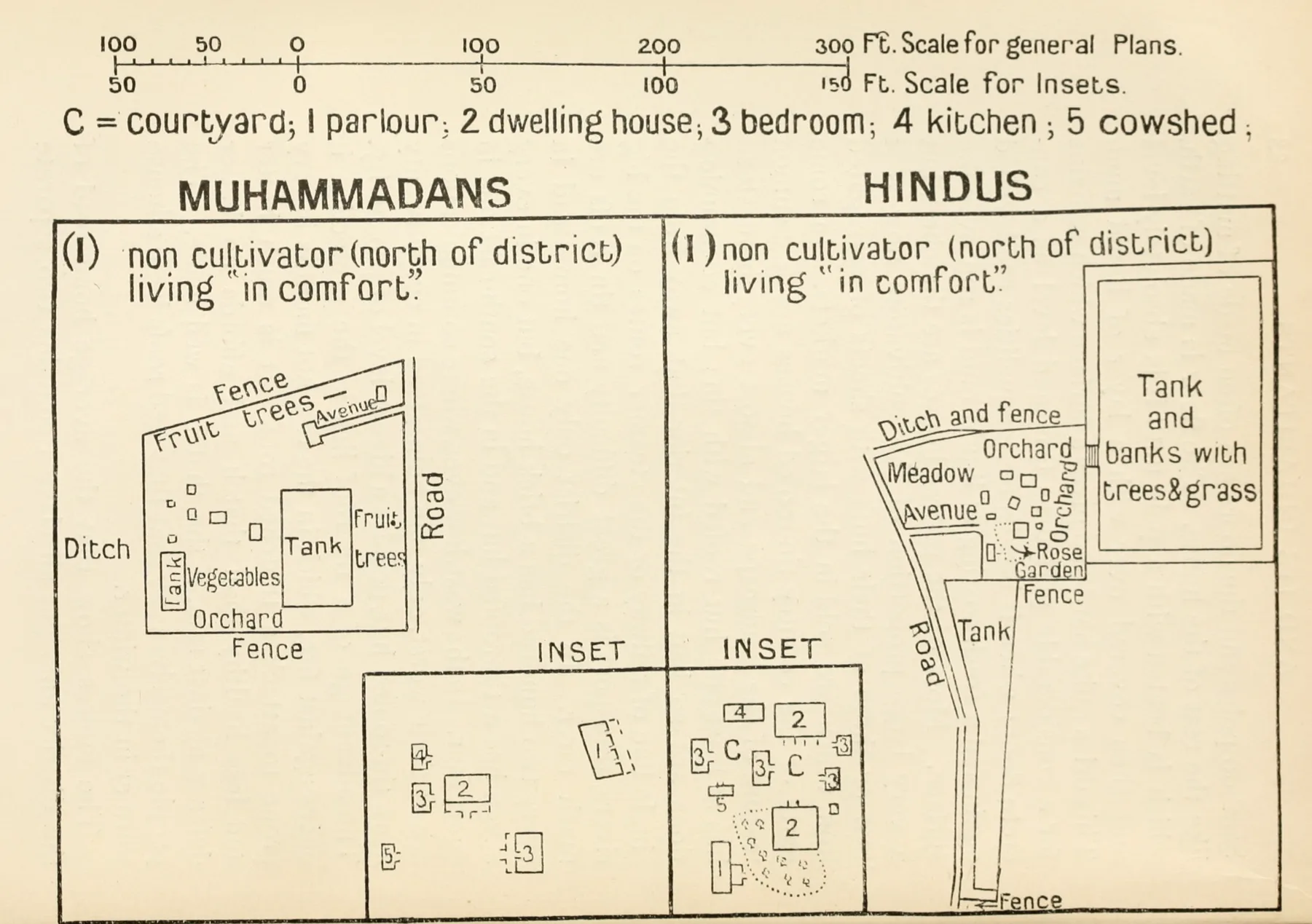
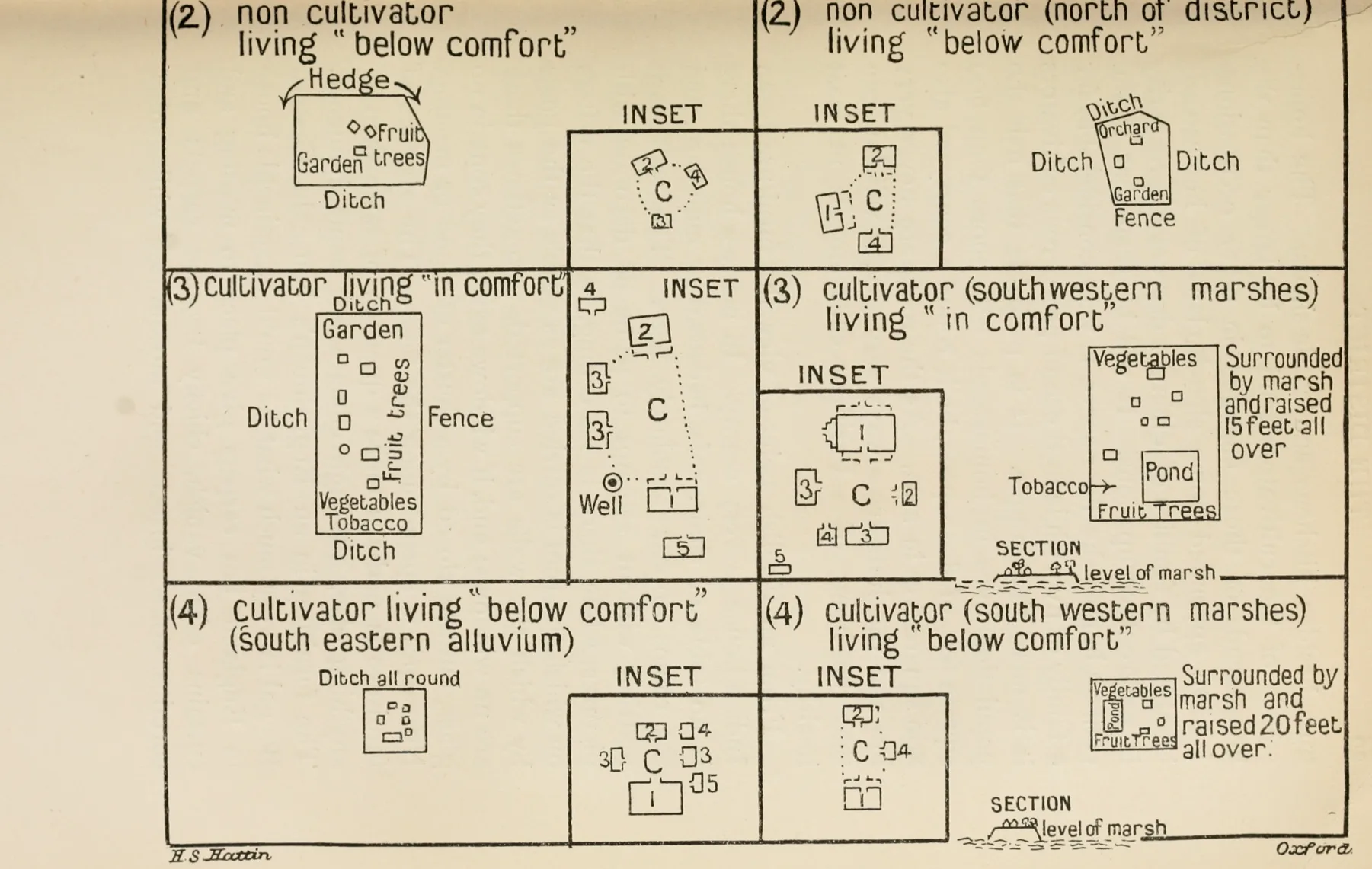
Plans of some homesteads in Faridpur . 24–5
Chapter I The District and its inhabitants, their homes and manner of life
[p. 13]
CHAPTER I
THE DISTRICT AND ITS INHABITANTS, THEIR HOMES AND MANNER OF LIFE.
The following pages are written round the few tables of dry statistics which bring this book to a close. The tables are few, because statistics are always unpleasant and will only be swallowed in small doses. The statistics themselves have been extracted from a mass of figures in several volumes and have been selected to illustrate as far as possible the various phases of the economic life of an Indian district. They concern the district or county of Faridpur, which is part of the large Indian province of Bengal and is situated near the coast at the northern angle of the Bay of Bengal. The province of Bengal is nearly as large as Great Britain and contains a greater population than the United Kingdom. Faridpur itself contains an area of 2,464 square miles and a population of 2,121,914 persons. It is therefore as large as the county of Devon and contains more people than any English county except Lancashire and Yorkshire. In contrast, however, to all the more populous counties of England and Scotland, the population is almost entirely rural. There are only two small towns in the whole district, of which the true urban population is not more than 20,000. There are no industries, so that the entire population, with insignificant exceptions, is dependent directly or indirectly upon the produce of the soil for its livelihood: yet the population is nine [p. 14] hundred to the square mile, far heavier than in any agricultural tract of Europe and almost as heavy as in any industrial tract of the same size. The purpose of these pages is to explain how these people live, to analyse their income and expenditure, and to examine the burden of taxation and indebtedness which they bear.
It will perhaps help to an understanding of the true nature of the statistics which are presented and reviewed if some description be given of the country and some account be attempted of the homes of its people and the manner of their life. To the ordinary European India conjures up visions of starved and toiling people, dusty plains or gorgeous vegetation under a scorching sun. The delta of the Ganges, although its population is larger than all England's, is forgotten in this picture, for it has none of these features. Yet it is a peculiar country, worth knowledge and worth description. It is made up of new mud, old mud and marsh; it contains rivers as large as any in the world, linked together by an amazing network of lesser rivers, streams and ditches; it mostly disappears under water for several months in the year, yet it grows abundant crops everywhere and supports a very considerable population in very considerable idleness. Faridpur is in all these respects a perfect specimen of the delta.
Faridpur is situated in the upper part of the Ganges delta. The Ganges delta is a very peculiar formation. It is absolutely flat and was in remote times a shallow lagoon of great extent on the edge of the Bay of Bengal. Two huge rivers, the Ganges and the Brahmaputra, flowed into this lagoon from the Himalayas and brought down in their streams an enormous [p. 15] mass of sand, silt and detritus which they had collected in their passage through the heavy woods bordering the slopes of the mountains and the friable soil at their foot. By means of this annual deposit the level of the lagoon was gradually raised until land emerged, extending slowly southward as the north was filled in. When land first appeared above the surface of the lagoon, it was intersected by a network of broad streams through which the water of the rivers flowed to the sea ; but each year its level was raised by a fresh deposit of silt until it had reached the height of an ordinary flood. The land was not, however, uniformly raised, as the parts which bordered the rivers and streams got the greater portion of the silt and the parts which were remote from them got very little ; hollows were thereby formed, and when the rivers should have turned their attention to these hollows their beds had silted and the volume of their deposit had diminished. Faridpur contains tracts which illustrate all stages of formation. In the south-east the land is still below flood-level and broad rivers and countless streams are still building up their banks ; in the south-west the rivers are flanked by wide strips of land which has emerged, but marsh is still predominant ; in the north the land is generally above flood-level, broad rivers have given place to narrow streams which are usually dry, hollows are already small and are slowly disappearing.
The dry north of Faridpur measures more than a thousand square miles and to the eye it is an infinite series of flat, sandy plains, broken by a large number of old water-courses which are now full of water only at the height of the flood season and at [p. 16] other times show dry beds which are merely a few feet below the surface of the banks. In the plains enclosed by these old water-courses there is usually in the centre a depression which still holds water for six or eight months of the year, but in the remaining months is capable of bearing a luxuriant crop. The country has been inhabited for several centuries and the villages are old. The population clusters along the banks of the old water-courses, which are always fringed by a thick belt of fruit and other trees. Scattered houses are rare: on the other hand there is always some orchard or garden between the houses fringing the banks of the streams. Away from the streams villages are found chiefly in the centre of the depressions, where houses have been built only after mounds have been raised to place them above flood-level. In such marshes a village appears as a cluster of houses raised ten or fifteen feet upon little hillocks and in the dry months looks from a distance not unlike a row of ninepins.
The south-east is much more interesting. It is still in process of formation and is full of rivers which are broad and deep, heavy in the flood season with constructive silt, yet sufficiently active to work their will upon a land of plastic mud. Here, as is the fashion of the delta, the rivers are washing away mud from one bank and re-forming it on the other with a method so complete and comprehensive that in the entire tract, perhaps 900 square miles in extent, very little of the present land has been in existence a hundred years and not very much for more than fifty years. Probably there has been land and population in all this country for five centuries and more; but so long as the [p. 17] general level of the land remains lower than the pitch of an ordinary flood, the rivers in the fury of the flood season will continue to eat away banks which are made of nothing firmer than mud, to sweep away the old country through which their currents carry them and to raise fresh flats of mud to take its place a few years later. It is a well-known law that the course of a river is not a straight line, but a series of oscillations, which must always shift if not confined between banks of rock. Here the banks are of mud so that the rivers can swing about at will; but although at any one spot there may be land to-day, a river next year and new land a few years later, yet in the total the land is always slowly increasing at the expense of the rivers and the level of the whole tract is always slowly rising. The soil in this portion of the district is very fertile and the population very dense; but the homesteads are new and orchards of well-grown trees are rarely to be seen. Homesteads are always built upon land which is raised three or four feet, the earth being obtained by cutting a tank or digging a pond beside the site.
In the south-western part of the district the whole land is a vast marsh, yet able to sustain a large and growing population. In the normal course this land would have been raised many centuries ago by silt from the great rivers, but owing to an abrupt and unexplained change in their courses, those rivers abandoned it and went farther eastward, leaving a few smaller distributaries to fill up the vast basin. It is only within the last century that the population has flocked to this basin, but to such purpose that the dismal swamp now contains 800 people to the square [p. 18] mile. For eight months of the year the country is a lake, 700 square miles in extent, whose surface is broken only by the village clumps and by the two narrow strips of land which mark the course of winding streams; in the other four months large parts dry up and enable crops to be grown upon them, but the centre, away from the rivers, is still marsh and unfit for cultivation. In all this portion of the district the villages are small and cluster round a tank or large pond. When the village was founded the tank was dug first and the earth heaped up until the banks were raised above the level of the marsh. Houses were then built on the top of the banks. In the dry season of the year, when the water in the marsh is very low or sinks into mud, these villages stand up in a rough circle like the crater of a volcano and can be seen for a long distance; at the height of the floods they appear to be islands floating on the surface of the lake.
There is no village street in the delta as in England, flanked on both sides by stone or brick houses in rows or pairs, with two or three shops, the village church, the village inn and the village hall or recreation-room. Indeed, in the English sense of the word, there is rarely a village at all, although in several parts of the district the homesteads of the villagers are grouped together in clusters. In the older north the houses usually straggle at irregular intervals along the banks of the streams and are surrounded by orchards or at least by some garden and a few trees. The hamlets in the depressions are also built in some kind of irregular line, but with houses closer together and each raised on a separate mound and usually shaded [p. 19] by several fruit-trees. In the south-western swamps the long line of homesteads is rarer, although it is always found, with much garden, beside the rivers; but elsewhere it gives place to the circular formation round a tank, and the houses are fewer and very close together and the trees are very few. In the alluvial south-east the land is too recently formed and too liable to be swept away to encourage the planting of a slow-growing orchard, but the normal line of detached homesteads is often seen, although isolated homesteads built by each cultivator on his own land are no less common. The newer lands are bare of trees and only in the older formations are orchards visible. In all these villages there is rarely a village road, usually a footpath leads from house to house, but often there is not a path at all. Nowhere are houses built of masonry, not a house in the district is semi-detached, nor is there a single row of houses as is the habit in European villages. As the village shop is not a Bengal institution, shops are found only in the markets of the more important centres; there are no village inns, parish halls, or recreation-rooms, while only rarely is there a place of worship, always the mosque of the Muhammadans. Worship among the Hindus is a family affair celebrated in their own houses, while amongst the Muhammadans it consists of prayers and preaching, which do not necessarily require a mosque, but may be conducted in the open air.
Nobody in Bengal, whether a cultivator or engaged in any other occupation, lives in a hired house. The peasant or the workman, although paying rent for the land to a landlord, always builds his own house at his [p. 20] own expense. This is the custom with all classes of the community, and I doubt if one man in a thousand in any part of the district lives in a hired house or in a house not erected by himself or at his own expense. This has always seemed to me one of the most effective points of contrast between Bengal and English conditions. The homesteads do not display as much variety in construction or arrangement as might be expected on this account. They conform to a common type amongst all classes of the community and tend also to cover an equal extent of ground. In the average they cover a quarter of an acre of ground in all parts of the district, although in the swamps, where a plinth sometimes 15 or 20 feet high has to be raised, the space is, as might be expected, very much smaller. Within this quarter-acre will usually be found a pond, an orchard and a courtyard, round which several huts with mat walls are constructed. The pond is in some parts of the district an almost universal feature and is everywhere very common. As the land nearly always needs to be raised to place it above flood-level, a pit or ditches would in any case be necessary, but the pond is preferred in order that the women of the household may take their daily bath in privacy—where there is no pond they must go to the public streams. The Bengali is certainly the cleanest race on earth. High and low, rich and poor, old and young, men and women, people of all occupations and all conditions bathe every day, submerging themselves even in the coldest weather from head to foot. The pond is also used for cleaning pots and pans and washing clothes and even for drinking, as the cultivators generally prefer its water to well-water, although in the north [p. 21] wells are common enough. The pond is always cut to a formal shape, usually a parallelogram, sometimes a square; the banks are well raised and usually planted with fruit-trees. The garden is popular wherever it is possible; but in the swamp villages and in the new alluvium it is naturally not to be found. In the north and in villages along the river banks elsewhere, every other house has a good garden, which contains several fruit and timber trees, besides plaintains and a clump of the indispensable bamboo. The homestead often has some kind of a hedge round it, and a patch is usually sown with tobacco or vegetables for the family consumption.
The homestead is neither a cottage nor a house as Europe knows them, that is to say, a building containing several rooms and probably two floors under one roof. It never consists of a single hut—even the poorest families always have a separate kitchen—and the huts, being cheaply made of materials grown on the land or locally obtained, are never strong enough to carry an upper story. A prosperous family builds larger huts and more of them; thus most cultivators in comfortable circumstances have five or six separate huts in their homesteads. Other classes of the community plan their houses in the same style, those who are prosperous usually erecting four or six huts, those who are poor contenting themselves with two or three. It is only in the main streets of towns or trading centres that a single hut is found sufficient and even then it is usual to contrive a detached kitchen. In the common model the huts surround an open courtyard, the dwelling-rooms often having verandahs opening into it. The largest hut will be [p. 22] used as a parlour in which guests are received; no friends or strangers will be admitted to any of the other huts, which will usually be smaller and be used as bedrooms by the family. Each hut will be raised on an earthen plinth one or two feet above the level of the courtyard. The most usual arrangement is to place the parlour facing down the avenue which leads to the homestead. All the huts will have doors, which will, however, only be closed at night. These houses are very rarely constructed of masonry, not so much on the ground of expense, but partly because the landlord will not permit it and partly because there is a preference in favour of mat houses on the score of healthiness. This preference is certainly well grounded, as even without windows and with doors shut sufficient air can get in to keep the atmosphere sweet, while in so mild a climate as that of Bengal protection against the weather is unnecessary. If houses were constructed of masonry, they would necessarily be very much smaller, and in every way it is wiser for the people to continue to build them of matting. It may be mentioned that Englishmen with large incomes prefer to build houses with mat walls than to live in the smaller and hotter brick houses as in Europe. The matting of which the walls are made is woven of reeds or grasses in large sections and is usually very tough. The poorer cultivators weave it of jute sticks, which are neither so durable nor so successful as a protection against the sun or the rain. In the houses of the more prosperous cultivators the door is usually made of wood and the posts inside the house to which the mat walls are nailed are substantial beams, but in the houses of the poorer classes the walls are often carried on [p. 23] bamboo poles and the doors are often made of matting like the rest of the house. The floor is made of earth, which is beaten with a pole until it is absolutely level and then covered over with a layer of liquid mud. This dries quite hard and gives a surface which remains for a considerable period as firm and level as a concrete floor; when it breaks up, inequalities are levelled again and a fresh coating of liquid mud is run over the surface. Most of the poorer houses are thatched, but a very large proportion of the cultivators now roof two or three of their huts with sheets of corrugated iron, which are sold in the larger markets. In some parts of the country tin-roofed houses are a common feature of the landscape and almost every homestead has at least one hut roofed with tin; but communications are so bad in the interior that, away from the single line of railway or the steamer routes on the big rivers, transport is a great difficulty and tin roofs are much rarer. In the district only one homestead in every two hundred has a brick house, but one in every seven has a tin-roofed hut and in the south-east one in every four. In the west, however, where communications are at their worst, only one homestead in every twenty has a tin-roofed hut, despite a higher level of prosperity. The advantage of a tin roof lies in the protection it offers against fire, which in the dry hot months is very prone to attack a thatched roof. It is much hotter and less healthy than thatch and affords no better defence against rain, if the thatch is well made. The people themselves say that thatched roofs keep a house warmer in the winter.
The figures show that the average homestead of the district amongst all classes contains two separate
[p. 24]
300 Ft. Scale for general Plans.
150 Ft. Scale for Insets.
(1) non cultivator (north of district) living "in comfort".
(1) non cultivator (north of district) living "in comfort".
[p. 25]
H. S. Hattin
[p. 26]
huts besides kitchens and cattle-sheds. The homesteads of the cultivators tend to be larger than the homesteads of those engaged in other occupations. I have appended some sketch-plans of homesteads inhabited by families of different degrees of prosperity in different occupations. It will be seen that in the poorest homes the floor-space is very considerable for a family of five, while in those of prosperous cultivators it is more than ample. It is probable that half the population lives in homesteads with more than 800 square feet of floor-space, built round a courtyard also 800 square feet in area. As the roofs are never very low and the huts are always very airy, it will be seen that the home of a Faridpur cultivator is at least healthy.
From an English point of view the furniture in an Indian house is very scanty. In many a house there is no table or chair, sofa, bedstead or cupboard, and the rooms appear absolutely bare. The walls are matting without attempt to paint or decorate with pictures, while there is no ceiling, so that the rafters on which the roof is carried are as visible as the posts by which the walls are supported. Sometimes there are no windows; and, if windows exist, they contain no glass, but are closed by a shutter of wood or matting. No carpet is spread upon the floor. The absence of furniture is perhaps more a question of taste than of anything else, although climate has some influence. The furniture in an Englishman's house in Eastern Bengal is very much what he would have in his house in England, but carpets give place to matting and curtains often vanish, chiefly because carpets and curtains collect insects and mosquitoes, while sofas, [p. 27] chairs and bedsteads are lightly made, often of cane. A wealthy Bengali, unless he keeps one room furnished in the English style for entertaining English guests, has as little furniture as a member of the poorer classes. Cupboards are rarely to be found even in the houses of the most wealthy; linen is usually kept in boxes or chests, often richly decorated with brass work. A Bengali always eats off the ground from a sheet or mat and squatting on his haunches. He will not eat off a table, even if his house contains one. If he sits on a chair at all, he selects a very low stool, for to sit on a chair of the ordinary size is to him not at all restful; when he is tired and requires a rest he will squat on his haunches, however many chairs he has in his house. To beds there is not the same objection, but of all articles of furniture bedsteads are the most expensive and cheap bedsteads are of little use. In truth the absence of internal decoration and of furniture is not a question of money, but a question of taste. The wealthiest Bengali who is untouched by foreign influences keeps as bare a house as his poorer neighbours and eschews ceilings, painted walls and furniture as completely as they do.
Perhaps the best means of conveying some idea of the interior of an Indian house and of the life led by the people who inhabit it is to describe exactly what was found in a few houses occupied by families of different classes. The homestead of a cultivator should be examined first, for cultivators form nearly 80 per cent. of the population. The huts will vary in size and number according to the prosperity of the family, but six huts appear to be the normal number, of which one will be a cowshed, one will be a kitchen and [p. 28] exclusively used as such, one will be a parlour for the entertainment of guests, one will be the ordinary dwelling-room and the remainder will be used as bedrooms. The less prosperous cultivators do without one or other of the bedrooms or without the parlour. In a homestead of this kind taken at random the kitchen contained two clay fire-places and a dozen earthen jars of large size filled with different kinds of eatables, while hanging from the walls were the cooking-pots made of brass, an iron pan, a mortar and pestle for husking purposes, a few knives and a jar full of water. The parlour contained a verandah, in which was placed a huge bedstead made of wood which is used in the daytime as a table or couch, as it has a flat wooden top. Inside the parlour there was a large wooden chest and ten large jars containing rice: on the walls hung a row of little brass pots and empty bottles. Raised from the ground and hanging from the roof there was a mat ledge, which is used as a cupboard. This is of large size and heaped upon it is all the bedding of the family—pillows, sheets, and blankets—and all the clean linen for the use of both men and women. Another shelf supported an ink-pot, a looking-glass and a brush and comb. Several bags and a few jars containing biscuits, sweetmeats and betel nut hung from different parts of the wall. On another shelf were some neat clay figures as ornaments and a lamp. A pair of shoes, several pairs of slippers, a fishing-rod and a fishing-net completed the contents of the hut. In one of the bedrooms there were a bedstead, a mat shelf to carry the usual earthen jars and a spinning-wheel. The other bedroom contained much the same furniture. One of the huts was [p. 29] used as a dining-room; it contained nothing except a shelf to hold fuel and a few sheets for the family to squat upon when eating. Along the wall were five brass plates, four brass cups and two glasses. The paddles for the boat of the family are kept in a corner. The best hut and the chief dwelling-room in the homestead had walls of split bamboo woven into a very artistic pattern. In the verandah at the door were two earthen jars, two feet high, besides a great deal of fishing-tackle and several garments. Inside the hut there were one tin trunk and one wooden chest as well as four cushions, several cane baskets, a large brass jar and a large pile of the best clothes of the family, including their fez caps and shoes. In one corner there was a lamp on a lamp-stand and there were the usual small jars for betel nut, betel leaves and lime, with which every guest is entertained; along the walls was the usual row of earthen pots containing rice, vegetables, condiments, sweetmeats and other foodstuffs.
Generally speaking, the houses of all cultivators are similarly filled, the most conspicuous features being fishing-tackle of all kinds and the rows of jars in which rice and other food is stored. If there are any chairs and caned stools, they are usually kept in the parlour, one or two at the most being kept in the general dwelling-house. In the poorer homesteads the most obvious signs of poverty will be holes in the walls of the huts and the absence of brass plates, pots and jars. There are rarely any pictures or prints on the walls except coloured photographs of the King and Queen, although in Hindu houses pictures of gods are sometimes found. The houses of non-cultivators of the working-classes are furnished in the same fashion.
[p. 30]
The huts are usually not so numerous or not so large, because the non-cultivator does not, like the cultivator, store rice and other foodstuffs for the consumption of a year. Occasionally a separate hut is kept entirely as a granary, in which case earthen jars containing rice are dispensed with in other rooms of the homestead.
The first comment which springs to the lips on an inspection of these interiors is that the Bengali house seems rather a store and a place to sleep in than a place to live in. These are indeed its uses. The menkind, who rise at dawn and go to bed soon after sundown, spend little time inside their houses except at night, as by favour of a mild climate they can live in the courtyards or the verandahs on most days of the year. Thus, although close-woven mats with a polished surface are kept in most houses as covers for the floor, they are usually spread in the courtyard and not within the huts. The womenkind spend most of the day inside the house, but their comfort and their tastes are little considered by the men; and if they were, the women must improve them by the light of nature, for they are not permitted to visit the houses of their neighbours. This accounts for the absence of all attempt to beautify or make comfortable and for the indiscriminate use of every room, even parlour and principal dwelling-hut, as bedroom as well as living-room; while the use of the house as a store-room accounts for the rows of jars, great and small, containing all varieties of food, for the fishing-tackle and for the clothes, linen and shoes which are to be seen in every room. Wooden cupboards are wisely avoided because of the countless moths and other destructive insects which they attract in so hot and damp a climate and because of the rats and mice [p. 31] which they too effectively conceal. Despite their absence there is not that untidiness which might have been expected. The garments of the family are chiefly cotton sheets, which fold neatly and take up little space.
The ideal domestic standard of Bengali society in these country districts may be shown by a description of the homes of a well-to-do Muhammadan gentleman who sees something of the officials and has travelled in other parts of India and of a prosperous Brahman amongst Hindus. The home of the Muhammadan is placed in the centre of a large garden, which covers nearly an acre and a half and contains a splendid pond or tank. There are five main huts, all with walls of matting, but of the best kind of matting, the larger with tin roofs and verandahs, the smaller with thatched roofs. The fruit-trees in the garden surround the huts on all sides and conceal them entirely from outside view. An avenue leads up to the guest-house, which is the only room into which the outside world can penetrate. This is divided by a corridor of matting into three rooms, each of which has a separate door on to the verandah and several windows with iron bars. The verandah has a neat wooden railing. In the hall there is a hanging lamp, a writing-table with writing materials, a shelf with a large number of books, a long bench upon which books are usually placed, a small round table, a praying-mat, two chairs, a steel trunk and a cane stool. Formerly there was a carpet, but when the tables and chairs were introduced the carpet was stowed away in the trunk and matting substituted for it. There is the usual jar of water and glasses which are to be found in every [p. 32] house. On the walls hang the clothes of the family; in this case the clothes for ceremonial occasions. There are also two war maps and some war pictures. In a corner of the room there are two wooden bedsteads with large pillows and coloured quilts. In another room, where a shelf carries a copy of the Koran, the Muhammadan Bible, there is a bench, a steel trunk and a wooden chest on which lie several novels; on the floor there is a rug, and in a corner there is a bedstead with bedding and quilt upon it. Facing the door there is a large mirror and beside it a large wooden chest containing a carpet, table-cloths and dish-covers, dresses for ceremonial occasions and clothing for the winter; on the top lie two decorated hookahs from Northern India. On a matting shelf there are a dozen brass pots for use when necessary. The furniture in the third room is very similar.
The second hut, which is walled with coloured matting in an oriental pattern, has a verandah and is used as the living-room of the family. It contains a camp table, a cane chair, a filter and a bamboo stand for four water jars, two cane stools, some large shelves of matting which hang from the roof and carry a variety of household requisites in the usual jars and all the crockery of the family, which is here of china or glass. In the centre of the room there is a bedstead and in a corner a brass lamp, a lamp-stand, two or three lanterns, two hookahs and two brass spittoons. Along the walls are three other bedsteads with mattresses, quilts and pillows and a cupboard which contains the work-a-day clothes of the family. One of the other huts is merely a bedroom with bedsteads, trunks and a large supply of linen of all kinds. The [p. 33] spare foot-gear of the family is kept here, besides a number of earthen jars containing the best rice. This is the bedroom of the mistress of the house, and it is curious to see that her toilet aids consist of one small looking-glass, one comb, a few hairpins, three or four pieces of black ribbon, one ball of thread and two needles. Another house in this homestead, which belonged to a son who died recently, is now in great disorder. It contains three benches, a chair and a stool, one cupboard and the usual bedstead, besides boxes and trunks which are full of the clothes which the son used to wear; he was something of a dandy and had many. The fifth house is the kitchen. It has the usual clay hearth with two mortars for husking purposes, several brass pots and two brass plates, and all the other crockery of the family—china plates and cups and glasses. Two small houses in the rear are used as a cowshed and a goatshed, the latter containing two large crates in which poultry are kept.
The Muhammadan was a man of the old school and had not received a modern education; but his home shows more traces of western influence in its furniture and arrangement than is usual amongst the most advanced and educated of Hindus. Educated Muhammadans are even more modern in their tastes and appear to have a natural instinct for the manners and social customs of the West.
At the risk of being wearisome I will complete the picture of domestic life in the district by describing the home of a Hindu of high caste in easy circumstances. He is not by any means one of the wealthiest inhabitants in the district, but he is a professional man with a modern education and a leader of the orthodox [p. 34] community, and his home will illustrate how far a Hindu imbued with the new western education is willing to amalgamate western and eastern domestic arrangements. He lives on the outskirts of a small country town and corresponds roughly in social position to a doctor living in an English country town with an income of between £500 and £1000 per year. In this Brahman's household there are five adult males, five adult females, three boys and four girls, a total of seventeen people. The houses and garden cover 2½ acres. In the homestead there are altogether eight separate huts of different sizes, besides a cowshed, the principal hut opening on a formal rose garden in the English style. The buildings are surrounded on all sides by land which is half a meadow and half an orchard, the fruit-trees in some measure screening them from view. An avenue leads to the principal dwelling-house and the guest-house. There are two courtyards, the larger and outer surrounded by five huts containing all the living-rooms, and the smaller opening from the larger and surrounded by the four smaller huts, two of which are kitchens, one a bedroom and the fourth the cowshed. Behind the main courtyard there is a large pond, shaped formally like a parallelogram and covering nearly 1½ acres, the banks of which are high and grow tall thatching-grass and a profusion of fruit-trees. This is the bathing-place of the family, and a flight of masonry steps leads to the water. The guest-house is somewhat apart from the courtyard, and behind it there is another large pond from which the drinking-water of the family is obtained. Both of the ponds were excavated mainly in order to raise the land of the garden and houses well above [p. 35] flood-level ; but a pond must in any case have been made to preserve privacy for the daily bath of the ladies of the household. In such a low-lying country as Eastern Bengal half of the land upon which the residence is placed must be sacrificed to a pond in order to raise the remaining half to a height which permits life to be maintained in health and comfort. Cultivators dig this pond themselves, but to the upper classes the cost of raising the land is a very large part of the expense of building a residence.
In internal arrangement and furniture the home of this professional man is very little different from the homes of cultivators ; in size and in strength and quality of materials it is better than the ordinary cultivator can afford, but no better than the more prosperous cultivators can and do provide for themselves. It contains in the same way a bewildering profusion of earthen and brass jars, as it is the custom of the upper class to buy rice for the whole year when the price is low, as well as supplies of other food for long periods. Very few homes contain a separate granary, chiefly owing to the depredations of rats, and no houses contain store-rooms or pantries, so that all the vast amount of food-stuff required by a large family must be stored in large or small jars which are scattered over all the huts of the residence, as many being found in the bedrooms as in the kitchen and dwelling-rooms. In this particular residence there are two kitchens, the smaller of which is used only to fry rice and not to cook the main meals of the family. The larger kitchen has strong walls of matting and a roof of corrugated iron. It is divided into two parts, of which the outer, a wide verandah, is used as the dining-room of the family and [p. 36] the inner, separated from the verandah by a strong wall, as the kitchen. In this kitchen there are five hearths for cooking and a brave array of cooking-pots and pans of iron, copper and brass, besides several metal waterjugs, sixteen cups and plates and eight tumblers, all of brass or of bronze alloy, as the Hindu prefers to eat off metal. Of the other huts, one is the guest-room, two others are the main dwelling-rooms of the family, although used also as bedrooms, one is exclusively used as a bedroom, and two smaller huts are used partly as bedrooms and partly as store-rooms. All these huts are strongly walled, the three larger partly of timber, and all have roofs of corrugated iron. All contain bedsteads (or taktaposh), the large, low, square, wooden tables which are used as beds at night and as tables in the daytime. The walls of all are hung with garments and linen of the family, while along the floor in rows stand earthen and brass jars. From the ceiling hang the large matting shelves upon which supplies of linen are promiscuously heaped at the side of plates and cups and jars of sweetmeats and spices, for the Hindu has much less idea of neatness and order than the Muhammadan. Material for chewing pān (betel) has a conspicuous place in every hut, while usually a shelf will carry articles of toilet.
It would be tedious to describe in detail the contents of any of these smaller huts, as a description of the guest-house and the main dwelling-house will serve as an indication of the contents of the rest. It may be said, however, that in the whole residence twelve huge, twenty-five large and forty small earthen jars were counted, besides twenty-two large and fifteen small brass jars and twelve baskets for holding vegetables, fish and fruits.
[p. 37]
The wide verandah of the guest-house contains one chair, a long stool and two benches. Inside, a portion is walled off to serve as a bedroom for a guest, but it contains only a single taktaposh; the rest of the house contains two taktaposh, which are used chiefly as tables, as this is the office of the master of the house; but they will serve as bedsteads in the event of guests arriving. In the main room there is another chair and two long low benches for visitors of the lower classes, as it is a custom in Bengal for people of all classes to call on the well-to-do and pass the time of day. The room contains a bookcase, three lamps and several fishing-nets. The articles more immediately necessary for the welcome of guests are five hookahs and smoking materials, the hookahs being scrupulously kept apart for the different classes of the community, two for the Brahman caste, two for Hindus of lower castes and one for Muhammadan visitors; in no case will any of these be used by people of another rank or denomination. A visitor is offered a smoke from his own particular hookah, just as a visitor in China is offered a cup of tea, or he is served with a leaf containing betel-nut and lime, which is as popular with high-caste Hindus in Bengal as chewing-gum is with Americans. Another interesting feature is a row of shoes and sandals ranged along the wall, which are offered for the use of guests.
The main dwelling-house is a very large room, flanked by two corridors, which are separated from the interior by mat partitions, and with broad verandahs on the north and south. It has altogether nine windows, each of which is carefully fenced with iron bars. One side of the room is used chiefly by the adult men of the [p. 38] family and the other by the boys. Although this is the principal dwelling-room of the family, yet the floor is the usual smooth mud, not covered with either mat or carpet. On the boys' side of the house there is a writing-desk, clock, bookcase and two small wooden chests, no chairs or stool : on the men's side there is a large easy chair, a long bench and a footstool, a writing-table and a large clock, two bookcases, one of which has a glass front and both of which are well filled, chiefly with novels and religious books, but the glass bookcase also with a shelf of the wonderfully modelled and painted clay figures representing Hindu deities. There are, besides, an iron chest to contain jewellery and valuables, three steel cash boxes, four tin trunks and one huge wooden chest which contains the plate, valuable crockery and richer garments of the family. On the walls there are several gaudy prints, chiefly mythological or religious in character. The corridors which contain only bedsteads and clothes are used as a bedroom by most of the family. There are seven prints on the walls, four of religious subjects, one of Queen Victoria and the other two of English women. In the verandah are a bicycle and a tennis bat.
The life of the cultivator in Eastern Bengal is in many ways a very happy life. Nature is bountiful to him, the soil of his little farm yields in such abundance that he is able to meet all his desires without excessive work. He can produce the food of his own family and sufficient to purchase everything else which he requires from a few acres of land that he can cultivate unaided without overwork. The whole of his labour is over in three months if he grows a rice crop only.
[p. 39]
He may take a second crop out of the land by sowing a spring or autumn crop. If he sows a spring crop, he pays it but little attention and only for a very short period, while if he sows an autumn crop he sows it only on a portion of his land and thereby reduces his work. In those parts of the country in which jute is grown he works at two seasons of the year, growing rice on one portion of his land and jute on another; but many of the cultivators content themselves with the winter rice crop and so put all their labour into the months of March, April and May. The harvest, which most of those who can afford it get in by hiring the labour of others, takes place in November. If they have decided to grow a spring crop, they will spend a day or two in December in preparing the ground and in planting the seed and will give very little further attention to it. If they grow the autumn crop of jute, they will need to spend much labour in July and August at the time of harvest in steeping and stripping the fibre. This work will not fill the whole of the day, but will be sufficient to occupy their energies for a few hours of every day during a month or six weeks. The time-table of the cultivator, therefore, when his land is unfit for jute, shows three months' hard work and nine months' idleness; if he grows jute as well as rice, he will have an additional six weeks' work in July and August. These are not conditions of which he can reasonably complain.
During the months of March, April and May, when he is really hard at work, the cultivator will get up at sunrise about five o'clock, smoke for a few minutes at his hookah and go forth to his field with his plough and cattle, where he will plough in the heavy soil until [p. 40] his children arrive with his hookah and tobacco. From that time until 9 or 10 o'clock he will work and smoke by turns. The children will bring him his breakfast to the fields about 10 o'clock and after breakfast he will continue his ploughing until noon. As a usual thing the breakfast consists of the rice cooked the evening before, heated up and mixed with green pepper (pantha). When his work is over at midday he goes off with his children for a bathe in the nearest river or stream, or in the pond near his house. He then returns to his house and eats the midday meal which his women-folk have prepared for him. This consists of rice mixed with a liquid preparation of pulses (dal) and a curry made of vegetables and fish. After his midday meal he will go to sleep for an hour or two and set out for his field about 3 or 4 o'clock, when he will engage himself in either harrowing or weeding. He will work in the field until dark and sometimes even later, if the field be close to the homestead; ordinarily, however, he is too superstitious and too much afraid of ghosts to work in the dark. On return to his house he will wash again, and if the night is, as usual, fine and balmy, sit on a stool in his courtyard and smoke hookah after hookah while his neighbours drop in to have a chat about the crops. At 8 or 8.30 they will go off to their evening meal and he to his, very much the same food being eaten as at the midday meal. After his meal is finished he will smoke for a short time and retire to rest usually about 9 or 9.30. He sleeps on a blanket or sheet on the floor of his hut, although some of the prosperous cultivators sleep on beds with or without mattresses, and often with a mosquito curtain.
[p. 41]
At other seasons of the year the cultivator has very little work in his fields and rarely pays a visit to them. If he has sown jute or an autumn crop, the ploughing has also been finished in April, but he will be busy with it at the harvest time in July and August. The harvest of the autumn rice crop is a simple operation taking only a few days, but the harvest of the jute crop is much more laborious. He has to cut it by degrees, steep it in some neighbouring water, which lies everywhere after the torrential rains at that season of the year, wash it and strip the fibre; all of which will occupy him for perhaps a month from early morning till the afternoon. He rarely pays a visit to his fields after the midday meal.
In the winter, from December to February, he is only engaged in the harvesting of the winter rice-crop, or perhaps, if he sows a spring crop, he may spend one or two days in ploughing and harrowing the ground and a few hours in February in harvesting the crop. The winter rice-crop is cut by hand by a small hook sickle. It is exhausting labour, as the reaper has to squat down and bend to it. However, the owner always hires a few men and employs his children with them so as to finish it in a few days; even when he has much land he arranges to finish harvesting within a week. He provides the hired labourers with breakfast and supplies them with tobacco to smoke in their frequent intervals of rest. They work until the early afternoon and receive as wages one-sixth part of the crop. After returning from the field he will take his delayed midday meal and occupy himself in the evening with thrashing the paddy in his courtyard. The cattle are tied to a central stake [p. 42] in the threshing floor, round which the paddy is piled, and are driven by him round and round until the ear is completely separated from the stalk. The stalk is then removed and the ear collected and passed through a sieve, when it is made over to his women-folk to husk. He does not forget the old injunction, ‘Thou shalt not muzzle the ox that treadeth out the corn’. Next morning at dawn, his first duty is to apportion the crop between himself and his labourers. In the east and south of Faridpur the whole of the rice harvest in many villages is cut by cultivators hired from neighbouring districts such as Nadia, who are lodged and fed by the owner for the week or fortnight during which they are employed. In the meantime he himself takes boat and goes off with a party of his neighbours to the fertile lands of Bakarganj and Mymensingh, where the cultivators are much too prosperous and much too proud to harvest their own crop and always import labour from other districts for the purpose. Here he gets his food and one-fifth of the crop as wages, the crop being so luxuriant that his share supplies his family with rice for the year and far outweighs the portion of his own crop which goes as wages to its harvesters.
During the rest of the winter the cultivators spend their days in comparative idleness. If there is water in the streams or marshes they go out fishing with rod or trap, and they always spend much of their time in mending their fishing-tackle to be of use in the rains, when fishing is at its best. They also spend no little time at this season of the year in repairing their houses and in thatching such as require it. For the rest of their time they either smoke away the day or attend [p. 43] one of the frequent markets and gossip with their fellows whom they find there.
During the dismal period of the rains, from July to September the cultivators spend much of their time in fishing or in visiting friends. At that season of the year water is everywhere, deep lakes forming in all depressions, the rivers and streams overflowing their banks, and water lying to the depth of a foot even in the highest field. Fish, both large and small, are innumerable, and some of the larger fish come swimming over the fields and are to be caught there. During this season of the year practically all men in the district go a-fishing, for which they have a variety of contrivances in rods, spears, nets, traps and baskets. With a rod, which is usually baited with smaller fish or grasshoppers, they tempt the bigger fish in the streams, but although fishing with a rod is an amusement eminently suited to their indolent natures, they are even more fond of spearing fish from a boat. Two or three will go together in a dug-out paddling over the fields, one will steer and the others standing in the bows will fling the spear at any fish seen moving through the shallow water. The spear is weighted with a barbed hook at the end (sometimes with one, sometimes three and sometimes seven barbs) and is thrown with wonderful accuracy, rarely missing its mark completely. This form of fishing is only possible on windless days, as the fish do not come over the fields when the shallow water is much ruffled into ripples. On other days the cultivator sets traps or nets, made of bamboo or string, with a pocket or purse in which the fish are caught. He visits them in the morning and evening with a basket and collects his catch. Another method of fishing in [p. 44] the fields which is very popular is the use of domeshaped baskets which are open at the base. All the villagers collect, each bringing a trap of this shape, and walk along the shallow water in the field in line with the traps in front of them. The traps are dropped simultaneously on the bed and no gap is left between them, so that the whole line is scoured. Any number of small fish are caught in this way and as the field is swept to a finish very few of the fish can get away. In the smaller streams other means are adopted besides the rod for catching fish. Most days and every night several nets and traps can be seen in every stream. The cultivator may walk along the bank with a net shaped like a lacrosse or butterfly net and attached to a bamboo pole. He will scoop it upwards through the water and with wonderful quickness fling any fish caught in it on to the bank. Or he may use a net shaped like a parachute and weighted all round the hem, holding it by a long rope attached to the crown. He will swing this out from the bank with a rapid jerk and, if he is dexterous, it will open wide and fall level on the water, when the weights on the end will gradually sink down, catching any fish which may be underneath in the meshes. Often he nets fish from a boat with nets which are shaped like large purses or bags and are fitted to the prow with a bamboo pole rising up as a lever. The boat is driven along at a rapid pace with the net spread out under the water; as soon as the fish is caught the bamboo pole swings slightly forward, whereupon the attendant at the prow jerks it back, raising the net out of the water and securing the fish. In the larger rivers and especially in the southern part of the district fishing from a dinghy, a large canoe, is [p. 45] very popular with all classes, the butterfly type of net being used by hand or with a rope, or more frequently an enormous net the size of a sail, which is fixed like a sail to a bamboo pole rising from the centre of the boat. This net is triangular in shape and rests upon three bamboo poles, which are secured to each other at the ends, the one which is used as a mast being fixed in a movable socket so that the whole net can be dipped over and sunk into the water. After it has been in a minute or two it is raised up and the fish secured which have been caught in its ample folds. It may be imagined what dexterity and watermanship are necessary to keep a long dug-out or canoe on an even keel and driving forward with such a weight swung over one of the sides. But this form of fishing is very popular in the great rivers of the south, which at the height of the rains on a breezy day present a most lively scene, the fishing fleets of the different villages collecting in hundreds, each boat with a triangular sail of many colours bellying in the breeze, each with a steersman standing at the helm to guide it as it drives rapidly before the wind, and each with a fisherman crouching intently over the prow, ready to jerk the net by pole or rope as soon as he discovers that a victim has been caught. The extent to which the villagers are devoted to fishing will be shown by a cursory glance inside the huts of any homestead, where rods, spears, traps and nets will often be seen of twelve varieties and rarely of less than six.
Once a week during the rains, if any marshy country is near, the cultivators will go off for the whole day in a party of five or six, each in his own boat, to cut marsh grass for the cattle. This is a more succulent [p. 46] food than might be expected and is a useful variant to the straw of the rice-crop. When water is everywhere, the cattle find little grass to eat and without such marsh grass are apt to lose condition very rapidly.
Another amusement of the cultivator during the dull season of July to September is a visit to his friends and relatives in other villages. This is more common amongst Muhammadan than Hindu villagers. When he visits a relative he will stay in his house, if there is room, as well as take his meals with him, but usually when he visits a friend he will only eat with him. On these visits he takes the entire family with him in a boat which is somewhat larger than the dinghy and must usually be hired, although many of the more prosperous cultivators possess one. This boat is about 15 feet long and 4 feet in beam and carries towards the stern a tunnel-shaped cabin about 6 feet long and 3 feet high, made usually of thick matting, but sometimes of corrugated iron. The entire family lives in this diminutive cabin, cooking such meals as are necessary on a fire improvised in the bows of the boat. During these visits the children play with the children of the village, the women cook the meals, and the cultivator smokes and gossips through the day or plays cards with his friends.
But the chief amusement of the cultivator at all seasons of the year is to attend the neighbouring markets on market-days. Probably ten or twelve such markets will be within walking or boating distance of his homestead, all of which he will attend in turn, even in his busiest season finding time to go to two markets a week and during the winter and the rains, [p. 47] when he has nothing to do, going usually to four or five and sometimes to a different market every day. No women go to market in Bengal, yet an infinite deal of chaffering and gossip is needed for the transaction of a very little business. The cultivator goes to market with his sons soon after his midday meal and will often forgo his midday sleep to attend a distant market; he leaves again at dusk. He does not ordinarily go to buy anything, but to talk with his friends and neighbours. He often smokes there but never eats or drinks anything. Muhammadans drink no alcohol in any case, and there are no tea-shops or restaurants at any of the markets. Even if he buys some soda-water or lemonade or sweetmeats, of which he and his children are inordinately fond, neither he nor they will consume them at the market. If he buys fruit, mangoes or lichis, one or two may be eaten at the market and he may drink a little water from the stream; but he finds his amusement in the idle gossip of a few hours amongst the crowd, in noting the price at which country produce sells and in looking at the cattle and live stock brought for sale and the price which is asked for them. On such occasions all disputes between neighbours are canvassed and advice offered, sometimes to conciliate the parties and sometimes to embroil them further. A cultivator may attend a market every day of the week and not spend more than fourpence altogether, but when he has money the Muhammadan at least is a great spendthrift. In the harvest season nine out of every ten cultivators returning from the market will carry an earthen jar full of sweetmeats and at least a pair of the best fish obtainable, whatever may be [p. 48] their price; if the large jack-fruit, which is not unlike a melon and a great favourite with the cultivator, is in season, he will carry home two or three also.
The women-folk in the family have a much less varied time. They have no seasons of work and seasons of idleness, but must work throughout the year at duties which are always the same. They get up before the men, sweep the yard and then the floors of the houses, sprinkling them with water and brushing them with a wet brush. The floors of working-class houses are always kept scrupulously clean and the brass jars and pans are always shining. The women next scrub all the cooking-pots and pans and take the pestle and mortar to husk the rice which will be eaten during the day. They then collect vegetables and other condiments and prepare the ingredients for the midday meal. After this they go to their pond or the nearest stream for their daily bath, taking with them a jar to bring back such water as may be necessary for cooking. During the rest of the day they are employed in cooking the meals for the family, keeping the houses clean, washing clothes, looking after the young children and tending to the sick. No woman is ever supposed or allowed to take any rest while husband or brother or father is in the house; or is ever allowed to eat until all the male members of the family, including her little sons, have finished their meal. The women in Eastern Bengal, with the exception of Christian women in the marsh country who are very few in number, do no work of any sort in the field. The only part they take in the agricultural round is to husk the rice both for sale and for consumption, although if jute is grown they are employed during the mornings in the homestead [p. 49] or very close to it in stripping the fibre after it has been steeped and dried. In this manner they may spend three or four hours every morning for a few weeks. Theirs is a dull life indeed; the bustle of the market-place is not for them, nor the gentle pleasures of the fisherman. They take no part in the conversation of the men and are not allowed the simplest amusements; they can only gossip with their women friends, when washing pots or bathing in the pond or public stream. But custom is a kindly autocrat who softens every hardship. They do not grumble or rebel and are not discontented with their lot; they do not know and do not want the charms of a fuller or a freer life.
The children in a Bengali family have a very easy life. The fathers are very fond of their boys and retain that fondness, at least to outward appearance, far longer than an ordinary father of an English family. Amongst the English working-classes there is little obvious affection between father and son after the boy has reached the age of fourteen and become rough; in an Indian family the bond between father and son remains very close even after the son has married and got a family of his own. At all times the father is never happy unless his boys accompany him to the field or in his fishing. When quite little lads, the boys take out breakfast to the father in the field and prepare tobacco for his occasional pulls at the hookah; when the morning’s work is done they drive the cattle back for him; in the afternoon they take off the cattle to graze and look after them. This is not always an easy task, as an Indian village has no meadow or set pasturage and the cattle pick up what [p. 50] they can on the grassy balks between the fields and on the roadside. They scatter very much, and the little lad must keep them from feeding on the crops of the neighbours, because it is only too easy, as there are no hedges to the fields, for the cow to stray from the grass into the fields of grain. The boys collect together while cattle-tending in the afternoon and play country games which require a good deal of activity. In many of the larger villages near schools and towns they play football in the evening; and even cricket, a more expensive game, is not unknown. Before going out in the afternoon with the cattle, they are usually given a simple meal, which amongst the more prosperous may often include ginger-beer or English biscuits, of which they are very fond. As the boys get older they help their fathers in the field and especially in weeding and when they reach the age of fourteen they take their place as a man in the whole of the agricultural round. Only a few of the village lads go to school, and village schools are very primitive institutions. There is no prejudice against learning, but even the most careless observer must notice the tendency of lads who have gone to school to refuse to work in the field and to despise their unlettered fathers. Elementary education may be a very blessed thing, but it would seem that in an agricultural country it needs to be universal, if it is not to prove a curse. The boys and the girls of a village never mix or play together after the age of six; but perhaps the most conspicuous feature of a Bengali village to an Englishman is the quietness of the boys, the lack of laughter and of the rough-and-tumble games so common amongst English lads of all classes. This is not due to hard conditions [p. 51] of life, for the children are well fed and well cared for and are ruled with a light hand. It may be an effect of the damp and depressing climate; but whatever the cause, boisterous merriment and merrymaking is not in Bengali character amongst old or young. On winter evenings it is a custom in some villages for boys to go out in parties round the homesteads and collect coppers by singing ballads to their elders. These ballads are written by rustics in the country dialect and are full of simple repetitions. They are often humorous and usually about local happenings which have struck the imagination of the village. The most popular of these ballads deal with the misfortunes of the great and describe their punishment with realism and relish. The elders like to hear the same ballad again and again; when it is ended they turn it over and over in their minds and gossip about it endlessly, wisely whispering obvious comments to their beards with many a shake of their heads. In the simple Bengali village this is the only amusement open to the villager in the long evenings. There are no inns or clubs or recreation-rooms, cards and dice are rarely played and other indoor games are unknown. There are no neighbouring towns with theatre or picture-palace and, if there were, there is no railway or other means of conveyance to them. Happily the villagers have not yet learnt to want them and are quite content with the simple songs that the village lads can sing.
The little girls learn to help very early in the house-work, brushing the floors, cleaning the pots and dishes, carrying water from the nearest river and keeping infants asleep with simple lullabies. They play with dolls, often beautifully made of painted clay, which are [p. 52] cheaply bought at special fairs in February. They gossip a great deal and play a few simple games, but they are very ignorant and learn very early to be women. The village school is not for them and it will be long before they are allowed into its precincts ; until then the happy days of childhood will be very short and in later life they will find no relief from the dull round of domestic duties.
It is impossible to give any brief description of the manner of life of the non-cultivating classes. Their occupations differ so widely and there are comparatively so few families engaged in each occupation that it is not worth while to go into any detail. They work, however, very much harder than the cultivator and with more regular hours ; they have also no seasons of idleness, but work throughout the year. Domestic servants are a hard-worked class, whose work is never done. Weavers—a numerous class— work at home on the hand-loom and not in factories, but they work long hours, beginning early and continuing into the night. The casual labourer in Faridpur, as elsewhere, has idle days in the week. Generally speaking, labourers, weavers and others of the working-classes take their meals and their daily bath, rise in the morning and go to bed at night at the same time as the cultivators. Fishermen—another numerous body—spend most of the day in their boats on the big rivers, but usually eat in their houses ; they very often spend the whole of the night fishing and certainly work harder than any other class of the community. The life of the women is in no way different from that of women of the cultivating classes, except that the wives and daughters of the well-to-do [p. 53] have women servants to assist them or to do their work for them. The few shopkeepers, the landlords and professional men and generally the population of the towns live a more civilized life with a greater variety of food, a greater variety of occupation and a greater variety of amusement. The hours of work of the professional classes are not different from those in Europe. The only feature of life amongst the professional classes which is worthy of comment is a result of the dependence of women upon the man. Amongst these classes, known in Bengal by the generic term of bhadralok, the bread-winner of the family is usually employed in one of the towns or away from his village; but instead of taking his family to live with him, he leaves them at home, not alone however, as he always leaves an adult male member of the family as guardian over them. These guardians have no serious occupation. Landowners also are accustomed to spend an idle life in their village homes, not only the father but all the sons together. The result is that idle men are found in many villages who have no possible means of spending their days profitably and who not unnaturally devote themselves to intrigue or to fomenting strife between their neighbours; wherever villagers quarrel or are at loggerheads with their neighbours there is usually some idle bhadralok who acts as the agent provocateur. Much of the sin and the crime in the villages is to be laid at their doors.
It may be added that all boys of the Hindu ‘respectable’ classes go to school from the age of six to the age of sixteen at least and many of them stay much longer; . indeed, in the highest forms of most schools some of the boys are really men with beards, [p. 54] a wife and a growing family. Hindu and Muhammadan traders also send their sons to school but usually take them away at the age of fourteen. Muhammadans of the landowner and ‘respectable’ classes have only recently begun to send their boys to school, and in many of such families the sons still lead a lazy life and create much bad blood and mischief. Labourers and fishermen rarely send their boys to school, weavers more often, while the Hindu shopkeeper, goldsmith or silversmith usually teaches his boys at home to read, write and keep accounts.
Chapter II The Domestic Budget
[p. 55]
CHAPTER II
THE DOMESTIC BUDGET
It will be convenient to examine the expenditure of an average family before recording the statistics of its income. The population of Faridpur, so far as it came under review in the course of our investigations, was found to consist to the extent of 77 per cent. of peasants and other agriculturalists and to the extent of only 23 per cent. of those who were not engaged in the cultivation of the soil. In the matter of expenditure, or what may be better described as the family budget, the distinction between these two classes is vital. The peasant grows his own food and is for the most part able to feed himself and his family; moreover, in many other ways he obtains from his surplus land, his trees, or his live stock materials which are useful to him and save expenditure. The non-agriculturalist on the other hand buys everything. As a result—and this is a truism thoroughly understood in every agricultural country—the peasant is always better fed than the non-agriculturalist who has nominally the same income. In Faridpur the two classes were kept rigidly apart in our investigations; all incomes and all calculations of the domestic budget of the peasant were expressed partly in cash and partly in crops as a basis of estimation, while those of the non-agriculturalist were expressed wholly in cash.
To deal with the agricultural population first, normal domestic budgets were collected from a large number [p. 56] of budgets drawn up with great care by every officer independently after personal enquiry. The officer was directed to examine the condition of the families in his village and to select several examples of families who were in the most comfortable circumstances and several examples of families who were in the most indigent circumstances. He was then directed to enquire of the peasant the amount which the family consumed of the different food-stuffs which were grown on its fields. The daily consumption also of rice, salt, and oil by the families was watched where this was possible, and an average daily rate of consumption per head was calculated. The peasant was closely questioned as to the kind, quantity and price of all food and of all other necessaries which he bought in a month or a year, his statements being tested by the sum which he had actually spent in the previous year. Generally speaking, averages obtained over so large a number of families selected by different enquirers in many different centres must give very fair results. Any one who has conducted such enquiries will know what pitfalls are in the way. Personal idiosyncrasy makes havoc of the most careful attempts at uniformity and in the spending of money moralists and economists alike deplore the latitude allowed to personal idiosyncrasy. In some items there was in the nature of the case considerable difficulty in striking an average of expenditure; thus, house repairs were an item which had to be taken into account, but as they were not necessary each year an estimate had to be made on the basis of spreading the cost of the occasional repairs over the number of years during which the repairs would last. Medical expenses were an item [p. 57] even more difficult to estimate, and here the estimation was done on an average taken direct from the budgets of the past year. In many parts of the country where large marshes or countless streams are found, boats take the place of cattle for the conveyance of produce; in the standard budgets the initial cost of such boats was spread over their probable period of employment. In a similar way the cost of cattle was spread over their average duration of life. Rent, which otherwise might have been a great difficulty, was obtained with absolute accuracy from the Record of Rights. It should be added that luxuries were not included in these domestic budgets. By this means jewellery was entirely eliminated. It may reasonably be urged that jewellery of some kind is a necessity and not a luxury to women, but it must be clear that the amount expended on it, being entirely a matter of personal taste or caprice, cannot possibly be estimated in a calculation of this kind. In addition there is the fact that almost every cultivator deposits his savings with his wife in the form of jewellery, so that expenditure on jewellery is less a part of his annual budget than a measure of his annual profit. Entertainment, although it might be accounted a luxury in the conditions of Europe, could not be so regarded in Bengal. In the house of a Hindu certain ceremonies and entertainments are obligatory on such domestic occasions as births, marriages, and deaths; and although not by religion obligatory in the same way upon Muhammadans, yet socially it is practically impossible for a Muhammadan to bury a member of his family without some expense or to marry a child without considerable expense. Some allowance for entertainment was clearly [p. 58] necessary in any true budget, but again taste and caprice enter so largely into the amounts spent by different families that an average became extremely difficult to estimate.
Very great labour was devoted to the preparation of domestic budgets by over two hundred officers who made a close scrutiny of the habits and expenditure of more than two thousand families for the purpose. It was found that expenditure tended to amount in all families in a similar degree of prosperity to identical totals, thereby making it possible to draw up model budgets with considerable accuracy. These model budgets were of great value in the tabulation of the resources of the agriculturalists, as they permitted the cash equivalent of all food grown on the family fields and consumed by the family to be calculated, and thereby the annual income of each agricultural family to be expressed in cash. It would have been impossible to estimate the cash value of crops retained for consumption by each individual agricultural family, and it was not attempted. Instead, all agricultural families were classified according to their degrees of prosperity and the model budgets used to assess the cash value of the food which the family would require to justify the classification.
Perhaps the most convenient method of illustrating the standards which were adopted for the classification of families will be to examine in detail the amounts which were finally adopted as equivalent to the expenditure of an ordinary family living in comfort and of an ordinary family living in indigence or just above the margin of starvation. In both cases the basis of the calculation was a family of five, consisting of two [p. 59] adult males, one adult female, one male and one female child. In the classification, as will be explained later, there were two more classes, ‘below comfort’ and ‘above indigence’, which were intermediate between the two selected for examination; but it is unnecessary to reproduce here the details of the normal budgets of these classes, as they were naturally between the two extremes.
Item of Expenditure.
Amount spent annually by a family in comfort.
Amount spent annually by a family in extreme indigence.
£
s.
d.
£
s.
d.
Food :
Rice
8
0
0
4
0
0
Salt
2
8
2
0
Oil .
8
0
4
0
Spices
2
8
1
4
Fish
6
8
—
Vegetables
10
0
2
0
Milk and Butter (ghi)
4
0
2
0
Other necessaries :
Kerosene oil
2
8
1
4
Tobacco and Molasses
2
8
1
0
Betel Nut
4
0
1
4
Clothes
1
13
4
12
0
Household utensils
1
4
1
4
Petty house-repairs
6
8
2
0
Furniture
4
0
2
0
Miscellaneous :
Rent
1
13
4
6
0
Local taxation
2
0
1
0
Medical treatment
6
8
2
0
Purchase of cattle
10
8
(hire)
2
0
Purchase of boat
1
4
—
Thorough house-repairs
10
8
5
0
Domestic festivals and entertainments
1
0
0
5
0
The total is £3 6s. 8d. (or fifty rupees) per head in families in comfort and £1 6s. 8d. (or twenty rupees) per head in families in indigence. It will be observed [p. 60] that the proportion of the total budget spent upon food by families in comfort is 58 per cent. and by families in indigence 69 per cent.
It has already been mentioned that a cultivator obtains many things from his land and live stock which the non-cultivator has to buy. As a result he gets more of all these things for the same price than the non-cultivator. This is obviously true of the food which he grows on his own land. When he gets in his harvest he puts aside the whole amount of the crop which is required for the family subsistence for a whole year, making a generous estimate of the quantity required, and he does not sell the surplus immediately but only as he requires money for other purchases. In a normal year, when the crop is good, he and his family will always fare generously, eating as much as each wants. After a poor harvest he does not usually stint himself in the matter of food until late in the year, when the food supply is visibly beginning to run out. It will be understood that rice forms the staple article of diet and that except on rare occasions the only ‘flesh’ which the ordinary cultivator eats is fish. He may and Muhammadans usually do keep a supply of live stock, fowls, ducks and two or three goats, but he rarely eats them and he never kills his cattle for the table. In addition to rice, vegetables, milk, oil, ghi (the native butter) and pulses form part of the daily diet. The cash equivalent of what the family eats of the minor articles of diet in a year has been taken at the sum which a non-cultivator would pay in buying them; although a cultivator would obtain them at cost price and therefore at somewhat less, yet he will compensate for this in consuming [p. 61] more. The cost of rice for ‘comfort’ is reckoned upon a consumption of one maund (82 lb.) of unhusked rice per head per month, at a price of 2s. 8d. (two rupees) per maund, which was the average price then ruling in the local markets. This is really more than the average individual will consume. The Famine Commission, in considering the daily subsistence, took three-quarters of a ser (1½ lb.) per head of husked rice as the amount required to keep a family of the cultivating classes physically fit. One maund of unhusked rice is equivalent to 27½ sers of husked rice as estimated by the cultivators themselves and is therefore about 20 per cent. more than the standard which the Famine Commission adopted. Very careful enquiries go to show that while adult males will eat one ser of husked rice a day, adult females will eat less than half a ser and small children about half a ser. A prosperous family of five would therefore in all probability eat considerably less than the five maunds per month which is adopted in the scale.
What has already been written will show that throughout the district fish is consumed by all classes every day. But the fish is generally caught by the consumer and so infrequently bought that ruling prices could not be discovered in the markets. This was so great a difficulty in preparing budgets expressed in money that it was thought advisable to eliminate from them all fish caught by the family and to include only such fish as is purchased. It will be understood that this is a very small proportion of the whole supply. It is possible for any cultivator in any part of the district, except at the height of the dry weather in the east and more particularly [p. 62] the north-east, to take a fishing-rod, walk perhaps a mile to the nearest stream and catch fish for the consumption of his family. As a result, fish is normally a daily article of diet in every family, but in addition to the fish which each catches for his own consumption it is common for a certain amount to be bought, either when the family has been otherwise employed and has had no time for fishing or when fish of a better quality is desired. As may be imagined, fish is very cheap in all the markets, indeed a halfpenny will purchase sufficient for a meal for a whole family. The sum included in the budget represents approximately the quantity which an average family purchases in a year. Probably this differs in different parts of the district, according as water remains in the rivers for all or only part of the year, but in practice in those parts in which water disappears from the stream-beds fish is eaten in less quantity, as the means of internal communication are not sufficient to transport it from a locality where water remains to a locality where the streams have dried up.
To Europeans the sum of money spent on milk may appear very small. The Bengali does not drink milk in any large quantity and the cultivator makes the amount which is supplied by his cattle sufficient for his needs. It is only near towns that anybody keeps milch kine. Tobacco is usually grown by the cultivator on the land near his homestead, but in recent times it has become the custom to purchase cigarettes. The women and children of cultivators smoke as well as the men, but this practice is not universal, as in some parts of the district only the male adult smokes. The amount allowed is what a family appears to spend in [p. 63] a year when no tobacco is grown. The expenditure on household utensils is merely the renewal of cheap earthenware jars and pots as they break. Under the head of petty house-repairs, the value of the materials only is allowed for, as the labour is always supplied by the members of the family. In thorough house-repairs the labour is also supplied almost exclusively by the family, although occasionally expert thatchers are employed. As the houses are usually walled with mat, roofed with thatch and floored with dry mud, the repair of houses by the family involves no great difficulty and no very heavy labour. With the exception of wooden beams, the cultivator usually obtains all the material for the repair of his house from his own land and garden. It was necessary, however, to value this material and the sum mentioned in the scale is that which a non-cultivator would ordinarily pay for raw materials for the repair of a similar house. The cost of cattle has been calculated on the assumption that one plough and two plough-cattle will meet the wants of a family of five. As the effective life of the cattle is ten years and the cost of each about forty rupees, this estimate is equivalent to an annual charge of eight rupees (10s. 8d.). Cattle are not fed with oilcake, but are allowed to graze on the somewhat scanty grass, on catch-crops occasionally grown in the cold weather and on the straw of the rice-crop. No money is actually spent upon their up-keep, nor is a valuation necessary as the straw has no selling value except in the near neighbourhood of the few towns. Nearly every family living in comfort possesses a small boat, usually a dinghy, which is somewhat like a large dug-out and somewhat like a canoe. It is usually about [p. 64] 15 feet long and between 2 and 3 feet in beam, costs twenty rupees, i.e. £1 6s. 8d., and has a life of twenty years.
The estimate for domestic festivals and entertainment is very rough and is based on the assumption that the lifetime of a generation is thirty years, during which there will be one birth, one marriage and one death per head of population. In a family of five there will be five of each such events, estimated to cost 5 rupees for a birth, 25 rupees for a death and 42 rupees for a marriage, or a total of 72 rupees for each member, which must be spread over thirty years and is so equivalent to an average charge of twelve rupees per year, the remainder of the sum set down in the table being a small allowance to cover the cost of the minimum amount of hospitality. It must be remembered that an Indian village affords no means of spending money on amusements. At the most an occasional strolling band of players may with luck invade the neighbourhood of the village for a week in every other year. It is impossible to take friends or family to the theatre or the picture-palace or out to tea because in the whole district there are no theatres, picture-palaces, or tea-shops. It is impossible for the peasant even to ‘treat’ his friend, as there are no inns or public-houses at which liquor can be purchased and the convivial habits of Europe are no part of the social life of the East. Friendliness, when shown at all, is shown by inviting a man to have a pull at the family hookah, which costs the host nothing. Members of the family and other friends will occasionally visit a homestead and be entertained, but an entertainment of this simple kind is not a recognized method of social intercourse [p. 65] in a Bengal village. When a cultivator wishes to entertain his friends and has the means, he either waits for an occasion such as a domestic event in his family or else he entertains magnificently, asking all his neighbours without exception, feeding them sumptuously and spending several times more than he can conveniently afford.
Most of these remarks naturally refer to those families who live in comfortable circumstances. The indigent never entertain except when they are compelled by the rigid social code which ordains this method of advertising domestic events in the family. In other respects the difference between the standard of living of an indigent and a prosperous cultivator lies in a reduction in the amount expended on each item of the budget and not in the cutting out of any item altogether. Except in the marshes, the poorer families do not keep a boat, and they save largely in all the smaller items of expenditure, in their purchase of cattle and clothes and in the cost of house repairs. In the important matter of the consumption of rice the scale which was adopted assumed that an indigent family eats only half as much as a prosperous family. An adult male will starve if his daily allowance of rice falls below half a ser. It was found after careful examination and enquiry that the food-scale in this standard really provides sufficient margin to prevent starvation, more especially when it is remembered that the poorest can catch fish as easily as the comfortable. In other words a cultivator possessing a realized income of the amount indicated will be able to support his family without resort to begging. They will be ill clothed and ill housed, but they will not [p. 66] be underfed; that is to say, although they will not receive sufficient nourishment to maintain their bodies at the greatest strength of which they are capable, yet the nourishment will be sufficient to enable them to continue at work and to perform their ordinary duties. In practice there is no such thing as starvation for a cultivator in the Bengal Delta, because if a man does not earn enough to buy his food, he can always beg it. The agricultural peasant is very generous and will always give the poor a full meal. What may be described as the cultivator's margin of starvation is therefore such an income as will just lift him above the necessity of begging for his food and no more, but in clothes and housing will maintain him in a very miserable manner. In a Bengal village the destitute never look starved, although they may have no cattle, their houses may be ramshackle and broken-down, their clothes thin and ragged. On this account it is impossible to attempt any comparison with the destitute in the western world. In any agricultural community utter destitution is unknown; but in Bengal the misery of comparative destitution is mitigated by a mild climate and by social custom which enjoins none but the simplest clothing. With few exceptions, those families which will be found in chronic need in any Eastern Bengal village will on enquiry prove to be either widows left with a family of young children or old people who are past work and who have no relatives to support them. At certain seasons of the year a few other families may lack a full meal and may even resort to begging for it, but once the harvest is gathered they live again, eating as well as their more prosperous brethren and showing their poverty only in the quality of their houses and their clothes.
[p. 67]
The domestic budget of a non-cultivator of the working-classes was found to be little different from that of a cultivator. It includes no more items and for all practical purposes does not vary greatly in the amount expended on each item. In past centuries, as is well known, Indian society was divided into functional groups. Each village was industrially self-sufficient, the industrial work being allotted to certain families, each family performing one task and one task only and no outsider being allowed to compete. But the caste system was never adopted by the Muhammadan and lost its hold upon converts from Hinduism, so that it has been gradually breaking down in Bengal for more than two centuries. In Farīdpur the population is two-thirds Muhammadan and only one-third Hindu; it is not therefore to be expected that functional groups should play any important part in industry. The non-agricultural community is not in any case of great importance, as it amounts to only 23 per cent. of the population, of which as much as 10 per cent. is employed in service or supported by the rent of land which it owns, 6 per cent. is engaged in trade and only 8 per cent. is employed in industry. Of this 8 per cent. only 3 per cent. could by any stretch of the imagination be called skilled labour, the remainder consisting of coolies employed to some extent on roads and earthwork, but chiefly as porters in the markets, towns, steamer and railway stations. In other words, Farīdpur is not only preponderantly but exclusively an agricultural district, that part of the population which is not engaged in the production of crops being almost exclusively engaged in services of different kinds to the agricultural community.
[p. 68]
As might be expected in such circumstances most of the non-cultivators are the brothers, sons, and grandsons of cultivators and exhibit no differences from them in domestic customs or their standard of living. There are only two industries of any importance in which the workers have been for several generations engaged in the same occupation and might therefore be expected to have a different standard. These industries are fishing and weaving, both of which are hereditary amongst Muhammadans as amongst Hindus, probably because the forefathers of the Muhammadans were converts from Hinduism. However, in neither industry is the number of those engaged sufficient to justify any separate treatment of their standards of living. Generally speaking, it may be said that weavers are thrifty folk and reach the same standard of comfort as a cultivator at considerably less than the same expense. The fishermen are those who fish in the Ganges for the market and are a very rough class, being comprehensively described in the words used by the Spanish Ambassador of the English peasantry in the reign of Henry VIII: ‘They live like pigs, but they fare as well as the King.’ The homestead of the fisherman is usually a miserable affair and ill furnished, his clothing is adequate but coarse, his food is always sufficient. A good deal of the unskilled labour is imported from neighbouring districts and does not need description, as it only stays in the district for short periods of the year and spends most of its time at home. The rest of the non-cultivating classes who work with their hands live in every respect at the same standard and in the same way as the cultivators from whom they sprang. This applies also to Muhammadan traders, [p. 69] to most of the smaller Muhammadan landowners and to Muhammadan clerks who are generally sons of the most prosperous cultivators and whose habits and standard of living conform in all respects to those of their fathers.
Amongst the Hindus, however, landowners, clerks, professional men such as doctors, lawyers and priests, form a class apart. They are of the three higher castes in the Hindu caste system and have for centuries lived in a different manner from the ordinary population. They have more wants and more ways of spending their money; they eat less but better food with greater variety; their houses are built on a different plan and are better furnished; their clothes although the same in cut display more variety in quality and colour. A budget for such classes will show great differences from the budget of the working classes in the proportionate amounts spent upon food, furniture, medical treatment and clothes. Muhammadan landowners, lawyers, doctors, and the like of good family will show a similar but not equal divergence in the proportion of their expenditure devoted to particular items. Another class which has a standard of living of its own, different on the one hand from that of the working classes and on the other hand from that of the ‘respectable’ classes, is the Hindu shopkeepers, who are often also workers in metals and the like. Their families tend to be numerous, they keep several servants, their houses are large, well built and well furnished, they expend a certain amount upon the education of their children and much larger sums than the working classes upon domestic events.
These classes were never sufficiently numerous to [p. 70] make it worth while to draw up separate budgets, more especially as the variations in income within the classes were very great and the scale of expenditure was different near towns and in the interior. Some attempt was made to deal exhaustively with the ‘respectable’ classes, but it was not very successful. The great difficulty was the joint-family system, in which parents live with all their sons and sons’ children and often with nephews and cousins. Thus there were families forty strong, twenty strong and five strong, and the task of reducing such divergencies to a common level could only be attempted by an officer who knew the whole district and had the figures of all such families at his elbow.
For comparison with the budgets of the cultivators I append domestic budgets drawn up for an ordinary non-agricultural family of the working class. A family of the same size is adopted and the average income per head works out at the same figure. These budgets must, however, only be taken as rough guides. It is really impossible to average the expenditure of fishermen, weavers, coolies and small traders; but the number of each group was so small in comparison with the total population of the district that it did not seem worth while to select sufficient families from each to enable budgets to be drawn up for each separately. In comparison with cultivators a larger proportion of the expenditure is upon food; but it is probable that this does not represent greater quantity or better quality. The bulk of the food is bought, but non-cultivators fish as cultivators do, although they probably buy more fish in the year than the cultivator. Some rent land and grow food crops upon them by hiring [p. 71] labour; most grow tobacco and vegetables on homestead lands, many keep a cow to give them milk and butter and grow thatching grass and a bamboo clump in their gardens to supply materials for the repair of their huts. The budgets are as follows:
Amount spent
Amount spent
Item of
annually by
annually by
Expenditure.
a family in
a family in
comfort.
extreme indigence.
£
s.
d.
£
s.
d.
Food:
Rice
8
0
0
4
0
0
Salt
2
8
2
0
Oil
8
0
4
0
Spices
5
0
2
0
Fish
10
0
3
0
Pulses
10
0
3
0
Vegetables
4
0
2
0
Milk and ghi (butter)
6
0
2
0
Other necessaries:
Betel nut
4
0
1
0
Kerosene oil
2
8
6
Tobacco and molasses
5
0
Clothes
1
13
4
13
4
Household utensils
3
0
2
0
Annual petty house repairs
10
0
3
0
Rent
7
8
2
6
Local taxation
2
0
6
Medical expenses
15
0
2
6
Furniture
10
0
Thorough house repairs
1
0
0
5
0
Domestic festivals and entertainment
15
0
5
0
Chapter III Income and economic condition of the people as revealed by the statistics
[p. 72]
CHAPTER III
INCOME AND ECONOMIC CONDITION OF THE PEOPLE AS REVEALED BY THE STATISTICS
I have gone into the expenditure of an average family in this detail because a thorough understanding of the social habits and method of life of the people is essential before the statistics and the classifications which were the result of the economic investigations made in Faridpur can be understood. The object of these investigations was first to find out the condition of the family by examining the condition of the homestead and its inmates and then to determine the income of the family partly by cross-examination of the adults and partly by computation from the amount of land which each cultivator's family possessed and the selling value of the crop which it could produce. The investigation was carried out by men (Bengalis who were mostly university graduates) who had already been several months in the locality, had made a survey field by field of the village and had prepared a paper describing the fields, soil, area, rent and rights for every tenancy belonging to every cultivator. They therefore knew much about the productive capacity of the soil and much about the habits of the villagers. They were directed to pay more attention to what they saw than to what they heard, and only after they had seen the condition of the family by a visit to its homestead to enquire into its resources, to tabulate its income and to enter its classification.
[p. 73]
In classification four standards were adopted: ‘comfort’, which implied a condition in which the material necessities of life could be fully satisfied; ‘indigence’, which implied a condition in which the family had just sufficient to keep itself alive and no more; and two classes intermediate between these extremes, one labelled ‘below comfort’, in which the income and material conditions approximated more nearly to those of families living in comfort than to those of families living in indigence, and the other labelled ‘above indigence’, in which the income and material conditions approximated more nearly to those of indigent families. The officers were expressly told that ‘where they find an agricultural family well-fed, well-housed and well-clothed, this is comfort; the material necessities are fully satisfied: where they find a family thin and ill-developed, their garments old and worn, their huts ill-thatched and tumbled-down, this is starvation. In most cases the evidence of the eye is decisive, but there are those of a miser’s nature who live poorly but possess much, and others of a spendthrift nature who live well but end in ruin. The local knowledge of the officer is more than ample to warn him of such cases.’ After inspection of the homestead and its inmates and after detailed cross-examination, the officers filled up a form, which was designed to express in money the income which the family obtained from every source, including for example how much a cultivator’s family derived not only from the sale of crops, but from the sale of dairy produce, bye-products, fruit and timber.
In estimating the income of cultivators only what they actually sold or earned was brought into the [p. 74] account, such of their crops as they retained for consumption in the family being ignored. The classification of the family and the enumeration of its members, adults and children, male and female, would enable a calculation to be made subsequently of the quantity which was necessary for the subsistence of the family at the standard at which it was living and the cash value of that quantity at current prices. Most cultivators in Faridpur have some subsidiary occupation. The amount which they earn by these occupations was also shown in different columns of the form. There was little difficulty in obtaining data as to the incomes of cultivators and little difficulty in filling up the form with a considerable degree of accuracy. The knowledge which the officer had acquired in his long stay in the village, the survey which he had made of all the land in the village and the information which was at his disposal as to the yield of the different crops enabled him to check very completely the statements of the cultivator. It was only in the columns which dealt with the sale of dairy produce, bye-products, fruit and so forth that any real difficulty was experienced. The cultivator had never kept account of these things, and his habit is to sell small quantities at a time. It was therefore exceedingly difficult to estimate his total sales in a year. The officer usually solved this difficulty by making no entry in the column at all, so that for the district as a whole the total income derived from these sources was greatly under-estimated. But the amount so obtained was so small a proportion of the total income of each family that this deficiency in the statistics had little ill effect upon the general average of accuracy. There was also a column for indebtedness. The figure [p. 75] in this column was obtained from the statements of the cultivators, supported as far as possible by an examination of the bonds which they had executed. The whole question of indebtedness is dealt with in a separate chapter, but the entry was of some value in the task of classification and of assessing the family income. On the one hand a family which was heavily in debt could not be classified accurately as living in the standard of comfort, although to all outward appearance it might seem to be of that standard; on the other hand in checking the statements of the cultivator as to his income the knowledge of a large debt was of some assistance in detecting exaggerations. These were less infrequent than might be expected. The ordinary man, whether in India or in any other country, is not in the habit of over-estimating his income, more especially when he is talking to a Government official; there are obvious risks of taxation which inculcate the virtue of discretion. But it was found that the spendthrift in Bengal had lost his caution as much in this respect as in the consumption of his resources. It was rather a matter of pride with him to exaggerate his income and also to exaggerate his debts, and whenever the debt was said to be large the officers soon learnt to examine the statements of the spendthrift with great care.
In the assessment of non-cultivators the whole income of the family was expressed in money. Most of them also receive it in money, but servants, temporary labourers (such as carters), boatmen and the like, are often paid partly in food or in kind. In such cases the produce, whether food, grain or fibre, was converted into its money equivalent before being entered into the form. It is probable that the statistics of income [p. 76] of the non-agricultural classes are less accurate than the statistics of income of the agricultural classes. This is especially likely in small towns or populous villages in which the non-agricultural element was large. All except the fishermen and the unskilled labourers were very cautious in their statements and very prone to minimize their profits or earnings. The officer, on the other hand, had no means except the evidence of his eye to check the statements, as his duties brought him into touch exclusively with the classes who possess land and he did not see as much of the non-agricultural classes or hear as much about them. In dealing with the respectable classes (bhadralok), these disadvantages were perhaps outweighed by the fact that the officer was of the same class himself and naturally knew more about their sources of income and scale of expenditure than about those of the lower classes. He learnt a good deal also in social intercourse with these families. In assessing the incomes of traders, shopkeepers and weavers it is probable that his estimates are least accurate. Here he had only the evidence of his eyes as a check upon the statement of the persons concerned, while it is a commonplace in India that men of these classes are most cautious in giving information. There is however one satisfactory feature in this lack of accuracy—the error is on the side of an under-statement and not of an over-statement. It is certain that the income of these classes is greater than the amount shown in the statistics, but this error would not necessarily enter into the classification which was made, as always, preponderantly upon the evidence afforded by the eyes.
A word should be added to explain the treatment in [p. 77] these statistics of families supported by absentees. This very characteristic feature of Bengal life is extremely common amongst the respectable classes, not unknown amongst the cultivators and frequent amongst non-cultivators of the working classes. The father of a family will go into service elsewhere or pursue the trade of boatman, shopkeeper or fisherman, remaining away from his home for long periods of time, during which he will send monthly remittances for the support of his family. He may remain for years in another district, in a distant town or even in a neighbouring town, but he will not set up house there and bring his family to live with him. Throughout the whole period the family will live in the old homestead in the village, and he will see them only for a few days in the year when he obtains a holiday. This custom is prevalent amongst all classes of the community, but it has the greatest vogue amongst the respectable classes. Clerks, lawyers and Government officials, who spend their lives in the head-quarters town, very rarely bring their wives and still more rarely their children to the town to live with them. This custom is no doubt partly due to the difficulties and expense of conveyance, especially of women who have never travelled, but among the ‘respectable’ classes the joint-family system must be reckoned to be the main reason. The individual may reside elsewhere, but the wife and children must be left in their real home, the bosom of the joint-family. In modern times the joint-family of the old pattern has shown a tendency to break up, but in the lifetime of the father the old home is usually still the abode of the sons and their families, although the father himself may be a lawyer in the head-quarters town, living alone [p. 78] in lodgings and sending the bulk of his earnings to support the family, while some of the sons may also be clerks or Government officials in distant or neighbouring towns. All these sons will leave their families in the old home under the care of their own mother and contribute with the bulk of their earnings to the support of the joint-family. It is by no means uncommon to find such a family with ten or more adult women and many children of different degrees of kinship under the care of a single man, probably one out of many sons, who has no other business in life than their management and no visible income of his own. The forms were so arranged as to include such cases, the family in the village being treated for purposes of classification as in possession of the income which they actually enjoyed, although it was earned by absent members of the family. In the town the income of the absent member was taken as the amount which he retained for his own support, and the bulk which he sent home to his family was excluded from consideration.
The total population which was brought under economic review proved to be 1,861,183, included in 342,108 separate families. Of this population 1,429,630 (or 77 per cent.) were agricultural, and the remainder (or 23 per cent.) non-agricultural. The average agricultural family was somewhat larger than the non-agricultural. Of cultivators 256,681 families were enumerated, each on the average containing 5·6 persons, while of non-agriculturalists 85,427 families were enumerated, each containing five persons. In the total there were 103 males to every 100 females, and 60 per cent. of the population was classified as adult. The line of division between adults and children was, however, taken as [p. 79] fifteen years, as a child arrives at maturity much sooner in the East than in the West and is often married and responsible for a family at that age besides undertaking the full work of a man or woman. The number of children, as would appear from a comparison with the census figures, is too small. This discrepancy is no doubt due to the fact that many young girls were entered as women or omitted altogether. They are kept in the house and not allowed to come out before strangers. The officers therefore could not see them, and as the officers were young men any questions on the subject would have been received with suspicion.
The census of 1911, which was taken three years after this economic investigation, enumerated a population of 2,122,000 in Faridpur. This number included the persons, mostly foreigners, living in boats in the big rivers on the day of the census, who were not included in our investigations, as well as the natural increase in the population in three years. Making allowance for these additions, it appears that in our investigations less that one person in ten was omitted. Omissions were to be expected in such enquiries ; but the fewness of the omissions shows that the investigation for all practical purposes covered the entire district.
The total annual income of the agricultural population was ascertained to be rupees 71,326,876, equivalent to £4,755,125. This amounts to rupees 280 or £18 13s. 4d. for each family, or rupees 50 (£3 6s. 8d.) for each individual. The annual income of the non-agricultural class was somewhat larger. This difference was due to the fact that the class is not homogeneous, as it includes on the one hand all forms of industrial labour, skilled and unskilled, and on the other hand [p. 80] all the clerical and learned professions and the landowners. Amongst the latter the average income is very much higher than the average income of cultivators. Traders and shopkeepers differ in their incomes very greatly, containing amongst their numbers some of the wealthiest families in the district, but in the average being little better off than the ordinary cultivator. The total annual income of the non-agricultural population was ascertained to be rupees 25,051,479 or £1,670,098 and the average income to be rupees 293 or £19 11s. per family and rupees 58 or nearly £4 for each individual. The average income of both classes together amounted to rupees 282 per annum or 7s. 3d. per week for each family.
It will be convenient to deal with the population in future by families, as the most important part of the investigation was the allocation of each family to one of the four economic classes, according as its circumstances exhibited or approximated to a condition of comfort or a condition of physical want. As has been explained this classification was based upon the apparent condition of the family as revealed by personal inspection rather than upon any calculation of income, but the average incomes which the mass of figures yielded for the four classes corresponded very fairly with the totals of the normal domestic budgets which had been arrived at by an examination of expenditure in selected families in the four economic conditions. Of the population examined 167,139 families, or very nearly half the total population, were classified as living in circumstances of comfort, 96,294 families, or more than half the remainder, as living in a condition which although below comfort was yet above hardship, 63,969 [p. 81] families, or 18½ per cent. of the total population, as in straitened circumstances although out of the reach of physical want, and 14,706 families, or 4·3 per cent., as struggling in the grip of want. The income of the average family in these four classes was ascertained to be :
Comfort (49 per cent.) : Rupees 365 per annum or 9s. 4d. per week.
Below comfort (28 per cent.) : Rupees 233 per annum or 6s. per week.
Above indigence (18½ per cent.) : Rupees 166 per annum or 4s. 3d. per week.
Indigence (4⅓ per cent.) : Rupees 115 per annum or 3s. per week.
In the average these figures of income probably represent correctly the facts, although the income of indigent families is often so precarious and so largely made up of charity as to be impossible of exact calculation.
No useful purpose is attained by continuing to examine the economic condition of the people as a whole when the manner of life of the agricultural and the non-agricultural sections is so different. In the first place, the cultivators are a homogeneous class ; none are really wealthy and those who are exceptionally prosperous and produce far more than is needed to maintain them in comfort are as few as those who are living in a condition bordering on physical want. In the non-agricultural group, on the other hand, all economic conditions are represented, the wealthy landowner with an enormous income, the lawyer with a large and lucrative practice, the Government official with a fixed and comfortable income, the miserly [p. 82] moneylender with large profits, the prosperous shopkeeper with his fluctuating returns, and at the other end of the scale the weaver working desperately for a subsistence in a declining market, the anxious fisherman with a precarious catch, the struggling clerk and doctor, the petty trader with his uncertain profits and the rude unskilled labourer earning when in work far more than his simple needs require. In the second place, the statistics collected from the two classes were collected in a different manner. The classification of non-cultivators, although dependent at bottom upon observation, was necessarily largely influenced by the statements of earnings provided by the individual, whereas the cultivator's homestead with its live stock and its store of grain was a sufficient clue to his economic condition, and his statements were really only of importance in recording the crops which he sold and his earnings from subsidiary employments. In these circumstances the classification of cultivators can be accepted with much greater confidence and requires fewer qualifications and exceptions than the classification of the non-cultivators.
Of agricultural families, 49½ per cent. were classified as living 'in comfort', 28½ per cent. 'below comfort', 18 per cent. 'above want', and 4 per cent. 'in want'. It is clear that the agricultural wealth of the district is divided with considerable fairness in such a way that the great majority of the cultivators have a reasonable share. This is no country of capitalist farmers with bloated farms and an army of parasitic and penurious labourers. The average income per head was calculated at rupees 60 for those 'in comfort', rupees 43 for those 'below comfort', rupees 34 for [p. 83] those ‘above want’, and rupees 27 for those ‘in want’, as compared with averages of rupees 50 and rupees 20 in the model budgets for comfort and extreme indigence. It is true that these figures of average income are largely the result of a calculation which is explained in the Appendix ; but they agree remarkably well in the three lower classes with average incomes of non-agriculturalists which were based throughout upon information, so that it is clear that the estimates of consumption afforded a very accurate basis for the calculation. The general accuracy of the figures of income is also proved, as will be shown later, by a valuation of the total agricultural produce of the district. In both cases the testimony to the accuracy of the figures is independent, as the model budgets were prepared before any tabulation of non-agricultural income or of crop statistics was begun.
Although the main dependence of the cultivators is upon agriculture there is a great deal of subsidiary employment. Much of this is of a very trivial kind and involves a very small addition to the annual income, but altogether 44 in every hundred families obtain some additional earnings in this way. Subsidiary employment is not at all confined to the poorer classes, as in every hundred families 44 of the comfortable, 41 of those below comfort, 47 of those above want, and 55 of the indigent engage in subsidiary employment. I am not able to give any details of these employments nor of the total amounts earned by them, as these statistics were unfortunately left behind in India. Menial and domestic service, fishing and weaving were the most common of them. They do not include agricultural labour for hire, of which separate statistics [p. 84] were kept. There was naturally a very great deal of this in a country in which the jute crop is so prominent, but the hired labourer in the English sense does not exist in the district. At harvest time, as already described, a considerable proportion of all cultivators work for hire, some even engaging labour to cut their own crops and going off themselves as labourers to cut the crops of other people. Similar arrangements are not uncommon in the steeping and stripping of the jute fibre. The proportion of agricultural labourers amongst the poorer families was naturally much greater than amongst the richer, but not by any means to the extent which might have been expected. The participation of the richer is no doubt due largely to the good wages obtainable for labour on the jute crop; while many of the most comfortable cultivators are employed in harvesting the crops of neighbouring districts to which the prejudice against work for hire on the village fields under the eyes of the neighbours does not extend. Of the cultivators in comfort 22 per cent., of those below comfort 31 per cent., of those above want 36 per cent., and of the indigent 37 per cent. were enumerated as engaged in agricultural labour. It is probable that amongst all these there were none who were exclusively agricultural labourers, that is to say, labourers in the English sense of the term. All had their land, some perhaps very inadequate in amount, but others only inadequate because the family contained at the time an undue proportion of young children. The landless labourer so common in England is unknown in Faridpur and very rare anywhere in Eastern Bengal. The proportion of the indigent supported by agricultural labour [p. 85] is not larger mainly because this class consists of old men who are unfit for the work and of families whose breadwinner has died before his time.
Statistics were kept of cultivators who buy part of their food. They were required in order to obtain correct figures of income, for the sum spent in buying food had of course to be deducted when a valuation of all food consumed by the family was added to the other income or earnings of the families to find the total income. The figures also were of interest for other reasons. Fifty years ago the cultivator in Eastern Bengal grew the whole of his food upon his own land, or, if his land was not adequate for the purpose, worked as a hired labourer in harvesting for others and obtained as his wages part of the crop which he had harvested. Since the introduction of jute, however, and its wide extension throughout Eastern Bengal, some of the cultivators have given up the growing of their whole food supply on a calculation that it would be more profitable to grow jute and buy grain. It is probable that no cultivator has ceased altogether to grow his own food. Although nearly all the land of Eastern Bengal is suitable for the rice crop, only a portion of it is suitable for jute; and it is rare that the whole holding of any cultivator is fit to grow jute. Nowadays the cultivator tends to grow jute on all the land fit for the purpose and to grow rice and other food crops only on the remainder. If that remainder is insufficient to supply the family requirements in food, he prefers to buy rather than to reduce the amount of land under jute. Of late years the price of jute has usually been so remunerative that even in the worst years he has had more than sufficient to purchase the [p. 86] food necessary, but the price of jute fluctuates very considerably and in some years there has been a very small margin. At the beginning of the present war the jute market collapsed completely, with the result that for the first time for many years the cultivators in Eastern Bengal were short of money with which to buy their food ; and it is probable that it will be many years before they again become so trustful as to grow less food than the family needs for the consumption of the year. On the statistics 41 per cent. of all agricultural families bought food grain, spending by their own statements an amount which was equivalent in the average to about two months' supply of the family consumption. It is possible that some families in the north of the district have not enough land to grow their own food supply in any case and will not be able to supplement the deficiency completely by ordinary agricultural labour. In such a family some members usually take service or go as boatmen ; but the number of families in which this is necessary is certainly very small and may be neglected.
It is possible with these figures to estimate the number of families in the district who feed themselves off their own land, the number who can only feed themselves by supplementing their own crops with the earnings of hired labour and the number who voluntarily omit to grow the whole of their food supply owing to the superior profit of sowing land with jute. In every hundred families it would appear that 35 feed themselves entirely off their own land, 25 need to work as labourers for complete support and 40 buy grain because they either prefer to grow jute or are unable to feed themselves, but certainly far more often because they prefer to grow jute.
[p. 87]
Statistics were also kept of the number of families who sell crops. These were returned at 215,612, or 80 per cent. of all agricultural families. The remaining 20 per cent. would be exclusively the poorer class of the agricultural community. The value of the crops sold was returned at rupees 16,955,724, or rupees 80 for each family. This sum represents certainly less than half of the total agricultural produce and considerably less than half of the annual income of the family expressed in cash. However, as most cultivators sell their produce in driblets, it is doubtful if their statements of totals are very accurate.
From the total figures of food production in the district it is possible to test by independent evidence the accuracy of the calculation of the total income of the agricultural classes. These figures were compiled after a detailed survey of every field in the district and are therefore as accurate as it is possible to make them. The prices at which the produce is valued are the prices which were ruling at the time when the economic investigation was made and which were used not only in preparing standard budgets but also in converting the food supply of the family into its money equivalent. The figures may be therefore accepted as a trustworthy test of the accuracy of the economic information. If the value of the total production and the total income of the agricultural classes approximately agree, it may be taken that the classification by economic condition has been well and truly made, as the chief part in the estimation of their income was the valuation of the food supply which was necessary to keep the family in that condition in which it was observed to be. The figures are :—
[p. 88]
Valuation of Produce in Faridpur at Prices Ruling in the Years 1906–10.
Crop.
Acreage.
Net value per acre of crop after deduction of cost of cultivation.
Total net value.
Rs.
Rs.
Rice
1,074,000
37½
40,275,000
Other food crops
176,000
25/
4,400,000
Oil seeds
44,000
20/
880,000
Jute
160,000
75/
12,000,000
Betel and sugar-cane
13,000
60/
780,000
Miscellaneous
35,000
10/
350,000
Grasses
40,000
20/
800,000
Fruit and garden produce
69,000
8/
552,000
Total in round figures
Rs. 60,000,000
The net value is naturally not the same in all parts of the district, being less than the amount adopted in this valuation in the north and more in the south of the district. The statistics of income of the cultivating classes, which included receipts by the sale of live stock and dairy produce and the very considerable earnings obtained from subsidiary employments, give a total income of rupees 71,300,000, which agrees very well with the valuation of the annual produce.
In dealing with the non-agricultural population I am much handicapped by the absence of detailed figures of income and classification for the families engaged in each occupation. These statistics have unfortunately been left in India. The non-agricultural population contains such very diverse elements that it is very misleading to consider only the total figures for the whole. More than one-third of the whole consists of the class locally known as ‘bhadralok’ or the respectable, and includes landlords, clerks and professional men, [p. 89] another third consists of the industrial population, one-fifth of traders, and one-tenth of domestic or menial servants. No valuable information can be expected from statistics which are so comprehensive as to embrace landlords and fishermen, clerks and coolies in the same set of figures. In the absence of separate statistics a few comments on the different elements must be made.
The respectable classes belong almost entirely to the three highest Hindu castes—Brahmin, Kayasth and Baidya—with a few Muhammadans of birth, breeding, or education. Nearly one-half (12,771 families) are landlords who support themselves partly or wholly upon the rents paid by their tenants, another quarter (6,935 families) are maintained by the professions, law, medicine or the priesthood, and the remainder (7,629 families) are clerks, either in Government employ or in the employ of landlords or traders. The ‘bhadralok’ is a very important class in Eastern Bengal, containing every man of education and influence and nearly every man of wealth in the district along with a considerable substratum of excessive poverty. Very careful statistics about them were collected and a very careful classification was made of their economic condition; but the results, which were valuable and interesting, are not available. Generally speaking, the ‘bhadralok’ lives in a condition of considerable comfort upon an average income which is much higher than the average in any other class of the community, although this is very largely due to the big incomes which the more successful enjoy. On the other hand, too large a proportion of the class lives in grinding poverty.
The landlords divide about four million rupees [p. 90] a year between them; the share of each in an equal division would not be sufficient to place him greatly above the standard of ‘comfort’ amongst cultivators. A considerable proportion are, however, wealthy men, and of the remainder many are partly maintained by some subsidiary employment, one or other of the sons earning a living in a profession and contributing the bulk of his earnings to the support of the family left at home.
Clerks are ill-paid in any country, although clerks in Government service in Bengal are far better paid than their fellows in most of the countries of Europe; clerks in shops and in trade, on the other hand, are generally very poorly paid. The salaries of clerks and agents in the employ of landowners are always miserable, but this class has from time immemorial supplemented its pay by exactions on a generous scale, with the help of which it has succeeded in maintaining itself as one of the most flourishing sections of the community. The agent of a landlord whose pay is 3 rupees a month will rarely be content with less than 30 or 40 rupees a month obtained by these peculiar means and a superior agent whose salary may be 5 or 10 rupees a month will usually have a real income of 100 rupees or more. This prosperity is ill-deserved, as the class is as a whole ignorant, disloyal to its employers, prone to swindling, selfish and rapacious to an incredible extent.
Amongst the professional men the priests are a very ill-paid class, and the Brahmin priest has fallen on very evil days; formerly he lived in comfort in the odour of sanctity, now he struggles along in an atmosphere which is little removed from contempt. Doctors make [p. 91] a moderate but not excessive income, if they are well qualified; but the ignorant get very little custom. The number of doctors in the district is singularly few, so that they would undoubtedly make an excellent living, if people generally had any faith in their capacity. As it is, most of the inhabitants prefer to die rather than go to a doctor. The lawyers are the spoilt children of Bengal life. They make an income entirely disproportionate to their abilities; thus an able lawyer will make five or ten times as much in a year as an equally able doctor, and even an incapable lawyer will make a better income than most capable members of other professions.
Amongst traders the money-lenders are commonly affluent, as is the habit of their kind; but the ordinary trader in general has a hard struggle; only those in the larger markets who engage in rice, oil or general trade, or the middlemen in the jute trade make large profits. Indeed, the general condition of trade in Faridpur is one of stagnation owing to the lack of easy means of communication. In the north-west so few roads exist that during the season when the rivers have dried up the transport of produce is almost impossible, which has all the more depressing an effect upon general trade since it is at this period of the year that the reaping of the main harvest has put money freely into the hands of the population. How great an effect easy communications have upon local prosperity is displayed with peculiar emphasis in this district. In the south-west all trade is carried by water, as the rivers and streams are very numerous and serve every village throughout the year. If a traveller walks through the northern part of the [p. 92] district in January or February and on to the south-west, he cannot fail to be struck by the contrast between the two. The one region shows no visible signs of prosperity and appears to be completely stagnant, the other is full of movement, the markets are crowded and ply a thriving trade, the rivers and streams are full of boats at all hours of the day and the people generally show every sign of alertness and prosperity.
Of that section of the population which is engaged in industry there is little to be said. It amounts altogether only to 8 per cent. of the total, and of this small proportion not one in three could by any stretching of the term be described as skilled. The great majority of unskilled labourers work as porters, or on earthwork on the roads or the numerous ponds. They earn good money, at busy times as much as one rupee a day and generally between 15 and 20 rupees a month. They are very ignorant and have few wants and a low standard of living, so that as a body they may be described as in a very comfortable condition. Weaving, which used to be a vigorous industry, has been killed partly by the importation of foreign or factory-made cotton goods and partly by the ravages of malaria, which has always made great inroads upon the colonies of sedentary weavers. A very large number of weavers have bought land and become ordinary cultivators. Of those who still continue to weave the most prosperous are Muhammadans, who show more enterprise than Hindus. The total number of families who mainly depend upon the industry is now only 4,200, whose total income was reported at 721,765 rupees, providing in the average for [p. 93] each family considerably less than the amount necessary to maintain a standard of comfort. Fishermen who fish for the market are congregated in small colonies along all the large rivers. They number 6,506 families with a total annual income of 1,298,983 rupees, which give an average somewhat higher than the average income of the weaver, but considerably lower than the average income of the cultivator. They are however a class with few desires to satisfy and they have a standard of comfort which is considerably lower than the standard of the cultivator. Generally speaking, they succeed in feeding themselves and their families as fully as their hearts desire.
Domestic and menial servants are chiefly employed by shopkeepers, landowners and the educated, but also to some extent by the more prosperous cultivators and traders. In comparison with the rest of the community they are probably better paid than the same class in Europe.
All classifications and figures of income for the non-agricultural population as a whole are somewhat fallacious owing to the mixture of such diverse elements ; but a comparison with the agricultural population is not without interest.
Percentages of the population classified as—
Agricultural.
Non-agricultural.
In comfort
49½
47
Below comfort
28½
27
Above want
18
20
In want
4
5½
It will be seen that the condition of the non-cultivator is generally worse than the condition of the cultivator. [p. 94] If the ‘bhadralok’, the moneylenders and the large traders were eliminated, the non-cultivator would come far worse out of the comparison. The average individual income in the several economic groups is substantially the same in the two classes, the excess in the income of the ‘comfortable’ non-cultivator being entirely due to the inclusion of the landlords and successful traders and ‘bhadralok’ in the group. The figures of income per head are :—
Annual average income of a cultivator.
Annual average income of a non-cultivator.
Rs.
Rs.
In comfort .
60
80
Below comfort
43
42
Above want
34
31
In want
27
24
The statistics collected were, as I have already mentioned, less trustworthy for the non-agricultural population than for the agricultural, but they reflect in the main the lessons which ordinary observation teaches. It is unfortunate that owing to the absence of detailed figures it is impossible to separate the successful from the ordinary members of each economic group; thus, in trade, had the larger traders in the great markets been separated in the statistics, the economic condition of the ordinary trader would have been apparent. Similarly, had the incomes of the larger landowners been separated the struggle for subsistence of the great majority would have been open to view. However, the figures sufficiently illustrate the dominant feature of economic conditions in Faridpur—that the whole community really depends [p. 95] upon agriculture for its livelihood. All the richest families in the district are parasites upon agriculture, the landowners who live on rents and give no service in return, the lawyers who live on litigation and help the peasant to waste his profits, the moneylenders who live on the necessities of the poor and the goldsmiths who cater for their extravagance. Apart from the produce of the soil, there is little indeed to support life in Faridpur. Jute is the only valuable export, and the import trade is very dull. A large trade passes through the district, but none of it is handled by its inhabitants. Weavers might be removed without any substantial loss to the prosperity of the district. Indeed, fishermen alone add anything appreciable to the produce of the soil. Not only is agriculture the whole of the economic life in Faridpur, but, as is proper, it has the best of that life, for the produce of the soil is not unfairly divided amongst the cultivating community. If inequality is the rule of life, at least there is in Faridpur amongst the peasants no undue proportion of families who are very poor, while amongst the great majority inequalities of income are not too greatly emphasized. Amongst that small non-agricultural population which does not depend upon the soil for its living conditions are much more unequal. A considerable proportion is far richer than even the most affluent of the cultivators; the great majority is certainly poorer than the mass of the cultivators; and there is a large minority very much poorer still, who have only a few unfortunates as counterpart in the agricultural world.
Chapter IV Indebtedness
[p. 96]
CHAPTER IV
INDEBTEDNESS
One of the subjects most often discussed in connexion with India is the burden of debt borne by the Indian cultivator. As one writer has put it ‘the cultivator is born in debt, increases his debt throughout his life and dies more hopelessly in debt than ever’. Many theories have been invented to account for this state of things and many remedies proposed to end it; but I believe that nobody has ever attempted to calculate or to estimate the total amount of debt in the whole of any province, of any district, or even of any village; or to base a campaign against it upon a comprehensive survey of the whole ground which it covers. Of late years, in connexion with the movement for co-operative credit, a good deal of information has been collected about individual villages and about the history of indebtedness of individuals in such villages; but I know that in my own province even the Registrar of Co-operative Credit Societies has no information of a comprehensive kind and no means of estimating the total amount of debt amongst the cultivators of the province which it is the business of his department ultimately to relieve. During the course of our economic investigations in Faridpur we paid a good deal of attention to the question of debt and we recorded the total indebtedness of every family, whether agricultural or non-agricultural. It was of [p. 97] course impossible to attempt any detailed enquiry into the history of the indebtedness of each individual, but much miscellaneous information could not fail to be obtained in the mere cross-examination necessary for the elucidation of the exact amount which each cultivator owed. Thus it was discovered that cultivators who borrow much rarely deal with a single moneylender. If they have mortgaged their fields to the hilt they will pledge jewellery with another lender to obtain more money for immediate necessities or if, as often happens in Faridpur, their land consists of two or more separate holdings under different landlords, they will mortgage each holding to a separate moneylender. They may borrow more money from a third moneylender on the security of the growing crop and they may pledge jewellery to fourth and fifth moneylenders to obtain fresh loans. The prudent cultivator who was little in debt usually dealt with a single moneylender and the amount of his debt was easily ascertained. The spendthrift, on the other hand, was in the nature of things careless of money and careless of accounts, and it was often difficult to find out his real position in his dealings with his many friends. But all information which was obtained concerning the history of indebtedness was collected as a result of enquiries into the total amount of indebtedness, as there was not time to make any detailed enquiry into the way in which the debt had grown up.
In the total population brought under review it was found that in the whole district the total amount of debt was £1,343,148, of which £943,729 was incurred by cultivators and £399,419 by non-cultivators. Including families which were omitted and allowing for [p. 98] the subsequent increase in population, the total indebtedness of the district may be estimated now at 230 lakhs of rupees or £1,500,000, of which the share of the agricultural population would be rather more than two-thirds. It was found that 55 per cent. of all cultivators were free from debt and that of the 45 per cent. who were in debt more than a half were in debt to a less amount than one-quarter of their annual income. The actual figures were as follows :—total number of agricultural families in debt 116,466, number in debt to the extent of a quarter of their income or less 60,146, number in debt to about a half of their income 33,760, number in debt to the extent approximately of a year's income 18,411, number in debt to the extent of more than a year's income 4,149. It will be observed that those who are hopelessly involved form only a small fraction of the agricultural population, only in fact 1½ per cent. Of non-agriculturalists 73 per cent. were free from debt. This is probably due to the fact that fishermen and unskilled labourers have little credit ; but the figures which might support this statement are in India, and the non-agricultural population is so diverse a body that generalizations are dangerous. Although the number of families in debt at all amongst non-cultivators was proportionately much smaller than amongst the cultivators, yet the number heavily involved was very much larger. This is certainly due to the distressed ‘bhadralok’, who is by virtue of his superior social position able to obtain loans far beyond the value of his securities. Amongst cultivators the average debt of each family in debt was about £8, or 121 rupees, while amongst non-cultivators it amounted to the much larger sum of 258 rupees or £17 4s. In the district as a whole the [p. 99] debt amounted to 11 rupees per head of the population and to 59 rupees for each family, or roughly to one-fifth of the annual income.
This sum is not perhaps unduly large, but it is clearly larger than any one had expected. The efforts of the co-operative credit societies to deal with debt seem very small when placed against these huge figures. In Faridpur, although the societies have been in existence ten years, they have not as yet touched one-hundredth part of the indebtedness of the district.
The problem of debt is very complex, as is sufficiently shown by the evenness with which debt is distributed amongst the more prosperous and the poorer classes of the community. This is most apparent amongst the cultivators, as they are a homogeneous class whose material circumstances are in general not very dissimilar. Nearly half the whole debt was incurred by cultivators who were classified as reaching a standard of comfort. As might be expected, however, very few of these were heavily involved, only one in a hundred being in debt to a greater amount than a year's income and only five in a hundred being in debt to more than half a year's income. Amongst cultivators classified as living in comfort 80 per cent. are either without debt or in debt only in a very small amount. Of the lowest class of all—the indigent—48 per cent. or nearly one-half are without debt, 3 per cent. are in debt to more than a year's income and 11 per cent. to more than half a year's income. These figures are at first view somewhat surprising, as it might have been expected that indebtedness would afflict the whole of this class much more severely. The truth is that most of these people are too poor to have any credit, and there is [p. 100] too much competition for loans to tempt the lenders to venture money with so little prospect of return. In the intermediate classes of those who live neither in comfort nor in actual want the percentage seriously in debt is very considerable, amounting to more than one-tenth of the whole body and to a much more formidable proportion of those who are indebted at all. It would be tedious to go into the figures in any further detail as they are reproduced in one of the tables appended to this book. They show that Muhammadans incur debt more eagerly than Hindus ; on the whole the Hindu cultivator is thrifty and when he borrows rarely rushes into ruin at the same headlong pace as his Muhammadan brother.
The great majority of agricultural debtors get into debt through improvident expenditure upon domestic ceremonies and in particular upon marriages. The sum spent upon the marriage of a son or daughter, both by Hindus and Muhammadans of the cultivating classes, is quite out of proportion to the incomes of the families. It is no uncommon thing for a whole or half a year's income to be spent, of which a great part goes upon entertaining the guests. Each cultivator, especially among Muhammadans, tries to make a greater display than was made at the previous marriage in the village, and in order to do so many have to borrow money on an extravagant scale. Apart from such extravagance debts are incurred to replace cattle which have died or to build houses which have been burnt down. From such enquiries as were made debts originally incurred for other causes are very few. Once a debt has been incurred it mounts with amazing rapidity. The interest is high, never less than 36 per [p. 101] cent., often 48 per cent. and more ; and the interest is added to the principal every year and sometimes every half-year, when it is usual for the moneylender to take a fresh bond for the increased amount. Perhaps half of the total debt throughout the district is really the result of compound interest. In almost every case in which an enquiry has been made the sum which the cultivator actually received from the moneylender is far smaller than the sum mentioned in the bond.
A great deal of the money which appears in these loan statements has been borrowed on the security of the family jewellery. As the cultivator invests his saving in a good year in jewellery, this form of borrowing is little different from realizing his investments, but it is very wasteful and involves a heavy reduction in his income, as the interest paid on these loans is usually very high, 36 per cent. compound being perhaps the normal rate.
Another wasteful form of borrowing is to borrow on the security of a sown crop. The repayment is usually made in kind, that is to say, a proportion of the crop, and a very undue proportion, is made over to the moneylender in liquidation of the loan. Loans of this type are contracted by the cultivator at the leanest periods of the year, when he is about to sow his crop and wants money to purchase seeds, or just before the harvest when his own food supply has run short. I have known cases of this kind in which the return to the moneylender after two or three months is produce to the value of three or five times the original loan. Such loans are always paid off in full at the time stipulated, as the moneylender sends a man to take away his share of the produce as soon as the [p. 102] crop is cut. Short-term loans of this nature are not included in the statements of indebtedness and no accurate estimate of their amount can be given. It is probable that one cultivator in five or one in ten contracts them and that in the total the sum borrowed does not involve an addition of more than 5 per cent. to the indebtedness of the agricultural classes.
In considering the problem of debt, it is more useful to view it in relation to the agricultural population as a whole, to ignore the effect upon the individual and to confine attention to the effect upon the mass. Upon the mass a debt which is equal to one-fifth of the annual income is not in itself a crushing burden, even when it bears so high a rate of interest as to involve the payment in interest alone of the earnings of one month in every year of the whole agricultural population. The heaviness of the interest would no doubt make repayment of the principal more difficult; but if the debt were divided amongst the cultivators proportionately to income, repayment within a measurable time might with thrift and organization be effected. Society is not however a charitable organization so that it is impossible to assume the pooling of the incomes of the solvent to liquidate the debts of the necessitous. As 55 per cent. of all cultivators are entirely free from debt and another 20 per cent. have borrowed very little, the income available for the reduction of debt is the income of only one quarter of the population, which already finds the earnings of four months in the year swallowed up in the payment of interest. With the greatest economy repayment or reduction of principal is clearly impossible. It would seem that the disturbing factor in the problem is not the amount [p. 103] which has been borrowed but the interest which is payable on the loan, and that the economic welfare of the district would be better secured by a general reduction in the rate of interest than by the repayment of principal, because the real injury to the cultivators lies in the curtailment of their spending power and therefore of their standard of living which is made necessary by the large payments of interest. Could the rate of interest upon all loans be reduced to 10 per cent., no extravagant proposal, the agricultural population as a whole would save three weeks' earnings for themselves and sacrifice only a single week's earnings to the moneylender, while the indebted quarter of the agricultural population would save three months' earnings in the year and sacrifice only one to the moneylender.
Any comprehensive campaign against debt in the interests of the district as a whole would necessarily have three distinct phases, of which the first and most important would be the reduction of interest, the second would be the repayment of principal, and the third would be the avoidance of fresh debt by the inculcation of thrift.
Although there can be no doubt of the importance of a general reduction in the rate of interest to the economic welfare of the district, there can be no hope of its being achieved in the ordinary economic way by the correlation of demand and supply. It is probable that all money in the hands of professional moneylenders is always out on loan and can only be obtained on competitive terms. In the scarcity of 1906 the moneylender was sucked so dry that no money was available for loan to cultivators with even the best [p. 104] security. If the rate of interest is to be reduced, it cannot be done through the agency of the moneylender. New sources must be tapped, which means in Indian conditions either a system of State banks or a system of co-operative credit amongst the cultivators. The Government of India has already rejected the Egyptian system of Land Banks financed by the State, on good and sufficient grounds, if Faridpur is any guide to debt in the rest of India or Bengal, as a capital of 200 millions sterling would be required in India and 40 millions sterling in Bengal, amounts which it would be impossible to raise now, even if it had been possible before the war. As an alternative the Government of India has initiated and encouraged a system of co-operative credit amongst the cultivators by forming co-operative credit societies in various villages and by organizing an official staff to inspect their accounts and to persuade other cultivators in the neighbourhood to form additional societies. Very little State money has been lent to the societies and no financial responsibility has been accepted by the State.
The first question which naturally arises in any consideration of this policy is whether the resources of the cultivators as a body are sufficient to meet the demands of the borrowers amongst them. This must remain a matter of opinion, as no information is available on the subject. Personally I have no doubt that they are substantially sufficient in the district of Faridpur. After all, the total debt is only one-fifth of the total annual income and therefore not beyond the reach of the accumulated profits of a few years, if those profits could be drawn forth and employed. The fact that 55 per cent. of the more prosperous cultivators [p. 105] in the district are without debt combined with the knowledge of the extent to which they now invest their savings in jewellery for their womenfolk shows that there is already sufficient capital amongst the cultivators themselves to meet all the needs for the year of their more necessitous brethren. No doubt co-operative credit societies would shrink from jeopardizing their resources in loans to cultivators who were heavily involved; but only 9 per cent. of the cultivators are indebted to the extent of a year's income or more. If the State could be induced to assist in the recovery of these cultivators by taking over some part of the loans, co-operative credit might be trusted to deal with the rest, while the liability of the State would be very small and would not extend in any case to more than 5 per cent. of the total indebtedness of the district.
The purpose of this study is the statement of economic fact and not the advancement of theory or the suggestion of reform. If I venture to make a few comments on the subject of agricultural indebtedness, it is only because they are suggested by the course of our own investigations and have not apparently been put forward by other workers in this field. The officers engaged in our investigations without doubt secured the confidence of the cultivators and had great influence with them. They obtained influence partly by the prestige of Government service and partly by their superior education, but chiefly by their knowledge of the agricultural world, and they inspired confidence partly because they were disinterested, but chiefly because they were personally known to every family. These happy results were only achieved by the rule which insisted that all enquiries were to be conducted [p. 106] in the homes of the people and by an allotment of time and space which made a strict observance of the rule possible. Those who know the Indian countryside will not need to be told that the agricultural peasant is prone to suspicion in all things and never more than when it is proposed to lay hands upon his savings. Nothing can be done with him unless his confidence be first secured and little can even then be done except by those who have acquired influence in his village or locality. It is not likely that the issue will be otherwise with co-operative credit. Indeed I venture to think that no real progress will be made with the movement until Government agents of an influential class are employed in sufficient number to enable them to know their agricultural world and the family and home of every inhabitant in their sphere of authority. In Faridpur this would involve the employment of about two hundred agents for inspection and control, who should in a well-organized scheme precede and not follow the establishment of co-operative credit societies in their spheres. At present only two or three men of the type required are employed in the district.
A staff of such quality and strength would make rapid progress possible in the introduction of co-operative credit, if rapid progress were desired; but however slowly co-operative credit is or is intended to be built up, it is still—I cannot but think—essential as a framework upon which to build. The Government policy in respect of the movement has been announced as a policy of slow and cautious expansion, aiming avowedly at a distant millennium. It is urged in favour of slow expansion that the virtues of the movement lie [p. 107] in teaching the cultivator co-operation and a sense of responsibility and that if the movement were pushed at a gallop, these virtues would be likely to be lost sight of in the cloud of dust. There is substance in these views no doubt, but a substance which it is sometimes difficult to separate from the shadow. Caution and slowness are comparative terms ; and it is not easy to say how many years of waiting and watching are needed to justify their use. In Faridpur at the present rate of progress, which has not enabled one hundredth part of the ground to be covered in ten years, it would require a thousand years to eliminate the professional moneylender by co-operative effort. Indeed the movement has not as yet got any real hold upon the district, nor is it likely to get any real hold until pioneer societies have been established far more widely than at present. If cultivators have to learn the value of the societies, they must at least see them in operation, which cannot be expected while societies are confined to ten centres in a district of four thousand villages, where communications are defective and the villagers rarely go far from their homes. Were a small society started on a comprehensive plan in every village or every group of villages, the advantages would at least be canvassed by every cultivator and the benefits of co-operation would have some chance of asserting themselves in every corner of the district. Such diffusion is not possible without a large staff for organization and control. If a staff of the quality and strength which I have suggested were already in existence, it would be their first duty to arrange the formation of these pioneer societies and to tempt out of the well-to-do cultivators their savings to finance them. At first [p. 108] the societies would need like all pioneer undertakings continuous care and attention, which it would be the second duty of the official staff to supply. To hope that men as ignorant as the Indian cultivator would be able at once to manage credit societies on co-operative principles in a businesslike manner without the help of advice and audit by some extraneous authority is to sigh for the moon. As soon as pioneer societies had been established and were working smoothly in each little group, it would be the third duty of the official staff to draw the attention of every cultivator in the group to their advantages in the course of friendly conversation and to encourage the formation of new societies. It is, I submit, much more likely that success will be achieved and that the benefits of co-operative credit will be widely appreciated by the cultivators in this way as a result of experience of societies in their own villages and amongst themselves than in watching them or hearing of their wonders in other villages amongst strangers.
Repayment of principal will naturally not begin concurrently with the formation of co-operative credit societies, although the reduction in the rate of interest places at the disposal of the cultivator some resources for the purpose. The experience of societies which have been already formed shows that the cultivator is inclined to display his appreciation of the value of cheap money by increasing his debt rather than by reducing it. This tendency has been accentuated by the lack of influential advice, as an ignorant cultivator can hardly be expected to realize that the more he borrows from his society, the less is available to rescue others from the moneylender or that repayment has [p. 109] a co-operative value in increasing the resources of his society and enabling it to extend its operations. In this regard more is to be expected from a competent and sufficient official staff than can have been hitherto attempted. Firmness is necessary and will be effective when the prestige of the official is combined with the solicitude of the friend. In the peculiar conditions of the Indian countryside there is another way in which the official staff can materially assist in reducing the dead-weight of the debt. The total debt of most of the cultivators includes much that they have never borrowed. As I have explained, it is the habit of the moneylender to add unpaid interest to the principal and to take a new bond for the increased sum every year and sometimes every half-year. A close examination into the origin and history of every debt is made before a cultivator can be admitted as member of a co-operative credit society. Already in many cases compositions have been arranged with the moneylenders, when they have been paid off by the society. With an official staff as influential as I have postulated these cases are likely to be much more numerous. To western eyes it may seem utopian to expect Shylock to forgo some of his pound of flesh; but in India it is no uncommon experience. During our investigations my officers and I have often arranged terms of composition and induced moneylenders to accept far less than their nominal dues. In the Central Provinces after the Famine such compositions were comprehensively arranged as a matter of policy on the inspiration of the local officials. It is not therefore extravagant to suppose that a large deduction can be obtained in the total indebtedness of the district, when nearly all [p. 110] debts are disproportionate to the sums which the borrowers have actually obtained ; but a staff of high quality is necessary for the purpose. If it is true that moral persuasion can always compel mitigation in the terms of an unconscionable bargain in Bengal, it is only true when the persuader is a person of influence, preferably an official, who is disinterested.
The third phase in the campaign against debt is the avoidance of fresh debt by the inculcation of thrift. There will always be borrowing ; but it should be borrowing for use and not borrowing for consumption. I have heard it asserted that a docile people like the Faridpur cultivators, pre-eminently willing to follow where the State leads, could be taught thrift in a generation. I have no such illusion. There will always be spendthrifts in Faridpur and the ordinary cultivator, especially the Muhammadan, is only too willing to spend when he has money in his pocket. Extravagance is particularly marked in marriage entertainments, which amongst a hospitable people is peculiarly difficult to eradicate. On the other hand there is no drink problem and no need to fight against the insidious demoralization which it carries in its train. In the inculcation of thrift success is more likely to be achieved indirectly, by an attempt to raise the general standard of living. The improvement of the homestead offers a great opportunity of diverting expenditure from wasteful objects. The cultivators take pride in their homes and could easily be induced to spend money upon them, to substitute masonry for mud plinths, tin roofs for thatch, timber for bamboo, and to fill them with better furniture. Exhibitions of model homesteads and of furniture would be very useful to [p. 111] help them, if held in many centres. It is hardly necessary to say that the co-operative credit staff with its knowledge of every home and every family would be able to give great assistance in raising the general standard of living and in directing the attention of the cultivators to the improvement of their homesteads and furniture and of the quality of their cattle and other livestock.
To sum up, of the debt incurred by cultivators in Faridpur 80 per cent. could be paid off in a reasonable period by the ordinary operation of land banks or credit societies, 13 per cent. is more serious, but might to a great extent be similarly dealt with after the close examination to which Government officers could subject it. The remainder, incurred by cultivators with small resources to a degree out of all proportion to those resources, must remain as a burden to the borrowers unless some public authority should step forward to take over the loan at a reasonable rate of interest. Put in another way, the cultivators of Faridpur may be divided into three classes, 55 per cent. entirely free of debt and making sufficient profit to free most of their indebted neighbours, 39 per cent. in debt but only to an extent which does not seriously cripple their resources, whose debts could in a short time be paid off by co-operative effort of the whole body of cultivators, and only 6 per cent. whose debts are far too large for any co-operative movement safely to deal with and must be tackled by public authority unless the cultivators are to be abandoned in the grip of their moneylenders. The sum to be found by public authority would not exceed ten lakhs of rupees and might in liquidation be reduced considerably below that amount.
[p. 112]
Without an analysis by occupations of the non-agricultural classes no useful purpose can be served by examining the figures of their debt. Most of the comments made upon the indebtedness of cultivators apply no doubt also to non-cultivators; but their occupations and their conditions of life are so diverse that it would need a special study of a very difficult kind before any comments or any generalizations could safely be ventured. The figures at least reveal the dimensions of their debt and the economic condition of those who have incurred it.
Chapter V Taxation
[p. 113]
CHAPTER V
Taxation
The incidence of taxation in any country is always an interesting but a difficult subject of enquiry. The enquirer is beset by pitfalls on all sides. Taxation assumes many forms and he cannot judge their relative severity; he must know the income of the country and he has no accurate statistics to help him. In some of the more civilized countries of the world attempts have been made recently by economists or statisticians to estimate the annual income, by which is meant not the value of the annual production but the sum of the annual incomes of every individual in the State. These estimates are very much in the nature of guesses, as must always be when a large part of the capital is invested in corporations or in foreign countries and when no return is made of lesser incomes. In England, where the income-tax applies to all forms of property and covers a reasonable proportion of the people, these estimates are probably more nearly correct than in countries where there is no income-tax to act as a guide to the estimator; but even in England trained statisticians differ in their estimates of the total income so widely that some place it at £1,600,000,000, others at £2,400,000,000. If the estimate of income is uncertain the burden of taxation on that income is still more difficult to assess. A large part of the revenue of every country is derived [p. 114] from customs duties, of which political economists have as yet failed to measure the effect. There is sound authority for the opinion that the buyer pays the duty, sound authority for the opinion that the seller pays the duty, and as sound authority for the opinion that the duty is paid partly by the buyer and partly by the seller in proportions varying in every country and in every article of commerce. It is difficult, therefore, to estimate the burden which such duties place upon the country. Apart from customs duties all countries differ in the proportions of their revenue which they derive from indirect sources, such as excise, stamps and commercial undertakings, and from direct taxation. Any comparison, therefore, between country and country must be subject to so many qualifications that at the best it can be only a rough guide; yet, in judging the pitch of taxation in India, it is impossible to avoid a comparison with other countries, if the burden of that taxation is to be measured by the ordinary reader. To say, for example, that taxation amounts to sixpence in the pound conveys nothing as a measure of burden to a foreigner, unless he rapidly makes a mental calculation of how much in the pound the taxation in his own country represents.
In Faridpur it is easy to estimate with considerable accuracy the burden of taxation. If the figures of income which have been compiled are at all correct, one of the two difficulties which face the estimator has been completely solved. The other difficulty, the revenue gathered, which is not easy to calculate for any division such as a county in European countries, is in India made comparatively easy by the fact that the district is the unit in which revenue is assessed and [p. 115] collected. It is only in the customs duties, which are collected at the port of entry, and in widespread commercial undertakings, such as State Railways, that there is any doubt.
In Faridpur the revenue collected under various heads is divided between three authorities, the greater part being allocated to the Imperial or Central Government and the lesser part being divided between local bodies and the local police force. The details of this revenue in the last year for which statistics are obtainable are given in round figures: land revenue (the Imperial Land Tax) 600,000 rupees or £40,000; stamps, chiefly judicial, 780,000 rupees or £52,000; income-tax 60,000 rupees or £4,000; excise and opium 180,000 rupees or £12,000; miscellaneous 120,000 rupees or £8,000. The whole of this revenue, amounting to 1,730,000 rupees or about £116,000, is allocated to the Central Government. The local rates, which are expended entirely within the district, amounted to 195,000 rupees or £13,000, while the local police-tax amounted to about 300,000 rupees or £20,000. This tax is assessed and collected by the village officials, and spent on watch and ward within the village. These figures represent the whole amount of revenue collected by the central or any local authority in the district. The large item of stamps reflects the extraordinary enthusiasm of the people for civil litigation, as four-fifths of this sum was collected in the shape of fees upon documents used in the law courts. The land-tax is a legacy of the Permanent Settlement and has never been varied for over 120 years. When originally imposed it nominally represented 91 per cent. of the rent paid by the cultivators of the soil, the remaining 9 per [p. 116] cent. being retained by the agents who collected the rent. There seems reason to believe, however, that it really represented a much smaller proportion of the rent and that the landowners who collected it retained a much larger proportion than was intended. In any case, the effect of the Permanent Settlement was to convert tax-collectors into landlords and to assure to them the natural increase in value which peace and growing prosperity and population would confer upon the land. Had the Permanent Settlement not been effected the whole of this increase would have become land-tax payable to the Central Government; it now goes to the landlords, who have thereby secured about 2,400,000 rupees or £160,000, their profits from the land having increased sixfold since the Permanent Settlement was concluded, while the land-tax remains at the same figure, £40,000, at which it was fixed 120 years ago. The local rates are imposed by the local authority and are assessed upon the rent paid by the cultivating classes, or in the two small towns upon property. They are very light, and represent to the cultivator an income-tax of less than 1 per cent. (about 0·3 per cent.) and to the landlord an income-tax of about 3 per cent. In the small towns the property-tax is assessed very capriciously and amounts in the average to 1½ rupees or 2s. per head of the population, equivalent to an income-tax of about 2 per cent. or less. The local police-rate, which is not collected in the towns, is in effect an income-tax on every family throughout the rest of the district. It is levied very unevenly, but it appears to represent in the average a tax of 0·3 per cent. upon income.
The other sources of revenue of government in [p. 117] India are all indirect. They are either customs and salt duties, or the profits of State railways and of commercial departments such as forests and the post office. There is no means of estimating what burden they impose upon different parts of the country. In calculating what portion of them is borne by the district of Faridpur it is fairest to assume that they press equally upon every family in India. In the total they amount to a sum of 2s. 4½d. per head of the population.
We are now in a position to examine the total taxation borne by the people of Faridpur :
Per head of population.
s.
d.
Paid to the Central Government:
Customs duties and excise
1
7
Salt
3
Profits and State Railways
6½
Miscellaneous profits and receipts
1
Stamps
6
Income-tax
½
Land-tax
4½
Local Rates
1½
Village Taxation
2¼
Total
3
8¼
The total is really a little less; but owing to the absence of detailed figures, I have not been able to separate excise from customs duties. The yield of excise and opium is very small (only 1½d. per head of the population) in an abstinent district like Faridpur, much smaller indeed than in India as a whole.
It may be assumed that the revenue from all sources amounts in Faridpur to about 3s. 6d. (Rs. 2 A. 10) per head of the population. A calculation on the same basis shows that the revenue demand in Bengal is only half what it is in any other province in India, although [p. 118] in all probability the income per head of population is greater than in any other province. The economic statistics which have been reviewed reveal an average income per head of 52 rupees or £3 9s. in the district. The total revenue demand is, therefore, about 5 per cent., or a shilling in the pound.
The Bengali delights to compare his country with England in all matters economic, although in truth there is no country in the world with which Bengal is less suitable for comparison. Great Britain is so preponderantly an industrial country that only one-seventh of the population is dependent upon the land for a livelihood; in Bengal the industrial population is insignificant and four-fifths of the population are directly supported by the land. In Great Britain five out of every six persons live in towns larger than any town in Faridpur, whereas in Faridpur only three persons in a hundred live in towns at all, and those towns are in everything except the name merely overgrown villages. Nevertheless the comparison should be made, as it will serve to exhibit more clearly than any other means the incidence of revenue in Bengal. The comparison is the more valuable because the proportion of revenue derived from tax and non-tax sources is approximately the same, thus :
Percentage of total revenue derived from
Customs and excise.
Stamps.
Profits.
Direct taxation.
Great Britain .
38
5
18
39
India . .
36
10
14
40
In the comparison I have adopted as the total income of Great Britain the latest estimate of the best [p. 119] statisticians, £2,000,000,000, or £45 per head of the population. The comparison is as follows:
Great Britain.
Faridpur.
£
s.
d.
£
s.
d.
Total revenue of the central government (tax and non-tax) per head of population
3
17
0
3
4½
Total revenue (tax) of the local authorities per head of population
3
0
0
3¾
Income per head of population
45
0
0
3
9
0
Incidence of revenue upon income :
Central revenue
8½ per cent.
8½ per cent.
Local „
6⅔ „ „
¼ „ „
Total „
15¼ „ „
8¾ „ „
It is more profitable to compare an agricultural district like Faridpur with the agricultural countries of the civilized world. It is impossible, however, to obtain sufficient information to complete the comparison. Most of the reference books which are obtainable give the figures of revenue without sufficient explanation, and many omit the details of local taxation altogether. The burden of the revenue upon the average income is, however, the real criterion. Unfortunately, no estimate of the total or average income in any of these countries is available. All that it is possible to say is that it is universally admitted that the average income in Great Britain is greater than in any of the countries selected for comparison and very much greater than in most of them.
The following table has been compiled from the latest statistics available for the period before the war. The figures for the revenues of the central governments all refer to the financial year preceding the outbreak of the war (1913–14). The figures for the revenues of the local authorities refer to that year
[p. 120]
Revenue per head:
Sources of revenue (central).
Country.
Of central authority.
Of local authority.
Total.
Customs and Excise.
Stamps.
Profits.
Direct taxation.
per cent.
per cent.
per cent.
per cent.
£
s.
d.
£
s.
d.
£
s.
d.
France
4
16
0
1
12
0
6
8
0
37
17
23
23
Italy
2
15
0
1
1
0
3
16
0
36
9
31
24
Denmark
2
11
0
2
1
0
4
12
0
51
9
16
24
Sweden
2
4
0
1
16
0
4
0
0
54
8
22
16
Holland
3
1
0
2
11
0
5
12
0
44
7
16
33
Japan
1
2
0
12
0
1
14
0
44
6
26
24
Faridpur
3
4½
3¾
3
8¼
36
10
14
40
[p. 121]
(Denmark, Japan) or the year previous (Italy, Sweden, Holland) or the year 1910 (France). The revenues of the central governments have been so distributed under the four heads as to present as uniform a classification and as clean a division as the data and the diverse practice of the several countries permit.
The astonishing feature about this comparison is the extraordinarily low rate of revenue in India. If it be urged that a high revenue and even a relatively high revenue in European countries is really a smaller burden upon the people owing to their larger resources than a low revenue in Asiatic countries, the case of Japan still remains to be explained. The rate of revenue in Japan is nine times as large as the rate in Bengal, but he would be a bold man who dared assert that the resources of the two countries bear a like proportion. There seems sound reason to believe that the income of a country district in Japan is really less and not more than the income of a district of Eastern Bengal, as wages appear in every occupation to be at a lower level. Civilized government is not a cheap thing, and the recognized law is that the poorer the country the greater the cost of its government. India is an amazing exception. It will be observed that Bengal, as illustrated by the figures collected for the district of Faridpur, is incontestably the most lightly taxed of civilized countries in the world. It is probable that there is no other in which the burden of taxation is not twice or three times as great as it is in Bengal. If it be urged that Faridpur is an exceptionally prosperous district and no guide to the conditions in the rest of Bengal, it may at once be answered that, on the contrary, it is the poorest district [p. 122] agriculturally in the whole of Eastern Bengal and that the cultivators and the general population of all the neighbouring districts on the south, east and west are certainly better off. Without a complete investigation this statement is not capable of absolute proof; but it is noteworthy that Bakarganj, the district on the south, which has the same proportion of the population dependent upon agriculture for a livelihood, produces crops which are twice as valuable to sustain a population which is very little more.
Cheap government is not necessarily good government, but it is certain that the people of Bengal, although they pay only one-half or one-third of the people of other countries for their government, get very little less in return. To any unprejudiced student of conditions in Europe and conditions in India it must be clear that any weakness or inefficiency in the administration of India is exclusively in local administration. There is not a single country in Europe nor a civilized country in Asia which does not pay far more heavily than India for its central government and which obtains in return superior service. The Indian bureaucracy has supplied India with cheaper railway communications than any possessed by European countries, has provided for her the greatest irrigation works in the world, has created a judicial system which will bear comparison for fairness and expedition with any system elsewhere, has maintained order and the security of life and property in the most unlikely conditions, has grappled successfully with widespread failure of crops, the most difficult problem which any government has ever been called upon to face, and has attempted of late years the stupendous [p. 123] labour of providing an ignorant and densely-populated country with a modern system of education and a modern system of sanitation. It has done all this at a cost which is an infinitely lighter burden upon the resources of a poor country than any of the governments in Europe has placed upon the resources of a rich country.
It is only when the eyes are turned upon local administration that the backwardness of India is apparent in comparison with Europe. Apart from the hardly-civilized nations in the Balkans or decadent countries like Spain and Portugal, the states of Europe provide for all their inhabitants elementary education, insist upon effective sanitation, supply good roads and means of communication, good lighting, and the numerous other material concomitants of modern civilization. In most, if not in all, countries this is done at the expense of local authorities by means of taxation which is neither imposed nor handled by the central government. It has not always or usually been done at the wish of the inhabitants or at the instance of the local authorities, but it has generally to a great extent and always to some extent been done at the direction of the central government through the agency of the local authorities. For this purpose the local authorities have provided themselves or have been provided with ample funds. An examination of the figures already given will show that none of the more progressive countries in Europe raises less than a quarter of its revenue by direct taxation through local authorities for expenditure upon local needs. The figures given for Faridpur will show, on the other hand, that the sums raised in Bengal by [p. 124] the local authorities or for local needs are insignificant and do not amount to a tenth part of the total revenue of the country. With such inadequate means it is impossible that local administration can bear any comparison with local administration in Europe.
It would perhaps be unfair to select for more detailed comparison any of the richest and foremost countries in Europe—Great Britain, Germany, or France—but it will not be at all unfair to take Italy, where the circumstances and character of the people are not very dissimilar from those in Bengal, where almost as large a proportion of the inhabitants is supported by agriculture and where the poverty of the country has always been a great obstacle to the efficiency of its government. Moreover in the matter of modern government Italy starts with no great advantage in the point of time over India. If the condition of India until the middle of the nineteenth century was chaotic, the condition of Italy at the same period was even more chaotic; if modern administration may be said to start in India after the Mutiny of 1857, modern administration in Italy may with equal justice be said to start after the reunion in 1859. The two countries are therefore eminently fit for comparison.
It so happens that a very competent enquirer published lately an analysis of income and taxation in a typical Italian village in an agricultural part of the country. He did not estimate the sum of the annual incomes of all the villagers, but he estimated the value of the total agricultural produce and he calculated the amount of taxation imposed by the central and local governments and by the village council. As regards the taxation of the central government he confined [p. 125] himself to the land-tax, which appears to represent only 10 per cent. of the revenue raised by the central government in Italy. In writing an official report upon the preparation of a Record of Rights in the district of Bakarganj, adjacent to Faridpur, I had occasion to use this analysis for the purpose of comparison. Bakarganj came very well out of the comparison, the net income of the cultivator being equal to that of the Italian cultivator who pays six times as much in taxes. The writer of the article remarked of life in the Italian village : ‘the people are vegetarians, not from choice but from necessity. They cannot afford to eat meat nor even eggs ; they cannot afford to eat wheat bread but eat maize porridge and maize bread, vegetables and fruit, and what the cow produces.’ This is for all practical purposes a description of the food of the people of Faridpur without the comfortable addition of fish in abundance to the daily diet. The houses of the Italian peasants are, no doubt, stronger, but that is due to the greater severity of the climate ; they do not contain as much floor space, although they are much better furnished. The clothes of the peasant are made of better cloth and are far less scanty, but this again is due to the difference of climate ; they must be warmer or the peasant will perish, but in return he has to content himself with one or two suits. The writer remarks that the Italian population has scarcely any money at all for such indulgences as jewellery and spends very much less upon marriages and similar domestic ceremonies. On a close comparison of taxation in the Italian village with taxation in the Bakarganj village, it appeared that while the Italian land-tax was three [p. 126] times as large, the local authority took twice as much, and the village council took seventeen times as much from the Italian peasant as from the Bakarganj peasant. In other words, what the Bengal peasant spends on marriages and jewellery, the Italian peasant is compelled by his government to spend on roads and lighting, on sanitation, on a good water supply, on medical attendance and on education. The economic enquiry in Faridpur has enabled even closer comparison to be made of the burden of taxation in both countries; but the results are very much the same. The Italian peasant surrenders one-third of the produce of the soil in land-tax or in local and village taxation; the Faridpur peasant less than one-twentieth. It is true that he has to pay in addition rent to his private landlord; but this amounts to less than a tenth of the produce of the soil and in any case does not reach the public exchequer.
Not all of this disproportion in the burden of taxation is due to the acquisition of those material benefits which are the principal feature of western civilization. It is clear that the system of administration in Italy is far more expensive than in India and, if a foreigner may judge, it is considerably less efficient. Railways in Italy are no more numerous and are much worse managed than they are in India, while light lines to serve village needs, such as are common in the best-governed European countries, are conspicuous by their absence in Italy. Civil justice is dilatory, criminal administration admittedly inefficient, and the police bear no very high reputation. But in the provision of local conveniences Italy is immeasurably more advanced. It is true that Faridpur is backward even [p. 127] for Bengal. Trunk roads are few and bad, there are no village roads of any sort although they are urgently wanted; doctors are fewer and less well qualified than in neighbouring districts, although fever and other diseases have taken such a heavy toll in some parts of the district as to reduce the population materially; finally, in the matter of education and its extension into the villages and amongst the cultivators, Farīdpur appears to be the most backward district in Eastern Bengal. It is only necessary, however, to compare the conveniences supplied to every agricultural village in Italy with the conveniences supplied to even the best-managed villages in Farīdpur to see that in the matter of local administration there is much room for improvement; in truth, in local administration every village in Italy is better managed than even the head-quarters town in Farīdpur. The Italian village has good roads and good lighting, good water and efficient sanitation. All children, both boys and girls, receive elementary education. A doctor and a midwife are provided free for the benefit of the villagers.
There is an opinion, which is generally held in England and by the educated class in India and has been emphasized in some recent books on India by people insufficiently informed of the facts, that India as a whole and in every part is overtaxed. This view will not bear a minute's scrutiny in Farīdpur in the light of the information which has been so laboriously gathered. The truth is that Bengal at least is more lightly taxed than any other civilized country in the world; and not only more lightly taxed, but far more lightly taxed. This comparison with one of the civilized countries in Europe serves to bring out the conditions [p. 128] by which taxation has been kept so low. It is due certainly in part to extreme economy and extreme efficiency in the central government, but it is also due to great neglect in local administration. Such neglect is in great measure the result of the circumstances of British rule in India. It is impossible for alien rulers to force material benefits upon a people which has not learnt to desire them, unless they can be introduced without any heavy increase in taxation. There would undoubtedly be grave discontent in every Faridpur village if village taxation were increased at one bound to the Italian level, even though the villager obtained in return all and more than all the material benefits which the Italian villager has secured. There is no doubt, however, that he would be prepared to pay without grumbling some increase in taxation if he could obtain in return some of the more obvious advantages, such as roads, good water, or medical attendance. The chief obstacle to an increase in village taxation has hitherto been the opposition of the central government owing to its ignorance of the incidence of existing taxation upon the income of the people. Although all governments in India have known for some time that India, and more especially Bengal, bears a very light burden of taxation, yet they have never had in their possession any accurate or detailed statistics with which to measure and to demonstrate its incidence. On the other hand, a considerable body of Indian opinion and a considerable number of uninstructed Englishmen have urged the view in and out of season that taxation in India is excessive and a disproportionate drain upon the resources of the people. Unless proof were available [p. 129] of the real incidence of taxation it was difficult in the face of such views held by influential parties to attempt any increase in local burdens. It was easier to leave the villager in the nakedness, which he hardly discerned, than to clothe him with modern conveniences at the risk of an agitation. Moreover in the absence of clear proof there was always the uncomfortable possibility that the pessimists might be right and the resources of the villagers so small as to make even the existing taxation excessive. The truth is that in Bengal not only is all taxation exceptionally light, but local taxation in particular is an insignificant burden upon the resources of the people, that the provision of local conveniences and material benefits is in consequence very inadequate, but that it cannot be improved unless larger sums are placed at the disposal of the local authorities.
The existing local taxation amounts in its yield to the local authorities to a rate of rather over a penny in the pound or about ½ per cent. on the total income of the population of the district. The amount actually paid by the taxpayers is probably double this rate owing to the extortion, corruption and waste which accompany the existing methods of assessment. One-sixth of the population is omitted from assessment, and the assessment upon the remainder is uneven and capricious. In truth, the present resources of the local authorities could be doubled by a reform in assessment and collection without increasing the rate at which the present taxes are collected.
The local rates are of two kinds, collected and assessed by different agencies and devoted to different objects, the district rate which is known as the Road and [p. 130] Public Works Cess, and the village rate which is known as the Chokidari Tax. The district rate is levied upon the agricultural classes only, although the services upon which it is spent, roads, water-supply and the like, equally benefit the non-agricultural classes. It is a tax of 6 per cent. assessed upon rent, half being paid by the landlord and half by the tenant. In other words, it is intended that the cultivator should pay a penny, the landlord a penny, and that the local authority should receive twopence, the landlord paying in the whole sum after gathering the tenants' penny from his tenants. In actual practice, however, the landlords habitually collect the whole tax from the cultivator, not only the amount which he ought to pay, but the amount also which they ought to pay; and they very often collect more than this amount and obtain a profit on the transaction. The assessment of the rate is a very cumbersome and costly process. The amount which each tenant or cultivator pays is proportionate to his rent and is therefore collected automatically by the landlord; but the amount which each landlord ought to pay is a lengthy calculation, which is made by the local authorities only at long intervals. In the intervening periods additional taxation due from increase in rent (which is a constant feature in Bengal) goes to the pocket of the landlord and not to the local authority.
The chief objection to the rate is, however, the exemption of the non-agricultural classes, weavers, fishermen, labourers, clerks, shopkeepers, and the like. There can be no reason for exempting these classes from payment, for such benefits as the activities of the local authority confer upon the villagers are shared [p. 131] equally by all, and the tax is in no respect used to help agriculture alone or to further only the interests of the cultivators. Careful enquiries were made into the amount which the cultivator actually pays, and it was found that it represented a penny in the pound upon his income. If the existing rate upon rent were converted into a penny in the pound upon income and applied to all non-agricultural as well as to all agricultural classes, the yield would be 400,000 rupees, or about three times as much as at present, the cultivator would pay no more than he does at present, the landlord would not escape or make a profit, and the non-cultivator would pay equally with the cultivator and would not obtain the benefits conferred by local administration for nothing.
The chokidari tax, or village rate, is assessed and collected in an entirely different manner. It is assessed in a rough and ready fashion by the headman of each village as a tax upon income with a maximum limit, and is spent upon the provision of village police. The total yield in Faridpur is equivalent to less than a penny in the pound upon income (0·3 per cent.), but the assessment is very capricious. Upon an investigation, which was most carefully made, of the amount paid by each family, and a comparison with the income of that family, it appears that generally speaking the poorer classes pay double as much as the richer classes, and too many of the latter escape altogether. The number of families in really good circumstances who escape too lightly or altogether was astonishing, especially amongst Hindus, while on the other hand at least half of the families who were found to be living in a condition very little [p. 132] removed from actual want were assessed to the rate. Were the average tax now realized from the poorer half of the population (½ per cent.) applied to the richer half and no exemptions permitted, the yield would be about 64 per cent. more than at present, while the rate on the poorest families would be considerably reduced.
During our economic investigations the incidence of local taxation was examined most carefully. The amount paid by each individual family was compared with the income of the family. It is reasonable to assume that the information which was collected can be trusted. The substance of that information is that the burden is not equally borne by all sections of the community, that all non-agricultural families and the richer cultivators escape too lightly, and that the local authorities receive less than half of what has been paid. The total yield to the local authorities is about four lakhs of rupees, although the total amount paid on account of the two taxes appears to be about eight lakhs of rupees. A rate of 1 per cent. upon income, or 2½d. in the pound, appears to be the scale upon which the poorer half of the cultivators is actually (not nominally) taxed. If the road cess were abolished and the chokidari tax were converted into a local tax upon income at this rate and applied to all classes of the community, the yield in Faridpur would be over ten lakhs of rupees or 2½ times the existing yield. It will be observed that the increase would be obtained without alteration in the scale on which the poorer cultivators are at present taxed; but entirely by assessing the richer cultivators and all non-cultivators at the same scale.
[p. 133]
I venture to make these suggestions because it is clear that greater expenditure on local administration will soon in Bengal become an urgent necessity. Before fresh taxation is proposed or considered, it is desirable that the incidence, yield and possibilities of existing rates of taxation should be accurately measured. Were these suggestions adopted, the cess upon rent abolished and the chokidari tax converted into a 1 per cent. tax upon all incomes, no new machinery for collection would need to be devised. The new tax would be collected, as is the chokidari tax, by the headmen of the villages, who do their work as well as any work of this kind is done in Bengal and much better than the landlords. There can indeed be no dispute that the headman is the most efficient agency for the collection of local rates. The assessment of these rates is an entirely different matter, which should not be left to the headman. It is true that the headman at present assesses the chokidari tax, but Table IV appended to these pages will show how capriciously he makes the assessment. He has sufficient local knowledge for the purpose, but is not sufficiently independent of local influences. It will not be disputed perhaps that to have made detailed investigations into the income of nearly 350,000 families warrants a claim to some knowledge of the difficulty of the task. I have no hesitation in saying that investigations into income are very easy to conduct in the simple circumstances of an Indian village. The value of the results depends chiefly upon the fairness of the investigator. It is essential that officers of superior position 1 should be [p. 134] employed who would be certain to combine the requisite knowledge and intelligence with the requisite freedom from local influences. It is the single mind which is most needed to make an accurate estimation, as it is in truth impossible for a man of ordinary intelligence to make any serious error in estimating the income of the ordinary family. In nine out of every ten families the intelligent observer can in a very short time make a guess which will be nearly accurate of the income of each family. It is only in the incomes of the comparatively rare misers or spendthrifts that any mistake is likely to be made, and the assessor would always have the headman and the principal villagers at hand to warn him. Taxation on the gross income of the family is, however, unequal in any community and is in Bengal very unequal owing to the great differences in the size of the family. A family which contains several young children cannot be assessed with fairness in the same manner as a family which consists entirely of adults, although the income of both may be the same. In some villages the headman, in assessing the chokidari tax, solved this difficulty by dividing the income by the number of persons whom it supported and arriving at an income per head. This was certainly a fairer means of assessing the tax, which by a natural development might be converted into an ideal method. The cost of maintenance of a woman or a young child is only half the cost of maintenance of a male of fifteen years or more. If each woman or young child were counted as only half a person in the calculation of the income per head, the result would be to obtain an artificial income per head of the population which would roughly correspond in every family [p. 135] to the amount per head available for expenditure. A tax upon this artificial income per head, deduced as it would be from the actual income of the family and its actual constitution, would equalize the burden of the rate in a way which no other system can possibly attempt. In the towns of western countries, where no one knows anything about his neighbour's business, such a system of taxation would probably be impossible; but in an Indian village, where every man knows the affairs of his neighbours almost as well as his own, so little can be hidden that an intelligent officer employing this system could, without any great difficulty, assess the proportions of the tax so that it would impose an equal burden upon every family in the village.
The cost of such an assessment by government officers of the class indicated would not be prohibitive, nor in fact need it be more than the cost of the assessment as made at present. It has been found that enormous sums are spent in revaluing a district under the present system for the purpose of the cess upon rent. The amount spent on such revaluations spread over every year during which they are in force would suffice to maintain a staff of a superior grade of officials able to assess the whole district on a basis of income once in every five years. Two advantages would be certain to accrue, an increase in the sum placed at the disposal of the local authorities, which would be more than twice as large as the sum which they have now at their disposal, and an equal distribution of the burden over all classes of the community. These advantages are worth securing, the more so that they do not involve any heavier [p. 136] burden upon the poorer classes. The taxation of 1 per cent. on income is not only very small in itself, but is also very considerably less than the amount paid for purposes of local administration by the inhabitants of the two small towns in the district. They are constituted as municipalities under the Municipal Act and for the upkeep of roads, lighting and conservancy they levy a property tax. It is a commonplace that this tax is most unequally assessed. The richer and professional classes generally escape with a very light assessment, the poorer and trading classes making up the deficiency. In the average the taxation in the two towns appear, as far as can be judged, to be equivalent to an income-tax of 21/2 per cent. or 6d. in the pound upon income. This is borne by the inhabitants without any grumbling, although it is, as will be observed, three times as heavy as the taxation in force in the rural parts of the district.
There can be no question that a universal income-tax, which embraces every income and varies with the size of the family, is the ideal form of taxation for any country. It has two supreme fiscal merits in that it is certain in its demand and in its yield and that it keeps pace with every change in the value of money. When prices are rising, its yield automatically increases, thus avoiding the necessity of disturbing the peace by changes in the method or the rate of existing taxation. It has also one great political merit in that it exhibits the taxable capacity of the country in the most accurate and unmistakable way. It reveals the national income and converts a calculation of the burden of taxation into a simple sum in proportion. In a country like India which is ruled by an alien [p. 137] government, whose fiscal policy dare not admit an error and whose every action is scrutinized by cold and critical eyes, these merits have an altogether exceptional value. The most pressing need of Indian administration in these days is accurate economic information in such a form that while it will enable all measures to be framed on a basis of ascertained fact, it will also be available to rob the critic of his sentimental stock-in-trade. Such information is best supplied by the univeral income-tax. To establish a universal income-tax is an undertaking from which the strongest governments have quailed. The Bengal administrator is happy in that it is already in existence, waiting only for development and modification to become an ideal fiscal instrument.
The collection of the economic information of which these pages attempt to give an analysis was not, however, undertaken for the purpose of advancing theory or suggesting reform. It was an attempt to tabulate the economic resources of the district. It may be as well to conclude with a brief summary of the broad results. If the statistics are trustworthy, the average income per head in the district of Faridpur is 52 rupees, the average debt 11 rupees and the average taxation 2¾ rupees. As the population of the district was 2,122,000 at the census of 1911, the total income of the inhabitants of the district would be 11 and their total debt 2⅓ crores of rupees.
Abstract of the Rules and Instructions in accordance with which the economic information was gathered, recorded and tabulated
[p. 138]
APPENDIX
ABSTRACT OF THE RULES AND INSTRUCTIONS IN ACCORDANCE WITH WHICH THE ECONOMIC INFORMATION WAS GATHERED, RECORDED AND TABULATED
I. RULES
Forms nos. 180 and 181 are the same form with headings suitable for the different classes, no. 180 for the cultivating classes and no. 181 for the non-cultivating classes. Every family inhabiting a homestead in the village and with a separate ‘mess’ will be shown separately in one or other of these forms, but not in both. It is necessary to understand clearly the difference between the two parts. In no. 180 will be included:
(1) All who cultivate land themselves or by their family or servants and whose main dependence is upon the produce of the land.
(2) All who live by agricultural labour.
In no. 181 will be included all who live by service or industry or on the rents of tenants.
Note 1.—The widow of a cultivator, who has leased out her lands on a produce rent during the minority of her children, will be included in no. 180.
Note 2.—A cultivator who is also a village watchman or a messenger of his landlord will be shown in no. 180. A cultivating fisherman or weaver will be included in no. 180 or no. 181 according as the bulk of his income is derived from the land or from fishing and weaving.
Note 3.—A petty landlord of the respectable classes who subsists on the produce rents of his tenants will be shown in no. 181.
[p. 139]
The following instructions in the filling up of the two forms should be carefully read :
No. 180. Cultivating classes.
If two families live in the same homestead but in separate ‘mess’ (i.e. taking their meals apart), there should be two separate entries with sub-numbers.
Population (cols. 2–6).
These must be accurate, showing the numbers of the family at home. Members employed elsewhere and not usually living at home should not be included, but temporary absentees should.
Religion and caste (col. 7).
Write ‘Christian’ or Muhammadan, but instead of Hindu write the caste, ‘Brahmin,’ ‘Kayastha,’ &c.
Sale of crops (col. 8).
A cultivator keeps a large amount of his food crops for the consumption of the family during the year and sells the remainder. The amount which he obtains annually by such sales only should be shown here. Where land is held at a produce rent, the landlord’s share of the crop should be excluded. The proceeds of the sale of all crops, rice, jute, sugar-cane, thatching grass, reeds, tobacco, &c., should be totalled and entered here.
Sale of bye-products (col. 9).
Bye-products are chiefly straw and paddy-huskings. The amount obtained by sale of these should be shown here. Local markets should be watched to see if sale of straw and huskings is prevalent.
Sale of dairy produce (col. 10).
Milk, eggs, butter, cheese, &c.
Sale of garden produce (col. 11).
Receipts from all kinds of vegetables together with the produce of fruit-bearing trees as shown in cols. 10–17 of the Homestead Statement and the value of bamboos annually sold should be added together and shown here. It is clear that where there is a large garden, there will usually be a corresponding entry in this column.
[p. 140]
Sale of live-stock (col. 12).
Calves, foals, fowls, chickens, ducks, pigs, sheep, goats. The average annual amount obtained by sale of these should be shown here.
Rent of under-tenants (col. 13).
When a cultivator sublets some of his land for a money rent, the amount will be entered here. If he sublets it at a produce rent and actually takes his share of the crop, it will not be entered, as he has either retained the crop for the subsistence of his family or has sold it, when it is included in col. 8. If, however, the crop is jute or a similar crop, the landlord's share is often sold or valued, and the tenant hands over not the produce but the money equivalent. In such cases the money equivalent will be entered here.
Sale of fish (col. 14).
Members of a cultivator's family often supplement their earnings by catching fish in a small way. (Fishermen of the fishing castes who live by fishing will be entered in no. 181.)
Carting (col. 15).
Where there are roads, cultivators may earn large sums annually by plying their carts, cattle, or pack-ponies for hire. An adequate allowance for fodder should be deducted and only the profit shown here.
Hire of cattle (col. 16).
Cultivators with cattle to spare let them out to less fortunate men for ploughing, carting, &c.
Agricultural labour (cols. 17 and 18).
Where one or more male adults in the same ‘mess’ labour on hire in the fields of others, their numbers will be entered in col. 17. If they receive a share of the crop as payment for their labour, the word ‘kind’ only will be entered in col. 18; if they receive cash, the annual amount earned by all. If they go to other districts to labour, the name of the district should be noted. Where labour is merely exchanged, there will be no entry. Agricultural labour may be either [p. 141] ploughing, sowing, weeding, or reaping, sugar pressing or steeping jute, &c.
Other kinds of unskilled labour (cols. 19 and 20).
This refers to labour on roads, or as a porter (coolie), bricklayer, &c.
Industries and service (cols. 21–3).
Certain small industries, such as paddy-husking or matweaving, are carried on by men and women. In such cases enter ‘paddy-husking’, &c., in col. 21 and the receipts in col. 23. Enter similarly the nature and profits of trading; probably petty moneylending will be the commonest case.
Service is more frequent. Thus the cultivator, his brothers, or his sons may serve as messengers of the landlord or the State, as village watchmen, as watchmen of shopkeepers and moneylenders, or as servants, or their womenkind may serve as maid-servants of the respectable classes. Enter in col. 21 ‘watchman’, ‘servant’, ‘maid-servant’, &c., and the total amount of annual earnings in col. 22 or 23, as the case may be. If they get food as well as money wages enter ‘Rs. 16 and food’, &c.
Contributions of absent earning members (cols. 24 and 25).
These columns deal with servants of the State, the railways, steamers, or private persons, who live away from their homes but maintain the family at home by remitting monthly contributions. Col. 25 will show the total amount sent home annually. If it varies, the amount sent home last year will be shown. If the absentee is in another part of the district, the fact is important and should be shown by noting (D.) in addition.
Purchase of rice (col. 26).
This must be filled up after careful enquiry, as it is an important entry. Cultivators whose land is sown chiefly with jute and sugar-cane very often require to buy paddy (rice). In such cases enter here the annual amount bought in maunds. If it varies from year to year, give the figures of a normal [p. 142] year and not the figures of a bumper year or a year of distress.
Village taxation (col. 27).
Enter here the actual total chokidari tax paid last year. The assessment should not be consulted, but the amount actually paid. Note that quarterly or monthly figures will not be given, but the total of the year.
Debt (col. 28).
In this column the total debt covered by written bonds will be entered. This will be found out by enquiry.
Classification (col. 29).
The circle officer will enter in this column against each family S. (starvation), A. S. (above starvation), B. C. (below comfort), or C. (comfort) after consultation with the Kanungo. See instructions to officers. This column should be carefully filled up.
No. 181. Non-cultivating classes.
Cols. 1–7. As in no. 180 care should be taken to include all inmates of the homestead, where there is a large Hindu family on the joint-family system.
Produce of homestead (col. 8).
Very often there is a little land attached to the homesteads of non-cultivators, e.g. weavers, fishermen, and so on, the produce of which should be entered here. Some respectable people cultivate a large amount of land by means of servants.
Rent (cols. 9 and 10).
When rent is paid in kind by the tenants it will be shown in col. 9. The party's statement as to the amount should be accepted. When rent is paid in money it will be shown in col. 10.
In both cols. 8 and 9 paddy (unhusked rice) will be shown in maunds, and all other crops, e.g. jute, in money, i.e. the money equivalent of the landlord's share.
[p. 143]
Trading profits (cols. 11 and 12).
The nature of the trade will be entered in col. 11 and the annual profit in col. 12. Where traders refuse to give any information, this column may be filled up by consulting neighbours. This column also includes the important item of moneylending. Officers should be careful to see that the amount of indebtedness shown in col. 29 of no. 180, and col. 22 of no. 181, in every considerable area should agree with the amount of moneylending, although of course there may be no balance in individual villages. The profit of traders may be calculated at 20 per cent. on the annual turnover in the default of any trustworthy accounts, the profit of moneylending at the rates of interest found prevalent in the village.
Earnings in industries (cols. 13 and 14).
All industries, whether skilled or unskilled, which may be found in the village should be entered here. Thus, weavers, fishermen, sugar millers, carpenters, boat builders, blacksmiths, &c. Labour, whether on earthwork or of any other kind, should be entered in these columns. Professional begging may be regarded as an industry for the purposes of this form. In col. 14 the profit should be arrived at by deducting the annual expenses of machinery and raw material from the total income.
Domestic or menial service (cols. 15 and 16).
In these columns such menial service as that of barbers, washermen, palki bearers will be included together with all guards, messengers, watchmen, and servants who are not cultivators.
Professions and clerical labour (cols. 17 and 18).
These are columns for the respectable classes. Here include all clerks, agents of landlords, &c., lawyers, village touts, doctors, priests, &c. In col. 18 the actual earnings and not the nominal salary should be shown; thus, a Naib's pay may be three rupees a month, but his earnings over a hundred. An estimate should in all cases be made of the real earnings.
[p. 144]
Contributions of absent earning members (cols. 19 and 20).
Absent earning members in poor families may be messengers, guards, servants, and the like; and amongst the respectable classes, lawyers, clerks, doctors, &c. Col. 20 should show the amount they sent home as a contribution to the family expenses last year. Here, if the absent earning member be employed in this district, note (D.) in col. 19 in addition.
Cols. 17 to 20 should be filled up with special care in dealing with a large joint-family.
Village taxation (col. 21).
The actual annual chokidari tax paid should be noted. Quarterly or monthly figures will not be given.
Debt (col. 22).
The total debt covered by written bonds will be entered.
Classification (col. 23).
The Circle Officer will fill this column after consultation with his Kanungos by entering ‘S.’, ‘A. S.’, ‘B. C.’ or ‘C.’ See instructions to officers.
II. Instructions to Officers
II. Instructions Issued to Officers
No Kanungo or Circle Officer is of the slightest value in economic enquiries unless he strips his mind entirely of preconceived notions and fills it solely with zeal for scientific truth. The object of the Economic Cadastre is not to prove theories, but to chronicle facts; but conditions are so diverse that only a trained mind can collect the facts and give them their proper perspective.
It should be noticed that there is a fundamental difference between the two Economic Cadastres. In Part II (non-agricultural classes) the columns are exhaustive of every possible kind of income, although part of it may in cols. 8 and 9 be shown in maunds of paddy and not in cash. In Part I, however, only that part of the income which is actually obtained in cash or realized into cash will be shown.
[p. 145]
Cultivators grow paddy for their own consumption and agricultural labourers are usually paid in kind. Where, however, the agricultural labourers' payment is jute or another non-food crop, the entry should be the cash value in rupees and not the amount of produce. But in jute-growing areas many cultivators do not ordinarily grow sufficient paddy for their own subsistence. In such cases col. 26 will be filled up by entering the amount of paddy which the family requires to buy over and above what it grows. Here the amount shown should be the excess amount required in a normal year for subsistence only.
It is clear that if the statements of the public are solely relied upon, the Economic Cadastres may in many cases be very wide of actuality. For some columns the figures in the homestead statement will give a valuable means of checking information. But the real check is to be obtained in the appearance of the family and the homestead. In this country the evidence of the eye is ten times more valuable than the evidence of the ear ; hence the need of filling up the Cadastres in the homestead of each family.
It is necessary, therefore, for the Kanungo
(1) To examine personally the condition of every family in its own homestead.
(2) To form definite standards of subsistence for his own use.
(3) To apply those standards on the basis of the condition which he observes.
For the purposes of the Economic Cadastres the standards adopted will be four : starvation, above starvation, below comfort, comfort, including also all degrees of greater affluence. The Kanungo will classify into one of these four standards in pencil in the remarks column after personal examination in the homestead. 'Starvation' implies a condition in which a family has just sufficient to keep itself alive and no more. 'Comfort' implies a condition in which the material necessities of life can be fully satisfied. The interval between the two is covered by the standards 'above starvation' and 'below comfort'. Where a Kanungo finds an agricultural family [p. 146] well-fed, well-housed, well-clothed, this is comfort. The material necessities are fully satisfied. Where the Kanungo finds a family thin and ill-developed, their garments old and worn, their huts ill-thatched and tumbled-down, this is starvation. In most cases the evidence of the eye is decisive, but there are those of a miser's nature, who live poorly but possess much, and others of a spendthrift nature who live well but end in ruin. The Kanungo's local knowledge will warn him of such cases.
The standard which the Kanungo forms must be capable of definite expression. For subsistence a man requires money for his clothes and rent besides his food. As his condition is more comfortable, he will purchase more and more articles for his house, his clothing, and for variety in his food. Part of the standard will therefore be expressed in cash. The other part will be expressed in rice. It may be accepted that a man will starve on less than half a seer of rice daily, and that he is comfortable on one seer daily. For a large family suitable reductions ‘for quantity’ will be made. A standard worked out on these lines would mean for any family: (a) Starvation.—Per head half a maund of paddy a month or 6 maunds a year with a minimum cash allowance for clothes, oil, rent, and other absolute necessaries. Thus a family of six would require 36 maunds of paddy and six times the minimum cash allowance. (b) Comfort.—Per head one maund of paddy a month or 12 maunds a year with a sufficient allowance in money for clothing, house-repairs, rent, oil, and the rest of what are generally considered necessaries of life. It must be clearly understood that luxuries are no part of a standard of comfort, which is attained when the body is sufficiently sheltered from the weather, the stomach sufficiently filled with food and the limbs decently covered with garments.
For the respectable classes the standards will naturally be somewhat higher. Food and clothing of a better quality are required, and there are other necessary expenses such as for education of the children, which the poorer classes do not [p. 147] feel. Allowances will be made for this in forming and applying the standards. In the respectable classes the joint-family system adds a further complication. Thus the income of a professional man may not be sufficient to keep all his dependants in comfort, although more than sufficient for his immediate family. In order to deal with this difficulty a double standard will be adopted for the respectable classes, both Hindu and Muhammadan. The first standard will show with the usual classification what would be the condition of the ‘immediate’ family on the actual income of its earning members. The ‘immediate’ family will be considered to consist of the earning member’s wife and children only together with his father and mother when living with him. The second standard will show the actual condition of the family, as augmented by the dependants found living in the homestead.
The classification of all respectable families will always begin with the letter R. Thus one earning member has an ‘immediate’ family of seven, and a joint-family of fourteen. His income is ample for the seven, but not quite sufficient for the fourteen. The correct entry in the remarks column would be ‘R. C./B. C.’ If the income were ample for the fourteen also the entry would be ‘R. C./C.’ If it were quite insufficient for the fourteen the entry would be ‘R. C./A. S.’, and if it were insufficient for the seven and misery for the fourteen ‘R. B. C./S.’
The Kanungo has formed his standards and made his classification in the remarks column. He will now fill up the main columns after cross-examination of the family. He will find income from moneylending, labour, the sale of vegetables, dairy produce, fruit, and bye-products invariably ignored or understated. Where the crops are chiefly jute and sugar-cane more rice will be bought, but in ‘sale of crops’ the increase will be proportionate. But in any case the total cash income in all the columns should roughly approximate to the standard noted in the remarks column after inspection of the homestead. As previously explained, in Part I [p. 148] (cultivators) the realized income in money only is shown; in Part II (non-cultivators) the whole. . . .
This is the only scientific method for translating fact into figures in the columns of the Economic Cadastres. It behoves the Kanungo to read, mark, learn and inwardly digest it. Above all, let there be no stupidities such as a classification of 'comfort' for a family of six and a cash income insufficient for 'starvation', or an entry of the purchase of 40 maunds of rice for a single man's consumption. Where a precarious existence is eked out by begging, the income will not reach the 'starvation' standard. In such cases note 'also begs' in the remarks column. In every other case the income shown must at least equal the 'starvation' standard. It is a fallacy to suppose that a man whose available income is not sufficient to keep him from starvation can support himself by borrowing. Moneylenders are not by nature philanthropists and will never lend more than the value of the security. A starving family's security is not worth much. Doubtless in some cases where the available income appears short, a suspicion may cross the Kanungo's mind that this income is supplemented by theft. There is, however, no column for theft in the Cadastres.
III. Tabulation
III. TABULATION
The only matters in tabulation which need explanation are the method by which a cash income was calculated for each cultivating family and the rates at which produce was valued.
Husked rice was selling at Rs. 4/4 per maund when the statistics were prepared.
Unhusked rice (paddy) was, however, valued at Rs. 2 per maund in all the tabulations.
The value of the food of servants who received food as well as wages was calculated at Rs. 50 per annum for a man and Rs. 40 for a woman. The former rate is the usual rate of calculation in the district (e.g. between Rs. 4 and 5 a month) [p. 149] for the cost of maintenance of a servant. The rate for a woman was probably too high ; but there were very few instances.
It will be remembered that in the forms no attempt was made to value the rice and other foodstuffs kept for family consumption. On the other hand a record was made of all money earned and all sales of crops, while all rice purchased was also entered where the family did not grow sufficient for the annual consumption. The family was classified in one of the four standards. In tabulation the rice consumed was taken as 12 maunds of paddy per head in families living ‘ in comfort ’, 10 maunds in families ‘ below comfort ’, 8 maunds in families ‘ above starvation ’, and 6 maunds in families at ‘ starvation ’. From the total consumption of the family was deducted the amount of paddy purchased in the year : the remainder was then valued at Rs. 3 per maund as an equivalent for the rice consumed and for the pulses, vegetables, fruits, dairy produce, bye-products, tobacco, bamboos, reeds, and grasses. To the sum thus obtained was added the cash income from all other sources, and this was accepted as the money-income of the family.
The rate of valuation was adopted after very extensive enquiries. It was the one arbitrary step in the calculations ; but its general accuracy is shown by the fact that the per head income of non-cultivators in the four different classes, which included no valuation and was exclusively based upon the figures of income supplied, turned out to be approximately the same as the per head income of cultivators of the same classes, calculated by aid of the valuation, while the total annual value of the agricultural produce of the district agreed sufficiently well with the total incomes of all agriculturalists as thus calculated to show that the rate of the valuation must have been essentially correct.
Table I. Population which came under review
[p. 150]
TABLE I
POPULATION WHICH CAME UNDER REVIEW
Hindu.
Muhammadan.
Others (chiefly Christian).
Total
1,861,183
691,968
1,164,824
4,391
„ male
945,873
348,033
595,560
2,280
„ female
915,310
343,935
569,264
2,111
Male: adults
Agriculturalists
404,185
104,838
298,256
1,091
Non-agriculturalists
125,241
97,429
27,664
148
Children
Agriculturalists
326,826
77,073
248,827
926
Non-agriculturalists
89,621
68,693
20,813
115
Female: adults
Agriculturalists
451,657
119,669
330,897
1,091
Non-agriculturalists
152,368
119,729
32,485
154
Children
Agriculturalists
246,962
56,344
189,855
763
Non-agriculturalists
64,323
48,193
16,027
103
Total
Agriculturalists
1,429,630
357,924
1,067,835
3,871
Non-agriculturalists
431,553
334,044
96,989
520
Proportion of males to females in total population 103 per cent.: amongst Hindus 101 per cent.: amongst Muhammadans 105 per cent.: amongst agriculturalists 104 per cent.: amongst non-agriculturalists 99 per cent.
Proportion of children to adults in total population 64 per cent.: amongst Hindus 55 per cent.: amongst Muhammadans 70 per cent.: amongst agriculturalists 67 per cent.: amongst non-agriculturalists 55 per cent.
Table II. (a) Classification of Population by Income and Economic Condition
[p. 151]
TABLE II
(a) CLASSIFICATION OF POPULATION BY INCOME AND ECONOMIC CONDITION
Total population.
Agricultural population.
Non-agricultural population.
Classified as living
Families.
Persons.
Income in rupees.
Families.
Persons.
Income in rupees.
Families.
Persons.
Income in rupees.
in comfort
167,139
951,205
61,625,269 (£4,108,351)
127,106
738,125
44,513,920
40,033
213,080
17,111,349
below comfort
96,294
524,803
22,453,532 (£1,496,902)
73,143
407,501
17,486,334
23,151
117,302
4,967,198
above indigence
63,969
319,315
10,611,387 (£707,426)
46,486
237,854
8,106,248
17,483
81,461
2,505,139
in indigence
14,706
65,860
1,688,167 (£112,544)
9,946
46,150
1,220,374
4,760
19,710
467,793
Total
342,108
1,861,183
96,378,355 (£6,425,223)
256,681
1,429,630
71,326,876 (£4,755,125)
85,427
431,553
25,051,479 (£1,670,098)
[p. 152]
Muhammadans
Classified as living
Total.
Agricultural.
Non-agricultural.
Families.
Persons.
Income in rupees.
Families.
Persons.
Income in rupees.
Families.
Persons.
Income in rupees.
in comfort
102,630
577,668
35,797,400
94,389
537,061
33,007,239
8,241
40,607
2,790,161
below comfort
61,458
332,027
14,379,238
55,771
305,878
13,330,792
5,687
26,149
1,048,446
above indigence
41,987
210,778
7,163,318
36,877
187,732
6,449,993
5,110
23,046
713,325
in indigence
9,658
44,351
1,171,496
7,938
37,164
997,186
1,720
7,187
174,310
Total
215,733
1,164,824
58,511,452
194,975
1,067,835
53,785,210
20,758
96,989
4,726,242
Hindus
Classified as living
Total.
Agricultural.
Non-agricultural.
Families.
Persons.
Income in rupees.
Families.
Persons.
Income in rupees.
Families.
Persons.
Income in rupees.
in comfort
64,143
371,133
25,694,502
32,391
198,890
11,387,040
31,752
172,243
14,307,462
below comfort
34,660
191,588
8,024,071
17,215
100,556
4,109,875
17,445
91,032
3,914,196
above indigence
21,845
107,832
3,425,490
9,503
49,582
1,638,553
12,342
58,250
1,786,937
in indigence
5,028
21,415
514,504
1,989
8,896
221,093
3,039
12,519
293,411
Total
125,676
691,968
37,658,567
61,098
357,924
17,356,561
64,578
334,044
20,302,006
[p. 153]
OTHERS (chiefly Christian)
Total.
Agricultural.
Non-agricultural.
Classified as living
Families.
Persons.
Income in rupees.
Families.
Persons.
Income in rupees.
Families.
Persons.
Income in rupees.
in comfort
366
2,404
133,367
326
2,174
119,641
40
230
13,726
below comfort
176
1,188
50,223
157
1,067
45,667
19
121
4,556
above indigence
137
705
22,579
106
540
17,702
31
165
4,877
in indigence
20
94
2,167
19
90
2,095
1
4
72
Total
699
4,391
208,336
608
3,871
185,105
91
520
23,231
(b) Percentages of Classification
(b) PERCENTAGES OF CLASSIFICATION
Of every hundred families the following proportions were classified
amongst Muhammadans.
amongst Hindus.
amongst others.
as living
in the population as a whole.
amongst cultivators only.
amongst non-cultivators only.
cultivators.
non-culti- vators.
cultivators.
non-culti- vators.
cultivators.
non-culti- vators.
in comfort
49
49½
47
48
40
53
49
54
44
below comfort
28
28½
27
29
27
28½
27
26
21
above want
18
18
20
19
25
16
19
17
34
in want
4·3
4
5·6
4
8
3
5
3
1
(c) Average Annual Income of Different Classes
[p. 154]
(c) AVERAGE ANNUAL INCOME OF DIFFERENT CLASSES
Of families classified as living
In the population as a whole.
Amongst cultivators only: per head.
Amongst non-cultivators only: per head.
Amongst Muhammadans: per head.
Amongst Hindus: per head.
Amongst others: per head.
per family.
per head.
cultivators.
non-culti- vators.
cultivators.
non-culti- vators.
cultivators.
non-culti- vators.
rs.
£ s. d.
rs.
sh.
rs.
sh.
rs.
sh.
rs.
rs.
rs.
rs.
rs.
rs.
in comfort
365
24 6 8
65
87
60
80
80
107
62
69
57
83
55
60
below comfort
233
15 10 8
43
57
43
57
42
56
43
40
41
43
43
38
above want
166
11 1 4
32
43
34
45
31
41
34
41
33
31
33
30
in want
115
7 6 8
26
35
27
36
24
32
27
24
25
23
23
18
Average of all classes
282
18 16
52
69
50
67
58
77
50
49
49
61
48
45
Taking the average income of a family as 100, the income of the average family in comfort (or half the population) would be represented by 131, of the average family ‘below comfort’ by 83, of the average family ‘above want’ by 59, and of the average family in want by 40: the average income of a cultivating family would be represented by 99 (Hindus 101 : Muhammadans 97) and of a non-cultivating family by 104 (Hindus 111 : Muhammadans 80).
Table III. Debt
[p. 155]
TABLE III
DEBT
(a) General Summary
In the population as a whole.
Amongst cultivators only.
Amongst non-culti- vators only.
Total amount of debt:
Rs.
20,147,232
14,155,946
5,991,286
£
1,343,148
943,729
399,419
Average amount of debt :
per family . .
Rs.
59
55
70
£ s.
3·19
3·13
4·13
per head . .
Rs.
11
10
14
Sh.
15
13
19
Number of families :
without debt . .
202,394
140,215
62,179
indebted . .
139,714
116,466
23,248
Percentage of population :
Free from debt . —
59
55
73
In debt about one-quarter of annual income —
20
24
10½
In debt about one-half of annual income —
12
13
7½
In debt about one year's income —
7
7
6
In debt two years' income and more —
2
1½
3
Average amount of debt amongst indebted families :
Rs.
144
121
258
£ s.
9
8·1
17·4
Amongst Muhammadans the average family debt was Rs. 58 or 21 per cent. of annual income amongst cultivators and Rs. 40 or 18 per cent. of annual income amongst non-cultivators. Amongst Hindus the average family debt was Rs. 47 or 17 per cent. of annual income amongst cultivators and Rs. 80 or 26 per cent. of annual income amongst non-cultivators. Amongst Christians debt was 11 per cent. of income amongst cultivators and 20 per cent. amongst non-cultivators, the average amounts being Rs. 50 and Rs. 74 respectively.
The total debt amongst cultivators was Rs. 14,155,946 (Muhammadans Rs. 11,252,539 : Hindus Rs. 2,883,201 : others Rs. 20,206) of which Rs. 7,054,092 (50 per cent.) was incurred by families ‘in comfort’, Rs. 4,453,511 (32 per cent.) by families ‘below comfort’, Rs. 2,264,200 (16 per cent.) by families ‘above want’, and Rs. 384,143 (2·7 per cent.) by families ‘in want’.
The total debt amongst non-cultivators was Rs. 5,991,286 (Muhammadans Rs. 848,110 : Hindus Rs. 5,138,140 : others Rs. 5,036) of which Rs. 3,695,511 (61½ per cent.) was incurred by families ‘in comfort’, Rs. 1,338,321 (22 per cent.) by families ‘below comfort’, Rs. 746,888 (12½ per cent.) by families ‘above want’, and Rs. 210,566 (3½ per cent.) by families ‘in want’.
(b) Proportion of Families Indebted
[p. 156]
(b) Proportion per cent. of Families Indebted
Amongst
Number of families free from debt.
Number of families indebted.
Amongst all families.
in comfort.
below comfort.
above want.
in want.
Amongst all families.
in comfort.
below comfort.
above want.
in want.
Cultivators:
Hindu
60
67
52
52
63
40
33
48
48
37
Muhammadan
53
58
46
47
56
47
42
54
53
44
Non-cultivators:
Hindu
74
79
67
70
72
26
21
33
30
28
Muhammadan
70
76
67
65
68
30
24
33
35
32
(c) Pitch of Indebtedness
[p. 157]
(c) PITCH OF INDEBTEDNESS
Amongst every hundred indebted families, whose debt amounted to
Amongst
about one-quarter of annual income, the following were classified as living
between one-quarter and three-quarters of annual income, the following were classified as living
between three-quarters and one and a half times annual income, the following were classified as living
twice annual income and upwards, the following were classified as living
in comfort.
below comfort.
above want.
in want.
in comfort.
below comfort.
above want.
in want.
in comfort.
below comfort.
above want.
in want.
in comfort.
below comfort.
above want.
in want.
Cultivators :
Hindu
60½
27
10½
2
53
28
16
3
44½
30
20½
5
41
28
23
8
Muhammadan
58
28
12
2
49½
30
17
3½
44
29
22
6
38
28
26
7½
Non-cultivators :
Hindu
39
25
23
13
34
30
25
11
32
26
27
15
28
23
24½
24½
Muhammadan
48
28
18
6
49
26
18
7
46
26
20½
7½
41
28
21
10
Table IV. Village Taxation
[p. 158]
TABLE IV VILLAGE TAXATION (CHOKIDARI TAX)
Upon families classified as living
Number of families exempted.
Assess- ment per family on families taxed.
Burden on income of families taxed.
Yield of tax.
In whole class (i. e. including families exempted) yield equivalent to tax per family of
In whole class (i. e. including families exempted) yield equivalent to propor- tion of income.