MARCH 8th, 1801.—On leaving Déva-kára, the valley watered by the Bidháti becomes very narrow, and you enter Karnata Désam, which extends below the Ghats, and occupies all the defiles leading up to the mountains. Karnata has been corrupted into Canara; and the coasts of Tulava and Haiga, with the adjacent parts of Malayála and Kankana, as belonging to princes residing in Karnata, have been called the coast of Canara. The language and people of this Désam being called Karnataca, the Mussulmans, on conquering the peninsula, applied this name, changed into Carnatic, to the whole country subject to its princes, and talked of a Carnatic above the Ghats, and one below these mountains; although no part of this last division belonged to the Karnata of the Hindus. Europeans for a long time considered the country below the eastern Ghats as the proper Carnatic; and, when going to leave Dravada and enter the real Karnata, they talked of going up from the Carnatic to Mysore.
After going two cosses near the river side, with stony hills to my right, I came to the first cultivated spot in Karnata. Here a small rivulet descends from the hills, and waters a narrow valley, which in the bottom is cultivated with rice, and on the sides is planted with Betel and coco-nut palms. For half a coss the road then passes through a forest of the kind which spontaneously produces black pepper. Beyond this I came to another narrow valley, that is watered by a perennial stream, and cultivated like the former. Afterwards I went about half a coss through a forest, where the ground is very level, and capable of being converted into rice fields. At the end of this I encamped in a third valley, which is called Barabuli, and like the two former is finely watered, planted, and cultivated. Near it is another hill that spontaneously produces pepper; and there are many such in this part of Karnata, especially in the Yella-pura and Chinna-pura districts. These pepper-hills are miserably neglected. The vines are not tied up to one third part of the trees, and the whole ground is overgrown with brush-wood. From their moisture a delightful freshness prevails in these places; and were they carefully cultivated, and the trees manured, I have no doubt, but that the pepper would be of a quality as good as any other. No tree should be allowed to grow in them, but such as are of some use; and of these the country spontaneously produces many; namely, two species of Artocarpus, Teak, blackwood, Cassia, wild nutmegs, Caryota urens, and the Bassia, with perhaps some others that escaped my notice. At present, however, these valuable kinds are not numerous, for they are overwhelmed by such as are totally useless. By the natives these pepper forests are called Maynasu Canu. The people here have no idea that any thing farther should be done to them, than once in three years to cut the bushes, and once annually to tie the vines to the young trees; and even these operations are much neglected. But, to make the most of such places, they ought to be carefully cultivated, no trees ought to be permitted to grow in them but such as are of use, and the vines ought to be manured as much as possible.
In all this day’s journey, even where the soil was full of stones, the forests through which I passed were very stately. The Mutti (Chuncoa Muttia Buch: MSS.) in particular grows to a prodigious size. The natives use the ashes of its bark to eat with Betel, in the same manner as in other parts quick-lime is employed. Fewer of the trees lose their leaves here than nearer the sea; for a freshness and moisture are kept up by the vicinity of the mountains, which every morning are involved in clouds.
The stream of the river is here slow, and its channel is filled with rocks and small islands. Owing to the quantity of rotten leaves that it contains, the water is dirty. From the straw and leaves which adhere to the trees high above the banks, it is easy to perceive, that in the rainy season it must be an immense stream, and must then rise between eight and ten feet above its present level, which in such a country will give it a most formidable velocity.
The climate here, although very pleasant, is reckoned extremely unhealthy.
9th March.—I went what was called two Sultany cosses, to Cutaki; but this estimate is formed more from the difficulty of the road than the actual distance, which cannot be above five or six miles. At first I ascended close to the river, with a high hill immediately on my right. Soon after I came to the foot of the Ghat, where a fine stream enters from the south through some ground fit for cultivation; but of this no traces can be observed. I then ascended a very long and steep hill, sloping up by the sides of deep glens; and having gone a little way on a level ridge, I descended a considerable way into a valley, where there is a fine perennial stream. On the banks of this are some rice ground, and a wood which spontaneously produces pepper, and which is totally neglected. I then ascended a mountain, still longer and steeper than the first; and after a very short descent came to a small lake, and a building for the accommodation of travellers. Another short ascent brought me to a plain country above the Ghats, and immediately afterwards I came to Cutaki.
The road, although not so steep as that at Pedda Náyakana Durga, is by no means judiciously conducted, and no pains have been taken in its formation. Loaded cattle, however, can pass; and, by the natives of the peninsula, that seems to be considered as the utmost perfection that a road demands.
Here the western Ghats assume an appearance very different from that at Pedda Náyakana Durga, or Kaveri-pura. The hills, although steep and stony, are by no means rugged, or broken with rocks: on the contrary, the stones are buried in a rich mould, and in many places are not to be seen without digging. Instead, therefore, of the naked, sun-burnt, rocky peaks, so common in the eastern Ghats, we here have fine mountains clothed with the most stately forests. I have no where seen finer trees, nor any Bamboos that could be compared with those which I this day observed. The Bamboos compose a large part of the forest, grow in detached clumps, with open spaces between, and equal in height the Caryota urens, one of the most stately palms, of which also there is great plenty. There is no underwood nor creepers to interrupt the traveller who might choose to wander in any direction through these woods; but the numerous tigers, and the unhealthiness of the climate, would render any long stay very uncomfortable. About midway up the Ghats the Teak becomes common; but it is very inferior in size to the following trees, which unfortunately are of less value.
Tari, Myrobalanus Taria Buch: MSS.
Jamba, Mimosa xylocarpon Roxb:
Nandy, foliis oppositis, non stipulaceis, integerrimis, subtus tomentosis.
This is reckoned to make good planks and beams.
Unda Muraga, foliis oppositis, integerrimis stipulis inter folia ut in Rubiaceis positis.
Also reckoned good for planks and beams.
Mutti, Chuncoa Muttia Buch: MSS.
Good timber.
Sampigy, Michelia Champaca.
The wood used for drums.
Shaguddy. Shaguda Buch: MSS. A strong timber.
Wontay. Artocarpus Bengalensis Roxb: MSS. The fruit is about the size of an orange, and is preserved with salt. Here it is used by the natives in place of tamarinds, which are much employed by the Hindu cooks.
Honnay. Pterocarpus santalinus Willd: The Teak in some parts of this district of Yella-pura is abundant, and in the rainy season may be floated down the river.
Below the Ghats the country consists of the Laterite, or brickstone, so often mentioned ; but it is much intermixed with granites, and talcose argilite, which seems to be nothing more than the pot-stone impregnated with more argill than usual, and assuming a slaty form.
The strata on the Ghats are much covered with the soil ; so that it is in a few places only that they are to be seen. Having no compass, I could not ascertain their course ; but, so far as I could judge from the sun in a country so hilly, they appeared to run north and south, with a dip to the east of about 30 degrees. Wherever it appears on the surface, the rock, although extremely hard or tough, is in a state of decay ; and owing to this decay, its stratified nature is very evident. The plates, indeed, of which the strata consist, are in general under a foot in thickness, and are subdivided into rhomboidal fragments by fissures which have a smooth surface. It is properly an aggregate stone, composed of quartz impregnated with hornblende. From this last it acquires its great toughness. In decay, the hornblende in some plates seems to waste faster than in others, and thus leaves the stone divided into zones, which are alternately porous and white. I am inclined to think, that all mountains of a hornblende nature are less rugged than those of granite, owing to their being more easily decomposed by the action of the air. This rock contains many small crystallized particles, apparently of iron.
From the summit of the Ghats to Cutaki, the whole country is level enough for the plough, and the soil is apparently good; yet, except in some low narrow spaces used for rice ground and Betel-nut gardens, there is no cultivation. Cutaki is a poor little village, with seven houses.
I perceive no difference in the temperature of air, on coming from the country below the Ghats; and, in fact, do not think that I have to-day ascended more than a thousand feet perpendicular height. This is perhaps the very lowest part of the mountains; but the country is said to rise rapidly all the way to the Marattah frontier.
Almost all the inhabitants of this neighbourhood are Haiga Bráhmans, who are a very industrious class of men, that perform all agricultural labours with their own hands. During Tippoo's government, thieves were in this vicinity very numerous; and many bands of a set of scoundrels, called Sady Jambuty, were then in the habit of coming from the Marattah country to plunder. The former have been entirely banished; but the Sady Jambutty still come in bands of twenty or thirty men, although not so commonly as in former times. On Mr. Monro's arrival, a thief of this country, finding that this was not likely to be a convenient place for his residence, withdrew to the Marattah territory, and formed an alliance with Lol Sing, a noted robber. With their united forces these two ruffians have made three incursions into this country. In their last expedition, about twelve days ago, both were taken prisoners, and are now in confinement at Hully-halla. When these robbers make their attack, or are known to be in the neighbourhood, the Bráhmans, and other peaceable inhabitants, retire from their houses with their effects, and even during the rainy season conceal themselves in the forests; for pestilence, or beasts of prey, are gentle in comparison with Hindu robbers, who, in order to discover concealed property, put to the torture all those who fall into their hands.
10th March.—I went four cosses to Yella-pura. The first part of the road led through a forest spontaneously producing pepper. The trees and soil are very fine; but owing to a want of cultivators, according to the report of the inhabitants, not above one fourth of the pepper is procured from it that ought to be. This forest is intersected by narrow vallies of rice-ground, with a few gardens well supplied with water from springs and rivulets. I afterwards passed through a very hilly country; but the hills are of no considerable height, and in general the soil is apparently good. The trees, however, are not so large as where the pepper grows; and it is universally agreed, that the plant will not thrive in any forest but where it is found spontaneously growing. Many places among these hills are so level that the plough might be employed; and I suppose they might be cultivated for Car' Ragy, as is done in similar situations at Priya-pattana; but the people say, that unless the ground has been formed into terraces, the rains here are so heavy as to sweep away the seed. The rains in general are fully adequate to produce one crop of rice from any land properly levelled; and therefore it might be thought that by far the greater part of the country here might be cultivated for rice; but the people have an idea that no part of the country is fit for that purpose, but what has been already cultivated. Even of this, owing to a want of cultivators, three fourths are at present waste. The gardens being more profitable, and being also private property, are better occupied; and not above one quarter of them have gone to ruin.
Yella-pura is the residence of a Tahsildar, and contains a hundred houses with a market (Bazar), which is tolerably well supplied; but every kind of grain is dearer here than at Seringapatam.
The Tahsildar gives me the following account of his district. Near the Ghats cultivation is confined to pepper and Betel gardens, and to rice fields, in which, as a second crop, a little Hessaru (Phaseolus Mungo) is raised, and occasionally a little sugar-cane. In the eastern parts toward Hully-halla, Sambrany, Madanuru, Mundagodu, and Induru, the woods consist mostly of Teak, and there are no gardens. The cultivated articles on low lands are rice, Carlay (Cicer Arietinum), and Horse-gram (Dolichos biflorus), and on the dry-field Ragy (Cynosurus Corocanus), and Ellu (Sesamum). The soil every where is tolerably free from stones. Although the rains are not so heavy as below the Ghats, they are sufficient on level land to bring to maturity one crop of rice. Little attention is paid here to the tanks; and they are rather dams to collect the water of small streams, or of springs, and to distribute it to the fields and gardens, than reservoirs to collect the rain water.
The Haiga Bráhmans say, that all the forests spontaneously producing pepper, with the gardens and rice fields intermixed, are their private property. By an old valuation, a separate land-tax is affixed on each kind of ground; but on most of the properties, on account of the depopulated state of the country, from one half to three fourths of what was exacted by the Ráyaru have been relinquished. To manage a Maynasu Canu properly, requires the following labour. Once a year the branches of the pepper vines must be tied up to the trees, and these must be freed from all climbing plants, especially the Pothos scandens Lin. and the Acrostichum scandens Buch: MSS. both of which climb to the tops of the highest trees. Every third year all the bushes ought to be cut down; and every fifth year the side branches of the trees should be lopped, to render them proper supports for the vine, which thrives best on slender straight trees. Where the trees are too distant, a branch or cutting ought to be planted; and if no young shoot of the pepper is near, a cutting or two of the vine should be put into the earth near the young tree. The pepper vine thus managed lives about ten years; when it dies, another young shoot must be trained up in its stead. In doing this, care must be taken to select shoots of a good kind; for, as the birds drop all the seeds promiscuously, shoots of the three different kinds of pepper are to be found in these woods. These three kinds are Cariguta, Bily Maynasu, and Vocalu. The first kind is the best; not that there is any difference in the quality of the pepper, but the amenta of the two last kinds contain very few grains. I have had no opportunity of determining, whether the difference consists in sex, species, or variety; but the natives, by examining their leaves, can distinguish the different kinds. Every kind of tree is reckoned equally fit for supporting the pepper vine; but, where the woods are too thin, the tree commonly planted is the Bondu Bala, because it easily takes root. As the produce could not be secured from the monkies, no fruit trees are planted. When the trees are about three cubits distant from each other, and are of a middling size, the vines thrive best. Very large trees do not answer for the pepper, but are said to be of advantage by giving shade. In fact they are very common; but I imagine more owing to the trouble of cutting them, than to any advantage that they are of to the pepper. In order to prevent the havoc which would be occasioned by the natural decay and fall of one of these immense trees, when they observe one beginning to wither, the natives cut off its branches, and a circle of bark from the bottom of the stem; by this means it decays gradually, and rots without falling down in a mass, owing to the weight of its branches. Except this rotten wood, no manure is used. Most of these steps, which I have now enumerated, are in general very much neglected. The pepper of a Maynasu Canu is reckoned somewhat inferior to that raised in gardens, which I consider as arising merely from a want of proper cultivation and manure. In a Maynasu Canu, a tree, although much larger than one in a garden, produces only one Cutcha Seer; while the one in the garden usually produces double that quantity. A man collects in the day the produce of twenty trees, or rather more than 12 lb., and at the same time he ties up the branches, which is all the annual labour required. He ascends the tree by means of a ladder of Bamboos, some of which are forty cubits long.
11th March.—I went four cosses to Caray Hosso-hully; that is, the new village at the tank. The whole country, so far as I saw, was totally uninhabited, and very few traces of former cultivation were observable. A few narrow vallies seem once to have been under rice. The higher grounds, I suspect, have been always a forest; although, from the stateliness of the trees, the soil would appear to be good, and in its present state much of it is not too steep for the plough, while no part seems incapable of being formed into terraces, as is done below the Ghats. In a small portion near Yella-pura, the trees of the forest were stunted, and from a want of moisture had lost their leaves; but in the greater part they were very luxuriant, and many of the kinds were, to me at least, quite unknown. In my botanical investigations, however, I had very little success; for the cutting down one of these trees is a day’s work for four or five natives; and at Yella-pura I could procure nobody that would climb to bring me specimens. The vast number of ants, indeed, that live on the trees in India, render this a very disagreeable employment.
Caray Hosso-hully is a miserable village of six houses, collected by Major Monro as a stage between Yella-pura and Soonda; for, on his taking possession of the country, the whole way was through a continued waste. The nearest inhabited place to Hosso-hully is two cosses distant. The new settlers are Marattahs, by which appellation in the south of India the Súdras of Maharastra Désam are known. Since the conquest, many of these people have come into this province; and many more would come, were small advances made to enable them to commence cultivation; for the desolation here has introduced a wildness equal to that of an American forest. The huts here are wretched, but the people have already cleared some ground. Throughout the forests of Soonda, tigers and wild buffaloes are very numerous, but there are no elephants.
The reservoir here has been a very fine one, and never becomes dry; but it is now so filled with bushes and long grass, that to put it in proper repair would require a thousand Pagodas. Its water never was employed for the cultivation of rice, but was used only to bring forward the young shoots of sugar-cane, which, till the setting in of the rainy season, require irrigation.
About two-thirds of the way from Yella-pura to Hosso-hully, I crossed the Bidháti-holay, which goes north, and joins a river coming from Supa to form the Sedásiva-ghur river. Its channel is wide, and in the rainy season is probably full, but at present it contains very little water.
The strata, laid bare by the river, are of the same nature with those on the Ghats; but their dip toward the east is greater.
12th March.—I went three cosses to Sancada-gonda. Immediately after setting out, I crossed a small branch of the Bidháti, which is called Baswa-holay; and still farther on I crossed another, named Gudialada-holay. The whole country is waste, and covered with forest. The soil almost every where appears to be excellent, with more low vallies, and more vestiges of former cultivation, than on the route of yesterday. This valley land is here called Taggu, and the rice growing on it requires five months to come to maturity. The higher lands are called Mackey, and the highest arable land is called Bisu. The rice cultivated there requires only three months to come to maturity. Sancada-gonda contains three houses, with some pretty rice lands in a good state. Not far from it are two other villages, each containing four houses, with some rice-land and gardens. These villages subsisted during all the trouble of Tippoo's government, and belong to the Guru of all the Haiga Bráhmans, who resides at Honawully Matam, in Soonda, pays the land-tax, and lets his lands to some of his disciples.
13th March.—I went three cosses to the place which Europeans and Mussulmans call Soonda. In the vulgar language of Karnata it is called Sudha, which is a corruption from Sudha-pura, the Sanskrit appellation. The road was very circuitous; as I went first about south-west, and afterwards almost east. The hills are much steeper than those on the last two days route, and of course are less fit for the cultivation of rice; but there are many deep and narrow vallies fit for Betel-nut gardens; and several of these, within or near the old walls, are now occupied, and filled with Haiga Bráhmans, who in this country are the sole cultivators of gardens. In many places I observed the pepper growing spontaneously; but it is entirely neglected; and many of the trees that would bear it are stript of their leaves and branches, which are used as manure for the gardens. All the rivulets that I crossed to-day are said to be branches of the Sálamala, which comes from Sersi; and on going below the Ghats assumes the name of Gangáwali, and forms the boundary between Haiga and Kankana.
I sent a message to the Guru of the Haiga Bráhmans, offering to visit him; but this he declined, and sent me word, that he would come to my tents at three o'clock, at which time he would have finished his devotions which then occupied his time. He did not however arrive until late in the evening, when I was eating; so that he could not enter. I found, that in place of prayer he had been employed in giving an entertainment to another Sannyási; and I am uncertain whether he thought that it would be consistent with his dignity to keep a European four or five hours in waiting; or whether these persons, who had relinquished the vanity of worldly pleasure, were detained so long at table by pious conversation.
The Haiga Bráhmans seem to have changed countries with the Karnataca Bráhmans of Sudha, who in Haiga are in greatest estimation, while the Bráhmans of that country have all the valuable property in Sudha, and their Guru has taken up his abode in its capital, at Honawully Matam, or the golden convent. Whatever truth may be in the story of Myuru Verma, the Haiga Bráhmans were certainly the first of the Panch Dravada division who penetrated among the Jain of these parts. It seems to have been with the view of depriving them of their property, that the pretence of their having lost a part of their cast, or rank, was set up by the subsequent intruders, who followed the conquests of the Vijaya-nagara monarchs. The character which the Haiga Bráhmans use in writing books on science, is the Grantha of Kérala, which they say includes all the countries created by Parasu Ráma. The Haiga Bráhmans, however, consider the Karnataca language as their native tongue; and all accompts and inscriptions on stone, whether in the vulgar language or in Sanskrit, are written in the Karnata character, which is nearly the same with the Andray, or old writing of Telingana.
While I was waiting for the Sannyásis, I assembled the most learned men of the place, among whom was the hereditary Guru of the Rájás, who has a written account of the family of Sudha, with a copy of each prince’s seal. These men said, that in the time of the father of Krishna Ráyaru this country belonged to Jain Polygars, the descendants of the Cadumba family; which strongly confirms the assertion of the Jain of Haiga, when these said that Myuru Verma was of their sect. These Polygars managed the country as usual, and paid tribute to Vencatuppati Ráya, the father of Achuta and Krishna Ráyalu, and who was their predecessor on the throne of Vijaya-nagara. This, however, is probably a mistake; as from an inscription at Gaukarna, already mentioned, it would appear, that the name of Krishna Ráya’s father was Sedásiva. Vencatuppati, having for many years obtained no children, promised the whole of his kingdom to his sister’s son Arasuppa Náyaka; but, having afterwards had two sons born to him, he gave to the young prince, his nephew, the full sovereignty of Sudha. This warrior governed from the year of Sal. 1478 (A. D. 155 5/6) till 1521 (A. D. 159 8/9). He built Sudha-pura; and having destroyed all the Jain Polygars, and the priests of these heretics, he brought up the Haiga Bráhmans to occupy the waste lands. He was succeeded by his son, Ram Chandra Nayaka, who governed till 1541 (A. D. 161 8/9). He was succeeded by his son, Ragunata Nayaka, who governed till 1561 (A. D. 163 8/9). His son, Mādŭ Linga Nayaka, became a follower of the Sivabhactars, and governed till 1597 (A. D. 167 4/5). He was succeeded by his son, Sedásiva Ráya, who governed till 1620 (A. D. 169 7/8); he by his son, Baswa Linga Rájá, who governed till 1668 (A. D. 174 5/6); and he by his son, Imody Sedásiva Rájá, who was expelled by Hyder in 1685 (176 2/3), and took refuge in Goa, where his son is now living on a pension from the viceroy.
During the government of these Rájás the country is said to have been cultivated, and the town to have been very large. The space within the walls is said to extend each way a coss, or at least three miles, and was fully occupied by houses. The country, having been repeatedly the seat of war between Hyder and the Marattahs, has been desolated, and the houses in the town are now reduced to about fifty. In the reign of Imody Sedásiva, the town suffered much from an attack of the Marattahs; but, when Hyder took possession of it, there still remained 10,000 houses. The original territories of the family seem to have been the four districts (Talucs) above the Ghats, now under the management of Mr. Read; and, according to the Guru, they acknowledged no superior. From the Vijaya-pura Sultans, Sedásiva, grand-father of the last Rájá, conquered five districts (Pansh-malu) in Kankana. Imody Sedásiva, as has been already stated, was attacked by the Marattahs, and forced to pay tribute (Chouti). Till he was able to collect the sum demanded, the Pansh-malu were given in pledge to a Marattah chief named Gópál Row, who restored them when the money was paid. On Hyder's attack, the Rájá resigned the Pansh-malu to the viceroy of Goa, who settled on him an annual pension of 12000 Putlis, or Venetians, equal to 48,000 Rupees. This his son now enjoys; and he has besides some houses, and gardens, befitting his rank. These five districts are said to be worth annually 80,000 Rupees, and seem to have been the remnant of the five larger districts, at one time governed by the Vazir of Ponday, after what now composes the Ancola district (Taluc) had been wrested from the Mussulmans, and Rájás of Sudha, by the Sivabhactars of Ikeri. Although in many points this account seems to be true, it is by no means accurate, as I learned from inscriptions found at this place. Those of which I was able to take any account to-day are as follow:
The most ancient inscription here is at a Jain temple (Busty) dedicated to Adéswara, the first of the gods (Sidaru). It is dated in the year of Sal. 722 (A. D. 799⁄800), and in the reign of Imody Sedásiva Ráya. This being the name of the last Rájá of Sudha, it might at first sight be supposed, that he was the prince mentioned in the inscription, the thousand years of the era having been omitted in the date, as is sometimes done among the Hindus; but this, it must be observed, would bring down the date to the year of our Lord 1 799⁄800, and the donation is made to a Jain temple that has been long in ruins, and to a sect abhorred by the last dynasty. Besides, it is said that the titles used in the inscription are totally different from those used by the late Rájás of Sudha, and are of a much higher nature.
The next inscription in antiquity is at a Jain Matam. A copy of this, as of the preceding, has been delivered to the Bengal government. It is dated in the year of Sal. 727, or A. D. 80 4⁄5, and in the reign of Chamunda Ráya, who has very high titles, like those of his predecessor, and is styled the chief of all the kings of the south. He mentions the advantages that had been gained over the followers of Buddha by two of his ancestors, Sedásiva and Belalla. These two inscriptions, therefore, belong to the dynasty of the Belalla Ráyas, monarchs of Karnata. Ramuppa Varmica makes the overthrow of that dynasty, as supreme monarchs, to have happened in the year of Christ 78 2⁄3; but here we find them governing in the northern parts of Karnata 22 years afterwards. Although this is an inaccuracy, yet the difference is so small, that the era of the government of the Belalla dynasty may be considered as ascertained to have been in the eighth century of the Christian era. The Jain religion was then the predominant one in the peninsula, and had been preceded by that of Buddha, whose followers were then persecuted by the Jain, as these again were afterwards by the followers of Vyása.
The third inscription, of which a copy has also been delivered to the Bengal government, is placed in a Jain Matam, and is dated in Sal. 1121, or A. D. 119 8⁄9, in the reign of Sedásiva Rájá of Sudha-pura; which shows, that this town was not founded by Arasuppa Nayaka, but had many centuries before his time been the residence of a Jain Rájá. Sedásiva does not acknowledge any superior, but he does not arrogate to himself such high titles as those used in the two last mentioned inscriptions. He is very lavish in praise of his Guru, Sri Madabinava Butta Calanca, who (that is to say, his predecessors in the same Matam) had bestowed prosperity on Belalla Ráya. Whether this Sedásiva was a descendant of the Belalla family, as this would incline one to think, or whether he was descended from the Cadumba family, as the Guru here supposes, is uncertain.
There are here two inscriptions by Imody Arasuppa, founder of the last dynasty of Sudha Rájás. The one is on a stone at Honawully Matam. The whole almost is in couplets, few of which are to be found in the inscriptions of an early date. The time of this inscription is involved in one of these conceits, of which I have not procured the explanation. The other inscription is at a Matam belonging to one of the Udipu Sannyásis. It is dated in the year of Sal. 1515, or A. D. 159 2⁄3, which confirms the chronology of the family Guru. The donation contained in the inscription is made by Arasuppa Nayaka, Rájá of Sudha, by the appointment of Sri Vira Prubu Vencatuppati, his superior, who gets all the titles usually bestowed on the sovereigns of Vijaya-nagara. This, in the first place, shows, that the Rájás of Sudha were not independent, but for a time governed, at least nominally, as vassals of the kings of Vijaya-nagara. Indeed, the first four persons of the family assumed only the title of Nayaka, which is that usually given to Polygars. In the year 1674, Sedásiva assumed the title of Ráya, 38 years after the Ikeri family had thrown off all form of respect for their ancient lords. This inscription also shows, that Vencatuppati could not have been the father of the celebrated Krishna Ráyaru; as he lived after the reign of that monarch. In fact, the date of this inscription is after the period assigned for the destruction of Vijaya-nagara by Ramuppa; and Vencatuppati was probably some person adopted to support the falling dynasty after the death of Ráma Rájá, and conjoined in the government with Sedásiva, usually reckoned the last king of Vijaya-nagara.
14th March.—I went four Sultany cosses to Sersi. The outermost wall of Sudha was at least six miles from where I had encamped, and is said by the natives to be sixteen cosses, or at least forty-eight miles, in circumference. There are three lines of fortification round the town. The extent of the first, as I have already observed, was estimated by the natives at three miles square, and the whole space that it contained was closely occupied by houses. In the two spaces surrounded by the outer lines, the houses were formerly scattered in small clumps, with gardens between them.
From the outer gate of Sudha, till I reached Sersi, I saw neither houses nor cultivation; but it was said, that there were villages in the vicinity of the road. The country is more level than that through which I came yesterday. In two places the trees of the forest were covered with pepper-vines; but these were entirely neglected. Sersi is a small village, but it is the residence of the Tahsildar under whom Sudha is placed. It is not centrical for the district, but is chosen on account of its being a great thoroughfare, and as having a very considerable custom-house. It has a small mud fort, in which nobody resides, although robbers are still troublesome; but to live in forts is not the custom of Sudha. Near it are the ruins of a fortress, which was built by Rám Chandra Nayaka, the second prince of the last dynasty. It is called Chinna-pattana, the same name with that of the city which we call Madras.
The hereditary accomptant (Shanaboga) of the place says, that his brother is now with Baswa Linga Rájá, the son of Imody Sedásiva, at Goa, and confirms the account given by the Guru. He says also, that an enumeration of all the houses of the country was taken, in order to levy a tax for discharging the tribute which the Marattahs exacted. Sersi then contained 700 houses, and Sudha 100,000; but with the amount of the whole population of the country the accomptant is not acquainted. The population of the capital consisted of the court and army, with their followers; for it would appear, that the country never possessed any manufactures. The country must have been then very well cultivated, and rich, to be able to support such a capital, whose inhabitants, if this account be true, were then at least three times as numerous as the present people of the whole territory : but the account is probably exceedingly exaggerated.
From a garden on the west side of Sersi, the Sálamala, or Gangawali river takes its rise; and on its east side, from a Tank called Aganasini, issues a river of the same name, which in the lower part of its course is called the Tari-holay.
15th March.—I continued at Sersi, taking an account of the state of the country, as an example of the western parts of Soonda, in which the cultivation of gardens is the chief object of the farmer.
In these gardens are raised promiscuously, Betel-nut, and Betel-leaf, black-pepper, cardamoms, and plantains. A great part of the ground formerly planted has now become waste, and there is some fit for the purpose that would appear never to have been cultivated; but it is only a small proportion of the whole country that can be employed in this way, and that is chiefly in the vicinity of the Ghats. Toward the eastern side of the province there are very few gardens. The situation required is a low narrow valley, with its head to the west, and opening toward the east; so that the hills by which it is bounded may defend it from the west and south sun. To add to the shelter, the hills in these directions must be covered with high trees. The hills on the north side of the valley must also belong to the garden, and must be covered with trees, which are annually pruned to procure branches that serve as manure. At all seasons the garden must command a supply of water. This commonly is obtained from springs, which are numerous in this country at the head of almost every little valley. The water of these springs is collected in a small pond or reservoir, from whence it can at pleasure be let out by a channel which is conducted along the upper side of the garden. Water is also procured by forming channels from the small rivulets with which the country abounds. Some rich men fill up the whole bed of one of these rivulets, and form their plantation in the place where it was. They have thus at its upper end a reservoir formed of the remaining part of the old channel, and by one side of the garden they draw a canal to carry off the superfluous water. This incurs a very considerable expense, not only in filling up the channel, but in giving the reservoir and canal a strength sufficient to resist the torrents of the rainy season. The best soil for these gardens is the Cagadali, a red mould containing very small stones. I observe, however, that all kinds of soil are used. The prevalent one throughout the country is a light-coloured loam of great depth.
The first step in the process of making a new garden is, to surround it by a ditch, to keep off the torrents which descend from the hills. The garden is then levelled with the hoe, and the whole is formed into beds, about twenty feet wide, by drains, which are parallel to each other, and run in the direction of the length of the valley, or nearly east and west. These drains are intended to carry off superfluous moisture, and in some gardens to carry away water that at all seasons springs up from the soil wherever it is opened. The soil where this abounds is reckoned by far the best; but the water itself is very pernicious, and nothing would grow unless it were carefully removed by the drains. These are about a foot broad, and, according to the natural moisture of the soil, are from a foot to eighteen inches deep. At the same time must be formed the reservoir or canal for giving the supply of water, with the channels in which it is to run. The principal channel runs at the head of the garden, and crosses the direction of the drains. From this a small channel leads between every two drains, in the centre of each bed. Such is the disposition of some of the gardens that I examined; but, according to the various declivities in different gardens, it must be varied considerably. The season for performing this labour is during the two months which precede the autumnal equinox.
In the month following the autumnal equinox, young plantain trees are set in rows, within two feet of each side of the drains, and at the distance of twelve feet from each other. If possible, the whole garden should then be covered with branches of the Nelli (Phyllanthus Emblica); at any rate, some must be put near each young plantain tree; and at the same time the centre channel of each bed must be raised a cubit high, with earth brought from the neighbouring hills. When the rainy season is over, the earth is spread upon the bed, the channel is formed anew, and every fifteen days water is given once. In the operation of watering, the channel is first filled; and then, with a pot or scoop, some water is thrown on the roots of the trees.
In the same season of the second year, a pit, of a cubit square and of the same depth, is made between every two plantain trees. In each pit is placed a young Areca, which is taken up from the seed-bed with much earth adhering to its root. The pit is filled with fresh earth, which is trampled down by the foot; so that one half of the pit becomes empty, and is afterwards filled with the leaves of the Emblica. At the same period of every even year, that is, the second, fourth, sixth, and so forth, the channels of every bed must be filled with fresh earth. In the month preceding the winter solstice, the beds must be levelled; and, new channels having been formed, the trees must be watered once every fifteen days. In the second month afterwards, the beds must be hoed, and each tree manured with rotten dung taken from the cow-house, where the litter used has been either fresh leaves or dry grass. Above this are spread the small branches and leaves of any kind of trees, and towards the root of every Areca a quantity of these is heaped up. In the month preceding the summer solstice, to prevent the rains from washing away the manure, the beds are covered with plantain leaves. In the uneven, or intermediate years, nothing is done in the garden, but to clear the drains and channels, and in the dry season to give the trees water. Each garden therefore is divided into two parts; in the first year one half is formed, and in the year following the other is planted.
The Betel-nut palm, or Areca, in thirteen years after it has been planted, begins to produce fruit, and in five years more arrives at perfection: it lives from fifty to a hundred years; and, when one dies, another from the nursery is put in its place. There is only one kind.
The nursery is managed as follows. In the month preceding the vernal equinox the seed is ripe. After having been cut, it is kept eight days in the house. In the mean time a bed of ground in a shady place is dug, and in this the nuts are placed nine inches from each other, and with their eyes uppermost. They must be covered with a finger breadth of earth. The bed is then covered with dry plantain leaves, and once in eight days is sprinkled with water. In the month preceding the summer solstice, the plantain leaves are removed, and young shoots are found to have come from the nuts. In the second month afterwards, leaves of the Emblica are spread between the young plants. In the month preceding the vernal equinox, they get a little dung. In the dry season they are watered once in from four to eight days, according to the nature of the soil. They are not removed till they are going to be finally planted in the garden, which is done in their fifth year. They are then estimated worth one silver Fanam a hundred, 5½ Fanams going to the Rupee; but they are seldom sold, any man lending to his neighbour when he may be in want of a few.
The crop season of an Areca garden continues from two months before, till one after, the winter solstice. The bunches are cut as they approach to ripeness, for the ripe nut is of no use except for seed. The husk is removed with a knife. A decoction is then made with a few nuts, a little Chunam (ashes of the bark of the Chuncoa Muttia Buch: MSS.), and some bark of the Honay, or Pterocarpus santolinus. These are bruised together, and are boiled six hours in water. A quantity of the nut cleared from the husk is then put in a pot, and into this the decoction is poured, until it rises above the nuts, which are then boiled till the eyes separate. They are now put upon a strainer of mats supported on posts, and are dried six days in the sun. At night they are covered with a mat. In this country the Betel-nut is never cut, but is sold entire, and is called red Betel. Any nuts of a bunch, that have become too ripe before it was cut, are picked out and kept separate. Their husks are removed, and they are dried in the sun without boiling. These are called raw Betel, and sell much lower than the other kind.
From the month preceding the winter solstice, to that following the vernal equinox, the leaves of the Areca fall off. Each is accompanied by its broad, leathery, membraneous petiole; which, when they are young, form collectively a green smooth body at the top of the stem. These membranes are cut off, and carefully preserved. They are about three feet long, and a cubit broad; and, in the rainy season, are used to make covers for the young bunches, or spadices. In the month following the summer solstice, a man mounts the Areca, and above every branch fixes a cover, so as entirely to keep off the rain. Some of the trees are so tall and slender, that they cannot bear the weight of the operator, and thus are deprived of covers. On these the bunches produce only from five to a hundred nuts, while two hundred nuts are reckoned the average produce of a covered bunch, and some bring five hundred to maturity. Each tree commonly yields two good bunches, or three small ones. The average produce is said to be 1 Maund, or 72 Seers of boiled nut from fifty trees, or from each 9149/10000 parts of a pound. A particular set of men are employed to cover the bunches, and cut down the fruit. At each time they get two Rupees for every thousand bunches, and are very dexterous. Round their ancles, and under their soles, they fix a rope made of plantain stems, and thus unite their feet, which are then placed against the stem, and drawn up together, while the climber holds on with his hands. Having placed the rope and his feet firm against the stem, he first moves up one hand, and then the other, and afterwards draws up his feet again. In this manner he reaches the top of one tree, where he secures himself by taking a round turn with a rope, which he carries up in his hand. One end of this rope is tied to the middle of a short stick, upon which the man seats himself, and performs his labour, drawing up whatever he wants, from an attendant below, by means of a line that he has fixed to his girdle. When he has done with one tree, he unties his seat, secures it round his neck, and swings the tree backwards and forwards, till he can reach another, upon which he then throws himself, and again makes fast his seat. He thus passes over the whole garden, without ever coming to the ground. The trees that, from being too tall and slender, are unable to support a man’s weight, have their fruit gathered by being pulled towards a neighbouring tree by means of a hook. The cultivators seem to under-rate the produce very much.
When the Betel-nut palm is thirteen years old, the garden is planted with either black pepper, or Betel-leaf vines, which climb upon the Areca. The pepper, as I have already mentioned, is of three kinds. The Cari Maynasu is the most productive, but requires a Cagadali soil. In this, the produce of a good tree covered with Cari Maynasu, is reckoned five Seers of cured pepper, or a small fraction more than three pounds. The Sambara and Arsina gutti thrive very well on Arsina Munnu, or a light-coloured soil; but the first produces only one Seer, and the latter two. The quality of all the kinds is the same. In the month following the vernal equinox, four cuttings of the pepper vine, each a cubit and a half in length, are taken for every Areca. One of their ends is buried five or six inches in the ground, the other is tied to the stem of its supporter. The vine requires no farther trouble, but tying its branches up once a year in the month preceding the summer solstice. It bears in six or seven years, and lives about twenty-five; so that one Areca requires three or four sets of vines. The crop season is during the two months which precede the vernal equinox. The fruit is collected by means of ladders; and a man does not collect, and cure, in a day more than five Seers, or three pounds. The pepper, as usual, is gathered when the grains are full grown, but not ripe. Here the amenta are gathered into a heap, which stands in the house, and there they are kept three days. They are then rubbed with the foot; and the grains, having been separated from all other matter, are then fit for sale.
A little white pepper is made by allowing the berries to ripen. The bunches, having been kept three days in the house, are washed and bruised in a basket with the hand, till all the amenta and pulp are removed. The seed is then dried five days, and is fit for sale. It is twice as dear as black pepper, but the demand for it is very small, for it is used only as a medicine.
The Betel-leaf is cultivated exactly like the pepper, and lives the same length of time. In this country, the Nagwally, or female plant, for it is dioecious, is that chiefly used; but the Umbadi, or male, may also be found. Here both frequently produce fructification, which I have not seen any where else. A thousand leaves of the Nagwally sell for 8 Dubs, while the same number of leaves of the Umbadi bring only one fourth part of that sum.
Whenever the Betel and pepper vines have fairly taken root, the greater part of the plantain trees are removed.
The cardamoms (Amomum repens) are propagated entirely by cuttings of the root, and spread in clumps exactly like the plantain tree, or Musa. In the month following the autumnal equinox, a cluster of from three to five stems, with the roots adhering, are separated from a bunch, and planted in the same row, one between every two Betel-nut palms, in the spot from whence a plantain tree has been removed. The ground around the cardamom is manured with Nelli (Emblica) leaves. In the third year, about the autumnal equinox, it produces fruit. The capsules are gathered as they ripen, and are dried four days on a mat, which during the day is supported by four sticks, and exposed to the sun, but at night is taken into the house. They are then fit for sale. Whenever the whole fruit has been removed, the plants are raised, and all the superfluous stems and roots having been separated, they are set again; but care is taken never to set a plant in the spot from whence it was raised, a change in this respect being considered as necessary. Next year these plants give no fruit, but in the year following yield capsules again, as at first. After transplantation the old stems die, and new ones spring from the roots. Each cluster produces from one quarter to one Seer weight of cardamoms, or from 15/100 to 6/10 of a pound.
All these gardens are private property, and all belong to Haiga Bráhmans. When a man wishes to make a new one, he fixes upon a spot, which must not only contain room for the trees, but must have hills for shelter, and for supplying manure, and a place for the house and kitchen garden. When a proper situation has been found, the planter purchases the whole from the government. The usual price has been ten Pagodas, or forty Rupees, for every thousand trees planted. For twelve years they pay no land-tax; on the thirteenth year, every thousand trees paid, on a good soil, three Pagodas; and every year, until the eighteenth, an additional tax of three Pagodas was imposed. Afterwards the thousand trees, on a good soil, paid yearly twenty Pagodas; on a bad soil, the tax was only ten Pagodas a thousand. Nothing was exacted for the plantains, pepper, Betel-leaf, or cardamoms. If the proprietor become poor, and be not able to cultivate his garden, so that it runs to waste, he informs the officers of revenue, who sell the ground, and give him the price. He may sell the garden when he pleases. This property is never mortgaged. Tippoo raised the land-tax; owing to which burthen, and other troubles, many of the gardens are now waste. Major Monro reduced the rent to the old standard; but as yet no new gardens have been formed, and the people are expecting some farther indulgence before they begin to plant.
In this country a few slaves are kept; but most of the labour, even in the grounds of the Bráhmans, is performed by the proprietors, or by hired servants. The Haiga Bráhmans toil on their own ground at every kind of labour, but they never work for hire. The hired servants seldom receive any money in advance, and consequently at the end of the year are free to go away. No warning is necessary, either on the part of the master or of the servants. These eat three times a day in their master's house, and get annually one blanket, one handkerchief, and in money 6 Pagodas, or 48 Rupees, or 2l. 8s. 4¼d. Their wives are hired by the day, and get 1½ Seer of rough rice, and 3 Dudus, of which 49½ are equal to to 1 Rupee. In so poor a country, these wages are very high. A male slave gets daily 2 Pucka Seers of rough rice, with annually one blanket, one handkerchief, a piece of cotton cloth, and some oil, tamarinds, and capsicum. He gets no money, except at marriages; but these cost 16 Pagodas, or 6l. 8s. 11½d., for the woman must be purchased. She, and all her children, of course become the property of her husband's master. The woman slave gets daily 1¾ Seer of rough rice, a blanket, and annually a piece of cotton cloth, and a jacket. Children and old people get some ready dressed victuals at the house of the master, and are also allowed some clothing. The men work from sun-rise till sun-set, and at noon are allowed one Hindu hour, or about twenty-four minutes, for dinner. The women are allowed till about eight o’clock in the morning to prepare the dinner, which they then carry to the fields, and continue to work there with the men until sun-set.
In the forests here, any person may cut whatever trees he pleases, except sandal-wood, and such as grow in forests producing pepper. The sandal trees are numbered, and put in charge of the head-man of the village. The custom of this district (Taluc) is, once in twelve years to cut the sandal. Three years ago a man purchased all that was fit for cutting, and procured about 100 Maunds of 40 Seers each, or about 21½ hundred-weight.
Few or no merchants reside in Soonda. Those from below the Ghats come, and purchase a little pepper; but by far the greatest part of this article, and all the Betel-nut and cardamoms, are brought up by the Banijigas, who come from Hubuli, Darwara, Hameri, or Haveli, and Umanabady in the Marattah dominions. They come here in the hot and dry season, between March and June, and, going round the houses of the cultivators, give cash for the produce of the gardens. The common price of pepper is 18 Ikeri Pagodas, or 72 Rupees, for the Nija of 12 Maunds, each weighing 72 Seers of 24 Dudus. This is at the rate of 3 321/1000 pence a pound, or at about 82½ Rupees for the Candy of 600 lb., which is used by the Company in Malabar. The cultivation of gardens being evidently more expensive here than in Malabar, we may, from the price given at this place, judge of the practicability of the Company’s taking at a low rate all the pepper of that country, and, provided they removed the land-tax, of giving a sufficient encouragement for its cultivation. The common price of red Betel-nut here is one Pagoda for the Maund, or 2 214/1000 pence a pound. The cardamoms sell for 7 Pagodas the Maund of 40 Seers; so that a pound costs almost 2s. 4d.
The Marattah merchants bring almost the whole cloth, and a great part of the grain, that is used in the country. Some they exchange with the cultivators; but the greater part is sold for ready money to shopkeepers, who again retail these articles to the people of the country. The iron used in the neighbourhood comes from Chandra-gupty, and other places in the dominions of Mysore. Their salt comes from Canara, and a vast quantity passes this way to the Marattah territory.
The Marattah merchants, who are just now here, say, that the Betel-nut of this place is greatly inferior to that of Sira, and the neighbouring countries; which is in direct opposition to the information of the people of Bangalore. The taste of the people in the two countries may be different; as, for instance, the female Betel-leaf is here preferred, while in some other countries the male is in greater request. There is no reason to doubt the accuracy of the price current given me at Bangalore. The Marattah merchants say, that they purchase all that they can get at Sira; but, that being totally inadequate to supply the demand, they must take whatever they can get. They say, that none grows in the Marattah territories, and from hence it is carried to the most remote parts of their dominion.
The cardamoms that grow here are of an inferior quality to what they get at Sringa-giri, that is, to the produce of Coorg.
The garden pepper of Soonda and of Nagara is of equal value, and is better than that which grows spontaneously, by three Pagodas a Candy, that is, in the proportion of ten to nine. They say also, that merchants and commerce meet with every protection and encouragement in the Marattah dominions. Indeed, among the Hindus, even in the most rapacious governments, this class of people is seldom molested.
In low moist vallies here, a kind of white clay, mixed with small bits of quartz, is very commonly found under the soil of rice-grounds. Its strata are often several cubits in thickness, and, where it comes to the surface, render the ground very sterile. It is called Jaydi Munnu, and is used to white-wash the houses of the natives. It is diffused in water to separate the sand and stones, and is then mixed with a little Chunam, that is to say, the ashes of Muddi bark (Chuncoa Muddia Buch: MSS.); for in this vicinity there is no lime.
The Panchanga, or astrologer of this place, gives me the following account of the weather. In the month preceding, and the four months following, the summer solstice, the winds are westerly, and very strong, with excessive rains; so that during these five months it is rarely ever fair for an hour. In the five following months, that is, two months before and three months after the winter solstice, the winds are easterly, and of moderate force. The weather is in general fair; but during the first month there are some showers, and during the two next there are every morning heavy dews, and thick fogs. In the two months following the vernal equinox, the winds are variable, but come mostly from the south. At first they are moderate, but they increase in strength toward the end of this period, and bring on the commencement of the rainy season. At present, toward the end of the second period, the nights are rather cool, with very heavy fogs in the morning. The days are clear, and very hot.
The two most unhealthy seasons are, the two first months of the rainy season, and the four months of cool weather. At all times, however, the country is extremely unhealthy for people not inured from birth to its dangerous air; and my servants are now suffering considerably from its baneful influence.
16th March.—Having been employed all the 15th in taking the foregoing account, I to-day went five cosses to Banawási. A great deal of the country through which I passed has been formerly cleared; and the greater part, although now waste, has not yet been overgrown with trees. The woods, being young, do not in general contain tall trees ; but I passed through a stately forest, in which the pepper-vine grows spontaneously. In this there was some Teak. The greater part of the country is not too steep for the plough ; but in many places the Laterite rises to the surface. Where that is not the case, the soil is apparently good. Banawási, in Hyder's government, contained 500 houses, which are now reduced more than one half. Its walls are ruinous, and, although it has been a place of great celebrity, do not appear to have been ever of great extent. It is now the residence of a Tahsildar. The Varadá river, after having come from Ikeri, passes on the east side of the town, and falls into the Tunga-bhadra. At present it is very small, and muddy, with little current ; but in the rainy season it is no where fordable, and might be applied to the purposes of commerce. It is only navigated, however, by the baskets covered with leather, which serve for ferry-boats.
I remained at Banawási two days, having met with a Bráhman very curious in antiquities, who was named Madu Linga Butta, and who was priest (Pújári) in the temple called Madugéswara, to the sanctity of which the celebrity of Banawási is attributed by Madu Linga. It is dedicated to Maducanata, one of the names of Iswara, or Maha Déva, of whom my antiquary is a most devout worshipper. This temple had formerly very large endowments ; and, although a very mean building, is still in good repair, and much frequented. Its priest was to me the most interesting object about the place. Although a person of the most austere and mortified life, and who employs much time in the ceremonies of devotion, yet he had considerable curiosity, and had been at great pains in studying and copying the ancient inscriptions, both here, and at some places of celebrity in the neighbourhood.
Banawási, he says, in the first Yugam was called Coumodi ; in the Traytaia-yugam it was called Jainti, or success ; in the Duaparyugam its name was changed to Beindivi ; and in this age it is called Vanavási in the Sanskrit, and Banawási in the vulgar language, as being situated in a forest. At the very commencement of this age, it was for some time the residence of Dharma, the youngest of the five sons of Pandu; and here several princes descended from Trenetra Cadumba held their court.
Madu Linga gave me copies of the following inscriptions, which have been delivered to the Bengal government.
The most ancient by far, and, unless there be some mistake in the matter, which indeed is almost certain, the most ancient inscription any where existing, is at the temple Madugéswara, and contains a grant of lands to the god Maducanata, by Simhunna Bupa of Yudishtara's family, dated in the year of the era of Yudishtara 168. As the Christian era, according to the usual reckoning of the Bráhmans, commences in the 3102 year of Yudishtara, this inscription was made 4735 years ago.
Another very ancient inscription, but following the other at a great interval, is also at the temple of Maducanata. It is dated in the year Jeya of the era of Vicrama 96, in the reign of Vicrama Dittya. This answers to the 39th year of our Lord.
The next most ancient inscription, of which he gave me a copy, is at Balagami, a place south-east from hence in the Mysore territory. Yudishtara, or Dharma Ráya, dwelt at it one year; and afterwards, during the reign of Vira Belalla, it was for some time the capital of Karnata. The ruins are said to contain an immense number of inscriptions. Two of these are dated in the reign of Yudishtara; and the others are all in the reigns of Jain princes, who, early in this Yugam, according to Madu Linga, expelled the followers of the Vedas, and till the time of Sankara, and Rám' Anuja, continued to be the governing power. The inscription of which I am now treating contains a grant of lands to the goddess Renuca, mother of Parasu Ráma. Her temple is, however, situated at Chandra-gupty. The date is in the year of Sal. 90, or A. D. 16⅞, in the reign of Trenetra Cadumba. I have many doubts concerning the antiquity of this inscription. It is said to mention, that, before the time of this Trenetra Cadumba, there had been fourteen Cadumba Ráyas, and twenty-one of the family of the Barbaraha; and that after him there would be seven Cadumba Rájás, and Vira Bojah Vassundara, a Rájá who, according to the Bráhmans, has not yet appeared, but who is soon to come, and who, after having expelled all Melenchas and other infidels, is to restore the true worship in all parts of Bharata-khanda. When I stated, that the inscription must have been written after the last of the twenty-one Jeantri Cadumba Rájás mentioned by Ramuppa, as their exact number is specified in the writing, my doubts by no means discomposed the Hindu antiquary; he said, that this matter could have easily been ascertained by prophecy; and, in order to remove my doubts, showed me a list of monarchs extracted from the eighteen Púranas, in which the Mussulman kings of Delhi were mentioned. Any reply to this could only have given offence; but the circumstance shows, that either these books usually attributed to Vyása are of recent fabrication, or have suffered gross interpolations.
Madu Linga was, however, so far from looking upon the power of foretelling future events as a proof of supernatural authority derived from divine favour, that he gave me a copy of an inscription on stone, which also came from Balagami, and which he says is prophetical, and yet acknowledges that it was composed by a Jain Guru, who by intense study had acquired the art of prophecy. A copy of what is said to be the prophetical part of this inscription I delivered with the others; the remainder Madu Linga did not think worth copying. The prophecy he applies to the success of the British arms in India; and says, that before the year of Sal. 1900, the English are to possess the whole country from the snowy mountains, to Raméswaram. The author of the inscription in question is said to have been Muru Jamadeya, Guru to Maha Sholia, or Sholun Rájá, a Jain prince, who was sovereign king of the five great divisions of the world. He lived since the time of Salivahanam; and my antiquary relates many extraordinary things of this infidel prince, and of his unbelieving Guru. I am at a great loss to account for this circumstance, as Madu Linga is apparently a zealous worshipper of Siva. I can only account for it by supposing, that he is inwardly a Jain, which does not prevent him from worshipping the Linga as a representation of a Devata. However that may be, he gravely relates, that Sholia Rájá permitted none of his subjects to die till they were a hundred years old; and also, that his Guru one day, about 3 o'clock in the afternoon, told the sun to stop, and the luminary immediately obeyed. After three hours the Guru allowed it to set, which it accordingly did at the usual time by a sudden movement to the west. The inscription in question was composed by Muru Jamadeya, that, when the prophecies in it came to be fulfilled, all future ages might have evident proof of his learning.
Another inscription is engraven on a stone at the temple of Talaléswara in Hanagul, a place in the Savanuru district (Taluc), which is probably the Shanoor of Major Rennell. The date is involved in the conceit of a couplet, but was interpreted to be Sal. 1130, being the year Jeya. The reigning prince is Cadumba Ráya, and must have been a descendant of the Jeantri Cadumba monarchs, who even then retained a portion of their dominions.
The next inscription is at a place called Cupatura, which lies east from Banawási. It is dated Anunda Sal. 1297 (A. D. 137 4⁄5), in the reign of Vira Buca Ráya of Hasinawali, which is the Sanskrit name of Anagundi, a city on the bank of the Tunga-bhadra, opposite to Vijaya-nagara.
The next inscription is engraven on a stone at a Jain temple (Busty) in the same place, Cupatura. It is dated in Sal. 1337, which, as I before mentioned, is probably an error of the copyist for 1437; as it is in the reign of Achuta Ráya, Narasingha Ráya, and Krishna Ráya.
It would appear, that until about this period the Jain in these parts continued numerous. Among other proofs, I may mention that a valuation of all the country between Nagara and Vereda, both included, and said to have been made by the orders of Krishna Ráyaru, appears to have been conducted by a Jain officer, Gopa Gauda. This valuation is engraved on stone at Balagami, or Balagavi; and a copy of it, which I procured from Madu Linga, accompanies the other inscriptions.
The next inscription is in a temple at Banawási, and is dated Paradavi, Sal. 1474, in the reign of Vencatadri Deva Maha Ráya.
The last inscription also is engraven on a stone at Banawási, and dated Vilumbi of Sal. 1501, in the reign of Imudy Arasuppa Nayaka of Sudha, which confirms the chronology of the Guru of that family in the account which he gave me while I was at their capital.
Having assembled the cultivators in presence of the officers of government, they gave me the following account of the state of agriculture; which may be considered as applicable to the eastern and more open parts of Soonda.
Every village has a different measure for grain: that in use here is as follows:
One Candaca contains 20 Bullas; 1 Bulla 4 Seers. The Seer, when heaped as usual, contains 76½ cubical inches. The Candaca, therefore, is equal to 2 846/1000 bushels. By this Candaca, the farmers estimate the seed and produce; but they sell rough rice by another, the Bulla of which is equal to 80 Seers, or which contains 56 9/10 bushels. The value of this at present is 6 Pagodas, which is at the rate of 10 19/100 pence a bushel. Rice again, when freed from the husk, is sold by a Candaca whose Bulla contains 32 Seers, or which is equal to 22¼ bushels. This at present sells for 6¼ Pagodas, or 25 Rupees; which is at the rate of 2s. 2½d. the bushel, and is said to be higher than the price at Seringapatam. The difference of price shows the enormous expense which attends the operation of removing the husks, owing to the ignorance of mechanism among the natives; for only one half of rough rice consists of husk.
Here, and all toward the east side of Soonda Ráyada, the great object of cultivation is rice; as toward the west the farmers are chiefly occupied with plantations. I measured two fields, in order, if possible, to ascertain the rate of seed and produce, but without getting any thing satisfactory. By measuring a great extent an average may be struck, as has been done by Mr. Ravenshaw; but it will be found, that some fields are alleged by the cultivators to require one half less seed than others of equal extent. Great allowances must be made, in a point even of such importance, to the ignorance of the farmers; but still I do not suppose them to be so grossly inattentive, as to make such a difference in the seed actually sown. I rather suppose, that what they call a Candaca’s sowing has nothing to do with the real quantity of seed, which is concealed with a view of lowering their burthens. One of the fields which I measured contained 72,698 square feet for the nominal Candaca, which is at the rate of 1 705/1000 bushel an acre. The other field was at the rate of 48,749 square feet a Candaca, or at 2 1/2 bushels an acre. These fields were contiguous, and the difference appeared to me to have arisen from two plots of Ragy ground having been stolen into the first, which in the revenue accompts was still kept at its original rate of sowing, but actually required more seed. As a foundation for calculation, I therefore prefer the last measured field.
The rains are not so heavy as to the westward; but, in ordinary seasons and a moist soil, are sufficient to bring to maturity a crop of rice that requires six months to ripen. Where the soil is very absorbent, small tanks are formed, to keep a supply for a few days that may occasionally happen to be without rain. A few of the highest fields are cultivated with a kind of rice that ripens in three months; but the natives here consider as totally useless much land that might be easily formed into terraces, like the Mackey land of Kankana, and of which the soil is apparently good. The rice ground never gives two crops of rice in one year, although, by means of tanks, a constant succession of crops might be obtained from the lower parts of the vallies. This kind of land is divided into two sorts; the Soru, or low fields; and the Bisu, or higher ones. Both are cultivated in the same way, and the only difference is in the quantity of produce.
The six months rices are cultivated on the low fields (Soru); and on the best of the higher land (Bisu); and are the following: Doda Honasu. Sana Honasu. Mulary. Cari Chinna Calli. Sali Butta. Mota Hulliga. Sidu Sali. Asidi Butta. Chinta Punny. All these are large grained.
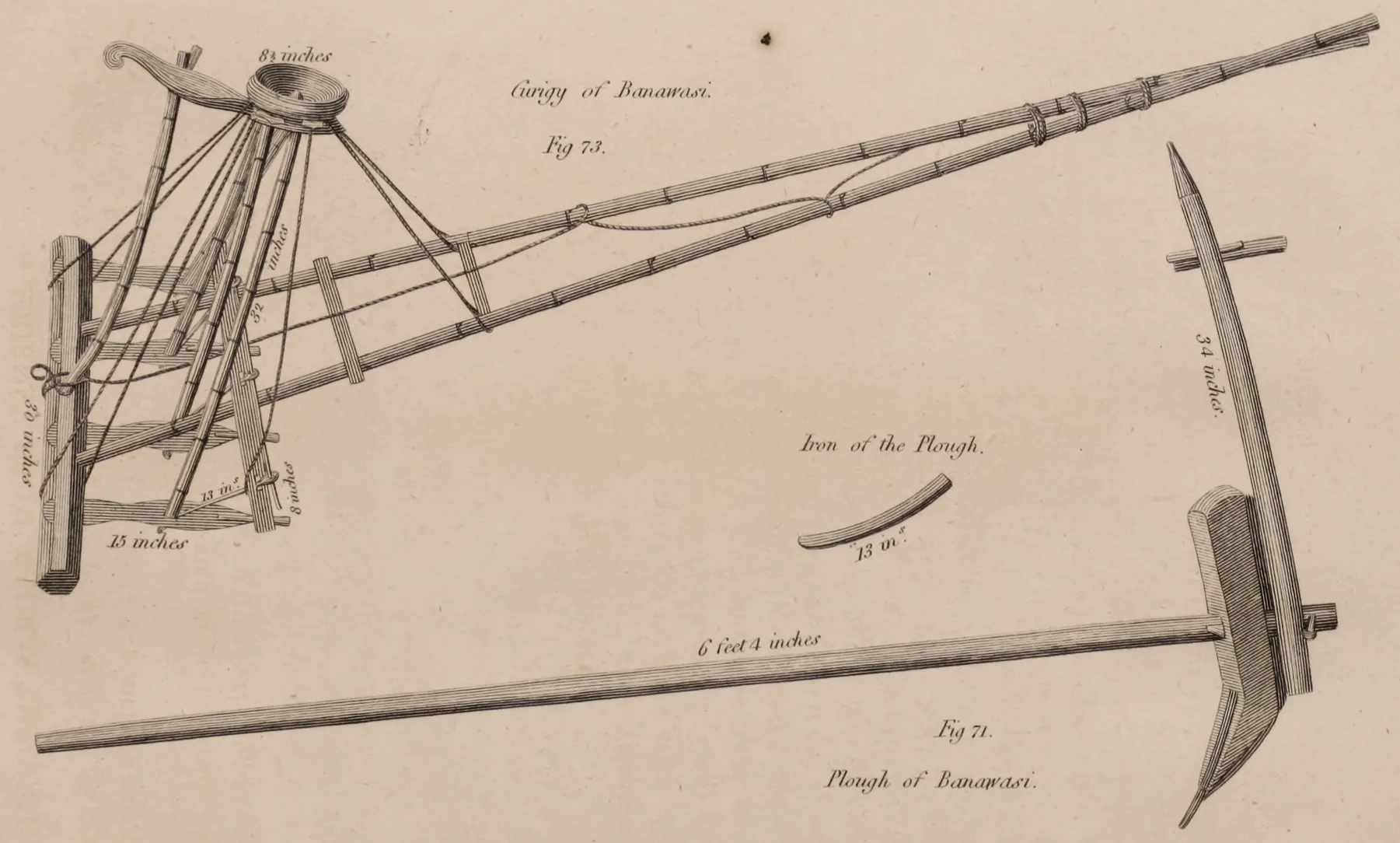
Sana Butta, a small grain, and rather more valuable than the others; but it is found to answer on very few soils. Experience shows, that certain fields agree best with certain kinds of rice, and each is of course sown with the kind only that gives most return. The natives have no rule to ascertain this a priori; and when a new field is brought into cultivation, they must find it out by experience. The manner of cultivating these kinds of rice is as follows. Immediately after harvest, the field is ploughed lengthwise and across. (The plough of this place is delineated in Plate XXVI. Fig. 71). The clods are then broken by drawing over the field an instrument named Coradu, which is yoked to a pair of oxen, and is represented in Plate XXIX. Fig. 72. The field is then allowed to rest exposed to the air until the month preceding the summer solstice, or until the rains commence, when its soil is loosened by the hoe drawn by oxen and called Heg Cuntay (Plate XXVIII. Fig. 75); and the seed is sown without preparation by means of a Curigy, or drill (Plate XXVI. Fig. 73). The four bills of this implement are secured by bolts of iron passing through a beam, to which the yoke-rope is fastened. The perforations, for the seed to pass through from the cup, are an inch in diameter; so that the seed must fall very thick. After having been sown, the field is manured with cow-dung, and smoothed with the Coradu. The water is allowed to run off as it falls. Eight days after having been sown, the field is hoed with the Cuntay, which kills the weeds without injuring the seed that is then just beginning to sprout. Eight days afterwards the young rice is four inches high, and the field is hoed between the drills with a hoe drawn by oxen, and called Harty, or Nir Cuntay, which is delineated in Plate XXVIII. Fig. 76. This kills the grass, and throws the earth toward the drills. After this, a bunch of prickly Bamboos is yoked to a pair of oxen, and the driver stands on a plank above the thorns, to give them weight. This is drawn over the field, and removes the grass without injuring the corn. When this is six inches high, if there be rain, the water is confined, and the field is kept inundated; but, if the weather should be dry, the field must again be hoed with the Harty Cuntay, and harrowed with the bunch of Bamboos. Whenever the field begins to be inundated, it must be again hoed with the same implement, and smoothed with the Coradu, which acts in some measure like a rolling-stone. At the end of the third month, the field is drained, and the weeds are removed. The water is again confined; but in fifteen days, if more weeds spring up, the field must be again drained and cleaned: this, however, is not always necessary. In the fifth month, a grass, much resembling rice, comes up, and must be carefully removed with a knife. In the seventh month the crop is reaped, and the straw is cut close by the ground. For three days it is allowed to remain on the field in handfulls. It is then thrown into loose heaps, and afterwards tied up in small sheaves, which are stacked on some airy place; and in the course of three months it is trodden out by the feet of oxen. All this time there is seldom any rain; and even when any comes, it seldom injures the reaped corn. The grain is always preserved in the husk, and beaten out as wanted for use. Any omission in these steps of cultivation produces a great diminution of the produce. Ten seeds, the farmers say, is a good crop on low land, and 7 seeds on the higher fields called Bisu. At this rate, an acre of the former produces 25 1⁄2 bushels, worth 1l. 1s. 7 1⁄4d.; and of the latter, 17 8⁄10 bushels, worth nearly 15s. 1 1⁄2d. The officers of revenue say, that the produce is about a fifth part more. Much reliance cannot, however, be placed upon what either party say; as all the officers have either lands of their own, or have relations who are deeply interested.
The kind of rice that is sown on the more elevated parts of the (Bisu) high land, and which ripens in three months, is called Varangully. The grain is of the same value with the others. Its cultivation is similar, only it is sown eight days later, and all the steps of the operation must succeed each other more rapidly. The produce is from five to seven seeds.
Sugar-cane is raised on the rice-ground, but in very small quantities, and the whole is made into Jagory. The ground fit for it must have a Tank containing water enough to irrigate the field twice after it has been planted, and once before the crop is reaped. The kind used is called the Hulocabo, or straw cane; and it is the same with the Maracabo of Bangalore. It is planted in the second month after the winter solstice, and is cut within the year. 1400 canes give a Maund of Jagory, and a Candaca of land will produce 21,000 canes, or 15 Maunds of 44 Seers, each weighing 24 elephant Dubs. The produce of an acre, by this account, is only about 357 lb. of Jagory. Some people allow the cane to grow up again from the roots, and thus get what in Jamaica is called a crop of Ratoons. This produces only half of the above mentioned quantity of Jagory. Between every two crops of sugar must intervene two of rice, which are as productive as usual.
At Banawási, no second crop of any kind is taken from the rice ground.
In the eastern parts of Soonda, a very small quantity of the grains called dry is cultivated, but none toward the west. This cultivation was formerly much more extensive; but the rice ground being most profitable, and the whole even of that not being cultivated, owing to a want of people and stock, the dry-field is of course much neglected. The fields used for dry grains are not levelled. I have already said, that all over the Ráyada, even in its western parts, there is a great extent of land apparently fit for the purpose; but the natives allege, that they find by experience, that the grain will thrive only in particular spots. Experience is their sole guide; they have no rule by which they can at sight discriminate the barren from the fertile land. I am inclined to think, that this is one of the absurd notions prevalent among all unskilful farmers; and that in a well watered country, such as this is, wherever the soil is not rocky, or the land too steep, it will be found productive.
A certain field having been found by experience fit for the cultivation of Ragy, the following succession of crops in three years is taken from it; Huts' Ellu, Ragy, fallow.
A month before or after midsummer, according as there is rain, the ground is ploughed three times, and smoothed twice with the Coradu before mentioned. The month following the autumnal equinox, the seed of the Huts' Ellu is sown broad-cast, ploughed in, and the field is then smoothed with the same implement. The seed is sown twice as thick as that of Ragy. It ripens in two months, and produces five seeds.
Next year, in the month preceding the summer solstice, the field is ploughed with the first rain. Eight days afterwards it gets a second ploughing. On or about the 16th day it is smoothed with the same implement, and two or three days afterwards it is ploughed a third time. After another interval of two or three days, furrows, at a span's distance, are drawn throughout the field. The seed of the Ragy is then mixed with some cow-dung; and at a span's distance from each other, small lumps of the mass, containing from eight to twenty seeds, are dropt into the furrows. The field is then smoothed with the Coradu before mentioned. In about fifteen days afterwards, when the plants are four or five inches high, the field is hoed with the Cuntay, and afterwards harrowed with the bunch of prickly Bamboos. About fifteen days afterwards, the intervals between the drills are ploughed, and the field is again smoothed with the Coradu. In five months the Ragy comes to maturity, and produces 20 fold. In this, the greatest imperfection, besides the usual want of proper implements, is the neglect of manure. I measured a field, said to sow one Colaga and a half of Ragy, and found it to contain 33,516 square feet. An acre at this rate sows about 27/100 parts of a bushel, and produces about 5½ bushels of Ragy. Its produce of Huts’ Ellu is half that of Ragy, and the seed is double.
By experience, other fields are found fit for the cultivation of Huruli, or Horse-gram; and Harulu, or the Ricinus. These are cultivated in a similar rotation of Huruli, Harulu, and fallow. Sometimes both crops consist of the Harulu.
For Harulu, the field is ploughed four times in the month preceding and the two months following the summer solstice. At the same time it is twice smoothed with the Coradu above mentioned. In the last of these months furrows are drawn throughout the field at one cubit’s distance, and crossing each other at right angles. In each intersection are placed two seeds, and the whole is again smoothed with the same implement. On the tenth day the plants come up; on the fifteenth the intervals between the rows must be hoed with the Cuntay. The plant does not rise above two cubits high, and produces four seeds. The crop season continues during the two months preceding the winter solstice. The oil is extracted entirely by boiling, and four Seers of seed give one of oil, but with the seed the measure is heaped. The oil is used for medicine and for the lamp. After the Harulu comes a fallow.
Then in the month preceding the summer solstice the field is ploughed twice, and smoothed with the Coradu. In the month preceding the autumnal equinox, the field is again ploughed, sown broad-cast, and smoothed with the same implement. In three months the grain ripens, and three seeds are reckoned a good crop.
A field said to sow 3 Seers of Huruli, and 3 1⁄2 of Harulu, measured 24,780 square feet. The seed required for an acre will be of Huruli 23⁄100 parts of a bushel, and the produce 69⁄100 parts of a bushel, or deducting seed 46⁄100. Horse-gram sells here at 15 Seers for the Rupee, or for 3s. 9 3⁄4d. a bushel. The value of the produce of an acre, deducting the seed, is therefore about 1s. 9 1⁄2d. The seed of Harulu required for an acre will be 269⁄1000 parts of a bushel, producing 807⁄1000 parts of a bushel.
The cattle of Soonda are of a rather larger breed than those of Kankana or Haiga; but they are greatly inferior to those of the country to the eastward, whence many are brought for the plough. Buffaloes are here more used than oxen. There are in Soonda no sheep, goats, swine, nor asses, and very few horses. In the dry season, that is, from the month preceding the shortest day, until the summer solstice, the cattle are fed on straw, and that of Ragy is preferred to that of rice. In the two months following the summer solstice, while there is much labour going forward, the cattle are allowed hay made of the soft grass which grows on the little banks separating the rice-fields: that of the hills is considered as totally useless. For the milch cattle the hay is boiled, and mixed with the bran of rice. During the three remaining months the cattle are allowed to pasture.
In the dry weather, the cattle are folded on the fields; in the rainy season they are taken within doors, and as a manure for the fields their dung is collected, and mixed with ashes, and the soil of the farmer's house. Those who have no gardens allow no litter: but the Haiga Bráhmans, for the use of their gardens, litter the cattle at one season with fresh leaves, and at another with dry grass. The two manures thus formed are kept separate, and applied to different purposes. A want of attention to manure is a striking feature in the grain farmers of Soonda.
All the arable land in Soonda is considered as the property of the government; but the value of every estate is fixed; and so long as a tenant pays his rent, it is not customary to turn either him or his heirs out of their possessions. It is true, that he cannot transfer his right to occupy the farm by sale, but he may transfer it by (Votay) mortgage to any person (Aduvacara) who will advance money. There are two kinds of mortgage. In the one the Aduvacara advances nearly the value of the property, cultivates it, and pays the taxes. This loan is made for a stipulated time; and, when that expires, the money must be repaid. If the mortgagee has neglected the weeding, arbitrators will fix a certain reduction to be made from the debt, on account of the injury which his neglect has done to the property. He can claim nothing on the score of improvement; indeed, a field, once regularly brought into cultivation with rice, is supposed to be incapable of farther amelioration. The other mortgage is, where the tenant borrows money on his land, and gives a bond, stating that he has borrowed so much money on such and such lands at such an interest, generally from 1½ to 2 per cent. per mensem, and that he will pay the interest monthly, and at such a period will repay the capital. The mortgager in this case continues to cultivate the lands and to pay the taxes. If he cannot discharge the debt when it becomes due, the mortgagee takes the land, pays the revenue, and keeps the profits for the interest; but it is always redeemable by the original tenant, should his circumstances ever enable him to repay the debt.
The revenue is paid entirely in money, at from one to four Rupees for the Candaca, according to the old valuation; but in some places the quantity sown is double of what is rated in the revenue accompts. The reason assigned for this is, that such lands are poor. The dry-field pays no revenue whatever; but a certain quantity is annexed to each estate of rice-land, as an encouragement for the farmer. Of the two fields that I measured, one paid at the rate of 2 Rupees, and the other at the rate of 2 34⁄100 Rupees an acre; the first equal to 4s. 0 1⁄4d., and the last to 5s. 8 1⁄2d. The gross produce I have already stated, on the report of the farmers, to be worth from 15s. to 1l. 1s. an acre. This calculation, and the custom of lending money on mortgage, are a clear proof that the tax is moderate, and that enough of the property remains with the actual cultivator, not only as a reward for his trouble, but to render his land a valuable property.
A farmer who has five ploughs is esteemed a rich man. With these he must keep six men and six women, and ten labouring cattle; and at seed-time and harvest he must hire additional labourers. Farmers, who are not Bráhmans, unless their farms be large, work the whole with their own families; but rich men must hire servants, or keep slaves; and, to hold their plough, Bráhmans must always have people of the low casts. This is a kind of work that even a Haiga Bráhman will not perform.
| A man slave gets daily 2 Seers of rough rice, or yearly about 26 bushels worth | £1 | 2 | 0 1⁄2 |
| A handkerchief, a blanket, and piece of cloth worth 2 Rupees | 0 | 4 | 0 1⁄4 |
| A Pagoda in money | 0 | 8 | 0 3⁄4 |
| Six Candacas of rough rice at harvest | 0 | 14 | 6 |
| 2 | 8 | 7 1⁄2 | |
| The women get one piece of cloth annually, and a meal of ready dressed victuals on the days that they work, which may amount annually to | 0 | 8 | 1 |
Hired men get four Seers of rough rice a day, worth less than three half-pence.
The farmers say, that, with a stock of six ploughs, a man can cultivate thirteen Candacas of land. The officers of government say, that three Candacas for a plough is the common reckoning; but even this cannot be received, unless we suppose the ground more productive than the farmers confess. For, supposing all the eighteen Candacas to be of a good quality, and to produce ten seeds, the whole value of the crop would be 21l. 15s. 2d.; and the support of six men and women slaves, not to mention seed, rent, cattle, &c. &c. would come to 16l. 19s. 9d. The people here are far from taking any extraordinary trouble with their lands; and, I should suppose, cultivate with a similar stock as much as is done in Bengal, where about seven acres may be considered as the usual rate of work for one plough. We may, therefore, allow between thirty and forty Candacas at least for six ploughs, or double that which the officers of revenue stated.
Being now about to enter the territories of the Mysore Rájá, I shall conclude what I have to say concerning Soonda, with extracts from Mr. Read's answers to my queries, which have been collected with great precision and ability from the reports of the native officers.
Mr. Read states the proportion of sterile and productive lands, in the four districts (Talucs) of Soonda, in the following proportions, supposing each to be divided into a hundred parts.
| Talucs. | Land capable of cultivation. | Sterile lands. |
|---|---|---|
| Supa | 12 | 88 |
| Soonda, or Sudha | 16 | 84 |
| Banawási | 20 | 80 |
| Billighy | 20 | 80 |
The produce of the waste lands Mr. Read states as follows. The Maund weighs 24 84⁄100 lb. and is divided into 40 Seers.
| Taluc. | Sandal wood trees. | Teak trees. | Sissa trees. | Annual produce of honey. | Annual produce of wax. | Annu a produce of wild cin-namon. | Annual produce of Cabob China. | Annual produce of wild pepper. |
|---|---|---|---|---|---|---|---|---|
| Maunds. | Maunds. | Maunds. | Maunds. | Maunds. | ||||
| Supa | 2097 | 394495 | 59770 | 33 23 | 49 6 | 15 30 | 5 10 | — |
| Soonda, or Sudha | 1718 | 1639 | 1715 | 8 7 | 29 28½ | 2 0 | 1 0 | — |
| Banawási | 3812 | 29 | 3069 | 11 24 | 3 13 | — | — | — |
| Billighy | 5266 | — | 34 | — | — | — | 43 0 | 34 8 |
| Total | 12893 | 396113 | 64588 | 53 14 | 72 7½ | 17 30 | 49 10 | 34 8 |
I know that wild pepper is collected in the Soonda Taluc, but it has not been reported to Mr. Read. The report of the Marattah merchants, I look upon as decisive, that it is not of so little value as interested persons have endeavoured to represent to the collector.
The Tahsildars have reported, that nearly the whole of the arable lands are now cultivated; which is in direct opposition to both what I heard and what I saw.
The number of sugar-canes cut annually amount to 6,260,400, which should produce about 4471 Maunds, of about 30 lb. each.
Dry grains are chiefly cultivated in Supa; and about one twentieth part of the arable land there is employed for that purpose.
The cultivation of gardens has decreased about a third since the year 1754, when it is supposed that they were in the greatest possible prosperity.
The stock employed in the country at present, according to Mr. Read, is.
| Taluc. | Ploughs belonging to | Cattle. | |||
|---|---|---|---|---|---|
| Landlords. | Tenants. | Total. | Buffaloes old and young. | Cow kind old and young. | |
| Supa - - - - | 2348 | 2043 | 4391 | 8992 | 19882 |
| Soonda - - - - | 1709 | 389 | 2098 | 3115 | 12234 |
| Banawási - - - | 804 | 454 | 1258 | 3658 | 7818 |
| Billighy - - - | 1407 | 360 | 1767 | 1760 | 7515 |
| Total - | 6268 | 3246 | 9514 | 17525 | 47449 |
Mr. Read gives the following account of the population of these districts.
| Talucs. | Houses, of which the following are occupied by | Slaves. | |||||
|---|---|---|---|---|---|---|---|
| Total | Christians. | Mussulmans. | Bráhmans. | Sivabhactars. | Jain. | ||
| Supa - - - - | 6929 | 87 | 515 | 1116 | 780 | 87 | 348 |
| Soonda - - - - | 3396 | 4 | 178 | 2015 | 417 | 21 | 61 |
| Banawási - - - | 2729 | — | 57 | 845 | 295 | 40 | — |
| Billighy - - - | 2593 | — | 50 | 692 | 433 | 14 | 36 |
| Total - | 15647 | 91 | 800 | 4568 | 1925 | 162 | 445 |
The exports and imports by land are very considerable, as may be seen by the accompanying Statement. The former amount to Rupees 9,63,833; and the latter to 1,08,045. The Rupee is worth nearly 2 s.
| No. | Names of the Articles. | Average annual Quantity Imported. | Total Value in Rupees. | Average annual Quantity Exported. | Total Value in Rupees. | |||||||||||||||||
|---|---|---|---|---|---|---|---|---|---|---|---|---|---|---|---|---|---|---|---|---|---|---|
| Nidge of 12 Maunds. | Bullock-loads of 6 Maunds. | Maunds of 44 Seers Cutcha. | Seers Cutcha of 24 Rups weight. | Per man's load (large) | Per man's load (small) | Potts. | Kodi, or Scores. | Adud, or Pieces. | Nidge of 12 Maunds | Bullock-load of 6 Maunds. | Maunds of 44 Seers. | Seers of 24 Rupees weight. | Per man's load (large) | Per man's load (small) | Guddah, or Potts. | Kodi, or Scores. | Baskets. | Pieces. | ||||
| 1 | Salt | — | 6039 | — | — | 11½ | 18½ | — | — | — | 18128 | — | 18544 | — | — | — | 1 | — | — | — | — | 74176 |
| 2 | Lamp-oil seed (Castor) | — | 55½ | — | — | — | — | — | — | — | 140 | — | — | — | — | — | — | — | — | — | — | — |
| 3 | Sweet-oil seed (Sesamum) | — | — | — | — | — | — | — | — | — | — | — | 3 | — | — | — | — | — | — | — | — | 24 |
| 4 | Jungle-oil seed | — | 5½ | — | — | — | — | — | — | — | 50 | — | — | — | — | — | — | — | — | — | — | — |
| 5 | Sweet-oil (Sesamum) | — | 242½ | 39¼ | 5 | — | — | 1 | — | — | 5985 | — | — | — | — | — | — | — | — | — | — | — |
| 6 | Coco-nut oil | — | 15 | 1081½ | 7½ | — | — | 1140½ | — | — | 13810 | — | — | — | — | — | — | 1274¾ | — | — | — | 12740 |
| 7 | Sandal oil | — | — | 5¾ | — | — | — | — | — | — | 1265 | — | — | — | — | — | — | — | — | — | — | — |
| 8 | Chillies (Capsicum) | — | 506½ | 9¾ | — | 2 | 5 | — | — | — | 4070 | — | 16 | — | — | — | — | — | — | — | — | 96 |
| 9 | Tamarinds | — | 43 | — | — | — | — | — | — | — | 130 | — | — | — | — | — | — | — | — | — | — | — |
| 10 | Garlick | — | 1 | — | — | — | — | — | — | — | 6 | — | — | — | — | — | — | — | — | — | — | — |
| 11 | Onion | — | 29½ | — | — | — | — | — | — | — | 90 | — | — | — | — | — | — | — | — | — | — | — |
| 12 | Mustard | — | 1½ | — | — | — | — | — | — | — | 18 | — | — | — | — | — | — | — | — | — | — | — |
| 13 | Coriander seed | — | 17½ | — | — | — | — | — | — | — | 158 | — | 14½ | — | — | — | 3 | — | — | — | — | 156 |
| 14 | Turmerick | — | — | — | — | — | — | — | — | — | — | — | — | — | — | — | — | — | — | — | — | — |
| 15 | Soonda salt | — | 2 | — | — | — | — | — | — | — | 12 | — | 27 | 22 | — | — | 4 | — | — | — | — | 555 |
| 16 | Cut (Terra Japonica) | — | 40 | 22 | 5 | 4 | 4½ | — | — | — | 685 | — | 158½ | 4 | — | — | — | — | — | — | — | 3820 |
| 17 | Dry coco-nuts | — | 7¾ | ¼ | — | — | — | — | — | — | 147 | — | 123½ | 76¾ | — | — | — | — | — | — | — | 2453 |
| 18 | Dates | — | 112¼ | 40 | — | 19 | 8 | — | — | — | 1472 | — | 1 | 147 | — | — | — | — | — | — | — | 612 |
| 19 | Dry dates | — | — | — | — | — | — | — | — | — | — | — | — | — | — | — | — | — | — | — | — | — |
| 20 | China sugar | — | 23½ | ¾ | — | — | 1 | — | — | — | 1460 | — | — | ¼ | 6 | — | — | — | — | — | — | 3 |
| 21 | Ghee (boiled butter) | — | 4 | — | — | — | — | — | — | — | 168 | — | — | 1 | — | — | — | — | — | — | — | 18 |
| 22 | Plumbs | — | — | — | — | — | — | — | — | — | — | — | 6 | — | — | — | — | 1 | — | — | — | 114 |
| 23 | Honey | — | — | — | — | — | — | — | — | — | — | — | — | — | — | — | — | — | — | — | — | — |
| 24 | Wax | — | — | — | — | — | — | — | — | — | — | — | 2 | 169½ | 2½ | — | 2 | — | — | — | — | 2017 |
| 25 | Cotton | — | 12½ | 6¾ | — | — | — | — | — | — | 163 | — | — | — | — | — | — | — | — | — | — | — |
| 26 | Cashew nuts | — | — | ¾ | — | 1½ | — | — | — | — | 8 | — | 1 | 66½ | — | — | — | — | — | — | — | 72 |
| 27 | Cinnamon | — | — | — | — | — | — | — | — | — | — | — | — | — | — | — | — | — | — | — | — | 72 |
| 28 | Bastard ditto (Cassia) | — | — | — | — | — | — | — | — | — | — | — | 4 | — | — | — | — | — | — | — | — | 180 |
| 29 | Brimstone | — | 48 | — | — | — | — | — | — | — | 864 | — | 10 | — | — | — | — | — | — | — | — | — |
| 30 | Saltpetre | — | 3 | — | — | — | — | — | — | — | 54 | — | — | — | — | — | — | — | — | — | — | — |
| 31 | Cuddakah (a seed) | — | — | — | — | — | — | — | — | — | — | — | 44 | — | — | — | 3½ | — | — | — | — | 23 |
| 32 | Sundry Curry-stuffs | — | 361 | 7¼ | — | 5½ | 65¼ | — | — | — | — | — | 1244¾ | — | — | — | 25 | — | — | — | — | — |
| 33 | Coco-nut | — | 2824 | — | — | 906½ | 1103½ | — | — | 57 | 19247 | — | 1536 | — | — | 229 | 202 | — | — | — | 76774 | 12508 |
| 34 | Toddy (palm wine) | — | — | — | — | — | — | 2 | — | — | 4 | — | — | — | — | — | — | 287½ | — | — | — | 575 |
| 35 | Iron bars | — | 65½ | — | — | — | — | — | — | 320 | 1422 | — | — | — | — | — | — | — | — | — | 4 | 170 |
| 36 | Iron pots | — | — | — | — | — | — | — | — | 1 | 40 | — | — | — | — | — | — | — | — | — | — | — |
| 37 | Ploughshares | — | — | — | — | — | — | — | — | 57 | 14 | — | — | — | — | — | — | — | — | — | — | — |
| 38 | Bill hooks | — | — | — | — | — | — | — | — | 71 | 71 | — | — | — | — | — | — | — | — | — | — | — |
| 39 | Coir (cordage made of coco-nut) | — | 36½ | 1¼ | — | 15½ | 8½ | — | — | — | 474 | — | 4½ | 37 | — | 7 | — | — | — | — | 56½ | 143 |
| 40 | White thread | — | — | — | — | — | 1 | — | — | — | 3 | — | — | — | — | — | — | — | — | — | — | — |
| 41 | Silk ditto | — | 2 | — | — | — | — | — | — | — | 3568 | — | — | — | — | — | — | — | — | — | — | — |
| 42 | Silk | — | — | — | — | — | — | — | — | 14 | 140 | — | — | — | — | — | 1 | — | — | — | — | 200 |
| 43 | Broadcloth | — | — | — | — | — | — | — | — | 11 | — | — | — | — | — | — | 2 | — | — | — | — | 240 |
| 44 | Sundry cloths | — | 594½ | — | — | 56 | 113 | — | 1 | 89 | — | — | — | — | — | — | — | — | — | — | — | — |
| 45 | Black Cumlies (blankets) | — | 99½ | — | — | 1 | 6 | — | 1½ | 453 | 10615 | — | — | — | — | — | — | — | — | — | — | — |
| 46 | Salt-fish | — | 4½ | — | — | 61 | 66½ | — | — | — | 56 | — | — | — | — | — | 67 | — | — | — | — | 100 |
| 47 | Red paint | — | 1 | — | — | — | — | — | — | — | 9 | — | 17½ | — | — | — | — | — | — | — | — | 88 |
| 48 | Tobacco | — | 309 | 88½ | 5 | — | 2 | — | — | — | 5830 | — | 8½ | 2 | — | — | — | — | — | — | — | — |
| 49 | Jagory (inspissated juice of sugar-cane) | — | 249 | 316¼ | — | — | — | — | — | — | 1810 | — | 21 | 951 | — | — | — | — | — | — | — | 2154 |
| 50 | Chunam (lime) | — | — | — | — | — | — | — | — | — | — | — | — | — | — | — | — | — | — | — | 206 | 52 |
| 51 | Sealing-wax | — | ¾ | — | — | — | — | — | — | — | 72 | — | — | — | — | — | — | — | — | — | — | — |
| 52 | Dammer (Resin) | — | — | — | — | — | — | — | — | — | — | — | — | ¾ | — | — | — | — | — | — | — | 18 |
| 53 | Arrack | — | — | — | — | — | — | 16 | — | — | 64 | — | — | — | — | — | — | — | — | — | — | — |
| 54 | Sheep | — | — | — | — | — | — | — | — | 983 | 1475 | — | — | — | — | — | — | — | — | — | — | — |
| 55 | Utchada cloth | — | — | — | — | — | — | — | 1139 | 2272 | — | — | — | — | — | — | — | 73 | 10 | |||
| 56 | Gunny sackcloth | — | — | — | — | — | — | — | 12 | 18 | — | — | — | — | — | — | — | — | — | |||
| 57 | Dungaree (cloth) | — | — | — | — | — | — | — | 6 | 3 | — | — | — | — | — | — | — | 137 | 5 | |||
| 58 | Cadjans (mats) | — | — | 2 | 1 | — | — | — | 5 | 4 | — | — | — | — | — | — | — | — | — | |||
| 59 | Country Kittisalls (umbrellas) | — | — | 4 | 8 | — | — | — | — | 24 | — | — | — | — | — | — | — | — | — | |||
| 60 | Ratton boxes | — | — | — | — | — | — | — | — | — | — | — | — | — | — | — | — | — | — | |||
| 61 | Country paper (bundles) | — | — | — | 1 | — | — | — | — | 8 | — | — | — | — | — | — | — | — | — | |||
| 62 | Sugar-cane | — | — | — | — | — | — | — | — | — | — | — | — | — | — | — | — | — | — | |||
| 63 | Stone plates | — | 8 | — | — | — | — | — | — | 32 | — | — | — | 28 | — | — | — | — | 14 | |||
| 64 | Skins | — | — | 1 | — | — | — | — | — | 8 | — | — | — | — | — | — | — | 2 | 1 | |||
| 65 | Jack Stones of the Artocarpus | — | — | — | — | — | — | — | — | — | — | — | — | 15 | — | — | — | — | — | |||
| 66 | Betel-leaf | — | 47 | 54 | 49 | — | — | — | — | 319 | — | — | — | 305½ | 5 | — | — | 29 | 158 | |||
| 67 | Dooleys (litters) | — | — | — | — | — | — | — | — | — | — | — | — | — | 3 | — | — | — | 31 | |||
| 68 | Gree plantains | — | — | — | — | — | — | — | — | — | — | — | — | — | — | — | 14 | — | 1734 | |||
| 69 | Horses | — | — | — | — | — | — | — | 2 | — | — | — | — | 3 | 2 | 62 | — | — | 78 | |||
| 70 | Hookah snakes | — | — | — | — | — | — | — | — | — | — | — | — | — | — | — | — | — | 4110 | |||
| 71 | Cattle | — | — | — | — | — | — | — | 574 | 11560 | — | — | 6 | — | — | — | — | 73 | 3 | |||
| 72 | Mangoes | — | — | — | — | — | — | — | — | — | — | 14 | — | — | — | — | — | — | 1470 | |||
| 73 | Jack fruit | — | — | — | — | — | — | — | — | — | — | 3 | — | — | — | — | — | — | 28 | |||
| 74 | Guavas fruit | — | — | — | — | — | — | — | — | — | — | 4 | — | — | — | — | — | — | 3 | |||
| 75 | Betel-nut 1st sort | — | — | — | — | — | — | — | — | — | 10251⅓ | — | 2½ | 9½ | — | — | — | — | 618081 | |||
| 76 | Ditto -. 2d ditto | — | — | — | — | — | — | — | — | — | 1245¾ | 10 | — | 5½ | — | — | — | — | 59836 | |||
| 77 | Ditto - 3d ditto | — | — | — | — | — | — | — | — | — | 168½ | — | ½ | ¾ | — | — | — | — | 5356 | |||
| 78 | Pepper | — | — | — | — | — | — | — | — | — | 1350 | — | ¼ | 7¼ | — | — | — | — | 109863 | |||
| 79 | Cardamoms | — | — | — | — | — | — | — | — | — | 121½ | — | 1¾ | 8½ | — | — | — | — | 48664 | |||
| 80 | Sandal-wood | — | — | — | — | — | — | — | — | — | 1024 | 44 | — | — | — | — | — | — | 1024 | |||
| Total value imports Rupees | — | 108045 | Total value exports Rupees | — | 963833 | |||||||||||||||||
(Signed) Alexander Read, Collector.
18th March.—I entered the territory of the Mysore Rájá, and went to Chandra-gupti. The country through which I passed is level, and would appear to have been at one time almost entirely cultivated. A great part of it is now overgrown with trees, which have not yet had time to arrive at a great height. Chandra-gupti, or Chandra-guti, is also called simply Guti; care must therefore be taken to distinguish it from Gutti, a place of some note situated at a distance toward the north. It formed one of the first acquisitions of the house of Ikeri, and has a fort, which stands on a high peaked hill. The fable of the natives says, that this hill was formerly of an immense height, and prevented the moon from going round in her due course; whence the name of the place is derived. When the Racsha Jellasunda had defeated Krishna, that incarnation of the deity hid himself among the rocks of this hill. The enraged demon, not being able to discover the god, consumed the hill to its present size, very much to the satisfaction of the moon. It may perhaps be thought, that this fable may have arisen from a tradition of the hill having been formerly a volcano. For my own part, I think that these stories are so monstrous, that nothing can be drawn from them, but a commiseration for the credulity of mankind. In times far posterior to those of Krishna this was a place of great celebrity; the town at the foot of the hill having been the residence of Trenetra Cadumba Ráya, on the site of whose palace I am encamped. A well, and some faint traces of walls and buildings, still mark the spot. On the fall of this dynasty the place lost its consequence. About a hundred and fifty years ago, it suffered much from an invasion by a Mussulman named Seyd Assaripha. In the time of Hyder, Somashecara Nayaka, Polygar of Billighy, destroyed it. Soon afterwards the commandant (Killadar) betrayed the fort to Purseram (Parasu-Ráma) Bhow; but seven months afterwards he was compelled to restore it. From that time the inhabitants had no molestation, until the troubles occasioned by Dundia, who held it almost a month. It at present contains about 100 houses.
To the eastward of the hill Chandra-gupti, although much of the country is waste, it is in a better condition than Soonda. Much of it is under Ragy, which pays no revenue; and between every two crops the ground is allowed three years fallow. The natives allege that the soil is very poor. I have never seen stronger stubble, and to all outward appearance the soil is rich. I suspect that the principal defect is in the cultivators; but without actual experiment, it would be rash to speak decidedly on the subject.
About a coss north from Chandra-gupti is a hill producing iron ore, which is wrought to some extent. It is found in veins intermixed with Laterite, like the ore of Angada-puram in Malabar. The ore is of the same nature with what is usually smelted in the peninsula; that is to say, it is a black sand ore, which here is conglutinated by clay into a mass, and contains less extraneous matter than common. It is broken into small pieces, and the little masses of iron are picked out of the clay. Every man employed in the work pays to government two Rupees, or about 4s.; and they all have an equal share of the produce. There being no tax on the forges, is perhaps the reason why none are mentioned in the public accompts of this Ráyada, in which much iron is smelted. The workmen say, that in Billighy and Sudha, there is abundance of ore; but in these districts there are no people who understand the process.
The rock on which the fort is built is a white granite without observable strata, exactly like that of Jamal-ábád, and which is common throughout Haiga. The nature of the minerals there and here is indeed quite similar.
In this district (Taluc) there is some sandal-wood of a very good quality. It grows on dry hard ground, where of course the forest trees do not arrive at any great size. It is never planted, but grows from the seed which the birds disperse. In Hyder's government, in order to regulate the market properly, it was cut by the officers of revenue (Amildars); and, after having been divided into proper billets, was sold on the account of government. Purseram Bhow cut all that he could, and the remainder was much injured by renting it out to merchants. All that was good for any thing was cut last year; but three years hence there will be some more fit for the market. The quantity procured last cutting was about 40 Candies, of 20 Cutcha Maunds, each weighing about 26 lb. Its price is commonly about 30 Pagodas, or 120 Rupees, a Candy. The following is considered to be the proper management. The trees, after having been cut, are allowed to remain in the woods for one month. They are then taken into a house; the white wood is removed, and the sandal, or heart, is cut into billets, and stored. The roots are dug up, and oil can be extracted from them, as well as from the chips, and the cuttings of the stem. All the persons who extract the oil are Mussulmans.
19th March.—I went three cosses to Sunticopa, or dry-ginger-village. The country through which I passed is by nature very fine; and the trees, by which much of it is overgrown, are low, a proof of its not having been long waste. The fields have never been enclosed, and the cultivation of dry grains is not at all understood, the ground being cultivated once only in four years. The rice grounds are tolerably well occupied. It probably would answer good purposes to bring here, from Priya-pattana, a colony to cultivate Car’ Ragy, and to send thither a colony of Haiga Bráhmans, to form Betel-nut plantations. No tanks are required for the rice grounds; but in this district of Chandra-guti, there are many small ones, for the use of gardens. The rice lands suffer much from the inundations of the Varadá, which frequently sweep away the crops. Of course, those near the river let very low, 5 Candacas, or 300 Seers sowing, being only taxed at four Rupees. Where the inundations do not reach, the lands let at from two to four Rupees a Candaca. The natives acknowledge twelve seeds as the produce of land which is properly laboured and manured.
The most numerous class of inhabitants are Halepecas, whose customs I described while in Canara. There are also many of rather a low class of Sivabhactars, called Malavaru, or Malawars. Most of the Gaudas are of this class; and the father of Sedásiva Nayaka was a Malawar, the Gauda of Kilidi. The people do not complain of the change of government from his descendants to Hyder; but they say, that not above a tenth part of the inhabitants remain. This devastation was occasioned, first by a cruel invasion of the Marattahs headed by the Peshwa, and afterwards by a sickness inflicted by the goddess Havali. This appears to have been a remittent fever, a disease that is still very prevalent; but of late its virulence has considerably abated.
In this neighbourhood the village god is Nandi, or the bull on which Siva rides. He is also called the Baswa, and receives no sacrifices, which are held in abhorrence by the Sivabhactar chiefs (Gaudas). The Halepecas and Whalliaru offer bloody sacrifices to Marima, and the other Saktis, but have no temples. The votaries go to the side of some river, put up a stone which represents the deity, and offer it the blood. From this worship the Sivabhactars entirely abstain; and under their government the temples of the Saktis were called Butagallu Champadi, or devil's huts, a name which the Mussulmans did not change.
20th March.—I went three cosses to Kilidi. The greater part of the country is pretty level; but the higher grounds seem to be entirely neglected, although the soil is in general apparently good. Most of the trees are small, owing to their being young; but in places where they are aged, they have grown to a large size, and support pepper vines. Tippoo prohibited the produce of these from being gathered, and of course the woods supporting them were neglected; but some pains having last year been bestowed, there is now a tolerable crop. In the neighbourhood of Kilidi are many gardens of Areca palms, in which pepper is raised; but among the Arecas neither Betel-leaf nor cardamoms are cultivated. The Arecas are planted wherever there is a supply of water, without regard to the exposure; but they are sheltered from the west and south by several rows of trees.
I here found a Bráhman, named Bayluru Dwuppa, whose ancestors have been the hereditary writers of the chronicles of the Kilidi family. He engaged to give me the family book, called Kilidi Ráya Paditti. It is in the old dialect and character of Karnata, and contains 400 Slókams, or distichs; for, like all the other works of any note among the Hindus, it is poetical. He afterwards forwarded a copy of the work to Purnea, who was so good as to add a translation into the modern language and character, and both of them have been delivered to the Bengal government. The family of the historiographer enjoyed an Enam, or free land, to the amount of sixty Pagodas a year.
From some particulars explained to me out of this historical poem it would appear, that its chronology differs considerably from that of Ramuppa. The Kilidi family were originally hereditary chiefs (Gaudas) of five or six villages in this neighbourhood, and were Sivabhactars of the Malavara cast. Bhadraconda, the son of Basw'- uppa Gauda, entered into the service of Krishna Ráyaru, who gave him the name of Sedásiva Nayaka, and conferred on him the hereditary government of some districts in the year Sal. 1422, being Sidarty. Kilidi continued the seat of government, until Sal. 1436 only. From Ikeri it was removed to Bidderuru, in Sal. 1568 (A. D. 164 5/6). Viru Magi, the last princess of the house of Kilidi, or Ikeri, says Dwuppa, allowed her adopted sons no power. She put the first to death when he was twenty-four years old, because he presumed to interfere with her intrigues. Soon afterwards Medicarey Náyaka, Rájá of Chatrakal, took a young man, a weaver by cast, and brought him up as Basw'-uppa Náyaka, the murdered prince. Finding, however, that he was not able to make any advantage of the young man's claims, he lent him to Hyder, who espoused the cause of the weaver with much seeming earnestness, and carried him about with great pomp. He accompanied the pretender through the whole country, merely as an ally; and, Viru Magi being detested on account of her criminal life, many of the commandants of fortresses were induced to deliver up their charge to the pretended Basw'- uppa. These were immediately garrisoned with the troops of his friend Hyder. The princess, conscious of the detestation in which she was held, retired with her adopted son Somashecara to a strong hold named Belalla Ráya Durga, and left her capital in charge of the Delawai, or prime minister, named Virapadruppa. On the approach of Hyder and the pretender, the people of Bidderuru deserted, and the Mussulman took possession without trouble. He laid siege to Belalla Ráya Durga, and after some time took the princess (Rany) and her adopted son prisoners. Thence he returned to the capital, on which he bestowed his own name of Hyder Nagara; and, disguise being no longer necessary, he began to treat the pretender with the utmost contempt, and at length induced the young man to quarrel with him, by taking his favourite dancing girls, who by intercourse with a Mussulman were defiled. Immediately after the rupture, the pretender, the princess, and her adopted son, were sent to Madhu-giri. Soon afterwards they were relieved by the Marattahs, who altogether neglected the pretender, and, knowing the weakness of his claims, dismissed him. The princess died on the road to Poonah of a pain in her bowels; but the Marattahs, with a view of taking advantage of his claims, carried the son to their capital. The people here do not know what has been his fate, and seem very little interested about the matter. The pretender, being in absolute want, applied to Hyder, who gave him free lands to the amount of 120 Pagodas a year, or 40 Rupees a month. He left two sons, who on the fall of Seringapatam collected a rabble, and began to plunder in the neighbourhood of Hossodary (Wostara of our maps, I suppose). They were soon taken by a party of British troops, and were immediately hanged as lawless robbers.
Sedásiva built a fort at Kilidi, which continued to be garrisoned till the time of Hyder. The town never was large, and the only remarkable building is a temple of Iswara, which Sedásiva erected by orders of the god, who appeared to him in a dream. As a curiosity, I was shown the pit whence Sedásiva dug out a treasure, and a sword, the commencement of his great fortune. To this he was conducted by a Naga, or hooded serpent, sent for the purpose by some propitious deity. While Sedásiva was asleep in a field, the Naga came, and shaded his head from the sun by raising up as an umbrella its large flat neck. The young man was awaked by a shriek from his mother, who, in looking after her son, found him under the power of the monster. He immediately started up to escape, but was opposed by the serpent, until he consented to follow it quietly, and was conducted to the place where the treasure was hid. Here the snake began to bite the ground, and make signs. At length Sedásiva, having dug into the earth, found a cave filled with treasure, and containing a sword. Such are the fables by which the Hindu chiefs endeavour to gain the admiration and respect of their countrymen, whose credulity indeed renders the means very adequate to the end proposed.
21st March.—I went three cosses to Ikeri, through a country entirely like that which I saw yesterday. Near Ikeri is a well-built town, named Ságar, which at present is the residence of the chief of the district (Amildar). It stands on the southern bank of the Varadá, which is here a very small stream, as being near its source. Ságar has some merchants of property, who export to a considerable distance the produce of the country. The exports are pepper, Betel-nut, and sandal wood; about equal quantities of which go to the dominions of the Nabob of Arcot, and to the country south of the Krishna, lately ceded by the Nizam to the Company. The prices are highest in the last mentioned territory; but the expenses and duties are in proportion. The returns from both countries are chiefly made in cloths, there being no manufactures in this neighbourhood. To Haiga the merchants of Ságar send pepper, cloth, iron, and grain; they receive from thence salt, coco-nuts, and Cut, or Terra Japonica. About one half of all the returns made to this country for its produce are in cash. The merchants say, that the sandal wood of the Ikeri Ráyada is superior to that of either the south or east. They acknowledge the inferiority of their Betel-nut. According to the report of the custom-house, the quantity of Betel-nut exported annually from Ságar is about 8000 loads. That of pepper is about 500 loads. The load is about 8 Maunds, or 196½ lb.
During the time Ikeri was the residence of the princes descended from Sedásiva, it was a very large place, and by the natives is said, in round numbers, and with the usual exaggeration, to have contained 100,000 houses. Like Sudha, its walls are of very great extent, and form three concentric enclosures, rather than fortifications. It had also a citadel, but of no great strength, which until eight or ten years ago continued to be garrisoned. Within it was the palace of the Rájá, constructed of mud and timber, like those of Tippoo, and by no means a large building. The wooden work has been neatly carved, and covered with false gilding. The temple of Siva, where the town stood, is a large edifice, and is formed of stone brought from a great distance; but, as usual, it is destitute of either elegance or grandeur. It is now repairing, and workmen have been brought from Goa for the purpose; even the Portuguese of India being more skilful artists than any that can be procured in this country. At Ikeri there remains no town, but the devastation has not been occasioned by any calamity. When the court removed to Bidderuru, the inhabitants willingly followed. Ikeri continued, however, to be the nominal capital; the Rájás were called by its name, and the coins were supposed to be struck there, although in fact the mint was removed.
So long as the government of the Sivabhactar family lasted, the coins continued to be called Ikeri Pagodas and Fanams. On the conquest, the name was changed, first by Hyder into Bahadury, and then by Tippoo into Sultany. The princes of Mysore never coined Pagodas; but Canterua Narasingha Ráya, the first of them who acquired considerable power, coined gold Fanams, called after his name Canter'-ráya Fanams, which we usually write Cantery. Ten of these formed a nominal Pagoda, which accomptants commonly use. On the fall of Tippoo, the Mysore government, having found it convenient to coin Pagodas of the same value with those before current, struck them at Mysore and Nagara, but restored the old name of Ikeri.
The Ságar district (Taluc) extends to the bottom of the mountains, on the declivity of which are many woods that spontaneously produce pepper. These forests are said to be very unhealthy.
The Amildar, who is a man of plain manners and good sense, says, that in this neighbourhood dry grains have been often tried, but have always failed; and that the goodness of the soil is merely apparent; for in general it is very shallow, and placed on a substratum of Laterite, which renders the soil above it very unproductive of grain. Even rice thrives ill, although the deepest and richest soils are reserved for its cultivation. It must be observed, that in all the countries where it is found the opinion of the unfitness of the soil for dry grains is prevalent. The Amildar makes a curious observation. He says, that in the country to the eastward the surface is covered with stones; but under these there is a fine cool earth; while here, the surface is earth, but under that there is a dry rock which burns up every thing. It must, however, be observed, that the forests here are greatly superior to those farther east; owing probably to the roots of trees being able to penetrate into the crevices of the rock, and to get at water, which is here generally found at no great depth from the surface: but to the eastward, before water can be procured, the wells must be dug to a considerable depth.
The Amildar says, that he was employed by the Sultán in a diplomatic capacity at Poonah when Seringapatam was taken. He would have been successful in procuring assistance for his then master, had the dissensions among the Marattah chiefs permitted them to act. Scindia was decidedly in favour of the Sultán; but was quite destitute of money; and the army which he had at Poonah, after having expended all the means that they possessed, had for some time been subsisted on plunder. The Amildar says, that Tippoo's government, when compared with that of the Marattahs, was excellent; and, notwithstanding all the evils the people suffered from the extortions of the Asophs, and the attacks of invading armies, they enjoyed a comparatively great security. The government never subsisted by open plunder; whereas among the Marattah chiefs there are very few who do not support their troops by avowed robbery.
22d March.—I went three cosses to Ghenasu-guli. The country all the way is hilly, and is considered by the natives as totally useless, although in many places the nature of thesoil would admit of the use of the plough. It does not even answer for pasture, and the coarse, rank grass that grows upon it in the rainy season cannot be made into hay. Once a year, in order to keep the country clear, it is burned. This is probably the reason of the stunted appearance of the trees. On the whole, no desert in Africa can be less productive of use to man. At Ghenasu-guli there is no market (Bazar); but there is a small village of Haiga Bráhmans, who, to judge from the appearance of the houses, are in easy circumstances. They cultivate some fine gardens. I here met with Ram' Row, chief officer (Subadar) of the Nagara principality (Ráyada), a very gentleman-like person, which is rather uncommon in people of his cast. He agrees entirely with the other natives, in thinking the higher lands of this Ráyada totally useless.
23d March.—I went three cosses to Duma, or Dumam. The country resembles that which I came through yesterday, and on the whole way I did not see the smallest trace of cultivation. I passed through a very long wood where pepper grows spontaneously. The trees are very fine, and the soil is apparently good; but it is quite neglected by the natives, who say that the pepper is of no value It is watered by the Pada-gópí, a rivulet that, after passing through the Garsopa district, falls into the inlet of the sea at Honawera. At Duma there is only one house belonging to a Malawar Gauda; but it is a very large one.
24th March.—Although I had desired the guides to divide the road into tolerably equal stages, I found this day’s journey to Fatah-petta very short. It was called two Sultany cosses. The country is rather opener than what we passed through on the two preceding days; but a large proportion of the small quantity of rice-ground is waste.
Fatah-petta, or the town of victory, is usually pronounced Puttypet. It was built by Hyder in commemoration of an advantage which he gained at this place over the troops of the princess of Ikeri. At first he built five hundred houses; but finding that the place injured the trade of Naggar, and gave a facility to smuggling, he reduced the shops to fifty, and they have now decreased to twenty-five. Near the town runs a small stream, commonly called Ram Chandra-pura from the place where it has its source; but its proper name is the Sarawati. North from Fatah-petta, it receives a small branch, and forms the Pada-gópí.
At this place the Rájás had a farm, which an overseer now cultivates on account of the government. It produces coco-nuts, Arecas, and rice; and is finely supplied with water by a canal, which is supplied from a perennial stream as clear as crystal. No experiment is made at this farm, nor any attempt at improving the usual cultivation of the country; which is the only rational inducement that could lead a prince to farm. On the contrary, it is in a more slovenly condition than any plantation that I have seen in the country. At this farm the Rájás had a Mahal, or palace, consisting of three squares, which are surrounded by low, mean buildings covered with tiles. These, however, contained baths, and all such conveniences as a Hindu chief requires. Near the palace are stables for the cattle of the farm, 25th March.—I went two cosses to the centre of Hyder Nagara, through a fog so thick that I could see little of the country. It is extremely hilly, and overgrown with woods, in which there are many fortified defiles and passes, that are guarded by armed men in the service of the Mysore Rájá.
I remained three days at Nagara, where I met with a kind reception from Captain Lloyd of the Bombay army, who commanded the garrison in the fort.
Nagara was originally called Bidder-hully, or Bamboo-village, and consisted of a temple dedicated to Nilcunta (Blue-neck, one of the titles of Siva), and surrounded by a few houses, under the direction of a Bráhman chief. Sivuppa, son of Chica Suncana, removed the seat of government from Ikeri to this place, and changed its name into Bidderuru, or Bamboo-place. The whole revenue of the country being then expended here, it immediately became a town of great magnitude and commerce. The situation is also favourable for trade, as the Hosso Angady pass, leading from Mangalore this way, is one of the best roads in the western mountains. The town is said to have contained 20,000 houses, besides a very great number of huts; but, on account of the inequality of the ground, could never have been closely built. It was defended by a circle of woods, hills, and fortified defiles, extending a great way in circumference, and containing many Bamboos, from which the name of the place was derived. The space within these defences is much larger than was ever occupied by the city, and contained many hills, woods, gardens, and rice fields. Toward the centre stood the Rájá’s palace, situated on a high hill, and surrounded by a citadel. To this Hyder added some new works; but, being commanded by some neighbouring hills, it never was capable of much defence. After Hyder took the town, its trade increased greatly; for he made it his principal arsenal, and employed many people in making arms and ammunition. He also continued the mint, and much money was coined there during his reign. He gave great encouragement to merchants, and endeavoured to introduce the cultivation of mulberries and silk, but in this he had little or no success. On the outside of the fort, he built a palace, and resided in it three years. On the invasion by General Mathews, the commandant of the fort, by way of showing an inclination to make an obstinate defence, burnt the palace; and the whole town shared the same fate during an engagement which took place on Tippoo's coming up with his army. It is commonly reported by our officers, that General Mathews was surprised; and, indeed, from his infatuated conduct, that would appear to have been the case; yet the people here say, that he had given them eight days previous notice of the probability of a siege, and of consequence they lost little more than their houses, as they had time to remove all their valuable effects. The palace was rebuilt by Tippoo, elated with the victory of which he made so cruel a use; but in the short time that has since intervened, it is now almost a ruin; for it is built entirely of mud and timber; and on these materials the excessive rains of this climate have so strong an effect, that without a very complete repair once in three or four years, no building of this kind will stand for any length of time. Tippoo also re-established the mint and arsenal, and recalled the people; but a great many of them did not return, being under suspense for the event of the siege of Mangalore.
After the peace of 1783, Tippoo returned to Bidderuru, and immediately afterwards his officers began to be troublesome to the merchants, and put a stop to all commerce with those who did not belong to the Sultán's dominions. At his death the town contained between fourteen and fifteen hundred houses, besides huts; one hundred and fifty new houses have been since built, and merchants are resorting to it from all quarters. It cannot be expected, however, to arrive at its former greatness, as it is neither the seat of a court, nor of any public works. It possesses no manufactures; so that its chief support will be its trade, as being a convenient thoroughfare. The mint is maintained, and every liberty granted to merchants; which seems to be all the encouragement that could with propriety be given.
During the princesses (Ranys) government a hundred families of Kankany Christians had settled at Bidderuru, and subsisted chiefly by distilling and selling spirituous liquors. Their condition may be estimated by knowing, that the building of their church cost 12 Pagodas, or less than 5l. They were, however, able to support a priest, and to maintain some form of worship. In the reign of Tippoo they were all carried to Seringapatam; but, since the fall of that place, ten families have returned, and are living in great poverty. The church was pulled down by the Cazi, who was a furious bigot, and delighted in overthrowing what he called the temples of idolaters. There were at this place many inscriptions on stone; but they were all broken to pieces by the zealot. With the ruins of temples he built a handsome mosque, and settled in it three priests (Moullahs), with whom he passed his leisure time in prayer, and exercises of religion. When he saw the Christian flag displayed on the fort, he could not endure the abomination, and immediately withdrew towards Mecca. The three priests remain in the mosque, where, in place of being pampered by the charity of the Asophs, and other officers of distinction, they drag out an existence upon an annual pension of 2 Pagodas, or 16s. Their being allowed any thing is however a great proof of Purnea's moderation; as they are still living in the spoils of Hindu temples, torn from the gods at their instigation.
During my stay here I had frequent intercourse with the Hujiny Swami, one of the four great chiefs of the Sivabhactar religion. His predecessors were the Gurus of the Ikeri family, and had obtained from them free-gift lands to the yearly amount of 3000 Pagodas (1208l. 16s. 8d.). By Hyder and Tippoo the whole was gradually taken away, and no allowance has been made to him since the country has been granted to the Rájá of Mysore. He has, it is true, a village considered as his property; but he pays rent for it like any other farmer. Whether it be owing to his poverty or to his good sense I know not, but he is quite free from pride or affectation; a kind of virtue that I do not expect among those who, like him, are considered by their followers as incarnations of the deity.
The Swami says, that a brother of Chinna Basw'-uppa is still alive in the Marattah territories, and lives near Savanuru. Somashecara, the last adopted son of the princess, died in the Marattah country unmarried, but has left behind him relations who are living with the brother of Chinna Basw'-uppa. By the Swami this person is considered as the lawful heir of the family. In case of his line failing, the relations of Somashecara would be entitled to the succession.
The original Matam or college of the Hujiny Swami was at Hara-punya-hully; but the seat was removed to this neighbourhood in the time of Choudeia Budreia, who founded Ikeri. According to the Swami, Sivabhactar is the proper name of the cast, which arose in the following manner. Iswara, having been displeased that his worship was neglected on this earth, commanded Baswa, or the bull on which he rides, to assume a human form, and to recall mankind to the true worship. Baswa was very reluctant to go among such a wicked race of beings; but at last consented, and took upon himself the form of a child, and was born in the family of a Bráhman. Having, while a boy, performed sundry miracles, and persuaded his supposed parents of his divine nature, he was called by the name of Baswana. In the year Vicrama of the Káli-yugam 3875 (A. D. 775), he took with him his sister, and went to Kalyán-pura, a city in the country now belonging to the Nizam, but at that time the residence of a prince named Bejala, who was a Jain. While this Rájá was sitting in his court surrounded by all his officers, there fell from the heaven called Coilasa a letter, which no one present could read. The stranger, who had already obtained some reputation, was called, and read the letter, which informed the Rájá, that is a certain place he would find a treasure amounting to some millions of Rupees. The treasure having been found, Baswana was made prime minister, and married the daughter of a certain Moduersa. Baswana's sister now became pregnant, without having been married. She alleged, that she had been impregnated by Iswara; and, as a proof of her veracity, the child came from her back, in place of being born in the usual manner. The child was called Chinna Baswana. The Baswa then began publicly to teach, that the only true worship was that of Iswara, or Siva; and, having gained many proselytes, he made 196,000 Jangamas, some of whom were allowed to marry, and others were ordained to be Sannyásis. In the year Racshasa, of the Kali-yugam 3911 (A. D. 811) the time for the Baswa's remaining on earth having been expired, he went to Capily, a place at the junction of the Malapahari (Malpurga) with the Krishna. At that place was a celebrated image of Iswara, which, on the appearance of Baswana, opened, and desired him to enter. Baswana replied, that nobody would believe that he had entered into a stone, and requested that the god would assume the form of a Jangama; which he accordingly did, and, having clasped Baswana in his arms, they became as one person, and ascended to Coilasu on Wednesday the 1st of Margasirsha, at 21 hours (Gurries) of the night.
Chinna Baswana succeeded his uncle as minister, and three months afterwards Bejala Rájá was killed by three servants of that personage, named Jagádeva, Maleya, and Bumuna. He was succeeded by Vira Vassuunta, who is allowed by the Swami to have been also a Jain.
The Sivabhactars are divided into two sects; the one is called Vira Siva, and comprehends all the Jangamas, and by far the greater part of the Banijigaru, who are of a much higher rank than the artists and cultivators who wear the Linga or emblem of their deity, and who compose the second division called Samana Siva. All the descendants of Jangamas continue to be of that class, whose proper profession, like that of the Bráhmans, is to subsist upon alms. The Upadésa of a Jangama may be given to any Sivabhactar, who is thus adopted into the sacred order; but this practice is condemned by those who are strict. The descendants, however, of these adopted Jangamas enjoy all the privileges of the sacred order. This class of men has so multiplied, that in order to procure a subsistence many of them are compelled to pursue the low occupations of the world.
The Swami says, that Iswara created the Védas, and also created many sects, some of which ought to follow one part of the sacred books, and some are bound to obey other portions of those writings. The Vira Siva ought to reject the greater part of the doctrine of the Védas concerning Curma, or ceremonials; that is to say, the offerings of Yagam, or sacrifice, washing of the head, Puja, and the like. They are, however, permitted to follow part of the Curma, and to give Dhana and Dharma, two kinds of alms bestowed on religious men. These ought only to be given to the Jangamas; but many of the laity, who are of the division called Samana, have been persuaded heretically to give to the Bráhmans both kinds of alms. The Vira Siva reject altogether the Bráhmans, and never employ them at any ceremony to read prayers (Mantrams). The doctrine of the Védas, which the Sivabhactars are bound to follow, is called Gniana, and consists in an acknowledgment of the gods, and in prayer. The Vira Siva follow in part only this doctrine, and confine their worship entirely to Iswara, his family and dependants: but the Samana Siva consider Vishnu and Bráhma as the same with Iswara, and worship them accordingly. These Samana Siva act as Pújáris in some temples, especially those of Baswa; but the Swami considers this as an abominable heresy.
The Swami says, that the eighteen Puranas were written by a very pious Bráhman named Vyása; and that ten of them contain doctrines which he considers as sound. Next in authority to the Védas, however, he considers twenty-eight Agamas, which contain an account of the doctrines taught by all sects, with warnings to avoid such as are heretical. Next in point of authority to these, is the Baswa Purana, written originally in the Andray language, by Andray Cavi Somaderu, at the command of Baswana, who did not deliver any thing in writing. The work has been translated into the Karnataca language by Bhíma Cavi; and of this translation a copy, which the Swami gave me, has been delivered to the Bengal government. Many commentaries have been written by different learned Jangamas.
At each Matam, or college, is a chief Sannyási, who gives the Upadésa of this rank to several children that become his disciples and servants. These Sannyásis are of various ranks, and some of them are even permitted to marry. They must be all children of Jangamas. From among these Sannyásis, the chief Guru or Swami of the Matam chooses the most pious person; and, when he is apprehensive of the approach of death, gives him the Upadésa peculiar to his elevated rank, and delivers over to him his book and authority. The successor, so soon as master of the Upadésa, is considered as being the same with Iswara.
The Guru reprimands his followers for small faults, and possesses the power of excommunication for great crimes, such as eating animal food, or drinking spirituous liquors. He also possesses the power of reconciling a man to his wife, when she has committed adultery with a man of the cast. In such cases, he reprimands the woman, but will seldom permit the husband to turn her away. If the crime has been committed with a man of another cast, the Guru does not interfere to prevent divorce; but the husband is not under any necessity of parting with his wife; for on paying a fine for her purification, he may retain her.
The Swami says, that at certain periods the fourteen Locums of the world are destroyed by water. The Baswa stands in the middle of the deluge, which reaches only half way up his thighs, and all living creatures are saved by laying hold of his hair. The world is afterwards restored by Iswara, who lives in Coilasu. It is thither that after death the spirits of good men go, and are united to the substance of God, where they are exempted from all future change. There is no other heaven, such as Moesha, or Sorghum; but there are various purgatories, and hells, in which are punished the spirits of wicked men, either for a time, or for eternity, according to the nature of their transgressions. The spirits of men who have been neither bad nor good in the extreme are born again, some as men, others as animals; on which account, except in battle, the Sivabhactars kill no animal. The crime of the premeditated death of an insect is quite the same with that of a man, nor is a cow more sacred than any other animal.
Having assembled the principal merchants, they say, that since the time of the Rájás and of Hyder, owing to a removal of the court, and of extensive public works, the trade of the place has greatly diminished. It never was the seat of private manufactures; but still has a considerable trade, and is the residence of several wealthy merchants, who export the produce of the country. This consists of pepper, Betel-nut, sandal wood, and cardamoms. The merchants cannot state the quantity of any of these articles exported, either now, or at any former period. They say, that advances to the cultivators are seldom made; but, when the owner of a plantation takes advances six months before crop-time, he gets one half of the value of the estimated produce. The price of the commodity is not fixed, but it is taken at the common market-price at the time of delivery; deducting ten per cent. for the money advanced. The greater part of the produce is, however, bought up for ready money, immediately after crop season, and more than one half of it is purchased by merchants of the Marattah territory, or other distant countries; some of whom come hither in person, and others employ agents. Every merchant, whether native or foreign, has certain families with whom he commonly deals; and at the proper seasons he goes round to their houses, and collects the produce of their farms. Fairs or markets are not in use.
The Marattah merchants purchase pepper, cardamoms, and sandal: the Betel of this place, being cut, is not fit for their purpose. They bring for sale a great variety of cloths, thread, and cotton-wool, most of which are again exported from hence. They also bring wheat, Callay (Cicer arietinum), and Danya, a carminative seed like anise.
The merchants of Mangalore, and other places below the western Ghats, take from hence pepper, wheat, Callay, Danya, tamarinds, capsicum, cotton-wool, cotton-thread, Goni (cloth made of the Crotolaria juncea), cotton-cloth, blankets, iron, iron-work, and steel. They bring up salt, rice, Horse-gram (Dolichos biflorus), coco-nuts, oil, turmeric, and sandal-wood.
From the ceded provinces south of the Krishna, the merchants import cotton-cloths, and take back Betel-nut, pepper, and cardamoms.
From the Chatrakal principality are imported buffaloes, sheep, blankets, Ghee (boiled butter), and tobacco.
From Gubi, Sira, Bangalore, &c. are brought cotton cloths, tobacco, blankets, Goni, sheep, steel, and iron. The exports to all these places are pepper, Betel-nut, and cardamoms.
Merchants from the dominions of Arcot, and those of the Company below the eastern Ghats, bring cotton cloth, with European and Chinese goods; and take back Betel-nut and pepper. The merchants say, that three quarters of the whole produce are purchased with ready money; and the imports brought are equal only to the amount of the remainder.
The pepper of Nagara is here reckoned better than that of the sea-coast; and a Parsi merchant says, that it sells higher at Bombay than the pepper of Malabar. The average price here is 23 Ikeri Pagodas for every Niza (Nidge, of vulgar English) of 21 Maunds, each weighing 40 of the Cucha Seers of Mangalore, that is used for Jagory; so that the Niza should weigh 515 1⁄2 lb., and sells for 92 Rupees. The carriage to Mangalore is one Rupee a Maund, making the Niza there worth 113 Rupees. The Company’s Candy of 600 lb. would therefore cost 131½ Rupees, beside the charges of merchandize.
The roads being bad, most of the goods are carried between this and Mangalore by porters. A man’s hire between the two places is 3 Rupees, or 6s.; and he carries 3 Maunds, or 73½ lb. To the country toward the east and north, all goods are sent on oxen, as back loads, each carrying 8 Maunds, or 196½ lb. For each load the hire is 4 Rupees for 10 Gavadas, or days journies; the Gavada being computed at four Sultany cosses, or Hardaries, or at about 14½ British miles; so that the carriage of one hundred-weight costs almost 1d. a mile.
The most important article of export from Nagara is Betel-nut, which is fit for the consumption of all the country to the eastward as far as Madras. The merchants cannot state the quantity. In Tippoo’s reign the merchants were afraid to purchase, knowing that obstacles would be put in their way. The whole, therefore, fell into the hands of the dependants of the Asophs, at a low price, and was exported on their account to Seringapatam, Bangalore, and other cities in the Sultán’s dominions; for the trade with foreign countries was prohibited. Owing to this, the cultivation was diminished; but the merchants think that this foolish plan had not continued so long as to occasion the loss of many of the trees; but that their produce was only diminished from a want of due cultivation. This year, all due encouragement having been given, it is expected that the produce will equal what it did at any former period. The price just now is higher than it was in Hyder’s government, and amounts to 20 Pagodas a Niza, or Candy.
It is evident from the considerable exportation of cardamoms from hence, all of which are the produce of Coorg, that what was stated at Tellichery as the amount of cardamoms reared in that country, is applicable only to the quantity sent down to Malabar. I have reason to believe, that a much greater quantity comes through the Mysore Rájá's territories, although I received no proper account of the specific quantity.
The grain measure in every village is different; and even in Nagara, that which the cultivators use is different from that by which grain is sold in the market. The Sida, or Cucha Seer of 20 7⁄10 cubical inches, is however the foundation of both.
The Colaga of the farmers contains 183 3⁄10 cubical inches. The Candaca of 20 Colagas is, therefore, equal to nearly 1 7⁄10 bushel. The market measure is a third larger.
The climate here is nearly the same with that of Sudha. In the day-time the winds, at present, are pretty strong from the westward. The same plants that one month ago were in flower, when I was at Kunda-pura in the same latitude, are now coming into flower here; the difference of elevation making this climate a month later than that of the sea-coast. It is remarkable, that in many parts of India, during March and April, there are on shore strong winds blowing directly from the sea; while in the offing it is a perfect calm. Thus in Bengal there are, at that season, very strong southerly winds; while in the bay calms prevail until May or June. On the coast of Malabar, the south-west monsoon does not commence blowing with strength until the beginning of the rainy season; but on shore there are strong westerly winds from about the vernal equinox.
The ground levelled for the cultivation of wet crops is here called Gudday, and is not subdivided into different kinds. The bottoms of vallies only are levelled, and are chiefly watered by the rain; but there are also some small reservoirs, from which a few days supply can be obtained in the rainy season, when there happens to be no fall for eight or ten days. For the same purpose, the water of some rivulets is turned into channels by dams; but irrigation is much neglected; and although in many places the rivulets are perennial, the farmers do not endeavour to take two crops in one year. The only crops taken from watered ground are rice and sugar-cane.
In order to give time to the cultivators, part of the rice is sown dry seed, and part is transplanted; the seasons for these two modes of cultivation being different. Every kind of rice that is sown here takes six months to grow; and they are of less variety than usual, namely, Billy Battu, or Heggai, and Jolaghena, which may be cultivated both ways; and Honasena, or Kempa, which can be sown only as dry-seed.
The Bara-butta cultivation is conducted as follows. In the course of the five months following the winter solstice, the field gets four single ploughings. In the second month after the vernal equinox, it is manured with leaf-dung, and ploughed once. After the next rain, the seed is mixed with dry cow-dung, sown broad-cast, and covered by the implement called Coradu, which differs from that of Banawási in having its section composed of three sides of a square, as in Plate XXIX. Fig. 78, in place of being a segment of a circle. A month after sowing, when the young rice is about four inches high, the field is turned over with a small plough, to kill the grass, and to destroy part of the young corn, which is always sown too thick. After this, the field is again smoothed with the same implement, and harrowed with a bunch of thorns, as described at Banawási. In the second month after the summer solstice, all the banks are repaired, to retain the water on the fields, which are then ploughed again, and smoothed with the implement called Aligena Coradu (Plate XXIX. Fig. 77.). A large rake, called Halacu, is then drawn by the hand over the field, to remove the weeds. In the month preceding the autumnal equinox, the weeds are removed by the hand. In the two months preceding the shortest day, the crop is ripe. It is cut close by the ground, and for four days is allowed to lie loose on the field. It is then stacked in heaps, with the ears inward, but without having been bound up in sheaves. In the course of three months, it is trampled out by oxen. The grain with the husk is preserved in store-houses, or straw bags, and is only made into rice as it may be wanted for immediate use.
The process for transplanted rice, called here Nitty, is as follows. In order to raise the seedlings, in the course of fifteen or twenty days during the month following the vernal equinox, a plot is inundated, and ploughed four times. It is then manured with any kind of fresh leaves, and with the dung made by cattle that have been littered with dried leaves. These are ploughed down, and the mud is smoothed, first with the Noli (Plate XXIX. Fig. 79.), and afterwards by the Mara, which is a square log of timber yoked in the same manner. The field is then drained so that three inches of water only remain. In any of the three months between the vernal equinox and the summer solstice, the seed is sown broad-cast. As this is the dry season, the seedling plot must be very low, so as to receive a supply of water from some rivulet. On the fifth day after the seed has been sown, the whole water is allowed to drain from the plot; and for three days this is kept dry, after which it is constantly inundated, till the seedlings are fit for transplantation. The field, into which they are to be removed, is inundated during the two months following the summer solstice, and in the course of three days during that period is ploughed four times. It is then manured, in the same manner as the plot was; and afterwards, in the course of two or three days, it is ploughed again three times. The mud is then smoothed with the Noli, above mentioned; and the water having been let off to the depth of three inches, the seedlings are transplanted into the field, which must be always kept under water; and a month after it has been planted, the weeds must be removed by the hand. The harvest is in the month preceding the winter solstice.
All the fields are capable of both modes of cultivation. The transplanting is reckoned most troublesome, and least productive, and requires most seed. A Candaca of land is an extent, that in the transplanting cultivation requires one Candaca of seed; in dry-seed cultivation, it requires only fifteen Colagas. The produce of all the three kinds of rice is nearly the same, only the Heggai gives rather most. Of this grain a Candaca of land of the first quality, cultivated by transplanting, produces eleven or twelve Candacas ; land of the second quality produces eight Candacas ; and land of the third quality produces six Candacas. The same ground, cultivated with dry-seed, would produce from one half a Candaca to one Candaca more.
Having taken the Shanaboga, or accomptant, and the farmers who gave me the foregoing account, to a man’s fields, who was rated in the public books as possessed of fourteen Candacas of land, I found that they contained 308,024 square feet, or that the Candaca was equal nearly to 22,000 square feet; so that the seed required for one acre, in the transplanted cultivation, would at this rate be 3 376⁄1000 bushels, which in Indian farming appears to be an excessive quantity. The owner would give no account of the quantity actually sown, nor of the usual produce; and I observed some contiguous plots, which he called Ragy land, and which of course paid no land-tax: but they appeared to have been cultivated with rice, and there was no observable difference between their soil or situation, and those of the neighbouring plots of Gudday land. The accomptant pretended ignorance; but from circumstances I am inclined to believe, that there was a collusion between him and the farmer to impose upon the government. At present, from the confused manner in which all native accompts are kept, this is too much in the accomptant’s power.
I afterwards sent to discover some farmer who would be more communicative, and at length found a respectable looking Gauda, who declared his willingness to tell me the real quantity of seed required to sow his fields, and the quantity that he usually reaped from them. I first measured two plots, each said to require one Colaga in the transplanted cultivation, and two thirds of a Colaga when sown with dry-seed; the produce in both cases was stated to be one Candaca and a half; that is, 30 seeds in the former, and 45 in the latter. The first plot measured 3836 square feet; the second 4131; average 3983. At this rate, the Candaca sowing on a good soil is 79,660 square feet; and the acre in the transplanted cultivation requires 7323/10000 parts of a bushel of seed; and in the dry-seed 6215/10000 of a bushel. The produce in both cases is 29 bushels. I then measured 1 2/9 Colaga of poor land, which proportionably requires more seed than that of a good quality. I found, that it contained 2880 square feet; so that the Candaca of poor land contains nearly 47,127 square feet. This plot produces one Candaca, and consequently about 16 36/100 seeds; and an acre at this rate would require 1 576/1000 bushel of seed, and would produce 25 79/100 bushels. From this it would appear, that a Candaca of land is not a measure of definite extent. I think that this man spoke the truth.
The same people who gave me the account of the cultivation of rice say, that the sugar-cane cultivated here is the Maracabo, or stick-cane. The ground fit for it is that which has a supply of water in the dry season. Any soil will do, but a red earth is reckoned the best. In the month preceding the vernal equinox, they plough four times; and then throughout the field, at the distance of one cubit and a half, they form with a hoe trenches one cubit wide, and one span deep. They then cover the field with straw, dry grass, and leaves, and burn them to serve as a manure. The soil in the bottom of the trenches is afterwards loosened with a hoe; and a man, with his hand, opens up the loose earth, puts in a little dung, and upon this places horizontally, and parallel to the sides of the trench, cuttings of the cane, each containing four or five joints. These he covers with a little dung and earth. The cuttings are placed in one row, in each bed, the end of the one being close to that of another. Once a day, for a month, the canes must be watered with a pot; the young plants are then about a cubit high; and, the earth round them having been previously loosened with a sharp pointed stick, a little dung should be given to their roots. After this, the ridges are thrown down, and the earth is collected toward the rows of young cane, which by this means are placed on ridges, with a trench intervening between every two rows. Until the rains commence, these trenches must every other day be filled with water. In the month preceding the autumnal equinox, in order to prevent them from being eaten by the jackalls and rats (Bandicotes), the canes are tied up in bundles of from five to ten, and each of these is surrounded by a service of straw rope. In ten months they are fit for cutting, and require no farther trouble. The crop season lasts one month. Five Colagas of land, or about 457⁄1000 parts of an acre, form what is considered as a large field of sugar-cane, and will produce one Maund and a half of Jagory, each Maund containing 40 Seers of 24 Dudus weight. At this rate, an acre of cane would produce only about 80 1⁄2 lb.; but these people do not state the produce of their rice land at more than a third of the truth; and respecting the sugar, they fall into at least an equal fault. Their mill consists of three cylinders moving by a perpetual screw, and turned by a man with a capstan bar, which is fixed to the cylinder in the centre. No addition is made to the juice when it is boiled into Jagory, which is done in flat iron boilers. The whole apparatus is extremely rude. On the second year a crop of Ratoons is taken, on the third year the roots are dug up, and the field is again planted with cane; so that it is never reinvigorated by a succession of crops. If a sugar-cane garden be to be converted into a rice field it is allowed a year's fallow before the rice is sown.
On the lower part of the hills bordering on the rice grounds, are some small plots of land called Hakelu, or Mackey, which are cultivated for dry-grains. The whole is of a small extent, and of a bad quality: the Ricinus, for instance, does not grow more than two feet high. The grains cultivated on these fields are Udu (or Phaseolus minimoo Roxb:), Huts' Ellu (Verbesina sativa Roxb:), Huruli (Ricinus palma christi), Harulu (Dolichos biflorus), Ragy (Cynosurus corocanus).
The garden cultivation is here of great importance, and produces about one third of the whole revenue, Much of it is conducted by Haiga Bráhmans; but they have not, as in Sudha, the exclusive possession. The most favourable situation is the head of a valley, where the two hills approach each other. By raising a bank from hill to hill, a tank is formed at the upper extremity; and along the declivity of each hill a canal is made from whence all the intermediate ground on the slopes, and in the valley below, can be supplied with water, and is planted for a garden. At the junction of the hills, or lowest part of the valley, the water from both sides is again collected, and carried down to where the valley is wide, and is cultivated with rice. A western exposure is reckoned very prejudicial; but I see some very thriving gardens which face the setting sun. They are sheltered from its withering influence by tall groves of forest trees. In some cool places, where the water is near the surface, the trees grow without irrigation; but then they require a great quantity of dung, and do not produce much fruit. Gardens are also made on plains, where a tank or canal affords a supply of water. These thrive very well. The Cagadali soil is here likewise preferred to all others.
The seed of the Areca is managed in the same manner as at Sersi. In the month preceding the autumnal equinox of the second year, the young plants are removed into another nursery, where they are planted a cubit distant, and manured with Nelli (Phyllanthus emblica) leaves and dung. This nursery must be kept clear of weeds, manured twice a year, and in the dry season should receive water once in eight days. The seedlings remain in it two years, when they are fit for transplantation. The gardens are formed as at Sersi; but when the Arecas are three years old, they are removed into the garden, planted close to the drains for letting off the water, and remain there two years, when they are finally placed in the spots where they are to grow. Once in twenty or thirty years only the watering channels are filled up with fresh earth, and then are not allowed water. During that year, the garden is kept moist by occasionally filling the drains. The water in these is, however, reckoned very prejudicial, and is never thrown upon the beds. Once in two years the garden is dug near the trees, and manured. The manure is dung, above which are placed the leafy twigs of all kinds of trees. When an Areca dies, a new one is planted in its stead; so that in an old garden there are trees of all ages. On this account, although a Candaca of land will plant 300 trees, in the books of revenue these are only rated as 100 taxable Arecas. When the trees are sixteen years old they are employed to support pepper vines. Here few or no cardamoms are raised. In some gardens there are a few plants, but they are not productive. After having been boiled, the Betel-nuts are cut into pieces. According to the report of the cultivators, a garden of a thousand rated trees in a good soil produces twenty-five Maunds of prepared Betel-nut, each Maund containing 60 Seers, of 24 Dudus weight. The pepper of such a garden will be four Maunds of the same weight. The extent of this garden is about 796,600 square feet, or about 18¼ acres. Its produce of Betel-nut weighs 920½ lb. worth 14l. 9s. 6d.; and of pepper 117 lb. worth 19s. 4¼d. A garden rated at two thousand trees is reckoned a good one; any thing less is small. Five thousand Arecas constitute a very great garden. Many proprietors of gardens have no rice ground. For dung, they must keep cows, and female buffaloes; but this is far from being a charge against the garden, which in the dry season supplies the cattle abundantly with grass, and in the rainy season they pasture on the hills without cost to the owner, who sells the males which he rears. Four men can work a garden of two thousand rated trees, and collect the fruit and pepper. In an ordinary situation, to bring such a garden to perfection will cost about 1000 Pagodas, or 403l. 8s. 11½d., besides 100 Pagodas for the tank; but of this the government advances one half. The only return, until the garden becomes productive, is from the plantains. The cultivators say, that they never take advances for the produce of their gardens, but sell for ready money when it is fit for market.
The fields here are called the property of the government; but the government cannot legally dispossess any farmer of his lands so long as he pays the rent, which is also considered as fixed. The Gudday, or rice ground, only is taxed; and each farmer has annexed to this a portion of Mackey, or dry-field. The whole of this is of little value, and pays no tax; but it gives room for evil practices; what is really Gudday, being sometimes, by the connivance of the accomptants, called Mackey. The pasture land is common. The farmer can neither sell his land, nor let it on mortgage. If he be not able to pay his rent, he goes away; but, if either he or his descendants recover stock enough, they may return, and claim their heritage, and any new occupant would be obliged to relinquish the property. The rent is paid in money, according to a valuation made by Sivuppa, of the Kilidi family; and for each Candaca of ground, according to its quality, amounts to from 3 to 10 Ikeri Fanams. Allowing that the land of the Gauda of veracity was of the best quality, this rent will amount to less than one sixth of the produce, 10 Fanams being worth almost 6s. 3d., and 29 Candacas of rough rice, at one sixth of an Ikeri Pagoda, the usual price, being worth nearly 1l. 18s. 11½d. Upon this valuation, the princess Viru Magi laid a per centage, or Puggaday Putti, of one fourth, making the rent of the Candaca of the best land 7s. 9¾d., or nearly one fifth of the produce. To this no addition has since been made; but some new taxes were imposed both by Hyder and Tippoo. The former, however, put a stop to certain exactions that had formerly been levied by the revenue officers; so that the people, on the whole, were not higher taxed than by their native princes. The taxes imposed by Tippoo have been repealed, and the revenue put on the same footing as in Hyder’s time, whose example Purnea seems most judiciously to follow.
The plantations of Areca can be sold or mortgaged; on which account they are looked upon as more the property of the cultivators, than the rice fields are; but this is a fallacy; for a rice field is in fact the cultivator's unalienably. If a cultivator get into debt, he must sell his garden to satisfy his creditors; but he may relinquish his rice-land for a time, and, whenever his creditors cease from molesting him, he may again obtain possession. The mortgage here is exactly similar to the wadset of Scotland; the lender of the money taking the use of the estate for the interest of his money. The tax on plantations varies, according to the nature of the soil, from 8 to 24 Canter'-Ráya Pagodas for every thousand rateable trees. This is from 2l. 9s. 11d. to 7l. 9s. 9¼d. for about 18¼ acres planted; but conjoined with this is always much ground for the house, tank, hills, &c. &c. According to the report of the cultivators, the produce, in a good soil, of 1000 rateable trees is worth 15l. 8s. 10½d.; so that the cultivator would at this rate pay about one half of the produce. A garden usually mortgages for from two to three times the amount of the tax, and sells out-right for twice the amount of the mortgage. The cultivators probably detracted as much from the real produce of the gardens, as they did from that of the rice land.
Most of the cultivation is carried on by the families of the cultivators: there are very few hired servants; but a good many slaves, by whom on the farms of the Bráhmans all the ploughing is performed. A slave gets annually 1½ Rupee for a blanket; 3 Rupees worth of cotton cloth; ¼ Rupee for a handkerchief; 6 Candacas of rough rice, worth 4 Rupees, to procure salt, tamarinds, &c.; and daily 1½ Colaga of rough rice, or annually 27½ Candacas (or almost 49 bushels), worth 1l. 16s. 11¾d.; add the annual allowances 17s. 7¼d. the total expense of maintaining a male slave one year is 2l. 14s. 7¼d. A woman slave gets as follows: 365 Colagas of rough rice, one daily, and 3 Candacas at harvest; in all, 21¼ Candacas, or 36¼ bushels, worth 14 3/16 Rupees; 2 Rupees worth of cloth, and ¼ Rupee for a jacket; in all, nearly 16½ Rupees, or 1l. 13s. 2d. The marriage of a slave costs 10 Pagodas, or about four guineas. The wife belongs to the husband's master. A master cannot hinder his slave girl from marrying the slave of another man, nor does he get any price for her. The widow and children, after a slave's death, continue with his master. If a slave has no children by his first wife, he is allowed to take another.
The same people who gave me an account of the cultivation of rice say, that a man who has ten ploughs is reckoned a very great farmer; and a man who has three ploughs is thought to have a good stock. These three ploughs require four men, and six oxen. They seldom have occasion to hire additional labourers at seed time or harvest, one man helping another on such occasions. The annual expense of the servants amounts to 17l. 11s. 1d. With three ploughs they can only cultivate 15 Candacas of land. The produce of these, supposing them of the best quality, would be only worth 30l., and the rent is 5l. 16s. 10¼d.; so that the farmer, for his trouble and stock, would have only 6l. 12s. 0¾d., which is evidently too little. From the number of people employed to manage the three ploughs, it is indeed probable, that, besides the fifteen Candacas of rice-land, the same stock cultivates also a plantation of Arecas.
The cattle here, like those of the country below the Ghats, are remarkably small. No large ones are ever bought, as they do not live long. About an equal number of oxen and buffaloes are employed for the plough. The country breeds more than are required for its cultivation, and a considerable surplus is annually exported to the sea-coast. In this country there are neither sheep nor asses. All the chief officers of revenue keep brood mares, considerably better than the common Indian ponies, or Tatoos. The horses, in the present state of the breed, would not answer for our cavalry; but it might, no doubt, be improved, by sending into the province a few good stallions.
The cattle are kept all the year in the house. In the rainy season, they are littered with green leaves. Fresh litter is every day added, but the stable is cleaned only once a week. This dung is collected in a pit, and called Sopina Gobra, or leaf manure. During the two months preceding and the two following the winter solstice, the cattle are littered with hill grass, and cleaned once in four days. This dung also is collected in a separate pit, and is called Hulu, or Soday Gobra. In the hot and dry season the cattle are littered with dry leaves, and cleaned once in four days; the dung is generally spread upon the hollow roads leading into the villages, where it is trodden upon by man and beast, and is thereby much improved; but it renders the villages quite loathsome. This is called Daraghina Gobra. The grass (Hulu) dung is never used for rice land; but all the three are indiscriminately used for gardens.