BEFORE I proceed to give an account of my journey through the province of Canara, I shall prepare my reader, by detailing the answers which were sent to my queries by Mr. Ravenshaw, the collector of the southern division ; a young gentleman who does credit to the school of Colonel Read, and to Mr. Hurdis, under whom he was formed to business.
Query 1st. What proportion of your district consists of land that has always been uncultivated? Of this, what part might, with proper management, be converted into rice-ground ? what part into coco-nut or Betel-nut gardens ? What proportion of this waste land is now cleared for grass, what is under forest, and what is enclosed for plantations of timber trees, firewood, &c.
Answer. No account of the extent of jungles (forests) has ever been taken. All the surveys that have been made only went to ascertain the cultivated lands, and those capable of culture, but not at present cultivated, and which are 111,965½ Morays. Of this, 24,181 Morays are cleared for grass, 7,043 have a capability of being converted into rice ground, and 1,789 are fit for gardens. No account is kept of the quantity enclosed for timber, but all the remainder would answer for the purpose. N. B. The average Moray is 45 Guntas, each 33 feet square, or 49,005 square feet, and is therefore nearly 1 13⁄100 acre.
Q. 2d. What proportion of your district consists of rice-land? Of this, what proportion has been cultivated last year, what has been waste or unoccupied?
A. 247,218 Morays; of which 225,782 were cultivated, and the remainder was waste, owing to a want of tenants. Of that which was cultivated, 1,591 Morays were overflowed, and the crops destroyed.
Q. 3d. What proportion of your district consists of garden grounds? In these, how many coco-nut or Betel-nut trees, and trees for supporting pepper vines, are planted? Is the estimate of these founded on any recent survey, or from an old valuation?
A. The number of trees contained in the gardens, according to the public accompts, are, coco-nut 695,060, Betel-nut 1,155,850, Mangos 59,772, sundries 54,362, pepper vines 368,828. This estimate is formed from an old survey made in the year 179 2⁄3. The number of trees, of each description, is at least double of what is here mentioned.
Q. 4th. How many ploughs are there in your district?
A. 71,716.
Q. 5th. How many slaves of all ages, and both sexes?
A. 7924.
Q. 6th. How many houses?
A. 71,856.
Q. 7th. Of these, how many are inhabited by Christians?
A. 2,545.
Q. 8th. How many by Mussulmans, including Moplays?
A. 5,223.
Q. 9th. How many by Bráhmans, including Namburis?
A. 7,187, exclusive of Kankánies, the Bráhmans of which nation are confounded with the other casts.
Q. 10th. How many by Jain?
A. 2,700.
Q. 11th. How many by those who wear the Lingam?
A. 880.
Q. 12th. How many by Nairs?
A. 788.
Q. 13th. How many by Massady Buntars?
A. 7,123.
Q. 14th. How many by Jain Buntars?
A. 1,060.
Q. 15th. How many by Kankánies?
A. 2,434.
Q. 16th. How many animals of the cow kind are there in your district?
A. Cows 62,130, males 98,860, calves 59,109.
Q. 17th. How many animals of the buffalo kind?
A. Females 12,129, males 43,596, calves 6,882.
Q. 18th. What quantity of seed rice is sown annually? As the Hany differs in different districts, it will be necessary to state this in Morays of Mangalore, or at least to state the proportion which the Hany of each district has to that measure.
A. 2,36,374 Morays of 60 Mangalore Hanies. N. B. This Moray contains 3,847½ cubical inches; the seed therefore is about 423,000 bushels.
Q. 19th. What goods are exported by the sea from your portion of Canara, and to what annual amount?
Q. 20th. What goods are imported by sea, and to what annual amount?
Q. 21st. What goods are exported from your division of Canara by land, and to what aunual amount?
Q. 22d. What goods are imported by land, and to what annual amount?
A. Annexed are statements of the exports and imports by sea, from the revenue accompts, for two years during the government of the Sultan; and for one year, since the country has come under the government of the Company.
The particulars of this commerce will be seen by consulting these: I shall, however, state the general result.
| Imports. | Exports. | |||||
|---|---|---|---|---|---|---|
| Pagodas | Fans. | Anas. | Pagodas | Fans. | Anas. | |
| Fusly or revenue year 1203 | 39,118 | 5 | 14¾ | 58,581 | 4 | 2½ |
| Ditto - - - - - 1205 | 13,641 | 6 | 2 | 68,903 | 0 | 3 |
| Ditto - - - - - 1210 | 84,461 | 7 | 19 | 1,72,427 | 2 | 10 |
From this will be evident, the immense benefit that the country has received by a change of government.
No custom-house accompt has been forwarded of the exports and imports by land; but Mr. Ravenshaw states the former to consist chiefly of salt, salt-fish, Betel-nut, ginger, coco-nuts, coco-nut oil, and raw-silk, to the annual amount of 20,388 Pagodas. The imports are chiefly cloths, cotton, thread, blankets, tobacco, and black cattle, with a small quantity of pepper, and sandal wood, to the amount of 37,455 Pagodas. The balance, in favour of the division of the province under Mr. Ravenshaw, is therefore 70,899 Pagodas, each worth at the mint price very nearly 8s. 0¾d.
Along with these answers to my queries, Mr. Ravenshaw most obligingly sent me some valuable statements relative to the quantity of seed required for rice lands, and to the quantity of produce,
| No. | ARTICLES. | IMPORTED. | EXPORTED. | Total Customs. | ||||||||||||||||||||||||||||||||
|---|---|---|---|---|---|---|---|---|---|---|---|---|---|---|---|---|---|---|---|---|---|---|---|---|---|---|---|---|---|---|---|---|---|---|---|---|
| Weighing Articles. | Measuring Articles. | Extra Articles. | Pieces. | Parcels. | Corge, or Score by Number. | Price. | Customs. | Weighing Articles. | Measuring Articles. | Extra Articles. | Score. | Pieces. | Parcels. | Price. | Customs. | |||||||||||||||||||||
| Candies. | Maunds. | Seers. | Corges of 42 Morays. | Morays. | Hanies. | Pagodas. | Fanams. | Anas. | Pagodas. | Fanams. | Anas. | Candies. | Maunds. | Seers. | Corges of 42 Morays. | Morays. | Hanies. | Pagodas. | Fanams. | Anas. | Pagodas. | Fanams. | Anas. | Pagodas. | Fanams. | Anas. | ||||||||||
| 1 | Chawl, or Rice | — | — | — | 16 | 30 | 21 | — | — | — | — | 771 | 2 | 8 | 21 | 9 | 5 | — | — | — | 4127 | 21½ | — | — | — | — | — | 56677 | 7 | 8 | 11142 | — | 14 | 11164 | — | 3 |
| 2 | Suparee, or Betle-Nut | 12 | 15 | — | — | — | — | — | — | — | — | 133 | 8 | 12 | 1 | 2 | 12 | 74 | 9 | 10 | — | — | — | — | — | — | — | 781 | 8 | 9 | 302 | — | 5 | 303 | 3 | 1 |
| 3 | Neshpany Dagah, or Silk Thread | — | 8 | — | — | — | — | — | — | — | — | 296 | — | — | 19 | 4 | 7 | — | — | — | — | — | — | — | — | — | — | — | — | — | — | — | — | 19 | 4 | 7 |
| 4 | Chinni Sacar, or Sugar | 51 | — | — | — | — | — | — | — | — | — | 1122 | — | — | 102 | 2 | 2 | — | — | — | — | — | — | — | — | — | — | — | — | — | — | — | — | 102 | 2 | 2 |
| 5 | Kahdy Sacar, or Sugar Candy | 9 | 19 | 20 | — | — | — | — | — | — | — | 435 | 1 | 9½ | 25 | 7 | 5 | — | — | — | — | — | — | — | — | — | — | — | — | — | — | — | — | 25 | 7 | 5 |
| 6 | Ilachy, or Kismess, or Plums | 13 | 15 | — | — | — | — | — | — | — | — | 171 | 8 | 12 | 21 | 4 | 9 | — | — | — | — | — | — | — | — | — | — | — | — | — | — | — | — | 21 | 4 | 9 |
| 7 | Gundagum, or Brimstone | 13 | 5 | — | — | — | — | — | — | — | — | 112 | 6 | 4 | 17 | 8 | 4 | — | — | — | — | — | — | — | — | — | — | — | — | — | — | — | — | 17 | 8 | 4 |
| 8 | Jeera, or Cummin Seed | 9 | 14 | 20 | — | — | — | — | — | — | — | 141 | 6 | — | 17 | 8 | 4 | — | — | — | — | — | — | — | — | — | — | — | — | — | — | — | — | 17 | 8 | 4 |
| 9 | Hing, or Asafœtida | 1 | 12 | 30 | — | — | — | — | — | — | — | 114 | 6 | 4 | 5 | 6 | 4 | — | — | — | — | — | — | — | — | — | — | — | — | — | — | — | — | 5 | 6 | 4 |
| 10 | Badam, or Almonds | 12 | 3 | 10 | — | — | — | — | — | — | — | 206 | 7 | 10 | 22 | 7 | 2 | — | — | — | — | — | — | — | — | — | — | — | — | — | — | — | — | 22 | 7 | 2 |
| 11 | Kansoo Catha | 3 | 10 | — | — | — | — | — | — | — | — | 52 | 5 | — | 6 | 6 | 7 | — | — | — | — | — | — | — | — | — | — | — | — | — | — | — | — | 6 | 6 | 7 |
| 12 | Ganja, or Flowers of Hemp | 6 | 19 | — | — | — | — | — | — | — | — | 347 | 5 | — | 19 | 9 | 10 | — | — | — | — | — | — | — | — | — | — | — | — | — | — | — | — | 19 | 9 | 10 |
| 13 | Cajure, or Dates | 122 | 11 | — | — | — | — | — | — | — | — | 615 | 2 | 8 | 106 | 5 | 6 | 9 | 4 | — | — | — | — | — | — | — | — | 46 | — | — | 3 | 5 | 15 | 110 | 1 | 5 |
| 14 | Kank, or Dry Dates | 11 | 14 | 20 | — | — | — | — | — | — | — | 93 | 8 | — | 11 | 6 | 2 | — | — | — | — | — | — | — | — | — | — | — | — | — | — | — | — | 11 | 6 | 2 |
| 15 | Ajuvan, a Seed like Anise | 7 | 19 | 20 | — | — | — | — | — | — | — | 69 | 7 | 13 | 8 | 1 | 2 | — | — | — | — | — | — | — | — | — | — | — | — | — | — | — | — | 8 | 1 | 2 |
| 16 | Tambacu, or Tobacco | 110 | 30 | — | — | — | — | — | — | — | — | 1870 | 6 | 6 | 143 | 9 | 3 | 3 | — | — | — | — | — | — | — | — | — | 51 | — | — | 1 | 2 | 14 | 145 | 2 | 1 |
| 17 | Gope Chundan, a kind of Earth | 21 | 7 | 20 | — | — | — | — | — | — | — | 90 | 8 | 7 | 16 | 6 | 9 | — | — | — | — | — | — | — | — | — | — | — | — | — | — | — | — | 16 | 6 | 9 |
| 18 | Piagee, or Onions | 55 | — | — | — | — | — | — | — | — | — | 158 | 1 | 4 | 25 | 4 | 5 | 17 | — | — | — | — | — | — | — | — | — | 2 | 1 | 9 | — | 1 | 4 | 25 | 5 | 9 |
| 19 | Ambly, or Tamarinds | 29 | 8 | — | — | — | — | — | — | — | — | 147 | — | 5 | 17 | 8 | 5 | — | — | — | — | — | — | — | — | — | — | — | — | — | — | — | — | 17 | 8 | 5 |
| 20 | Loah, or Iron | 18 | — | — | — | — | — | — | — | — | — | 157 | 5 | — | 11 | 2 | 8 | 5 | 8 | — | — | — | — | — | — | — | — | 47 | 2 | 8 | 1 | 5 | 14 | 12 | 8 | 6 |
| 21 | Copri, or Dry Coco-nut Kernels | 96 | 7 | 20 | — | — | — | — | — | — | — | 674 | 6 | 4 | 83 | 3 | 12 | — | — | — | — | — | — | — | — | — | — | — | — | — | — | — | — | 83 | 3 | 12 |
| 22 | Sis, or Lead | 1 | 1 | 30 | — | — | — | — | — | — | — | 19 | 5 | 9 | 2 | — | 6 | — | — | — | — | — | — | — | — | — | — | — | — | — | — | — | — | 2 | — | 6 |
| 23 | Tamba, or Brass | — | 11 | 30 | — | — | — | — | — | — | — | 36 | 6 | 14 | 1 | 7 | 12 | — | — | — | — | — | — | — | — | — | — | — | — | — | — | — | — | 1 | 7 | 12 |
| 24 | Cupper Sootoo, or Tutenague | — | 17 | 20 | — | — | — | — | — | — | — | 18 | 5 | 10 | 1 | 6 | 7 | — | — | — | — | — | — | — | — | — | — | — | — | — | — | — | — | 1 | 6 | 7 |
| 25 | Aridall | — | 9 | 20 | — | — | — | — | — | — | — | 11 | 3 | 2 | 1 | — | 5 | — | — | — | — | — | — | — | — | — | — | — | — | — | — | — | — | 1 | — | 5 |
| 26 | Cathilla | 1 | — | — | — | — | — | — | — | — | — | 55 | — | — | 2 | 9 | 8 | — | — | — | — | — | — | — | — | — | — | — | — | — | — | — | — | 2 | 9 | 8 |
| 27 | Navasagur | — | 3 | — | — | — | — | — | — | — | — | 15 | 7 | 8 | — | 6 | 3 | — | — | — | — | — | — | — | — | — | — | — | — | — | — | — | — | — | 6 | 3 |
| 28 | Jasthah Mathou, a Wood | 1 | 15 | — | — | — | — | — | — | — | — | 13 | 1 | 4 | 2 | 9 | — | 4 | — | — | — | — | — | — | — | — | — | 1 | 5 | — | — | 1 | 10 | 3 | — | 10 |
| 29 | Kachorah, a Root | — | 4 | — | — | — | — | — | — | — | — | 4 | — | — | — | 4 | 5 | — | — | — | — | — | — | — | — | — | — | — | — | — | — | — | — | — | 4 | 5 |
| 30 | Lobanah | — | 11 | 20 | — | — | — | — | — | — | — | 23 | 3 | — | 1 | 4 | 10 | — | — | — | — | — | — | — | — | — | — | — | — | — | — | — | — | 1 | 4 | 10 |
| 31 | Safeth Daga, or White Thread | — | 9 | — | — | — | — | — | — | — | — | 14 | 4 | — | — | 7 | 9 | — | — | — | — | — | — | — | — | — | — | — | — | — | — | — | — | — | 7 | 9 |
| 32 | Sabashigy | — | 14 | 20 | — | — | — | — | — | — | — | 7 | 5 | 3½ | — | 7 | 13 | — | — | — | — | — | — | — | — | — | — | — | — | — | — | — | — | — | 7 | 13 |
| 33 | Mulakedub | 3 | 2 | — | — | — | — | — | — | — | — | 31 | — | — | 3 | 2 | 3 | — | — | — | — | — | — | — | — | — | — | — | — | — | — | — | — | 3 | 2 | 3 |
| 34 | Ghee, or Melted Butter | — | 7 | — | — | — | — | — | — | — | — | 9 | 4 | 8 | — | 5 | 6 | — | — | — | — | — | — | — | — | — | — | — | — | — | — | — | — | — | 5 | 6 |
| 35 | Pathang Lakdy, or Red Wood | — | 4 | 30 | — | — | — | — | — | — | — | 2 | 1 | 15½ | — | 2 | 8 | — | — | — | — | — | — | — | — | — | — | — | — | — | — | — | — | — | 2 | 8 |
| 36 | Opium | — | 1 | — | — | — | — | — | — | — | — | 14 | — | — | 1 | 1 | 10 | — | — | — | — | — | — | — | — | — | — | — | — | — | — | — | — | 1 | 1 | 10 |
| 37 | Luvangum, or Cloves | — | 2 | 30 | — | — | — | — | — | — | — | 36 | 2 | 8 | 3 | 8 | 12 | — | — | — | — | — | — | — | — | — | — | — | — | — | — | — | — | 3 | 8 | 12 |
| 38 | Daniah, or Coriander Seeds | 5 | 7 | 30 | — | — | — | — | — | — | — | 53 | 8 | 13 | 4 | 7 | 8 | — | — | — | — | — | — | — | — | — | — | — | — | — | — | — | — | 4 | 7 | 8 |
| 39 | Katha, or Cordage | 4 | 11 | — | — | — | — | — | — | — | — | 22 | 7 | 8 | 2 | 4 | 8 | — | — | — | — | — | — | — | — | — | — | — | — | — | — | — | — | 2 | 4 | 8 |
| 40 | Till, or Oil | 5 | 16 | — | — | — | — | — | — | — | — | 46 | 8 | — | 4 | 1 | 10 | — | — | — | — | — | — | — | — | — | — | — | — | — | — | — | — | 4 | 1 | 10 |
| 41 | Shora Namuck, Salt Petre | — | 10 | — | — | — | — | — | — | — | — | 5 | 7 | 8 | — | 2 | 8 | — | — | — | — | — | — | — | — | — | — | — | — | — | — | — | — | — | 2 | 8 |
| 42 | Caday Pellah | — | — | — | — | — | — | — | — | — | — | — | — | — | — | — | — | 10 | — | — | — | — | — | — | — | — | — | 7 | 8 | 12 | — | 3 | 5 | — | 3 | 5 |
| 43 | Naga Ressara | — | — | — | — | — | — | — | — | — | — | — | — | — | — | — | — | 2 | 20 | — | — | — | — | — | — | — | — | 1 | 1 | 4 | — | — | 15 | — | — | 15 |
| 44 | Call Merchy, or Black Pepper | — | — | — | — | — | — | — | — | — | — | — | — | — | — | — | — | 5 | 10 | — | — | — | — | — | — | — | — | 192 | 5 | — | 11 | 8 | 7 | 11 | 8 | 7 |
| 45 | Alldey, or Saffron | — | — | — | — | — | — | — | — | — | — | — | — | — | — | — | — | 19 | 16 | 10 | — | — | — | — | — | — | — | 178 | 3 | 3½ | 9 | 8 | 10 | 9 | 8 | 10 |
| 46 | Dalachinnes, Cassia | — | — | — | — | — | — | — | — | — | — | — | — | — | — | — | — | 5 | 11 | 20 | — | — | — | — | — | — | — | 40 | 3 | 15 | 2 | 5 | 6 | 2 | 5 | 6 |
| 47 | Ruhu, or Cotton | 26 | — | 20 | — | — | — | — | — | — | — | 539 | 7 | 11 | 30 | 2 | 2 | — | — | — | — | — | — | — | — | — | — | — | — | — | — | — | — | 30 | 2 | 2 |
| 48 | Gooll Jagory | — | — | — | — | — | — | — | — | — | — | — | — | — | — | — | — | 36 | 16 | — | — | — | — | — | — | — | — | 220 | 8 | — | 9 | 5 | 1 | 9 | 5 | 1 |
| 49 | Lol Mirche, or Capsicum | — | — | — | — | — | — | — | — | — | — | — | — | — | — | — | — | 5 | 1 | — | — | — | — | — | — | — | — | 42 | 9 | 4 | 1 | 5 | 11 | 1 | 5 | 11 |
| 50 | Googal, a Resin or Frankincense | — | 16 | 30 | — | — | — | — | — | — | — | 23 | — | — | 1 | 9 | — | — | — | — | — | — | — | — | — | — | — | — | — | — | — | — | — | 1 | 9 | — |
| 51 | Aldruck, or Ginger | — | — | — | — | — | — | — | — | — | — | — | — | — | — | — | — | 1 | — | — | — | — | — | — | — | — | — | 3 | — | — | — | 3 | 11 | — | 3 | 11 |
| 52 | Shawls | — | — | — | — | — | — | — | 1½ | 4 | — | 145 | — | — | 6 | 6 | 14 | — | — | — | — | — | — | — | — | — | — | — | — | — | — | — | — | 6 | 6 | 14 |
| 53 | Taftiah, Taffetas | — | — | — | — | — | — | — | 34½ | 2½ | — | 1419 | 6 | 4 | 125 | 5 | 11 | — | — | — | — | — | — | — | — | — | — | — | — | — | — | — | — | 125 | 5 | 11 |
| 54 | Avaranga Sail Saddy, Cloth | — | — | — | — | — | — | — | 24½ | 4 | — | 827 | 4 | 8 | 83 | 8 | — | — | — | — | — | — | — | — | — | — | — | — | — | — | — | — | — | 83 | 8 | — |
| 55 | Kincaff, Silk Cloth | — | — | — | — | — | — | — | 3½ | — | — | 497 | 2 | 8 | 16 | 9 | 14 | — | — | — | — | — | — | — | — | — | — | — | — | — | — | — | — | 16 | 9 | 14 |
| 56 | Rishmany Cashe, Ditto | — | — | — | — | — | — | — | 1½ | 1 | — | 115 | 2 | — | 5 | 4 | 7 | — | — | — | — | — | — | — | — | — | — | — | — | — | — | — | — | 5 | 4 | 7 |
| 57 | Mushroo, Cloth | — | — | — | — | — | — | — | 62½ | — | — | 2359 | 3 | 12 | 149 | 5 | 8 | — | — | — | — | — | — | — | — | — | — | — | — | — | — | — | — | 149 | 5 | 8 |
| 58 | Pithambri Saddy, or two sorts of Cloth | — | — | — | — | — | — | — | 2½ | 1 | — | 92 | — | — | 5 | 5 | — | — | — | — | — | — | — | — | — | — | — | — | — | — | — | — | — | 5 | 5 | — |
| 59 | Malthay, Cloth | — | — | — | — | — | — | — | 32 | 3 | — | 996 | 6 | 8 | 69 | 2 | 3 | — | — | — | — | — | — | — | — | — | — | — | — | — | — | — | — | 69 | 2 | 3 |
| 60 | Rishmany Illachy Suci, Ditto | — | — | — | — | — | — | — | 6½ | 2½ | — | 474 | 8 | 12 | 34 | 1 | — | — | — | — | — | — | — | — | — | — | — | — | — | — | — | — | — | 34 | 1 | — |
| 61 | Ditto, Roomaal, or Handkerchief | — | — | — | — | — | — | — | 13 | 4 | — | 369 | 6 | — | 27 | 6 | 2 | — | — | — | — | — | — | — | — | — | — | — | — | — | — | — | — | 27 | 6 | 2 |
| 62 | Kaipatteh, Cloth | 7 | 3 | — | — | — | — | — | — | — | — | 289 | 5 | 12 | 13 | 4 | 2 | — | — | — | — | — | — | — | — | — | — | — | — | — | — | — | — | 13 | 4 | 2 |
| 63 | Hainah, or Looking Glasses | — | — | — | — | — | — | — | 6½ | 1½ | — | 45 | 9 | 11 | 6 | 4 | 13 | — | — | — | — | — | — | — | — | — | — | — | — | — | — | — | — | 6 | 4 | 13 |
| 64 | Surattys Chirits, Cloth | — | — | — | — | — | — | — | 32½ | 4½ | — | 347 | 2 | 8 | 27 | 7 | 1 | — | — | — | — | — | — | — | — | — | — | — | — | — | — | — | — | 27 | 7 | 1 |
| 65 | Pallang Foss, or Sheets, ditto | — | — | — | — | — | — | — | 16 | — | — | 130 | — | — | 12 | 5 | 7 | — | — | — | — | — | — | — | — | — | — | — | — | — | — | — | — | 12 | 5 | 7 |
| 66 | Sucy Illachey, ditto | — | — | — | — | — | — | — | 32½ | 3½ | — | 485 | 9 | 15 | 30 | 8 | 12 | — | — | — | — | — | — | — | — | — | — | — | — | — | — | — | — | 30 | 8 | 12 |
| 67 | Canga, or Blue Cloth | — | — | — | — | — | — | — | 574½ | — | — | 10049 | 3 | 12 | 517 | 9 | 2 | — | — | — | — | — | — | — | — | 4½ | — | 50 | 5 | — | 1 | 7 | — | 519 | 6 | 2 |
| 68 | Muscatty Leengy, Cloth | — | — | — | — | — | — | — | 38½ | 1 | — | 899 | 4 | 12 | 40 | 2 | 4 | — | — | — | — | — | — | — | — | — | — | — | — | — | — | — | — | 40 | 2 | 4 |
| 69 | Kutchy or Parkala, two sorts of ditto | — | — | — | — | — | — | — | 173 | — | — | 4325 | 6 | 4 | 178 | — | 12 | — | — | — | — | — | — | — | — | — | — | — | — | — | — | — | — | 178 | — | 12 |
| 70 | Jumbkanak, or Carpet | — | — | — | — | — | — | — | 8½ | — | — | 44 | 6 | 4 | 5 | 2 | 11 | — | — | — | — | — | — | — | — | — | — | — | — | — | — | — | — | 5 | 2 | 11 |
| 71 | Sinnee Narmuddy, Cloth | — | — | — | — | — | — | — | 28½ | 4½ | — | 258 | — | 12½ | 16 | 4 | 9 | — | — | — | — | — | — | — | — | — | — | — | — | — | — | — | — | 16 | 4 | 9 |
| 72 | Karwah, Coarse Cotton Cloth | — | — | — | — | — | — | — | 54 | 1 | — | 385 | 1 | 1 | 30 | 1 | 4 | — | — | — | — | — | — | — | — | — | — | — | — | — | — | — | — | 30 | 1 | 4 |
| 73 | Dabally, Cloth | — | — | — | — | — | — | — | 41 | 4 | — | 206 | — | — | 20 | 10 | — | — | — | — | — | — | — | — | — | — | — | — | — | — | — | — | — | 20 | 10 | — |
| 74 | Pagdy, or Turbans | — | — | — | — | — | — | — | 17 | 1½ | — | 1457 | 2 | 4 | 42 | 3 | 6 | — | — | — | — | — | — | — | — | — | — | — | — | — | — | — | — | 42 | 3 | 6 |
| 75 | Kumbawathy, Cloth | — | — | — | — | — | — | — | — | 3 | — | 15 | — | — | — | 7 | 2 | — | — | — | — | — | — | — | — | — | — | — | — | — | — | — | — | — | 7 | 2 |
| 76 | Amaroo, ditto | — | — | — | — | — | — | — | — | 4 | — | 9 | — | — | — | 5 | 1 | — | — | — | — | — | — | — | — | — | — | — | — | — | — | — | — | — | 5 | 1 |
| 77 | Jarukaty Calla Kumalla | — | — | — | — | — | — | — | 2½ | 2 | — | 43 | — | 8 | 3 | 6 | 2 | — | — | — | — | — | — | — | — | — | — | — | — | — | — | — | — | 3 | 6 | 2 |
| 78 | Salloo Saddy, Cloth | — | — | — | — | — | — | — | 1½ | 2½ | — | 79 | 6 | 14 | 2 | 8 | 14 | — | — | — | — | — | — | — | — | — | — | — | — | — | — | — | — | 2 | 8 | 14 |
| 79 | Thevassy, ditto | — | — | — | — | — | — | — | 1½ | 4 | — | 16 | 3 | 2 | 1 | — | 15 | — | — | — | — | — | — | — | — | — | — | — | — | — | — | — | — | 1 | — | 15 |
| 80 | Nawarah Undah, ditto | — | — | — | — | — | — | — | — | 4 | — | 1 | 2 | 8 | — | 1 | 4 | — | — | — | — | — | — | — | — | — | — | — | — | — | — | — | — | — | 1 | 4 |
| 81 | Razay, Chintz | — | — | — | — | — | — | — | 1 | 1 | — | 6 | 3 | — | — | 6 | 10 | — | — | — | — | — | — | — | — | — | — | — | — | — | — | — | — | — | 6 | 10 |
| 82 | Safeth Shellah, or White Cloth | — | — | — | — | — | — | — | 1½ | 3 | — | 15 | 4 | — | 1 | — | 7 | — | — | — | — | — | — | — | — | — | — | — | — | — | — | — | — | 1 | — | 7 |
| 83 | Surte Caspe, Cloth | — | — | — | — | — | — | — | 3 | — | — | 25 | 5 | — | 1 | 2 | 6 | — | — | — | — | — | — | — | — | — | — | — | — | — | — | — | — | 1 | 2 | 6 |
| 84 | Calligy, ditto | — | — | — | — | — | — | — | 9½ | 1 | — | 270 | 4 | 4 | 19 | 6 | 9 | — | — | — | — | — | — | — | — | — | — | — | — | — | — | — | — | 19 | 6 | 9 |
| 85 | Nawaby, ditto | — | — | — | — | — | — | — | 42½ | 1 | — | 691 | 9 | 5 | 76 | 9 | — | — | — | — | — | — | — | — | — | — | — | — | — | — | — | — | — | 76 | 9 | — |
| 86 | Nummuck, or Salt, (Cumba 8½ 6) | — | — | — | — | — | — | — | — | — | — | 755 | 3 | 12 | 31 | 7 | 8 | — | — | — | — | — | — | — | — | — | — | — | — | — | — | — | — | 31 | 7 | 8 |
| 87 | Withallah | — | — | — | — | — | — | — | 9 | 11 | — | 260 | 3 | 10 | 13 | 5 | 13 | — | — | — | — | — | — | — | 9 | — | — | 5 | — | 10 | — | 2 | 11 | 13 | 8 | 10 |
| 88 | Narell, or Coco-nuts | — | — | — | — | — | — | — | — | — | 186990 | 6 | — | — | 69 | 7 | — | — | — | — | — | — | — | — | — | — | — | — | — | — | — | — | — | 69 | 7 | — |
| 89 | Comple Moss, Fish | — | — | — | — | — | — | — | — | — | 34½ | 206 | 8 | 7 | 8 | 8 | 1 | — | — | — | — | — | — | — | — | — | — | — | — | — | — | — | — | 8 | 8 | 1 |
| 90 | Boria, or Matts | — | — | — | — | — | — | — | — | — | 31000 | 93 | — | — | 5 | 8 | 2 | — | — | — | — | — | — | — | — | — | — | — | — | — | — | — | — | 5 | 8 | 2 |
| 91 | Capdeh Catteyor, Cloth Bundles | — | — | — | — | — | — | — | — | — | 8 | 382 | — | — | 10 | 8 | 4 | — | — | — | — | — | — | — | — | — | — | — | — | — | — | — | — | 10 | 8 | 4 |
| 92 | Talawar Taff, or Swords | — | — | — | — | — | — | — | — | — | 24 | 7 | 5 | — | — | 9 | 12 | — | — | — | — | — | — | — | — | — | — | — | — | — | — | — | — | — | 9 | 12 |
| 93 | Cagath Regnee, or Paper Reams | — | — | — | — | — | — | — | — | — | 29 | 25 | 3 | 12 | 4 | 1 | 8 | — | — | — | — | — | — | — | — | — | — | — | — | — | — | — | — | 4 | 1 | 8 |
| 94 | Jarick Ranaray, Goat | — | — | — | — | — | — | 1 | — | — | — | 27 | — | — | — | 7 | 11 | — | — | — | — | — | — | — | — | — | — | — | — | — | — | — | — | — | 7 | 11 |
| 95 | Chapetty, or Tea in Boxes | — | — | — | — | — | — | — | — | — | 8 | 24 | — | — | 1 | 5 | — | — | — | — | — | — | — | — | — | — | — | — | — | — | — | — | — | 1 | 5 | — |
| 96 | Mingurry Cutt, or Fish Fins | — | — | — | — | — | — | — | — | — | — | — | — | — | — | — | — | — | — | — | — | — | — | 15 | — | — | — | 45 | — | — | 2 | 8 | 2 | 2 | 8 | 2 |
| 97 | Adody, or Leather | — | — | — | — | — | — | — | — | — | — | — | — | — | — | — | — | — | — | — | — | — | — | 140 | — | — | — | 21 | — | — | 1 | 3 | 2 | 1 | 3 | 2 |
| 98 | Banath, or Sackcloth | — | — | — | — | — | — | — | 1 | — | — | 3 | — | — | — | 2 | 8 | — | — | — | — | — | — | — | — | — | — | — | — | — | — | — | — | — | 2 | 8 |
| 99 | Cirkah Pitty, or Vinegar Pipes | — | — | — | — | — | — | — | — | — | 19½ | 32 | 6 | 4 | 1 | 4 | 11 | — | — | — | — | — | — | — | — | — | — | — | — | — | — | — | — | 1 | 4 | 11 |
| 100 | Coodveh, or clean Rice Bags | — | — | — | — | — | — | — | — | — | — | — | — | — | — | — | — | — | — | — | — | — | — | 60 | — | — | — | 90 | — | — | 3 | 7 | 8 | 3 | 7 | 8 |
| 101 | Maihug, or Salt Fish, (118 Bundles) | — | — | — | — | — | — | — | — | — | 14200 | 316 | 5 | — | 30 | 8 | 14 | — | — | — | — | — | — | 1576 | — | — | — | 75 | 9 | — | 3 | 3 | — | 34 | 1 | 14 |
| 102 | Cutcha Safeth Rumall, or Handkerchiefs | — | — | — | — | — | — | — | — | — | 94½ | 147 | 5 | — | 8 | 8 | 9 | — | — | — | — | — | — | — | — | — | — | — | — | — | — | — | — | 8 | 8 | 9 |
| 103 | Kunghi, or Combs | — | — | — | — | — | — | — | — | — | 26 | 20 | 3 | 2 | 1 | 2 | 3 | — | — | — | — | — | — | — | — | — | — | — | — | — | — | — | — | 1 | 2 | 3 |
| 104 | Kenzany Ricab, China Ware | — | — | — | — | — | — | — | — | — | 3 | 4 | 7 | — | — | 2 | 13 | — | — | — | — | — | — | — | — | — | — | — | — | — | — | — | — | — | 2 | 13 |
| 105 | Lukly Kinarah Babut Hyna, or Looking Glasses | — | — | — | — | — | — | — | — | — | 14½ | 6 | 6 | 15 | — | 4 | 3 | — | — | — | — | — | — | — | — | — | — | — | — | — | — | — | — | — | 4 | 3 |
| 106 | Hynuck, Spectacles | — | — | — | — | — | — | — | — | — | 2 | 1 | 5 | 10 | — | — | 15 | — | — | — | — | — | — | — | — | — | — | — | — | — | — | — | — | — | — | 15 |
| 107 | Mushooru Topi | — | — | — | — | — | — | — | — | — | 10 | 18 | 7 | 8 | 1 | 1 | 4 | — | — | — | — | — | — | — | — | — | — | — | — | — | — | — | — | 1 | 1 | 4 |
| 108 | Pittalka Tarass | — | — | — | — | — | — | — | — | — | 6¾ | 8 | 4 | 6 | — | 5 | 1 | — | — | — | — | — | — | — | — | — | — | — | — | — | — | — | — | — | 5 | 1 |
| 109 | Virrannah, or Fans | — | — | — | — | — | — | — | — | — | 6 | 3 | 7 | 8 | — | 2 | 4 | — | — | — | — | — | — | — | — | — | — | — | — | — | — | — | — | — | 2 | 4 |
| 110 | Sitally Wallah | — | — | — | — | — | — | — | — | 40 | — | 6 | 2 | 8 | — | 3 | 12 | — | — | — | — | — | — | — | — | — | — | — | — | — | — | — | — | — | 3 | 12 |
| 111 | Suhi, or Needles | — | — | — | — | — | — | — | — | 24000 | — | 15 | 6 | 4 | — | 9 | 6 | — | — | — | — | — | — | — | — | — | — | — | — | — | — | — | — | — | 9 | 6 |
| 112 | Chamdeke Baldy, or Leather Pots | — | — | — | — | — | — | — | — | — | 2 | 1 | 5 | 10 | — | — | 15 | — | — | — | — | — | — | — | — | — | — | — | — | — | — | — | — | — | — | 15 |
| 113 | Chapli Joddah, or Malabar Shoes | — | — | — | — | — | — | — | — | — | 1 | 1 | 5 | 10 | — | — | 15 | — | — | — | — | — | — | — | — | — | — | — | — | — | — | — | — | — | — | 15 |
| 114 | Path Cothaday | — | — | — | — | — | — | — | — | — | 3 | 5 | 6 | 4 | — | 3 | 6 | — | — | — | — | — | — | — | — | — | — | — | — | — | — | — | — | — | 3 | 6 |
| 115 | Panush, or Lanterns | — | — | — | — | — | — | — | — | — | 3 | 3 | 7 | 8 | — | 2 | 4 | — | — | — | — | — | — | — | — | — | — | — | — | — | — | — | — | — | 2 | 4 |
| 116 | Bilawara Sishaw | — | — | — | — | — | — | — | — | — | 15 | 1 | 8 | 12 | — | 1 | 2 | — | — | — | — | — | — | — | — | — | — | — | — | — | — | — | — | — | 1 | 2 |
| 117 | Taftha Chattery, or Silk Umbrellas | — | — | — | — | — | — | — | — | — | 1 | 1 | 8 | 12 | — | 1 | 2 | — | — | — | — | — | — | — | — | — | — | — | — | — | — | — | — | — | 1 | 2 |
| 118 | Pingany Kattora Chotti, and Badda | — | — | — | — | — | — | — | — | 37000 | — | 115 | 6 | 4 | 6 | 9 | 6 | — | — | — | — | — | — | — | — | — | — | — | — | — | — | — | — | 6 | 9 | 6 |
| 119 | Anchorage Duties for Boats | — | — | — | — | — | — | — | — | — | 15 | — | — | — | 9 | 6 | 4 | — | — | — | — | — | — | — | — | — | — | — | — | — | — | — | — | 9 | 6 | 4 |
| 120 | Ditto for Sibadey | — | — | — | — | — | — | — | — | — | 2 | — | — | — | 3 | — | — | — | — | — | — | — | — | — | — | — | — | — | — | — | — | — | — | 3 | — | — |
| 121 | Ditto for Boats | — | — | — | — | — | — | — | — | — | 1 | — | — | — | 3 | 6 | 11 | — | — | — | — | — | — | — | — | — | — | — | — | — | — | — | — | 3 | 6 | 11 |
| 122 | Ditto Munchoes | — | — | — | — | — | — | — | — | — | 4 | — | — | — | 7 | 6 | 4 | — | — | — | — | — | — | — | — | — | — | — | — | — | — | — | — | 7 | 6 | 4 |
| 123 | Ditto Sahzaddy | — | — | — | — | — | — | — | — | — | 2 | — | — | — | 1 | 1 | 4 | — | — | — | — | — | — | — | — | — | — | — | — | — | — | — | — | 1 | 1 | 4 |
| 124 | Ditto Chanbuk | — | — | — | — | — | — | — | — | — | 12 | — | — | — | 6 | 7 | 8 | — | — | — | — | — | — | — | — | — | — | — | — | — | — | — | — | 6 | 7 | 8 |
| 125 | Ditto Balla | — | — | — | — | — | — | — | — | — | 4 | — | — | — | 6 | 2 | 8 | — | — | — | — | — | — | — | — | — | — | — | — | — | — | — | — | 6 | 2 | 8 |
| 126 | Ditto Manjee | — | — | — | — | — | — | — | — | — | 61 | — | — | — | 39 | 3 | 2 | — | — | — | — | — | — | — | — | — | — | — | — | — | — | — | — | 39 | 3 | 2 |
| 127 | Ditto Pattamars | — | — | — | — | — | — | — | — | — | 43 | — | — | — | 49 | 9 | 6 | — | — | — | — | — | — | — | — | — | — | — | — | — | — | — | — | 49 | 9 | 6 |
| 128 | Ditto Magh Herry | — | — | — | — | — | — | — | — | — | 32 | — | — | — | 22 | — | — | — | — | — | — | — | — | — | — | — | — | — | — | — | — | — | — | 22 | — | — |
| 129 | Ditto Doney | — | — | — | — | — | — | — | — | — | 59 | — | — | — | 18 | 3 | 12 | — | — | — | — | — | — | — | — | — | — | — | — | — | — | — | — | 18 | 3 | 12 |
| Total | 39118 | 5 | 14½ | 2800 | 1 | 10 | 58581 | 4 | 2½ | 11400 | 3 | 6 | 14200 | 5 | — | |||||||||||||||||||||
| No. | ARTICLES. | IMPORTED. | EXPORTED. | Total Customs. | |||||||||||||||||||||||||||||||
|---|---|---|---|---|---|---|---|---|---|---|---|---|---|---|---|---|---|---|---|---|---|---|---|---|---|---|---|---|---|---|---|---|---|---|---|
| Weighing Articles. | Measuring Articles. | Extra Articles. | Pieces. | Parcels. | Corge, or Score by Number. | Price. | Customs. | Weighing Articles. | Measuring Articles. | Extra Articles. | Score. | Pieces. | Parcels. | Price. | Customs. | ||||||||||||||||||||
| Candies. | Maunds. | Seers. | Corges of 42 Morays. | Morays. | Hanies. | Pagodas. | Fanams. | Anas. | Pagodas. | Fanams. | Anas. | Candies. | Maunds. | Seers. | Corges of 42 Morays. | Morays. | Hanies. | Pagodas. | Fanams. | Anas. | Pagodas. | Fanams. | Anas. | Pagodas. | Fanams. | Anas. | |||||||||
| 1 | Biam, or Rice | 3749 | 17 | 21 | 67489 | 5 | 10200 | 7 | 7 | 10200 | 7 | 7 | |||||||||||||||||||||||
| 2 | Suparee, or Beetle-nut | 99 | 909 | 22 | 4 | 34 | 8 | 20 | 344 | 2 | 8 | 99 | 7 | 10 | 122 | 1 | 10 | ||||||||||||||||||
| 3 | Reshmany Daga, Silk Thread | 1 | 29 | 31 | 9 | 3 | 4 | 2 | 3 | 4 | 2 | ||||||||||||||||||||||||
| 4 | Chinni Saccar, or Sugar | 21 | 4 | 10 | 350 | 1 | 38 | 8 | 12 | 38 | 8 | 12 | |||||||||||||||||||||||
| 5 | Chathila, or Tutenague | 9 | 20 | 30 | 8 | 12 | 1 | 5 | 1 | 5 | |||||||||||||||||||||||||
| 6 | Sisa, or Lead | 9 | 20 | 10 | 9 | 4 | 9 | 9 | 9 | 9 | |||||||||||||||||||||||||
| 7 | Aridalla | 6 | 30 | 13 | 5 | 2 | 8 | 12 | 8 | 12 | |||||||||||||||||||||||||
| 8 | Karpura, or Camphor | 17 | 120 | 5 | 4 | 1 | 10 | 4 | 1 | 10 | |||||||||||||||||||||||||
| 9 | Lobauni, or Incense | 17 | 20 | 43 | 7 | 4 | 2 | 2 | 15 | 2 | 2 | 15 | |||||||||||||||||||||||
| 10 | Shora Nummuck, or Salt Petre | 3 | 12 | 44 | 3 | 5 | 6 | 4 | 6 | 4 | |||||||||||||||||||||||||
| 11 | Thigdeh | 2 | 20 | 2 | 1 | 14 | 2 | 8 | 2 | 8 | |||||||||||||||||||||||||
| 12 | Jeera, or Cummin Seed | 4 | 11 | 81 | 9 | 8 | 8 | 1 | 9 | 20 | 8 | 5 | 8 | 2 | 10 | 9 | 11 | ||||||||||||||||||
| 13 | Kala Mirchy, or Black Pepper | 6 | 13 | 232 | 7 | 8 | 14 | 3 | 14 | 3 | |||||||||||||||||||||||||
| 14 | Kotha | 2 | 6 | 37 | 9 | 8 | 4 | 4 | 10 | 4 | 4 | 10 | |||||||||||||||||||||||
| 15 | Mour, or Wax | 1 | 12 | 32 | 1 | 6 | 14 | 1 | 6 | 14 | |||||||||||||||||||||||||
| 16 | Cajure, or Dates | 13 | 15 | 20 | 86 | 15 | 12 | 7 | 2 | 4 | 15 | 20 | 29 | 8 | 11 | 1 | 9 | 10 | 14 | 6 | 12 | ||||||||||||||
| 17 | Karick | 6 | 2 | 56 | 1 | 12 | 5 | 3 | 4 | 5 | 3 | 4 | |||||||||||||||||||||||
| 18 | Pathang Lakdy, or Red Wood | 15 | 20 | 5 | 1 | 12 | 7 | 4 | 7 | 4 | |||||||||||||||||||||||||
| 19 | Aludy | 27 | 18 | 20 | 307 | 1 | 12 | 15 | 2 | 7 | 15 | 2 | 7 | ||||||||||||||||||||||
| 20 | Sanap, or Twine | 1 | 19 | 20 | 16 | 2 | 15 | 1 | 9 | 4 | 1 | 9 | 4 | ||||||||||||||||||||||
| 21 | Haiputty, or Canvas | 17 | 10 | 1137 | 5 | 44 | 9 | 6 | 44 | 9 | 6 | ||||||||||||||||||||||||
| 22 | Tamback, or Tobacco | 11 | 6 | 20 | 155 | 7 | 2 | 13 | 7 | 13 | 7 | ||||||||||||||||||||||||
| 23 | Kaday Sacar, or Sugar Candy | 2 | 5 | 2 | 15 | 2 | 15 | ||||||||||||||||||||||||||||
| 24 | Golaloo Battah | 2 | 20 | 3 | 1 | 4 | 1 | 12 | 1 | 12 | |||||||||||||||||||||||||
| 25 | Papada Kahray | 2 | 10 | 1 | 7 | 13 | 1 | 7 | 13 | ||||||||||||||||||||||||||
| 26 | Isabgola | 3 | 1 | 6 | 14 | 1 | 9 | 1 | 9 | ||||||||||||||||||||||||||
| 27 | Ruhi, or Cotton | 42 | 6 | 10 | 846 | 8 | 8 | 47 | 6 | 47 | 6 | ||||||||||||||||||||||||
| 28 | Humbly, or Tamarinds | 16 | 2 | 7 | 3 | 1 | 3 | 1 | |||||||||||||||||||||||||||
| 29 | Lal Mirch, or Capsicum | 8 | 10 | 53 | 1 | 4 | 1 | 8 | 14 | 1 | 8 | 14 | |||||||||||||||||||||||
| 30 | Goola, or Jagory | 16 | 11 | 20 | 99 | 4 | 8 | 3 | 9 | 3 | 9 | ||||||||||||||||||||||||
| 31 | Kattu, or Cordage | 7 | 19 | 39 | 7 | 4 | 4 | 4 | 11 | 4 | 4 | 11 | |||||||||||||||||||||||
| 32 | Peajee, or Onions | 6 | 6 | 20 | 22 | 1 | 4 | 3 | 1 | 3 | 3 | 1 | 3 | ||||||||||||||||||||||
| 33 | Lassoow, or Garlick | 1 | 6 | 2 | 6 | 2 | 6 | ||||||||||||||||||||||||||||
| 34 | Gopy Chundun | 11 | 8 | 62 | 7 | 6 | 1 | 3 | 6 | 1 | 3 | ||||||||||||||||||||||||
| 35 | Coppree, or Coco-nut Kernels | 85 | 595 | 71 | 1 | 14 | 71 | 1 | 14 | ||||||||||||||||||||||||||
| 36 | Tell, or Oil | 21 | 5 | 20 | 170 | 3 | 8 | 15 | 7 | 13 | 15 | 7 | 13 | ||||||||||||||||||||||
| 37 | Kadapilla | 10 | 2 | 5 | 1 | 15 | 1 | 15 | |||||||||||||||||||||||||||
| 38 | Shawl | 2 | 3 | 344 | 12 | 9 | 14 | 12 | 9 | 14 | |||||||||||||||||||||||||
| 39 | Safith Baptah, or Cloth | 3 1/2 | 1 1/2 | 178 | 7 | 8 | 13 | 5 | 2 | 13 | 5 | 2 | |||||||||||||||||||||||
| 40 | Mushroo, ditto | 22 3/4 | 910 | 52 | 8 | 7 | 52 | 8 | 7 | ||||||||||||||||||||||||||
| 41 | Mogah Shaddy ditto | 2 1/4 | 1 | 75 | 9 | 5 | 2 | 5 | 5 | 2 | 5 | ||||||||||||||||||||||||
| 42 | Reshmany Soocy, ditto | 2 | 3 | 5 | 2 | 4 | 2 | 4 | |||||||||||||||||||||||||||
| 43 | Nawabby, ditto | 2 | 45 | 4 | 8 | 4 | 8 | ||||||||||||||||||||||||||||
| 44 | Charkence Sucy, ditto | 1/4 | 5 | 6 | 4 | 5 | 1 | 5 | 1 | ||||||||||||||||||||||||||
| 45 | Illchy Sucy, ditto | 14 | 196 | 12 | 1 | 9 | 12 | 1 | 9 | ||||||||||||||||||||||||||
| 46 | Soorty, Chintz | 18 1/2 | 3 | 144 | 5 | 10 | 14 | 1 | 15 | 14 | 1 | 15 | |||||||||||||||||||||||
| 47 | Palangposs, or Counterpanes | 2 1/4 | 1 | 23 | 1 | 8 | 6 | 1 | 8 | 6 | |||||||||||||||||||||||||
| 48 | Cathey, Cloth | 4 1/2 | 1 | 446 | 1 | 15 | 30 | 9 | 10 | 30 | 9 | 10 | |||||||||||||||||||||||
| 49 | Jamkana, or Carpet | 7 1/4 | 3 | 57 | 3 | 12 | 4 | 7 | 12 | 4 | 7 | 12 | |||||||||||||||||||||||
| 50 | Chitty Pagdy, Turbans | 1 1/4 | 1 | 11 | 3 | 12 | 8 | 11 | 8 | 11 | |||||||||||||||||||||||||
| 51 | Shaddy, or Womens' Cloth | 1 1/2 | 3 1/2 | 62 | 5 | 10 | 2 | 4 | 10 | 3 1/4 | 162 | 5 | 4 | 13 | 6 | 5 | 4 | ||||||||||||||||||
| 52 | Lungy Passoddy, Cloth | 25 | 9 | 6 | 9 | 6 | |||||||||||||||||||||||||||||
| 53 | Porkatty, ditto | 11 1/4 | 221 | 6 | 14 | 10 | 7 | 13 | 10 | 7 | 13 | ||||||||||||||||||||||||
| 54 | Shilla, ditto | 11 | 2 | 152 | 6 | 4 | 8 | 7 | 3 | 8 | 7 | 3 | |||||||||||||||||||||||
| 55 | Manapadd Kutcha, ditto | 29 | 3 1/2 | 1041 | 2 | 8 | 36 | 11 | 36 | 11 | |||||||||||||||||||||||||
| 56 | Colihy Panchaddy, ditto | 11 | 247 | 5 | 10 | 8 | 14 | 10 | 8 | 14 | |||||||||||||||||||||||||
| 57 | Pandy Munddah, ditto | 4 3/4 | 4 | 99 | 4 | 3 | 6 | 4 | 3 | 6 | |||||||||||||||||||||||||
| 58 | Punjy, ditto | 1 | 26 | 2 | 8 | 1 | 2 | 10 | 1 | 2 | 10 | ||||||||||||||||||||||||
| 59 | Doothary Chariany, ditto | 1/2 | 1 1/2 | 21 | 8 | 8 | 7 | 15 | 7 | 15 | |||||||||||||||||||||||||
| 60 | Thiwassy, ditto | 1/2 | 10 | 7 | 8 | 5 | 1 | 5 | 1 | ||||||||||||||||||||||||||
| 61 | Kassy | 2 | 1 | 2 | 8 | 1 | |||||||||||||||||||||||||||||
| 62 | Kagha, or Blue Cloth | 120 | 2400 | 115 | 3 | 5 | 115 | 3 | 5 | ||||||||||||||||||||||||||
| 63 | Sunny Narmuddy, Cloth | 9 3/4 | 1 3/4 | 88 | 4 | 4 | 5 | 7 | 9 | 5 | 7 | 9 | |||||||||||||||||||||||
| 64 | Dahbully, ditto | 10 3/4 | 76 | 4 | 12 | 6 | 8 | 6 | 8 | ||||||||||||||||||||||||||
| 65 | Karwah, ditto | 1 1/2 | 11 | 2 | 8 | 8 | 8 | ||||||||||||||||||||||||||||
| 66 | Safeth Rumall, ditto | 4 | 5 | 10 | 1 | 11 | 1 | 11 | |||||||||||||||||||||||||||
| 67 | Chiley Lungy, ditto | 5 1/4 | 4 | 122 | 6 | 4 | 5 | 2 | 11 | 5 | 2 | 11 | |||||||||||||||||||||||
| 68 | Bengally Roomall, ditto | 1 | 10 | 8 | 12 | 6 | 7 | 6 | 7 | ||||||||||||||||||||||||||
| 69 | Withalla | 13 | 28 | 21 | 320 | 8 | 9 | 19 | 4 | 1 | 3 | 15 | 103 | 6 | 3 | 9 | 15 | 23 | 4 | ||||||||||||||||
| 70 | Kagath Resmy | 16 | 44 | 3 | 3 | ||||||||||||||||||||||||||||||
| 71 | Comblemoss, Fish | 3 | 18 | 7 | 8 | 7 | 8 | ||||||||||||||||||||||||||||
| 72 | Narrell, or Coco-nut | 17000 | 85 | 7 | 1 | 7 | 1 | ||||||||||||||||||||||||||||
| 73 | Sherka Petty | 7 1/2 | 11 | 2 | 8 | 5 | 10 | 5 | 10 | ||||||||||||||||||||||||||
| 74 | Mashy or Bumbly, Fish Bundles | 12606 | 393 | 2 | 4 | 32 | 1 | 14 | 32 | 1 | 14 | ||||||||||||||||||||||||
| 75 | Choodweh Kattoo | Cunba | Bundles. 50 | 62 | 5 | 3 | 1 | 4 | 3 | 1 | 4 | ||||||||||||||||||||||||
| 76 | Ncemmuck, or Salt Bundles | 8 1/4 9 1/2 1/4 | 668 | 1 | 6 | 31 | 1 | 2 | 31 | 1 | 2 | ||||||||||||||||||||||||
| 77 | Maundy Jenuss Babath | 40 | 40 | 6 | 4 | 2 | 6 | 14 | 2 | 6 | 14 | ||||||||||||||||||||||||
| 78 | Anchorage Duties for Dow Dunghie, Boats | 16 | 110 | 1 | 4 | 110 | 1 | 4 | |||||||||||||||||||||||||||
| 79 | Ditto, for Navaday ditto | 6 | 22 | 1 | 4 | 22 | 1 | 4 | |||||||||||||||||||||||||||
| 80 | Ditto, for Sibuday ditto | 2 | 4 | 4 | |||||||||||||||||||||||||||||||
| 81 | Ditto, for Wallah ditto | 1 | 1 | 5 | 1 | 5 | |||||||||||||||||||||||||||||
| 82 | Ditto, for Munchill ditto | 4 | 4 | 5 | 4 | 5 | |||||||||||||||||||||||||||||
| 83 | Ditto, for Pattamars ditto | 37 | 47 | 10 | 47 | 10 | |||||||||||||||||||||||||||||
| 84 | Ditto, for Munjee ditto | 22 | 16 | 16 | |||||||||||||||||||||||||||||||
| 85 | Ditto, for Hoolky ditto | 9 | 14 | 10 | 14 | 10 | |||||||||||||||||||||||||||||
| 86 | Ditto, for Chunbuck ditto | 15 | 8 | 4 | 6 | 8 | 4 | 6 | |||||||||||||||||||||||||||
| 87 | Ditto, for Koondery ditto | 1 | 5 | 10 | 5 | 10 | |||||||||||||||||||||||||||||
| 88 | Ditto, for Tancy ditto | 26 | 8 | 2 | 8 | 8 | 2 | 8 | |||||||||||||||||||||||||||
| Total ........ | 13641 | 6 | 2 | 1025 | 1 | 2 | ..................................... | 68903 | — | 3 | 10347 | 7 | 15 | 11372 | 9 | 1 | |||||||||||||||||||
| No. | ARTICLES. | IMPORTED. | EXPORTED. | Total Customs. | |||||||||||||||||||||||||||||||||
|---|---|---|---|---|---|---|---|---|---|---|---|---|---|---|---|---|---|---|---|---|---|---|---|---|---|---|---|---|---|---|---|---|---|---|---|---|---|
| Weighing Articles. | Measuring Articles. | Extra Articles. | Pieces. | Parcels. | Corge, or Score by Number. | Price. | Customs. | Weighing Articles. | Measuring Articles. | Extra Articles. | Pieces. | Parcel. | Corge, or Score by Number. | Price. | Customs. | ||||||||||||||||||||||
| Candies. | Maunds. | Seers. | Corges of 42 Morays. | Morays. | Hanies. | Pagodas. | Fanams. | Anas. | Pagodas. | Fanams. | Anas. | Candies. | Maunds. | Seers. | Corges of 42 Morays. | Morays. | Hanies. | Pagodas. | Fanams. | Anas. | Pagodas. | Fanams. | Anas. | Pagodas. | Fanams. | Anas. | |||||||||||
| 1 | Chawl, or Rice | — | — | — | 69 | 20 | — | — | — | — | — | 1389 | 5 | 4 | 26 | 1 | 2 | — | — | — | 7080 | 11 | 21 | — | — | — | — | 141605 | 4 | 6 | 14178 | 7 | — | 14204 | 8 | 2 | |
| 2 | Calli Mirchy, or Black Pepper | 49 | 17 | — | — | — | — | — | — | — | — | 1641 | 7 | 8 | 16 | 6 | — | 460 | 12 | 20 | — | — | — | — | — | — | — | 15200 | 6 | 4 | 1007 | 5 | 2 | 1024 | 1 | 2 | |
| 3 | Suparee, or Beetle-nut | 61 | 14 | — | — | — | — | — | — | — | — | 740 | 4 | — | 6 | 2 | 2 | 144 | 19 | 25 | — | — | — | — | — | — | — | 1739 | 7 | 12 | 390 | 3 | 2 | 396 | 5 | 4 | |
| 4 | Maschy, or Sugar Candy | 16 | 12 | 30 | — | — | — | — | — | — | — | 713 | 8 | — | 46 | 3 | — | — | 3 | 10 | — | — | — | — | — | — | — | 6 | 5 | — | — | 2 | 8 | 46 | 5 | 8 | |
| 5 | Cutcha | — | 12 | 10 | — | — | — | — | — | — | — | 8 | 9 | 12 | 1 | 2 | 5 | — | — | — | — | — | — | — | — | — | — | — | — | — | — | — | — | 1 | 2 | 5 | |
| 6 | Kapure, or Camphor | — | 17 | 7½ | — | — | — | — | — | — | — | 328 | 1 | 5 | 10 | 6 | 15 | — | — | — | — | — | — | — | — | — | — | — | — | — | — | — | — | 10 | 6 | 15 | |
| 7 | Lobawn, or Incense | — | 8 | 10 | — | — | — | — | — | — | — | 29 | 4 | 6 | 1 | 4 | 12 | — | — | — | — | — | — | — | — | — | — | — | — | — | — | — | — | 1 | 4 | 12 | |
| 8 | Jeerah, or Cummin Seeds | 8 | 15 | — | — | — | — | — | — | — | — | 173 | 9 | 15 | 18 | 8 | 5 | — | 1 | 30 | — | — | — | — | — | — | — | 1 | 7 | 10 | — | — | 13 | 18 | 9 | 6 | |
| 9 | Nowasacar, or Tin | — | 5 | 20 | — | — | — | — | — | — | — | 13 | 8 | 8 | — | 7 | 14 | — | — | — | — | — | — | — | — | — | — | — | — | — | — | — | — | — | 7 | 14 | |
| 10 | Lack, or Sealing Wax | — | 5 | — | — | — | — | — | — | — | — | 7 | — | — | — | 5 | 12 | 1 | 16 | 20 | — | — | — | — | — | — | — | 39 | 5 | 6 | 2 | — | 14 | 2 | 6 | 10 | |
| 11 | Cathilla | 12 | 7 | 30 | — | — | — | — | — | — | — | 776 | 1 | 14 | 34 | 7 | 7 | — | — | — | — | — | — | — | — | — | — | — | — | — | — | — | — | 34 | 7 | 7 | |
| 12 | Biligar | — | 3 | 30 | — | — | — | — | — | — | — | 4 | 5 | 10 | — | 4 | 3 | — | — | — | — | — | — | — | — | — | — | — | — | — | — | — | — | — | 4 | 3 | |
| 13 | Hing, or Asafœtida | 1 | 6 | 20 | — | — | — | — | — | — | — | 156 | 9 | 11 | 5 | 1 | 12 | — | — | — | — | — | — | — | — | — | — | — | — | — | — | — | — | 5 | 1 | 12 | |
| 14 | Tamba, Pittal, & Kassaund | 3 | 18 | — | — | — | — | — | — | — | — | 330 | 8 | 12 | 15 | 7 | 1 | — | — | — | — | — | — | — | — | — | — | — | — | — | — | — | — | 15 | 7 | 1 | |
| 15 | Reshmany Daga, or Silk Thread | — | 9 | 9½ | — | — | — | — | — | — | — | 231 | 1 | 2 | 20 | 6 | 15 | — | — | — | — | — | — | — | — | — | — | — | — | — | — | — | — | 20 | 6 | 15 | |
| 16 | Mombatty, or Candles | 3 | 3 | 27½ | — | — | — | — | — | — | — | 364 | 5 | 14 | 12 | 7 | 15 | — | — | — | — | — | — | — | — | — | — | — | — | — | — | — | — | 12 | 7 | 15 | |
| 17 | Drashum | 13 | 9 | 13½ | — | — | — | — | — | — | — | 120 | 4 | 2 | 25 | — | 10 | 2 | 5 | — | — | — | — | — | — | — | — | 19 | 8 | 2 | 1 | 7 | 4 | 26 | 7 | 14 | |
| 18 | Jasta Mathoo | 6 | 14 | — | — | — | — | — | — | — | — | 50 | 2 | 8 | 11 | 5 | 8 | 5 | 9 | — | — | — | — | — | — | — | — | 38 | 1 | 8 | 3 | 6 | 15 | 15 | 2 | 7 | |
| 19 | Saboon, or Soap | 17 | 9 | — | — | — | — | — | — | — | — | 211 | 1 | 12 | 21 | 5 | 2 | — | — | — | — | — | — | — | — | — | — | — | — | — | — | — | — | 21 | 5 | 2 | |
| 20 | Tobacco | 104 | 2 | 10 | — | — | — | — | — | — | — | 1530 | 6 | 6 | 139 | 5 | 7 | — | — | — | — | — | — | — | — | — | — | — | — | — | — | — | — | 139 | 5 | 7 | |
| 21 | Sanapoo | 11 | 18 | 10 | — | — | — | — | — | — | — | 113 | 3 | 3 | 13 | 7 | 9 | — | — | — | — | — | — | — | — | — | — | — | — | — | — | — | — | 13 | 7 | 9 | |
| 22 | Ganjaw, or dry Flowers of Hemp | 17 | 11 | — | — | — | — | — | — | — | — | 331 | 7 | 8 | 24 | 8 | 10 | — | 3 | — | — | — | — | — | — | — | — | 2 | 8 | 8 | — | — | 6 | 24 | 9 | — | |
| 23 | Dallehinny, or Cinnamon | — | 1 | — | — | — | — | — | — | — | — | 3 | — | — | — | — | 8 | — | 6 | — | — | — | — | — | — | — | — | 42 | 4 | — | 2 | 6 | 9 | 2 | 7 | 1 | |
| 24 | Ayaputty | 15 | 5 | 38½ | — | — | — | — | — | — | — | 1015 | 2 | 8 | 50 | 8 | 9 | — | 1 | — | — | — | — | — | — | — | — | 4 | 5 | — | — | 1 | 2 | 50 | 9 | 11 | |
| 25 | Daniah, or Coriander Seeds | 1 | 11 | 20 | — | — | — | — | — | — | — | 16 | — | 12 | 1 | 5 | 4 | — | 3 | 20 | — | — | — | — | — | — | — | 24 | 3 | — | 1 | — | 5 | 2 | 5 | 9 | |
| 26 | Peazei, or Onions | 107 | 1 | — | — | — | — | — | — | — | — | 486 | 9 | 13 | 68 | 9 | — | — | — | — | — | — | — | — | — | — | — | — | — | — | — | — | — | 68 | 9 | — | |
| 27 | Til, or Oil | 374 | 5 | 20 | — | — | — | — | — | — | — | 383 | 7 | 13 | 332 | 6 | 1 | — | — | — | — | — | — | — | — | — | — | — | — | — | — | — | — | 332 | 6 | 1 | |
| 28 | Coprah, or Coco-nut Kernels | 133 | 2 | 20 | — | — | — | — | — | — | — | 1577 | 9 | 5 | 113 | 1 | 9 | 4 | 15 | — | — | — | — | — | — | — | — | 41 | 5 | 10 | 1 | 8 | 12 | 115 | — | 5 | |
| 29 | Lasoon, or Garlick | 1 | 4 | — | — | — | — | — | — | — | — | 7 | 2 | — | — | 8 | 4 | 27 | 18 | 11¼ | — | — | — | — | — | — | — | 164 | 6 | 15 | 6 | 9 | 15 | 7 | 8 | 3 | |
| 30 | Gudd, or Jagory | 2 | 15 | 25 | — | — | — | — | — | — | — | 16 | 3 | 15 | 1 | — | 9 | 2 | 18 | 11¼ | — | — | — | — | — | — | — | 23 | 1 | 1 | — | 8 | 2 | 2 | 7 | 2 | |
| 31 | Catha, or Cordage | 160 | 18 | 5 | — | — | — | — | — | — | — | 951 | 9 | 6 | 86 | 2 | 3 | 28 | 19 | 30 | — | — | — | — | — | — | — | 153 | — | 14 | 6 | 4 | 7 | 902 | 6 | 10 | |
| 32 | Ambly, or Tamarinds | 19 | 3 | — | — | — | — | — | — | — | — | 91 | 5 | 2 | 12 | 4 | 4 | — | — | — | — | — | — | — | — | — | — | — | — | — | — | — | — | 12 | 4 | 4 | |
| 33 | Lala Mirchy, or Capsicum | 3 | 14 | 30 | — | — | — | — | — | — | — | 20 | 8 | — | 1 | 7 | 2 | 25 | 1 | 4½ | — | — | — | — | — | — | — | 176 | 2 | 1 | 8 | — | — | 9 | 7 | 2 | |
| 34 | Tukum Barayne Bejah | 1 | 6 | 10 | — | — | — | — | — | — | — | 8 | 9 | 10½ | 1 | 4 | 7 | — | — | — | — | — | — | — | — | — | — | — | — | — | — | — | — | 1 | 4 | 7 | |
| 35 | Safeth Daga, or White Thread | — | 5 | 21½ | — | — | — | — | — | — | — | 11 | 4 | 6 | — | 5 | 9 | 5 | 9 | 10 | — | — | — | — | — | — | — | 22 | — | 14 | — | 8 | 5 | 1 | 3 | 14 | |
| 36 | Caurekay, or Dates | 56 | 3 | 10 | — | — | — | — | — | — | — | 415 | 4 | 3 | 61 | 9 | 14 | 12 | 4 | 30 | — | — | — | — | — | — | — | 83 | 9 | 12 | 5 | 5 | 3 | 67 | 5 | 1 | |
| 37 | Nilly, or Blue colored Indigo | — | — | 3 | — | — | — | — | — | — | — | — | 2 | 8 | — | — | 2 | — | — | — | — | — | — | — | — | — | — | — | — | — | — | — | — | — | — | 2 | |
| 38 | Inglicum, or Red Ink | — | 8 | — | — | — | — | — | — | — | — | 4 | 5 | — | — | 6 | 8 | — | — | — | — | — | — | — | — | — | — | — | — | — | — | — | — | — | 6 | 8 | |
| 39 | Sajura | — | 7 | — | — | — | — | — | — | — | — | 6 | — | — | — | 4 | 7 | — | — | — | — | — | — | — | — | — | — | — | — | — | — | — | — | — | 4 | 7 | |
| 40 | Gond, or Gum Arabic | 3 | 17 | 10 | — | — | — | — | — | — | — | 18 | 6 | 4 | 2 | 2 | 15 | — | — | — | — | — | — | — | — | — | — | — | — | — | — | — | — | 2 | 2 | 15 | |
| 41 | Mahipull | — | 7 | 30 | — | — | — | — | — | — | — | 13 | 2 | 8 | — | 9 | 3 | — | — | — | — | — | — | — | — | — | — | — | — | — | — | — | — | — | 9 | 3 | |
| 42 | Cassiassy, Poppy Seed | — | — | 30 | — | — | — | — | — | — | — | — | 7 | 8 | — | — | 13 | — | — | — | — | — | — | — | — | — | — | — | — | — | — | — | — | — | — | 13 | |
| 43 | Jashawn | 1 | 9 | 30 | — | — | — | — | — | — | — | 92 | 8 | 6 | 5 | — | 12 | — | 13 | 30 | — | — | — | — | — | — | — | 27 | 5 | — | — | 4 | 1 | 5 | 4 | 13 | |
| 44 | Hingadeh | — | 7 | — | — | — | — | — | — | — | — | 6 | 1 | — | — | 7 | 5 | — | — | — | — | — | — | — | — | — | — | — | — | — | — | — | — | — | 7 | 5 | |
| 45 | Sandly Til, or Sandal, Oil | — | 14 | 7½ | — | — | — | — | — | — | — | 172 | 4 | 4 | 19 | 3 | 1 | — | 7 | 20½ | — | — | — | — | — | — | — | 160 | — | — | 8 | 2 | 3 | 27 | 5 | 4 | |
| 46 | Poonada Beja, or White Cotton | — | 10 | 20 | — | — | — | — | — | — | — | 18 | 4 | 8 | 1 | 2 | — | — | — | — | — | — | — | — | — | — | — | — | — | — | — | — | — | 1 | 2 | — | |
| 47 | Goolaby Fool, or Roses | — | — | 10 | — | — | — | — | — | — | — | — | 1 | 4 | — | — | 4 | — | — | — | — | — | — | — | — | — | — | — | — | — | — | — | — | — | — | 4 | |
| 48 | Illachey, or Cardamoms | — | — | 13½ | — | — | — | — | — | — | — | 1 | — | — | — | — | 7 | — | 2 | 10 | — | — | — | — | — | — | — | 18 | 5 | 10 | — | 5 | 10 | — | 6 | 1 | |
| 49 | Assway Gundy | — | 8 | 20 | — | — | — | — | — | — | — | 5 | 3 | 2 | — | 8 | 4 | — | — | — | — | — | — | — | — | — | — | — | — | — | — | — | — | — | 8 | 4 | |
| 50 | Gunda Bidu | — | — | 10 | — | — | — | — | — | — | — | 4 | 3 | 12 | — | 5 | 2 | — | — | — | — | — | — | — | — | — | — | — | — | — | — | — | — | — | 5 | 2 | |
| 51 | Sahjee Khar | — | 1 | 20 | — | — | — | — | — | — | — | 2 | 4 | 6 | — | 1 | 12 | — | — | — | — | — | — | — | — | — | — | — | — | — | — | — | — | — | 1 | 12 | |
| 52 | Manjest, or Madder | 4 | 3 | 10 | — | — | — | — | — | — | — | 70 | 7 | 10 | 8 | 6 | 5 | — | 19 | 20 | — | — | — | — | — | — | — | 220 | 5 | 9 | 12 | 6 | 13 | 21 | 3 | 2 | |
| 53 | Badam, or Almonds | 5 | 14 | 20 | — | — | — | — | — | — | — | 91 | 4 | 11 | 11 | 1 | 4 | 1 | 15 | — | — | — | — | — | — | — | — | 27 | 6 | 4 | 1 | 6 | 6 | 13 | 2 | 10 | |
| 54 | Angoor, or Pomgranat | 1 | 14 | — | — | — | — | — | — | — | — | 18 | 6 | — | 3 | 2 | 4 | — | — | — | — | — | — | — | — | — | — | — | — | — | — | — | — | 3 | 2 | 4 | |
| 55 | Allua, or Sweetmeats | — | 8 | 20 | — | — | — | — | — | — | — | 6 | 9 | 6 | — | 8 | 6 | — | — | — | — | — | — | — | — | — | — | — | — | — | — | — | — | — | 8 | 6 | |
| 56 | Kunkna Caur | — | 2 | 20 | — | — | — | — | — | — | — | 2 | 1 | 14 | — | 2 | 7 | — | — | — | — | — | — | — | — | — | — | — | — | — | — | — | — | — | 2 | 7 | |
| 57 | Gunny Surkoo | — | 7 | 28¼ | — | — | — | — | — | — | — | 9 | 3 | 6 | — | 8 | 7 | — | — | — | — | — | — | — | — | — | — | — | — | — | — | — | — | — | 8 | 7 | |
| 58 | Putkur, or Alum | — | 9 | 30 | — | — | — | — | — | — | — | 4 | 6 | 5 | — | 9 | 1 | — | — | — | — | — | — | — | — | — | — | — | — | — | — | — | — | — | 9 | 1 | |
| 59 | Googelloo, Resin | — | 4 | 30 | — | — | — | — | — | — | — | 2 | 4 | 11 | — | 4 | 6 | — | — | — | — | — | — | — | — | — | — | — | — | — | — | — | — | — | 4 | 6 | |
| 60 | Cupper Sooth | 4 | 2 | 10 | — | — | — | — | — | — | — | 115 | 1 | 8 | 9 | 8 | 10 | — | — | — | — | — | — | — | — | — | — | — | — | — | — | — | — | 9 | 8 | 10 | |
| 61 | Kuttuck Rohiny | — | 1 | — | — | — | — | — | — | — | — | 2 | 1 | 8 | — | 1 | 8 | — | — | — | — | — | — | — | — | — | — | — | — | — | — | — | — | — | 1 | 8 | |
| 62 | Balla Arraday | — | 1 | 30 | — | — | — | — | — | — | — | 2 | — | 2 | — | 1 | 10 | — | — | — | — | — | — | — | — | — | — | — | — | — | — | — | — | — | 1 | 10 | |
| 63 | Thigdy | — | 2 | — | — | — | — | — | — | — | — | 2 | 3 | — | — | 2 | 3 | — | — | — | — | — | — | — | — | — | — | — | — | — | — | — | — | — | 2 | 3 | |
| 64 | Pimply | — | 2 | 30 | — | — | — | — | — | — | — | 8 | 9 | 2 | — | 8 | 10 | — | — | — | — | — | — | — | — | — | — | — | — | — | — | — | — | — | 8 | 10 | |
| 65 | Cussumby Attah | — | 3 | 10 | — | — | — | — | — | — | — | 3 | 7 | 6 | — | 3 | 7 | — | — | — | — | — | — | — | — | — | — | — | — | — | — | — | — | — | 3 | 7 | |
| 66 | Ghee, or boiled Butter | 51 | 1 | 20 | — | — | — | — | — | — | — | 1533 | 5 | — | 9 | 7 | 13 | — | — | — | — | — | — | — | — | — | — | — | — | — | — | — | — | 9 | 7 | 13 | |
| 67 | Paupdah Caur | 5 | 17 | 20 | — | — | — | — | — | — | — | 33 | 9 | 14 | 6 | 3 | 5 | — | — | — | — | — | — | — | — | — | — | — | — | — | — | — | — | 6 | 3 | 5 | |
| 68 | Cajure, or Dates | 189 | 4 | — | — | — | — | — | — | — | — | 1078 | 2 | 10 | 184 | 3 | 11 | 14 | 4 | 20 | — | — | — | — | — | — | — | 70 | 9 | 12 | 5 | 7 | 3 | 190 | — | 2 | |
| 69 | Paneer, or Rose Water | 1 | 17 | — | — | — | — | — | — | — | — | 21 | 2 | 12 | 2 | 1 | 14 | — | — | — | — | — | — | — | — | — | — | — | — | — | — | — | — | 2 | 1 | 14 | |
| 70 | Sandal Wood | — | 3 | 32 | — | — | — | — | — | — | — | 4 | 7 | 3 | — | 1 | 7 | 3 | 10 | 20 | — | — | — | — | — | — | — | 92 | 7 | — | 6 | 7 | 7 | 6 | 8 | 14 | |
| 71 | Cloves | — | 3 | 30 | — | — | — | — | — | — | — | 72 | 5 | — | 5 | 4 | 14 | — | — | — | — | — | — | — | — | — | — | — | — | — | — | — | — | 5 | 4 | 14 | |
| 72 | Puthry | 1 | 1 | 3 | — | — | — | — | — | — | — | 60 | 6 | 14 | 2 | 6 | 15 | — | — | — | — | — | — | — | — | — | — | — | — | — | — | — | — | 2 | 6 | 15 | |
| 73 | Ajuvaun, a Seed like Anise | 1 | 7 | 20 | — | — | — | — | — | — | — | 12 | 5 | — | 1 | 5 | 15 | — | 4 | 20 | — | — | — | — | — | — | — | 2 | 9 | 12 | — | 2 | 6 | 1 | 8 | 5 | |
| 74 | Opium | — | — | 20 | — | — | — | — | — | — | — | 5 | 6 | 4 | — | 5 | 15 | — | — | — | — | — | — | — | — | — | — | — | — | — | — | — | — | — | 5 | 15 | |
| 75 | Anny Cajure | — | 4 | 30 | — | — | — | — | — | — | — | 9 | 8 | — | — | 2 | 9 | — | — | — | — | — | — | — | — | — | — | — | — | — | — | — | — | — | 2 | 9 | |
| 76 | Sherry Lobaun | — | 5 | 10 | — | — | — | — | — | — | — | 1 | 5 | 15 | — | 2 | 13 | — | — | — | — | — | — | — | — | — | — | — | — | — | — | — | — | — | 2 | 13 | |
| 77 | Badde Sop | 1 | 5 | 20 | — | — | — | — | — | — | — | 11 | 1 | 10½ | 1 | 4 | 12 | — | — | — | — | — | — | — | — | — | — | — | — | — | — | — | — | 1 | 4 | 12 | |
| 78 | Ralli Dub | 4 | 17 | 20 | — | — | — | — | — | — | — | 37 | 3 | 12 | 2 | 3 | 9 | — | — | — | — | — | — | — | — | — | — | — | — | — | — | — | — | 2 | 3 | 9 | |
| 79 | Ruhi, or Cotton | 6 | 15 | 20 | — | — | — | — | — | — | — | 145 | 4 | 2 | 8 | 3 | — | — | 1 | 20 | — | — | — | — | — | — | — | 23 | 3 | 7 | — | 7 | 13 | 8 | 8 | — | |
| 80 | Lovah, or Iron | — | — | 27½ | — | — | — | — | — | — | — | 1 | — | — | — | — | 6 | — | 6 | 11 | 30 | — | — | — | — | — | — | 91 | 9 | 2 | 3 | — | 13 | 3 | 1 | 3 | |
| 81 | Ununjec | — | 3 | 30 | — | — | — | — | — | — | — | — | 8 | 12 | — | 1 | 2 | — | — | — | — | — | — | — | — | — | — | — | — | — | — | — | — | — | 1 | 2 | |
| 82 | Kaury Caur | 1 | 4 | 20 | — | — | — | — | — | — | — | 2 | 5 | — | — | 6 | 3 | — | — | — | — | — | — | — | — | — | — | — | — | — | — | — | — | — | 6 | 3 | |
| 83 | Sahinda Lavanah | — | — | 20 | — | — | — | — | — | — | — | — | 2 | 8 | — | — | 2 | — | — | — | — | — | — | — | — | — | — | — | — | — | — | — | — | — | — | 2 | |
| 84 | Minbassy | 6 | — | 20 | — | — | — | — | — | — | — | 45 | 1 | 14 | 2 | 2 | 9 | — | — | — | — | — | — | — | — | — | — | — | — | — | — | — | — | 2 | 2 | 9 | |
| 85 | China Sucar, or Sugar | 200 | 12 | — | — | — | — | — | — | — | — | 3937 | 5 | 10 | 450 | — | 4 | 72 | 3 | 30 | — | — | — | — | — | — | — | 443 | 7 | 8 | 80 | 5 | 11 | 730 | 5 | 15 | |
| 86 | Tauftah Chutry, Taffetas | — | — | — | — | — | — | — | — | — | 24 | 3¾ | 853 | — | 5 | 97 | 4 | 13 | — | — | — | — | — | — | — | — | — | — | — | — | — | — | — | — | 97 | 4 | 13 |
| 87 | Avarunga Shahe, Cloth | — | — | — | — | — | — | — | — | — | 1¾ | 2 | 61 | 1 | — | 5 | 7 | 12 | — | — | — | — | — | — | — | — | — | — | — | — | — | — | — | — | 5 | 7 | 12 |
| 88 | Munga Suddy, ditto | — | — | — | — | — | — | — | — | — | 16¼ | ¼ | 444 | 7 | 10 | 42 | 1 | 10 | — | — | — | — | — | — | — | — | — | — | — | — | — | — | — | — | 42 | 1 | 10 |
| 89 | Pillahu Tan, ditto | — | — | — | — | — | — | — | — | — | 3½ | 4½ | 146 | 4 | 4 | 10 | 6 | — | — | — | — | — | — | — | — | — | — | — | — | — | — | — | — | — | 10 | 6 | — |
| 90 | Pittambur Suddy ditto | — | — | — | — | — | — | — | — | — | 2 | 1 | 84 | 5 | 2 | 5 | 9 | 3 | — | — | — | — | — | — | — | — | — | — | — | — | — | — | — | — | 5 | 9 | 3 |
| 91 | Pittambur Doputur ditto | — | — | — | — | — | — | — | — | — | 14 | 1¼ | 468 | 1 | 14 | 38 | — | 11 | — | — | — | — | — | — | — | — | — | — | — | — | — | — | — | — | 38 | — | 11 |
| 92 | Reshmany Sucy Illacky, ditto | — | — | — | — | — | — | — | — | — | 16 | 3½ | 297 | 6 | 8 | 39 | 1 | 10 | — | — | — | — | — | — | — | — | — | — | — | — | — | — | — | — | 39 | 1 | 10 |
| 93 | Coothney, ditto | — | — | — | — | — | — | — | — | — | 67¼ | 4¾ | 1446 | 5 | 6 | 163 | 2 | 1 | — | — | — | — | — | — | — | — | 1 | 1 | 23 | 6 | 4 | 1 | 1 | 8 | 164 | 3 | 9 |
| 94 | Nawabby, ditto | — | — | — | — | — | — | — | — | — | 15 | 3¾ | 181 | 5 | 3 | 33 | 6 | 6 | — | — | — | — | — | — | — | — | — | — | — | — | — | — | — | — | 33 | 6 | 6 |
| 95 | Reshmany Rumallo, ditto | — | — | — | — | — | — | — | — | — | 9¾ | 3¾ | 261 | — | 4 | 24 | 8 | 4 | — | — | — | — | — | — | — | — | — | — | — | — | — | — | — | — | 24 | 8 | 4 |
| 96 | Illachy Sucy, ditto | — | — | — | — | — | — | — | — | — | 33¾ | 4 | 460 | 7 | 8 | 37 | — | 3 | — | — | — | — | — | — | — | — | 2 | — | 2 | 8 | — | — | 6 | 37 | — | 9 | |
| 97 | Kutchey Chuttoo, ditto | — | — | — | — | — | — | — | — | — | 29½ | 2¾ | 343 | — | 2 | 31 | 1 | 11 | — | — | — | — | — | — | — | — | ½ | 7 | — | — | — | 2 | 4 | 31 | 3 | 15 | |
| 98 | Palampous, ditto | — | — | — | — | — | — | — | — | — | 15¾ | 3½ | 104 | 4 | 5 | 15 | 9 | 14 | — | — | — | — | — | — | — | — | — | — | — | — | — | — | — | — | 15 | 9 | 14 |
| 99 | Manapaut Cutchey, ditto | — | — | — | — | — | — | — | — | — | 103 | ¾ | 2980 | 4 | 6 | 146 | 2 | 12 | — | — | — | — | — | — | — | — | ½ | 14 | 2 | 8 | — | 4 | — | 146 | 6 | 12 | |
| 100 | Porkally Shillah, ditto | — | — | — | — | — | — | — | — | — | 40¼ | 3½ | 515 | 7 | 3 | 89 | 8 | 13 | — | — | — | — | — | — | — | — | 2½ | — | 8 | 12 | — | — | 6 | 39 | 4 | 3 | |
| 101 | Dohattus, ditto | — | — | — | — | — | — | — | — | — | 43¼ | 1¼ | 810 | 9 | 3 | 48 | 9 | 6 | — | — | — | — | — | — | — | — | ¾ | 4 | 2 | 8 | — | 1 | 5 | 49 | — | 11 | |
| 102 | Caungs, ditto | — | — | — | — | — | — | — | — | — | 1279¼ | 1¼ | 21864 | — | 7 | 1857 | — | — | — | — | — | — | — | — | — | — | 17 | 3½ | 263 | 2 | 4 | 8 | 7 | 15 | 1865 | 7 | 15 |
| 103 | Nankins, ditto | — | — | — | — | — | — | — | — | — | 24¾ | 2 | 428 | 9 | 4 | 26 | 2 | 2 | — | — | — | — | — | — | — | — | 2 | 2 | 1 | 4 | — | — | 10 | 26 | 2 | 12 | |
| 104 | Muscat Lungy, ditto | — | — | — | — | — | — | — | — | — | 49¾ | 3¾ | 1052 | 8 | 8 | 29 | 3 | 5 | — | — | — | — | — | — | — | — | ½ | 2 | 8 | — | — | — | 2 | 29 | 3 | 7 | |
| 105 | Nawor Undah, ditto | — | — | — | — | — | — | — | — | — | 8 | 1½ | 44 | 7 | 14 | 5 | 4 | 4 | — | — | — | — | — | — | — | — | ½ | 5 | 10 | — | — | — | 4 | 5 | 4 | 8 | |
| 106 | Suffeth Chillah, ditto | — | — | — | — | — | — | — | — | — | 8 | 4¼ | 184 | 6 | 3 | 10 | 1 | 6 | — | — | — | — | — | — | — | — | 2 | 1 | 1 | 4 | — | — | 6 | 10 | 1 | 12 | |
| 107 | Ditto Pugdey, or Turbans | — | — | — | — | — | — | — | — | — | 8¾ | 3¾ | 147 | 7 | 15 | 9 | — | 6 | — | — | — | — | — | — | — | — | — | — | — | — | — | — | — | — | 9 | — | 6 |
| 108 | Ditto Baughthaw, Cloth | — | — | — | — | — | — | — | — | — | 6¼ | 1¾ | 71 | 6 | 14 | 5 | 8 | 15 | — | — | — | — | — | — | — | — | ¼ | 1½ | 6 | 1 | 13 | — | 2 | 3 | 6 | 1 | 2 |
| 109 | Chint Pachady, ditto | — | — | — | — | — | — | — | — | — | 4¾ | 2¾ | 69 | 2 | 13 | 4 | 9 | 3 | — | — | — | — | — | — | — | — | — | — | — | — | — | — | — | — | 4 | 9 | 3 |
| 110 | Cauthey, ditto | — | — | — | — | — | — | — | — | — | 47¼ | 3¾ | 464 | 1 | 6 | 42 | 7 | 9 | — | — | — | — | — | — | — | — | 3¼ | — | 21 | 1 | 6 | — | 9 | 9 | 43 | 7 | 2 |
| 111 | Paundey Mundaragueray, ditto | — | — | — | — | — | — | — | — | — | 20½ | 4 | 340 | 5 | 2 | 29 | 9 | 14 | — | — | — | — | — | — | — | — | — | — | — | — | — | — | — | — | 29 | 9 | 14 |
| 112 | Sunny, ditto | — | — | — | — | — | — | — | — | — | 11 | 3 | 140 | 3 | — | 10 | 3 | 13 | — | — | — | — | — | — | — | — | — | — | — | — | — | — | — | — | 10 | 3 | 13 |
| 113 | Safeth Dutty, ditto | — | — | — | — | — | — | — | — | — | 22¼ | 1 | 165 | 5 | — | 16 | 9 | 6 | — | — | — | — | — | — | — | — | — | — | — | — | — | — | — | — | 16 | 9 | 6 |
| 114 | Dahuby, ditto | — | — | — | — | — | — | — | — | — | 45 | 4 | 384 | 7 | — | 34 | 7 | 4 | — | — | — | — | — | — | — | — | 3 | — | 8 | 12 | — | — | 5 | 34 | 7 | 9 | |
| 115 | Kaurruy, ditto | — | — | — | — | — | — | — | — | — | 31½ | 2½ | 184 | 5 | 12 | 28 | — | 11 | — | — | — | — | — | — | — | — | — | — | — | — | — | — | — | — | 28 | — | 11 |
| 116 | Zarukanaray Rumaul, ditto | — | — | — | — | — | — | — | — | — | 4½ | 1¾ | 174 | 3 | 12 | 9 | 9 | 1 | — | — | — | — | — | — | — | — | 22½ | — | 460 | — | — | 14 | 4 | 9 | 24 | 3 | 10 |
| 117 | Shawls | — | — | — | — | — | — | — | — | — | 3½ | — | 367 | — | — | 19 | 7 | 11 | — | — | — | — | — | — | — | — | — | — | — | — | — | — | — | — | 19 | 7 | 11 |
| 118 | Gurbsooth Loongy, Cloth | — | — | — | — | — | — | — | — | — | 1 | 3½ | 30 | 4 | 4 | 2 | 7 | 9 | — | — | — | — | — | — | — | — | — | — | — | — | — | — | — | — | 2 | 7 | 9 |
| 119 | Callegey Saddy, ditto | — | — | — | — | — | — | — | — | — | 23¾ | 4 | 646 | 1 | 4 | 60 | — | — | — | — | — | — | — | — | — | — | ¾ | 4 | 10 | 3 | 8 | — | 4 | 7 | 60 | 4 | 7 |
| 120 | Kinkaub, or Athalass, ditto | — | — | — | — | — | — | — | — | — | — | 4½ | 23 | 8 | 13 | 1 | — | 2 | — | — | — | — | — | — | — | — | — | — | — | — | — | — | — | — | 1 | — | 2 |
| 121 | Reshmahny Kins, ditto | — | — | — | — | — | — | — | — | — | 3½ | ¾ | 144 | 6 | — | 9 | 8 | 10 | — | — | — | — | — | — | — | — | — | — | — | — | — | — | — | — | 9 | 8 | 10 |
| 122 | Humbroo, ditto | — | — | — | — | — | — | — | — | — | — | ¾ | 3 | 7 | 4 | — | 2 | 6 | — | — | — | — | — | — | — | — | — | — | — | — | — | — | — | — | — | 2 | 6 |
| 123 | Reshmaney Duptah, ditto | — | — | — | — | — | — | — | — | — | — | ¼ | 1 | 2 | 8 | — | 1 | 4 | — | — | — | — | — | — | — | — | — | — | — | — | — | — | — | — | — | 1 | 4 |
| 124 | Chint Razaray ditto | — | — | — | — | — | — | — | — | — | 1¾ | 1¾ | 8 | 4 | 2 | 1 | 1 | 4 | — | — | — | — | — | — | — | — | — | — | — | — | — | — | — | — | 1 | 1 | 4 |
[This Account is continued on the annexed Sheet.]
| 125 | Rajapudy Nagpudy Sahdy, Cloth | 114¼ | 4 | 1974 | 6 | 1 | 123 | — | 6 | 2½ | 2 | 6 | 4 | — | — | 13 | 123 | 1 | 3 | ||||||||||||||||||||
| 126 | Bengally Dattarry Charkana, ditto | 18¾ | 1¼ | 405 | 4 | 4 | 22 | 9 | 8 | ¼ | 1 | 17 | 3 | 8 | — | 5 | 5 | 23 | 4 | 13 | |||||||||||||||||||
| 127 | Sageth Pothul, ditto | — | 1 | 10 | 1 | 14 | — | 6 | — | — | 6 | — | |||||||||||||||||||||||||||
| 128 | Soothy Kans, ditto | 5¾ | 1½ | 76 | — | 1 | 5 | 4 | — | 5 | 4 | — | |||||||||||||||||||||||||||
| 129 | Colthy Pachody, ditto | 50¾ | 1½ | 1019 | — | 8 | 58 | 4 | 1 | 58 | 4 | 1 | |||||||||||||||||||||||||||
| 130 | Mercoly Pachody, ditto | — | 3 | 10 | 1 | 4 | — | 8 | 8 | — | 8 | 8 | |||||||||||||||||||||||||||
| 131 | Shuttrunjee, Carpets | 1¾ | 2½ | 14 | 7 | 15 | 1 | 5 | 11 | 1 | 5 | 11 | |||||||||||||||||||||||||||
| 132 | Tevassy, Cloth | 2½ | 4½ | 57 | 9 | 10 | 3 | — | 14 | 3 | — | 14 | |||||||||||||||||||||||||||
| 133 | Cachika Larbotay, ditto | 3¼ | 2 | 33 | 6 | 4 | 3 | — | 1 | 3 | — | 1 | |||||||||||||||||||||||||||
| 134 | Ruhi Coddry, ditto | — | 4 | 6 | 3 | 12 | — | 8 | 5 | — | 8 | 5 | |||||||||||||||||||||||||||
| 135 | Hynah, or Looking Glasses | 8¾ | 1¼ | 45 | 1 | 7 | 8 | 5 | 10 | 8 | 5 | 10 | |||||||||||||||||||||||||||
| 136 | Gunlaby Sisha, Rose Water Glasses | 118 | 22 | 5 | — | 1 | 9 | 2 | 1 | 9 | 2 | ||||||||||||||||||||||||||||
| 137 | Chatah Booriahs, or Matts | 233000 | 466 | — | — | 49 | 2 | 5 | 49 | 2 | 5 | ||||||||||||||||||||||||||||
| 138 | Machehy, or Fish | 27113 | 473 | 4 | 10 | 56 | 4 | 5 | 100 | 6 | 7 | 8 | — | 2 | 13 | 56 | 7 | 2 | |||||||||||||||||||||
| 139 | Lavekah Sahall | 21 | 5 | 2 | 8 | — | 2 | 3 | — | 2 | 3 | ||||||||||||||||||||||||||||
| 140 | Paper, Reams | 195 | 390 | — | — | 41 | 4 | 6 | 34¼ | 68 | 5 | — | 3 | 2 | 1 | 44 | 6 | 7 | |||||||||||||||||||||
| 141 | Complemess, Fish | 23½ | 216 | 9 | 12 | 7 | 9 | 1 | 7 | 9 | 1 | ||||||||||||||||||||||||||||
| 142 | Coconut | 306585 | 4286 | 9 | 8 | 277 | 2 | 7 | 277 | 2 | 7 | ||||||||||||||||||||||||||||
| 143 | Chasop Petty, or Box | 47 | 587 | 5 | — | 4 | 1 | 2 | 4 | 1 | 2 | ||||||||||||||||||||||||||||
| 144 | Wine, or Leaguer of Liquors | 48 | 1120 | — | — | 67 | 5 | 10 | 67 | 5 | 10 | ||||||||||||||||||||||||||||
| 145 | Jagory, Bundles | 19 | 1 | 1 | 14 | — | — | 9 | — | — | 9 | ||||||||||||||||||||||||||||
| 146 | Balihah Berah, or large Mats | 143 | 39 | 7 | 14 | 1 | 8 | 7 | 1 | 8 | 7 | ||||||||||||||||||||||||||||
| 147 | Pawdah | 329 | 5 | 4 | 13 | 4 | — | 12 | 31 | 6 | 5 | 8 | — | 2 | 3 | 4 | 2 | 15 | |||||||||||||||||||||
| 148 | Kutcha Suparee, or raw Betle Nut | 247550 | 61 | 8 | 14 | 7 | — | 9 | 19000 | 4 | 7 | 8 | — | 5 | 5 | 7 | 5 | 14 | |||||||||||||||||||||
| 149 | Acroot, or Walnuts | 23000 | 8 | 6 | 4 | — | 7 | 5 | — | 7 | 5 | ||||||||||||||||||||||||||||
| 150 | Sicka Boja, or Vinegar Boxes | 8½ | 14 | 8 | 12 | — | 7 | 6 | — | 7 | 6 | ||||||||||||||||||||||||||||
| 151 | Horses | 2 | 20 | — | — | — | 7 | 12 | — | 7 | 12 | ||||||||||||||||||||||||||||
| 152 | Sulleh Thaunoo | 55¼ | 312 | 7 | 8 | 40 | 3 | 5 | 40 | 3 | 5 | ||||||||||||||||||||||||||||
| 153 | Banah Tookdah | 1 | 3 | 5 | — | — | 3 | 6 | — | 3 | 6 | ||||||||||||||||||||||||||||
| 154 | Mungala Ghuree Rumalla, Handkerchiefs | 76¾ | 3 | 1068 | 1 | 13 | 138 | 2 | 11 | 138 | 2 | 11 | |||||||||||||||||||||||||||
| 155 | Jutti, or Shoes | 8¾ | 23 | 2 | — | 1 | 6 | 4 | 25½ | — | 21 | — | 7 | 2 | 8 | 14 | |||||||||||||||||||||||
| 156 | Poth Custy Many Sur | 77½ | 31 | 1 | 5 | 2 | 1 | 2 | 2 | 1 | 2 | ||||||||||||||||||||||||||||
| 157 | Pithla, or Copper | 2 | 30¼ | 6 | 6 | 4 | 1 | 2 | 9 | 1 | 2 | 9 | |||||||||||||||||||||||||||
| 158 | Fans | 13½ | 6 | 9 | — | — | 4 | 6 | — | 4 | 6 | ||||||||||||||||||||||||||||
| 159 | Duva, Coconut | 60161 | 189 | 3 | 12 | 13 | 5 | 10 | 13 | 5 | 10 | ||||||||||||||||||||||||||||
| 160 | Cadjans, or Mats of Coconut Leaves | 2456 | 64 | 1 | 9 | 4 | 3 | 10 | 4 | 3 | 10 | ||||||||||||||||||||||||||||
| 161 | Pithal Caung | ½ | 2 | 1 | 5 | 10 | — | — | 15 | — | — | 15 | |||||||||||||||||||||||||||
| 162 | Lavehka Kuluph | 4½ | 3 | 12 | 8 | 2 | — | 8 | 9 | — | 8 | 9 | |||||||||||||||||||||||||||
| 163 | Cauguth, or Paper Bundles | 72½ | 51 | 4 | 4 | 3 | 4 | 15 | 3 | 4 | 15 | ||||||||||||||||||||||||||||
| 164 | Ivory | 3¼ | 1 | 5 | 10 | — | 1 | 1 | — | 1 | 1 | ||||||||||||||||||||||||||||
| 165 | Wood | 133¼ | 53 | — | 3 | 3 | 5 | 15 | 3 | 5 | 15 | ||||||||||||||||||||||||||||
| 166 | Gomtah | 67 | 3 | 9 | 8 | — | 2 | 11 | — | 2 | 11 | ||||||||||||||||||||||||||||
| 167 | Small Boxes | 16½ | 1 | 5 | 3 | 2 | — | 3 | 10 | — | 3 | 10 | |||||||||||||||||||||||||||
| 168 | Kalabuth Topi, or Caps | 2½ | 1 | 5 | 10 | — | 1 | 1 | — | 1 | 1 | ||||||||||||||||||||||||||||
| 169 | Bajurabut Maniswar | 5 | — | 8 | 11 | — | — | 9 | — | — | 9 | ||||||||||||||||||||||||||||
| 170 | Sallah | 5 | 5 | 4 | — | — | — | 5 | — | — | 5 | ||||||||||||||||||||||||||||
| 171 | Rekabor Pingany | 2½ | 18 | 3 | 6 | 1 | 2 | 10 | 1½ | 4 | — | 3 | 2 | — | — | 3 | 1 | 2 | 13 | ||||||||||||||||||||
| 172 | Pithallka Culuph | 3½ | 3 | 4 | 6 | — | 2 | 5 | — | 2 | 5 | ||||||||||||||||||||||||||||
| 173 | Uthy, or Iron Box | — | 2 | — | 6 | 4 | — | — | 7 | — | — | 7 | |||||||||||||||||||||||||||
| 174 | Cages | 4 | 1 | 8 | 12 | — | 1 | 4 | — | 1 | 4 | ||||||||||||||||||||||||||||
| 175 | Savekah | 5¾ | 3 | 4 | 4 | 13 | — | 3 | 3 | — | 3 | 3 | |||||||||||||||||||||||||||
| 176 | Thutty Boriah | 327 | 2 | 96 | 9 | 12 | 6 | 5 | 11 | 6 | 5 | 11 | |||||||||||||||||||||||||||
| 177 | Oinnuck, or Spectacles | 45¾ | 3 | 34 | 6 | 14 | 2 | 4 | 7 | 2 | 4 | 7 | |||||||||||||||||||||||||||
| 178 | Silk Umbrellas | 4 | 3 | 57 | — | 14 | 3 | 9 | 9 | 3 | 9 | 9 | |||||||||||||||||||||||||||
| 179 | Empty Boxes | 1¼ | 2 | 10 | 9 | 6 | — | 6 | 14 | — | 6 | 14 | |||||||||||||||||||||||||||
| 180 | Nuchy | 1½ | 10 | 6 | 4 | — | 6 | 6 | — | 6 | 6 | ||||||||||||||||||||||||||||
| 181 | Pithleyka Tabuck, or Iron Vessels | 3 | 1 | 8 | 12 | — | 1 | 4 | — | 1 | 4 | ||||||||||||||||||||||||||||
| 182 | Wooden Boxes | 42¾ | 3 | 3 | 6 | — | 2 | 4 | — | 2 | 4 | ||||||||||||||||||||||||||||
| 183 | Cachkady Paunuss | ¼ | — | 7 | 3 | — | — | 8 | — | — | 8 | ||||||||||||||||||||||||||||
| 184 | Laveka Much | 2 | — | 5 | 2 | — | — | 3 | — | — | 3 | ||||||||||||||||||||||||||||
| 185 | Bengalli Davath | 10 | 1 | 2 | 8 | — | — | 15 | — | — | 15 | ||||||||||||||||||||||||||||
| 186 | Pingany Dobey | 405 | 4½ | 78 | 1 | 12 | 5 | 3 | 2 | 3¼ | 3 | 1 | — | 7 | — | — | 10 | 5 | 3 | 12 | |||||||||||||||||||
| 187 | Cuthny Topi, or Hat Feathers | 24¾ | 4 | 43 | 7 | 8 | 2 | 9 | 10 | 2 | 9 | 10 | |||||||||||||||||||||||||||
| 188 | Penknives | 3½ | 2 | 3 | 9 | 11 | — | 2 | 14 | — | 2 | 14 | |||||||||||||||||||||||||||
| 189 | Needles | 19000 | 5 | — | — | — | 3 | 6 | — | 3 | 6 | ||||||||||||||||||||||||||||
| 190 | Safeth Saddy, or Tape | 1½ | 2 | 1 | 14 | — | 1 | 7 | — | 1 | 7 | ||||||||||||||||||||||||||||
| 191 | Looking Glasses covered with Paper | 94½ | 2 | 43 | 8 | 9 | 2 | 9 | 13 | 49½ | 7 | 8 | 2 | — | 4 | 11 | 3 | 4 | 8 | ||||||||||||||||||||
| 192 | Dabum, Coarse Needles | 12½ | — | 6 | 4 | — | — | 7 | — | — | 7 | ||||||||||||||||||||||||||||
| 193 | Rathalloo | 3 | 1 | 4 | 13 | — | 1 | — | — | 1 | — | ||||||||||||||||||||||||||||
| 194 | Sunth Thugdoo | 53¾ | 1 | 32 | 6 | — | 2 | 2 | — | 2 | 2 | — | |||||||||||||||||||||||||||
| 195 | Iron Good goody | 1¼ | 1 | 2 | 1 | — | — | 1 | 6 | — | 1 | 6 | |||||||||||||||||||||||||||
| 196 | Kungay, or Wood Combs | 34 | 2 | — | 15 | — | 2 | 4 | — | 2 | 4 | ||||||||||||||||||||||||||||
| 197 | Ditto, Ivory ditto | 67¼ | 38 | 2 | 7 | 2 | 5 | 15 | 2 | 5 | 15 | ||||||||||||||||||||||||||||
| 198 | Pothmany Lushuddy | 25 | 1 | 8 | 12 | — | 1 | 5 | — | 1 | 5 | ||||||||||||||||||||||||||||
| 199 | Wooden Shoes | 7 | — | 5 | — | — | — | 5 | — | — | 5 | ||||||||||||||||||||||||||||
| 200 | China Till Tavah | 1 | 2 | 5 | 6 | 4 | — | 3 | 13 | — | 3 | 13 | |||||||||||||||||||||||||||
| 201 | Iron Weights | 1¾ | 2 | 4 | 4 | 11 | — | 3 | — | — | 3 | — | |||||||||||||||||||||||||||
| 202 | Pizar, or Shoes | ¾ | 2 | 3 | 14 | — | 1 | 8 | — | 1 | 8 | ||||||||||||||||||||||||||||
| 203 | Chadrung, or Dice | 3 | — | 9 | 6 | — | — | 9 | — | — | 9 | ||||||||||||||||||||||||||||
| 204 | Bungday, or Bracelets | ½ | 4 | 1 | 5 | — | — | — | 11 | — | — | 11 | |||||||||||||||||||||||||||
| 205 | Lackdy Pallah | 7 | 4 | 1 | 3 | 10 | — | — | 14 | — | — | 14 | |||||||||||||||||||||||||||
| 206 | Kagath Shettry, Paper Umbrellas | 49½ | 1 | 111 | 3 | 8 | 7 | 5 | 12 | 7 | 5 | 12 | |||||||||||||||||||||||||||
| 207 | Goodgoodyke Rully | 5 | — | 6 | 4 | — | — | 7 | — | — | 7 | ||||||||||||||||||||||||||||
| 208 | Laveeh Galah, or Fish Hooks | 100 | — | 6 | 4 | — | — | 7 | — | — | 7 | ||||||||||||||||||||||||||||
| 209 | Brass covered Red Looking Glasses | 1 | 3 | 1 | 4 | — | 2 | 2 | — | 2 | 2 | ||||||||||||||||||||||||||||
| 210 | Puttacky-Cutt | 12 | 1 | 5 | 10 | — | 1 | 1 | — | 1 | 1 | ||||||||||||||||||||||||||||
| 211 | Duggah Bootawh | 1000 | — | 3 | 2 | — | — | 3 | — | — | 3 | ||||||||||||||||||||||||||||
| 212 | China Toppy | 1 | 3 | 1 | 4 | — | 2 | 2 | — | 2 | 2 | ||||||||||||||||||||||||||||
| 213 | Stones for grinding Sandal | 24 | — | 9 | 6 | — | — | 10 | — | — | 10 | ||||||||||||||||||||||||||||
| 214 | Soorat Pans | 3 | 2 | 8 | 2 | — | 1 | 15 | — | 1 | 15 | ||||||||||||||||||||||||||||
| 215 | Ditto, Mutty qui Dubby | 6 | 3 | 7 | 8 | — | 2 | 8 | — | 2 | 8 | ||||||||||||||||||||||||||||
| 216 | Plantains | 1540 | 1 | 7 | 12 | — | 1 | 4 | — | 1 | 4 | ||||||||||||||||||||||||||||
| 217 | Sooma Gudah | 470 | 1 | 7 | 12 | — | 1 | 4 | — | 1 | 4 | ||||||||||||||||||||||||||||
| 218 | Goa Buckingahi Tabu | 2650 | 16 | 5 | 10 | 1 | 1 | 4 | 1 | 1 | 4 | ||||||||||||||||||||||||||||
| 219 | Mooskity Tokray | 9 | — | 8 | 12 | — | 1 | 4 | — | 1 | 4 | ||||||||||||||||||||||||||||
| 220 | Goa Bringalls | 280 | — | 5 | 4 | — | — | 5 | — | — | 5 | ||||||||||||||||||||||||||||
| 221 | Chilhey Denuss | 8 | 1 | 4 | — | — | 4 | 14 | — | 4 | 14 | ||||||||||||||||||||||||||||
| 222 | Lackdybabuth Cungsy | 80 | 1 | 8 | 12 | — | 1 | 2 | — | 1 | 2 | ||||||||||||||||||||||||||||
| 223 | Munjal, or Saffron | 59 | 5 | 30 | 414 | 9 | 14 | 27 | 1 | 13 | 27 | 1 | 13 | ||||||||||||||||||||||||||
| 224 | Uthdruch | 1 | 9 | 5 | — | — | 6 | — | — | 6 | — | ||||||||||||||||||||||||||||
| 225 | Macky & Gurry, Bundles | 2¼ | 9 | — | — | — | 4 | 4 | — | 4 | 4 | ||||||||||||||||||||||||||||
| 226 | Adohdy | 200 | 25 | — | — | 2 | 1 | — | 2 | 1 | — | ||||||||||||||||||||||||||||
| 227 | Choodveh | 3 | 5 | 2 | 8 | — | 1 | 13 | — | 1 | 13 | ||||||||||||||||||||||||||||
| 228 | Gunney Bindeh | 227 | 20 | 4 | 6 | 1 | 2 | — | 1 | 2 | — | ||||||||||||||||||||||||||||
| 229 | Wihulla | 128 | 21 | 30 | 3438 | 9 | — | 184 | 2 | 6 | 3 | 19 | — | 63 | 5 | 9 | 4 | 2 | 12 | 188 | 5 | 2 | |||||||||||||||||
| 230 | Churudahy | Cumba. 31 | Solagic. 5¼ | Solagic. 2¼ | 2229 | 9 | 6 | 222 | 9 | 13 | 9339 | 8 | 7 | 622 | 6 | 9 | 845 | 6 | 6 | ||||||||||||||||||||
| 231 | Nimmuck, or Salt | 2619 | 4 | 8 | 115 | 2 | 3 | 115 | 2 | 3 | |||||||||||||||||||||||||||||
| 232 | Chop, or Marks upon Cloths | — | — | — | 7 | 7 | 13 | 7 | 7 | 13 | |||||||||||||||||||||||||||||
| 233 | Daw Dunghie, Duties on Anchorage | 32 | 232 | — | — | 232 | — | — | |||||||||||||||||||||||||||||||
| 234 | Long Boat, ditto | 6 | 12 | 5 | — | 12 | 5 | — | |||||||||||||||||||||||||||||||
| 235 | Pattamars, Boats ditto | 281 | 932 | 2 | 12 | 239 | 7 | 12 | |||||||||||||||||||||||||||||||
| 236 | Munjee ditto | 190 | 114 | 2 | 14 | 114 | 2 | 14 | |||||||||||||||||||||||||||||||
| 237 | Chambauk ditto | 28 | 11 | 2 | 8 | 11 | 2 | 8 | |||||||||||||||||||||||||||||||
| 238 | Toney, Canoes ditto | 179 | 58 | — | 4 | 58 | — | 4 | |||||||||||||||||||||||||||||||
| 239 | Small Boats ditto | 1 | 7 | 2 | 8 | 7 | 2 | 8 | |||||||||||||||||||||||||||||||
| 240 | Sebadah ditto | 9 | 9 | 8 | 5 | 9 | 8 | 5 | |||||||||||||||||||||||||||||||
| 241 | Coondry ditto | 24 | 10 | 6 | 14 | 10 | 6 | 14 | |||||||||||||||||||||||||||||||
| 242 | Munchill ditto | 14 | 14 | 5 | 9 | 14 | 5 | 9 | |||||||||||||||||||||||||||||||
| 243 | Koolky ditto | 50 | 21 | 9 | 13 | 21 | 9 | 13 | |||||||||||||||||||||||||||||||
| 244 | Sowdey ditto | 11 | 5 | 8 | 2 | 5 | 8 | 2 | |||||||||||||||||||||||||||||||
| 245 | Navaddy ditto | 2 | 2 | 1 | 14 | 2 | 1 | 14 | |||||||||||||||||||||||||||||||
| 246 | Mahigherry ditto | 26 | 8 | 7 | 13 | 8 | 7 | 13 | |||||||||||||||||||||||||||||||
| 247 | Malcaly Bellah ditto | 8 | 9 | 8 | 14 | 9 | 8 | 14 | |||||||||||||||||||||||||||||||
| Total | 84461 | 7 | 13 | 7328 | 8 | 15 | 172427 | 2 | 10 | 14431 | 6 | 15 | 23760 | 5 | 14 |
JOHN G. RAVENSHAW.
of which I shall hereafter avail myself. He also favoured me with a statement of the population made up about this time; and reliance may be placed on its accuracy with respect to numbers. I have taken the liberty of altering the orthography, to make it conformable to the other parts of my account. The different casts are detailed in the usual confused manner, with which they are spoken of by the native officers of revenue.
| No. | Casts or Trades. | Houses. | Men. | Boys. | Women. | Girls. | Total. |
|---|---|---|---|---|---|---|---|
| 1 | Bráhmans. Nearly all but that of holding the plough | 6867 | 12677 | 6932 | 13192 | 4080 | 36881 |
| 2 | Coochastully. The same | 320 | 762 | 450 | 799 | 275 | 2286 |
| 3 | Kankánies. Bankers, shopkeepers, and traders | 2434 | 4724 | 2419 | 4495 | 1436 | 13074 |
| 4 | Pennecar a 2d sort. Same, but in a lower line | 152 | 242 | 112 | 281 | 82 | 717 |
| 5 | Novaisgar. Cultivators, and shopkeepers | 277 | 544 | 269 | 542 | 140 | 1501 |
| 6 | Stanicas. Employed in low offices at heathen temples | 880 | 1466 | 744 | 1396 | 450 | 4029 |
| 7 | Gujjer. Merchants from Gujjerat | 4 | 38 | — | 8 | 5 | 51 |
| 8 | Hurry Chitties. Merchants | 161 | 293 | 129 | 291 | 83 | 796 |
| 9 | Lingabantar. Merchants, usually called Banijigar | 328 | 573 | 205 | 535 | 151 | 1464 |
| 10 | Rajputs. Messengers, soldiers, and robbers | 47 | 91 | 38 | 79 | 23 | 231 |
| 11 | Satanies. Adorn the idol Vishnu | 6 | 10 | 3 | 9 | 4 | 26 |
| 12 | Daseris. Religious mendicants | 114 | 181 | 67 | 154 | 74 | 476 |
| 13 | Vairágis. Ditto | 6 | 11 | 4 | 7 | 5 | 27 |
| 14 | Jainas. Cultivators | 2700 | 5108 | 2307 | 4763 | 1914 | 14092 |
| 15 | Bunts. Ditto | 8183 | 19349 | 7775 | 19041 | 6654 | 52819 |
| 16 | Davadygar (Devagaica). Musicians | 1583 | 2893 | 1079 | 2968 | 918 | 7853 |
| 17 | Nairs. Farmers | 788 | 1718 | 748 | 1800 | 620 | 4886 |
| 18 | Moplays. Farmers and merchants | 3835 | 6383 | 3402 | 6776 | 2582 | 19143 |
| 19 | Moylar. Similar to the Stanica, No. 6. | 160 | 206 | 111 | 318 | 87 | 722 |
| 20 | Carwar. Generally seamen | 28 | 33 | 8 | 36 | 5 | 82 |
| 21 | Mussulmans. Exclusive of Moplays, and artists | 1388 | 2276 | 1200 | 2377 | 832 | 6685 |
| 22 | Cunians. Fortune-tellers, exorcists | 145 | 234 | 118 | 233 | 83 | 668 |
| 23 | Chuplygur. Day labourers (a Mussulman word) | 43 | 72 | 24 | 73 | 20 | 189 |
| 24 | Pomebut. Attendants on the idols of destructive spirits | 224 | 414 | 147 | 367 | 124 | 1052 |
| 25 | Coilaury. Cultivators, and servants | 523 | 1037 | 410 | 1052 | 417 | 2916 |
| 26 | Carda Kankánies. Ditto | 719 | 1385 | 598 | 1336 | 399 | 3718 |
| 27 | Kankány Walleygar. Messengers, &c. | 273 | 511 | 205 | 517 | 125 | 1358 |
| 28 | Chuptagar. Carpenters, woodcutters, &c. | 259 | 406 | 176 | 439 | 126 | 1147 |
| 29 | Baat. Persons employed by the great to sing their praises | 8 | 16 | 11 | 17 | 12 | 56 |
| 30 | Gauda Barla Wocul. Cultivators | 3271 | 6218 | 3587 | 6264 | 2708 | 18777 |
| 31 | Biluaras. People who extract the juice of palms | 11397 | 20222 | 8087 | 19376 | 6079 | 53764 |
| 32 | Marattahs (Súdras of that Désa). Cultivators | 1943 | 3298 | 1689 | 3152 | 1285 | 9424 |
| 33 | Bedor. A savage race, who eat cats, and with great propriety are called murderers | 16 | 29 | 13 | 23 | 14 | 79 |
| 34 | Kshatriyas (pretenders to the 2d. cast). Messengers, robbers, &c. | 289 | 657 | 295 | 640 | 170 | 1762 |
| 35 | Mogayar. Fishermen, boatmen | 2410 | 4017 | 1530 | 4166 | 1349 | 11062 |
| 36 | Parsis. Merchants | 1 | 8 | — | — | — | 8 |
| 37 | Tælies. Oil-makers | 755 | 1266 | 553 | 1283 | 506 | 3608 |
| 38 | Garludda Kankánies. Gardeners, and cultivators | 114 | 193 | 65 | 167 | 40 | 465 |
| 39 | Christians. Cultivators, merchants, &c. | 2545 | 3701 | 1968 | 3603 | 1605 | 10877 |
| 40 | Conegeyer. Cultivators | 63 | 89 | 58 | 97 | 31 | 275 |
| 41 | Cabbadi. Sellers of butter, and milk | 23 | 31 | 12 | 33 | 16 | 92 |
| 42 | Currey Cudemdaer. A low cast of cultivators | 206 | 437 | 261 | 393 | 182 | 1273 |
| 43 | Malayala Biluaras. (Tiars) Toddy-sellers | 128 | 219 | 83 | 219 | 62 | 583 |
| 44 | Mar, Marattahs. Cultivators | 41 | 74 | 55 | 69 | 22 | 220 |
| 45 | Malay-cudis. Cultivators living on the hills | 579 | 885 | 404 | 863 | 247 | 2399 |
| 46 | Hola Davaru (Halypecas?). Cultivators | 155 | 330 | 150 | 334 | 124 | 938 |
| 47 | Bhyru. Day labourers | 265 | 402 | 190 | 377 | 175 | 1144 |
| 48 | Cundlagar. Farmers | 57 | 106 | 71 | 102 | 38 | 317 |
| 49 | Upar. Pioneers | 6 | 9 | 3 | 6 | — | 18 |
| 50 | Garwady. Snake-catchers | 1 | 4 | 2 | 1 | — | 7 |
| 51 | Govaygar (natives of Goa). Merchants | 46 | 115 | 77 | 94 | 44 | 330 |
| 52 | Autgar. A sort of actors, who represent the ancient wars of India | 3 | 7 | 1 | 5 | 2 | 15 |
| 53 | Conchittigar. Farmers | 18 | 21 | 18 | 21 | 10 | 70 |
| 54 | Comutty (Vaisyas). Merchants of the 3d pure cast | 12 | 18 | 6 | 27 | 5 | 56 |
| 55 | Pacanat. Collectors, and venders of drugs | 12 | 17 | 18 | 17 | 8 | 60 |
| 56 | Dumbar. Tumblers. | 5 | 20 | 10 | 25 | 8 | 63 |
| 57 | Bardsegar. Labourers, and cultivators | 31 | 46 | 26 | 50 | 38 | 160 |
| 58 | Baylall. Farmers | 18 | 47 | 11 | 52 | 19 | 129 |
| 59 | Rachewar. Messengers, soldiers, robbers | 5 | 8 | 2 | 8 | 3 | 21 |
| 60 | Gursor. A set of people living in forests, on what they can procure wild there | 6 | 6 | — | 6 | 2 | 14 |
| 61 | Rarney. Day labourers | 14 | 18 | 7 | 14 | 5 | 44 |
| 62 | Barsagur. Farmers | 24 | 54 | 35 | 56 | 18 | 163 |
| 63 | Mar Daerd (Whalliaru?). Day labourers, Messengers, &c. | 1198 | 1634 | 833 | 1594 | 603 | 4664 |
| 64 | Cundacar. Land measurers | 5 | 12 | 9 | 10 | 2 | 83 |
| 65 | Buy. Palanquin-bearers | 171 | 284 | 134 | 278 | 98 | 794 |
| 66 | Mally Buy. Fishermen | 7 | 11 | 8 | 10 | 4 | 33 |
| 67 | Coomaru Marattahs. Farmers | 5 | 13 | 3 | 10 | 8 | 34 |
| 68 | Telinga Bulgewars. Traders, and labourers. Teliga Banijigaru of Karnata | 32 | 48 | 30 | 55 | 22 | 155 |
| 69 | Cunabi. Farmers of pure Súdra descent | 179 | 447 | 200 | 361 | 136 | 1144 |
| 70 | Mocarey (Mogayar No. 35.). Boatmen | 135 | 218 | 124 | 247 | 98 | 687 |
| 71 | Gollors. Various services | 173 | 299 | 146 | 291 | 106 | 842 |
| 72 | Jogies. Religious mendicants | 200 | 332 | 160 | 319 | 102 | 913 |
| 73 | Bundarey. Shopkeepers, servants | 112 | 229 | 89 | 213 | 67 | 598 |
| 74 | Curubaru. Cattle-drivers, and dealers | 49 | 68 | 24 | 70 | 21 | 18 |
| 75 | Busive (Baswa). Prostitutes of the sect who worship the Linga | 33 | 16 | 14 | 71 | 16 | 117 |
| 76 | Jotygur. Gardeners | 75 | 166 | 83 | 148 | 38 | 435 |
| 77 | Neckar (Nuccal). Jugglers, &c. | 16 | 21 | 7 | 23 | 4 | 55 |
| 78 | Buda Budiky. Beggars | 15 | 21 | 25 | 30 | 11 | 87 |
| 79 | Lingawer. Ditto | 12 | 14 | 7 | 13 | 10 | 44 |
| 80 | Telingas. Merchants from Telingana | 19 | 34 | 30 | 35 | 15 | 114 |
| 81 | Polut. Cultivators | 48 | 83 | 37 | 92 | 25 | 237 |
| 82 | Savunts. Ditto | 2 | 4 | 2 | 3 | 1 | 10 |
| 83 | Carady. Various services | 18 | 33 | 10 | 34 | 9 | 36 |
| 84 | Mooshgey. Farmers | 6 | 8 | 3 | 7 | 8 | 26 |
| 85 | Ambigor. Boatmen | 12 | 22 | 16 | 22 | 6 | 66 |
| 86 | Duckey. Beggars, worshippers of Buddha | 11 | 15 | 5 | 17 | 5 | 42 |
| 87 | Seddar. Ditto | 36 | 66 | 17 | 66 | 14 | 163 |
| 88 | Veor. Ditto | 14 | 23 | 9 | 24 | 13 | 69 |
| 89 | Mistries. Head carpenters | 14 | 26 | 13 | 23 | 4 | 66 |
| 90 | Chowdeky. Beggars | 1 | 1 | 2 | 2 | — | 5 |
| 91 | Ruddi. Farmers | 7 | 14 | 2 | 13 | — | 29 |
| 92 | Mallewar. Farmers, who wear the Lingam | 689 | 1376 | 623 | 1257 | 472 | 3728 |
| 93 | Puroo. Merchants' servants | 16 | 28 | 13 | 23 | 9 | 73 |
| 94 | Cunnucungal. Day labourers | 1 | 4 | 3 | 4 | 3 | 14 |
| 95 | Sopucoragur (Corar). Ditto | 158 | 267 | 118 | 258 | 106 | 749 |
| 96 | Dererd (Whalliaru). Slaves employed in cultivation | 12278 | 16751 | 7528 | 16633 | 6446 | 47358 |
| 97 | Dobe. Washermen | 517 | 912 | 352 | 855 | 284 | 2403 |
| 98 | Hujam. Barbers | 517 | 912 | 352 | 855 | 284 | 2403 |
| 99 | Chummar. Workers in leather | 193 | 386 | 187 | 378 | 149 | 1100 |
| 100 | Sungtrash. Stone-cutters | 27 | 48 | 16 | 42 | 16 | 122 |
| 101 | Sunar. Gold and silver smiths | 1329 | 2714 | 1194 | 2640 | 1017 | 7565 |
| 102 | Cassar. Workers in brass | 127 | 234 | 95 | 223 | 73 | 625 |
| 103 | Lohar. Blacksmiths | 127 | 210 | 101 | 201 | 95 | 607 |
| 104 | Julai. Weavers | 847 | 1367 | 707 | 1335 | 543 | 3952 |
| 105 | Canara Kumbhara. Pot-makers | 2188 | 3892 | 1570 | 3646 | 1350 | 10458 |
| 106 | Buddai. Carpenters | 602 | 986 | 529 | 1027 | 382 | 2924 |
| 107 | Rungary. Dyers | 1 | 4 | — | 2 | — | 6 |
| 108 | Borudir. Mat-makers | 65 | 111 | 55 | 106 | 39 | 311 |
| 109 | Tambutgars. Coppersmiths | 5 | 13 | 9 | 12 | 5 | 39 |
| 110 | Chitrigar. Painters | 5 | 9 | 5 | 9 | 4 | 27 |
| 111 | Pinjar. Cotton-cleaners | 16 | 27 | 12 | 28 | 4 | 71 |
| 112 | Shiculdars. Cutlers | 10 | 26 | 6 | 23 | 7 | 62 |
| 113 | Zeendar. Saddlers | 32 | 62 | 26 | 62 | 25 | 175 |
| 114 | Dirzi. Taylors | 125 | 252 | 119 | 245 | 87 | 703 |
| 115 | Toipha. Dancers and musicians | 156 | 140 | 96 | 345 | 142 | 723 |
| 116 | Jetty. Wrestlers | 2 | 5 | 3 | 4 | 1 | 13 |
| 117 | Killabund. Architects, literally constructors of forts | 4 | 3 | — | 7 | 4 | 14 |
| 118 | Tapegar. Jewellers | 1 | 2 | 2 | 2 | 1 | 7 |
| 119 | Jilligar. People who search wells, and tanks for lost money | 5 | 7 | 5 | 4 | 2 | 18 |
| 120 | Moothaley. | 26 | 35 | 21 | 27 | 24 | 107 |
| 121 | Adagathur Mogayar. Boatmen and fishermen | 31 | 51 | 18 | 61 | 14 | 144 |
| 122 | Corchey. Day labourers | 3 | 11 | 4 | 7 | 11 | 33 |
| Grand total | 79856 | 141681 | 64952 | 140302 | 49737 | 396672 |
The general result is, that in the southern division of Canara there are 79,856 houses, inhabited by 396,672 persons; of whom
Males, Men - 141,681 Boys - 64,952 206,633 Females, Women 140,302 Girls - 49,737 190,039 This excess of males above the female population, which also has been found to prevail in the Bara-mahal, and other parts of the peninsula where an accurate census has been taken, entirely overthrows the doctrine upon which some ingenious reasoners have attempted to account for the prevalence of polygamy in warm climates.
16th January, 1801.—I went about two miles, said to be two cosses and a half, to a place called Urigara, or the bank. Immediately beyond Cavar I was ferried over a very wide inlet of the sea, which separates the province of Malabar from that of Canara; but the country called Malayala by the natives extends a considerable way farther north. My road all the way led along a narrow bank of sand, between the sea and the inlet. The surf, although larger than any that I have seen on this coast, is by no means so violent as at Madras; and small fishing canoes go through it with ease. At Urigara the sand bank increases in width, and admits of some rice fields, and plantations of coco-nut trees. There is here no village; but there are a few huts inhabited by Moplays, who now possess the sea-coast of this part of Malayala, as the Nairs do the interior. On the side of the inlet, opposite from Urigara, is Niléswara, now a Moplay village, but formerly the residence of a Rájá, who derived his title from the place, which is called after one of the names of the god Siva. Although the Nairs are still more numerous than the Moplays, yet during Tippoo's authority, while not protected by government, the Hindus were forced to skulk in the woods, and all such as could be caught were circumcised. It must be observed, that however involuntary this conversion may be, it is perfectly effectual, and the convert immediately becomes a good Mussulman, as otherwise he would have no cast at all; and, although the doctrine of cast be no part of the faith of Muhammed, it has in India been fully adopted by the low ranks of Mussulmans. On entering Canara, an immediate change in the police takes place. No person is here permitted to swagger about with arms: these may be kept in the house for protection against thieves; but they must not be brought into public, for the encouragement of assassination.
17th January.—I went about ten miles to Hosso-durga, or Pungal-cotay; both of which signify the new fort, the former in the dialect of Karnáta, and the latter in the Malayala language. The country near the sea, most of the way that I came to-day, is low and sandy; but much of it is rice-land, intermixed with which is much sandy land, too poor, the natives say, to produce coco-nut palms. The whole appears to be much neglected, owing to a want of inhabitants.
Towards Hosso-durga, the dry-field rises into gentle swells; yet it is too hard and dry for plantations. It is now waste; but, when there were plenty of people, it was cultivated for Ragy (Cynosurus corocanus), Horse-gram (Dolichos biflorus), Sesamum, and different pulses. The hill-rice is here unknown; the soil, however, is exactly the same as that which is used to the southward for this grain.
The fort is large, and well built of the Laterite common all over Malayala. The bastions being round, it is more capable of defence than the native forts in general, in which the defences are usually square. It occupies a fine rising ground, looks well at a distance, and commands a noble prospect. The only inhabitants are a few Puttar Bráhmans, who serve a temple, and whose ancestors were placed there by the Ikeri Rájá, who built the fort.
According to the report of the Nairs here, all this part of the country originally belonged to Colata-nada; but from the river of Cavai to that near Beäcul had been long alienated, from the house of Colastri, to the Niléswara Rájá, a chief of the Tamuri family. In the year 905 (A. D. 17 29⁄30), Ráma Varmá Rájá of Niléswara was invaded by the Ikeri Rájá, who in the following year built the fort. After a struggle of twelve years, the Nair prince was compelled to become tributary. His country was divided into three Nadas, or districts, for each of which he agreed to pay annually 530 Ikeri Pagodas, or 213l. 12s. 3d. On paying this sum the Rájás were allowed to retain the entire management of their country, and seem at least so early to have established a regular land-tax in lieu of their claims on the moveable property of all persons dying in their territory. These claims they entirely relinquished, and took one half of the landlord's (Jenmcar's) profit on rice-lands, and one fifth of his profit on gardens. On the destruction of the Ikeri family, Hyder took possession of this country, and increased the tribute to 1500 Pagodas for each district; but allowed the Rájá, as collector, an establishment of 650 Pagodas a year; so that, in fact, each district paid 1283⅓ Pagodas, or 517l. 2s. 4½d. Some time afterwards, some landlords (Jenmcars) having made complaints of violent oppression against the Rájá, he resisted the people sent by Hyder to investigate the matter, and a war ensued, which ended in the Rájá's being forced to an exile in Travancore. Hyder then took the country under his own management, and increased the rate of the land-tax; but, as usual, he made this more palatable by granting considerable allowances to the temples and Bráhmans. As soon as Tippoo obtained authority in the country, these were stopped; but, since the province was conquered by the Company, a part of the allowances have been given to the priests (Pújáris) who officiate in the temples. When General Mathews took Bangalore, the Rájá came back from Travancore, and seized on the country. After the Sultan had triumphantly made the peace of Mangalore, he was opposed with such success by this petty Rájá, that he was forced to consent that the Rájá should manage the country, and pay only the same tribute which had been exacted by Hyder. In the year 961 (A. D. 178 5⁄6), the Rájá, having been lulled into security, was inveigled, by repeated promises of safety and friendship, to visit Budr' uz Zamánkhán, governor of Beäcul, who hanged him instantly, and, having marched all his forces into the country, before any measure could be taken to resist him, reduced the whole to the obedience of his master. The younger brother of Ráma Varmá made his escape to Travancore, and remained there until Lord Cornwallis invaded Seringapatam. He then came to Tellichery, from whence he received supplies of arms. In the year 966 (A. D. 179 0⁄1), he returned with these to Niléswara, raised an insurrection, and compelled the Sultan to allow him the management of the country, on condition of paying the former tribute. After the fall of Seringapatam, when Major Monro arrived to take charge of Canara as collector, the Rájá was sick, but sent his sister's son, or heir, to wait on that gentleman; who very prudently told the Rájá, that his case would be laid before the government for their decision. In the mean while, the country was put entirely under the management of Tahsildars, exactly on the plan introduced by Colonel Read, under whom Major Monro had been instructed in civil affairs. The Rájá has thus been deprived of all power; and the favourable time was chosen, when the terror inspired by the fall of Seringapatam rendered this easy to be done. The Rájá has been allowed, for his support, a remission of the land-tax on all his Cherical lands, or private estate. The Nairs, however, complain of a want of good faith in the British officers. They allege, that General Hartley, on his return from Seringapatam, promised the Rájá that he should be continued in the management of the country.
The dominions of the Niléswara Rájá extended from the sea to the Ghats; and, according to the report of the same Nairs, are exceedingly depopulated by war, and by a famine that ensued while they were forced to retire into the woods to avoid circumcision. The inner parts of the country are much overgrown with woods, and are very thinly inhabited. Like the other parts of Malayala, they consist of alternate low hills and narrow vallies. In cultivation, more slaves than free men are employed.
18th January.—I went an easy stage to Beäcul. From Pungal-cotay, to a river bounding the country of the Niléswara Rájá to the north, the road leads along a ridge, sloping very gently towards the sea, and rather steeper towards a narrow valley now covered with the second crop of rice. Beyond this are low hills. The soil of the ridge is extremely sandy, and the country is very bare. The river is not wide, and has at its mouth some low land well planted with coco-nut trees.
Between the river and Beäcul the low hills come close down to the sea side, and are very little intermixed with rice land. In the whole way I crossed only one narrow field. The hills, however, are not steep, and seem all to be capable of being laboured by the plough; but no traces of cultivation are visible.
Beäcul is a strong native fort, placed, like Cananore, on a high point projecting into the sea towards the south, and having within it a bay. The town stands north from the fort, and contains forty or fifty houses scattered about in great confusion. The inhabitants are chiefly Moplays and Mucuas, with a few Tiars, and people of Kankána, who have been long settled in Canara as shop-keepers. The country extending between the river south from Beäcul, and that near Chandra-giri, was divided into two districts (Nadas), which continued subject to the Cherical Rájás, as representatives of the house of Colastri, until the invasion by the Ikeri Rájá. Beggars begin to swarm here, as is the case almost every where in India in which I have been, except Malabar, where I scarcely met with one.
The Tahsildar (collector) says, that in the part of Malayala which is contained in Canara, the rice-lands near the sea produce annually only one crop, and yield from 5 to 10 seeds, or from 12½ to 25 bushels an acre. In the vallies of the inland country the produce is greater; the land that produces one crop only gives from 12 to 15 seeds, or from 24 to 37½ bushels an acre; that which gives two crops, produces the same quantity in the first, and from 8 to 10 seeds in the second, or from 20 to 25 bushels an acre. More grain is raised in the country than the small number of inhabitants can consume. The people are accused by the Tahsildar of excessive indolence, and of drunkenness; vices which he attributes to the constant troubles that prevailed during the government of the Sultan.
Trimula Row, the Tahsildar, says, that the nominal value of this part of Malayala which is contained in Canara, according to the revenue accompts of Tippoo’s officers, was 8000 Bahádary Varáhas, or 32,000 Rupees. Although Major Monro did not make any formal remission of this rent, he only levied 6000 Pagodas, or 24,000 Rupees, and did not keep the remainder as a balance against the cultivators, which would have depressed their spirits. He took from each man, what in his present circumstances he could afford to pay, and did not, for the sake of a nominal revenue on paper, prevent all exertion in the cultivator, by holding over his head the terror of a balance which he could never hope to clear. The rice ground now is not taxed by any share of the Varum, or neat rent; but each field pays so much, according to its supposed value; and this tax is alleged to consume the whole rent. Very few of the landlords (Jenmcars) remain, and even the mortgagees (Canumcars) are willing to give up all the land, which they cannot cultivate with their own stock, to any one who will pay the land-tax. The gardens here pay not only a tax on the trees, as in Malabar, but also a tax on the extent of ground which they occupy; yet by Trimula Row they are reckoned by far the most profitable heritage for the cultivators. He thinks that the taxes on the cultivator are heavier here than those in Arcot. I must observe, that with all these complaints there is little of the rice-land waste; while there is no tax on the cultivation of dry grains, and very little of them is sown.
Trimula Row says, that Poduga and Cavi, the two districts formerly belonging to Cherical, had been entirely subdued; but that the Niléswara Rájás had constantly disputed the authority of Tippoo. They frequently were able to retain the management, on condition of paying tribute, and then again were frequently driven into exile. The Rájá asked nothing more, from Major Monro, than a remission of the taxes on the Cherical lands, which was last year granted; but it is uncertain whether or not this favour will be continued.
19th January.—I went to a temple dedicated to Iswara, at a place called Pulla. The first part of my journey was over a sandy spit, separating a salt water lake from the sea. Beyond this, the country rises into open rising lands, all the way to Chandra-giri river, which is the northern boundary of Malayala. This rising land is in very few places too steep for the plough, and these places are in general rocky. The whole of this land is totally waste, and looks very ill, being covered with long withered grass. There are traces of its having been formerly cultivated; and, no doubt, with manure it would be productive of dry grains. For the cultivation of rice, tanks or reservoirs might easily be constructed; but, with the present paucity of inhabitants, it would be madness to cultivate any thing, except the richest spots. Intermixed with this rising land are a few plots of rice-ground, surrounded by palm gardens and the houses of the Nairs; but the proportion of this rich land does not seem to be above a hundredth part of the country.
Chandra-giri is a large square fort, situated high above the river on its southern bank. It was built, like the other forts beforementioned, by Sivuppa Náyaka, the first prince of the house of Ikeri that established his authority in this part of Canara.
At low water the river is shallow, but very wide. The country on its north side is by the Hindus called Tulava, and resembles that through which I passed on the south side of the river. I left to my right another fort named Casselgoda, which also was built by Sivuppa, when he subjected the petty Rájás of Tulava. Pulla, where I stopped, is on the banks of a salt water lake, communicating both with the sea and with the Chandra-giri river.
20th January.—I went about ten miles to Kanya-pura, and about half way crossed a river of considerable width; yet at low water it is shallow. The country through which I passed resembles much the part of Tulava that I saw yesterday, but the plantations of coco-nuts were rather more numerous. The rice grounds are more neatly cultivated than those in Malayala, and the water for the second crop is conducted to them with great care. In many places, where the ground is too high to give a second crop of rice, a crop of Ricinus, or of sweet potatoes (Convolvulus), is taken. Near the sea, sugar-cane is cultivated. Many traces of former gardens are to be seen from the road, which shows that this kind of cultivation may be greatly extended.
Kanya-pura is seated on the south bank of a river which surrounds the fort and town of Cumly. This is situated on a high peninsula in a salt water lake, which is separated from the sea by a spit of sand. Two rivers fall into this kind of lake, and contain between them the peninsula on which Cumly stands. By far the greater part of the coast is occupied by a chain of salt water lakes; but the necks of land interposed render them of little use for an inland navigation. Kanya-pura contains about 200 houses, and Cumly about 150. The inhabitants are chiefly Moplays, Mucuas, Mogayers, and Kankanies. The interior parts are chiefly occupied by the Bráhmans of Tulava, and the Bunts, or Buntar.
The Tulava Bráhmans resemble the Namburis, and consider themselves as the proper lords of the country.
The Buntar are the highest rank of Súdras in Tulava, and resemble the Nairs of Malayala. Having assembled some reputable persons of this cast, they gave me the following account of their customs. They are of three kinds: Massadi Bunts, or Buntar properly so called; Jain; and Parivarada Buntar. The Massadi Bunts are those whom I here examined. They can eat and drink with the Nairs; but the two casts have no sexual intercourse. They do not pretend to be by birth soldiers; their proper duty is the cultivation of the land. They can keep accompts, but are not admitted to any higher kind of learning. They have head-men, called Mocustas, one for every district. The office is hereditary in the males by the female line; the same mode of succession prevailing here, as in Malayala. At present, this office merely confers dignity; the officers of government having assumed all the jurisdiction that formerly belonged to the Mocustas, who settled disputes not only relative to casts, but also concerning property. In general, all the brothers and unmarried sisters of a family live together in the same house. All the property belonging to the family is considered as common, and is managed, for the good of the whole, by the oldest male. A man’s own children are not his heirs. During his life-time he may give them money; but all of which he dies possessed goes to his sisters, and to their children. If a man has a mother’s-brother’s-daughter, he must marry her; but he may take two or three wives beside. The ceremony is performed by the girl’s father, or other near kinsman. When a man marries several wives, none of them can leave him without his consent; but when discord runs high, he in general sends one of the disputants back to her brother’s house; and then she is at liberty to marry again. A man at any time, if he dislikes his wife, may send her back to her brother's house ; and he can do no more if she has committed adultery. In all these cases, or when a widow returns to her brother's house on her husband's death, she is accompanied by her children, and may marry again, unless she has committed adultery with a person of low cast; but if that crime has been committed with a Bráhman, Kshatri, Vaisya, or Bunt, she is well received, her children become her brother's heirs, and no man will have any objection to marry her. The Buntar are permitted to eat animal food, and to drink spirituous liquors. They burn the dead. They seem to be entirely ignorant of a state of future existence; only they believe, that such men as die accidental deaths become Pysáchi, or evil spirits, and are exceedingly troublesome, by making extraordinary noises in families, and occasioning fits, and other diseases, especially in women. To expel these, the Buntar apply to the Nucaru, who are a class similar to the Cunian of Malayala, and who pretend by means of incantations (Mantrams) to have a power over the spirits. For the same purpose, sacrifices are offered to various Saktis, which differ in almost every different village. Those worshipped here are Dumawutty, Iberabuta, or the twin devils, and Birnala. Besides the sacrifices offered to these idols, to free the people from the attacks of the Pysáchi, Iberabuta and Birnala must be appeased by an annual, and Dumawutty by a monthly sacrifice. If these are omitted, the enraged devils kill both man and beast. Siva, however, is the proper deity of the cast; yet the Buntar pray also to Vishnu. They call the Tulava Bráhmans their Puróhitas ; but on no occasion do these read Mantrams for their followers. All that they can do is to receive Dharma, or charity, and to bestow consecrated ashes and holy water.
All this south part of Tulava formerly belonged to the Cumly Rájá, who pretends to be a Kshatri from the north of India. The manners of his family are the same with those of the Rájás of Malayala. All the males keep Nair girls; but their children, who are called Tambans, have no right to the succession. The eldest daughter in the female line cohabits with a Tulava Bráhman; her sons become Rájás, and her eldest daughter continues the line of the family. Whenever she pleases, she changes her Bráhman. The younger daughters also cohabit with Bráhmans, and produce a race of people called Bayllal, who have no right to the succession. The dominions of this family extended from the Chandra-giri river to that on the north side of Cumly, and produced an annual revenue of 15,000 Ikeri Pagodas, or 6044l. 3s. 4d. The Rájá lives now in the country; but he has neither lands nor authority. Before the last war he lived at Tellichery, on a pension from the Company; which has been doubled since we got possession of the country of his ancestors.
The interior parts are said to be naturally very fertile in rice, but they suffered much in the last war. The Coorg Rájá, during the siege of Seringapatam, under pretence of assisting the English, made an incursion into the country, and swept away all the inhabitants that he could seize. He has given them possessions in his own country; but they are very desirous of returning home, although I do not hear that he uses them ill.
The people of Tulava, although longer subjected to a foreign yoke than those of Malabar, never have been so entirely subdued as the greater part of the Hindus, and have always been able successfully to resist the pretensions of their governors to be proprietors of the soil. Their native chiefs have, indeed, been in general able to retain more or less of the management of the country; and on the fall of Seringapatam, I am here informed, were very much disposed to try how far they could assert their independence. Two months are said to have elapsed, after the arrival of Major Monro in the country, before that gentleman could induce the people to meet him for the purpose of settling the revenue; but the decisive measures adopted to punish all those who presumed to disturb the peace, an assumed severity of manner to prevent the hopes of success from cajolery, and a strict forbearance from making promises or concessions for the sake of a temporary submission, have saved Canara from anarchy, and destructive, though petty warfare.
21st January.—I ferried over the lake to the peninsula on which Cumly stands, and which was formerly joined to Kanya-pura by a bridge. The situation of the fort is very fine, and the town has formerly been pretty considerable. The two rivers leave a narrow isthmus of rice-fields. At present, both the rivers and the lake are salt; but in the rainy season they are quite fresh, and at that time, when no boats can venture to sea, might afford a fine supply of fish: this, however, is an article of food which, except by persons of very low cast, is seldom used. Having crossed the north branch, I went along the sea-beach, having on my right high sandy downs, which prevented me from seeing the country, until I arrived at the banks of a wide but fordable river. On the north side of this is a large straggling town called Manjéswara. It contains many good houses, chiefly inhabited by Moplays, Buntar, and Biluars. Having crossed the plain on which Manjéswara stands, and forded a small river, I took up my quarters at a town named Hosso-betta, or the new-strength, which is situated on a steep bank that overhangs the last mentioned river.
Immediately after crossing the northern branch of the Cumly river, you enter a country that formerly belonged to a Jain family called Byrasu Wodear, which resided at Carculla. The Jain here say, that this family were overthrown by Sivuppa Náyaka of Ikeri, who divided the country into small districts, each producing an annual revenue of from one to three thousand Pagodas. Over each of these was placed a petty Rájá of the Jain religion. Ever since, the country has been constantly on the decline, having been continually in a state of insurrection or confusion.
The dominions of the first of these Jain chiefs that I entered were those of the Bungar Rájá. Tippoo hanged the last person who possessed this dignity; and his children cultivate some land at Nandavara, a village in the territory of the family.
Hosso-betta is also frequently called Vitly Manjéswara, from its having belonged to another Jain chief named Hegady Rájá of Vitly. By the intervention of other districts it is however entirely separated from the other territory which belonged to the Vitly Rájás, the last of whom was hanged here about three months ago. Before the war, he had lived at Tellichery, and received from the Company a monthly pension of 200 Rupees. When the army of General Harris approached Seringapatam, the Rájá came here, and, having collected a rabble, plundered the country with great success, and then returned to Tellichery. After Canara became subject to the Company, the people, who had been thus wantonly plundered, applied for redress, and Hegady was required to restore their property. This he refused, and, having procured 800 muskets, it is said from Mousa, he returned to Vitly, dressed up some ruffians like Sepoys, and assumed the authority of a sovereign prince. For almost a year he was able to skulk about the woods, and support himself by plunder; but having been then taken, he was immediately hanged, ever since which the country has been perfectly quiet.
The principal inhabitants of Hosso-betta, and indeed of many of the towns in Tulava, are Kankánies, or people descended from natives of Kankána. They say, that they fled hither, to avoid a persecution at Govay (Goa), their native country. An order arrived from the king of Portugal to convert all the natives. The viceroy, when this order arrived, was, they say, a very lenient good man, and permitted all the natives who chose to retire to carry their effects with them, and allowed them fifteen days to arrange their affairs. Accordingly, all the rich people, Bráhmans and Súdras, retired to Tulava, with such of their property as they could in that time realise, and they now chiefly subsist by trade. Both Bráhmans and Súdras are called by the national appellation of Kankánies, and the other Bráhmans will have no communion with these exiles. They are, however, in flourishing circumstances ; and I saw some of their marriage processions passing to-day, attended by a number of exceedingly well dressed people, and very handsome girls. The poor Kankánies who remained behind at Goa were, of course, all converted to what was called Christianity.
22d January.—I went a short stage to Ulala, a large town on the south side of the lake of Mangalore, and formerly the residence of a petty prince. I first passed through Harawurry Manjéswara, which is immediately north from the Manjéswara that belonged to the Vitly Rájá; but it is situated in the district surrounding Mangalore, which was not divided among the petty Rájás, but was immediately under the government of the lieutenant of the Ikeri Rájá who commanded at Mangalore.
I afterwards crossed over the lake to the town, where I remained until the 29th. The lake is a fine body of salt water, separated from the sea by a beach of sand. In this, formerly, there was one opening ; the depth of water in which was such, that ships of a considerable burthen, after their cargo had been removed, could enter the lake. Last year a new opening formed in the beach, which has proved very injurious to the harbour. The depth of the old opening has diminished, and that of the new one has never become great ; so that now, even at high water, and in easy weather, vessels drawing more than ten feet cannot enter.
For a native place of strength, the fort of Mangalore was well constructed ; but was destroyed by Tippoo, after he had found how little his fortresses were calculated to resist European soldiers, and with what difficulty he could retake any of them, that were garrisoned by a few British troops. The town, called also Codeal Bundar, is large, and is built round the sides of the peninsula, in the elevated center of which the fort was placed. The lake, by which the peninsula is formed, is a most beautiful piece of salt water. The boats that ply on it are execrable; and the fishermen by whom they are managed are a very indolent drunken race.
These fishermen are called Mogayer, and are a cast of Tulava origin. They resemble the Mucuas of Malayala, but the one cast will have no communion with the other. The Mogayer are boatmen, fishermen, porters, and palanquin bearers. All of this cast can eat and intermarry together. They pretend to be Súdras of a pure descent, which is rather doubtful; and assume a superiority over the Halepecas, one of the most common casts of cultivators in Tulava; but they acknowledge themselves greatly inferior to the Bunts. They have head-men called Gurucaras, whose office is hereditary in the males by the female line. With the assistance of a council, the head-man settles disputes, and punishes all transgressions against the rules of cast. The only fault that is punishable with excommunication is when a woman commits fornication with a person of a lower cast; but for adultery with either a man of the cast, or of one that is higher, a woman is seldom turned away by her husband; and even if she be, she is by no means disgraced, but returns to her brother’s house, and may be married again whenever she finds a new lover. The men may take several wives, and the whole ceremony of marriage consists in giving the girl some ornaments. After accepting these, she must live in his house, nor can she leave it without her husband’s consent; but, whenever he pleases, he may send her back to her brother. The children always follow the mother, and are the heirs to her brothers, and not to their father. If a man’s sister be living in the house, she has the entire management of it, and his wives have no authority. The Mogayer are permitted to eat animal food, and to drink intoxicating liquors. Some few of them can read, and write accompts. Those of them who are rich burn, those who are poor bury their dead. The spirits of good men go to Moesha, which, according to the Bráhmans, is the heaven where Vishnu resides; but the Mogayer know of no other. After death, bad men are supposed to be taken by Emma Dharma Raja, the judge of the infernal regions. Some of the Mogayers pray to Vishnu, and some to Siva; but the proper deity of the cast is a goddess named Restali Mahastumma, who is represented by an image in the form of a woman. The priest (Pújari) is a Biluar, whose office is hereditary in the males of the female line. The women of this family live with laymen, and the daughters of these are kept by the priest. This is the only kind of priest that these people have. The Brahmans indeed accept Dharma (duty) from them; but they do not attend at any of their ceremonies, to read Mantrams. The goddess has other worshippers, Buntar, and oil-makers. She never occasions any trouble to her votaries, if they pray and offer sacrifices; but, if these are neglected, she inflicts sickness on the impious persons. Men who have incurred her displeasure, and who in consequence have become sick, make a vow to suspend themselves by hooks passed through the skin of their backs, and thus to be swung round before her temple. This expiation is performed at the Játram, or great annual feast, when many bloody sacrifices are offered. Women who suppose that the goddess has inflicted on them barrenness, or other great infirmity, vow to walk barefooted on red-hot coals before the temple. If the goddess hears their prayers, she prevents the coals from burning their feet. My informants impudently assert, that the ceremony is frequently performed. A quantity of red-hot coals are spread before the temple; and the woman, after having fasted a whole day, walks three times slowly with bare feet over the fire. The Mogayers suppose themselves liable to various diseases from the influence of evil spirits, called Jacny, and Teiteno, which resemble those called Paisáchi. These are not to be expelled by sacrifices; but the Mogayer apply to some Biluaras, and Mussulmans, who possess invocations (Mantrams) fit for the purpose.
The princes of the house of Ikeri had given great encouragement to the Christians, and had induced 80,000 of them to settle in Tulava. They are all of Kankána descent, and retained the language, dress, and manners of the people of that country. The clergy, it is true, adopted the dress of the order to which they belonged; but they are all natives descended from Kankána families, and were purposely educated in a seminary at Goa, where they were instructed in the Portuguese and Latin languages, and in the doctrines of the Church of Rome. In Tulava they had 27 churches, each provided with a vicar, and the whole under the control of a vicar-general, subject to the authority of the archbishop of Goa. Tippoo threw the priests into dungeons, forcibly converted to Islámism the laity, and destroyed all the churches. As the Christian religion does not prevent the readmission into the church of such delinquents, these involuntary Mussulmans have in general reconciled themselves with the clergy, who now of course are at liberty, and 15,000 have already returned to Mangalore and its vicinity; 10,000 made their escape to Malabar, from whence they are returning home as quickly as their poverty will admit. The clergy are now busy with their flocks, whose poverty, however, has hitherto prevented them from rebuilding any of their churches. During the government of Hyder, these Christians were possessed of considerable estates in land, all of which were confiscated by Tippoo, and immediately bestowed on persons of other casts, from whom it would be difficult to resume them. These poor people have none of the vices usually attributed to the native Portuguese; and their superior industry is more readily acknowledged by the neighbouring Hindus, than avowed by themselves. The vicar-general was long confined in Jamál-ábád. He speaks Latin neither correctly nor with fluency, and seems very desirous of obtaining what he calls a domineering power over the sect, that his authority may be equal to that of the native Gurus; so as to keep his flock in good order, not only by the spiritual means of excommunication, but also by the temporal expedients of fine and corporal punishment.
The coins in common currency here are,
Gold.
| The Ikeri Varaha, or Pagoda struck by the princes of Ikeri, exchanges for | Rupees 4 |
| The Bahadary Varaha, or Pagoda struck by Hyder | 4 |
| The Sultany ditto, Pagoda coined by Tippoo | 4 |
| The Krishna Raja ditto, Pagoda coined by the present Mysore Raja | 4 |
| The Puli Varaha, star Pagoda of Madras | 3½ |
| The Feringy Petta Varaha, or Porto-novo Pagoda | 3 |
| The Sultany, Canter’-Raya, or Ikeri Hunas or Fanams | ⅕ |
| The Vir’-Raya Huna, or Fanam coined by the Coorg Raja | ¼ |
Silver.
Suráti Rupiya, the Rupee coined at Surat, worth silver Fanams 5½ Company Rupiya, the Madras Rupee lately introduced, ditto 5½ Bily Huna, the same silver Fanam that is current in Malabar. In the Bázár it exchanges for 10 Dudus, or Dubs, but in revenue is taken for 14.
Copper.
Both the Any Dudus, or Tippoo’s copper Dubs, and the Bombay Paisa, coined in England, are current here; and these with their fractions, ⅓, ½, and ¼, are the only small coin in use. Cowries, or small shells, are not in circulation.
In payment for goods, or debts, every person must receive these coins at the above rate of exchange. The money-changers give silver for gold at the regulated price; but they take a small Batta, or exchange, when they give gold for silver. They give copper for silver at the regulated price; but demand 10½ Dubs for the silver Fanam.
Merchants accompts are commonly kept in Sultany Pagodas, Rupees, and Anas, or fractions of 16 parts; others are kept in Pagodas, a nominal Huna of 10 to the Pagoda, and Anas, or 16 parts of these Hunas.
I shall make my alculations by reducing all sums to Sultany Pagodas, and taking these at their mint value of a little more than 8s.
Weights.
The Seer (Sida) used for weighing ought to equal 24 Bombay Rupees, those in common currency having from 178 to 179 grains. I weighed a Seer in common use in the market (Bazar), and found, that it contained 4297 grains, which is more than the standard of 24 Rupees. The Seer is divided into halves, quarters, eighths, and sixteenths.
The Maund (Mana) by which goods are sold in the market, contains 46 Seers, or 28 14/100 lb.
The Maund by which the merchants purchase weighs 16 Rupees more, or is 28 55/100 lb. This is the weight by which the Company buys and sells.
Jagory is both bought and sold by a Maund of 40 Seers, or 24 47/100 lb.
The Candy (Baru) contains 20 Maunds, and varies, accordingly, from 571 lb. to 489 1/2 lb. These calculations are founded on the weight of the Rupee. If the Seer that I weighed were taken as a standard, we must to the above mentioned weights add about one-third per cent.
Grain Measures.
These differ not only in every village, but also as they are used for retailing grain in the market, for purchasing grain from the farmer, or for sowing the seed. These differences have, no doubt, been introduced in order to confuse the officers of revenue.
For retailing in the market here, the Seer (Sida) is formed by mixing equal quantities of salt and of the nine most common grains; and then, by taking of the mixture 84 Bombay Rupees weight. This quantity, when heaped, fills a Seer measure, and is 73 683⁄1000 cubical inches. The Moray, or Mudi, contains 38 Seers, or about 1 3⁄10 bushel.
The grain measure by which the farmers sell their crops is thus formed:
64 125⁄1000 cubical inches = 1 Hany. 14 Hanies - - = 1 Cullishigay. 3 Cullishigays - = 1 Mudi or Moray, or 1 2525⁄10000 bushel.
Grain, salt, and sometimes pepper, are sold by measure. Of this last a Pucka Seer, or 73 683⁄1000 cubical inches, is reckoned to weigh 51 1⁄2 Bombay Rupees.
In Tulava the era of Sáliváhanam is in use, and at Mangalore this is reckoned the year 1722; but in the north it is reckoned the year 1723, and the people there are certainly the most learned. The year of Tulava is solar. I here give an almanack for the current year, according to the Bráhmans of Carculla, who agree with those above the Ghats concerning the time of the era.
| Tulava Months. | European Months. | Tulava Months. | European Months. | ||||
|---|---|---|---|---|---|---|---|
| Era of Sál. 1723 | A. D. 1800. | Era of Sal. 1723 | A. D. 1800. | ||||
| Sughi - - | 1 | 13 | March. | Sughi - - | 18 | 30 | March. |
| 2 | 14 | 19 | 31 | ||||
| 3 | 15 | 20 | 1 | April. | |||
| 4 | 16 | 21 | 2 | ||||
| 5 | 17 | 22 | 3 | ||||
| 6 | 18 | 23 | 4 | ||||
| 7 | 19 | 24 | 5 | ||||
| 8 | 20 | 25 | 6 | ||||
| 9 | 21 | 26 | 7 | ||||
| 10 | 22 | 27 | 8 | ||||
| 11 | 23 | 28 | 9 | ||||
| 12 | 24 | 29 | 10 | ||||
| 13 | 25 | 30 | 11 | ||||
| 14 | 26 | 31 | 12 | ||||
| 15 | 27 | Puggu - - | 1 | 13 | |||
| 16 | 28 | 2 | 14 | ||||
| 17 | 29 | 3 | 15 | ||||
| Puggu - - | 4 | 16 | April. | Baysha - - | 21 | 3 | June. |
| 5 | 17 | 22 | 4 | ||||
| 6 | 18 | 23 | 5 | ||||
| 7 | 19 | 24 | 6 | ||||
| 8 | 20 | 25 | 7 | ||||
| 9 | 21 | 26 | 8 | ||||
| 10 | 22 | 27 | 9 | ||||
| 11 | 23 | 28 | 10 | ||||
| 12 | 24 | 29 | 11 | ||||
| 13 | 25 | 30 | 12 | ||||
| 14 | 26 | 31 | 13 | ||||
| 15 | 27 | 32 | 14 | ||||
| 16 | 28 | Catialu - - | 1 | 15 | |||
| 17 | 29 | 2 | 16 | ||||
| 18 | 30 | 3 | 17 | ||||
| 19 | 1 | May. | 4 | 18 | |||
| 20 | 2 | 5 | 19 | ||||
| 21 | 3 | 6 | 20 | ||||
| 22 | 4 | 7 | 21 | ||||
| 23 | 5 | 8 | 22 | ||||
| 24 | 6 | 9 | 23 | ||||
| 25 | 7 | 10 | 24 | ||||
| 26 | 8 | 11 | 25 | ||||
| 27 | 9 | 12 | 26 | ||||
| 28 | 10 | 13 | 27 | ||||
| 29 | 11 | 14 | 28 | ||||
| 30 | 12 | 15 | 29 | ||||
| 31 | 13 | 16 | 30 | ||||
| Baysha - - | 1 | 14 | 17 | 1 | July. | ||
| 2 | 15 | 18 | 2 | ||||
| 3 | 16 | 19 | 3 | ||||
| 4 | 17 | 20 | 4 | ||||
| 5 | 18 | 21 | 5 | ||||
| 6 | 19 | 22 | 6 | ||||
| 7 | 20 | 23 | 7 | ||||
| 8 | 21 | 24 | 8 | ||||
| 9 | 22 | 25 | 9 | ||||
| 10 | 23 | 26 | 10 | ||||
| 11 | 24 | 27 | 11 | ||||
| 12 | 25 | 28 | 12 | ||||
| 13 | 26 | 29 | 13 | ||||
| 14 | 27 | 30 | 14 | ||||
| 15 | 28 | 31 | 15 | ||||
| 16 | 29 | 32 | 16 | ||||
| 17 | 30 | Ati - - - | 1 | 17 | |||
| 18 | 31 | 2 | 18 | ||||
| 19 | 1 | June. | 3 | 19 | |||
| 20 | 2 | 4 | 20 | ||||
| Ati | 5 | 21 | July. | Sonay | 22 | 7 | September. |
| 6 | 22 | 23 | 8 | ||||
| 7 | 23 | 24 | 9 | ||||
| 8 | 24 | 25 | 10 | ||||
| 9 | 25 | 26 | 11 | ||||
| 10 | 26 | 27 | 12 | ||||
| 11 | 27 | 28 | 13 | ||||
| 12 | 28 | 29 | 14 | ||||
| 13 | 29 | 30 | 15 | ||||
| 14 | 30 | Cannay | 1 | 16 | |||
| 15 | 31 | 2 | 17 | ||||
| 16 | 1 | August. | 3 | 18 | |||
| 17 | 2 | 4 | 19 | ||||
| 18 | 3 | 5 | 20 | ||||
| 19 | 4 | 6 | 21 | ||||
| 20 | 5 | 7 | 22 | ||||
| 21 | 6 | 8 | 23 | ||||
| 22 | 7 | 9 | 24 | ||||
| 23 | 8 | 10 | 25 | ||||
| 24 | 9 | 11 | 26 | ||||
| 25 | 10 | 12 | 27 | ||||
| 26 | 11 | 13 | 28 | ||||
| 27 | 12 | 14 | 29 | ||||
| 28 | 13 | 15 | 30 | ||||
| 29 | 14 | 16 | 1 | October. | |||
| 30 | 15 | 17 | 2 | ||||
| 31 | 16 | 18 | 3 | ||||
| Sonay | 1 | 17 | 19 | 4 | |||
| 2 | 18 | 20 | 5 | ||||
| 3 | 19 | 21 | 6 | ||||
| 4 | 20 | 22 | 7 | ||||
| 5 | 21 | 23 | 8 | ||||
| 6 | 22 | 24 | 9 | ||||
| 7 | 23 | 25 | 10 | ||||
| 8 | 24 | 26 | 11 | ||||
| 9 | 25 | 27 | 12 | ||||
| 10 | 26 | 28 | 13 | ||||
| 11 | 27 | 29 | 14 | ||||
| 12 | 28 | 30 | 15 | ||||
| 13 | 29 | Buntäelu | 1 | 16 | |||
| 14 | 30 | 2 | 17 | ||||
| 15 | 31 | 3 | 18 | ||||
| 16 | 1 | September. | 4 | 19 | |||
| 17 | 2 | 5 | 20 | ||||
| 18 | 3 | 6 | 21 | ||||
| 19 | 4 | 7 | 22 | ||||
| 20 | 5 | 8 | 23 | ||||
| 21 | 6 | 9 | 24 | ||||
| Buntäela - | 10 | 25 | October. | Jarday - - | 29 | 12 | December. |
| 11 | 26 | 30 | 13 | ||||
| 12 | 27 | Perarday - | 1 | 14 | |||
| 13 | 28 | 2 | 15 | ||||
| 14 | 29 | 3 | 16 | ||||
| 15 | 30 | 4 | 17 | ||||
| 16 | 31 | 5 | 18 | ||||
| 17 | 1 | November. | 6 | 19 | |||
| 18 | 2 | 7 | 20 | ||||
| 19 | 3 | 8 | 21 | ||||
| 20 | 4 | 9 | 22 | ||||
| 21 | 5 | 10 | 23 | ||||
| 22 | 6 | 11 | 24 | ||||
| 23 | 7 | 12 | 25 | ||||
| 24 | 8 | 13 | 26 | ||||
| 25 | 9 | 14 | 27 | ||||
| 26 | 10 | 15 | 28 | ||||
| 27 | 11 | 16 | 29 | ||||
| 28 | 12 | 17 | 30 | ||||
| 29 | 13 | 18 | 31 | ||||
| Jarday - - | 1 | 14 | 19 | 1 | January 1801. | ||
| 2 | 15 | 20 | 2 | ||||
| 3 | 16 | 21 | 3 | ||||
| 4 | 17 | 22 | 4 | ||||
| 5 | 18 | 23 | 5 | ||||
| 6 | 19 | 24 | 6 | ||||
| 7 | 20 | 25 | 7 | ||||
| 8 | 21 | 26 | 8 | ||||
| 9 | 22 | 27 | 9 | ||||
| 10 | 23 | 28 | 10 | ||||
| 11 | 24 | 29 | 11 | ||||
| 12 | 25 | Pointalu - | 1 | 12 | |||
| 13 | 26 | 2 | 13 | ||||
| 14 | 27 | 3 | 14 | ||||
| 15 | 28 | 4 | 15 | ||||
| 16 | 29 | 5 | 16 | ||||
| 17 | 30 | 6 | 17 | ||||
| 18 | 1 | December. | 7 | 18 | |||
| 19 | 2 | 8 | 19 | ||||
| 20 | 3 | 9 | 20 | ||||
| 21 | 4 | 10 | 21 | ||||
| 22 | 5 | 11 | 22 | ||||
| 23 | 6 | 12 | 23 | ||||
| 24 | 7 | 13 | 24 | ||||
| 25 | 8 | 14 | 25 | ||||
| 26 | 9 | 15 | 26 | ||||
| 27 | 10 | 16 | 27 | ||||
| 28 | 11 | 17 | 28 | ||||
| Era of Sál. 1723 | A. D. 1801. | Era of Sál. 1723 | A. D. 1801. | ||||
| Pointalu - | 18 | 29 | January. | Mahi - - | 10 | 20 | February. |
| 19 | 30 | 11 | 21 | ||||
| 20 | 31 | 12 | 22 | ||||
| 21 | 1 | February. | 13 | 23 | |||
| 22 | 2 | 14 | 24 | ||||
| 23 | 3 | 15 | 25 | ||||
| 24 | 4 | 16 | 26 | ||||
| 25 | 5 | 17 | 27 | ||||
| 26 | 6 | 18 | 28 | ||||
| 27 | 7 | 19 | 1 | March. | |||
| 28 | 8 | 20 | 2 | ||||
| 29 | 9 | 21 | 3 | ||||
| 30 | 10 | 22 | 4 | ||||
| Mahi - - | 1 | 11 | 23 | 5 | |||
| 2 | 12 | 24 | 6 | ||||
| 3 | 13 | 25 | 7 | ||||
| 4 | 14 | 26 | 8 | ||||
| 5 | 15 | 27 | 9 | ||||
| 6 | 16 | 28 | 10 | ||||
| 7 | 17 | 29 | 11 | ||||
| 8 | 18 | 30 | 12 | ||||
| 9 | 19 | ||||||
The Bráhmans of Tulava, like the Namburis, pretend, that the country was created expressly for their use by Parasu-ráma, and that they are the only persons entitled to be called Baliky, or proprietors of the soil. It would not appear, however, that in Tulava this story was ever so successful as it has been in Malayala. The Bráhmans indeed say, that they did not like the country, and were always running away to a city named Ahichaytra, which seems to be in Telingána. At length a prince, named Myuru Varmá, made all those here adopt some new customs; after which the Panch-Drávida Bráhmans of Ahichaytra, and they, could no longer live in communion. They allege, that Myuru Varmá reinstated them again in the whole property of Tulava.
At present, however, the greater part of the country belongs to Bunts, and other Súdras, who style themselves proprietors (Balikies), although the Bráhmans are willing only to give them the title of Mulacaras, or tenants. The property, if ever it belonged to the Brahmans, has been entirely alienated ; nor is there even a pretence set up, of the Brahmans having a power of redemption.
The Balikies, Mulacaras, or proprietors, are answerable for the land-tax, called here Shista, and by the Mussulmans Shist. The estate is always called by the Baliki or proprietor's name, although it is often mortgaged to its full value.
The mortgagee is here called Aduvacara, from Aduva, a mortgage. The mortgagee pays the amount of the land-tax to the landlord (Baliky), who gives it to government. The remainder of the profit is retained by the mortgagee for the interest of the money that he has advanced, which is in general at the rate of 12 1/2 per cent. per annum : in some places, however, it is only 10 per cent. Land is never mortgaged without a regular writing, wherein is mentioned the sum for which the estate is mortgaged. It may be resumed, by paying up this sum, whenever the landlord pleases ; but, if the mortgagee has planted any trees, he must be paid for them at a certain fixed rate, which is known to be equal to the expense that he must have incurred. Many of the landlords retain their own estates, and cultivate much of them with their own stock; but about an eighth of the country has been mortgaged. Some landlords have mortgaged the whole of their estates, and, having had no hopes of being able to redeem them, have entirely left the country. The estates still, however, go by their names, and the tax is paid in their names by the mortgagees.
Both proprietors and mortgagees let part of their lands to tenants, or Gaynicaras. In this district, the tenant gives a writing, obliging himself to pay a certain rent, but receives no lease in return; and, whenever the land-holder pleases, may be ejected from his farm. In other districts, however, especially that of Barcuru, the tenant has a lease in perpetuity, of which he can only be deprived by his, or his heirs, failing to pay the stipulated rent. Some of this rent is paid in rice, and some in money.
When a tenant undertakes to plant a garden, he obtains a writing from the landlord, by which he is ensured of the payment of the expenses incurred, should the garden be resumed ; and he pays no rent (Gayni) for a number of years sufficient to allow the garden to become productive. The amount of the expenses to be paid is settled by arbitration. When rice-land has been waste, the tenant for two or three years pays nothing, except the tax. This is the account given by the landlords.
The tenants ought, on rice-lands, to have one-half of the produce ; so, at least, the proprietors say. The proprietors let very few of their gardens, this being a profitable kind of farming.
In this district (Taluc) there are no waste lands ; but some fields, actually cultivated, were by Major Monro allowed to be considered as waste, on account of the clamours made by the natives of their poverty.
Although all the Inams, or charity lands, were ordered by Tippoo to be resumed, yet some belonging to temples have been concealed, as is acknowledged both by the Tahsildar and by the Hindu landlords. This has not been disturbed by Major Monro, nor his successor Mr. Ravenshaw ; and an allowance is made by the government to both heathen temples and mosques. The principal Hindu temple here receives annually 120 Pagodas, and its lands produce 360, in all 480 Pagodas, or 193l. 8s. 3d. The people are very anxious for its being restored to its former splendour. Major Monro seems to have thought that very moderate expenses should be incurred in supporting the religious ceremonies of the natives, the allowances that he has made for the temples being in general very small. I do not find that this economy has had any bad effect ; and it is impossible for a European to be more respected by Hindus, than Major Monro is by those who were lately under his authority.
In Tulava the state has no lands ; the whole is private property. All the land-tax is now paid in money ; but before the conquest part of it was demanded in rice, and other articles of consumption for the troops, at a low rate, which was fixed by the officers of government. The accompts contain solely the tax which each proprietor ought to pay. When a man alienates part of his lands, he agrees with the purchaser to take a part of the tax, and then the revenue of the new proprietor is entered in the public accompts under his name. The sum which he is to pay is always mentioned in the title deeds; and the government has a right to prevent any division, that is not in proportion to the value of the lands alienated; otherwise the revenue might suffer greatly. The proprietors allege, that the tax amounts to more than the rent, and that they are obliged to borrow money, or to give part of the profit from the lands cultivated with their own stock, to enable them to satisfy the claims of government. Those whom I had assembled to give me information, and most of whom were as fat as pigs, gravely told me, that they were reduced to live upon Kanji, or rice-soup. From what they say, therefore, no estimate can be formed of the share of the rent which they pay to government. Every one thinks himself bound to conceal the truth, and none more so than the native officers of revenue. Every step, indeed, seems to have been taken, by a chaos of weights and measures, and by plausible but false accompts, to keep the state of the country a profound mystery.
To judge from appearances, the occupiers of land in Tulava are richer than even those of Malabar, who are, no doubt, in easier circumstances than those in Coimbetore, or those above the Ghats. The universal cry of poverty, however, that prevails in every part of India, and the care, owing to long oppression, with which every thing is concealed, render it very difficult to know the real circumstances of the cultivator. We may safely however conclude, from the violent contest for landed property of every kind in Canara, that each occupant has still a considerable interest in the soil, besides the reward due to him for cultivating whatever his stock enables him to do. It is indeed sincerely to be wished, that this property may long continue unmolested; as no country can thrive where the absolute property of the soil is vested in the state.
Cultivators who are rich keep from twenty to twenty-five ploughs, but at least one half of the actual farmers have only one. Those who keep two, three, and four ploughs, are common. Near the sea there are many plantations, and some cultivators take care of these only; but, in general, each cultivator has some rice-ground, and some gardens. In the interior parts of the country very few have gardens. A farmer with four ploughs requires constantly six men, four women, and eight oxen. To transplant his rice, he must also hire women; ten are required to plant in two days a Moray land. The wages of these ten for two days is said to amount to 40 Hanies, or almost the value of the seed; which seems to be exaggerated. A farm, thus stocked, ought to contain 8 Morays sowing. Some people cultivate 10 Morays, but they do it imperfectly. The land, either for rice or pulse, it must be observed, is cultivated twice a year. I made many measurements to endeavour to satisfy myself with respect to the extent of what is called a Moray, or Mudi sowing; but, owing to some artifices of the natives, the results differed so essentially, that I can place no reliance on my own measurements, and am inclined to think the extent very indefinite. The average Moray, according to Mr. Ravenshaw's answer to my queries, is 1 13⁄1000 acre. At this rate, the eight Morays cultivated by four ploughs would amount to little more than 9 acres, which is absurd. The least that can be allowed for a plough is, I am persuaded, six or seven acres.
The cultivation is chiefly carried on by Culialu, or hired servants; but there are also some Muladalu, bought men, or slaves. A hired man gets daily 2 Hanies of clean rice, or annually 21 3⁄4 bushels, together with 1 1⁄2 Rupee's worth of cloth, a Pagoda in cash, and a house. A hired woman gets 1 1⁄2 Rupee for cloth, and 3⁄4 of the man's allowance of grain. In planting season, the women hired by the day get two Hanies of rice, or 128 1⁄4 cubical inches. These wages are very high, and may enable the hired servants to keep a family in the greatest abundance. It is evident from hence, that the stock required to cultivate eight Morays of land was excessively exaggerated by the proprietors. The wages, in grain alone, would amount to 156½ Morays of rice for 8 Morays sowing; so that, to pay even them, would require at least 40 seeds. We may safely allow six Morays for each plough fully wrought; but the number of ploughs in the whole district amount to rather less than one to 3 Morays of rice ground in actual cultivation, according to the revenue accompts; owing, probably, to a want of cattle and other stock. At the end of the year, the hired servant may change his service, if he be free from debt; but that is seldom the case. When he gets deeply involved, his master may sell his sisters’ children to discharge the amount, and his services may be transferred to any other man who chooses to take him and pay his debts to his master. In fact, he differs little from a slave, only his allowance is larger, but then the master is not obliged to provide for him in sickness nor in old age.
A male slave is allowed daily 1½ Hany of rice, or three-fourths of the allowance for a hired servant; a woman receives one Hany. The man gets 1½ Rupee’s worth of cloth, and 2 Rupees in cash; the woman is allowed only the cloth. They receive also a trifling allowance of oil, salt, and other seasonings. A small allowance is given to children and old people. When a slave wishes to marry, he receives 5 Pagodas (2 guineas) to defray the expense. The wife works with the husband’s master. On the husband’s death, if the wife was a slave, all the children belong to her mother’s master; but, if she was formerly free, she and all her children belong to her husband’s master. A good slave sells for 10 Pagodas, or about 4 guineas. If he has a wife who was formerly free, and two or three children, the value is doubled. The slave may be hired out; and the renter both exacts his labour, and finds him in subsistence. Slaves are also mortgaged; but the mortgager is not obliged to supply the place of a slave that dies; and in case of accidents, the debt becomes extinguished; which is an excellent regulation. Free men of low cast, if they are in debt or trouble, sometimes sell their sister’s children, who are their heirs. They have no authority over their own children, who belong to their maternal uncles.
In this country the hill ground is never cultivated, except for gardens; the whole may therefore be divided into rice-land and garden ground.
The rice land is of three kinds; Bylu, Majelu, and Betta. Bylu ground is that in the lower part of vallies which are watered by small streams, from whence canals are dug to convey the water to the fields, which by this irrigation are able to give annually two crops. The Majelu land is higher than the Bylu, and is provided with small reservoirs, which ensure one crop, even when the rains last only two or three months. From some of these reservoirs, the water is let out by a sluice. It is raised from others by means of the Yatam, or by a basket suspended between ropes. The Betta land is the highest part of the rice ground, and is provided with neither streams nor reservoir; so that the crop depends entirely on the rain. In some places there is another kind of rice ground called Potla. During the rainy season, it is so inundated, that it cannot then be cultivated; and, as the water dries, the rice is transplanted.
On the Bylu land there are three crops in the year, 1st. Yenalu, 2d. Sughi, and 3d Colaky. This last is only produced by a few spots particularly favoured with water. The accompanying table will explain several particulars relative to the cultivation of rice.
| Kind. | Quality. | Soil. | Crop for which it is used. | Months required for this crop. | Manner of cultivation. | Increase in a good crop. Folds. | Produce of an Acre, supposing it to sow 1¼ Bushel. |
|---|---|---|---|---|---|---|---|
| Bily Ayki | White and small | Bylu | Yenalu | 5 | transplanted | 20 | 25 |
| Ditto | Ditto | ditto | Colaky | 3 | sprouted seed | 5 | 6¼ |
| Ditto | Ditto | Majelu | Yenalu | 5 | ditto | 12 | 15 |
| Jirigay Saly | Very small | Bylu | ditto | 5 | transplanted | 15 | 18¾ |
| Amutty | Large and black | ditto | ditto | 5 | sprouted seed | 20 | 25 |
| Cagi Ayki | Ditto | ditto | ditto | 5 | ditto | 15 | 18¾ |
| Ditto | Ditto | ditto | Colaky | 3 | ditto | 5 | 6¼ |
| Atticaráya | Red and low priced | ditto | Sughi | 3½ | ditto | 10 | 12½ |
| Kiny Vettu | — | Majelu | Yenalu | 3 | ditto | 10 | 12½ |
| Ditto | — | Bettu | ditto | 3 | ditto | 8 | 10 |
| Sampa Saly | — | Majelu | ditto | 3½ | ditto | 10 | 12½ |
| Soma Saly | — | ditto | ditto | 3½ | ditto | 10 | 12½ |
| Ditto | — | Bettu | ditto | 3½ | ditto | 8 | 10 |
| Tungalu | — | ditto | ditto | 3 | ditto | 8 | 10 |
| Attigary | — | Potla | — | 5 | transplanted | 10 | 12½ |
The kinds of rice that are transplanted for the Yenalu crop on Bylu land are cultivated as follows. Between the 14th of May and the 14th of June, water the ground intended for raising the seedlings for two days, and then plough it twice; all the water, except two inches in depth, being let off at each ploughing. The two ploughings must be repeated every other day, until the eighth time. The field, before the last ploughing, is manured with ashes, and with dung, in which, while in the cow-house, the leaves of every kind of bush and tree have been mixed. The mud is then smoothed with the Mutu Pallay, or plank drawn by oxen (Plate XXII. Fig. 58.). The seed, prepared by causing it to sprout, is then sown very thick, the water being three inches deep. Next day the water is let off. On the fifth day, when the shoots come up, they get as much water as covers the half next the ground; and every day, as the plants grow, the quantity of water is increased. On the ninth day the water is let entirely off, and is not given again until the eleventh day. If worms affect the plants, about the end of the third week the water is again let off for three days, and some ashes are sprinkled over the field to kill these destructive animals. The seedlings must be transplanted between the 30th and 35th days.
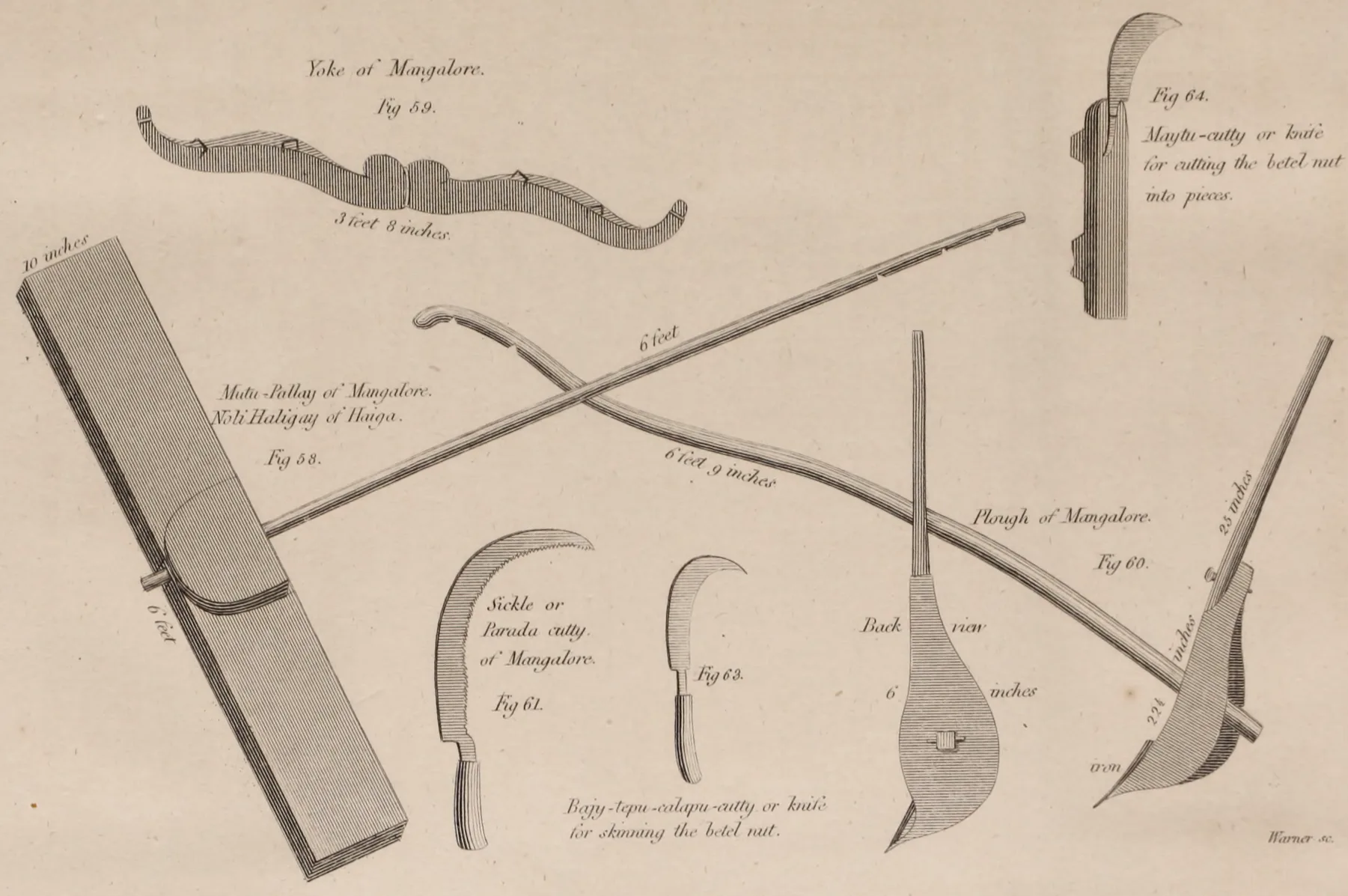
On the day that the seed is sown, the ground for receiving the seedlings when transplanted begins to be ploughed, and in the course of the month gets four double ploughings. The plough in use here (Plate XXII. Fig. 60.) is neater than usual in India, but is an implement equally wretched. In the intervals between the ploughings, the field is kept inundated. At the time of ploughing, two or three inches only of water are allowed to remain. After every ploughing, the soil is smoothed with the plank drawn by oxen. Between the 4th and 15th of July all the water except one inch is let off, and the seedlings are transplanted. On the third day the field is drained; and for two days it is allowed to dry. On the sixth it receives 2 inches of water, and then is continued inundated until the crop ripens. Between the 5th and 16th of August the weeds are removed by the hand. In October, or at the beginning of November, the straw is cut with the grain, and, till it be dry, is allowed to lie on the ground. In Figure 61, the sickle is delineated. The rice is thrashed by beating handfulls of the straw against a grating of Bamboos, which is placed sloping from a stone to the ground: the grain falls through the grating. This operation is performed in the square surrounded by the farm-houses; for here, as well as in most parts of India, there are no barns. The rough rice is dried in the sun, and much attention is paid to this operation with what is intended for seed. The straw is spread out to the sun as much as possible; but, owing to the rain, is seldom got in well. The seed is kept in Morays, or straw bags, which are hung up in the smoke of the kitchen. The rice intended for consumption is put up in heaps, placed on straw, and covered with thatch. The husks are beaten off in the course of two or three months, and immediately sold. The rough rice is put into large pots, overnight, with so much water as will cover it. In the morning it is boiled until the husks begin to open. It is then dried in the sun, and beaten in a small hole in the ground, or in a stone with a long pestle, the end of which is covered with iron. For the use of Bráhmans, a little is beaten without having been boiled; but it does not preserve long.
The rices that are cultivated as sprouted seed for the Yenalu crop on Bylu land are thus managed. The ploughings and manure are conducted exactly in the same manner as in the field on which the seedlings are raised; but, in order to gain time, they are made fifteen days later. The seed is prepared by putting the Moray, or straw bag, in which it has been kept, into water from the evening until next day at noon. The bag is then removed into the house, and in the morning of the fourth day is opened, the seed is sprinkled with dung and water, and immediately sown. After having been sown, it is managed like the seedlings; but the weeds are removed about the 26th of July. The quantity of seed required on the same ground for the sprouted seed cultivation, is to that required for transplantation, as two to three.
In the Sughi crop on Bylu land the rice is mostly cultivated as sprouted seed. It is inferior in quality to the rice of the Yenalu crop, and is chiefly reserved for home consumption. Being reaped in the hot and dry season, the straw, though short, is well dried, and is a valuable supply of fodder. The sprouted seed for this crop is thus cultivated. Between the 16th of October and the 14th of November, immediately after the Yenalu crop has been reaped, the ploughings commence; and are carried on exactly as before described; only in place of one man's standing on the plank drawn by oxen, the ground being now harder, three or four men must stand on this instrument; a most barbarous and expensive manner of adding weight; but in India it is seldom that an attempt is made to accomplish any thing by machinery, that can be performed by human labour. The quantity of manure required for this crop is larger than that which is given to the first. If this crop be transplanted, it only produces six seeds.
The seed of the rices that are cultivated for the Colaky crop is sown sprouted. Between the 12th of January and the 10th of February, immediately after having cut the Sughi crop, the ploughing for the Colaky commences, and the field is managed exactly as in the Sughi crop. In most places the water must be raised by the Yatam, called here the Panay, or by the instrument called Cai-dumbay (Plate XXV. Fig. 62), which makes the cultivation very expensive. The Cai-dumbay cannot raise water more than three feet, and is a means of irrigation very inferior to the basket suspended by ropes and wrought by two men. This crop requires a great deal of manure, otherwise it injures the following crop called Yenalu.
In place of this third crop of rice, where the quantity of water is too small, a crop of Urudu (Phaseolus minimoo Roxb: MSS.), Padingi (Phaseolus Mungo), or Cudu (Dolichos biflorus), is taken from the Bylu land. In some villages, but not in this immediate neighbourhood, a crop of Enama (Sesamum) is taken. For the three leguminous plants the ground in five days gets five double ploughings, and after each is smoothed with the plank drawn by oxen. It is then manured with dung and ashes, and the seed is sown broad-cast, and covered by the plough; after which the soil is again smoothed with the plank drawn by oxen. Then, if the field be not sufficiently moist, it must be divided into small plots surrounded by little banks, and once in fifteen days it must receive water. The quantity of the seed required for these pulses, is one-fourth of that required for rice in the sprouted seed cultivation, or about five-sixteenths of a bushel an acre. The produce is about 8 seeds, or 2½ bushels an acre.
In order to prevent the torrents of water, which in the rainy season run down from the hills, from injuring the Bylu land, a strong mound is formed round the bottom of the hills; and a channel above this mound conveys all the superfluous water into the sea, or into rivers. Coco-nut trees are frequently planted under the bank, or mound, in order to give it strength.
All the rices cultivated on the second sort of rice land, called Majelu, are sown sprouted; only, any seedlings, that may happen to remain after planting the Bylu fields are put into the Majelu. The cultivation on this is exactly the same, and at the same season, as the Yenalu, or first crop on Bylu land. The water, in case of a deficiency of rain, is supplied from small tanks, which reserve a supply for fourteen or fifteen days after the rains are over. The seed required for this kind of land is said to be one third more, than that required for the same extent of Bylu; but, on actual measurement, I found that a Moray of seed required considerably more Majelu than it did of Bylu. On a small portion of Majelu land, a second crop of Cudu (Dolichos biflorus) is taken. It is sown between the 16th of October and the 13th of November, and its produce is nearly the same as when cultivated on Bylu land.
The third sort of rice land, called Betta, is the same with the lower Parum, or hill-land of Malayala, which is there chiefly used for gardens. The rice cultivated on this is always sown sprouted, exactly in the same manner as the Yenalu, or first crop; only it requires two more ploughings, and a greater quantity of manure. The seed ought to be 1¼ of that which is required for the same extent of Bylu; but this also, I found, was not confirmed by actual measurement. This rice is kept for home consumption; for that of the Yenalu, or first crop from Bylu, or the lowest land, is the kind commonly exported.
It is upon this kind of ground that sugar-cane is cultivated; but very small quantities only are raised, and that entirely by the native Christians. Their method is as follows. Between the 14th of December and the 11th of January the ground, for four successive days, has a double ploughing, and, after each, is smoothed with the plank drawn by oxen. Then, with a hoe, called Haray (Plate XXI. Fig. 56), parallel channels are formed, at the distance of every 8 or 10 cubits. At right angles to these, and contiguous to each other, are formed trenches three quarters of a cubit deep, half a cubit wide at the bottom, and one cubit and a half at the top. The field is then manured with dung and straw; which, after they have been spread on the field, are burned; so that, in fact, the manure is ashes. The canes for seed are then cut into pieces, from half to three quarters of a cubit long; and these are soaked in water a whole day and a night. On the day after the manure has been burned on the field, the soil in the bottom of the trenches is loosened with the hoe, and mixed with the ashes; and with these united the joints of the cane are slightly covered. They are placed horizontally, two and two, in lines parallel to the trenches; and the ends of one pair touch the ends of the two adjacent pairs. The field is then watered, the channels being filled from a tank, or well, by means of the machine called Yatam. Except when there is rain, it must be watered every fourth day, speaking as a medical man; that is to say, if it be watered on the 1st day of a month, it will be watered again on the 4th, 7th, 10th, and so forth. A compost having been formed of rich mould, dung, and dry grass, it is burned; and on the 15th day from planting the ashes are spread over the field. At the end of the month, the weeds are removed by the hand, and with a small instrument named Sulingy. At the same time, the young canes are again manured with the burnt compost. At the end of the second month, if the cane has a sickly colour, it is again manured. The rains commence about that time, and then the earth from the intermediate ridges is gathered up round the young canes; which thus, in place of being in trenches, stand on the top of ridges. The field must then be well fenced. The dried leaves must be removed by the hand, which is all the farther trouble required, no watering being necessary after the rainy season is over. Jackalls eat the cane, and must be carefully watched. The cane is fit for cutting in 11 or 12 months. There are two kinds; the Bily, and Cari Cabbu; or white, and black canes. The former is the Restali, and the latter the Putta Putty of the country above the Ghats. The same ground will not produce sugar-cane every year; between every two crops of cane there must be two crops of rice. A piece of land that sows one Moray of rice, will produce 4000 canes, which are about six feet long, and sell to the Jagory boilers at from half to one Rupee a hundred. The Moray sowing of Betta land is here about 30,000 square feet; so that, according to the price of sugar cane, the acre produces from about 58 to 29 Rupees, or from about 5l. 17s. to 2l. 18s. 6d. The land-tax is the same as when the field is cultivated for rice. The want of firewood is the greatest obstacle to this cultivation; the trash, or expressed stems, is not sufficient to boil the juice into Jagory, while that operation is performed in earthen pots placed over an open fire. If all the land in Codeal Taluc (district) that is fit for the purpose, were employed to raise sugar-cane, it would yearly produce 1000 Pagodas worth of cane; that is to say, there are about 1125 Mudis sowing of land, that once in three years might be cultivated. The quantity in the neighbouring district on the south side of the river is much greater. The Jagory made here is hard, but black, and of a bad quality. It sells at 3 Maunds for the Pagoda, or at 12s. 3½d. a hundred-weight.
Between the rows of sugar-cane are raised some cucurbitaceous plants, and some kitchen stuffs, that soon come to maturity.
On Betta, or the highest of rice-land, where the water may be had by digging to a little depth, some people, chiefly Christians, cultivate capsicum, and Banguns (Solanum Melongena), as a second crop after rice. In good soils, these require to be watered once in three days; in bad soils, they must be allowed water every other day.
The kind of land called Potla, or Mojaru, is situated in deep places near the banks of rivers; and is so much overflowed in the rainy season, that, until the violence of this is over, it cannot be cultivated. Even in the dry season, it would in general be overflowed by the tide at high water; so that it is necessary to make banks to exclude the sea. The rice which it produces is always transplanted. Between the 17th of August and the 15th of September the seed is sown, and is managed in the same manner as the transplanted rice on Bylu land; only the season is different. The same quantity of seed is required for the same extent of Bylu ground; that is, one-half more than would be required for sowing broad-cast. This is a very precarious crop, being subject to be totally ruined by either too little or too much rain.
Poor land of every denomination requires more seed than richer land of the same kind.
The leaves of every kind of tree and bush, except such as are prickly, are used for manure. The cattle are kept in the house all night, and their dung is collected for the same use. It is kept in pits, and every day’s collection is covered with leaves; the whole dunghill thus forming alternate strata of dung and leaves, which soon rot. The ashes and sweepings of the family are kept in a separate pit. The soil of towns is never used as manure.
In Tulava the coco-nut and Betel-nut are the only productions of the gardens that are taxed. The gardens are formed on hilly ground which has a red soil; but, as the trees require to be watered, such places only are considered fit for the purpose, as afford water by digging wells to no great depth, or as can be watered by forming reservoirs. The water of the wells is raised by the machine called Yatam; but the gardens thus supplied, although requiring a great deal of trouble, are equally valuable with those watered from tanks; for as these sometimes fail in the hot season, the crop for that year is lost, although the trees do not perish.
Here the Areca or Betel-nut palm forms separate plantations, which are surrounded by some rows of the coco-nut tree, and is not scattered about the gardens, as in Malabar. The following is the manner of making one of these plantations, as described by the proprietors. Between the 17th of December, and the 13th of February, the seed must be collected from trees that are at least fifty years old. Having been kept four days in the house, it is tied up in a Moray, or straw-bag, and is immersed for 25 days in the water of a well. In the mean time a small plot of rice ground is repeatedly ploughed until it be reduced to a fine mud, and is well manured with dung and ashes. In this mud the nuts are placed close to one another, with their eyes uppermost, and one half of them above the earth. Then the plot is covered with straw, and is watered once a day for a month. A piece of dry ground is then dug up with the hoe, and manured with dung and ashes. Into this the nuts, which have now sprouted, are transplanted at half a cubit's distance from each other. The nuts only are covered, and the sprouts are left projecting. For two months, if the soil be moist, it must be watered once in four days; if it be dry, once in three days is sufficient. Another piece of ground is in the mean time prepared; and at the end of the two months the young seedlings are removed thither, and placed at the distance of one cubit from each other. In this nursery they remain eight months; and once in four days, when there is no rain, they are watered. In the mean while the garden is prepared by inclosing it with a dry hedge of prickly bushes. Within the hedge a row of coco-nut palms is planted, each being 24 cubits from the other. Within these, at 10 cubits distance from each other, are formed pits, two cubits in diameter, and two cubits deep. In the bottom of each of these is put a young Areca; all its roots are covered with fine mould, and it is manured with a little dung. This is between the 19th of October and the 16th of November, at the close of the rainy season. Every fourth day the pits must be watered, while the sun is excluded by branches and leaves. At the end of six months some dung must be given, and the weeds removed by the hand. Whenever there is no rain the waterings are to be continued; and twice a year the trees must be manured, and the weeds ought to be removed from near their roots. In two years the pits are filled up with the manure. At the end of five years another set of pits is made, one between every two of the old ones; and in these is placed another set of young plants, and managed as the first set. At this second planting some plantain trees (Musas) are set in the garden, but not above forty for the hundred Arecas. Near the hedge, in a line with the coco-nut palms, are also put some Jack (Artocarpus integrifolia) and Mango (Mangifera indica) trees. When ten years old, the Areca begins to produce fruit; but until the fifteenth year does not arrive at perfection. For thirty-five years it continues in full bearing. From its 50th year until its death, which happens in from its 70th to its 100th year, the quantity of fruit gradually diminishes, but its quality rather improves. The trees in full fruit produce annually three bunches, which ripen in succession between the 19th of October and the 16th of December. Each bunch contains from 30 to 100 nuts; so that, according to the natives, 200 nuts may be taken as the average produce of an Areca when it is in vigour. When the Mango and Jack trees have grown up, the pepper vines are usually put round them. Some people plant them also against the Areca, but they diminish its produce. Yams (Dioscoreas) are planted near the hedge.
The Betel-nut is collected by a set of people called Devadigas, who are sometimes kept as servants, and sometimes hired for the crop season, at 1¼ silver Fanam a day (5½d.), part of which is paid in rice. A Devadiga in the forenoon cuts 25 bunches, and in the afternoon assists the family to prepare the nuts. If the season promise to be favourable, that is to say, not too rainy, when the nuts are three quarters ripe, they are cut for Wan'-Adiky, or dry-betel. Immediately after they are cut, the husk is separated, and the nuts are then put into a pot, with as much water as will cover them, and boiled until the eyes (Corculla) fall out. They are then cut into eight pieces, and dried in the sun four days, being removed into the house at night, or on the appearance of rain. It is of great advantage to the Betel to be dried on a gray granite rock (Bily Cullu); but where that cannot be procured, it is dried on a piece of ground that is purposely made hard and smooth. For this operation, the Devadiga requires the assistance of four people, generally the women of the house; and they prepare daily 12 Seers measure of Wan'-Adiky (1 655/1000 peck). When the weather threatens to be rainy, the nuts are allowed to ripen on the tree for Nir'-Adiky, or wet-betel, which is thus prepared. The nuts, with the husk on, just as they are taken from the bunch, are put into large jars full of water, and the mouths of these are closely shut. In this state they cannot be preserved longer than four or five months, and are therefore taken for immediate consumption. A quantity adequate to supply the demand is daily taken out of the jar, and skinned as wanted. The knives used in preparing Betel-nut are delineated in Plate XXII. Fig. 63, 64.
A garden of 300 Arecas, which is one of a middling size, if it be watered by a well, requires the labour of six people, but of three only if it be watered by a tank. In the rainy season, however, while the cultivation of rice is chiefly carried on, the three men who are employed to raise the water have nothing to do in the garden, and are employed on the rice ground; even the three other men may be a few hours daily employed at any other kind of work. In fact, I suspect that the men, who spoke of six servants and four ploughs being requisite to cultivate 8 Morays of rice-land, ought to have added to the account an Areca garden of 300 trees. These men get 1 1/2 Pagoda a year in money, 2 Rupees worth of cloth, and eat three times a day in their master's house.
The pepper is managed as follows. Between the 24th of May and the 22d of June, the ground near the tree upon which it is to be trained is dug with a hoe. Then two, three, or four cuttings of the pepper vine, each a cubit long, are put in the ground, one end them being allowed to project. They are then covered with grass. This is done when the rainy season commences. A month afterwards they get a little dung. As the vines shoot, they are tied to the tree. When the dry season commences, they must be watered every second day, until a year old, after which they require water once in four days. Twice a year also they must get manure of dung and leaves; and long grass, or bushes, must be prevented from growing near their roots; but there is no occasion to dig or plough the whole ground. They begin to bear in the fifth year; but are not in full crop until the eighth. If the worms attack the vine, they die in twelve or fifteen years; but otherwise they live twenty-five, and all the while produce good crops. When any vine dies, a new one is planted in its stead. Here they are trained upon the Pongary or Hongary (Erythrina), the Nuriga (Moringa), Jack (Artocarpus), Mango (Mangifera), Areca, coco-nut, and tamarind. The first is, however, most commonly employed, and in this country lives fifty years. It is not customary here to prune the trees upon which the pepper is trained. Each tree, according to the number of vines that it can support, produces from two to four Pucka Seers measure, or from 5483/10000 parts to 1,0966/10000 of a Winchester gallon, which will weigh from 2,625/10000 lb. to 5,25/100 lb. When one or two berries begin to appear red, the whole are collected by pinching off the amenta. A man, in one day, can take the fruit from three trees, that is to say, can cure about 12 pounds of pepper. It is kept all night in the house. Next day the berries are rubbed off with the hands, and picked clean. They are then dried three days on mats, or on a piece of smooth hard ground, and every night are taken into the house. The pepper is then fit for sale, and the common price is one Vir'-Ráya Fanam for the Seer, which is at the rate of 106 1/2 Rupees a Candy of 560 lb. the weight here in use; or at the rate of 120 Rupees nearly for the Candy of 640 lb. which the cultivators in Malabar employ. The export price is on an average 136 Rupees for the small Candy; but in this the merchants profit and the customs are included.
The crop season is between the 15th of January and the 13th of February. Some people take advances; but the practice does not seem to be so prevalent as in Malabar, and the terms are somewhat more reasonable, although abundantly severe on the imprudent cultivator. If the advance be made six months before the time of delivery, the borrower gets three fourths of the value of the pepper; so that the lender has a profit of one Rupee for every three advanced, or 33⅓ per cent. If, however, there is a delivery short of the stipulated quantity, the merchant gets back only a proportional part of the advance, with interest at the rate of three fourths of a Rupee for the Pagoda per annum, that is to say, 18¾ per cent.
Although I examined both the cultivators and extractors of palm wine concerning the plantations of coco-nut trees, the account that I can give of them is not at all satisfactory; what they said being in some places evidently false, and in others contradictory.
The cultivators say, that the seed must be allowed one whole year on the tree to ripen, and must be the produce of a palm above fifty years old. After being plucked, it is kept four months in a place which is sheltered from the sun and rain. Then it is put in a well, and kept a month under water. A small plot of dry ground is then dug, and manured with dung and ashes. In this the coco-nuts are placed, at one cubit’s distance from each other, and buried so as just to be covered above the eyes, which are placed uppermost. The plot must be near a tank or rivulet, from which with a wooden scoop, Tay-pallay (Plate XXV. Fig. 68.), the water is thrown into it every other day when there is no rain. If there be rain, pains must be taken to prevent too much from lodging on the plot. These operations may be performed at any season; so that the young plants, after remaining in the plot from 12 to 15 months, may be fit for transplanting between the 22d of July and the 20th of August. In this month square pits two cubits in width, two cubits deep, and at 24 cubits distance, are dug; and in the bottom of each is placed a coco-nut with its young shoot, which then is about three feet high. Round it are placed a Seer of salt, some ashes, and as much fine mould as will rise four inches above the nut and roots. The young plant must be watered every other day, until the second leaves expand, which will be in about six weeks. In dry weather they must, for at least five years, be watered once in four days. In low grounds near the sea or inlets, the trees after this age require no watering: but on high ground, during the dry season, they must be watered as long as they live. In both situations the trees must be manured twice a year with ashes, dung, and leaves; and, if at a distance from the sea-water, they must at the same time get a little salt. When the first set are from five to ten years old, another set is planted in the spaces between them. They arrive at full perfection in twelve years, and continue in vigour until sixty. Those in plantations near the sea die at this age. These require no trouble; but after five years of age to be manured once in six months; and here no plantation is hoed or ploughed. Every second year, in the rainy season, between the 24th of May and the 16th of November, those trees which grow in low places near the sea are let for six months to the people who extract the juice. During this time, owing to the quantity of rain, the nuts in such situations do not ripen. In the year in which juice is extracted, the tree gives four bunches of nuts; in the intermediate year it gives six bunches. According to the farmers, a garden on high ground, that contains 500 trees, if watered by a tank, requires twenty men to work it; if watered by a well, it requires thirty men in the rainy, and forty in the dry season. This, however, must be an excessive exaggeration. In the dry season these trees may once in three years be let for extracting juice; but the practice is not common. Each tree, while in vigour, ought annually to produce fifty nuts. Those on the low ground produce more, but on the high-land they live much longer. They there continue in full vigour until sixty years old, and for about ninety more gradually decay.
The men who extract the juice in general hire the trees when these are fit for their purpose. The rate that they give seems very low, being only one fourth of a Rupee for three trees near the salt-water, and one fourth of a Rupee for four or five trees growing on hill-land; and there must be some mistake, as both to the north and south the rate for each tree is half a Rupee. It is true, that here the trees are never exhausted, and, even in the year in which juice is taken, produce a crop of nuts. According to the Biluaras the trees near the sea can at all times yield juice, those growing on hills produce it only in the rainy season; which is directly contrary to the assertion of the cultivators. The juice is partly sold, for drink, while fermenting; partly distilled into a liquor called Gungasir; and partly boiled into Jagory.
The people who follow the business of extracting juice from palm trees, in their native language of Tulava, are called Biluaras; but in that of Karnáta, which the people of rank here commonly use, they are called Halépeca Davaru. Their proper business is to extract juice from palm trees, to boil it down to Jagory, or to distil it into spirituous liquor; but many of them also cultivate the ground, a few as masters, but many more as Culialu, or hired servants. Some of this cast have now settled above the Ghats. These will marry the daughters of the people remaining in Tulava; but those here will not marry a girl from Karnáta, because the property there goes to a man's children, but here it goes to the children of his sisters; and, if he married a girl from Karnáta, her brothers would not receive the children. The Biluaras pretend to be Súdras, but acknowledge their inferiority to the Bunts. The business of the cast is settled by a person called Guricara, who is appointed for the purpose by the government, and who, with the assistance of a council of elders, has the power of excommunication, and of inflicting corporal punishment. None of this cast can read. They are permitted to eat animal food, but ought not to drink intoxicating liquor. The men are allowed a plurality of women, who live in their houses; but on the husband's death the widows, with their children, return to their brother's houses, and the eldest son of the eldest sister of the deceased person becomes master of his house and property. If a man fall into poverty, his children go to their uncle's house, before their father's death. Girls continue to be marriageable after the age of puberty; and a widow, or divorced woman, may marry again. A man may turn away his wife when he pleases; but a woman cannot leave her husband without his consent. This however, by committing adultery with any person of the cast, she can in general procure; for few husbands retain their wives when unfaithful; and she is not disgraced, but may get another husband, or at any rate she can live with her brother. Those who are in easy circumstances burn their dead; those who die poor are buried. The spirits of good men are supposed to go to a heaven called Sorgum, those of bad men are sent to a place of punishment called Nuraka. They seem to have no idea of transmigration. A few of them worship Vishnu; the greater part, however, never pray to any of the great gods, but content themselves with an annual sacrifice to Marima, and the other Saktis, by which they hope to avert the evils that are occasioned by these agents of Siva. Their women are liable to disorders that are attributed to the influence of Paisáchi, or evil spirits. These are not appeased by sacrifices; but the Biluaras apply to the Cunian, whose Mantrams, they fancy, are capable of casting out these devils. None of the Biluaras have Puróhitas to read Mantrams or Sástrams on occasion of any ceremony, such as marriage, or the commemoration of their deceased parents; nor have those who confine their worship to the Saktis any Guru; but those who pray to Vishnu are subject to the Sri Vaishnavam Bráhmans, who accept of their Dharma, or duty, and bestow on them Upadésa, Chakrántikam, holy-water, and the like.
But to return to the gardens. The tenants (Gaynigaras) not only differ from the Biluaras, but also give a different account from the proprietors (Mulucaras). They say, that when they are disposed to plant a garden, they agree with a proprietor for a piece of ground suited to the purpose. They agree to give him a fixed annual rent in money; and so long as they pay this, the garden cannot on any pretence be resumed. In case of a deficiency of rent, the proprietor may resume the garden; but he must pay the tenant for all improvements made by planting. The value of each kind of tree is fixed, and is not left to arbitration, as was alleged by the proprietors. For coco-nut palms the value differs, according to their age, from one to three Rupees. A Betel-nut palm is valued at one fourth of a Rupee; ten or twelve fruit trees at one Rupee; a tree covered with pepper vines one Rupee. The expense of rearing all these must be as great here as in Malabar; and we may safely conclude, that these values at least equal the expense incurred. A tenant cannot sell his garden; but he may at any time go to the proprietor and compel him to take it off his hands, and to pay the value of the trees. The tenants sometimes hire gardens that have been brought to maturity. In this case, they pay a certain sum for each palm, but nothing for any of the other articles that are reared in the garden. The proprietor continues to cultivate the garden, and to keep up the number of the trees. This seems to be a reason for the low state at which the cultivation of pepper is in Tulava; as the proprietor is not at all interested in increasing the number of vines.
Betel-leaf (Piper Betle) is here cultivated in separate gardens, as is the case in most parts of India, except in Malabar. For this purpose, a red stony soil on the side of a rising ground is preferred. Some of the gardens are watered from tanks; others, by means of the Yatam, from wells, in which the water stands from 12 to 24 feet under the surface. Between the 23d of April and the 23d of May the ground is first dug, and is then formed into beds six cubits wide, which are separated by trenches three fourths of a cubit broad, and half a cubit deep. In the centre of each trench, at four finger-breadths from each other, are planted, in a row, cuttings of the Betel-vine, each a cubit in length. If there is no rain, they must be slightly watered five times a day, and then covered with branches to keep off the sun. At the end of the first and second months, a little fresh red soil, mixed with small stones, are put in the bottoms of the trenches. At the end of the third month a row of branches, at six or eight cubits from each other, is planted on each side of every trench. The branches are intended to grow up to trees as supports to the vines. Those chosen are the Pongary (Erythrina), the Nuriga (Moringa), and the Agashay (Æschynomene grandiflora). At the same time, a little more earth and some dung are put into the trenches. In the sixth month more earth and dung is given ; and, Bamboos having been tied horizontally along the rows of branches, the young Betel-vines are tied up to these. At the same time, in the middle of every second bed, a channel is formed, which every other day is filled with water ; and from thence, by means of the Tay-pallay (Plate XXV. Fig. 68 ), the water must be thrown on the plants. Every month, a little dung and red earth is put to the roots of the vines, and these are tied up to the Bamboos and trees. When a year old, the garden begins to produce leaves for sale ; after which, once in two months, it requires to be manured, and in dry weather to be watered once in two days. In the centre of each of the beds that have no channels, is then put a row of plantain trees. The garden is generally surrounded by a quickset hedge, at other times by a dead hedge of prickly bushes, and in the interval between the fence and vines are planted Capsicums, and other kitchen stuffs. Every four years the Betel-vines die ; but in their stead others are immediately planted, a new trench being dug in the situation of each old one. In eighteen or twenty years, the soil having been exhausted, all that is near the trees is removed, and in its place fresh red earth is brought into the garden. The trees last for fifty or sixty years; but when, by accident, one dies sooner, a fresh branch is planted to supply its loss. These substitutes, however, do not thrive. When, from old age, the whole trees begin to decay, the garden is abandoned, and a new one is formed in another place. If the garden receive its supply of water from a reservoir, the cultivator, each time that he plants, pays to the proprietor 10 gold Fanams, or 2½ Rupees for every 1000 vines. In the three intermediate years he pays nothing. If the water be supplied from a well, the rent is only half of the above mentioned sum.
The cattle employed in labour here are chiefly bred in the inland districts about Subhra-mani, and are no larger than those of Malabar. From the month of January, until the commencement of the rainy season, they are supported on fodder. Between the 17th of November and the 16th of December a bad hay is made of the long grass which grows naturally on some hills that are purposely kept clear of bushes. This hay is chopped, and is boiled with rice husks for three hours; of this the oxen are allowed a quantity morning and evening; half a Maund (14 lb.), the people say, would be a good allowance. At night they get rice straw to the amount of about three fourths of a Maund (21 lb.), as the people whom I consulted conjecture; but, from the appearance of the cattle, the quantity allowed cannot be near so much. The people indeed merely spoke by guess, no Hindu, so far as ever I heard, having thought of weighing fodder. At the end of the dry season the cattle, as usual in India, become very poor; but in the rainy season those here are fat, and the cows are entirely supported by pasturing on the hills: at night the working cattle are allowed rice straw. An ox is wrought from sun rise until noon only, and is allowed the afternoon to pasture. Epidemic diseases are sometimes very destructive, and are attributed to a contagion which is supposed always to originate above the Ghats. An old man says, that he remembers twenty times the prevalence of this epidemic; but that seems to be speaking in round numbers: for the five last years there has been no disease of the kind. A good cow gives twice a day half a Seer of milk. For this purpose few female buffaloes are kept, but a great many males are employed in the plough. Swine are kept by some of the low casts; but the pork of tame swine is an abomination with the Bunts, as with all the higher ranks of Hindus, although many of them are fond of the meat of the wild hog. No horses, sheep, goats, nor asses are bred in Tulava; nor have its inhabitants any carts.
Salt is made on this coast by a process similar to that used in Malabar; but the quantity manufactured is very inadequate to the demand of the country. A low piece of ground covered by the flood, but dry at low water, is chosen, and surrounded by a bank that is capable of excluding the tide. By means of a tunnel passing through the bank, and formed of a hollow coco-nut tree, the salt water can at pleasure be admitted. A sufficient quantity having been received, the tunnel is shut; and, when the water has evaporated, the soil is very strongly impregnated with salt. Brine is formed, as usual in India, by filtering salt water through this saline earth. The brine is exposed to the sun in small plots, levelled, and rendered impenetrable to water by a coating of clay and sand well beaten together, and rubbed smooth with a stone. To form the salt requires 28 hours evaporation; and it can be made only between the 26th of March and the 23d of May. The man who makes it gets from the government an advance of five Pagodas in cash, and of rice to the same amount. He repays the money, but not the rice, and pays on an average a tax of 43 Pagodas; so that, in fact, government gets from him 38 Pagodas (15l. 16s. 3d.) for an ordinary salt-field. Larger or smaller ones pay in proportion. The manufacturer sells his salt as he pleases. It is mixed with a considerable quantity of earthy impurities, but not with more than the common salt of Bengal contains. The grains are large and cubical, and often adhere together in large porous masses. It seems to be very deliquescent. The common price is 1120 Seers for the Pagoda. The Seer measures 76½ cubical inches; the bushel therefore, in cluding the duties, costs less than 2½d.
No iron is made in the province of Canara.
Having assembled the principal traders of this place, they say, not only that the trade of the place has decayed greatly since the time of Hyder, which may possibly be true; but they also assert, contrary to the evidence of the custom-house accompts, that since the fall of Tippoo the imports have diminished greatly. They acknowledge, however, that under this prince the merchants suffered terrible oppressions, and that under his government the greater part of them were ruined. Hyder had collected them together with great pains, and he always allowed a Lac of Rupees (10,073l. 12s. 2½d.) to be in advance to honest and industrious, but poor men; by which means such valuable persons were induced to come from great distances, and to settle at this place. The principal merchants in Hyder's time were Moplays and Kankánies; a few came from Guzzerat. Since the Company has acquired the government of the country, many men of substance have come from Surat, Cutch, Bombay, and other places to the north. These men are chiefly of the Vaisya cast, but a good many Parsis are among them. The shopkeepers are still mostly Moplays and Kankánies. The Bunts are now beginning to pursue commerce. The vessels employed in trade chiefly belong to other ports.
Rice is the grand article of export. It is sent to Muscat, Bombay, Goa, and Malabar. The duties on its exportation were lowered by Major Monro; but that has made no material difference in the price, and the cultivators are not sensible of any benefit from this measure. The average price, including duties and shipping charges, varies, according to its quantity, from 24 to 18½ Pagodas a Corge of 42 Morays. This makes the price from almost 3s. 6½d. to 2s. 8¾d. a bushel. The cultivators, of course, sell it lower; about 2 Morays for a Pagoda may be the average price that they get for good rice, which is 3s. 1d. a bushel. The coarser kinds are lower in proportion.
Next to rice, Supári or Betel-nut is the chief export. It is sent to Surat, Bombay, and Cutch. The export price of the raw nut is 14 Pagodas a Candy, or 1l. 2s. 4½d. a hundred-weight. That of the boiled nut is 15 Pagodas, or 1l. 3s. 11¾d. a hundred-weight.
Black-pepper the merchants reckon the next greatest article of export; but, to judge from the custom-house accompts, it would seem to be more considerable. Its average price is 34 Pagodas a Candy, or 3l. 1s. 1d. a hundred-weight. The customs on pepper are lower here than in Malabar, and no rent nor tax is exacted from the cultivator; yet the price at Mangalore is higher than at Tellichery, and the cultivation is more neglected.
Sandal wood is sent to Bombay; but it is all the produce of the country above the Ghats.
Cassia, called here Dhál'-China, or cinnamon, is sent to Muscat, Cutch, Surat, and Bombay; and is exported at 9 Pagodas the Candy, or 14s. 4½d. the hundred-weight. The buds of this tree are called Cabob China, which seems to be the origin of the European word Cubeb. They are exported to the same places.
Turmeric grows in the country, and is exported to Muscat, Cutch, Surat, and Bombay, at the rate of 8 Pagodas a Candy, or 12s. 9½d. a hundred-weight.
The chief imports, according to these merchants, are blue cotton cloths from Surat, Cutch, and Madras. The Surat cloth is the most common. It is 36 cubits long, two broad, and of a very dark colour, and sells for from 18 to 50 Pagodas a Corge, or from 3⅘ to 10 Rupees a piece.
Coarse white cotton cloth from Cutch, Bavanagur, and other places north from Bombay.
Salt from Bombay and Goa. The former sells at 70 Pagodas a Cumbu, and the latter at 50 Pagodas: the former is a little more than 3¼d. and the latter than 2½d. a bushel.
Raw-silk, for the use of the manufacturers above the Ghats, is imported from China and Bengal; and from Muscat a kind of red dye, called Munjisht, which I believe is a species of madder.
Sugar is imported from Bengal and China, and oil and Ghee (boiled butter) from Surat.
Much of the cloth used in the country is brought from above the Ghats; partly by the merchants of this place, and partly by those of Bangalore and Cuddapa.