ON the 1st of November I went ten Malabar hours’ journey to Kanya-uru, which is a small village without any shops, and is situated at some distance north from the Noyel river. The country near Coimbatore is fully cultivated, but very bare of trees. A few very fine hedges show how well they would thrive, if all the fields were inclosed. Towards Kanya-uru large proportions of the fields are unoccupied, but the country is better wooded. Much of the soil is poor, and all at any distance from the Noyel is dry-field.
2d November.—I went ten Malabar hours’ journey to Avanasi, the residence of a Tahsildar. The country looks well; about one half of the arable lands being under cultivation, and many of the fields being surrounded by good hedges, especially those of the Elanda Moula, or Euphorbium antiquorum. This kind of hedge requires to be annually repaired, by inserting cuttings in the places where old plants have decayed; but large cuttings being taken, and supported by Bamboos and thorns, they become immediately a fence sufficient against cattle.
The principal cultivation here is Horse-gram (Dolichos biflorus), with which very little trouble is taken. The ploughing is so rude, that hardly any of the bushes are overturned; and the field at a little distance appears as if it were waste. Many bushes resist even the repeated ploughings given to the fields of Cambu, but they are soon overtopped by this vigorous plant.
In the vicinity of Avanasi are many Palmira groves, which in a country so naked give it a good appearance. Here there are two reservoirs for watering rice-ground. The one receives all its supply of water from the rain which it collects. The ground irrigated by this tank amounted to eleven Candacas, equal to twenty-two Cheis, or twenty-nine acres; but, owing to its being out of repair, it now supplies only ten Cheis. The other reservoir receives a supply of water from a rivulet called the Semudir, which, after giving a supply to another large reservoir, falls into the Noyel at Tripura. The dam turning the water from the Semudir into the reservoir at Avanasi, is in such bad repair, that the supply is deficient, and thirty-two Cheis only are at present cultivated, of the eighty which formerly were irrigated.
Before the invasion of General Meadows, Avanasi contained two hundred houses, which are now reduced to about fifty, that are chiefly inhabited by the Bráhmans, musicians, and dancers belonging to a temple of Siva. These people pretend, that their temple is equal in sanctity to the celebrated Baranasi at Kási; but this pretension is laughed at by their neighbours. In this district there are many weavers, Coicular, Jadar, and Parriar.
Many sheep are bred throughout Coimbetore, and especially in this district. Under the term Bacri, the Mussulmans here include both the long-legged goat and the sheep. The former, in the native language of this country, is called Veladu; of the sheep there are in this place two kinds, the one called Curumbar, and the other Shaymbliar. The goats here are greatly inferior to those above the Ghats; but the sheep, though small, are of a good quality, fattening readily, and making most delicious meat. Even grass-mutton may be had here tolerably fat; for the pasture, although it looks very bare, seems to be more nutritious than that on the banks of the Ganges, where no tolerable mutton can be reared without the assistance of grain. Even the Mussulman officers never thought of fattening their sheep with grain, and indeed made very little difference between fat and lean mutton. A good female goat (Veladu), or a sheep of either kind, costs from 4 to 3 Fanams, or
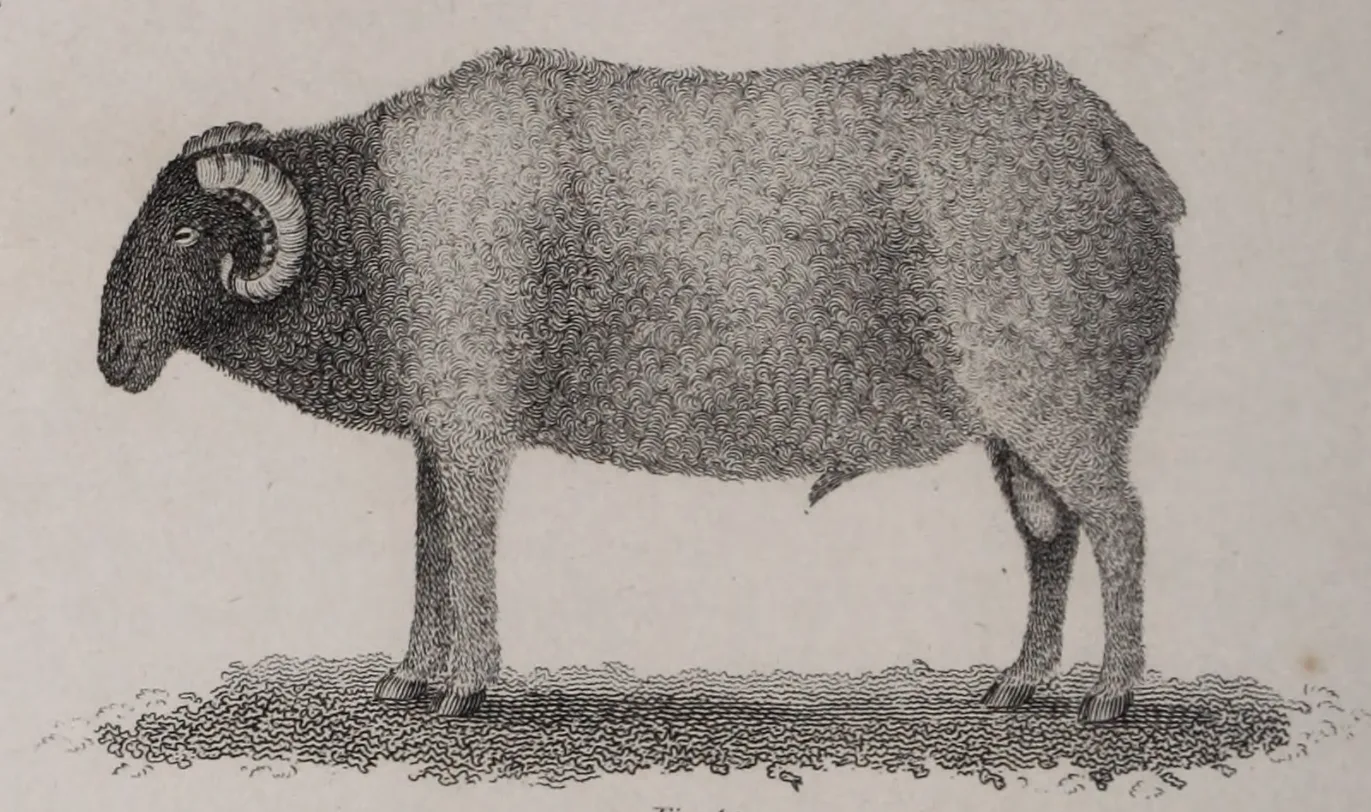
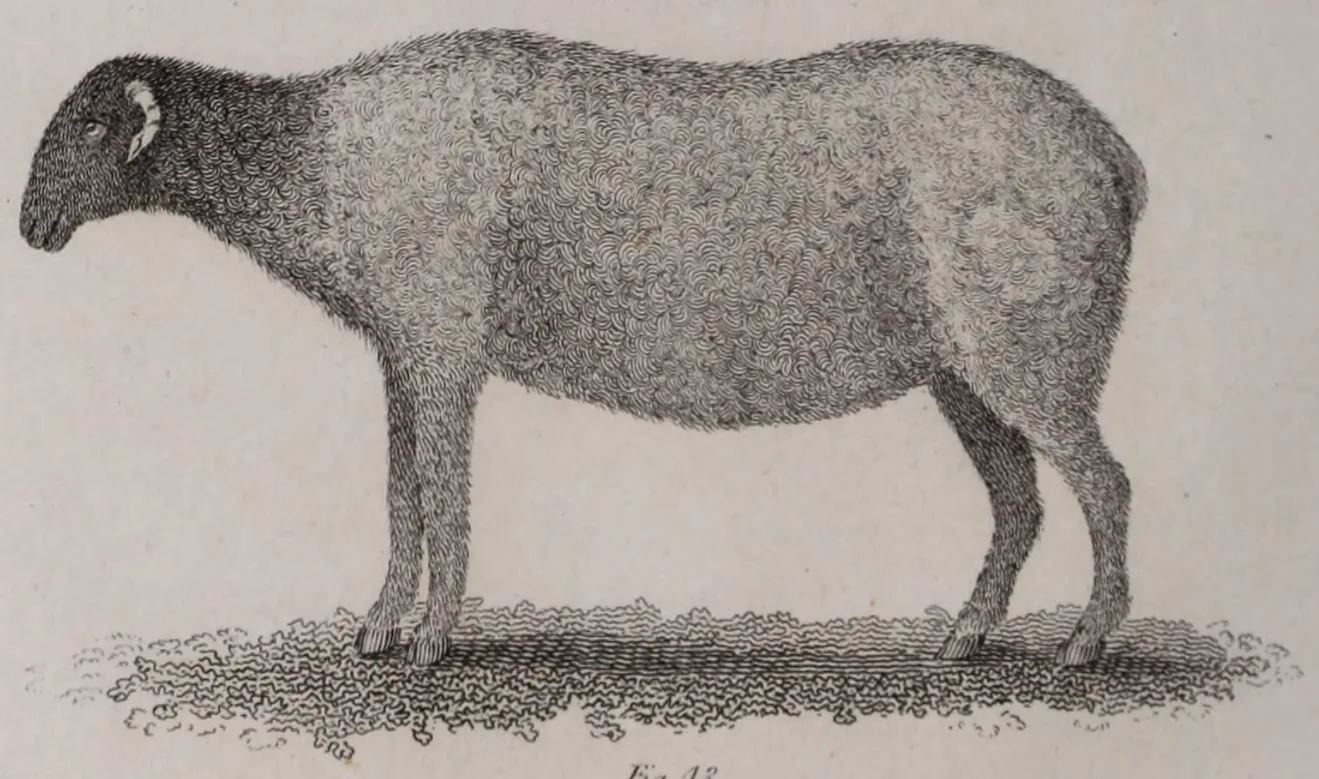
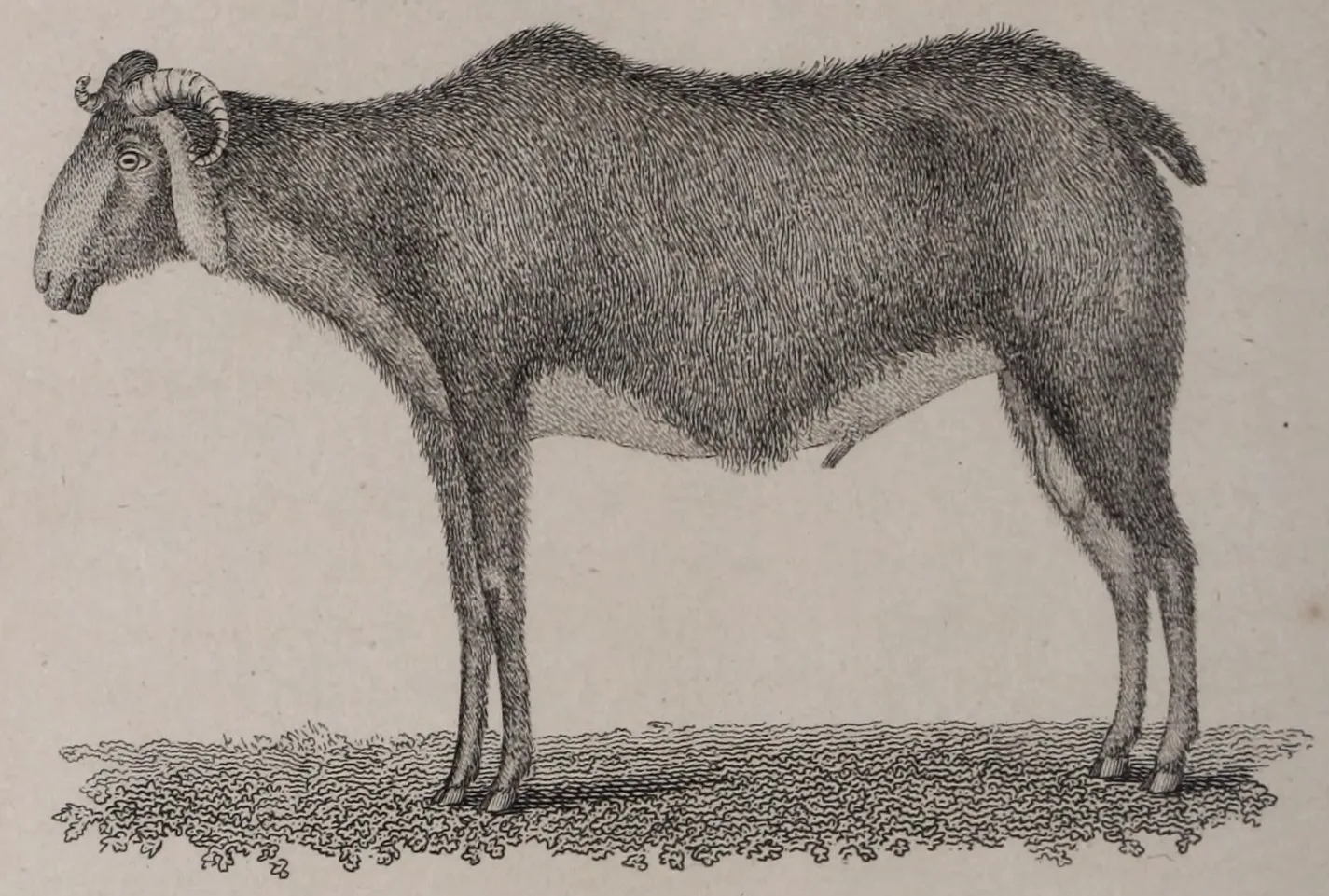
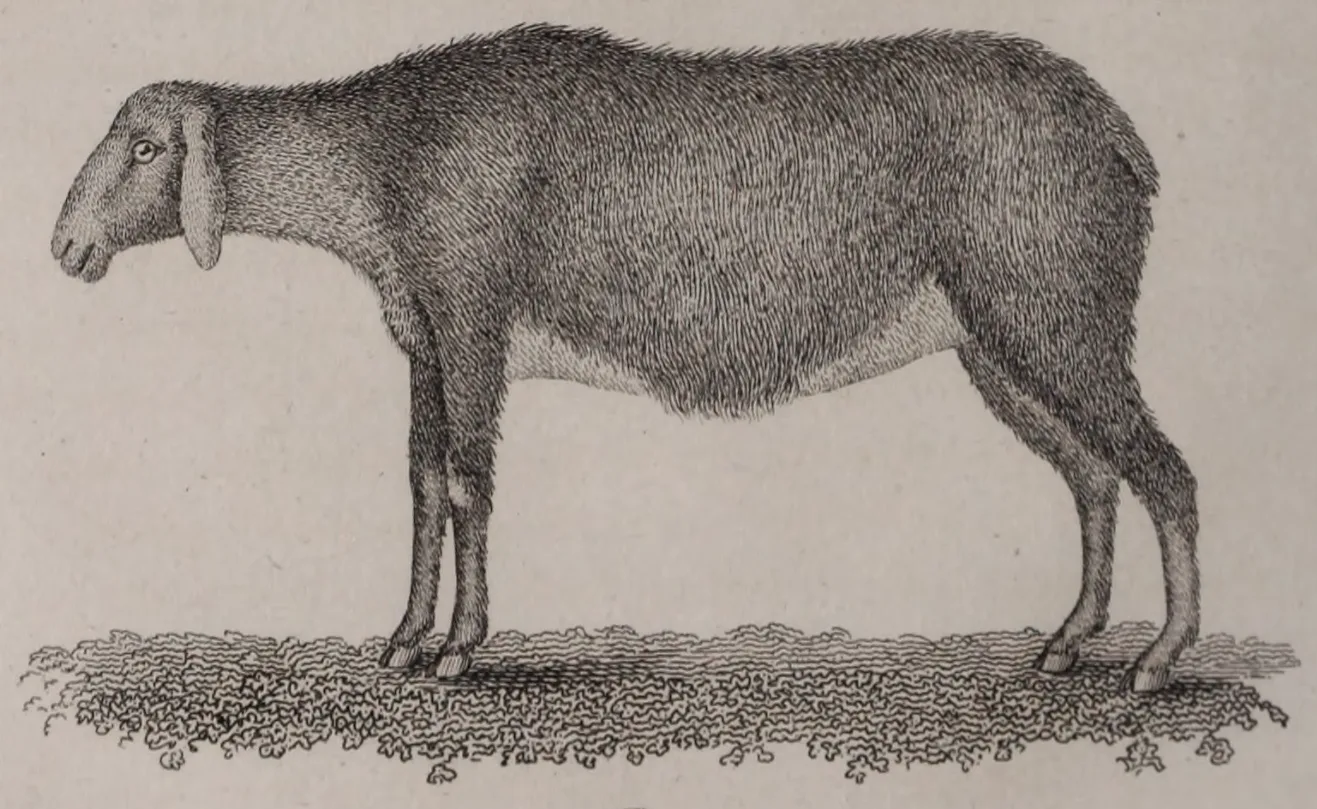
from 1s. 11¾d. to 1s. 5¾d. A good wether costs from 6 to 5 Fanams, or from 2s. 11¾d. to 2s. 6d.
The Curumbar (Plate XVII, Fig. 42, 43.) is a short bodied sheep, with a short small tail, like that of a hare, or goat: the rams have short horns turned back, and their ears are very short and pendulous. The ewes seldom have horns. The wool is thick and curly, and has little or no hair intermixed with it. Here they are in general white, with black heads; but above the Ghats they are frequently altogether black. It is of the wool of this kind only that blankets are made. They are shorn twice a year.
The Shaymbliar (Plate XVIII, Fig. 44, 45.) is of a thinner make than the Curumbar. Their horns and tails are similar; but their ears are longer, and their wool is very scanty, their principal covering being hair. In this country they are generally of a redish brown colour; but in Mysore they also are most commonly black.
Both kinds lamb once a year from the 15th October to the 15th of November. Twice a day, during the two following months, about ¼ of a Seer, or about seventeen cubical inches of milk, are taken from each. The long legged goat gives double that quantity for three months after each kid, and breeds twice a year. The milk of all the three, together with that of cows and buffaloes, is mixed for making butter. My Bengal servants acknowledge, that both the Ghee (boiled butter) and curdled milk of this country are superior to those of their own, where a preference is given to unmixed cow's milk. Wethers of all the three kinds are made by bruising the testicles of the animals when they are two years old, and never while they are young: the natives prefer the meat of the goat to that of the sheep, and the meat of the Shaymbliar to that of the Curumbar; which is directly in opposition to the taste of most Europeans. Owing to this, however, the cultivators in general keep only the goats and Shaymbliars; while the Curubas, or weavers of blankets, keep the Curumbars, as these only can supply them with wool.
In Coimbetore no kind of cattle are housed at any season. Previous to the ploughing season, they are always folded on the lands that are to be cultivated. In order to increase the quantity of manure, the farmers every where keep sheep and goats; but it is chiefly in this neighbourhood, that the Curubas pasture their flocks of Curumbars. The Curubas, who by the Mussulmans are called Donigars, are all of Karnáta extraction, and in Coimbetore never cultivate the ground. Their sole occupation is feeding their flocks, and weaving their wool into coarse blankets; none of which made here, exceed in value four Vir’-Ráya Fanams, or 1s. 11¾d. Each man possesses from fifty to one hundred sheep, which he pastures on the fields all day without paying any rent; and at night he folds them on the arable lands of the cultivators, who might each give a Bulla of grain to the proprietor of one hundred sheep for the manure. Every family of the Curubas pays a poll-tax, and there is a duty on their blankets.
3d November.—I went five Malabar hours’ journey to Tripura, fording the Noyel at that town. The country is not so well occupied as that through which I came yesterday; and in every village there are many ruinous houses. The soil is rather poor, but the fields are well fenced. The Noyel is a river very inferior to the Bhawání, and was easily fordable, although much swollen by a very heavy rain that lasted all night. On crossing this river, I entered the district under Mr. Hurdis. Tripura is an open town, containing three hundred houses, with a large weekly market or fair. I observed, that the women here did not conceal themselves when their curiosity prompted them to view me as a stranger. This is also the case in all the country above the Ghats; but in the part of Coimbetore north from the Noyel river, the women in general ran out of my way, and satisfied their curiosity by peeping from behind walls and hedges, as is usual in the country of Bengal.
The Tahsildar of this district resides at a place called Palar, where there is a fort, but only thirty houses, of which fifteen are inhabited by Bráhmans. The district is fifteen Malabar hours’ journey from north to south, and twelve from east to west. The Tahsildar met me with great readiness, to give me an account of his district. He says, that none of it is absolutely waste; as the fields that are not cultivated pay a trifle as a rent for grass. The country suffered little during the invasion of General Meadows, as it lay at some distance from the routes of the contending armies. Last year many of their cattle died of the epidemic distemper.
The land-measure differs every where in the province under Mr. Hurdis; and all the revenue accompts are kept according to an old measurement made by Chica Déva Ráya. In this district no less than three different land-measures prevail. 1st, at Palar, thirty-two Vaums or fathoms make one Russy, Caur, or chain; which is, therefore, two hundred and sixteen feet. Three chains by two make a Bulla-sowing, which is 6 426/1000 acres. 2dly, at Madupura hobly, the Bulla is a square of sixty-four Vaums each side, or contains 4,284 acres. 3dly, at Tripura, forty-eight Vaums square make a Bulla-land, equal to 2,41 acres.
The Mau, or Candaca of watered land, is equal to two Cheis of the new measurement, or contains 2,644 acres.
The measures of grain also vary extremely. The Puddy varies from 64 to 72 Rupees weight of grain, or from 56 83/100 to 63 96/100 cubical inches: four Puddies make one Bulla, sixteen Bullas make one Morau, six Moraus make one Podi, which therefore varies from about 10 15/100 to 11 42/100 bushels.
The weights near this are every where the same. 8 Rupees=1 Pull, 3 Pulls=1 Seer=0,6067 lb.; also 33 1/3 Seers, or 100 Pulls, are =1 Tolam=20 1/4 lb.
Here is established a Niruc, or regulation, by which all coins have a certain value affixed to them; and at this rate they are received in the payment of the revenue; but in dealings between private persons attention is not paid to this rule. Accompts are commonly kept in Chucris, or Canter'-Ráya Pagodas, and Fanams; but the coins commonly current are Pondichery and Sultany Rupees, and Vir'-Ráya Fanams.
On the rice land in this neighbourhood there is only one crop, which is sown after the sprouted manner, from between the 12th of July and the 18th of August. The land is watered partly from reservoirs, and partly from canals, which are brought from the Noyel by dams. It lets for from 9 Chucris to 4½ for the Candaca, or for from 1l. 1s. 3d. to 10s. 7½d. an acre. The dams on the Noyel are said to be 32 in number. Of these four were in this district; but two of them have been so long ruinous, that no accounts remain of the quantity of land to which they gave water. Owing to the want of repairs, rather more than a third of the land formerly watered by the two remaining dams, is now uncultivated. The water from some of the dams on the Noyel is applied directly to the fields from the canals; in others, it is previously collected in reservoirs, in order that no more ground may be cultivated than the supply of water is adequate to irrigate.
For six years past there has been a great scarcity of rain, which has injured considerably the cultivation of the dry-field. About ⅜ of what was formerly cultivated is now neglected; and for pasture it has always been customary to leave some of the fields fallow. The whole, however, are now let; but the rent given for those which are in grass is very trifling. The greatest article of cultivation here is Colu, or the Dolichos biflorus, called Horse-gram by the English of Madras; next to that, about equal quantities of Cambu (Holcus spicatus), mixed with Bullar (Dolichos Lablab), and of Sholum (Holcus sorghum); next to those, Upum cotton. The other articles cultivated on dry-field are inconsiderable.
The produce of a Bulla land, Palar measurement, is stated to be 200 Tolas of cotton, with the seed, or about 629 pounds an acre.
Cambu seed per Bulla, 52 Bullas produce 20 Podis. Bullar - - - - 16 - - - - 2¾
Cambu seed per acre, 0,956⁄1000 bushel, produce 35,55⁄100 bushels. Bullar - - - - 0,294⁄1000 - - - - - - 4,82⁄100 Seed 1,25⁄100 bushel. Produce 40,43⁄100
Sholum seed per Bulla, 56 Bullas ; produce 28 Podis. Ditto per acre, - - 1,03⁄100 bushel ; ditto 49,78⁄100 bushels. Colu seed per Bulla, 64 Bullas ; produce 10 Podis. Ditto per acre, - - 1,17⁄100 bushel ; ditto 17,77 bushels.
This is the produce of a good soil, as stated by the Tahsildar ; but it seems to be over-rated.
A farmer who has four ploughs, wrought by four men and eight oxen, and who occasionally hires women labourers, can cultivate with dry grains four Bullas, Palar measurement. This is at the rate of rather less than six and a half acres for a plough.
The quantity of ground cultivated as garden, and watered by the Capily, is in this district very considerable.
In Palar and Chinghery subdivisions 180 Bullas, or 1156 acres. In Madupuru - - - - - - - - 187 ditto, or 801 ditto. In Tripura - - - - - - - - - - 159 ditto, or 383 ditto. 2340 acres.
It produces Sholum (Holcus sorghum), Cambu (Holcus spicatus), Kevir (Cynosurus corocanus), Meti, or fenugreek (Trigonella fænum græcum), wheat of the Hotay kind (Triticum spelta), Jiray and Danya, two of the carminative seeds, tobacco, garlic, onions, Tenay (Panicum italicum), Banguns (Solanum melongena), and capsicum. Almost every farmer cultivates some of this ground.
The whole land in this district is said to be arable ; but certain of the poorest fields are set aside for pasture, and pay a small rent. Some of them continue always in grass ; others are alternately cultivated for Horse-gram (Dolichos biflorus), and produce grass. Four Bullas of Palar measurement (25 3⁄4 acres) are reckoned sufficient pasture for 20 oxen. In the dry season, they must be either sent to the hilly country, or fed with the straw of Sholum, or Cambu, the two species of Holcus cultivated in this country.
A man who has four ploughs, four or five servants, with occasional labourers, and sixteen oxen, is said to cultivate ½ + ⅛ Bulla (4,163/1000 acres) of garden, and 3¾ Bullas (24,1/10 acres) of dry-field, and has 1½ Bulla (9,64/100 acres) of pasture: in all, 37,9 acres: for this he pays 1220 Sultany Fanams a year, which would be at the rate of 1l. an acre for the average rent of the whole district. Another man is said to have ¾ Bulla (4,82/100 acres) of garden, 1 Bulla (6,426/1000 acres) of dry-field, and ½ + ⅛ Bulla (4,163/1000 acres) of pasture; for which he pays 850 Fanams a year, which is at the rate of 1l. 14s. 5d. an acre. Both these statements were given me by the Tahsildar, with much seeming accuracy, from the public accompts; but they appear to me perfectly absurd. He was entirely a man of paper, and came prepared to show long statistical accompts, on which, it seemed to me, no reliance could be placed.
I did not wonder at the Tahsildar being ignorant of the neighbouring country, as he was not a native of the place; but in the whole town he could not find a person that could inform me of the place where the iron sold in their weekly markets was made: all agreed, that it came from the neighbouring district, called China Mali; but every one differed concerning the village.
4th November.—I went ten Malabar hours’ journey to Tallawai Pallyam, as being the most likely place to find the iron forges; but in this I was disappointed, no iron having been ever made there. Some parts of the country through which I passed were well cultivated, while others were quite waste. Although the soil is in general poor; yet traces remain to show that the whole has once been cultivated; and there are many excellent fences even in places where the fields are waste. The quantity of rice ground is very small, and I saw none of it cultivated, although I passed under the bank of a large reservoir, containing much water. I passed another large reservoir, with a stream of water running through it; but its bank was broken. The canals from the Noyel and its branches are very small, and would be employed to most advantage in filling reservoirs. As I approached Tallawai Pallyam, I saw some small conical hills scattered through the country, which derives its name from that circumstance, China Mali signifying little hills. Tallawai Pallyam is a poor village without a shop, and contains only twenty houses. The cultivators say, that for five years past there has not once been enough of rain to fill their tank, and this has been the case with a great part of the province. The produce of dry grains during the same space of time has not been more than one half of the usual quantity.
The names of plants in Coimbetore are quite different from those given to the same at Tritchenopoly, although in both countries the language of the Tamuls is spoken. The Tamul of Coimbetore is perfectly intelligible to my Madras servants, although natives of a different Désa. Among the Mussulmans it is called the Arabi language, and their own northern dialect is here called the Asmani.
5th November.—I went a short stage to China Mali, and by the way examined a forge for smelting iron, at a village named Cottumbally. It is wrought by the low people called Siclars; and the plan is nearly the same with that of the forges above the Ghats; but it is in every respect more miserable. The furnaces are built in the open air; so that in the rainy season they cannot be used; and the bellows, being made of a goat’s skin, give very little wind. The man who works it sits on a stone, and, holding the bag between his legs, presses down the end with his right arm, and raises it with the same. The bag at each time is not half emptied, and in fact a pair of common kitchen bellows would give as much wind. The furnace has a lateral slit, close to the ground, for letting out the vitrified matter. The iron is taken out in front. The furnace is first filled with charcoal, then a small cupful of black sand is put on the top. As it burns down a scoopful of charcoal and another cupful of sand are added; and this is continued from early in the morning until three or four in the afternoon, when a mass of iron is formed and removed ; and this is the whole day's work. The cup contains about half a pint, and the scoop about three quarts ; so that the expenditure of fewel is immense. The mass of iron is very imperfectly fused. The sand is found in the channels of little torrents, which wash it down from the hills in the rainy season. Much of it, I am told, comes from a village called Vir' Sholavarum, in Canghium district, which is on the south side of the Noyel.
Some people of the Shanar tribe, who make iron near China Mali, tell me, that when they take the mass of iron from the furnace, they immediately cut it in two with a strong Kudali, or hatchet. In this state it is sold to the blacksmiths, who by repeated heatings and beatings reduce each portion to a small bar. Four Shanar work at each furnace, every one performing a part at each stage of the business. In the rainy season they collect the sand. Then they make the charcoal ; and finally, in an interval of about three months between the crop seasons of the Palmira and coco-nut palms (Borassus flabelliformis and Cocos nucifera), they smelt the iron. They pay a thirtieth part of the iron smelted to the government, besides a duty for permission to cut timber for fewel.
At almost every village in the Perinduru district, iron is also smelted from black sand.
Throughout the country watered by the Noyelar, the strata are vertical, and composed in general of aggregate stones in a slaty form. The strata run nearly east and west ; and in many places, especially near rivers or torrents, have been over-flowed by the Tufa calcaria, already frequently mentioned. The sporadic concretions usually found above the Ghats, and the great diffused masses found in Coimbetore, seem to consist exactly of the same materials. The whole calcarious matter, however, in Coimbetore is by no means in large beds ; many sporadic concretions are every where to be found.
The country through which I passed to-day, except where occupied by the small conical hills, is nearly in the same state with that described yesterday. Although the people complain of a want of rain, I passed a large reservoir full of water, which is not applied to irrigate the fields.
Many of the hedges here, and in other parts of Coimbetore, are made of a thorn called Mulu-kilivay. It seems, from its habit, to be a Rhus; but, not having found the fructification, I am very uncertain concerning its place in the botanical system. It makes a very good fence: cuttings, three or four cubits long, are put in the ground between the 12th of March and the 10th of April. The ends are buried in the earth about a span, and very soon shoot out roots. From the moment it is planted, it forms a fence against cattle; but seems to require a better soil than either the Euphorbium Tirucalli, or the Euphorbium antiquorum, which are the most common hedges here, and will grow any where.
The people of China Mali are either unwilling to give me any information, or are in a beastly state of ignorance. In the whole town I could not procure means to weigh a piece of iron half the produce of one smelting. The inhabitants of this province, indeed, appear to be as far behind those of Mysore in intelligence, and in most of the arts, as these again are behind the natives of Calcutta or Madras. As is the case in every part of Bengal where arts have not been introduced by foreigners, the only one that has been carried to tolerable perfection is that of weaving.
In the reign of Hyder, China Mali contained above 200 houses. These are now reduced to 125, of which 17 belong to Bráhmans, who keep 18 houses of dancing-girls and musicians, leaving 90 houses for those who are supported by honest industry. Of these, 41 are inhabited by weavers, 5 by shop-keepers, and 7 by cultivators.
The small-pox has been lately raging in the town, and is said to have proved fatal to 100 persons; a very terrible mortality in so small a place! Inoculation is unknown to the natives; and the mention of it excites their astonishment and abhorrence. They trust for cure to the application of the leaves of the Melia Azadirichta, a tree that is sacred to the goddess Marima, who inflicts this dreadful distemper. The priest (Pujári) at her temple is a Handy, a person of very low cast; yet in these times of affliction he gets presents even from the Bráhmans. The disease having now stopped, a grand sacrifice is to be performed at night, in order to thank the angry deity for having restrained her wrath. In this, however, the Bráhmans do not join. The number of singers, drums, horns, and other powerful sources of noisy discord, which have been assembled for the occasion, leave me no room to hope for sleep.
6th November.—I went five Malabar hours’ journey to Perinduru. The soil of the country through which I passed is in general poor, and not much of it cultivated. There are few fences, but a good many gardens of the Palmira tree, or Borassus. The Tahsildar says, that the whole rice-ground in the district is of very little extent. Two canals from the Noyel come through it. The one fills a reservoir, the water from the other is applied directly to the fields; but the extent watered by both means is inconsiderable. In the district of China Mali there is no rice-ground. In this district there is also much land watered by the Capily, and cultivated for what is called here Tarkári. The rent of such land is higher than that of dry-field. The Tahsildar says, that three quarters of the district are now waste, owing to a want of people. To me it appears, that he over-rates the population greatly; but he says, that many of the waste fields are of a very poor soil; and, although they have been once or twice cultivated, they were found not to repay the labour bestowed on them, and have ever since been neglected. I doubt much the accuracy of this statement; for I see fields now cultivated, that are apparently of as bad a soil as those which are waste. By the way, I passed one village totally in ruins. The people say, that since the death of Hyder they have not had one year with a proper fall of rain. This year there has been abundance, but it came too late by two months.
In this district there about 800 looms. Perinduru, the chief town, contains at present 118 houses, of which 24 are inhabited by Bráhmans, most of whom are attached to a temple. It has a mud fort, which is not inhabited; and there are many ruins in the town. The temple had formerly lands producing 10,000 Gópály Fanams (139l. 13s. 3d.) a year. It is now allowed 1018 Rupees (103l. 1s. 4½d.) a year to support its establishment. The village gods have small Enams, or lands for which they pay half-rent. There are besides lands, belonging both to Mussulmans and Bráhmans, dedicated to the service of God; and these lands are either free, or pay a very trifling rent. The Mussulmans, on account of their lands, are bound to perform certain ceremonies; but the Bráhmans may do as they please. These free lands (Enams) may be mortgaged by what is called Bhógyam: the money is advanced for a certain term of years, the lender taking the produce of the land for interest; and the property is entirely forfeited, if at the stipulated time the money be not repaid. By this means, as is usual all over India, the lands originally intended for the support of religion are now perverted to quite different purposes.
7th November.—I went eight Malabar hours’ journey to Erodu, or, as it is called in our maps, Eroad. The country through which I passed is in a state similar to that between China Mali and Perinduru, and contains no rice lands.
Erodu has a large mud fort, occupied by a battalion of Sepoys, which, in this part of the country, now procures a ready supply of recruits. Tippoo’s soldiers now begin to enter readily into the Company’s service, the late augmentation of the Sepoys’ allowances having had a most excellent effect. In the government of Hyder the suburb contained about 3000 houses. Tippoo’s government had reduced them one third part, and the whole was entirely destroyed during the invasion of General Meadows. It is now rising up again, and contains about 400 houses. The situation is fine, and healthy; and the place will probably soon attain its former importance, its centrical position rendering it very fit for a military station. The weavers in this district amount to 2050 persons, Coicular, Jadar, and Parriar. These last are said to make the best cloth; but the whole is very coarse.
The canal, coming by Erodu from the Bhawání, is an excellent work, and waters a narrow space of ground fifteen Malabar hours’ journey long, and of various breadths. At this place the canal is carried over a small rivulet by means of an aqueduct. It is said that formerly it extended all the way to Caruru, and was carried over the Noyel river by means of an aqueduct, that must have been a great work. The whole is said to have been made by a Vaylalar farmer, named Caling Ráya, who being a rich man, and of great influence, raised from among the people of his cast a sum sufficient for the purpose. This was more than 400 years ago. His family is extinct, and never seems to have received any reward in lands on account of the grand work that he completed. The lands watered by it at present amount to 1045 Mau, or Candacas, which have been found to measure from 2 to 3 Cheis each; and, taking the medium, the whole will be 3459 acres, of which about 83 only are waste. In this district the waste dry-field amounts to 400 Bullas, or about 1713 acres.
8th November.—I remained at Erodu, and procured the following statements from the Tahsildar, a very intelligent Bráhman.
A Mau or Candaca of watered land is here so much as will sow 100 Seers of rice in the sprouted-seed cultivation. The Seer is equal to 80 Rupees weight, and therefore the quantity of seed for an acre will be very little less than one bushel. The best land lets at 250 Sultany Fanams, and the worst at 60 for the Mau; which is at the rate of from 2l. 7s. 1½d. to 11s. 4d. an acre. Both sprouted seed and transplanted cultivations are in use, and the former is most prevalent. One kind of rice called Mulaghi requires eight months to ripen, and is sown between the 13th of July and the 19th of August. No other crop can follow it in the same year. In a good crop it produces 30 Mau from a Candaca land, or about 30 bushels an acre.
The other kinds admit of two crops in the year; producing in both, when they are good, from 45 to 49 bushels an acre. The first crop is of a kind of rice called Anadanum, which is sown between the 12th of May and the 12th of July, and ripens in five months. It produces about 25 bushels an acre. Three kinds of rice, Sambau, Déva Ráya Sambau, and Shindalay, are sown as a second crop, between the 14th of November and the 10th of January, and ripen in six months. The first in a good crop produces 24 bushels, the two latter about 20 bushels, an acre.
Although the supply of water here is equally good and regular with that at Nala Ráyana Pallyam, and the produce here is very much less than at that place, yet we need not thence conclude that the statements given at the two places are erroneous; for the greater fertility of the rice ground at Nala Ráyana Pallyam may arise from the transplanted cultivation having been there adopted; while here the sprouted-seed is still retained, the inhabitants not having been forced by a high rent to exert themselves.
The dry-field here lets for from 40 to 10 Sultany Fanams the Vullam, which is of the same extent as that of Coimbetore. The rent for the acre is therefore from 5 s. 10 d. to 1 s. 5¾ d. In the following Table will be seen an estimate of the seed and produce of one Vullam, and one acre, cultivated with the different articles raised on this kind of ground.
| Of one Vullam. | Of one Acre. | |||
|---|---|---|---|---|
| Seed. | Produce. | Seed. | Produce. | |
| Cambu, or Holcus spicatus - | 6 Vullams | 2 Podis - | dec. Bushels 0,1852 | dec. Bushels 5,926 |
| Muchu-cotay, or Dolichos Lablab - - - - - | 1 ditto - | 2 Moraus | - - 0,0308 | - - 0,247 |
| Total - - | - - - | - - - | - - 0,216 | - - 6,173 |
| Sholum, or Holcus sorghum | 6 Vullams | 8 Moraus | - - 0,1852 | - - 0,988 |
| Tat' Ellu, or Sesamum - - | 1⁄4 Vullam | 6 Vullams | - - 0,0077 | - - 0,185 |
| Total - - | - - - | - - - | - - 0,1929 | - - 1,173 |
| Shamay, or Panicum miliare | 6 Vullams | 8 Moraus | - - 0,1852 | - - 0,988 |
| Wulindu, or Phaseolus minimoo - - - - - | 6 ditto - | 3 ditto - | - - 0,1852 | - - 0,37 |
| Pacha Pyru, or Phaseolus Mungo - - - - | 6 ditto - | 3 ditto - | - - 0,1852 | - - 0,37 |
| Tovaray, or Cytisus Cajan | 3 Puddies | 1 ditto - | - - 0,0023 | - - 0,123 |
| Nadum cotton - - | 1 Tolam - | 5 Tolams | - lb. 4,7619 | lb. 23,8095 |
No Upum cotton is raised here. The produce of the Sholum, Shamay, &c. seems to be greatly under-rated.
The garden ground watered by the Capily lets for from 260 to 30 Sultany Fanams a Vullam, or from 37s. 10 1⁄2d. to 4s. 4 1⁄2d. an acre. The chief articles of produce in them are as follow :
Sholum, or Holcus sorghum.
Seed per Vullam 6 Vullams. Produce in good ground 4 Podis. Ditto per acre 0,1852⁄10000 bushels. Ditto ditto - 11,851⁄1000 bushels.
Kevir, or Cynosurus corocanus.
Seed per Vullam 6 Vullams. Produce in good ground 4 Podis. Ditto per acre 0,1852⁄10000 bushels. Ditto ditto - 11,851⁄1000 bushels.
Tobacco.
Produce per Vullam, in good ground - - 7 Tolams. Ditto per acre - - - - - 49½ lb.
The produce of this kind of ground seems also to be greatly under-rated by the Tahsildar.
In the beginning of Tippoo's reign there were here a few plantations of coco and Betel palms; but they have since been ruined. Orders have now been given to plant 20,000 of these palms, and 100,000 Palmiras (Borassi). In a country so bare of trees, this last is very useful for building. In a good soil it grows up in thirty years, in a bad one it requires fifty.
9th November.—I went a very long stage, called ten Malabar hours' journey, to Pashar. The canal from the Bhawání continued near my route on the left, and goes on three Malabar hours' journey farther, to a place called Colanelly. The high ground on my right was in general very poor. Of what is tolerably good a large proportion is cultivated. Pashar is an open village, containing 130 houses, of which 40 are inhabited by Bráhmans. There is, however, only one small temple that has a Bráhman Pújári, or priest. The others have betaken themselves to honest industry, and rent the lands which they formerly held in Enam; that is to say, almost the whole rice-ground belonging to the place. They are said actually to have put their hands to the plough. Great complaints are made here, of a want of rain.
I observed near Pashar very large rocks of white quartz, in which it is evidently disposed in plates, like schistus, from one quarter of an inch to one inch in thickness, standing vertically, and running east and west in the direction of the common strata of the country.
10th November.—I went eight Malabar hours' journey to Codo-mudi, a town on the bank of the Cavery. The road is interrupted by several torrents, swelled much by the heavy rains. A great part of the route led me through a country fully cultivated and inclosed; and, although not so well wooded as England, yet I think, on the whole, the most beautiful that I have seen in India. The Cavery, which at present is a noble river, and many hills scattered through the country, add much to the beauty of the scenery. The soil is however in general poor, and near Codo-mudi many of the fields are waste. Codo-mudi has a temple, said as usual to be of great antiquity, and provided with an establishment of 11 Bráhmans, and 21 musicians and dancing-women. It is a poor building; but, this being a holiday, it was crowded with multitudes of all ages and both sexes, many of whom were prostrated before the images. The houses in Codo-mudi are 118, of which 28 are occupied by Bráhmans. It is a new town, and money has been advanced to assist the people to build houses. Colanelly, which we passed on the way, has been deserted. At this place a canal is taken off from the Cavery, without the assistance of a dam. A canal of this kind is called a Corum. In the dry season this is carried across the channel of the Noyel, and waters the fields near Pogolur.
The Bráhmans, who now live here, were formerly all Vaidíkas, or men dedicated to religious meditation; and in Hyder's government lived on the opposite bank of the Cavery, where they had Enams, or free lands. Having lost this property, they have been obliged to rent some lands, which they cultivate by means of their servants.
11th November.—I went seven and a half Malabar hours' journey to Pogolur, in the district under the management of Mr. Hurdis. By the way, I visited the place where the Corum, or canal taken from the Cavery at Codo-mudi, is conducted over the river Noyel. In the rainy season, the water taken from the Cavery at A, in the annexed plan, is allowed to fall again into that river by the passage B; for the quantity of water in the Noyelar is then sufficient to supply the canal DE. But in the dry season, when the Noyel is absorbed by the sands of its extensive channel, the water of the Cavery is conducted to D by the canal A. C. D, and is conveyed across the channel of the Noyel by a temporary dam of earth (D), erected immediately below the course of the canal.
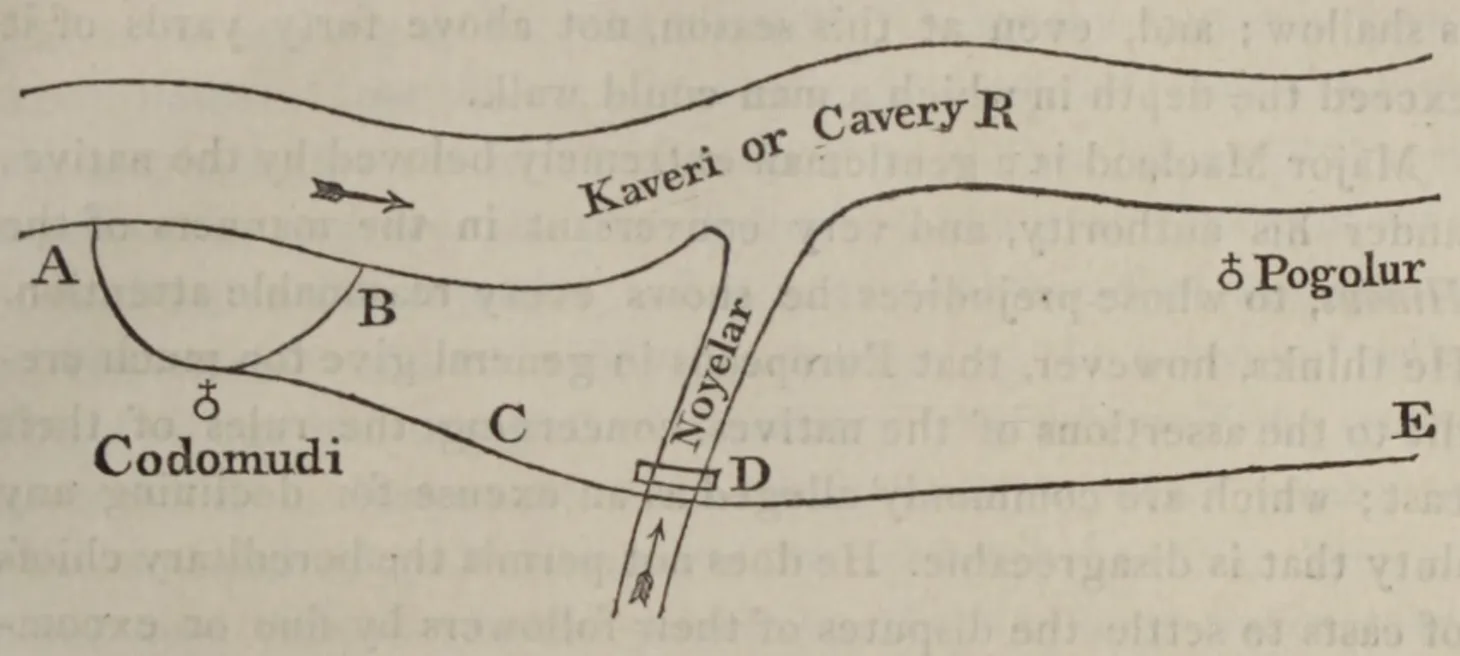
In Pogolur village, this canal supplied with water 200 Canays, or 265 acres of rice-land, besides much in some other places. The whole of the rice-lands are cultivated; and, according to the village accompts, three-fifths of the dry-field in Pogolur are also cultivated. Pogolur is a small village without shops, and contains only about one half of the houses that it did in Hyder's government. Few of the fences near it are good; but there is much good soil, especially near the Noyelar.
The whole of the rice-lands are occupied by the Bráhmans, to whom they formerly belonged in Enam, or free gift. Tippoo made them pay a moderate rent of four-tenths of the produce. Last year this was converted to money, at the rate of 22 Rupees for the ten Canays, which is about 3s. 5 3/4d. an acre. Their Enams may therefore be considered as still valuable property. The rent for this year has not yet been fixed. One half of these lands produce annually two crops of rice. Four Bráhmans hold the whole, and are called Potails. These let them out to other Bráhmans, who cultivate them by means of servants.
12th November.—I went to visit Major Macleod, the collector of the northern division of the Coimbetore province; and having passed the day with him at Pramatí, on the east side of the Cavery, I returned at night to Pogolur. The river here is about six or eight hundred yards wide, with a strong but smooth current. It is shallow; and, even at this season, not above forty yards of it exceed the depth in which a man could walk.
Major Macleod is a gentleman extremely beloved by the natives under his authority, and very conversant in the manners of the Hindus, to whose prejudices he shows every reasonable attention. He thinks, however, that Europeans in general give too much credit to the assertions of the natives concerning the rules of their cast; which are commonly alleged as an excuse for declining any duty that is disagreeable. He does not permit the hereditary chiefs of casts to settle the disputes of their followers by fine or excommunication; and has had no difficulty in making persons be again received into society, who had been made outcasts owing to the pique or caprice of leading men. In cases of complaint against any one for his having infringed the rules of cast, he orders an assembly of the most respectable people of the tribe to meet in the public office before the Tahsildar, who inquires into the business; and, after having consulted the assembly concerning their real customs, decides on the nature of the guilt, and its appropriate punishment. Any person who is troublesome, and refuses to submit to the decision of the Tahsildar and assembly, is immediately banished from the district. He has had no great difficulty in allaying the disputes between the right and left hand sides. He has caused arbitrators from both sides, men of prudence and temper, to meet in the public office, and there to come to an agreement concerning what the custom should be. A copy of this agreement is given to each of the parties, and another to the Tahsildar, who is ordered to enforce it both by fine and corporal punishment. When it has been necessary to divide any town into separate quarters for the two sides, the party insisting on any adversary's removing to his own quarter must build for him a new house. Any man may retire from his adversary's quarter, whenever he pleases.
Major Macleod says, that the custom of the country has always been understood to be, that no tenant could be turned out of his possession so long as he paid his rent. Under the former government, however, the officers of revenue removed the tenants as they pleased, and gave the best land to their favourites. This will always be the case, wherever the principal officer of a province is not very alert in redressing injustice, and very accessible to the lower classes of inhabitants; which is rarely the case among the natives of rank. Every village had a register, containing a valuation of its arable lands, which is always said to have been made by some prince, or governor, and called by his name; there having, however, been no other copy than that in the possession of the village accomptant, there was no check upon him and the head-man. These officers therefore were constantly varying, for corrupt purposes, the rates of the different fields; and, if they took care to keep the total amount the same, they might make the assessment on the fields held by themselves and friends quite light, and lay what they ought to pay on their neighbours, or on lands that were not occupied. Major Macleod thinks, therefore, that in justice no attention ought to be paid to these valuations; and accordingly, in the Saliem part of his district, has made a new valuation of the whole. He is also of opinion, that this valuation should only be continued for a specific number of years; at the end of which the government may have an option of increasing the rent, in proportion to the improvement of the country, and to the progressive diminution of the value of the precious metals. This he would do by laying a per-centage upon the whole, which seems to me liable to many objections. He admits, that in the course of a few years the present valuation must become an unequal tax; but he thinks that a new valuation at the end of every lease would be attended with great difficulty, and open a door for numerous abuses. Under the administration of a weak or corrupt collector, it no doubt would do so; but with such men as the collectors brought up under Colonel Read, I have no doubt of its being attended with the greatest benefit, both to the government and to the tenant.
Major Macleod thinks it impracticable for the government to avoid the most excessive embezzlement, in receiving rent by a division of the crops. It might be done by a petty Polygar, but not in any large government. When the Company obtained possession of the Saliem country, the rice grounds that are watered by the fine canals from the Cavery were rented by a division of the crops. At that time a great part of these grounds was waste, and the rents were low, and collected with difficulty. The changing them into a fixed revenue, to be paid in money, occasioned murmurs at first; but the whole lands are now cultivated; tenants are eager to procure them, and the revenue is greatly increased. In fact, the stimulus of rent raised with moderation, according to circumstances, is the best source of industry in every country, and hence contributes equally to improve the revenue and the condition of the tenantry.
At present, the whole public lands are held immediately of the government, and none are farmed out to collectors, or hereditary Zemindars. The former are always oppressors; and, although the latter give a security and ease in collecting the revenue, there can be little doubt, that hereditary proprietors of large landed estates are a political evil in a country governed by foreigners. The regulations introduced by Colonel Read for collecting the revenue, seem to me sufficient to secure the regular payment of more than can ever be procured from Zemindars; and I am persuaded, that any deficiencies must arise either from a neglect of duty, or from dishonesty in the collectors. I here allude to hereditary Zemindars, merely as affecting the revenue, and political state of the country: they must be considered as useful toward the improvement of agriculture.
There are some small Enams, or private properties in land, but none of great extent. Major Macleod proposes, that the lands formerly belonging to the Bráhmans should be restored to them, at a rent somewhat lower than could be procured by letting them to the best bidder; but their extent, and the rent to be paid for them, should be defined in the usual manner. The Enams, as well as the pensions granted by Hyder and Tippoo to Mussulman establishments, have been continued. The Enams belonging to the Gráma Dévatas, or village gods, have been all measured, and valued on actual inspection by Major Macleod, who has reduced their size where they seemed more than was necessary to support the expense of the usual ceremonies. The lands belonging to the temples of the great gods have been entirely reassumed; and in their stead monthly pay is given to the necessary attendants. On the whole, the quantity of Enam, or land not belonging to the public, is very small; but it is looked upon by Major Macleod as highly injurious. He allows, that it is better cultivated than the land belonging to the public; but this arises from the Enamdars letting the whole of their lands at a very low rent, and thus seducing away the tenants of the government. In the present state of the country, the Enamdars are content to get any rent, rather than allow their lands to be waste; and when the population recovers, they will raise their lands as high as the government does.
Major Macleod alleges, that the chiefs and accomptants of villages have no just right to the hereditary possession of their offices; and says, that it was always by means of bribery and corruption, that the son of a person who had been turned out for mismanagement, was permitted to enjoy his father's office. I admit the utility of Major Macleod's system; but am persuaded, that it is contrary to the customary law of the natives.
The cultivators and peasantry continue exactly in the same dress, and same houses, that they used in Tippoo's government, and have a prejudice against changes. Major Macleod thinks, that their women are beginning to wear more gold and silver in their ornaments than they formerly did. The merchants and manufacturers are evidently improving in their manner of living, are forsaking their pyramidical or conical huts, and are erecting tiled houses. To enable them to do this, government, without charging interest, advances money, which is repaid by instalments.
The manufacturers are now satisfied, that the stamp-tax will be on the whole easier to them, than the different duties on looms, houses, and transit, which it supplants; and, from the ease of collection, it will be more productive to government. The custom-houses which are at present farmed, do not in Major Macleod’s opinion impede trade, and the revenue which they produce is considerable. Fixed rates are pasted up at every custom-house; and a copy is given to the Tahsildar, who is bound to protect every trader from delay or imposition on the part of the farmer.
All disputes are settled in open court, by arbitrators mutually chosen; and these are not permitted to retire until they decide the cause, in order to leave no room for corruption and intrigue; against which, among the natives, it is necessary to guard with the utmost vigilance. This seems an admirable plan, and much superior to the commissioners in Bengal. In fact, the Tahsildar, with this assistance, seems fully adequate to manage the collection of the revenue, the police, and the judicial department; but without the active inspection of an intelligent superior, there is great room for abuse.
The present state of the coin is a serious grievance, and bears heavy on the poor. Major Macleod thinks, that a uniform coinage, with pieces forming aliquot parts of each other, would be so willingly received by the inhabitants, that, without a murmur, they would, for new money, pay into the collector’s treasury all their old coin, at such a discount as would defray the expence of the mint. The only difficulty in the whole measure would be, to procure a sufficient quantity of new coin.
The Bagait, or gardens watered by the machines called Capily and Yatam, are of great importance. This manner of cultivation enables a small extent of ground to support many people, and to pay a high rent; and it is less liable to fail, from a want of rain, than the common cultivation of the dry-fields. Major Macleod therefore advances money to every farmer who engages to dig a well. This advance is repaid in between eighteen months and two years. For the first year a garden pays only the rent which it did while cultivated as dry-field; in the second year, one half of the additional rent is laid on; and in the third year it pays the full rent.
Where the water is near the surface, Major Macleod prefers the Yatam, as the cheapest manner of irrigating a garden; but where the water is far from the surface, he prefers the Capily. He has not however ascertained, by actual experiment, the relative advantages of these two machines.
13th November.—I went ten Malabar hours’ journey to Caruru, or Caroor. A considerable proportion of the country is not cultivated, and there are very few fences. The soil is in general poor, with many projecting rocks, especially of pure white quartz, among which are found irregular masses perfectly pellucid. There is a quarry near Caroor, of a stone called Carum-gull, or the black stone. It differs from the hornblende of Mysore, being mixed with felspar; but is used for the same purposes, and is called by the same name.
Caruru is a considerable town, situated on the northern bank of the Amara-wati river, and having at a little distance from it a neat fort, containing a large temple, and a garrison of Sepoys. The town contains 1000 houses. Its merchants seem, however, to be chiefly petty dealers, nor are the weavers in the place numerous.
Lands now waste, but formerly cultivated, in this part of the country, are in the language of the Tamuls called Tirsi; by the Mussulmans they are called Banjur. The lands in cultivation are called Sagwulli. Lands not watered are called Kiet; and those which are watered are called Danwudi. In this district almost the whole of the latter are cultivated, and belong entirely to the Bráhmans. Last year one half of the dry-field was waste; the quantity that will be occupied this year is not yet ascertained. The proportion occupied by rivers, roads, rocks, woods, &c. in the opinion of the Tahsildar, does not exceed one tenth part of the whole.
In this district there are below Pogolur two canals (Corums) from the Cavery, that water much rice-land, and are full throughout the year. Several canals for watering the ground are also brought from the Amara-wati, both by means of dams (Anacuts), and by simple canals, or Corums. The supply of water in this river does not always last the whole year; so that, in some seasons, there is only one crop of rice.
In this district a great deal of sugar-cane is raised. It is cultivated nearly in the same manner as at Bala-pura, and ripens in ten months. A crop of Ratoons is sometimes taken, but it is very poor. Between every two crops of sugar-cane it is customary to take two or three crops of rice. Two thousand holes are formed in every Canay of ground, which is equal to 100 Culies of 32 Adies square. Three cuttings are put in each hole. In a good crop, a Canay of land produces of Jagory 120 Tolams of 27½ Seers of 28 Rupees. This is at the rate of only 8¾ cwt. from an acre. When cheap, the Jagory sells at half a Rupee a Tolam, or 6s. 4½d. a hundred-weight. The whole value of the produce of an acre, at this rate, is 2l. 16s.; but the Jagory often sells at double the price here stated. A Mr. Campbell has lately undertaken to make the Jagory into sugar, and has received from the Company considerable encouragement. He advances 20 Rupees for every Canay of land which the farmers plant, and is to receive one half of the Jagory. Out of this half he is to pay the rent to the government. The twenty Rupees are to be repaid him out of the farmer’s half. The farmer’s share is therefore one half of the produce, and he receives money in advance to enable him to cultivate the land.
14th November.—I went seven and a half Malabar hours’ journey to Cutamboor, a small village without a shop. The river Amara-wati is at least 400 yards wide; but its stream is very gentle, and almost always fordable. To-day it was about two feet deep. The channel is entirely of sand, and the banks are very low; so that, for watering the rice-grounds, canals (Corums) are easily taken from it.
Near the river the rice-grounds are extensive, and fully cultivated. Farther on, the soil becomes poor, and has many large projecting rocks; but they do not rise high above the surface. There are few inclosures, and much of the dry-field is waste. The country south from the river Noyel is remarkably bare of trees.
15th November.—I went seven and a half Malabar hours’ journey to Arava-courchy. The road passes through a pretty country; but the soil is poor, and there are very few inclosures. I saw very little cultivation; but the Tahsildar insists that two-thirds of the whole of his district are cultivated, and the remainder pays a small rent for grass. To judge from what I have seen of the country, I should conclude that not more than a quarter of the dry-field is cultivated.
The articles of any importance that are cultivated here on this kind of ground are about equal quantities of Sholum (Holcus sorghum), and Cambu (Holcus spicatus), with some accompanying legumes; a smaller quantity of Colu, or Horse-gram (Dolichos biflorus), and a small quantity of Shamay (Panicum miliare E. M.), and nearly the same of cotton called Nadum.
The best dry-field lets here at 40 Sultany Fanams for the Vullam of 64 Vaums square; the second at 30; the third at 20; and the fourth at 10. The best grass land at 6 Fanams, the worst at 3. These, reduced to English money and measure, are as follow:
| s. | d. | |
|---|---|---|
| One acre of arable land of the 1st quality lets for | 5 | 10 |
| 2d ditto - - - | 4 | 4½ |
| 3d ditto - - - | 2 | 11 |
| 4th ditto - - - | 1 | 5½ |
| One acre of the best pasture land lets for | 0 | 10½ |
| One ditto of the worst ditto | 0 | 5¼ |
The produce of the best land is as follows :
| Of Sholum, or Cambu, per Vullam 4 Moraus per acre, bushels | 5,63 | ||
| with the legumes. Muchu Cotay. | 0 | 10 Vullams | 0,44 |
| Tata Pyru, | 0 | 10 | 0,44 |
| Mutu Cotay, | 0 | 10 | 0,44 |
| 5 | 14 | Bushels 6,95 | |
| Colu, or Horse-gram, | 3 | 3,51 | |
| Shamay | 2 | 2,81 | |
| Cotton | 9 | Tolams | lb.42½ |
In this district there are four dams (Anacuts) on the Amara-wati; and these water the rice grounds of four villages, which are rented entirely by Bráhmans. Between Cutamboor and Arava-courchy are two torrents, that in the dry season contain no water. The most considerable, named Coduganar, is not applied, in this district at least, to the purposes of agriculture. The other, named Nunganji, supplies two villages with water : one by the intervention of a reservoir, and another by means of a canal. The Potails, or renters of these villages, are Sudras. None of the rice-ground in this district produces annually two crops.
In every village of this district the measures differ ; which seems to have been contrived purposely to enable the farmers, and lower officers of revenue, to confuse the accompts, and thus to defraud the government.
Arava-courchy signifies the seat of Arava, a person of the Baydar cast, who was the only inhabitant of the place, when a Polygar came from the north and built a town. This afterwards became subject to Madura, and then to Mysore; the Curtur or sovereign of which built near the town a neat fort, and gave it the name of Vijaya-mangalam, which by Mussulmans is called Bijamangle. About the end of Hyder's government, an English army, under the command of Colonel Laing, took the fort. His batteries were erected in the town, which was destroyed during the siege, and continued uninhabited until Mr. Hurdis took possession of the district. It now contains about 250 families, and a new market (Bazar) of well-built houses is rising up; but the people are very poor. The family of the Polygar who founded it has been long extinct. The tradition among the oldest Brahmans here does not reach back to the time when this country was subject to the kings of Vijaya-nagara; but they have all heard of these princes. The inhabitants of Arava-courchy mostly speak the Tamul language; but there are among them some Telingas, probably introduced by the Polygar; for the Veerpachry Rája and all the neighbouring Polygars are of Telinga extraction, and all originally came from the north. Tamul, it must be observed, is the proper national appellation of the Sudras of all the eastern side of the south end of the peninsula; and the Prakrit, Bhásham, or vulgar dialect of the country, is therefore called the language of the Tamuls. Both language and people are, by those of Karnáta, called Arabi and Tigular. The Bráhmans of the Tamuls are called Drávida; and the dialect spoken by their families, although considered as a vulgar tongue, has a much greater resemblance to the Sanskrit, than the common Tamul; from whence it may be reasonably concluded, that these Bráhmans have originally come from a country where the Sanskrit was more prevalent; and, in fact, they are said to have had their origin at Kalpi, a town of Hindustan proper, near the river Jumna.
In this part of the country, as well as above the Ghats, no Bráhman, except the Panchanga, or village astrologer, will condescend to act as Puróhita for the low casts. If the Panchanga's son can read, he always succeeds to the office of his father.
The Vaidika Bráhmans now act as renters for the lands which they formerly possessed in Enam. Even according to their account, they pay a lower rent than the Sudras do.
I found some of them possessed of a considerable portion of learning. These gave me a list of the fifty-six Désas, or counties of Bharata-khandá, and an explanation of what was meant by such of the Désas as they knew. I here give a copy of it, and annex another list given me by a learned Bráhman from Sri Rangam, the celebrated temple near Tritchenopoly. This man, having been a great traveller, is much better acquainted, than the others, with the local situation of the Désas.
List given by the Bráhmans of Arava-courchy.
- 1 Anga.
- 2 Vanga.
- 3 Kalinga.
- 4 Kámbója.
- 5 Kámarúpa, (Assam.)
- 6 Sauvíra.
- 7 Sauvaráshtra.
- 8 Maháráshtra, (Marattahs.)
- 9 Magadha.
- 10 Málava.
- 11 Népála.
- 12 Kérala, (Malabar.)
- 13 Chéra, (Saliem and Coimbetore.)
- 14 Chóla, (Tanjore.)
- 15 Pándava, (Madura and Tinevelly.)
- 16 Panchála, (Panjáb ?)
- 17 Bangála (Bengal.)
- 18 Gauda, or Gaura.
- 19 Malayala, probably it ought to be read Malayachala.)
- 20 Singhala.
- 21 Dravida, or Dravíra, (Arcot, Madras.)
- 22 Karnáta, (Mysore, Sira, Colar.)
- 23 Láta.
- 24 Marata, (This probably ought to have been Marahata.)
- 25 Nata.
- 26 Pulinda.
- 27 Andhray, (Nellore, and the country north from Madras.)
- 28 Húna, Europe, (Huns ?)
- 29 Dasárnada.
- 30 Bojay, (Vijaya nagara.)
- 31 Kuru, (Delhi.)
- 32 Gandhára,
- 33 Vidarbha.
- 34 Vidéha.
- 35 Banleka.
- 36 Barbara
- 37 Kékaya.
- 38 Kósala, (Oude.)
- 39 Kanta.
- 40 Kiráta.
- 41 Gurjara, (Guzerat.)
- 42 Hindu.
- 43 Tienkana.
- 44 Kankana.
- 45 Vankana.
- 46 Matsya.
- 47 Mathura.
- 48 Sálwa.
- 49 Chédi.
- 50 Sindhu, (Irán or Persia.)
- 51 Avanti, (Banares, or Kási.)
- 52 Mudday.
- 53 Yavana, (Mecca).
- 54 Chína, (China.)
- 55 Karushay.
- 56 Trikárta, (a part of Arabia.)
List of the 56 Désas, according to Náráyana Shastri of Sri Rangam.
- 1 Anga.
- 2 Vanga (country east from the Brahma-putra river.)
- 3 Kalinda, (Vijaya-nagara.)
- 4 Kalinga, (Muttura Binderabund.)
- 5 Kambója, (Thibet or Bootan.)
- 6 Kásmíra.
- 7 Súra, (Surat.)
- 8 Gurjara, (Guzerat.)
- 9 Barbara.
- 10 Murada.
- 11 Gandhára.
- 12 Sauvíra.
- 13 Sauvaráshtra.
- 14 Maharáshtra, (Marattahs.)
- 15 Mathura, (a place north from Oude.)
- 16 Magadha, (Gya, Patna, &c.)
- 17 Andhra (Telingána.)
- 18 Nisháda.
- 19 Sindhu.
- 20 Dasárnada.
- 21 Málava, (capital Barodra.)
- 22 Népála.
- 23 Panchála, Delhi, (Panjáb.)
- 24 Bangála, (from Boidinat to the Brahma-putra.
- 25 Malayáchala, (a hilly country producing sandal.)
- 26 Chóla, (Tanjore.)
- 27 Kérala, (Malabar.)
- 28 Singárá, (perhaps Singhala.)
- 29 Gauda, (Lakshmanapuram,) vulgo Lucknow.)
- 30 Gotáki.
- 31 Karnátaka, (Mysore, &c.)
- 32 Karahátaka.
- 33 Marahataka.
- 34 Panáta.
- 35 Pandava.
- 36 Pulinda.
- 37 Kanta.
- 38 Trika, (perhaps Trikarta?.)
- 39 Trilavanti.
- 40 Avanti, (Ujina, or Ougein)
- 41 Vidéha, (Janucapuram, vulgo Janucpour, north from Bengal.)
- 42 Vidarbha, (Dinagepore, Rungpore.)
- 43 Kékaya.
- 44 Kósala, (Oude).
- 45 Kankana.
- 46 Tienkana, (Coorg.)
- 47 Hurnay.
- 48 Matsya, (Benares.)
- 49 Bachya.
- 50 Makala.
- 51 Páká.
- 52 Vahlika, (Vahli-konda-puram, or Kishkinda, south from Arcot.)
- 53 Yavana, Mussulmans.
- 54 Lavakya, (Dwáraká).
- 55 Drivéda, (Raméswara.)
- 56 Drávidà, (Arcot.)
These lists, as usual with all information received from Bráhmans, differ most essentially. It is clear, however, that Bharata-khanda contains all the habitable world, as far as was known to the authors of the books esteemed sacred among the Hindus, and is by no means applied to signify the country which we call Hindustan. Indeed, I have never been able to discover any name that the Bráhmans have for the country over which their doctrine has extended. They always describe it by a circumlocution, and say all the country between Himavat-giri and Raméswara. The Bráhmans speak of nine Khandas in this Jambu Dwipa, or world inhabited by men; but all that is said concerning them, Bharata-khanda excepted, seems to be the silly extravagance of a disordered imagination.
Bharata-khanda is surrounded by a sea of salt water, and its most celebrated river is the Bhágírathi, called by way of eminence the Gangá, or river. It is only that part of the river which lies in a line from Gangóttara to Ságara that is holy; and that is named the Gangá, or Bhágírathi. The Hoogley river of European geographers, therefore, is considered as the true Ganges; and the great branch that runs east to join the Mégna, or Bráhma-putra, is by the Hindus called Padma (vulgo Pada) or Padmawatí, and is not by them esteemed equally sacred. Although the water of the whole river from Gangóttara to Ságara is holy, yet there are five Tírthas, or places more eminently sacred than the rest; and to these, of course, all pilgrims from a distance resort to perform their ablutions, and to take up the water that is used in their ceremonies. These Tírthas are, Gangóttara; Haridwára, or Maya; Prayága (called by the Mussulmans Elahabad), Uttara Janagiri, a little below Monghir; and Ságar, at the mouth of what we call the Hoogley river. Náráyana Shastri, who has been at all these places, says, that at Gângóttara three small streams fall down from impassable snowy precipices, and unite into a small bason below, which is considered by the Hindus as the source of the Ganges, over which at that place a man can step. It is situated about twenty days journey north and west from Haridwára (Hurdwar); and the Bráhman's road lay on the west side of the river, until he came near Gangóttara. He observed no considerable stream joining the Bhágírathi from the east, until he came to the Alikanandra. Prayága, however, is the most celebrated Tírtha, or holy place by water; as Kási is the most sacred Kshétra, or place of worship by land.
In the district of Arava-courchy are some families of Mussulman farmers. They were formerly Candashara, or persons holding lands free of rent on condition of serving as private soldiers. After the invasion by Colonel Laing, Tippoo abolished this kind of militia; and the persons who composed it continue to occupy the lands, but pay rent like other farmers.
16th November.—I went ten Malabar hours’ journey to Mulinuru. The country is better enclosed, and less rocky, than that through which I came yesterday; but it is equally uncultivated. By the way I passed an iron forge, of the same structure with that seen in Major Macleod’s district, and, like it, calculated to smelt black sand. At Arava-courchy I had been informed, that at Mulinuru I should find a market; but on coming up I found, that the whole place had been destroyed by an invading army, probably that under Colonel Fullarton, and that it has never since been rebuilt. All that remains is a small temple, which has got an establishment of Bráhmans, dancing women, and musicians. The neighbouring country is adorned with many plantations of the Borassus. The calcareous Tufa abounds at least as much on the south side of the Noyel as it does toward the north, and in some places covers the whole surface of the ground in continued masses. West from Mulinuru is a field of this kind, where the calcareous masses assume a botryoidal form.
For some days the weather has become comparatively pleasant. It is very clear, and, although hot in the day and evening, is then by no means oppressive; while the mornings are delightful.
17th November.—I went a long stage to Daraporam. Near this are two fine canals, that water much rice-land in a good state of cultivation. The soil of the dry-field is poor, and but little of it is cultivated.
At Daraporam, or more properly Dharma-puram, is a large mud fort, the commandant of which, according to the report of the natives, agreed to surrender the place to Colonel Fullarton. As he wished, however, to make an appearance of resistance, some pioneers were sent into the ditch to undermine the wall; which they did very coolly, while over their heads the garrison kept up a tremendous fire. When the passage was open, the firing ceased, and our troops walked in quietly, without any injury having been done on either side. Previous to this the town was very large; but it is now only beginning to recover from a state of ruin. Mr. Hurdis having made it the head office (Cutchery) of his district, it will soon increase. He has laid out the plan of a new town, in which all the streets will be straight and wide; and in this a good many new houses have been built. The inland situation of the place is, however, a great disadvantage; and in favourable seasons the cultivators cannot find a market for their grain.
18th to the 20th November.—I remained with Mr. Hurdis, a most intelligent and active young gentleman. He manages the disputes about cast, and those arising between the right and left hand sides, in the same manner as is done by Major Macleod. The nature, indeed, of the whole management of both their districts is nearly the same; and in place of a jealousy between them, as belonging to two different services, they live in the greatest cordiality, and the only struggle between them is an honourable emulation in the performance of their duty.
Both gentlemen make it a rule, that their Umlahs, or native officers, should not leave the court, until every cause that comes before it is decided.
Mr. Hurdis thinks that the present rents are greatly too high; and, no doubt, the peasantry here, as well as in almost every part of India, are miserably poor. I am inclined to think, however, that other causes contribute more to this than the greatness of the rents. Mr. Hurdis says, that all the land which is not cultivated is by no means unlet (Tirsi); but owing to the want of rain, and of stock, the farmers are not able to cultivate the whole of what they rent. This, in my opinion, shows, that the fields are by no means over-assessed; and that the farmers, if they would not grasp at more than they have stock to manage, might be in a much more comfortable situation. One great cause indeed of the poverty of the farmers, and consequent poverty of crops, in many parts of India, is the custom of forcing land upon people who have no means of cultivating it. Thus all the lands are apparently occupied; but it is in a manner that is worse than if one half of them were entirely waste. I believe every intelligent farmer in England will say, that one acre fully improved will give more profit than two that are half cultivated.
The Polygar government Mr. Hurdis considers as highly oppressive to the peasantry, who are always squeezed by irregular means, although nominally they pay a low rent. The Polygars, he says, were originally men who had the management of certain tracts of land, with all manner of jurisdiction over the inhabitants. Each was to keep up a certain number of armed men ready for the defence of the country ; and they were to account to the king for the whole revenue, deducting from the proceeds a certain sum for their own maintenance and that of their soldiers. Mr. Hurdis considers the headmen and accomptants of villages as having an hereditary right to their offices.
The Vir'-Ráya Fanam is here the most common currency among the people, who reduce all other coins to its standard. In the following table is given the number of Vir'-Ráya Fanams for which each coin passes, with the value of these at the Tower mint price.
| V. R. F. | s. | d. | |
|---|---|---|---|
| Sultany, Bahadury, and Ikeri Varahun, Huns, or Pagodas | 16 1/4 + 1/32 = | 8 | 1 |
| Star-Pagoda | 14 3/4 + 1/64 = | 7 | 4 |
| Porto-Novo, or Feringy ditto | 12 1/2 = | 6 | 2 1/2 |
| Sultany Fanam | 1 25/100 = | 0 | 7 1/2 |
| Silver Coins. | |||
| Pondichery, or Sultany Rupee | 4 1/4 + 3/16 + 1/64 = | 2 | 2 1/2 |
| Company's Madras Rupee | 4 3/16 + 1/32 = | 2 | 1 |
These are calculated to the nearest farthing : all sums of money in Mr. Hurdis's district I value at this rate of exchange ; using, however, the exact fraction, in place of the foregoing approximation.
The Weights in use here are,
24 Star Pagodas = 1 Polam = 0,1782/10000 lb. 100 Polams = 1 Tolam = 17,82/100 lb.
The measure of grain used by the farmers, and that by which it is sold in the market, are different.
The measure used by the farmers for dry-grains is thus formed : 72 Company's Rupees weight of grain fill a Puddy.
4 Puddies = 1 Bulla or Vullam = cubical inches 246,5/10 16 Bullas = 1 Morau, Siliga, or Candy - 3958,8 6 Moraus = 1 Podi - - - 23697,7
Also for Rice.
40 Bullas = 1 Siliga or Candy - - inches 9874,2 30 Siligas = 1 Mau - - - - 29622,1
The Market (Bazar) Measures are, For Rice.
84 Sultany Rupees weight of grain fill a Puddy. 3 Puddies = 1 Bulla, containing cubical inches - 216. 40 Bullas = 1 Siliga or Candy - - - 8640. 30 Siligas = 1 Mau - - - - 259200.
Also for Dry-grains.
16 Bullas = 1 Morau, Siliga, or Candy - - 3456.
The Measure for Rice-ground.
24 feet square = 1 Culy. 220 Culies = 1 Mau, which therefore contains 2,8965/10000 acres.
The rice lands in this neighbourhood are let to persons of all casts. That of the first quality pays 160 Fanams a year for the Mau; the second quality pays 140 Sultany Fanams; the third, 136 Fanams; and the fourth 118 Fanams. These, reduced to English money and measure, give 1l. 15s. 9½d.; 1l. 9s. 10½d.; 1l. 9s.; and 1l. 5s. 2d. an acre. If the rice land be cultivated for Betel-leaf (Piper Betle), it pays 360 Fanams, or at the rate of 3l. 16s. 9d. an acre. Land cultivated with sugar-cane pays no higher rent than that cultivated with rice; yet very little sugar is made here, while much is raised in other districts, where it is higher assessed. The accompanying Table, explaining the cultivation of wet-grains, has been compiled from the reports of the farmers and merchants assembled for the purpose. One crop only of the three first kinds of rice can be taken in the year. If the Caru Curivay be sown, a crop of Kevir (Cynosurus corocanus) follows. This is much used, the produce of the two crops, on the whole, being of greater value. It is evident, that the produce here is much under-rated; as the whole value of the crops, after deducting the seed, is little more than the rent paid to government. It must be observed, that the land here is much lower rented than at Nala Ráyana Pallyam; yet the farmers here do not acknowledge a greater produce than what will pay their low rent, while those of Nala Ráyana Pallyam acknowledge a produce, that, after paying the heavy tax imposed on them, leaves a considerable gain. Could entire reliance be placed on the accuracy of these statements, this would show in a very decisive manner the advantages of high rents; but it must be evident, that the data upon which a traveller can found his calculations are liable to innumerable objections; nor do I think, that less than a residence of ten years, with actual experiments on every crop, could enable a person to speak decidedly on the rate of productiveness which the land of any district possesses.
| Kinds. | Crop for which each is fitted. | Months each requires to ripen. | Quality. | Average value of Bazar Siliga. | Average value of farm Siliga. | Average Value of Bushel. | Seer per Mau land. | Seed per acre. | Produce. | ||||||
|---|---|---|---|---|---|---|---|---|---|---|---|---|---|---|---|
| Of a Mau land. | Of an Acre. | ||||||||||||||
| Siligas. | Value, deduct-ing seed. | Bushels. | Value, deducting seed. | ||||||||||||
| V. R. F. | V. R. F. | s. | d. | Bullas | Bush. | V. R. F. | £. | s. | d. | ||||||
| Sambau Rice - - | Nadavu, or transplanted | 6 | Small | 8½ | 9,714 | 0 | 11¾ | 40 | 1,579 | 30 | 281¾ | 47,35 | 2 | 8 | 1 |
| Alaky Manawal do. | ditto | 8 | Coarse | 7 | 8 | 0 | 8 | 40 | 1,579 | 30 | 232 | 47,35 | 1 | 19 | 7 |
| Sri Ravabanum do. | ditto | 6 | Small | 8½ | 9,714 | 0 | 11 | 40 | 1,579 | 30 | 281¾ | 47,35 | 2 | 8 | 1 |
| Caru Curivay ditto | CaiVarapu, or sprouted seed | 3 | Coarse | 7 | 8 | 0 | 8¾ | 80 | 3,157 | 25 | 184 | 39,46 | 1 | 11 | 4¾ |
| Kevir, or Ragy | 7¼ | 8,286 | 0 | 9½ | 3 | 0,118 | 15 | 123½ | 23½ | 1 | 1 | 1¼ | |||
I also received the following account of the Kiet, or dry-field cultivation of Darapuram.
The best fields let at 60 Canter'-Ráya Fanams a Vullam of 64 Vaums square; the worst lands at 4 Fanams. Grass land lets from 10 to 2 Fanams. These rents, when reduced to English money and measure, are as follow: arable land from 8s. 8¼d. to 7d. an acre. Grass land from 1s. 5¼d. to 3½d. an acre.
The quantity of cotton raised is considerable, and the kind most commonly cultivated is the Nadum Pirati, which requires a red soil. The ground is ploughed four times; and between the 10th of April and the 10th of May the seed is sown. No other grain is mixed with the cotton. For three seasons it produces a crop once a year, in April and May; after which a crop of grain is taken, before cotton is again sown on the same field. In a good year a Vullam land produces 5 Tolams, or an acre 20⁸⁄₁₀ lb. It sells at 2½ Vir'-Ráya Fanams a Tolam, when containing the seed; or at ⁸³⁵⁷⁄₁₀₀₀₀ of a penny a pound; so that the value of the produce of an acre is 1s. 5¼d.
The Upum cotton requires a black soil. It ripens in six months, and a Vullam land produces seven Tolams of raw cotton.
| Kinds. | Seed. | Produce. | ||
|---|---|---|---|---|
| Per Vullam land. | Per Acre. | Per Vullam land. | Per Acre. | |
| Vullams. | Dec. of Bush. | Podis. | Bushels. | |
| Sholum (Holcus sorghum) | 8 | 0,2144 | 4 | 10¼ |
| Avaray (Dolichos Lablab) or Tovary (Cytisus Cajan) | 1½ | 0,0402 | 1 | 2½ |
| Total | 9½ | 0,2546 | 5 | 12¾ |
| Cambu (Holcus spicatus) | 8 | 0,2144 | 4 | 10¼ |
| Avaray or Tovary | 1½ | 0,0402 | 1 | 2½ |
| Total | 9½ | 0,2546 | 5 | 12¾ |
| Colu (Dolichos biflorus) | 8 | 0,2144 | 1½ | 3¾ |
| Shamay (Panicum miliare) | 10 | 0,2681 | 2 | 5¼ |
Garden-ground rents here at 80, 60, 50, and 40 Canter'-Ráya Fanams a Vullam, or at 11s. 7d., 8s. 8¼d., 7s. 3d., and 5s. 9½d. an acre, according to its quality. When the water is far below the surface, it is raised by the Capily, one of which can supply a Vullam of land, or 4¼ acres. If the depth of the water be less, it is raised by the Yatam, on which four men walk along the balance. A Vullam of land requires from one to two Yatams, according to the distance the water has to be raised ; but two Yatams, wrought by ten men, are here reckoned cheaper than one Capily, wrought by one man and two oxen : the men, however, do other work in the garden.
The principal article cultivated is tobacco ; and a crop of grain is always procured in the course of the year from the same ground. The produce of a Vullam land of a good quality is 700 bundles of tobacco, weighing on an average 8 Polams, and worth 25 Vir'-Ráya Fanams a hundred. The crop of Sholum is estimated at 6 Podis, or at 15½ bushels an acre. The crop of Cambu from tobacco land is estimated at the same amount with that of Sholum ; that of Ragy is estimated at 7 Podis, or 18 bushels an acre.
The farmers who are in easy circumstances keep their grain until they can retail it in the weekly markets. Poor men, in order to discharge their rents, are under the necessity of selling it to dealers, and in general lose 20 per cent.
The servants employed here in agriculture are hired in the beginning of the year for twelve months. They may change their service when this term expires, if they be not in their master’s debt ; but, as he generally advances money for their marriages, and other ceremonies, they are seldom at liberty to go away. They get twenty Bullas of rough rice (Paddy) a month, with four Fanams and one Siliga of rough rice yearly ; and their master pays their house rent. The whole is about 31 bushels of rough rice, of which one half is husk, with two shillings in money, besides the house rent, which will not exceed one or two shillings a year. These servants generally have one wife, who at seed-time and harvest works for the master for daily wages. A woman’s daily wages are four Puddies of grain, worth about nine-tenths of a penny. A man gets 6 Puddies of grain. A servant with these wages can once or twice a month procure a little animal food. Milk is too expensive. His common diet consists of some boiled grain, with a little salt and capsicum, and perhaps some pickles. His drink is the water in which the grain was boiled. He has very little clothing, and that little is extremely dirty; his house is a hovel, and he is commonly over-run with vermin and cutaneous disorders. The women, although not clean, are fully-clothed.
Throughout the Coimbatore province there are earths impregnated with muriatic salts, and others with nitrates; both of which have occasionally been made into culinary salt, and nitre.
In Tippoo's reign the makers of saltpetre received advances from government, and prepared the saltpetre from the earth. It was twice boiled, and was delivered to the government at 1 Vir'-Ráya Fanam for the Bulla containing 4 Puddies of 72 Rupees weight each, or at about 7s. 6¾d. a hundred-weight. This earth seems to contain the nitre ready formed, as no potash was added to it by the makers. It is only to be found in the hot season; so that I had no opportunity of examining its contents. I saw the two places in this neighbourhood where it is collected. The soil in both is very sandy and rocky, and the ways passing over them are much frequented by men and cattle. From the 10th of January until the 10th of February the saline earth is scraped from the surface, and is lixiviated, boiled, and crystallized twice.
21st November.—I went about eleven miles to Puna-puram. By the way I saw very little cultivation, but the whole country has formerly been ploughed. From a want of trees and hedges it is very bare, and the soil is rather poor. Immense fields of lime-stone are every where to be seen; and the strata of it at Puna-puram are much thicker than I have observed any where else. Many wells having been dug through these strata, to the depth of twelve and fifteen feet, give the traveller a good view of them. The calcarious matter seems to have been gradually deposited in horizontal strata, or layers. It involves small angular masses of quartz, and other stones, which, I suppose, must have arisen from its having flowed over the surface of the original strata while it was in a soft state, and collected fragments of these as it rolled along. On the surface of the layers, or in cavities, some of it assumes a botryoidal form, while other parts of these cavities have a smooth undulating or conchoidal surface. The original strata are all aggregate rocks. Puna-puram is a small fort, of which the hereditary chief is a young boy. He was brought to me by his grandmother, and male relations, who are the chief farmers in the place. This season they have had scarcely any rain, to which some of the waste appearance of the country must be attributed ; but they say, that they have suffered much from the neighbouring Polygars, especially during a commotion that took place about three years ago.
22d November.—I went seven and a half Malabar hours’ journey to Mangalam, an open village belonging to a Polygar. The country is not so stony as that through which I passed yesterday ; but it is equally uncultivated. Mangalam is now reduced to forty houses. It formerly contained one hundred. This diminution is attributed to the oppression of Tippoo, and to want of rain ; for many of the cultivators have removed to places blessed with a more favourable climate. The Polygar is one of the most stupid looking men that I have ever seen, and goes about with very little attendance, or state.
Wherever wells have been dug into the lime-stone, water has been found at no great distance from the surface ; yet here there is little or no garden cultivation. Much of the well water has a saline taste ; and in almost every part of the neighbourhood culinary salt may be procured in the dry season by scraping the surface of the earth, and by lixiviation.
23d November.—I went seven Malabar hours’ journey to Pujar-petta, an open village with a few shops. Like almost all those in this neighbourhood, it is surrounded and intersected by many hedges, which serve as a defence against the thieves and robbers who come to drive away the cattle; and these miscreants, owing to the vicinity of the Polygars, have always been numerous. The village belongs immediately to the government, but is surrounded by the lands of Polygars.
This day's road led through a country which is in nearly a similar state with all that I have seen west from Darapuram; but the soil in some places is much better, and really very good. The hills of Coimbetore, and those that bound the Ani-malaya pass on the south, are both visible from Pujar-petta.
24th November.—I went six Malabar hours' journey to Palachy. As I approached it, the country became gradually more cultivated, and better inclosed; and its environs look well, being adorned with groves of coco-nut palms; but there are no other trees near it. The town contains 300 poor houses and a small temple, and derives its name from the second wife of a Vaylalar, who came to the place when the country was entirely covered with woods, and began to clear it by the Cotu-Cadu cultivation. The town is rising fast into importance, having been made the residence of a Tahsildar, and being placed in the line of the new road that has been opened to Pali-ghat. Near it is a small fort.
In this vicinity was lately dug up a pot, containing a great many Roman silver coins, of which Mr. Hurdis was so kind as to give me six. They were of two kinds, but all of the same value, each weighing 56 grains. One of the kinds is of Augustus. The legend round the head is CAESAR AVCVSTVS DIVI F PATER PATRIAE; that is, Cæsar Augustus Divi Filius Pater Patriæ. Above the reverse, representing two persons standing with two bucklers and spears placed between them, the legend is AVCVSTI F COS DESIC PRINC IVVENT; that is, Augusti Filio Consule designato, principe juventutis. Under the figures is written CAESARIA, or Cæsaria, at some city of which name it has been struck. The other coin is of the same weight, and belongs to Tiberius. The legend round the head is TI CAESAR DIVI ΛVC F ΛVCVSTVS; Tiberius Cæsar Divi Augusti Filius Augustus. On the reverse, representing a person seated, and holding a spear in one hand and a branch in the other, is the following legend: PONTIF MAXIM, or Pontifex Maximus.
The Tahsildar showed me a very regular account of the whole lands in his district, according to the mensuration and valuation made by Chica Déva Ráya of Mysore. The proportion of land not possibly arable is stated to be very small; and almost the whole face of the country, except in the immediate vicinity of Palachy, appears to the traveller to be waste; yet the Tahsildar's accompts state the whole arable lands to be occupied.
The manner of letting the lands here is very singular. The worst ground, being left for pasture as a common, pays no rent, and must be much more extensive than the Tahsildar states; as is clearly proveable by the immense extent of uncultivated land that is every where to be seen. The remainder of the ground belonging to each village, and which is reckoned all that is arable, has an average valuation fixed upon it. In some villages this is 20 Fanams a Bulla for the whole arable land, good or bad; in others, it is so high as 50 Fanams a Bulla. If the fields rated as Bullas contained no more than the proper measure, the first rent would be 2s. 10¾d. an acre, the latter 7s. 3d.; the average value of the whole lands of a village having been fixed, the fields are divided into three qualities, according to the goodness of their soil; and they are then divided among the cultivators by an assembly of these people; in which, in order to prevent partialities, the officers of revenue have no right to interfere. The farmers complain, that the land is forced on them, and that they are compelled to rent more than they have stock to enable them to cultivate. A man who rents 17 Bullas of land is able only to plough 9 of them; whereas, if he had full stock, he would plough between 11 and 12, leaving one third part in fallow. The rents, however, have been lowered; in some villages one-fifth, in others one-third, in order to compensate the loss which the farmer suffers by this manner of renting lands, where there is not a sufficient stock to cultivate the whole. This sort of tenure seems to be a great evil, and, in order to keep down the rent, will occasion constant clamours of poverty among the farmers.
One plough is reckoned here adequate to cultivate 2 Bullas of land, or 8,569/1000 acres. A few farmers possess 10 ploughs, but by far the greater number have only one.
There are here two kinds of servants employed by the farmers to cultivate the lands: they are called Pudial, and Pungal.
The Pudials receive yearly 3 Podis of grain (29 bushels), worth 48 Vir'-Ráya Fanams, with 10 Fanams in money, and a house. The 58 Fanams are equal to 1 l. 8 s. 9 1/2d. The wife and children of the Pudial are paid for whatever work they perform. He is hired by the year; but, if he contracts a debt with his master, he cannot quit the service till that be discharged.
The Pungals go to a rich farmer, and for a share of the crop undertake to cultivate his lands. He advances the cattle, implements, seed, and money or grain, that is necessary for the subsistence of the Pungals. He also gives each family a house. He takes no share in the labour, which is all performed by the Pungals and their wives and children; but he pays the rent out of his share on the division of the crop, which takes place when that is ripe. If a farmer employs six Pungals to cultivate his land, the produce is divided into 15 portions, which are distributed as follow:
- 6 to the farmer, or Punnadi, for rent, seed, &c.
- 1 to ditto for profit.
- 2 to ditto for interest of money advanced.
- 6 to the Pungals, or labourers.
15 portions.
Out of their portions the Pungals must repay the farmer the money which he has advanced for their subsistence. The farmers prefer employing Pudials, when they can be procured; but among the labourers the condition of the Pungals is considered as preferable to that of the Pudials. Six-fifteenths of the whole produce is indeed a very large allowance for the manual labour bestowed on any land; and, as the farmer can afford to give it, the rents must be moderate.
The Grain Measure in use here is as follows :
63 Rupees weight of 9 grains, mixed in equal quantities, fill a Puddy, which measures 54 cubical inches.
4 Puddies = 1 Bulla, or Vullam = 0,1005/10000 bushel. 96 Bullas = 1 Podi - = 9,644/10000 30 Bullas = 1 Candy, or Siliga = 3,014/10000 The Weights for Cotton are :
8 Rupees = 1 Pull = 0,19995/1000000 lb. 100 Pulls = 1 Tolam = 19,995/10000 The coins commonly current here are Vir’-Ráya Fanams, and Feringy, or Porto-novo Pagodas, equal in value to ten Vir’-Ráya Fanams. The revenue is estimated in Canter’-Ráya Fanams at the rate of 100 for 125 Vir’-Ráya Fanams.
The land measure is the same as at Coimbetore, the Bulla or Vullam land being a square of 64 Vaums or fathoms each way, and is therefore equal to 4,284/1000 acres; but, by the actual measurement of a field, I found that it contained 5,88/100 acres, or that the Vullams, by which the accompts are kept, are larger than they ought to be, as 1372 is to 1000. Not knowing, however, how far the other fields may exceed the true measurement, I have in all my calculations considered that as the standard; but I would warn the reader to think it probable, that the size of the computed Bullas is at least equal in general to that of the one which I measured.
In the accompanying TABLE will be seen many particulars relative to the cultivation of the dry-grains, which is here almost the sole occupation of the farmers. The produce is taken on the average of a good year, as allowed by the farmers in presence of the Tahsildar.
| Kinds. | Average Value. | Seed. | Produce. | |||||
|---|---|---|---|---|---|---|---|---|
| For One Vullam land. | For One Acre. | Of One Vullam land. | Of One Acre. | |||||
| Quantity. | Value. | Quantity. | Value. | |||||
| V.R.F. | s. d. | Pence. | s. d. | |||||
| Sholum (Holcus sorghum) | Per Podi 16 | Per Bushel 0 9¾ | Bullas 12 | Bushels 0,2814 | 2¾ | Podis - 8 | Bushels 18 | 14 10 |
| Shamay (Panicum miliare E. M.) | ditto - 17½ | ditto - 0 10¾ | ditto 32 | ditto 0,7504 | 8 1/10 | ditto - 8 | ditto - 18 | 16 2¾ |
| Bajera, or Cambu (Holcus spicatus) | ditto - 16 | ditto - 0 9¾ | ditto 15 | ditto 0,3517 | 3½ | ditto - 10 | ditto - 22½ | 18 6½ |
| Tovary (Cytisus Cajan) | ditto - 24 | ditto - 1 2¾ | ditto 2 | ditto 0,0469 | 7/10 | ditto - 1 | ditto - 2½ | 2 9¼ |
| Muchu Cotay (Dolichos Lablab) | ditto - 16 | ditto - 0 9¾ | ditto ½ | ditto 0,0117 | 11/100 | ditto - ¼ | ditto - 56/100 | 0 5½ |
| Mutu Cotay (Ricinus palma Christi) | ditto - 24 | ditto - 1 2¾ | ditto ½ | ditto 0,0117 | 17/100 | ditto - 5/16 | ditto - ¾ | 0 11 |
| Tata Pyra (Dolichos catsjang) | ditto - 16 | ditto - 0 9¾ | ditto ½ | ditto 0,0117 | 11/100 | ditto - 3/16 | ditto - 45/100 | 0 4½ |
| Colu (Dolichos biflorus) | ditto - 7 | ditto - 0 4¼ | ditto 12 | ditto 0,2814 | 1¼ | ditto - 7 | ditto - 15¾ | 5 8 |
| Wulindu (Phaseolus minimoo Roxb:) | ditto - 24 | ditto - 1 2¾ | ditto 12 | ditto 0,2814 | 4¼ | ditto - 4 | ditto - 9 | 11 1½ |
| Pacha Pyra (Phaseolus mungo) | ditto - 32 | ditto - 1 7¾ | ditto 15 | ditto 0,3517 | 7 | ditto - 4 | ditto - 9 | 14 10 |
| Ellu (Sesamum) | ditto - 32 | ditto - 1 7¾ | ditto 3 | ditto 0,0703 | 1 4/10 | ditto - 5 | ditto - 11¼ | 18 6 |
| Carlay (Cicer arietinum) | ditto - 38 4/10 | ditto - 1 11¾ | ditto 20 | ditto 0,469 | 18 18/100 | ditto - 3½ | ditto - 7½ | 14 5½ |
| Cotton Upum | Per Tolam 2 | Per lb. - 0 0 6/10 | ditto 2 | lbs. - 9,332 | Tolams 20 | lbs. - 93⅓ | 4 7½ | |
| Ditto Nadum | ditto - 2 | ditto - 0 0 6/10 | ditto 2 | ditto 9,332 | ditto - 20 | ditto - 93⅓ | 4 7¼ | |
Except 240 Bullas, or 1029 acres, given in Enám, the whole arable lands in the subdivision immediately depending on Palachy are rented, and pay at the rate of 40 Fanams a Vullam, or 5s. 9½d. an acre. It formerly let for 50 Fanams a Vullam ; but the rents have been lowered one-fifth part, on account of the farmers' poverty. Almost the whole is fit for the cultivation of Cambu and Sholum, which renders it so valuable. Twenty-six Bullas only are cultivated with the machine called Capily, and that in a very slovenly manner. This pays no additional rent ; a strong proof of the advantage of rent as a stimulus to industry ; for in most places of this province, where a great additional rent is demanded, this kind of cultivation is carried on with great spirit and care.
The following statements will show the common manner of cropping the ground, which is done here with more judgment than is usual in India.
| Value per acre. | |||
|---|---|---|---|
| I. First year Cambu, with accompanying grains | £. 1 | 3 | 0 |
| Second year 1st crop Sholum — 14s. 10d. | |||
| 2d crop Colu — 5s. 8d. | 1 | 0 | 6 |
| Third year grass manured by folding cattle on it | 0 | 1 | 6 |
| Total produce of three years | 2 | 5 | 0 |
| Deduct Rent — 17s. 4½d. | |||
| Seed — 0s. 7½d. | 0 | 18 | 0 |
| Remainder for stock and labour | £ 1 | 7 | 0 |
| II. First year Cambu, with its accompanying grains | £ 1 | 3 | 0 |
| Second year 1st crop Shamay — 16s. 4¾d. | |||
| 2d crop Colu — 5s. 8d. | 1 | 2 | 0¾ |
| Third year grass | 0 | 1 | 6 |
| Total produce of three years | 2 | 6 | 6¾ |
| Deduct Rent — 17s. 4½d. | |||
| Seed — 1s. 0¾d. | 0 | 18 | 1½ |
| Remainder for stock and labour | £ 1 | 8 | 1½ |
In place of Shamay, may be sown Wulindu, or Pacha-Pyŕa, or Ellu.
| III. First year Cambu, with the accompanying grains | £1 | 3 | 0 |
| Second ditto Sholum and Nadum cotton | 0 | 19 | 5½ |
| Third ditto cotton remains giving ¾ of a crop | 0 | 3 | 5½ |
| Fourth ditto grass | 0 | 1 | 6 |
| Total produce of four years | 2 | 7 | 5 |
| Deduct Rent | 19s. 2d. | ||
| Seed | 0s. 6½d. | ||
| 0 | 19 | 8½ | |
| Remainder for stock and labour | £1 | 7 | 8½ |
Some farmers in the third year sow Sholum between the drills of cotton. The crop is very poor.
The manner of cultivating these crops is as follows: the field, while in grass, is manured by folding on it as many cattle as can be procured. Then between the 26th of May and the 27th of July it is ploughed five times. During this season there are slight showers of rain; but in a few days afterwards the heavy rains generally commence. When this happens, sow the Cambu broad-cast, and cover it with the plough. On the second or third day furrows are drawn through the field, at the distance from each other of six cubits. Into these a man, who follows the plough, drops the seeds of Tovary, Muchu-cotay, Mutu-cotay, and of Tata-Pyra (see the annexed Table), while another plough comes behind, and covers them with a second furrow. These accompanying seeds are never intermixed; one being sown in one part of the field, and another in another part: but in every field a proportion of each is sown. The Tata-Pyra is sometimes mixed with the Cambu seed, and sown broad-cast. At the end of one month, the young Cambu is about 4 or 5 inches high, and the field is then ploughed. In five months it ripens, and two months afterwards the accompanying grains come to maturity. The ears of the Cambu, when ripe, are cut off, and immediately trodden out. The grain, after being separated from the spikes, is dried in the sun two or three days, and put up in store-houses, so as to be secured from moisture and the circulation of air. After having been kept one year, its value is much diminished, and at the end of two years it becomes totally useless.
The Cambu straw is only used for thatch, and is allowed to stand on the field until between the 12th of March and the 10th of April, when it is pulled up by the roots. These being large, the ground is loosened by the operation, and, without having been ploughed, is immediately afterwards sown with Sholum, or Wulindu, or Pachapyra, or Ellu (see the Table). After these seeds have been sown broad-cast, the field is once ploughed. If Shamay is to be sown, the field is ploughed once, the seed is sown between the 12th of May and the 11th of June, and then covered by the plough. One month after having been sown, the Sholum field must be again ploughed ; the others ripen without any trouble. Sholum straw is here reckoned the best fodder. These crops ripen between the 14th of September and the 14th of October ; and immediately after they are reaped the field is ploughed, and sown with Colu, or Horse-gram, the seed of which is covered by a second ploughing. At the end of a month weeds ought to be removed by the hand. In five months more it is ripe.
When cotton is cultivated with Sholum, the seed of the latter is first sown, and then that of the cotton is scattered over the field. Both are then covered by the plough, and at the end of the first month the field is again ploughed. At the end of the second month the weeds are removed by a small hoe. After the Sholum has been reaped, the field is ploughed three times between the cotton plants, which grow quite irregularly three or four cubits from each other. Between the 10th of February and the 10th of April the cotton produces a full crop. Next year, according to the native reckoning, between the 15th of October and the 12th of December, the field is ploughed again three times, and at the usual season gives a crop of three fourths of what it produced in the first year. The plants are immediately pulled up, and the field is allowed a year’s fallow.
The soil here is partly a red, and partly a dark coloured sandy loam; but in some neighbouring villages there is a rich black soil, which every year produces a crop of Upum cotton, mixed with the Cicer arietinum, or with two umbelliferous plants, called Danya and and Cuderi Womum.
The Cuderi Womum, or Horse-womum, is used as a carminative for horses; and, such being considered by the natives of this country as necessary for these animals, a mixture of it with pepper, onions, and the like, is once a week given to every horse.
I have already mentioned, that besides the bad stony land, which is common, the farmers here keep in fallow for pasture one third of their whole land. They pay full rent for the latter, but nothing for the use of the commons. For pasture, they never are necessitated to send their cattle to the hills. The sickness that prevailed last year among the cattle over a great part of the country was not severely felt at Palachy; but the year before it had raged. The cattle of the cow kind in this neighbourhood are of the same breed with those above the Ghats, but are rather inferior in size.
The Ani-malaya Polygars are twelve in number. My information is taken from one of them, called the Gopina Gauda. He says, that six generations ago they were sent into the country by Trimula Náyaka, the Rájá of Madura. Several of them are of Telinga descent, but not any are of the Madura family. Each of them paid an annual tribute, and, according to the extent of his district, was bound to keep up a certain number of Candasharas, or foot soldiers. Whenever called upon, the Polygars were bound to serve in the field with all these infantry; but then they got Batta, or subsistence money, from the Rájá. Each Candashara had a small farm, which he or his family cultivated for his support in peace, and for his clothing. The head Candashara of every village had a large farm, and acted under the Polygar as captain; but out of the profit of his farm he was bound to provide arms for his company. Some of the villages in each district were thus divided among the Candasharas ; while others were let for a rent, out of which the Polygar maintained his family, and paid his tribute. Within his own district he possessed the power of life and death, with every kind of jurisdiction, civil and military. Of the twelve Polygars of Ani-malaya, five are of the Vaycliar cast, a Telinga tribe ; four are Vaylalar, a Tamul cast ; one is a Golar Totier, also of Telinga extraction ; one is a Poloa, which is a cast of Malayalam ; and the twelfth is of the Vir'-pachry family, the head of which is now in a kind of rebellion. The Gopina Gauda's district contained 60 villages, maintained 1000 Candasharas, and paid a tribute of 40,000 Vir'-Ráyá Fanams, or 951l. 7s. 2 1/4d. Things continued in this state until the government of Hyder, who entirely did away the military tenure, but left each Polygar some lands in Enám, or free of rent, in place of what it might be supposed they before enjoyed for the support of their families. The Enám left to the Gopina Gauda was six villages, or one-tenth of his district. In this Enám he retained the full jurisdiction that he formerly possessed over his district ; for, in eastern governments, the life and property of the subject are frequently intrusted to the discretion of the most petty officers, or land-holders. On Tippoo's accession, the Asoph or lieutenant of Coimbetore, Khadir Ali Khan, forced the Polygars to pay tribute for the lands which Hyder had allowed them to retain, and they were entirely disarmed ; but they were allowed to retain over their vassals both civil and criminal jurisdiction. Ten years ago Tippoo endeavoured to seize them, in order, by circumcision, to make them Mussulmans ; but they made their escape into the country of the Cochin Rájá, and continued there until the fall of Seringapatam. The lands left to them by Hyder as Enáms have now been restored for a tribute, amounting to three-fourths of what was exacted by Tippoo in the beginning of his reign ; and their jurisdiction is similar to that of the Tahsildars, except that the government does not interfere with the manner in which they let their lands. In fact, they are now almost on the same footing with the Zemindars of Bengal, only they possess a small authority in matters of police, and a limited civil jurisdiction, and their rents are more moderate. Gopina Gauda alleges, that he pays three-fourths of his collections; Mr. Hurdis estimates his profits at 40 per cent. Formerly, during the confusion which subsisted in the open country, the districts of these chiefs, being inaccessible without great trouble, were an asylum for those in distress; but since the Company’s government has given security to all well-disposed persons, most of the people who had retired thither have returned to their former places of residence; on which account the estates of the Polygars are now thinly inhabited. The Polygars collect their rents without the assistance of armed men. Candasharas are allowed to the Tahsildars; but they serve them rather in their capacity of officers of police, than in collecting the revenue.
Throughout the Coimbetore province the Vaylalar are a numerous tribe of the Tamul race, and are esteemed to be of pure Súdra cast. They are of several different kinds; such as Caracata, Palay, Chóla, Codical, Cotay, Pandáva, and Shayndalay Vaylalars: of this last kind are those who give me information. All Vaylalars can eat together; but these different kinds do not intermarry, nor can a man marry a woman of the same family with himself in the male line. The Vaylalar are farmers, day-labourers, and servants who cultivate the earth; many of them can keep accompts, and read books written in their native language. At Canghium resides Canghium Manadear, hereditary chief of all the Shayndalay Vaylalars. Formerly this person settled all disputes in the cast; but Mr. Hurdis, having found that the hereditary chiefs excommunicated unjustly the people of their clans, ordered that all cast business should be settled in public court by the Tahsildar, with the advice of a council of persons skilled in the rules and customs of the cast in question. The people seem to be satisfied with this change. The Vaylalars are not permitted to drink intoxicating liquors; but such of them as have not received Upadésa may eat animal food. If their first wife has children, they cannot marry another; nor do the men ever keep concubines in their houses. The women continue to be marriageable after the age of puberty; but widows are not allowed to take a second husband, nor to live with men as concubines. For adultery, if the fault has been committed with a person of the cast, a woman is seldom divorced, unless her shame has become very public. The widow ought to burn herself with her husband's corpse, and this is still sometimes, though very rarely, practised. The tombs of such women as have committed this action are considered as places of worship, and their memory is venerated as that of saints. They are all worshippers of Siva; but the proper penates, or family gods, are various Saktis, or female destructive spirits; such as Kálí, Bhadra-Kálí, and the like. The Vaylalar offer sacrifices at the temples of these idols, and, if they have not received Upadésa, eat the flesh; but in Chéra the Pújáris or priests in these temples are all Pundarums, who are the Súdras dedicated to the service of Siva's temples, in the same manner as the Satánanas are dedicated to those of Vishnu. In sickness, they make vows to ornament the temple of the Sakti who is supposed to occasion the disease; and if they recover, they employ the potter, who makes an image of a child or a horse, which is placed in the court of the temple. This kind of offering is extremely common in every part of Coimbetore, but I have not seen it in any other part of India. If the proper funeral ceremonies are performed, the Vaylalar believe that after their decease they will reside at the feet of Iswara. They do not know what becomes of those who after death are not burned with the due rites. They do not require a Puróhita to read Mantrams at any of the family ceremonies; but, if the Panchánga chooses to come and read, he receives something for his trouble. Their Gurus are the Siva Bráhmanas, or Bráhmans who act as Pújáris in the temples of Siva, and the great gods of his family. These are considered as greatly inferior to the Smartal, either Vaidíka, or Lokika. The Guru comes annually to each village, distributes consecrated leaves and holy water, and receives a Fanam from each person, with as much grain as they choose to give. Some of them purchase an Upadésa from the Guru; giving for it, according to their circumstances, from one to ten Fanams. Those who have procured this may make a Lingam of mud, and perform Puja or worship to this rude emblem of the deity, by pouring flowers and water over it while they repeat the Upadésa. Such persons must abstain entirely from animal food. Those who have no Upadésa must pray without any set form, but are allowed to eat the flesh of sacrifices.
The Handy Curubaru are settled in this country in small numbers, and are generally employed as armed messengers for the police. They are all of Karnátaca extraction, and came originally from Kana-giri and Anagundi.
The Totear are a Telinga tribe settled here in considerable numbers as cultivators. They are very poor, and remarkably ignorant, which prevented me from obtaining any rational account of their customs.
27th November.—I went seven Malabar hours’ journey to Ani-malaya. Until I came to the river Alima, the road passed through a country well cultivated and inclosed. I forded the Alima at a town called Umbrayen-pallyam, which has formerly been a large place, but is now mostly in ruins, having been destroyed by the Nairs in their wars with Tippoo. I then proceeded up the side of the Alima, having a fine canal with rice-fields to my left, and woods on my right. These occupy the grounds of a village, in which there was formerly much cultivation of dry grains. This also was destroyed by the Nairs, who are considered by the people here as fierce and cruel barbarians.
Ani-malaya, or Elephant-hill, is so called from the great number of elephants and hills in its neighbourhood. It is a town which contains about 400 houses, and is situated on the west side of the Alima. It is the common thoroughfare between Malabar and the southern part of the Arcot dominions, being placed opposite to the wide passage that is between the southern end of the Ghats of Karnáta, and the hills that run north from Cape Comorin. The Madura Rájás, the former lords of the country, built a fort close to the river; which having fallen to ruins, the materials were removed by the Mysore Rájás, and a new fort was built at some distance to the westward. Twelve years ago Tippoo gave it some repairs, and, to procure materials for the purpose, pulled down five large temples. It is still a very poor work, and is in the district of Palachy.
The greater part of the dry-field in the neighbourhood is now overgrown with woods; for eight entire villages to the westward have been completely destroyed by the Nairs, and have never been repeopled. There are three dams on the Alima, that water much rice-ground, the greater part of which is cultivated. There was formerly a fine tank, supplied with water from a branch of the Alima called the Shinar; but it fell into decay, and now the workmen are only beginning to put it in order. The whole watered-land in the village of Ani-malaya amounts, according to the measurement of Chica Déva Rájá, to 750 Candacas, which should be about 3100 acres. The dry-field is rated in the books at 400 Bullas; but of this three-fourths have become totally waste, and 70 Bullas only are actually cultivated. Ten villages in the immediate vicinity are without a single inhabitant. This shows how very inaccurate the accompts are that were shown to me at Palachy by the Tahsildar. Indeed, very little dependence is to be placed on the statements of native officers of revenue.
When the measurement of this district was made by the order of Chica Déva Rája of Mysore, a pole was taken, which was 25 Adies, or native feet, in length. Marks have been made on a long stone, which is preserved as a standard. These show the pole to have been 24 1/2 English feet in length. 20 poles in length, by 15 in breadth, are called a Candaca of watered-land, which is therefore 4,134/1000 acres. The Candaca of grain is rather more than 3 bushels. The whole rice-lands pay 72½ Canter'-Ráya Fanams a Candaca (10s. 10½d. an acre), whether the soil be good or bad. Every ten years the different farmers draw lots for the fields, each of which, being a long narrow stripe of land, contains all the varieties of soil.
The farmers of Ani-malaya are mostly Sudras; and, owing to the want of hands and stock, can only take one crop in the year from their lands; but there being plenty of water for two crops, one half of the farm is cultivated at one season, and the other at another. Rice and a little Betel-leaf (Piper Betle) are the only articles raised upon watered ground. The crop sown between the 13th of July and the 13th of August is cultivated after the dry-seed manner. The sprouted-seed may be sown at any time between the 10th of May and the 10th of December, and is attended with the least trouble. This year a little transplanted rice has been tried, but in the present want of labourers it is considered as requiring too much trouble.
In the accompanying Table will be seen the particulars of the cultivation of rice in this district. The estimate is formed on the average of good soils, according to the report of the cultivators, who say, that the smallest produce is about three quarters of that stated in the Table. I however think it rather probable, that what I have given may be considered as the average produce of the whole lands, good and bad. The Cutari rice is that most commonly cultivated, as it is less liable than the others to be injured by the herds of wild elephants; for these animals, although they eat rice, do not kill that kind when they tread on it. The Cartic Sambau is the best. At Ani-malaya no manure, either of leaves or dung, is used.
| Kinds. | Seed. | Time it requires to grow. | Value in the Husk, | Produce. | Amount of seed and rent for one acre. | ||||||||
|---|---|---|---|---|---|---|---|---|---|---|---|---|---|
| For a Candaca land. | For an Acre | Per Candaca. | Per Bushel. | Of a Candaca land. | Of an Acre. | ||||||||
| Candacas. | Bushels. | Months. | V.R.F. | s. | d. | Candacas. | Bushels. | £. | s. | d. | s. | d. | |
| Punedi Rices, or those sown dry-seed. | |||||||||||||
| Anacumba Sambau | 5 | 3,645 | 6 | 6 | 0 | 11¾ | 45 | 32,8 | 1 | 12 | 5 | 14 | 5¾ |
| Perum Sambau | 5 | 3,645 | 7 | 5 | 0 | 9¾ | 45 | 32,8 | 1 | 7 | 0¼ | 13 | 10½ |
| Molagy | 3 | 2,187 | 7 | 5 | 0 | 9¾ | 45 | 32,8 | 1 | 7 | 0¼ | 12 | 8¼ |
| Cai Vayrapu Rices, or those sown sprouted-seed. | |||||||||||||
| Perum Sambau | 5 | 3,645 | 6 | 5 | 0 | 9¾ | 37½ | 27,34 | 1 | 2 | 6¼ | 13 | 10½ |
| Molagy | 3 | 2,187 | 6 | 5 | 0 | 9¾ | 37½ | 27,34 | 1 | 2 | 6¼ | 12 | 8¼ |
| Cutari | 5 | 3,645 | 4 | 5 | 0 | 9¾ | 40 | 29,16 | 1 | 4 | 0¼ | 13 | 10½ |
| Shurinavalin | 5 | 3,645 | 4½ | 5 | 0 | 9¾ | 42½ | 30,98 | 1 | 5 | 6¼ | 13 | 10½ |
| Cartic Sambau | 2¾ | 2,004 | 5 | 6 | 0 | 11¾ | 42½ | 30,98 | 1 | 10 | 7½ | 12 | 10¼ |
Although this is in the Palachy district, the manner of letting the dry-field at the two places is quite different. The rent here is paid according to the kind of crop. A Bulla land, sown with Cambu or Sholum, pays 25 Canter’-Ráya Fanams, or 3s. 7½d. an acre; if cultivated for Shamay, Colu, &c. it pays 15 Fanams, or 2s. 2d. an acre; if left fallow for pasture, it pays 5 Fanams, or about 8½d. an acre.
Here is a person called Malaya-pudy, or hill-village-man. He rents the exclusive privilege of collecting drugs in the hills south from Ani-malaya. These are collected for him by a hill people called Cadar, of whom, among the hills two days journey hence, there is a village of 13 houses. The renter has there a small house, to which he occasionally goes to receive the drugs that the Cadar have collected, and brings them home on oxen. The men only work for him, and each daily receives in advance four Puddies of rice, worth half a Vir’-Ráya Fanam, or about 3d. At the end of the year the accompts are settled, every article having a fixed value; and the whole that each person has delivered having been estimated at this rate, he receives the balance, if any be due. In Tippoo’s government, the renter paid annually 30 Canter’-Ráyá Pagodas, or 6l. 4s. 1 1⁄2d. His rent has this year been raised to 150 Pagodas, or 31l. 0s. 8 1⁄2d.; but then he is allowed to take all the ivory that is found where elephants have died, and which formerly belonged to the government. The articles collected on account of the renter are as follow:
- 1. Nonaputta; the bark of a Morinda, which is used as a red dye.
- 2. Magali Calangu; the root of a non-descript Cynanchum, which is a favourite pickle with the natives, and smells exactly like bugs.
- 3. Inji; wild ginger.
- 4. Munjal; wild turmeric.
- 5. Mutti palu; the juice of a tree, which by long keeping concretes into a kind of gum; both juice and gum are used by the natives to fumigate their clothes.
- 6. Cunghi-lium; the resin of a non-descript tree, which I have called Chloroxylon Dupada, and which is a kind of frankincense.
- 7. Shica-gai; the fruit of the Mimosa saponaria, used by the natives to wash the oil out of their hair.
- 8. Honey and wax. There are here four kinds of honey-bee; 1st. Malan ten, a large bee which builds in cavities of rocks, and forms a large nest. One will produce four Puddies, or about 3 quarts of honey; and four Polams, or 12 8⁄10 ounces of wax. In procuring this there is much trouble, as the bee stings violently, and builds in places very difficult of access. A Bamboo-ladder is let down by means of a rope, from the summit of the rock, to where the honey is. The Cadar, taking a fire-brand in his hand, descends by the rope to the ladder, and, having chased away the bees by means of the fire, he collects the honey, and is then drawn up. Two men this year have been so violently stung by the bees, that they let go their hold, and were killed by the fall. 2d. Todugy ten, a middling sized bee, that builds in the hollow trunks of old trees. Its nest is but about a fourth part of the size of that of the Malan ten. The only trouble in collecting this is the enlarging the hole by which the bees enter, so as to get at the combs. Their sting is of no consequence. 3d. Coshu ten, a very small bee with a proportionably small quantity of honey, and that of a bad quality. It also builds in hollow trees. 4th. Cambu ten, a large bee which builds its nest round the branches of trees. The quantity of honey is small, but it is of the best quality. This bee is easily driven away by the twig of a tree switched round. The common price of wax is 30 Vir'-Ráya Fanams for the Tolam of 800 Rupees weight, or 4l. 2s. 6d. a hundred-weight.
- 9. Casturi Munjal; a kind of wild turmeric, which has a smell somewhat resembling musk. It is mixed with the powder of sandal-wood, with which the Hindu women of rank rub their skins.
- 10. Levanga putty; the bark of the Laurus Cassia. It is the Cassia lignea of India, which is very inferior to that of China.
- 11. Ivory.
The renter trades with villages belonging to Travancore, and inhabited by rude tribes called Visuar or Coravan, Vucamar, and Munnan. These tribes occupy a hilly tract ten days journey in length, and are scattered through this extent in villages of ten or twelve huts. They use the Cotu-cadu cultivation, and collect the same articles with those above mentioned, and have besides cardamoms, which is the only thing that they sell to the renter who lives at Ani-malaya. In January they are brought to him fit for the market, and he knows nothing of the manner in which they are prepared, only that they grow on the hills without cultivation. The Cadar inform me, that their neighbours in the hills of Travancore know the places fit for cardamoms, by observing in the woods places where some of the plants grow. There the hill-people cut all the trees, and give the sun access to the plants, which afterwards shoot up apace. It is three years, however, before they come to perfection. In the third and fourth years they produce abundantly, and then die; when the wood is allowed to grow up, and another part is cleared for a future crop. Between the 10th of January and the 9th of February the fruit is fit for cutting. If the seed be to be preserved in the capsules or husks, the scapi, or fruit-stems, before the fruit is quite ripe, are cut off by the root, and kept in a heap for some days; after which the capsules are separated from them by the hand. If the seed only be to be collected, the fruit-stems are allowed to ripen, until they become redish, and until the birds begin to eat the seed. They are then cut, dried under the pressure of a stone for three or four days, and rubbed with the hand to separate the seed. This sells in the market here for 6 Canter'-Ráya Pagodas a Tolam, or 10l. 6s. 5½d. a hundred-weight. The capsules are rarely brought hither for sale, and are higher priced.
Wild black-pepper is also found in these hills; but it is of a bad quality.
In some of the hills which belong to Erupa Náyaka, one of the Company's Polygars, a renter has the exclusive privilege of collecting the Myrobalans called Cadugai, which are the fruit of the Myrobalanus Arula Buch: MSS.
At Ani-malaya are three persons called tamarind-renters, who pay a trifling rent for the exclusive privilege of collecting the tamarinds, honey, wax, and Nonaputta, that are found in the woods, which lie near the town. The people employed by them are called Malasir, and are also the wood-cutters of the country.
There is here plenty of the Pala-tree, or Nerium tinctorium Roxb: MSS.; but at present nobody makes it into Palac, or indigo. Fourteen years ago a man from Darapuram came for this purpose, but he was carried away by tigers.
In the gardens round the town a few sandal trees have been planted. It does not come to any perfection; but its leaves serve as an offering to the idols. It does not grow on the hills.
I could have wished to have passed some days among these hills in botanical investigations; but at this season my attendants would have been exposed to great danger from the unhealthy air, and one half of them would probably have been seized with fevers; as I experienced in the hills of the Káveri-pura pass, which are not reckoned so bad as those of Ani-malaya.
The elephants are increasing here in number, owing to no hunt having been made for some years past. They are very destructive and formidable, and kill many poor people who are travelling in a solitary manner.
The Cadar are a rude tribe inhabiting the hills in this neighbourhood, and speaking a dialect that differs in accent only from the Tamul. The men live by collecting drugs for the renter, as I have already mentioned. The women collect wild roots that are edible. They have no means of killing game, but eat any that they find dead. They rear no domestic animals, nor cultivate any thing whatever; but their clothing is as good as that of the neighbouring peasantry. They pay no taxes, and the renter settles all disputes among them. They live in villages called Malaya-pudy. They always marry in their own tribe, but cannot take a girl who is of the same family with themselves in the male line. They are allowed a plurality of wives. The lover presents the mother of his mistress with some cloth, and iron tools, and the ceremony consists in a feast given to the relations. The girls continue to be marriageable after the age of puberty, and a widow can without disgrace marry again. If a woman commit adultery, the tribe assembled deliver her over to her paramour, who pays a fine to the husband, and takes the woman to be his wife. They do not drink spirituous liquors; and they bury the dead. After death, the spirits of good men reside with a god named Mudivirum, while those of wicked men go to a bad place. Their temples are small huts, in which rude stones represent Mudivirum, and two female deities called Pay-cotu-Ummum, and Kali Ummum. These deities protect their votaries from tigers, elephants, and disease, but have no priests. Once a year the whole people assemble at the temple, and offer rice and flowers to the images, and sometimes sacrifice a goat. When in the low country, they say that they are of Vishnu's side; but they pray to every image that they see. They say, that the men of another tribe living in the hills, and called Visabun, or Corabun, are their Gurus, and are able to read and write. They make presents to their Guru, and he gives them consecrated ashes. They have nothing to do with the Bráhmans.
28th November.—I went seven Malabar hours' journey to Mingara, a place in the middle of the Ani-malaya forest, and on the frontier of the country which formerly belonged to the Tamuri Rája, where a guard of 15 armed men is placed by the Tahsildar of Palachy. The men are hutted on the banks of a mountain torrent; and, although relieved once a fortnight, suffer exceedingly from this unhealthful climate. They are stationed here to prevent the passage of thieves and armed vagabonds, to prevent smuggling, and to intercept unlawful correspondence. The three small huts which they occupy are the only habitations near the place.
On strong high trees the guard has constructed two stages, to which the men fly when they are attacked by solitary discontented male elephants, who are not to be driven away by firing at them, unless the ball takes place in some sensible part. Herds of elephants come very frequently to drink at the torrent; but are easily alarmed, and run away at the first shot. The guard meets with no annoyance from tigers. For the sake of water, merchants stop to breakfast at this place, and very often pass the night under protection of the guard. The road is a great thoroughfare, and between this and Ani-malaya is very good for loaded cattle. Carts might pass all the way, but in some places with difficulty. A very little expense would make the whole good.
The woods are stately, and clear of bushes or climbers; nor does the grass reach higher than the knee. The season for examining them would be March and April; at present they are extremely unhealthful. The greater part of the soil, in the woods between this and Ani-malaya is tolerably good, and consists of gently swelling lands, with a moderate descent towards Malabar; so that the whole might be cultivated. The forests are too remote from water carriage to be valuable on account of producing timber for exportation; and the hills afford a sufficient quantity of timber for the use of the country.
The following are the trees which I observed in passing through this forest; the names are Tamul; and the account of their qualities is given on the authority of some wood-cutters that I purposely hired to accompany me.
- 1. Buriga.
A lactescent tree, with leaves three-lobed, petioled, alternate, and without stipules. It has a strong disagreeable smell, like that of a dirty man at hard labour, and its timber is of no use.
- 2. Vagy, Mimosa speciosa Jacquini.
A large tree with black timber.
- 3. Vayda talla, Mimosa cinerea.
- 4. Parumba, Mimosa Tuggula Buch: MSS.
It grows here very large and straight, and its timber is reckoned very good.
- 5. Carungali, Mimosa Sundra Roxb: MSS. A small tree, producing black wood, that is used by the natives for making the large pestles with which they beat rice to remove the husk.
6. Puchay, Shaguda Cussum Buch: MSS. A small but strong timber tree.
7. Caracuttay, Zizyphus Caracutta Buch: MSS. Used for beams in the huts of the natives.
8. Vaypa Maram, Melia azadirachta.
9. Calocutta Tayca, Premna tomentosa Willd. A small tree, and bad timber.
10. Tayca, Tectona grandis. In great abundance, and of the best quality.
11. Bamboo. Here are both the hollow and the solid kinds. When 15 years old, they are said to bear fruit, and then to die. The grain is collected by the rude tribe called Malasir, and is occasionally used by all ranks of people. What is reckoned a delicacy among the Hindus, is formed by taking equal quantities of honey and of the Bamboo seed, putting them in a joint of Bamboo coated outwardly with clay, and roasting them over the fire.
12. Bayla nava, Andersonia Panchmoun Roxb: MSS. Large, good timber.
- 13. Wodagu. Bad timber.
14. Aty Bauhinia. Its bark is used for matches.
15. Buruga. Perhaps an Aleurites? The timber is very soft, and used for making the scabbards of swords.
16. Patchely, Dalbergia paniculata Roxb: Reckoned good timber here; but that must be a mistake.
- 17. Iruputtu or Carachu, Dalbergia or Pterocarpus. This is the black-wood of Bombay, and is called Viti by the people of Malabar.
- 18. Vaynga, Pterocarpus bilobus Herbarii Banksiani. This differs from the Pterocarpus santolinus which above the Ghats is sometimes called by the same name. It is a good black-wood.
- 19. Aia Maram. A good timber, taking a fine polish.
- 20. Tayta Maram, Strychnos potatorum.
- 21. Malaya Taynga, Sterculia foliis digitatis. It wants the offensive smell of the Sterculia fœtida. Its name signifies the hill coco-nut. The follicles are as large as the two hands joined, and contain many seeds about the size of nutmegs, which the natives eat.
- 22. Tanacu, Sterculia foliis lobatis, capsulis hirtis. A middle sized tree, but its wood is very soft.
- 23. Paylay, Pelon Hort: Mal: The timber makes beams for the huts of the natives. The elephant is very fond of its fruit.
- 24. Shorghilly, Sweitenia febrifuga Roxb: A very strong timber, but not large.
- 25. Calani, Clutia retusa. It strongly resembles the Clutia stipularis, but its fruit is disposed on long spikes. A small tree ; but its timber is strong, and is used for beams and posts in the huts of the natives.
- 26. Conay, Cassia fistula.
- 27. Valambery, Helicteres Isora indica. A small tree of no use.
- 28. Manjay Cadumbay. Used by the natives for stocks to their matchlocks.
- 29. Cadumbay Nauclea Daduga Roxb: MSS. A large tree and good timber.
- 30. Mava Linga, Crateva Tapia ? Useless.
31. Velly Madara, Chuncoa Huliva Buch: MSS. A large tree, and good timber.
32. Tani Cai Maram, Myrobalanus Taria Buch: MSS. A large tree, and good timber. The fruit is used in medicine.
33. Cari Marada, Chuncoa Marada Buch: MSS. A large tree, and good timber.
34. Peru Maram. This is the Doda Maram of Karnáta. Both names signify the great tree; not owing to its size, which is small, but to its great power in stopping alvine fluxes. The fresh bark is beaten with a little butter-milk; the juice is then squeezed out, and taken by the mouth.
35. Cat Elavu. Bombax. Probably the Ceiba. A soft wood, used for trunks and swordscabbards.
36. Tumbi Chirongia sapida Roxb: MSS. The timber is bad; the fruit is esculent.
37. Punga. Robinia mitis. A large tree with useless timber. Lamp oil is expressed from the seeds.
38. Bilputri Limonia crenulata Roxb.
- 39. Corunga Munji Maram, Rottleria tinctoria Roxb. The name signifies Monkey's-face-tree, or Mimusops; for these animals paint their faces red, by rubbing them with the fruit. The tree is small, and the timber bad. The natives deny all knowledge of the dyeing quality possessed by the red powder that covers the fruit; but at different places in Mysore, I was told that the dye was imported from this part of the country.
In the channel of a mountain torrent I here found the iron ore, of a nature exactly similar to the black sand, but in lumps about the size of peas. The surrounding strata were all aggregate stones of a foliated texture, running east and west, and strangely undulated, so as to resemble marbled paper. From these, while they are in a state of decay, the ore is probably derived.