AUGUST 7th, 1800.—Having been informed, that in the woods to the north and north-east of Sira many cattle are bred, and that in the hills to the eastward much steel is made, I determined to take a short journey in these directions, although it was in some measure retracing my steps. For the cattle, Pauguda and Niddygul are the principal places; there being twelve large herds in the one district, and ten in the other. These places, however, being much out of my way, I determined to proceed to Madigheshy, where, I was told, there were several herds. In the morning I went five cosses to Chandra-giri, or Moon-hill, which is a poor village at the foot of a high rock east from Badavana-hully. Of course, I had before travelled the greater part of the road. In the neighbourhood of Chandra-giri are some fine betel-nut gardens. Formerly these amounted to five Candacas of land, or 150 acres. In the time of a dreadful famine, which happened about thirty-six years ago, these gardens suffered much, owing to the wells having become dry; for they are all watered by the machine called Capily. They suffered still more owing to the desertion of their proprietors, on account of the assessment which was imposed by Tippoo, to enable him to pay the contribution which Lord Cornwallis exacted. They are now reduced to about 45 acres, or 1½ Candaca.
The tank here ought to water 6 Candacas of land, or 180 acres; but, from being out of repair, it at present supplies one sixth part only of that extent. The farmers here allege, that in the last twenty years they have had only one season in which there was as much rain as they wanted. In this district of Madhu-giri some of the villages want ¼, some ½, and some ⅔ of the cultivators which would be necessary to labour their arable lands, and some have been totally deserted.
8th August.—I went three cosses to Madigheshy. Part of the road lay in the country ceded to the Nizam, who in the neighbourhood of Ratna-giri has got an insulated district, in the same manner as the Rája of Mysore has one round Pauguda. The whole country through which I passed was laid waste by the Marattah army under Purseram Bhow; and as yet has recovered very little. In the Nizam’s territory the villages were totally deserted. The greater part of the country is now covered with low trees, but much of it is fit for cultivation. On my arrival at Madigheshy, I was not a little disappointed on being told by the civil officers, that in the whole district there was not a single cow kept for breeding; and that the only cattle in the place were a few cows to give the village people milk, and the oxen necessary for agriculture.
Madigheshy is a fortress situated on a rock of very difficult access, and garrisoned by a few Company’s seapoys; in order, I suppose, to prevent any of the ruffians in the Nizam’s country from seizing on it, and rendering it a strong-hold to protect them in their robberies. At the foot of the hill is a well fortified town, which was said to contain 100 houses; but that account was evidently greatly under-rated. In it were 12 houses of farmers, and twenty of Bráhmans, who, except two officers of government, were all supported by the contributions of the industrious part of the community; for Tippoo had entirely resumed the extensive charity lands which they formerly possessed. Their houses were, however, by far the best in the town, and occupied, as usual, the most distinguished quarter. The place is now dependant on Madhu-giri ; but during the former government was the residence of an Asoph, or lord-lieutenant. His house, which is dignified with the title of a Mahal, or palace, is a very mean place indeed. The Mussulman Sirdars under Tippoo were too uncertain of their property to lay out much on buildings; and every thing that they acquired was in general immediately expended on dress, equipage, and amusement.
The place originally belonged to a Polygar family; a lady of which, named Madigheshy, having burned herself with her husband’s corpse, her name was given to the town ; for, above the Ghats, this practice, so far as I can learn, has been always very rare, and consequently gave the individuals who suffered a greater reputation than where it is constantly used. Madigheshy was afterwards governed by Ránís, or princesses, of the same family with the heroine from whom it derived its name. From them it was conquered by the family of Chicuppa Gauda, who retained it long after the Polygars of Mysore had deprived them of their original possessions, Madhu-giri and Chin’-náráyan’-durga. During the invasion of Lord Cornwallis, a descendant of Chicuppa Gauda came into this country; and, when he found that the place must return to the Sultan’s dominion, he cruelly plundered it of the little that had escaped Marattah rapacity. He did not leave the place, which is extremely strong, till Commur ud’ Deen Khan came into the neighbourhood with a considerable force.
In the vicinity there is very little cultivation ; owing, as the natives say, to the want of rain. The late Sultan three years ago expended 700 Pagodas (about 230l.) in repairing a tank, that ought to water 8 Candacas, or 240 acres of rice-land : but in no year since has the rain filled it, so as to water more than what sows two Candacas. The wells here are too deep for the use of the machine called Capily.
9th August.—The native officer commanding the sepoys in the fort having informed me that I was deceived concerning the herds of breeding cattle, and the village officers being called, he gave such particular information where the herds were, that it became impossible for them to be any longer concealed. The people, in excuse for themselves, said, they were afraid that I had come to take away their cattle for the use of Colonel Wellesley’s army, then in the field against Dundia; and, although they had no fear about the payment, yet they could not be accessory to the crime of giving up oxen to slaughter. In the morning I took the village officers with me, and visited some of the herds; but the whole people in the place were in such agitation, that I could little depend on the truth of the accounts which they gave; and I do not copy what they said, as I had an opportunity soon after of getting more satisfactory information.
The country round Madigheshy is full of little hills, and is overgrown with copse wood. The villages of the Goalas, or cow-keepers, are scattered about in the woods, and surrounded by a little cultivation of dry-field. The want of water is every where severely felt, and the poor people live chiefly on Horse-gram, their Ragy having failed. In many places the soil seems capable of admitting the cultivation to be much extended.
Near the town is a fine quarry, of a stone which, like that found at Ráma-giri, may be called a granitic porphyry.
Here also may be easily quarried fine masses of gray granite.
10th August.—In the morning I went three cosses to Madhu-giri. The road led through pretty vallies, surrounded by detached rocky hills. These vallies showed marks of having once been in a great measure cultivated, and contained the ruinous villages of their former inhabitants. Ever since the devastation committed by Purseram Bhow, and the subsequent famine, they have been nearly waste; and many of the fields are overgrown with young trees. A few wretched inhabitants remain, and a few fields are cultivated; and it is said, that this year greater progress would have been made\n toward the recovery of the country, had not the season been re-\n markably dry and unfavourable.
On my arrival at Madhu-giri, and questioning Trimula Náyaka\n on the subject, I found, that every town and village in this hilly\n country had herds of breeding cattle. One of the herds I had met\n on the road; but they were so fierce, that, without protection from\n the keepers, it would have been unsafe to approach them. I deter-\n mined, therefore, to remain a day at Madhu-giri and examine the\n particulars.
11th August.—I went with Trimula Náyaka, and examined three\n herds of breeding cows, one of them chiefly his own property.\n From him, and from some of the most sensible Goalas, I afterwards\n took the following account.
In this country the Cadu Goalas, or Goalaru, are those who breed\n cattle. Their families live in small villages near the skirts of the\n woods, where they cultivate a little ground, and keep some of their\n cattle, selling in the towns the produce of the dairy. Their families\n are very numerous, seven or eight young men in each being com-\n mon. Two or three of these attend the flocks in the woods, while\n the remainder cultivate their fields, and supply the towns with fire-\n wood, and with straw for thatch. Some of them also hire themselves\n to the farmers as servants. They are a very dirty people, much\n worse than even the generality of the people of Karnáta; for they\n wear no cloathing but a blanket, and generally sleep among the\n cattle; which, joined to a warm climate, and rare ablutions, with\n vermin, itch, ring-worms, and other cutaneous disorders, render\n them very offensive.
In criminal matters relating to cast, the Goalas are under the ju-\n risdiction of a renter, who in the language of Karnáta is called Beny\n Chavadi, or in the Mussulman dialect Musca Chavadi, which signifies\n the head of the butter-office. He resides at the capital, and pays to\n government an annual revenue. He goes to every village where any regular families of Goalas are established, and from each levies the tax which they pay to government for liberty to pasture their flocks on its property. In this neighbourhood, every family, whether it consists of many persons or of few, or whether it be rich or poor, pays the same tax; which is indeed a mere trifle, being only six Fanams, or about 4s. a year. For this small sum they are exempted from any tax or rent for grass, and may feed their cattle in whatever woods they please. In some villages there is often only one family of privileged Goalas, in others there are two. If a family change its place of abode, it must always pay its tax, and also certain dues owing to the temples, at its original village. The same happens to the individuals of a family, which sometimes may occupy ten houses; the whole of them, wherever settled, must send their share of the tax to the head of the family. The head man of the family is generally the eldest son of the last man who held the office; but in case of his being incapable, from stupidity, of transacting business, the Beny Chavadi appoints an acting chief, or Ijyamána. There are some Goalas, who are not privileged, nor under the authority of the Beny Chavadi, who in proportion to the extent of their flocks pay a rent for the grass to the Gydda Cavila, or keeper of the forest. This also is very moderate; 100 cows paying annually five Fanams, or 3s. 4d.
The Ijyamánas, or hereditary chiefs of Goala families, settle all disputes; but the Beny Chavadi punishes all transgressions against the rules of cast. When the flocks of any family have perished, either by war or pestilence, the sufferers go and solicit a new stock from the other persons of the cast, each of whom will give a beast or two for that purpose. Should they be so unreasonable as to refuse this bounty, the Beny Chavadi will compel them to assist their distressed neighbours.
There are a great many different races of Goalas, with whom the Cadu Goalas neither eat nor intermarry. These last are a tribe of Karnáta; and persons, who consider themselves as of any rank, marry into such families only, with the purity of whose origin they are well acquainted; for in this tribe there is a very numerous race of Cutigás, or bastards. Widows who prefer disgrace to celibacy, and women who commit adultery, connect themselves with the bastard race, who also keep Hadras, or concubines; a practice that is not permitted to Goalas of a pure descent. These, however, may keep as many wives as they please. A woman who is incontinent with a man of any other cast, is inevitably excommunicated. If the adultery has been committed with a Goala, she will be received as a Cutiga; and both the man who seduced her, and her husband, are fined in twelve Fanams, or about 8s. The Goalas are not permitted to drink spirituous liquors, nor to eat fish, or hogs; but they may eat sheep, goats, deer, and fowls. They bury the dead, and have no knowledge of a future life, except believing that those who die unmarried will become Virigas, whom they worship in the usual manner. The gods peculiar to their cast are, Jinjuppa and Ramuppa. The Bráhmans say, that the former is the same with Lechmana, the younger brother of Ráma; but of this the Goalas are ignorant. These poor people have a small temple, containing two shapeless stones; one of which they call Jinjuppa, and the other Ramuppa. The Pujári, or priest, is a Goala, whose office is hereditary; but who intermarries with the laity. Sacrifices are not offered to these idols; they are worshipped by offerings of fruit, flowers, and the like. There is a forest called Gyddada Mutráya, to which the Goalas repair, and sacrifice animals to Mutráya, who is represented by the first stone which the votaries find in a convenient place. On this occasion there is a great feast; and any Dáséri (religious mendicant) that attends obtains the head of the sacrifice, and some bread. They sacrifice also to the goddess Marima. Some of the Cadu Goalas take the vow of Dáséri; but none of them can either read or write. Their Guru is a Sri Vaishnavam Bráhman; but they neither know his name nor where he lives. He comes once in two or three years, admonishes them to wear the mark of Vishnu, and gives them holy water. Each person presents him with a Fanam; and, if he happen to be present at a marriage, he gets a measure of rice. Although these people call their Guru a Bráhman, it is more probable that he is a Vaishnavam or Satánana; for the Panchánga, or astrologer of the village, does not act as Puróhita at any of their ceremonies, and they are not a tribe that can claim to be of Súdra origin.
The race of oxen in this country may be readily distinguished from the European species, by the same marks that distinguish all the cattle of India; namely, by a hump on the back between the shoulders, by a deep undulated dewlap, and by the remarkable declivity of the os sacrum. But the cattle of the south are easily distinguished from those of Bengal by the position of the horns. In those of Bengal the horns project forward, and form a considerable angle with the forehead; whereas in those of the south the horns are placed nearly in the same line with the os frontis. In this breed also, the prepuce is remarkably large; and vestiges of this organ are often visible in females; but this is not a constant mark.
Of this southern species there are several breeds of very different qualities. Plates XIII. XIV. and XV. contain sketches of some of them. Above the Ghats, however, two breeds are most prevalent. The one is a small, gentle, brown, or black animal: the females are kept in the villages for giving milk, and the oxen are those chiefly employed in the plough; their short, thick make enabling them to labour easily in the small rice-plots, which are often but a few yards in length. This breed seems to owe its degeneracy to a want of proper bulls. As each person in the village keeps only two or three cows for supplying his own family with milk, it is not an object with any one to keep a proper bull; and as the males are not emasculated until three years old, and are not kept separate from the cows, these are impregnated without any attention to improvement, or even to prevent degeneracy. Wealthy farmers, however, who are anxious to improve their stock, send some cows to be kept in the folds of the large kind, and to breed from good bulls. The cows
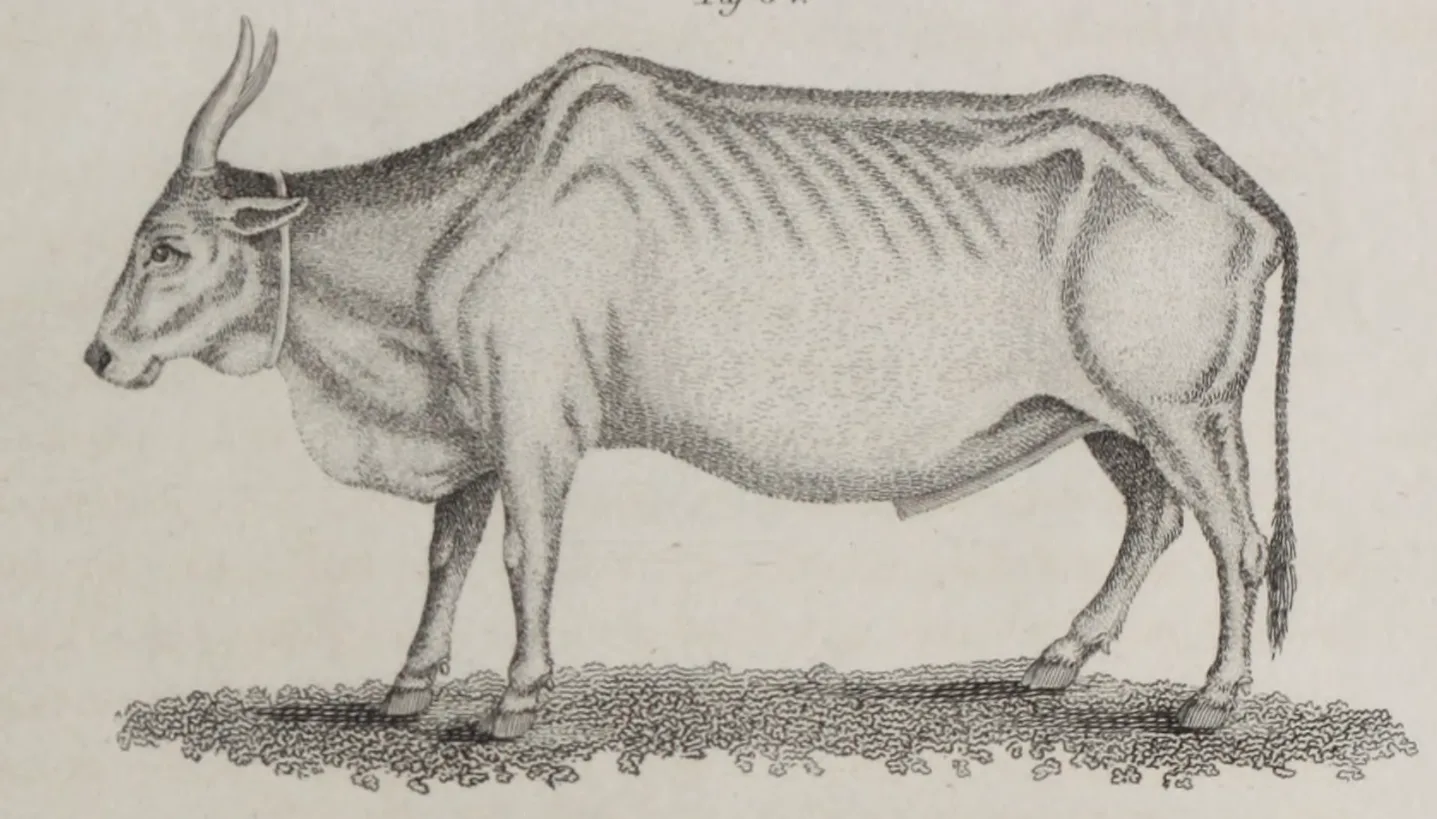
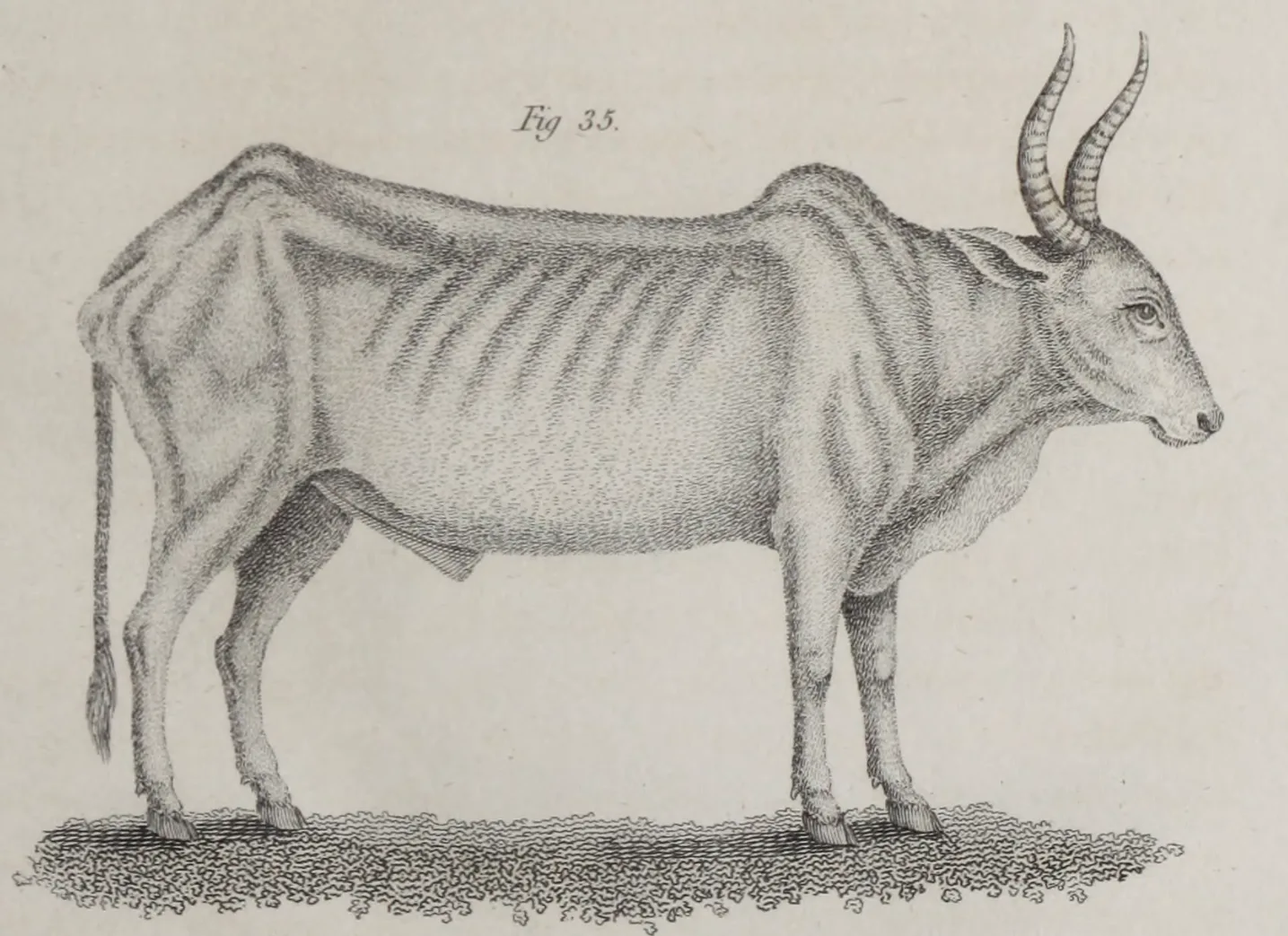
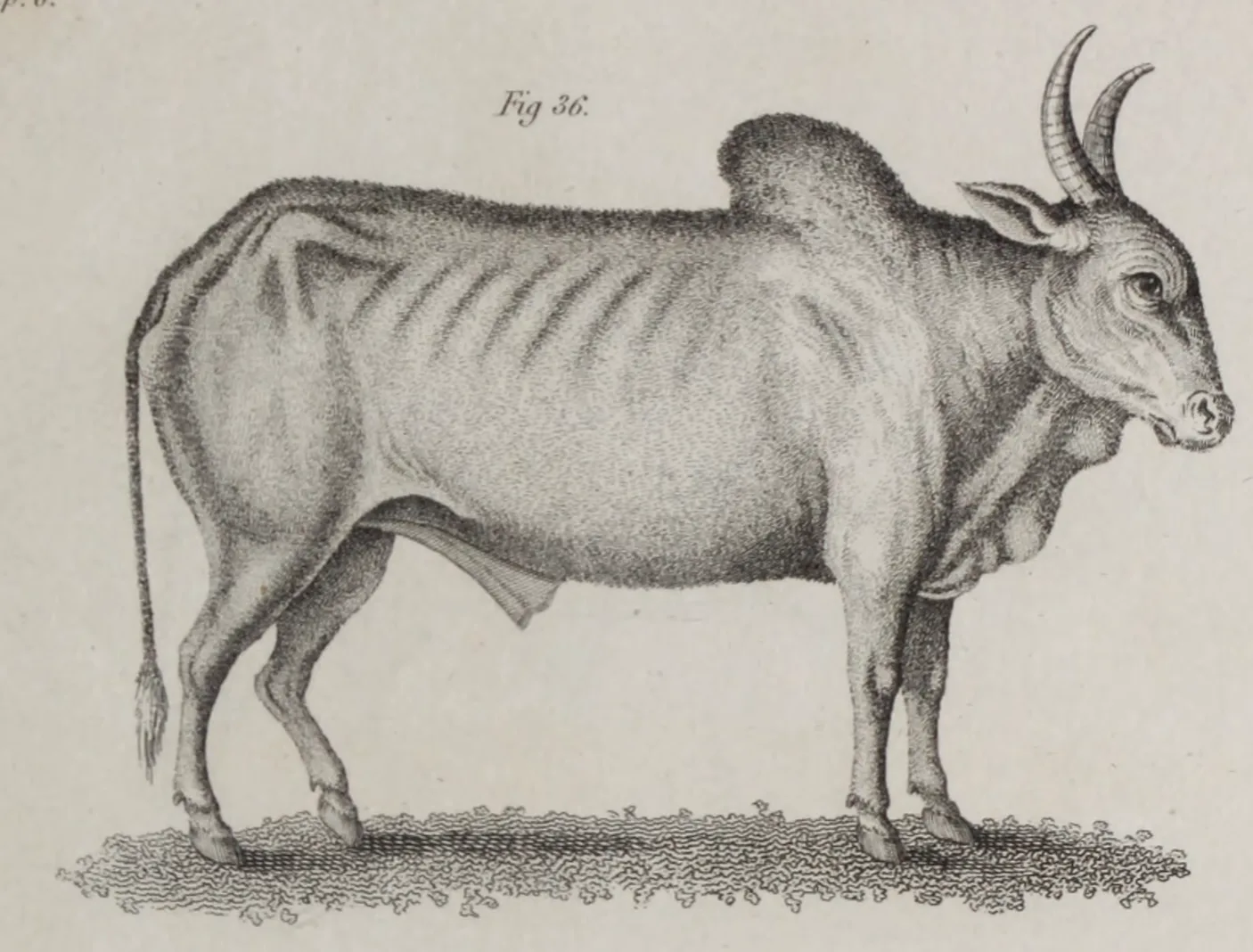
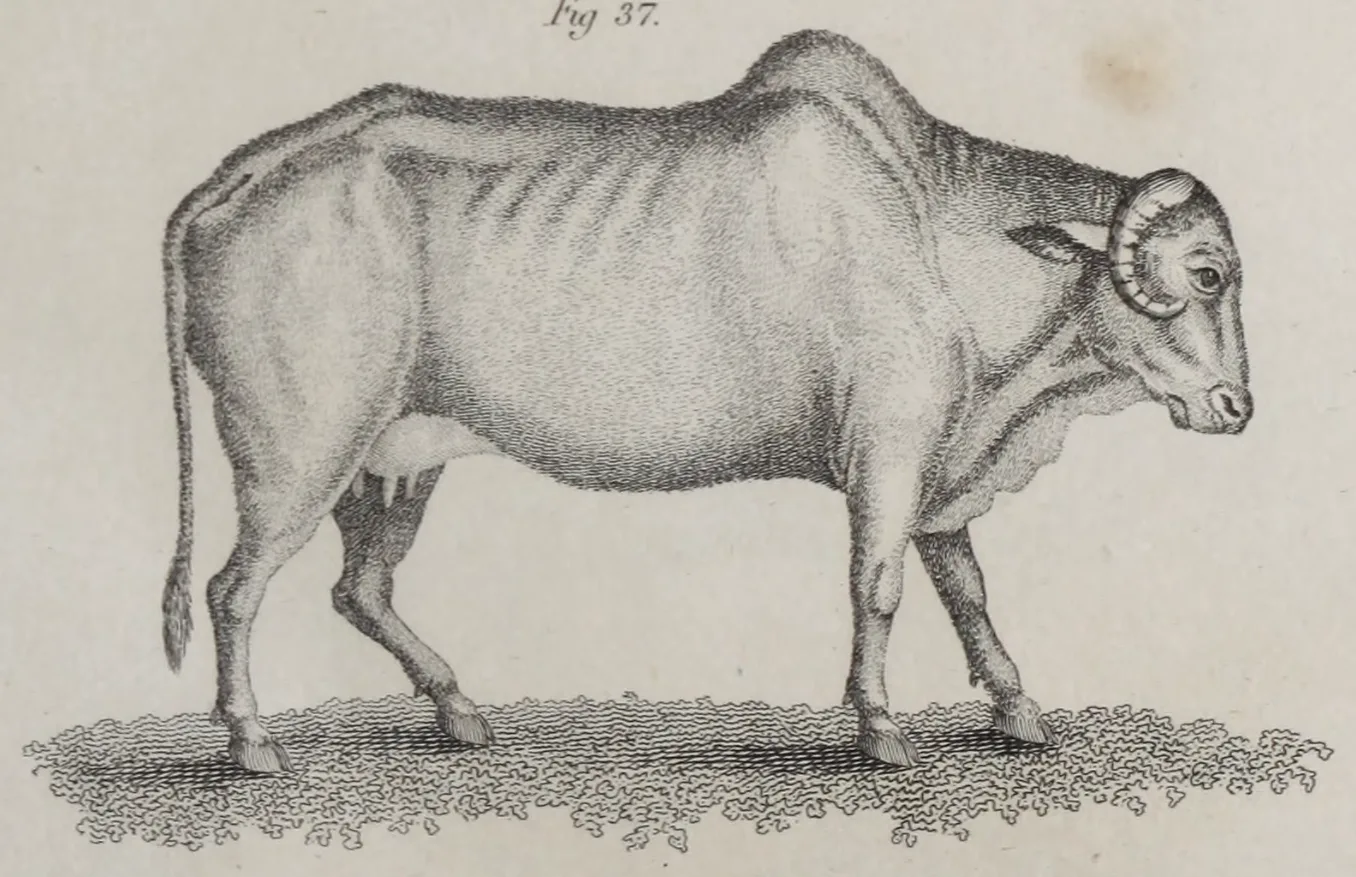
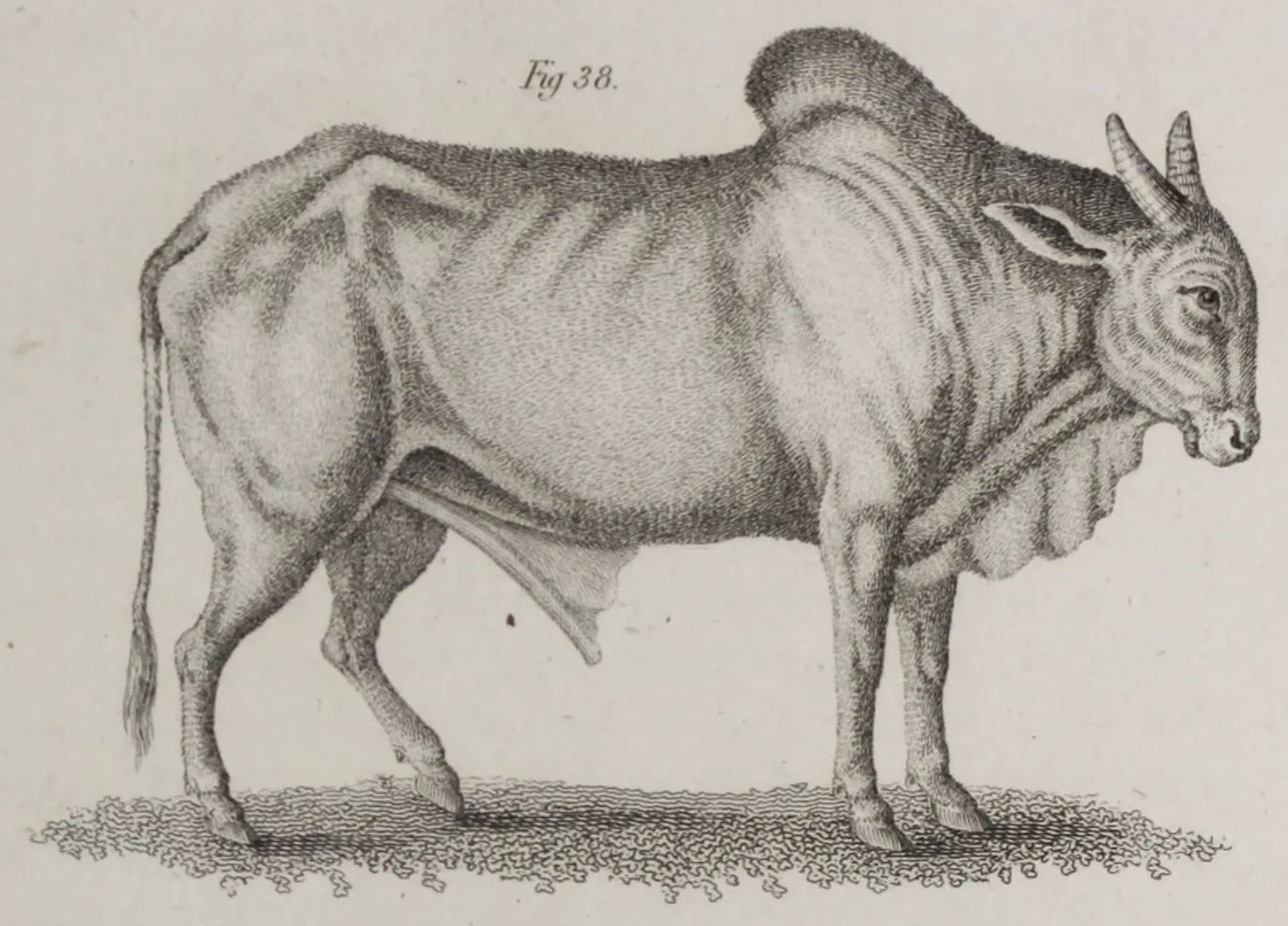
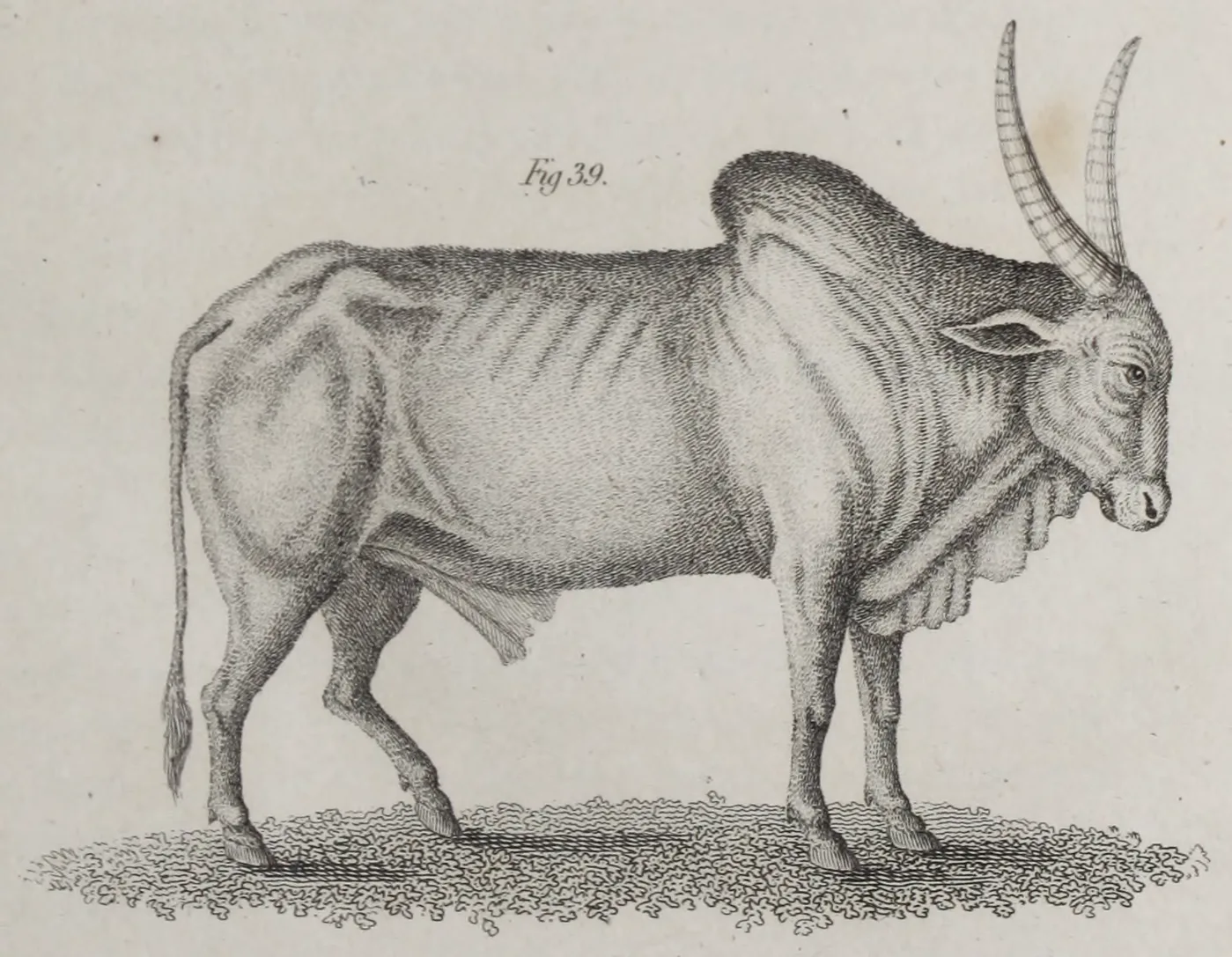
sprung from these always remain at the fold, and in the third generation lose all marks of their parents degeneracy. The males are brought home for labour, especially in drawing water by the Capily; and about every village may be perceived all kinds of intermediate mongrels between the two breeds.
In the morning the village cows are milked, and are then collected in a body, on the outside of the wall, with all the buffaloes and oxen that are not employed in labour. About eight or nine in the morning the village herdsman, attended by some boys or girls, drives them to the pasture. If the flock exceeds 120, two herdsmen must be kept, and their herds go in different directions. The pastures are such waste lands as are not more than two miles distant from the village, and are in general poor; the tufts of grass are but thinly scattered, and the bare soil occupies the greater space. This grass, however, seems to be of a very nourishing quality, and the most common species is the Andropogon Martini of Dr. Roxburgh’s manuscripts. At noon, and at four o’clock, they are driven to water, to raise which the Capily is often employed. At sun-set they are brought home; and in the rainy season the cow-house is smoked, to keep away the flies. In the back yard of every house stands a large earthen pot, in which the water used for boiling the grain consumed by the family is collected; and to this are added the remains of curdled milk, of puddings, and a little flour, oil-cake, or cotton seed. This water becomes very sour, and is given as a drink to the cows in the evening, when they are again milked. At night, in the rainy season, the cattle get cut grass, which is collected in the woods, and about road sides: this last is the most nutritious, the very succulent roots being cut up with the leaves, and the situation preventing the harsh stems from growing. In dry weather, the cattle at night have straw. Those who can afford it, chiefly Bráhmans, give their milch-cows cotton-seed and Avaray. The working cattle ought to have Horse-gram. After the milk for the family has been taken, the calves are allowed to suck; and unless they be present, as is usual with all the Indian race of cattle, the cows will give no milk. The cows here go nine months with calf, begin to breed at three years of age, and continue until 15 years old. They breed once a year, but give milk for six months only. A good cow of the village kind gives twice a day from four to six Cucha Seers, or from about 2½ to 3¾ pints ale measure.
The cattle of the other breed are very fierce to strangers, and nobody can approach the herd with safety, unless he be surrounded by Goalas, to whom they are very tractable; and the whole herd follows, like dogs, the man who conducts it to pasture. The bulls and cows of this breed never enter a house; but at night are shut up in folds, which are strongly fortified with thorny bushes, to defend the cattle from tigers. At 5 years old the oxen are sold, and continue to labour for twelve years. Being very long in the body, and capable of travelling far on little nourishment, the merchants purchase all the best for carriage. To break in one of them requires three months labour, and many of them continue always very unruly. The bulls and cows were so restless, that, even with the assistance of the Goalas, I could not get them measured; but the dimensions of a middle sized ox were as follow: From the nose to the root of the horn, 21 inches. From the root of the horn to the highest part of the hump, 30 inches. From the height of the hump to the projecting part of the ossa ischia, 45 inches. From the hump to the ground 46 inches. From the top of the hip-bones to the ground 51 inches.
The cows of this breed are pure white; but the bulls have generally an admixture of black on the neck and hind quarters. These cattle are more subject to the disease than the cattle living in villages; and once in three years an epidemic generally prevails among them. It is reckoned severe when one-third of a man’s stock perishes, although sometimes the whole is lost; but in general, as all the cows are reserved for breeding, the loss occasioned by one epidemic is made up before another comes.
These cattle are entirely managed by Goalas; and some of these people have a considerable property of this kind: but the greater part of these breeding flocks belong to the rich inhabitants of towns or villages, who hire the Goalas to take care of them; and, for the advantage of better bulls, send to the fold all their spare cows of the village breed. In procuring bulls of a good kind, some expense is incurred: for the price given for them is from 10 to 20 Pagodas (3l. 7s. 1d. to 6l. 14s. 2d.), while from 8 to 15 Pagodas is the price of an ox of this kind. Care is taken to emasculate all the young males that are not intended for breeding, before they can injure the flock.
The Goalas live in huts near the small villages, in parts of the country that contain much uncultivated land, and are surrounded by the folds, in which they always keep as many cattle as will cultivate a little land, and as the pasture near the place will maintain. But as local failures of rain frequently occasion a want of forage near their huts, some of the men drive their flocks to other places where the season has been more favourable, and either take up their abode near the huts of some other Goalas, giving them the dung of their fold for the trouble which they occasion, or live in the midst of woods, in places where the small reservoirs, called Cuttays, have been formed to supply their cattle with water. All the breeding and young cattle, with all the sheep and goats, are carried on these expeditions; but a few labouring cattle and the buffaloes are left at home in charge of the women, and of the men who can be spared from accompanying the flocks. During the whole time that they are absent the Goalas never sleep in a hut; but, wrapped up in their blankets, and accompanied by their dogs, they lie down among the cattle within the folds, where all night they burn fires to keep away the tigers. This however is not always sufficient, and these ferocious animals sometimes break through the fence, and kill or wound the cattle. The men have no fire-arms, the report of which would terrify the cattle; and for driving away the tiger, they trust to the noise which they and their dogs make. They are also much distressed by robbers, who kill or carry away the sheep and goats; but unless it be a numerous rabble that call themselves the army of a Polygar, no thieves can annoy their black cattle; for these are too unruly to be driven by any persons but their keepers, and the most hardened villain would not dare to slaughter an animal of this sacred species.
Exclusive of the buffaloes, which are managed as I have described at Seringapatam, the cattle of the Goalas have nothing to eat, except what they pick up in the wastes. The cows and sheep eat grass, and the goats the leaves of every kind of tree, bush, or climber, those of the Periploca emetica W: excepted. Each kind of cattle must have a separate fold. From this, when at a distance from home, they are driven out at sun-rise, as then the calves get all the milk, except a little used by the herdsmen; but near the village the cows are milked every morning; and this operation, which is performed by the men, takes up two hours. From each about two Seers, or 1¼ pint, only are taken. They are indeed miserably lean, and at twenty yards distance their ribs may be distinctly counted. The cattle are once a day conducted to the water; and the calves, after they are a month old, follow their mothers to pasture: before that they remain in the fold, under the charge of the man who cooks.
When a rich man sends a flock of a hundred cows under the care of the Goalas, he allows wages for two men, each of whom has annually 60 Fanams, with a blanket and pair of shoes; in all, worth about 2l. 5s. 1d.; and when they come on business to their master's house, they get their victuals. For grass he pays also five Fanams a year to the keeper of the forest. These (3s. 4d.) with the two men's wages, making in all 4l. 13s. 2d. are the whole of his annual expence. The profits, when no disaster happens, will be: for Ghee, or boiled butter, 8 Pagodas; for sour curds, butter-milk, &c. 4 Pagodas; for 20 three-year-old bullocks 60 Pagodas; in all 72 Pagodas, or 720 Fanams, or 24l. 3s. 6d.: from this deduct the expense, and there will remain 19l. 10s. as the gain upon the original stock, which may be estimated at 150 Pagodas for the 100 cows, and 30 Pagodas for the two bulls; in all, 1300 Fanams, or 43l. 13s. which is almost 45 per cent. annually on the original value of the stock.
The Goalas keep many Curis, and Maykays, or sheep and goats. These always accompany them in their expeditions; and even those who are servants to the rich men generally carry with them flocks of sheep and goats, or are accompanied by some men possessed of that stock; so that less than four men never go together. The sheep are more subject to the disease than the cows, and the goats still more so than the sheep. A flock of a hundred small cattle requires the attendance of two men, and two dogs; and these have more profit from their own small herd, than the men who serve the rich to take care of cows. This they acknowledge themselves; yet they will only allow the profits of the 100 goats to amount to 100 Fanams a year; that is to say, 80 Fanams for 30 three-year-old males, and 20 Fanams for boiled butter. They eat the old females, and give the keeper of the forest two males for every hundred, in order to obtain his permission to cut the trees, that the goats may procure leaves.
A Goala, that is reckoned rich, will have 200 cows, 30 female buffaloes, 50 ewes, and 100 she goats; and will keep as many labouring oxen as will work three ploughs. Such a man, Trimula Náyaka says, besides paying rent, and finding his family in provisions, will annually make 100 Pagodas, or 33l. 10s. 10d. His clothing, being a blanket, costs a mere trifle; and part of the money he expends in the marriages of the younger branches of the family, and in religious ceremonies; the remainder is in general buried, and a great deal of money is in this way lost; as when the men get old, and stupid, they forget where their treasures are hidden, and sometimes die without divulging the secret.
The farmers also keep small flocks of goats and sheep, which are sent, under the charge of a boy, to the pastures near the village. In the evening they are brought home; when the goats are taken into the house, and the sheep are folded on the field of their proprietor.
The cattle in this country, as I have already mentioned, are milked by the men, who carry the produce home to the women; for they prepare the butter. The milk, on its arrival, is immediately boiled for at least one hour; but two or three hours are reckoned better. The earthen pots, in which this is done, are in general so nasty, that after this operation no part of the produce of the dairy is tolerable to an European; and whatever they use, their own servants must prepare. The natives never use raw milk, alleging that it has no flavour. The boiled milk, that the family has not used, is allowed to cool in the same vessel; and a little of the former days Tyre, or curdled milk, is added to promote its coagulation, and the acid fermentation. Next morning it has become Tyre, or coagulated acid milk. From the top of each potful, five or six inches of the Tyre are taken, and put into an earthen jar, where it is churned by turning round in it a split Bamboo. This is done very expertly by a rope, which, like that of a turner’s lathe, is passed two or three times round the Bamboo, and a quick motion in contrary directions is given by pulling first one end of the rope, and then the other. After half an hour’s churning, some hot water is added, and the operation is repeated for about half an hour more; when the butter forms. The natives never use butter; but prefer, what is called Ghee, not only as that keeps better, but also as it has more taste and smell. In order to collect a quantity sufficient for making Ghee, the butter is often kept two or three days; and in that time a warm climate renders it highly rancid. When a sufficient quantity has been collected, it is melted in an earthen pot, and boiled until all the water mixed with the butter has evaporated. It is then taken from the fire; and, for what reason I could not learn, a little Tyre and salt, or Betel-leaf and reddle, are added. It is kept in pots, has a very strong smell, and is best preserved from spoiling by a little tamarind and salt, which at any rate enter into the dishes of all the natives that can afford to use Ghee. It is eaten when even a year old. Three Pucka Seers, or 252 Rupees weight of buffaloes milk, give 100 Rupees weight of Ghee; the same quantity of cow and buffalo milk mixed, as usual, give 80 Rupees weight; cow milk alone gives 60 Rupees weight, and goat milk only 40 Rupees weight.
12th August.—Having been informed, that Chin’-náráyan’-durga was distant three cosses, I ordered my tents to be pitched at that place; but on coming up, I found that the distance was only one coss. In this country, it is indeed very difficult to get any accurate information concerning routes and distances. The road leads through a very narrow rugged valley, capable of very little cultivation. It is situated in the highest part of the country, the water from its north end running into the northern Pinákaní, while the Cávéri receives the torrent flowing from its southern extremity. Chin’- náráyan’-durga, by its situation, is a strong place, and is garrisoned by the troops of the Mysore Rája. It is greatly inferior in appearance to Madhu-giri, although it is said to have been the favourite residence of Chicuppa Gauda. The town is the Kasba, or capital of a district, but is very poor. Nothing can be rougher than the neighbouring country, which at first sight appears a mass of rocks and bare hills thrown confusedly together; but on a nearer inspection, many fertile spots are observed.
In the neighbouring woods is found abundance of the Popli bark, which I have frequently mentioned as a dye, and as an article of export. It is the bark of the root of a large scandent plant, which climbs to the top of the highest trees. I saw neither flower nor fruit, so can say nothing of its botanical affinities; and the specimens of the stem and leaves were not known to Dr. Roxburgh. It is collected by some Baydarus, who are in the service of the Gydda Cavila, or keeper of the forest.
13th August.—I went three cosses to Tavina Caray, in company with the Amildar, who seems to be a very industrious man. He says, that last year he brought 200 ploughs into his district, and that 200 more would be required for its full cultivation. Near Chin’-náráyan’-durga the country, for the most part, consists of a rugged valley surrounded by hills; but the fields between the rocks were formerly cleared, and well cultivated, and are said to be very favourable for Ragy, the rock enabling the soil to retain moisture. Among these rugged spots we visited some iron and steel forges, which had indeed induced me to come this way. The information procured on this subject, is as follows.
Iron is smelted in various places of the following Talucs, or districts; Madhu-giri, Chin’-náráyan’-durga, Hagalawadi, and Déva-ráya-durga. In the first two districts the iron is chiefly made from the black-sand which the small torrents formed in the rainy season bring down from the rocks. In the two latter districts, it is made from an ore called here Cany Callu, which is found on the hill Kindalay Guda, near Muga-Náyakana-Cotay in the Hagalawadi district. A little of the same iron ore is also procured from a hill, called Kaymutty, near Muso-conda in the district of Chica-Náyakana-Hully.
The manner of smelting the iron ore, and rendering it fit for the use of the blacksmith, is the same here as near Magadi. The people belonging to the smelting-house are four bellows-men, three men who make charcoal, and three women and one man who collect and wash the sand. They work only during the four months in which the sand is to be found; and for the remainder of the year they cultivate the ground, or supply the inhabitants of towns with fire-wood. The four men relieve each other at the bellows; but the most skilful person takes out the iron, and builds up the furnace; on which account his allowance is greater. In each furnace the workman puts first a basket (about half a bushel) of charcoal. He then takes up as much of the black sand as he can lift with both his hands joined, and puts in double that quantity. He next puts in another basket of charcoal, and the fire is urged with the bellows. When the first charcoal that has been given burns down, he puts in the same quantity of sand, and one basket of charcoal; and does this again, so soon as the furnace will receive a farther supply. The whole quantity of sand put in at one smelting measures 617 cubical inches, and weighs, when dry, about 42 1/2 lb. avoirdupois. This gives a mass of iron, which, when forged, makes 11 wedges, each intended to make a ploughshare, and weighing fully 1 82/100 lb. The workmen here, therefore, procure from the ore about 47 per cent. of malleable iron; but, as usual in India, their iron is very impure.
In the forging-house are required 3 hammer-men, one man to manage the forceps, 2 bellows-men, and 4 men to supply charcoal, which for this purpose is always made of the Bamboo. Every day three furnaces are smelted, and 33 wedges forged. The workmen are always paid by a division of the produce of their labour; and every fourth day, or when 132 pieces have been prepared, the division is made as follows.
| Pieces. | |
|---|---|
| To the proprietor | 35 |
| To the Panchála, who is the fore-man at the forge | 10 |
| To the fore-man at the smelting-house | 8 |
| To one of the bellows-men, who removes the ashes and dross | 5 |
| To two of the women, who wash the sand, at 5 each | 10 |
| To the remaining 16 persons, at 4 each | 64 |
| 132 |
The Panchála, or black-smith, out of his wages, is bound to find all the iron instruments, such as the anvil, the hammers, and the forceps. The proprietor defrays all other expenses; and these are,
| Fanams. | |
|---|---|
| To the keeper of the forest, for permission to make charcoal | 100 |
| To the Gauda, or chief of the village, for leave to gather iron sand | 40 |
| To ditto for furnace rent | 15 |
| To the Sunca, or collector of customs | 30 |
| To a pair of bellows for the smelting-house | 42 |
| To ditto for the forge | 24 |
| To sacrifices | 15 |
| To charity for the Bráhmans | 10 |
| Fanams | 276 |
The buildings are so mean that they go for nothing; and at the beginning of the season are put up by the workmen in the course of a day.
The stone-ore is made into iron exactly in the same manner; the quantity put into the furnace, and the produce, being nearly the same. The iron from the stone ore is reckoned better for all the purposes to which malleable iron is applied, but it sells lower than the iron made from the sand; for this last is the only kind that can be made into steel. The stone-iron sells at 6 pieces for the Fanam; and the people who work it are paid by daily wages. The wedges that it forms are larger than those of the sand iron, and weigh from 3 to 4 Seers each; so that this iron costs about 6s. 10d. a hundred-weight. The iron made from the sand sells at four pieces for the Fanam, or about 10s. 4d. a hundred-weight, the pieces weighing, according to estimate, only three Seers. I am inclined, however, to think, that on an average they weigh at least a tenth part more; but it would be difficult to ascertain this, as the pieces differ considerably in size, and are never sold by weight.
It must be evident, that in this account the head-man, wishing to conceal his profit, deceived us. For thirty dividends can only take place in the course of four months; and, each dividend giving him 35 wedges of iron, he will receive in all 1050 pieces, which, at the usual price, are worth only 262½ Fanams; so that in the course of the year, his expenses being 276 Fanams, he would lose 13½ Fanams, while the lowest workman gets monthly 7½ Fanams, or about 5s. which is more than is earned by the common labourers of the country. The point in which I think he attempted to deceive was in the number of days that the people wrought. If they smelted every day in the year, his profits would be very great; but allowing for many interruptions, owing to the avocations of agriculture, and to occasional deficiencies of sand, we may safely suppose that the forge is employed 6 months in the year; and then the profits of the proprietor will be about 100 Fanams, which is nearly in the same proportion to his stock, as the gains of the breeder of cattle are to his property. At this rate, the quantity smelted in each set of works, taking my estimate of the weight of each piece, will be about 106 hundred-weight; and the 19 forges, stated in the public accompts to be in this district, and that of Madhu-giri, will yearly produce about 100 tons of iron, worth nearly 1000l.
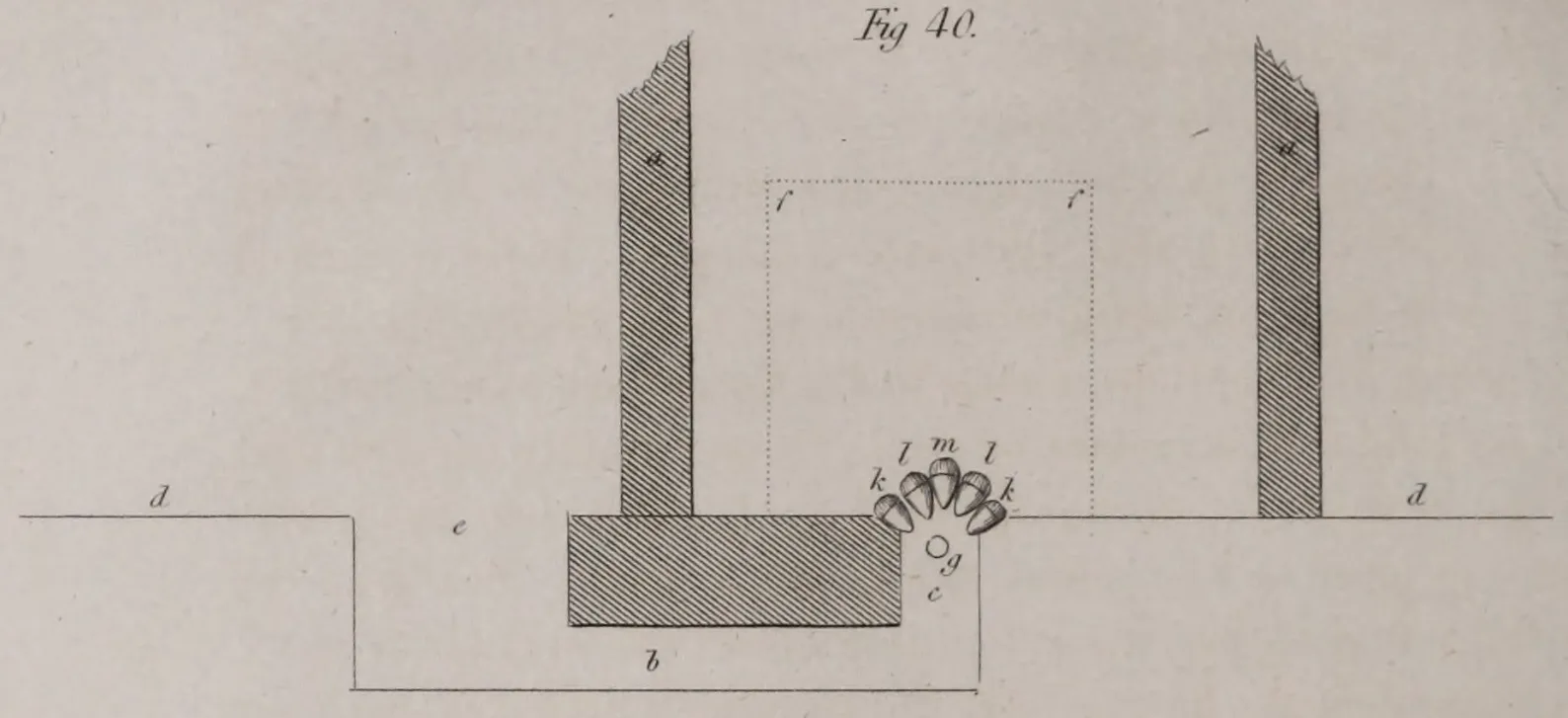
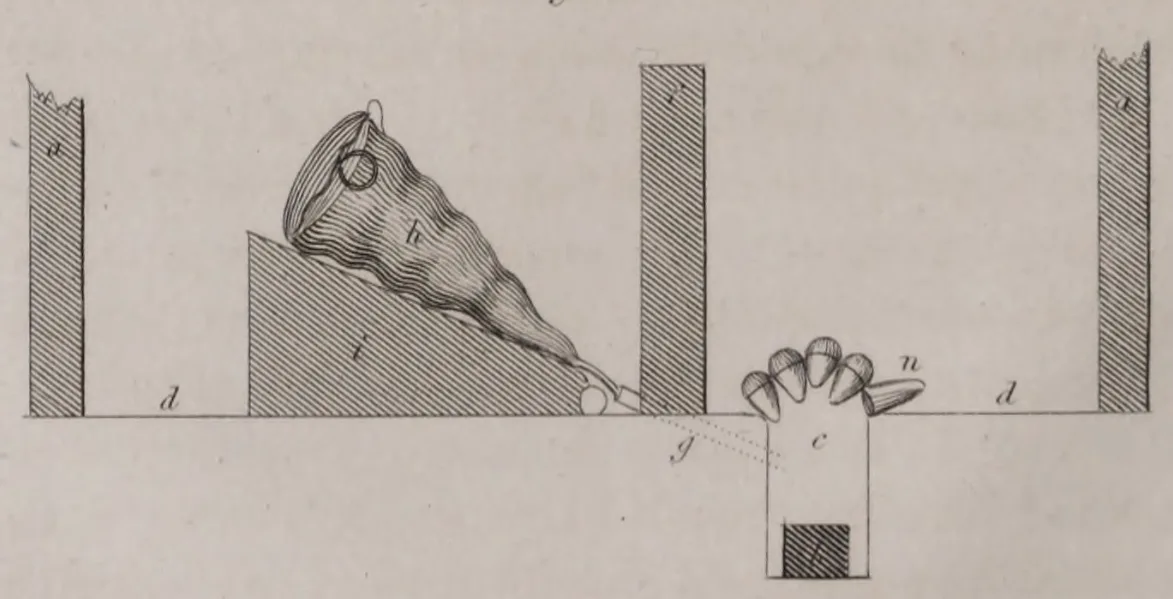
For making steel, there are in this vicinity five forges; four in this district, and one in Déva-Ráya-Durga. To enable the workmen to give them a supply, the merchants frequently make advances; for almost the whole is exported. It is used for making stone-cutters-chisels, sword-blades, and the strings of musical instruments. The furnace (see Plate XVI. Fig. 40, 41.) is constructed in a hut (a); and consists of a horizontal ash-pit (b), and a vertical fire-place (c), both sunk below the level of the ground (d). The ash-pit is about ¾ of a cubit in width and height, and conducts from the lower part of the fire-place to the outer side of the hut, where it ends in a square pit (e), in which a man can sit, and with a proper instrument draw out the ashes. The fire-place is a circular pit, a cubit in diameter, and descends from the surface of the ground to the bottom of the ash-pit, being in all two cubits deep. Its mouth is a little dilated. Parallel to the ash-pit, and at a little distance from the mouth of the fire-place, in order to keep the workman from the sparks and the glare of the fire, is erected a mud wall (f) about five feet high. Through the bottom of this passes an earthen tube (g) which conducts into the fire-place the wind of two bellows (h). The bellows are as usual supported on a bank of earth (i), and consist each of a bullock's hide; they are wrought, as in other places of this country, by the workman passing his arm through a leather ring.
The crucibles are made, in a conical form, of unbaked clay, and each would contain about a pint of water. In each is put one third part of a wedge of iron, with three Rupees weight (531 grains) of the stem of the Tayngada or Cassia auriculata, and two green leaves of the Huginay, which is no doubt a Convolvulus, or an Ipomea with a large smooth leaf; but never having seen the flower, I could not in such a difficult class of plants attempt to ascertain the species. The mouth of the crucible is then covered with a round cap of unbaked clay, and the junction is well luted. The crucibles, thus loaded, are well dried near the fire, and are then fit for the furnace. A row of them (k) is first laid round the sloping mouth of the fire-place; then within these another row is placed (l); and the center of this kind of arch is occupied by a single crucible (m), which makes in all fifteen. That crucible in the outer row (k) which occupies the place opposite to the muzzle of the bellows, is then taken out, and in its stead is placed horizontally an empty crucible (n). This the workman, who manages the fire, can draw out when he pleases, and throw fewel into the fire-place. The fuel used is charcoal prepared from any kind of tree that grows in the country, except the Ficus Bengalensis, and the Chloroxylon Dupada of my manuscripts. The fire-place being filled with charcoal, and the arch of crucibles being covered with the same fewel, the bellows are plied for four hours; when the operation is completed. A new arch is then constructed, and the work goes on night and day; five sets, of 14 crucibles each, being every day converted into steel. When the crucibles are opened, the steel is found melted into a button, with evident marks on its superior surface of a tendency to crystallization; which shows clearly, that it has undergone a complete fusion. It is surrounded by some vitrified matter, proceeding from the impurities of the iron, and probably nearly equal to the quantity of carbon absorbed from the sticks and leaves shut up in the crucible; for the steel in each crucible is by the workmen reckoned to weigh 1¼ Seer. These buttons, however, are never sold by weight, and those that I tried weighed very little more than one Seer of 24 Rupees. In some crucibles the fusion is not complete; in which case, the steel is of a very inferior quality, and differs but little from common iron.
The number of people employed at one of these works is thirteen; a head workman, who makes the crucibles, loads them, and builds up the arch; and four reliefs of inferior workmen, each consisting of three persons, one to attend the fire, and two to work the bellows. Each set therefore, in the working season, labours only four hours in the day; except every fourth day, when they must attend double that time. They are all cultivators; and in the leisure time which they have from the furnace, they manage their fields. There is also a proprietor, who advances all the money required, and who receives payment when the steel is sold. Fifteen Pagodas worth of iron is purchased; two for the head workman, and one for each labourer, and for the proprietor. This iron is then given to the head workman, who for three months is occupied in making the crucibles, loading them, and preparing the furnace. During this time the twelve workmen bring him clay, repair the buildings, and make charcoal; but these labours occupy only intervals, that could not be employed on their small fields of Ragy. In the fourth month, when all has been prepared, they convert the 15 Pagodas worth of iron into steel, as above described. Every man then takes the steel which his iron has produced; and the proprietor is repaid for his advances. Another quantity of iron is then purchased, and the same process is repeated; so that by each furnace 45 Pagodas worth of iron is, in the course of the year, converted into steel. Besides the money advanced for iron, the proprietor, for the immediate subsistence of the workmen, is occasionally under the necessity of advancing them money; and he must also pay the general expenses attending the forge. These are:
| Fanams. | |
|---|---|
| To the keeper of the forest, for leave to make charcoal | 110 |
| To the Sunca, or collector of the customs | 30 |
| To the Gauda, or chief of the village, for house-rent | 15 |
| To sacrifices | 30 |
| To bellows | 42 |
| To the Bráhmans as charity | 20 |
| Fanams 247 |
Every man, however, repays his share of this, in proportion to his quantity of steel; and the whole profit of the proprietor is the having three Pagodas worth of iron converted into steel, for which he will in general be in advance about 40 Pagodas. He therefore requires a capital to that extent; unless he can borrow it from some merchant, which indeed he generally does.
The 45 Pagodas procure 1800 wedges of iron, and on an average procure 4500 pieces of good steel; which, at 2½ for the Fanam, are equal to - - - - Fanams 1800
| 900 pieces of bad steel, at 6 Fanams | 150 |
| 1950 | |
| Deduct general charges | Fanams 247 |
| Price of iron | 450 |
| 697 | |
| Neat gain | 1253 |
The neat gain, 1253 Fanams, divided by 15, gives 83½ Fanams clear profit for each share. The workman's wages are equal to one share, and thus amount to about 7 Fanams a month; with double that for the foreman, because he gives up his whole time to the business. These wages are good; but the allowance for the proprietor is small, unless we consider, that he in general gets the money from the merchant, and that his only claim for reward is some trouble in settling the accompts, and the risk of some of the people running away with the advances made to them. Among the natives themselves, however, very little danger arises from this cause, as they are perfectly acquainted with the characters of the individuals employed.
Taking the estimate of the natives, of 30 Rupees weight being the true average of the pieces of steel, the quantity of stee, fit for exportation, that is annually made in this vicinity, will be about 152 hundred weight, and its value about 300l. or 2l. a hundred weight.
Having examined the iron and steel works, the Amildar and I visited a fine tank, which is said to have been constructed by Krishna Ráyalu of Vijaya-nagara; and it is the finest work of the kind that I have yet seen above the Ghats: unfortunately, it has long been out of repair, and lofty trees now cover all the fields which it watered. It is said, that it would require 10,000 Pagodas (about 3354l.) to remove all the mud collected in its bottom, and to put it in complete order. A partial repair has just now been given, and it will be able to water some part of its former fields: the remainder will be cleared, and cultivated for Ragy, until other more urgent demands shall allow the repair to be completed.
As we approached Tavina-Caray, the country becomes open; and I observed that every field was cultivated. Tavina-Caray is a small town; but several additions to it are making. Some streets in the Petta are well laid out; and, as an ornament before each shop, a coco-nut palm has been planted. The fortress, or citadel, is as usual almost entirely occupied by Bráhmans. This might seem to be an improper place for men dedicated to study and religion; but in cases of invasion their whole property is here secure from marauders; while the Súdras, who are admitted during the attack as defenders, must lose all their effects, except such moveables as in the hurry they can remove.
14th August.—I went to Tumcuru, the chief place of a district, called also Chaluru. The country is the most level, and the freest from rocks, of any that I have yet seen above the Ghats. I observed only one place in which the granite showed itself above the surface. The soil in most places is good, and might be entirely cultivated. Near Tavina-Caray it is so; but as I approached Tumcuru, I observed more and more waste land. I understand, that the late Amildar did not give the people proper encouragement; and about twenty days ago he was removed from his office. By the way I passed nine or ten villages, all fortified with mud walls and strong hedges. At some distance on my left were hills; and the prospect would have been very beautiful, had the country been better wooded; but, except some small palm gardens scattered at great distances, it has very few trees. Tumcuru is a town containing five or six hundred houses. The fort is well built, and by the late Amildar was put in excellent repair. The Petta stands at some distance. The great cultivation here is Ragy, but there are also many rice-fields. This year there will be no Kártika crop, as at present the tanks contain only eight or ten days water.
Here, as in several other parts of the country, there are people of a Karnáta tribe of Bestaru, who, although they do not intermarry with the Telinga Bestas, are so nearly allied, that they will eat together. They never carry the Palankeen, their principal occupation being the burning of lime-stone. Some of them are small farmers; but they never hire themselves out as hinds, or Batigaru. This tribe are called also Cubbaru. They have hereditary chiefs, called Ijyamánas, who, with a council of the heads of families, settle disputes, and excommunicate those who, notwithstanding admonition and reprimand, obstinately persist in bad practices. If a woman commit adultery with a strange man, she is excommunicated; but if it be with a Cubba, both the adulterer and the husband are fined; the one as a corrupter, and the other for having been negligent. An assembly of at least ten of the tribe is called, and the woman is asked before the people, whether or not she chooses to return to her husband. If she consents, and he agrees to receive her, as is usually the case, he gives the assembly a dinner, and no one afterwards mentions the affair. If the parties cannot agree, the marriage is dissolved. This cast does not admit the connection called Cutiga. The women are extremely industrious, and hence are very valuable to their husbands, and are independent of them for support; which seems to be the reason of their possessing such a licence in their amours. After the age of puberty they continue to be marriageable. Except a few rich men, the Bestas of Karnáta generally content themselves with one wife, unless the first has no children, or has had only daughters. In such cases, even the poor struggle to procure a second wife, to keep up the family. They are allowed to drink spirituous liquors and to eat animal food. None of them can either read or write. They bury the dead, and seem to have no knowledge nor belief in a future state; but they appeared very willing to assent to any thing that either I or my interpreter said on the subject. This, however, did not proceed from any conviction of its truth; but merely from civility, they being unwilling to contradict persons who were supposed to be better informed than themselves. They neither make the vow of Dáséri, nor believe in the spirits called Virika. The goddess of the cast is Yellama, one of the Saktis, in whose temples the Pujáris are persons of this tribe. They offer sacrifices to her, and to all the other destructive spirits; but say that they are of Vishnu's side. They have a Guru; yet, although he was here fifteen days ago, they know very little about him. He is a married man, is named Linguppa, and was attended by servants of the Curuba cast. His disciples here were Cubbaru, Curubas, and some other cultivators. He slept in one of the temples of the Saktis. All these circumstances would point him out to be a worshipper of Siva, and one of the Curubaru Jangamas; but he wore a thread, and marked his forehead with turmeric, like a woshipper of Jaina. He gave the Cubbas turmeric to mark their foreheads, and accepted of their Dharma, or charity. His Matam, or college, is at Meilar, near Savanuru. The Panchánga acts as Puróhita at marriages, Mala-paksha, and births. For his trouble, he receives rice, or other provisions, but is sometimes paid in lime; money being rather scarce among this tribe.
The Curubas here say, that, at a temple of Bhairawa at Hervay Samudra, which is near Mercasera, to the north of this place, and where one of their cast acts as Pújári, the image represents a man sitting on horseback, with the Linga round his neck, and a drawn sword in his hand. They offer sacrifices to this image, and eat the flesh. The family of Rávana have now spread all over the country; but Sarur is still considered as the proper family seat. Their Guru has the power of restoring any outcast to the enjoyment of full communion. They have a book peculiar to the cast, called Jiraga Chapagodu. It is written in the language of Karnáta, and gives an account of the tribe. The Curubaru buy their wives; a girl of a good family costs from 30 to 40 Fanams; a girl of the bastard or Cutiga breed costs 15 Fanams, or 10s.
The Panchama Cumbharu, or Cumbharu that wear the Linga, are an original tribe of Karnáta. They say that they are of the Gunda Brimmia family, and claim no connection with Sáliváhanam, as the other Cumbharu do. They follow no other profession than the making of earthen-ware. Their hereditary chiefs are called Ijyamanas, and pay annually to government a certain sum for the clay used in their manufacture. The Ijyamana divides this assessment upon the families that are under his authority, so that each pays its proportion. They must also furnish with pots all persons travelling on public business. Each house, besides, pays annually three Fanams, or 2s. The Ijyamanas assemble four persons as a council, and with their assistance settle disputes, and punish transgressions. No higher punishment is inflicted on men than a temporary excommunication. Women, who commit adultery, are entirely excommunicated, and are never allowed to remain as concubines; and the man who seduces another's wife is obliged to pay a fine to the public. They, and the Pancham Banijigas, although they do not intermarry, can eat together; of course, they neither can eat animal food nor drink spirituous liquors. They can marry into any of the forty families descended from Gunda Brimmia; but a man and woman of the same family cannot be married together. The men are allowed to take several wives, who are very industrious in bringing clay, and making cups. The girls continue to be marriageable after the age of puberty; but a widow is not allowed to take a second husband. None of them can read. Like all other persons who wear the Linga, they bury the dead. The men of this cast have no knowledge of a future state, and neither believe in the Vírika, nor take Dáséri. Their principal object of worship is Iswara, represented as usual by the Linga; in sickness they pray to the Saktis, who are supposed to inflict disorders; and they make vows of presenting their temples with money, fruit, and flowers, provided these vengeful powers will relent, and allow them to recover; but they never appease the wrath of the Saktis by bloody sacrifices. Their Guru is an hereditary Jangama, who resides at Gubi, and is called Sank’-ráya. He comes once a year, eats in their houses, accepts of their charity, gives them consecrated ashes, and advises them to follow the duties and labours of their cast. If any of them are in distress, he bestows alms on them. The Panchánga, or village astrologer, reads Mantrams at their marriages, and on the building of a new house, and is thus supposed to render it lucky. The Jangamas attend to receive charity at the Mala-paksha, or annual commemoration of their deceased parents, at births, and at funerals; but do not either read or pray on these occasions.
There are many of the Woculigas, or Súdra cultivators of Karnáta extraction, who wear the Linga. In this neighbourhood these are of the following tribes: Cunsa, Gangricara, Sadru, or Sadu, and Nona. But many of each of these tribes worship Siva without wearing his badge; and still more are worshippers of Vishnu. All those who wear the Linga can eat together, and with the Pancham Banijigas; but they only marry in their own tribes.
The Nona Woculigaru, who are here called Nonabur by the Mussulmans, consider themselves as Súdras, and their hereditary chief is the male representative of a person called Honapa Gauda. This chief always lives at Hosso-hully; but he sends agents to act for him in different parts of the country. He wears the Linga, but many of the tribe worship Vishnu. This, however, produces no separation in cast, the woman always following the religion of her husband. My informants are wearers of the Linga; and say, that besides the worship of this emblem, they pray and offer fruit and flowers to the Saktis, but never sacrifice animals. When any explanation of a future state of rewards and punishments is given by a more learned neighbour, they say that they believe it; but this is done merely out of compliment to his superior endowments; and their worship of the gods seems to be performed entirely with a view of procuring temporal blessings, or of avoiding present evil. They believe that the Vírika, or spirits of men who have died chaste, can cure diseases. The married Jangamas are their Gurus, give them the Linga, and receive contributions in money or grain. At all ceremonies they attend for charity, but do not pray. It is at marriages only that the Panchánga reads his Mantrams. Like most other persons who wear the Linga, they never take Dáséri, and they bury the dead. Some of them can read the Baswa Purána, and many of them understand accompts. They are not allowed to eat animal food, nor to drink spirituous liquors. Their chief, or his deputies, with the assistance of a council, settle disputes, and expel from the cast all transgressors of its rules. These, as usual, are, men who eat forbidden meat, and women who are forgetful of their duty to their husbands. This cast does not admit of concubines of the kind called Cutigas, nor are widows allowed to marry again. The girls, however, continue marriageable after the age of puberty, and all the women are industrious in the labours of the field. The men take as many wives as they can procure.
15th August.—I went three cosses to Gubi; which, although a small town, containing only 360 houses, is a mart of some importance, and has 154 shops. The houses in their external appearance are very mean, and the place is extremely dirty; but many of the inhabitants are thriving, and the trade is considerable. It is said to have been founded about 400 years ago, by a family of Polygars, who resided at Hosso-hully, two miles from hence, and who traced their descent from Honapa Gauda, the hereditary chief of the Nona Woculigaru that I lately mentioned. Honapa Gauda lived about 700 years ago, and his family possessed a country which annually produced about 3000 Pagodas. They were first brought under subjection by the Mysore Rájas, who imposed a tribute of 500 Pagodas. Hyder increased this to 2500, leaving them little better than renters. They were entirely dispossessed by his son, and have returned to their original profession of cultivators; but in their own tribe they still retain their hereditary rank.
From the pride of two contending sects, the Comaties, and the Banijigas, Gubi has lately been in a very disorderly state, and has even been in danger of destruction. The former having erected a temple to a sainted virgin of their tribe, who threw herself into the flames, rather than gratify the lust of a tyrannic Rája, the Banijigas took offence, pretending that such a temple was contrary to the customs of the town; there never before having been in that place any such building. Both parties being obstinate, the one to retain the temple, and the other to destroy it, Purnea last year ordered the town to be divided by a wall; on one side of which the Comaties and their adherents should live, and on the other their adversaries. The Comaties hitherto had on their side some show of reason, as they did not attempt to force any one to honour their saint; but now they became exorbitant in their pretensions; they would not submit to the order of Purnea; and said, that the custom of the town was for all parties to live together, the Bráhmans excepted, who occupied the fort; and that it would be an infringement of the rules of cast for them to be forced into a separate quarter. The Banijigas, to show their moderation, now offered to leave the town altogether, and to build a suburb on the opposite side of the fort, where at present there are no houses. To this also the Comaties, on the same grounds, refused their consent. The quarrel has lately been inflamed, by the chief of the Comaties having, during a procession, entered the town on horseback with an umbrella carried over his head; which are assumptions of rank, that the Banijigas have beheld with the utmost indignation. Purnea, I suppose, thinks that they are least in the wrong, and has appointed one of this cast to be Amildar. He arrived here yesterday with positive orders to assemble a council of wise men; and, these having determined what the custom originally was, to enforce that with the utmost rigour. The Amildar seems to be a prudent man, and not at all heated with the dispute; in which moderation he is not imitated by any one of the inhabitants, except the Bráhmans, who look with perfect indifference upon all the disputes of the low casts. How far the plan proposed will be successful, however, it is difficult to say. Both sides are extremely violent and obstinate; for in defence of its conduct neither party has any thing like reason to advance. If justice be done, both sides will complain of partiality, and murmurs are now current about the necessity of killing a jack-ass in the street. This may be considered as a slight matter; but it is not so, for it would be attended by the immediate desolation of the place. There is not a Hindu in Karnáta that would remain another night in it, unless by compulsion. Even the adversaries of the party who killed the ass would think themselves bound in honour to fly. This singular custom seems to be one of the resources, upon which the natives have fallen to resist arbitrary oppression; and may be had recourse to, whenever the government infringes, or is considered to have infringed upon the customs of any cast. It is of no avail against any other kind of oppression.
At Gubi is one of the greatest weekly fairs in the country, and it is frequented by merchants from great distances. The country, for ten or twelve cosses round, produces for sale coarse cotton cloth both white and coloured, blankets, sackcloth, betel-nut of the kind called wallagram, or neighbouring, coco-nuts, jagory, tamarinds, capsicum, wheat, rice, ragy, and other grains, lac, steel, and iron. Beside the sale of these articles, and of those imported for the consumption of the neighbourhood, this is also an intermediate mart for the goods passing through the peninsula.
From Mudo-Biddery, and Subhramani, two places in the country which we call Canara; from Codagu Bogundi, some place in what we call Coorg; and from a place in Malayála called Calesa, are brought black pepper, cardamoms, rol, the gum, and dupa, the wood, of the Chloroxylon Dupada, Buch: MSS. ginger, betel-nut of Bengal, cinnamon, cabob-china, or cassia-buds; casturi-china, or wild turmeric; capili flour, and a sweet smelling root called cachora. These people take away jirigay, one of the carminative seeds, blankets, sack-cloth, cotton cloths of many kinds, but chiefly coarse; sugar-candy, sugar, the pulse called tovary, tamarinds, and cash.
From Tellichery are brought dates, raisins, nutmegs, saffron, borax, pepper, and terra japonica. The returns are the same as those above mentioned.
The merchants of Gubi frequent a weekly fair, at a place called Biruru, which is east from thence 24 cosses. This is a great resort of the merchants of Nagara, and of Malayala, who sell to those of Gubi black pepper, Deshavara betel-nut, terra japonica, dates, ginger, danya, an umbelliferous seed, garlic, fenugreek, wheat, the pulse called hessaru, and capsicum. They buy sugar and sugar-candy, lac, coarse cotton cloth, sack-cloth, and bagy, or calamus aromaticus, and receive a large balance in money.
From Seringapatam is brought money to purchase betel-nut, sugar-candy, sugar, jirigay-seed, Madras goods, and blankets.
The merchants of Bangalore, Colar, and other adjacent places, bring cotton cloths, and a few of silk, and take away betel-nut both Deshavara and Wallagram, black pepper, coco-nuts, cinnamon, ginger, terra japonica, capili flour, and carthamus, or cossumba. If the demand be sudden, they bring ready money: but commonly they bring as much cloth, as, when sold, procures their investment backwards; and sometimes even more.
From Namagundla, Gudibunda, and Pallia, which are places near Bala-pura, the merchants bring sugar, sugar-candy, and jagory. They take back betel-nut, coco-nuts, terra japonica, and ginger. The exchange is about equal.
From Pamudi near Gutti, and other places in the country ceded to the Nizam, merchants bring a variety of cotton cloths, and take away coco-nuts, and lac, with a balance in money.
From Haveri, in the Marattah country, merchants bring cossumba, terra japonica, opium, tent-cloth, mailtuta, or blue vitriol for colouring the teeth, borax, sajira, the seed of an umbelliferous plant, and asafœtida. They take away coco-nuts, lac, and money.
Merchants from Gubi, and its neighbourhood, go to Wallaja Petta, near Arcot, with Deshavara betel-nut, and black pepper; and bring back cloth, and all kinds of goods imported by sea at Madras.
Merchants from Saliem, and Krishna-giri bring cloths, and take away betel-nut, pepper, and money.
Trade is allowed to be flourishing at present. At every fair there are sold from 50 to 100 loads of betel-nut, produced in the neighbouring districts of Sira, Hagalawadi, Chica-Náyakana-Hully, Budihalu, Honawully, and Gubi: with about from 20 to 40 loads of Copra, or dried coco-nut, from the same districts. Much, however, of these articles, the produce of these districts, is sold at other places. The load is 8 Maunds, each of 40 Sultany Seers. The average rate of this would give 31,000 Maunds, or 6698 hundred weight of betel-nut; and 12,480 Maunds, or 2704 hundred weight of coco-nut, the produce of these districts, sold annually at Gubi.
The coarse cloths made in the neighbourhood by the Dévángas, Togotas, and Whalliaru, sell from 2 to 6 Fanams for each piece called Shiray. About 100 pieces are sold at each fair, worth in the whole year about 20,000 Fanams, or nearly 666l. In the neighbourhood, however, there are many fairs, where these manufactures are also sold.
Although this is a very short distance from Sira, the Candaca of grain contains only 320 Seers, and the shells called Cowries are not at all current. The Batta, or allowance made for exchanging gold to copper, is 1/52, or not quite 1/2 per cent. on the regulated price.
The country, between Tumcuru and Gubi, consists of gently swelling lands, entirely resembling that through which I came yesterday. A very considerable proportion of it is not cultivated. The soil near Tumcuru is rather sandy. Near Gubi it is in general good, with a large proportion of rice lands. This is now cultivating chiefly for the crop called Puneji. The tanks are too small to retain a supply of water for the Vaisákha crop. They answer only for cultivation in the rainy season; as they merely preserve a quantity sufficient to supply the fields, when there may be an interval of eight or ten days of dry weather. The rains seem to have been here more copious than towards the north and east; but still the people complain. In no place between this and Madhu-giri is water raised by the Capily, although no reason is assigned for this neglect, except that it is not the custom.
16th August.—I went three cosses to Muga-Náyakana-Cotay, a village in the Hagalawadi district. It is strongly fortified with mud walls, and contains 190 houses. Before the last Marattah invasion, it had, in the Petta, a handsome market, consisting of a wide street, which on each side had a row of coco-nut palms. While Purseram Bhow was at Sira, he sent 500 horse and 2000 irregular foot, with one gun, to take the place, which was defended by 500 peasants from the neighbourhood. They had two small guns, and 100 matchlocks; the remainder were armed with slings and stones. The siege lasted two months, during which the Marattahs fired their gun several times, but they never succeeded in hitting the place. On some occasions they had the boldness to venture within musket shot of the walls; but two or three of their men having been killed, they afterwards desisted from such deeds of hardihood, and finally retired without one of the defendants being hurt. The peasants destroyed the market, to prevent the Marattahs from availing themselves of the houses in their approach. Nothing can equal the contempt which the inhabitants of Karnáta have for the prowess of a Marattah army, but the horror which they have at its cruelty. When Purseram Bhow left this neighbourhood, his people carried off all the handsome girls that fell into their hands; and they swept the country so clean of provisions, that three fourths of the people perished of hunger.
The country through which I have come to-day, is much like that which I saw yesterday. For three years the crop of Ragy has almost entirely failed. Last year the rain coming in plenty, after the crop of Ragy had been burnt up, they had a good crop of rice. The year before, there being in the reservoir only a small quantity of water, the people had no rice; but applied the water to the cultivation of sugar. Hitherto this year the Ragy looks well; but there has been no rain for twenty days. There has been water enough, however, to enable them to sow one fourth of the Kártika crop of rice. If in ten days any rain should come, the crop of Ragy will be good, and much of it would still endure a drought of three weeks. Notwithstanding this scarcity, the natives are not absolutely in want of provisions; for they bring a supply of grain from other places that have been more favoured.
17th August.—In the morning I went two and a half cosses to Conli. About three miles from my last night’s quarters, the country is hilly; but the hills are lower, and not near so rugged as those to the eastward among the Durgas. Owing probably to the vicinity of the iron mines, they are very bare of trees, and their surface is covered with small stones intermixed with bare rock; but this, not being granite, never appears in those immense naked masses so common in the hills running north from Capala-durga, or near the eastern Ghats. The hills here, as well as the others above the Ghats, do not form long uninterrupted ridges, but are almost every where surrounded by level ground; so that in travelling among them, there is little occasion to ascend any great heights. The vallies in some places are narrow, and torn up by the empty channels of torrents; in other places they are wide, and well cultivated. I am informed, that this range of low hills extends all the way north to Chatrakal, and in its course comes near to Sira. It seems to extend about three miles south from Conli; and beyond that I can see quite a level country, extending to a low range of hills at Miasamudra. In the vallies here are many palm-gardens. The people complain much of the want of rain; but their crops have not suffered, and I suspect that they exaggerate the dryness of the country. A Bráhman here would not allow that he had ever seen a season in which rain had fallen in tolerable plenty.
On my way I passed over Doray Guda, the hill producing iron-ore; but, not being satisfied with the view which I then took, I determined to stay another day to examine it more fully; and in the mean while I investigated the process that is used for smelting the ore.
At each set of works twenty men are employed. In the smelting-house there are,
- 1 man to put in the ore and charcoal, and to take out the iron.
- 3 men to blow the bellows.
- 6 men to supply the charcoal.
- 1 man to supply ore. In a forge that is about two miles from the mine, he must keep 5 asses.
In the forging-house there are, 1 blacksmith to manage the fire and furnace. 2 bellows-men. 3 hammer-men. 3 charcoal-men. No Bamboos are to be procured; the charcoal of trees, therefore, must be used; but were the other obtainable, it would be preferred.
The ore is smelted twice a day. At each time, about 166 Cucha Seers of cleaned ore are put into the furnace; and the two smeltings, on an average, should produce 65 Seers of wrought iron, which is about 20 per cent. of the ore. The two blocks of iron from the smelting-furnace are heated, and then cut into five wedges, each about three Seers; and twenty-five, each about two Seers. These, having been heated in the forging-furnace (which is open above, and does not seem to give more heat than a good blacksmith’s forge), are beaten once by three men, with hammers weighing about 12 or 14 pounds, and are then fit for sale. The iron from the first, therefore, is very malleable, and the fusion is never so complete as to form a button of the metal. The iron, according to the demand, sells at from three to five small pieces, or from 6 to 10 Seers, for the Fanam; and is bought up by the merchants of Chin’-ráya-pattana, and Narasingha-pura, who carry most of it to Seringapatam. At the first price it brings 20 s. 8 d. a hundred weight; at the second price, it brings rather more than 12 s. 2 d. It must be observed, that this account entirely contradicts that which was given in the Chin’-ráyan’-durga district; the quantity of iron produced from the ore here, being infinitely smaller and higher priced than that produced from the black-sand. The wedges are also smaller, and the workmen are paid by a division; all of which are contrary to the assertions of the people of Chin’-ráyan’-durga.
The manner of division is as follows: the master gets the produce of one day’s labour, and the workmen get that of three, and divide each day’s work thus:
| Large Pieces. | |
|---|---|
| To the man who furnishes ore, for himself and cattle | 2 |
| To each of the bellows-men at the smelting-furnace 1 large piece | 3 |
| Large pieces | 5 |
| Small Pieces. | |
| To the head-man at the smelting-furnace | 3 |
| To each of the 9 charcoal makers 1 small piece | 9 |
| To the blacksmith | 5 |
| To each of the bellows-men at the forge 1 piece | 2 |
| To each of the hammer-men 2 pieces | 6 |
| Small pieces | 25 |
The labourers do no other work; and, when the master can make the necessary advances, are employed the whole year. Allowing that they smelt in all 320 days in the year, the lower workmen, at a medium price of 4 pieces of iron for the Fanam, make only 5 Fanams a month, out of which they must pay ground-rent for their huts. This is low wages. The blacksmith has high wages; but he must find the hammers, anvils, forceps, &c.
The annual expenses of the master are:
| Fanams. | |
|---|---|
| To the renter of mines and woods | 130 |
| To ground-rent for the forge | 50 |
| For bellows | 180 |
| For an annual sacrifice to Gudada Umma, the mother of the hill | 10 |
| For two sacrifices to Hombalu Déváru, the god of furnaces | 30 |
| To a feast given by the labourers at Gauri, in honour of the anvil, 150 coco-nuts, and one Rupee's worth of legumes | 20 |
| A new cloth to the blacksmith at Sivarátrí | 10 |
| Fanams | 430 |
As, at the rate of working above stated, 80 days produce of the forge comes to his share, he gets 2600 pieces of iron, which at the average price are worth 450 Fanams, leaving only a profit of 20 Fanams. From the smallness of this profit, I doubt the accuracy of the account; especially as, by way of a retainer, the master must advance from 50 to 70 Fanams to each man, say in all 1200 Fanams, and must make them occasional advances of 20 or 30 Fanams, to enable them to subsist till they can sell their iron. They are by this means bound to his service; and, without repaying the advance, which very few of them are ever able to do, they can follow no other employment. If he cannot employ them, they may for a subsistence work with the farmers. He is obliged to build their huts, which is done in the intervals of other labour. It is probable, in fact, that all the advances are made by the merchant, in which case his profit is sufficient.
18th August.—In the morning I went all over Doray Guda, which is about a mile in length, from five to six hundred yards in width, and is divided into three hummocks. The northernmost of these is the most considerable, and rises to the perpendicular height of four or five hundred feet. It is situated in the Hagalawadi district; but, for what reason I know not, pays its rent to the Amildar of Chica Nayakana Hully. This is the only hill in this vicinity that produces the iron ore; but as the same hill in different villages is called by different names, I at one time imagined that the mines had been numerous. The people here were ignorant of there being any other mine in this range of hills; but that I afterwards found to be the case. At Conli this hill is called Doray Guda, which name I have adopted. On all sides it is surrounded by other low hills; but these produce no iron.
The whole strata of these hills are vertical, and, like all others that I have seen in the country, run nearly north and south. Where they have been exposed to the weather on a level nearly with the ground, which is generally the case, these strata divide into plates like schistus, and seem to moulder very quickly. In a few places they rise into rocks above the surface, and then they decay into roundish or angular masses. All that I saw were in a state of great decay, so that it was difficult to ascertain their nature; but, no doubt, they are either earthy quartz, or hornstone variously impregnated with iron, and perhaps sometimes with manganese. Within, the masses are whitish, with a fine grained earthy texture; but outwardly they are covered with a metallic efflorescence, in some places black, in others inclined to blue.
A ledge of this rock passes through the longer diameter of Doray Guda, and seems to form the basis of that hill; but the whole superstratum, both of the sides and summit, seems to be composed of a confused mass of ore and clay. The surface only is at present wrought; so that very little knowledge can be obtained of the interior structure of the hill. In its sides the miners make small excavations, like gravel-pits, but seldom go deeper than five or six feet. On the perpendicular surface of these the appearance is very various. In some places the ore is in considerable beds, disposed in thin brittle vertical plates, which are separated by a kind of harsh sand, yellow, bluish, or green. In one place I observed this sand of a pure white, and forming little cakes, readily crumbling between the fingers. In other places the ore is hard, forming irregular concretions, with various admixtures of earth, clay, and ochres. This kind has a tendency to assume regular forms, botroidal, and reniform, which inwardly are striated with rays diverging from a center. Sometimes plates are formed of this kind of ore, which consist internally of parallel striæ. Another form of the ore is bluish, and very brittle. The whole is mixed with what the natives call Cari-cul, or black-stone, which is brown hæmatites. This is also scattered all over the surface of the ground, and there especially assumes botroidal and reniform shapes. By the natives it is considered as totally useless. In some pits I could observe nothing like a regular disposition of the component parts; in others, the various substances are evidently stratified, both in straight and waved dispositions.
The manner of mining the ore is extremely rude and unthrifty. A man with a pick-axe digs on the side of the hill, until he gets a perpendicular face five or six feet wide, and as much high, having before it a level spot that is formed from what he has dug. Before him he has then a face containing ore, more or less intermixed with clay, sand, and hæmatites, and covered with two or three feet of the external soil. He then scoops out the ore, and matters with which it is mixed; and having beaten them well with the pick-axe, and rubbed them with his hands, he picks out the small pieces of ore, and throws away the hæmatites, sand, clay, ochre, and large pieces of ore; assigning as a reason for so doing, that, as he can get plenty of small pieces there is no occasion for him to be at the trouble of breaking the large ones. The crumbling ores are also much neglected, as they are transported with difficulty. When they have dug as far as they choose to venture, which is indeed a very little way, the miners go to another spot, and form a new pit. The ore, broken as I have now mentioned, is carried down on asses backs, and farther cleaned from earth, and broken into very small pieces, before it is put into the furnace. If it is to be carried far, it is generally transported by buffaloes: but this unwieldy animal is incapable of ascending the hill, which in many places is very steep, and the paths are formed on the mouldering materials that have been thrown away by the miners. There is no person who prepares the ore for those who come from a distance: they remain here for sometime with their asses; and, when they have collected a considerable quantity, a number of buffaloes are brought to carry it away. The renter has no occasion to come near the mine. He knows the men that get a supply of ore, and each pays yearly a certain sum, and takes as much ore as he pleases. The renter states the furnaces that are supplied from hence to be six in Tumcuru, ten in Hagalæwadi, seven in Chica Nayakana Hully, and three in Sira; but I have access to know that he conceals part of them; yet he is much more correct than the revenue accompts that are kept in Purnea's office at Seringapatam.
No tradition remains concerning the time when this mine began to be wrought, for the natives think that ore has been taken from it ever since the creation of the world; or, as they express themselves, since the hill was born; and, as above 100 ass-loads are daily carried from it, I think it probable that the miners have repeatedly gone over the surface. At each time the natives remove only a very small proportion of the iron; and after a certain number of years, new decompositions, and recompositions of the materials seem capable of rendering the surface again fit for their manner of working.
The miners have a tradition, that formerly there had been dug into the southern face of the largest hummock an immense cavern, from whence the whole neighbourhood was supplied with ore. The roof of this is said to have given way, and to have buried the miners of seven villages, with all their cattle. The appearance of the hill confirms the truth of this tradition, there being evident proofs of a part of it having fallen in; and in the perpendicular surface, left by this convulsion, may be seen the mouth of a cavern, probably a part of the old mine. The time when this happened, is likely to have been very remote; as, lower down than this convulsed surface, there is another mine, which the natives believe to be a natural cavern, and into which, not without some reason, they are afraid to enter. Indeed, none of them have attempted it; for they are persuaded that it extends a great way into the earth, which made me curious to examine it.
The miners have evidently wrought into this part of the mine from the westward; and until they came to the ledge of earthy quartz, or hornstone, before mentioned, they have carried on a regular face of considerable width and depth. This ledge cutting off the mine, they had by the side of the barren rock made a horizontal cavity into the hill, and thus formed a cavern about fifty feet long, twelve feet high, and nine wide. It is probable, that they had then met with some obstruction ; for under this they have formed another mine, which cuts off the communication between the ground and the first mentioned cavern. As there were evident marks of the feet of a large beast of prey at the mouth of the cave, I took the precaution of making a Seapoy fire his musket into it ; and, nothing but a large flock of bats having appeared, I went in, accompanied by two armed men. We soon came to a place where a bed had been formed in the sand by some of the tiger kind ; and having advanced about 100 feet we reached the end of the cave, where another wild beast had formed its bed. This, therefore, was probably the usual haunt of a pair of leopards. We found also a porcupine's quill ; but were uncertain, whether the animal had fallen a prey to the leopards ; or whether, protected by its prickles, it ventured to shelter itself in their company. The sides of the mine consist partly of the ore, and partly of the rock already mentioned, which is much intermixed with the Caricul, or brown hæmatites. The place is perfectly dry. It is probable that the work was deserted when the poor people in the higher mine suffered. Ever since, the miners have contented themselves with working on the surface, and even there are in constant fear. An annual sacrifice is offered to prevent the spirit of the hill from overwhelming the miner. She is called Canicul Déváru, or the goddess of ironstone, and Gudada Umma, the mother of the hill ; and is represented by the first convenient stone that the workmen find when they come to offer the sacrifice. They also put themselves under the protection of a benevolent male spirit, named Muti Raya, or the pearl king. He is worshipped by offerings of flowers and fruits only, and is represented by a shapeless stone, that is hid in the obscurity of a shrine, which is composed of stones and flags, and which in all its dimensions extends about six feet.
19th August.—In the morning I went two cosses to a village named Madana Mada, having been detained on the way by examining the minerals of a hill, which, from a temple situated near it, and dedicated to Siva, is named Malaiswara Betta. Owing to the vicinity of this temple, a white Lithomarga that is found on the hill is considered as holy, and is used in place of the consecrated ashes which the followers of Siva employ to make the marks of their religion. The strata are nearly the same as near Doray Guda, and consist of a schistose decaying rock disposed vertically. Parallel to this I observed strata of white fat quartz, from one inch to twenty feet in thickness. Near the temple I found the veins or strata of quartz running parallel to each other, and from six to twelve inches distant, and at similar distances sending off transverse bands which united the strata. The interstices of this kind of network were filled up with the common stone of the country, not much decayed. It seems to be a hornstone, containing a good deal of iron, and some mica. The surface of this rock had a curious appearance. The ferrugineous brown of the hornstone being checquered with the gray quartz; while this, resisting the weather best, stood up considerably above the surface, and represented in miniature the whin-dykes of the island of Mull, as described in the Philosophical Transactions. In some places I saw the white quartz decaying into sand, and forming masses that on the slightest touch crumbled between the fingers. As I ascended the hill, I met with a curious concretion of brown calcareous tufa. It resembled very exactly a decayed white-ant's (termes) nest changed into lime; and amongst its branches were impacted some pieces of decayed hornstone, round which it had evidently been formed. In these hills such concretions, I was afterwards informed, are very common; and some of them are of a pure white, in which case they are burned into lime. But this information I did not receive in time to ascertain the fact. I saw also several detached lumps of brown hæmatites; but on the hill there is no ore of iron, that is by the natives considered as workable.
The Lithomarga is found in large masses heaped together, and incumbent on the rocky strata, with various fragments of which it is intermixed; and it appears to me to have been formed from the hornstone in a particular state of decay. Its surface is generally shining, polished, and conchoidal. The masses, so far as I observed, are not disposed in strata; but, internally, some of the pieces are composed of alternate thin plates of different colours. That used for superstitious purposes is of a pure white colour, and indurated substance; some is red, being coloured by an oxyde of iron; some, as I have observed before, is internally stratified, and consists of alternate layers of the Lithomarga and of a yellow ochre; some is black, resembling very dark vegetable mould in an indurated state; some again of the Lithomarga is of a pure white colour, and friable nature; and nearly approaching to this is another clay, which is evidently decomposed white mica. Among the Lithomarga is found a black friable substance, in its appearance much resembling charcoal; but it is undoubtedly of a fossile nature, and probably is an iron ore. It has a bluish tinge, which it probably derives from manganese.
The temple of Malaiswara is a very poor building; but is much frequented at a festival in the month of Magha. Some of the figures on the chariot of the image are exceedingly indecent. The woods above the temple are rather taller than usual in these barren hills, and contain many trees of the Dupada, Chloroxylon Dupada, Buch: MSS. The resin is used as incense; and musical instruments, somewhat resembling the guitar, are made of the wood. From the top of the hill the view is very fine; the country being composed of hills, cultivated fields, reservoirs like small lakes, and palm gardens, all intermixed. In this hilly country are some considerable flocks of sheep, but no herds of breeding cows.
Madana Mada contains 40 or 50 houses, and is placed between two reservoirs; one belonging to itself, and the other to a neighbouring village. So partial are the rains in this country, that the one reservoir is now half full, while the other has not above a quarter of its water; the two hills, from whence they are supplied, being on opposite sides of a very narrow valley. Madana Mada has a very fine palm garden, for the use of which the water of its reservoir is entirely reserved. When that fails, the proprietors have recourse to the machine called Capily. Three thousand Pagodas have been granted by Purnea for enlarging their reservoir; by which means the machinery is expected to become unnecessary, and of course the revenue will be greatly augmented. The gardens here contain 48,000 palm trees.
At night I was awaked by a prodigious noise in the village, which was at some distance from my tents. On inquiry of the sentry, I was told, that there was no one near except himself; every other person having gone into the village as soon as the uproar commenced. I lay for some hours in great uneasiness, supposing that my people had quarrelled with the natives; but, it being a rainy night, I did not venture out, and was unwilling to part with the sentry. Soon after all was quiet, and the people returned. In the morning my interpreter told me with a good deal of exultation, that one of the cattle-drivers had been possessed by a Pysachi, or evil spirit, and had been for some time senseless, and foaming at the mouth. On this occasion the whole people, Mussulmans and Pagans, had assembled; and, in hopes of frightening away the devil, had made all the noise that they could: but he had continued obstinately to keep possession, till the arrival of the Bráhman, who, having thrown some consecrated ashes on the man, and offered up the prayers proper for the occasion, at length procured a release. The interpreter, I suspect, made the most of his story, in order to remove my infidelity; as the day before I had refused my assent to believe, that certain Mantrams pronounced by a Bráhman could compel the gods to be present in whatever place he chose. It is almost unnecessary to observe, that the poor cattle-driver was subject to the epilepsy, the recurrence of which this night had, I believe, been occasioned by a violent paroxysm of intoxication, in which the whole party had been so deeply engaged, that until morning I could not get a man to tie up the baggage.
20th August.—In the morning I went to Chica Nayakana Hully; and by the way visited a hill called Gajina Guta, which produces much Cavi cullu, or reddle. This hill is reckoned 1 1/2 coss from Chica Nayakanahully. The part of it which I examined consists of Caricul, or brown hæmatites, and clay. In some places the hæmatites forms a kind of rock; in others, it is found only in small lumps immersed in the clay. In this hill it has every where a strong tendency to decomposition, and then in most places forms red ochre, but in some parts it falls into a yellow oxyde. I observed nothing in it like strata. Those masses which consist of clay mixed with lumps of the hæmatites, in various stages of decomposition, bear a strong resemblance, except in hardness, to the hornstone porphyry found near Seringapatam; for many of the lumps of hæmatites are angular, and have a glassy longitudinal fracture, while their transverse fracture is earthy. Whoever sees these masses, I am persuaded, will be struck with the resemblance, and will believe that from the one kind of mineral the other derives its origin. In all this chain of hills, however, I confess, I saw no porphyry, nor even granite. The reddle is found in large veins, or irregular masses, running through the rock of hæmatites, or masses of clay, in very irregular directions; and seems to be nothing more than the hornstone of the country dissolved into clay, and then strongly impregnated with the red oxyde of iron, from a similar dissolution of the hæmatites. It always contains specks of yellow ochre. People come to dig it from Hegodu Devana Cotay, Chin'-ráya-pattana, Narasingha-pura, Gubi, and all the intermediate country toward the south and west, and they send it still farther toward the frontiers. For every ox-load of about 5 Cucha Maunds, or about 130 lb. they pay to the renter 12 Dudus, or about 6d. He says, that about 30 loads only are annually required. He keeps no person on the spot, and is either attempting to deceive me, or is himself defrauded; for the excavations made to collect it are very considerable. It is used to paint walls, and to dye Goni, or sackcloth, and the cloth used by Sannyásis and Jangamas. The dye comes out with the least water, but the colour is easily restored.
In the same places are found Lithomargas of several colours, which seem to me to be portions of the clay less impregnated with iron than the reddle; and which perhaps derived their origin from hornstone, that contained magnesia, as some are known to do.
In one of the excavations that have been made by digging out the hæmatites, and which forms a cave, I found the nests of a flock of wild pigeons, exactly resembling those of the caves of Europe. This bird therefore, is perhaps one of the most universally diffused kinds in the old world, at least of such as are in a wild state. The common sparrow is equally universal.
Chica Nayakana Hully is a large square town strongly fortified with mud walls, and having Bruches, or cavaliers, at the angles. In its center is a square citadel fortified in a similar manner. In the outer town a wide street runs all round, and on both hands sends off short lanes to the outer and inner walls. The houses are at present very mean and ruinous, and do not nearly occupy the whole space within the walls. They are in number about 600, of which 80 are occupied by Bráhmans. It contains a garden which belongs to the government, is in great disorder, and is rendered disgusting by two Banyan-trees (Ficus Bengalensis) loaded with large bats, whom the people will not disturb. To the south of the town, there was formerly a large suburb; but about forty years ago it was destroyed in an invasion of the Marattahs. It was plundered by Purseram Bhow, when he was going to join Lord Cornwallis at Seringapatam; but at that time he obtained very little, the inhabitants having hidden their most valuable effects, and withdrawn into the hilly country. When the Marattah army retired to Sira, they sent to the inhabitants assurances of protection, and began by making small daily distributions of charity to the Bráhmans. By this means they inveigled back a considerable number of the inhabitants; and no sooner had they got the leading men into their power, than they put them to the torture, until the wretched men discovered where their effects were hid, and thus they procured 500,000 Rupees. During the remainder of Tippoo's reign the place continued languishing, the inhabitants of 300 houses only having ventured back. It possesses a small manufacture of coarse cotton cloth, both white and coloured, and made by Dévángas and Togotaru. It has also a weekly fair, at which these goods, and the produce of the numerous palm-gardens in the neighbourhood, are sold. Many of its inhabitants act as carriers, transporting goods to different places for the merchants of Naggara and Bangaluru. Its name signifies the town of the little chief; which was the title assumed by the Polygars of Hagalawadi, its former masters, and who about 300 years ago first fortified it. About a century afterwards they were overcome by the Polygars of Mysore; and, in order to retain Hagalawadi free from tribute, gave up entirely this part of their dominions. Hyder made them tributaries even for Hagalawadi, and his son stripped them of every thing.
21st August.—I remained at Chica Nayakana Hully, investigating the management of the palm-gardens in its vicinity. These occupy by far the greater part of the watered land in the districts called Honawully, Budihalu, Hagalawadi, and Chica Nayakana Hully, with a considerable portion in Sira and Gubi. In the dry season they require the assistance of the Capily, the water in the reservoirs seldom lasting throughout the year.
Coco-nut palms are planted in rows round the Betel-nut gardens, and also separately in spots that would not answer for the cultivation of this article. The situation for these gardens must be rather low; but it is not necessary that it should be under a reservoir; any place will answer, in which water can be had by digging to the depth of two men's stature. The soil which is here reckoned most favourable for the coco-nut, is a red clay mixed with sand. It must be free of lime and saline substances. Other soils, however, are employed; but black mould is reckoned very bad. The coco-nuts intended for seed are cut in the second month after the winter solstice. A square pit is then dug, which is sufficiently large to hold them, and is about a cubit in depth. In this, fifteen days after being cut, are placed the seed nuts, with the eyes uppermost, and contiguous to each other; and then earth is thrown in so as just to cover them, upon which is spread a little dung. In this bed, every second day for six months, the seed must be watered with a pot, and then the young palms are fit for being transplanted. Whenever, during the two months following the vernal equinox, an occasional shower gives an opportunity by softening the soil, the garden must be ploughed five times. All the next month it is allowed to rest. In the month following the summer solstice, the ground must again be ploughed twice; and next month, at the distance of 48 cubits in every direction, there must be dug pits a cubit wide, and as much deep. In the bottom of each a little dung is put; and the young plants, having been previously well watered to loosen the soil, are taken up, and one is placed in each pit. The shell still adheres to the young palm, and the pit must be filled with earth, so far as to cover the nut. Over this is put a little dung. For three months the young plants must be watered every other day; afterwards every fourth day until they are four years old, except when there is rain. Afterwards they require no water. Every year the garden is cultivated for Ragy, Udu, Hessaru, or whatever other grain the soil is fitted for, and is well dunged; and at the same time four ox-loads of red mud are laid on the garden, for every tree that it contains, while a little fresh earth is gathered up toward the roots of the palms. The crop of grain is but poor, and injures the palms; it is always taken, however; as, in order to keep down the weeds, the ground must at any rate be ploughed; as the manure must be given; and as no rent is paid for the grain. On this kind of ground the coco-nut palm begins to bear in twelve or thirteen years, and continues in perfection about 60 years. It dies altogether after bearing for about a hundred years. They are always allowed to die; and when they begin to decay, a young one is planted near the old one, to supply its place. In this country, wine is never extracted from this palm, for that operation destroys the fruit; and these, when ripe, are considered as the valuable part of the produce. A few green nuts are cut in the hot season, on account of the refreshing juice which they then contain, and to make coir rope: but this also is thought to injure the crop. The coir made from the ripe nuts is very bad, and their husks are commonly burned for fewel. A sufficient quantity of coir for country use is made by people of the low cast called Whalliaru, who collect the green husks of the nuts, which have been cut for juice, or thrown down by the monkies. In order to rot the substance connecting the fibres, they steep the husks for six months in water; and then having placed them on a stone, they beat them with a stick, and finally rub off with their hands all the adhering substance. The fibrous part, or coir, is then fit for being twisted into yarns. The crop begins in the second month after the summer solstice, and continues four months. A bunch is known to be ripe when a nut falls down, and it is then cut. Each palm produces from three to six bunches, which ripen successively. A middling palm produces from 60 to 70 nuts. As the nuts are gathered, they are collected in small huts raised from the ground on posts. When a merchant offers, the rind is removed, at his expense, by a man who fixes an iron rod in the ground, and forces its upper end, which is sharp, through the fibres; by which means the whole husk is speedily removed. He then, by a single blow with a crooked knife, breaks the shell, without hurting the kernel, which is then fit for sale, and is called Copra. A man can daily clean 1300 nuts. From 20 to 30 per cent. of them are found rotten. These kernels sell to the merchant at from 30 to 40 Fanams a thousand. The merchants frequently advance to the whole amount of the expected produce, and sometimes are forced to wait for repayment till a second crop: but the price, they allow, is in general low; and the proprietors of gardens, that are in easy circumstances, prefer taking their chance of the market.
The old branches and leaves, of which a certain number annually perish, are allowed to drop spontaneously; and are here used chiefly for fewel. They are also used to thatch the huts in the garden; but in this country are seldom, if ever, employed in the houses of the natives. The shells are made into charcoal, which is the only kind that the goldsmiths use.
To stock a garden of 200 trees, requires two men, three oxen, and a buffalo. These do no other work, but are sufficient for the whole cultivation. It must be observed, that if the palms are planted at the distance stated by the cultivators, a garden containing 200 trees would occupy above 23 acres; and the dry crop of grain may be considered as fully equal to the whole expense of cultivation. A garden of good soil pays 70 Fanams for the hundred trees; and of a very bad soil, such as that containing lime, the hundred trees pay only 20 Fanams; and all intermediate rents are paid according to the value of the soil. At the first rate, the tree pays as rent about 5½d. and the acre not quite 4s. Take the average produce of a middling tree, as the neat produce of a tree on a good soil, and we have 65 nuts, the average price of which, at 35 Fanams a thousand, will be 18⅓ pence; from which deducting the rent, each tree is worth about 13d. a year to the proprietor. To judge from appearance, however, I am inclined to think that the trees are in general planted nearer to each other.
The coco-nuts that are planted around betel-nut gardens are not so productive, but pay a similar rent; which, however, is always low, in proportion as the soil is bad. They are planted in order to shelter the betel-nut palms.
The Betel-nut palm, or Areca, thrives best in the rich black mould called by the natives Eray, or Krishna Bumi. The natives here look upon it as a matter of indifference, whether or not, on digging a little depth, water may be found in the soil. All that is required, is to have a proper supply of water either from the reservoir, or by means of machinery.
In the second month after the winter solstice, the nut intended for seed is cut; and, having been put in a heap, is for eight or ten days kept in the house. A seed-bed is then dug to the depth of a foot, and three inches of the mould is removed from the surface, which is then covered with a little dung. On this the nuts are placed with their eyes uppermost, and close to each other. They are then covered with an inch of mould, and for three months are watered every other day. The seedlings are then three or four inches high, and must be transplanted into a fresh bed that is prepared in the same manner; but in this they are placed a cubit distant from each other. Here they grow for three years, receiving water once every other day; and once a month they are cleaned from weeds, and have a little dung.
One year after planting the seed, the ground that is intended for the garden must be dug to the depth of a cubit, and the soil exposed for two months. Young plantain trees (Musa) are then placed in it at 16 cubits distance from each other, and it is surrounded by a screen of coco-nut palms, and of Jack (Artocarpus integrifolia), lime, and orange trees, which are defended by a hedge of the Euphorbium Tirucalli, or milk-bush. At the same time seeds of the Agashay, or Æschynomene grandiflora, are planted throughout the garden, at the distance of four cubits. When there is no rain, the garden must once in fifteen days be watered by channels made for the purpose. In the second month after the summer solstice of the third year, the young Arecas are fit for transplantation. Then throughout the garden, at the distance of 16 cubits, and in the middle between every two plantain trees, are formed pits, a cubit deep and a cubit wide. In each of these pits a young Areca is put, and it must be carefully raised from the seed-bed with much earth adhering to its roots; and, after it is placed, the pit must be filled with earth, and then receive a pot of water. The young Arecas are then between two and three feet high, and have four or five branches. If there be water in the reservoir, an irrigation once a month is sufficient; but the Capily must be used once in ten days, as the waterings given by it are but scanty. For three years afterwards the whole garden must be completely hoed twice annually. At the one hoeing, for every four Arecas, it must have a bullockload of dung; and at the other hoeing, every tree must be allowed an ox-load of red soil. The mud of reservoirs is here thought to be very bad for a betel-nut garden. Ever afterwards the garden is hoed completely once a year only, and is then manured with dung and red earth. At the intermediate period of six months, it is hoed near the trees, and has a little dung. At the end of the first three years, the Agashay trees are cut. The plantains are always reserved; but, as the old stems are cut, which is always done in from 12 to 18 months, the young shoots are conducted to a distance from where the parent was originally placed; and when the garden is twenty years old, in these spots are planted other young Arecas, to supply the places of the old ones when they decay. This second set are again supplanted by a third, growing where the first set did, and thus a constant succession is preserved. In a new garden, the Areca begins to bear fruit in nine years; but fourteen or fifteen years are required to bring forward those which are planted among old trees. They continue to bear for sixty or seventy years; but after having been twenty-five or thirty years in perfection, they begin to decay.
In a few gardens here, the mode of raising betel-nut that is in use at Madhu-giri has been adopted; and it is said to be preferable, but is attended with much trouble. The plantain tree, however, is always preserved, and is considered as useful to the old palms. Yams, or Dioscoreas, are considered as prejudicial; but I observed them in several gardens, the proprietors of which said that they allowed them only to climb on the old palms, and to these they did little harm.
There are annually two crops of betel-nut: one in the second month after the summer solstice; the other in the two months which precede the shortest day. The last crop is superior both in quantity and quality. The nut, on being cut, is skinned in the course of two days, and put into a large pot with as much water as will cover it two inches. It is then boiled for about three quarters of an hour, until a white scum rises. The largest are then cut into eight pieces, and the smallest into two, with the others in proportion to their size. During the four following days they are spread out in the sun to dry, and every night they are gathered in a heap. When the fruit has been allowed to approach too near to maturity, the nut loses its colour; and a deceit is attempted, by adding a little reddle to the water in which it is boiled. This frequently deceives the consumer, but never the experienced dealer; and seems to be done purposely to enable him to defraud the unwary.
A garden of 1000 trees, allowing eight cubits square for each tree, ought to contain rather more than 3 1⁄3 acres; but a young garden, containing trees at sixteen cubits, will require 8 1⁄2 acres. If it receive a sufficient supply of water from a reservoir, it requires the constant attendance of two men and two buffaloes; but if it be watered entirely by the Capily, it requires an addition of two men and four oxen. The rent in the first case is 25 Fanams for the hundred trees, and in the latter case only 12. The labour of two men and four oxen is therefore estimated at 130 Fanams a year, and we may allow 120 for two men and two buffaloes. The great digging of the garden requires additional labourers to the amount of 40 Fanams. The nut is prepared by a man who receives two Dudus for every Maund, or about 6 Fanams for the garden. The bunches of nuts are cut by a person of the Bayda cast, who gets 3 Fanams for the thousand bunches, or about 10 Fanams for the garden. The whole annual expense therefore of a garden of 1000 trees is about 426 Fanams. The produce is reckoned from 40 to 60 Maunds; the average is 50, which, for each tree, is exactly the same quantity that was said to be procured at Madhu-giri. Nothing is paid to the Amildar for the plantains or other fruit; but on this account the custom-house, according to the size of the garden, charges annually from three to five Fanams. Where the Capily is used, the rent for each tree is rather under a penny. When the reservoir supplies the water, it is rather above two pence. Even in this case, when the trees are at 16 cubits distance, the rent of an acre does not exceed 20 s.; which is less than rice would give, and not a third part of what is paid for the same quantity of ground at Madhu-giri. On the same produce, the rent is rather greater here; so much superior at the former place is the skill of the cultivator. The Areca tree is never cut till its leaves have turned brown. Its stem has then acquired great hardness, and in building cottages is very useful.
The monkies and squirrels are very destructive, but it is reckoned criminal to kill either of them. They are under the immediate protection of the Dáséris, who assemble round any person guilty of this offence, and allow him no rest, until he bestows on the animal a funeral, that will cost from 100 to 200 Fanams, according to the number of Dáséris that have assembled. The proprietors of the gardens used formerly to hire a particular class of men, who took these animals in nets, and then by stealth conveyed them into the gardens of some distant village; but, as the people there had recourse to the same means, all parties have become tired of this practice. If any person freed the poor people by killing these mischievous vermin, they would think themselves bound in decency to make a clamour; but inwardly they would be very well pleased; and the government might do it, by hiring men whose consciences would not suffer by the action, and who might be repaid by a small tax on the proprietors.
The Marattah invasion has ruined one half of the gardens; the trees having been cut for the cabbage, which is composed of the young leaves collected, at the summit of the tree, in a large bud. New gardens are now planting without advances from government. Many of the old proprietors, having been reduced to poverty, have sold their right of replanting to others, who were in better circumstances; for all palm-gardens become private property, and may be sold or mortgaged, which, in the Rája's dominions, is not the case with any land that is cultivated for grain. The proprietors complain, that for old trees they are obliged to pay the same rent as for young ones. An old garden thus becomes much more valuable to the government, as on the acre there will be more trees that pay rent. If allowed to live to the full age of 80 years, 13/16 will pay rent; but, if cut at 45 years of age, when they begin to decay, 2/3 only would pay. The produce of the country however suffers by allowing the trees to live after they begin to decay; and as the profits of the cultivator are at present sufficiently great, they might be allowed to cut the trees whenever they pleased, by fixing on the ground a rent equal to the present: the fixing the rent on the tree, is indeed a bad custom for all parties.
In the country between Sira and Seringapatam, there are scarcely any kitchen gardens. The farmers have a few spots, where for family use they raise greens; but I see no gardeners who make this business a profession, except in the island of Seringapatam, and in the country to the eastward of the Durgas, as it is called, or that which lies to the eastward of the chain of hills which runs north from Capala-Durga, and on which there are so many fortified strong-holds.
22d August.—I went three cosses to Arulu Gupay. Except the ridge of hornstone hills on my left, and a short detached ridge on my right, the country was free from hills. The soil was however by no means so good as that in the level country which lies between the Durgas and the ridge of hornstone; for in many places the rock appeared above ground, and lumps of white quartz almost intirely covered many fields. The rock here was gray granite. I believe the hornstone is confined to the ridge in which Doray Betta is situated. In the small ridge to my right, the rocks were gray granite; the black-stone already described as accompanying this in the eastern Ghats; and the same containing white spots, which probably were quartz.
At a small village by the way, I was shown a well, from whence what the natives call Shidy munnu had been taken. It was in the back yard of a Bráhman's house. About two months ago he had dug 20 feet through the common soil of the country, which in many places is very deep. He then came to a stratum of this substance, which he continued to procure until prevented by water. It is a loose scaly earth, of a silvery white colour, and is mixed with small fragments of quartz. It is so friable, that it cannot be handled without falling to pieces, and is no doubt Schistose Mica in a state of decay. The micaceous matter is washed off by water, and, in the houses of inferior persons, serves the same purposes that the powdered mica, or abracum, does in the palaces of the great. They are in fact the same, only the abracum is purer. Shidy munnu is said to be found in great quantity near Colar.
Arulu Gupay is a large village in the Hagalawadi district. It is fortified with a mud wall and ditch; but its market, which is a street running the whole length of one side of the town, is quite defenceless. It contains about a hundred houses, and a temple of curious workmanship dedicated to Narasingha. It is not of great size, but the whole is built of what the natives call Sila Cullu, or image-stone, which is indurated pot-stone. This has been cut and carved with great pains and industry, but is totally devoid of elegance or grandeur. The general design is clumsy, and the execution of the figures miserable. It wants even strength, the usual concomitant of clumsiness among the buildings of rude nations; and the walls, although not above fourteen feet high, and built of large stones which have suffered no injury, are yielding to the pressure of the roof, and probably will soon fall. It is said to have been built by one of the Sholun Ráyas.
23d August.—In the morning I was detained by a very heavy rain, which has given the people high spirits. In the afternoon I went two cosses to Turiva-Caray, the residence of an Amildar. The country afforded a melancholy prospect. Like that near Bangalore, and the other places toward the eastern Ghats, it rises into gentle swells, and occasionally projects a mass of naked granite, or of quartz blackened by iron; but it has once been completely cultivated; and every spot, except those covered by rock, bears marks of the plough. Scattered clumps of trees denote the former situations of numerous villages: all now, however, are nearly deserted. I saw only two houses; and a few fields ploughing for Horse-gram seemed to be the commencement of cultivation, from the time the country had been laid desolate by the merciless army of Purseram Bhow.
Turiva-Caray consists of an outer and an inner fort, strongly defended by a ditch and mud wall. It has besides, at a little distance, an open suburb, and contains 700 houses; but is by no means completely rebuilt. It has no merchants of any note; but contains 20 houses of Dévánga weavers, and 150 of farmers. It possesses two small temples, similar to that at Arulu Gupay; and which, like it, are said to have been built by a Sholun Raya, who was contemporary with Sankara Achárya, the restorer of the doctrine of the Vedas.
This prince is very celebrated, by having built temples throughout the country south from the Krishna river. All of them that I have seen are small, and entirely built of stone. Their architecture is very different from the great temples, such as that at Kunji; the upper parts of which are always formed of bricks, and whose most conspicuous part is the gateway. This last mentioned system of architecture seems to have been introduced by Krishna raya, of Vijaya-nagara; at least, the 18 most celebrated temples in the lower Carnatic are commonly said, by the Bráhmans, to have been rebuilt by that prince: for it must be observed, that scarcely any temple of celebrity is admitted to have been founded in this Yugam, or age of the world; and many of them are supposed to be coeval with the universe. The small rude temples so common in the country, and which, from the simplicity of their form, are probably of great antiquity, are all dedicated to Saktis, or to spirits worshipped by the low casts, and never to any of the great gods. Many of them, no doubt, are of very late erection; but they seem to me to preserve the simple form of temples erected by rude tribes; and the worship performed in them appears to be that which prevailed throughout India before the introduction of the 21 sects which the Bráhmans reckon heretical; although some of them were probably antecedent, at least in southern India, to the three sects of Bráhmans who follow the doctrine of the Vedas.
This place formerly belonged to the Hagalawadi Polygars, who, although called Chica Náyakas, or little chiefs, seem to have been a powerful family. One of them, who lived about 250 years ago, constructed in this neighbourhood four temples, and four great reservoirs. According to the legend, Ganésa supplied him with money for carrying on these. This god appeared to the chief in a dream, informed him that a treasure was hidden under an image which stood in the suburbs, and directed him to take the money and construct these works. The treasure was accordingly found, and applied as directed. The image, from under which the treasure had been taken, was shown to me; and I was surprised at finding it lying at one of the gates quite neglected. On asking the reason, why the people allowed their benefactor to remain in such aplight, they informed me, that, the finger of the image having been broken, the divinity had deserted it; for no mutilated image is considered as habitable by a god. At one of the temples built with this money, I saw a very fine black stone, well polished, and cut into a rude imitation of a bull. It was about eight feet long, six high, and four broad; and seemed to be of the same kind with the pillars in Hyder's monument at Seringapatam. The quarry is six miles distant. The reservoir here is in very fine condition, and was constructed with Ganesa's treasure. It formerly watered some excellent Areca gardens; but, in consequence of Purseram Bhow's invasion, most of the trees perished. For some days his head quarters were at this place. The coco-nut palms, that formerly surrounded the betel-nut gardens, still remain, and mark their extent. The Amildar says, that he has only one half of the people that would be necessary to cultivate his district, and that most of them are destitute of the necessary stock.
24th August.—I was detained all day at Turiva-Caray by the violence of the rain. The strata here consist chiefly of gray granite, or gneiss; for the matters composing it are sometimes nearly stratified, the dark green mica, or talc, being in some strata much more predominant than in other. This gives it a veined appearance; but it is perfectly solid, and, except this appearance, has nothing of a slaty texture. Here may be observed beds parallel to the strata of granite, and consisting entirely of this green matter in a state of decay. Its very greasy feel makes me suspect that it is rather talc than mica. Here also, as well as in many parts of the country, the gray granite is intersected in all directions by veins of reddish felspar, intermixed with fragments of white quartz. These veins are frequently a foot wide; and sometimes, in place of being disposed in veins, the felspar runs in beds, or strata, which are parallel to those of the granite, and are several feet in width.
25th August.—In the morning I went two cosses to Cada-hully, a small village fortified with a mud wall. The country nearly resembles that between Arulu Gupay and Turiva-Caray; but the soil is more inclined to be stony. It is, however, in a rather better state of cultivation, and perhaps a fourth part of the arable fields is now occupied. At this village there was a sheep-fold, strongly fortified by a hedge of dry thorns, and containing four huts, which the shepherds usually occupied. These people, alarmed at my appearance, and suspecting that I came to take away their flocks for the use of the army, did not approach the village all night; but preferred exposing their cattle to the danger of tigers. These beasts of prey are said to be numerous here, and at night frequently prowl under the walls; we therefore burned fires round the tents, as was our usual practice in suspicious places. My motive for stopping at this poor place was, to examine the quarry from whence the fine black stone used in Hyder's monument was taken. When I assigned this reason to the people, it appeared so absurd to them, that their fears were greatly increased.
This quarry is situated about half a mile east from the village, and rises in a small ridge about half a mile long, a hundred yards wide, and from twenty to fifty feet in perpendicular height. This ridge runs nearly north and south, in the common direction of the strata of the country, and is surrounded on all sides by the common gray granite, which, as usual, is penetrated in all directions by veins of quartz and felspar; but neither of these enter the quarry.
This stone is called Caricullu, or black-stone, by the natives, who give the same appellation to the quartz impregnated with iron, and to the brown hæmatites; and in fact they all run very much into one another, and differ chiefly in the various proportions of the same component parts; but have a certain general similitude easily defined, and are found in similar masses and strata. The black-stone of this place is an amorphous hornblend, containing minute, but distinct rhomboidal lamellar concretions of basaltine. I imagine that it is the same stone with that which by the antients was called Basaltes, and which was by them sometimes formed into images, as it is now by the idolaters of India.
The surface of the ridge is covered with large irregular masses, which, where they have been long exposed to the air in the natural process of decay, lose their angles first. When these masses have thus become rounded, they decay in concentric lamellæ; but where the rock itself is exposed to the air, it separates into plates of various thicknesses, nearly vertical, and running north and south. In the sound stone, there is not the smallest appearance of a slaty texture, and it splits with wedges in all directions. The north end of the ridge is the lowest, and has on its surface the largest masses. It is there only that the natives have wrought it; they have always contented themselves with splitting detached blocks, and have never ventured on the solid rock, where much finer pieces might be procured than has ever yet been obtained. The Baswa, or bull, at Turiva-Caray, is the finest piece that I have seen.
Immediately north from the village is a quarry of Ballapum, or pot-stone, which is used by the natives for making small vessels; and is so soft, that pencils are formed of it to write upon books, which are made of cloth blackened, and stiffened with gum. Both the books, and the neatness of the writing, are very inferior to the similar ones of the people of Ava, who, in fact, are much farther advanced in the arts than the Hindus of this country. This pot-stone separates into large amorphous masses, each covered with a crust in a decaying state; and some of them are entirely penetrated with long slender needles of schorlaceous actynolite.
In the same place I found the calcareous tufa in a solid mass, and procured a specimen distinctly marked with the impression of a leaf.
Immediately parallel, and contiguous to the pot-stone, is a stratum of quartz in a state of decay; which separates into schistose plates, disposed vertically, and running north and south.
At Haduna Betta, or Kite-hill, a coss east from Belluru, masses of a harder pot-stone, called Sila Cullu, may be procured; and from thence probably Sholun Ráya conveyed it to build his temples at Arulu Gupay, and Turiva-Caray.
26th August.—In the morning I went three cosses to Belluru. The greater part of the country consists of barren heights covered with low bushes, and has never been cultivated. More than one half of the arable fields appear to be now waste; but near Belluru there is a good deal of fine rice-ground, and more of it is under the Kártika crop than I have seen in any other place. The tank of Belluru is a fine work, and at present contains water to ripen 40 Candacas of seed, sowing at 200 Seers a Candaca. Another heavy rain will secure them in 30 Candacas of the Vaisákha crop. Here the sprouted-seed cultivation is preferred to all others. One half of the cattle died last year of the epidemic distemper. There was plenty of forage. The people have not suffered from famine since the invasion of the country by Lord Cornwallis; but on that occasion their misery was terrible. On the approach of the British army, the Sultan laid waste the whole country between this and the capital, and forced the inhabitants of the open country to retire to the hills, where they built huts, and procured provisions in the best manner that they could; no steps having been taken by their prince to obviate the famine likely to ensue. They were chiefly supported by the grain of the small villages that are hid among the hills and woods, and which it was not thought necessary to destroy. A large proportion, however, perished of hunger, or of the diseases following too scanty a diet; and in the whole Nágamangala country, of which this forms a part, one half of the inhabitants are now wanting, although they have had eight years to recover. This is the calculation of the officers of government. To judge from the desolation that I see around me, I should conclude the loss to have been greater.
In this part of the country a good many sheep are bred: in the morning I met with three large folds of them.
To the eastward of Belluru is a range of barren rocky hills. One of them rises to a considerable height, and is called Haduna Cullu Betta, or Kite-rock hill, from its abounding with that kind of bird. So far as is known to the natives, these hills produce neither wood nor ore of any use.
Belluru is a large town, and both suburbs and citadel are strongly fortified with a mud-wall, and ditch. The walls of the citadel have been lately repaired; but those of the suburb are in the same ruinous state in which, on the approach of Purseram Bhow, they were left by Tippoo's troops.
In all this part of the country it has been customary, when a new village was founded, for the person appointed to be hereditary Gauda, or chief, to place a large stone in or near the village. This stone is called the Curuvu Cullu, or calf-stone, and is considered as representing the Gráma Déváru, or god of the village. The hereditary Gauda always officiates as Pújari, or priest; and at the annual village feast, after having rubbed it with oil, offers a sacrifice, with which he feasts his relations and the chief men of the place.
The Cummays, or as they are called by the Mussulmans, the Cummavar, are a kind of Bráhmans different from the others of the country; but I could not learn whence the difference arose. They eat in common with the others, but do not intermarry. They consist of four tribes, which never intermarry, and are called Canara, Arava-Tocala, Urichy, and Boburu Cummays. The three first tribes are of Karnáta descent; the last are of Telinga extraction. They are of the same Gótrams, or families, with the other Bráhmans, and like them are divided into three sects, the Smartal, Sri Vaishnavam, and Madual; but some of them are of a sect called Bhágavata. These, although they follow Sankara Achárya, wear the mark of Vishnu; and their name implies that they are worshippers of that god. They observe the Ekadasi fasts at the same time with the Tayngala Sri Vaishnavam Bráhmans, which occasionally differ some hours from those observed by the Smartal. These fasts have given still farther room for differences among the Bráhmans, the Vadagalay Sri Vaishnavam, the Vaisráya Mata Maduals, and Utraya Mata Maduals, all differing from each other, and from those before mentioned; and, as might reasonably be expected on such a subject, they dispute about the proper time with great bitterness. The length of time for which the fast should last has given rise to other disputes; some thinking that they ought to abstain from eating 24 hours; others, that the fast should be protracted to two days. In these fasts, all those who aim at being thought good men abstain totally from both food and drink. Lokika people, or those who prefer to their duty the gratification of their appetites, satisfy the cravings of their stomachs with fruit. The greater part of the Vaidika Bráhmans here, although they employ much of their time in reading the Vedas, or eighteen Puránas, do not pretend to understand either. They get a copy of some portion of either of these books, and every day employ a certain number of hours in reading it aloud, which they perform with a most disagreeable cant, and twang through the nose. This, however, they consider as sufficiently meritorious to entitle them to the love of god, and the veneration of men; and a large proportion of their countrymen are of the same opinion.
27th August.—I went three cosses to Nágamangala. The country through which I came resembles what I saw yesterday; but the greater part of the heights, although barren, appear as if they had been formerly cultivated. At present very little of the country is under cultivation, and it looks very bare. Within sight were many ruinous villages.
Nágamangala is a large square mud fort, and contains in its center a square citadel, which, like that of Chica Nayakana Hully, leaves room in the outer town for one street with short lanes on each side. In the inner fort are two large temples, and some other religious buildings, in good repair; and a Mahal, or palace, a Cutchery, or public office, and several large granaries, in ruins. The town and all these public buildings were erected by a prince named Jagadéva Ráya, who seems to have been of the same family with the Rájas of Mysore; for the two houses had frequent intermarriages. According to tradition, Jagadéva Ráya, who founded this city, lived about 600 years ago. His dominions extended from Jagadéva-Pattana on the east, to the frontiers of the Manzur-ábád Polygar and of the Ikeri Rája on the west. They were bounded by Hagalawadi on the north, and included the Belluru district. On the south they were bounded by the territories of the Rája of Mysore, and of the Vir'-Ráya, who possesses the country that we call Coorg, and who was then proprietor of Mahá-Ráyana-Durga. About three centuries ago, the successor of Jagadéva Ráya, dying without children, was succeeded by his kinsman, the Curtur of Mysore. This town was originally called P'hani-pura, or the city of snakes; but its name has been changed into Nágamangala, which signifies the blessed with serpents. Before the invasion of Purseram Bhow it contained 1500 houses, which are now reduced to 200, that are scattered amid the ruins. At the same time the Marattahs destroyed 150,000 palm trees. In the whole district there are only about one half of the necessary cultivators, and they come in slowly, the Nizam's country being at too great a distance. Forty houses only have been built since the place received Cowl, or protection from the English. It possesses three fine reservoirs; but for the last four years so little rain has fallen, that very little of the rice-ground has been cultivated, and the proprietors have not been able to replant their palm-gardens.
I observed the people fishing in the small quantity of water that is in the reservoirs; and was told, that small fishes are to be found in all the tanks of the country, although they frequently dry up, and have no communication with streams from whence they might get a supply. The eggs, no doubt, remain dry in the mud, and are not hatched until they have been moistened by the return of the water.
The greater part of the inhabitants of Nágamangala are what are here called Tigularu, or Taycularu; that is to say, are descended from persons who came from countries where the Tamul language is spoken. According to tradition, they left Kunji about 700 years ago; but they can give no account as to the occasion of their ancestors deserting their native country. Most of them have lost their original language: but they never intermarry with the native Karnátas. Some of them can read the books in the Tamul language that belong to their cast.
In this district the Gaudas, or chief farmers, partly rent the village, and partly collect, on the public account, whatever can be had from the inhabitants. If a renter receives from them a much greater sum than what he agreed to give to the Amildar, part is taken from him; but a small or reasonable profit is allowed. In every village a piece of ground is allotted for the Gauda. If he rents the village, he pays nothing for this land, and has it free on account of his trouble; but if another person manages the village, the hereditary Gauda pays rent like any other farmer. If the crop be very deficient, the renter is not obliged to fulfil his agreement, as he can raise little or nothing from the farmers; but if he can raise 80 or 90 per cent. of his expected collections, he must make up the balance. The farmers have a fixed property in the fields, which are let according to a valuation made by Jagadéva Ráya; and so long as a man pays his rent according to that valuation, he cannot be turned out of his possession. The Sultan made a new valuation, but never realized it; for the outstanding balances always at least equalled the additional imposts. The rice ground always pays by a division, and the dry-field by a money-rent. Ground that has not been occupied for some time pays no rent for the first year that it is brought into cultivation; a fourth part of the valued rent is laid on every succeeding year; so that on the fourth year it pays a full rent. Almost every where in India somewhat similar prevails; and the custom arises from a conviction that rest injures the soil. In some places it is necessary to cut trees; but that is not the case here.
Immediately west from Nágamangala is a hill, which consists chiefly of a talcose argillite, approaching very near to a slaty pot-stone; the natives indeed call it by the same name; and they use it for pencils as they do the other. Its structure is slaty, and it is disposed in strata much inclined to the horizon, and running north and south. Some of it is reddish, and some has a greenish hue. Intermixed with it are several large masses of white quartz. The rock at the town is granite.
28th August.—In the morning I went three cosses to Chinna. The country is more barren than any that I have seen for some time, and the heights rise into low rocky hills. Some parts of it are covered with low trees, especially with the Elate sylvestris, or wilddate. Chinna is a poor ruinous place. It was formerly of some note; but about 30 years ago it was destroyed by the Marattah army, then attacking Hyder, and it has never since recovered.
I found near this a herd of draught oxen belonging to the Company, and in excellent condition. This seems to be owing to the care which is bestowed, during the rainy season, on collecting hay. By taking the same trouble, the herds of the natives might be kept in a very different state from that in which they now are.
Here are a set of people, among whom is the chief of the village, that are called Jaina Banijigas. They seem to be different from those called Jainu, as they do not wear the Linga. There are about forty families of them, scattered through the villages north and east from Seringapatam. The Gauda relates, that Ráma Anuja Achárya, having obtained the victory in a great dispute with the priests of Jaina at Tonuru, caused these, with as many of their followers as were obstinate, to be ground in oil-mills. The remainder, who had been converted by this powerful mode of argument, received Chakrántikam from the Bráhman, and their descendants are these Jaina Banijigas. They neither eat nor intermarry with Jainas who retain their former worship; but adore Vishnu, and are disciples of one of the hereditary chiefs of the Sri Vaishnavam Bráhmans, who gives them Chakrántikam and holy water, and accepts of their Dharma. They are traders, farmers, and cultivators.
29th August.—I went one coss to Mail-cotay, or the lofty fortress. The country is steep, and nearly uninhabited. There are, however, many places on the ascent that have a good soil, and that have formerly been cultivated. The other lands are covered with copse wood.
Mail-cotay, in the Sanskrit language, is called by the uncouth name of Dakshina Bhadarikásramam. It is situated on a high rocky hill, and commands a noble view of the valley watered by the Cávéri, and of the hills of Mysore to the south; of those of the Ghats to the west; and toward the east, Savana-Durga and Siva-Gangá close the prospect. It is one of the most celebrated places of Hindu worship, both as having been honoured with the actual presence of an Avatára, or incarnation of Vishnu, who founded one of the temples; and also as being one of the principal seats of the Sri Vaishnavam Bráhmans, and having possessed very large revenues. About forty years ago, it contained almost a thousand houses inhabited by Bráhmans, who did not allow many of the Súdras to remain in the place. A few shop-keepers and Satánanas composed the remainder of the inhabitants. Soon after this period the Marattahs gained a victory over Hyder, and encamped for some time on the south side of the hill. The Bráhmans here were too cunning to be caught, and the place was entirely deserted; but even the temples of their gods did not escape Marattah rapacity. For the sake of the iron-work, and to get at it easily, they burned the immense wooden Raths, or chariots on which the idols are carried in procession; and the fire spread to the religious buildings, some of which were entirely consumed. A sufficient number, however, still remain. The three principal are, a temple placed on the very summit of the rock, and dedicated to Narasingha, one of the Avatáras of Vishnu; the great temple of Chillapulla Ráya; and a noble tank.
The large temple is a square building of great dimensions, and entirely surrounded by a colonnade; but it is a mean piece of architecture, at least outwardly. The columns are very rude, and only about six feet high. Above the entablature, in place of a balustrade, is a clumsy mass of brick and plaster, much higher than the columns, and excavated with numerous niches; in which are huddled together many thousand images composed of the same materials, and most rudely formed. Unwilling to give offence, I did not see any of the interior parts of it, although no remonstrance would have been made against my entering the inner courts; but I wished to get some information from the Bráhmans; and my not presuming to approach so holy a place evidently gave satisfaction. The present structure was built, or at least put into its present form, by Ráma Anuja Achárya; but, as I have before mentioned, the temple itself is alleged to be of wonderful antiquity, and to have been not only built by a god, but to be dedicated to Krishna on the very spot where that Avatára performed some of his great works. Although the image represents Krishna, it is commonly called Chillapulla Ráya, or the darling prince; for Chillapulla is a term of endearment, which mothers give to their infants, somewhat like our word darling. The reason of such an uncommon appellation being given to a mighty warrior is said to be as follows: on Ráma Anuja’s going to Mail-cotay, to perform his devotions at that celebrated shrine, he was informed that the place had been attacked by the Turc king of Dehli, who had carried away the idol. The Bráhman immediately set out for that capital; and on his arrival he found that the king had made a present of the image to his daughter; for it is said to be very handsome, and she asked for it as a plaything. All day the princess played with the image; at night the god assumed his own beautiful form, and enjoyed her bed; for Krishna is addicted to such kinds of adventures. This had continued for some time when Ráma Anuja arrived, and called on the image, repeating at the same time some powerful Mantrams; on which the idol immediately placed itself on the Bráhman's knee. Having clasped it in his arms, he called it his Chillapulla, and they were both instantaneously conveyed to Mail-cotay. The princess, quite disconsolate for the loss of her image, mounted a horse, and followed as fast as she was able. She no sooner came near the idol than she disappeared, and is supposed to have been taken into its immediate substance; which, in this country, is a common way of the gods disposing of their favourites. A monument was built for the princess; but as she was a Turc, it would have been improper to place this building within the walls of the holy place; it has therefore been erected at the foot of the hill, under the most abrupt part of the rock.
The tank is a very fine one, and is surrounded by many buildings for the accommodation of religious persons, and for the intended recreation of the idols when they are carried in procession. Were these kept in good order, they would have a grand appearance; but the buildings are filthy and ruinous. The natives believe, that every year, at the time of the grand festival, the water of the Ganges is conveyed by subterranean passages, and fills this tank; yet they candidly acknowledge, that not the smallest external mark of any change takes place. On this occasion it is customary to throw in bits of money. My attendant messenger, who is a Bráhman, says, that he was present when all the water was taken out by orders from the Sultan, who expected by this means to find a great treasure. All that was found, however, was a potful of copper money.
The jewels belonging to the great temple are very valuable; and even the Sultan was afraid to seize them. They are never exposed to the risk of being carried away by any desperate ruffian, but are always kept in the treasury at Seringapatam; and during the time of the festival are sent to Mail-cotay, under a strong military guard. This property was respected by the British captors, and the jewels are sent to the place as formerly. The town has never recovered itself since the first Marattah invasion. Hyder, indeed, allowed to the Bráhmans the full enjoyment of their revenues; but his son first reduced their lands to 6000 Pagodas a year; then to four; then to two, and at length to one thousand; finally, he entirely took away their land, and gave them an annual pension of 1000 Pagodas. After his fall, General Harris granted them lands to the amount of 6000 Pagodas; but at present, from want of cultivators, they produce only 4000, or 1343l. 3s. 5d. These lands are managed by an Amildar, appointed by the government, and accountable to it for his conduct. The houses at present amount to 300, of which 200 are inhabited by Bráhmans. The only people here who live by industry are twenty families of weavers, and a few shopkeepers. In the great temple four hundred Bráhmans form the higher class of the servants; and from thence they receive a daily allowance. There is also a class of servants of a Súdra extraction, and consisting of musicians, dancing-girls, and Vaishnavam, or Satánanas. The houses here are better than any belonging to Hindus that I have seen above the Ghats; for the begging of the Bráhmans is a lucrative employment, and several Gurus make this their chief place of residence. The houses are roofed with tiles, and have an odd look, from being entirely covered with thorns. This is done to prevent the monkies from unroofing the houses; for those mischievous animals are here very numerous, and to destroy them is reckoned a grievous sin. The very person who applauds his Guru for having ground the Jainas in an oil-mill, will shudder with horror at the thought of a monkey’s being killed.
I expected here to be able to get some account of the Mysore family, who long had been generous benefactors to the Bráhmans of Mail-cotay; but in this I was entirely disappointed. I was told, that they gave themselves no concern about worldly affairs; and that to them the history of the low casts was of no consequence. They seem not at all interested about their young Rája; and the family has been so long in obscurity, that it is no longer looked up to with awe; which among the natives in general is the only thing that supplies the place of loyalty. Their military men are the only class that seem to have a strong attachment to their princes; and they serve faithfully, so long as they are regularly paid, or gratified by a permission to plunder; but provided these pay them better, they are equally willing to serve a Mussulman or Christian leader, as a Hindu prince. Terror is therefore the leading principle of every Indian government; and among the people, in place of loyalty and patriotism, the chief principles are, an abject devotion to their spiritual masters, and an obstinate adherence to custom, chiefly in matters of ceremony and cast.
30th August.—I remained at Mail-cotay, endeavouring to get a fuller account of the Sri Vaishnavam Bráhmans, or Aayngar; but I had not so much success as I expected. I could not procure an interview with any of the Gurus; for each of them an excuse was made; some were sick, some were fasting, and most of them were absent on their duty of begging, as it is called. I, however, met with a Vaidika Bráhman, who was a very accurate man; and it was not owing to either want of abilities or inclination in him, that I did not procure the information which I wanted. He was of the Tayngala sect, and said that the Wadagalay separated from them in the time of Védánta Achárya, who was born about 30 years after the death of Ráma Anuja. Tayngala signifies southern language, while Wadagalay signifies that of the north. In the country where the Tamul language prevails, the former are most numerous; and the Wadagalay are most numerous in Telingana; but there are Bráhmans of both sects in either country; nor does the difference in opinion prevent them from intermarrying, if they be of the same nation.
The books of the Bráhmans do not mention the time when the heretical sects arose; they only notice the persons by whom the false doctrines were first promulgated. These sects are, or were, eighteen in number; and their authors, according to this Bráhman, extracted their doctrine from the six books of the eighteen Puránas that are reckoned of a bad nature. These sects were very prevalent, and the Bráhmans very low, till the time of Sankara Achárya, whom even this Sri Vaishnavam acknowledges to have been Iswara himself, who about 1520 years ago entered a woman of the sacred cast, and was born at Sringa-giri, near the western Ghats. He had great success against the heretical sects, and entirely destroyed twelve of them; but was contented to permit six of them to exist for some time longer. These six sects were, Páshandi, Charvaca, Buddha, Jaina, Vamana, and Pashu or Ganapatyam. The Pashandi include all the people who wear the Linga; and the Pundarums, or all those that worship Siva, and pretend to be exempted from the authority of the Bráhmans. These are still very numerous, but consider this name as a reproach. The Charvaca worship a bull. There are many Jainas about Chin’-ráya-pattana. A few Buddhas remain in the Codagu country, which we call Coorg. The Vamanas are followers of a person of that name, and deny altogether the existence of a deity. The Ganapatyam believe in God; but allege, that the Védas and Sástrams, with all the books esteemed sacred by the Hindus, are mere fables. These two last sects are very thinly scattered, and are held in great abhorrence; on which account they do not openly profess their doctrine, but call themselves by some other name. My informant does not know whether any of the other twelve sects now remain and profess their doctrine; but he says, that at any rate by far the greater part were obliged to adopt some of the six doctrines permitted by Sankara Achárya to remain, as being true. How this could happen, or how a Smartal Bráhman could admit the truth of the doctrines of an atheist or deist, I do not profess to understand. The fact, I suppose, is, that these six sects had influence enough with the governing powers to prevent the intrigues of Sankara Achárya from having effect. It is certain, that long after his time by far the greater part of the people were not followers of his college, or Mata.
About six hundred years after the time of Sankara Achárya, the snake Sésha entered a woman of the sacred cast at Sri Permaturu, and was born as Ráma Anuja Achárya. At that time the greater part of the people who lived below the eastern Ghats were Páshandis; and of those who lived above the Ghats, the greater part were Jainas: but Ráma Anuja not only converted a great many Bráhmans from the doctrine of Sankara Achárya, but also persuaded many of the heretics to become followers of the Bráhmans. Among others was Vishnu Vardana Ráya, a Jaina prince, and king of the whole country, who resided at Yadava-puri; that is to say, the city of the cow-keeper, a place that is now called Tonuru. By the assistance of this king, he converted the Jainas, and ground their obstinate priests in an oil-mill. As a Bráhman, he could not put these people to death; but having publicly convicted them of heresy, it became the king’s duty to punish their infidelity. This great leader of the Bráhmans made 700 Matas, or colleges, for Sannyásis; all of which, except four, have gone to ruin. He also appointed 74 hereditary chiefs, of every one of which the representative in the male line continues at present to enjoy his elevated dignity. The Sannyásis are considered as of the highest rank; but the hereditary chiefs will not receive from them either Chakrántikam or Upadésa; for this would be too humiliating an acknowledgment of superiority. Each Guru, married or unmarried, has a certain number of families, both Bráhmans and Súdras, that are hereditarily subjected to the authority of his college, or house. The Sannyásis are addressed by the title of Swámalu, or Swámyalu; the hereditary chiefs by that of Achárya. Every Bráhman in this country is called Swámi, or lord.
The appearance of Ráma Anuja being one of the most important eras in the history of southern India, I was anxious to ascertain the exact time of that event. The Bráhman who had hitherto given me information was not in possession of the book that contained an account of the life and actions of the founder of his sect, and which, I found, was considered as too sacred for profane eyes to behold. Having sent for the owner of the book, and requested permission for my informant to copy the date, he replied that he would not venture to take such a step without the advice and consent of the leading men in the place. A council was accordingly assembled at my tent, and it was judged allowable to give me the information which I wanted. To avoid delay, and to encourage the man, I offered the owner a small sum of money to pay the writer for copying the date, and of this he readily accepted. At two o’clock the whole party went to consult the book; and at seven in the evening, no one of them having returned, I sent for my first informant. He told me, that, this having been a fast day, none of them, when I saw them, had eaten any thing; and that, immediately on leaving the tent, they had all dispersed, and could not be assembled without an order from the Parputty, or civil officer; and that singly no man would do any thing. Application having been made to the Parputty, he immediately called an assembly, and they agreed to copy for me a life or journal of the proceedings of Ráma Anuja, leaving out only such Mantrams and passages as were fit only for the ear of a Bráhman. Four or five hours, they said, would be sufficient; and my interpreter was ordered, until the work was finished, to attend his brethren the Bráhmans at the temple.
There is here a Matam, or convent of Vairágis, who claimed being my countrymen, as I belonged to the Bengal establishment. They said, that their cast was descended from the children of persons of all kinds, who, not having had any heirs, have made a vow to the image of Ráma at Ayódya (Oude) to consecrate to his service their eldest son, should the god interpose, and grant them a family. Many of these consecrated persons have married, and the whole of their descendants are Vairágis. Their chief convents are at Ayódya, and Jaya-pura; but smaller ones are scattered in every part of India. Their Gurus are also Vairágis, but are always descended from the children of Bráhmans. They say, that in Hindustan proper the only Pújáris in the temples of Vishnu are the Bráhmans of their cast. In that country many of them are learned; but those here acknowledged their ignorance. They abstain from animal food, and hold in abhorrence the custom, which prevails here, of marrying their aunt's daughter. In every part of India a man's marrying his uncle's daughter is looked upon as incestuous. The Vairágis of Súdra origin always assume the appearance of beggars; but they frequently trade from place to place in horses, arms, pearls, shawls, and other valuable articles; and on such occasions, to secure their property, they travel in large bodies well armed; not trusting entirely to their professions of poverty. They never trade in shops. They are at constant variance with the people of a tribe called here Gossain (properly Góswámi); and in the engagements that take place between these two sets of vagrants, lives are frequently lost. The forms assumed by the Vairágis in begging are various. Some of them constantly remain in some painful or difficult posture; and, according to the postures which they assume, are called Urdabáhu, or Ticrawalla. Some of them, called Paramahansa, or Digambara, go quite naked, with their hair matted, and thickened with dirt; these beg from door to door, frequently pretending to be idiots, and to live in wastes and woods on leaves and wild fruits. The remainder are called Rámanandi. There is in this country a set of scoundrels who call themselves Vairágis; but who are disowned by those who pretend to be really so, and are by them called Bersta. These fellows extort compassion by burning themselves with torches, and cutting themselves with swords. If possible, they surround a woman who is with child, and threaten to torment themselves before her, unless she gives them money. The woman in general complies, being commonly tender-hearted, and also being afraid lest her child should be disfigured by her looking at their distortions and agonies.
The hill on which Mail-cotay stands consists of many different kinds of rock; but to most of them, the French term Roche feuilletée seems applicable. They are all aggregates, with their component parts disposed in a striated or foliated manner. They are of very great tenacity, being extremely difficult to break, especially across the fibre; they split somewhat more easily in its direction, but even in that strongly resist all external violence. These rocks are disposed in vertical strata running north and south, and the fibres or laminæ are placed in the same direction. In small pieces this structure is often not easily discernible; but it is always very conspicuous in large masses, or when the rock begins to decay. The strata are intercepted by fissures crossing them at right angles; but never, so far as I observed, containing any extraneous fossil, such as quartz or felspar. In decay, this rock has a tendency to form long cylindrical masses, which from their fibrous nature have somewhat the appearance of petrified logs of timber. The most common of these strata are various kinds of gneiss, which may be cut here into pillars of any size, and afford admirable materials for fine buildings. Some of it is very small grained, and assumes the form which by some mineralogists is called regenerated granite. In some of the buildings here are columns of this kind, which are of an excellent quality, and cut remarkably well. The people could not tell from whence they had been brought. Many other strata consist of a granitel, composed of hornblend-slate, quite black, and mixed with white quartz. When broken longitudinally, the quartz forms veins; when transversely, it forms spots. It might perhaps be called a hornblend porphyry. Here are also strata of schistose Mica; one of which is decayed into a kind of earth called Nama, and is a source of some profit to the place. It is supposed to have been created by Garuda, or the mythological eagle on which Krishna rides; and near this is used by all the Sri Vaishnavam Brahmans, and their followers, to mark their foreheads. Some of it is, for this purpose, sent even to Kási, or Benares. Some Vaishnavams work it by digging the whole substance out of the beds in which it lies, and throwing it into large vessels of water. It is well stirred about; and, while the mica swims, the fragments of quartz remain at the bottom, and are taken out by the hand. The mica is then allowed to subside, and forms into a mass, which is divided into small pieces, and afterwards made into balls by being moistened in water. These are sold for use, and are perfectly white.
31st August.—In the morning my interpreter informed me, that last night, until a late hour, he had attended the council of Bráhmans at the temple. After a long deliberation, it was determined that they would give him a verse, or Slókam containing the era that I wanted to know, enigmatically expressed, as is usual in these verses. They also explained the enigma to him in the vulgar language, and gave him a copy of this, which he might show; but they enjoined him by no means to expose to profane eyes the Slókam, a request that he treated with great contempt. It was also determined, that they would neither copy any part of the book, nor permit it to be seen, under pretence of its having been carried away by the Marattahs. What could induce them to adopt such an excuse, I cannot tell. Before a hundred people at my tent, and these the chief inhabitants of the place, a man venerated for his years, his learning, and his piety, declared himself possessed of the book, and received money to defray the expense of copying a part of it; and now he was not ashamed to declare, that thirty years ago he had been robbed of it. To do him justice, he offered to refund the money; but my interpreter refused it, having no orders to rescind the bargain. It had, indeed, been by his advice that I had made the advance. He alleged, that in his cast no promises of reward are looked upon as good for any thing; but that the immediate view of the money produces strong effects; and, after receiving the money, the faithful performance of what a Bráhman undertakes may very generally be expected.
I then went to Tonuru-Caray, by the Mussulmans called Muti Talau, or the pearl-tank, a name given to it by one of the Mogul officers who visited the place. From Mail-cotay it is distant three cosses. The intermediate country is very rough, containing only a narrow fertile band on the sides of a water-course, which, after heavy rain, conveys some water from Mail-cotay into the reservoir of Tonuru. This band is at present cultivated only in part, all the dry fields being entirely unoccupied. Although these are almost a continued bed of loose nodules of white quartz, they have formerly been cultivated; and to make room for the plough, the stones have in many places been gathered up into ridges. At present, the country is quite bare; but the remaining stumps show, that the whole way between the two places an avenue of trees formerly sheltered the road.
At Tonuru I found some intelligent Bráhmans, who told me that the translation of the verses given me at Mail-cotay was a false one; and that the real meaning of them is, that Ráma Anuja Achárya was born in the year of the Kali-yugam 4118, or the year 1025 of the Christian era. These Bráhmans repeated another Slókam, which makes the birth of Ráma Anuja to have happened in the year of Sáliváhanam 932, or A. D. 1010, a difference only of 15 years.
The account of Ráma Anuja, given here, is as follows. Yadavi Puri, now called Tonuru, was formerly a place of great note, and the residence of a powerful king named Belalla Ráya. Nine princes of the same name had preceded him, and his empire extended to a great distance. Like his ancestors, he was a worshipper of Jaina; and it is said, that in his capital city seven hundred temples were dedicated to that god. At this time Ráma Anuja, having taught new opinions in the country below the Ghats, was persecuted by Shola Rája, or the king of Tanjore, who was a strenuous supporter of the Smartal Bráhmans. Ráma Anuja was obliged to retreat from this persecution, and come to the court of Belalla Ráya. The daughter of this prince was then possessed by Brimma Racshasu, a female devil, who rendered the princess so foolish, that she was unable even to dress herself. The king had carried his daughter to all the temples of his idol; and all his priests, who were generally admitted to be very skilful magicians, had attempted to free the princess from the monster; but all these efforts were vain. Ráma Anuja having obtained permission to try his power, he presented the princess with some consecrated ocymum (Tulsi), and sprinkled her with holy water; on which she was immediately restored to her understanding. The king then declared, that he would follow Ráma Anuja as his Guru, and worship Vishnu; whereupon the Bráhman gave him the name of Vishnu Vardana Ráya, and bestowed on him Chakrántikam and Upadésa.
The priests of Jaina, as may be naturally supposed, were enraged with the Bráhman for having converted their king; and a grand dispute took place before the whole court. After eighteen days of disputation, the Jainas were fully confuted: some of them took Chakrántikam, some made their escape, and the remainder were put to the terrible death which I formerly mentioned. The king then presented a large sum of money to his new Guru. With this that Bráhman pulled down all the temples of the Jainas, and with the materials built the great reservoir. He also repaired three temples of Vishnu that had long been quite deserted, and in one of them he resided three years. He then had a dream, in which Náráyana ordered him to go to Mail-cotay, and to repair the temple of Rámapriya. This is the original name of the idol now called Chillapulla Ráya; and I have already related the fable concerning the origin of that name; which was told here also, with very little variation. On his return from Dehli with the image, Ráma Anuja repaired the temple, and promulgated the laws that are now observed by the A'ayngar Bráhmans. He resided there fourteen years; when, the Shola Rája that had persecuted him having died, he went to Sri Rangam, near Tritchenopoly, and there also had very great success against the infidels, converting them by means similar to those which were used at Tonuru.
The only remains of the ancient city are some ruins of the walls, which are sufficient to show that they were of great extent. The three temples said to have been repaired by Ráma Anuja are in good preservation, and must either have been founded by him, or entirely rebuilt; which last is the most probable opinion. Before that time, they were perhaps small buildings belonging to a persecuted or newly established sect. Their present size is very considerable. The Sultán had converted one of them into a fort, and made it the residence of an Asoph, or lord lieutenant; but it has now been purified, and I found that an infidel could not be admitted within the gate. At no place in the peninsula have I found that a European could get admission into the shrine, or chamber in which the idol is placed. In most cases, indeed, the door will be opened; but as there is no light in any of these places, except that of a glimmering lamp, I have never been able to discern the form of any of the idols that are worshipped by the Bráhmans: they are said, however, to be of the same form with the images without, thousands of which are placed about the temples as ornaments, and which any one may see, handle, or purchase. These are not at all objects of adoration; the divinity not having been placed in them by the powerful Mantrams of a Bráhman.
The reservoir, or Yadavi Nuddi, is a very great work. Two mountain torrents here had united their streams, and forced a way through a gap between two rocky hills. Ráma Anuja stopped up this gap by a mound, said to be 78 cubits high, 150 cubits long, and at the base 250 cubits thick. The superfluous water is let off by a channel, which has been cut with great labour through one of the hills, at such a height, as to enable it to water a great deal of the subjacent plain, which is three or four miles in extent. When the reservoir is full, it contains a sufficient quantity of water to supply the cultivators for two years; but owing to failures of rain, the water frequently continues lower than the opening of the out-let. Although the torrents bring down much sand, it so happens that the reservoir is never affected by that circumstance; for the two streams enter in such directions, as to force all the sand toward the extreme corners, without diminishing the main depth. A few years ago the Sultan destroyed this favourite monument of the great Hindu doctor, which had been built with the spoils of refuted heretics, and was hence doubly valued by every true follower of the Puránas. Tippoo cut a narrow trench through the mound; and the water, having got vent, rushed forth with such violence as to sweep away two thirds of the whole. Although the demolition of this work by Tippoo was but a just retaliation for the enormities by which it had been erected, nothing could be more absurd or impolitic, both as giving offence to his subjects, and as injuring the resources of the country. The motive that induced him to act so foolishly is doubtful. Some say, that he expected by draining the reservoir to find a great treasure, and that he thought he should be able to effect this without the demolition of the work, which, contrary to his wishes, was swept away by the violence of the torrent undermining the foundations. Others attribute the action to a sudden ebullition of bigotry, which was his ruling passion. Near the place there is a monument dedicated to one of the fanatical followers of Mahmud Ghizni, who had penetrated this length, and had here suffered martyrdom. Very early a monument had been erected over his grave, and the Sultan had buried one of the ladies of his family by the side of the stair which leads up to the tomb of the reputed saint. When he destroyed the reservoir, he had been on a visit to this sacred place; and his zeal against the infidels had been inflamed into rage by the recollection of the martyrdom: the monument of the Mussulman was enlarged, and endowed with the spoils which the Bráhmans had torn from the priests of Jaina. The former establishment in the mausoleum of this fanatic is supported at the Company's expense; and a robust intelligent saint (Peer) receives annually 200 Pagodas, and performs the proper ceremonies. From the Mysore government the temples annually receive 300 Pagodas.
The town is increasing fast, and will, no doubt, be soon a considerable place; for orders were given by General Harris for the immediate rebuilding of the tank, and the Amildar has already made great progress in the work. This Bráhman, whom Hyder, in one of his invasions of the dominions of Arcot, carried away from Kunji, has been appointed Amildar of the lands which were restored to the Bráhmans of Mail-cotay. When informed of their conduct, he was greatly enraged, and sent immediately for the leaders of the council. He did this, partly to inform them of the necessity there was for performing their engagements with me; and partly, by the journey, to punish their folly. He told them, that as the English gentlemen had always protected the Bráhmans, there could be no reason for concealing their books, of which no one would attempt to deprive them. He then told me, that under the former government these poor people had got into such habits of lying, as a kind of skreen from oppression, that they were now utterly incapable of speaking the truth. The Bráhmans of Tonuru are very communicative, which the Amildar attributed to their poverty.
The strata here are similar to those at Mail-cotay; but are so intersected by fissures, as to be of no use for building.
On the rising ground north from the reservoir a severe battle was fought between the Marattahs and Hyder. The latter was completely defeated, and all his army destroyed, except one corps, with which he fled into Seringapatam, passing by the western end of the hills.
1st September.—I went three cosses to the northern bank of the Cavery, at Seringapatam. By the way, I examined the quarry of gray granite at Chica Mally Betta, which is the best in the neighbourhood. It is about six miles north from Seringapatam. The workmen have never cut upon the solid rock, but have contented themselves with splitting the lower blocks that cover the surface of the hill, and a stone 12 cubits long is reckoned a very large one. Longer ones, if wanted, might no doubt be obtained by cutting into the solid rock. This granite, in its appearance, has nothing either of a fibrous or foliated texture; but in fact its parts are so disposed, that the stone splits much easier in one direction than in any other. The workmen cannot judge of this by external appearance; but they try the block by chipping it in various parts, until they find out the direction in which the wedge will have its most powerful effects. In decay, the plates of which the rock consists are abundantly conspicuous. This stone is easier wrought than that of Mail-cotay; but, owing to the coarseness of its grain, cannot be cut into such fine figures.
Chica Mally Betta and the French rocks, as we call them, are two small rocky hills, which rise up in the middle of the country between Tonuru and the Cavery. In no other place, except the Kari-ghat hill, is the surface too steep for the plough. All the low ground has formerly been cultivated, though in many places the declivity of the fields is great. North from the canals a very small portion of the arable land is at present in cultivation; and even under the canals there is waste land, although these noble works are now full of water, and send forth copious streams to all the fields between them and the river. Owing to the steepness of the ground, many of the rice plots are not above six feet square; and the ingenuity and labour with which they have been formed almost equal those of the Chinese terraces.
1st—4th September 1800.—I remained at Seringapatam repairing my equipage, and making ready for the journey. The Cavery is now full, and contains a large rapid stream ; but its water is by no means clear, and is reckoned unwholesome. The town is so low, that at this season many of the houses are damp and unhealthy ; and the air of the eastern end of the island is still more prejudicial to the human constitution.