FROM the 22d of June until the 2d of July I remained at Bangalore, or Bangaluru; a city which was founded by Hyder, and which, during the judicious government of that prince, became a place of importance. Its trade was then great, and its manufactures numerous. Tippoo began its misfortunes by prohibiting the trade with the dominions of Arcot and Hyderábád, because he detested the powers governing both countries. He then sent large quantities of goods, which he forced the merchants to take at a high rate. These oppressions had greatly injured the place; but it was still populous, and many individuals were rich, when Lord Cornwallis arrived before it, with his army in great distress from want of provisions. This reduced him to the necessity of giving the assault immediately, and the town was of course plundered. The rich inhabitants had previously removed their most valuable effects into the fort; but these too fell a prey to the invaders, when that citadel also was taken by storm. After the English left the place, Tippoo encouraged the inhabitants to come back, and by promises allured them to collect together the wrecks of their fortunes, from the different places to which these had been conveyed. No sooner had he effected this, than, under pretence of their having been friendly to the English, he surrounded the place with troops, and fleeced the inhabitants, till even the women were obliged to part with their most trifling ornaments. He then kept them shut up within a hedge, which surrounded the town at the distance of a Coss, till the advance of the army under General Harris made the guard withdraw. The inhabitants, not knowing whom to trust, immediately dispersed, and for some months the place continued deserted. The people, however, are now flocking to it from all quarters; and although there are few rich individuals, trade and manufactures increase apace; and the imports and exports are estimated already to amount to one fourth of what they were in its most flourishing state. The manufacturers and petty traders are still very distrustful and timid; but the merchants, many of whom have been at Madras, and are acquainted with British policy, seem to have the utmost confidence in the protection of our government.
At Bangalore almost every coin of India is current; but all accompts are kept in Canter'raia Pagodas, Fanams, and Dubs. The first is an imaginary money; the second, at present, exchanges for 18 Dubs. When any English officer resides in the fort, he once a month fixes the rate of exchange; and it may be supposed, that care has been taken, in doing so, to attend to justice, as the Niruc, or regulation made by the officers, has been always followed by the whole neighbourhood, although not at all under their jurisdiction.
The Cucha Seer of this place weighs 25 1/2 Rupees; so that the Maund of Bangalore is equal to 42 1/2 Seers of the Seringapatam standard, or to a very little less than 26 pounds avoirdupois. Every weighable article, except such as are brought from Seringapatam, is sold by wholesale according to this weight; but in retail the Seringapatam standard is used. The bullock load is reckoned 8 Maunds, or nearly 206 lb.
The Pucka Seer measure is the same with that of Seringapatam. The Candaca contains only 160 Seers, or is equal to 5 53/1000 Winchester bushels. In order to avoid confusion, grain is seldom sold by the Candaca, but by the hundred Seers.
Crishna Ráyalu of Vijaya-nagara, once the sovereign of all the peninsula, established a valuation of the greater part of his dominions; and, perhaps with a view of carrying on this operation of finance with more exactness and facility, than he could otherwise have done, he at the same time granted one tenth of the whole to the Bráhmans. In some places the Bráhmans received their share by an estimate of the quantity of seed sown; but in other places the land was measured. The standard for this measure was the Acsaya Muttadu colu, a rod equal in length to the height of the king, who was a tall man. The rod is not equal to the double Gujah of Tippoo, but may be taken at six feet. The whole land of each village was measured out into small plots, ten rods, or sixty feet, square; by which we may judge of the state, in the art of geometry, to which the subjects of the greatest Hindu monarch had, about three centuries ago, arrived.
Having assembled the most respectable traders here, they gave me the accompanying price current, as the average rate of sale of the principal articles of commerce. In order to make the valuation uniform, the value of the Fanam is taken at the exchange of Seringapatam.
| Kind of Goods. | Quality. | Sultany Fanams. | English Money. Cwt. | |||
|---|---|---|---|---|---|---|
| Maund | Cwt. | £. | s. | d. | ||
| Betel-nut | Deshavara | 20 8/10 | 90¾ | 3 | 0 | 8¼ |
| Sandal-wood | Nagara 1st sort | 12 | 52⅛ | 1 | 15 | 1 |
| —— 2d sort | 10 | 43 4/10 | 1 | 9 | 2 | |
| —— 3d sort | 8 | 34¾ | 1 | 3 | 4 | |
| Walagram 1st sort | 8 | 34¾ | 1 | 3 | 4 | |
| —— 2d sort | 6 | 26 1/10 | 0 | 17 | 6½ | |
| —— 3d sort | 5 | 21 9/10 | 0 | 14 | 7 | |
| Arulay, or Myrobalans | — | 1½ | 6½ | 0 | 4 | 4½ |
| Cardamoms | Ghettadu | 100 | 434 | 14 | 11 | 8 |
| Tripathi | 50 | 217 | 7 | 5 | 10 | |
| Cut, or Terra japonica | White | 16 | 69½ | 2 | 6 | 8 |
| Red | 14 | 60 8/10 | 2 | 0 | 10 | |
| Black | 12 | 52⅛ | 1 | 15 | 1 | |
| Asafœtida | Multany | 200 | 868 | 29 | 11 | 4 |
| Codeal | 160 | 695 | 23 | 6 | 8 | |
| Bad | 120 | 521¼ | 17 | 10 | 10 | |
| Cossumba | Prepared 1st sort | 13½ | 58⅝ | 1 | 19 | 5½ |
| — 2d sort | 10 | 43 4/10 | 1 | 9 | 2 | |
| Flowers 1st sort | 20 | 86 8/10 | 2 | 18 | 4 | |
| — 2d sort | 16 | 69½ | 2 | 6 | 8 | |
| Dates | Green or 1st quality | 10 | 43 4/10 | 1 | 9 | 2 |
| Common or 2d quality | 7 | 30 4/10 | 1 | 0 | 5 | |
| Saffron | Cashemere | 2400 | 10425 | 350 | 1 | 2 |
| European | 1200 | 5212½ | 175 | 0 | 7 | |
| Tundu flowers | Nagara | 10 | 43 4/10 | 1 | 9 | 2 |
| Denkina cotay | 17 | 73 8/10 | 2 | 9 | 7 | |
| Nutmegs | — | 200 | 868 | 29 | 11 | 4 |
| Cloves | — | 240 | 1042½ | 35 | 1 | 8 |
| Mace | — | 1720 | 7471½ | 250 | 1 | 9¼ |
| Raw silk | Bily-china, or white china | 500 | 2172 | 73 | 8 | 7¼ |
| Casturi do. or yellow do. | 460 | 1998 | 67 | 2 | 0 | |
| Rajanagari white and yellow | 380 | 1650½ | 56 | 8 | 7 | |
| Yekatava or Mugaduty | 120 | 521¼ | 17 | 10 | 10 | |
| Camphor | Unrefined 1st sort | 160 | 695 | 23 | 6 | 8 |
| — 2d sort | 120 | 521¼ | 17 | 10 | 10 | |
| Benjamin | Canday sembrany | 60 | 260⅝ | 8 | 15 | 5 |
| — 2d quality | 40 | 173¾ | 5 | 16 | 8 | |
| — 3d quality | 30 | 130 5/16 | 4 | 7 | 8½ | |
| Sugar candy | China | 30 | 130 5/16 | 4 | 7 | 8⅛ |
| Namagundla | 16 | 69½ | 2 | 6 | 8 | |
| Sugar | Madras | 20 | 86 8/10 | 2 | 18 | 4 |
| Namagundla | 14 | 60 8/10 | 2 | 0 | 10 | |
| Jagory sugar cane | Best | 4½ | 19½ | 0 | 13 | 1½ |
| Second | 3½ | 15 2/10 | 0 | 10 | 2½ | |
| — Date | — | 2 | 8⅔ | 0 | 5 | 10½ |
| Tin | — | 35 | 152½ | 5 | 2 | 1 |
| Lead | — | 10 | 43 4/10 | 1 | 9 | 2 |
| Zinc | — | 20 | 86 8/10 | 2 | 18 | 4 |
| Copper | — | 50 | 217 | 7 | 5 | 10 |
| Quicksilver | — | 160 | 695 | 23 | 6 | 8 |
| Indigo | Carada 1st sort | 100 | 434 | 14 | 11 | 8 |
| — 2d sort | 60 | 260⅝ | 8 | 15 | 5 | |
| Bapaly 1st sort | 40 | 173¾ | 5 | 16 | 8 | |
| — 2d sort | 20 | 86 8/10 | 2 | 18 | 4 | |
| Shicai fruit | — | 1 | 4⅓ | 0 | 2 | 11¼ |
| Popli-chica dye | — | 6 | 26 1/16 | 0 | 17 | 6½ |
| Lodu-chica do. | — | 25 | 108½ | 3 | 12 | 11 |
| Honey | — | 6 | 26 1/16 | 0 | 17 | 6½ |
| Bees-wax | Yellow | 30 | 130 5/16 | 4 | 7 | 8½ |
| Stick-lac | Cleaned | 14 | 60 8/10 | 2 | 0 | 10 |
| Including the sticks | 6 | 26 1/16 | 0 | 17 | 6½ | |
| Alum | — | 16 | 69½ | 2 | 6 | 8 |
| Muddi-chica dye | — | 6 | 26 1/16 | 0 | 17 | 6½ |
| Dinduga gum | 1st sort | 8 | 34¾ | 1 | 3 | 4 |
| 2d sort | 6 | 26 1/16 | 0 | 17 | 6½ | |
| Borax, or Biligara | 1st quality | 50 | 217 | 7 | 5 | 10 |
| 2d quality | 40 | 173¾ | 5 | 16 | 8 | |
| 3d quality | 30 | 130 5⁄10 | 4 | 7 | 8½ | |
| Opium | 320 | 1390 | 46 | 13 | 4 | |
| Soulu, or soda | 1½ | 6½ | 0 | 4 | 4½ | |
| Suja cara, or soda | 15 | 65 1⁄6 | 2 | 3 | 10¼ | |
| Capili-podi a dye | Ráma-giri | 70 | 304 1⁄16 | 10 | 4 | 4½ |
| Nagara | 40 | 173¾ | 5 | 16 | 8 | |
| Tamarinds | 1½ | 6½ | 0 | 4 | 4½ | |
| Ghee | 18 | 83¼ | 2 | 15 | 9½ | |
| Betel-nut | Walagram | 16 | 73¾ | 2 | 9 | 7¼ |
| Black pepper | 16 | 73¾ | 2 | 9 | 7¼ |
| Cotton wool | Cleaned white | 13⅓ | 56½ | 1 | 18 | 0¾ |
| ——— red | 12 | 50½ | 1 | 13 | 11¾ | |
| Uncleaned | 11 | 46½ | 1 | 10 | 11¾ |
| Kind of goods. | Quality. | Sultany Fanams. | English Money. Bushel. | |||
|---|---|---|---|---|---|---|
| Candaca. | Bushels. | |||||
| Salt | Madras | 26½ | 3 8⁄10 | 0 | 2 | 6½ |
| Ragy | 12 | 1 7⁄10 | 0 | 1 | 2 | |
| Rice | Best | 66½ | 9½ | 0 | 6 | 5 |
| Coarse | 28½ | 4 | 0 | 2 | 9 | |
| Wheat | 57 | 8¼ | 0 | 5 | 6 | |
Coco-nuts per hundred 10 Fanams, or 6s. 8½d.
A fat sheep ⅓ of Star-Pagoda, or 2s. 5½d.
Milk 3 Seers for the Fanam, or 2¾d. an ale quart.
There is only one place below the western Ghats, with which at present the people of Bangalore carry on any trade. It is called here Codeal, or Cowdal, and in our maps is named Mangalore. To that place are from hence sent cotton cloths, both white and coloured, and manufactured in this neighbourhood. The returns are raw silk and silk cloths. The trade to Calicut was formerly very considerable; but at present, owing to the unsettled state of the province of Malabar, it is at a stand. The imports were all kinds of foreign goods brought in by sea. The exports were coloured cotton cloths. Some persons are now about to venture a renewal of this commerce.
The trade with the country ceded to the Nizam, and Marattahs, south from the Krishna river, is carried on chiefly by the merchants of Balahari (Bellary), Advany (Adoni), Aggady, Darwara, Hubuli, Naragunda, Navalagunda, and Gutti. Agents from each of these places reside here, receive goods from their principals, and sell them to the merchants of Bangalore. Sometimes, but rarely, the merchants of Bangalore go for a cargo of goods; but at these places they have no agents. In the countries of the Nizam, and Marattahs, merchants meet with no disturbance; but the duties are rather heavy. The chief import from thence is cotton wool, with some coarse cotton thread, both white and red; coarse white, red, and blue cotton cloths; muslins; Dotras, or cotton cloths with silk borders; blankets worth from two to three Pagodas each; wheat; asafœtida; terra japonica; Carthamus flowers, or Cossumba; Seringi root, a red dye used at Saliem; dates; and Dratcha, a kind of bad raisin. The returns from Bangalore are made chiefly in money; but some coloured cotton and silk cloths are also sent.
Some Gossai merchants from Poonah bring shawls, saffron, and musk from Cashemire, and Persian pearls from Surat. The returns are made in money, and Manar pearls.
From Burrahunpour Patan merchants formerly brought Chitties, or chintz, and gold lace, cloth, and thread. The exports were money, and pearls. This trade has always been protected by the Marattahs; but, owing to the oppressions of the Sultan’s government, has for some years been at a stand. Some merchants are now preparing investments for its renewal.
From Hyderábád, Narain-petta, Guldometcullu, and other places in the old territories of the Nizam, Patan and Gujerati merchants brought red cotton cloth, flowered with gold and silver, for the dress of the children of the Mussulman chiefs, and other rich persons; turbans; and fine manufactures of cotton. The returns are in money and pearls. In the reign of the Sultan, this trade was contraband, and now suffers interruption from the robbers that are numerous in the Nizam's dominions.
The trade between the dominions of the Nabob of Arcot and Bangalore is carried on at Wallaja-petta, chiefly by the merchants of this place, who constantly keep agents there; at times, however, they send cargoes to other places below the Ghats. The imports from the lower Carnatic are salt; sulphur; tin; lead; zinc; copper; European steel, paints, and glue; indigo; nutmegs; cloves; camphor; benjamin; Modi, a hot root used in medicine; Tripathi cardamoms (grana paradisæ?); china root; raw silk of the kinds called Bily china, Casturi china, Rajanagari, Cumercani, (Comercally in Bengal?), Seidabad and Caia, of which the first is by far the best; Bengal, China, Walinda, and Burrahunpour silk cloths; Conjeveram, and Arnee cotton cloths; English woollen cloth, canvas, and blankets; Goni cloth; packthread; English and native paper from Lala-petta, Wallaja-petta, and Tripatúru; English hardware, glass-ware, and looking-glasses; China sugar-candy; Bengal sugar; dates; and almonds. The returns from Bangalore are chiefly betel-nut, Sandal-wood, black pepper, true cardamoms, Shicai, and tamarinds. Cloths, I suspect, are also sent; but the merchants here deny it. Pearls and red coral were formerly brought up from the low country; but ever since the war this trade has been at a stand. The balance of money is in general due by the low country merchant.
The duties levied by the Nabob on cloths amount to four Canter'raia Pagodas, or 3s. 8¼d. on the bullock-load. This, on coarse goods, amounts to about four per cent. of their value; but on fine goods is a mere trifle. Small articles of various kinds pay only 2½ Pagodas, or about 20 pence, on the bullock-load. No estimate can be formed of the per centage, to which this amounts; as some bullock-loads cost five Pagodas, and some 500. On all goods going from this country the duties are 1½ Canter'raia Pagodas, or one shilling on the bullock-load. Salt pays nothing. The whole of the duties are no great burthen, and the merchants do not complain of any trouble or delay in the collection. They consider the duties as a pledge for the protection of the government of the country through which they pass; and the custom-houses are bound to make good all losses by robbers.
No direct trade has been yet carried on between Bangalore and the Company's Jaghire; but some Gujerati merchants, now here, are making the necessary arrangements for opening a trade directly with Madras.
Tanjore merchants bring hither pearls, and take away money.
The merchants of the Bara mahal, and Saliem districts, annexed by Lord Cornwallis to the Company's dominions, send cotton cloths, and take back the same articles that are carried to Wallaja-petta. Agents from Krishna-giri and Vanambady constantly reside here; and merchants occasionally come from Saliem and Darapuram. The merchants here have no agents at those places, but occasionally send goods thither.
In the dominions of the Raja of Mysore a considerable trade is carried on with several places in the Nagara district, namely Bidderuru, Bogunji, Sringa-giri, Copa, Kigganymara, Calasa, Mundaycara, and Muturu. From these places are imported great quantities of Betel-nut, black pepper, Sandal-wood, and cardamoms, partly by the merchants of Bangalore, and partly by those of the Nagara district. The returns from hence are grain; tobacco; tamarinds; blankets; muslins, turbans, coloured cotton stuffs, and silks the manufacture of this place; and the paper of the lower Carnatic. Both parties prefer selling their goods by wholesale, and laying in their returning investment by the same means; but they are seldom able to do so, and are more commonly reduced to the necessity of leaving part of their goods in the hands of an agent, and of purchasing their new investments at the different weekly markets in the country. Three quarters of the returns from Bangalore to Nagara are made in cash.
From Seringapatam the imports to Bangalore are black pepper, sandal-wood, and cardamoms: the return is made in every kind of cloth manufactured here, with all the kinds of goods brought from the lower Carnatic, to a far greater value than that of the goods imported from Seringapatam.
From Gubi and its neighbourhood, in the centre of the Raja’s dominions, are imported pepper, betel-nut, and coco-nuts. The merchants of Bangalore make the purchases at the weekly markets, and carry with them chiefly money; but also turmeric, the produce of this place; and oxen from Hosso-cotay, and Colar.
To Chatrakal (Chittledroog) the merchants of Bangalore send the manfactures of the place, and in return receive country blankets. The dealers carry their own goods from one place to the other, and generally return with the produce in cash.
From Doda Balla-pura occasional traders bring fine red cotton cloth manufactured there, and take back the produce in money.
From Namagundla, beyond Nandi-durga, are brought Jagory, raw sugar, and sugar-candy, which are also sold for cash.
The places east from Bangalore, such as Colar, and Nursapura, send money, and procure betel-nut and black pepper.
Betel-nut is the principal article of trade at Bangalore, and is of two kinds; the best, called Deshavara, comes from the Nagara district; the inferior quality is called Wallagram, and comes from Gubi, and all the places south from Sira, and north from Madura. This last is chiefly reserved for country use: but the Deshavara is dispersed through the country to the eastward, as far as Madras. It is all what is called boiled nut.
In this country black pepper is, next to betel-nut, the most common article of commerce. Of this also there are two kinds, the Codali, and Baygadi; the difference in value is inconsiderable, but the Codali is reckoned rather the best. Much of it is sent down to the Baramahal, and to the dominions of the Nabob of Arcot. This was one of the articles in which the Sultan traded.
Sandal-wood is also a considerable article of commerce at Bangalore. The best comes from the Nagara district, and from the country bordering on the western Ghats. An inferior kind comes from Madura, Denkina-cotay, Deva-ráyana-cotay, and other places in the ridge of hills which run north from Capala-durga. Each kind is divided into three sorts: the first is that which is between the root and first branches; the second is that of the large branches; and the third is that of the small branches, so far as these contain red wood. The sandal tree, according to the idea of the natives, is of two kinds; male and female: the former of which is dark, the latter pale-coloured; both are of the same value. The sandal of the old tree is said to be more valuable than that from a young one; but the merchants, in forming an estimate of its value, go entirely by the strength of its smell. During Tippoo's government none of the sandal-wood came to this market: he either did not allow it to be cut, or else stored up in his forts whatever was felled.
Black blankets, or Cumlies, are here a considerable article of commerce; and some merchants, of the Carubaru cast, trade in nothing else. They are brought chiefly from Gori Bideruru in the Madhu-giri taluc, and also from Sira, Chatrakal, and Balahari. These last are by much the best; next to them are those from Chatrakal. They vary in price from 4 Fanams, or 2s. 9¼d. to 15 Pagodas, or 3l. 3s. 6¾d. By far the greater part are under the value of one Pagoda, or 6s. 8½d. They are chiefly retailed here for country use.
The importation of cotton wool to Bangalore is very great, and is carried on entirely by the Pancham Banijigaru. There are two kinds of cotton wool; one called red, and another white; which distinction does not arise from any difference in the plants, but from the quality of the soil in which they are raised. The white is the best; and both are imported clean, and fit for use. It comes mostly from the dominions of the Marattahs, and the Nizam; and is brought hither by the merchants from Naragunda, Navalagunda, and Savonuru in the Duab; from Jalalu, the district in which Gajéndraghur is situated; and from Hubuli, in which stands Darwara, all of which belong to the former: and from Balahari and Advany, which belong to the latter power. All the merchants are natives of these places, and in the Marattah country are very well protected. They sell by wholesale to the traders of Bangalore, who retail it out in the town and neighbourhood. A bullock-load of cotton, coming from the Marattah country to Bangalore, and worth from 14 to 20 Ikeri Pagodas, or from 5l. 10s. 3d. to 8l. 1s. 8d. pays in all, of transit duties, nearly two Canter’raia Pagodas, or 13s. 5d. In this neighbourhood it has been in vain attempted to cultivate cotton. For family use a little has been raised; but the produce has been very small.
A kind of drug merchants at Bangalore, called Gandhaki, trade to a considerable extent. Some of them are Banijigaru, and others are Ladaru, a kind of Mussulmans. They procure the medicinal plants of the country by means of a set of people called Pacanat Jogalu, who have huts in the woods, and, for leave to collect the drugs, pay a small rent to the Gaudas of the villages. They bring the drugs hither in small caravans of ten or twelve oxen, and sell them to the Gandhaki, who retail them. None of them are exported. Small traders from the neighbouring towns bring Popli and Muddi barks; honey, and wax; Agalasunti, and Hayguntigay, two medicinal roots; Myrobalans; and Dinduga gum; all which they procure from the Eriligaru. The whole wax of the country used formerly to be brought hither; but now a great part of it is carried directly to the lower Carnatic. The quantity annually procured does not exceed a hundred Maunds, or about 2,425 pounds. The Dinduga gum might be had to the extent of two or three hundred Maunds, or from 4,850 lbs. to 7,275 lbs. a year, if money were advanced for it at the rate of from 8 to 12 Fanams a Maund, or from 1l. 3s. 4d. to 1l. 15s. 1d. the hundred weight. At present a small quantity only is collected for the use of the silk-weavers. The cotton-merchants from the Duab of the Krishna supply the Gandhaki with Cut, or terra japonica; with asafœtida; Mailtuta and Maiful, two substances used by the natives in cleaning their teeth; Costa, a medicine; Loduchica, a dye; sulphur; alum; borax; and opium. From the Gandhaki these merchants purchase Muddi and Popli dyes; lac; and wax. The lac is partly bought from the Woddar, who collect it in the neighbourhood; and partly from traders, that bring it from Madhu-giri, Goda-giri, Banirgutta, and Denkina-cotay. The spices, the Tagashay seed, and indigo, are procured by the Gandhaki from the lower Carnatic. Fossile alkali, or soda, is partly brought from Krishna-giri in the Bára-mahál; and partly from Chin’-ráya-pattana, Gutalu, and Holy Nara-singa-pura. Tonda flowers, for dyeing, are brought from Nagara, and from Denkina-cotay; those produced in the latter place are the best. Most of the Capili-podi dye, or flower produced on the fruit of the Rotleria tinctoria of Dr. Roxburgh, comes from Chin’-ráya-pattana; but a little is procured from Ráma-giri. The Cossumba, or Carthamus tinctorius, that grows in the country, is not nearly sufficient for its demand; and much of this article is imported by the cotton-merchants from the Duab.
The trade in salt from the lower Carnatic is very considerable, as none but the poorest people eat that made in the country. It is carried on by two classes of people: the Woddaru, or tank-diggers; and the Coramaru, who, in the intervals between their commercial expeditions, make baskets. The salt is brought up from the lower Carnatic by people of the same casts; and by those, who reside here, is distributed throughout the country as far as Magadi, and Chinapatam. The people who bring the salt take back, in return, tamarinds, seeds for making oil, and all kinds of grain that happen to be cheaper here than in the low country.
Goods of all kinds are transported by cattle in back loads. The best cattle are used in the cotton trade, and belong to Pancham Banijigaru, natives of the country where the cotton grows. These people speak the Karnata as their native language, but do not intermarry with the Pancham Banijigaru of Bangalore. The bullocks employed in this trade are very fine animals; and each brings from 12 to 15 Maunds of cotton, or from 327½ lb. to 409¾. They travel daily at the rate of 3 computed Cosses, which may be about twelve British miles; and in three hours they perform this journey. Besides straw, they are fed on oil-cake, and the seed and leaves of the cotton-plant. They cost from 15 to 25 Pagodas, or from 5l. 0s. 8½d. to 8l. 7s. 10¾d. In the same manner are fed the oxen which are employed in transporting betel-nut, pepper, and most other kinds of goods; but these cost only 4 or 5 Pagodas, or from 1l. 6s. 10¼d. to 1l. 13s. 7d. They also travel three Cosses a day; but their average load is only eight Maunds, or 206¼ lb. Many Banijigaru follow the profession of carriers, and keep oxen for the purpose. The rate of hire is always fixed on the average load of eight Maunds, and never according to time, but always by distance. The carriage of a bullock-load of pepper, betel-nut, or other articles that stow well, and may be equally divided, costs 15 Fanams from Bangalore to Wal-laja-petta, distant about 145 British miles; on articles that cannot be so well divided, the price is about 18 Fanams. The first gives 1 500/1000 penny a mile for the hundred weight; the second gives 1 846/1000 penny. The carriers are not answerable for any accident that may happen to the goods; the merchant therefore must send with them some trusty person, who is generally a younger branch of the family. The bullock employed in carriage is always shod with slight iron shoes.
Buffaloes of the northern breed are sometimes employed, especially by cloth-merchants; their great size enabling them with convenience to support a bulky article. They are very fine animals, and their common load is 15 Maunds, or about 410 lb. with which they travel at the rate of 12 or 15 miles a day; but they require higher feeding than the bullock does.
The people who transport salt and grain generally use asses, or a very poor kind of bullock. The ass carries from 40 to 50 Seers measure, or from 1 39/100 bushel to 1 74/100 bushel. They can travel about six miles a day, and are all males purchased from the washermen who breed them. Two men take charge of twelve loaded asses. These creatures get nothing to eat but what they can pick up by the sides of the road. Their cost is from 1 1/2 to 2 Pagodas, or from 10s. 0 3/4d. to 13s. 5 1/4d.
The bullocks employed by these people are treated much in the same manner as the asses; but each carries from 60 to 80 Seers of grain, or from 2 08/100 bushels to 2 784/1000 bushels. Merchants, who deal in betel-nut, pepper, &c. have sometimes had recourse to this poor kind of conveyance; but it is very rarely done, the slowness with which these cattle travel rendering the dealer liable to suffer great loss from fluctuations in the markets.
This is the information collected from all the most respectable merchants of the place. According to the custom-house accompts the imports are salt; sugar; sugar-candy; coco-nuts; betel-nut; pepper; cut, or terra japonica; ginger; capili, patunga root, and muddi dyes; wax; lac; steel; false gilded paper; indigo; sandal-wood; salt-petre; sulphur; yellow arsenic; cinnabar; brass and copper, wrought and unwrought; lead; zinc; paper; dates; casturi, a kind of turmeric; benjamin; sompa, one of the carminative seeds; asafœtida; camphor; cardamoms; cloves; nutmegs; mace; gopichandana, a clay used by the Bráhmans for making their marks; rudrakshi, a fruit used by the Bráhmans for their beads; almonds; opium; golai, a kind of opium; sanacallu, the stone used for powdering sandal; balapum, or pot-stone; allum; five medicinal salts from Madras; bang; oil of sesamum; ghee; honey; oil of the Melia Azadarichta; coco-nut oil; Carnatic tobacco; Madras cloths, cotton, silk, and woollen; raw silk; red and white cotton thread; carpets; Thibet cow tails; cossumba flowers; Burrahunpour cloths; Balahari cloths; Cashemire goods brought by Gossais, who travel with horses and camels; the goods are, musk, saffron, carpets, and shawls; mutabi, or gold cloth of Hyder-ábád; cumlies, or country blankets from Chatrakal and Balahari; English blankets, or hutsu cumlies; paints; goats, and sheep from Penu-conda; hard-ware; palmira, and date Jagories; molasses; myrobalans; wheat from Balahari and Penu-conda; besides the produce of the neighbouring country.
The trade of the country not having been yet opened a year since the inhabitants had deserted the place, no proper estimate can be formed of the quantity of exports and imports; but it is on the increase every month, and is now about one fourth of the quantity that was exported and imported in the most flourishing time of Hyder's government. The son of the person who had then charge of the custom-house, states the following particulars of the trade at that period. In one year there were imported 1500 bullock-loads of cotton wool; 50 bullock loads of cotton thread; 230 bullock loads of raw silk; 7000 bullock loads of salt; foreign goods from Madras 300 bullock loads. At the same time were exported of betel-nut 4000 bullock loads, and of pepper 400 bullock loads.
From the quantity of the raw materials some estimate may be formed of the extent of the manufactures: 1500 bullock loads of cotton wool, and 50 of cotton thread, make rather more than 5100 hundred weight, worth about 8160l. and 230 bullock loads of raw silk make 47,437½ lb. worth about 27,000l.
The cloths here being entirely for country use, and never having been exported to Europe, are made of different sizes, to adapt them to the dress of the natives; and the Hindus seldom use tailors, but wrap round their bodies the cloth, as it comes from the weaver.
1. The cloth which the women wrap round their haunches, and then throw over their heads and shoulders like a veil, is from 14 to 17 cubits long, and from 2 to 2½ cubits wide. It is called Shiray.
2. If these cloths are for the use of girls, they are called Kirigay; and are from 9 to 12 cubits long, and from 1¼ to 1¾ cubit broad.
3. The little jacket which the women at this place wear, is made up in pieces containing 12 jackets, and called Cupissa tan. These are 14½ cubits long, and two cubits, or two cubits and a nail, broad.
4. Men wrap round them a cloth called Dotra, which is from 10 to 12 cubits long, and from 2¼ to 2½ cubits broad.
5. The wrappers of boys, called Bucha Khana, are 6 or 7 cubits long, and 1¼ or 1¾ cubit broad.
6. Cloth for wrapping round the head and shoulders of men, like shawls, is named Shalnama; and is 6 cubits long, and 2½ broad. Smaller ones are made for children.
7. Paggoo, or turban pieces, are from 30 to 60 cubits long, and ¾ of a cubit broad.
Having assembled the different kinds of weavers, I took from them the following account of their various manufactures.
The Puttuegars, or silk-weavers, make cloth of a very rich, strong fabric. The patterns for the first five kinds of dresses are similar to each other; but are very much varied by the different colours employed, and the different figures woven in the cloth; for they rarely consist of plain work. Each pattern has an appropriate name, and, for the common sale, is wrought of three different degrees of fineness. If any person chooses to commission them, whatever parts of the pattern he likes may be wrought in gold thread; but, as this greatly enhances the value, such cloths are never wrought, except when commissioned. The fabric of the sixth kind of dress is also strong, and rich; but the figures resemble those on the shawls of Cashemire.
The turbans are made of a thin fabric of cotton and silk.
The Puttuegars make also, in a variety of figured patterns, the first three kinds of dresses of silk and cotton.
They also make Sada Putaynshina, or thin white muslins with silk borders. These are either plain, or dotted in the loom with silk or cotton thread; and are frequently ornamented with gold and silver. This is an elegant manufacture, and is fitted for the first five kinds of dresses.
Plain green muslin with silk borders for the first three kinds of dresses, is also made by the Puttuegars; but not of so fine a quality as that made by the Devangas, as will be afterwards mentioned.
The same may be said of the coloured striped muslin with silk borders, called Dutari Huvina, which is used also entirely for female dresses, and is wrought of various patterns.
The Puttuegars dye much of their own silk; and they gave me the following account of their processes.
The silk is thus prepared for dyeing, the operation being performed sometimes on the raw material, and sometimes on the thread. Take 5 Seers 3 223/1000 lb. of silk, 3 Seers (1 934/1000 lb.) of Soulu, or impure soda, and 1 1/2 (0 967/1000 lb.) of quick-lime; mix the soda and lime, with 4 or 5 Seers, or about 308 cubical inches, of water; and boil them for half an hour. One half of the boiling ley is poured into a widemouthed pot, and one half of the silk is immediately put into it suspended on a stick. If it be not sufficiently wet, it will not take the colour: and, if it be allowed to remain any length of time, the silk is destroyed. The rest of the silk is now dipt into the remaining ley; then washed in cold water, and dried in the sun.
If a white silk be wanted, take three Seers (1 934/1000 lb.) of prepared silk, 3 Seers of Soulu, or impure soda, 1 Dudu weight (6 471/1000 drams avoirdupois) of indigo, and 18 Seers (about 1235 cubical inches) of water; boil them for about two hours. Then wash the boiled silk in some hot water, and dry it. In this operation much care is necessary; as by too much of the Soda the silk is apt to be spoiled, and, if it be boiled too short a time, it will not be sufficiently white. The workmen judge of the time, by taking up a few threads on a stick, and putting on them a drop of cold water: whenever they appear of a proper colour, the silk must be immediately washed in clean water.
To give the red dye with Lac take 1½ Maund (38 67⁄100 lb.) of Lac, cleared from the sticks, 1½ Seer (0 967⁄1000 lb.) of Lodu bark, 1½ Seer of Suja Cara, or soda, and two Dudus weight (12 942⁄10000 drams) of turmeric. Put them into a narrow-mouthed pot, capable of holding 80 Seers (5492 cubical inches), with 40 Seers (2746 cubical inches) of water, and boil them four hours; then decant the liquor, which is impregnated with the dye; and, having to the same materials added 20 Seers (1373 cubical inches) more of water, boil them again for three hours, decant this liquor into the former, and then, for three hours, boil the materials a third time, with 10 Seers (686½ cubical inches) of water. Decant this also into the two former, and preserve, in a covered pot, the whole liquor for eight days. At the end of this period the workman judges how much silk his materials will dye. If the Lac has been good, it will dye 5 Seers (3 223⁄1000 lb.); but if it be poor, it will not dye more than 3½ Seers (2 256⁄1000 lb). For 5 Seers of silk take 20 Seers (12 39⁄100 lb.) of tamarinds, and for two days infuse them in 18 Seers (1235 cubical inches) of water. Then strain the infusion through a thick cloth, till about 5 Seers (343 cubical inches) of clear infusion are procured. Put this into a large open pot with the silk, and warm them, until they be rather too hot for the hand. Take out the silk, and pour into the warm infusion of tamarinds three quarters of the decoction of Lac, strained through a cloth. Then return the silk, and boil it for three hours. After this, examine the silk. If it have received a proper colour, nothing more is added; but if the colour be not deep enough, the remaining decoction is strained, and added by degrees, till the colour is completed. The pot must then be taken from the fire, and from time to time this silk must be examined with a stick. If the colour be blackish, some tamarind infusion must be added. If too light, it must be again boiled with some more of the decoction of Lac: when cool, the silk must be washed in cold tank water, and dried in the shade. This is the finest red dye in use here: in some places cochineal is used; but it is much more expensive. The Lac dye is not discharged by washing.
The Puttuegars dye their silk of a pale orange colour, with the Capili podi, or dust collected from the fruit of the Rotleria tinctoria. For 5 Seers of silk (3 223/1000 lb.) prepared for dyeing, take three Seers (1 934/1000 lb.) of Capili reduced to a fine powder, and sifted through a cloth; 4 Dudus (1 619/1000 oz.) weight of Sesamum oil; 1 1/4 Seer (12 892/1000 oz.) of powdered Soulu, or soda; 1 Seer (10 314/1000 oz.) of Suja Cara, another kind of soda, and three Dudus weight (1 213/1000 oz.) of alum; and put them in a pot. Then take 2 1/2 Seers (1 616/1000 lb.) of Soulu, and boil it in about 3 1/2 Seers (240 cubical inches) of water, till it be dissolved. With this solution moisten the powders that are in the pot, and form them into a paste, which is to be divided in three equal parts. Put one of these portions in the remaining solution of Soulu, and heat it, but not so as to boil. Then put in the silk, prepared as before, and wet it thoroughly. Take it out, and add a little water, and a second portion of the paste. This being dissolved, soak in it the silk as before. Then put in the remainder of the paste with 18 Seers (1235 cubical inches) of water; and, replacing the silk, boil it for two hours. Then cool it, and having washed it in the tank, dry it either in the shade or sun, indifferently. This is a pretty colour, fixes well, and is cheaper than that of the Lac.
To dye their silk yellow, the Puttuegars use turmeric. For 3 Seers (1 934/1000 lb.) of silk take 4 Seers (2 578/1000 lb.) of turmeric, powdered and sifted; make it into a paste with water, adding 4 Dudus weight (1 619/1000 oz.) of Sesamum oil. Divide the paste into three portions, one of which is to be put into a pot with 8 Seers (549 cubical inches) of warm water. In this immerse the silk prepared as before, and continue the operation exactly in the same manner as with the Capili paste. It must, however, be dried in the shade, and the colour then stands very well; which it would not do, were it dried in the sun.
The Puttuegars give their yellow silk to the Niligaru, who dye it with indigo. It is then washed by the Puttuegars in the infusion of tamarinds, and afterwards is of a fine green colour; which, if it be dried in the shade, is tolerably well fixed.
The Niligaru dye all the other colours; such as light and dark blue, sky blue, and purple. The silk is never dyed in the piece.
The red and orange-coloured silks are mostly in demand.
Some weavers called Cuttery, who pretend to be of the Kshatriya cast, manufacture exactly the same kinds of goods as the Puttuegars.
The whole of the demand for these goods, according to the account of the manufacturers, is in the country formerly belonging to Tippoo: Seringapatam, Gubi, Nagara, Chatrakal, and Chin’-ráya-pattana, are the principal marts. When the goods are in much demand, it is customary for the merchant to advance one half, or even the whole, of the price of the goods which he commissions; but when the demand is small, the manufacturers borrow money from the bankers at two per cent. a month, and make goods, which they sell to the merchants of the place. They never carry them to the public market. The silk is all imported, in the raw state, by the merchants of this place.
The master weavers keep from two to five servants, who are paid by the piece. Workmen that are employed on cotton cloth with silk borders make daily about a Fanam, or nearly 8d. Those who work in cloth consisting of silk entirely make rather less, or from 10/12 (6 3/4 pence) to 6/8 (6 pence) of a Fanam, according to the fineness of the work. It is not usual for weavers of any kind in this country, except those of the Whalliaru cast, to employ part of their time in agriculture; but many persons of casts that ought to be weavers, are in fact farmers. The Cuttery are more affluent than the Puttuegars, and these again are more wealthy than any other kind of weavers.
Another kind of manufacture is coloured cotton cloths of a thin texture, and with silk borders. It resembles one of the manufactures of the Puttuegars, called Dutari Huvina, but is coarser. It is entirely fitted for the different kinds of female dress; and is made of various lengths, from eight to sixteen cubits, according to the age and size of the wearers. In this way three different kinds of weavers are employed; the Shaynagaru, the Canara Devangas, and the Teliga Devangas. These people buy the thread at the public markets. The red thread comes mostly from Advany, Balahari, and other places near the Krishna river: the various shades of blue are dyed by the Niligaru.
The weavers themselves dye part of the red thread with the Muddi root, which is that of two species of Morinda; the Citrifolia of Linnæus, and the Ternifolia described in my manuscripts. The colour is dark, but stands washing in cold water. In boiling, it fades. The following is the process used. The thread must be divided into parcels each weighing one Seer (10 314⁄1000 oz.). For each parcel take ¼ Seer (2 578⁄1000 oz.) of powdered Soulu, and dissolve it in 4 Seers (274 6⁄10 cubical inches) of water. Put into the solution ¼ Seer of sheep’s dung, and ½ Seer (5 157⁄1000 oz.) of Sesamum oil, and with the hand mix the whole well. Wet the parcel of thread in this mixture thoroughly, and let it hang up in the house all night to dry. Next day expose it on a rock to the sun; and during the four or five following days it must be dipped nine times in a solution of ⅛ Seer (1 289⁄1000 oz.) of Soulu, in one Seer (a little more than 68 cubical inches) of water. Between each immersion it must be dried in the sun. After this, the thread remains in the house ten days; it is then taken to a tank, and well washed by beating it on a stone, as is the usual practice of this country. When it has been dried, soak each parcel in a solution of two Pagodas weight (1 937⁄1000 dram) of alum in one Seer of water, and then dry it again. Infuse one Seer measure (74 8/10 cubical inches) of powdered bark of Muddi root, in 4 Seers of cold water, and in this soak one parcel of thread ; then throw into a large pot, the whole of the parcels that have been treated in a similar manner. Next day take them to a tank, beat them as usual, so as to wash them clean, and then dry them again in fresh infusions of Muddi powder. This must be daily repeated, till the colour is sufficiently strong ; which, if the bark be from the roots of an old tree, will require six infusions ; but nine infusions of bark from a young plant will be requisite.
These weavers dye cotton-thread green in the following manner. They send it to the Niligaru, who dye it Mavi, or a kind of sky blue. The weavers then wash it, and put it into two Seers (137 1/4 cubical inches) of water, containing 1/2 Seer (5 157/1000 oz.) of powdered turmeric, five Myrobalans powdered, and the juice of ten limes. Here the thread is kept four hours, and the operation is finished. The colour is a fine green, but very perishable. It is said that the Niligaru have the power of fixing it ; but they keep their art a profound secret.
The Devangas dye cotton cloth of a fine red colour resembling that of the pomegranate flower, and called Gulenari. This is done with the Cossumba, or flowers of the Carthamus tinctorius. The same gives another red colour, called simply Cossumba. Neither of the colours are well fixed. The demand for the Cossumba dye being much greater than the country can supply, much of it is imported. This is always done in the form of powder, which powder is adulterated with the flowers of the Yecada, or Asclepias gigantea ; on which account it is cheaper than the flowers produced in the neighbourhood. The powder is made by drying the flowers in the sun, and beating them in a mortar, and will not keep longer than one year ; the flowers, if carefully packed in sacks, and well pressed, may be preserved for five years.
The Cossumba colour is given in the following manner. Take 15 Sultany Seers (9 1/10 lb.) of pure Cossumba powder, and put it on a cloth strainer. Clean it by pouring on water, and rubbing it with the hand, till the water runs through clear. The Cossumba is then to be spread on a blanket, and mixed with 15 Dudus weight (6 067/1000 oz.) of Suja cara, and an equal weight of Soulu, both powdered. They are gathered together in the centre of the blanket, and trodden for an hour by a workman's feet. They are then put upon a cloth strainer, supported as usual by sticks at the corners ; and water is poured on them, until it passes through the strainer without colour. This water is divided into three portions : that which came first, that which came in the middle of the operation, and that which came last ; the first being of the strongest quality. Then take 60 good limes, or 100 bad ones, cut each into two pieces, beat them in a mortar, and strain their juice, through a cloth, into the pot containing the dye of the first quality. Then put a little water to the skins, beat them again, and strain off the water into the pot containing the second quality of the dye. Then add more water to the lime-skins, and having beat them, strain it into the dye of the worst quality. The cloth to be dyed, having been well washed, is put into this last pot, and boiled for an hour and a half. It is then dried in the sun, and dipped into the second quality of dye, but not boiled. It is then dried again, and afterwards kept half an hour in the dye of the first quality. At the end of this time, should the colour not be sufficiently strong, the cloth must be boiled in the dye. It is then dried, and the operation is finished. The cloth commonly dyed is for turbans ; and a turban 60 cubit long requires 15 Seers of Cossumba.
The only difference, in the process for dyeing the Gulenari, is, that to the pot of the first quality, as prepared for dyeing Cossumba, is added half a Seer (34 1/3 cubical inches) of a decoction of Tundu flowers (Cedrella toona Roxb: MSS.) prepared as follows. Take 24 Dudus weight (9 707/1000 oz.) of dried Tundu flowers, beat them in a mortar, and boil them for half an hour in 2 Seers (137 1/4 cubical inches) of water. Then strain the decoction through a cloth for use.
The Devangas frequently make a very dark blue, which they call black, by means of the bark of the Swamy, or Sweitenia febrifuga Roxb: MSS. This colour is cheap; but its intensity leaves it on the first washing; whereas the very deep blue imparted by repeated immersions in indigo, and approaching near to black, is very high priced, and durable. It is the colour most esteemed by the natives, who call it black. The Devangas take cotton thread or cloth, that has been dyed blue by the Niligaru with indigo, and sprinkle it with a decoction of Swamy bark. This is made by powdering the dry bark, and boiling it for an hour and a half. While the cloth or thread is sprinkled, it must be moved with the hand, so as to imbibe the colour equally in every part.
These weavers say, that they obtain advances from the merchants, and borrow money from the bankers, exactly on the same terms as the Puttuegaru. They sell their goods to merchants, or to private customers, and never carry them to the public markets. None of them follow any other business, than that of weaving, and many are in good circumstances. The Shaynagaru are the richest. The servants are paid by the piece, and make about 20 Fanams (13s. 5¼d.) a month.
A kind of weavers called Bily mugga by the Mussulmans, but in fact consisting of the casts called Shaynagaru, Padma-shalay, and Samay-shalay, weave many kinds of white muslins.
I. Dutary, striped and chequered muslins, called in Bengal Durias. They are from 28 to 32 cubits long, and from 2 to 1¾ broad; and, if commissioned, flowers of cotton, or gold thread, are frequently woven in them.
II. Soda shilla, or plain muslin, like the Mulmuls of Bengal. These are from 26 to 32 cubits in length, and 1½ to 2 cubits in breadth.
III. Asto cumbi, a cloth like the Cossahs of Bengal. They have sometimes striped or silver borders, and are always ornamented with silver at the ends. They are used by men to wrap round their shoulders.
IV. Turbans from 30 to 100 cubits in length, and from ½ to 1 cubit in width, and ornamented with silver and gold thread at the ends.
Each kind of cloth has several patterns, and each pattern is of three degrees of fineness, which, in the technical language of European merchants in India, are marked by the letters A. B. and C.
These people say, that they receive advances from the merchants, and borrow money from the bankers, in the same manner as the Puttuegars do. Where the cloth is made on the weaver’s own account, it is sold partly to merchants, and partly in the weekly markets. When a weaver receives advances, he cannot sell any cloth till his contract be fulfilled. Among the Padma shalay there are few servants employed; but all the males of a family live together, and work in the same house, very seldom engaging themselves to work out for hire. The Samay shalay keep more servants. The people of these two classes live better than those employed in agriculture. A man at fine work can gain a Fanam (rather more than 8d.) a day. At coarse work a man cannot make above 3d. a day. The servants live in their own houses; but, although paid by the piece, they are generally in debt to their masters, and are consequently bound in the same manner as the servants of the farmers. This circumstance is applicable to journeymen weavers of every kind.
The Togotaru are a class of weavers that make a coarse, thick, white cotton cloth with red borders, which among the poorer class of inhabitants is used as the common waist-cloths of all ages and sexes. This kind of cloth goes by the name of the manufacturers who weave it, and is also of three degrees of fineness.
The same people make Romals, or handkerchiefs with red borders, from three to five cubits square, that are commonly used by the poor as a head dress. The pieces are about twenty cubits long, and are divided into a greater or smaller number of handkerchiefs, according to their width. They are also of three degrees of fineness.
The weavers of this class are poor, and say that they cannot afford to make the cloth on their own account. They in general receive the thread from the women in the neighbourhood, and work it up into cloth for hire. For weaving a piece that is worth 8 Fanams, or 5s. 4½d, they get 2½ Fanams, or 1s. 8d. This occupies a workman four or five days; so that his daily gains are from four to five pence. They never cultivate the ground.
The Whalliaru make a coarse, white, strong cloth called Parcalla. It serves the poorer male inhabitants, throughout the country, as a covering for the upper parts of their bodies. The pieces are from 24 to 28 cubits long, and from 1½ to 1¾ broad, and as usual of three different degrees of fineness. Weavers of this kind live scattered in the villages, and frequently hire themselves out as day-labourers to farmers, or other persons who will give them employment.
At the weekly markets the cotton wool is bought up, in small quantities, by the poor women of all casts, except the Bráhmans; for these never spin, nor do their husbands ever plough the soil. The women of all other casts spin, and at the weekly markets sell to the weavers the thread that is not wanted for family use. The thread that is brought from Balahari, and other places toward the Krishna, is much coarser than that which the women here spin Such is the account given me by the various weavers; but the cloth agents, who are all of a cast called Nagarit, say, that it is not customary to make advances for goods of an ordinary kind, unless the demand from a distance be very great. When this is the case, or when goods of an uncommonly high price are wanted, in order to enable the manufacturer to purchase the raw materials, one half of the value is advanced. The credit is for three months, and for this time there is no interest paid; but, if the goods are not then delivered, monthly interest is demanded at the rate of ¾ per cent. until the contract is fulfilled. The commission here on the purchase of goods is only two per cent. and the agent is answerable for all the sums advanced to the weavers. On confronting some of the richer Shaynaguru with the Nagarit, they acknowledged that this statement was true.
The places from whence agents are at present employed to purchase cloths are Nagara, Chatrakal, Seringapatam, Chin'-ráya-pattana, Sira, Madhugiri, and Devund-hully. A small quantity of cotton and silk cloth for women's jackets goes to the lower Carnatic. This is the account of the Nagarit; but I have good reason to think, that a very large quantity of goods, especially of the silk manufacture called Combawutties, are sent to that country, and are much in request among the women of the rich Bráhmans. The Nagarit say, that the merchants, who import cotton, take away silk cloths for the dress of the Bráhmans of both sexes, and also blue and red cotton stuffs; but not in a quantity sufficient to repay the whole cotton. During the former government of the Rája's family much cloth went from this neighbourhood to Tanjore, Negapatam, and other parts of the southern Carnatic: but since that period, this commerce has been entirely at a stop.
The Mangalore merchants send hither for every kind of cloth. The dress of that country requires cloth only eight cubits long. The pieces intended for that market, have therefore a blank left in their middle. In Hyder's time there was a great exportation of cloth to Calicut: but the troubles in Malabar have put an entire stop to this branch of commerce.
The accompanying price current of the different kinds of cloth made at Bangalore is only applicable to those made for common sale. Persons who wish for particularly fine goods may, by commissioning them, have them made at four times the highest price stated here, or at any intermediate value.
| Cubits | Highest Price. | Lowest Price. | ||||||||||
|---|---|---|---|---|---|---|---|---|---|---|---|---|
| Length. | Width. | |||||||||||
| Greatest. | Smallest. | Greatest. | Smallest. | Sultany Fanams. | Eglish Money. | Sultany Fanams. | English Money. | |||||
| Cloths made by the Puttuegars of silk entirely. | ||||||||||||
| £. | s. | d. | £. | s. | d. | |||||||
| Puttay Shiray | 17 | 14 | 2½ | 2 | 150 | 5 | 0 | 9 | 40 | 1 | 6 | 10¼ |
| Ditto Kirigay | 12 | 9 | 1¾ | 1¼ | 50 | 1 | 13 | 7 | 20 | 0 | 13 | 5 |
| Ditto Cupissa | 14½ | - - | 2⅛ | 2 | 120 | 4 | 0 | 7 | 35 | 1 | 3 | 6 |
| Ditto Dotra | 12 | 10 | 2½ | 2¼ | 110 | 3 | 13 | 10½ | 30 | 1 | 0 | 1¾ |
| Ditto Bucha Khana | 7 | 6 | 1¾ | 1¼ | 40 | 1 | 6 | 10¼ | 10 | 0 | 6 | 8½ |
| Ditto Shalnama large | 6 | - - | 2½ | - - | 100 | 3 | 7 | 2 | 50 | 1 | 13 | 7 |
| Ditto Paggoo full length | 60 | - - | ¾ | - - | 60 | 2 | 0 | 3½ | 50 | 1 | 13 | 7 |
| Cloths made by the Puttuegars of cotton and silk mixed, and with figured patterns. | ||||||||||||
| Shiray | 17 | 14 | 2½ | 2 | 60 | 2 | 0 | 3½ | 15 | 0 | 10 | 1 |
| Kirigay | 12 | 9 | 1¾ | 1¼ | 40 | 1 | 6 | 10¼ | 12 | 0 | 8 | 0¾ |
| Cupissa | 14½ | - - | 2⅛ | 2 | 50 | 1 | 13 | 7 | 15 | 0 | 10 | 1 |
| Plain white cotton cloths, with silk borders, made by the Puttuegars. | ||||||||||||
| Shiray | 17 | 14 | 2½ | 2 | 50 | 1 | 13 | 7 | 8 | 0 | 5 | 4¼ |
| Kirigay | 12 | 9 | 1¾ | 1¼ | 20 | 0 | 13 | 5 | 3 | 0 | 2 | 0 |
| Dotra | 12 | 10 | 2½ | 2¼ | 50 | 1 | 13 | 7 | 8 | 0 | 5 | 4¼ |
| Bucha Khana | 7 | 6 | 1¾ | 1¼ | 30 | 1 | 0 | 1¾ | 5 | 0 | 3 | 4¼ |
| Green cotton cloth with silk borders made by the Puttuegars. | ||||||||||||
| Hasseru Shiray | 17 | 14 | 2½ | 2 | 20 | 0 | 13 | 5 | 15 | 0 | 10 | 1 |
| Ditto Kirigay | 12 | 9 | 1¾ | 1¼ | 10 | 0 | 6 | 8½ | 3 | 0 | 2 | 0 |
| Ditto Cupissa | 14½ | - - | 2⅛ | 2 | 30 | 1 | 0 | 1¾ | 8 | 0 | 5 | 4¼ |
| Coloured cotton cloth with silk borders made by the Devangas. | ||||||||||||
| Shiray | 17 | 14 | 2½ | 2 | 50 | 1 | 13 | 7 | 8 | 0 | 5 | 4¼ |
| Kirigay | 12 | 9 | 1¾ | 1¼ | 20 | 0 | 13 | 5 | 3 | 0 | 2 | 0 |
| Cupissa | 14½ | -- | 2⅛ | 2 | 30 | 1 | 0 | 1¾ | 8 | 0 | 5 | 4¼ |
| Cotton cloth made by the Shalay and Shaynagaru. | ||||||||||||
| Dutary | 32 | 28 | 2 | 1¾ | 20 | 0 | 13 | 5 | 10 | 0 | 6 | 8½ |
| Sada-Shilla | 32 | 26 | 2 | 1½ | 20 | 0 | 13 | 5 | 10 | 0 | 6 | 8½ |
| Asto-cumbi | -- | -- | -- | -- | 20 | 0 | 13 | 5 | 10 | 0 | 6 | 8½ |
| Bily-Paggoo | 60 | -- | ¾ | -- | 30 | 1 | 0 | 1¾ | 10 | 0 | 6 | 8½ |
| Cotton cloth with red borders made by the Toga-taru. | ||||||||||||
| Dotra | 12 | 10 | 2½ | 2¼ | 12 | 0 | 8 | 0¾ | 7 | 0 | 4 | 8¼ |
| Shiray | 17 | 14 | 2½ | 2 | 13 | 0 | 8 | 8½ | 6 | 0 | 4 | 0 |
| Romal | 5 | 3 | 5 | 3 | 10 | 0 | 6 | 8½ | 4 | 0 | 2 | 8 |
| Coarse cloth wrought by the Whalliaru, and called | ||||||||||||
| Parcala | 28 | 24 | 1¾ | 1½ | 15 | 0 | 10 | 1 | 5 | 0 | 3 | 4¼ |
The weavers of Bangalore seem to me to be a very ingenious class of men, and, with encouragement, to be capable of making very rich, fine, elegant cloths of any kind that may be in demand: but, having been chiefly accustomed to work goods for the use of the court at Seringapatam, they must now labour under great disadvantages: for it never can be expected, that the court of Mysore should equal that of Seringapatam, nor will the English officers ever demand the native goods, so much as the Mussulman Sirdars did. The manufactures of this place can never, therefore, be expected to equal what they were in Hyder's reign, unless some foreign market can be found for the goods. Purnea, very desirous of the re-establishment of this city, has forwarded by me the musters of cotton and silk cloth that accompany this account, with a request, that they may be presented in his name to the Marquis Wellesley : and I beg leave to recommend, that the attention of the board of trade may be directed to them, with a view of forming some commercial arrangements that may assist in restoring a country which has suffered so much.
The silk manufacture seems especially favourable for a country so far from the sea, and from navigable rivers : as long carriage, on such a valuable article, is of little importance. At present all the raw material is imported : but I see no reason why it might not be raised in Mysore to great advantage. Tippoo had commenced a trial, but his arbitrary measures were little calculated to ensure success. Some of the mulberry trees, however, that remain in his gardens, show how well the plant agrees with this climate. It is true, that the experiments hitherto tried below the Ghats have not been favourable ; but much resolution and patience are always required to introduce any new article of cultivation ; and I suspect that the climate here, owing to its being more temperate, will be found more favourable than that of the lower Carnatic.
There is a small duty levied here on every loom ; and it is judiciously diminished to those who keep many, in order to encourage men of wealth to employ their capital in that way. A man, who has one loom, pays annually 3¾ Fanams (2s. 6¼d.); two looms pay 5 Fanams (3s. 4¼d.); and a man who keeps more than two looms, pays only for each two Fanams, or 1s. 4d. All shop-keepers pay similar trifling duties.
There is here a set of people called Rungaru, who act as tailors, cloth-printers, and dyers. Their printed cloths are very coarse, and the art among them is in a very imperfect state. The only two colours that they can give in printing, are red, and black. Their process is as follows :
The cloth that is to be printed is kept all night in a mixture of sheep's dung and water. Next morning it is washed, and then bleached the whole day in the sun, having water occasionally. At night it is again put into a mixture of sheep's dung and water, to which is added a little quicklime. Next morning it is washed again, and then put into a cold infusion of Arulay Myrobalans, (Terminalia Arula, Buch. MSS.) mixed with some gum of the Dinduga tree, (Andersonia Panchmoum, Roxb. MSS) . The quantity of Myrobalans for 12 cubits of cloth is 6 Dudus weight (2 426/1000 ounces), and of gum two Dudus weight (12 943/1000 drams). The cloth, after being thoroughly wet in this, is taken out, and dried in the sun. It is then folded, placed on a smooth plank, and well beaten with a stick, which serves instead of mangling.
The Mordant for the red dye is made as follows : Dissolve in one Seer (68 cubical inches) of hot water, 6 Dudus weight (2 426/1000 ounces) of alum, and 12 Dudus weight (4 852/1000 ounces) of Dinduga gum. This Mordant is poured into a cavity that is made in a block of timber, and covered with four folds of country blanket well moistened with the Dinduga mucilage. The wooden blocks for printing are moistened with the Mordant, by applying their surfaces to the blankets. The cloth to be printed is laid on a table covered with four folds of old cloth, and the blocks are applied, and pressed down by the hand. It is then kept for eight or ten days.
If the printer wishes to add black to the pattern, the cloth must be again printed with the following Mordant. Take 5 Seers (3 033/1000 lb.) of iron dross, and 5 Seers of old iron, put them into a pot containing rather more than two ale quarts (2 1/2 Seers) of hot Kanji, or decoction of rice; then add half a Seer (4 852/1000 ounces) of Sugar-Jagory, and keep it six or seven days. Next add half a Seer of Dinduga gum rubbed up with a little Ghee (boiled butter), and allow it all night to dissolve; the Mordant is then fit for use, and is applied in the same manner as the other. After this the cloth requires only four days to dry.
After the Mordants have been dried on it, the cloth must be taken to the tank, washed very well, by beating it on a stone for an hour, and then dried. In order to give it the colour, put a piece, that has received the Mordants, into a pot, with 20 Seers (about five gallons) of water of the kind called here salt, one half Seer of Popli bark, and one Dudu weight (6 471/1000 drams) of castor oil; then boil it for two hours, all the while carefully stirring the whole. The cloth is then taken out, and dried in the sun. At night it is soaked in a mixture of sheep's dung and water, next morning washed, and then bleached all day. At night it is again put into the mixture of sheep's dung and water, and next day is again bleached. The operation is then finished by starching it with Kanji. The black is a fixed colour, but the red is perishable.
With the Patunga wood these Rungaru dye cotton cloth of a red colour, which is bright, but does not stand washing. It is said, that the people of Madras have the art of fixing it. The process used by the Rungaru is as follows: Prepare the cloth by soaking each piece in a Seer of water, containing six Dudus weight of powdered Myrobalans. Then dip it into two or three Seers (about two quarts) of a decoction of Patunga wood, in which have been dissolved two Dudus weight of alum. Then dry the cloth in the sun. The operation must be repeated four or five times, until the colour be deep enough. The decoction of Patunga is made as follows: Beat two Seers (1 213/1000 lb.) of Patunga wood, put it into a pot with 20 Seers (about 5 gallons) of water, and boil for six hours.
The Niligaru are another class of dyers, of the same cast with the potmakers, and derive their name from their dyeing with the Nila or indigo. The whole of this dye that is used here, comes from the lower Carnatic, or northern Circars. In order to make a vat, the Niligaru take ten Seers (6 066/1000 lb.) of indigo, ground with a little water to a fine powder; put it into a pot capable of containing 50 Seers measure (or a little more than 12 ale gallons); and add a decoction of Tagashay Bija, or seed of the Cassia Tora, which is made as follows. Take 4 Seers measure (113/1000 Winchester gallon) of the seed, and boil it for 6 hours in four or five Seers of water (about an ale gallon). The boiled seed, as well as the decoction, must be put into the vat; and then there must be added 10 Seers (6 067/1000 lb.) of powdered Soulu, or impure soda, 12 Seers (7 28/100 lb.) of quicklime, and two Seers of the ley of pot-ash (137 cubical inches). The whole is then stirred with a stick, and the mouth of the pot is covered up. Every evening and morning, for four days, three Seers (206 cubical inches) more of the ley must be added; and in the last portion must be put about the size of an apple of quicklime. The vat now rests for three days; when four or five Seers of boiling water must be added to it, and the vat is then ready for dyeing. The ley of pot-ash is prepared as follows: Burn to ashes the branches of the Calli, (Euphorbium Tirucalli), or of the Utrayena (Achyranthes muricata): of these ashes put 2 Seers (1 213/1000 lb.) into a pot, in the bottom of which there is a small hole. The hole is covered with a small inverted cup, and that by some rice husks or chaff. Above these are put the ashes, and on them are poured by degrees 25 Seers, or about 6 ale gallons of water, which filters through the hole in the bottom of the pot, and forms the ley. It must be observed, that the water used by the Niligaru is always either that called here salt, or that which is found in places abounding with calcarious Tuffa.
The indigo vat having been prepared, an estimate is formed of the number of Seers weight of cotton that it will dye. For every Seer weight of cotton thread pass a Seer measure of water through the pot containing the ashes, and in this weak ley dip the Seer of cotton; wash it well, and then wring out the water. The solution of indigo is then divided into five equal parts. The thread is dipped, by Seers weight at a time, into these pots, till the colour in each is exhausted; and what does not obtain a proper colour in the first, after being dried, receives repeated dips, until the colour arrives at the required intensity. The solution of indigo is kept for a month, and every night a little lime water is added ; this enables it to give some more colour, which next day is again exhausted by dyeing some more cotton. The colour given by one dip is called Mavi, and is a sky blue; that which is given by five dips in a strong pot, is of an intense colour nearly approaching to black, and is in fact called black by the natives, among whom it is in great esteem.
From the weavers, the Niligaru receive cotton, and silk thread dyed yellow with turmeric, and return it to them of a green colour, which it obtains by a dip in a weak pot.
At Bangalore, as well as in all the neighbouring country, Goni is a considerable article of manufacture. It is a coarse, but very strong sack-cloth, from 18 to 22 cubits in length, and from ½ to ¾ of a cubit broad ; and is made from the Janupa, or Crotalaria juncea. It is divided into three kinds, which differ in value according to their strength, and to the closeness of the fabric. The same people, who are a particular cast of men, cultivate the plant, and carry on the manufacture, until the Goni be fit for sale; the price of the hemp cannot therefore be ascertained, as it is not sold in that state. The Goni-maker hires from some farmer as much high ground as he thinks will raise a quantity of Janupa sufficient to employ his family to manufacture in one year. The soil ought to be red or black, like the best kinds used for the cultivation of Ragy. It is allowed no manure ; and the seed is sown broad-cast on the ground, without any previous cultivation, at the season when the rains become what the natives call male, that is to say, when they become heavy. After being sown, the field is ploughed twice, once lengthwise, and once across; but receives no farther cultivation. At other times the Janupa is cultivated on rice-ground in the dry season; but it must then be watered from a canal, or reservoir. It requires four months to ripen, which is known by the seeds having come to full maturity. After being cut down, it is spread out to the sun, and dried. The seed is then beaten out by striking the pods with a stick. After this, the stems are tied up in large bundles, about two fathoms in circumference, and are preserved in stacks, or under sheds. The bundles are taken out as wanted, and put in the water, at which time their bands are cut, and the stems being opened out, are kept down to the bottom by stones or mud. According to circumstances, they require to be kept in the water from six to eight days. They are known to be ready, when the bark separates easily from the pith. It is then taken out of the water, and a man, taking it up by handfuls, beats them on the ground, and occasionally washes them until they be clean; and at the same time picks out with his hand the remainder of the pith, until nothing except the bark be left. This is then dried, and being taken up by handfuls, is beaten with a stick to separate and clean the fibres. The hemp is then completely ready, and is spun into thread on a spindle, both by the men and women. The men alone weave it, and perform this labour in the open air with a very rude loom.
Leather is tanned here by a class of people esteemed of very low cast, and called Madigaru.
To dress the raw hides of sheep or goats, the Madigaru in the first place wash them clean, and then rub each with the fourth part of a kind of soft paste, made of 6 Dudus weight of the milky juice of the Yecada (Asclepias gigantea), about 6 Dudus weight (2 426/1000 ounces) of salt (muriate of soda), and twelve Dudus weight of Ragy Sanguty, or pudding of the Cynosurus coracanus, with a sufficient quantity of water. This paste is rubbed on the hairy side, and the skins are then exposed for three days to the sun; after which they are washed with water, beating them well on a stone, as is usual in this country. This takes off the hair. Then powder 2 Seers (1 213/1000 lb.) of Arulay Myrobalans, and put them and one skin into a pot with 3 or 4 Seers measure of hot water, where it is to remain for three days. The skin is then to be washed and dried.
This tanned skin is dyed black as follows: take of old iron, and of the dross of iron forges, each a handful; of plantain and lime-skins, each five or six; put them into a pot with some Ragy kanji, or decoction of Ragy, and let them stand for eight days. Then rub the liquor on the skins, which immediately become black.
These skins may be dyed red by the following process: Take of ungarbled Lac 2 Dudus weight (about 13 drams), of Suja cara, or fine soda, 1 Dudu weight, and of Lodu bark 2 Dudus weight. Having taken the sticks from the Lac, and powdered the soda and bark, boil them all together in a Seer of water (68 5/8 cubical inches) for 1 1/2 hour. Rub the skin, after it has been freed from the hair as before mentioned, with this decoction; and then put it into the pot with the Myrobalans and water for three days. This is a good colour, and for many purposes the skins are well dressed.
The hides of oxen and buffaloes are dressed as follows: For each skin take 2 Seers (1 213/1000 lb.) of quick lime, and 5 or 6 Seers measure (about 1 1/3 ale gallon) of water; and in this mixture keep the skins for eight days, and rub off the hair. Then for each skin take ten Seers, by weight, (about 6 lb.) of the unpeeled sticks of the Tayngadu (Cassia auriculata), and 10 Seers measure of water (about 2 1/2 ale gallons), and in this infusion keep the skins for four days. For an equal length of time, add the same quantity of Tayngadu and water. Then wash, and dry the skins in the sun, stretching them out with pegs. This leather is very bad.
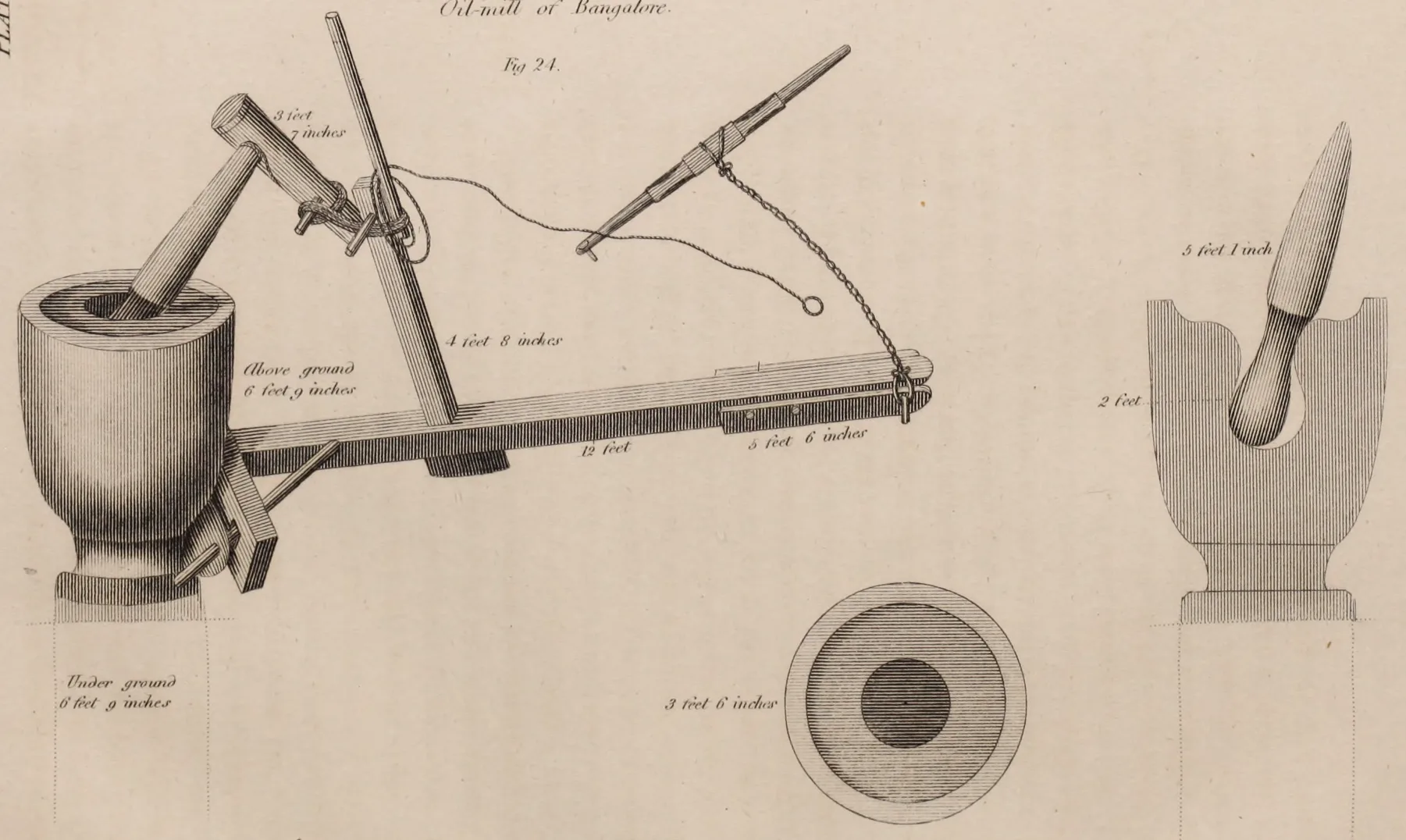
The oil makers at Bangalore are a very considerable class of people, and are of the kind that use two bullocks in their mill, of which a plan is given (Figure 24). The mortar is a block of granite. This class of people are called Jotyphanada, or Jotynagarada Ganagaru. They express the following kinds of oil: Wull'-Ellu, Huts'-Ellu, Harulu, Cobri, Ipay, and Hoingay.
The Wull'-Ellu oil is expressed from two varieties, or species of Sesamum seed, called here Surugana and Cari Ellus. They are the same with the Wullay and Phulagana Ellus of Seringapatam. The first gives the least oil; but for the table it is esteemed the best of any in the country; the price, however, of the two kinds is the same. The mill receives at one time about seventy Seers measure (2 42/100 Winchester bushels) of Sesamum seed; and, in the course of grinding, ten Cucha Seers measure of water (2 78/100 ale quarts) are gradually added. The grinding continues for six hours, when the farinaceous parts of the seed, and the water, form a cake; and this having been removed, the oil is found clean and pure in the bottom of the mortar, from whence it is taken by a cup. Seventy Pucka Seers (2 42/100 Winchester bushels) of Surugana, or 65 Seers of Cari-Ellu seed (2 256/1000 Winchester bushels), give 2 Cucha Maunds (rather more than 5 1/2 ale gallons) of oil. The mill requires the labour of two men and four oxen, and grinds twice a day. The oxen are fed entirely on straw, and are allowed none of the cake; which is sometimes dressed with greens and fruits into Curry, and at others given to milch cattle.
The Huts'-Ellu is managed exactly in the same manner as the Sesamum. The seventy Seers measure require a little more water than the other Ellu, and give 65 Seers of oil (or a little more than 4 1/2 gallons). This also is used for the table. The cake is never used for Curry, but is commonly given to milch cattle.
The Harulu, or castor oil, is made indifferently from either the large or small varieties of the Ricinus. It is the common lamp oil of the country, and is also used in medicine. What is made by boiling, as described at Seringapatam (p. 109.) is only for family use; all that is made for sale, is expressed in the mill. To form the cake, seventy Seers of the seed require only five Seers, cucha measure (1 39/100 ale quarts), of water, and give 60 Seers (4 17/100 ale gallons) of oil; which, after being taken out of the mill, must be boiled for half an hour, and then strained through a cloth. The cake is used as fewel.
Cobri oil is that made from the dried kernel of the coco-nut, which is called Cobri. This oil is chiefly used for anointing the hair and skin. Cakes are also fried in it, and it is sometimes used for the lamp. The mill receives 6 Maunds weight of the Cobri (almost 93 lb.), and 11 Cucha Seers measure of water (a little more than 3 ale quarts). This produces three Maunds (about 7 8⁄10 ale gallons of oil. The natives eat the cake dressed in various ways.
The Ipay oil, made from the fruit of the Bassia longifolia, is used for the lamps burned before the gods, being esteemed of a better quality than that of the Ricinus. The mill takes 70 Seers measure, and the seed requires to be moistened with 12 Cucha Seers (3 1⁄2 ale quarts) of tamarind water, in which 2 Seers of tamarinds have been infused. The produce is 70 Seers (4 365⁄1000 ale gallons) of oil. The cake is used as soap to wash oil out of the hair of those who anoint themselves.
The Hoingay oil, produced from the seed of the Robinia mitis, is used for the lamp; but it consumes very quickly. It is also used externally in many diseases. Take 70 Seers, Pucca measure, of the seed freed from the pods, add 4 Cucha Seers measure of water (1 11⁄100 ale quart), and beat them in a mortar into a paste. Then tread the paste with the feet; and, having kept it for two or three days, dry it in the sun. It is then put into the mill with one Cucha Seer (19 6⁄10 cubical inches) of water. It produces 40 Seers (2 3⁄4 ale gallons) of oil. For fewel, the cake is mixed with cow-dung.
The English weight, to which all the native weights are reduced, is the pound avoirdupois.
The only year in use above the Ghats is the Chandra-manam, or lunar year; it is that by which, among the Bráhmans, all religious ceremonies are performed. The current year, as extracted from the almanack here, is as follows. At Bangalore this is reckoned to be the year 4893 of the Kali yugam, and 1722d of the era of Sáliváhanam, which is in universal use in the peninsula. It must be observed, that in all my accounts of seasons, I use the European days, as they correspond with the Karnataca days in this year; but the year of Karnata being lunar, this correspondence does not commonly take place; and there is in some years a difference of eleven days between what is stated here, and the days that actually correspond with each other in the two almanacs.
| European Months. | Karnata Months. | Holidays. | European Months. | Karnata Months. | Holidays. |
|---|---|---|---|---|---|
| 1800 | 1722 | 1800 | 1722 | ||
| Mar. 26 | Chaitra - 1 | Agádi. | May 14 | Vaisáka - 21 | |
| 27 | 2 | 15 | 22 | ||
| 28 | 3 | 16 | 23 | ||
| 29 | 4 | 17 | 24 | ||
| 30 | 5 | 18 | 25 | ||
| 31 | 6 | 19 | 26 | ||
| April 1 | 7 | 20 | 27 | ||
| 2 | 8 | 21 | 28 | ||
| 3 | 9 | 22 | 29 | ||
| 4 | 10 | 23 | 30 | Amávásya. | |
| 5 | 11 | 24 | Jyaishta - 1 | ||
| 6 | 12 | 25 | 2 | ||
| 7 | 13 | 26 | 3 | ||
| 8 | 14 | 27 | 4 | ||
| 9 | 15 | Chaitra Paurnimá. | 28 | 5 | |
| 10 | 16 | Sankranti. | 29 | 6 | |
| 11 | 17 | 30 | 7 | ||
| 12 | 18 | 31 | 8 | ||
| 13 | 19 | June 1 | 9 | ||
| 14 | 20 | 2 | 10 | ||
| 15 | 21 | 3 | 11 | ||
| 16 | 22 | 4 | 12 | ||
| 17 | 24 | 5 | 13 | ||
| 18 | 25 | 6 | 14 | ||
| 19 | 26 | 7 | 15 | ||
| 20 | 27 | 8 | 16 | ||
| 21 | 29 | 9 | 17 | ||
| 22 | 30 | Amávásya. | 10 | 18 | |
| 23 | Vaisáka - 1 | 11 | 20 | ||
| 24 | 1 | 12 | 21 | Sankránti. | |
| 25 | 2 | 13 | 22 | ||
| 26 | 3 | Achatadiga Gauri | 14 | 23 | |
| 27 | 4 | 15 | 24 | ||
| 28 | 5 | 16 | 25 | ||
| 29 | 6 | 17 | 26 | ||
| 30 | 7 | 18 | 27 | ||
| May 1 | 8 | 19 | 27 | ||
| 2 | 9 | 20 | 28 | ||
| 3 | 10 | 21 | 29 | ||
| 4 | 11 | 22 | 30 | Amávásya. | |
| 5 | 12 | 23 | Ashádha - 1 | ||
| 6 | 13 | 24 | 2 | ||
| 7 | 14 | 25 | 3 | ||
| 8 | 15 | Vyása Paurnimá. | 26 | 4 | |
| 9 | 16 | 27 | 5 | ||
| 10 | 17 | Sankranti. | 28 | 6 | |
| 11 | 18 | 29 | 7 | ||
| 12 | 19 | 30 | 8 | ||
| 13 | 20 | July 1 | 9 | ||
| July 2 | Ashádha - 10 | Seyna ékádasi. | Aug 17 | Srávana - 27 | |
| 3 | 11 | Chaturmasyam. Gopadma-aritam Lukshya-vrata-dipiam. Prathama ékádasi. | 18 | 28 | |
| 4 | 13 | 19 | 29 | ||
| 5 | 14 | 20 | 30 | Amavasya. | |
| 6 | 15 | Vyása pújá. | 21 | Bhadrapada 1 | |
| 7 | 16 | 22 | 2 | ||
| 8 | 17 | 23 | 3 | Swarna Gauri vrata. | |
| 9 | 18 | 24 | 4 | Ganésa vrata | |
| 10 | 19 | 25 | 5 | Rishi panchami. | |
| 11 | 20 | 26 | 6 | ||
| 12 | 21 | 27 | 7 | ||
| 13 | 22 | Sankranti, sun returns | 28 | 9 | Gaja Lakshmi vrata. |
| 14 | 23 | [south. | 29 | 10 | |
| 15 | 24 | 30 | 11 | ||
| 16 | 25 | 31 | 12 | ||
| 17 | 26 | Sept. 1 | 13 | ||
| 18 | 27 | 2 | 14 | Ananta chaturdasi. | |
| 19 | 28 | 3 | 15 | Uma Maheswara vratam. | |
| 20 | 29 | 4 | 16 | Beginning of general fast. | |
| 21 | 30 | Dipastambha-vrata. | 5 | 17 | Bhagavari vratam. |
| 22 | Srávana - 1 | 6 | 18 | ||
| 23 | 2 | 7 | 19 | ||
| 24 | 3 | 8 | 20 | ||
| 25 | 4 | Nagachetrusti. | 9 | 21 | |
| 26 | 5 | Garuda panchami. | 10 | 22 | |
| 27 | 6 | 11 | 23 | ||
| 28 | 7 | 12 | 24 | ||
| 29 | 8 | 13 | 25 | ||
| 30 | 9 | 14 | 26 | Sankranti. | |
| 31 | 10 | 15 | 27 | ||
| Aug. 1 | 11 | Vara maka Lakshmi vrata. | 16 | 28 | |
| 2 | 12 | 17 | 29 | ||
| 3 | 13 | 18 | 30 | General fast in honour of | |
| 4 | 14 | Sravana Paurnima. | 19 | Aswayuja or Aswaja - 1 | [deceased parents ends. Navarátri. |
| 5 | 16 | 20 | 2 | ||
| 6 | 17 | 21 | 3 | Mahasura Gauri vratam. | |
| 7 | 18 | 22 | 4 | ||
| 8 | 19 | 23 | 5 | Kanaka Lakshmi vrata. | |
| 9 | 20 | 24 | 6 | Guhya Gauri vrata. | |
| 10 | 21 | 25 | 7 | Saraswati puja. | |
| 11 | 22 | 26 | 8 | Durga astami. | |
| 12 | 23 | Gokul ashtami. | 27 | 9 | Mana Navami. |
| 13 | 24 | 28 | 9 | ||
| 14 | 24 | 29 | 10 | Visya Dasami or Dana. | |
| 15 | 25 | Sankranti. | 30 | 12 | [puja vrata. |
| 16 | 26 | Oct. 1 | 13 | ||
| 2 | 14 | ||||
| 3 | 15 | Kanmudi vrata, an eclipse. | |||
| 1800. | 1722. | 1800. | 1722. | ||
| Oct. 4 | Aswayuja - 16 | Nov. 21 | Márgasírsha 5 | Bhadrí Gaurí. | |
| 5 | 17 | 22 | 6 | Sampada srishti. | |
| 6 | 18 | 23 | 7 | ||
| 7 | 19 | 24 | 8 | ||
| 8 | 20 | 25 | 9 | ||
| 9 | 21 | 26 | 10 | ||
| 10 | 22 | 27 | 11 | ||
| 11 | 23 | 28 | 12 | ||
| 12 | 24 | Naraka chaturdasi. | 29 | 13 | |
| 13 | 25 | 30 | 14 | ||
| 14 | 26 | Sankránti. | Dec. 1 | 15 | |
| 15 | 27 | 2 | 16 | ||
| 16 | 28 | 3 | 17 | ||
| 17 | 29 | 4 | 18 | ||
| 18 | 30 | Dípávali Amávásya. | 5 | 19 | |
| 19 | Kartika - 1 | 6 | 20 | ||
| 20 | 2 | [Gaurí. | 7 | 21 | |
| 21 | 3 | Dadhi Gaurí and Giraki | 8 | 22 | |
| 22 | 5 | Apanga Lilita Gaurí. | 9 | 23 | |
| 23 | 6 | 10 | 24 | ||
| 24 | 7 | 11 | 25 | ||
| 25 | 8 | 12 | 26 | ||
| 26 | 9 | 13 | 27 | ||
| 27 | 10 | 14 | 28 | Sankránti. | |
| 28 | 11 | 15 | 29 | ||
| 29 | 12 | Uttana dwadasi and Si- | 16 | 30 | Amávásya. |
| 30 | 13 | [rabdi vratam. | 17 | Paushya - - 1 | |
| 31 | 14 | 18 | 2 | ||
| Nov. 1 | 15 | Dhatri pújá. | 19 | 4 | |
| 2 | 16 | 20 | 5 | ||
| 3 | 17 | 21 | 6 | Tulava srishti. | |
| 4 | 18 | 22 | 7 | ||
| 5 | 19 | 23 | 8 | ||
| 6 | 20 | 24 | 9 | ||
| 7 | 21 | 25 | 10 | ||
| 8 | 22 | 26 | 11 | ||
| 9 | 22 | 27 | 12 | ||
| 10 | 23 | 28 | 13 | ||
| 11 | 24 | 29 | 14 | ||
| 12 | 25 | 30 | 15 | ||
| 13 | 26 | 31 | 15 | ||
| 14 | 28 | Sankránti. | 1801. | ||
| 15 | 29 | Jan. 1 | 16 | ||
| 16 | 30 | Amávásya | 2 | 17 | |
| 17 | Márgasírsha 1 | 3 | 18 | ||
| 18 | 2 | Tantrini Gaurí. | 4 | 19 | |
| 19 | 3 | Rambha Gaurí. | 5 | 20 | |
| 20 | 4 | 6 | 21 | ||
| 1801. | 1722. | 1801. | 1722. | ||
| Jan. 7 | Paushya - 22 | Feb. 10 | Magha - 27 | ||
| 8 | 23 | 11 | 28 | ||
| 9 | 24 | 12 | 29 | Sivarátri. | |
| 10 | 25 | 13 | 30 | Amávásya. | |
| 11 | 26 | Sankránti. | 14 | Phalguna - 1 | |
| 12 | 28 | 15 | 3 | ||
| 13 | 29 | Savitra Gaurí. | 16 | 4 | |
| 14 | 30 | Amávásya. | 17 | 5 | |
| 15 | Magha - 1 | 18 | 6 | ||
| 16 | 2 | 19 | 7 | ||
| 17 | 3 | 20 | 7 | ||
| 18 | 4 | 21 | 8 | ||
| 19 | 5 | 22 | 9 | ||
| 20 | 6 | 23 | 10 | ||
| 21 | 7 | Ratri saptami. | 24 | 11 | |
| 22 | 8 | 25 | 12 | ||
| 23 | 9 | 26 | 13 | ||
| 24 | 10 | 27 | 14 | ||
| 25 | 11 | 28 | 15 | Káma Dhanam. | |
| 26 | 12 | Mar. 1 | 16 | ||
| 27 | 13 | 2 | 17 | ||
| 28 | 14 | 3 | 18 | ||
| 29 | 15 | Cunti Gaurí vrata. | 4 | 19 | |
| 30 | 16 | 5 | 20 | ||
| 31 | 17 | 6 | 21 | ||
| Feb. 1 | 18 | 7 | 22 | ||
| 2 | 19 | 8 | 23 | ||
| 3 | 20 | 9 | 24 | ||
| 4 | 21 | 10 | 26 | ||
| 5 | 22 | 11 | 27 | ||
| 6 | 23 | 12 | 28 | ||
| 7 | 24 | 13 | 29 | ||
| 8 | 25 | 14 | 30 | Amávásya. | |
| 9 | 26 | Sankránti. |
Although, in common reckoning, the day begins at sun-rise, yet this is by no means the case in the Chandramánam almanac. Some days last only a few hours, and others continue for almost double the natural length; so that no one, without consulting the Panchánga, or almanac-keeper, knows when he is to perform the ceremonies of religion. What increases the difficulty is, that some days are doubled, and some days altogether omitted, in order to bring some feasts, celebrated on certain days of the month, to happen at a proper time of the moon, and also in order to cut off six superfluous days, which twelve months of thirty days would give more than a year of twelve lunations. Every thirtieth month one intercalary moon is added, in order to remove the difference between the lunar and solar years. As the former is the only one in use, and is varying continually, none of the farmers, without consulting the Panchánga, know the season for performing the operations of agriculture.
These Panchángas are poor ignorant Bráhmans, who get almanacs from some one skilled in astronomy. This person marks the days, which correspond with the times in the solar year, that usually produce changes in the weather, and states them to be under the influence of such and such conjunctions of stars, male, female, and neuter; and every one knows the tendency of these conjunctions to produce certain changes in the weather. The poor Panchángas are as much in the dark as their neighbours, and actually believe that the year consists of 360 days, six of which are lost, nobody can tell how. As for the skill in astrology by which the learned are supposed to be able to foretel the seasons, I have never met with even a Vaidika Bráhman, that doubted its existence. It is, however, looked upon as a common science, as not having any thing miraculous in it, nor being communicated to its professors by divine favour.
The office of Panchánga in every part of this country is hereditary, and is always held by a Bráhman, who acts as Puróhita, or family priest, to all the persons of pure descent in the town or village. In Bengal, Bráhmans who have lost cast act as Puróhitas for the low or impure casts; but both here, and in the lower Carnatic, such an office would be considered as too degrading for even the most reprobate of the sacred order. The office of Puróhita consists in reading at certain ceremonies, such as marriages, births, funerals, the building of a new house, or the like, what are called Mantrams, and Sástrams. Mantrams are certain fixed forms of prayer, or invocations of the deity; and the high dignity of the Bráhmans arises from the power which certain Mantrams, pronounced by them, are believed to possess. For instance, by a proper Mantram, the deity may be removed from any inspired image into a pot of holy water; and the image having been ornamented by profane hands, the deity may be again transferred back from the pot of water. Sástrams are portions of the writings esteemed sacred; and of which certain parts are appointed to be read on particular occasions, such as I have above mentioned.
I assembled at different times the chief persons of some of the most conspicuous casts at Bangalore, and procured from them the following account of their customs.
The Banijigas, or Banijigaru, are in this country a very numerous class, and are of three kinds, the Pancham, the Jaina, and the Telinga Banijigaru.
The Pancham Banijigaru are by the Mussulmans called Lingait, as being the chief persons of the sect, who wear, round their necks, a silver box containing an image of Siva in shape of the Linga, under which form only he is ever worshipped. From this circumstance they are also called Sivabhactaru, and Lingabuntaru; but in this country there are many other lower casts, who wear the same badge of religion. The Pancham Banijigaru are also the heads of the right hand side. They admit of no distinction of cast among themselves, except that arising from a dedication to the service of God; but they do not admit of any proselytes from other Hindu races; nor do they intermarry with any of the lower casts that wear the Linga. The Bráhmans allege, that they are Súdras; but this, in general, they earnestly deny. The manner in which the Bráhmans reason with them is this: You are, say they, neither Bráhman, Kshátri, nor Vaisya. If therefore you are not Súdras, you must belong to one of the low, or impure casts. Many of the Lingait, rather than endure such a terrible degradation, are induced to acknowledge themselves of the Súdra cast. It must however be observed, that Vánija, from which their name is probably derived, is said to be a Sanscrit word, signifying any person of the Vaisya cast who follows trade.
The Pancham Banijigaru are divided into a number of tribes, which seem to derive their names from certain places where they were formerly settled. Two persons of different tribes never intermarry; but all persons of the cast can eat together, and the whole are under the jurisdiction of the head-man (Pedda Chitty), of whatever tribe he may be. This office is, as usual, hereditary; and the person who enjoys it is exempted by government from house-rent, and from one half of the customs on his goods. He finds merchants coming from a distance in lodging and warehouses, settles disputes among his clan, and punishes them for misdemeanours. In general, he is supported by the officers of government, who punish such of his followers as do not give him the customary obedience. His judicial authority, however, is not arbitrary. All his proceedings are open; and he cannot act contrary to the advice of his council, which consists of all the old and respectable men of the cast.
Besides this division into tribes, which arises from the names of places, there seem to be other distinctions among the Linga Banijigas; some are called Aray, that is, Marattahs, and some Teliga, that is, Telingas; and neither of these ever intermarry with each other, or with those who are of the Karnata nation. Some persons allege, that Pancham, the title commonly given to the whole, is only the name of a division; and that there are also Linga Banijigas called Budugulu, Lalgunderu, and Turcanaru.
The Pancham Banijigaru are chiefly traders. They may however follow any profession, except such as belong to the most disgraced casts; and this exception seems rather to arise from a wish to keep themselves respectable, than from any positive law. Like all other worshippers of Siva, they bury the dead, and never offer sacrifices. They do not purchase their wives, of whom they may marry as many as they please. The women are not confined, but cannot marry a second husband; and after the signs of puberty appear, a girl is no longer marriageable. Adultery is very rare ; that is to say, among the women ; for among the people of this country the term is never applied to the infidelity of married men. The Pancham Banijigas never eat animal food, nor take any intoxicating substance. They cannot eat, except when the sun shines ; of course, in cloudy days they are under the necessity of fasting.
Like most other Hindu casts, the Pancham Banijigas consist of a portion that follow worldly affairs, and another that dedicate themselves entirely to what they call the service of the gods; that is to say, idleness, meditation, prayer, abstinence, and the mortification of the passions. Among this cast, these consecrated persons are called Jangamas, Einaru, or Wodearu. Any Pancham Banijiga, who is qualified by his education and manners, may, theycome a Jangama; but the descendants of a Jangama never betake themselves to honest industry. They always subsist upon charity; and most of them wander about with a great number of small bells tied to their legs and arms, in order to give the inhabitants of the villages notice of their presence; so that they may come out to invite the holy men to their houses, or to bestow charity. Many others live about the Matas, or colleges of the Gurus of the cast, and act as their servants.
The Gurus or Swamalus of the Pancham Banijigaru are Sannyásis; that is, men who have forsaken all; and they possess an absolute authority in all religious matters, among which is included the chastity of the women. Of these Gurus, or Sannyásis, there are four, that are called thrones, and whose Matams are called Baly-hully; Hujiny, near Nagara; Sri-shela, near Nundyal; and Canelly, near Bangaluru. These thrones seem to be independent of each other; and their occupants, for the time being, are supposed to be actual incarnations of Siva. When a Guru leaves this world, and is reunited to Siva in heaven, he is in general succeeded by a person of his own nomination. The Guru generally educates four or five children of his own family, with a view of choosing the fittest of them for his successor. These pupils are taken into the Matams at five or six years of age, and, until they attain their thirteenth year, are called Mari; after which they are not by name distinguished from the common Jangamas; but if they choose to marry, they must relinquish all hopes of becoming a Guru. The pupil is made a Guru (sage), or an incarnation of God, by receiving from his master a particular Upadésa; and in case of a Guru's dying without having disclosed this awful secret, the other Gurus assemble, appoint the most promising pupil to succeed, and at the same time deliver to him the Upadésa of his rank. The Guru, when he pleases, may marry; but he is thereby degraded from being a portion of the divinity, and from his power; and no one has yet been found so desirous of marriage, as to relinquish these pre-eminencies.
There are many inferior Matams which are occupied by Sannyásis, called Mahántina. These originally received an Upadésa from some of the four chief Gurus, and were sent to distant parts to manage the concerns of their superiors; but, though they all acknowledge the superiority of the four Gurus, yet they educate pupils in the same manner; and from among these appoint their successor, by teaching him their Upadésa. These pupils, till they arrive at the age of puberty, are called Putta Dévaru. The Mahántina having sent deputies to different places, even these have now assumed a separate jurisdiction, and educate their own successors.
The Mahántina attend at marriages and funerals, and punish all persons of the cast, for every kind of offence against religion, by ordering every good man to avoid communication with the delinquent. This excommunication is not removed, till, by the intercession of friends, and the most humiliating requests of the offender, he obtains pardon by paying a fine under the name of charity. On this occasion, the Mahántina bestow some consecrated water and victuals, which wipe away the offence. The Gurus occasionally visit the different Mahántina throughout the country; but it is the Guru only of the Matam from whence the Mahántina originally came, that possesses any jurisdiction over the inferior.
The Pancham Banijigaru worship only Siva, his wife, and his sons: but they allege, that Brahmá and Vishnu are the same with Siva. They suppose, that their sect has existed from the beginning of the world ; but that at the time of Bejala Rája, who reigned about 720 years ago at Kalyána Pattana, the kings and most of the people were Jainas. At this time Baswana, the supposed son of a Bráhman, became prime minister of the Rája, and restored the worship of Siva. Many of the Jainas were converted, and their descendants now form the Jaina Banijigaru, who, although they have the same religion with the Pancham, are never admitted to the priesthood, nor to intermarry with the original sect. Bejala Rája having been put to death by Jagadíva and Bomanna, two servants of Baswana, that minister reigned in his stead ; and then promulgated the law which this sect now follow ; and this, with an account of all the actions of Baswana, are contained in a book called Baswana Purána; which was written by a Bráhman called Bhimakavi, at the desire of Baswana. The sect are in possession of another book of great authority. It consists of six Sástrams written by a Jangama named Nijaguna, who, in the conversation which he had with an image of Siva at a temple on a hill near Ellanduru, received the necessary instruction. After he had finished the book, this Jangama did not die ; but the image, opening, received him into its substance. It continues ever since to be held in great estimation. These books are open to the vulgar ; but it is said, that the Jangamas have some books which are kept secret.
The Teliga Banijigaru derive their name from having originally come from the Telinga country, which, in the dialect of Karnata, is called Teliga. They all retain the Telinga language, and allege that all Banijigas are descended from a person called Prithivi Mala-chitty. By his first wife, who was of the Vishnu sect, he had the ancestors of their cast; and by his second wife, who worshipped Iswara, or Siva, he had the ancestors of the Lingabantaru. They are evidently an inferior people, and more ignorant than the other Banijigas, owing probably to their being under the Bráhmans, who exclude their followers from a share of their learning. In the Teliga language they are called Balija; whence, probably, is derived the name Buljewar, which is bestowed by the Mussulmans on all Banijigas.
The true Telinga Banijigas are merchants and traders of all kinds, farmers, and farmers servants, and porters for the transportation of goods or baggage; but never artists, nor mechanics. They are divided into a number of tribes, all of which can eat together; but one tribe never marries with another. The chiefs of the Lingabantas have a civil jurisdiction over the Teliga Banijigaru; but in order to settle matters relating to their own cast, they choose the man whom they judge to be most capable; and in the absence of their Gurus, this man calls an assembly of the elders, and settles the affair.
Their Gurus are all hereditary chiefs of the Sri Vaishnavam Bráhmans, and never punish any delinquent without the advice of a council of elders. In their visits, these Gurus live in the temples, and assemble the people in order to collect their contributions, and to bestow Upadésa and Chacrántikam on such as choose to receive them. The Panchánga acts as their Puróhita, attending at births, marriages, and funerals, and on each occasion receives charity.
Among the Teliga Banijigaru the custom of Dáséri prevails. A Dáséri is a man dedicated to the service of the Tripathi Vishnu; that is to say, who subsists by begging in the name of that idol. When a sick man is in great danger, he frequently vows, if he recovers, to take Dáséri, or to make one of his sons assume that profession; and ever afterwards the eldest son of the family must follow that business, but the younger sons follow some industrious employment. The Dáséri may marry, and may be a rich man; as the younger branches of his family live in his house, and cultivate the ground, or carry on trade; but he himself wanders about, and collects grain, and small money, from those who are charitable. They get by rote a prayer in Telinga poetry, which they constantly bawl out in the streets, and endeavour farther to attract notice by blowing on a conch. It seems to be only the Súdras of the Vishnu sect that follow this idle life, and few of them are able either to read or write.
The Telinga Banijigaru are acknowledged to be true Súdras, and they allow this to be the case. A few of them learn to read and write accompts, but they never attempt any higher kind of learning. They eat sheep, goats, hogs, fowls, and fish, and may use Bang; but they ought not to drink spirituous liquors. They bury the dead, and the women formerly used to bury themselves alive with their deceased husbands; but this custom has fallen into disuse. They pray to Vishnu, and all the gods of his family; and also to Dharma Rája, an inferior god of a beneficent nature; but with the Bráhmans he is not an object of worship. In case of danger, they offer bloody sacrifices to several destructive spirits; such as Marima, Putalima, Mutialima, and Gungoma, which is a lump of mud made into a sort of temporary image. The Bráhmans of this country abhor this kind of worship, and call all these gods of the vulgar evil spirits, Saktis, or ministers of Siva. They never offer sacrifices at the temples of these deities, and much less ever act as their Pújáris. Influenced, however, by superstition, although they condemn the practice, they in sickness occasionally send a small offering of fruit or money to these deities; but, being ashamed to do it publickly, the present is generally conveyed by some child, who may be supposed to have made the offering by mistake. The small temples of these deities are very numerous, and the Pújáris are in general of the impure casts. I am inclined indeed to believe, that they are the original gods of the country; and that these impure casts are the remains of the rude tribes that occupied the country before the origin of the Bráhmans, or other sects, that introduced forms of worship more complicated, and more favourable to the priesthood.
Many of the people who burn lime are a kind of low Teliga Banijigaru, as they can eat in the houses of that class; but their native language is the Karnataka, or Canarese; and the two tribes do not intermarry. They are divided into several families, and no man marries out of his own; but they can all eat together. They have hereditary chiefs, who settle disputes relating to cast; but in civil affairs they are subject to the chiefs of the Pancham Banijigaru. They do not wear the Linga, yet they consider as their Guru the Nidamavudy Swámalu, who is a Mahántina Einaru, and lives in the Bala-pura district. They never eat with the sect of Siva; and use animal-food, and Bang; but are not allowed to drink spirituous liquors. They bury the dead. They are allowed a plurality of wives, who are not confined, and are so industrious that they are looked upon as a support to their husbands. They are never divorced, except for adultery; and if their infidelity has not been with a man of a very low cast, the parties are frequently reconciled by the Swámalu, who makes them eat together some consecrated victuals, which, with some holy water, puts an end to all differences. None of them can either read or write. They never become Dáséri. The god of their cast is Vencaty Rámana, or the Tripathi Vishnu: but they pray also to Dhárma Rája, and offer sacrifices to Marima, and other destructive spirits.
Another inferior kind of Teliga Banijigas are the Goni makers. They will willingly eat in the houses of that cast; but these will not return the compliment. They will also eat the meat prepared by a Pancham Banijiga. They have their own hereditary chiefs, who are as ignorant as their followers, none of them being able either to read or write. Some of them are farmers, and some are small traders, which does not effect any difference in cast. They do not wear the Linga, and their Guru is one of the hereditary chiefs of the Sri Vaishnavam Bráhmans, whose family title is Tata Achárya. The present Guru, named Ráma Achárlu, lives here. Those who are natives of this country bury their dead, and the Goni makers of the lower Carnatic burn theirs; but this does not prevent the two from intermarrying. They are allowed a plurality of wives. Without danger of losing cast they can eat hogs, fowls, mutton, and fish, and can drink spirituous liquors.
The Dévángas are a set of weavers, consisting of two nations, Karnata, and Telinga.
The Karnata or Canara Dévángas in this country all wear the Linga, but are a distinct cast from the Pancham Banijigas, with whom they neither eat nor intermarry. The same is the case between them and the Teliga Dévángas. Their Guru is Cari Baswa-uppa, who, from the place of his residence, is commonly called the Nidamavudy Swámalu. The Dévángas pretend that he is totally independent of the Gurus of the Linga Banijagaru; but I have reason to think that this is a vain piece of pride, and that he is one of the Mahantina before mentioned. The Guru sends Jangamas to all the villages where Dévángas reside, and receives contributions under the name of charity. Owing to a dispute about the burning of the body of the Rája’s mother, this priest incurred the heavy displeasure of Tippoo, and was under the necessity of flying to the dominions of the Nabob of Arcot, and still remains there at Trinomaly. The learning is chiefly confined to the Swámalu and his pupils. Most of the Jangamas are acknowledged, even by their followers, to be very ignorant. The sect have a book called Dévánga Purána, which every one may read. It was written by Dévánga Muni, the common ancestor of the race. The Jangamas read the Baswana Purána, and possess many books that the Dévángas are not permitted to see. Out of these they repeat portions to the laity at the annual ceremony performed in memory of their deceased parents, at births, and at funerals. These portions are committed to memory by the Jangamas, it not being lawful for the laity even to look at the books; but as these are written in the vulgar language, and of course are understood by every one, the Dévángas are laughed at by their neighbours for considering them as of any value. The Panchánga attends at marriages, and reads a Mantram in Sanskrit; which, being unintelligible, is very highly valued. The knowledge of the laity is confined to the keeping of accompts and writing letters. The Gurus and Jangamas possess the same authority over the Dévángas, as they do over the Pancham Banijigas.
The proper god of the cast is Iswara or Siva, and his wife and family; especially his servant the Baswa, and his son Ganésa, who has particular authority over the loom, and, when his worship is neglected, is apt to make it go wrong.
The hereditary chiefs of the Canara Dévángas are called Ijyamána. With the assistance of a council of the elders, these chiefs take cognizance of all offences against the ceremonies of cast. They reprimand for small offences; for those of a higher nature, excommunicate; and, in cases of great importance, send the accused person to the Swámalu for his decision. The chiefs and councils endeavour to settle all civil disputes between members of the cast, first by admonition; then by excommunication of those who are unreasonable; and finally by applying to the officers of government, who generally enforce the decrees of the Ijyamánas.
The whole of the Canara Dévángas can intermarry. They are allowed a plurality of wives, which they purchase from their parents, paying from 4 to 16 Pagodas (1l. 6s. 2 1/4d.—5l. 7s. 5 1/2d.) for each, according to their circumstances. The wives are not shut up, nor are they ever divorced except for adultery. They eat no animal food, nor use any intoxicating substance, except as a medicine. They bury the dead, and believe that after death good men are united to God; bad men suffer transmigration. The Nidamavudy Swámalu is looked upon as the same with Iswara, and even a common Jangama is considered as a portion of the deity.
The Teliga Dévángas retain their native Telinga language, but are divided into two sects; of whom one worships Vishnu, and the other Iswara; but both sects intermarry, the wife always adopting the religion of the husband.
The Teliga Dévángas of the sect of Siva do not wear the Linga, although they consider Cari Baswa-uppa as their Guru. This priest admonishes them to wash their heads, and to pray regularly to Iswara; and, as usual, requires from them contributions. He has a small due on every marriage. The Panchánga reads Mantrams at births, marriages, and funerals; at the Amávásya, or last day of the lunar month, and at the Tithi, or day on which their parents died; on both of which days a fast, in commemoration of their deceased parents, is observed by the greater part of the Hindu race. On these occasions the Jangamas attend, but merely to receive charity. Concerning a future life, they have similar opinions with those who wear the Linga. They offer bloody sacrifices to the Saktis. They bury the dead; and the custom of the widow burying herself alive with her husband's body was once prevalent among them, but has now become obsolete. Girls, after the age of puberty, continue to be marriageable. A man is allowed to take many wives, but is not permitted to shut them up, nor to divorce them for any cause except adultery. The men confine their learning to the being able to read and write accompts. They eat fowls, fish, hogs, sheep, and goats, but account it unlawful to drink spirituous liquors.
The Teliga Dévángas of the Vishnu sect are followers of the Sri Vaishnavam Bráhmans, and are acknowledged by them to be Súdras.
The hereditary chiefs, or Ijyamánas, of all the Dévángas are the same; each man in the place submitting to the authority of the chief of the sect that is most numerous.
The Shaynagas, or Shaynagaru, form a very numerous and wealthy class of weavers. They are divided into two nations, Telinga, and Canara; but of the former, there are none in this neighbourhood.
Although by far the greater part of the Canara Shaynagas are settled below the Ghats, in countries where the Tamul language is spoken; and though all these who are settled now in this neighbourhood came up from the lower Carnatic about eighty or a hundred years ago; yet the whole cast retain the language of Karnata as their native tongue. This confirms the truth of a tradition prevalent among them, of their having all originally gone down from this country; but they can assign no date, nor any reason for such an emigration. They are divided into two classes; one dedicated to Religion, and called Einaru, Jangamas, or Wodearu; the other follow lay professions. All the weavers can intermarry; but they are never honoured by an intermarriage with the Einaru, nor are they ever admitted into that sacred order. They wear the Lingam, and consider their priests as portions of the deity. They bury the dead. They can eat in the house of a Pancham Banijiga; but the two casts never intermarry.
The hereditary chiefs of the Canara Shaynagas are called Ijyamána, and, with a council of elders, possess the sole cognizance of transgressions against the rules of cast, as well as of civil disputes; for the power of the Jangamas is confined to admonition. They do not shut up their women; and are not allowed to take a second wife, unless the first dies, or has no children. When a man marries his first wife, he must give her father 101 Fanams, or 3l. 7s. 10d.; for a second he must give 131 Fanams, or 4l. 7s. 11¾d. No divorce can take place, except for adultery on the side of the woman; the wife in India having no remedy for her husband’s infidelity except her tongue; and in case of her being too free in the use of that weapon, the men very frequently repress it by a beating.
The weavers learn to read and write accompts, and letters on business; but in this country these are reckoned very mean accomplishments. A plain composition in prose, and consisting merely of common sense, is looked upon as a kind of reading beneath the dignity of a man of learning, who ought always to compose in poetry; and the more obscure he renders his meaning by allegories, the better. The books containing the doctrines of the sect are confined entirely to the Einaru, whose duty it is to explain them to the laymen. The chief book in use among them is called the Márkandiya Purána; and they do not receive as canonical the Baswana Purána.
Among the Einaru of the Shaynagas are several high priests called Putta Dévarus or Swámalus. These are all Sannyasis, and seem to be independent of each other. Those which are known to the people here, are, Sankara Dévaru, who lives at Changamau near Trinomaly; Bhuságara Swámi, at Narasingha pura, near Arnee; Gangádhara Swámi, at Kunji; Sénavéra Dévaru, at Chinamangala near Trinomaly; and Gurusiddha Dévaru, at Trinomaly : all which places are in the lower Carnatic. These Putta Dévaru have their Matams at the places above mentioned; but travel occasionally through the country occupied by the weavers, collecting the contributions of the charitable, bestowing advice on the adults, and the Linga on the children, who receive it with some particular ceremonies. Each of the Putta Dévarus educates a boy, who is of the sacred class by birth, who is intended to be the successor of his master, and who is called Mari. The Putta Dévaru, if he chooses, may deliver over his office to the Mari, and take a wife; in which case he is degraded to the rank of a common Einaru. This is frequently done, as my informants were obliged to confess; though they did so with great reluctance; for they were unwilling to disgrace their Swámalus before their neighbours, who consider celibacy as a much more honourable state than marriage. The married Einaru have their houses near the different Matams. Some of them live with the Sannyásis, and are their menial servants; but the greater part of them, that are able to undergo the fatigue, wander about to collect charity for their support. In the lower Carnatic they are said to sell glass rings, and other trinkets.
The people of this cast, with whom I conversed, were either so ignorant, or so unwilling to speak, on the subject of their religion, that I cannot depend much on what they said. The Jangamas of the Pancham Banijigaru allege, that the Swámalus of the Shaynagas are of their sect: and the Mahántina, no doubt, attend at the funerals and other public ceremonies of the Shaynagas; but those allege that this is merely for the purpose of begging, and that they perform no part of the ceremony. The Panchánga reads Mantrams at marriages and births, and receives the usual fees.
The Coramas, or Coramaru, are a set of people, considered by the Bráhmans as of an impure or mixed breed. They make baskets, and trade in grain and salt to a considerable extent; but none of them can read or write. They live, in general, in small camps of moveable huts, which are sometimes stationary near large towns; but they are often in a state of daily motion, while the people are following their mercantile concerns. The Coramas consist of four families, Maydraguta, Cavadiru, Maynapatru, and Satipatru. These are analogous to the Gótrams of the Bráhmans; for a man and woman of the same family never intermarry, being considered as too nearly allied by kindred. The men are allowed a plurality of wives, and purchase them from their parents. The agreement is made for a certain number of Fanams, which are to be paid by instalments, as they can be procured by the young woman’s industry; for the women of this cast are very diligent in spinning, and carrying on petty traffic. When the bargain has been made, the bridegroom provides four sheep, and some country rum, and gives a feast to the cast; concluding the ceremony by wrapping a piece of new cloth round his bride. Should a man’s wife prove unfaithful, he generally contents himself with giving her a beating, as she is too valuable to be parted with on slight grounds; but, if he chooses, she may be divorced. In this case, he must assemble the cast to a feast, where he publicly declares his resolution; and the woman is then at liberty to marry any person that she chooses, who is willing to take her.
The Coramas do not follow nor employ the Bráhmans; nor have they any priests, or sacred order. When in distress, they chiefly invoke Vencaty Rámana, the Tripathi Vishnu, and vow small offerings of money to his temple, should they escape. They frequently go into the woods, and sacrifice fowls, pigs, goats, and sheep, to Muni, who is a male deity, and is said by the Bráhmans to be a servant of Iswara; but of this circumstance the Coramas profess ignorance. They, as usual, eat the sacrifices. They have no images, nor do they worship any. Once in two or three years the Coramas of a village make a collection among themselves, and purchase a brass pot, in which they put five branches of the Melia azadarichta, and a coco-nut. This is covered with flowers, and sprinkled with sandal-wood water. It is kept in a small temporary shed for three days, during which time the people feast and drink, sacrificing lambs and fowls to Marima, the daughter of Siva. At the end of the three days they throw the pot into the water.
The Panchálas, or Panchálaru, a name corrupted by the Mussulmans into Panshcal, are a cast that follow five different trades, goldsmiths, carpenters, blacksmiths, masons, and coppersmiths. These occupations do not occasion any difference of cast; the son of a man of any one of the trades may, if he pleases, follow any other, and all of them can eat together and intermarry. Each trade, it is true, has a head-man; but the whole are subject to one hereditary chief, who is here a goldsmith. He is the leader of the left hand side; and at present the dispute between him and the chief of the Banijigas runs so high, that government have been obliged to part the town into two divisions. In the one of these the right hand side is not allowed to perform any ceremonies, nor to go in procession; and the other division is kept equally sacred from the intrusions of their adversaries. The head-man of the goldsmiths has a similar jurisdiction with other chiefs of casts; and, with the assistance of his council, can levy fines, which are given to the goddess Kálí; that is to say, to her priest.
The Panchálaru are divided into two sects; one worshipping Siva, the other adoring Vishnu; but this does not produce any schism; the two parties eating together, and intermarrying; and when this happens, the wife adopts the religion of her husband. Kálí is considered as the proper deity of the cast; but receives no bloody sacrifices from her votaries. Both sects are prohibited from animal food, from spirituous liquors, from divorce (except in case of adultery), and from marrying a girl that has arrived at the age of puberty. The Bráhmans read Mantrams at the births, marriages, and funerals of both sects; and no distinction is made by either, whether the Bráhman be a worshipper of Siva, or of Vishnu.
The most numerous and richest of the Panchálas belong to the sect of Siva, and wear the Linga; but they have nothing in common with the Pancham Banijigas, and in fact are their most bitter enemies. This sect bury the dead.
The Panchálas who worship Vishnu are called Bagota, and have among them a family dedicated to religion. The eldest son of this family always succeeds to the dignity of Guru on the death of his father; the other male branches of the family are supported by the contributions of the sect, and pass their time in devotion and study. The women of the family intermarry with the working men of the cast. The Guru is named Vipur Vencaty Achárya; Vipur being his name, and Vencaty Achárya his title. He lives at Wadiga-palla, which is twelve Cosses from Bangalore, and in the Doda Bala-pura district He travels about among his followers, receiving their contributions, and bestowing Upadésa, and Chakrántikam, or Mudradárana as it is called in the Sanskrit language.
The Madigas, or Madigaru, are looked upon as a very low cast. They dress hides, make shoes, and some of them cultivate the ground, acting as servants to the farmers. They are divided into small tribes of ten or twelve houses, and intermarry with the daughters of these houses only, in order to be certain of the purity of their race; of which they seem to be as fond, as those casts that are esteemed infinitely superior in rank. Some of the richer among them take two or more wives; but this is not common, as a girl's father requires from 30 to 80 Fanams (1l. 0s. 1¾d.—2l. 13s. 8¾d.). They never divorce their wives for any crime, except adultery. They eat carrion, and all manner of animal food, and avowedly drink spirituous liquors. Their religious worship seems to be exactly the same with that of the Coramaru ; but they have a priestly tribe, who never intermarry with the laity, who live entirely on their contributions, and are called Jambu. There is a Matam of Jambu at Cuddapa ; and the office of high priest there is hereditary. This person takes frequent rounds through the country, collecting money, and admonishing his followers. I have never seen any of the Jambu ; and, if they have any learning among them, they keep it entirely to themselves, as none of the laity can either read or write.
The Madigaru, who by the English of Madras are called Siclars, have no hereditary chiefs ; but, in case of any fault being committed by a person of the cast, the elders assemble, and punish him according to custom.
The Rungaru are a tribe admitted to be of the Súdra cast. They are taylors, and printers of calico cloths. They have hereditary chiefs, with the usual jurisdiction, and follow the rules of their cast. Their Guru is an hereditary chief of the Sri Vaishnavam, who resides at Seringapatam. He punishes obstinate offenders, and bestows Upadésa ; and in return takes their contributions. He does not favour this cast by giving them Chakrántikam.
The Jotyphanada, or Jotynagarada Ganagaru, are a kind of oil-makers, who deal largely in that commodity, and have two oxen in their mills. They pretend to be of the Bheri, or Nagarada sect of the Vaisya cast ; but this is not admitted by either the Bheri or Bráhmans. They are a real Karnataca tribe. Two families here wear the Linga, and are not admitted either to eat or intermarry with the others, who are all followers of one of the hereditary chiefs of the Sri Vaishnavam Bráhmans, who lives here, and is called Nullary Chakravarti. He bestows on them Upadésa, and sometimes Chakrántikam, but that rarely. When they marry, he gives them a string or thread, to be worn over the shoulder. This should be given to the real Vaisya only; but a relaxation is made in their favour, as they pay for the badge; and the preservation of the privileges of the lower casts is looked upon as a matter of very little importance. The Guru comes sometimes in person, and at others sends his agents, to levy the dues which are paid at marriages, and to receive the casual charity that is given according to the ability and disposition of his followers.
These oil-makers offer sacrifices to the Saktis, or destructive powers; making vows to do so, when they are in sickness or distress. Some of them take Dáséri; and their descendants ever afterwards follow the same manner of living, and refuse to intermarry with the industrious part of the cast, whom they consider as their inferiors. Some of the oil-makers burn, and some bury the dead. There have been instances, in the memory of man, of some of their widows having burned themselves along with the bodies of their husbands; but it is a very rare occurrence. Their wives can be divorced for adultery only, and are not shut up, although the men are allowed a plurality of women. They eat no animal food, nor is it lawful for them to drink spirituous liquors. They possess no learning, farther than being able to read and write accompts; and a few poems in the Andray, or poetical language of Telingana, which the Dáséri commit to memory.
The people who, in the language of Karnata, are called Chitrakaru, are commonly better known by the Mussulman appellation Jinigar, or Jiligar. They make chests, trunks, scrutoires, beds, and palankeens, paint houses, draw pictures of the gods and of women, gild, act as tailors, make gold thread, and sword scabbards, turn wood, and bind books. They never cultivate the ground, nor act as merchants. They pretend to be of the Kshátriya cast; and their Guru, in consequence, indulges them with a thread like that of the Bráhmans; but their pretensions to high rank are entirely disavowed by all other casts. They have among them some rudiments of learning.
In the Brahmanda Purána, which is the book that they consider as appropriated to their cast, it is related, they say, that their ancestors, on account of some injury done to the Bráhmans, were condemned to follow their present mechanical occupations. They are divided into two sects; one worshipping Siva, and the other Vishnu: but this division produces no difference of cast, as they can all eat and marry together, the wife, as usual, adopting the religion of her husband. The worshippers of Siva do not wear the Linga, but are followers of the Smartal Bráhmans. A Vaidika Bráhman residing here bestows the thread and Upadésa, and attends at births, marriages, and funerals, which are performed on the pile, and are sometimes accompanied by the sacrifice of a wife. Those who worship Vishnu are followers of the Sri Vaishnavam Bráhmans. Neither division of these people eat animal food, nor drink spirituous liquors. They are allowed plurality of women, but do not confine them. Like all the other tribes of this country, however, they do not willingly admit any person of a different race into the inner apartments of their houses; especially if he be of a cast that they consider as inferior to their own; persons of their own tribe, and those whom they consider as of higher rank, can go into every part of their house, except the kitchen. The circumstances which seem chiefly to add dignity to a cast are, its being restricted from the pleasures of the world, especially those of the table; the following no useful employment; and the being dedicated to what they call piety and learning. Almost every man endeavours, as much as possible, to assume at least the external appearance of these qualifications; and in the people of this country a hypocritical cant is a remarkable feature. Even young men of active professions, when talking on business, will frequently turn up their eyes to heaven, and make pious ejaculations, attended with heavy sighs.
The Shalay are a cast of weavers, divided into two distinct tribes, that never intermarry, and have separate hereditary chiefs. They are of Telinga origin, and in their families retain that language: According to tradition, they have been in this country for six generations.
The Samay Shalay wear the Linga, and of course are worshippers of Iswara, and the gods of his family. They reject the worship of the Saktis, or destructive powers. Their Gurus are the Einaru of the Pancham Banijigas, with which cast the Samay Shalay can eat, but they cannot intermarry. When their Guru visits the town, each Shalay of this sect must present him with two Fanams (1s. 4d.); and when a Samay Shalay waits on the Guru at the Matam, he must make an offering of ten Fanams, (6s. 8½d.). The Guru does not give Upadésa; but, in place of it, bestows the Linga. In case of the Guru's absence, this may be done by any Einaru. The Einaru attends at births, marriages, funerals, and on the occasion of building a new house. The Panchánga attends at marriages to read the Mantrams, or service proper for the ceremony, and receives the usual fees. On these occasions, the Einaru washes the bridegroom's feet, and gives him some consecrated victuals. They bury the dead, and the widow is sometimes buried alive at the same time, but not in the same grave with the deceased husband. Widows cannot marry a second time, as is the case throughout India with females of any cast above those that are reckoned impure. The men are allowed a plurality of wives; but, except for adultery, can neither confine nor divorce them. They cannot legally eat animal food, nor drink spirituous liquors. The laymen are permitted to read several Puránas; such as the Baswa Purána, which gives an account of the laws of their religion: and the Shalayswara Purána, which is extracted from a book called the Bráhmanda Purána, and contains the rules of their particular sect, as the original work contains the rules of every sect whatever.
The worshippers of Vishnu, among this class of weavers, are called Padma Shalay, and give the following account of their origin. The whole Shalay formerly wore the Linga; but a house having been possessed by a devil, and this sect having been called upon to cast him out, all their prayers were of no avail. At length ten persons, having thrown aside the Linga, and offered up their supplications to Vishnu, they succeeded in expelling the enemy; and ever afterwards followed the worship of this god, in which they have been imitated by many of their brethren. The descendants of these men, who are called Sadana Ashorlu, or the celebrated heroes, never work; and having dedicated themselves to the service of god, live upon the charity of the industrious part of the cast, with whom they disdain to intermarry.
The Guru of the Padma Shalay is Tata Achárya, one of the hereditary chiefs of the Sri Vaishnavam Bráhmans. He lives at Doda Bala-pura, and bestows Upadésa and Chakrántikam. He has here a deputy, a Vaidika Bráhman, who attends at births, marriages, and burials. Widows are never buried alive. The Padma Shalay are allowed a plurality of wives; but cannot confine their women, nor divorce them, except for adultery. They cannot legally eat animal food, nor drink spirituous liquors; but are permitted to use Ganja, or hemp, which the English in India usually call Bang. Some among them are able to read poetry, and have a book called Márkandiya Purána, which is also followed by several sects that wear the Linga, and is said to have been written by a Rishi named Markanda.
The Comatigas say, that they are the only true Vaisya, which is the third in rank of the pure casts; and they pretend, that now they are next in rank to the Bráhmans, as the second pure cast has become extinct. In both these pretensions they are supported by all the Bráhmans who are not desirous of flattering some Rája that pretends to be a Kshatri. They are found thinly scattered in every part of India, and are not prevented from eating in common, or from intermarriage, by any difference of nation or sect. A Comatiga coming from Kási or Benares, on being examined, and found to be acquainted with certain customs peculiar to the cast, and which are kept secret, is received here into all families, and may marry any of their women. They deal in cloth, and all kinds of merchandize, especially money and jewels; but are not allowed to sell spirituous liquors, nor any intoxicating substance; nor do they ever cultivate the ground, or follow any mechanical profession. They have hereditary chiefs, called Pedda Chitties; and the chief of each town or district is totally independent of the others. When a town is very large, the chief, for the parts that are remote from his house, appoints inferior officers, who settle trivial disputes. These chiefs possess the usual jurisdiction, and enjoy more than common immunities, for they pay nothing to government. They can in no case act without the assistance of all the elders in the place. The Comatigas are not allowed to take animal food, nor any thing that will intoxicate. Polygamy is allowed to the men, and the women are not divorced for any cause, except adultery. In this country they are not confined; but in the northern parts of Hindostan the Comatigas follow the example of their neighbours, and shut up their wives. Many of this cast read books composed in poetry; that which is considered as peculiarly belonging to it, is called Vaisya Purána, and is imagined to have been composed by the goddess Kanyaká Paraméswarí, which is one of the names of the wife of Iswara. They all burn the dead, and sometimes the widow accompanies on the pile her departed husband. The women are no longer marriageable after the signs of puberty have appeared; and widows are condemned to perpetual celibacy. Some families of this cast worship Vishnu, and their Guru is Bhadra Achárya, one of the hereditary chiefs of the Sri Vaishnavam Bráhmans, who resides at Sri Rangam near Tritchinopoly. Younger branches of the family reside at different places, and act as deputies for the chief. The one who acts in this neighbourhood resides at Doda-Bala-pura, and is called Chicana Botalu. The other families of this cast worship Siva, and have for their Guru a Sannyási Bráhman of the Smartal sect, who lives at Sivaganga, and acknowledges the Sringa-giri Swamalu as his superior.
The Ruddi are one of the tribes of Súdra cast, which being much employed in agriculture are called Woculigaru in the language of Karnata, and Cunabi in that of the Decany Mussulmans. Besides cultivating the land, both as farmers and as their servants, they act also as porters, and sometimes carry on a small trade in grain. Like all the other Súdras employed in agriculture, they have formed a part of the native foot militia, that seems to have been established throughout India, and in which probably every man of this description was enrolled. The considering the Kshatriya as the military cast seems an error. At present, the Ruddi frequently serve as Candashara, or the armed men, that without discipline collected the revenue, and composed the most considerable body in the armies of all native princes. They appear to form a numerous race of men; many of them live below the Ghats, and some are of Telinga, while others are of Karnata extraction. They can all eat together, but they never intermarry, except with particular families, the purity of whose descent they consider as well known. They acknowledge an inferiority to another class of Súdras who cultivate the land, and are called Sadru; for they will eat in the house of a Sadru, but he will not return the compliment by eating in theirs; which, among the Hindus, is a sure criterion of rank. They have Ijyamánas, or hereditary chiefs, possessing the usual jurisdiction and immunities. Some of them can read and write accompts; but none proceed farther in learning. They eat hogs, sheep, goats, venison, and fowls, and can take Bang (or the leaves of the Cannabis sativa); but lose cast by drinking spirituous liquors. The men are allowed polygamy; but do not shut up their women, who are very industrious, and perform much of the country labour. They are divided into two sects by a difference of religion; one party worshipping Vishnu, and the other Siva; but this does not prevent intermarriages. Those who worship Vishnu are followers of the Sri Vaishnavam Bráhmans; but do not receive either Upadésa or Chakrántikam, contenting themselves with a little holy-water, which they obtain in return for their charity. Those who worship Siva are followers of a kind of Jangamas, but do not wear the Linga. The\n people with whom I conversed seemed to consider these as the same\n with the Jangamas of the Pancham Banijigas; but this cast informed\n me, that they were distinct, and that the Gurus of the Ruddi were\n the same with those of the Curabaru, whose chief resides at Can-\n gundy in the Bára-mahál. In their visits, the Gurus of both kinds\n receive from one to ten Fanams (from 8d. to 6s. 8½d.) from each\n Ruddi, according to his circumstances. The Panchánga attends at\n births, marriages, funerals, and other ceremonies; and on each oc-\n casion receives a Fanam. At the new and full moons, he also gets\n some trifling present of grain. Besides the worship of the great\n gods, they offer sacrifices to the destructive powers; among whom\n a female spirit, named Chaudéswarí, has in this neighbourhood many\n temples. The Pújári, in at least one of them, is an oil-maker of\n the cast formerly described, and his office is hereditary. The Ruddi\n is one of the lowest of the casts employed in agriculture, and allowed\n to be of pure descent; but many of its members are rich, and are\n the Gaudas, or hereditary chiefs of villages.
The Bheri are a kind of merchants, who call themselves also Na-\n garatra, corrupted by the Mussulmans into Nagarit. They pretend\n to be of the Vaisya cast; but this is denied both by the Bráhmans,\n and by the Comatigas. They deal in drugs, grain, cloth, and money,\n and travel about in caravans. Some of them are farmers; but they\n never cultivate the ground with their own hands; nor do they ever\n follow any mechanical profession. They are divided by religion\n into two sects, that do not eat together, nor intermarry; and each\n has its own hereditary chief, who acts independently as to matters\n of ceremony; but in matters of a civil nature, the chief of the sect\n that is most numerous in the place assumes the sole authority.\n These chiefs are called Ijyamána, and possess the usual jurisdiction;\n but are not indulged with any immunities from taxes. When a man\n wants to marry, he goes to his hereditary chief, as is indeed usual\n with all the higher casts, presents him with betel, and discloses his intention. The chief sends for the father of the girl, and endeavours to bring the matter to a favourable conclusion. As for the girl, she is not at all consulted, and is indeed too young to have formed any attachments, as she must be married before any signs of puberty appear; for afterwards she is considered as being deflowered, and incapable of marriage. Owing to the custom of polygamy, however, very few of the women in this country live in a state of celibacy, except young widows of the higher casts, who never can marry again, and who are very numerous; for matches between old men and mere children are common. The comfort of having children, however, is, in general all the pleasure that married women of rank in India enjoy. Where polygamy prevails, love is little known; or if it does possess a man, he is generally captivated by some artful dancing girl, and not by any of his wives; all of whom were married before they could either excite or feel that passion.
The Nagaratra, who worship Vishnu, are here the most numerous sect. They burn their dead, and the rules of cast require the widow to burn herself with her husband’s body; but this custom has fallen into disuse. They do not intermarry with such of their sect as, being originally of the lower Carnatic, speak the Tamul language as their native tongue. Their Guru is Trimula-tata Achárlu, an hereditary chief of the Sri Vaishnavam Bráhmans; but, as forming part of the left hand side, they are, in all matters belonging to that division, under the authority of Dharma Siva Achárlu, a Smartal Sannyási, and who, they say, bestows Upadésa and Chakrántikam on them, in the same manner as their own Guru. My interpreter, however, suspects that in this there is some mistake; as the latter ceremony is performed with the point of Vishnu’s spear, which a Smartal Bráhman, so far as he knows, never uses. Their own Guru comes once a year, receives contributions, bestows Upadésa and Chakrántikam, and, as usual, exercises spiritual jurisdiction. The Panchánga acts as their Puróhita; and it is of no consequence, whether or not he be of the same sect with them. Some of this cast are able to read poetry, and peruse a book called Vaisya Purána, which they consider as belonging to their cast.
The Pallíwánlu are the only persons in the Colar province (of which this is a part) who cultivate kitchen gardens. They also cultivate the ground, both as farmers, and as their servants. They are all of Tamul extraction; and, although they have been in this country for many generations, still speak the Tamul language in their own houses, and intermarry with the Pallí of Arcot and Vellore. They are properly called Vana Pallí, and must be distinguished from the Mina Pallí, who are fishermen. This is one of the most numerous of the tribes of the Tamul nation, but is considered as rather low. They have hereditary chiefs called Gaunda, who possess the usual jurisdiction. None of them can read. They are allowed to eat animal food, and to drink spirituous liquors. Their women continue to be marriageable after the age of puberty, and are very laborious. They cannot be divorced for any cause, except adultery; but the men are permitted to have a plurality of wives. They bury their dead.
The Pallíwánlu have no Guru; but the Panchánga acts as their Puróhita at births and marriages, at the Amávásya, and at the annual commemoration of their deceased parents. They wear the mark of Vishnu's sect, and sometimes pray to Vencaty Rámana; but the proper god of the cast is Dharma Rája. His images exactly resemble those of Godama, who is frequently called by that name; but by the people here their god is said to be the eldest brother of the five sons of Pándu, who lived at the commencement of this Yugam. He is a beneficent deity, like Godama, abhorring blood; and is worshipped by offerings of fruit, flowers, and the like. The Pallíwánlu have temples of this god attended by Pújáris of their own cast. Like all the other inhabitants of this country, they are much addicted to the worship of the Saktis, or destructive powers; and endeavour to avert their wrath by bloody sacrifices. These are performed by cutting off the animal’s head before the door of the temple, and invoking the deity to partake of the sacrifice. There is no altar, nor is the blood sprinkled on the image; and the body serves the votaries for a feast. The Pallíwánlu have temples dedicated to a female spirit of this kind named Mutialima, and served by Pújáris of their own cast. These priests can neither read nor write, but their office is hereditary. Their families can intermarry with those of the laity, who cultivate the priest’s garden, and give him annually a suit of clothes. The Pallíwánlu also offer sacrifices to Márimá, whose Pújáris here are Curubáru; and to Putálimá, whose Pújáris are Lingáit. They sometimes take the vow of Dáséri.
In many parts of this country, the wells contain what the natives call salt water; and at Bangalore there are many of this kind. Some of these are situated very near wells that are perfectly fresh; which is easily accounted for, from the vertical situation of the strata. This salt water is preferred, by the dyers, to that which is fresh. It has a maukish disagreeable taste, no smell, and is quite limpid. It is never used medicinally. A white precipitate is formed in it by the nitrate of silver. It, therefore, probably contains some muriate of soda. No sensible action is produced on it by the sulphuric, nitric, or muriatic acids, nor by lime-water. The carbonates of soda and potash throw down a white precipitate, which is readily dissolved in the sulphuric acid; and the solution is soluble in water. It, therefore, contains magnesia. When evaporated, this water deposits a dirty pulpy semideliquescent matter, which is only partially soluble in water. It effervesces strongly with the sulphuric acid; but part of it falls down again in an insoluble state. The water, therefore, contains lime also. While the sulphuric acid is acting on the precipitate formed by boiling, it emits a very offensive smell. The lime and magnesia are evidently suspended in the water by being dissolved in some volatile acid; and, if it had not been for the offensive smell above mentioned, I should have supposed the solvent to be the carbonic acid. Circumstances did not allow me to ascertain this point; nor to analyse the water with any precision.
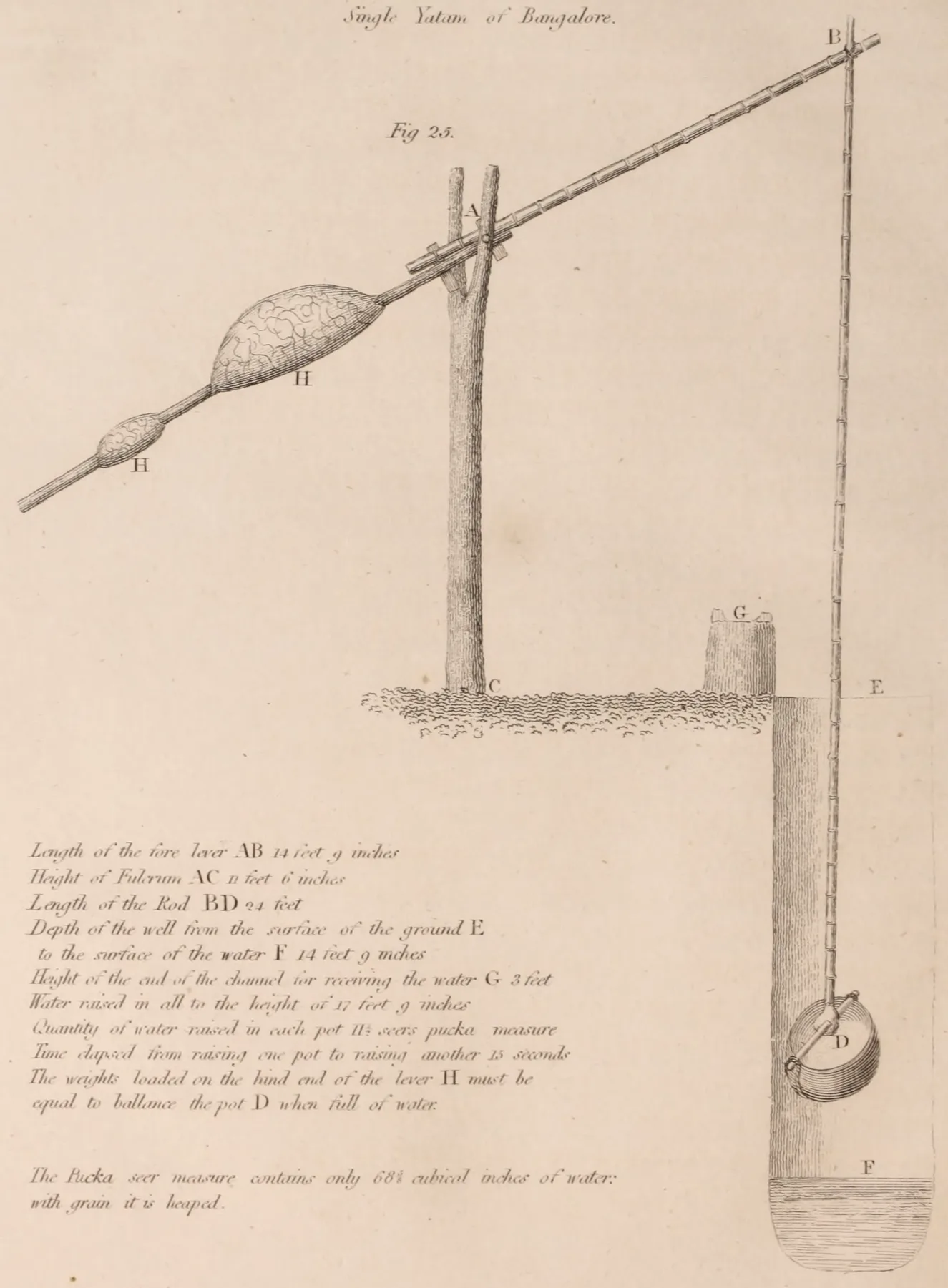
In this country the water for supplying gardens is generally raised by a machine, called Yatam in both the Tamul and Karnata languages. Of this a sketch is given in (Fig. 25). In the lower Carnatic the machine is wrought by a man, who walks along the balance; coming before the fulcrum, when he wants to sink the bucket; and going back again, when he wants to bring up the water. Another man in this case attends to empty the bucket. But in this country one man, standing at the mouth of the well, performs the whole labour. I have made no actual experiments to ascertain by which of the two methods the same number of men would raise the greatest quantity of water; but it appears to me, that the plan in use here is the most perfect. At Madras, the man who walks along the lever, or balance, is in considerable danger of falling; and the man who empties the bucket is in danger of being hurt, for it must come up between his legs, as he stands fronting the end of the lever; and although the bucket there is much larger than the one in use here, I have observed that the workman was never able to empty more than two thirds of its contents, owing to the awkward position in which he stood. The machine, from which the drawing was taken, consisted of a lever or balance (A B) 14 feet 9 inches in length. This rested on a fulcrum (A C) 11 feet 6 inches high. The fulcrum is commonly a tree planted near the well. A rod or Bamboo (B D) 24 feet in length, by which the workman raises and lowers the bucket (D), containing 789 cubical inches. Depth of the well, from the surface of the earth (C E) to the surface of the water (F) 14 feet 9 inches. Height of the end of the canal for conveying away the water (G), 3 feet. Total height to which the water is raised, 17 feet 9 inches. The far end of the lever is loaded with mud (H H), so as exactly to counterbalance the pot, when full of water. The average time which the workman took to raise a pot of water was 15 seconds. By this means, therefore, a man can in an hour raise about 671 ale gallons to the height of 17 feet 9 inches. If the depth of the well be less, as is usually the case, the quantity raised by the same labour will be much greater; but in what proportion I did not ascertain.