HAVING finished my business at Seringapatam, on the 6th of June 1800, I left it early in the morning, and assembled my people at a small village, named Gaynangur, which is situated among the hills north from the river Cávery. The fields that are at present occupied having now been all ploughed, I observe that a large proportion of the arable land is left waste.
At Gaynangur there is much talc; but the laminæ are not large enough to serve for glass. It occupies the rents and small veins in an extensive chain of quartz, which is in a state of decomposition, and of which some parts are red, and some white. By digging deep, it is probable that larger pieces of the talc might be found. The inhabitants are wonderfully ignorant of the mineral productions of their country; for they did not know the limestone nodules, so common in this place, when shown to them in their own fields. All their lime comes from the city.
7th June.—I went to Mundium. Not above one third of the arable land appears to be now occupied.
The flight of locusts that I saw when I was here last (p. 57), settled at a village to the eastward, and ate up all the young Jola.
The rice land here is watered entirely from tanks or reservoirs; and the cultivation is never commenced till there be a sufficiency of water in the tank to ensure the crop. When the rains set in early, and fill the tank timely, the farmers have yearly two crops; but when the early part of the season is dry, they take a Hainu crop of Wull’ Ellu, Udu, Hessaru, or Carlay; and afterwards, when the tank is filled, plough for a crop of Caru rice.
The kinds of rice cultivated here are as follow :
| Names. | Ripening. | Names. | Ripening. |
|---|---|---|---|
| Doda Butta | 5 months. | Conawaly | 5 months. |
| Putu Butta | 5 months. | Mulu Butta | 3 months. |
| Hotay Caimbuti | 5 months. |
Every kind may be cultivated, either as Hainu or Caru. The Mulu Butta is never sown, except when there is a deficiency of water. The only cultivation here is the Mola Butta, or sprouted-seed ; the manner of preparing which is as follows : Steep the seed in water all night ; next morning mix it with cow-dung, and fresh plants of the Tumbay Sopu, or Phlomis esculenta, Roxb. MSS., and put it in a Mudy. On the Mudy place a heavy stone, and on the two following days sprinkle it with water. On the third day it is fit for sowing.
For the Hainu crop, the ploughings, from about the 1st of June till the 11th of July, are nine in number. Dung and leaves are then put on the field, and trampled into the mud. The water is now let off, until no more than a depth of one inch remains ; afterwards, the seed is sown, and a slight sprinkling of dung is laid over it. A watering once in three days is then given ; and after the third time, the field is inundated till the grain ripens. The weeds are removed on the 20th, 40th, and 60th days. The Caru cultivation is exactly the same, only the ploughings are between the 21st of November, and the 20th of December.
In both kinds of cultivation, and in every species of rice, an equal quantity of seed is sown on the same extent of ground, and the produce is nearly equal. By measuring a plot of ground, and reducing to the English standards the farmer's estimate of its seed and produce in a middling good crop, I find the seed to be for an acre, 1 bushel 1,624 gallon, and the produce to be 36 bushels 0,720 gallon, or thirty fold. The quantity of seed here is smaller, and the produce greater, than in the land watered by the river Cávery.
8th June.—I went to Madura. Since the 4th instant, when we had a heavy storm of wind, rain, and thunder, the weather has been remarkably pleasant. The sun is in general clouded, and the temperature of the air like moderate summer weather in England.
The proportion of ground in actual cultivation does not appear to exceed one tenth part of the country. At Madura there is a very fine reservoir, which indeed waters more ground than the inhabitants can cultivate; for they are much reduced in number. In Hyder’s time they amounted to 250 houses; and they rose to 400 in the early part of the Sultan’s government. By the expeditions of Lord Cornwallis the houses sunk to 250, and Tippoo’s late oppressions have reduced them to 100. The people, however, seem to be much satisfied with the protection they enjoy under the British forces, and are betaking themselves with industry to the re-establishment of their country.
The reservoir, and an old pagoda in the fort, are said to be the work of Vishnu Verdana Raya, a prince who, about 700 years ago, had very extensive dominions in this country. The reservoir is a very valuable work, and ought to render this prince’s name venerable to the latest posterity. It receives a supply from the river by means of a dam and canal; and, with the repairs which it is now about to receive, is expected to be able to supply with water, through the whole year, all the fields under the level of its bank. The extent of this land is very considerable; but the supply of water having been for some years deficient, the farmers have been obliged, on many fields, to content themselves with a Hainu crop of Carlay, and a Caru crop of Jola.
Two crops of rice are never taken from the same field in one year; but in order to divide the labour, part of the rice ground is cultivated in the Hainu, and part in the Caru season.
The following are the kinds of rice cultivated here:
| NAMES. | Months required to bring the Seed to maturity. | Seed required for one Acre. | Produce of one Acre 1st Quality of Soil. | Increase on one Seed. | Produce of one Acre 2d Quality of Soil. | Increase on one Seed. | Produce of one Acre 3d Quality of Soil. | Increase on one Seed. | ||||||||
|---|---|---|---|---|---|---|---|---|---|---|---|---|---|---|---|---|
| Bushels. | Pecks. | Gallons. Decimal parts. | Bushels. | Pecks. | Gallons. Decimal parts. | Bushels. | Pecks. | Gallons. Decimal parts. | Bushels. | Pecks. | Gallons. Decimal parts. | |||||
| Hotay Caimbuti | 5 | 1 | 0 | 1.467 | 59 | 1 | 0.47 | 100 | 41 | 2 | 0.25 | 70 | 23 | 2 | 1.8 | 40 |
| Doda or Bily Butta | 5 | 1 | 0 | 1.467 | 59 | 1 | 0.47 | 100 | 41 | 2 | 0.25 | 70 | 23 | 2 | 1.8 | 40 |
| Arsina Caimbuti | 4½ | 0 | 3 | 0.627 | 47 | 1 | 1.6 | 114 | 35 | 2 | 0.7 | 84 | 17 | 2 | 1.52 | 42 |
| Putu Butta | 4½ | 0 | 3 | 0.627 | 47 | 1 | 1.6 | 114 | 35 | 2 | 0.7 | 84 | 17 | 2 | 1.52 | 42 |
| Yalic Raja | 4½ | 0 | 3 | 0.627 | 47 | 1 | 1.6 | 114 | 35 | 2 | 0.7 | 84 | 17 | 2 | 1.52 | 42 |
| Murargilli | 6 | 0 | 3 | 0.627 | 47 | 1 | 1.6 | 114 | 35 | 2 | 0.7 | 84 | 17 | 2 | 1.52 | 42 |
| Conawaly | 5 | 0 | 3 | 0.627 | 47 | 1 | 1.6 | 114 | 35 | 2 | 0.7 | 84 | 17 | 2 | 1.52 | 42 |
| Sucadass | 4½ | 0 | 3 | 0.627 | 47 | 1 | 1.6 | 114 | 35 | 2 | 0.7 | 84 | 17 | 2 | 1.52 | 42 |
This estimate was formed by taking a farmer to his own field, asking him how much seed it required, and measuring it. The measures were then changed into English; and the other farmers were interrogated concerning the quantity that each kind of rice should produce on an equal extent of the different kinds of soil. The produce of the same kind of rice, in the same soil, whether cultivated as Hainu or Caru, or as Mola or Nati, should be nearly the same.
All the kinds of rice may be raised either as Hainu or Caru crops, or by the Mola or Nati modes of cultivation. No Puneji is ever attempted. The Mola cultivation is exactly the same as at Mundium. The seedlings for transplantation, in the Nati cultivation, are always raised as Niragy.
The cultivation of sugar-cane being somewhat different from that used at Seringapatam, I shall enter into the particulars. The only cane cultivated here is the Restali. The preparation of the ground occupies about three months previous to the end of Phalguna, which happened this year on the 14th of March. The steps taken in this preparation are as follow. Water the field. Allow it three days to dry, then plough it six times, and break the clods with the Col Kudáli. Manure with leaves, and plough again; manure with dung, and plough three times. The field, having been thus prepared, is divided into beds, as at Seringapatam (p. 96). Four holes, about a cubit's distance from each other, are formed in the breadth of each bed. Two cuttings of three joints each, are put in each hole, and covered first with an inch of earth, and then with five inches of dung. Water is given to each hole, and every morning for fifteen days this is repeated. The holes are then dug up with a sharp stick, and more dung is given. For fifteen days more the watering must be again repeated. The whole field must then be hoed with the Yella Kudáli, and in each bed a winding channel must be formed, passing through between the rows of holes, as in the explanatory sketch (Fig. 7). When there is no rain, these channels must once a week be filled with water. At the end of a month the ground must be again hoed, and the channels formed afresh. Between the 24th of May and the 22d of June, the canes become a cubit high. The plants of each hole must then be tied together with a binding of leaves. A third hoeing is now given, and the earth heaped up round the roots of the cane. The waterings once a week must be continued. When the plants have grown another cubit, which will be about the beginning of September, they must be tied a second time; and again a third time about the beginning of November, the watering once a week having been regularly continued. About the end of December, the works are repaired; in the tenth month from planting the crop commences, and must be finished in the eleventh. The cane is succeeded by Sesamum, that by rice, and that again by sugar. The Sesamum and rice occupy one year, and the sugar-cane another, alternately. The best fields for this cultivation are composed of a sandy red soil. The low black clays are reserved entirely for rice.
In this part of the country much of the soil is impregnated with saline matter, and called Soulu munnu. Of this there are two kinds ; one chiefly impregnated with carbonate of soda, the other with the muriates of soda and magnesia. The latter would produce nothing : the former is cultivated, although it produces poor crops. The manure used for it is formed of the branches of the Euphorbium Tirucalli, which in this part of the country are never used on any other kind of rice-ground. In the country near Madras they are, for all soils, the most esteemed manure.
Having procured a Sri Vaishnavam Bráhman, esteemed a man of great learning, I examined him concerning the peculiarities of his sect ; but with very little satisfaction. However well these men may be instructed in certain dogmas, and the art of disputation, they are not qualified to give any satisfactory information concerning the origin of their order, or the means by which it came to prevail over others ; for, of the sectaries which differ from themselves, such as those of Budha, Jaina, or Siva, they profess an almost total ignorance, and sovereign contempt.
This man allows, that in the existing Védas no mention is made of any division of the Bráhmans into sects ; but he contends, that from the very beginning of the universe all the three sects of Smartal, Aayngar, and Madual, existed ; and he says, that they are mentioned in the eighteen Puránas, which, next to the Védas, are by the Bráhmans esteemed as most holy. Although the Bráhmans have existed from the beginning of time, yet in the ninth century of the era of Sáliváhana, or tenth century of Christianity, twenty-one heretical sects had arisen in Bhárata-khanda, and had turned from the true worship almost the whole of its inhabitants. Each of these sects had a Bhásha, or book explaining their doctrine, founded partly on dogmas derived from the Védas, and explained in the last six of the eighteen Puránas, and partly on tenets contrary to the books esteemed sacred by the Bráhmans. The most remarkable of these sects were the Buddhists, the Jainas, and the Sarvakas.
About this time arose a celebrated doctor of the Bráhmans, named Sankara Achárya, who belonged to the sect of Siva. The eighteen Puránas are divided into three distinct doctrines, called Satwika, Rájasa, and Támasa; the principles of which, from their tendency, are compared to God, to a king, and to the devil; the first and last resembling God and the Evil Spirit, while the Rájasa is of a princely nature, partly good and partly bad. Sankara Achárya, as a Smartal, acknowledged the two first parts to be the proper guide for the conduct of Bráhmans; and wrote a Bhásha, or commentary, called after his own name; in which he explained the doctrine of the first twelve of the eighteen Puránas, so as to reconcile it with the tenets of six of the prevailing sects, of whom the most remarkable were the Savaram, Ganapatyam, Saivam, and Vaishnavum. By this method he gained a strong party; and having, among others, brought over the prince of Sringa-giri, where he lived, he commenced a violent persecution against the heretical doctrines.
In the year of Sáliváhana 932 (A. D. 1009), at Sri Permaturu, or Srivaram P’huthur, near Madras, was born Ráma Anuja Achárya of the Sri Vaishnavam sect of Bráhmans, and who, of course, followed the authority of the first six only of the eighteen Puránas. These six are called Vaishnavam, Náradyam, Bágawatam, Garudam, Padmam, and Varáham. The second division of the eighteen Puránas is read by this sect of Bráhmans, although they do not found on it any of their doctrines. They look with horror on the third division. On arriving at the age of discretion, Ráma Anuja became a Sannyási, and wrote a commentary, in which he confuted the works of Sankara Achárya, and demonstrated, that of the twenty-one sects, the only one that ought to be tolerated was that called Vaishnavam. The commentary of Ráma Anuja is now the chief guide of the Sri Vaishnavam Bráhmans. They worship Vishnu, and the gods of his family only, and all over the Decan are almost exclusively the officiating priests in the temples of these deities. They allege Brahmá to be a son of Vishnu, and Siva the son of Brahmá, and consider them as the creative and destructive powers in the universe; but they abhor the worship of these gods. Vishnu they consider as the same with Para Brahmă, or the Supreme Being: yet they worship him in nine only of his ten incarnations. Budha, although the tenth incarnation of Vishnu, is never worshipped by them, nor, I believe, by any Bráhman. The reason assigned for this is as follows: one of the Asuras, or demons, named Tripura, possessed a city, the inhabitants of which were very troublesome to the inhabitants of Brahma Lóka, heaven of Brahmá, who attempted in vain to take the place; it being destined not to fall, so long as the women who resided in it should preserve their chastity, which hitherto had been inviolate. The angels at length offered up their prayers to Vishnu, who took upon himself the form of a most beautiful young man, and became Budha Avatára. Entering then into the city, he danced naked before the women, and inspired them with loose desires; so that the fortress, being no longer defended by the shield of purity, soon fell a prey to the angels. As the Bráhmans cannot defend this action of the god, they never invoke him by the name or in the form of Budha Avatára.
Ráma Anuja Achárya having had great success both against the Smartal, and the heretical sects, especially the Jainas, formed a hierarchy for his followers. He divided the whole into eighty-four portions; and ordered, that each portion, and their descendents, should be subject to a Guru or Swámalu of his appointment, and to the successors of this Guru. The number of Gurus belonging to this sect are therefore eighty-four; of whom five are Sannyási, and seventy-nine are married hereditary chiefs.
The Matams, or places where the five Sannyási Gurus chiefly reside, are Ahobalum, Totadri near Ráméswara, Tripathi, Sri Rangam, and Kunji. When one of these Sannyásis observes the approach of death, he appoints some Vidwansa, or man of learning and piety, to be his successor. If the person chosen give his consent, he must forsake his wife, children, and goods, part of which goes to his children, and part is given in charity; that is to say, to the Bráhmans. The new Sannyási shaves his head, and throws aside the thread by which Bráhmans are distinguished. The virtues and powers belonging to his high rank he receives along with an Upadésa, which is delivered to him by his predecessor. Upadésa is a mysterious sentence, which the Hindus receive from their Gurus, and constantly mutter when at their devotions. That of the Bráhmans is entirely different from what is bestowed on the lower casts; and is again very inferior to that given to the Sannyási Gurus, which, according to them, has most wonderful powers. In case of sudden death, the followers of the Mata meet, and choose from among themselves a Sannyási, who gets an Upadésa from one of the others. These Gurus frequently give an Upadésa, and some images, to a favourite disciple, and appoint him a kind of deputy to manage their affairs at a distance. Thus the Ahobalam Swámalu has sent a deputy to Mailcotay, who resides at that great place of Hindu worship, and there watches over the interests of his superior. These deputies observe the rules of Sannyási, but have no power to appoint a successor. When one of them dies, the followers send back the images to their Guru, and request that he would depute another representative.
Among the Sri Vaishnavam Bráhmans the office of an hereditary Guru descends in the male line according to primogeniture; but, when one of them has no children, he must adopt his nearest male relation, who succeeds him as his son. Kindred by the female line is considered as not forming a tie of blood. These hereditary chiefs, once in two or three years, make a circuit round the places where their followers live. They also send agents to transact their business. An infant may succeed, and during his minority the business is carried on by the nearest male relation, or by some other Vaidika Bráhman, whom the family appoints.
The Sannyásis and hereditary Gurus seem to be totally independent of each other, and to possess nearly the same authority and powers over their followers. When a Guru of any sect comes near a place, the whole inhabitants of a pure descent, whether they be his followers or not, must go out to receive him with the utmost respect. What is meant by the followers of a Guru, are certain families attached to him, to whom he performs certain ceremonies, and over whom, in all matters connected with religion, he possesses a jurisdiction. In general, every man follows the Guru of his father: but this seems to be a voluntary submission; and it is commonly allowed, that a man, whenever he pleases, may change his Guru. The ceremonies bestowed by the Sri Vaishnavam Gurus on their followers are chiefly Upadésa and Chakrántikam. The Upadésa I have already explained. It is delivered orally to the follower; and to write it down, or reveal it, are crimes of such an enormous magnitude as to be quite unknown. The Chakrántikam is performed with the spear of the god Vishnu, which is made hot, and applied by the Guru to the shoulder of the disciple, so as to burn the skin. During life this is frequently repeated; the Upadésa is only delivered once.
Neither of these ceremonies are ever bestowed on a person of an impure birth; so that the Whalliaru and Madigaru must content themselves with praying to God for his blessing to avert evil, or bestow good. This however not being satisfactory, these poor people frequently attack the Bráhmans for an Upadésa. In order to be quit of their importunity, the Bráhmans sometimes tell them the name of any god, the constant muttering of which pleases the man much better, than the offering up his requests to the deity in the pure language of the heart. So powerful is the influence of ceremony over that of reason.
In their judicial capacity the Gurus possess great authority. They take cognizance of all omissions of ceremonies, and actions that are contrary to the rules of cast. Small delinquencies they punish by pouring cow-dung and water on the head of the guilty person, by fine, and by whipping. For great offences they excommunicate the culprit; which is done by shaving his head. This excludes a man from all society, even from that of his nearest connections; for his very wife would incur a similar punishment by giving him any assistance. The excommunication may be removed by the Guru; in which case he purifies the repentant sinner by a copious draught of cow’s urine. Though the deputies have no proper authority to punish delinquents, yet they frequently make people voluntarily submit to their correction. They threaten any person to send a complaint to his Guru of some crime laid to his charge, and an order to proceed to the residence of the Guru to answer the complaint. Most persons, however, choose to submit to whatever the deputy dictates, rather than undertake the trouble of a long journey; at the end of which they might be more severely punished by the Guru, than they would have been at home by the deputy.
When a Guru is accused of any misdemeanor, he is called before a Trimatustaru, or assembly of the most eminent Vaidika Bráhmans of all the three sects, who have the power of inflicting six different punishments, all of which are very severe.
9th June.—I went to Chinapatam, or Chenapattana, which was formerly the residence of a Polygar family called Jacadéva Rayas. They were Teliga Banijigaru, and seem to have risen into power about five centuries ago. They continued till very lately possessed of considerable territories; and were reduced by the Mysore Rajas, no long time before these, in their turn, became subject to the Mussulmans. The direct heir of the family, in the male line, now resides here in great poverty; and, being a petty trader, is called Jiva Raja Chitty.
Glass-ware is one of the manufactures of this place. It is made by two operations. In the first, from the raw materials, are formed masses of glass; in the second, these masses are wrought up into small bottles, and ornamental rings for the arms of women.
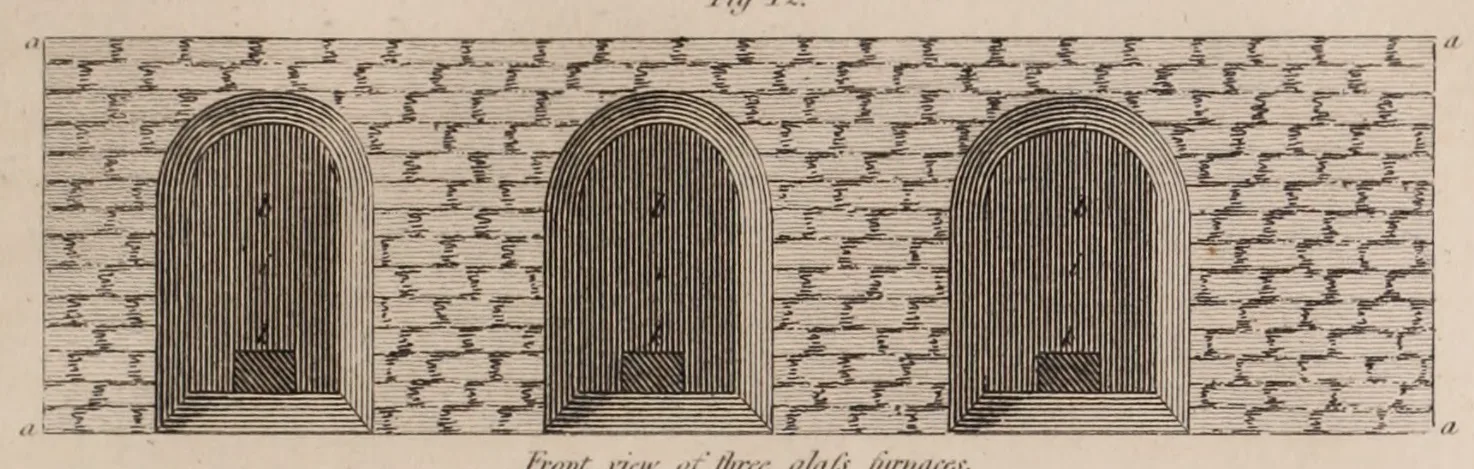
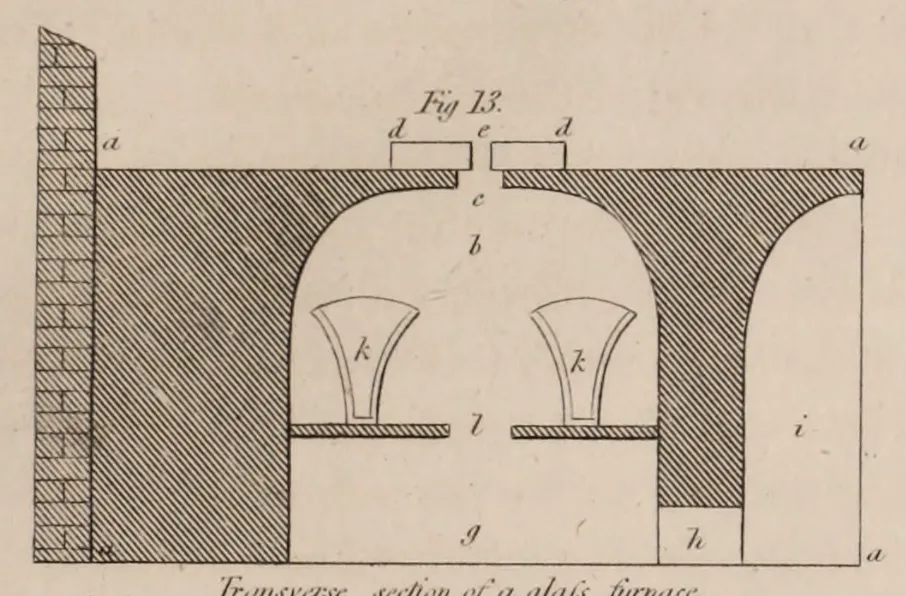
The rude sketches in the Figures 12 and 13, will assist the reader to understand the following account of the furnaces by which the first operation is performed. Two or three of them are in general constructed in the same building (a a a a), which is erected in form of a terrace against one of the walls of a yard; and which, where there are three furnaces, may be six feet high, twelve broad, and twenty-six long. The furnace (b) is arched, and in the summit has a round opening (c) about two feet in diameter. This is covered by a flat stone (d), in there is an aperture (e). Near the surface of the ground is a platform (f f) which has an aperture in its centre (l). This divides the furnace into two cavities, the lower of which (g) serves for the fewel, which is introduced by an opening (h) at the bottom of a niche (i i i) that is formed in the front of the terrace. The crucibles containing the materials (k k) are introduced by the opening (c) in the summit of the furnace, and placed in a circle on the platform (f f). The opening (c) is then covered with the flat stone (d), and the air is excluded by covering the stone with moist clay. The small hole (e), however, is left open. The fire place (g) is then filled with wood, and the fire is managed according to the nature of the materials which the crucibles contain.
For making green glass, take of the following articles according to apothecary’s weight:
| lb. | oz. | dr. | scr. | gr. | |
|---|---|---|---|---|---|
| Broken glass | 14 | 9 | 0 | 0 | 0 |
| Banaji Callu, powdered white quartz | 14 | 9 | 0 | 0 | 0 |
| Loha (an old button like brass was given to me as a specimen) | 0 | 3 | 2 | 1 | 13 |
| Copper | 0 | 2 | 9 | 1 | 16 |
| Caricullu, iron ore with manganese | 0 | 2 | 1 | 2 | 2 |
| Soulu, or impure soda | 29 | 6 | 0 | 0 | 0 |
| lb. 58 | 11 | 5 | 2 | 11 |
This is the charge for one crucible.
PLATE VI.
Warner sc
In making red glass the Loha is left out. Forty-four crucibles stand in one furnace. A small quantity of the materials is assayed in the furnace used for blowing the glass; and, if the soda prevails too much, an addition is made to the quartz.
In order to vitrify these materials, burn on the first day ten bundles of firewood. Next day put out the fire by stopping the air. Next day put in fresh wood, and keep up the fire for eight days; but no supply of fewel is given at night. The fire of course goes out towards morning. Afterwards the fire must be kept up night and day, till the glass be melted; which is known by putting an iron rod into the crucible through the small hole (e) in the flat stone. This requires from four to six days more. The fire at first is put out with a view of preventing, by this means, the glass from being injured by the smoke: but it is not easy to conceive any chemical operation more injudiciously conducted than this is. The alkali is never saturated, and effloresces from the glass, when that is kept any length of time. Each crucible ought to produce 41 lb. 3 oz. 4 dr. 2 scr. 8 gr. of glass, worth seven Sultany Fanams or 4s. 8½d.
The contents of one crucible for black glass, are
| lb. | oz. | dr. | |
|---|---|---|---|
| Quartz | 14 | 9 | |
| Soda | 29 | 6 | |
| Broken glass | 22 | 1 | 4 |
| lb. 66 | 4 | 4 |
In eight or nine days this is vitrified by a fire burning constantly, and produces about 44¼ lb. worth 4½ Fanams, or a little more than three shillings.
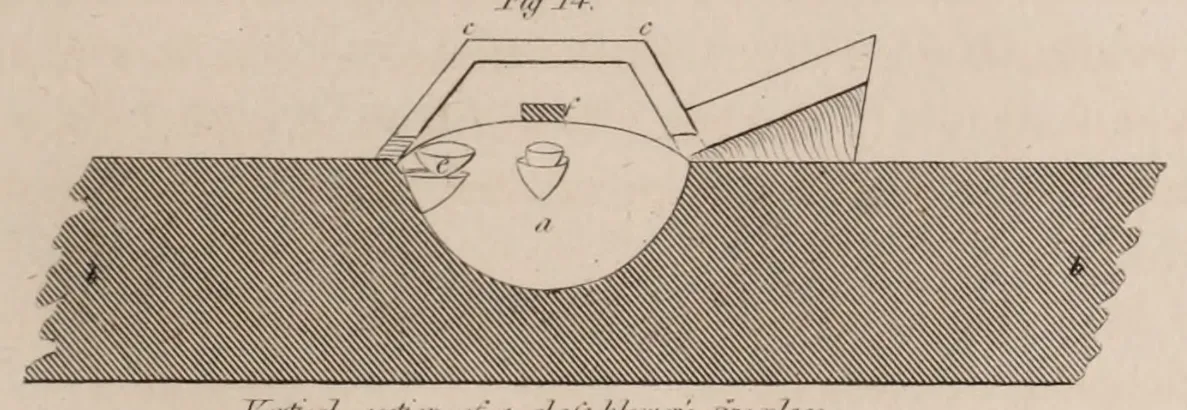
The ornamental rings are made as follows (see Fig. 14): A circular cavity (a), about two feet and a half in diameter, is dug in the floor of the work-shop (b b), and is covered by a flat dome of baked clay (c c). In this are four perforations, one of which cannot be seen in the sketch, as it is a section. By one of these the fewel, which is charcoal, is introduced by an inclined plane (d). The three other openings (f f) are for the workmen to take out the glass, which is put in a flat earthen crucible (e e) like a soup-plate. When the glass is melted, two workmen sit down at each of the three openings, six men in all to each furnace, with an assistant to keep up the fire. One man of each pair introduces the point of an iron rod, and turns it round among the melted glass, till a sufficient quantity adheres. He then takes out the rod, and with one hand gives it a quick rotatory motion on a stone, that is placed before him. With the other hand he applies a knife, and forms the glass into a ring round the point of the rod. He then pushes the ring into the furnace, and there gives it a quick rotatory motion, so that the liquid glass by the centrifugal force assumes an elliptic form. The rod is then withdrawn, and the ring is dilated by inserting the point of the knife between it and the rod. It is then pushed on the point of a cone managed by the other workman, who also gives his cone a rotatory motion, and pushes up the ring, till it becomes of a proper size. He then polishes it, while it is cooling, by applying his knife to the surface, all the while continuing the rotatory motion. The work is carried on with considerable dexterity, and the two men make about ten rings in a minute.
These rings are universally worn by the women of the Decan, as an ornament on the wrists; and their applying closely to the arm is considered as a mark of delicacy and beauty; for they must of course, be passed over the hand. In doing this, a girl seldom escapes without drawing blood, and rubbing part of the skin from her hand: and as every well-dressed girl has a number of rings on each arm, and as these are frequently breaking, the poor creatures suffer much from their love of admiration: but in the female breast, this is a more powerful motive than the dread of any common pain.
The soda, or fossile alkali, is found in the soil near Madura, and at Gutalu, a town east from Mundium. In the hot season the glass-makers go to these places, and prepare as much as they want. They collect the Soulu Munnu, or saline earth, into heaps; and near these dig three pits, which I shall call A, B, and C. The pit A in the center is a square of four cubits in extent, and one foot in depth. The pit B is circular, three and a half cubits in diameter, and two and a half in depth. The pit C is a small circular cavity capable of containing four or five pots of water, and communicates with the pit A by means of a small channel, which can be occasionally shut up with clay. When all things are ready, the pit B is filled nearly with Soulu Munnu, and then is added a little water, which is mixed well with the saline earth, so as to form thin mud. This is then put into the pit A for two hours; when the earth subsides, and leaves a clear water impregnated with alkali, which is allowed to run off into the pit C. Some of this water is then put into a fourth pit, and mixed with cow-dung. The mixture is allowed to putrify for three days, and is then spread thin on forty mats by means of the twig of a tree, which retains its leaves. When dry, this forms a very thin crust on the mats, which are then laid on the ground, and exposed to the sun. Every day afterwards these mats are sprinkled with fifty pots of the clear brine from the pit C, procured as before mentioned. This is continued for twenty days; when a cake of soda, about half an inch in thickness, is formed all over the mats. It is very impure, and sells for two Paissas the Cucha Seer, or 13s. 9¼d. the hundred weight. It is used for washing, and for making glass. Large quantities of it are said to be brought from Ellanduru, a town about forty miles east from Mysore.
Another manufacture, for which Chinapatam is celebrated, is that of steel wire for the strings of musical instruments, which are in great esteem, and are sent to remote parts of India. A very distinct account of this manufacture was given me by Colonel Close, who procured it from Mr. Ingledew, surgeon to the Resident in Mysore. I shall preserve his words, only reducing the weights and prices to the English standard.
“ The mode of preparing country steel, before it is drawn into wire, is by taking any quantity, and heating it in a charcoal fire until it be red hot; when it is taken out, beaten into a long thin plate upwards of an inch in breadth, and rolled up into an oval or round form, leaving a small space between each of the folds. It is then put into the fire again, well heated, and hammered out as before. This process is repeated eight times, by which the weight of the steel is reduced to one fifth of the original quantity.
“When this is done, it is ready for being formed into wire, and is again heated, and beat into small square rods. It is heated again, and drawn through a small hole, in a plate of common steel, into wire by means of pincers. In this plate there are several holes, of various dimensions, for the purpose of gradually reducing the wire to the size required.
“After it has been once drawn, it is necessary to heat it again, before it can be drawn a second time, which is done through a hole somewhat smaller than the former one. It afterwards requires no farther heat; but is drawn eight or ten times more until it be sufficiently fine; and this is partly ascertained by the sound it gives, when struck by the finger on being stretched out.
“At the time of drawing it through the plates, a small quantity of oil is applied to it, to make it pass easily.
“The length of time taken up in making four pieces of wire, nearly of the same weight, and as fine as the larger of the specimens” (its weight 169 grains, its fineness 2 grains a foot), “from the time of commencing the preparation of the steel, will occupy one man four days. One Rupee weight (177 grains) of this wire sells for one Sultany Fanam (8d.). The price of the smaller one is double the other, being much finer.
“The steel of the Bazar, or market, is sold at the rate of one Seer for one small silver Fanam (or near 3¼d. a pound). When refined, and ready for being made into wire, one Seer might be purchased for eight Sultany Fanams (or 2s. 1½d. a pound); but there being no demand for it, it has no sale.”
10th June.—I passed this day in examining the forests of this neighbourhood; but shall defer giving an account of the particulars, till I have visited some other parts of the same chain of woody hills, and shall be thus enabled to give at once a view of the whole. Owing to the badness of the soil in the hills near Chinapatam, few of the trees come to great perfection.
11th June.—I remained at Chinapatam, taking an account of the palm gardens in the vicinity. A tract of land runs near this from Madura towards Magadi, which is about eighteen miles in length, and varies from one mile to a quarter of a mile in width. The whole of this, except a few barren spots intersecting it, is planted with coco-nut and betel-nut palms. All this ground might be cultivated for rice, and has a supply of water from reservoirs; but the plantations are much more valuable.
The betel-nut palm, or Areca, called by the Mussulmans Supári, requires a rich black soil, and is planted in such places only as produce water on digging a well two cubits deep. There are here two varieties of the Areca, the one bearing large, and the other small nuts. The produce of both kinds is nearly equal in value and quantity. The nut of this country is said by the people here to be as good as any brought to market at Madras, that from Coimbetore excepted; but I afterwards found that they were misinformed.
The following account was given me, by the proprietors, of the manner in which they make a new betel-nut garden.
A plot of ground, having been selected for a nursery, is dug to the depth of one cubit. When the seed is ripe, which happens between the 15th of January and the 13th of February, trenches must be formed in the nursery a span broad, and a cubit deep. The trenches are half filled up with sand, on the surface of which is placed a row of the ripe betel-nuts. These are again covered with five inches of sand, and two inches of rich black mould, and watered once in three days for four months, at which time they are fit for being transplanted into the garden.
The garden having been fenced with a hedge of Euphorbium Tirucalli, or Jatropha Curcas, is dug to the depth of a cubit at the same time with the nursery, and planted with rows of plantain-trees at the distance of three cubits. When the young palms are fit for being transplanted, the garden must be dug again to the former depth, and two young Arecas must be set in one hole between every two plantain-trees. When there is no rain, they must have water every third day. When the rainy season commences, a trench must be dug between every third row of trees; that is to say, so as between every trench to form beds, each of which contains two rows of the Areca. These trenches serve to carry off superfluous water, and to bring a supply from the reservoir, when wanted. The garden must be dug twice a year, to keep it clear of weeds. At the end of three years the original plantain-trees are removed, and a row is set in the middle of each bed, and kept up ever afterwards, in order to preserve a coolness at the roots of the Areca. When the betel-nut trees are about five feet high, which requires about five years, they receive no more water than what is given to the plantain-trees, which in dry weather must be watered twice a month. The tree, when five years old, begins to produce fruit, and lives from thirty to forty years.
Each tree pushes out three or four spadices, which from about the 21st of August until the 16th of November, become fit for cutting, at different intervals of twenty or thirty days, one after the other. When the nuts have been cut, the skin is removed with an iron knife, and a quantity is put into a pot with some water, in which it must be boiled till the eyes be separated. The nut is then cut into three or four pieces, and for three or four days dried on mats exposed to the sun, when it becomes fit for sale. Each tree is reckoned to produce yearly the value of one Sultany Fanam, or 8 pence, which is the usual price of two Cucha Seers, or nearly 1⅕ lb. Squirrels are very troublesome, and destroy a great deal of the fruit; but it is considered as sinful to kill them.
These plantations are interspersed with coco-nut, mango, lime, jack, and Humteca (Spondias dulcis) trees; which add to the shade, and to the freshness of the soil. Under the trees are cultivated ginger, and all kinds of fruits and roots that are called Tarkári; but no greens, or Sopu. The whole, however, is kept in a very slovenly manner; only the fences are good.
The betel-nut that is raised here, is sold to the merchants and shop-keepers for ready money; the farmers never receive any advance.
At Chinapatam there are four varieties of the coco-nut; 1st, red; 2d, red, mixed with green; 3d, light green; and 4th, dark green. These varieties are permanent; but, although the red is reckoned somewhat better than the others, they are commonly sold promiscuously. Their produce is nearly the same.
The soil does not answer, unless water can be had on digging into it to the depth of three or four cubits; and in such situations a light sandy soil is the best. The black clay called Eray is the next best soil. The worst is the red clay called Cabbay; but with proper cultivation all the three soils answer tolerably well.
The manner of forming a new coco-nut garden is as follows:
The nuts intended for seed must be allowed to ripen until they fall from the tree; and must then be dried in the open air for a month, without having the husk removed. A plot for a nursery is then dug to the depth of two feet, and the soil is allowed to dry three days. On the Ugadi feast (26th March) remove one foot of earth from the nursery, and cover the surface of the plot with eight inches of sand. On this, place the nuts close to each other, with the end containing the eye uppermost. Cover them with three inches of sand, and two of earth. If the supply of water be from a well, the plot must once a day be watered; but, if a more copious supply can be had from a reservoir, one watering in the three days is sufficient. In three months the seedlings are fit for being transplanted. By this time the garden must have been enclosed, and hoed to the depth of two feet. Holes are then dug, for the reception of the seedlings, at twenty feet distance from each other in all directions; for when planted nearer, they do not thrive. The holes are two feet deep, and a cubit wide. At the bottom is put sand seven inches deep, and on this is placed the nut with the young tree adhering to it. Sand is now put in until it rises two inches above the nut, and then the hole is filled with earth and a little dung. Every day for three years, except when it rains, the young trees must have water. While the trees are young, the garden is cultivated for all kinds of Tarkári stuffs, which serves for weeding. When they have grown up, the ground is ploughed, and cultivated for sugar-cane, betel-leaf, Cara Butta rice, Sesamum, Huts' Ellu, Tadaguny, Carlay, Hessaru, Udu, Huruli, Shamay, Navonay, or Ragy, according as the soil is fitted for either of these crops. Mango and jack trees are also planted in these gardens, but greatly to their prejudice; for no cultivation can be carried on under these trees.
The coco-nut palm begins to produce when seven or eight years old, and lives so long that its period of duration cannot readily be ascertained. I was shown some that were said to have been planted by Jacadeva Raya, and the people believe that they will live for a thousand years. Young trees, however, produce most fruit, which comes forward at all seasons of the year. A good tree gives annually a hundred nuts. A few are cut green on account of the juice, which is used as drink; but by far the greater part are allowed to arrive at some degree of maturity, although not to full ripeness; for then the kernel would become useless. The cultivator in general removes both husk and shell, and sells nothing but the kernel to the merchants, as they transport them even so far as to Madras.
The kernel of the coco-nut enters much into the food of the richer natives, both in its raw state, and dressed after various fashions; and it yields by far the finest oil of India, provided the nut is fresh, and the oil used soon after expression. The husks of the green coco-nuts are sold to the Whalliaru for making ropes, at the rate of two thousand the Sultany Fanam (about 8d.); but the husk of the ripe nut is not fit for this purpose. At Chinapatam, Tári, or palm wine, is never extracted from the coco-nut tree, as the practice injures its growth. Two old leaves in general fall annually from every tree, and each of these forms two of the mats which are used in thatching huts. These mats sell at sixty for the Sultany Fanam, and are put on as the first coat, which is afterwards covered with grass or straw: but in this neighbourhood thatched roofs are not much esteemed.
Merchants from Seringapatam, Bangalore, Colar, Ballapura, Hosso-cotay, and Devund-hully, come here to purchase the produce of these gardens.
Although the soil is considered as the property of the government, yet when a man plants a palm garden, the trees are considered as his property, and he may at pleasure sell them. He pays one half of the produce to the government, as ground-rent; but pays nothing for the fruit-trees that are intermixed, nor for the vegetables or grains that are cultivated under them. On this account the proprietors seem to be very careless in planting new trees, in room of those that have died, or that are in a state of decay; for the older and thinner the palm trees are, the less they injure the crops under them. The Amildars, it is alleged, expect presents of the fruit, Jagory, and other articles that are cultivated in these gardens, and that do not pay rent.
In this vicinity the Palmira tree thrives remarkably well, and is planted in barren dry spots, where the other palms will not succeed. It is only used for Tári, or wine, and that is never distilled, and seldom made into Jagory. Its stem is considered as much better for building than that of the coco-nut.
At Chinapatam a family of Linga Banijigaru have the art of making very fine white sugar. The process has always been kept a profound secret by the head of the house, who instructs his successor a short time only before his death. The sugar is made for the sole use of the court, who allow the maker 27 Fanams a Maund, or 4l. 3s. 7d. a hundred weight, and furnish him with the juice of the cane, which he boils down, at the furnace of the cultivators, to 3/7ths of the original bulk, and then carries it home to complete the operation. This family is also allowed a village rent-free, as being sugar-makers to the court. Such a miserable monopoly of good things is a favourite practice in the arbitrary governments of Hindustan. Instead of wishing to procure articles of the best quality by giving a high price for what they want, the princes of India are contented with preventing their subjects, by a monopoly, from getting such good things as they can; not reflecting that a prince, by his superiour wealth, can always in the fair market procure better things than his subjects. I examined the head of this family of sugarboilers; but what he said concerning the manner of conducting the operation was evidently false; and I did not think it fair to press him too closely, as a discovery of the art might injure his property.
Both Putta Putti and Restali canes are cultivated, and of both the white sugar can be made; but cane that is raised on a rich soil will not answer for this purpose, as its juice can never be made to granulate.
Taking with me some sensible cultivators, and a Parputty, I shewed them a small plot of cane, and asked how much Jagory it would produce: they said, 400 balls at 1 3/4 Seer each. By measuring the field, and reducing the measures and weights to the English standard, I found this to give 13 1/4 hundred weight an acre.
In the black soil called Eray the crop-season commences at Sivarátri feast, or on the 12th of February. In the sandy soil called Marulu it begins a few days earlier. By this time all the implements are brought to the works, and the iron boiler is hired from the government at the rate of one Fanam (about 8d.), and one ball of Jagory, a day.
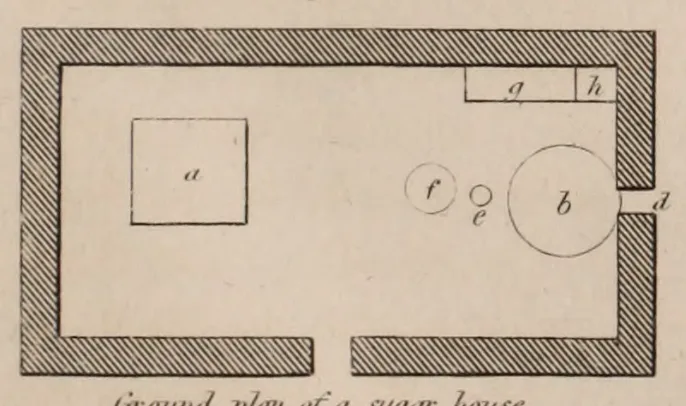
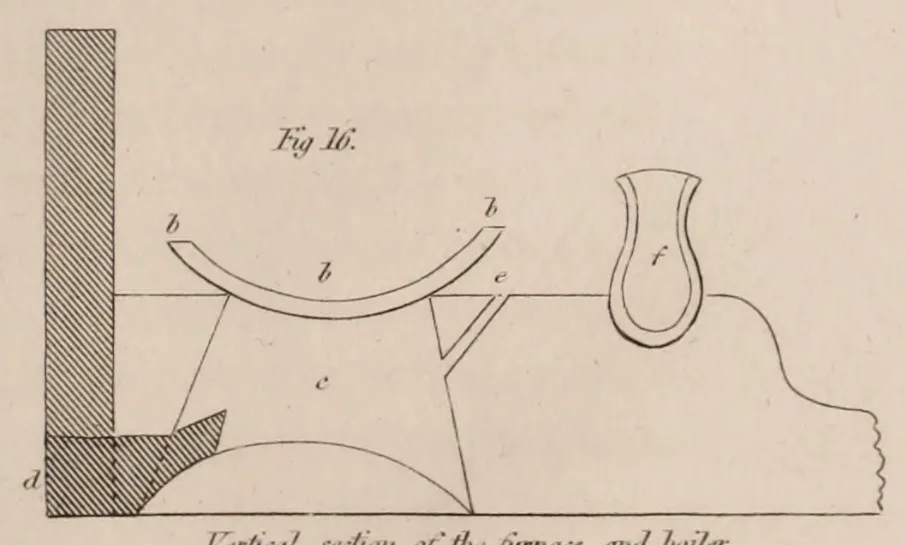
The boiling-house is a thatched hut, about forty feet long and twenty broad, with a door in front, but without windows. The walls are mud, and stand all the year; but a new roof of very slight materials is put on annually, when the crop is ripe; at one end is a square pit for holding the cuttings of the sugar-cane, (see Fig. 15 and 16, a), and at the other is the boiler (b). The furnace (c) is partly raised, and partly sunk; it is in the form of a truncated cone, and the fewel is supplied from without by an opening in the wall (d). The small hole (e) for letting out the smoke is most injudiciously placed before the boiler, and has no chimney. The iron boiler (b b b) is flat, and completely shuts the mouth of the furnace. Before the boiler is a cavity (f) for containing the large cooling jar. At one of its sides is a seat of mud (g) for the workman who superintends the boiling; and at one end of this is kept a small ark, (h) dedicated to the gods. Here is daily put a proportion of Jagory, and a bit of money, which are given to any Bráhman that may come to bless the operation by his presence; but, if none come, the money is sent to the Bráhmans of the town, and the workmen eat the Jagory, after having presented it to the gods, and uttered their names.
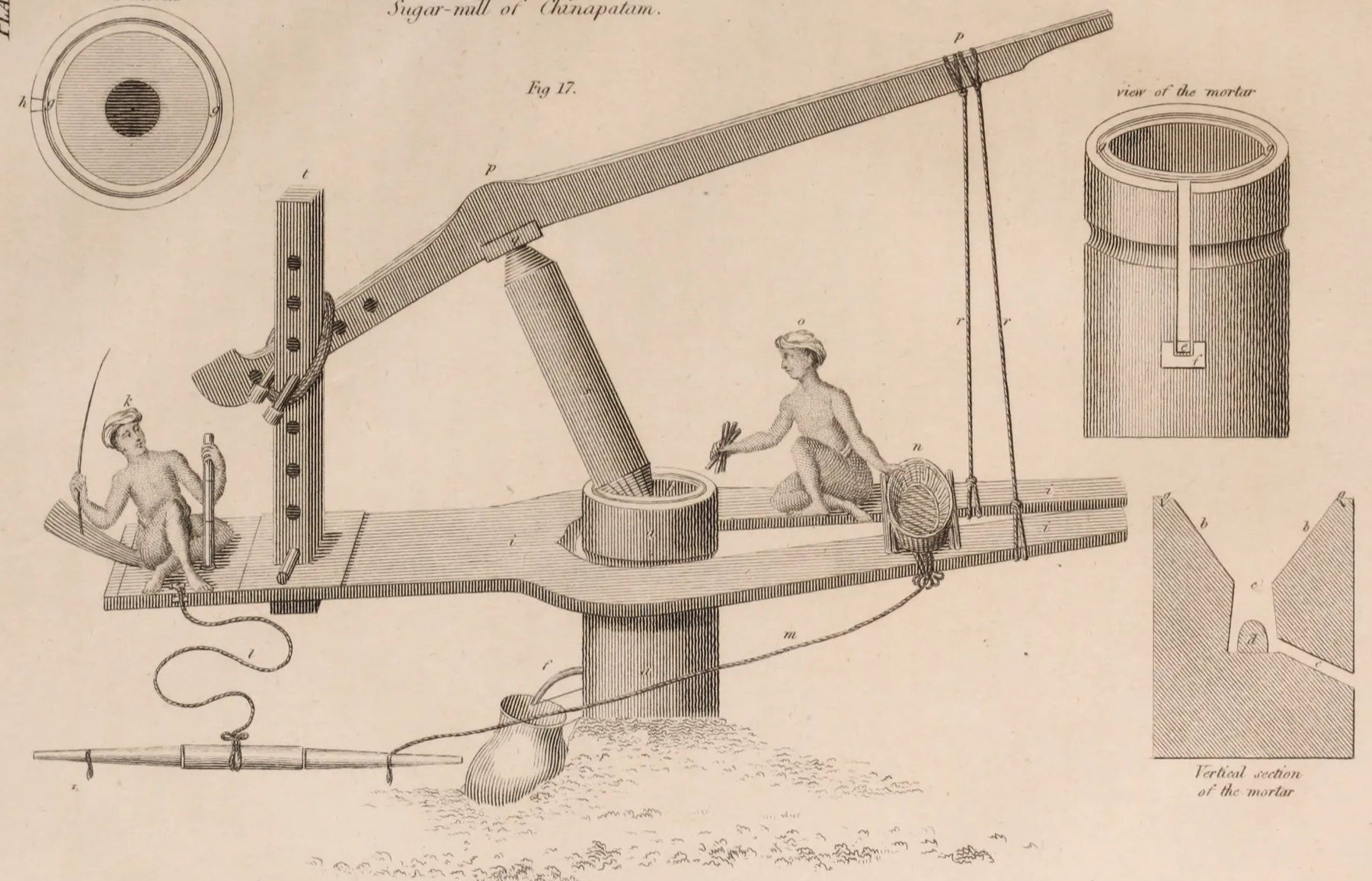
The sugar mill (see Fig. 17) consists of a mortar, beam, lever, pestle, and regulator.
The mortar (a a) is a tree, about ten feet in length, and fourteen inches in diameter. It is sunk perpendicularly into the earth, leaving one end two feet above the surface. The hollow (b b) is conical, truncated downwards, and then becomes cylindrical (c), with a hemispherical projection (d) in its bottom, in order to allow the juice to run freely to the small opening (e), that conveys it to a spout (f ), from which it falls into an earthen pot. Round the upper mouth of the cone is a circular cavity (g g), which collects any of the juice that may run over from the upper ends of the pieces of cane; and from thence a canal (h h) conveys this juice down the outside of the mortar to the spout (f ).
The beam (i i i) is about sixteen feet in length, and six inches in thickness, and is cut out from a large tree that is divided by a fork into two arms. In the fork an excavation is made for the mortar, round which the beam turns horizontally. The surface of this excavation is secured by a semicircle of strong wood. The end towards the forks is quite open, for changing the beam without trouble. On the undivided end of the beam sits the bullock-driver (k), whose cattle are yoked by a rope (l), which comes from the end of the beam; and they are prevented from dragging out of the circle by another rope (m), which passes from the yoke to the forked end of the beam. On the arms a basket (n) is placed to hold the cuttings of cane; and between this and the mortar sits the man (o) who feeds the mill. Just as the pestle comes round, he places the pieces of cane sloping down the cavity of the mortar; and, after the pestle has passed, he removes those which have been squeezed.
The lever (p p) is a piece of timber nearly of the same length with the beam. Its thicker and lower end is connected with the undivided end of the beam by the regulator. Some way above its junction with the regulator, a piece of Sujalu, which is a very hard wood, is dovetailed into the lower side of the lever; and in this piece (q) is made a smooth conical hollow, which rests on the head of the pestle. The upper end of the lever is fastened to the two arms of the beam by two ropes (r r).
The pestle (s) is a strong cylindrical piece of timber, about four feet in length. At each end it is cut to a point, so as at the upper end to form a cone, and at the lower a pyramid of from twelve to fifteen sides, surmounted by a short cylinder. The cavity in the lever being towards one end, makes the position of the pestle always oblique; so that as it passes round it rubs strongly against the sides of the mortar. Its cylindrical point rubs on the top of the hemispherical projection (d) that is in the bottom of the cylindrical cavity of the mortar.
The regulator (t) is a strong square piece of timber, which passes through the undivided end of the beam, and is secured below by part of its circumference being left for checks. It is perforated by eight holes, in the lowest of which is placed a pin to prevent the regulator from falling when the strain is removed. A pin in one of the upper holes of the regulator, and another in one of the holes in the thick end of the lever, serve to secure in their place the ropes that bind closely together these two parts of the machine. According as these pins are placed higher or lower, the relative direction of all the moveable parts of the machine is altered, and the balance of the beam is so regulated, that it goes round without any friction, but yet with its fork closely applied to the mortar. The only frictions in this machine, it must be observed, are at the two extremities of the pestle; and that which is at the lower end is entirely employed in bruising the cane, which is the object in view; still, however, it is a machine badly contrived for the purpose to which it is applied.
When the works and machinery have been prepared for making Jagory, all the proprietors of sugar-cane in the village assemble, and work together a day at each man's field, in rotation, until the whole is finished. A sufficient number of people bring the canes to a man, who cuts them into pieces about six inches long, and puts them in the square cavity (a) in the boiling-house. From thence one man supplies the basket of the person who feeds the mill, and who is the third man employed at the works. The fourth man drives the bullocks; a fifth carries the juice to the boiler; a sixth attends the fire; and a seventh manages the boiler. The mill goes night and day, and gives 56 pots of juice, containing in all about 218 ale gallons. The bullocks are changed, after having expressed three pots, and do no more work that day, having been obliged to go very fast. Two of them are in the yoke at a time.
The cane raised on black mould gives about a fifth part more juice than that produced on sandy soil: but then nine pots of the latter give a hundred balls of Jagory, while it requires twelve, or even fourteen, pots of the former to produce the same quantity. The workmen always put into the boiler as much juice as will yield a hundred balls of Jagory. It is strained into the boiler through a cotton cloth, and there is added to it a proper quantity of lime-water. In a boiler full of rich juice, from cane raised on sandy soil, there is put half a Seer of lime-water, or about 34 cubical inches ; and poorer juice from the same kind of soil requires double that quantity. The boiler full of juice from black mould requires five or six Seers, which is added by degrees. The boiler performs his operations three times in the twenty-four hours. When the juice has been evaporated to a proper consistence, it is put into a large pot, and allowed to cool for three hours. It is then poured into the mould, which consists of a long thick plank, in which a hundred holes are formed, each in the shape of a quadrilateral inverted pyramid. The Jagory, or inspissated juice, is allowed to dry in the mould for four hours ; when the plank being turned over, the balls, or rather pyramids of Jagory, fall down. They are dried by placing them on leaves for a day, and are then fit for sale. These balls weigh 1¾ Seer, or 10,617 lb. ; and, if made from cane raised on black mould, sell for about seven balls for the Sultany Fanam, or 8s. 0½d. the hundred weight. If made from cane raised on sandy soil, six balls cost a Fanam, which is at the rate of 11s. 9¾d. a hundred weight. The Jagory, it would thus appear, contains both the sugar and molasses, and is similar to what in Jamaica comes out of the cooler before it is taken to the curing-house. It is, however, somewhat more inspissated ; for which an allowance must be made, if we wish to compare the strength of the sugar-cane juice in the two countries. By the foregoing account it requires about 37 gallons of the best juice to make a hundred weight of Jagory.
By the account of a man, who came into my tents from another village, twelve pots of juice from a black mould give 165 Seers of Jagory ; which agrees very well with what was told me in the presence of the Parputty.
The government and the farmers share the produce of Jagory equally. An acre produces 13,4/10 hundred weight, at a medium of 10s.; the average rent of sugar land is therefore 3l. 6s. 6d. an acre. The farmers allege, that the Amildars, in order to favour the court sugar-maker, who generally supplies them also, take all the juice that is produced on sandy soil, and estimating the quantity of Jagory which would fall to the farmer's share, repay him with Jagory made of cane raised on black mould; but this seems too paltry a kind of imposition to be practised, and shows that they have little real cause of complaint when they mention one so trivial.
12th June.—I went to Ráma-giri. A part of the way I had travelled before; but, on coming to the Arkawati river, I turned to the north, and passed through a valley naturally beautiful, but which appeared dismal on account of its having been in a great measure deserted. Near its head I found a few small villages surrounded by a little cultivation.
Since the accession of Tippoo, Ráma-giri has been strangely agitated. The town, which was then considerable, he removed from the west side of the river, and placed close under the hill upon which the fort is built. It was then surrounded by a wall, and some other defences of no great importance. The army of Lord Cornwallis summoned the fort; and the garrison, intimidated by the taking of many strong places which they had seen fall, surrendered without any resistance, and for some time our troops kept possession. After the peace Tippoo dismantled the fort, and now the Amildar has again removed the town to the west side of the river, and placed it lower down than its original situation. During the incursions of Lord Cornwallis the inhabitants were deprived of the means of subsistence, and a large proportion of them perished of hunger. I give this, and other similar accounts of the state of population, from the information of the natives, which I believe is just, and rather partial to the British side, partly from flattery, and partly from their being sensible that they never before were under the protection of a people so humane, just, and powerful. The place is dreadfully infested by tigers, especially the fort, which occupies a large rocky hill, capable of a very tedious defence, even without any assistance from art. Several Bráhmans reside near the summit, for the place is reputed holy; but it is kept in a very slovenly state. It is plentifully supplied with water from several large cavities, or chasms in the rock, which receive the rain, and by their coolness prevent its sudden evaporation. Such cavities are called by the natives Donays, and in all the rocky hills of this great chain of mountains are very common. In the hottest season they never become dry; but they have no springs to give a supply of fresh water, and of course afford but unwholesome drink.
The granite, of which the rock of Ráma-giri consists, is very beautiful, and is composed of small grains of black mica, or perhaps micarelle, and of white glassy quartz, in which are immersed large masses of red felspar. It seems to agree exactly with Mr. Kirwan’s definition of granitic porphyry. It is a very elegant stone, and might be procured in very large masses.
Cattle seem to be the principal object of the people of Ráma-giri. On account of the great quantity of prickly bushes, and a number of what they call wild dogs, no sheep can be kept; but there are considerable numbers of goats and cows. The inhabitants seem to be uncommonly cleanly; as they gave me some butter that was free from any bad smell or taste, a circumstance that I never before met with in India, except where the butter was purposely made for the use of an European.
Very few wethered goats are kept here, most of the males being sacrificed when young. Three males are reckoned sufficient for a hundred females. The females begin to breed when a year old, and twice annually have a kid. They give milk eight months in the year; that is to say, four months after each kid, and yield daily half a Seer, or about an ale pint. They are killed when eight years old. A young goat, male or female, sells for five or six Fanams, or for 3s. 4¼d. or 4s. 0¼d. The tigers are very destructive to this kind of cattle.
The farmers who are in easy circumstances keep from ten to thirty breeding cows; but the number of cattle has been exceedingly reduced by a most fatal disorder that prevailed among them last year. It is attributed by the natives to a contagion introduced by the Brinjaries, who followed the British army; and no doubt it raged with the utmost violence in the camps before Seringapatam; but a similar disease frequently occurs at the same season, although it was never before known to prove so fatal. I am therefore inclined to believe, that it is rather endemic than contagious. It commenced in April, and lasted three months. The cattle seized by this disease pass bloody, or at least very red, urine, and are reduced by a purging; but, although very few recover, the disease does not kill suddenly; they live under it from two to three months. It is alleged, that last year nine tenths of the whole cattle in this district perished from this cause.
The cows are always kept in a house at night, and by some are littered with straw; but by others this is neglected. At night they always get straw to eat. In the morning, about an hour after sun-rise, all, except the working oxen, are turned out to the woods under the charge of a man, who takes care of fifty head. They are much exposed to tigers, and are not guarded by dogs. At noon they have water, and again in the evening, when they are brought home. The milch cows on this occasion have for their drink the water in which the grain of the family has been boiled.
The cow begins to breed at about three years of age, but at no particular season of the year. She goes nine months with calf, and does not breed oftener than once in two or three years. She continues to give milk, until within three months of calving. For the first month the calf has all the milk; afterwards it continues to have a little every day, till the mother becomes dry. A middling good cow gives, twice a day, three quarters of a Seer of milk, or about a pint and a half, besides what the calf draws. A cow lives until she is twenty years of age, but does not breed after sixteen. The idea of putting a cow to labour shocks the natives here exceedingly. They cannot hear it mentioned with patience; and relate, with marks of great satisfaction, that for this offence their last Raja put to death several Brinjaries; for it is customary with that people to make cows carry their baggage.
The working oxen begin to plough at sun-rise, and continue until sun-set, with an intermission of three hours at noon; at which time they have a feed of straw, as they have also at night. They have water at noon, at three o'clock, and at sun-set. The cattle bred here are not fit for the road. The richest man of the village keeps a bull or two, as there may be occasion, and these serve all the cows without hire. The best calves are kept for this purpose; and occasionally a good bull is purchased from some distance, to improve the breed. The bull begins to propagate at three years of age, and continues till ten. Those intended for labour are emasculated at three years of age, by bruising the parts between two sticks. They very seldom die in consequence of this operation; but for about fifteen days are in pain from the swelling, and for a month do not begin to work. In the Decan, castration is not practised on any quadruped. The young bulls are frequently wrought, and the ox continues to labour until he is ten or twelve years of age; when, worn out by hunger, fatigue, and bad usage, he dies a premature death, and his carrion is devoured by the Whalliaru. The late emasculation of the cattle intended for labour is done with a view of giving the ox spirit; but I am inclined to think that it produces a great degeneracy in the breed; for the cows, in consequence, are frequently impregnated by the poorest creatures of the herd.
In all diseases of the ox kind, the grand remedy is the actual cautery, applied very fancifully in different places, and to a different extent, according to the supposed nature of the disease. The animal is thrown down, his mouth and legs are tied, and long lines are burned with a hot iron, so as to bring off both hair and skin. Three lines are often thus drawn, on each side, the whole length of the animal's body. Although the killing an animal of this kind is by all Hindus considered as a kind of murder, I know no creature, whose sufferings equal those of the labouring cattle of Hindustan.
Before the fatal disease of last year, the usual price of a middling ox five years old, was from 25 to 30 Fanams, or from 16s. 9½d. to 1l. 0s. 1¾d.; and of a cow, from 20 to 25 Fanams, or from 13s. 5d. to 16s. 9½d. The price of an ox is now 40 Fanams, or 1l. 6s. 10d.; and of a cow, 30 Fanams, or 1l. 0s. 1¾d.
In this hilly tract, there is a race of men called by the other natives Cad' Eriligaru; but who call themselves Cat' Chensu. Here they live in little huts near the villages, and have a small piece of blanket, or cotton cloth, to cover their nakedness. They are reconciled to the other natives, and pay a trifling capitation tax to government. Where the woods are more extensive, they are terrified at the sight of any civilized being, and live absolutely without any clothing, but cover their nakedness with a few leaves. In these forests they dwell in caves, or under bushes, which they make a better shelter from the weather, by adding small branches from other trees. When the civilized part of this tribe go into the woods to visit their relations, or to trade with them, they must throw off their rags, lest they should be mistaken for a villager, in which case none of the Chensu would approach.
The language of the Chensu is a dialect of the Tamul, with occasionally a few Karnata or Telinga words intermixed; but their accent is so different from that of Madras, that my servants did not at first understand what they said. Their original country, they say, is the Animalya forest below the Ghats, which is confirmed by their dialect. Those who live in the villages have taken the Pancham Banijigaru as their chiefs; they trade chiefly with them, and call them their Swámis, or lords; but, although they have learned to invoke the name of Siva, they do not wear the Lingam. Those in the woods have either no religion, or some simple one with which those here are unacquainted. The people of this country attribute to the Chensu the power of bewitching tigers; and my Bráhman gravely informed me, that the Chensu women, when they went out to procure food, left their infants in charge of one of these ferocious beasts. The Chensu of course deny their possessing any such power; but allege, that the art is known to another rude tribe named Soligaru, who inhabit the southern Ghats which separate this country from Coimbetore.
The Chensu here live upon game, wild roots, herbs, and fruits; and a little grain, which they purchase from the farmers. They are enabled to do this by collecting some drugs, honey, and wax. It is on account of their having the exclusive privilege of collecting these two last articles, that they pay a poll-tax, which is annually fifteen Fanams, or 10s. 0¾d. for each family.
The bees are of two kinds: one, smaller than our bee, builds its nest on the twigs of trees, and is easily procured; the other is a large bee, which builds in the clefts of rocks, and its honey is obtained with great difficulty. The wax sells at 2½ Seers for the Fanam, or 1l. 8s. 4d. a hundred weight. The honey sells at 2 Seers for the Fanam.
The drugs collected by the Chensu are as follow: Agulusunti, and Hegguntigay, two roots used in medicine. Popli, a bark used as a red dye. The plant that produces it is a scandent shrub, the flower or fruit of which I could never find; nor did Dr. Roxburgh know it by the dry specimen of the branches in leaf. It seems, however, to be nearly related to the Ventilago. The Muddi, or bark of the root of at least two kinds of Morinda, is also used as a dye; as is likewise the Capily Podi. It is the red dust shaken from the fruit of the Rotleria tinctoria. The merchants of Bangaluru and Colar buy up these articles, paying to the Chensu a Fanam for 32 Seers of Popli, and Muddi, or 3s. 10½d. a hundred weight, and a Fanam for one Seer of Capily Podi, or 1s. 1¼d. a pound.
When ordered, the Chensu collect gum from various trees; but they never do it without a special commission, and the quantity that they could procure is inconsiderable. The trees which produce it are,
- Dinduga, - - Andersonia Panshmoum, Rox. MSS.
- Bewu, - - Melia azadirachta.
- Muruculu, - - Chirongia glabra, Buch. MSS.
- Mavena, - - Mangifera Indica.
- Avaricay, - - Cassia auriculata.
- Nugay.
- Bayla, - - - Ægle marmelos.
- Jala, - - - Shorea Jala, Buch. MSS.
- Chadacalu, - - Chloroxylon Dupada, Buch. MSS.
- Betta Tovary, - - Bombax gossypinum, Lin.
The principal articles of vegetable food collected by the Chensu, are, the seed of the Bamboo, and several kinds of Dioscorea, or Yams, that grow wild in the neighbouring woods.
The kinds of game which they kill are as follow :
- Wudamu, or Jevaji - Lepus Hurgosa, Buch. MSS.
- Bandicoote - - Mus Malabaricus, Shaw.
- Cad' Hundi - - Sus Scrofa ferus.
- Hulay - - - Antilope Gazella.
- Saraga, or Manu - Cervus axis.
- Cadaba - - - Cervus Cadaba, Buch. MSS.
- Condagurovi - - Cervus Muntjac.
- Cadu Cauli - - Phasianus Gallus.
- Navelu - - - Pavo.
- Paruala - - - Columba.
- Lavagay.
- Chipula Haki.
- Cad' Haki.
- Swaray Haki.
Haki signifies a bird. My time would not permit me to enter into a particular investigation of these species. The beasts are killed with a match-lock, which the farmers give to the Chensu, with powder and ball, on condition of receiving a part of the game. The birds are killed with the pellet-bow, or caught by hair springes. The Chensu possess no domestic animals.
Lac is produced in several of the neighbouring hills, upon the tree called Jala, which seems to be of the same genus with the Shorea of Gærtner, and this is probably not different from the Vatica of Linnæus. The tree is never planted, but grows naturally; and the persons who rent the Lac carry the insect from one tree to another. The tree grows to a large size; and there are a great many, on which no insects have been put. The Chensu and Woddar are the persons who commonly rent it; but they allege, that they are discouraged from the employment, by the want of leases for a number of years. Stick-lac sells here at three Fanams for the Maund of 40 Seers, or 9s. 4½d. a hundred weight.
13th June.—I went to Magadi, which in our maps is called Maghery. This stage was very fatiguing for my cattle; and the road passed through a wild but romantic country, which consists of low hills, intermixed with little cultivated vallies. The soil of these is tolerably good; and, like the Ráma-giri valley, they are cultivated with dry grains only. The higher parts are covered with trees, which, owing to the poverty of the soil, are in most places very small; but near Savana-durga, and in a few other parts, the timber and Bamboos grow to a good size. The summits of all the ridges of hills are bare rocks of the granitic porphyry, and often rise into high sharp peaks, or immense masses of naked stone. By far the most remarkable of these is occupied by Savana-durga, which the army of Lord Cornwallis took by assault; ever since which time it has been deserted.
On my way I examined some iron forges, of which there are many in this hilly tract of country; and from a man, who employs twelve labourers, I procured the following account of the operations performed on the ore. The iron is made partly from the black sand which is found in the rainy season in the channels of all the torrents in the country; and partly from an ore which is found at Ghettipura, two cosses from Magadi. During the four months of heavy rains, four men are able to collect as much sand as a furnace can smelt in the remainder of the year. In order to separate the earth and sand, which are always mixed with it in the channel of the torrent, it requires to be washed. These men get ten Fanams, or 6s. 8½d. a month, and the nature of their service is similar to that of the farmers servants, being bound by occasional advances of money to continue in the employment of the master. During the remaining eight months of the year they work at the forge.
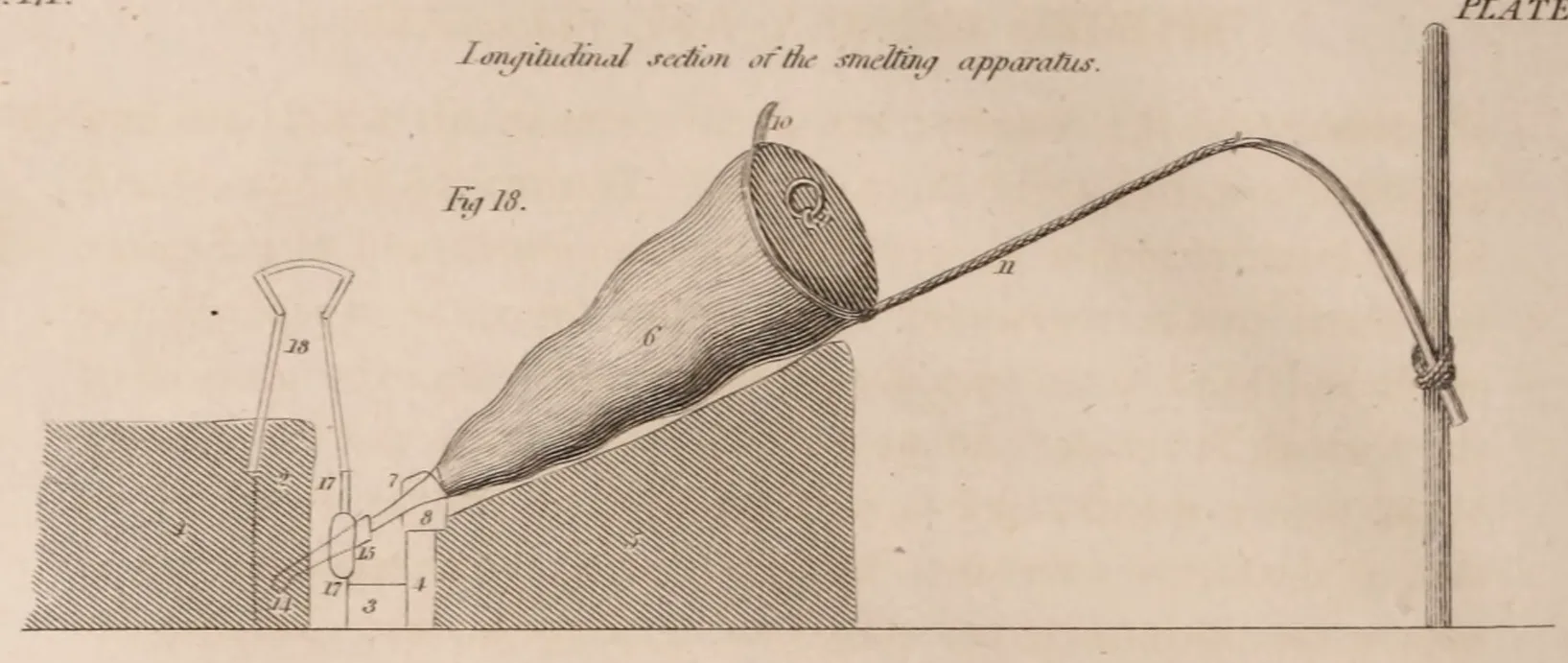
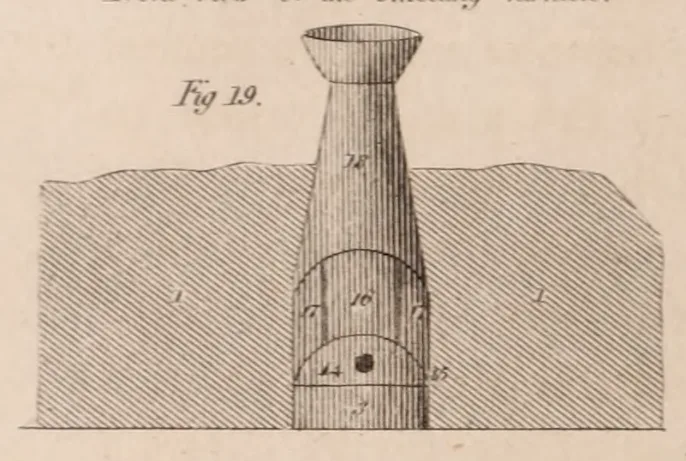
The smelting furnace is made in the front of a square mound of clay, sloping up gradually from behind forwards. In order to assist the imagination, I give rude sketches (Fig. 18 and 19) of the longitudinal and transverse sections. In the front, the mound (1) is twenty-two inches high, and three feet broad. In this, from top to bottom, is made a semicylindrical cavity (2), about a foot in diameter. On the ground, in front of the cavity, is laid a stone (3) six inches high, a foot long, and a foot broad. Contiguous to this is placed another stone (4) a foot square, and two inches thick. On the top of this is fixed a small piece of timber (8), behind which rises another mound of clay (5), sloping upwards gradually, and widening as it recedes from the furnace. On this rest the bellows, of which there are two. Each consists of a whole buffalo's hide, removed without cutting it lengthwise. Where it has been cut at the neck, it is sown up, so as to leave a small opening for a wooden muzzle (7), which is made fast to the piece of timber (8) before-mentioned. The hinder part of the skin is slit vertically, and the one side is made to lie over the other. In the middle of this outer side is fastened a ring of leather (9), through which the workman passes his arm, and seizes the upper angle of the skin (10), which serves as a handle. When he draws back his arm, the opening in the hinder part of the skin is dilated, and admits the air; when he forces his arm forward, the opening is closed up, and the air is forced through the muzzle. The lower part of the bellows is retained in its place by a rope fastened to the lower angle (11), and supported by an elastic piece of timber (13), which is fastened to one of the posts of the hut, like a turner’s lathe. The muzzles of both the bellows are inserted in one common tube (14), which is made of baked clay, and is placed in a sloping direction, so as to pass through a mass of moist clay (15), that occupies the front of the furnace above the first mentioned stone (3). Above this is placed a large tile (16); and the empty spaces between this and the mound (1) are filled up with moist clay (17). The furnace is now cylindrical, and open at top, on which is placed a chimney (18) made of baked clay, in the form of two truncated cones joined together by the apices. Of these the upper cone is by far the shortest. From this it must be observed, that the whole lower front of the furnace is moveable; and when it has been newly built up, a little charcoal is burned in it for an hour, to dry the moist clay by which the various parts are connected. The rents formed during this operation must be carefully closed with more clay, and the furnace is then ready for immediate use.
For smelting the black sand, the following is the process. A quantity of the sand is measured out, and divided into three parts, each of which I found to weigh a little more than 25 pounds 11 ounces avoirdupois. Three baskets of charcoal are then set aside, of which each contains about a bushel. Two of the baskets of charcoal are then put in by the top of the chimney, and above these one third part of the sand. The fire is then kindled, and urged with the bellows. When the fire subsides, one half of the remaining charcoal, and another third of the sand, are put in; and, when those have again subsided, the remainder of the sand and charcoal is added, and the fire is urged six hours and a half from the commencement. The front of the furnace is then broken, and on removing the walls a mass of iron is found at the bottom, which is taken out with forceps, and cut into two blocks, weighing each half a Maund, or a little more than twelve pounds two ounces. By this it would appear, that the ore produces no more than about 31½ per cent. ; and the iron so produced, although malleable at first, is extremely impure. Tippoo took it from the workmen at 3 Fanams a Maund, or 9s. 3½d. a hundred weight. He gave them, however, great employment ; as he made his shot of this iron, by hammering ; for the fusion is never so complete as to allow it to be ca i moulds.
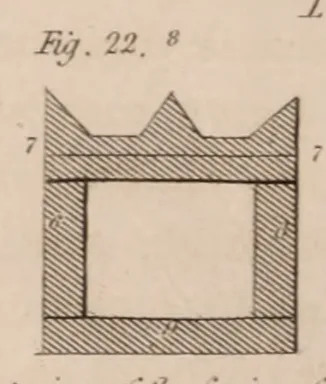
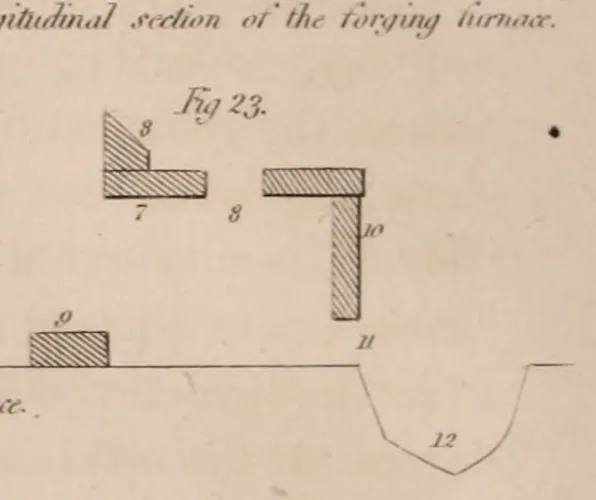
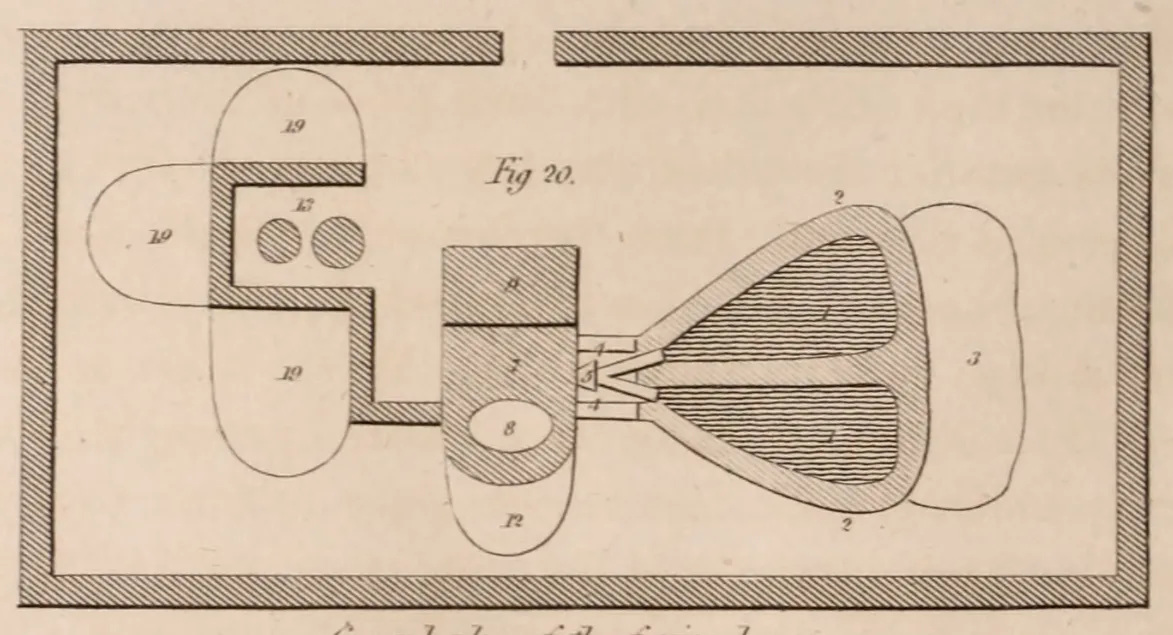
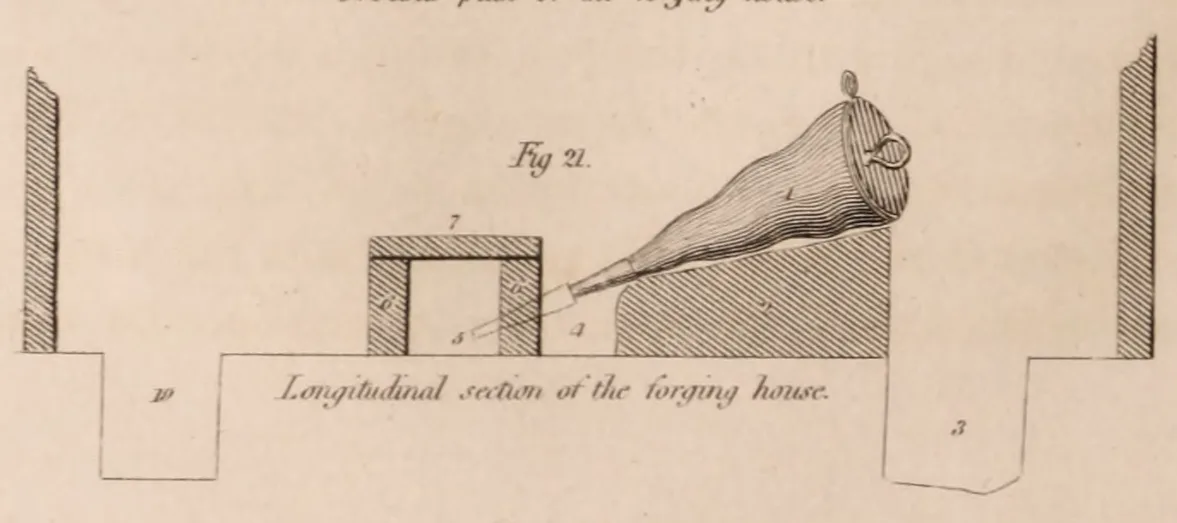
In order to render this iron more pure, and to fit it for being wrought up into the implements of husbandry, it is taken to another house, and repeatedly forged. Fig. 20, 21, 22, and 23, are rude sketches of the apparatus necessary for this purpose. There are here also two bellows (1), but they are smaller than those in the smelting-house ; and, the mound (2) on which they are supported being low, a pit (3) is formed behind it, in which the labourers stand to reduce them to the proper level. The muzzles of the bellows (4) are inserted into an earthen tube (5), which conveys the air into the furnace through one of its side-walls (6) These walls are two masses of clay, one cubit long, ten inches high, and four inches thick ; and are placed on the floor, parallel to each other, at the distance of a foot. On them is laid a flat cover (7) made of baked clay, and about an inch and a half in thickness. In its hinder part is an oblong opening (8), sufficient to admit one of the blocks of iron. The fore part of the furnace is secured on the top by a moulding (23) of clay, which is somewhat ornamented. Before it is placed a stone (21) a cubit long, twelve inches broad, and three high. Except what is shut up by this stone, all the fore part of the furnace is open. The hinder part (10) is entirely shut up with clay, except a small opening (11), by which the ashes and vitrified scoriæ fall into the ash-pit (12).
A block of iron from the smelting-house having been put into the centre of the furnace, it is filled with Bamboo charcoal, and strongly heated ; while another block is put into the upper opening (8), to receive some heat as a preparation. When the first block is properly heated, it is placed on an anvil (13), and receives a few strokes of a large hammer from three workmen, who stand in three cavities (19) formed round the anvil, to reduce them to a proper level, and who thus knock off some ill smelted portions, and much of the adhering scoriæ. With a kind of hatchet the block is then cut into three wedges; and in this operation the workmen show much dexterity. The second piece is then put into the center of the furnace, and a third piece is placed in the upper opening of the furnace (8); while these are heating, the three wedges are again made red hot, and well beaten on the anvil (13) by the three workmen with large hammers. In this state the six wedges produced from one smelting weigh 24 Seers, or a little more than 14½ pounds avoirdupois; and are sold to the blacksmiths; who are, however, obliged to heat and beat the iron three or four times, before it is fit for making the implements of husbandry. The weight of the six wedges is then reduced to fifteen Seers, or a little more than nine pounds; and they sell at from two to three Fanams, or from about 1s. 4d. to 2s.: that is, from about 16s. 6d. to 24s. 9d. a hundred weight. From this it appears, that the good malleable iron, produced by this means, is not quite 12 per cent. of the weight of the ore.
The same persons also make steel. Good clay is mixed with an equal quantity of the charcoal that is made from Paddy husks; and, having been well moistened with water, is thoroughly mixed, by being trodden under the feet of oxen. It is then picked clean, and made into cuppels, which are dried one day in the shade, and next day in the sun. A fire place is then made, in form of a parallelogram, by placing two stones one cubit long, and two inches and a half high, parallel to each other. At the distance of a foot above the stones is placed a wall of clay eight inches high. One end is shut up, in the same manner, by stone and clay; the other is built up with clay alone to the height of two cubits. Through this is inserted a tube for two bellows. Each of the cuppels is now loaded with a small piece of iron, from one to one and a half Seer (9 7/10 oz. to 14 oz.) in weight, together with five small pieces of the Tangayree wood (Cassia auriculata). Three rows of the loaded cuppels are placed one above the other, so as to occupy the whole area of the furnace; the room of one cuppel only being left empty, opposite to the muzzle of the bellows, in order to give access to the wind. They are covered with two bushels of charcoal, and burned for six hours; a third bushel of charcoal having been added, as the former two were consumed. The pieces are then taken out, and hammered into small square bars, having been heated with charcoal of the Sujalu (Mimosa Tuggula, Buch. MSS.)
The expence that attends the working of one of these iron forges is as follows :
| Fanams. | |
|---|---|
| To 4 men for collecting iron sand, at 10 Fanams each for 4 months | 160 |
| To 6 men to make charcoal, 4 for the smelting-house, and 2 for the forge, during 8 months, at 8 Fanams monthly for each | 384 |
| To 4 labourers at the smelting-house, for 8 months, at 10 Fanams each | 320 |
| To 6 labourers in the forging-house, of whom 1 has 12 Fanams, the others 6 Fanams a month, for 8 months | 336 |
| To the government paid yearly; for making charcoal 60 Fanams, for ground rent for furnace 20 Fanams, for ditto for servants houses 20 Fanams | 100 |
| Fanams | 1300 |
The smelting-house burns thrice a day, for about eight months of 32 days each, without any allowance for holidays, and at each time produces as much iron as, when forged, sells for from two to three Fanams.
| Fanams. | |
|---|---|
| At two Fanams the returns are | 1536 |
| Cost | 1300 |
| Net profit | 236 |
| Fanams. | |
| At three Fanams gross produce | 2304 |
| Cost | 1300 |
| Net profit | 1004 |
The operation for smelting the ore is exactly the same as that used for the black sand, except in the cleaning of it. The ore is first reduced to powder with an iron bar, and then the earthy particles are washed away in a wooden trough; when it becomes exactly like the black sand, and is called by the same name, Aduru. The collecting of it is attended with less trouble than that employed to collect the black sand; but the carriage to any considerable distance prevents it from being used in general; as the workmen must live where the farmers will give them employment in their vacant time.
Two other men, one from Ghettipura, and one from Cutlu on the way to Bangaluru, confirm the above account. Each smelting, according to them, takes nearly 68 pounds of black sand. The difference here, from the other account, probably arises from my having weighed the former when very moist, and this when dry: for the workmen always put the sand into the furnace, after having thoroughly soaked it with water. According to this account, however, the ore gives rather more than 37 per cent. of the impure iron, and a little less than 20 per cent. of iron fit for the use of the blacksmith. For this purpose, after it has been split into wedges, it requires to be four times heated and hammered..
According to the account of these people, the following are the expences of a smelting-house and forge:
| Fanams. | |
|---|---|
| To 3 men to collect and prepare ore for 9 months, at 10 Fanams | 270 |
| To 5 persons to make charcoal, at ditto | 450 |
| To the head workman at the smelting furnace, at 15 Fanams a month | 135 |
| To 3 under workmen at ditto, at 13 Fanams each a month | 351 |
| To the head workman at the forge, 20 Fanams a month | 180 |
| To 3 hammer-men at ditto, at 9 Fanams each | 243 |
| To 2 bellows-men at ditto, at 8 Fanams each | 144 |
| Paid to the Government: | |
| For liberty to make charcoal | 200 |
| For ground-rent of furnace | 10 |
| Ditto for workmen's huts | 54 |
| Total of expences | 2037 |
| Fanams. | |
|---|---|
| Gross produce, at 2 Fanams each smelting | 1728 |
| Loss | 309 |
| Gross produce, at 3 Fanams each smelting | 2592 |
| Total expence | 2037 |
| Profit | 565 |
In this account the expences greatly exceed those stated by the first man, and seem to me to be much exaggerated. The persons who gave it allege, that the Ghettipura ore has not been lately wrought.
14th June.—I remained at Magadi to procure specimens of the timber contained in the forests, which was attended with more difficulty than could have been supposed. About forty men, employed all day, brought only ten specimens ; and of these several were useless, from being spoiled at the heart.
15th June.—Having had little success yesterday in sending the woodmen to bring me specimens of timber, I went to-day into the woods on the east side of Savana-durga, which name has been corrupted by us into Severndroog. It is an immense bare rock, which has many fortifications on its summit. A lower rock, but yet one of great strength, is fortified, and is situated at the base of the larger, towards the small river, which runs in a very deep ravine; and a large space between the ravine and rock is also enclosed by a stone wall, and surrounded by thick forests. This place formerly contained several temples, and some large gardens belonging to Magadi Kempa Gauda; and served as a place of refuge for the inhabitants of all the neighbouring country, who in case of invasion retired hither with their grain and cattle. A few families of Bráhmans remain near the ruinous temples; and the site of the gardens is evident from a number of fruit and flowering trees. Every other part of the enclosure is overgrown with forest trees and Bamboos.
Magadi Kempa Gauda, or the red head-man of Magadi, was a wealthy farmer, who, having gathered together a number of followers, built at his native village two large temples, and the fortress of Savana-durga, and became a Polygar of great distinction; as he possessed also Ráma-giri, and a great extent of the neighbouring hilly tract. About five years ago, Tippoo, with his usual policy of removing every monument of Hindu government, destroyed Magadi, and forced the inhabitants to settle in a new town, which he erected in the woods, and called Ali-nagar. The people are now deserting this place, and returning to their old abode in Magadi.
In the hollow ground near the river are some of the best forests in the country, the trees growing to a considerable size. The cattle of the inhabitants never go into them; nor can any one cut the timber without an order from government. Much of the lower land in this forest might be cleared and cultivated.
Throughout these hills, which extend northward from Capaladurga, are many cultivated spots, in which, during Tippoo’s government, were settled many Baydaru, or hunters, who received twelve Pagodas (4l. 5s.) a year, and served as irregular troops whenever required. Being accustomed to pursue tigers and deer in the woods, they were excellent marksmen with their match-locks, and indefatigable in following their prey ; which, in the time of war, was the life and property of every helpless creature that came in their way. During the wars of Hyder and his son, these men were chief instruments in the terrible depredations committed in the lower Carnatic. They were also frequently employed with success against the Polygars, whose followers were men of a similar description. At present, as they receive no pay, they are obliged to apply more closely to agriculture ; for in that way they always employed their leisure; and there is a prospect of their becoming a quiet and industrious people, although they still retain their arms, and an anxious desire for plunder.
16th June.—I remained at Magadi, endeavouring to complete my collection of the various timber trees. I sent also to Ghettipura to inquire after the iron mines : but was informed by the officers of government, that, nobody having wrought them for some years, their situation was not now known. After a long search, however, they had found a few stones, which they sent, believing that they might be iron-ore. I then sent for the man who had given me the information ; and on the following day, 17th June,—I took him along with me to Ghettipura, where I not only found the ore in several places, but also the pits, from which the people were then actually taking it to supply their furnaces. I am at some loss to account for this desire of concealment relative to minerals, which also extends to every kind of quarry throughout the country, and which equally pervades the officers of government and the other inhabitants. Men, who have given me apparently correct information relative to their farms, have eagerly denied a knowledge of the fossile kingdom, which they no doubt possessed, and for which denial I can assign no plausible motive. The late Sultan, indeed, is said to have harassed his subjects exceedingly, by making them work at quarries, and also to have been very severe on the smelters of iron; and the people may have suspected, that my inquiries might lead to similar oppressions; but according to the iron-smelters’ own account, the Sultan gave them a high price for their iron, and by his great demand afforded them constant employment. It is probable, however, that he compelled them to work much harder than they were inclined to do, and that they were defrauded by those who were entrusted with the payment.
Much steel was formerly made at Ghettipura, from whence it derives its name, which signifies literally hard town. It is a small village situated by the compass W. S. W. from Savana-durga, and is distant from Magadi about seven miles. Near it are many cultivated fields intermixed with low rocky hills. The ore is found both in the fields and hills.
The iron ore of the fields consists of small irregular masses separated by thin layers of earthy matter, and is found in beds that are from five to ten feet deep, which have only been wrought in a few places, where they come so near the surface that they have been discovered by the plough. It is probable, that by digging deep they might be found to be of great extent. The small masses are easily beaten into powder, and then the black sand is readily separated, by washing, from the clay and sand that are the other ingredients in their composition. This ore is of two kinds; one efflorescing into red ochre, the other into yellow. Intermixed with both these kinds of ore, which are called female stones, are many lumps of what the natives call male stone. It appears to me to be composed of the same materials with the female stone, but is so hard, that the imperfect manipulations of the natives cannot reduce it to a powder, and of course they cannot separate the earthy matter. It is, therefore, looked upon as useless, fluxes being totally unknown to the miners of Mysore. The female stone appears to me to be the male in a state of decay.
The iron ore of the hills is also male and female; the latter being the only one used; and this is also, in my opinion, the male in a state of dissolution. The male stone in the hills bears a much larger proportion to the female, than it does in the fields. This ore also is found on digging a very little depth into the soil, and seems to be the source from whence most of the black sand of the country is washed by the rain. It appears to me to differ from the quartz impregnated with iron, which I mentioned in the account of the Pedda Náyakana durga Ghats, only by containing a larger quantity of metal. The female stone is very easily reduced to a powder; and the iron sand is readily separated, by washing, from the quartzose sand, which is the other ingredient in the ore. It is not so rich in metal as the ore found in the fields. These two ores are called Aduru Cullu, or stones containing iron sand.
On the surface of the hills is found another iron ore called Ipanada, which is scattered among the gravel in small lumps, from the size of an egg downwards. They are a pure ore, and are put in the furnace without any preparation, except breaking the larger pieces into bits about the size of a filbert. The quantity of Ipanada required for one furnace is exactly the same, by measure, as that of Aduru; but the weight of Ipanada is of course less, there being more space occupied by interstices, from the greater size of the pieces. The produce of iron from both is the same. The surface of the lumps of Ipanada is often covered with a kind of black enamel.
18th June.—I passed this day in the woods near Savana-durga, investigating their productions. The woodmen are a poor ignorant race, most of them of the lowest cast called Whalliaru; but they always pretend to know every plant of which the name is asked. They have also a number of specific appellations, such as Bily, white; Kempu, red; Cari, black; Doda, large; Chica, small; Betta, mountain; Wullay, cultivated; Cadu, wild; Timbo, eatable; and the like; many of which they often apply to the same species, and sometimes the same name to different species, with so little accuracy, that any person, who depends on their accounts will find himself thrown into great confusion.
19th June.—I was obliged to remain at Magadi still another day, to complete my collection of forest trees, and to procure specimens of the stones from the best quarries.
The stones that are employed in building the temples at Magadi are,
1st. The granitic porphyry, or the granite which contains large masses of red felspar in a small grained mixture of grey quartz and black mica, and which I described at Ráma-giri. Near Savana-durga there is an excellent quarry of this stone.
2d. A granite consisting chiefly of black mica and red felspar. This may be procured of a very large size.
3d. The common grey granite of the country. I met also with the two following stones :
1st. A granite with large grains black and white. This may be procured of great size.
2d. A most ornamental aggregated rock. The basis is green, of what nature I am uncertain; perhaps it may be a hornstone. It contains veins of white quartz, and concretions of red felspar. The whole takes an elegant polish, and may, in Mr. Kirwan’s acceptation of the word, be considered as a porphyry. Near the surface the rock is full of rents; but by digging deep, it is said, large masses may be procured. It seems to differ from the fine green stone which was found in the palace at Seringapatam, only by containing felspar.
The trees that compose the forests among these hills are chiefly the following :
Henna Gorivi, Ixora arborea, Roxb. MSS.
A small tree used for beams and posts in the houses of the poorer natives. People travelling at night use pieces of it for torches, as it burns readily and clearly.
Ghendu Gorivi, or Haydarany. Serves for the same purposes as the preceding, and is probably a species of the same genus.
Cari Hulivay? Clutia forte stipularis? I believe the natives misapplied this name. They had often mentioned it to me, and had brought a specimen of the timber; but in the woods they sometimes called one tree by this name, and sometimes another. At last they fixed positively on this, which is said to produce good timber.
Heb, or Bily Hulivay, Chuncoa Huliva, Buch. MSS. A large tree, and good timber.
Tor Mutti, Chuncoa Muttea, Buch. MSS. At Chinapatam this tree is called Cari Hulivay. To the northward it is commonly called Muddi, which is a Telinga name. It is a very large tree, and its timber is very useful.
Tari, Myrobalanus Taria, Buch. MSS. Is a large tree much used by the natives. Its timber becomes tolerably durable, if, after being cut, it be kept some months under water. The kernel of the fruit is esculent.
Arulay, Myrobalanus Arula, Buch. MSS. The timber of this tree, like that of the former, requires to be watered in order to render it durable. The fruit is the common tanning and dying myrobalan of this country.
Amutty, or Gowda? It grows to be a large tree, and its timber is used for planks, beams, and posts.
Jugalagunti, Diospyros montana, Roxb. The timber of this tree is said to be hard, and durable; but from some prejudice, it is never used by the natives. Its name signifies the scolding wife.
Tupru, Diospyros Tupru, Buch. MSS. used for small beams and posts. The timber is said to be very hard and strong.
Vana Rája, or Asha, Bauhinia. It is called the prince of the forest, on account of the superior excellence of its timber; but it does not grow to a large size.
Hassur Gunny, Dalbergia? Grows to a middling size, and its timber is good; it nearly resembles the following tree; but may be readily distinguished by the bottom of its leaflets being acute; while in the other they are rounded.
Pachery, Dalbergia paniculata, Rox. Grows to a large size, but its timber is very useless; for the layers of which it is composed readily separate.
Biridy, Pterocarpus Sissoo, Roxb. MSS. A middling sized tree of an excellent quality for furniture. By the Mussulmans it is called Sissoo; but it does not seem to be exactly the same with the tree of that name which grows in the north of India.
Whonay, Pterocarpus santalinus, L. F. A large good timber tree, fit for furniture. Its bark contains a blood-coloured juice.
Hoingay, Robinia mitis, Lin. It grows to be a large tree, and its timber becomes tolerably durable; if, after it has been cut, it be kept some months in water.
Hurugulu, Chloroxylon quod Sweitenia chloroxylon, Roxb. This never grows to be a large tree, but its timber is beautiful. It is said to be the satin wood of the English cabinet-makers.
Chadacalu, Chloroxylon Dupada, Buch. MSS. An elegant tree, producing a resin that is frequently used in the temples, as incense.
Swamy, Sweitenia febrifuga, Roxb. MSS. A strong, but small timber tree, produces a fine clear gum.
Gowda, Sweitenia trilocularis, Roxb. MSS. A large tree; but its timber is very bad. Another tree, as before mentioned, was by the woodmen called Gowda; but that probably is a mistake.
Jani, Grewia. There are three species called by this name, the Asiatica, the Orientalis, and that which I have named Jania. The timber of none of them is useful.
Bili Tali, Bilitalium farinosum, Buch. MSS. In the Telinga language this tree is called Tellamaliki. It grows to a large size, and its timber was said to be good; but I found it to be white, soft, and very perishable.
Betta Tali, or Betta Tovary, Bombax gossyppinum. A large tree. Its timber becomes somewhat durable, if kept in water for some time after being cut; but without this precaution it is little worth.
Nai, or Cag Nerulu. This cannot be of the same genus with the following Nerulu, as it has alternate serrated leaves. A large tree, the timber of which is much used.
Rudrashu Nerulu, Calyptranthes Jambulana Willd. Also much used. This is the tree from whence the Bráhmans derive the name of this earth.
Betta Padri, Bignonia chelonoides. A small tree; but its timber makes strong posts and beams.
Wullay Padri, Bignonia spathacea. Timber little used.
Navulady, Mail elou, Hort. Mal. V. t. 1. A large tree, and durable timber, which takes a polish, and is used for furniture, planks, beams, and posts.
Shivuli, A small but good timber tree.
Topala, Mimosa leucophlea, Roxb. The bark, when newly cut, has a strong disagreeable smell, like that of the Mimosa Indica, E. M. It grows to be a large tree, and produces strong timber for posts and beams. The bark is used by the natives in distilling spirit from Jagory.
Cagali, Mimosa catechu, Roxb. Pl. Cor. N. 174. In some places, as near Chinapatam, this grows to be a large crooked tree. The quality of the timber is good. It is not the tree which produces the Catechu.
Mugli, Mimosa Covalum, Buch. MSS. A large tree. Timber black, very strong, and fit for posts and beams; but, like that of the foregoing, I was told, does not take a polish. This last report of the natives seems to be ill founded.
Wullay Sujalu, Mimosa Tuggula, Buch. MSS. A large tree, but its timber is said to be not durable. To judge from appearance, however, this seems to be an error.
Betta Sujalu, Mimosa odoratissima, L. This is a large tree, which, according to the report of the woodmen, produces excellent durable timber.
Shalay, Ficus. Used for beams, and pillars of a small size.
Atty, Ficus glomerata, Rox. A large, useful tree. Its wood is remarkably light.
Cull Atty, Ficus rupestris, Buch. MSS. In a good soil grows to a large size, but soon divides into branches. It is used for beams, posts, and planks.
Birsi, Ficus. A large useless tree.
Dévadárum, Erythroxylon sideroxylloides, E. M. Never grows to a large size; but its wood is odorous, durable, and capable of a polish. It is used by the poor instead of sandal-wood.
Sri Gunda, Santalum album. Sandal-wood of the English merchants. All the trees that were fit for sale have been lately cut by a Bráhman, who was sent on purpose from Seringapatam. He procured about three thousand trees; but in less than ten years no more will be fit for cutting. The common size of the tree at the root, when it is cut, is about nine inches in diameter; but it has been known to arrive at a circumference of three cubits. In either case, not above a third of the diameter of the tree is of value; the remainder is white wood, totally devoid of smell. The wood is of the best quality in trees that have grown on a steep rocky soil; that which grows in low rich situations produces wood of little value. The trees were cut partly by the servants of the Bráhman, and partly by woodmen hired on the spot. The branches and white wood were removed in the woods, and the billets were brought hither, and dried in the shade. Although the bottom of the stem, under the ground and immediately above the division into roots, is the most valuable part of the tree, no pains were taken to procure this, and the trees were cut above the surface of the soil. This want of economy is said to have proceeded from the stony nature of the soil; but this I doubt. Every thing relative to the price, market, or customs upon sandal-wood are here unknown; and the person who cut it was not under the authority of the Amildar. At two places in this hilly country the tree comes to great perfection; namely, at Jalamangala, between Magadi and Chinapatam; and at Mutati Habigay, near Capala-durga.
Jala, Shorea Jala, Buch. MSS.
Here it grows only to a small size; but at Ráma-giri, and many other places, it becomes large. It is said to take a polish, to be durable, and to be used for furniture. In Mysore it is on this tree only that the Lac insects breed. Formerly there were many trees near Ráma-giri that contained Lac, and paid a considerable rent; but during the war carried on by Lord Cornwallis they were destroyed by the armies. Although there are now great numbers of the trees, none of the insects are reared. This is attributed to the want of leases. The Amildar was wont to let the trees for no longer than one year; it can therefore be no object for an individual to supply the trees with insects, as he would not be certain of enjoying the fruits of his labour. Some settled bargain for a number of years ought to be entered into with those who are willing to introduce such a valuable article of cultivation.
Dinduga, Andersonia Panchmoum, Roxb. MSS.
A large valuable timber tree, that is used for planks, beams, pillars, and furniture. It abounds in gum, and is nearly allied to the Conocarpus of botanists.
Doda Tayca, Tectona robusta.
A few trees of this valuable timber are found in most places of this hilly tract; but in general they do not grow to be of a size sufficient for use. Some good timber may, it is said, be procured at Mutati Habigay, a place near Capala-durga.
Ursina Tayca, Nauclea cordifolia, Roxb.
Grows to be a large tree; and its timber is said to be equally valuable with that of the Tectona, or common Teak.
Cadaga, Cadaba, or Cadava, Nauclea purpurea, Roxb.
A large tree, the timber of which is much used.
Chaningy, Lagerstromia parviflora, Roxb.
In favourable situations it also grows to a large size; but its timber is of very little value. It may be improved, however, by soaking it in water for some months after it has been cut.
Hadaga.
A small tree; but its timber is used for furniture, door frames, and other purposes which require strong materials.
Mitly, Trophis aspera Koenigii.
A small tree; but its timber is much esteemed on account of its being hard, and taking a good polish.
Easy, Premna tomentosa.
Reported to be bad timber; but apparently without foundation. It is put as a frame work in the middle of mud walls in order to give them strength.
Bewu, Melia azadirachta.
A large timber tree, that is much used here, and from which a gum exudes.
Mara halay, Nerium tinctorium, Roxb. MSS.
The natives are acquainted with its dyeing quality. Its timber is said to be hard, and white like ivory, and is used for small furniture, such as beds and chairs.
Tapissa, Ulmus integrifolia, Roxb. Is a small tree, but makes beams, planks, and posts.
Elichi, Rhamnus jujuba, L. Grows crooked; but its timber is hard, and is used for small furniture.
Heb Hessary, Uvaria tomentosa, Roxb. A small tree that is also used for furniture.
Chica Hessary, Uvaria cerasoides, Roxb. Useless.
Timbu Bayla, Ægle marmelos, Roxb. A large tree, producing strong timber.
Nai Bayla, Limonia crenulata, Roxb. Useless.
Bideru, Bambusa. The Bamboo here is divided into two kinds : one solid, or nearly so, and called by the natives Chittu ; the other hollow, and called Doda. They are not considered as distinct species, the solidity of the former being attributed to its slow growth in dry stony places. Not having had an opportunity of examining the fructification, I cannot determine how far this opinion is well founded. It is the only kind found among these hills ; and, although not of great size, is very strong and heavy. For common purposes I do not think it so useful as the hollow kind : but it is admirably adapted for the shafts of spears, and by Tippoo was applied to that use for his cavalry.
Muruculu, Chirongia glabra, Buch. MSS. In many parts, and especially near Chinapatam, this is the most common tree. Its wood is not much valued ; but it produces large quantities of a dark-coloured gum. The fruit is esculent.
Hulu Muruculu, Antidesma alexiteria. Of no use.
Cadu Nimbay, or Cadimbay. A small tree, that produces very hard timber fit for bolts, and small beams.
Narwully, Cordia monoica, Roxb. Ropes are made of its bark. The fruit is esculent, but tasteless.
Cambi, Gardenia.
Hay Cambi, Gardenia latifolia, Roxb. These two trees are useless.
Mara Harulu, Jatropha curcas. Its seed is collected for lamp oil. The dried stems answer excellently for match, as they burn slowly, and without flame.
Gheru, Anacardium semecarpus. The fruit used in medicine, and for marking linen. The timber is useless.
Mudali, Ochna squarrosa. A beautiful but useless tree.
Nelli, Phyllanthus emblica. The timber is bad, yet the poor use it for beams and rafters. The fruit is pickled.
Cacay, Cassia fistula. Used in religious ceremonies.
Chillu, Strychnos potatorum Koenigii. The timber useless. The use of the fruit, in cleaning water, is known to the natives.
It must be observed, that the account I have given of the qualities of the timber trees is derived from the natives. I have had no opportunity yet of ascertaining their nature by experiments: but I have procured specimens of most of them; and from these specimens their real qualities may be hereafter determined. For this purpose, they have been transmitted to the Honourable Court of Directors, in whose Museum they have been deposited.
20th June,—In the morning I went to Taveri-caray, by a road passing the whole way through woods. I saw only one small village, which was occupied by iron smelters, and surrounded by a little cultivated land. The country round Taveri-caray is well cleared, and seems to have suffered little from the wars.
It is said, that in the great forests round Savana-durga, there is a small animal called the Shin-Nai, or red dog, which fastens itself by surprise on the neck of the tiger, and kills him. On this account the tiger is not so common in these large forests, as in the smaller woods. The Shin-Nai is quite distinct from the wild dog, which is said to be very common here, to grow to a large size, and to be very destructive to sheep. By this wild dog the natives probably mean the wolf. I have seen native drawings of the Shin-Nai, which appear to represent an animal not yet described.
21st June.—I went from Taveri-caray to Bangalore. Much of the country is covered with bushes, and consists of a very poor soil. The greater part of the arable lands near Bangalore are cultivated : but at some distance from it many fields are waste, owing to a want of people.
The reservoirs are numerous, but small ; many of them are designed for supplying cattle with drink, and not for cultivation, and are of the kind called Cuttay. The tank formed, like those in Bengal, by digging a square cavity into the ground, is here called Gunta. Above the Ghats, however, this manner of procuring water is not very common ; but the most usual manner of coming at a spring is by digging a large square pit with sides almost perpendicular, and called Boudy. The workmen dig till they find the water, which is often twenty or thirty feet from the surface. Afterwards a narrow passage, with a gentle slope, is cut in one of the sides, and a stair is formed in it, by which the women descend to bring up the water in earthen pots. It is from these wells, chiefly, that water is drawn by the Capily, or leather bag wrought by two bullocks descending on an inclined plane. When applied to this use, the Boudy is called Capily Bamy. If the water rise so near the surface, that it can be thrown out, to irrigate the land, by two men swinging a basket fixed to ropes, the Boudy is then called Guday Bamy. Narrow wells, such as are commonly dug in Europe, are seldom used in Mysore, except for the Yatam, and rarely supply the inhabitants with drink.
The leaves of the Aletris nervosus, Roxb: are used here for making cordage. Before they are beaten to separate the fibres, they are steeped in water fifteen days, in order to rot the useless parts.
On this day’s journey I observed the cultivation of a kind of sugar-cane called Maracabo, or stick cane. This kind never grows thicker than the finger, and is very hard, and unproductive of juice; but it requires less water than the Restali. It seems to have been the original sugar-cane of the Colar district, of which all the country on this side of the central chain of hills forms a part. The farmers have lately introduced the Puttaputti from the lower Carnatic, and are extending its cultivation as fast as they can procure cuttings.