THE OCCUPATION OF BOMBAY, 1665
As we have seen in the preceding volume, at the opening of the year Humphrey Cooke, with his sadly depleted force, was waiting at Goa for the Portuguese commissioners to accompany him to Bombay and put him in possession of the island. The conditions on which the transfer was to be made were laid down in a document signed by the Viceroy, Antonio de Mello de Castro, on 4/14 January, 1665. Cooke was aware of its terms before leaving Goa, and he has been blamed for accepting them; but it is only fair to remember his difficulties. The Portuguese were masters of the situation. Anjidiv had been abandoned; the expeditionary force could not remain indefinitely at Goa, cooped up in leaky boats, nor could it reach Bombay without the Viceroy’s assistance; and that official had already shown his willingness to grasp at any pretext that would enable him to delay the surrender, to which he was still bitterly opposed. In these circumstances Cooke evidently thought it best to get possession as soon as possible, leaving the conditions to be argued, if necessary, between the authorities in London and Lisbon. He knew—and surely the Viceroy, who was so pedantic about credentials, must have known—that he had no power to bind the English government to anything that went beyond the terms of the treaty.
Cooke’s own account is contained in his letter of 3 March, addressed to Lord Arlington (Secretary of State), now preserved in the Public Record Office (C.O. 77, vol. ix. no. 91).1 This narrates the course of events, as already given, down to the arrival of the force at Goa and complains of the delay there, ‘the soldjery and my selfe lying aboard in the hott sunn all the time, which was not a little troublesome’. At last the Viceroy informed Cooke that the commissioners were ready,
And sends mee a paper that containes severall articles and conditions made by him that I should observe and signe after the receipt of the island; which [I] to excuse disputes promised I would, and did, as appeareth by the said papers of the rendition; for otherwise there would have bin one thing or other to have excused the delivery while [i. e. until] further orders from Europe. Our boates wee came in were rotten and ready to sinck, soe could not possibly have held out any longer, if there had bin made anie scruple or doubt in the delivery of the island. But now I have the possession, [I] shall observe noe more his articles then what is convenient.
Bruce states (Annals of the East India Company, vol. ii. p. 155) that Cooke had acceded to a treaty on the subject in November, 1664; but evidently this is incorrect.
The contents of the document dictated by the Viceroy are well known.1 It was tacitly assumed that only the island of Bombay was in question, and the first article provided that the other islands should retain their freedom of trade and navigation. Any Portuguese subjects taking refuge in Bombay were to be surrendered. The Catholic inhabitants of the island were guaranteed the free exercise of their religion. Portuguese vessels were to be allowed to use the harbour without interference. The inhabitants of Bombay were to preserve their rights of property. Portuguese residents in Salsette, Karanja, &c., were to be permitted to fish in the bay and in the strait dividing Bombay from Salsette by Bāndra, without payment of any duty; and the same liberty was conceded to the inhabitants of Bombay Island. Any native residents quitting Portuguese territory for English must be surrendered, even if they desired to become Protestants. The lady to whom the manor of Bombay belonged [i. e. Senhora de Miranda] was to retain her houses and estates, though after her death the English might buy these from her heirs. If her house should be wanted in order to erect fortifications, a just compensation was to be given her. Persons drawing revenue from Bombay were to retain their rights. The Catholic clergy or monks were to be left unmolested. Finally, the inhabitants and landholders were not to be required to pay more than the foros [quit-rents] exacted under the rule of the Portuguese.
On the same day that these instructions were issued, the Viceroy addressed a letter to Cooke, informing him that everything was ready and that he might take his departure as soon as he pleased.1 According to a letter from one of the commissioners (Dr. Migos),2 the flotilla left Goa on 7 January, and was escorted as far as Chaul by the Portuguese fleet under the command of the Viceroy’s son. This is confirmed by Cooke’s report (quoted later) and by a letter from Taylor and Petit at Goa to Surat, dated 7 January, which says
They [i. e. Cooke and his men] were promised a quick dispatch hence, and were very confident thereof … but since they have found the contrary, as wee allwayes suspected they would; being now dispatched. The Viadore da Fazenda and Chancellour of the citty are sent to deliver possession of the island of Bombay; before receipt whereof the Lieutenant Governour is to signe to some articles, drawn up by the Vice Roy, too ridiculous to be long kept (if they are any wayes obligatory). The Vice Roy hath violated one himselfe; for the Lieutenant Governour [i. e. Cooke] meeting with two souldiers that ranne away at Anjedeva, seized upon them; which being discovered to the Vice Roy by Dom Francisco de Lima, who had shipped them aboard his vessell for Portugall and was very earnest to have them againe, the Vice Roy, to gratifie a person to whom he is so much obliged, immediately ordered the Captain of Aguada Castle to seize upon any English he could meet with belonging to His Majestie; and he quickly found an oppertunity to secure one Capt. Jowles and Mr. Ball, which were kept prisoners in said fort untill the other two rogues were delivered back, and then released. Five of the Londons men and four of the Royal Charles are runne away; and allthough wee have severall times demanded restoration of them, yet cannot hitherto obtaine the same.
The letter added that, in accordance with instructions from Surat, 4,000 dollars had been paid over to Cooke.
Bombay was reached at the beginning of February, and then a further delay occurred, for some of the authorities at Bassein had to be summoned to the scene; and it was not until 8 February3 that the formal transfer took place, ‘in the great house4 of Donna Ignes de Miranda, widow of the late Dom Rodrigo de Monssanto’. The Portuguese commissioners, probably under local pressure, took advantage of Cooke’s pliancy to narrow to the utmost the territory to be ceded, defining it as simply Bombay proper, Mazagaon, Parel, and Warli, thus excluding not only the island of
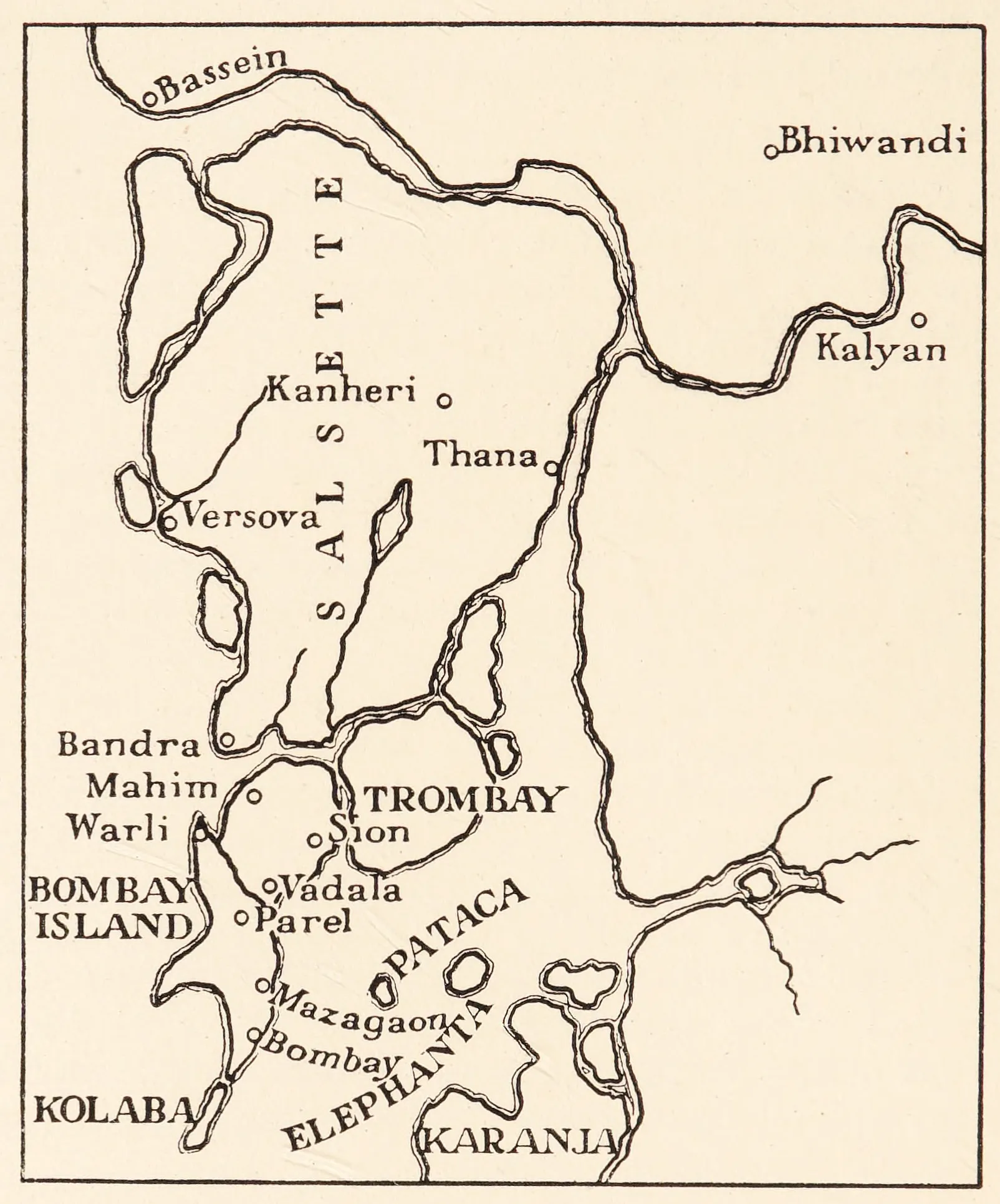
Kolāba on the south, but also Māhīm, Sion, and Vadāla, which were separated from the rest of the island by a shallow channel.1 Mr. Edwardes (Rise of Bombay, p. 92) has pointed out that the Portuguese had some grounds, from a legal point of view, for fixing these limits; but it can hardly be doubted that the treaty between the two crowns contemplated the surrender of the whole island, while even the Viceroy’s instructions to the commissioners appear to have accepted the strait between Bombay and Salsette as the proper dividing line. However, Cooke made no demur, and he further agreed to the demand that the conditions laid down by the Viceroy should be accepted by the English as binding. The documents relating to the cession having been solemnly read and Cooke’s credentials produced and examined,
He personally tooke possession and delivery of the said port and island of Bombaim; goeing therein, takeing earth and stones in his hands, entering and passing into the forts thereof, and puting the rest1 on the walls thereof, and goeing allso in the said island, takeing the earth and stones thereof in his hands, and doeing like things required by law, without that in such time he was any way hindered or contradicted in the said possession and delivery. And so he effectually tooke it, peacably and quietly, with liberty and in peace, without any question or contradiction, for the Most Excellent King of Great Britaine, his heires and successors, to have, possess, and be lords of the said island of Bombaim and of the port thereof, according to the capitulations aforesaid made between both Crownes and instructions of the Vice King.2
Directions were then given for the proceedings to be formally recorded. The witnesses on the English side included Ensign Thorne, John Stevens (captain of the Chestnut), Henry Gary, and Richard Ball.
Cooke’s first care was to take steps to make his position safe against attack. This, however, entailed expenditure and his funds were low. Even before he had taken possession of the island he had written to the President and Council at Surat, asking them to supply him with money for the purpose; but Oxenden and his colleagues were unwilling to do anything of the kind, as they had no specific authority from the Company and it was notoriously a difficult matter to recover from King Charles money spent in his service, even when the expenditure had been previously sanctioned. Replying on 2 February (P.R.O.: C.O. 77, vol. ix. nos. 77, 78), Oxenden pointed out that any unauthorized outlay on fortifications was likely to be repudiated in England, and that, if the King had intended that the island should be fortified, he would doubtless have sent out the requisite funds. For himself, he considered such expenditure unnecessary. Neither the Company nor the factors themselves had any money to spare for such a purpose ; and it was not understood why Cooke should be so short of cash, seeing that the supplies from home were intended to suffice for paying the whole of the original force, which was now so much depleted. In this connexion Cooke was reminded of the King’s order that a muster should be held and the result sent home. The President had still in his hands a balance of 10,550 rials of eight out of the money sent by Alderman Backwell on the King’s behalf to meet Shipman’s expenses. Hitherto this sum had been withheld, owing to Cooke’s refusal to comply with the conditions laid down by the Alderman ; but, in his anxiety to serve the King’s occasions, Oxenden would risk paying it over at once, if Cooke would say whether he would send for it or have it remitted by bills of exchange. Evidently Cooke had intimated a desire to take into the royal service any unemployed Englishmen at Surat, for the letter closed with a statement by Oxenden that he had ‘ appointed a person to acquaint the English with your desires to entertaine them upon the conditions you propound ’.
The report which the President and Council made to the Company on the matter has been noticed already on p. 4. In addition, Oxenden, who was afraid that his action might be construed at home as showing an unwillingness to assist the King’s affairs in an emergency, wrote both to Lord Arlington (6 March)1 and to King Charles (12 March).2 In the latter document he assured his sovereign that he had done his best to help the English at Bombay, in obedience to His Majesty’s commands. To the Secretary of State Oxenden was more explicit. Referring to the stay of the expeditionary force at Anjidiv, he said that
The first yeare prooved very fatall to the souldiery, which noe reason cann bee given for, since this last hath soe well agreed with them that they have not lost five menn in the whole twelve monthes upon the island, which in itselfe stands in a good and wholesome ayre ; and therefore it is gennerally imputed to the menns disagreeing with these partes and intemperate life.
After mentioning Shipman’s death and Cooke’s assumption of the command, Oxenden alluded to the fact that only one military officer remained alive, and he was an ensign merely.
By which meanes you may conclude the commonn souldiery are not soe well govern’d as they ought to bee, Mr. Cooke himself having but very little experience in the command of persons of their temper, his education and employment being quite of another nature; wherefore (as I am bound in duty) I cannott but acquaint you thus much, that speedy care bee taken for supply of the garrisonn with some honourable experienc’d person, as allsoe sober and well quallified officers, that may prevent the misdemeanours of those whome they command.
Bombay was well spoken of; it was healthy and so well situated for commerce that
The whole trade may in a short time bee drawne thither and Bombaim become the scale of India; the bay and harbour being very commodious and faire, that there is noe need of pillotts, but shipps of any burden may goe out and in at midnight. Besides, the countrey people, being soe slavishly used by the Portugalls, uppon civill treatment would resort thither, for they are much more affected to us then [to] their ould masters.
Finally, Oxenden said that he had already paid to Cooke 4,000 rials of eight, and was sending the balance by the ships bound for England. Cooke had demanded more, but Oxenden had no authority to advance any money from the Company’s funds.
Reverting to Bombay, we note that the muster of the garrison which Gary had been ordered to take (see the previous volume, p. 335) had been held on 25 February, 1665. The list 1 gives the names of one ensign, four sergeants, six corporals, four drummers, and ninety-seven privates, a provost-martial, a surgeon and his mate, two gunners, a gunner’s mate, a gunsmith, and a storekeeper; also the officers and crews of the Chestnut and of the sloop commanded by John Burgess. This is supplemented by a list 2 of the stores in hand on 3 March, signed by the storekeeper, Walter Gollofer. Whether he was the Company’s servant who went home from Surat in January, 1656, does not appear.
Cooke soon showed that he did not intend to be bound by the agreement he had signed; for within a month he had sent a detachment to take possession of Māhīm and its dependencies. Early in March he dispatched Ensign Thorne via Surat with a packet of letters informing the authorities at home that Bombay had been made over to him and detailing the steps he had already taken for the administration of the island. The principal document in the packet was a letter to Lord Arlington, dated 3 March, 1665,1 from which we have already quoted. It continues :
Herin I remitt the papers of the said rendition, by which you will see all the particulars therin, and may perceive his [i. e. the Viceroy’s] willingnes to bee troublesome, that wee might not have the surrender, in regard hee nominates noe person that shall receive the island for our Kings Majestie, but sait[h] that it shall bee delivered to the Gentlemen English.2 The persons that were to make the rendition scrupled at it; soe cost some trouble to cleare. Wee set saile from Goa toward Bombaim in the aforesaid boates the 7th January 1664[–65], accompanied with 10 galliotts that brought the Chancelor of Goa and the Viador da Fazanda, whome were the persons appointed to make the surrender of Bombaim. Both were very antient men. By the way they fell sick; soe put into Chaule, where wee staied 8 daies for their recovery. The 2d February 1664 wee arriv’d at Bombaim, being there detained on board six daies more, while [i. e. until] the city and gentrey of Bassin came to bee present at the delivery as witnesses. The 8th February wee landed our men in armes, to receive the island in our Kings Majesties name; which was donne with all the ceremony and honour could bee. What they deliver’d was onely two small bulworks, some earth and stones (the ceremony for the island), as appeareth by the papers of the rendition. The King of Portugall (as they say) hath neither house, fort, amunition, nor foote of land on it, onely the aforrowes [foros] or rents, which is but small, importing about 700l. yearely. The two bulworkes they delivered Donna Ennes da Miranda claimes to bee hers, and appeareth soe, with the house. Our Kings Majestie hath nothing more then the rents that the King of Portugall had, with the island and port, which, being wholy unfortyfied, will cost much monies to make it defenceable by sea and land; which must bee donne if His Majestie intends to make any thing of it. At present I shall onely make a platforme for our security, while [i. e. until] further orders from His Majestie ; which, with the two bulworkes, will hold all our ordnance. It will bee very necessary [to make ?] two or three small forts more, with a wall aboute the towne, for which [wee] shall want guns and orders, with effects to accomplish the same. In this island was neither government nor justice, but all cases of law was carried to Tannay and Bassin. Now it is in His Majesties jurisdiction, there must bee a setlement of justice, according to such lawes as His Majestie shall thinck fitt. For the present I have nominated for the whole island a Tannadar,1 which is a kind of an under captain. Hee had the place afore, with 300 serapheens 2 a yeare ; I am to allow him as much. I have likewise nominated a Justice of Peace, to examine all causes with a Bailiffe, that, matters being brought to a head, they may make report to mee, to sentence as I shall see cause. I have likewise nominated two persons to take care of orphans estates, one for the white people and one for the blacks, as it was formerly, with other officers under them. I have enordered a prison to bee made to keepe all in quietness, obedience, and subjection, these people generally being very litigious. I have alsoe nominated two Customers, one at Maym and another at this place. If our monies will reach, [I] shall build in each place a house for His Majesties accompt, which will bee very necessary to recover his customes. In the island are five churches, nine townes and villages, and upwards of 20,000 soules, as the Padres have given mee an accompt. The generall language is Portugueez ; soe that it will bee necessary the statutes and lawes should bee translated into that language. The people most of them are very poore. As yet wee have bin here but a short time ; as I find occation, [I] shall nominate what other officers shall bee necessary. I intend, as soone as may bee, to have a generall muster, to know what armes are in the island, and by the next oppertunity give you an accompt thereof. This island yeildeth at present nothing but a greate quantity of coco nutts and rice, with other necessary provissions. The Jesuits are much troubled at our being here, and strives all [that] may bee to make us odious to the people, and hath already attempted to take orphans off this island of the Gentues, Moores, and Banians, to force them to bee Christians ; 3 which if should bee suffered, wee shall never make any thing of this place, for the liberty of conscience makes all the aforenamed desirous to live amongst us. I shall doe all [that] may bee to give them encorougement, as His Majestie commands in his instructions. They desire to have churches, but for the present I have not granted it ; neither shall till I have further orders for it. If I should, the Portugalls will strange, in regard they looke on it as a scandall to their church. For the present I have ordered [that] they [i. e. the Hindus, etc.] use their ceremonies in their houses privately, but are not to give scandall to any. It will bee requisite that orders bee sent what shall bee donne in this particular.
Cooke next narrates his ineffectual attempts to extract money from the President and Council at Surat, and then goes on :
According to His Majesties comands, I have administred the oath of allegiance to all our owne people and some of the inhabitants. Hereafter I shall tender it to all the rest that are of a capacity to receive it. As yet [I] have not found any deny to take it. This island lyeth excelent well seated for trade, both for the South Seas, Red Seas, Gulph of Persia, Coast of Mallabarr, Cormondell, Bay of Bangaule, Pegu, and other places. ‘Tis a very wholsome aire and pleasant. It ’s some eight miles in length and five miles and a halfe broad.1 Severall merchants begins to flock hither already from all parts ; soe that I question not but in a short tyme it may bee as beneficiall to our Kings Majestie as Battavia is now to the Dutch. It will cost monies to fortyfy it as it ought ; but in a short time noe question it will repay its charges with proffit. Herin I remitt you a coppy 2 of the King of Portugalls patent given for part of the customes of Maym, a towne and port in this island, for soe many lives as appeares in it, they paying onely 240 serapheens rent to the King for the customes ; which is but small in consideration of what the port rents. I shall desire to know whether the patent is to stand in force, now the island belongs to our Kings Majestie. Here are severall that holds lands and other rents for lives on the same terms ; therefore it will bee necessary to know His Majesties pleasure herin. Since I had the possession of this island I have writt to the Vice Roy at Goa, demanding in His Majesties name all the rents that hath bin due to him since the arrivall of his fleete here with My Lord of Marlebrough, which was in Sept. 1662, the said Vice Roy then constituting himselfe Governour of this island for our Kings Majestie ; 3 soe noe question but hee received the rents to his use. What his answer will bee [I] know not, but hope His Majestie will demand it of the King of Portugall in case he gives not satisfaction here (which is to bee feared). For the advancement of this port it will bee necessary to procure from the Court of Portugall the priviledge of navigating in that Kings currents and streames here freely and without any manner of impediment for all boates and vessells whatsoever that shall bee bound to this island with merchandizes, belonging to either English, Moores, Persians, or Banian merchants, from and to two places lying beyond Tannay upon the terra firme in the Mogolls dominions, the one called Cullian and the other Buimdy,1 where (if ever this bee made a good port) all goods of Indostan growth and make, as well as those of Decan, Gulcondau, and the coast of Cormondell, must necessarily bee brought ; which will make them cheaper by 15 or 20 per cent. then those that are carried to Surrat, in regard of the great distance from it and vecinity to the two prementioned places. And wheras these goods brought to the aforesaid townes must there bee shipped off and pass downe the river by Tannay, in all probabillity (if provission bee not made to prevent the same) the King of Portugalls ministers there may lay imposition upon and take custome for them, as the King of Denmarke doth in the Sound at Elsenore. And for the making this port more flourishing, orders from His Majestie will alsoe bee necessary for the building six briganteens or galliots for keeping the coast heraboutes free from Mallabarrs, who doe very much infest the same, to the greate detriment of trade.
Cooke transmits the muster taken by Gary, and explains the delay. He points out how weak the garrison is
To defend ourselves and keepe those islanders in obedience ; out of which [I] am forced to send 20 men to Maym, to remaine there to keepe them under likewise. His Majestie will plainely see how necessary it will bee [to send ?] a good recruit, both of officers and soldjers, which to save his monies I have not made any ; soe that my care hath bin the more, in officiating my selfe all the officers places that are wanting ; which service I doubt not but His Majestie will please to consider.
He sends also the account of disbursements made by Shipman and afterwards by himself down to 3 December, 1664.2 This, he says, will show how economical they have both been.
In the said accompt Sir Abraham Shipman charges every private soldjer 3d. per day for the six months they were aboard shipp, the other six pence being discounted for His Majestie for their victualls and is not charged in this accompt. The 3d. is for clothes, shirts, stockings, and shoes to every one, as it was ordered in England by His Majestie to bee given aboard shipp, the which was observed ; soe that what soldjer[s] died aboard, their 3d. per day would not pay for their clothes they received, which loss Sir Abraham Shipman sustaines.
The gun carriages brought from England, as also those left by Marlborough’s squadron, are all decayed and wormeaten ; and Cooke has consequently been forced to provide new ones. He trusts that a supply of men and stores will speedily be sent. He has received from Oxenden a portion of the money furnished from England, and the rest is promised shortly.
I perceave His Majestie is to pay after the rate of 5s. 6d. for each dollar [i. e. rial of eight]. Here they goe in payment to the soldjery for noe more then 4s. 9d. a peece, and will not pass in the country for more then 4s. 6d. each. To raise them to the soldjery in payment cannot bee, without particular order from His Majestie ; and if hee should doe that, at 5s. 6d. each dollar they were not able to live on their pay. Sir Abraham Shipman never paid the same dollars at more then 4s. 9d. a peece, and the Portugall crusadoes at 4s. a peece. For mee to innovate and raise its price would cause mutiny, and [it] would not bee received at more then aforesaid. I see His Majestie will bee a greate looser by it, but it cannot bee remedied. The 14,550 peeces of eight, computed to bee 4,000l. at home, will not make here more then 3,455l. 12s. 6d. according as I pay them to the soldjery.
Cooke commends to His Majesty’s favour the bearer of this letter, Ensign Thorne, who is a kinsman of Shipman and has been a sharer in the enterprise from its start. Several Englishmen have made their way to Bombay and applied to be entertained in the King’s service, but Cooke has hitherto refrained from engaging them, because he has no authority to do so. Now, however, he has decided to enlist 40 or 50 men, if he can procure them, and he trusts that his action will be approved, in view of the great need he has of soldiers. He sends a packet directed to the Portuguese ambassador in London from the Chancellor of Goa, who was one of the Commissioners for the delivery of the island and ‘was very instrumentall thereunto, hee having put a period to all scruples and doubts’. Finally, their minister being dead, Cooke asks for ‘an orthodox divine’ to take his place.
In a postscript, dated 15 March, 1665, Cooke continues his story.
Since the finishing and firming [i. e. signing] of the preceding, the Vicar of Parela, Padre Antonio Barboza (a Jesuit), presented mee with the paper which is herewith sent for your perusall,1 by which hee endeavours to make appeare that 2000 sherapheens out of the Kings rents at Maim (which comes but to 26 sherapheens more per annum) were given to their Company by the King of Spaine, Don Phillipp, then Lord alsoe of Portugall, and confirmed unto them by the Vice Roys of India. But it seeming unto mee a thing most unreasonable that they should take away all the benefitts of the rents of the said Maim, and His Majestie [have] nothing at all, hee being at soe vast a charge in mainteyning this garrison, which is for the security of this island, and consequently of the lands and livings which these people enjoyes, I shall therefore secure the said 2000 sherapheens, by having it deposited untill His Majesties further order; as I shall proceed in the same manner with him that hath the patent for the customes of 3½ per cent. at Maim, conceiving that, now our Kings Majestie is absolute king and lord of this island and the King of Portugalls dominion and governement ceasing, all merces,2 as donatives of the like nature, ceaseth alsoe with his governement. Many more suchlike matters I suppose may present themselves herafter; of all which I shall take such care as His Majesties interrest shall not in the least bee prejudiced; but being newly arrived and entred into this government, and these Christians that had offices in it being most unwilling to discover unto mee the trueth of things, it is impossible to bee acquainted as yet of that which time will make manifest. When that I had proceeded thus far, I was informed of a bussiness of importance, which is, that the Bandarins3 of this island, a sort of people who gaine a livelyhood by drawing of tody (a liquor distilling from the coco nut tree), paid formerly unto the Foreirors Mayores4 or Senhorios of the severall cossabeys5 or townes a duty called Coito,6 that is, for the knife wherewith they prune their trees, amounting unto about 700 or 800l. per annum, which falls now to His Majestie; which, together with what more may bee discovered and collected of His Majesties rents, importing at present (which as yet is come to my knowledge) in circa to 1500l. per annum, it will bee a helpe towards the payment and mainteynance of this his garrison. I have at last (after much enquiry made) obtained a coppy of the forall1 of the mandowin2 or registring house (a kind of a customehouse) of Maim, which I herewith send alsoe for your perusall.3 By the same you will discover how far the limits of the said mandowin reaches, and what places are subordinate and paies duties unto it. . . . Whilst [i. e. until] I shall receive further orders from his Majestie for the encouragement of marchants to come to [in]habit and have commerce in this port, I have imposed 4½ per centum custome uppon all merchandize to bee imported or exported, vizt. 3 per centum to bee added to His Majesties cash and 1½ per centum towards the defraying of the charges of custome house officers; but at Maim the duties that hertofore were paid to that mandowin are, vizt. 3½ per centum, which goes to Francisco Murzelo Coutinho aforementioned, 2 per centum, called consulado,4 1 per centum imposizon,5 besides some other petty duties, wherof a just accompt is kept in a booke apart by the Customer.
In another postscript written on 18 March Cooke acknowledges the receipt from Oxenden of the balance of the money due, but complains that, instead of 10,550 rials of eight that should have been sent, 21,625 rupees 12 pice have been forwarded as an equivalent. Since the rupees will not go for more than 2s. 3d. each (as against 4s. 9d. for the rial), there will be a loss of 72l. 16s. 3d., which Cooke considers should be made good by Alderman Backwell. A further postscript, added the following day, says that, according to report, the Jesuits and other Portuguese have written to their friends in England, urging them to solicit King Charles
To confirme their old pattents, as alsoe the coito beforementioned, taverns, and shopps, with other more exacting tributes, not well lookt upon by tradsmen, especially the latter; which if hee grants, hee will not have any considerable matter left towards the defraying of this vast charge hee is at of mainteyning this his garrison.
In the whole of this long report Cooke does not mention the name of Gary, though it is clear that the latter had been his right-hand man in all the measures he had taken, the credit for which he evidently desired to reserve for himself. He did, however, do something privately to advance the interests of his assistant, for, in writing1 (4 March) to Thomas Povey (who had considerable influence at court), about the estate of the latter’s brother Charles, he, after mentioning that he had written both to the King and to the Duke of York, said :
Mr. Henry Gary (I understand) you are a well wisher to. Hee hath bin effectually officious in this rendition, and hath done His Majestie good service. I have nominated him Cheife Customer of this place, and some other things that will bee beneficiall unto him, that hee and his family may live, Sir George Oxinden not having requited him att all for his many yeares service for the East India Company. If you can prevaile that the Kings Majestie confirmes him in the place aforesaid of Cheife Customer, it will bee a place of good requitall for his zeale to His Majesties service, and I question not but hee will know how to bee thankfull to you for your good wishes.
However, if Cooke was unwilling to give Gary full credit for his assistance, the latter was quite capable of pushing his claims himself. On 16 February he had written via Surat to Lord Arlington, narrating his services and pressing for a permanent appointment.2 He took credit for having been mainly instrumental in securing the surrender of Bombay to Cooke and the transport of the expeditionary force to that island; and he then proceeded to detail the efforts he was making to secure settlers.
My endeavours at present beeing to draw hither as many merchants (Banians as well as Moores and Persians) as possibly I cann from Suratt, Cambaya, Ahmadavad, Boroach, Diu, Tahtah, etc. other places; unto whom yf His Majesty will but graunt liberty to buyld them pagados and mesquitas to excercise theyr religion publiquely in, noe doubt then but this will bee made a very famous and opulent port; hopeing that my service to my King may merrit his favor of beeing boath his factour and cheiff modeler and dispatcher of his customehowse affayres of this island and port of Bombaim; which I question not but to performe to greate satisfaction.
He then emphasized the necessity of obtaining from the Portuguese free access to Kalyān without paying dues at Thāna, and the advisability of building some light vessels for convoy work. His language on both points is so similar to the corresponding passages in Cooke’s later letter as to leave little doubt that either the latter was in effect quoting from some memorandum by Gary, or else Gary had had a hand in drafting the letter signed by Cooke.
The dispatch of Thorne overland with Cooke’s dispatches enabled Gary to send Lord Arlington a transcript of the abovementioned letter, together with a fresh one dated 22 March (ibid., no. 84). In this he again urged the necessity of securing freedom from Portuguese duties on goods passing between Bombay and the inland ports. Should any difficulty be made in granting that concession,
The remedy must bee found out heere, by impeding all such boats as belongs to the Portuguezes to navigate in this bay, notwithstanding Antonio de Mello de Castro (at present Vizorey of India) his apuntamentos,1 vizt. the first and second things of his owne erecting, many of them not having any consonancy with the 11th artickle of [the] treaty betweene the two Crownes. There are severall places uppon the maine belonging unto Sevagee not farr from us, to which wee may freely goe and where the caravans might also come out of Hyndostan and Decan without coming neere the Portuguezes jurisdiction, with paying but a small custume unto him; but hee is so greate a robber that it is to bee doubted that merchants will scarse runn the hazard of having theyr goods brought or carryed through his country; tho some are of oppinion that, giving his oath, hee will religiously keepe it. The Greate Mogull, Orangzeb, hath sent a greate army against him, consisting of above 100,000 horse. Yf hee prevaile and take his country from him, which lyeth betweene us and Chaul, it will bee very happy for this island; for then all manner of merchandize will bee brought downe to us in greate quantitys, and then no doubt but this will be the most florishing port of the Orient. But heere must necessaryly bee six brigantins or more, not only to scoure and keepe the coaste free from Malabars, but likewise to give convoy and atendance on the fleetes that lades rice, cairo [coir], coco nuts, salt, suger, etc. other commodities, boath heere and at Maim, for severall parts of India, as also for the Gulph of Persia and Redd Sea; the aforesaid rovers beeing so bold, in regard of this deffect of light and nimble vessells (so much wanting unto us) to give them chase, that many times since our having possesion of this island they have come in this bay and ridd within sight of His Majestys flag; which is no small dishonor, boath to it and the nation. I well know not how the Easte India Company will proceede as to matter of theyr trade, now that His Majesty (much against theyr wills) hath possesion of this island. I have therefor in case they should give over and His Majesty or His Royall Highnesse [the Duke of York] should entertaine thoughts of prosecuting the trade, drawne out a list of the severall commoditys that are proper for this Indian mart.1
Care must be exercised in choosing a trustworthy and experienced person to manage the trade, and timely warning would be necessary, in order that an investment might be started. Letters of credit should also be sent, directed to ‘Virgee Vora, Chout Tackur, and Heridass Benwalidass,2 Banians in Suratt’, to furnish the requisite money. Gary trusted that the King would appoint him to this duty,
Hoping hee will consider me for the service I have allready don him, I performing the dutys of Secretary, Cheiff Customer, and Muster Master at present, without any maner of consideration for the same.
That Gary’s advocacy of religious freedom for the inhabitants of Bombay rested largely upon a conviction of its material expediency is suggested by a proposal that follows.
Heere is uppon this island a tanque or pond of watter, neere unto which many yeeres since stood a pagode or temple,3 where in the latter the Banians worshipped and in the former purifyied them selves, multitudes of Banians resorting to it to this day, boath from neere and remot places, to wash them selves. But when the temple was standing, those that came to doe theyr devotions accounted not theyr vou of theyr pilgrimage accomplised without the expence of an offering; and yf His Majesty would but permitt them to erect theyr temple againe, I am confident the benefit that would bee reaped by it would bee so considerable, by a voluntary tributt every one would give, as that it would much helpe towards the maintenance of this his garison. Neither would the permission of this bee more scandalous unto our Christian religion than His Hollinesse permiting in Rome the Jews (who chrucifyied our Blessed Saviour) to have publique sinagogues, the King of Poland, Republique of Venice, Greate Duque of Tuscany, and many other princes and republiques permitting them the same priviledge without beeing looked uppon as scandalous.
Finally, Gary expressed the opinion that, should a war in Europe between England and Holland result in an English victory, the ascendancy of the Dutch ‘in these parts’ would soon be at an end, as they were very unpopular with the Indians on the Malabar Coast, who only waited an opportunity to rise against them.
Gary evidently left no means untried to achieve his object, for the document which forms no. 66 in the same volume was doubtless due to his instigation. This is a translation of an undated representation from certain Portuguese at Goa, transmitted apparently to the Portuguese ambassador in London. It declared that Gary had rendered important services to both nations and that it would be very acceptable to the Portuguese in those parts (the Viceroy would certainly not have agreed as to this) if he were now employed by King Charles ‘in some places of trust and qualitie’, such as ‘His Majesties Merchant and Cheef Customer’. Queen Catherine was accordingly urged to use her good offices with her husband for that purpose.
Another letter in Thorne’s packet was one addressed by John Stevens, the captain of the Chestnut, to the Navy Commissioners, dated 11 March.1 In this he complained that no arrangements had been made for the necessary payments on account of his vessel. Shipman and Cooke had nevertheless defrayed the cost of repairing and victualling her, and had advanced enough to enable him to pay the crew five months’ wages; but the men were discontented at not receiving more, seeing that the soldiers were paid regularly every month. Stevens had urged Cooke to send the Chestnut to England, but the latter was unwilling to spend the money that would be needed to renew her rigging and victual her for the voyage, and pleaded that he had no orders. The Commissioners were begged to send out a supply of money, to take steps to relieve Stevens’s wife and family, and to permit him to return to England.
Thorne’s departure from Surat ‘on a junck for Bussora’ on 5 April is chronicled in the Surat letter to the Company of that date. He appears to have reached London about a year later. He had been detained at Aleppo for eight weeks for want of a ship, and at Marseilles for a still longer period owing to lack of money (see his letter in P.R.O. : C.O. 77, vol. x. f. 20).
The alarm excited by Cooke’s proceedings is shown by two petitions (ibid., vol. xi. ff. 35, 36) addressed to the King of Portugal in March, 1665, by Bernardin de Tavora and Francisco Murzelo Coutinho, asking for protection.
On 13 May Cooke issued a proclamation requiring all inhabitants of the island between the ages of 14 and 60 to appear at his head-quarters with any arms in their possession; and he thereupon administered to them an oath of allegiance, which included a renunciation of any outside authority, temporal or spiritual.1 This was interpreted by the Portuguese as an interference with the religious freedom guaranteed to the Roman Catholics of Bombay, and both actions—as also Gary’s activity in enticing away weavers from Chaul and other places—led in May to an acrimonious controversy between Cooke and Ignacio Sarmento de Carvalho, the Captain-General of the North.2 The Viceroy himself was next embroiled in the dispute. As we have seen (p. 46), Cooke had demanded that the revenues drawn from Bombay from the time of Marlborough’s arrival in 1662 to the actual date of the transfer should be made good to him, on the ground that during that period the island had been wrongly withheld from the English. Naturally, De Mello de Castro repudiated the claim; and he took the opportunity to protest against Cooke’s seizure of Māhīm and his failure in other instances to observe the capitulations.3 At the close of the year the Viceroy wrote to his King enumerating these breaches, and adding that they were instigated by Henry Gary, who was ‘a terrible heretic’. With regard to Cooke’s claim that the Māhīm district was part of Bombay, because it was possible at low tide to walk across the intervening channel, the Viceroy pointed out that the same reasoning might be used to justify the seizure of Salsette Island. He declared that the Portuguese of the North would have taken up arms and driven out the English, had he not soothed them with assurances that the King was already in treaty for purchasing back the island. It was, however, possible that, before anything could be done in Europe, the Dutch would have captured Bombay from the English. Cooke had of late changed his tone of bravado for one of humble entreaty; but it would be dangerous for the Portuguese to embroil themselves with the Dutch by giving open assistance to their enemy.1
The reference in the above to negotiations between Lisbon and London for the retrocession of Bombay requires some explanation. We have seen (p. 136 of the preceding volume) that in December, 1662, the Viceroy had proposed to his sovereign that the English claim should be compromised by a money payment, towards which, he was convinced, the inhabitants of Portuguese India would gladly make substantial contributions. To this the King replied on 15 April, 1665 (N.S.), declaring that he had negotiated with Charles II, who appeared to be willing to entertain the idea of selling the island but wanted a very large sum for it. The Viceroy was accordingly directed to collect and remit as soon as possible all the contributions he could procure, on the understanding that, if the negotiations came to nothing, the money would be used against the Dutch instead.2 It would seem, however, that the Viceroy found that he had been mistaken in his estimate of the possibility of obtaining money in India for such a purpose.
Some light is thrown upon these negotiations by the papers included among the State Papers, Portugal, in the Public Record Office. From these it appears (vol. vi. f. 243) that early in 1664 King Alfonso dispatched Francisco Fereira Rebello to London, ostensibly to satisfy King Charles that instructions had been sent to the Viceroy to hand over Bombay without further ado, but really to negotiate for the repurchase of the island. Charles expressed his willingness to agree to this, provided he were adequately compensated for the expenditure he had incurred and for the value of the territory to be surrendered. The amount he demanded was 229,862l. 14s.; but as this sum was obviously greater than the Portuguese could pay, Charles intimated orally that he would be satisfied if King Alfonso ‘would lay downe a somme that might be considerable, proportioned rather to the necessity of his present affaires’ than to the amount demanded. With this answer Rebello returned to Lisbon in the spring of 1665 (vol. vii. ff. 1, 13, 15, 145–9). The Portuguese seem to have remained confident of a favourable issue to the negotiations; for writing on 3 August, 1665, Thomas Maynard, the British consul at Lisbon, said that the news of the actual transfer of Bombay had proved a great blow to the court, because ‘they thought that all difficulties for not delyveringe that place according to articles were overcome and the place to remaine in thire possession’ (ibid., f. 63). Still, King Alfonso and his advisers were not daunted, and a few months later the negotiations were renewed. On 14 February, 1666, Don Francisco de Mello, the Portuguese ambassador in London, wrote to the English sovereign (ibid., ff. 145–9) that his master had instructed him to renew the former offer, in spite of the fact that Bombay had now been formally transferred. Evidently the agitation against the surrender of the island had strongly impressed the Lisbon authorities, for the ambassador said:
The scandal and complaints of his subjects from all hands encresing daylye, to his great disturbance at home as well as in India, where they yet expresse in their many and pressing instances hopes of returning to live under His Majesties obedience in more secure possession of their propperty and free enjoyment of their religion, the King my master, thinking him selfe obliged to endeavour the peace and quiet of his people by all possible meanes, hath comanded me to continue and prosecute a treaty of satisfaction.
Don Francisco hoped that, in regard to the compensation to be given, King Charles would show his wonted consideration for the financial distresses of his royal relative; and he pointed out that ‘the conveniences of that island are att very present very inconsiderable’, that the expense and trouble of sending supplies thither were immense, and that Bombay was in great danger, if it remained in English hands, of being captured by the Dutch, to the serious detriment of both kingdoms. However, the proposal came to nothing. The financial distresses of Portugal, owing to the lengthy war with Spain, were notorious. King Alfonso could not find money even to pay the expenses of the English troops sent to his assistance, and a great portion of the dowry promised to King Charles with his Portuguese bride was still owing. A cash payment, which was the only consideration likely to secure the retrocession of Bombay, was therefore out of the question. The unpopularity of King Charles’s surrender of Dunkirk to France may have been a further deterrent.
The reference to the danger of a Dutch attack upon Bombay bring us back to our chronicle of events. On the arrival at Surat of the African (4 September), bringing news that war with the Dutch had actually broken out, the President and Council wrote (9 September) to acquaint Cooke with that important intelligence and to forward a packet from His Majesty, addressed to Shipman, whose death was not known in England at the date of its dispatch. The authorities at home, alarmed for the safety of the expeditionary force at Anjidiv, and fearing a Dutch attack upon it, had concluded an agreement with the East India Company,1 by which part of the force was to be carried to England in the African and the St. George, while the remainder was to be transported to Fort St. George and incorporated in the garrison there. Instructions were accordingly given by the Company to the President and Council at Surat to effect these operations, and a letter from the Duke of York to Captain Stevens, of the Chestnut, directing him to place himself at Oxenden’s disposal for that purpose, was also forwarded. These arrangements naturally fell through in the changed circumstances.
Cooke replied to Oxenden’s letter on 20 September, the day after its receipt. He had, he said, already heard of the outbreak of war ;
Which hath caused me to take a resolution upon me not only to fortifie but likewise maintaine this place (as hath allso all my officers and souldiers unanimously done the same) to the very last, by Gods assistance. . . . The shipp or shipps arrived (or that may arrive) with you from England this monsoon, together with the men, would (in case you should not returne them) be very usefull here for the help and defence of this His Majesties port and island, wee having had a mortallity amongst us these last raines of some 30 men. So that I earnestly desire you to take this into your consideration, it being a thing of so great importance, in case wee should be assaulted by the enemy.1
He also asked for a supply of medicines, proffering payment either in India or in England, though he would prefer the latter, ‘because mony is very scant with us’.
To this letter a reply was sent on 2 October. Cooke’s resolve to defend Bombay was warmly praised. A promise was given that he should be supplied with medicines as far as these were procurable. It was explained that the African could not be detained in India without violating the Company’s instructions and the conditions of the charter-party; and moreover Captain Harman was strongly opposed to any such employment of his vessel. As for Cooke’s want of money, it was quite out of the power of the Council to supply him with any, in the absence of express authority from home.
Cooke’s answer was dated 26 October. He urged his great need of money, and suggested that, since the Company’s funds could not be drawn upon for the purpose, Oxenden might do the King a service by advancing 1,500l. or 2,000l. ‘out of his owne stock’, accepting in return a bill upon the Treasurer of the Navy.
Our works are allready in a good forwardnesse, having allmost all things in a readinesse to indure a seige, in case our enemies should invest us; but our cheifest want is mony to raise men. So that how to levie as many as will defend and maintaine this fort I well know not how to effect without it; which puts me allmost at my witts end; which once more makes me desire Sir George Oxinden to take it into his serious consideration, intreating you allso that, if there be in Surat of our nation any supernumeraries, and that may be spared [from] your Companies service, that you would be pleased to send them hither with all the expedition that may be, to joine with our small forces; for in this allso you will doe the King my master very good service. . . . You need not strange at my want of mony . . . if you will but consider that I have been at upwards of 240l. per mensem charge to pay the souldiery ever since December last out of the last supply sent out [from] England, besides what hath been disbursed in erecting of a new platforme etc. other expences which are unavoidable, especially at this time that wee must furnish our selves with many utensills for warre and are at present raising new fortifications . . . [PS.] I have received lately letters, both from the Vice Roy of India and Captain Generall of the North, that for certaine the Hollander intends to make an attempt upon this island very suddenly. . . .
Oxenden and his Council replied on 8 November. With regard to his lending money for the King’s service, the President said frankly that
Hee is not in a present capacity to doe it. And that it may appeare to the world that this his pretence is not fained, hee is now constrained, for the clearing thereof, to publish somewhat more then hee hath hitherto been willing should have been knowne nor (had it not been for this occation) would have been to his reputation; which is (as hee saith) his great unhappiness that in his last voyage for India hee became intregu’d with his employers, upon an urgent occation there was, to mix his whole personall estate with theirs, to the amount of many thousand pounds; who, possessing themselves therewith, found pretences to keepe it from him, involving him in many troublesome sutes of law,1 which are (for ought hee knowes) depending to this day, and when or whether they will end in his ruine, time must manifest. And thus much hee hath further to say, that those troubles by the detention of his estate brought him to so low an ebb that hee can (when lawfully called) make oath that hee brought not any personall estate with him, saving what was his necessaryes and a small parcell of plate for his owne use. And how bad the times have been since hee came forth for the getting of any thing, hee leaves to your selfe as the best judge (having actually laboured to doe something that way). And now that hee hath laid himselfe so open as nothing but this occation should have perswaded him to doe, the greatest civillity and favour you can shew him is to keepe this great secret to your selfe; which hee heartily desires of you, considering that every mans outward garb cannot possibly discover his inward condition, as you see now this of his is, although hee beleives you would little have suspected it. Else would hee express his zeale as high as any mans, for hee referrs to all that have been acquainted with him from his youth up, who can very well testifie that hee is no new convert in his affections to His Sacred Majesty. . . . As to what you move us in concerning more men, Sir George Oxinden saith hee hath spared you all his two ships companyes Royall Welcom and Hopewell, except it be some few who have shipped themselves on board the Affrican in the rome of those that dyed, and that here are not any left except the commander, Mr. Griffin, and his purser, with one or two more that keepe the ship. But wee observe some here that drive a kind of trade betwixt you and this place, that first went hence under the pretence of their desires to serve His Majesty on the island of Bombaim; and therefore it is but reason you should detaine them as they come thither and make them so good as their promise.
The endeavours of Cooke and Gary to draw settlers to Bombay produced trouble at Surat. On 13 December the President and his Council wrote as follows to Bombay.
It was the 6 present when the President wrote you [not extant] in particular by expresse, inclosing a pacquett to you from Ensigne Thorne, with such news as he received from Bussora. Since which we have to advise you that the Kings Intelligencer1 of this towne hath given many informations up to court, which hath caus’d severall letters to be writt downe to this Governour concerning our Kings Majesties settling his souldiery on Bombaim; enordering a strict inquisition into your actions there and what new fortifications you have erected since your taking possession of the iland, togeather with many other particulars from advices gonne up from hence; which caused this Governour to give us a greate deale of trouble and would have commanded us to write to you to desist from further fortifying; which he backt with menaces and threats that he would turne us out of his country. Our answer was that we were strangers and upon permittance, and that it was the Kings country [and] he might doe with us as he pleased; but it lay not in our power to forbid or enorder anything there with you, being His Majestie of England our Kings officers and people, whose subjects we were, and that the government was independant to ours, who were noe other then merchants and therefore dare not presume to concerne ourselves in state affaires. Next he told us that the King was greately offended that we endeavour’d to inveigle and draw away his subjects and strangers that frequented his port, to goe and inhabit with you, which was designed to destroy and draw away all trade from hence. This we stoutly denyed; whereupon this Governour proceeded to summon all the merchants in towne and cause them one by one to signe a paper how that we had not labour’d to draw off any of them; which they confirmed under hand and seale, on a penalty and forfeiture unto the King in case it could hereafter be prooved to the contrary. This went on untill it came to Cojah Minnas [Khwāja Minaz], the President for the Armenians, to firme and seale; who boggl’d at it and, fearing least it should in time be discover’d what had passt between your selfe and him, produced an instrument, signed and sealed by you, that invited him thither, declaring what priviledges should be allowed him, if he and his nation would remoove thither; which was noe sooner given to the Governour but we were sent for againe thither and charged as before; which we still opposed. Whereupon the Governour shewed the President the writing you had sent to Cojah Minnas; which having read, we told him we were not privy to the writing, and that it was probable he had invited himselfe first; whereupon we received very hard language from him, and as hard usage since. But we thought all had been passed over, untill a day or two since we are acquainted that there is both a phirmaund from the King and husball huccum1 (which is a writing passed by the Kings immediate order upon this Governour) that one Syed Mahmud, a factious and troublesome person once Customer here, is enordred to be sent downe to view your workes and place and give an accomptt thereof to this King; whereupon we are again sent for and commanded to give a letter of recommendations to you to admitt him; which we refused, telling the Governour it was not accustomary to admitt of strangers to view fortifications or suffer them to come into castles, of which there was not any on the iland. This our denyall did much offend him, that we know not but he may force such a paper from us; and in case he doe, it shall extend noe further then you please to admitt. However, we thought good to preacquaint you with what hath passt before his coming, and referr all to you, who best know what is to be done in such cases. Wee on our parts shall be contented rather to be sufferers and hazard all then any of our Kings Majesties intrest should receive the least prejudice.
To this letter Cooke replied on 25 December, stating how he proposed to deal with Sayyid Mahmūd.
If he doe [come] in way of a spy, I shall, according to my duty, doe justice upon him; but if he come as an envoy, he shall be treated accordingly, though not admitted either to approach, much lesse to view, them [i: e. the fortifications]. And then, if convenient, I shall shew him Cojah Minas his letter, to manifest unto him what a jugler he hath proved himselfe, in first inviting himselfe to come to live among us and then to cause so much trouble as hath allready been and is like to insue upon his treacherous proceedings.
Cooke expressed regret for the harsh usage the English at Surat were receiving from the Governor, and suggested that they should, if necessary, take refuge at Bombay. In their letter to the Company of 1 January, 1666, the President and Council, after alluding to the demands made upon them by Cooke for monetary assistance, proceeded to give an account of the disputes with the Governor described above. This adds a few fresh details. It appears that the Governor had been severely blamed by Aurangzeb for not having advised him that the English were fortifying Bombay; also that Cooke’s action in this direction was defended by Oxenden on the ground that an attack from the Dutch was feared. The Governor declared, among other things, that
This King was inform’d that we sent our ships thither and that we had begunne our trade of egresse and regresse from thence; which we told him was not true, for hitherto our ships had imported and received their lading and dispatches from hence; but how soone it might be otherwise we knew not, or, as servants, was it for us to enquire into.
Cooke’s invitation to the Armenians of Surat to remove to Bombay included, it seems, a promise of ‘land to build them houses and warehouses, also a church for the service of God’. The Governor read to Oxenden the letter from Aurangzeb,
In which he was very particular and seem’d to be much concern’d, saying therein that he had also wrote to his ministers at Chowle [Chaul], not only to prevent any egresse and regresse from those parts, but also desir’d a particular accomptt from them of what was done upon the iland.
The Council’s answer on these matters had been sent to Court, and they were waiting to hear the result. They feared that further trouble was impending and trusted that the Company would direct them how to act.
The people there [Bombay] live very loose lives and ungovern’d, for want of an experienc’d and able person to command them, that we fear His Majestie may loose his intrest in those parts in case he doe not [send such a one?]. Yet give us leave humbly to offer our opinions concerning those troubles that will necessarily arise, should you speedily command our remoovall thither, on your presuming that it may be better and safer for you; to which we answer that greate care must be taken herein, first, that there be a through and full settlement on the place, establisht under a prudent and able Governour and other ministers, such persons as will lay aside all selfe ends for the generall good; secondly, that you first see that there be egresse and regresse of merchants that frequent the port, which will aske some yeares concourse of merchants before it be fitt you draw off from hence (which will be difficult); lastly, if you should suddainly remoove this Presidency, we opine you would be at a losse for goods to lade your ships home, in reguard, when such a thing shall happen, this King and people will certainly be your enemies, not suffring you to take off any goods from this place but stop all places of land convaighance throughout all his dominions, which extend to the southward of Bombaim as farr as Chowle, now that he hath worsted that grand rebell Sevagy, who, finding himselfe overpowred by his sending of numerous armies upon him, hath submitted himselfe, delivering up to this Kings Gennerall upward of 30 castles and strongholds, togeather with all the countries belonging to them, and accepted of this Kings pay of 5,000 horse; yet we cannot heare that he hath resign’d himselfe personally, but done all this by treaty, keeping to himselfe some few of his strongest castles for his retirement.1 This victory thus obtain’d over him is very pleasing to the King, and hath made him way to assault Vizapore [Bījāpur], the greate metropolis of Deccan, who before was tributary but refus’d to pay his annuall tribute for some yeares, whilst Sevagy was powerfull and stood as a wall and partition between them; who, now that he is worsted, is willing to pay his arrears, if this King will withdraw his army from further assaulting him; and yet ’tis thought by some that Sevagy hath an after game to play still. This discourse hath carry’d us away from what we were upon, concerning your remooving this your factory to Bombaim; to which we have only this to add, an humble offer of our opinions that it would be best and safest for you to settle a small factory there first, continuing your head factory and cheife tytle to be in Surratt, whilst those there are subordinate; which will not soe much be taken notice of, and may endeavour to draw a trade downe out of Deccan, and soe be buying of what comes in, for the encouragement of merchants to frequent the port; which goods may be either brought up by your ships that goe to the southward for pepper (which may be done without any further charge), or, if not, one of the ships design’d home, being dispeeded 5 or 6 days earlier then the other, may call there and receive it in, and be in a readinesse to sayle with the other ships, they calling upon her as they goe, or otherwise meet at St. Hellena. Likewise, that you would (if to be accomplisht) procure an order from thence for a sufficient platt of ground to be allotted you in a convenient place, for warehouses, store houses, and a dwelling house for your factors, etc. conveniencies; all which must be erected, there being nothing of that nature at present.
Meanwhile, on the island itself things were going none too smoothly. During the rains sickness had worked havoc among the garrison; money was scarce; and the roseate anticipations of an early influx of merchants and other well-to-do settlers had not been fulfilled. Moreover, although this did not appear on the surface, Cooke’s rule had produced bitter resentment among his principal assistants, Gary, Stevens, and Ball. On 23 December, 1665, the Lieutenant-Governor sent home a further report to Lord Arlington.1 In this he relates his controversy with the Portuguese authorities over the occupation of Māhīm.
They would have Maim and Bombaim to bee two severall islands, but cannot well make it out. I never tooke boate to pass our men when I tooke the possesion of it, and at all times you may goe from one place to the other dryshod. . . . Maim is the best part of this island, and they thinke it to[o] good for our Kings Majesty; but befor they have it againe (except His Majesty please to enorder it to them) it shall bee long enough by my consent. They since begin to bee sensible of theyr errors and are very quiet. I thinke they thought to have frighted us out of what was His Majestys due with theyr greate words and threatnings; but seeing it doeth not prevaile, they find it theyr best way to bee quiet.
Cooke then refers to his demand upon the Viceroy for the back revenues of the island.
Hee answered me that what hee had received hee spent in keepeing garison in this said island for our Kings Majesty.2 I demaunded what orders hee had for that, our Kings Majesty having a Governour and souldjery of his owne for the said purpose. On this I have had severall letters to and againe, but I cann gett no moneys.
Cooke sent a protest to Goa, but has received no reply, and, from the enclosed copy of a note 3 from the Secretary there, he concludes that the Viceroy does not intend to answer.
The Portugalls on the maine and neighbouring places in these parts, some have lands on this island and many inhabitants heere have lands there. So that I have bein forced (to excuse a comfusion) to settle the civill law among them in this island; the which hath hugely pleased boath partys. Among our selves is marshall law. And for religion, liberty of conscience is given to all.
He next confesses the failure of the attempts made to attract traders, and proposes that the Company’s factors should be forced to remove from Surat to Bombay.
This island is hitherto but a meere fishing place, and as yett no merchant of quallity nor any else is come to settle heere, nor will not while [i. e. until] a trade begins; which must bee done by His Majestys enordering all the Companys shipps to lade and unlade heere, and the factory of Suratt to bee removed hither. Theyre very custume only will goe neere to pay the garison and a great animating for others to come to live heere; and noe question in few yeares will reape a large bennefitt for His Majesty. In the interim hee cannot expect but to bee at a yearely charge by sending supplyes, in regard the rents of this island are so small, all not ammounting unto above 1000l. per annum. And although in my last to Your Lordship the last yeare I writt about a rent that did belong to the King, that might import to about 700 or 800l. per annum, for the knife that was to prune the cocer nutt tree, it hath proved incerto [i. e. doubtful], for since by papers I find it belongs to the owners or foreiros of the ground, for which they pay unto His Majesty what appeares by theyr foralls; so that it proved a fals information. These last raines hath proved very pestilentiall to our menn, having lost by death and runn away 51, as appeares by the enclosed list of theyr names [missing]; which, in our small quantity, hath much weakened us, allthough I entertaine all, what English, French, or Sweds,1 that comes. The last yeare 2 I made an end of fortifying this house towards the sea, by the building of a large plattforme 51 yards long, wherein cann play 18 peeces of large ordinance. It hath cost His Majesty monyes, but is the best piece in India and secures all the roade. It’s made as strong as lime and stone cann make it, and no question will last for many hundered yeares. I have likewise repaired the two slight bulworks and made them substantiall against battery.
Cooke acknowledges the receipt of Lord Arlington’s letter of 27 March, 1665, announcing the measures taken to carry home the soldiers, should they still be at Anjidiv—an arrangement no longer applicable.
The which letter and contract I caused publiquely to bee redd in our garison, that all might understand the greate care His Majesty hath had of us to bee at such a vast charge to transport us home after so greate a losse and not having don him as yett any service ; whose most gratious favor hath so much oblidged all in generall that I am comfident they will all venter theyr lives on theyr bare knees to do him service. . . . In regard wee were ordered home, His Majesty sent us no supplys of moneys this yeare, and its imposible the souldjery cann live without its pay ; heere beeing nothing to be had but for our moneys, and not one man that liveth uppon this island is able to trust us for a dayes victualling. They have it not, beeing most of them fishermen.
The letter goes on to complain of Oxenden’s refusal to supply Cooke with funds.
So that, I having a little mony of my owne and of some freinds in England, I hope I shall bee able to rubb out whilest [i. e. until] September next 1666 ; which otherwise this garison could not have subsisted, and consequently His Majestys interest lost. All this sommer I have bein ordering and makeing fortifications to the landward for a place of security, which as yett is not quite made an end of. Heere inclosed Your Lordship will receive its ruff draught,1 which bee pleased to shew unto His Majesty. It’s all done with turffe and cocernutt trees, 14 foote hygh round. With little repayring it will last for many yeares, all beeing cannon proofe. This worke would have cost His Majesty 5,000l. to have concluded it; but I hope it will not cost him 100l., for I have taken such care to have all the islanders to worke by turnes, some dayes 1000 men, some dayes 800, without pay, only something to drinke. It ’s much worke to bee done by force of hands. Wee have bein about it upwards of three monthes. It hath not cost me little trouble and care. Wee are now dayly expecting the enemy. The greate want of the losse of those menn that dyed the last raynes and the many sentinells wee have with our new workes hath forced me to entertaine in our fower companies tenn menn in eache company, beeing in all forty, Portuguezes, white menn of Europe. They have the same pay our owne menn hath. I would entertaine more, but our mony will not hold out to pay them.
Cooke trusts that next September he will receive supplies of men, money, ordnance, and ammunition. He has been obliged to have some match made on the island, but it is bad and dear. Fearing lest the Chestnut should be burnt in the event of a Dutch attack, he has hauled her ashore under the guns, taken out her ordnance and stores, and enrolled her crew in the garrison. This will save 600l. a year. ‘John Stevens, commander, stomacks it much, and hath a turbulent and mutinous spiritt about it, that maters not at all. Ile doe my duty.’ They much need a supply of medicines; also a chaplain. Finally, Cooke, disillusioned and no longer ambitious of being confirmed as Governor, begs that it may be represented to the King
How the ayre of this country doeth not agree with mee, having bein very sick of a flux, and am desirous to end my old age in my owne country; therefor most humbly desire his leave to goe home by the next shipps. I hope hee will send a Governour out befor this cann come to your hands; but in case hee should not, then to minde him heerein.
In a postscript he adds that, on hearing from the Viceroy of the probability of a Dutch assault upon Bombay, he wrote to that functionary, soliciting help in men and stores; but to his four letters on the subject no answer has been vouchsafed. Cooke thinks the King should know of this attitude on the part of the Viceroy. He continues:
The greate house, with three small ones and the ground that is now in His Majestys possession fortified, appertaines unto the widdow of Dom Roderigo de Monsanto, deceased, Donna Ignes de Miranda, who as yett will not agree to take what moneys all was valued in unto hir at the death of hir said husband, which is neere 350l. It must bee paid. I cann assure the houses only were never built for 4,000l. The Arabs1 hath don much hurt to the houses, espetially the greate one, which will cost much to repaire. There is one thing of much importance that I shall desire you please to advise His Majesty thereof, that is, in case hee please to bee absolute owner of all this bay, port, and rivers that the Portugalls hath that runns out into this bay, ther must of necessity bee a fort made, with tenn or twelve good gunns and one hundered English men constantly to bee there, to examine all vessells that goeth in or out, it beeing much out of command of our gunns from this fort. It’s a small island that lyeth at the botome of this bay, cald by the Portuguezes Ilha das Patecas2 by Trumba. There is no inhabitants on it, but [it] belongeth to a subject of His Majesty on this island. My Lord of Marleborough cann give Your Lordship a large relation of it and how necessary it will bee to bee don; except which wee cann never expect any greate trade from the maine, the Portuguezes demaunding custumes allready of any thing that cometh hither, and maketh theyr owne rates; and [it] can noe wayes bee remedied, except the said fort bee there to keepe them under.
It was doubtless by the same conveyance that Gary dispatched a letter on his own account to Lord Arlington, dated 16 December,3 in which he did not hide his feelings towards Cooke. He said that the political outlook had been rendered somewhat more favourable by Jai Singh’s conquest of the districts on the neighbouring mainland, ‘whereby all that country, which before was hardly to bee travelled in, is now become free and peaceable; though this island, to this present, hath not received any bennefitt thereby’. This might be partly due to the rumours of an impending attack by the Dutch; yet, had Cooke taken Gary’s advice and sent some one to negotiate with Jai Singh
About a settlement of a trade and commerce with that country, doubtlesse hee had so farr prevailed with his master the King of Hyndostan that by this time a new port had bein errected on the other side in sight of us, and merchants had also brought downe commoditties to have bein shipt off from hince, to bee transported for Persia, Bassora, Mocha, etc. other parts in the South Seaes, there beeing in the country adjacent of Balagat 1 severall sorts of commoditties procurable, very proper for the prementioned places [and] marts in greate quantitys. It hath bein knowne, befor the Portuguezes prosperity begun to decline, that there hath very neere 20 greate vessells beeine laden at Chaule and departed for Bussora with fine and course Decan goods in one montzoone. But, to deale ingeniously with Your Honour, the greatest obstruction that wee have noe more merchants come to us as yett hath bein selfe interest, which most prodigiously hath predominated heere in those that should entertaine more noble and generous thoughts for the honour of theyr King and nation; which inferiour deportments, I am very comfident, hath bein the greatest reasone that hath dettered many merchants of quallity to come to us; whereby my endeavours have beine made fruitelesse and hopes alltogeather frustrated.
Gary then referred to the trouble at Surat over Khwāja Minaz, who had ‘promised to come hither with all the rest of the merchants of his nation’; and he went on to say that
I am of oppinion that, unlesse His Majesty doeth absolutly enorder the Companys Presidency and factorys removeall to this place, and force the trade hither by keepeing some frigats heere in India, a trade will scarse bee settled as it should bee. Were the Companys factors to bee heere, the custumes of theyr commodities imported and exported would helpe much to maintaine this His Majestys garison, for in Suratt the custumes that the English pay unto the King of Hyndostan ammounts unto yearely about 40,000 rupees, which at 2s. 3d. per rupee is starling mony 4,500l., which is something considerable. All cases of law and processes having bein determined heere by the lawes of Portugall, it will bee very requisit that His Majesty send hither a civillian,2 with power to administer an oath and to examine as well the sentences and determinations past (at which some seeme discontented), as what lands and rights belonge properly unto the King and Crowne of England; for, as I am given to understand, there hath bein many encroachments made uppon the crowne land, espetially by the Padres Jesuits, who pay not more for the whole cassabey of Maim than 32 sherephins and 2 larees rent per annum (which is but 2l. 17s. 2d. at 21d. per x[erafin]) for xs. 1806 and 1 laree (or 158l. 1s. 1d.) comforme the accompt of the rents of this island heerewith sent for Your Honours perusall, they useing to discount in their payements to the King of Portugalls receivers xs. 1773 and 2 larees for an ordenado3 given and allowed them by the said King for the Padres of Agra, which not many yeares since was paid them out of another place, untyll that notice was given into Portugall that they possessed the better moitie of this island; so that in all right and justice they ought to bring it into our Kings treasury heere. I am assurredly emfowrmed likewise that there is much land which divers of this island posseseth without any true title, which formerly belonged to the Gentills temples and Mahometans mesquits, which in right belongs unto His Majesty. Bernardin de Tavora of Mazagans pattent was strictly examined to know whither hee had any true title for his fishing in the bay; but there appearing non, possession thereof was taken for His Majesty, vizt. on Munday the 14th of Agust, 1665, by order of Mr. Humphrey Cooke, the Lieutenant Governour, given unto Serjant Thomas Price, who, with one drum [i. e. drummer] and twelve private sentinells and tabellion [Port. tabellião, a notary], published the said order in the aforesaid towne of Mazagaon, requireing the fishermen to bring in the rents they used to pay unto the prementioned Tavora unto one Vitelgee, appointed to receive the said rents, which amounts unto about xs. 6,500 or 568l. 15s. per annum. Yett, notwithstanding these solemnitys beeing performed in takeing possession thereof, and that the said Tavora could never make appeare any just title for it (as Mr. Cooke comfessed), the said fishing on the 6th of September followeing (beeing Wedensday) 1665 was restored unto him by an order given him for the same by the said Mr. Cooke, and the prementioned serjant, drum, etc. sentinells cald back from thince againe unto the garison. I understand that Bernardin de Tavora, beeing very dubious what may succede unto him futurely, hath not only written unto some freinds in England but likewise sent one Padre Antonio Belen, a Franciscan fryer, thether to sollicit this affayre in his behalfe, that yf possible the said fishing may bee comfirmed unto him; which I thought very requisit thus more particollarly to advise Your Honour with. The excise uppon arrack and other strong liquors (which may ammount to about at present, in this places minority, 400l. per annum) Mr. Cooke appropriats unto himselfe, and enorders [h]is servant Elias Hyll to receive it, notwithstanding that by Act of Parliament the excise of strong liquors hath bein settled uppon the Kings Majesty. Besides which he drawes from the Kings treasure 56l. every moneth, assuming the title and dignity of Governour unto himselfe; which hath very much exhausted it, and, Sir George Oxinden having denyed to lend mony lately and noe supplyes come from England this yeare, noe considerable summe remaynes wherewith to levie soldjers for to deffend and maintaine this place, now that it is indiferently well fortifyied.
The work of fortification was next described, and the number of the garrison was stated to be about 120. No provisions had been laid in against a siege, and Cooke’s appeals to the Viceroy at Goa for assistance remained unnoticed. In truth, said Gary, the Viceroy was ‘a most capitall enemy to our nation in generall’, and it was at his instigation that the Captain-General of the North sent Cooke a protest against the seizure of Māhīm; but this protest was ‘so smartly answered’ that nothing more had been heard on the subject. Gary had asked Anthony Smith at Surat to procure 20,000 rupees for the King’s service and had received an encouraging reply, copy of which he enclosed (see no. 141 in the same volume).
The ‘accompt of the rents of this island’ which Gary enclosed has got separated from his letter, but it will be found at f. 255 of vol. x of the same series. The only date it bears is 16 December, and it has been wrongly classified among the 1667 papers. It is a document of the first importance, for hitherto the earliest return available of the Bombay revenues has been that sent home by Gary in 1667. It is written in Portuguese1 and signed by Gary; and it gives the following particulars of the income derived from the island by the Portuguese just prior to the transfer.
| Zer. | lāris. | reis. | |
|---|---|---|---|
| Rent of the kasaba of Bombay | 1,953 | 1 | 40 |
| Revenue from the testing of coco-nuts (called parquauna)2 | 9 | 1 | 35 |
| ‘Suretor’3 | 2 | 2 | 16 |
| Rent of the aldea4 of Parel | 441 | 2 | 72 |
| ‘Vala’ [Vadāla?] | 23 | 0 | 0 |
| ‘Aldea Verulim’ [Warli?] | 81 | 2 | 36 |
| Sion | 36 | 1 | 36 |
| Mazagaon | 266 | 1 | 40 |
| Rent of the Māhīm customs | 272 | 2 | 16 |
| Rent of the kasaba of Māhīm | 1,806 | 1 | 0 |
| Rent of the tobacco monopoly | 4,800 | 0 | 0 |
| Revenue from taxes [dreitos] after deducting the costs of the officials | 4,000 | 0 | 0 |
| 13,694 | 1 | 51 | |
| Deduct the allowance for the Agra Padres out of the payment for Māhīm | 1,773 | 2 | 0 |
| 11,920 | 2 | 515 |
This at 21d. per zerafin gives 1,043l. 1s. 7d. as the actual revenue, to which should be added the 155l. 4s. 11d. kept back; total, 1,198l. 6s. 6d., as against Gary’s figure of 1,197l. 9s.
The charges made against Cooke in the foregoing letter are more explicitly formulated in a document bearing the same date and doubtless forwarded at the same time.1 This is in Gary’s hand and is signed by him, Stevens, and Ball; and they all declare their willingness to prove their statements on oath, whenever power is sent out from England to examine witnesses. The charges, eighteen in number, are as follows. (1) At Anjidiv Cooke many a time made false entries in the muster rolls of six or seven men more than were actually serving. (2) He charged 30l. more than he spent for his expenses between Goa and Bombay. (3) Finding himself described in Gary’s muster roll as Lieutenant-Governor, he insisted on this being altered to Governor, in order that he might receive pay accordingly at 56l. per mensem.2 (4) Both at Anjidiv and at Bombay he has appropriated to himself the levy of 4l. on each butt of arrack expended, though such a duty clearly belongs to the King. From this source he has received, it is estimated, about 480l.
5. That, out of a pretence that the privilidge of permitting the country people to keepe taverns belongs to him, hee not only hath graunted them his lisence to sell arrack etc. other liquor for a summe of about 400 sherefins or 40l. starling per annum, but hath likewise permitted them to bring in theyr said liquors without paying any excise or custume unto the King, giving it them under his owne firme. 6. That for the luker of 200 sherefins which hee tooke from Luis de Souza of Bandora, Farmer of the Parqauna,3 which would bee worth about x[erafin]s 400 per annum unto the King, hee lett him continue with it (after hee had taken the abovesaid bribe), receiving only for His Majesty but xs. 9. 1. 35 res per annum. 7. That notwithstanding that Mr. Henry Gary and Mr. Richard Ball had rented the stanck4 of tobacco at xs. 4800 per annum, neverthelesse hee went back from his word and would not lett them have it or continue with it, unlesse they gave him xs. 1000 more, which they were forced to doe, having disbursed a considerable summe of mony in furnishing theyr warehouse with tobacco etc. other disbursments, all which would have bein utterly lost unto them in case they had not complyed with his avaritious desires by paying him the said xs. 1000, which he appropriats unto himselfe. 8. That hee made a most shamefull contract with Padre Antonio Barboza, Superior of Bandora, for xs. 2000 to remayne, with 1773 xs. and 2 larees per annum which the King of Portugall had allowed them for theyr ordinado of the Padres of Agra, also with all the lands they had encroached uppon of the Kings uppon this island, they paying only unto His Majesty but xs. 32 and 2 larees per annum at present, the rent of the cassabey of Maim beeing in all xs. 1806 and 1 laree. 9. That hee appropriats all penalties, which are due by right unto the King, unto himselfe, notwithstanding an order that was published under his owne firme wherein hee declares them for His Majesty.
The tenth charge is that, after publicly confiscating Tavora’s fishing rights on the score of illegality, Cooke restored them to him for a bribe of 3,000 zerafins.
11. That through his most insatiable avarice hee detered many merchants of quallity from coming to live uppon this island; which made Mr. Gary once tell him that, yf hee should take any thing from any uppon accompt of permission to come, hee would incurr His Majestys displeasure thereby. But hee answered that hee would hazard that and twas noe matter. 12. That hee hath taken many bribes from severall people uppon the passing of sentences, to considerable summes of money, most uncharitably and unchristianlike, namely from one Christovar de Azavedo hee tooke rupees 300, and from divers others, as John Anthunes, his Ovidor,1 better knowes than any one else uppon this island. 13. That hee appropriats to himselfe all that is received uppon accompt of anchorage, which of right belongs unto the Lord Hygh Admirall of England. 14. That hee hath, much to the disatisfaction of the country people, made choice of and appointed menn of the Portuguez nation for officers of the island, of whom they very much complaine for theyr oppression, under whose burdaine they groane and lye. 15. That all suites and differences among the people of this island hee hath determined, not according to the English, butt Portugueze lawes.
The next charge relates to Cooke’s remissness in not sending an ambassador to Jai Singh, ‘when hee was but five dayes journy off’, to treat concerning the opening up of trade between Bombay and the opposite mainland (as detailed in the foregoing letter).
17. That Mr. Henry Gary did severall times speake unto him to buy Francisco Coutinhos house and hortchiard [orchard] for the King, to make the custume house there, because it lyeth in the most properest place for that purpose and had bein allwayes in former times the mandowin or custume house. But hee answered him that hee would not disburse a farthing in that nature for the King; though most certaine it is that hee had mony enough to satisfy so small a summe as would have paid for it. However, it appeares hee never entended to promote the Kings interest any manner of way, for hee bought the said house himselfe to make merchandize of. 18. That (in conclusion) hee hath wholy neglected the advancing His Majestys interest, which hee never sought to promote, his cheiffest studie beeing how to looke after nothing else but his owne private interest.
With this interesting glimpse into the inner workings of Cooke’s administration we leave the subject for a time.
Notes
- 1. See note on p. 44. The letter has been printed in full by Professor Shafaat Ahmad Khan at p. 464 of his Anglo-Portuguese Negotiations relating to Bombay, 1660–77.
- 1. For English versions see O.C. 3054; C.O. 77 (P.R.O.), vol. ix. no. 80; Forrest’s Selections from the Bombay Records, Home Series, vol. ii. p. 377; Professor Khan’s work already cited, p. 479; and Bombay Gazetteer, vol. xxvi. p. 17. The Portuguese text will be found in O.C. 3053; C.O. 77, vol. ix. no. 79; and Biker’s Tratados, vol. iii. p. 41.
- 1. Portuguese versions in O.C. 3053 and Biker’s Tratados, vol. iii. p. 56; English in O.C. 3054 and Bombay Gazetteer, vol. xxvi. p. 15.
- 2. See Biker’s Tratados, vol. iii. p. 73.
- 3. Ash Wednesday. Some at least of the Portuguese may have thought this appropriate.
- 4. Afterwards the head-quarters of the English administration. This is the house shown in the frontispiece, and described by Fryer as ‘pretty well seated’, with ‘a delicate garden’. It stood on the site now occupied by the arsenal behind the Town Hall.
- 1. See Dr. Migos’s letter in Biker (op. cit.).
- 1. The Portuguese text has pondo as mãos, i. e. putting his hands, and the translation in the Public Record Office is corrected accordingly.
- 2. O.C. 3054. For other English versions see Bombay Gazetteer, vol. xxvi, p. 20, and P.R.O.: C.O. 77, vol. ix. no. 80; and for Portuguese, O.C. 3053, Biker’s Tratados, vol. iii. p. 32, and P.R.O.: C.O. 77, vol. ix. no. 79.
- 1. P.R.O.: C.O. 77, vol. ix. nos. 93, 94 ; also nos. 101, 102, which are signed copies, dated 2 March. (An extract will be found in C.O. 324, vol. i. p. 335.)
- 2. Ibid., nos. 97–100.
- 1. P.R.O.: C.O. 77, vol. ix. nos. 85, 86. A copy will be found in Home Miscellaneous, vol. 48 (India Office).
- 2. Ibid., nos. 87, 88. There is a copy at the India Office in the volume referred to above.
- 1. P.R.O.: C.O. 77, vol. ix. no. 91. See also the duplicate (no. 104), which dates the postscripts. No. 89 in the same volume is a letter from Cooke to an unnamed correspondent, dated 3 March, 1665; but it contains nothing of special interest. It has been printed by Professor Khan in his Anglo-Portuguese Negotiations (p. 471).
- 2. This is not correct, for the document says that the island is to be made over to the person named by the King of Great Britain; but it is true that the viceroy refrained from mentioning Cooke’s name and so left to the commissioners the responsibility of deciding whether he was the person intended.
- 1. Thānadār, a term now restricted to the chief of a police station (thāna, a post). The Portuguese adopted it for a military officer charged with the policing and defending of a town or district, as here.
- 2. The Portuguese zerafin is reckoned by Gary as equivalent to 1s. 9d. Three lāris made a zerafin and 80 reis one lāri.
- 3. See the previous volume, p. 144.
- 1. Three to four would be more correct, according to modern measurement ; but at that time the mile had not its present definite length.
- 2. See the same volume, nos. 73 and 74. The claimant was Francisco Murzelo Coutinho.
- 3. See the preceding volume, p. 136. But the Viceroy had not intended the expressions then used to be taken so literally.
- 1. For Kalyān and Bhiwandi see p. 10 of the preceding volume.
- 2. See the previous volume, p. 338.
- 1. See nos. 75, 76 in the same volume.
- 2. Port. mercê, a grant.
- 3. Mahr. Bhandārī, a toddy-drawer.
- 4. Chief tenants.
- 5. Hind. kasaba, the chief place of a pargana.
- 6. Marāthi koyti, a knife or sickle. A letter from the Company to Surat, 27 March, 1668, mentions among the revenues of Bombay ‘cotto, or whetting of knives’, producing 2,000 pardaos.
- 1. Port. foral, a register of what was due to the King.
- 2. Guj. and Mahr. māndavi, a store-house, and hence a custom house.
- 3. See nos. 68, 69 in the same volume, and ff. 22–8 in vol. x.
- 4. Port. consulado, the office of a consul.
- 5. Port. imposição, a tax or excise.
- 1. P.R.O.: C.O. 77, vol. ix. no. 92. Povey’s interest in Gary is shown by an entry on p. 30 of The Court Minutes, &c., of the East India Company, 1660–63.
- 2. Ibid., nos. 83, 84. These differ slightly in phrasing, and we follow the second, which is clearer and fuller than the other.
- 1. The conditions (apontamentos) of the surrender of the island, see p. 38.
- 1. See the same volume, nos. 65, 105.
- 2. Virji Vora, Chhota Thākur, and Haridās Benvallidās.
- 3. This may have been either the shrine of Mumba Devi, which stood near the Phansi Talao or Gallows Pond (a site now included in the enclosure of the Victoria railway station), or else the old temple of Wālkeshwar, not far from Malabar Point. Fryer (ed. Crooke, vol. i. p. 176) saw on the seaward slope of Malabar Hill ‘the remains of a stupendous pagod, near a tank of fresh water, which the Malabars visited it mostly for’.
- 1. P.R.O.: C.O. 77, vol. ix. no. 96.
- 1. Biker’s Tratados, vol. iii, pp. 77, 78.
- 2. Ibid., pp. 78–87. See also P.R.O.: C.O. 77, vol. ix. no. 109.
- 3. Ibid., pp. 88–93. See also P.R.O.: C.O. 77, vol. ix. nos. 110, 135.
- 1. Biker’s Tratados, vol. iii. p. 94. For an English version see Da Cunha’s Origin of Bombay, p. 265 and Danvers’s Portuguese in India, vol. ii. p. 355.
- 2. Ibid., p. 76, and Da Cunha’s Origin of Bombay, p. 259. The letter is also printed at p. 461 of Professor Shafaat Ahmad Khan’s Anglo-Portuguese Negotiations relating to Bombay.
- 1. See Home Miscellaneous, vol. 42, pp. 115, 120 ; P.R.O.: C.O. 77, vol. ix. no. 106 ; and Cal. S. P. Dom., 1670, p. 700.
- 1. That the Dutch contemplated making an attack upon Bombay is shown in a letter from Batavia to Surat of 13 September, 1665 (N.S.), in Hague Transcripts, series iii. vol. vi (A 11).
- 1. The dispute (which related to the voyage of the King Fernandez) nearly led to the rescinding of Oxenden’s appointment; see Court Minutes, &c., of the East India Company, 1660-3, pp. 144, 146. Some particulars are given in a printed paper at the Public Record Office (C.O. 77, vol. xi. f. 222). The controversy was still going on in 1673-4; see the Ninth Report of the Historical MSS. Commission, appendix ii. p. 32.
- 1. i. e. the Wāki’a-navīs, or news-writer, whose business it was to keep the Emperor informed of all events of importance.
- 1. Hasb-ul-hukm (see the last volume, p. 312).
- 1. See note on p. 36.
- 1. P.R.O.: C.O. 77, vol. ix. no. 142. It is in Gary’s handwriting, a task which would fall to him in his capacity of Secretary, but the language is Cooke’s. The letter is endorsed as received 19 February, 1667. Professor Khan has printed it in full (p. 475).
- 2. This is rather a travesty of the Viceroy’s reply.
- 3. See no. 135 in the same volume.
- 1. From the Swedish ship at Goa (see p. 36).
- 2. Ending 24 March, 1665.
- 1. There seems to be good reason for identifying this ‘ruff draught’ with the undated plan of ‘Bombaim’ (23 in. by 17 in.) in the Public Record Office Museum, which has been reproduced as frontispiece to the present volume. The lettering appears to be in Gary’s hand and there is every probability that the plan was his production. It shows (A) two sides of the original quinta or dwelling-house of Senhora de Miranda, which had now become the English head-quarters. B and C may be the two bulwarks likewise taken over from the Portuguese and strengthened ; while M and N—a garden-house and a banqueting-house respectively—are also part of the original buildings. This outlying portion, which overlooked a large pond (Q), was protected by temporary bastions and a platform mounting a number of guns ; and from these bastions a strong stockade ran on either side to the main building, two further bastions (F and H) being arranged to sweep the ground in front of the palisades. Access to the enclosure was gained by a small sally-port (P) close under B, and by an opening, defended by a gun, at O. As shown by the compass-rose in the centre, the main axis of the fort lay north and south. This is confirmed by the drawing, dated 2 April, 1668, given in Ovington’s Voyage to Suratt (p. 147), which shows only a slight margin between the sea and the stockade E–F, and the pond as lying near the sea-shore. Ovington’s plan is very like the one here given, with the addition of a range of stables in the centre of the enclosure. We may recall Dr. John Fryer’s lamentation (1673) over the disappearance of the original garden in favour of the ‘hardy cannon’, ‘bold rampires’, and fences ‘of a more warlike force’ (ed. Crooke, vol. i. p. 165). The plan also makes it clear that the views of the English head-quarters given by Baldaeus in his Naauwkeurige Beschryvinge uan Malabar (1672) were taken before Cooke constructed his fortifications.
- 1. See the previous volume, p. 132.
- 2. Water-melon Island, afterwards termed Butcher’s Island. ‘Trumba’ is Trombay.
- 3. No. 140 in the same volume. For copies see ff. 48 and 50 in vol. x
- 1. Bālāghāt, the country ‘above the passes’, i. e. the Ahmadnagar and Bījāpur districts.
- 2. A person skilled in civil law.
- 3. Port. ordenado, a salary or stipend.
- 1. My thanks are due to Miss De Alberti, Mr. M. Longworth Dames, and Mr. S. M. Edwardes, C.S.I., C.V.O., for assistance in translating the document.
- 2. See p. 73.
- 3. As Mr. Edwardes suggests, this appears to be a corruption of Marāthi sura-tor, meaning ‘knife-tax’, i. e. the coito of pp. 49, 66. It would only be received in the case of ground directly belonging to the state; hence the low figure.
- 4. Village or hamlet.
- 5. Gary made a mistake of 10 zerafins in this subtraction, thus throwing out as well his conversion into sterling. His figures have been corrected above.
- 1. P.R.O.: C.O. 77, vol. ix. no. 138. No. 139 is another copy (signed).
- 2. At 2l. per day. The month was reckoned at 28 days.
- 3. See p. 72. As suggested by Mr. Edwardes, this appears to be a corruption of the Marāthi pārkhane, which means to examine or test. If so, the term probably refers to the annual inspection of coco-nut palms to determine the revenue to be paid thereon.
- 4. Port. estanque, an authorized monopoly.
- 1. Port. ouvidor, a magistrate or overseer; in this case possibly the ‘Justice of Peace’ mentioned by Cooke on p. 45.