The ‘Three Kingdoms’
Southern India, as distinguished from the plateau of the Deccan, from which it is separated by the Krishnā (Kistna) and Tungabhadrā rivers, has a character of its own, and a history generally independent of that of the rest of India. This extensive region may be described in modern terms as consisting of the Madras Presidency, excluding the ‘Northern Circars’ Districts of Vizagapatam and Ganjām, and with the addition of the native states of Mysore, Cochin, and Travancore. It is essentially the land of the Tamil race and speech, and accordingly the greater portion of it was known in ancient times as Tamilakam, or the Tamil country. The earliest tradition fixed the northern boundary of Tamilakam on the east coast at Pulicat, a little above Madras, and on the west coast at the White Rock near Badagara, to the south of Mahé, the frontier line between those two points passing round the hill of Venkata or Tirupathi, 100 miles to the north-west of Madras, and then inclining southwards to Badagara.1 Later traditions extended the north-eastern boundary as far as Nellore on the N. Pennār river,2 and the north-western limit to the Chandragiri river south of Mangalore.3 This chapter is concerned only with the Tamil states and the Pallava dynasty. The dynasties of Mysore have been treated in Chapter XV, being closely connected with the kingdoms of the Deccan plateau.
The Greek geographer Ptolemy, who wrote his treatise about a. d. 140, was well acquainted with Southern India, which he called Damirikē, a good transliteration of Tamilakam, r and l being interchangeable, but unfortunately corrupted in the manuscripts into the unmeaning form Limyrikē, owing to the frequent confusion between Γ and Δ.1 In his time one language only, the Tamil, was spoken over the whole area ; Malayālam, now the speech of Malabar, not having been developed as a separate tongue until some centuries later. The population comprised various elements, of which the Villavar, or bowmen (Bhīls), and Mīnavar, or fishermen (Mīnas), are supposed to have been the most ancient. The Tamils seem to be later immigrants.
The early Tamil poetical literature, dating, according to competent expert opinion, from the first three centuries of the Christian era, gives a vivid picture of the state of society at that period. The Tamils had developed an advanced civilization of their own, wholly independent of Northern India.2 Immigrants from the North, who had settled at Madura and some other cities, sought to introduce Hindu notions of caste and ceremonial, but met with much opposition, and the caste system, which for many centuries past has been observed with special strictness in the South, was then inchoate and imperfect.3 The prevailing religion was a form of ‘demon-worship’, which still survives under new names. For example, the most powerful demoness of the southern races, Koṭṭaval, ‘the Victorious,’ has now taken her place in the Hindu pantheon as Umā or Durgā, the consort of Siva.4
In addition to the three principal kingdoms, which will be described presently, about a hundred and twenty more or less independent chieftains shared the government of the country, and indulged in unceasing internecine wars, waged with exceptional ferocity by the agency of the aboriginal tribesmen, whose representatives, the Maravar, Kallar, and others, still form an important and turbulent element in the population. ‘These desolating wars’, Dr. Pope observes, ‘account for the multitudes of deserted strongholds whose ruins are yet to be seen, and for the comparative sparseness of the population at the period when authentic history begins.’
The aboriginal ‘devil worship’, exposed to the persistent attacks of the three northern religions—Jainism, Buddhism, and Hinduism—was gradually forced into the background, and constrained to veil itself behind the names and forms of the more respectable faiths. The introduction of Jainism into the South was effected, according to Jain tradition, by a body of emigrants who were driven out of the North from their homes by the pressure of a twelve years’ famine, in the reign of Chandragupta Maurya. The event is assigned by some authorities to 309 B. c. The strangers settled at Sravana Belgola in Mysore, where their sainted leader, Bhadrabāhu, starved himself to death in the approved Jain manner. The present head of the ancient Jain settlement at Sravana Belgola claims to be the successor of Bhadrabāhu and is recognized as the pontiff of all the Jains of Southern India. The story is associated, as we have seen (ante, p. 154), with statements concerning the last days of Chandragupta Maurya which are discredited by some and accepted by other critics. Whatever may be the truth concerning the alleged abdication and suicide of the Maurya emperor, no sufficient reason seems to exist for rejecting the tradition of the Jain immigration, which brought the religion of Mahāvīra to the South half a century before Buddhist missionaries appeared. Samprati, a grandson of Asoka, is said to have been converted by Suhastin, and to have sent many missionaries to preach Jainism in the Peninsula, where his creed undoubtedly secured such wide acceptance that Mr. Rice is justified in affirming that during the first millennium of the Christian era Jainism may be regarded as having been the predominant religion of Mysore. Nor was it confined to Mysore; it spread everywhere more or less.1 In the Pāṇḍya country the decline of Jainism began in the seventh century, but the religion continued to flourish in Mysore and the Deccan for ages after that time.
The effective importation of Buddhism undoubtedly was the work of Asoka's brother Mahendra and the other missionaries sent out by the great proselytizing emperor in the middle of the third century b. c. (ante, p. 193). The imperial religion does not seem to have become at any time the dominant creed of the South, although it attained a considerable amount of popularity during several centuries. In the seventh century of the Christian era it was dying out, overshadowed by both Jainism and Hinduism. After that date those two faiths almost exclusively disputed the field, often with great bitterness and ferocity. The early southern Buddhism ignored caste, but the mysterious and insidious power of the Brahmanical organization was too much for it, and won the day. The rules of caste are now enforced in the South with far greater rigour than in the North. It is not possible to follow the subject farther in this place, but it is safe to affirm that there is room for a very interesting book on the history of the conflict of religions in the Tamil and Kanarese country.
Slavery is said to have been unknown among the ancient Tamils. The statement of Megasthenes that 'it was a great thing that all Indians were free, no slave existing in India' (ante, pp. 105 n., 187 n.), probably was based on a rash generalization made from information which may have been strictly true for parts of the South.2 His strange enumeration of the seven classes of the population, usually mistranslated 'castes', as being (1) philosophers, (2) agriculturists, (3) herdsmen, shepherds, and graziers, (4) artisans and traders, (5) the military, (6) the overseers, and (7) the councillors (ante, pp. 140, 141 n.), may be compared with the list of the 'five great assemblies', which checked the autocracy of Tamil kings, and comprised the people, priests, astrologers, physicians, and ministers.1
The frequency and savagery of the internecine wars described in the old literature might seem to justify the opinion that the arts of peace and the amenities of civil life must have been wholly neglected in the ancient Tamil states. But such an inference would be erroneous, for there is no doubt that poetry and other refined arts were carried to a high degree of excellence, and that the dwellers in the cities, at all events, enjoyed all the luxuries which wealth could purchase. In this matter, too, an observation of Megasthenes helps us to understand the apparent contradiction between a state of incessant war and the existence of a rich trading and agricultural community of peaceful citizens.
'The second class', the Greek ambassador noted, 'consists of the husbandmen, who form the bulk of the population, and are in disposition most mild and gentle. They are exempted from military service, and cultivate their lands undisturbed by fear. They never go to town, either to take part in its tumults, or for any other purpose. It therefore not unfrequently happens that at the same time, and in the same part of the country, men may be seen drawn up in array of battle and fighting at the risk of their lives, while other men close at hand are ploughing and digging in perfect security, having these soldiers to protect them.'
This pretty picture may be a little overdrawn, although we may accept as true the statement that in the India known to Megasthenes the fighting ordinarily was done by professional soldiers, who interfered little with the work of the harmless and necessary peasant. The fortified towns too, as a rule, were protected by their gates and walls from the injuries of war, and only on rare occasions suffered the horrors of a sack. Thus it was possible for the Tamils, like the mediaeval Florentines and Pisans, to have their fill of fighting and still pay a close attention to careful farming and lucrative trade.
Tamil Land had the good fortune to possess three precious commodities not procurable elsewhere, namely, pepper, pearls, and beryls. Pepper fetched an enormous price in the markets of Europe, and was so highly prized that when Alaric the Goth levied his war indemnity from Rome, in a. d. 409, his terms included the delivery of 3,000 pounds of pepper.1 The pearl fishery of the southern sea, which still is productive and valuable, had been worked for untold ages, and always had attracted a crowd of foreign merchants. The beryl or aquamarine gem, which, as Pliny truly observed, is closely related to the emerald, was highly esteemed by both Indians and Romans, and often furnished material for the choicest achievements of the engraver's art. Its scarcity, except in India, tempted clever Indian forgers to fabricate imitations made from rock-crystal. Three Indian mines are recorded, namely, (1) Punnāta, where Ptolemy noted that beryl was found, close to Kittūr on the Kabbani river, a tributary of the Kāvirī (Cauvery) in the south-west of Mysore; (2) Padiyūr or Pattiāli, 40 miles ESE. from the town of Coimbatore, where a mine was worked successfully as late as 1820; and (3) Vāniyambādi, in the north-eastern corner of the Salem District, not far from the Kolar gold-field. The large and numerous hoards of Roman gold coins found in the districts where the mines were situated, testify to the activity of ancient commerce in the gems of Southern India. The fact that the mineral corundum, a variety of the ruby and sapphire, found abundantly in Salem and Coimbatore, bears a purely Tamil name (kurrandam), affords another indication of the familiarity of ancient Europe with the products of the Indian gem mines.2
The Tamil states maintained powerful navies, and were visited freely by ships from both east and west, which brought merchants of various races eager to buy the pearls, pepper, beryls, and other choice commodities of India, and to pay for them with the gold, silver, and art ware of Europe. The Roman aureus circulated in Southern India as freely as the English sovereign passed on the continent of Europe before 1914, and Roman bronze small change, partly imported and partly minted at Madura, was commonly used in the bazaars.1 There is good reason to believe that considerable colonies of Roman subjects engaged in trade were settled in Southern India during the first two centuries of our era, and that European soldiers, described as ' powerful Yavanas, dumb Mlechchhas [barbarians], clad in complete armour,' acted as bodyguards to Tamil kings, while ' the beautiful large ships of the Yavanas ' lay off Muziris (Cranganore) to receive the cargoes of pepper paid for by Roman gold. It is even stated, and no doubt truly, that a temple dedicated to Augustus existed at Muziris. Another foreign (Yavana) colony was settled at Kāviripaddanam, or Puhār, a busy port situated on the eastern coast at the mouth of the northern branch of the Kāviri (Cauvery) river. Both town and harbour disappeared long since, and now lie buried under vast mounds of sand.2 The poems tell of the importation of Yavana wines, lamps, and vases, and their testimony is confirmed by the discovery in the Nīlgiri megalithic tombs of numerous bronze vessels similar to those known to have been produced in Europe during the early centuries of the Christian era, and by the statements of the Periplus.1
So far as I can judge, the scholars who maintain the early date of the best Tamil poems are right, and the ‘Augustan age’ of Tamil literature may be placed in the first three centuries of the Christian era. One authority would assign it to the first century, but the wider limits indicated may be accepted with some confidence.2 Other arts besides poetry were cultivated with success, including music, the drama, painting, and sculpture ; but the statues and pictures apparently were executed in perishable materials, and have wholly vanished. The plays are said to have been of two kinds—the Tamil or indigenous, in numerous varieties, which permitted the insertion of love scenes ; and the Aryan or northern, which were more formal, and restricted to eleven stock subjects.
Such was the state of civilization in the three Dravidian or Tamil kingdoms of the South during the early centuries of the Christian era, when they are disclosed dimly to view in the pages of the ancient native literature and the scanty notices of Greek and Roman authors, as supplemented by a few archaeological and numismatic observations. With the exception of the Asoka edicts, the Bhattiprolu casket inscriptions, and a small number of other records, epigraphic testimony does not go back so far. General tradition recognized the existence of three important kingdoms, and only three, in the Tamil country—namely, the Pāndya, Chola, and Chera or Kerala. The poet sings :
For boundary the ocean wide,
The heaven, where tempests loud sway not,
Upon their brow rests as a crown.
Fertile the soil they till and wide :
Three kings with mighty hosts this land divide.1
Asoka calls the Chera realm by the name of Keralaputra, ‘son of Kerala’, which appears in corrupt forms in Pliny’s work and the Periplus, and he adds a fourth name, Satiyaputra, not recorded elsewhere.2 Mangalore is the centre of the Tuluva country, in which Tulu, a language allied to Kanarese, is spoken.
The Pāndya kingdom, as defined by tradition, extended north and south from the Southern Vellāru river (Pudukottai) to Cape Comorin, and east and west from the Coromandel coast to the ‘great highway’, the Achchhankōvil Pass leading into Southern Kerala, or Travancore ; and thus was nearly co-extensive with the existing Districts of Madura and Tinnevelly, with part of Travancore in which Cape Comorin is now included.
According to the most generally received traditions, the Chola country (Choḷamaṇḍalam) was bounded on the north by the Pennār, and on the south by the Southern Vellāru river ; or, in other words, it extended along the eastern, or Coromandel, coast from Nellore to Pudukottai, where it abutted on the Pāṇḍya territory. On the west it extended to the borders of Coorg. The limits thus defined include Madras and several other British districts on the east, as well as the greater part of the Mysore State. But the ancient literature does not carry the Tamil Land farther north than Pulicat and the Venkata or Tirupathi Hill, 100 miles to the north-west of Madras. On the other hand, in the seventh century, the Chola country, as known to Hiuen Tsang, was a small territory, nearly coincident with the Cuddapah District, and did not extend to the south. Cholamandalam, or the Coromandel coast, called Dravida by the pilgrim, was then in the hands of the Pallava kings, whose capital was at Kānchī (Conjeeveram) 45 miles WSW. from the city of Madras.
Scholars are now agreed that Chera and Kerala are only variant forms of the one word.1 The name of Kerala is still well remembered, and there is no doubt that the ancient kingdom so called was equivalent to the Southern Konkans or Malabar coast, comprising the present Malabar District with Travancore and Cochin. The southern portion of Travancore, known as Ven or Venādu, was attached to the Pāṇḍya kingdom in the first century after Christ. In later times the Chera kingdom included the Kongu country, the modern Coimbatore District with the southern part of Salem, but it is doubtful whether or not such was the case in early days. Generally, Kerala means the rugged region of the Western Ghāts south of the Chandragiri river. Of course, the boundaries of the three kingdoms varied much from time to time.
From about the fourth to the eighth century the Pallava dynasty plays a great part in the history of Southern India. But there was no Pallava country with traditional limits. The Pallava domination, while it lasted, extended in degrees varying from time to time over all the three ancient kingdoms, the extent of such domination being in proportion to the vigour of the Pallava chiefs and the weakness of their rivals. This fact has been held to indicate that the Pallavas, like the Marāthās, were a predatory clan, tribe, or caste, which rose to power by violence, and superimposed its authority upon the Rājas of the territorial kingdoms. It is, however, possible that the Pallavas were not one distinct tribe or class, but a mixed population, composed partly of foreigners and partly of south Indian tribes or castes, differing in race from the Tamils, and taking their name from the title of an intruding foreign dynasty, which obtained control over them and welded them into an aggressive political power.1 The tradition of the Pallava rule is faint, and the existence of the dynasty was unknown to European scholars until 1840, when the discovery of a copper-plate inscription drew their attention to the subject.2 Since then many similar discoveries have been effected, and much progress has been made in the reconstruction of the dynastic framework of Pallava history.
In the following sections of this chapter an attempt will be made to give an outline of the political history, so far as it is known, of the three Tamil kingdoms, the position and character of which have been described, and also of the intrusive dynasty of the Pallavas. But the time for writing in brief the history of the southern kingdoms in a satisfactory manner has not yet come, and at present any sketch such as that now offered must be tentative and incomplete. In its revised form it is less imperfect than the account in the earlier editions of this work, but, until specialists intimately acquainted with the languages and local conditions shall have worked out detailed monographs for each dynasty, it will not be possible to compile an adequate early history of the southern kingdoms in a form suitable for inclusion in a volume dealing with India as a whole. Still, notwithstanding the inevitable defects incident to the attempt, it is worth while to make it. I do not know of the existence of any book which professes to give the student or general reader a view of the history of Southern India before the Muhammadan conquest, as it has been partially recovered by the patient labours of modern scholarship.1 I feel assured, therefore, that my effort to supply the want, however imperfectly executed, will not be wasted, and that expert critics who know the difficulties of the subject will be the most ready to pardon my shortcomings. Tout connaître c'est tout pardonner.
Those difficulties are great. The sources of southern history prior to the ninth century are far scantier than those available in the north. The eighteen Purāṇas pay small attention to the south, early inscriptions are extremely rare, the coinage gives little help, the publication of archaeological investigations in a finished form is backward, and the exploration of the ancient literature is incomplete.2 On the other hand, from the ninth century onwards, the mass of epigraphic material is so enormous as to be unmanageable. The southern princes and peoples have bequeathed to posterity many thousands of inscriptions, which often attain portentous length. Eight volumes of Mr. Rice's Epigraphia Carnatica, which are concerned with both the Deccan and the Tamil kingdoms, give notices of 5,800 inscriptions. The staff of the Archaeological Survey in Madras during a single year copied more than 800 inscriptions, none of which, probably, are included in Mr. Rice's work; and every year makes a huge addition to the unwieldy accumulation of historical material. The length of individual documents is illustrated by the fact that one important record is engraved on thirty-one sheets of copper, fastened together on a massive ring. It is obvious that the thorough examination of the epigraphic sources alone of the early history of Southern India must be the work of specialists for many years to come, and that additions to knowledge of the subject must continue to be made from day to day. With these preliminary explanations I proceed to give the best account that I can of the three Tamil kingdoms, and of the intruding Pallava dynasty which for a time overshadowed them all.
SECTION II
The Pāṇḍya, Chera, or Kerala, and Satiyaputra Kingdoms
The Pāṇḍya kingdom, approximately equivalent to the modern Madura and Tinnevelly Districts, with part of Trichinopoly and sometimes also of Travancore, is supposed to have been divided into five principalities, the chiefs of which were known as the ‘five Pāṇḍyas’. Details as to the jurisdiction of the several chiefs are unknown, and the evidence for the existence of ‘the five kings’ is of doubtful value.1
As early as the time of Pliny, in the first century after Christ, the capital was Madura or Kūdal; but there is reason to believe that in still more ancient days Korkai was the chief place of the kingdom, and there is some evidence that a place called South Mañalūr on the east side of the Madura District had been the capital of Pāṇḍya chiefs in prehistoric times.2 All native traditions indicate Korkai or Kolkai, the Greek Κόλχοι, as the cradle of South Indian civilization, and the home of the mythical three brothers who were supposed to have founded the Pāṇḍya, Chera, and Chola kingdoms. The city, now represented by an insignificant village on the bank of the Tāmraparni river1 in Tinnevelly, was a great seaport in the days of its glory, and the head-quarters of the trade in pearls and conch-shells (Turbinella rapa), which constituted the special source of wealth enjoyed by the Pāṇḍya kings. Even when the royal court was established at Madura, the Crown Prince resided at Korkai in order to control the important revenue and commercial interests centred there. In the course of time the slow elevation of the coast2 rendered Korkai inaccessible to ships, and the city gradually decayed, like the Cinque Ports in England.
Its commercial business was transferred to the new port, which was founded at Kāyal,3 3 miles lower down the river, and continued for many centuries to be one of the greatest marts of the east. Here Marco Polo landed late in the thirteenth century, probably more than once, and was much impressed by the wealth and magnificence of both prince and people.1 But the same process which had ruined Korkai caused the abandonment of Kāyal, and compelled the Portuguese to remove their trade to Tuticorin, where a sheltered roadstead, free from deposits of silt, offered superior convenience. The site of Kāyal is now occupied by the miserable huts of a few Muhammadan and native Christian fishermen.2
It is impossible to name a date for the abandonment of Korkai as a port, but the coins of that mint are supposed to extend up to about a. d. 700. The special crest or cognizance of the princes of Korkai was the battle-axe, often associated with the elephant. The kings of Madura adopted a fish, or a pair of fishes, as the family crest.3
The capital of the country, as already mentioned, was at Madura in Pliny's time, but the kingdom had existed from much earlier days. The Pāṇḍyas were known to the Sanskrit grammarian Kātyāyana, whose date probably is not later than the fourth century b. c.;4 and in the same century, Megasthenes, the ambassador of Seleukos Nikator at the court of Chandragupta Maurya, was told strange tales about the southern realm, which was supposed to be under the regimen of women. He was informed that ‘Herakles begat a daughter in India whom he called Pandaia. To her he assigned that portion of India which lies to the southward and extends to the sea, while he distributed the people subject to her rule into 365 villages, giving orders that one village each day should bring to the treasury the royal tribute, so that the queen might always have the assistance of those men whose turn it was to pay the tribute in coercing those who for the time being were defaulters in their payment.’ This female potentate was credited with having received from her hero father 500 elephants, 4,000 cavalry, and 130,000 infantry. She possessed a great treasure in the fishery for pearls, which, as Arrian observes, had been eagerly sought by the Greeks, and in his time were equally prized by the Romans.1
We hear of a mission sent by ‘King Pandion’ to Augustus Caesar in 20 b. c. ;2 and both the author of the Periplus of the Erythraean Sea (c. a. d. 80) and Ptolemy the geographer (c. a. d. 140) were well informed concerning the names and positions of the marts and ports of the Pāṇḍya country. Caracalla’s massacre at Alexandria in a. d. 215 checked, or perhaps put an end to, the direct Roman trade between Southern India and Egypt,3 so that for long ages the history of the Pāṇḍya realm is hidden from our eyes.
The ancient Tamil literature, now being vigorously explored by many patriotic students in Southern India, mentions numerous kings by their clumsy names or titles, of whom some may be referred to an extremely early period. But the first Pāṇḍya king who can be placed in a chronological position at all definite is Nedum-cheliyan, who lived in the second century of the Christian era, and was more or less contemporary with Nedumudi Killi, grandson of Karikāla Chola, with Chenkuttuvan, a powerful Chera king, and with Gajabāhu I of Ceylon. As is usually the case in Indian history, the key is obtained by the synchronism with a foreign prince. Although it cannot be said that the chronology of the early kings of Ceylon has been settled definitely, Professor Geiger's dating of the reign of Gajabāhu between a. d. 173 and 191 may be accepted as a close approximation to the truth.1
The most remarkable characteristic of the Pāṇḍya state in those times was the maintenance at Madura of a flourishing literary academy or Sangam, the members of which produced much literature of the highest quality. The famous Kural of Tiruvalluva—which lives in the hearts of the Tamil people— may be assigned to a time a little before or after a. d. 100. The interesting 'Epic of the Anklet' and the 'Jewel-belt' are a century or so later. It is impossible at present to write out a 'connected relation' of the story of the Pāṇḍya kings during the early centuries of the Christian era, and the reader must be content with these few observations.2
When Hiuen Tsang visited Southern India, in a. d. 640, he spent a considerable time, doubtless including the 'rest' during the rainy season, at Kāñchī (Conjeeveram), then the capital of the Pallava king Narasimhavarman, the most considerable potentate in the South at that period. The pilgrim did not personally visit the Pāṇḍya country farther south, and was content to record notes from descriptions supplied by his Buddhist friends at Kāñchī. He gives the name of Malakūta, or Malakotta, to the country, but fails to indicate the name or position of the capital, which presumably was Madura, and is silent on the subject of the mode of government. It is probable that the Pāṇḍya Rāja at that time was a tributary of the powerful Pallava king of Kāñchī. In Malakūta Buddhism was almost extinct, the ancient monasteries being mostly in ruins. Temples of the Hindu gods were numbered by hundreds, and the nude (Digambara) Jains were present in multitudes. The inhabitants were reputed to care little for learning, and to be wholly immersed in commercial pursuits, especially the pearl trade.1
An inscription furnishes a list of Pāṇḍya kings who reigned from about the middle of the eighth to the beginning of the tenth century, but they are little more than names. Arikesarin, who lived in the eighth century, is said to have defeated the Pallavas, and there is reason to believe that the accession of Varaguṇavarman, who was defeated by the Pallava, Aparājita, at the battle of Srī Purambiya, may be assigned to the definite date a. d. 862–3.2 During this period the Chola kingdom, ground between the Pallava and the Pāṇḍya millstones, was weak and unimportant, and the business of resisting Pallava aggression seems to have devolved chiefly on the Pāṇḍyas. The defeat of Nandivarman by Vikramāditya Chalukya, in a. d. 740, had greatly weakened the Pallava power, which was still further reduced by the victories of Āditya Chola at the close of the ninth century.3 From the beginning of the tenth century the Pāṇḍya kings were constrained to acknowledge the ever-growing power of the Cholas. Whether independent or tributary, the Pāṇḍya dynasty continued to exist throughout the ages, and its conflicts with neighbouring powers are noticed in inscriptions from time to time, but few of the events recorded are deserving of remembrance.1
The Pāṇḍya state, in common with the other kingdoms of the South, undoubtedly was reduced to a condition of tributary dependence by the Chola king, Rājarāja the Great, about the year 994, and continued to be more or less under Chola control for nearly two centuries ; although, of course, the local administration remained in the hands of the native Rājas, and the relations of the two states varied from time to time. Some revival of the Pāṇḍya power took place in the first half of the thirteenth century.
When Hiuen Tsang, the Chinese pilgrim, visited Southern India in A. D. 640, Digambara Jains and Jain temples were numerous in both the Pallava realm (Dravida) and the Pāṇḍya kingdom (Malakoṭṭa).2 His account does not offer the slightest indication of religious persecution. We must hold, therefore, that the persecution which certainly occurred about that time was subsequent to the pilgrim's visit. It is well established that king Kūna, Sundara, or Nedumāran Pāṇḍya, who had been brought up as a Jain and was married to a Chola princess, was converted about the middle of the seventh century, by his consort and the famous saint Tirujñānasambandar, to the faith of Siva, which was warmly supported by the Chola dynasty. King Sundara displayed even more than the proverbial zeal of a convert, and persecuted his late co-religionists, who refused to apostatize, with the most savage cruelty, inflicting on no less than eight thousand innocent persons a horrible death by impalement. Certain unpublished sculptures on the walls of a temple at Trivatūr (Tiruvattūr) in Arcot record these executions, and are regarded as confirmation of the tradition.1 The position of the Jain religion in the South was much shaken by the persecution, which evidently was a reality, although possibly exaggerated.
Wars between the Pāṇḍya kings and the rulers of Ceylon frequently occurred. The most notable incident in this protracted conflict was the invasion of the Pāṇḍya territory, in or about A. D. 1166, by a powerful force under the command of two generals in the service of Parākrama-bāhu, the ambitious king of Ceylon. Two detailed accounts of this event, written from different points of view, are extant. The story, as told in the island chronicle, the Mahāvaṁśa, naturally represents the victorious career of the invaders as unbroken by defeat; but the rival account, preserved in a long Chola inscription at Arpakkam near Kāñchī, which is the more trustworthy record, proves that the invading army, having gained considerable success at first, ultimately was obliged to retire in consequence of the vigorous resistance of a coalition of the southern princes. The occasion of the Sinhalese intervention was a disputed succession to the Pāṇḍya throne of Madura, contested by claimants bearing the oft-recurring names of Vīra and Sundara.2 This recurrence of names is one of the difficulties which hinder the reconstruction of the dynastic framework of Pāṇḍya history.
Prof. Kielhorn has succeeded in working out the dates of seventeen Pāṇḍya rājas who ruled a territory more or less extensive during the long period between A. D. 1100 and 1567, but the list of names is believed to be incomplete, and most of the princes were merely local chiefs of slight importance.1 By far the most powerful of the mediaeval Pāṇḍya Rājas was Jaṭāvarman Sundara I, who reigned from A. D. 1251 to at least 1271, and made himself master of the whole eastern coast from Nellore to Cape Comorin. Some of his coins can be identified.2 The partial Muhammadan conquest effected by Malik Kāfūr and other leaders in A. D. 1310 and subsequent years, did not destroy the local dynasties, although it marks a change in political conditions which has been taken as the limit of this history.
The earliest reference to the Kerala or Chera kingdom is that made in the edicts of Asoka under the name of Keralaputra, which was known in slightly corrupted forms to both Pliny and the author of the Periplus as still used in their time, the first century after Christ. The ancient Tamil literature, dating approximately from the same period, or a little later, proves that the Chera kingdom comprised five nādus or districts, namely : (1) Pooli, ‘ the sandy,’ extending from Agalappula to the mouth of the Ponāni river, about 10° 50′ N. lat. ; (2) Kudam, ‘ the western,’ extending from the Ponāni to the southernmost mouth of the Periyar river near Ernakulam, about 10° N. lat. ; (3) Kuddam, ‘ the land of lakes,’ about Kottayam and Quilon ; (4) Ven,3 from below Quilon nearly to Cape Comorin ; and (5) Karkā, ' the rocky,' the hill country to the east of No. 2. Pliny's Cottonara or Kottanara, the pepper coast, corresponds with No. 3.
In the early centuries of the Christian era, two of the principal ports at which the trade in pepper and other rarities was carried on were Muziris, the modern Cranganore, at the mouth of the Periyar, and Bakarei, or Vaikkarai, the landing-place for Kottayam. With a favourable south-east monsoon, the voyage from Arabia to Muziris occupied forty days during July and August, and traders were able to return in December or January after transacting their business.
These notices, recorded by the Greek and Roman authors, concerning the extent and methods of commerce are no doubt extremely interesting, but they give little help towards the reconstruction of the political history of Kerala. In fact, next to nothing is known on that subject until Kerala was forced into contact with the aggressive Chola power in the tenth century, from which time the Chola inscriptions throw some sidelights on the history of the western kingdom.
The most ancient Chera capital is said to have been Vanji, Vanchi, or Karūr, now represented by the deserted village Tiru-Karūr, high up the Periyar, about 28 miles ENE. of Cochin. Tiruvanji-kalam, near the mouth of the Periyar, was a later capital. Some writers have erroneously believed Karūr in Coimbatore to have been the Chera capital, but there is no doubt that that opinion is mistaken.1
In the earliest times of which we have any knowledge the Kongu country, comprising Coimbatore and the southern part of Salem, is believed to have been distinct from Kerala, whereas in later days both Kerala proper and the Kongu country seem to have been comprised in a single kingdom ; and subsequently again the Kongu country alone was known as the Chera kingdom, while Kerala was separate. Apparently it is not possible at present to assign these changes to definite dates. Kerala itself has not always formed a single kingdom, and it now comprises the British District of Malabar, as well as the native states of Cochin and Travancore.
Tamil literature represents, as already observed (ante, p. 452), that Chenkuttuvan, an exceptionally powerful Chera king, was contemporary more or less with Nedum-cheliyan, the Pāndya, and Nedumudi Killi Chola, the grandson of Karikāla, as well as with Gajabāhu I of Ceylon. The authentic political history of the Chera or Kerala kingdom, therefore, like that of the other Tamil monarchies, cannot at present be carried back farther than the first two centuries of the Christian era. Even about the events of that period very little is recorded.
A learned writer, the late Mr. P. Sundaram Pillai, who was a native of Travancore, rightly claimed that his country possesses claims to exceptional interest, and may be regarded as an epitome of India. Having never been affected seriously by the Muhammadan conquest, it ‘plays in Indian anthropology the part of a happy and undisturbed fossiliferous stratum’. To vary the metaphor, the state may be regarded as a museum in which are preserved alive survivals of nearly all the ancient Indian peoples, religions, laws, customs, and manners. The old and new can be studied together within that limited area in a way which is not possible elsewhere. I have already invited attention (ante, p. 8) to the view that the scientific study of the history of Indian institutions should begin with the South, rather than with the North.
The political history of Travancore was seriously investigated for the first time by the scholar named above, who collected over a hundred inscriptions, mostly recorded in the ancient Vatteluttu alphabet,1 by the aid of which he was able to trace back the royal family to a. d. 1125, and to compile a nearly complete list of the Rājas for two centuries from that date.1 The records published show that at the beginning of the twelfth century Travancore, or Southern Kerala, formed part of the Chola empire of Rājendra Chola-Kulottunga,2 and to all appearance was well governed and administered. The details of the working of the ancient village associations or assemblies are especially interesting, and prove that the government was by no means a mere centralized autocracy. The village assemblies possessed considerable administrative and judicial powers, exercised under the supervision of the Crown officials.
The crest or cognizance of the Chera kings was a bow. Their coins are very rare, and only two late types, characterized by the bow device, are known. They are found in the Kongu country of Salem and Coimbatore, and I do not know any record of the coinage of Kerala, the Malabar coast.3
The above disjointed notes are all that I am in a position to offer as a contribution to the early history of the Chera or Kerala kingdom. One of the most important of the later Chera kings was Ravivarman, born in a. d. 1266–7 (Saka era, 1188), who conquered both the Pāṇḍyas and Cholas in 1299 and was crowned at Quilon in 1312. During the first quarter of the fourteenth century he seems to have been the leading power in South India and he played a prominent part in the organized resistance offered to Malik Kāfūr.4 The story of the Zamorins of Calicut falls outside of the limits of this work. Professor Kielhorn has compiled a list of the inscriptions of the later kings and chiefs of Kerala, being mostly those collected by Mr. Sundaram Pillai,5 but has not attempted to draw up a dynastic list.
SECTION III
The Chola Kingdom
According to tradition, the Chola country (Choḷamaṇḍalam) was bounded on the north by the Pennār, and on the south by the southern Vellāru river ; or, in other words, it extended along the eastern coast from Nellore to Pudukottai, where it abutted on the Pāndya territory. On the west it reached to the borders of Coorg. The limits thus defined include Madras, and several other British districts on the east, as well as the greater part of the Mysore state.1 The most ancient historical capital was Uraiyūr, or Old Trichinopoly, so far as is known with certainty.2 A town called North Mañalūr, of which the position is not known, is said to have been the Chola capital in prehistoric times.3
The existence of well-known traditional boundaries must not be taken to justify the inference that they always agreed with the frontiers of the Chola kingdom, which latter, as a matter of fact, varied enormously. The limits of the Chola country, as determined by tradition, mark ethnic rather than political frontiers on the north and west, where they do not differ widely from the lines of demarcation between the Tamil and the other Dravidian languages—Telugu, Kanarese, Malayālam, and Tulu. Tamil, however, is as much the vernacular of the Pāndya as of the Chola region, and no clear ethnical distinction can be drawn between the peoples residing north and south of the Vellāru, the southern limit of the traditional Chola territory.
The kingdom of the Cholas, which, like that of the Pāndyas, was unknown to Pāṇini, was familiar by name to Kātyāyana, and recognized by Asoka as independent. Inasmuch as the great Maurya's authority unquestionably extended to the south of Chitaldūrg in Mysore, and down to at least the fourteenth degree of latitude, the Pennār river probably was the northern Chola frontier in the Maurya age. In later times that frontier on both north and south was much advanced, while, on the contrary, at an intermediate date, it was greatly contracted during the period of Pallava supremacy.
Ancient Tamil literature and the Greek and Roman authors prove that in the first two centuries of the Christian era the ports on the Coromandel or Chola coast enjoyed the benefits of active commerce with both West and East.1 The Chola fleets did not confine themselves to coasting voyages, but boldly crossed the Bay of Bengal to the mouths of the Ganges and Irrawaddy, as well as the Indian Ocean to the islands of the Malay Archipelago. All kinds of goods imported into Kerala or Malabar from Egypt found a ready market in the Chola territory; while, on the other hand, the western ports drew a large part of their supplies of merchandise from the bazaars of the eastern coast, which produced great quantities of cotton goods. The principal Chola port was Kāviripaddinam, situated at the northern mouth of the Kāvērī (Cauvery) river. This once wealthy city, in which the king maintained a magnificent palace, and foreign merchants found residence agreeable and profitable, has vanished, and its site lies buried under deep sand-drifts.2
The first historical, or semi-historical, Chola king is Karikāla (Karikkāl), who is represented by the early poets as having invaded Ceylon and carried off thence thousands of coolies to work on the embankments of the Kāvērī river, a hundred miles in length, which he constructed. He founded Kāviripaddinam, transferring his capital from Uraiyūr to the new port. He enjoyed a long reign, which was much occupied by fighting with his neighbours, the Pāṇḍyas and Cheras. He seems to have lived in the second half of the first century of the Christian era, or perhaps in the second century. Karikāla was succeeded on the throne by his grandson, Nedumudi Killi, in whose reign Kāviripaddinam is supposed to have been destroyed by the sea. Nedumudi Killi was contemporary with Chenkuttuvan Chera and Gajabāhu I of Ceylon. The Chera king appears to have then become the leading power in the South for a short time, while the glory of the Cholas departed, not to be renewed until ages had passed.
Literary references indicate that, in the second or third century after Christ, the power of the Chola and other Tamil kings declined, and was superseded by the rise of the Aruvalar and similar tribes, apparently distinct in race from the Tamils.1 The earliest known Pallava inscriptions, dating from about the beginning of the fourth century, show that at that time a Pallava prince was reigning at Kānchī in the middle of the traditional Chola country; and it may well be that the opposition of the tribes alluded to was organized and directed by the foreign or semi-foreign dynasty of the Pallavas, who, as hereafter stated, may perhaps have been connected by descent with the rulers of Maṇi-pallavam or the Jaffna peninsula in Ceylon.2 However that may be, a Pallava king certainly was established at Kānchī when Samudragupta raided the South, about a. d. 350 (ante, p. 300), and the Chola dominions at that time must have been much diminished in consequence.3 Nothing further is known about Chola history until the seventh century.
The observations of Hiuen Tsang give an interesting notice of the Chola kingdom in the first half of that century, the significance of which has not been fully appreciated by commentators on his travels. His visit to the South, when he penetrated as far as Kāñchī, the Pallava capital, may be dated with certainty in the year a. d. 640. At that time the kingdom of Chola (Chu-li-ya) was a restricted territory estimated to be 400 or 500 miles in circuit, with a small capital town barely 2 miles in circumference. The country was wild and mostly deserted, consisting of a succession of hot marshes and jungles, occupied by a scanty population, of ferocious habits, addicted to open brigandage. The few Buddhist monasteries were ruinous, and the monks dwelling in them as dirty as the buildings. The prevailing religion was Jainism, but there were a few Brahmanical temples. The position of the country is indicated as being some 200 miles or less to the south-west of Amarāvatī. It must, therefore, be identified with a portion of the Ceded Districts, and more especially with the Cuddapah District, which possesses the hot climate and other characteristics noted by the pilgrim, and was still notorious for brigandage when annexed by the British in 1800. The pilgrim speaks merely of the ‘country’ of Chola, and makes no mention of a king; doubtless for the reason that the local Rāja was a person of small importance, subordinate to the reigning Pallava king of Kāñchī, the powerful Narasimhavarman, who two years later destroyed the Chalukya power.1 The correctness of this interpretation of Hiuen Tsang’s notice of the Chola principality is demonstrated by the discovery in the Cuddapah District of stone inscriptions of local Chola Rājas engraved in characters anterior to the eighth century.2
During the early part of that century the struggle for predominance in Southern India was waged between the Chalukyas of the Deccan and the Pallavas of Kāñchī, the Cholas not counting for much. But the severe defeat suffered by the Pallavas at the hands of the Chalukya king, Vikramāditya, in 740, weakened the power of the kingdom of Kānchī, and gave the Cholas, who had been reduced to insignificance by the pressure of the Pallavas on the north and the Pāndyas on the south, an opportunity of recovering their position. We hear of a Chola Rāja named Vijayālaya, who came to the throne about the middle of the ninth century, and reigned for thirty-four years. His son Āditya (c. A. D. 880–907) conquered Aparājita Pallava, and so finally put an end to the Pallava supremacy.
From the date of the accession of Āditya's son and successor, Parāntaka I, in A. D. 907, the historian stands on firm chronological ground, and is embarrassed by the plethora rather than by the lack of epigraphic material. More than forty stone inscriptions of Parāntaka I were copied during the single season of 1906–7, ranging in date from his third to his forty-first year, i. e. from A. D. 909–10 to 947–8. This ambitious prince, not content with the overthrow of the Pallava power, pushed on to the extreme south, captured the Pāndya capital, Madura, drove its king into exile, and invaded Ceylon.
Certain long inscriptions of Parāntaka I are of especial interest to the students of village institutions by reason of the full details which they give of the manner in which local affairs were administered by well-organized local committees, or panchāyats, exercising their extensive administrative and judicial powers under royal sanction. It is a pity that this apparently excellent system of local self-government, really popular in origin, should have died out ages ago. Modern governments would be happier if they could command equally effective local agency. The subject has been studied carefully by several Indian scholars, whose disquisitions are well worth reading. Whenever the mediaeval history of Southern India comes to be treated in detail, a long and interesting chapter must be devoted to the methods of Chola administration.1
Parāntaka I died about a. d. 953 or possibly later.1 His son, Rājāditya, seems to have predeceased him, having been killed in battle at Takkola about a. d. 947–8 by the Rāshtrakūta king, Krishnarāja III. Parāntaka was followed by five obscure successors, who had short and troubled reigns.
The accession in 985 a. d. of a strong ruler, Rājarāja-deva the Great, put an end to dynastic intrigue, and placed at the head of the Chola state a man qualified to make it the leading power in the South. In the course of a busy reign of about twenty-eight years, Rājarāja passed from victory to victory, and, when he died, was beyond dispute the Lord Paramount of Southern India, ruling a realm which included nearly the whole of the Madras Presidency, Ceylon, and a large part of Mysore.
He began his career by the conquest of the Chera country,2 and in the fourteenth year of his reign his acquisitions on the mainland comprised the Eastern Chalukya kingdom of Vengī, formerly held by the Pallavas, Coorg, the Pāndya country, and extensive regions in the table-land of the Deccan. During the next three years, Quilon (Kollam) on the Malabar coast, and the northern kingdom of Kalinga were added to his dominions. Protracted campaigns in Ceylon next occupied Rājarājā, and resulted in the annexation of the island in the twentieth year of his reign. In or about a. d. 1005 he sheathed the sword and spent the rest of his life in peace. From 1011 his son Rājendra became his colleague, in accordance with Chola custom.
The ancient enmity between the Chalukyas and the Pallavas, inherited by the Chola power, which had succeeded to the premier rank formerly enjoyed by the Pallavas, led to a four years' war, ending in the defeat of the Chalukyas, who had not been long freed from subjection to the Rāshtrakūtas.
Rājarāja possessed a powerful navy, of which he made full use, and his last martial exploit was the acquisition of a large number of unspecified islands, meaning, perhaps, the Laccadives and Maldives, in his twenty-ninth year.
The magnificent temple at his capital Tanjore (Tanjūvūr), built by his command, the walls of which are engraved with the story of his victories, as recorded in the twenty-sixth year of his reign, stands to this day as a memorial of Rājarāja's brilliant career.1
Although himself a worshipper of Siva, he was sufficiently liberal-minded to endow a Burmese Buddhist temple at the port of Negapatam, where two such temples continued to be the object of foreign pilgrimages until the fifteenth century. One of them, probably that endowed by Rājarāja, survived in a ruinous condition until 1867, when the remains of it were pulled down by the Jesuit Fathers, and utilized for the construction of Christian buildings.2
Rājendra-Choladeva I, surnamed Gaṅgaikoṇḍa, son and successor of Rājarāja, continued his father's ambitious career, with added vigour and even more conspicuous success. His fleet, crossing the Bay of Bengal, attacked and captured Kaḍāram (Kidāram), the ancient capital of the kingdom of Prome or Pegu, and also the seaports of Takkolam and Matama, or Martaban, on the same coast. The fall of these towns involved the temporary annexation of the whole kingdom of Pegu to the Chola empire.4 Two granite pillars still standing at the town of Pegu are believed to have been set up by the Chola king to commemorate his conquest, which was effected in the years a. d. 1025–7.1 The annexation of the Nicobar (Nakkavāram) and Andaman islands followed on the conquest of Pegu.
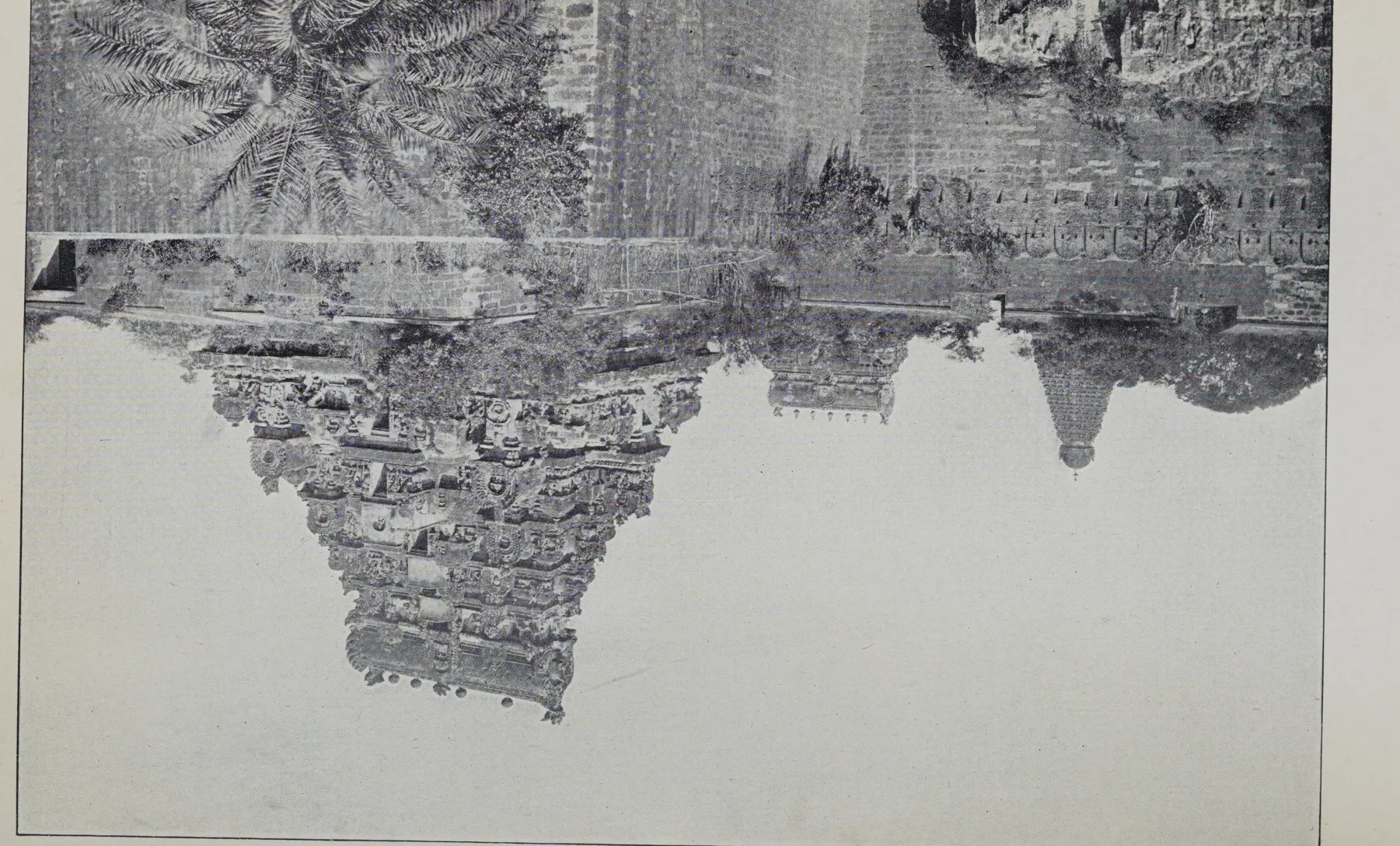
During the earlier years of his reign Rājendra-Choladeva had occupied himself with a succession of wars against the northern powers. About a. d. 1023 he came into collision even with Mahīpāla, king of Bihār and Bengal, and brought his army to the banks of the Ganges. In memory of this exploit he assumed the title of Gangaikonda,2 and built a new capital city, which he called Gangaikonda-Cholapuram. Near the city he constructed a vast artificial lake, with an embankment 16 miles long, fully provided with the necessary sluices and channels for the irrigation of a large area. The city was adorned by a magnificent palace and a gigantic temple, enshrining a lingam formed of a black granite monolith 30 feet high. The ruins of these structures, sadly defaced by the ravages of modern utilitarians in search of building material, still stand in lonely grandeur in a desolate region of the Trichinopoly District. The sculptures in the temples are of singular excellence.3 The Pāndya dominions continued to be subject to the Chola domination during the reign of Rājendra Gangaikonda, and were administered by his son as Viceroy, with the title of Chola-Pāndya.4
Rājādhirāja, eldest son of Rājendra, who had been his father's colleague since 1018, succeeded him in a. d. 1035, and continued the never-ending fight with all the neighbouring powers.1 He fell in the fierce struggle with the Chalukya army at the battle of Koppam (ante, p. 448) in a. d. 1052 or 1053, which determined that the Tungabhadrā river should be the frontier between the rival Chola and Chalukya empires. Notwithstanding the death of Rājādhirāja, the fortunes of the day were retrieved by his brother Rājendra Parakesarivarman, who was crowned on the battle-field as his successor.
The customary wars went on during the reigns of this king and three kings who succeeded him, but few of the details are worthy of remembrance. A notable incident was the battle of Kūdal Sangamam, fought at the junction of the Krishnā and Panch Ganga rivers,2 in which the Chalukyas suffered a severe defeat at the hands of Vīrarājendra Chola (acc. a. d. 1062–3). In the civil war between the brothers and rival claimants to the Chalukya throne—Somesvara II and Vikramāditya—Vīrarājendra took the side of the latter, and gave him his daughter in marriage.
The death of Vīrarājendra (a. d. 1070) was followed by a disputed succession and civil war. Vikramāditya Chalukya, having established himself on the throne of the Deccan, came to the aid of his brother-in-law, Adhirājendra, and succeeded in making him king of the Chola realm (1072). But the new sovereign proved to be unpopular, and was assassinated two years later (1074). With him the direct line in male succession of the great mediaeval Cholas came to an end.
Adhirājendra appears to have left no issue capable of ruling, and so was succeeded by his relative Rājendra, subsequently known as Kulottunga I. Rājendra, whose mother was a daughter of the famous Gangaikonda Chola, was the son of the Eastern Chalukya prince of Veṅgi who had died in 1062. But Rājendra had preferred to remain at the Chola court, and had allowed his uncle to rule Veṅgi for some years. In 10701 Rājendra was crowned as lord of Veṅgi, and four years later, when Adhirājendra was murdered, he assumed the government of the whole Chola territory. He thus founded a new Chalukya-Chola dynasty, taking the title of Kulottuṅga Chola. He was worthy of his position and ruled his extensive dominions successfully for forty-nine years. He reconquered Kalinga, defeating the Eastern Gaṅga king, Anantavarman Chola. His internal administration was distinguished by the execution of an elaborate revision of the revenue survey in A. D. 1086, the year of the survey for Domesday Book.
The celebrated philosopher, Rāmānuja, the most venerated teacher of the Vaishnava Hindus in the south, received his education at Kāñchī, and resided at Srī-raṅgam near Trichinopoly during the reign of Adhirājendra; but, owing to the hostility of the king, who professed the Saiva faith, was obliged to retire into Mysore territory until Adhirājendra’s death freed him from anxiety. The holy man then returned to Srī-raṅgam, where he remained until his decease.2
Vikrama Chola, the son and successor of Kulottuṅga, continued to fight with his neighbours according to precedent, and seems to have succeeded in maintaining the predominant position of his dynasty.3 The next three kings, who had short reigns, were not notable in any way.
The last Chola king of any importance was Kulottuṅga Chola III, who reigned for about forty years from A. D. 1287. The succession was then disputed, and the Chola princes sank into a position of insignificance. For a time the Pāṇḍyas in the south reasserted themselves and gained the upper hand, until 1310, when the power of all the Hindu states in Southern India was broken by the successes of Malik Kāfūr's Muḥammadan army in that year and following years. The rapid development of the Vijayanagar kingdom during the fourteenth century again restored Hindu authority in the Peninsula. The extreme South passed under the rule of Vijayanagar about A. D. 1370.1
SECTION IV
The Pallavas
Who were the Pallavas? Whence did they come? How did they attain the chief place among the powers of the South? To these questions no complete answer can be given at present, although considerable progress has been made in solving the problem.
The name Pallava resembles Pahlava so closely that some writers have been disposed to favour the hypothesis that Pallavas and Pahlavas were identical, and that consequently the Southern Pallava dynasty of Kānchī should be considered as ultimately of Persian origin. But recent research has failed to adduce any historical facts in support of that notion.
A close study of ancient Tamil literature has recently led to the suggestion that the Pallavas were originally connected with Ceylon. An examination of the Tamil poems, Maṇimēkalai and Chilappatikāran, seems to indicate that the destruction by the sea of the Chola capital, Puhār or Kāviripaddinam, must have occurred before the close of the third quarter of the second century A. D., when Gajabāhu's reign in Ceylon came to an end, and that Kiḷḷi Vaḷavan or Nedumuḍi Kiḷḷi, the Chola king, then moved his capital to Uraiyūr.1 Quite recently, Mr. Mudaliyar C. Rasanayagam of Colombo,2 on the strength of a further study of these Tamil epics, asserts that this Chola king had a liaison with a Nāga princess, daughter of Vaḷaivānam, the Nāga king of Maṇipallavam, which can be identified with the Jaffna peninsula, at that early date an island off the coast of Ceylon. Of this union was born a son, known as Toṇḍaimān Iḷantirāyan,3 who some time in the latter half of the second century A. D. was created by his father (Kiḷḷi Vaḷavan) king of Toṇḍaimandalam, as distinct from Cholamandalam, with his capital at Kāñchī. The dynasty, of which Toṇḍaimān Iḷantirāyan thus became the first representative, took its title from the second half of the word Maṇipallavam, the home of his Nāga mother, who was regarded as inferior in rank to his Chola father. According to this view, therefore, the Pallavas, who were a dynasty rather than a tribe or clan, were descended on one side from the Chola family of Uraiyūr and on the other from the Nāga rulers of what is now the Jaffna peninsula in Ceylon.4 The persistent hostility of the Pallavas to the territorial Tamil states and the fact that tradition does not assign any recognized territorial limits to the Pallava dominion 1 are indications that the Pallavas were distinct in race from the Tamils, and that their rule was superimposed upon that of the Rājas of the Pāndya, Chola, and Chera countries, the three states which together covered the whole area of the south, according to constant tradition. The possible origin of the Pallavas, as suggested by ancient Tamil poetry, does not appear to conflict with known facts and may perhaps offer an additional reason for the enmity which unquestionably existed between the Pallavas and the Tamil kingdoms. Professor S. K. Aiyangar holds that the historical Pallavas were feudatories of the Satavahanas of the Deccan and belonged to the Naga family.
The rāja of the Pudukottai tributary principality, who is the recognized head of the Kallar tribe, still styles himself Rāja Pallava, and claims descent from the ancient royal family. The Kallars, as Sir Walter Elliot observes, ‘belong to what have been called the predatory classes,’ and their ‘bold, indomitable, and martial habits’ agree well with the characteristics of the ancient Pallavas as known from history. Until recent times the Kallars exercised a formidable control over the peaceable inhabitants of the Carnatic, from whom they levied blackmail in return for protection, just as the Marāthās levied similar contributions under the name of chauth. It seems to be highly probable that the political power of the Pallavas was exercised in a similar manner, its extent varying according to the variations in the relative strength of the ancient Tamil states and that of the usurping tribesmen. The Palli caste and certain sections of the Vellāla agricultural caste, which is proverbially associated with the Kallar and Maravar robber tribes, also claim a connexion with the Pallavas.1 It may well be that the so-called ‘predatory classes’, whom the Pallava dynasty may once have governed and welded into an aggressive force, belong to a section of the population distinct from and more ancient than the Tamils.
The earliest known documents of the dynasty, certain copperplate grants found in the Guntūr District, tell us of a king reigning at Kānchī (Conjeeveram), whose dominions included Amarāvatī, and so extended to the Krishnā (Kistnā) river. Those grants, which date from about the third century or the beginning of the fourth, and are written in Prākrit, give no indication of the manner in which the kingdom was acquired. It seems to be safe to date its origin not later than the beginning of the third century. All authors are agreed in regarding as a Pallava the Rāja Vishnugopa of Kānchī, who was defeated by Samudragupta about a. d. 350; and Hastivarman, the contemporary Rāja of Vengī, also must have been a Pallava. The names Vishnugopa and Hastivarman both occur in Pallava genealogies. Simhavarman, king of Kānchī (acc. a. d. 437), was a Buddhist.2
From the second half of the sixth century, when Chalukya history begins, until the overthrow of the Chalukya power by the Rāshtrakūtas, in a. d. 753, the Pallavas and Chalukyas, who regarded each other as ‘enemies by nature’, remained constantly in touch and generally at war, each power striving to acquire for itself the mastery of the South. During this period of about two centuries the Pallava royal genealogy for nine reigns, beginning with Simhavishnu (acc. c. A. D. 575,) is well ascertained.1 Simhavishnu claims to have inflicted defeats on the kings of Ceylon and the three Tamil states.
Mahendravarman I, son and successor of Simhavishnu (c. A. D. 600 to 625), has immortalized his name by the excavation of many rock-cut temples in the Trichinopoly, Chingleput, North Arcot, and South Arcot Districts. His fame is also preserved by the ruins of the city of Mahendravādi, between Arcot and Arkonam, and of a great reservoir, the Mahendra tank, near the same. A cave temple dedicated to Vishnu exists on the bank of the tank.2
In war Mahendravarman encountered a formidable rival in the person of the ambitious Chalukya monarch, Pulakēsin II, who boasted of having inflicted a severe defeat on the Pallava king about A. D. 609 or 610. At or about the same time the Chalukya king annexed the province of Vengī, the northern portion of the Pallava dominions, and made it over to the government of his younger brother, the founder of the Eastern Chalukya dynasty. It is probable that the loss of Vengī stimulated the Pallavas to push forward their southern frontier, and it is certain that Mahendravarman held Trichinopoly. He appears to have been a Jain originally, and to have been converted to faith in Siva by a famous Tamil saint. The king, after his conversion, destroyed the large Jain monastery at Pātaliputtiram in South Arcot, replacing it by a Saiva fane. It is interesting to find the name of the old imperial capital brought down to the neighbourhood of Madras, presumably by the Jains.
The Pallava power and art attained their highest point in the reign of Mahendravarman's successor, Narasimha-varman I (c. a. d. 625–45). In a. d. 642 he enjoyed the satisfaction of taking Vātāpi, the capital of his enemy, Pulakēsin II, who presumably then lost his life. It is certain that the reverse was so crushing that the Chalukya power remained in abeyance for thirteen years, while the Pallava king became beyond dispute the most influential sovereign in the South, and extended his jurisdiction far into Mysore and the Deccan. The Pallava monarch received effective help in his enterprise from a Sinhalese prince named Mānavamma, who was subsequently enabled to seize the island crown by means of an army equipped by the grateful Indian king.1
Hiuen Tsang, who visited Kānchī (Conjeeveram) in a. d. 640, during the reign of Narasimha-varman I, and stayed there for a considerable time, calls the country of which Kānchī was the capital by the name of Dravida, and describes it as being about 1,000 miles in circuit. It corresponded, therefore, very closely with the traditional ‘Chola country’ between the Northern Pennār and the Southern Vellāru rivers. The soil was fertile and regularly cultivated, producing abundance of grain, flowers, and fruits. The capital was a large city 5 or 6 miles in circumference. In the kingdom the pilgrim found more than a hundred Buddhist monasteries,2 occupied by a large number of monks, estimated at above ten thousand, all attached, like the majority of the Ceylonese, to the Sthavira school of the Mahāyāna. The Hindu, including the Jain, temples numbered about four-score, and, as in other parts of Southern India, the sect of nude, or Digambara, Jains had many adherents. In the Pāṇḍya country farther south Buddhism was almost extinct. Kāñchī, which is reckoned among the seven Hindu sacred cities, enjoyed special fame among the Buddhists as having been the birthplace of Dharmapāla, a celebrated metaphysician, who was the predecessor of Hiuen Tsang's teacher Sīlabhadra in the headship of the great monastery at Nālandā.1
The earliest of the remarkable monolithic temples known as the Seven Pagodas at Māmallapuram, namely that now called the Dharmarāja Ratha, was the work of Narasimha-varman, who bore the title of Mahāmalla, or ‘great champion’, from which the name of the place is derived.2 The other similar shrines were wrought under the orders of the same king and his successor down to about the time when Kāñchī was taken by its hereditary enemies.3 That calamity probably explains the fact that some of the shrines were never completed.
The noble temple now called Kailāsanātha at Kāñchī, and the ‘Shore Temple’ at the Seven Pagodas were built by Narasimha-varman II, also named Rājasimha, late in the seventh century.
In or about A. D. 655 Vikramāditya I Chalukya, a son of Pulakēsin, retrieved the fortunes of his family, and recovered his father's dominions from Paramesvara-varman, who had succeeded to the Pallava throne. During this war Kāñchī, the Pallava capital, was taken and occupied for a time by the Chalukyas. On the other hand, the Pallavas claimed the gain of a victory at Peruvalanallūr.
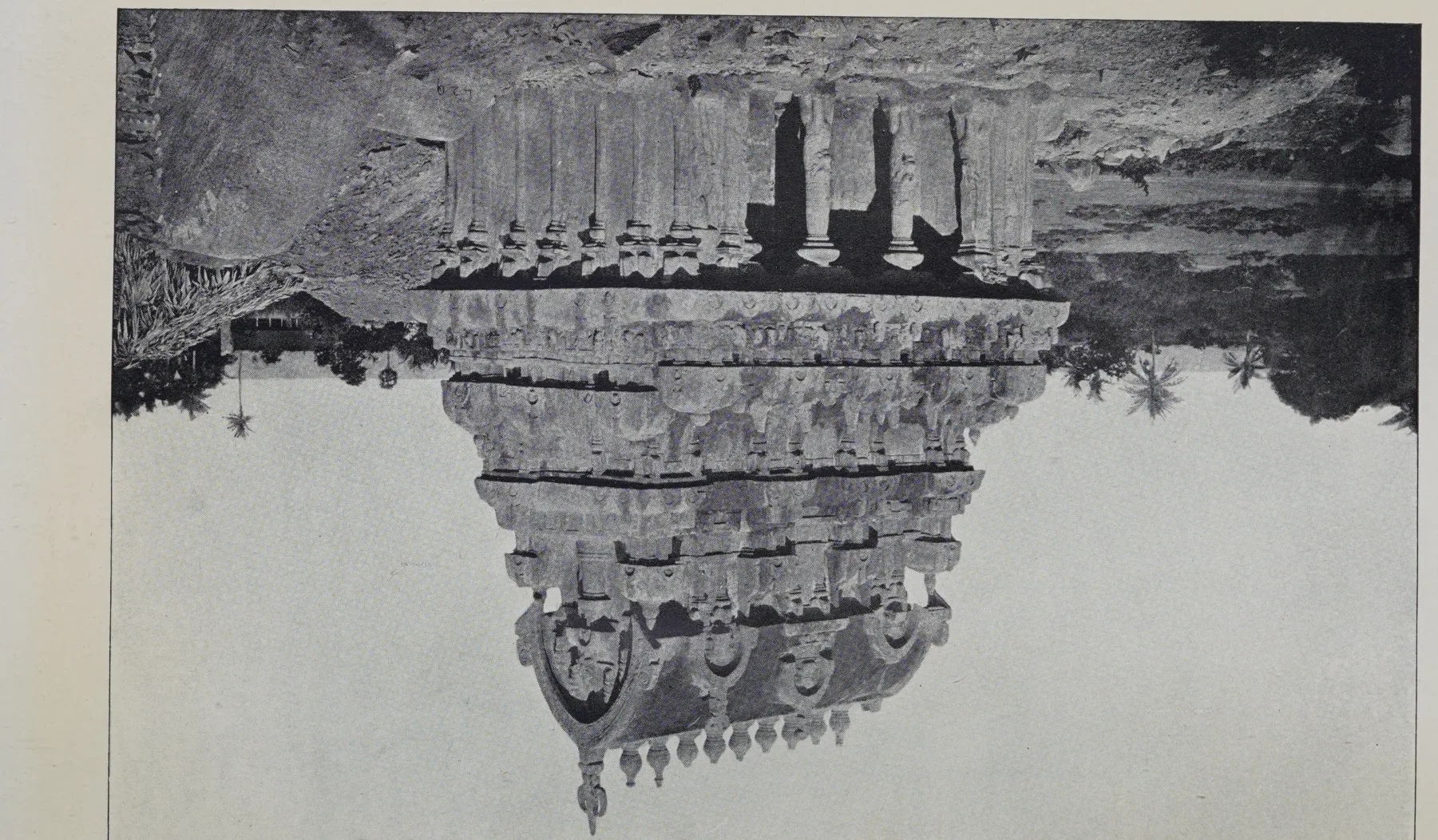
The perennial conflict continued during succeeding reigns. In about A. D. 740 Kāñchī was captured once more by Vikramāditya II Chalukya, who inflicted on Nandivarman Pallava a defeat so decisive that the event may be regarded as the beginning of the end of the Pallava supremacy. Nandivarman, who had succeeded Parameśvara-varman II about A. D. 720, was a distant relative of that prince, being descended from a brother of King Simhavishnu. The change in the line of succession is stated to have been the result of a popular election; and a curious series of sculptures, accompanied by unfinished labels apparently intended to have been explanatory, still extant in a mutilated form at the Vaikuntha Perumāl temple in Conjeeveram (Kāñchī), seems to have been designed as a contemporary record of the dynastic revolution.1
Nandivarman reigned for about sixty-two years, and was succeeded by several princes ending with Aparājita Pallava, who vanquished the Pāndya king, Varaguna II, at the battle of Srī-Purambiya, but was himself overcome by Āditya Chola about the close of the ninth century.2 From that time the Pallava supremacy, which had been severely shaken by the Chalukya successes in 740, finally passed away and was transferred to the Cholas, who, as already narrated, brought all the southern kingdoms under their control more or less completely during the tenth and eleventh centuries.
During their period of decline the Pallava chiefs managed to do some fighting on their own account. When the Rāshtrakūtas supplemented the Chalukyas in the middle of the eighth century, the traditional hostility between the leading power of the Deccan and its southern enemy was not abated, and the new rulers took up the old quarrel with the Pallavas. King Dhruva, a cousin of Dantidurga, who had overthrown the Chalukya dynasty, inflicted a defeat on the Pallavas about a. d. 775 ; and his son, Govinda III, levied tribute from Dantiga, Rāja of Kānchī, in a. d. 803.
During the tenth century we hear of wars between the Pallavas and the ancient dynasty of the Gaṅga kings of Gaṅgavādi, or Mysore, who are now commonly known as the Western Gaṅgas, in order to distinguish them from the family of the same name which ruled Kalinga in the east, and held court at Kalinganagaram, the modern Mukhalingam in the Ganjām District. Various inscriptions of the Western Gaṅgas, which are certainly genuine, date back to about the close of the fifth century a. c. ;1 and the dynasty appears to have reached the zenith of its power during the long reign of Srīpurusha (a. d. 725–776), whose territory was known as the Fortunate Kingdom.2 The most notable king of the Eastern Gaṅgas of Kalinga was Anantavarman Chodagaṅga, who reigned for seventy-one years from a. d. 1076 to 1147, and carved out for himself a considerable kingdom, extending from the Ganges to the Godāvarī. He built the temple of Jagannāth at Puri.3
The later Pallava chiefs sank into the position of mere feudatory nobles and officials in the service of the territorial kingdoms ; and it is on record that the Pallava Rāja took the first place among the feudatories of King Vikrama Chola early in the twelfth century.4 The Rājas can be traced as in possession of limited local power down to the thirteenth century, and Pallava nobles are mentioned as late as the close of the seventeenth century. After that time all trace of the Pallavas as a distinct race or clan disappears, and their blood is now merged in that of the Kallar, Palli, and Vellāla castes.5
The earliest Pallava king who can be precisely dated, Simhavarman, in the fifth century, presented an image at Amarāvatī and is expressly described as being a lay worshipper of Buddha. Probably other members of the dynasty also were Buddhists.1 Several princes were specially devoted to the cult of Vishnu.2 Mahendravarman, who was a Jain in early life, at first persecuted the followers of Siva, but was converted to the Saiva creed and turned against his former co-religionists, whose principal monastery he destroyed.3
Usually, however, the adherents of rival creeds seem to have lived together in peace and to have enjoyed the impartial protection of the government. The narrative of Hiuen Tsang implies that such was the case in a. d. 640.3 All the later Pallava kings, apparently, were worshippers of Siva, whose emblem, the bull, was adopted as the family crest. Two of the kings were so zealous for religion that they have been included in the list of sixty-three Saiva saints.4
This is the fourth edition of Dr. Vincent A. Smith’s work, the second edition having appeared in 1908, and the third in 1914. In commending the third edition to the public, the author wrote :—‘ My task—a labour of love—is now ended, and this book goes forth once more in its new form which, so far as the author is concerned, is not unlikely to be final. Planned twenty-five years ago, it appeared for the first time sixteen years later in a very imperfect shape. The generous reception accorded to that faulty pioneer attempt encourages the hope that this much improved edition may be of still greater service in guiding and stimulating the study of the early history of India, now pursued with laudable ardour by a multitude of her sons as well as by foreigners.’ The reviser can only re-echo the hope that the present work, based as it is upon the further investigations and discoveries of scholars during the last few years, will prove as acceptable to students of India’s early history as the earlier editions, and that the work of revision will be adjudged to have been performed in a manner worthy of the late author and of the great theme with which his name is so closely and so honourably associated.
The volume deals with the political history of Hindu India, the land of the Brahmans, which is the real India ; a land the fascination of which is largely due to the unique character of its civilization. That quality of strangeness makes the history of Hindu India less attractive to the European or American general reader than the more easily intelligible story of the Muslim and British conquerors, but anybody who desires to understand modern India must be content to spend some labour on the study of ancient India during the long ages of autonomy.
The political history of India cannot vie with that of Greece, Rome, or modern Europe as illustrating the evolution of constitutions in city or state. Indians, like other Asiatic peoples, usually have been content with simple despotic rule, so that the difference between one government and another has lain in the personal characters and abilities of the several despots rather than in the changes consequent upon the gradual development of institutions. The regulations devised by able individual autocrats, such as Chandragupta Maurya, Asoka, and Akbar, have mostly perished with their authors. The nascent Indian constitution now in course of construction is a foreign importation, imperfectly intelligible to the people for whose benefit it is intended, and perhaps will never be thoroughly acclimatized.
The most important branch of the history of India is the history of her thought.1 For the adequate presentation of the story of Indian ideas in the fields of philosophy, religion, science, art, and literature, a chronological narrative of the political vicissitudes of the land is the indispensable foundation. Readers who may find such a narrative dry, or at times even repellent, may take comfort in the conviction that its existence will render possible the composition of more attractive disquisitions, arranged with due regard to the order of time.
Notes
- 1. The Tamils Eighteen Hundred Years Ago, pp. 10, 17.
- 2. Elliot, Coins of Southern India p. 108.
- 3. The Chandragiri is the boundary between Kerala and the Tuluva country.
- 1. Ptolemy, bk. vii, ch. 1, 85 ; transl. McCrindle, Ind. Ant., xiii, 367. The Peutingerian Tables correctly give the name as Damirikē (Ind. Ant., viii, 144). Possibly, as S. Krishnaswāmi Aiyangar suggests, Damirikē was the transliteration of a Sanskrit form Dramidaka.
- 2. See M. Srīnivāsa Aiyangar, Tamil Studies, Madras, Guardian Press, 1914, which professes to give ‘a complete bird's-eye view of Tamil culture and civilization’.
- 3. The Tamils Eighteen Hundred Years Ago, pp. 3, 10, 39.
- 4. Pope, ‘Extracts from the Tamil Purra-poruḷ Veṇba-Mālai, and the Purra-nānnūrru (J. R. A. S., 1899, p. 242). Pope was not so decided in opinion concerning the early date of the literature as South Indian scholars are, but subsequent discussion seems to establish the high antiquity of the great classical works in Tamil.
- 1. For Jain historical traditions, with varying systems of chronology, see Jacobi in S. B. E., vol. xxii, and many articles in the Indian Antiquary, vols. ii, ix, xi, xiii, xvii, xx, and xxi, by Hoernle and other writers; also Rice, Mysore and Coorg from the Inscriptions.
- 2. The statement is not true if applied to Malabar or Keraḷa (Dubois, Hindu Manners, Customs, and Ceremonies, by Beauchamp, third ed. (1906), p. 56).
- 1. The Tamils Eighteen Hundred Years Ago, pp. 108, 114.
- 1. Gibbon, ch. xxxi.
- 2. References for the beryl trade of the Padiyūr mine. The mine at are: Πουννάτα ἐν ᾗ βήρυλλος, Vāniyambādi rests on the authority Ptolemy, Geogr., Bk. vii, ch. i. of Sewell (J. R. A. S., 1904, p. 86, transl. in Ind. Ant., xiii, 367; 595). The correct identification Pliny, Hist. Nat., Bk. xxxvii, of Πουννάτα, which in the second ch. v; Walhouse, ‘Aquamarina edition I wrongly identified with Gems, Ancient and Modern’, Ind. Padiyūr, following Sewell, is due Ant., v, 237, with a full account to Lewis Rice. Ptolemy's name, Pounnata, is an accurate transcription [p. 462] of Punnāṭa (al. Punāḍu or Punnāḍu), an ancient principality mentioned in an early inscription, perhaps of the fifth or sixth century, and also in the Brihatkathākośa of Harisheṇa, dated a. d. 931. Kittūr, a village on the Kabbini (Kapini) river, a tributary of the Kāviri (Cauvery), in the south-west of Mysore, represents Kitthipura or Kīrtipura, the ancient capital of the Punnāṭa State (Rice, Mysore and Coorg from the Inscriptions (1909), pp. 4, 10 ; Ind. Ant., xii, 13 ; xviii, 366). The Mamballi copper-plates from Yelandūr taluk, Mysore, of Rāshtravarma, Rāja of Pumrāshtra [=Punnāṭa], mention the Kāvēri and Kapini rivers, and show that the capital Kittūr (Kīrtipura) was on the Kapini in Heggaḍadēvankōt taluk. The plates, written in the Hale-Kan-naḍa script, are clearly genuine and date from about a. d. 550 (Mysore, A. S. Rep. for 1917, pars. 87–9). Full details about the mines of corundum in Balfour Cyclop., s.v.
- 1. Sewell, ' Roman Coins found in India,' J. R. A. S., 1904, pp. 591–637, a valuable article. See especially pp. 609–13.
- 2. According to S. K. Aiyangar, the destruction took place in the first quarter of the third century after Christ at the latest. The Tamil tradition is that the city was ' overwhelmed by the sea ' as stated in the Epic of the Anklet and the Jewel-Belt, referred to in S. K. Aiyangar's Ancient India, p. 352. M. Srīnivāsa Aiyangar in [p. 463] Tamil Studies, p. 60, puts the date of its ‘destruction’ in the second century A. D. This theory of the ruin of the city does not accord with the view held by C. P. Venkatarāma Ayyar (Town Planning in Ancient Dekkan, Madras, 1916) that ‘this ancient sea-port, which had an extensive commerce, has ceased to be of importance owing to the silting-up of the Kavery’.
- 1. The Tamils Eighteen Hundred Years Ago, pp. 16, 25, 31, 36, 38. Puhār is also written Pugār or Pukār. The ‘Peutingerian Tables’, a collection of ancient maps believed to date from about A. D. 226 (ed. Scheyb, 1733; Mannert, Leipzig, 1824; Charles Ruelens, Brussels, 1884; Walker, On the Tabula Peutingeriana, Cambridge, 1883, in Cambridge Antiquarian Society's Communications, vol. v, p. 237), are the authority for the temple of Augustus at Muziris, which is indicated on the map by a rough sketch of a building marked ‘templ. augusti’ inserted beside ‘Muziris’. The identification of Muziris with Cranganore is well established. Kāviripaddanam = Puhār; = Kākanthi (Kākandī of Bharhut inscription, No. 101, Ind. Ant., xxi, 235); = Kamara (Periplus, ch. 60, Ind. Ant., viii, 149); = Khabēris (Ptolemy, Bk. vii, ch. 1, 13, Ind. Ant., vii, 40; xiii, 332). For the bronze vessels see the collection in the British Museum, and the labels on the specimens; Ind. Ant., 1905, p. 229; Breeks, An Account of the Primitive Tribes and Monuments of the Nīlagiris, London, 1873; Foote, Catal. Prehist. Antiq. Madras Museum, 1901, pls. x–xiii. The Periplus (ch. 56), states that ‘ships which frequent these ports are of a large size, on account of the great amount and bulkiness of the pepper and malabathrum of which their lading consists’. A full list of exports and imports is then given. Malabathrum (μαλάβαθρον) was not ‘betel’, as McCrindle erroneously supposed, but the leaves of different species of Cinnamomum, especially C. Zeylanicum (Schoff, transl. of Periplus p. 84; with references). The massacre at Alexandria, perpetrated in 215 by Caracalla, stopped most of the direct trade between that port and India (J. R. A. S., 1907, p. 954).
- 2. Gover was of opinion that Tiruvalluva, the famous author of the Kural (Cural), ‘probably flourished about the third century of our era’ (The Folk-songs of Southern India, 1872, p. 217). Gover penetrated into the Hindu mind perhaps more deeply than any other European writer, and any one desirous of understanding Southern India should read, if possible, his admirable book, which, unfortunately, is now scarce.
- 1. Pura-nannūṟu, No. 35, in Tam. Ant., vol. i, No. 6, p. 50.
- 2. See ante, pp. 171, 194.
- 1. Keraḷa is the Kanarese form of the Tamil Cheraḷa. The country was anciently called Cheraḷam or Cheraḷa-nāḍu, and the kings were Cheraḷ-ādan or Cheraḷ-Irum-Porrai, Cheraḷam means ‘mountain-range’, and so is equivalent to Malabar (Pundit D. Savariroyan in Tamilian Antiquary, No. 1, pp. 69–71).
- 1. See pp. 491–3, post.
- 2. Elliot, Coins of Southern India, p. 39.
- 1. The volume of collected essays by Mr. S. Krishnaswāmī Aiyangar, entitled Ancient India (Luzac, 1911), although valuable, and freely utilized in the following pages, does not profess to be the desired book.
- 2. Southern India has Purāṇas of its own.
- 1. See Sewell in Ind. Ant., Aug. 1915, vol. xliv, p. 176. He holds that the monarch was always single and that the belief in the ‘Five Kings’ grew out of the legend of the Five Pāṇḍavas.
- 2. Pliny, Hist. Nat., Bk. vi, ch. 23 (26). He describes Becarē, the harbour on the Malabar coast, the Bakarai or Barkarē of Ptolemy (Bk. vii, ch. 1, 8), which is Vaikkarai, the landing-place for Kottayam; and adds that ‘there Pandion used to reign, dwelling at a great distance from the mart, in a town in the interior of the country, called Modura’. At the time he was writing Caelobothras (Keralaputra) was sovereign of the Malabar coast. The Periplus (ch. [p. 469] 54, 55) shows clearly that while Muziris belonged to the kingdom of Keralaputra, Bakarē, farther south, was included in the Pāṇḍya dominions; which, therefore, must have comprised the southern parts of the modern Travancore State. This tract was called Venāḍu or Ven. For identification of Becarē and many other places, see The Tamils Eighteen Hundred Years Ago, pp. 17–20. Pliny’s work was published in a. d. 77, as is proved by the dedication to Titus, before his accession. The Periplus may be dated about a. d. 70, and Ptolemy about a. d. 140. For Mañalūr see Ind. Ant., 1913, pp. 66, 72. North Mañalūr, of which the position is not known, is supposed to have been the earliest Choḷa capital.
- 1. The river was also called Porundam and Mudigoṇḍaśōlapperāru (Ep. Ind. xi (1914), p. 295). It is mentioned in Rock Edicts ii and xiii of Asoka and in chap. xi of the Arthaśāstra of Kautilya. Caldwell (Tinnevelly, p. 5) points out the great commercial importance of the river. See also the author’s article in Ind. Ant., vol. xlvii (1918), p. 48.
- 2. The gradual elevation of the land is proved specifically by a piece of pottery resembling modern ware being found in grit stone at Kulasēkhara paṭṭanam, a mile from the seashore. Caldwell concludes that the grit stone which contains recent shells is of comparatively modern formation (Hist. of Tinnevelly, Madras, 1881, p. 5).
- 3. This Kāyal is now Old Kāyal, and is not to be identified with Kāyal-paṭṭanam (Caldwell, ibid., p. 38). For alteration in the eastern coast-line, see The Tamils Eighteen Hundred Years Ago, p. 236.
- 1. Medlycott, India and the Apostle Thomas, pp. 85 and 87. The first visit seems to have been made in 1288 and the second in 1293.
- 2. Bishop Caldwell, Ind. Ant., vi, 80–3, 279.
- 3. Loventhal, The Coins of Tinnevelly (Madras, 1888), p. 9.
- 4. Bhandarkar, Early History of the Dekkan, 2nd ed., in Bomb. Gaz. (1896), vol. i, part i, p. 139. I accept the view of Professors Goldstücker and Bhandarkar concerning the antiquity of Pāṇini and Kātyāyana as necessarily resulting from the ascertained date of Patañjali, 150 b. c. In an essay, Systems of Sanskrit Grammar, published Poona, 1915, with the permission of the University of Bombay, Shripad Krishna Belvalkar, M.A., Ph.D., remarks (p. 18) that there is nothing in Pāṇini's Ashṭadyāyi inconsistent with his having flourished in the seventh century b. c. He believes in this early date, while admitting that none of the arguments are decisive when taken singly, and on p. 15 gives 700 to 600 b. c., ‘as near an approximation to Pāṇini's time as, in our present state of knowledge, or rather want of knowledge, we are likely to get.’
- 1. Megasthenes, Fragm. I, lvi B, lviii, in Schwanbeck’s text and McCrindle’s translation ; Arrian, Indika, ch. viii. The story may have been suggested by distorted reports of the Malabar system of succession through females. Mr. F. Fawcett informs me that at the present day the Laccadive islands are administered by the women while the men are at sea.
- 2. Strabo, Bk. xv, ch. 4, 73 ; Merivale, History of the Romans under the Empire, iv, 118, 175.
- 3. J. R. A. S., Oct., 1907, p. 954.
- 1. K. G. Sankara Aiyar, in 'The Age of the Third Tamil Sangam' (J. Mythic Soc., 1917) prefers a. d. 154-76—anyhow the second half of the second century a. c. The same author puts the third Sangam about the same time, which seems reasonable.
- 2. The Tamils Eighteen Hundred Years Ago, pp. 80, 81, 88. Gover dated Tiruvallava in the third century (Folk Songs of Southern India, p. 217). See Ancient India, by S. K. Aiyangar, ch. xiv; 'The Augustan Age of Tamil Literature'; Dr. J. Lazarus on the Kural in Tam. Ant., vol. ii (1913), pp. 53-72, and various other papers in vol. i of the same periodical.
- 1. Beal, ii, 228–30; Watters, ii, 228–33. See remarks by Hultzsch, Ind. Ant., xviii, 242. What has happened to the ruins of the Hindu and Buddhist buildings anterior to the seventh century? It seems tolerably certain that some of them were converted at a later date to Brahmanical use. This is clearly the case with the Buddhist apsidal chaitya hall at Chazarla in Guntūr District, converted into a Saiva temple of late Pallava style (A. S. Ann. Rep. S. Circle, 1917– 18, p. 35). See ‘Bouddha Vestiges in Kānchīpura’, by T. A. Gopinatha Rao, M.A., Trivandrum (Ind. Ant., 1915, pp. 127–9) with plates. In twelve hours the author discovered five images of Buddha, two being inside the Kāmākshī Temple, which probably occupies the site of a Buddhist Tārā temple, the image inside at A being 7′ 10″, including pedestal, which is not likely to have been moved far. All five images are of considerable size. See also Wilson in Introduction to Mackenzie Coll. (ed. 1882), p. 40.
- 2. Progress Report, Epigraphy, 1906–7, in Madras G.O., Public, No. 503, June 27, 1907, pp. 62–70. That report by the late Rai Bahadur V. Venkayya Avargal gives a summary of the few known facts about the early Pāṇḍya kings, as ascertained to date. Additions have been made by T. A. Gopinatha Rao in the Travancore Archaeol. Series, especially No. 7 (1911).
- 3. Progress Report, Epigraphy, 1905–6, in Madras G.O., Public, No. 492, July 2, 1906, paras. 10, 16. ‘The Chōḷa king who extended his sovereignty over the Toṇḍaināḍu was, as we know from other sources, Rāja Kēsarivarman Āditya, the first. He allied himself with the Pāṇḍya king, Varaguṇa Pāṇḍya, and uprooted the Pallava dynasty, and extended his dominions over the whole of the Toṇḍaināḍu. Therefore, Āditya ought to have lived about the second half of the ninth century, for we know Varaguṇa Pāṇḍya reigned from a. d. 862–3 upwards’ (Travancore Archaeol. Series, vol. ii, p. 77). Jouveau-Dubreuil (Pallavas, p. 66) dates Varaguṇa’s accession about a. d. 854.
- 1. The Pāṇḍyas could never be completely subdued. They continued in a state of chronic revolt against the Choḷa yoke during the whole period of Choḷa supremacy. For about fifty years in the eleventh century Choḷa-Pāṇḍya kings governed the Pāṇḍya country, i. e. Choḷa princes acting apparently as viceroys under the Choḷa suzerain at Tanjore. The first Choḷa-Pāṇḍya was the son of Rājendra-Choḷa I (A. D. 1011–44). Two others are recorded, and there are inscriptions of two out of the three (K. V. Subrahmanya Aiyar, Ep. Ind., xi (1914), p. 293). For further details, see Epigraphy (G.O., No. 1035, Home (Education), Aug. 10, 1917, pp. 106, 107.
- 2. Hultzsch, Ind. Ant., xviii, 240.
- 1. The date of Tirujñānāsambandar and Kūna Pāṇḍya was settled by Hultzsch in 1894–5 (Ep. Ind., iii, 277). See also Tam. Ant., vol. i (1909), No. 3, p. 65. The approximate date thus determined is one of the most important fixed points in the early political and literary history of the South. The event took place at Madura, where it is celebrated as 'the impalement of the Jains' on the 7th day of the mahōtsava of Siva, and is treated as an utsava (T. A. Gopinatha Rao, Elements of Hindu Iconography, 1914, Introd., p. 55). The persecution is described in the 62nd and 63rd Tiruvalliadal (Wilson, Mackenzie MSS. 2nd ed., Calcutta, 1828, p. 41). The story is repeated in Rodriguez (The Hindu Pantheon, Madras, 1841–5), illustrated by a plate depicting the horrid tortures of the victims; also by Gribble in Calc. Rev., 1875, p. 70; and by Elliot, Coins of Southern India (1885), p. 126. The Pāṇḍya king is named Neḍumāran in the Periyapurāṇa (Ind. Ant., xxii, 63). All the southern kings had many names and titles, which cause much confusion. For the sculptures, see Sewell, Lists, vol. i, p. 167.
- 2. Full details will be found in the article appended to Madras [p. 476] G. O., Public, Nos. 922, 923, dated Aug. 19, 1899, pp. 8–14. See also Hultzsch, ‘Contributions to Singhalese Chronology’ (J. R. A. S., 1913, pp. 517–31).
- 1. ‘Supplement to the List of Inscriptions of Southern India,’ in Ep. Ind. viii, App. ii, p. 24. In the second half of the sixteenth century the Pāṇḍyas ‘became more or less Polygars, and had to wait, like vassals, on the proud Telugu Kartas’ (‘The History of the Naik Kingdom of Madura,’ Ind. Ant., 1915, p. 39).
- 2. Ind. Ant., 1911, pp. 137, 138.
- 3. The Periplus and Pliny assign the southern province or district to the kingdom of Pāṇḍya. No doubt the Pāṇḍyas always did their best to obtain control of some ports on the western coast, and sometimes succeeded in securing their object.
- 1. The Tamils Eighteen Hundred Years Ago, p. 15 ; Ind. Ant., xvii, 259 ; xxxi, 343 ; Ep. Ind., iv, 294 ; S. I. Inscr., vol. iii, part i, p. 30. A few names of early Chera kings have been ascertained : e. g. Sthānu Ravi was contemporary and friendly with Āditya Choḷa, the father of Parāntaka I (' Epigraphy,' p. 61, in Madras G. O., Public, No. 919, July 29, 1912). Three inscriptions of Sthānu Ravi have been published and discussed. He made the famous grants to the Syrian Christians of Koṭṭayam, the only Christian documents of the pre-Portuguese period. The inscriptions are about 40 or 50 years later than the date of the Kollam Era, a. d. 825, which perhaps marks the foundation of Koḷam (Quilon) by Sapīr Ēśō, who built the church at Quilon.
- 1. According to M. M. Haraparshad Sāstrī, the Vatteluttu alphabet is the sole descendant of Kharoshṭhī (J. B. & O. Res. Soc., vol. i, p. 58).
- 1. ‘Some Early Sovereigns of Travancore,’ Ind. Ant., vol. xxiv (1895), pp. 249, 277, 305, 333; ibid., vol. xxvi, p. 109; ‘Miscellaneous Travancore Inscriptions,’ ibid., vol. xxvi, pp. 113, 141. Later information will be found in V. Nagam Aiya, The Travancore State Manual, 3 vols., Trivandrum, 1906, and in the Travancore Archaeological Series, commencing in 1910.
- 2. Kerala had been annexed at an earlier date by Rajendra-Choḷa I.
- 3. Ante, plate of coins, fig 17; Tufnell, Hints to Coin Collectors in Southern India (Madras, 1889), p. 17.
- 4. See Ep. Ind., iv, 145 ff.
- 5. Ep. Ind., vol. vii, App. O, Nos. 939–66. The inscriptions generally are dated in the Kollam or Malabar era of a. d. 824–5, which marks the date of the foundation of Kollam or Quilon (J. R. A. S., 1916, p. 156). Much further information will be found in the works above cited, but the details are not of general interest.
- 1. Coins of Southern India, p. 108. Choḷa is also written Chora, Śola, or Śora. Coromandel is a corruption of Choḷamaṇḍalam (Yule & Burnell, Anglo-Indian Glossary, s. v. ‘Coromandel’). The name Choḷa means a people as well as a dynasty, but nothing is known about the Choḷas as a people. They have become merged in the existing population without leaving a trace.
- 2. Uraiyur is also spelt Woraiyur. ‘Woraiyur, which is two miles from Trichinopoly, was a city newly planned and built by the great Choḷa king, Karikāl Peruvaḷattān’ (Town Planning in Ancient Dekkan, by C. P. Venkatarama Ayyar, Madras, 1916, p. 11).
- 3. Ind. Ant., 1913, pp. 70, 72.
- 1. Schoff holds that ‘the eastern sea-trade of India exceeded its western trade’ (J. A. O. S., 37, p. 242).
- 2. For Kāviripaddinam, see ante, p. 462. The Tamils Eighteen Hundred Years Ago, pp. 25, 26, 38. The full Tamil name of the town is Kāvēripūmpaṭṭinam.
- 1. The Tamils Eighteen Hundred Years Ago, pp. 64–78; S. Krishnaswāmī Aiyangar, ‘Some Points in Tamil Literary History,’ Malabar Quarterly Review, 1904. The dates in Kanakasabhai’s book seem to be placed too early, Chap. vi of S. K. Aiyangar’s book, Ancient India, 1911, is the best history of the Chola kingdom. In the article entitled ‘Karikala and his Times’ (Ind. Ant., 1912, p. 146), K. V. S. Aiyar unsuccessfully tries to prove that Karikāla lived in the earlier half of the sixth century after Christ. That view seems to me to be wholly untenable, and to involve a false chronology of Tamil literature.
- 2. See p. 491, post.
- 3. The Tamils Eighteen Hundred Years Ago, p. 44.
- 1. Beal, ii, 227–30, Watters, ii, 224.
- 2. Reports on Epigraphy in Madated June 27, 1907, para. 43. For dras G. O., Public, No. 518, dated the state of Cuddapah in 1800, see July 18, 1905, p. 48, and No. 503, Hamilton, Description of Hindostan, 4to ed., 1820, vol. ii, p. 323.
- 1. S. Krishnaswami Iyenngar, 1300 A. D.' (Madras Review, 1903), The Chola Administration, 900– and Ancient India, pp. 158–91. [p. 485] The author sometimes spells his name Aiyangar. V. Venkayya, ‘Irrigation in Southern India in Ancient Times’ (Archaeol. Survey Annual Rep., 1903–4, pp. 203–11). R. D. Mukharji, Local Government in Ancient India, 1919; and R. C. Majumdar, Corporate Life in Ancient India, Calcutta, 1918.
- 1. Ep. Ind., vol. xii, July, 1913, pp. 123, 124.
- 2. T. A. Gopinatha Rao (Travancore Archaeol. Series, vol. ii, pp. 3–5) shows that the earliest inscriptions of Rājarāja are of the 8th and 10th regnal years, and imply the conquest of the Chera country. The Chera king was Bhāskara Ravivarman, who ruled for at least 58 years, from a. d. 978 to about 1036 (ibid., p. 33).
- 1. A characteristic specimen of his coinage is shown in Fig. 15 of the plate of coins.
- 2. Ind. Ant., vii, 224, with plates ; Madras G. O., Public, Nos. 922, 923, dated Aug. 19, 1899.
- 3. Diwan Bahadur L. D. Swamikannu Pillai Avagal works out astronomically a number of Choḷa and Pāṇḍya dates in Prog. Rep. Epigraphy, Madras G. O., No. 1260, dated 25 Aug. 1915, pp. 72 ff. He makes the reign of RājendraCholadeva I begin between May 6 and July 7, 1012. But this may be his conjoint reign, as the writer makes his successor, Rājādhirāja I begin between May 9 and Dec. 3, 1018 (see next page), reducing Kielhorn's limits by two months.
- 4. V. Kanakasabhai, ‘The Conquest of Bengal and Burma by the Tamils’ (Madras Review, 1902, p. 251). Kidāram or Kaḍāram is supposed to be Tharekhettra, 8 miles west of Prome (Ind. Ant., [p. 487] xxii, 6, 160). Takkolam = Takōla of Ptolemy (Bk. vii, ch. 2, 5 ; Ind. Ant., xiii, 372), and is now called Ayethema (ibid., xxi, 383), some miles from the present coast. On Takkolam and Kadāram (or Kālagam), see Taw Sein Ko in Burma A. S. Prog. Rep., 1909–10, pp. 14– 16 and 1916–17, para. 57. It is Taikkula to SE. of Pegu. It is suggested that Pegu was under foreign Indian domination for 500 years. Kadāram seems to mean Pegu. Yet the position of Ptolemy's Takōla really is uncertain. See articles by St. John and Blagden in Actes xi, Congrès Or., Paris, 1898, Deuxième Section.
- 1. Archaeol. S. Burma, Progr. Rep., 1906–7, p. 19.
- 2. Rice interprets the title differently : ‘His son Rājendra Coḷa, in command of his father's forces, advanced against Talekād, the Ganga capital, and this ancient city fell in 1004, and with it the Ganga line came to an end as a sovereign power. The event was marked by Rājendra Coḷa assuming the title of Gaṅgaikoṇḍa Coḷa, “the Coḷa who took Gangai”’ (Bh. Comm., vol. 1917, p. 247).
- 3. Hist. of Fine Art in India and Ceylon, figs. 159–61. A detailed survey and description of the site, fully illustrated, would be of much interest.
- 4. Report on Epigraphy, in Madras G. O., Public, No. 503, dated June 27, 1907, para. 25.
- 1. The practice of appointing the Crown Prince, or yuvarāja, as his father's colleague causes the regnal years to overlap. The chronology has been settled by Prof. Kielhorn (Ep. Ind., viii, App. ii, 26). The references in detail to inscriptions can be traced through the paper cited. Later discoveries will be found in the Reports on Epigraphy in Madras G. O., Public, No. 492, dated July 2, 1906, and No. 503, dated June 26, 1907, and subsequent issues, as well as in Ep. Ind. to date.
- 2. Fleet, Ep. Ind., xii, 298.
- 1. ‘L. D. S. Pillai says that Kulottuṅga I’s ‘reign must have commenced before 28 June 1070’—as shown by inscriptions (G. O., No. 920, Aug. 4, 1914, Epigraphy, p. 59). See also ibid., No. 1260, Aug. 25, 1915, p. 73, where he says that the limits of the reign are now established beyond doubt.
- 2. For the history of Adhirājendra, Kulottuṅga, and Rāmānuja, I follow Bhaṭṭanātha Svamin, ‘The Cholas and the Chalukyas in the Eleventh Century’ (Ind. Ant., 1912, pp. 217–27). His article is based on a contemporary metrical chronicle, entitled Divyasūricharita, of which he is about to publish a critical edition. The text was printed in Mysore in 1885. The title Kulottuṅga means ‘highest in his family’.
- 3. The exploits of Vikrama Choḷa are the subject of a Tamil poem of some merit, entitled Vikrama-Choḷan-Ulā (Ind. Ant., xxii, 142).
- 1. The coins of the Muhamma- A. D. 1329–30 to 1377–8 (Hultzsch dan Sultans of Madura range from in J. R. A. S., 1909, p. 682).
- 1. Ind. Ant., xxvii, 235.
- 2. ‘The Origin of the Pallavas’ (Ind. Ant., lii, April, 1923, pp. 75– 80). But see S. K. Aiyangar’s ‘Origin and Early History of the Pallavas of Kāñchī’, mentioned in Preface ante.
- 3. So named, according to the article (ibid.), because on his way from Maṇipallavam to Puhār he was shipwrecked and washed ashore on a toṇḍai creeper. The name probably indicates the totem of the tribe or community.
- 4. According to M. C. Rasanayagam, the name Maṇipallavam occurs only in the Maṇimēkalai, the island or peninsula being elsewhere called Maṇipuram, and by the Sinhalese Maṇi-Nāgadīpa, owing to its being populated by Nāgas and governed by Nāga kings. The Tamils retained the word Maṇi and added pallavam, meaning in Tamil, ‘a sprout’ or ‘shoot’, in allusion to the appearance of the isle, which to persons sailing from India to Ceylon would have looked very like a sprout or branch from the parent island. It is noteworthy also that the Pallava kings called themselves Pōt-rāyar, from the Tamil word pōttu, which is a synonym of pallavam. The later Pallavas adopted Sanskritic titles ending in aṅkūra, which also signifies a ‘sprout’, and may indicate memories of their origin. Though the derivation of the name is tentative, it seems to me quite as plausible as Mr. Rea’s derivation from Tamil pal, ‘milk’, and the masculine termination, -avan (sing.), or -avar (pl.), which would make the name equivalent to that of the Gwālas and Āhīrs of Hindustan.
- 1. The monuments, as distinct from the copperplates, show that ‘the Pallava kingdom extended all along the Coromandel coast from Kālahasti in the north to Pudukottai in the south, and was bounded on the west by the Eastern Ghāts’ (Jouveau-Dubreuil, Pallava Antiquities, vol. viii, p. 43). Kālahasti town is in N. Arcot District, in 13° 45′ N. and 79° 42′ E. The limits from north to south include N. Arcot, Chingleput, S. Arcot, Trichinopoly and Tanjore Districts. Pudukottai town is in 10° 23′ N. and 78° 49′ E. in the State of the same name. Traditionally the northern part of the State belonged to the Cholas and the southern to the Pāṇḍyas; so the Pallava dominion evidently extended over the Chola country to the Pāṇḍya boundary. Pudukottai is near the centre of the State.
- 1. Elliot, Coins of Southern India, pp. 42–4. ‘The caste of Kullars, or robbers, who exercise their calling as an hereditary right, is found only in the Marava country, which borders on the coast, or fishing, districts. The rulers of the country are of the same caste. They regard a robber’s occupation as discreditable neither to themselves nor to their fellow castemen, for the simple reason that they consider robbery a duty and a right sanctioned by descent. They are not ashamed of their caste or occupation, and if one were to ask of a Kullar to what people he belonged, he would coolly answer, “I am a robber”. This caste is looked upon in the district of Madura, where it is widely diffused, as one of the most distinguished among the Sudras’ (Dubois, Hindu Manners, Customs, and Ceremonies, by Beauchamp, 3rd ed., p. 17).
- 2. The date is deduced from the colophon of a Jain work, which gives Śaka 380 = a. d. 458 as the 22nd year of Simhavarma, king of Kānchī. The date, which is genuine, is the earliest date recorded in the Śaka era so far (Arch. S. of Mysore, Report, 1908– 9, p. 31; 1909–10, para. 115).
- 1. Full details given by Prof. Kielhorn (op. cit., p. 20). The following observations, except as otherwise stated, are based on three publications, namely (1) Venkayya, ‘The Pallavas’ (A.S.I., Ann. Rep. 1906–7, pp. 217–43); (2) Hultzsch, ‘The Pallava Inscriptions of the Seven Pagodas’ (Ep. Ind., vol. x (July, 1909), pp. 1–14); and (3) Rea, Pallava Architecture, 1909, with cxxiv plates, being vol. xxxiv of the 4to Imperial Series of the Archaeol. Survey.
- 2. Report on Epigraphy in Madras G. O., Public, No. 518, dated July 18, 1905, p. 47; Archaeol. S. Annual Rep., 1903–4, p. 203. In 1882, when Mr. Sewell inserted a note on Mahendravāḍi in his Lists of Antiquities, Madras, vol. i, p. 162, the Pallava origin of the remains was not known. Three gold coins, ascribed to Mahendravarman, are mentioned in A. S. Prog. Rep. W. I., 1917–18, pp. 17, 18. Jouveau-Dubreuil (Pallava Antiq., vol. ii (1918)) distinguishes three styles of Pallava building, with sharply marked characteristics, viz. (i) Mahendra, (ii) Māmallapuram (Narasiṅha), (iii) Rājasiṅha. One example of a fourth style belongs to the period of Aparājita, c. A. D. 850–900.
- 1. Mahāvaṁsa, part ii, chap. xlvii.
- 2. One large building, ‘a rendezvous for the most eminent men of the country,’ stood to the south of Kānchī, and a stūpa built by Asoka, 100 feet high, adjoined it. As stated in note on page 473 ante, some of these Buddhist buildings were later converted to Brahmanical uses. Jain buildings were similarly utilized.
- 1. Beal, Records, ii, 228–30; Life, pp. 138–40; Watters, ii, 226–8; I-tsing, Records of the Buddhist Religion, transl. Takakusu; pp. lvii, lviii, 179, 181.
- 2. The name of the place assumes many forms—such as Māvalivaram, Mahābalipur, Mahavellipore, &c., but the true name is that given in the text. The forms which include the word bali in one spelling or another are based on a false etymology.
- 3. It is probable that all the rocks of the Seven Pagodas were carved during the reigns of the two princes, Narasimhavarman I (c. A. D. 625–50) and Parameśvara-varman I (c. 655–90). The style is intermediate between the cave style of Mahendravarman I and the structural temples of Rāja-siṁha (Jouveau-Dubreuil, Pallava Antiquities, Probsthain, London, 1916, vol. i, p. 60).
- 1. Report on Epigraphy in Madras G. O., Public, No. 492, dated July 2, 1906, paras. 2–4.
- 2. Reports on Epigraphy in Madras G. O., Public, No. 492, dated July 2, 1906, paras. 9, 25; and No. 502, dated June 27, 1907, paras. 8, 19–24.
- 1. Mysore A. S. Rep., 1917, paras. 73–82.
- 2. Bhandarkar Comm. Vol., p. 244.
- 3. Monmohan Chakravarti, ‘Chronology of the Eastern Gaṅga kings of Orissa,’ an excellent monograph in J. A. S. B., vol. lxxii, part i (1903). For Mukhalingam, about 20 miles distant from Parla-Kimedi, see Ep. Ind., iv, 183–93, and Madras G. O., Public, Nos. 827–9, dated Aug. 25, 1902. The history of the Western Gaṅgas has been discussed by Dr. Fleet in Kanarese Dynasties.
- 4. Ind. Ant., xxii, 143.
- 5. The contents of the Pallava inscriptions as known up to 1896 are summarized by Fleet in Bomb. Gaz. (1896), vol. i, part ii, ‘ Dynasties of the Kanarese Districts,’ [p. 499] 2nd ed. Later discoveries are described in S. I. Inscriptions, the annual Progress Reports of the Madras Archaeol. Survey ; Kielhorn’s List and Supplement (Ep. Ind., vii, viii, App.), and the publications of Prof. G. Jouveau-Dubreuil, of the College, Pondicherry, namely (i) Archéologie du Sud de l’Inde ; Tomes I and II, Paris, Geuthner, 1914 ; (ii) Pallava Antiquities, vol. i, London, Probsthain, 1916 ; (iii) Dravidian Architecture, Madras, S. P. C. K. Press, 1917 ; (iv) The Pallavas, Pondicherry, sold by author, 1917.
- 1. Amarāvatī inscr. No. 39 (S. I. Inscr., vol. i, p. 25). This record is to be read from the bottom upwards. I assume the identity of the Buddhist Simhavarman with the king who came to the throne in a. d. 437 (Śaka 359). The inscription may be a copy of an older document (Venkayya, op. cit., p. 240, note 9).
- 2. Hastivarman (Attivarmā), Vijayaskandavarman, and Vishṇugopavarman.
- 3. Venkayya, op. cit., p. 235, notes.
- 4. Ibid., p. 229, note 11.
- 1. See R. W. Frazer, Indian Thought, Past and Present (Unwin, 1915)—an attempt to give ‘a history of the underlying thought of India, in so far as that Thought has influenced the aspirations, religious beliefs, and social life of all thinking and orthodox Hindus.’