The deficiency of material which embarrasses the historian when dealing with the latter half of the sixth century is no longer experienced when he enters upon the seventh. For this period he is fortunate enough to possess, in addition to the ordinary epigraphic and numismatic sources, two contemporary literary works, which shed much light upon the political condition of India generally, and supply, in particular, abundant and trustworthy information concerning the reign of Harsha, who ruled the North as paramount sovereign for more than forty years. The first of these works is the invaluable book of travels compiled by the Chinese pilgrim, Hiuen Tsang, who visited almost every part of India between a. d. 630 and 644, and recorded observations more or less minute about each state and province. The narrative in the Travels is supplemented by the pilgrim's biography, written by his friend Hwui-li, which supplies many additional details. The second work alluded to is the historical romance entitled 'The Deeds of Harsha' (Harsha-charita), composed by Bāna, a Brahman author, who lived at the court and enjoyed the patronage of the hero of his tale. Further information of much interest and importance is given by the official Chinese histories; and when all sources are utilized, our knowledge of the events of the reign of Harsha far surpasses in precision that which we possess respecting any other early Indian king, except Chandragupta Maurya and Asoka.
From remote ages the country surrounding the city of Thānēsar (Sthānvīsvara)1 has been holy ground, known as the ‘Land of Kuru’, and famous as the battle-field of legendary heroes. In the latter part of the sixth century, the Rāja of Thānēsar, Prabhākara-vardhana by name, had raised himself to considerable eminence by successful wars against his neighbours, including the Mālavas, the Hun settlements in the North-western Panjāb, and the Gurjaras, probably those of Rājputāna, but possibly those of the Gurjara kingdom in the Panjāb, now represented by the Gujarāt and Gujrānwāla Districts. The fact that his mother was a princess of Gupta lineage no doubt both stimulated his ambition and aided its realization.1
In the year 604, this energetic Rāja had dispatched his elder son Rājya-vardhana, a youth just entering upon manhood, with a large army to attack the Huns on the north-western frontier; while his younger and favourite son, Harsha, four years junior to the Crown Prince, followed his brother with a cavalry force at a considerable interval. The elder prince having advanced into the hills to seek the enemy, the younger lingered in the forests at the foot of the mountains to enjoy the sport of all kinds which they offered in abundance.
While thus pleasantly employed, Harsha, who was then a lad fifteen years of age, received news that his father lay dangerously ill with a violent fever. He returned to the capital with all speed, where he found the king in a hopeless condition. The disease quickly ran its course, and all was over long before the elder son, who had been victorious in his campaign, could return to claim his birthright. There are indications that a party at court inclined to favour the succession of the younger prince; but all intrigues were frustrated by the return of Rājya-vardhana, who ascended the throne in due course. He had hardly seated himself when news arrived which compelled him again to take the field.
A courier brought the distressing intelligence that king Grahavarman Maukhari, husband of Rājyaśrī, sister of the princes, had been slain by the king of Mālwā,1 who cruelly misused the princess, ‘confining her like a brigand’s wife, with a pair of iron fetters kissing her feet’, at Kanauj. Rājya-vardhana, resolute to avenge his sister’s wrongs, started at once with a mobile force of 10,000 cavalry; leaving the elephants and heavy troops behind in his brother’s charge. The king of Mālwā was defeated with little effort, but the joy of victory was turned into sorrow by the receipt of intelligence that the victor had been treacherously slain by the vanquished king’s ally, Saśānka, king of Central Bengal,2 who had inveigled Rājya-vardhana by fair promises to a conference, and had assassinated him when off his guard. Harsha was further informed that his widowed sister had escaped from confinement, and fled to the Vindhyan forests for refuge; but no certain news of her hidingplace could be obtained.
The murdered king was too young to leave a son capable of assuming the cares of government, and the nobles seem to have hesitated before offering the crown to his youthful brother. But the disorder and anarchy from which the country suffered during the interregnum forced the councillors of state to come to a decision concerning the succession. The ministers, acting on the advice of Bhandi, a slightly senior cousin, who had been educated with the young princes, ultimately resolved to invite Harsha to undertake the responsibilities of the royal office. For some reason, which is not apparent on the face of the story, he scrupled to express his consent, and it is said that he consulted a Buddhist oracle before accepting the invitation. Even when his reluctance, whether sincere or pretended, had been overcome by the favourable response of the oracle, he still sought to propitiate Nemesis by abstaining at first from the assumption of the kingly style, modestly designating himself as Prince (Rājaputra) Sīlāditya.
These curious details indicate clearly that some unknown obstacle stood in the way of Harsha's accession, and compelled him to rely for his title to the crown upon election by the nobles rather than upon his hereditary claims. The Chinese work entitled Fang-chih represents Harsha as ‘administering the government in conjunction with his widowed sister’, a statement which suggests that he at first considered himself to be Regent on behalf of his sister, or possibly, an infant child of his late brother.1 There is reason to suppose that Harsha did not boldly stand forth as avowed king until A. D. 612, when he had been five and a half or six years on the throne, and that his formal coronation or consecration took place in that year. The era called after his name, of which the year 1 was A. D. 606–7, dated from the time of his accession in October, 606.2
Whatever may have been the motives which influenced the nobles of Thānēsar in their hesitation to offer their allegiance to young Harsha, the advice of Bhandi was justified abundantly by the ability of his nominee, who quickly proved his right to rule.
The immediate duties incumbent upon him obviously were the pursuit of his brother's murderer, and the recovery of his widowed sister. The latter task, being the more urgent, was undertaken in all haste, even at the cost of permitting the assassin's escape. The haste shown was none too great; for the princess, despairing of rescue, was on the point of burning herself alive with her attendants, when her brother, guided by aboriginal chiefs, succeeded in tracing her in the depths of the Vindhyan jungles. The details of the campaign against Sasāṅka have not been recorded, and it seems clear that he escaped with little loss. He is known to have been still in power as late as the year 619; but his kingdom probably became subject to Harsha at a later date.1
Harsha, having recovered his sister—a young lady of exceptional attainments, learned in the doctrines of the Sammitīya school of Buddhism—devoted his signal ability and energy to the prosecution of a methodical scheme of conquest, with the deliberate purpose of bringing all India ‘under one umbrella’. He possessed at this stage of his career a force of 5,000 elephants, 20,000 cavalry, and 50,000 infantry. Apparently he discarded as useless the chariots which constituted, according to ancient tradition, the fourth arm of a regularly organized Indian host; although they were still used in some parts of the country.2
With this mobile and formidable force Harsha overran Northern India; and, in the picturesque language of his contemporary the Chinese pilgrim, ‘he went from east to west subduing all who were not obedient; the elephants were not unharnessed, nor the soldiers unhelmeted.’ By the end of five and a half years the conquest of the north-western regions, and probably also of a large portion of Bengal, was completed; and his military resources were so increased that he was able to put in the field 60,000 war elephants and 100,000 cavalry. He then reigned happily for thirty-five years longer, and during that period devoted most of his immense energy to the government of his extensive dominions.1 His last recorded campaign, an attack on the sturdy inhabitants of Ganjām, on the coast of the Bay of Bengal, took place in a. d. 643.
His long career of victory was broken by one failure. Pulakēsin II, the greatest of the Chalukya dynasty, whose achievements will be noticed more fully in a later chapter, vied with Harsha in the extent of his conquests, and had raised himself to the rank of lord paramount of the South, as Harsha was of the North. The northern king, who could not willingly endure the existence of so powerful a rival, essayed to overthrow him, advancing in person to the attack, with ‘troops from the five Indies2 and the best generals from all countries’. But the effort failed. The king of the Deccan guarded the passes on the Narmadā so effectually that Harsha was constrained to retire discomfited, and to accept that river as his frontier. This campaign may be dated about the year a. d. 620.3
The war with Valabhī, which resulted in the complete defeat of Dhruvasena (Dhruvabhata) II, and the flight of that prince into the dominions of the Rāja of Bharōch (Broach), who relied probably on the powerful support of the Chalukya monarch, seems to have occurred later than a.d. 633 and before Hiuen Tsang’s visit to Western India in 641 or 642. Dhruvabhata, as already related, was compelled to sue for peace, to accept the hand of the victor’s daughter, and to be content with the position of a feudatory vassal. The same campaign may be presumed to have involved the submission of the kingdoms or countries of Ānandapura, Ki-c‘ha, or (?) Cutch, and Soratha, or Southern Kāthiāwār, all of which in a.d. 641 were still reckoned to be dependencies of Mo-la-p‘o, or Western Mālava, formerly subject to Valabhī.1
In the latter years of his reign the sway of Harsha over the whole of the basin of the Ganges (including Nepāl),2 from the Himalaya to the Narmadā, besides Mālwā, Gujarāt, and Surāshtra, was undisputed. Detailed administration of course remained in the hands of the local Rājas, but even the king of distant Assam (Kāmarūpa) in the east obeyed the orders of the suzerain, whose son-in-law, the king of Valabhī in the extreme west, attended in the imperial train.
For the control of his extensive empire, Harsha relied upon his personal supervision, exercised with untiring energy, rather than upon the services of a trained bureaucracy. Except during the rainy season, when travelling with a huge camp was impracticable and opposed to Buddhist rule, he was incessantly on the move, punishing evil-doers, and rewarding the meritorious. Luxurious tents, such as were used by the Moghal emperors, and still form the
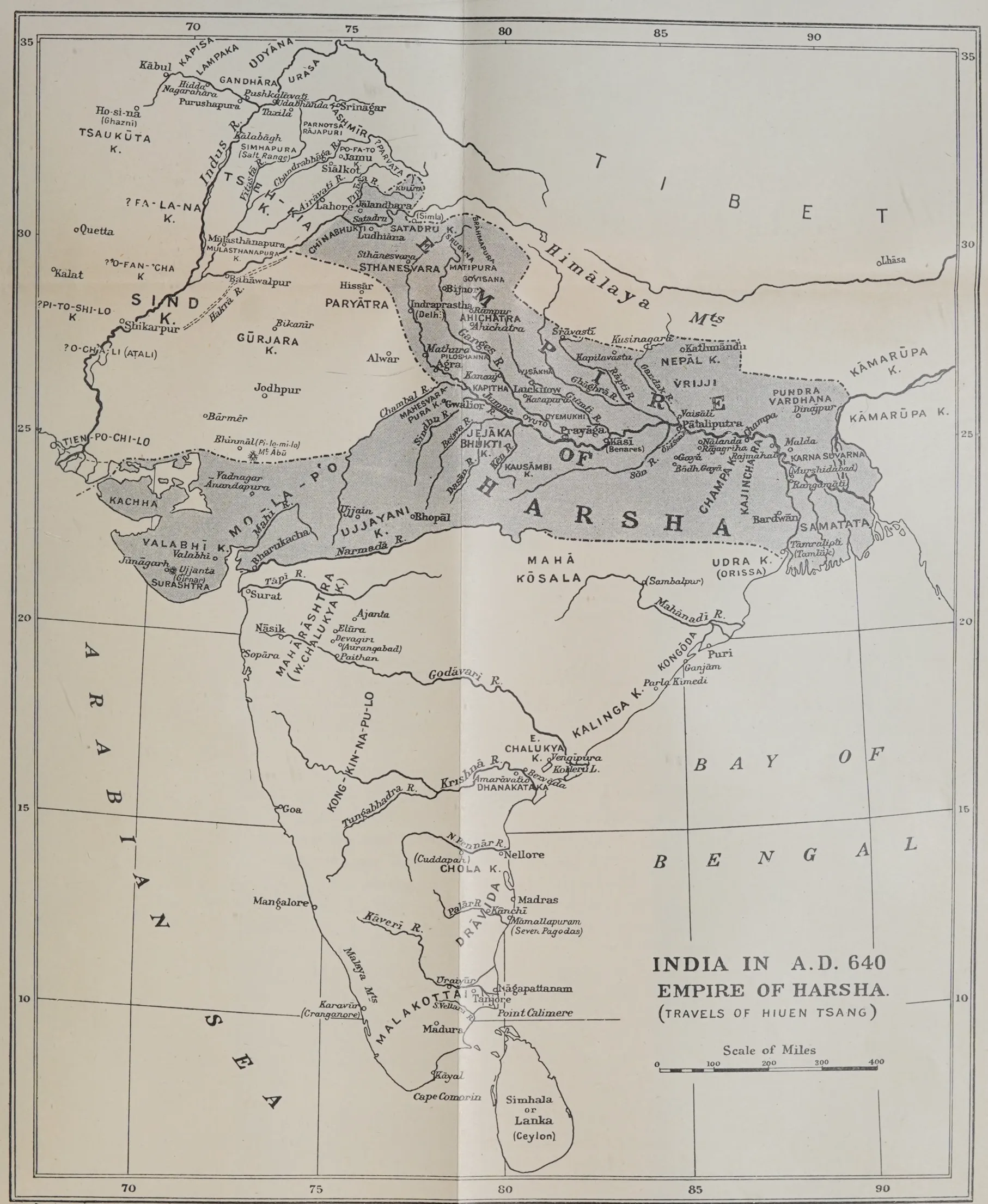
EMPIRE OF HARSHA.
(TRAVELS OF HIUEN TSANG)
Scale of Miles 0 100 200 300 400
B. V. Darbishire, Oxford, 1907
movable habitations of high Anglo-Indian officials, had not then been invented, and Harsha was obliged to be content with a ‘ travelling palace ’ made of boughs and reeds, which was erected at each halting-place, and burnt at his departure.1 He was accustomed to move in great state, being accompanied by several hundred drummers, who beat a note on golden drums for each step taken. No other king was allowed to use such ‘ music-pace drums ’.2
Hiuen Tsang, like his predecessor Fa-hien, more than two centuries earlier, was favourably impressed by the character of the civil administration, which he considered to be founded on benign principles. The principal source of revenue was the rent of the crown lands, amounting, in theory at all events, to one-sixth of the produce. The officials were remunerated by grants of land; compulsory labour upon public works was paid for; taxes were light; the personal services exacted from the subject were moderate in amount; and liberal provision was made for charity to various religious communities.
Violent crime was rare, but the roads and river routes evidently were less safe than in Fa-hien’s time, as Hiuen Tsang was stopped and robbed by brigands more than once. Imprisonment was now the ordinary penalty, and it was of the cruel Tibetan type; the prisoners, we are told, ‘ are simply left to live or die, and are not counted among men ’. The other punishments were more sanguinary than in the Gupta period: mutilation of the nose, ears, hands, or feet being inflicted as the penalty of serious offences, and even for failure in filial piety; but this penalty was sometimes commuted for banishment. Minor offences were visited with fines. Ordeals by water, fire, weighment, or poison were much esteemed as efficient instruments for the ascertainment of truth; and are described with approval by the Chinese pilgrim.
Official records of public events were kept in every province by special officers, whose duty it was to register ‘good and evil events, with calamities and fortunate occurrences’. Such records were, no doubt, consulted by the writers of the great historical inscriptions, but no specimen of them has survived.
Education evidently was diffused widely, especially among the Brahmans and numerous Buddhist monks; and learning was honoured by the government. King Harsha was not only a liberal patron of literary merit, but was himself an accomplished calligraphist and an author of reputation. Besides a grammatical work, three extant Sanskrit plays
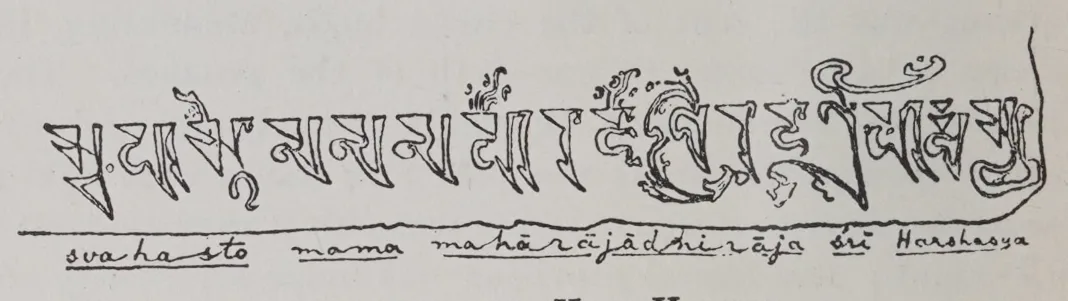
and sundry compositions in verse are ascribed to his pen; and there is no reason for hesitating to believe that he had at least a large share in their composition, for royal authors were not uncommon in ancient India. One of these plays, the Nāgānanda, which has an edifying Buddhist legend for its subject, is considered to rank among the best works of the Indian theatre; and the other dramas, the Ratnāvalī, or ‘Necklace’, and the Priyadarsikā, or ‘Gracious Lady’, although lacking in originality, are praised highly for their simplicity of both thought and expression.1
The greatest ornament of the literary circle at Harsha’s court was the Brahman Bāṇa, author of the historical romance devoted to a panegyrical account of the deeds of his patron, which is an amazingly clever, though irritating, performance; executed in the worst possible taste, and yet containing passages of admirable and vivid description. The man who attributes to the commander-in-chief, Skandagupta, 'a nose as long as his sovereign's pedigree,' may be fairly accused of having perpetrated the most grotesque simile in all literature. But the same man could do better, and shows no lack of power when depicting the deathagony of the king. 'Helplessness had taken him in hand: pain had made him its province, wasting its domain, lassitude its lair. . . . He was on the confines of doom, on the verge of the last gasp, at the outset of the Great Undertaking, at the portal of the Long Sleep, on the tip of death's tongue; broken in utterance, unhinged in mind, tortured in body, waning in life, babbling in speech, ceaseless in sighs; vanquished by yawning, swayed by suffering, in the bondage of wracking pains.' Such writing, although not in perfect good taste, unmistakably bears the stamp of power.1
One campaign had sated Asoka's thirst for blood; thirty-seven years of warfare, continuous for six years, and intermittent for the rest of the time, were needed by Harsha before he could be content to sheathe the sword. His last campaign was fought against the people of Ganjām (Kongōda) in a. d. 643, and then at last this king of many wars doffed his armour, and devoted himself for his few remaining years to the arts of peace and the practice of piety, as understood by an Indian despot. He obviously set himself to imitate Asoka, so that the narrative of the doings in the latter years of Harsha's reign reads like a copy of the history of the great Maurya.
At this period the king began to show marked favour to the quietist teachings of Buddhism, first in its Hīnayāna, and afterwards in its Mahāyāna form. He led the life of a devotee, enforcing the Buddhist prohibitions against the destruction of animal life with the utmost strictness and scant regard for the sanctity of human life. ‘He sought’, we are told, ‘to plant the tree of religious merit to such an extent that he forgot to sleep and eat’; and forbade the slaughter of any living thing, or the use of flesh as food throughout the ‘Five Indies’ under pain of death without hope of pardon.
Benevolent institutions on the Asokan model, for the benefit of travellers, the poor, and sick, were established throughout the empire. Rest-houses (dharmsālā) were built in both the towns and rural parts, and provided with food and drink, physicians being stationed at them to supply medicines to the necessitous without stint. The king also imitated his prototype in the foundation of numerous religious establishments, devoted to the service of both the Hindu gods and the Buddhist ritual. In his closing years the latter received the chief share of the royal favour; and numerous monasteries were erected, as well as several thousand stūpas, each about 100 feet high, built along the banks of the sacred Ganges. These latter structures doubtless were of a flimsy character, built chiefly of timber and bamboos, and so have left no trace; but the mere multiplication of stūpas, however perishable the materials might be, was always a work of merit. Although Buddhism was visibly waning in the days of Harsha and Hiuen Tsang, the monks of the order were still numerous, and the occupants of the monasteries enumerated by the pilgrim numbered nearly two hundred thousand.1 A monastic population of such magnitude offered abundant opportunities for the exercise of princely liberality.
The picture of the state of religious belief and practice in India during the seventh century, as drawn by the contemporary authors, is filled with curious and interesting details. The members of the royal family to which Harsha belonged freely acted on their individual preferences in the matter of religion. His remote ancestor, Pushyabhūti, is recorded to have entertained from boyhood an ardent devotion towards Siva, and to have turned away from all other gods. Harsha’s father was equally devoted to the worship of the Sun, and daily offered to that luminary ‘ a bunch of red lotuses set in a pure vessel of ruby, and tinged, like his own heart, with the same hue ’. The elder brother and sister of Harsha were convinced Buddhists, while Harsha himself distributed his devotions among the three deities of the family, Siva, the Sun, and Buddha ;1 and erected costly temples for the service of all three. But, in his latter years, the Buddhist doctrines held the chief place in his affections ; and the eloquence of the Chinese Master of the Law induced him to prefer the advanced teaching of the Mahāyāna sect to the more primitive Hīnayāna doctrine of the Sammitīya school with which he had been familiar previously.
The religious eclecticism of the royal family was the reflection and result of the state of popular religion at the time. Buddhism, although it had certainly lost the dominant position in the Gangetic plain which it had once held, was still a powerful force, and largely influenced the public mind. The Jain system, which had never been very widely spread or aggressive in the North, while retaining its hold on certain localities, especially at Vaisāli and in Eastern Bengal, could not pretend to rival the general popularity of either Buddhism or Purānic Hinduism. The last-named modification of the Hindu system was now firmly established, and the earlier Purānas were already revered as ancient and sacred writings. The bulk of the population in most provinces was then, as now, devoted to the service of the Purānic gods ; each man and woman being, of course, free to select a particular deity, Siva, the Sun, Vishnu, or another, for special adoration according to personal predilection. As a rule, the followers of the various religions lived peaceably together ; and no doubt many people besides the king sought to make certain of some divine support by doing honour to all the principal objects of popular worship in turn.
But, while toleration and concord were the rule, exceptions occurred. The king of Central Bengal, Śaśāṅka, who has been mentioned as the treacherous murderer of Harsha's brother, and probably was a scion of the Gupta dynasty, was a worshipper of Siva, hating Buddhism, which he did his best to extirpate. He dug up and burnt the holy Bodhi tree at Bōdh Gayā, on which, according to legend, Asoka had lavished inordinate devotion; broke the stone marked with the footprints of Buddha at Pātaliputra; destroyed the convents, and scattered the monks, carrying his persecutions to the foot of the Nepalese hills. These events, which are amply attested by the evidence of Hiuen Tsang, who visited the localities thirty or forty years later, must have happened about a. d. 600. The Bodhi tree was replanted after a short time by Pūrna-varman, the local Rāja of Magadha, who is described as being the last descendant of Asoka, and as such was specially bound to honour the object venerated by his great ancestor.
The details given by Hiuen Tsang and his biographer prove that at times bitter animosity marked the relations of the two great sections of the Buddhist church with one another; and that equal ill-feeling was evoked in the breasts of Purānic Hindus, when they beheld the royal favours lavished upon their Buddhist rivals. It is clear, therefore, that general statements concerning the perfect religious toleration enjoyed in ancient India can be accepted only with a certain amount of reservation. Official persecutions and popular ebullitions of sectarian rancour undoubtedly occurred from time to time, although they were not frequent.
Harsha himself sometimes offended against the principle of perfect religious toleration and equality. Like Akbar, and many other Indian sovereigns, he was fond of listening to the expositions of rival doctors, and heard with pleasure the arguments adduced by the learned Chinese traveller in favour of the Mahāyāna form of Buddhism, with the doctrines of which he does not seem to have been familiar. An interesting illustration of the comparative freedom of ancient Hindu society from the trammels of the system of female seclusion favoured by the Muhammadans, is afforded by the fact that his widowed sister sat by the king's side to hear the lecture by the Master of the Law, and frankly expressed the delight which she received from the discourse. One Chinese authority even asserts that Harsha administered the government in conjunction with her, as already noted.1
The king was determined that his favourite should not be defeated in controversy; and when opponents were invited to dispute the propositions of the Chinese scholar, the terms of the contest were not quite fair. Harsha, having heard a report that Hiuen Tsang's life was in danger at the hands of his theological rivals, issued a proclamation concluding with the announcement that
' if any one should touch or hurt the Master of the Law, he shall be forthwith executed; and whoever speaks against him, his tongue shall be cut out; but all those who desire to profit by his instructions, relying on my goodwill, need not fear this manifesto '.
The pilgrim's biographer naïvely adds that
' from this time the followers of error withdrew and disappeared, so that when eighteen days had passed, there had been no one to enter on the discussion '.2
King Harsha was so delighted with the discourse of Hiuen Tsang, whom he had met while in camp in Bengal, that he resolved to hold a special assembly at Kanauj, then his capital, for the purpose of giving the utmost publicity to the Master's teaching. The king marched along the southern bank of the Ganges, attended by an enormous multitude; his ally Kumāra, King of Kāmarūpa, with a large but less numerous following, keeping pace with him on the opposite bank. Advancing slowly in this way, Harsha, Kumāra, and the attendant host reached Kanauj in the course of ninety days, and there encamped, in February or March, a.d. 643.1 The sovereign was received by Kumāra, the Rāja of Kāmarūpa, who had accompanied him on the march, the Rāja of Valabhī in Western India, who was connected with him by marriage, and eighteen other tributary rājas; as well as by four thousand learned Buddhist monks, including a thousand from the Nālandā monastery in Bihār, and some three thousand Jains and orthodox Brahmans.
The centre of attraction was a great monastery and shrine specially erected upon the bank of the Ganges, where a golden image of Buddha, equal to the king in stature, was kept in a tower, 100 feet high. A similar but smaller image, 3 feet in height, was carried daily in solemn procession, escorted by the twenty rājas and a train of three hundred elephants. The canopy was borne by Harsha in person, attired as the god Sakra, while his ally, Rāja Kumāra, the most important of the princes in attendance, was clad as the god Brahmā, and had the honour of waving a white fly-whisk. The sovereign, as he moved along, scattered on every side pearls, golden flowers, and other precious substances, in honour of the 'Three Jewels'—Buddha, the Religion, and the Order; and, having with his own hands washed the image at the altar prepared for the purpose, bore it on his shoulder to the western tower, and there offered to it thousands of silken robes, embroidered with gems. Dinner was succeeded by a public disputation of the one-sided kind already described; and in the evening the monarch returned to his ‘travelling palace’, a mile distant.
These ceremonies, which lasted for many days, were terminated by startling incidents. The temporary monastery, which had been erected at vast cost, suddenly took fire, and was in great part destroyed; but when the king intervened in person, the flames were stayed, and pious hearts recognized a miracle.
Harsha, attended by his princely train, had ascended the great stūpa to survey the scene, and was coming down the steps, when a fanatic, armed with a dagger, rushed upon him and attempted to stab him. The assassin, having been captured instantly, was closely interrogated by the king in person, and confessed that he had been instigated to commit the crime by certain ‘heretics’, who resented the excessive royal favour shown to the Buddhists. Five hundred Brahmans of note were then arrested, and being ‘straitly questioned’, were induced to confess that, in order to gratify their jealousy, they had fired the tower by means of burning arrows, and had hoped to slay the king during the resulting confusion. This confession, no doubt extorted by torture, probably was wholly false; but, whether true or not, it was accepted, and on the strength of it the alleged principals in the plot were executed, and some five hundred Brahmans were sent into exile.
After the close of the proceedings at Kanauj, Harsha invited his Chinese guest to accompany him to Prayāga (Allāhābād), at the confluence of the Ganges and Jumna, to witness another imposing ceremonial. The Master of the Law, although anxious to start on his toilsome homeward journey, could not refuse the invitation, and accompanied his royal host to the scene of the intended display. Harsha explained that it had been his practice for thirty years past, in accordance with the custom of his ancestors, to hold a great quinquennial assembly on the sands where the rivers meet, and there to distribute his accumulated treasures to the poor and needy, as well as to the religious of all denominations. The present occasion (a. d. 643) was the sixth of the series, which evidently had not been begun until Harsha had consolidated his power in the north.
The assembly was attended by all the vassal kings and a vast concourse of humbler folk estimated to number half a million, including poor, orphans, and destitute persons, besides specially invited Brahmans and ascetics of every sect from all parts of Northern India. The proceedings lasted for seventy-five days, terminating apparently about the end of April, and were opened by an imposing procession of all the rājas with their retinues. The religious services were of the curiously eclectic kind characteristic of the times. On the first day, an image of Buddha was set up in one of the temporary thatched buildings upon the sands, and vast quantities of costly clothing and other articles of value were distributed. On the second and third days respectively the images of the Sun and Siva were similarly honoured, but the accompanying distribution in each case was only half the amount of that consecrated to Buddha. The fourth day was devoted to the bestowal of gifts on ten thousand selected religious persons of the Buddhist order, who each received one hundred gold coins, a pearl, and a cotton garment, besides choice food, drink, flowers, and perfumes. During the next following twenty days, the great multitude of Brahmans were the recipients of the royal bounty. They were succeeded by the people whom the Chinese author calls ‘heretics’, that is to say, Jains and members of sundry sects, who received gifts for the space of ten days. A like period was allotted for the bestowal of alms upon mendicants from distant regions; and a month was occupied in the distribution of charitable aid to poor, orphaned, and destitute persons.
‘By this time the accumulation of five years was exhausted. Except the horses, elephants, and military accoutrements, which were necessary for maintaining order and protecting the royal estate, nothing remained. Besides these the king freely gave away his gems and goods, his clothing and necklaces, ear-rings, bracelets, chaplets, neck-jewel and bright head-jewel, all these he freely gave without stint. All being given away, he begged from his sister [Rājyaśri] an ordinary second-hand garment, and having put it on, he paid worship to the "Buddhas of the ten regions", and rejoiced that his treasure had been bestowed in the field of religious merit.'
The strange assembly, which in general appearance must have much resembled the crowded fair still held annually on the same ground, then broke up; and, after a further detention of ten days, Hiuen Tsang was permitted to depart. The king and Kumāra Rāja offered him abundance of gold pieces and other precious things, none of which would he accept save a fur-lined cape, the gift of Kumāra. But although the Master of the Law uniformly declined gifts intended to serve his personal use, he did not disdain to accept money for the necessary expenses of his arduous journey overland to China. These were provided on a liberal scale by the grant of three thousand gold and ten thousand silver pieces carried on an elephant. A rāja named Udhita was placed in command of a mounted escort, and charged to conduct the pilgrim in safety to the frontier. In the course of about six months of leisurely progress interrupted by frequent halts, the rāja completed his task, and brought his sovereign's guest in safety to Jālandhar in the east of the Panjāb, where Hiuen Tsang stayed for a month. He then started with a fresh escort, and, penetrating with difficulty the defiles of the Salt Range, crossed the Indus, and ultimately reached his home in distant China by the route over the Pāmīrs and through Khotan, in the spring of a.d. 645.1
The pilgrim did not come home empty-handed. Notwithstanding losses on more than one occasion, due to accident or robbery, he succeeded in bringing safely a hundred and fifty particles of Buddha's bodily relics; sundry images of the Teacher in gold, silver, and sandal-wood; and no less than 657 distinct volumes of manuscripts, carried upon twenty horses. The rest of his life was mainly devoted to the work of translation, and he had completed the Chinese versions of seventy-four separate works when he brought his literary labours to a close in the year A. D. 661. He lived in peace and honour for three years longer, and then calmly passed away, leaving behind him a reputation for learning and piety surpassing that of any other Buddhist doctor.
The pages of Hiuen Tsang and his biographer give the latest information about King Harsha, who died either at the end of 646 or the beginning of 647, not long after his distinguished guest's departure.
During his lifetime he maintained diplomatic intercourse with the Chinese empire. A Brahman envoy, whom he had sent to the emperor of China in 641, returned in A. D. 643, accompanied by a Chinese mission bearing a reply to Harsha's dispatch. The mission remained for a considerable time in India, and did not go back to China until A. D. 645. The next year, Wang-hiuen-tse, who had been the second in command of the earlier embassy, was sent by his sovereign as head of a new Indian mission, with an escort of thirty horsemen. Early in A. D. 647, or possibly at the close of 646, King Harsha died, leaving no heir, and the withdrawal of his strong arm plunged the country into disorder, which was aggravated by famine.
Arjuna, or Arunāsva, a minister of the late king, usurped the throne, and took the field with 'barbarian' troops against the Chinese mission. The members of the escort were massacred, or taken prisoners, and the property of the mission, including the articles presented by Indian kings, was plundered; but the envoys, Wang-hiuen-tse and his colleague, were fortunate enough to escape into Nepāl by night.
The reigning king of Tibet, the famous Srong-tsan Gampo, who was married to a Chinese princess, succoured the fugitives, and supplied them with a force of twelve hundred picked soldiers supported by a Nepalese contingent of seven thousand horsemen, Nepāl at that time being subject to Tibet. With this small army Wang-hiuen-tse descended into the plains, and, after a three days' siege, succeeded in storming the chief city of Tirhūt. Three thousand of the garrison were beheaded, and ten thousand persons were drowned in the neighbouring river, perhaps the Bāgmatī. (?) Arjuna fled, and having collected a fresh force, offered battle. He was again disastrously defeated and taken prisoner. The victor promptly beheaded a thousand prisoners, and in a later action captured the entire royal family, took twelve thousand prisoners, and obtained more than thirty thousand head of horses and cattle. Five hundred and eighty walled towns made their submission during the course of the campaign, and Kumāra, the king of Eastern India, who had attended Harsha’s assemblies a few years earlier, sent in abundant supplies of cattle and accoutrements for the victorious army. Wang-hiuen-tse brought the usurper as a prisoner to China, and was promoted for his services. Afterwards, in a. d. 650, when the emperor T‘ai Tsung died and his mausoleum was erected, the approach to the building was adorned by statues, which included the effigies of the Tibetan king, Srong-tsan Gampo, and of the usurper, (?) Arjuna. Tirhūt apparently remained subject for some time to Tibet, which was then a powerful state, strong enough to defy the Chinese empire. Thus ended this strange episode, which, although known to antiquaries for many years, has hitherto escaped the notice of the historians of India.
Wang-hiuen-tse once more visited the scene of his adventures, being sent by imperial order in a. d. 657 to offer robes at the Buddhist holy places. He entered India through Nepāl, by the Lhāsa road, which was then open and used by many Buddhist pilgrims; and, after paying his respects at Vaisāli, Bōdh-Gayā, and other sacred spots, returned home through Kapisa, or Northern Afghanistan, by the Hindū Kush and Pāmīr route.1
The observations of Hiuen Tsang throw considerable light upon the political arrangements of India in the regions beyond the limits of Harsha's empire during the seventh century. In the north, Kashmīr had become the predominant power, and had reduced the kingdoms of Taxila and the Salt Range (Simhapura), as well as the minor principalities of the lower hills,1 to the rank of dependencies.
The greater part of the Panjāb between the Indus and the Biās rivers was comprised in the kingdom called Tseh-kia, or Chēh-ka, by the pilgrim, the capital of which was an unnamed city situated close to Sākala (Siālkot), where the tyrant Mihiragula had held his court. The province of Multān, where the Sun-god was held in special honour, and a country called Po-fa-to, probably Jamū, to the north-east of Multān, were dependencies of this kingdom.
Sind was remarkable for being under the government of a Buddhist king belonging to the Sūdra caste, and for the large number of Buddhist monks which the country supported, estimated at ten thousand. But the quality was not in proportion to the quantity; most of the ten thousand being denounced as idle fellows given over to self-indulgence and debauchery. The Indus delta, to which the pilgrim gives the name of 'O-tien-p'o-chi-lo, was a province of the kingdom of Sind.2
From other sources of information we learn that the kingdom of Sind, of which Balūchistan was a dependency, in those days was rich and powerful, far more populous and fertile than it is now. It occupied the whole valley of the Indus from the neighbourhood of the Salt Range to the sea, and was separated from India proper by the 'lost river', the Hakrā or Wahindah, the Sin-tu of Hiuen Tsang. The capital, to which the pilgrim gives the name of P'i-shan-p'opu-lo, was Arōr or Alōr, on the west bank of the Hakrā, a large fortified city, the ruins of which are still traceable 5 miles to the south-east of Rohri (Rūrhī) in the Sukkur (Sakhar) District, N. lat. 27° 39′, E. long. 68° 59′. According to a romantic legend, the ruin of the city was effected, about A. D. 800, by a merchant named Saif-ul-Mulūk, who diverted the waters of the river in order to save a beautiful girl from the clutches of a licentious rāja.
The Buddhist king of the Sūdra caste mentioned by the pilgrim must be Sihras Rāi, son of Dīwajī, who was succeeded by his son Sāhasī. During the reign of Sihras Rāi, the ever-victorious Arabs, then in the first flush of enthusiasm, entered Makrān (Balūchistan), and were met by Sihras Rāi, who was defeated and slain. Makrān was permanently occupied by the invaders late in A. D. 644, and about two years later, Sāhasī, who continued to oppose the foreign enemy, shared his father's fate. The sceptre then passed into the hands of a Brahman minister named Chach, who ruled for about forty years. Sind was invaded by the Arabs in A. D. 710–11 (A. H. 92), under the command of Muhammad, the son of Kāsim, who defeated and killed Dāhir, the son of Chach, in June, A.D. 712. From that date the ancient Hindu kingdom was extinguished, and the province passed permanently into Muslim hands.1
The kings of Ujjain and other kingdoms in Central India, which must have been more or less subject to Harsha's control, belonged to the Brahman caste. The Ujjain country supported a dense population, comprising few Buddhists. Most of the monasteries were in ruins, and only three or four, occupied by some three hundred monks, were in use. The early decay of Buddhism in this region, which was sanctified by the traditions of Asoka, and included the magnificent buildings at Sānchī, is a curious fact, at present unexplained.
Bhāskara-varman, or Kumāra Rāja, the King of Kāmarūpa, or Assam, who played such a prominent part in Harsha's ceremonials, also was described as being by caste a Brahman, and without faith in Buddha; although well disposed towards learned men of all religions. He was so far subject to the sovereign of Northern India, that he could not afford to disobey Harsha's commands.1
Kaliṅga, the conquest of which had cost Asoka such bitter remorse nine hundred years earlier, was depopulated, and mostly covered with jungle. The pilgrim observes in picturesque language that 'in old days the kingdom of Kaliṅga had a very dense population. Their shoulders rubbed one with the other, and the axles of their chariot wheels grided together, and when they raised their arm-sleeves a perfect tent was formed'. Legend sought to explain the change by the curse of an angry saint.
Hiuen Tsang's account of Kashmīr, Nepāl, and the kingdoms of the South and West will be noticed in due course in subsequent chapters.
Harsha's death loosened the bonds which restrained the disruptive forces always ready to operate in India, and allowed them to produce their natural result, a medley of petty states, with ever-varying boundaries, and engaged in unceasing internecine war. Such was India when first disclosed to European observation in the fourth century B.C., and such it always has been, except during the comparatively brief periods in which a vigorous central government has compelled the mutually repellent molecules of the body politic to check their gyrations and submit to the grasp of a superior controlling force.
The visitation of the Hun invasions had caused such suffering that the wholesome despotism of Harsha was recognized as a necessary remedy. When he died, the wounds inflicted by the fierce foreign savages had long been healed, while the freedom of the country from external attack relieved men's minds from feeling the necessity for a deliverer; and so India instantly reverted to her normal condition of anarchical autonomy.
Excepting the purely local incursions of the Arabs in Sind and Gujarāt during the eighth century, interior India was exempt from serious foreign aggression for nearly five hundred years, from the defeat of Mihiragula in a. d. 528 until the raids of Mahmūd of Ghazni at the beginning of the eleventh century, and was left free to work out her destiny in her own fashion.
In political institutions no evolution took place. No sovereign arose endowed with commanding abilities and capable of welding together the jarring members of the body politic, as Chandragupta Maurya, Asoka, and in a lesser degree the Gupta kings and Harsha of Kanauj had done. The nearest approach to the position of universal lord of Northern India was made by Mihira Bhoja of Kanauj (c. a. d. 840–90), but unluckily we know next to nothing about his character or administration. Even the heavy pressure of Muslim invasion failed to produce effective cohesion of the numberless Hindu States, which, one by one, fell an easy prey to fierce hordes of Arabs, Turks, and Afghans, bound together by stern fanaticism. Literature, although actively cultivated and liberally patronized at many local courts, sank far below the level attained by Kālidāsa. In mathematics, astronomy, or any other branch of science, little or no advance was made. Religion suffered a grave loss by the gradual extinction of Buddhism, which, in virtue of imperceptible changes, became merged in various Hindu sects. Only in Magadha and the neighbouring countries the religion of Gautama, under new forms, preserved a vigorous existence for four centuries (c. a. d. 780–1193), sustained by the support of Dharmapāla and his successors of the Pāla dynasty.
The art of sculpture, devoted in most places to the service of the Hindu gods, and in the Pāla dominions to that of modified Buddhism, was developed in diverse styles by many schools of artists. The aesthetic value of that abundant mediaeval sculpture is the subject of keen controversy, admirers seeing in it the highest achievement of Hindu genius, while other critics are repelled by its lack of restraint and its tendency to lapse into ugly grotesqueness. The paintings of mediaeval times, unfortunately, have disappeared utterly, so that it is impossible to judge whether pictorial skill advanced or declined. The art of coinage certainly decayed so decisively that not even one mediaeval coin deserves notice for its aesthetic merits.
But architecture was practised on a magnificent scale. Although most of the innumerable buildings erected were destroyed during the centuries of Muhammadan rule, even the small fraction surviving is enough to prove that the Hindu architects were able to plan with grandeur and to execute with a lavishness of detail which compels admiration while inviting hostile criticism by its excess of cloying ornament.
The three following chapters, which attempt to give an outline of the salient features in the bewildering annals of Indian petty states when left to their own devices for several centuries, may perhaps serve to give the reader a notion of what India always has been when released from the control of a supreme authority, and what she would be again, if the hand of the benevolent power which now safeguards her boundaries should be withdrawn.
CHRONOLOGY OF THE SEVENTH CENTURY
| A. D. | EVENT. |
|---|---|
| 600 | Hiuen Tsang, Chinese pilgrim, born. |
| c. 600 | Persecution of Buddhism by Śaśāṅka. |
| 605 | Rājya-vardhana, Rāja of Thānēsar, acc. |
| 606 | Harsha-vardhana, Rāja of Thānēsar, acc. |
| 606–12 | Conquest of Northern India by Harsha. |
| 608 | Pulakeśin II Chalukya, acc. |
| 609 | Pulakeśin II Chalukya, crowned. |
| Oct. 612 | Harsha crowned; his era established, as from 606. |
| 615 | Kubja Vishṇu-vardhana (Vishamasiddhi), viceroy of Vengī. |
| 618 | Kao-tsu, first T‘ang emperor of China, acc. |
| 619–20 | Ganjām inscription of Śaśāṅka. |
| c. 620 | Defeat of Harsha by Pulakeśin II Chalukya. |
| 622 | Muhammadan era of the Hijra or ‘flight’. |
| 627 | T‘ai Tsung, emperor of China, acc. |
| 628–9 | Banskhera inscription of Harsha. |
| 629 | Hiuen Tsang began his travels. |
| 629 | Accession of Srong-tsan-Gampo, king of Tibet. |
| 630–1 | Madhuban inscription of Harsha. |
| c. 635 | Conquest of Valabhī by Harsha. |
| 636 | Nestorian Christianity introduced into China by Alopen. |
| 641 | Harsha sent embassy to China; king Srong-tsan-Gampo of Tibet married Chinese princess Wen-cheng;1 Sassanian king Yezdegird defeated by the Arabs at Nahavend; Arab conquest of Egypt. |
| 642 | Death of Pulakeśin II Chalukya. |
| 643 | Harsha’s expedition to Ganjām; his meeting with Hiuen Tsang; Chinese mission of Li-I-piao and Wang-hiuen-t’se; Harsha’s assemblies at Kanauj and Prayāga; Hiuen Tsang started on return journey. |
| 645 | Arrival of Hiuen Tsang in China. |
| 646 | Dispatch of second mission of Wang-hiuen-t’se. |
| 647 | Death of Harsha. |
| 647–8 | Usurpation of (?) Arjuna and his defeat by Chinese, Nepalese, and Tibetans; publication of Hiuen Tsang’s Travels. |
| 649 | Death of T‘ai Tsung, emperor of China; Kao-tsung, acc. |
| 657 | Third mission of Wang-hiuen-t’se. |
| 661–5 | Greatest extension of Chinese dominions. |
| 664 | Death of Hiuen Tsang. |
| 670 | Defeat of Chinese by Tibetans. |
| 671 | I-tsing, Chinese pilgrim, began his travels. |
| 675–85 | I-tsing resided at Nālandā. |
| 691 | I-tsing composed his Record. |
| 695 | I-tsing returned to China. |
| c. 698 | Death of Srong-tsan-Gampo, king of Tibet. |
Notes
- 1. Sthāṇvīsvara, from Sthāṇu, a name of Śiva, locally used, and īśvara, 'lord' (Bāṇa). The name is also spelt Sthāneśvara, from sthāna, 'shrine', and īśvara.
- 1. The family genealogy is given in the inscriptions, viz. (1) Sonpat seal (Gupta Inscr., No. 52); (2) Banskhera copper-plate (Ep. Ind., iv, 208); (3) Madhuban copper-plate (ibid., i, 67). Mahāsena-guptā was the mother of Prabhā-kara-vardhana, who was also called Pratāpaśīla. His queen was Yaśomatī. Harsha’s full name was Harsha-vardhana. The coins found in the Fyzabad District, Oudh, bearing the names or titles Pratāpaśīla and Śīlāditya, appear to have been issued respectively by Prabhākara-vardhana and Harsha (Burn, J. R. A. S., 1906, p. 845). Hoernle has another theory (ibid., 1909, p. 446).
- 1. Doubts have been expressed as to the situation of the Mālwā (Mālava) referred to, which is quite uncertain. Tāranāth (Schiefner, p. 251) mentions a ‘Mālava in Prayāga’. Grahavarman may or may not have been lord of Kanauj. He was the son of Avantivarman, mentioned in an inscription from the Shāhābād District in South Bihār (Fleet, Gupta Inscr., p. 215).
- 2. Gauḍa (Bāṇa); probably identical with Karṇa-suvarṇa (Hiuen Tsang). The capital is supposed by Beveridge to have been at Rangāmāṭī, 12 miles south of Murshidābād (J.A.S.B., lxii, pt. i (1893), pp. 315–28). But Monmohan Chakravarti argues that more probably it was Lakshmaṇāvati (Lakhnauti or Gauṛ) (ibid., vol. iv, N.S. (1908), p. 281).
- 1. Watters, i, 345.
- 2. Kielhorn (Ind. Ant., xxvi, 32). Twenty inscriptions dated in the Harsha era are known (Ep. Ind., vol. v, App. Nos. 528–47). When Hiuen Tsang was with Harsha, in A. D. 643, the king's reign was reckoned as having lasted for more than thirty years (Records, i, 213; ‘lord of India for thirty years and more’, Life of Hiuen Tsang, p. 183). The quinquennial assembly in the spring of A. D. 643 was the sixth held in the reign (Beal, Life of Hiuen Tsang, p. 184). The period of five and a half years (Julien), or six years (Watters), spent in the preliminary subjugation of the north, is not included in this computation.
- 1. Ganjām copper-plate inscription, dated G. E. 300, A. D. 619–20 (Ep. Ind., vi, 143). Hluen Tsang refers to Śaśāṅka as a recent king, and mentions no successor.
- 2. In his general description of India, Hiuen Tsang tells how the general of an Indian army rode in a four-horsed chariot, protected by a body-guard (Beal, Records, i, 82).
- 1. The pilgrim’s statement that the king, after the subjugation of Northern India, completed in 612, ‘reigned in peace for thirty years without raising a weapon’, must not be interpreted literally, for as a matter of fact, the wars with Pulakēśin II and Valabhī occurred. ‘The text is Ch‘ui-san-shih-nien-ping-ko-pu-ch‘i. Here the word ch‘ui is employed, as frequently, to denote “don the imperial robe”, that is “to reign gently and happily”’ (Watters, i, 343, 346). Similar phrases are used as commonplaces in Sanskrit inscriptions.
- 2. ‘The five Gaudas or “five Indies”, viz. Svārasvata (the Panjāb), Kānyakuvja (Kānoja), Gauda (Bengal), Mithilā (Darbhāngā), and Utkala (Orissa) were formerly more allied to one another than they are now. We find the Bengalis to have been in close touch with the people of other parts of Āryāvarta. ‘The old Bengali poems were known by the common name of Panchāli. This word shows that we owe at least some forms of the old Bengali metres to Panchāla or Kānoja. ‘Svārasvata or the Panjāb gave us its Caka era, which was adopted by the Bengalis as it was by the people of other parts of India. ‘The civilization of Bengal—the new learning, especially that of logic, which made the tols of Nadia famous throughout India, came from Mithilā, when Magadha, its glorious days over, had ceased to give light to Eastern India. ‘With Kaliṅga or Orissa, Bengal in the past was inseparably associated. Our prophet Chaitanya Deva counts more votaries among the Uriyā people than in Bengal itself. So we find that the five Gaudas, as the five influential provinces of Āryāvarta were called, had in the past ages a greater touch with one another, and exchanged their thoughts and ideals more freely than now’ (Dinesh Chandra Sen, History of Bengali Language and Literature, Calcutta Univ., 1911).
- 3. Ma-twan-lin, the Chinese encyclopaedist (Max Müller, India, [p. 354] p. 287). Fleet’s date, 609 or 610, is impossible, Harsha being then engaged in the subjugation of Northern India.
- 1. Grant of Dadda of Bharōch (Ind. Ant., xiii, 70). The event is discussed by M. Ettinghausen in pp. 47–9 of his interesting monograph, Harsa Vardhana, empereur et poète de l’Inde septentrionale, a.d. 606–48; Louvain, 1906.
- 2. Sylvain Lévi and Ettinghausen (pp. 47, 184) deny the conquest of Nepāl by Harsha and the use of his era in that country; but, I think, without adequate reason. See Ind. Ant., xiii, 421; Kielhorn, List of Northern Inscriptions, Ep. Ind., vol. v, App. p. 75.
- 1. Beal, Records, ii, 193; Wat- | ling of the royal order of architecters, ii, 183. The kings of Burma | ture was erected in a day (Symes, in the eighteenth century followed | Embassy to Ava, i, 283, Constable). the same practice. A spacious and by no means uncomfortable dwel-
- 2. Beal, Life of Hiuen Tsiang, p. 173.
- 1. The facsimile of Harsha’s autograph is from the Banskhera inscription. Presumably it was engraved from a tracing of the original. Similar facsimile royal signatures frequently occur in Mysore inscriptions (A. S. Prog. Rep., 1911–12, para. 109, &c.). For the plays see Wilson, Hindu Theatre; Sylvain Lévi, Théâtre Indien; and Boyd’s translation of the Nāgānanda. For royal authors see Ind. Ant., xx, 201. Ettinghausen discusses the literary history of Harsha’s reign in chapter iii of his work.
- 1. The translation of Bāṇa's lished by the Royal Asiatic Society work by Dr. F. W. Thomas and in 1897, is a triumph of skill. the late Professor Cowell, pub-
- 1. J. R. A. S., 1891, pp. 418–21.
- 1. It is, of course, not strictly accurate to describe Buddha as a deity ; but, when the Buddhism of the seventh century is in question, the inaccuracy is little more than formal.
- 1. The Fang-chih (Watters, i, 345).
- 2. Beal, Life of Hiuen Tsiang, p. 180. In the second edition, a legend related by Tāranāth (Schiefner, p. 128) concerning a certain king named Śrī Harsha, was erroneously applied to Harsha of Kanauj. The historian states that Śrī Harsha enticed 12,000 followers of outlandish religions to assemble in a wooden building, where he burnt them all alive with their books, and so reduced the religion of the Persians and Śakas to very narrow limits for nearly a century. This atrocity is said to have taken place near Multān. Tāranāth adds that Śrī Harsha, in order to atone for his sins, built four great monasteries severally situated in Maru (Mārwāṛ), Mālava, Mewāṛ, Pituva, and Chitavara, in each of which 1,000 monks were maintained. I cannot identify Pituva or Chitavara, nor can I determine the date; but it is clear that Śrī Harsha must have been a chief in Rājputāna, probably of Mārwāṛ, the first country named. The sixth century seems to be indicated as the time. Harsha was born in Mārwāṛ, and ruled all the kingdoms of the west (ibid., p. 126). Ettinghausen (Harśa Vardhana, p. 84), who also erroneously identified the Śrī Harsha of Mārwāṛ with Harsha of Kanauj, cites Ceylonese versions of the story of the burning. I have not yet found a Rāja Harsha in the Rājputāna lists, but there was a town called Harshapura in Mewāṛ (Ind. Ant., 1910, p. 187), which may have been named after the hero of Tāranāth's story.
- 1. 'It was now the second month of springtime' (Beal, Records, i, 218).
- 1. 'Yuan-chuang returned to China, and arrived at Ch'ang-an in the beginning of 645, the nineteenth year of T'ang T'ai Tsung' (Watters, i, 11). See map and itinerary appended to vol. ii of Watters's work.
- 1. The story of Wang-hiuen-t’se is fully related in Sylvain Lévi’s article, ‘Les Missions de Wang-Hiuen-T’se dans l’Inde’ (J. As., 1900), which has been translated in Ind. Ant., 1911, pp. 111 seqq. The name of the usurper appears in the Chinese text as Na-fū-ti O-lo-na-shuen, which may represent either Arjuna or Aruṇāśva. Lt.-Col. Waddell’s valuable article ‘Tibetan Invasion of India in a. d. 647 and its Results’ (As. Qu. Rev., Jan., 1911), emphasizes the [p. 368] true position of Tibet at that time, and corrects the date of Harsha's death.
- 1. Uraśā, or Hazāra; Parnōtsa, or Punach; Rājapuri, or Rajauri, the ancient Abhisāra.
- 2. The proper Indian equivalents of Tseh-kia, Po-fa-to, and 'O-tienp'o-chi-lo are not known with any approach to certainty. See map. Many stūpas and other Buddhist remains in Sind, hitherto overlooked, are now coming to light (A. S. W. I., Prog. Rep., 1909–10, p. 40).
- 1. Raverty, Notes on Afghanistan, pp. 566–70, 663 ; J. A. S. B., part i (1902), pp. 233, 239, 251 ; Elliot, Hist. of India, vol. i, Note B, p. 405. Raverty's statements are more accurate than those of Elliot, which contain many errors. The name which Elliot (p. 405) reads as ‘ Kanauj ’ really is Kinnauj, a dependency of Multān.
- 1. An undated copperplate inscription of Bhāskara-varman has been described in Ind. Ant., 1914, p. 25, and edited with facsimiles by Radha Govinda Basak in Ep. Ind., xii, 65–79. He believes that at first Bhāskara was in terror of Śaśāṅka, but when Śaśāṅka died later than 619, his kingdom passed into the hands of Harsha. Bhāskaravarman may have obtained Karṇa-suvarṇa in Bengal, whence the copperplate was issued, after the defeat of the usurper.
- 1. Date of marriage according to Waddell and Sarat Chandra Dās.