K. A. Nilakanta Sastri
1892 - 1975
Tirunelveli, Tamil Nadu
Biography
Kallidaikurichi Aiyah Nilakanta Sastri stands as one of the most distinguished historians of modern India and the preeminent authority on South Indian history. Born in 1892 in Tirunelveli district to a Telugu Niyogi family, Sastri dedicated his life to rigorous historical scholarship, producing works that continue to serve as standard references decades after their publication.
Academic Career
After completing his Master’s degree at Madras Christian College in 1913, Sastri began his teaching career at Hindu College, Tirunelveli. His brilliance soon earned him positions at India’s premier institutions: Banaras Hindu University (1920-1922), Madras University (1922-1946), and University of Mysore (1952-1955). From 1957 to 1972, he directed UNESCO’s Institute of Traditional Cultures of South East Asia, where he fostered international scholarship on Asian civilizations.
Scholarly Contributions
Sastri’s scholarship was characterized by meticulous research, command over multiple languages (including Sanskrit, Tamil, Telugu, and English), and an exceptional ability to synthesize diverse sources. His major works include:
A History of South India (1955) - Regarded as a classic that “retains its importance and has never quite been replaced,” this comprehensive work traces South Indian history from prehistoric times through the fall of Vijayanagar.
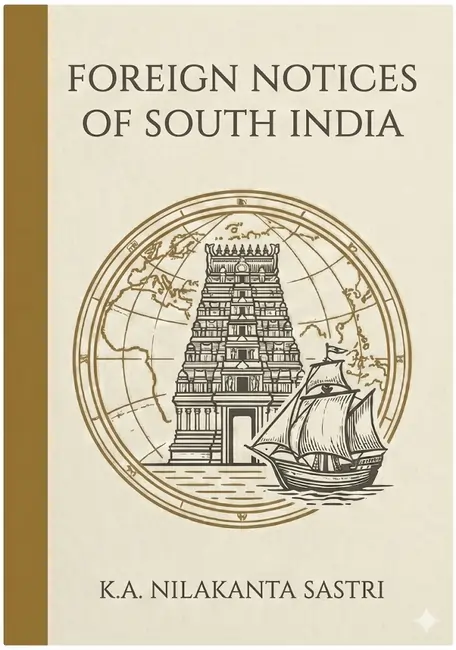
Foreign Notices of South India (1939) - A seminal source-book compiling accounts by Greek, Roman, Chinese, Arab, Persian, and European travelers from ancient to medieval times, making previously scattered sources accessible to scholars.
The Colas (1935) - A definitive study of the Chola dynasty, one of South India’s greatest empires.
An Advanced History of India (co-authored with R.C. Majumdar and H.C. Raychaudhuri) - A standard university text that shaped the study of Indian history for generations.
Studies in Cola History and Administration - Detailed examinations of administrative systems and historical developments during the Chola period.
Methodology and Approach
Sastri pioneered the use of epigraphy, numismatics, and foreign sources alongside traditional textual materials. His work in Foreign Notices exemplifies this approach—he painstakingly gathered and translated excerpts from works in multiple languages, providing scholarly context and explanatory notes that made complex historical materials accessible. His editorial rigor and commitment to primary sources set new standards for historical scholarship in India.
Recognition and Legacy
In 1957, Sastri was honored with the Padma Bhushan for his outstanding contributions to history and Indology. His students and successors carried his methods forward, establishing robust traditions of historical research at major Indian universities.
Nilakanta Sastri is remembered not only for his prodigious output—over 25 books and numerous articles—but for establishing South Indian history as a serious field of academic inquiry. His work demonstrated that regional histories possessed depth, complexity, and significance equal to any national or imperial narrative. For anyone studying the history of South India, Sri Lanka, or Southeast Asian cultural connections, Sastri’s works remain indispensable starting points.
He passed away on June 15, 1975, in Madras, leaving behind a scholarly legacy that continues to illuminate the rich historical heritage of South India.
Timeline
Born in Tirunelveli
Born on August 12 into a Telugu Niyogi family in Tirunelveli district
Master's Degree
Secured MA degree from Madras Christian College
Professor at Banaras Hindu University
Appointed History professor at the newly-inaugurated BHU
Professor at University of Madras
Succeeded S. Krishnaswamy Aiyangar as Professor of History and Archaeology at Madras University, serving until 1946
Foreign Notices of South India
Published comprehensive source-book compiling foreign accounts of South India from ancient to medieval times
Professor at University of Mysore
Served as Professor of Indology at University of Mysore until 1955
Padma Bhushan Award
Awarded India's third highest civilian honour for his contributions to history and Indology
UNESCO Director
Appointed Director of UNESCO's Institute of Traditional Cultures of South East Asia, serving until 1972
Visiting Professor at Chicago
Delivered series of lectures on South Indian History at University of Chicago
Passing
Died on June 15 in Madras, leaving behind an unparalleled scholarly legacy