Making India’s forgotten books readable again.
Travellers’ roads and the Company’s ledgers, famine commissions and village life, Vedic hymns and letters to a friend. Long out of print, now set to be read, and free to all.
It opens with Buchanan’s A Journey from Madras, 1807. Or browse all sixty-six books, or read why Akshara exists.
New on the shelves
The libraryThe featured edition
Akshara No. 19A Journey from Madras through the Countries of Mysore, Canara, and Malabar
Francis Buchanan · London, 1807 · three volumes
“In the afternoon of the 23d April 1800, I set out from Madras, in the very hot dry weather, which usually prevails at this season.”
Seringapatam had fallen the year before. The Company sent Buchanan, a Scottish physician, through Mysore, Canara and Malabar to write down how the country lived: its crops and wells, its mills and looms, its weights, coins and rents. This is his journal of the road, with the engravings made from his drawings.
Small things from the books
All 25 platesEngravings, woodcuts and devices printed in these books, each cleaned from its own page and printed in the ink of its shelf. Each one opens the book it came from.
How a book is made
The methodFrom the camera’s photographs to a page that can be trusted. The hardest part of an old book is often its figures, so here is one of its tables, photographed and set.
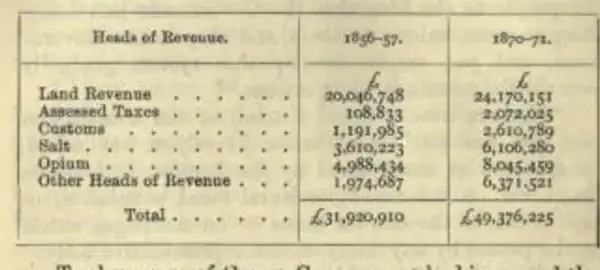
| Heads of Revenue. | 1856–57. | 1870–71. |
|---|---|---|
| Land Revenue | £20,046,748 | £24,170,151 |
| Assessed Taxes | 108,833 | 2,072,025 |
| Customs | 1,191,985 | 2,610,789 |
| Salt | 3,610,223 | 6,106,280 |
| Opium | 4,988,434 | 8,045,459 |
| Other Heads of Revenue | 1,974,687 | 6,371,521 |
| Total | £31,920,910 | £49,376,225 |
From Romesh Chunder Dutt, The Economic History of India in the Victorian Age, 1904. Every table is given with its book as CSV, as printed and in tidy form.
The photographs
The PDFs on the Internet Archive are compressed, and compression can turn one digit into another. Akshara goes back to the camera’s own photographs of each page and rebuilds a clean copy before a word is read.
The reading
A vision model reads each page as it was printed: old spellings, accents and italics kept, footnotes followed across pages, shoulder notes kept beside the paragraph they belong to.
The figures
Every table in rupees, annas and pies, or in pounds, shillings and pence, is added up again by program, and each printed total is read a second time on its own.
The proof
Nothing read by machine is passed off as proofread. Each edition says how far it has been checked, and any reader can open a page beside its scan and set it right.
The eight shelves
The whole libraryThe library is arranged as a reader would arrange it, by the kind of book. Each shelf is introduced by a sentence from one of its own books.
Literature and Letters
Seven books, 1862–1921I wonder what I should do without your dear letters; there would be such a gap in my everyday life, if I did not receive them.
Village and Society
Three books, 1891–1903A cluster of trees, consisting of the tamarind, mango, cocoanut, plantain, and other useful Indian trees; a group of dwellings, some thatched and some tiled; a small temple in the centre.
Travel and Chronicles
Eight books, 1862–1924We who are closet students of Indian history can deal only with old paper, with MS. records of the past; we can touch only the exterior of the Mughal system.
Classical and Philology
Five books, 1883–1915Even at the present moment, after a century of English rule and English teaching, I believe that Sanskrit is more widely understood in India than Latin was in Europe at the time of Dante.
Maritime and Company Records
Seventeen books, 1893–1925The growth of civilization in India created an active merchant marine, trading to the Euphrates and Africa, and eastward we know not whither.
Political Economy
Ten books, 1832–1917In their prosperity will be our strength, in their contentment our security, and in their gratitude our best reward.
Surveys and Gazetteers
Eleven books, 1807–1918In good sooth, my masters, this is no door. Yet is it a little window, that looketh upon a great world.
Currency and Finance
Five books, 1881–1922The Punjab is an agricultural province, a land of peasant proprietors, a large and annually increasing portion of whom are sinking into the position of serfs to the money-lenders.